
Search for decays of stopped, long lived particles from 7 TeV pp collisions with the ATLAS detector
23
0
0
Texto completo
(2) 2. ray muons, beam-related backgrounds and instrumental noise. Similar searches for out-of-time decays have previously been performed by other experiments [9,10]. This analysis complements previous ATLAS searches for long-lived particles [11,12] which are less sensitive to particles with initial β ≪ 1. By relying primarily on calorimetric measurements, this analysis is also sensitive to events where R-hadron charge-flipping may make reconstruction in the inner tracker and the muon system impossible. A potential detection of stopped R-hadrons could also lead to a measurement of their lifetime and decay properties. Moreover, the search is sensitive to any potential new physics scenario producing large out-of-time energy deposits in the calorimeter with minimal additional detector activity. The data analysed in this Letter were recorded by the ATLAS experiment between April and November 2010, exploiting proton-proton collisions at a centre-of-mass energy of 7 TeV.. discussed in Section 7. The inputs to the jet algorithm described in this paper are calorimeter energy deposits. Jet energy is quoted without applying a hadronic calibration; only jets with energy above 10 GeV are considered in this search. ATLAS jet reconstruction algorithms are described in more detail elsewhere [15]. 3 LHC bunch structure and trigger strategy. The LHC accelerates two counter-rotating proton beams, each divided into 3564 25 ns bunch slots. When protons are injected into the LHC not every slot is filled. In late 2010 running, slots that were filled typically had 1011 protons. Unfilled slots could contain protons due to diffusion from filled slots, but this was typically below 5 × 10⁸ protons per slot. The filled and unfilled slots can be combined to make three different “bunch crossing” scenarios. A paired crossing consists of a filled bunch from each beam colliding in ATLAS and is by far the most likely to produce R-hadrons. An unpaired crossing has a filled bunch from 2 The ATLAS detector one beam and an unfilled slot from the other. Finally, in an empty crossing the slots from both beams are unThe ATLAS detector [13] consists of an inner trackfilled. Empty crossings typically had a proton-proton ing system (ID) surrounded by a thin superconductcollision rate less than one-millionth the rate in paired ing solenoid, electromagnetic and hadronic calorimecrossings[16]. In the search sample, described in Secters and a muon spectrometer (MS). The ID consists tion 5, there are approximately 350 paired bunch crossof pixel and silicon microstrip detectors, surrounded by ings organized in groups of eight. Inside a group, paired a transition radiation tracker. The calorimeter system is bunch crossings occurred every 150 ns or longer, while based on two active media for the electromagnetic and the gaps between groups are longer. Most ATLAS analhadronic calorimeters: liquid argon (LAr) in the inner yses use data collected from the paired crossings; this and forward regions, and scintillator-tiles (TileCal) in analysis instead searches for physics signatures of LLPs the outer barrel region. The absorber materials are lead in the empty crossings. This is accomplished with a set and either steel, copper, or tungsten. The calorimeters of dedicated low-threshold calorimeter triggers which are segmented in cells which have typical size 0.1 by 0.1 may fire only in the empty or unpaired crossings where in η-φ space3 in the TileCal section. The MS, capable the background to this search is much lower. of reconstructing tracks within |η| < 2.7, uses toroidal ATLAS has a three-level trigger system consisting of bending fields generated by three large superconducting one hardware and two software levels [17]. Signal canmagnet systems. didates for this analysis are collected using a hardware Jets are constructed using the anti-kt jet algorithm [14] trigger requiring localised calorimeter activity with a with a radius parameter (in η-φ space) set to R = 0.4, 10 GeV transverse energy threshold. This trigger could which assumes the energetic particles originated from fire only during an empty crossing at least 125 ns afnominal interaction point. This assumption, while inter the most recent paired bunch crossing. By waiting correct, still accurately quantifies the energy released to collect data only during the empty crossings many from the stopped R-hadron decays occurring in the signal decays are lost; however, this provides a sample calorimeter; the associated systematic uncertainty is nearly free of all collision backgrounds. Although the R-hadrons decay at a time randomly distributed with 3 ATLAS uses a right-handed coordinate system with its orirespect to the bunch-crossing clock (which has a 25 ns gin at the nominal interaction point (IP) in the centre of period), this does not cause any loss of efficiency as the the detector and the z-axis along the beam pipe. The x-axis points from the IP to the centre of the LHC ring, and the calorimeter response is longer than 25 ns. A sideband y-axis points upward. Cylindrical coordinates (r, φ) are used region to study beam-halo muons is collected with a in the transverse plane, φ being the azimuthal angle around similar trigger that fired in the unpaired crossings. Both the beam pipe. The pseudorapidity is defined in terms of the samples are collected with only a hardware-level trigger polar angle θ as η = − ln tan(θ/2)..
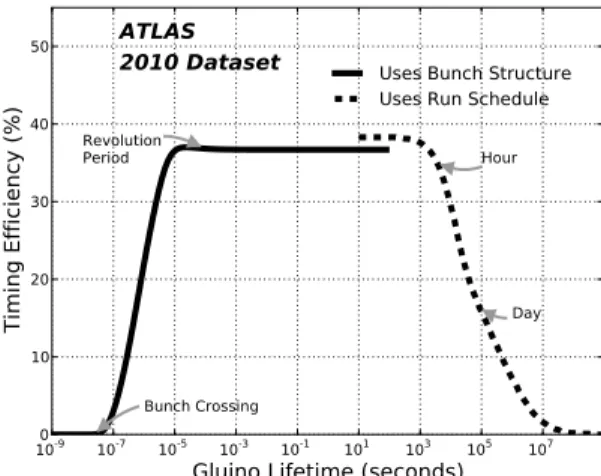
(3) 3. and without further requirement at the higher trigger levels.. Regge : Only one (electrically neutral) baryonic state is allowed. The scattering model employs a tripleRegge formalism. This is expected to result in a lower stopping fraction than the Generic scenario.. 4 Simulation of R-hadrons. If an R-hadron comes to rest in ATLAS, its location is recorded. Table 1 shows the probability for an R-hadron to stop as a function of the generated gluino mass for the two models considered. The stopping fraction shows no significant dependence on the gluino mass within the available simulation statistics. These stopping locations are used as input into a second step of Pythia where the decays of the Rhadrons are simulated. Different models allow the gluinos to decay via the radiative process, g̃ → g χ̃01 , or via g̃ → q q̄ χ̃01 . The reconstruction efficiencies are comparable for both decay modes however, the results are interpreted assuming a 100% branching ratio to g χ̃01 in accordance with previous results [9,10]. In all simulations the neutralino mass, mχ̃01 , is fixed to 100 GeV. Interactions of the decay products with the detector are simulated with Geant4. These events then follow the standard ATLAS reconstruction which outputs signal candidates.. Table 1 Signal Monte Carlo stopping fractions for various gluino mass values with their statistical uncertainties. Each efficiency is the number of R-hadrons that stop anywhere in the detector divided by the number of produced R-hadrons events. Some R-hadrons stop in parts of the detector where there is little sensitivity to detect their decay. This is accounted for in the reconstruction efficiency in Table 2. mg̃ (GeV) 200 300 400 500 600. Generic (%). Regge (%). 11.5±0.7 13.1±0.7 12.4±0.7 13.2±0.7 11.8±0.7. 5.7±0.5 4.7±0.5 6.5±0.5 4.5±0.5 5.6±0.5. To compensate for the fact that R-hadron scattering is not strongly constrained by SM analogues, the simulation of R-hadron interactions in matter is handled by a special detector response simulation [20] using Geant4 [21,22] routines based on two rather different scattering models with different sets of assumptions: the Generic [20,23] and Regge [24,25] models. Each model makes different assumptions about the R-hadron nuclear cross-section and mass spectra of various internal states. Briefly, the phenomenologies of the two models are described as follows: Generic : Limited constraints on allowed stable states permit the occurrence of doubly charged R-hadrons and a wide variety of charge-exchange scenarios. The scattering model is purely phase space driven. This model is chosen as the nominal signal model for gluino R-hadrons.. 50. Timing Efficiency (%). Monte Carlo simulations are used primarily to determine the reconstruction efficiency and stopping fraction of the R-hadrons, and to study associated systematic uncertainties on the quantities used in the selections. The simulated samples have gluino masses in the range 200–600 GeV, to which the present analysis is sensitive. Furthermore, a detailed simulation incorporating gluino generation, stopping and decay steps provides a modular approach for signal production. The Pythia program [18] is used to simulate gluino-gluino pair production events. The string hadronisation model [19], incorporating specialised hadronisation routines [5] for Rhadrons, is used inside Pythia to produce final states containing two R-hadrons.. 40. ATLAS 2010 Dataset. Uses Bunch Structure Uses Run Schedule. Revolution Period. Hour. 30. 20 Day. 10 0 10-9. Bunch Crossing 10-7. 10-5. 10-3. 10-1. 101. 103. Gluino Lifetime (seconds). 105. 107. Fig. 1 Percentage timing efficiency as a function of gluino lifetime. The region 10−5 to 103 seconds has the highest efficiency, approximately 37%. For shorter lifetimes many Rhadrons decay in paired bunch crossings while for longer lifetimes many decay when ATLAS is not taking data. The solid line is calculated with the assumption that no R-hadron survived from one run to the next (allowing a per run analysis for shorter lifetimes). The dashed line is calculated after averaging over bunch structure but does allow R-hadrons to decay in a run they are not produced in.. An additional inefficiency arises because only a fraction of the stopped R-hadrons decay in an empty crossing, while ATLAS is taking data. This inefficiency is a function of the gluino lifetime, and is calculated from.
(4) 4. a detailed knowledge of the bunch structure across different LHC fills (relevant for short lifetimes) and the ATLAS data acquisition schedule (relevant for long lifetimes). The timing efficiency versus lifetime is shown in Figure 1; the plateau corresponds to 37% efficiency for lifetimes from 10−5 to 103 seconds. These lifetimes are long enough to survive until an isolated empty crossing which may be many microseconds after the production event. However, these lifetimes are short enough so that most of the R-hadrons do not decay outside of an ATLAS data-taking run, which is typically ten to twenty hours.. 6 Candidate selection. In addition to the signal candidates, several background processes survive the trigger: beam-halo muons, protonproton collisions, proton-gas collisions, calorimeter noise and cosmic ray muons. The first three of these processes arise from the non-zero proton population in the empty bunches, as described in Section 3. Beam-halo muons are produced when a stray 3.5 TeV proton collides with a collimator or residual gas many metres away from ATLAS. The subsequent shower decays or is blocked by shielding, but occasionally a muon survives to traverse the detector. The search and sideband samples are divided into two exclusive channels based on the number of recon5 Data samples structed jets with energy over 10 GeV, Njets . Lower energy R-hadron decays tend to be reconstructed as a sinAs discussed in Section 3, data are collected with calorimetergle jet, but very energetic ones may be reconstructed as based triggers in the empty and unpaired crossings. To multiple jets due to their larger spatial extent. The two construct two sidebands and a signal search sample, the channels, denoted single jet and multi-jet, differ primardata from empty bunch crossings are separated into ily in their respective noise rejection criteria, labelled as early, middle and late 2010 subsets, respectively. The “jet cleaning”. Without requirements on a second jet total integrated luminosity in paired crossings concur−1 to reject background, the single jet channel, Njets = 1, rent with these three empty-crossing samples is 34 pb uses a more demanding calorimeter selection. Selection [16]. Each sample has a different signal to background criteria described below that are not specifically menratio due to the rapidly increasing instantaneous lumitioned in the event yield summary (Table 2) fall under nosity of the LHC during 2010. the jet cleaning label for either the single or multi-jet To predict the number of cosmic ray muons—the channel. dominant background—both the amount of time and varying number of empty bunches per beam revolution in each data-taking run must be accounted for. The trigger live-time (in units of crossing-hours) is quantified by taking the product of the number of hours the trigger is active and the number of empty bunch crossings per beam revolution in that LHC filling scheme. The first data sample, the background sample, had low beam current and corresponds to a trigger live-time of 1.07×10⁶ crossing-hours and 0.26 pb−1 of integrated luminosity; it is used to estimate the background from cosmic ray muons. A second sample, the control sample, corresponds to 0.55×10⁶ crossing-hours, and an integrated luminosity of 2.6 pb−1 . This sample has different beam conditions, and acts as a cross-check for the cosmic ray muon background estimate. The signal search is performed in the search sample, which corresponds to 0.32×10⁶ crossing-hours. Data collected in the search sample reflect an integrated luminosity of 31 pb−1 with a peak instantaneous luminosity of approximately 2.1×1032 cm−2 s−1 . The probability of producing an R-hadron in either the background or control sample is small compared to the search sample. Finally a small sample from the unpaired crossings is used to quantify the background induced by beamhalo muons.. 6.1 Criteria common to both channels All events in the three empty-crossing data samples, described in Section 5, must pass basic beam, detector and data quality requirements. Events with proton-proton collisions or proton-gas collisions, which happen at a very low rate in empty crossings, are rejected by requiring no reconstructed tracks in the ID. Additionally, events where the missing transverse momentum is less than half of the leading jet transverse momentum are vetoed. The criterion on missing transverse momentum removes the rare collision events since they tend to produce jets with balanced transverse momentum. A signal event, however, produces only one localised energy deposit, since even if both R-hadrons stop in the detector they are likely to decay at times separated by more than 25 ns. The trigger system would identify these decays as separate events because its timing resolution is significantly smaller than 25 ns. To reduce the contribution from calorimeter noise, the most energetic jet must have an energy greater than 50 GeV, and be in the central region (|η| < 2.2). Furthermore, n90 , the minimum number of calorimeter cells.
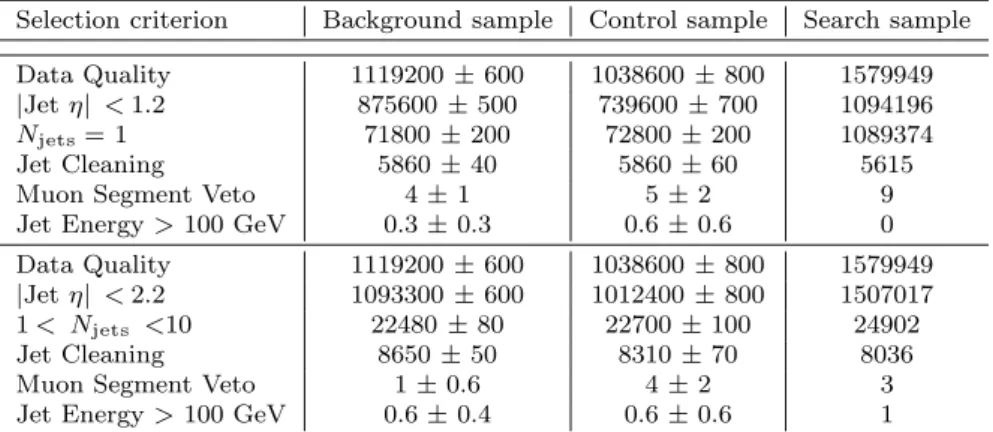
(5) 5 Table 2 Event yield at various levels of the selection for the single jet (top) and multi-jet (bottom) channels. The yields of the background and control samples are scaled by detector live-time to the search sample. The background and control samples agree well in the bottom three rows for both channels, showing the live-time scaling works after detector noise is removed (via jet cleaning). Agreement is not expected before jet cleaning due to the sporadic nature of calorimeter noise across 2010. Since the rate of beam-halo muons scales with beam current it only contributes significantly to the search sample as discussed in Section 8. Only statistical uncertainties are shown in the table. Selection criterion. Background sample. Control sample. Search sample. Data Quality |Jet η| < 1.2 Njets = 1 Jet Cleaning Muon Segment Veto Jet Energy > 100 GeV. 1119200 ± 600 875600 ± 500 71800 ± 200 5860 ± 40 4±1 0.3 ± 0.3. 1038600 ± 800 739600 ± 700 72800 ± 200 5860 ± 60 5±2 0.6 ± 0.6. 1579949 1094196 1089374 5615 9 0. Data Quality |Jet η| < 2.2 1 < Njets <10 Jet Cleaning Muon Segment Veto Jet Energy > 100 GeV. 1119200 ± 600 1093300 ± 600 22480 ± 80 8650 ± 50 1 ± 0.6 0.6 ± 0.4. 1038600 ± 800 1012400 ± 800 22700 ± 100 8310 ± 70 4±2 0.6 ± 0.6. 1579949 1507017 24902 8036 3 1. that collectively contain 90% of the jet energy, must be greater than three. Cosmic ray and beam-halo muons are vetoed by requiring the absence of a muon segment anywhere in the MS. A muon segment is formed when there is correlated activity in a single detector station of the MS, and serves as input to more sophisticated track finding algorithms. This presents the common selection in the different jet channels and is used to study the data sample. In the final search only events with leading jet energy over 100 GeV are considered. This threshold optimises the search reach while maintaining sensitivity to lighter gluino models.. 6.2 Single jet criteria To remove effects from the noisier calorimeter endcaps, the leading jet must be well within the barrel region (|η| < 1.2). Jets must have at least half of their energy in the TileCal (fTile > 50%) to reject beam-halo muons, which occur more frequently closer to the beam pipe. The energy weighted transverse size of the jet, in η−φ space, must be greater than 0.04.. 6.3 Multi-jet criteria The requirement of a second jet in the multi-jet channel, 1 < Njets < 10, strongly suppresses the noise and beam-halo contributions, allowing for looser jet cleaning cuts. The energy of the sub-leading jet must be at least 15 GeV to ensure it is well reconstructed; requiring Njets < 10 vetoes several events with bursts of calorimeter noise. In this channel, there is no jet transverse size. requirement; however, one of the two leading jets must have fTile > 10%.. 6.4 Data sample consistency A very small fraction of the cosmic ray muons incident on the ATLAS detector deposit sufficient energy in the calorimeters to mimic the R-hadron signal. This is the dominant background in all data samples prior to applying the muon segment veto. Figures 2(a) and 2(b) show the jet energy distributions, scaled to live-time, of the events selected in the single and multi-jet channels, respectively. The distributions show the event populations after applying the jet cleaning criteria but prior to the muon segment veto. Agreement among the three empty-crossing data samples is found, demonstrating that cosmic ray muons dominate the background at this point.. 6.5 Signal efficiency The same selection criteria are applied to both the data and the signal sample; their affect on signal efficiency is calculated using the simulation. There is an additional small signal loss when a muon segment is reconstructed in the same event as the signal decay. Muon segments due to cosmic rays or noise would cause the event to be vetoed but they are not included in the simulation, unlike those due to signal decays. Using data from the empty bunches acquired with a random trigger, it is estimated that 93% of decays would pass the muon segment veto and remain in the search sample..
(6) Entries/10 GeV. 6. 103. ATLAS. Search sample. Njets = 1 s = 7 TeV. ∫ L dt = 31 pb. Control sample Background sample. -1. 102. 10. 1 0. 100 200 300 400 500 600 700 800 900 1000 Jet Energy [GeV]. (a) Jet energy for single jet channel Entries/10 GeV. yields a total systematic uncertainty of 23% on the predicted number of signal events.. 103. ATLAS. Search sample. Njets > 1 s = 7 TeV. 102. ∫ L dt = 31 pb. Control sample Background sample. -1. 10. 1 0. 100 200 300 400 500 600 700 800 900 1000 Jet Energy [GeV]. (b) Leading jet energy for multi-jet channel Fig. 2 Distributions of jet energy for the single jet (a) and multi-jet (b) channel. Events are plotted for the three emptycrossing data samples considered in the analysis, scaled to the detector live-time of the search sample, prior to applying the muon segment veto. Cosmic ray muons, whose rate is independent of LHC luminosity, dominate the data samples before the muon segment veto is applied.. The reconstruction efficiency is modified by the different stopping models, since they affect the stopping locations of the R-hadrons in the calorimeter. Both channels’ signal reconstruction efficiencies are summarised in Table 3. Very energetic R-hadron decays are more likely to be reconstructed as several jets, due to their large spatial extent. This causes the single jet channel efficiency to drop slightly, while the multi-jet channel efficiency grows, for heavier R-hadrons.. 7 Systematic uncertainties on the signal A variety of systematic uncertainties are investigated; their descriptions and magnitudes are given in the following list. Adding these uncertainties in quadrature. – R-hadron Nuclear Interaction (17%): To account for theoretical uncertainties in the interaction model, the cross-section for the quarks in the R-hadron to interact with a nucleus is varied up and down by a factor of two. The stopping fraction is recalculated and the largest deviation from the nominal value is taken as the uncertainty. The anticorrelation between the reconstruction efficiency and the stopping efficiency is conservatively not taken into account. This procedure is applied for both stopping models, and the larger deviation is quoted. – Selection Criteria (9.9%): Each individual selection criterion is varied by ±10% except for the n90 requirement which is varied by ±1 cell. The largest difference across all simulated signal samples and selection flow is used as the systematic uncertainty. The 10% variation serves as a conservative estimate of the effects of jet energy scale and resolution uncertainties and other detector effects. This variation includes effects arising from the jets originating inside the calorimeter and propagating in unusual directions. This number also accounts for the uncertainty from the limited Monte Carlo statistics. – Luminosity (3.4%): This uncertainty is taken directly from Ref. [26]. – Calorimeter Timing (3%): In the signal simulation, each R-hadron decay is given a random timing offset between ±50 ns relative to the nominal bunch crossing time. This allows the quantification of the calorimeter response to significantly out-of-time decays. In reality, a signal decay will cause the trigger to be fired in the first 25 ns window in which it deposits enough transverse energy to satisfy the calorimeter trigger threshold (10 GeV); the simulation, however, only models the trigger in one bunch crossing. To take this into account, the signal efficiency is measured in the following windows [–10, 15], [–5, 20] and [0, 25] ns relative to the nominal bunch crossing time. A 3% fractional variation in the efficiency is observed. The window is conservatively varied by 5 ns since the calorimeter channelto-channel timing uniformity is of order 2 ns. – Production Cross-Section (10%): The same procedure as in Ref. [11] is used. The production crosssection from Prospino [27] is calculated using the sparticle mass as the renormalisation scale with uncertainties estimated by varying the renormalisation and factorisation scales upward and downward by a factor of two..
(7) 7 Table 3 Signal reconstruction efficiency for various gluino mass values with a fixed χ̃01 mass of 100 GeV. Efficiencies are shown for the single jet (multi-jet) channels and the uncertainties quoted are statistical only. Only the process g̃ → g χ̃01 is considered here. These values do not take into account stopping inefficiencies, timing inefficiency, or losses from random muon segments discussed in Section 4 and Section 6.5. mg̃ (GeV) 200 300 400 500 600. Generic (%) 0.9±0.3 8.8±0.6 9.5±0.8 8.6±0.8 8.3±0.7. Regge (%). (0.1±0.1) (4.1±0.4) (6.5±0.7) (9.0±0.8) (9.8±0.8). 1.6±0.3 (0.0±0.0) 10.3±0.8 (6.1±0.6) 13.1±0.9 (8.9±0.7) 9.9±0.8 (12.0±0.8) 9.8±0.7 (14.1±0.8). Table 4 The number of observed and expected events for each channel after the muon segment veto and jet energy requirement are applied, as in Table 2. The cosmic ray muon and beam-halo expectations are derived from the background sample and unpaired crossings, respectively. Only statistical uncertainties are shown in the table. Selection criterion Single Jet: Muon Veto Single Jet: > 100 GeV Multi-Jet: Muon Veto Multi-Jet: > 100 GeV. Number of events Expected cosmic ray muons Expected beam-halo 4±1 0.3 ± 0.3 1 ± 0.6 0.6 ± 0.4. 8 Background estimation To quantify the expected number of background events in the search sample we investigate three different sources: cosmic ray muons, beam-halo muons, and calorimeter noise. Since cosmic ray muons occur at a constant rate regardless of LHC conditions their rate is measured using the background sample. From this rate, 0.3 ± 0.3 (0.6±0.4) events are expected to pass the single (multi) jet selection in the search sample, as shown in Table 2. Here the uncertainties are statistical only. The rate of beam-halo muons changes with the LHC conditions, most importantly with the beam current. Beam-halo muons should contribute significantly only to the search sample where the beam current is far higher than for the other data samples. The number of beam-halo muons expected to pass the selection is calculated using data collected in the unpaired crossings from the same LHC fills as the empty crossing data. These events have a filled bunch in only one beam and, after requiring a far forward muon segment (|η| > 2.2), correspond to a nearly pure beam-halo sample. Of the beam-halo events that passed the single (multi-) jet criteria, all but 0.6% (0.05%) leave a muon segment. In the empty bunches there are 83 (531) events with far forward muon segments consistent with beam-halo that otherwise pass the selection. Thus 0.5±0.2 (0.2±0.2) beam-halo events are expected to pass the selection criteria without leaving a muon segment in the search sample. This expected yield of beam-halo background is added to the final numbers in the background sample of Table 2 to obtain the overall expected background yield. 4 ± 1.8 0.5 ± 0.2 0.8 ± 0.8 0.2 ± 0.2. Observed 9 0 3 1. shown in Table 4. After the jet cleaning selection much less than 1 event is expected from calorimeter noise in either of the search channels.. 9 Results The leading jet energy distribution of the selected events is shown in Figures 3(a) and 3(b) for the single jet and multi-jet channels respectively. No excess of events is observed in either signal region beyond leading jet energies of 100 GeV. Limits are set for the single and multi-jet measurements separately; however, since the single jet channel gives an expected limit on the cross-section which is half that of the multi-jet channel, the observed limit from the single jet channel is quoted as the final result. This limit applies to R-hadrons decaying to a gluon and lightest supersymmetric particle (mχ̃01 =100 GeV) with a lifetime between 10−5 to 103 seconds as described in Section 4. The limit takes into account systematic uncertainties on the signal cross-section and efficiency as well as on the background estimate, as described above. Limits are set on the signal cross-section for each gluino mass, mg̃ , using a Bayesian method [28] with a uniform prior. Given the expected cross-section as a function of mass, and a limit on the expected number of signal events, gluino R-hadrons with a mass mg̃ < 341 GeV (294 GeV) are excluded at 95% credibility level (C.L.) for the Generic (Regge) model. Gluino masses mg̃ < 200 GeV are not investigated. Figure 4 shows the expected and observed 95% C.L. limit and the ±1 and.
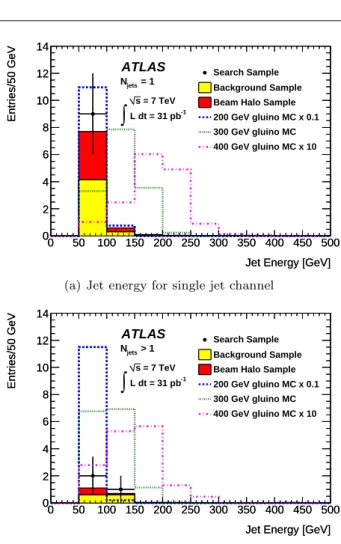
(8) 14 12 10. ATLAS. Search Sample. Njets = 1. Background Sample. s = 7 TeV. ∫ L dt = 31 pb. -1. 8. Beam Halo Sample 200 GeV gluino MC x 0.1 300 GeV gluino MC 400 GeV gluino MC x 10. 6. ~~ 95% CL σ(pp → g g) (pb). Entries/50 GeV. 8. Expected Limit ± 2 σ Expected Limit ± 1 σ. ATLAS. Prospino SUSY. Leading Jet Energy > 100 GeV Njets = 1. 102. Observed Limit Expected Limit. 4 s = 7 TeV. ∫ L dt = 31 pb. 2 0 0. -1. 50. 100 150 200 250 300 350 400 450 500. 10. 200. 250. Entries/50 GeV. 14 12 10. ATLAS. Search Sample. Njets > 1. Background Sample. s = 7 TeV. ∫ L dt = 31 pb. -1. 8. Beam Halo Sample 200 GeV gluino MC x 0.1 300 GeV gluino MC 400 GeV gluino MC x 10. 6. 350. 400. 450. 500. 550. 600. M~g (GeV). Jet Energy [GeV]. (a) Jet energy for single jet channel. 300. Fig. 4 The 95% C.L. limit on the gluino pair production cross-section as a function of gluino mass, mg̃ , assuming mχ̃01 =100 GeV. Limits are shown for the Generic stopping 0 model and g̃ → g χ̃ decay.. √ data collected from collisions at s = 7 TeV. They derived a 95% C.L. limit, excluding mg̃ < 370 GeV.. 4. 10 Summary 2 0 0. 50. 100 150 200 250 300 350 400 450 500 Jet Energy [GeV]. (b) Leading jet energy for multi-jet channel Fig. 3 Distributions of jet energy for the single jet (a) and multi-jet (b) channels, for selected events before the leading jet energy requirement is applied. In each case the signal region is defined as those events which have leading jet energy above 100 GeV. The background and control samples predict cosmic-ray muon yields, but do not include the background from beam halo. The signal distributions shown correspond 0 to gluino decays to a gluon and a χ̃ with 100 GeV mass. The signal distributions do not change for any gluino R-hadron lifetime between 10−5 and 103 seconds.. ±2 standard deviation bands. The cross-section limit changes rapidly in the 200 < mg̃ < 300 GeV region as, with the increasing gluino mass, more decays pass the 100 GeV jet energy selection. Above 300 GeV the limit depends only moderately on the gluino mass. The −2σ and −1σ variations of the expected limit coincide with the observed limit since no events are observed in the final selected data sample, and the background is low.. A search is presented for long-lived gluinos which have stopped in the ATLAS detector, using 7 TeV protonproton collisions at the LHC. No evidence for the sub0 sequent decay of these particles into g χ̃ is found, in a dataset with peak instantaneous luminosity of 2 × 1032 cm−2 s−1 and an integrated luminosity of 31 pb−1 , during time periods where there are no proton-proton collisions. A dedicated calorimeter trigger is employed, and the observed events are consistent with the background expectation derived from control samples in data. Limits on the gluino pair production as a function of gluino lifetime are derived and exclude 200 < mg̃ < 341 GeV at 95% C.L. for lifetimes between 10−5 to 103 seconds with a fixed neutralino mass of mχ̃01 =100 GeV and the Generic matter interaction model.. Acknowledgements We thank CERN for the very successful operation of the LHC, as well as the support staff from our institutions without whom ATLAS could not be operated efficiently. We acknowledge the support of ANPCyT, Argentina; YerPhI, Armenia; ARC, Australia; BMWF, Austria; ANAS, Azerbaijan; SSTC, Belarus; CNPq and FAPESP, Brazil; NSERC, NRC and CFI, Canada; CERN; CONICYT, Chile; CAS, MOST and NSFC, China; COLCIENCIAS, Colombia; MSMT CR, Both the D0 and CMS collaborations performed MPO CR and VSC CR, Czech Republic; DNRF, DNSRC searches yielding comparable results for similar lifetime and Lundbeck Foundation, Denmark; ARTEMIS and ERC, ranges. The D0 collaboration analysed 410 pb−1 of proton- European Union; IN2P3-CNRS, CEA-DSM/IRFU, France; √ antiproton data collected from collisions at s = 1.96 TeV GNAS, Georgia; BMBF, DFG, HGF, MPG and AvH Foundation, Germany; GSRT, Greece; ISF, MINERVA, GIF, DIP and derived a 95% C.L. limit, excluding mg̃ < 270 GeV. and Benoziyo Center, Israel; INFN, Italy; MEXT and JSPS, Japan; CNRST, Morocco; FOM and NWO, Netherlands; RCN, The CMS collaboration used 10 pb−1 of proton-proton.
(9) 9 Norway; MNiSW, Poland; GRICES and FCT, Portugal; MERYS (MECTS), Romania; MES of Russia and ROSATOM, Russian Federation; JINR; MSTD, Serbia; MSSR, Slovakia; ARRS and MVZT, Slovenia; DST/NRF, South Africa; MICINN, Spain; SRC and Wallenberg Foundation, Sweden; SER, SNSF and Cantons of Bern and Geneva, Switzerland; NSC, Taiwan; TAEK, Turkey; STFC, the Royal Society and Leverhulme Trust, United Kingdom; DOE and NSF, United States of America. The crucial computing support from all WLCG partners is acknowledged gratefully, in particular from CERN and the ATLAS Tier-1 facilities at TRIUMF (Canada), NDGF (Denmark, Norway, Sweden), CC-IN2P3 (France), KIT/GridKA (Germany), INFN-CNAF (Italy), NL-T1 (Netherlands), PIC (Spain), ASGC (Taiwan), RAL (UK) and BNL (USA) and in the Tier-2 facilities worldwide.. References 1. N. Arkani-Hamed, S. Dimopoulos, G.F. Giudice, A. Romanino, Nucl. Phys. B709, 3 (2005). DOI 10.1016/j. nuclphysb.2004.12.026 2. J.L. Hewett, B. Lillie, M. Masip, T.G. Rizzo, JHEP 09, 070 (2004). DOI 10.1088/1126-6708/2004/09/070 3. A. Mafi, S. Raby, Phys. Rev. D62, 035003 (2000). DOI 10.1103/PhysRevD.62.035003 4. N.R. Shah, C.E.M. Wagner, Phys. Rev. D74, 104008 (2006). DOI 10.1103/PhysRevD.74.104008 5. M. Fairbairn, et al., Phys. Rept. 438, 1 (2007). DOI 10.1016/j.physrep.2006.10.002 6. P. Gambino, G. Giudice, P. Slavich, Nucl.Phys. B726, 35 (2005). DOI 10.1016/j.nuclphysb.2005.08.011 7. G.R. Farrar, P. Fayet, Phys. Lett. B76, 575 (1978). DOI 10.1016/0370-2693(78)90858-4 8. A. Arvanitaki, S. Dimopoulos, A. Pierce, S. Rajendran, J.G. Wacker, Phys. Rev. D76, 055007 (2007). DOI 10. 1103/PhysRevD.76.055007 9. V.M. Abazov, et al., Phys. Rev. Lett. 99, 131801 (2007). DOI 10.1103/PhysRevLett.99.131801 10. CMS Collaboration, Phys. Rev. Lett. 106, 011801 (2011) 11. ATLAS Collaboration, Phys. Lett. B701, 1 (2011) 12. ATLAS Collaboration, Phys. Lett. B703, 428 (2011) 13. ATLAS Collaboration, JINST 3, S08003 (2008) 14. M. Cacciari, G. P. Salam, and G. Soyez, JHEP 04, 063 (2008) 15. ATLAS Collaboration, Eur. Phys. J. C71, 1521 (2011). DOI 10.1140/epjc/s10052-010-1512-2 16. ATLAS Collaboration, Eur. Phys. J. C71, 1630 (2011). DOI 10.1140/epjc/s10052-011-1630-5 17. A. Collaboration, Eur.Phys.J. C72, 1849 (2012). DOI 10.1140/epjc/s10052-011-1849-1 18. T. Sjostrand, S. Mrenna, P. Skands, JHEP 05, 026 (2006) 19. B. Andersson, G. Gustafson, G. Ingelman, T. Sjostrand, Phys. Rept. 97, 31 (1983). DOI 10.1016/0370-1573(83) 90080-7 20. A.C. Kraan, Eur. Phys. J. C37, 91 (2004). DOI 10.1140/ epjc/s2004-01997-7 21. S. Agostinelli, et al., Nucl. Instrum. Meth. A506, 250 (2003). DOI 10.1016/S0168-9002(03)01368-8 22. ATLAS Collaboration, Eur. Phys. J. C70, 823 (2010). DOI 10.1140/epjc/s10052-010-1429-9 23. R. Mackeprang, A. Rizzi, Eur. Phys. J. C50, 353 (2007). DOI 10.1140/epjc/s10052-007-0252-4 24. Y.R. de Boer, A.B. Kaidalov, D.A. Milstead, O.I. Piskounova, J. Phys. G35, 075009 (2008). DOI 10.1088/ 0954-3899/35/7/075009. 25. R. Mackeprang, D. Milstead, Eur. Phys. J. C66, 493 (2010). DOI 10.1140/epjc/s10052-010-1262-1 26. ATLAS Collaboration, ATLAS-CONF-2011-011 27. W. Beenakker, R. Hopker, M. Spira, P.M. Zerwas, Nucl. Phys. B492, 51 (1997). DOI 10.1016/S0550-3213(97) 00084-9 28. J. Heinrich, L. Lyons, Annual review of Nuclear and Particle Science 57, 145 (2007).
(10) 10. The ATLAS Collaboration G. Aad48 , B. Abbott110 , J. Abdallah11 , A.A. Abdelalim49 , A. Abdesselam117 , O. Abdinov10 , B. Abi111 , M. Abolins87 , H. Abramowicz152 , H. Abreu114 , E. Acerbi88a,88b , B.S. Acharya163a,163b , D.L. Adams24 , T.N. Addy56 , J. Adelman174 , M. Aderholz98 , S. Adomeit97 , P. Adragna74 , T. Adye128 , S. Aefsky22 , J.A. Aguilar-Saavedra123b,a , M. Aharrouche80 , S.P. Ahlen21 , F. Ahles48 , A. Ahmad147 , M. Ahsan40 , G. Aielli132a,132b , T. Akdogan18a , T.P.A. Åkesson78 , G. Akimoto154 , A.V. Akimov 93 , A. Akiyama66 , A. Aktas48 , M.S. Alam1 , M.A. Alam75 , J. Albert168 , S. Albrand55 , M. Aleksa29 , I.N. Aleksandrov64 , F. Alessandria88a , C. Alexa25a , G. Alexander152 , G. Alexandre49 , T. Alexopoulos9 , M. Alhroob20 , M. Aliev15 , G. Alimonti88a , J. Alison119 , M. Aliyev10 , P.P. Allport72 , S.E. Allwood-Spiers53 , J. Almond81 , A. Aloisio101a,101b , R. Alon170 , A. Alonso78 , M.G. Alviggi101a,101b , K. Amako65 , P. Amaral29 , C. Amelung22 , V.V. Ammosov127 , A. Amorim123a,b , G. Amorós166 , N. Amram152 , C. Anastopoulos29 , L.S. Ancu16 , N. Andari114 , T. Andeen34 , C.F. Anders20 , G. Anders58a , K.J. Anderson30 , A. Andreazza88a,88b , V. Andrei58a , M-L. Andrieux55 , X.S. Anduaga69 , A. Angerami34 , F. Anghinolfi29 , N. Anjos123a , A. Annovi47 , A. Antonaki8 , M. Antonelli47 , A. Antonov95 , J. Antos143b , F. Anulli131a , S. Aoun82 , L. Aperio Bella4 , R. Apolle117,c , G. Arabidze87 , I. Aracena142 , Y. Arai65 , A.T.H. Arce44 , J.P. Archambault28 , S. Arfaoui29,d , J-F. Arguin14 , E. Arik18a,∗ , M. Arik18a , A.J. Armbruster86 , O. Arnaez80 , C. Arnault114 , A. Artamonov94, G. Artoni131a,131b , D. Arutinov20 , M. Asai142 , S. Asai154 , R. Asfandiyarov171, S. Ask27 , B. Åsman145a,145b , D. Asner28 , L. Asquith5 , K. Assamagan24 , A. Astbury168 , A. Astvatsatourov52 , G. Atoian174 , B. Aubert4 , E. Auge114 , K. Augsten126 , M. Aurousseau144a , N. Austin72 , G. Avolio162 , R. Avramidou9 , D. Axen167 , C. Ay54 , G. Azuelos92,e , Y. Azuma154 , M.A. Baak29 , G. Baccaglioni88a, C. Bacci133a,133b , A.M. Bach14 , H. Bachacou135 , K. Bachas29, G. Bachy29 , M. Backes49 , M. Backhaus20 , E. Badescu25a , P. Bagnaia131a,131b , S. Bahinipati2 , Y. Bai32a , D.C. Bailey157 , T. Bain157 , J.T. Baines128 , O.K. Baker174 , M.D. Baker24 , S. Baker76 , E. Banas38 , P. Banerjee92 , Sw. Banerjee171 , D. Banfi29 , A. Bangert136 , V. Bansal168 , H.S. Bansil17 , L. Barak170, S.P. Baranov93, A. Barashkou64, A. Barbaro Galtieri14 , T. Barber48 , E.L. Barberio85, D. Barberis50a,50b , M. Barbero20 , D.Y. Bardin64 , T. Barillari98 , M. Barisonzi173 , T. Barklow142 , N. Barlow27, B.M. Barnett128 , R.M. Barnett14 , A. Baroncelli133a , G. Barone49, A.J. Barr117, F. Barreiro79, J. Barreiro Guimarães da Costa57 , P. Barrillon114 , R. Bartoldus142 , A.E. Barton70 , D. Bartsch20 , V. Bartsch148 , R.L. Bates53 , L. Batkova143a , J.R. Batley27 , A. Battaglia16 , M. Battistin29 , G. Battistoni88a , F. Bauer135 , H.S. Bawa142,f , B. Beare157 , T. Beau77 , P.H. Beauchemin117 , R. Beccherle50a , P. Bechtle41 , G.A. Beck74 , H.P. Beck16 , M. Beckingham48 , K.H. Becks173 , A.J. Beddall18c , A. Beddall18c , S. Bedikian174 , V.A. Bednyakov64, C.P. Bee82 , M. Begel24 , S. Behar Harpaz151 , P.K. Behera62 , M. Beimforde98 , C. Belanger-Champagne84, P.J. Bell49 , W.H. Bell49 , G. Bella152 , L. Bellagamba19a, F. Bellina29 , M. Bellomo29 , A. Belloni57 , O. Beloborodova106,g , K. Belotskiy95 , O. Beltramello29 , S. Ben Ami151 , O. Benary152 , D. Benchekroun134a , C. Benchouk82 , M. Bendel80 , N. Benekos164 , Y. Benhammou152 , D.P. Benjamin44 , M. Benoit114 , J.R. Bensinger22 , K. Benslama129 , S. Bentvelsen104 , M. Beretta47 , D. Berge29 , E. Bergeaas Kuutmann41 , N. Berger4, F. Berghaus168 , E. Berglund49 , J. Beringer14 , K. Bernardet82 , P. Bernat76 , R. Bernhard48 , C. Bernius24 , T. Berry75 , A. Bertin19a,19b , F. Bertinelli29 , F. Bertolucci121a,121b , M.I. Besana88a,88b, N. Besson135 , S. Bethke98 , W. Bhimji45 , R.M. Bianchi29 , M. Bianco71a,71b , O. Biebel97 , S.P. Bieniek76 , K. Bierwagen54, J. Biesiada14 , M. Biglietti133a , H. Bilokon47 , M. Bindi19a,19b , S. Binet114 , A. Bingul18c , C. Bini131a,131b , C. Biscarat176 , U. Bitenc48 , K.M. Black21 , R.E. Blair5 , J.-B. Blanchard114, G. Blanchot29 , T. Blazek143a , C. Blocker22, J. Blocki38 , A. Blondel49 , W. Blum80 , U. Blumenschein54 , G.J. Bobbink104 , V.B. Bobrovnikov106, S.S. Bocchetta78 , A. Bocci44 , C.R. Boddy117 , M. Boehler41 , J. Boek173 , N. Boelaert35 , S. Böser76 , J.A. Bogaerts29, A. Bogdanchikov106, A. Bogouch89,∗ , C. Bohm145a , V. Boisvert75, T. Bold162,h , V. Boldea25a , N.M. Bolnet135 , M. Bona74 , V.G. Bondarenko95, M. Bondioli162 , M. Boonekamp135 , G. Boorman75 , C.N. Booth138 , S. Bordoni77 , C. Borer16, A. Borisov127, G. Borissov70, I. Borjanovic12a, S. Borroni86, K. Bos104 , D. Boscherini19a, M. Bosman11 , H. Boterenbrood104, D. Botterill128 , J. Bouchami92 , J. Boudreau122 , E.V. Bouhova-Thacker70, C. Bourdarios114, N. Bousson82 , A. Boveia30, J. Boyd29 , I.R. Boyko64, N.I. Bozhko127 , I. Bozovic-Jelisavcic12b, J. Bracinik17 , A. Braem29 , P. Branchini133a , G.W. Brandenburg57, A. Brandt7 , G. Brandt15 , O. Brandt54 , U. Bratzler155 , B. Brau83 , J.E. Brau113 , H.M. Braun173 , B. Brelier157 , J. Bremer29 , R. Brenner165 , S. Bressler151, D. Breton114 , D. Britton53 , F.M. Brochu27 , I. Brock20 , R. Brock87 , T.J. Brodbeck70 , E. Brodet152 , F. Broggi88a , C. Bromberg87, G. Brooijmans34 , W.K. Brooks31b, G. Brown81 , H. Brown7, P.A. Bruckman de Renstrom38 , D. Bruncko143b, R. Bruneliere48 , S. Brunet60 , A. Bruni19a , G. Bruni19a , M. Bruschi19a , T. Buanes13 , F. Bucci49 ,.
(11) 11. J. Buchanan117 , N.J. Buchanan2 , P. Buchholz140 , R.M. Buckingham117 , A.G. Buckley45 , S.I. Buda25a , I.A. Budagov64, B. Budick107 , V. Büscher80 , L. Bugge116 , D. Buira-Clark117, O. Bulekov95 , M. Bunse42 , T. Buran116 , H. Burckhart29 , S. Burdin72 , T. Burgess13, S. Burke128 , E. Busato33 , P. Bussey53 , C.P. Buszello165 , F. Butin29 , B. Butler142 , J.M. Butler21 , C.M. Buttar53 , J.M. Butterworth76 , W. Buttinger27 , J. Caballero24 , S. Cabrera Urbán166 , D. Caforio19a,19b , O. Cakir3a , P. Calafiura14 , G. Calderini77 , P. Calfayan97 , R. Calkins105 , L.P. Caloba23a , R. Caloi131a,131b , D. Calvet33 , S. Calvet33 , R. Camacho Toro33 , P. Camarri132a,132b , M. Cambiaghi118a,118b , D. Cameron116 , S. Campana29 , M. Campanelli76 , V. Canale101a,101b , F. Canelli30,i , A. Canepa158a , J. Cantero79 , L. Capasso101a,101b, M.D.M. Capeans Garrido29 , I. Caprini25a , M. Caprini25a , D. Capriotti98 , M. Capua36a,36b , R. Caputo147 , C. Caramarcu24, R. Cardarelli132a , T. Carli29 , G. Carlino101a , L. Carminati88a,88b , B. Caron158a , S. Caron48 , G.D. Carrillo Montoya171, A.A. Carter74 , J.R. Carter27 , J. Carvalho123a,j , D. Casadei107 , M.P. Casado11 , M. Cascella121a,121b, C. Caso50a,50b,∗ , A.M. Castaneda Hernandez171 , E. Castaneda-Miranda171, V. Castillo Gimenez166 , N.F. Castro123a , G. Cataldi71a , F. Cataneo29 , A. Catinaccio29 , J.R. Catmore29 , A. Cattai29 , G. Cattani132a,132b , S. Caughron87 , D. Cauz163a,163c , P. Cavalleri77 , D. Cavalli88a , M. Cavalli-Sforza11, V. Cavasinni121a,121b , F. Ceradini133a,133b , A.S. Cerqueira23a , A. Cerri29 , L. Cerrito74 , F. Cerutti47 , S.A. Cetin18b , F. Cevenini101a,101b , A. Chafaq134a , D. Chakraborty105, K. Chan2 , B. Chapleau84 , J.D. Chapman27 , J.W. Chapman86 , E. Chareyre77 , D.G. Charlton17 , V. Chavda81 , C.A. Chavez Barajas29, S. Cheatham84 , S. Chekanov5 , S.V. Chekulaev158a , G.A. Chelkov64 , M.A. Chelstowska103 , C. Chen63 , H. Chen24 , S. Chen32c , T. Chen32c , X. Chen171 , S. Cheng32a , A. Cheplakov64, V.F. Chepurnov64 , R. Cherkaoui El Moursli134e , V. Chernyatin24 , E. Cheu6 , S.L. Cheung157 , L. Chevalier135 , G. Chiefari101a,101b , L. Chikovani51a , J.T. Childers58a , A. Chilingarov70, G. Chiodini71a , M.V. Chizhov64 , G. Choudalakis30 , S. Chouridou136 , I.A. Christidi76 , A. Christov48 , D. Chromek-Burckhart29, M.L. Chu150 , J. Chudoba124 , G. Ciapetti131a,131b , K. Ciba37 , A.K. Ciftci3a , R. Ciftci3a , D. Cinca33 , V. Cindro73 , M.D. Ciobotaru162 , C. Ciocca19a , A. Ciocio14 , M. Cirilli86 , M. Citterio88a , M. Ciubancan25a , A. Clark49 , P.J. Clark45 , W. Cleland122 , J.C. Clemens82 , B. Clement55 , C. Clement145a,145b , R.W. Clifft128 , Y. Coadou82 , M. Cobal163a,163c , A. Coccaro50a,50b, J. Cochran63 , P. Coe117 , J.G. Cogan142 , J. Coggeshall164, E. Cogneras176, C.D. Cojocaru28 , J. Colas4 , A.P. Colijn104 , C. Collard114 , N.J. Collins17 , C. Collins-Tooth53 , J. Collot55 , G. Colon83 , P. Conde Muiño123a , E. Coniavitis117 , M.C. Conidi11 , M. Consonni103 , V. Consorti48 , S. Constantinescu25a , C. Conta118a,118b , F. Conventi101a,k , J. Cook29 , M. Cooke14 , B.D. Cooper76 , A.M. Cooper-Sarkar117, K. Copic34 , T. Cornelissen173 , M. Corradi19a, F. Corriveau84,l , A. Corso-Radu162, A. Cortes-Gonzalez164, G. Cortiana98, G. Costa88a , M.J. Costa166 , D. Costanzo138 , T. Costin30 , D. Côté29, R. Coura Torres23a , L. Courneyea168 , G. Cowan75 , C. Cowden27 , B.E. Cox81 , K. Cranmer107 , J. Cranshaw5, F. Crescioli121a,121b, M. Cristinziani20 , G. Crosetti36a,36b , R. Crupi71a,71b , S. Crépé-Renaudin55, C.-M. Cuciuc25a , C. Cuenca Almenar174 , T. Cuhadar Donszelmann138 , M. Curatolo47 , C.J. Curtis17 , P. Cwetanski60 , H. Czirr140 , Z. Czyczula174 , S. D’Auria53 , M. D’Onofrio72 , A. D’Orazio131a,131b, P.V.M. Da Silva23a , C. Da Via81 , W. Dabrowski37 , T. Dai86 , C. Dallapiccola83 , C.H. Daly137 , M. Dam35 , M. Dameri50a,50b , D.S. Damiani136 , H.O. Danielsson29 , D. Dannheim98 , V. Dao49 , G. Darbo50a , G.L. Darlea25b , C. Daum104 , J.P. Dauvergne 29 , W. Davey85 , T. Davidek125 , N. Davidson85 , R. Davidson70 , E. Davies117,c , M. Davies92 , A.R. Davison76 , Y. Davygora58a, E. Dawe141 , I. Dawson138 , J.W. Dawson5,∗ , R.K. Daya-Ishmukhametova39, K. De7 , R. de Asmundis101a , S. De Castro19a,19b, P.E. De Castro Faria Salgado24, S. De Cecco77 , J. de Graat97 , N. De Groot103 , P. de Jong104 , C. De La Taille114 , H. De la Torre79 , B. De Lotto163a,163c , L. de Mora70 , L. De Nooij104 , D. De Pedis131a , A. De Salvo131a , U. De Sanctis163a,163c , A. De Santo148 , J.B. De Vivie De Regie114 , S. Dean76 , R. Debbe24 , D.V. Dedovich64 , J. Degenhardt119 , M. Dehchar117 , C. Del Papa163a,163c , J. Del Peso79, T. Del Prete121a,121b , M. Deliyergiyev73 , A. Dell’Acqua29 , L. Dell’Asta88a,88b , M. Della Pietra101a,k , D. della Volpe101a,101b , M. Delmastro29 , P. Delpierre82 , N. Delruelle29 , P.A. Delsart55 , C. Deluca147 , S. Demers174 , M. Demichev64 , B. Demirkoz11,m , J. Deng162 , W. Deng24 , S.P. Denisov127 , D. Derendarz38 , J.E. Derkaoui134d , F. Derue77 , P. Dervan72 , K. Desch20 , E. Devetak147 , P.O. Deviveiros157 , A. Dewhurst128 , B. DeWilde147 , S. Dhaliwal157 , R. Dhullipudi24,n , A. Di Ciaccio132a,132b , L. Di Ciaccio4 , A. Di Girolamo29 , B. Di Girolamo29 , S. Di Luise133a,133b , A. Di Mattia171 , B. Di Micco29 , R. Di Nardo132a,132b , A. Di Simone132a,132b , R. Di Sipio19a,19b , M.A. Diaz31a , F. Diblen18c , E.B. Diehl86 , J. Dietrich41 , T.A. Dietzsch58a , S. Diglio114 , K. Dindar Yagci39 , J. Dingfelder20 , C. Dionisi131a,131b , P. Dita25a , S. Dita25a , F. Dittus29 , F. Djama82 , T. Djobava51b , M.A.B. do Vale23c , A. Do Valle Wemans123a , T.K.O. Doan4 , M. Dobbs84 , R. Dobinson 29,∗ , D. Dobos29 , E. Dobson29,o , M. Dobson162 , J. Dodd34 , C. Doglioni117 , T. Doherty53 , Y. Doi65,∗ , J. Dolejsi125 , I. Dolenc73 , Z. Dolezal125 , B.A. Dolgoshein95,∗ , T. Dohmae154 ,.
(12) 12. M. Donadelli23d , M. Donega119 , J. Donini55 , J. Dopke29 , A. Doria101a , A. Dos Anjos171 , M. Dosil11 , A. Dotti121a,121b , M.T. Dova69 , J.D. Dowell17 , A.D. Doxiadis104 , A.T. Doyle53 , Z. Drasal125 , J. Drees173 , N. Dressnandt119 , H. Drevermann29 , C. Driouichi35 , M. Dris9 , J. Dubbert98 , T. Dubbs136 , S. Dube14 , E. Duchovni170 , G. Duckeck97 , A. Dudarev29 , F. Dudziak63 , M. Dührssen 29 , I.P. Duerdoth81 , L. Duflot114 , M-A. Dufour84 , M. Dunford29 , H. Duran Yildiz3a , R. Duxfield138 , M. Dwuznik37 , F. Dydak 29 , M. Düren52 , W.L. Ebenstein44 , J. Ebke97 , S. Eckert48 , S. Eckweiler80, K. Edmonds80 , C.A. Edwards75, N.C. Edwards53, W. Ehrenfeld41 , T. Ehrich98 , T. Eifert29 , G. Eigen13 , K. Einsweiler14 , E. Eisenhandler74 , T. Ekelof165 , M. El Kacimi134c , M. Ellert165 , S. Elles4 , F. Ellinghaus80 , K. Ellis74 , N. Ellis29 , J. Elmsheuser97 , M. Elsing29 , D. Emeliyanov128, R. Engelmann147 , A. Engl97 , B. Epp61 , A. Eppig86 , J. Erdmann54 , A. Ereditato16 , D. Eriksson145a , J. Ernst1 , M. Ernst24 , J. Ernwein135 , D. Errede164 , S. Errede164 , E. Ertel80 , M. Escalier114, C. Escobar122, X. Espinal Curull11 , B. Esposito47 , F. Etienne82 , A.I. Etienvre135 , E. Etzion152 , D. Evangelakou54, H. Evans60 , L. Fabbri19a,19b , C. Fabre29 , R.M. Fakhrutdinov127 , S. Falciano131a , Y. Fang171 , M. Fanti88a,88b , A. Farbin7 , A. Farilla133a , J. Farley147 , T. Farooque157 , S.M. Farrington117 , P. Farthouat29 , P. Fassnacht29 , D. Fassouliotis8 , B. Fatholahzadeh157 , A. Favareto88a,88b , L. Fayard114 , S. Fazio36a,36b , R. Febbraro33 , P. Federic143a , O.L. Fedin120 , W. Fedorko87, M. Fehling-Kaschek48, L. Feligioni82 , D. Fellmann5 , C.U. Felzmann85 , C. Feng32d , E.J. Feng30 , A.B. Fenyuk127 , J. Ferencei143b , J. Ferland92 , W. Fernando108 , S. Ferrag53, J. Ferrando53 , V. Ferrara41, A. Ferrari165 , P. Ferrari104, R. Ferrari118a , A. Ferrer166 , M.L. Ferrer47 , D. Ferrere49 , C. Ferretti86 , A. Ferretto Parodi50a,50b, M. Fiascaris30, F. Fiedler80 , A. Filipčič73 , A. Filippas9 , F. Filthaut103 , M. Fincke-Keeler168, M.C.N. Fiolhais123a,j , L. Fiorini166 , A. Firan39 , G. Fischer41 , P. Fischer 20 , M.J. Fisher108 , S.M. Fisher128 , M. Flechl48 , I. Fleck140 , J. Fleckner80 , P. Fleischmann172 , S. Fleischmann173 , T. Flick173 , L.R. Flores Castillo171 , M.J. Flowerdew98 , M. Fokitis9 , T. Fonseca Martin16 , J. Fopma117 , D.A. Forbush137 , A. Formica135 , A. Forti81 , D. Fortin158a , J.M. Foster81 , D. Fournier114 , A. Foussat29 , A.J. Fowler44 , K. Fowler136 , H. Fox70 , P. Francavilla121a,121b, S. Franchino118a,118b , D. Francis29 , T. Frank170 , M. Franklin57 , S. Franz29 , M. Fraternali118a,118b , S. Fratina119 , J. Freestone81 , S.T. French27 , F. Friedrich 43 , R. Froeschl29 , D. Froidevaux29 , J.A. Frost27 , C. Fukunaga155 , E. Fullana Torregrosa29, J. Fuster166 , C. Gabaldon29 , O. Gabizon170 , T. Gadfort24 , S. Gadomski49 , G. Gagliardi50a,50b, P. Gagnon60 , C. Galea97 , E.J. Gallas117 , V. Gallo16 , B.J. Gallop128 , P. Gallus124 , E. Galyaev40 , K.K. Gan108 , Y.S. Gao142,f , V.A. Gapienko127 , A. Gaponenko14 , F. Garberson174 , M. Garcia-Sciveres14, C. Garcı́a166, J.E. Garcı́a Navarro49, R.W. Gardner30 , N. Garelli29 , H. Garitaonandia104 , V. Garonne29 , J. Garvey17 , C. Gatti47 , G. Gaudio118a , O. Gaumer49 , B. Gaur140 , L. Gauthier135 , P. Gauzzi131a,131b , I.L. Gavrilenko93, C. Gay167 , G. Gaycken20, J-C. Gayde29 , E.N. Gazis9 , P. Ge32d , C.N.P. Gee128 , D.A.A. Geerts104 , Ch. Geich-Gimbel20 , K. Gellerstedt145a,145b , C. Gemme50a , A. Gemmell53 , M.H. Genest97 , S. Gentile131a,131b , M. George54 , S. George75 , P. Gerlach173 , A. Gershon152 , C. Geweniger58a , H. Ghazlane134b , N. Ghodbane33 , B. Giacobbe19a , S. Giagu131a,131b , V. Giakoumopoulou8 , V. Giangiobbe121a,121b , F. Gianotti29 , B. Gibbard24 , A. Gibson157 , S.M. Gibson29 , L.M. Gilbert117 , M. Gilchriese14 , V. Gilewsky90 , D. Gillberg28 , A.R. Gillman128 , D.M. Gingrich2,e , J. Ginzburg152 , N. Giokaris8 , M.P. Giordani163c , R. Giordano101a,101b, F.M. Giorgi15 , P. Giovannini98 , P.F. Giraud135 , D. Giugni88a , M. Giunta92 , P. Giusti19a , B.K. Gjelsten116 , L.K. Gladilin96 , C. Glasman79 , J. Glatzer48 , A. Glazov41 , K.W. Glitza173 , G.L. Glonti64 , J. Godfrey141 , J. Godlewski29 , M. Goebel41 , T. Göpfert43 , C. Goeringer80 , C. Gössling42 , T. Göttfert98 , S. Goldfarb86 , T. Golling174 , S.N. Golovnia127 , A. Gomes123a,b , L.S. Gomez Fajardo41, R. Gonçalo75 , J. Goncalves Pinto Firmino Da Costa41 , L. Gonella20 , A. Gonidec29 , S. Gonzalez171 , S. González de la Hoz166 , M.L. Gonzalez Silva26 , S. Gonzalez-Sevilla49, J.J. Goodson147 , L. Goossens29 , P.A. Gorbounov94 , H.A. Gordon24 , I. Gorelov102 , G. Gorfine173 , B. Gorini29 , E. Gorini71a,71b , A. Gorišek73, E. Gornicki38 , S.A. Gorokhov127, V.N. Goryachev127, B. Gosdzik41 , M. Gosselink104 , M.I. Gostkin64 , I. Gough Eschrich162 , M. Gouighri134a , D. Goujdami134c , M.P. Goulette49 , A.G. Goussiou137 , C. Goy4 , I. Grabowska-Bold162,h , P. Grafström29 , C. Grah173 , K-J. Grahn41 , F. Grancagnolo71a, S. Grancagnolo15, V. Grassi147 , V. Gratchev120 , N. Grau34 , H.M. Gray29 , J.A. Gray147 , E. Graziani133a , O.G. Grebenyuk120 , B. Green75 , D. Greenfield128 , T. Greenshaw72 , Z.D. Greenwood24,n , K. Gregersen35 , I.M. Gregor41 , P. Grenier142 , J. Griffiths137 , N. Grigalashvili64, A.A. Grillo136 , S. Grinstein11 , Y.V. Grishkevich96 , J.-F. Grivaz114 , M. Groh98 , E. Gross170 , J. Grosse-Knetter54 , J. Groth-Jensen170 , K. Grybel140 , V.J. Guarino5 , D. Guest174 , C. Guicheney33 , A. Guida71a,71b , S. Guindon54 , H. Guler84,p , J. Gunther124 , B. Guo157 , J. Guo34 , A. Gupta30 , Y. Gusakov64 , V.N. Gushchin127 , A. Gutierrez92 , P. Gutierrez110 , N. Guttman152 , O. Gutzwiller171 , C. Guyot135 , C. Gwenlan117 , C.B. Gwilliam72 , A. Haas142 , S. Haas29 , C. Haber14 , H.K. Hadavand39 , D.R. Hadley17 , P. Haefner98 , F. Hahn29 , S. Haider29 , Z. Hajduk38 ,.
(13) 13. H. Hakobyan175, J. Haller54 , K. Hamacher173 , P. Hamal112 , A. Hamilton49 , S. Hamilton160 , H. Han32a , L. Han32b , K. Hanagaki115 , M. Hance119 , C. Handel80 , P. Hanke58a , J.R. Hansen35 , J.B. Hansen35 , J.D. Hansen35 , P.H. Hansen35 , P. Hansson142 , K. Hara159 , G.A. Hare136 , T. Harenberg173 , S. Harkusha89 , D. Harper86 , R.D. Harrington45 , O.M. Harris137 , K. Harrison17 , J. Hartert48 , F. Hartjes104 , T. Haruyama65, A. Harvey56 , S. Hasegawa100, Y. Hasegawa139, S. Hassani135 , M. Hatch29 , D. Hauff98 , S. Haug16 , M. Hauschild29 , R. Hauser87 , M. Havranek20 , B.M. Hawes117 , C.M. Hawkes17 , R.J. Hawkings29 , D. Hawkins162 , T. Hayakawa66, T. Hayashi159, D. Hayden75 , H.S. Hayward72, S.J. Haywood128 , E. Hazen21 , M. He32d , S.J. Head17 , V. Hedberg78 , L. Heelan7 , S. Heim87 , B. Heinemann14 , S. Heisterkamp35 , L. Helary4 , M. Heller29 , S. Hellman145a,145b , D. Hellmich20 , C. Helsens11 , T. Hemperek20 , R.C.W. Henderson70 , M. Henke58a , A. Henrichs54 , A.M. Henriques Correia29, S. Henrot-Versille114 , F. Henry-Couannier82, C. Hensel54 , T. Henß173 , C.M. Hernandez7 , Y. Hernández Jiménez166 , R. Herrberg15 , A.D. Hershenhorn151 , G. Herten48 , R. Hertenberger97, L. Hervas29 , N.P. Hessey104 , A. Hidvegi145a , E. Higón-Rodriguez166 , D. Hill5,∗ , J.C. Hill27 , N. Hill5 , K.H. Hiller41 , S. Hillert20 , S.J. Hillier17 , I. Hinchliffe14 , E. Hines119 , M. Hirose115 , F. Hirsch42 , D. Hirschbuehl173 , J. Hobbs147 , N. Hod152 , M.C. Hodgkinson138 , P. Hodgson138 , A. Hoecker29, M.R. Hoeferkamp102 , J. Hoffman39 , D. Hoffmann82 , M. Hohlfeld80 , M. Holder140 , S.O. Holmgren145a , T. Holy126 , J.L. Holzbauer87 , Y. Homma66 , T.M. Hong119 , L. Hooft van Huysduynen107 , T. Horazdovsky126, C. Horn142 , S. Horner48 , K. Horton117 , J-Y. Hostachy55, S. Hou150 , M.A. Houlden72 , A. Hoummada134a , J. Howarth81 , D.F. Howell117 , I. Hristova 15 , J. Hrivnac114 , I. Hruska124 , T. Hryn’ova4 , P.J. Hsu174 , S.-C. Hsu14 , G.S. Huang110 , Z. Hubacek126 , F. Hubaut82 , F. Huegging20 , T.B. Huffman117 , E.W. Hughes34 , G. Hughes70 , R.E. Hughes-Jones81, M. Huhtinen29 , P. Hurst57 , M. Hurwitz14 , U. Husemann41 , N. Huseynov64,q , J. Huston87 , J. Huth57 , G. Iacobucci49 , G. Iakovidis9, M. Ibbotson81 , I. Ibragimov140, R. Ichimiya66 , L. Iconomidou-Fayard114, J. Idarraga114, P. Iengo101a , O. Igonkina104 , Y. Ikegami65 , M. Ikeno65 , Y. Ilchenko39 , D. Iliadis153 , D. Imbault77 , M. Imori154 , T. Ince20 , J. Inigo-Golfin29 , P. Ioannou8 , M. Iodice133a , A. Irles Quiles166 , A. Ishikawa66, M. Ishino67 , R. Ishmukhametov39 , C. Issever117 , S. Istin18a , A.V. Ivashin127 , W. Iwanski38 , H. Iwasaki65 , J.M. Izen40 , V. Izzo101a , B. Jackson119 , J.N. Jackson72 , P. Jackson142 , M.R. Jaekel29 , V. Jain60 , K. Jakobs48, S. Jakobsen35, J. Jakubek126 , D.K. Jana110 , E. Jankowski157, E. Jansen76 , A. Jantsch98 , M. Janus20 , G. Jarlskog78, L. Jeanty57 , K. Jelen37 , I. Jen-La Plante30 , P. Jenni29 , A. Jeremie4 , P. Jež35 , S. Jézéquel4, M.K. Jha19a , H. Ji171 , W. Ji80 , J. Jia147 , Y. Jiang32b , M. Jimenez Belenguer41 , G. Jin32b , S. Jin32a , O. Jinnouchi156 , M.D. Joergensen35 , D. Joffe39 , L.G. Johansen13 , M. Johansen145a,145b , K.E. Johansson145a, P. Johansson138, S. Johnert41 , K.A. Johns6 , K. Jon-And145a,145b , G. Jones81 , R.W.L. Jones70 , T.W. Jones76 , T.J. Jones72 , O. Jonsson29, C. Joram29 , P.M. Jorge123a , J. Joseph14 , T. Jovin12b , X. Ju129 , C.A. Jung42 , V. Juranek124 , P. Jussel61 , A. Juste Rozas11 , V.V. Kabachenko127, S. Kabana16, M. Kaci166 , A. Kaczmarska38, P. Kadlecik35 , M. Kado114 , H. Kagan108 , M. Kagan57, S. Kaiser98 , E. Kajomovitz151, S. Kalinin173 , L.V. Kalinovskaya64, S. Kama39 , N. Kanaya154, M. Kaneda29 , T. Kanno156 , V.A. Kantserov95, J. Kanzaki65 , B. Kaplan174 , A. Kapliy30 , J. Kaplon29 , D. Kar43 , M. Karagounis20, M. Karagoz117, M. Karnevskiy41, K. Karr5 , V. Kartvelishvili70 , A.N. Karyukhin127 , L. Kashif171 , R.D. Kass108 , A. Kastanas13 , M. Kataoka4, Y. Kataoka154 , E. Katsoufis9 , J. Katzy41 , V. Kaushik6 , K. Kawagoe66, T. Kawamoto154, G. Kawamura80, M.S. Kayl104 , V.A. Kazanin106 , M.Y. Kazarinov64, J.R. Keates81 , R. Keeler168 , R. Kehoe39 , M. Keil54 , G.D. Kekelidze64 , M. Kelly81 , J. Kennedy97 , C.J. Kenney142 , M. Kenyon53 , O. Kepka124 , N. Kerschen29 , B.P. Kerševan73, S. Kersten173 , K. Kessoku154 , C. Ketterer48 , J. Keung157 , F. Khalil-zada10, H. Khandanyan164, A. Khanov111 , D. Kharchenko64, A. Khodinov95 , A.G. Kholodenko127 , A. Khomich58a , T.J. Khoo27 , G. Khoriauli20 , A. Khoroshilov173, N. Khovanskiy64 , V. Khovanskiy94, E. Khramov64 , J. Khubua51b , H. Kim7 , M.S. Kim2 , P.C. Kim142 , S.H. Kim159 , N. Kimura169 , O. Kind15 , B.T. King72 , M. King66 , R.S.B. King117 , J. Kirk128 , L.E. Kirsch22 , A.E. Kiryunin98 , T. Kishimoto66 , D. Kisielewska37 , T. Kittelmann122 , A.M. Kiver127 , E. Kladiva143b , J. Klaiber-Lodewigs42, M. Klein72 , U. Klein72 , K. Kleinknecht80 , M. Klemetti84 , A. Klier170 , A. Klimentov24 , R. Klingenberg42, E.B. Klinkby35 , T. Klioutchnikova29, P.F. Klok103 , S. Klous104 , E.-E. Kluge58a , T. Kluge72 , P. Kluit104 , S. Kluth98 , N.S. Knecht157 , E. Kneringer61, J. Knobloch29 , E.B.F.G. Knoops82 , A. Knue54 , B.R. Ko44 , T. Kobayashi154, M. Kobel43 , M. Kocian142 , A. Kocnar112 , P. Kodys125 , K. Köneke29 , A.C. König103 , S. Koenig80 , L. Köpke80 , F. Koetsveld103 , P. Koevesarki20, T. Koffas28 , E. Koffeman104 , F. Kohn54 , Z. Kohout126 , T. Kohriki65 , T. Koi142 , T. Kokott20 , G.M. Kolachev106 , H. Kolanoski15, V. Kolesnikov64, I. Koletsou88a , J. Koll87 , D. Kollar29, M. Kollefrath48 , S.D. Kolya81 , A.A. Komar93, Y. Komori154 , T. Kondo65 , T. Kono41,r , A.I. Kononov48, R. Konoplich107,s , N. Konstantinidis76 , A. Kootz173 , S. Koperny37 , S.V. Kopikov127, K. Korcyl38 , K. Kordas153, V. Koreshev127, A. Korn117 , A. Korol106 , I. Korolkov11, E.V. Korolkova138, V.A. Korotkov127, O. Kortner98 ,.
(14) 14. S. Kortner98 , V.V. Kostyukhin20 , M.J. Kotamäki29 , S. Kotov98, V.M. Kotov64 , A. Kotwal44, C. Kourkoumelis8, V. Kouskoura153, A. Koutsman104 , R. Kowalewski168, T.Z. Kowalski37, W. Kozanecki135 , A.S. Kozhin127 , V. Kral126 , V.A. Kramarenko96, G. Kramberger73, M.W. Krasny77 , A. Krasznahorkay107, J. Kraus87 , J.K. Kraus20 , A. Kreisel152 , F. Krejci126 , J. Kretzschmar72, N. Krieger54 , P. Krieger157, K. Kroeninger54, H. Kroha98 , J. Kroll119 , J. Kroseberg20, J. Krstic12a , U. Kruchonak64 , H. Krüger20 , T. Kruker16 , Z.V. Krumshteyn64 , A. Kruth20 , T. Kubota85 , S. Kuehn48 , A. Kugel58c , T. Kuhl41 , D. Kuhn61 , V. Kukhtin64 , Y. Kulchitsky89 , S. Kuleshov31b , C. Kummer97 , M. Kuna77 , N. Kundu117 , J. Kunkle119 , A. Kupco124 , H. Kurashige66, M. Kurata159 , Y.A. Kurochkin89 , V. Kus124 , M. Kuze156 , P. Kuzhir90 , J. Kvita29 , R. Kwee15 , A. La Rosa171 , L. La Rotonda36a,36b , L. Labarga79, J. Labbe4 , S. Lablak134a , C. Lacasta166 , F. Lacava131a,131b , H. Lacker15, D. Lacour77 , V.R. Lacuesta166 , E. Ladygin64 , R. Lafaye4 , B. Laforge77, T. Lagouri79, S. Lai48 , E. Laisne55 , M. Lamanna29 , C.L. Lampen6 , W. Lampl6 , E. Lancon135 , U. Landgraf48 , M.P.J. Landon74 , H. Landsman151 , J.L. Lane81 , C. Lange41 , A.J. Lankford162 , F. Lanni24 , K. Lantzsch173 , A. Lanza118a , S. Laplace77 , C. Lapoire20 , J.F. Laporte135 , T. Lari88a , A.V. Larionov 127 , A. Larner117 , C. Lasseur29 , M. Lassnig29 , P. Laurelli47 , W. Lavrijsen14 , P. Laycock72, A.B. Lazarev64, O. Le Dortz77 , E. Le Guirriec82 , C. Le Maner157 , E. Le Menedeu135 , C. Lebel92 , T. LeCompte5 , F. Ledroit-Guillon55 , H. Lee104 , J.S.H. Lee149 , S.C. Lee150 , L. Lee174 , M. Lefebvre168 , M. Legendre135 , A. Leger49 , B.C. LeGeyt119 , F. Legger97, C. Leggett14 , M. Lehmacher20 , G. Lehmann Miotto29 , X. Lei6 , M.A.L. Leite23d , R. Leitner125 , D. Lellouch170 , M. Leltchouk34 , B. Lemmer54 , V. Lendermann58a , K.J.C. Leney144b , T. Lenz104 , G. Lenzen173 , B. Lenzi29 , K. Leonhardt43 , S. Leontsinis9 , C. Leroy92, J-R. Lessard168 , J. Lesser145a , C.G. Lester27 , A. Leung Fook Cheong171 , J. Levêque4 , D. Levin86 , L.J. Levinson170 , M.S. Levitski127 , M. Lewandowska21, A. Lewis117 , G.H. Lewis107 , A.M. Leyko20 , M. Leyton15 , B. Li82 , H. Li171,t , S. Li32b,d , X. Li86 , Z. Liang39 , Z. Liang117,u , H. Liao33 , B. Liberti132a , P. Lichard29 , M. Lichtnecker97 , K. Lie164 , W. Liebig13 , R. Lifshitz151 , C. Limbach20 , A. Limosani85 , M. Limper62 , S.C. Lin150,v , F. Linde104 , J.T. Linnemann87 , E. Lipeles119 , L. Lipinsky124 , A. Lipniacka13 , T.M. Liss164 , D. Lissauer24, A. Lister49 , A.M. Litke136 , C. Liu28 , D. Liu150,t , H. Liu86 , J.B. Liu86 , M. Liu32b , S. Liu2 , Y. Liu32b , M. Livan118a,118b , S.S.A. Livermore117, A. Lleres55 , J. Llorente Merino79 , S.L. Lloyd74 , E. Lobodzinska41 , P. Loch6 , W.S. Lockman136 , T. Loddenkoetter20 , F.K. Loebinger81 , A. Loginov174 , C.W. Loh167 , T. Lohse15 , K. Lohwasser48, M. Lokajicek124 , J. Loken 117 , V.P. Lombardo4, R.E. Long70 , L. Lopes123a,b , D. Lopez Mateos57 , M. Losada161 , P. Loscutoff14 , F. Lo Sterzo131a,131b , M.J. Losty158a , X. Lou40 , A. Lounis114 , K.F. Loureiro161 , J. Love21 , P.A. Love70 , A.J. Lowe142,f , F. Lu32a , H.J. Lubatti137 , C. Luci131a,131b , A. Lucotte55 , A. Ludwig43 , D. Ludwig41 , I. Ludwig48 , J. Ludwig48 , F. Luehring60 , G. Luijckx104 , D. Lumb48 , L. Luminari131a , E. Lund116 , B. Lund-Jensen146 , B. Lundberg78 , J. Lundberg145a,145b , J. Lundquist35 , M. Lungwitz80 , A. Lupi121a,121b , G. Lutz98 , D. Lynn24 , J. Lys14 , E. Lytken78 , H. Ma24 , L.L. Ma171 , J.A. Macana Goia92 , G. Maccarrone47, A. Macchiolo98 , B. Maček73 , J. Machado Miguens123a , R. Mackeprang35, R.J. Madaras14, W.F. Mader43 , R. Maenner58c , T. Maeno24 , P. Mättig173 , S. Mättig41 , L. Magnoni29 , E. Magradze54, Y. Mahalalel152 , K. Mahboubi48 , G. Mahout17 , C. Maiani131a,131b , C. Maidantchik23a , A. Maio123a,b , S. Majewski24 , Y. Makida65 , N. Makovec114, P. Mal6 , Pa. Malecki38 , P. Malecki38 , V.P. Maleev120 , F. Malek55 , U. Mallik62 , D. Malon5 , C. Malone142 , S. Maltezos9 , V. Malyshev106 , S. Malyukov29, R. Mameghani97 , J. Mamuzic12b , A. Manabe65 , L. Mandelli88a , I. Mandić73 , R. Mandrysch15 , J. Maneira123a , P.S. Mangeard87, I.D. Manjavidze64 , A. Mann54 , P.M. Manning136 , A. Manousakis-Katsikakis8, B. Mansoulie135 , A. Manz98 , A. Mapelli29 , L. Mapelli29 , L. March 79 , J.F. Marchand29 , F. Marchese132a,132b , G. Marchiori77, M. Marcisovsky124, A. Marin21,∗ , C.P. Marino60 , F. Marroquim23a , R. Marshall81 , Z. Marshall29 , F.K. Martens157 , S. Marti-Garcia166, A.J. Martin74 , A.J. Martin174 , B. Martin29 , B. Martin87 , F.F. Martin119 , J.P. Martin92 , Ph. Martin55 , T.A. Martin17 , V.J. Martin45 , B. Martin dit Latour49 , S. Martin-Haugh148 , M. Martinez11 , V. Martinez Outschoorn57 , A.C. Martyniuk81 , M. Marx81 , F. Marzano131a, A. Marzin110 , L. Masetti80 , T. Mashimo154 , R. Mashinistov93 , J. Masik81 , A.L. Maslennikov106 , I. Massa19a,19b , G. Massaro104, N. Massol4 , P. Mastrandrea131a,131b, A. Mastroberardino36a,36b, T. Masubuchi154 , M. Mathes20 , P. Matricon114 , H. Matsumoto154 , H. Matsunaga154 , T. Matsushita66 , C. Mattravers117,c , J.M. Maugain29 , S.J. Maxfield72 , D.A. Maximov106,g , E.N. May5 , A. Mayne138 , R. Mazini150 , M. Mazur20 , M. Mazzanti88a , E. Mazzoni121a,121b , S.P. Mc Kee86 , A. McCarn164 , R.L. McCarthy147 , T.G. McCarthy28 , N.A. McCubbin128 , K.W. McFarlane56 , J.A. Mcfayden138 , H. McGlone53 , G. Mchedlidze51b , R.A. McLaren29 , T. Mclaughlan17 , S.J. McMahon128 , R.A. McPherson168,l , A. Meade83 , J. Mechnich104 , M. Mechtel173 , M. Medinnis41 , R. Meera-Lebbai110 , T. Meguro115 , R. Mehdiyev92 , S. Mehlhase35 , A. Mehta72 , K. Meier58a , J. Meinhardt48 , B. Meirose78 , C. Melachrinos30, B.R. Mellado Garcia171 , L. Mendoza Navas161 , Z. Meng150,t , A. Mengarelli19a,19b , S. Menke98 ,.
(15) 15. C. Menot29 , E. Meoni11 , K.M. Mercurio57 , P. Mermod117 , L. Merola101a,101b, C. Meroni88a , F.S. Merritt30 , A. Messina29 , J. Metcalfe102 , A.S. Mete63 , C. Meyer80 , J-P. Meyer135 , J. Meyer172 , J. Meyer54 , T.C. Meyer29 , W.T. Meyer63 , J. Miao32d , S. Michal29 , L. Micu25a , R.P. Middleton128 , P. Miele29 , S. Migas72 , L. Mijović41, G. Mikenberg170 , M. Mikestikova124, M. Mikuž73 , D.W. Miller30 , R.J. Miller87 , W.J. Mills167 , C. Mills57 , A. Milov170 , D.A. Milstead145a,145b , D. Milstein170 , A.A. Minaenko127 , M. Miñano Moya166, I.A. Minashvili64 , A.I. Mincer107 , B. Mindur37 , M. Mineev64 , Y. Ming129 , L.M. Mir11 , G. Mirabelli131a , L. Miralles Verge11 , S. Misawa24, A. Misiejuk75 , J. Mitrevski136 , G.Y. Mitrofanov127, V.A. Mitsou166 , S. Mitsui65 , P.S. Miyagawa138, K. Miyazaki66 , J.U. Mjörnmark78 , T. Moa145a,145b , P. Mockett137 , S. Moed57 , V. Moeller27 , K. Mönig41 , N. Möser20 , S. Mohapatra147, W. Mohr48 , S. Mohrdieck-Möck98, A.M. Moisseev127,∗ , R. Moles-Valls166 , J. Molina-Perez29, J. Monk76 , E. Monnier82 , S. Montesano88a,88b , F. Monticelli69 , S. Monzani19a,19b , R.W. Moore2 , G.F. Moorhead85 , C. Mora Herrera49, A. Moraes53 , N. Morange135 , J. Morel54 , G. Morello36a,36b , D. Moreno80 , M. Moreno Llácer166 , P. Morettini50a , M. Morii57 , J. Morin74 , A.K. Morley29 , G. Mornacchi29 , S.V. Morozov95, J.D. Morris74, L. Morvaj100 , H.G. Moser98 , M. Mosidze51b , J. Moss108 , R. Mount142 , E. Mountricha135 , S.V. Mouraviev93 , E.J.W. Moyse83 , M. Mudrinic12b , F. Mueller58a , J. Mueller122 , K. Mueller20 , T.A. Müller97 , D. Muenstermann29 , A. Muir167 , Y. Munwes152 , W.J. Murray128 , I. Mussche104 , E. Musto101a,101b , A.G. Myagkov127, M. Myska124 , J. Nadal11 , K. Nagai159 , K. Nagano65 , Y. Nagasaka59, A.M. Nairz29 , Y. Nakahama29 , K. Nakamura154 , T. Nakamura154 , I. Nakano109 , G. Nanava20 , A. Napier160 , M. Nash76,c , N.R. Nation21 , T. Nattermann20 , T. Naumann41 , G. Navarro161, H.A. Neal86 , E. Nebot79 , P.Yu. Nechaeva93 , A. Negri118a,118b , G. Negri29 , S. Nektarijevic49 , A. Nelson63 , S. Nelson142 , T.K. Nelson142 , S. Nemecek124 , P. Nemethy107 , A.A. Nepomuceno23a , M. Nessi29,w , S.Y. Nesterov120 , M.S. Neubauer164 , A. Neusiedl80 , R.M. Neves107 , P. Nevski24 , P.R. Newman17 , V. Nguyen Thi Hong135 , R.B. Nickerson117 , R. Nicolaidou135 , L. Nicolas138 , G. Nicoletti47 , B. Nicquevert29 , F. Niedercorn114 , J. Nielsen136 , T. Niinikoski29 , N. Nikiforou34 , A. Nikiforov15 , V. Nikolaenko127, K. Nikolaev64 , I. Nikolic-Audit77 , K. Nikolics49 , K. Nikolopoulos24 , H. Nilsen48 , P. Nilsson7 , Y. Ninomiya 154 , A. Nisati131a , T. Nishiyama66 , R. Nisius98 , L. Nodulman5 , M. Nomachi115 , I. Nomidis153 , M. Nordberg29 , B. Nordkvist145a,145b , P.R. Norton128 , D. Notz41 , J. Novakova125, M. Nozaki65 , L. Nozka112 , I.M. Nugent158a , A.-E. Nuncio-Quiroz20, G. Nunes Hanninger85 , T. Nunnemann97 , E. Nurse76 , T. Nyman29 , B.J. O’Brien45 , S.W. O’Neale17,∗ , D.C. O’Neil141 , V. O’Shea53 , F.G. Oakham28,e , H. Oberlack98 , J. Ocariz77 , A. Ochi66 , S. Oda154 , S. Odaka65 , J. Odier82 , H. Ogren60 , A. Oh81 , S.H. Oh44 , C.C. Ohm145a,145b , T. Ohshima100 , H. Ohshita139 , S. Okada66 , H. Okawa162 , Y. Okumura100 , T. Okuyama154, M. Olcese50a , A.G. Olchevski64 , M. Oliveira123a,j , D. Oliveira Damazio24 , E. Oliver Garcia166 , D. Olivito119 , A. Olszewski38 , J. Olszowska38, C. Omachi66 , A. Onofre123a,x , P.U.E. Onyisi30 , C.J. Oram158a , M.J. Oreglia30 , Y. Oren152 , D. Orestano133a,133b , I. Orlov106 , C. Oropeza Barrera53, R.S. Orr157 , B. Osculati50a,50b , R. Ospanov119 , C. Osuna11 , G. Otero y Garzon26 , J.P. Ottersbach104 , M. Ouchrif134d , F. Ould-Saada116 , A. Ouraou135 , Q. Ouyang32a , M. Owen81 , S. Owen138 , V.E. Ozcan18a , N. Ozturk7 , A. Pacheco Pages11 , C. Padilla Aranda11 , S. Pagan Griso14 , E. Paganis138, F. Paige24, K. Pajchel116 , G. Palacino158b, C.P. Paleari6, S. Palestini29 , D. Pallin33 , A. Palma123a , J.D. Palmer17 , Y.B. Pan171 , E. Panagiotopoulou9, B. Panes31a , N. Panikashvili86 , S. Panitkin24 , D. Pantea25a, M. Panuskova124, V. Paolone122, A. Papadelis145a , Th.D. Papadopoulou9, A. Paramonov5, W. Park24,y , M.A. Parker27, F. Parodi50a,50b, J.A. Parsons34, U. Parzefall48, E. Pasqualucci131a , A. Passeri133a, F. Pastore133a,133b, Fr. Pastore75, G. Pásztor 49,z , S. Pataraia173, N. Patel149 , J.R. Pater81, S. Patricelli101a,101b , T. Pauly29 , M. Pecsy143a , M.I. Pedraza Morales171 , S.V. Peleganchuk106, H. Peng32b , R. Pengo29, A. Penson34 , J. Penwell60 , M. Perantoni23a, K. Perez34,aa , T. Perez Cavalcanti41 , E. Perez Codina11 , M.T. Pérez Garcı́a-Estañ166, V. Perez Reale34 , L. Perini88a,88b , H. Pernegger29, R. Perrino71a, P. Perrodo4, S. Persembe3a, A. Perus114 , V.D. Peshekhonov64, B.A. Petersen29 , J. Petersen29 , T.C. Petersen35 , E. Petit82 , A. Petridis153 , C. Petridou153 , E. Petrolo131a , F. Petrucci133a,133b , D. Petschull41 , M. Petteni141 , R. Pezoa31b, B. Pfeifer48 , A. Phan85 , A.W. Phillips27 , P.W. Phillips128 , G. Piacquadio29, E. Piccaro74, M. Piccinini19a,19b , A. Pickford53 , S.M. Piec41 , R. Piegaia26, J.E. Pilcher30 , A.D. Pilkington81 , J. Pina123a,b , M. Pinamonti163a,163c , A. Pinder117 , J.L. Pinfold2 , J. Ping32c , B. Pinto123a,b , O. Pirotte29 , C. Pizio88a,88b , R. Placakyte41 , M. Plamondon168 , M.-A. Pleier24 , A.V. Pleskach127 , A. Poblaguev24, S. Poddar58a, F. Podlyski33 , L. Poggioli114, T. Poghosyan20, M. Pohl49 , F. Polci55 , G. Polesello118a, A. Policicchio137, A. Polini19a , J. Poll74 , V. Polychronakos24, D.M. Pomarede135, D. Pomeroy22, K. Pommès29, L. Pontecorvo131a, B.G. Pope87 , G.A. Popeneciu25a , D.S. Popovic12a, A. Poppleton29 , X. Portell Bueso29 , R. Porter162, C. Posch21, G.E. Pospelov98, S. Pospisil126 , M. Potekhin24 , I.N. Potrap98, C.J. Potter148 , C.T. Potter113 , K.P. Potter81 , G. Poulard29, J. Poveda171, R. Prabhu76 ,.
Figure

Documento similar