Reducing the Overhead of Message Logging in
Fault-Tolerant HPC Applications
Esteban Meneses
National Advanced Computing Collaboratory, National High Technology Center and School of Computing, Costa Rica Institute of Technology
Costa Rica
Abstract. With the exascale era within reach, the high performance computing community is preparing to embrace the challenges associ-ated with extreme-scale systems. Resilience raises as one of the major hurdles in making those systems usable for the advance of science and industry. Message logging is a well-known strategy to provide fault tol-erance, one that is promising due to its ability to avoid global restart. However, message-logging protocols may suffer considerable overhead if implemented for the general case. This paper introduces a new message-logging protocol that leverages the benefits of a flexible parallel pro-gramming paradigm. We evaluate the protocol using a particular type of applications and demonstrate it can keep a low performance penalization when scaling up to 128,000 cores.
Keywords: resilience, fault tolerance, message logging.
1
Introduction
The imminent arrival of extreme-scale supercomputers sometime next decade will provide scientists and engineers with the right tool to accelerate fundamen-tal discoveries in the grand challenges of several disciplines. From cosmological simulations of the origin of the universe to drug design for personalized medicine, our understanding of nature heavily depends on the ability to efficiently exploit the massive computational power of those machines. However, with an exascale machine already in sight, reliability stands out as one of the major obstacles in reaching a productive supercomputing system [2, 10]. Considering the gigantic number of components that must be assembled into extreme-scale systems, fail-ure rate will undoubtedly increase. Addressing the resilience challenge is crucial to the advance of science and industry.
Determinants (84%)
Piggybacking (10%)
Logging (4%)
Bookkeeping (2%)
(a) Contribution of each factor to
message-logging performance penalty.
Block
(b) Communication structure in
LULESH.
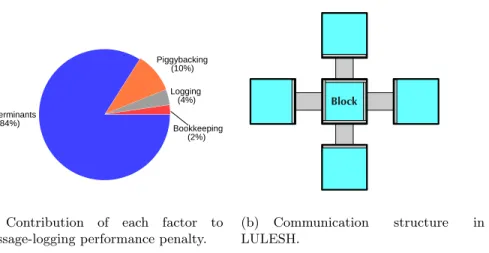
Fig. 1. Performance cost of determinants in LULESH. The main source of the per-formance penalty of message logging with LULESH comes from determinants. The communication structure of LULESH, however, suggests there is a way to avoid deter-minants altogether.
the additional mechanisms that ensure a correct recovery. One of those mecha-nisms is calleddeterminants, which are in charge of storing all information about non-deterministic events.
The focal points of this paper are:
– A description of a particular kind of programs and high level programming language constructs that exposes the determinism in communication (§3).
– The design offast message-logging, a protocol that removes all determinants in this type of programs (§4).
– A comparative evaluation between simple causal message-logging and fast message-logging is offered (§5).
2
Background
Rollback-recovery is the most popular strategy to build resilient applications in HPC. In the usual form, called checkpoint/restart, a program starts execution and periodically stores its global state. If a failure strikes the system (failures are assumed to be permanent), the application rolls back to the previous checkpoint and resumes from that point. If messages are also stored, then the failure of one component only requires the rollback of the tasks running on that component. Messages can be replayed to the recovering element until it reaches a consistent state with the rest of the system. Therefore, in most of HPC implementations, message logging requires checkpoints to be taken at global synchronization points and messages to be stored at the sender side.
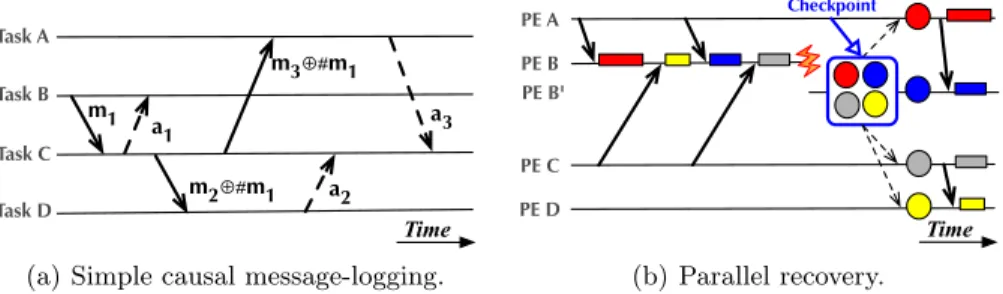
There are several variants of message logging [3], which differ in the way they handledeterminants. Since message logging provides local rollback (i.e. only the failed tasks must roll back to the previous checkpoint), certain non-deterministic decisions must be stored to provide a consistent recovery. Determinants repre-sent those decisions and protocols become piece-wise deterministic. Figure 2(a) shows an example of a protocol called simple causal message-logging [7]. Assume an application is composed by several tasks, fromAtoD. Message reception is, in general, non deterministic. Therefore, every message reception will generate a determinant. For instance, message m1 from B to C generates determinant
#m1. That determinant stores the order in which message m1 was received at
C and it will be necessary for recovery as long as other events in the system causally depend on that. Therefore, determinant #m1 will be piggybacked on
outgoing messages fromCuntil an acknowledgmentaiconfirms the determinant has been safely stored somewhere else. The simple causal message logging proto-col tolerates a single task failure but works in the general case. More advanced message-logging protocols bank on certain properties of HPC applications to re-duce the number of determinants generated. For instance, a program may show
send determinism [4] if the sequence of send events is always the same for every valid execution. Such program may use a protocol that avoids creating some determinants and thus reduces the overhead of the protocol.
m1
m2⊕#m1
a1
a2
a3 m3⊕#m1
Task A
Task B
Task C
Task D
Time
(a) Simple causal message-logging.
Time
PE A
PE B'
PE C
PE D PE B
Checkpoint
(b) Parallel recovery.
Fig. 2. Message logging leverages the overdecomposition property of the parallel-objects programming model.
represented by a set of processing entities (PE) interconnected through a fast network that does not guarantee FIFO ordering. The number of objects usu-ally exceeds the number of PEs in the system and the environment is said to be
overdecomposed. The ratio between objects and PEs is calledvirtualization ratio. Since the location of an object is irrelevant to the programmer, a smart runtime system may decide to migrate objects between PEs. Some goals of migration include load balancing, proactive fault tolerance, and reduction of power con-sumption. The parallel-objects model has been implemented into Charm++ [5], a C++ language extension. It is precisely overdecomposition what gives parallel objects an edge on message logging. As shown in Figure 2(b), if PEBholds 4 ob-jects (represented by the colored circles), the recovery of PEB(replaced byB0) can be done concurrently. This is calledparallel recovery and entails migrating objects in the recovering PE to other PEs during recovery.
In this paper we explore a scripting language that makes the control flow explicit. This is a language extension to Charm++ that provides certain struc-ture and tame the relative flexibility in which messages can be processed at their destination in the parallel-objects model. These extra constructs in the language are referred as SDAG orstructured dagger. Using programs written in SDAG, we aim to reduce the number of determinants generated in the program and reduce the total execution-time overhead of message-logging.
3
Removing Determinants in Parallel Programs
In the parallel-objects model, each message has atype, determined by the particular method that gets triggered when it is received. Thus, it is possible to distinguish between two messages based on their type. Furthermore, messages of the same type can also be differentiated by the particular combination of sender object and receiver object. Finally, each message may carry atag (called
reference number in SDAG) that is used to decide whether to process a message at reception. The tag can be used to further separate two otherwise identical messages. The combination of type, sender, receiver, and tag is an essential component of a message-logging infrastructure.
The parallel-objects model is able to express a wide variety of parallel pro-grams. In particular, it is very well suited for a class of programs named as
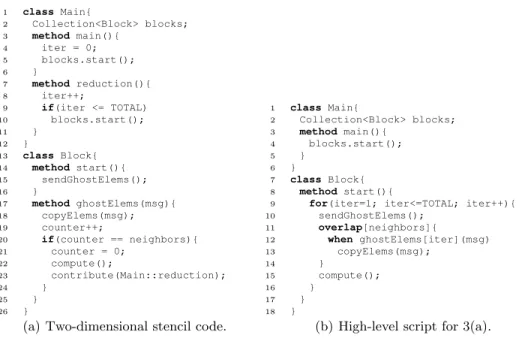
stencil codes. These programs are iterative kernels that update elements on a grid in a very structured way. Partial differential equations (PDEs) are a good source for this type of codes. Usually, to numerically solve a PDE, a discretized version of the space is required. The space can thus be represented by a grid or mesh. Other types of stencil codes are used in image processing, computational fluid dynamics, and other kinds of scientific simulations. The nature of stencil codes consists of applying an operation to all the points in the grid until some convergence criteria is met or after certain number of iterations have been com-pleted. In a parallel implementation of this type of codes, the whole grid is split intoblocks. Each processing element holds a subset of the blocks. The computa-tion proceeds by iteratively exchanging some values between neighboring blocks, applying an operation over the elements in the blocks and following to the next step. Most of the time, the values exchanged between blocks correspond to the neighboring elements of each block. The communication is very structured and does not change during the execution. The namestencil actually comes from the fixed pattern in which message exchange takes place. A program formulated in the parallel-objects model is shown in Figure 3(a).
Two types of objects are shown:MainandBlock. The former orchestrates the execution of the total number of iterations in the program. It initially broad-casts the messagestartto all blocks (line 5). The latter represents each block and handles exchanging messages between all the blocks. Each iteration starts by sending the ghost elements to the neighbors (line 15). Then, each block must keep track of how many ghost-element messages it has received. Once the counter has reached the total number of neighbors, the block proceeds to apply the com-putation to its elements. At the end of every iteration (line 23), all the set of blocks contribute to a reduction that returns the control to Main. The cycle starts again until the total number of iterations is completed. Note that the re-duction after each iteration is inevitable in this model. Since the channels are not FIFO in delivering the messages, then it is possible for a couple of messages be-tween neighboring blocks to go out-of-order. Therefore, a synchronization must be used to avoid such scenario. The reduction effectively separates messages from consecutive iterations.
1 class Main{
2 Collection<Block> blocks;
3 method main(){
4 iter = 0;
5 blocks.start();
6 }
7 method reduction(){
8 iter++;
9 if(iter <= TOTAL)
10 blocks.start();
11 }
12 }
13 class Block{
14 method start(){
15 sendGhostElems();
16 }
17 method ghostElems(msg){
18 copyElems(msg);
19 counter++;
20 if(counter == neighbors){
21 counter = 0;
22 compute();
23 contribute(Main::reduction);
24 }
25 }
26 }
(a) Two-dimensional stencil code.
1 class Main{
2 Collection<Block> blocks;
3 method main(){
4 blocks.start();
5 }
6 }
7 class Block{
8 method start(){
9 for(iter=1; iter<=TOTAL; iter++){
10 sendGhostElems();
11 overlap[neighbors]{
12 when ghostElems[iter](msg)
13 copyElems(msg);
14 }
15 compute();
16 }
17 }
18 }
(b) High-level script for 3(a).
Fig. 3.Program structure of a two-dimensional stencil code. Each block exchanges the ghost elements with its neighbors in each step. There is an asynchronous barrier after each iteration in 3(a). Its high-level script counterpart in 3(b) removes the synchro-nization reduction after each iteration, and handles message reordering by tagging each message with an iteration number.
regarding the order in which messages are going to be received. Thecounter
in Figure 3(a) reflects the palliative effort in the program to allow concurrency but avoid erroneous receptions. The same effect can be achieved through a high-level script language that expresses the control dependencies between certain types of events. Additionally, this script language must retain the advantages of the reactive characteristic of objects in the program. To illustrate the way a high-level description would work with the same example as in Figure 3(a), we show the new version of the code in Figure 3(b).
(line 11) has neighbors as a parameter, meaning it allows the reception of theghostElemsmessages in any order. This clearly expresses the structure of the code, that requires the ghost data from all the neighbors before perform-ing the computation. The second grammatical construct is thewhenstatement that specifies a message type and a tag (line 12). In the example the message type corresponds to the transmission of ghost elements and the tag matches the iteration number. Using tagging removes the need of a synchronization call af-ter every iaf-teration, because it separates messages from different iaf-terations with otherwise equal type, sender and receiver.
The code in Figure 3(b) makes explicit the messages that must be received before the computation can take place. It defines the control dependencies in the program. Given that message receptions are specified in the code, this high-level description promotes a receiver centric view of the program. However, it still retains the flexibility of the model by allowing different reception orderings via the overlap construct. Permitting different sequences of message receptions may be a source of non-determinism. However, if the behavior of the program is the same, regardless of the reception order of messages within an overlap
region, then we say the statements in the regioncommute and any ordering in the reception of those messages is always correct. Note that different sequences of message receptions may lead to a different order of message emissions. However, a different order in the sending of messages is natural in the system model. The receiver has to ensure that messages are actually processed in the right order.
Expressing more clearly the control and data dependencies in the program not only permits eliminating artificial synchronization calls, but effectively re-moving determinants. The reason of existence of determinants is to guarantee a consistent recovery. Therefore, determinants ensure messages are received in the same order during recovery as they were before the failure. Additionally, the combination ofhsender, receiver, ssniis used in discarding duplicate messages. In the stencil code for the two-dimensional stencil of Figure 1(b), it is possible to avoid the generation of determinants if a high-level script is used. Figure 3(b) shows that aBlockwould receive the four messages from its neighbors in every iteration before computing and sending out the messages for the next iteration. If a blockαwould be recovering, then the high-level structure of the code would order all the messages being resent from the other objects. No determinants are required to guarantee a successful recovery. The other objects should, neverthe-less, discard duplicate messages.
Using the stencil code as an example, we provide a list of conditions for the total elimination of determinants in a program expressed in a high-level language:
2. Commutative overlap regions.The statements inoverlapregions must commute.
3. Explicit causal ordering. The program must make explicit the causal order between two messages.
In addition, if determinants disappear from the message-logging layer, it must be guaranteed that all internal structures in the runtime system are still correct. This includes all the data structures for load balancing, checkpointing, collective communication operations, etc.
4
Fast Message-Logging Protocol
Using the insight from the previous section and the background work of Sec-tion 2, we present a new breed of message-logging protocols. We name it fast message-logging because it focuses on accelerating the three sources of overhead in a resilience solution: forward path, checkpointing, and recovery. This is brief justification about why it is fast message-logging:
Fast forward-path By removing determinants from an execution, it reduces the slowdown of message-logging. According to Figure 1(a) determinants are the main source of overhead, so eliminating them should bring the perfor-mance overhead to a minimum.
Fast checkpoint It uses local checkpoint to avoid checkpoint-time congestion in the file system. This reduces the robustness of the system, but just by a tiny margin, given that most failure in HPC systems only involve a single node [8].
Fast recovery It uses parallel recovery to accelerate the recovery of the failed components.
Network
Message-Logging Layer Message logging Message replaying Duplicate-message suppression
High-level Layer Message buffering Valid message delivery
Application
<sender,receiver,ssn> <type,iteration>
(a) Separation of concerns with the fast message-logging protocol.
Piecewise-deterministic
Send-deterministic
Receive-deterministic
(b) Relationships between piecewise,
send and receive determinism.
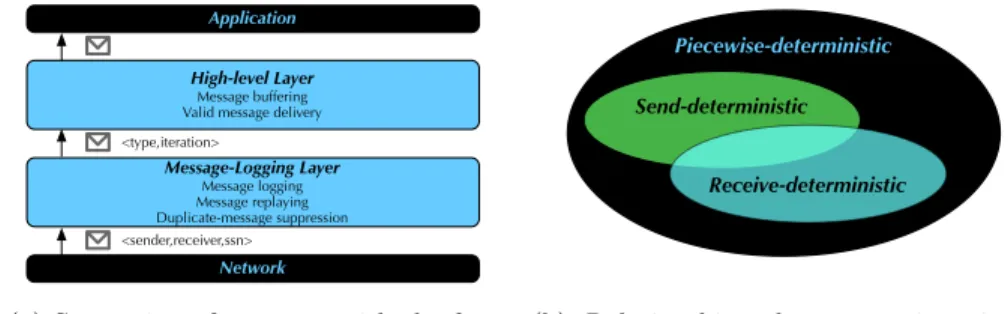
Fig. 4. Fast message-logging protocol. The functionalities of the protocol are split with the high-level scripting infrastructure. The type of programs that can run with this protocol overlap send-determinism and require piece-wise determinism.
4.1 Algorithmic Description
The fast message-logging algorithm assigns a message identifiermsgIDto each message. There are various sources for this identifier. If the application is send-deterministic, the protocol may assign a sender sequence number (ssn) to each message based on the combination hsender, receiveri. If the application is a receive-deterministic stencil, the msgID can be the concatenation of iteration and message type. Otherwise, the message type and the tag associated with that message will form the identifier for the message.
There are a handful of major data structures that keep the protocol correct. The structureidTablereturns themsgID for each message and combination ofhsender, msg, receiveri. For each of the cases explained above, that structure will return a unique identification for each message. The structure dupTable
determines whether a message is a duplicate or not. Again, depending on the properties of the application, this structure can be optimized to improve perfor-mance. The structuremsgLogstores all messages sent between the PEs. Finally, a couple of lists keep track of objects that have been distributed to other PEs for parallel recovery. If an object α resides in a PE A that crashes, α might be sent to other PEB for recovery. In that case, we refer toαas an emigrant
from the perspective ofAand as an immigrant from the perspective ofB. The
sets listImmigrantsand listEmigrantsstore the list of objects in each
category, respectively.
Algorithm 1FastMessageLogging
1:procedureSend(α, msg, β) .Objectαsendsmsgto objectβ
2: id←idTable.getID(α, msg, β)
3: msg.id←id
4: msg.sender←α
5: msg.receiver←β
6: msg.incarnation←IncarnationNumber
7: if α.PE6=β.PEthen
8: msgLog.add(msg) .Storing remote message
9: end if
10: NetworkSend(msg)
11: end procedure
12: procedureReceive(α, msg, β) .Objectβreceivesmsgfrom objectα
13: num←msg.incarnation
14: ifOldIncarnation(num)then
15: DiscardOld(msg) .Ignoring old message
16: end if
17: f lag←dupTable.getFlag(α, β, msg.id)
18: iff lagthen
19: DiscardDuplicate(msg) .Ignoring repeated message
20: return
21: end if
22: Process(msg) .Forward to high-level layer
23: end procedure
24: procedureCheckpoint .Called at PEA
25: Send all objectsαinlistImmigrants 26: Wait for all objectsαinlistEmigrants 27: ckptM sg← {}
28: msgLog.clean()
29: for allobjectsαdo
30: ckptM sg.add(α.state)
31: NetworkSend(ckptM sg)
32: end for
33: end procedure
34: procedureRestart(A) .Received at every PE except forA
35: for allobjectsαinAdo
36: Send all messages bound toαinmsgLog 37: end for
38: end procedure
39: procedureRecovery .Called at PEA
40: for allobjectsαinAdo
41: Distributeαto a PE in{A1, A2, ..., AP}
42: AddαtolistEmigrants 43: end for
44: end procedure
Fast message-logging relies on globally coordinated synchronized checkpoint. The programmer uses global synchronization points in the application to trig-ger the checkpoint calls. ProcedureCheckpointpresents the steps included in the checkpoint process. First, all immigrant objects are send back to their orig-inal PEs. These objects may have been migrated to a PE for parallel recovery purposes. Next, a PE waits for all its emigrant objects to arrive. The message log is cleaned up and a new checkpoint message is built with the state of all the objects. Once a failure has been detected, the runtime system notifies the rest of the PEs about the crash of one PE. Let us assume PE Afails. The fail-ure notification activatesRestart in other PEs, which replay the messages in
msgLogbound to objects in PEA. Concurrently, PEAexecutesRecoveryto
0.3 0.35 0.4 0.45 0.5 0.55 0.6
1 2 4 8 16 32 64 128 256
Iteration Time (s)
Virtualization Ratio Causal
Fast Base
(a) Wave2D.
0.15 0.2 0.25 0.3 0.35 0.4 0.45 0.5 0.55 0.6
1 2 4 8 16 32 64 128 256
Iteration Time (s)
Virtualization Ratio Causal
Fast Base
(b) Jacobi3D.
2 2.2 2.4 2.6 2.8 3 3.2 3.4
1 2 4 8 16 32 64 128 256
Iteration Time (s)
Virtualization Ratio Causal
Fast Base
(c) LULESH.
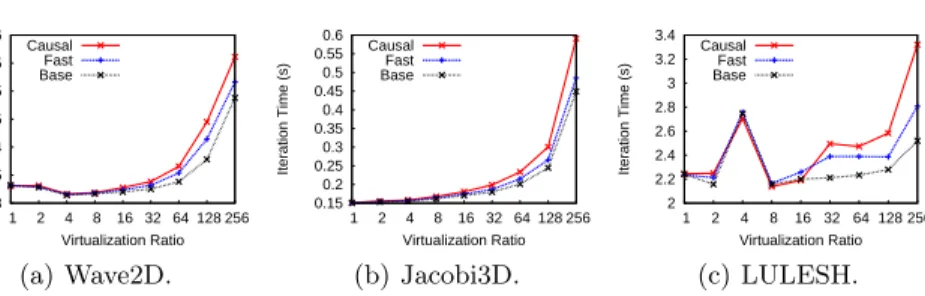
Fig. 5.Effect of virtualization ratio on performance. Stencil codes admit a high virtu-alization ratio without sacrificing a significant portion of its performance.
5
Experimental Results
In order to understand the performance penalization imposed by the fast message-logging protocol, we examined three stencil codes: Wave2D, Jacobi3D and LULESH. These programs were implemented in SDAG to decrease execution time (since barriers between iterations are not needed anymore) and allow the possibility of removing determinants.
We first examine the effect of virtualization ratio on each program. Recall from Section 2 that virtualization ratio stands for the average number of objects per PE. For this experiment, each PE is a core. Figure 5 presents the results on 1,024 cores of Intrepid supercomputer at Argonne National Laboratory (ANL). Each data point reflects the average of 5 repetitions of the same experiment. Wave2D in Figure 5(a) seems to manifest that Wave2D benefits from virtual-ization. In fact, the performance of the program stays within a 5% difference up to 32 objects per core. A similar behavior occurs in Jacobi3D in Figure 5(b), except in this case the program is always slightly slowed down by virtualization. Again, the average iteration time stays within a 10% margin up to 32 objects per core. Finally, Figure 5(c) accepts a higher virtualization ratio without a sig-nificant performance degradation. Even 128 objects per core stays within a 3% margin. Having a high virtualization ratio is beneficial for applications in view of the eminent thermal variation of future systems. With more objects per core, it is possible to obtain a better load balance in case some of the PEs have to be slowed down to reduce their temperature.
0 2 4 6 8 10
1K 2K 4K 8K 16K
Performance Overhead (%)
Number of Cores Causal Fast (a) Wave2D. 0 2 4 6 8 10 12 14
1K 2K 4K 8K 16K
Performance Overhead (%)
Number of Cores Causal Fast (b) Jacobi3D. 0 2 4 6 8 10 12 14 16 18
1K 2K 4K 8K 16K
Performance Overhead (%)
Number of Cores Causal
Fast
(c) LULESH.
Fig. 6.Performance overhead of fast message-logging. It approximately reduces per-formance overhead to a half when compared with causal message-logging.
2 4 6 8 10 12
2 4 8 16 32
Recovery Speedup
Number of Cores in Parallel Recovery
(a) Wave2D. 1 2 3 4 5 6 7 8
2 4 8 16 32
Recovery Speedup
Number of Cores in Parallel Recovery
(b) Jacobi3D. 1 2 3 4 5 6 7 8
2 4 8 16 32
Recovery Speedup
Number of Cores in Parallel Recovery
(c) LULESH.
Fig. 7.Parallel recovery in fast message-logging. The more cores are used to recover, the faster the recovery.
the fast and causal variants increases to the point where the overhead of fast message-logging is around 15% of the overhead of causal.
An important feature of the fast message-logging protocol is it ability to work in conjunction with parallel recovery. Section 2 introduced parallel recovery. The more PEs help in recovery, the faster it is expected the failed PE will catch up with the rest of the system. There are, however, a couple of considerations to keep in mind. First, the number of PEs helping in recovery cannot exceed the virtualization ratio. Second, it is possible to have diminishing returns with the addition of more PEs. This latter effect results stems from the fact that more PEs involve sending more remote messages and potentially hitting network bot-tlenecks. Figure 7 shows for the 3 applications the speedup in recovery when the number of PEs helping ranges from 2 to 32. Wave2D offers the best scenario for parallel recovery. This is due to its relatively simple communication characteris-tics. Therefore, spreading the objects to more PEs results in a greater speedup. Both Jacobi3D and LULESH present moderate speedup levels during recovery.
0 5 10 15 20 25
8K 16K 32K 64K 128K
Performance Overhead (%)
Number of Cores Causal
Fast
(a) Performance Overhead.
0 50 100 150 200 250 300 350 400
8K 16K 32K 64K 128K
Checkpoint Time (milliseconds)
Number of Cores
(b) Checkpoint Time.
5 10 15 20 25 30 35
8K 16K 32K 64K 128K
Speedup
Number of Cores
(c) Speedup.
Fig. 8. Large strong-scale experiment with LULESH. Fast message-logging keeps a low performance overhead, fast checkpoint and fast recovery, compared to check-point/restart.
Program Remote Generated Piggybacked Determinants
Messages Determinants Determinants per Message
Wave2D 72.90 144.40 317.59 4.36
Jacobi3D 141.10 214.80 870.78 6.17
LULESH 3181.85 4295.55 32411.52 10.19
Table 1.Average statistics on messages and determinants per iteration.
in milliseconds. Figure 8(b) offers the checkpoint time as the program is scaled. Based on the runtime-level checkpoint and in-memory checkpoint, the dump of the state of an application is fast. Finally, the speedup over checkpoint/restart is reported in Figure 8(c). For this case, the program runs for two checkpoint periods (for an arbitrary checkpoint interval), with a failure injected in the sec-ond one. The speedup reported in the figure correspsec-onds to the total execution time of fast message-logging versus checkpoint/restart.
6
Related Work
The seminal work on send determinism [4] provided a clear insight on the fu-tility of creating determinants for all message receptions. Protocols based on that property rely on FIFO channels. We removed that assumption to use the asynchronous execution model of Charm++. However, to tame the excessive flexibility in the order of message reception, we relied on high level program-ming language constructs. The send-determinism protocol requires to replay the causally-dependent messages in a synchronized fashion, which hampers the abil-ity of message-logging to achieve a faster recovery. By using a reception control mechanism, fast message-logging is able to receive all messages at once and com-pletely sort them in a valid program order. The large scale simulatorBigSim [12] used parallel discrete event simulation (PDES) to make predictions on the perfor-mance of scientific codes for supercomputers. Since BigSim is based on POSE (a framework for PDES), it would allow speculative simulation of different threads of events. In that regard, programs that allow only one possible execution se-quence would find a very efficient simulation. In BigSim, linear order parallel programs are a special kind of codes for which messages are processed in ex-actly one order. A scalable replay system was designed based on an algebraic framework to store partial-order dependencies in message-passing programs [6]. That framework improves on most replay algorithms, which make minimal as-sumptions about the programming model. If some deterministic decisions can be extracted from the programming model, the framework incorporate them into the number of determinants that must be stored. The management of determi-nant of the fast message-logging protocol presented in this paper is a particular case in that algebraic framework. A new design of the message-logging layer for Open MPI [1] revealed a vast amount of determinants that are not necessary to guarantee a safe recovery. By interposing a message-logging substrate between the application and the network layer, this new design is able to create matchings of events posted by the application and arrival events coming from the network. Matchings may be deterministic if the expected sender and the actual sender of the message are the same. Use of wildcards will create non-deterministic matches. By logging only non-deterministic matches, this design is able to dramatically reduce the number of determinants.
7
Conclusion and Future Work
somehow regular and general-case expensive assumptions can be removed. We also plan to use message-tagging to implement the protocol in MPI.
Acknowledgments. This work was partially supported by a machine alloca-tion on the XSEDE under award ASC050039N, and by a machine allocaalloca-tion on Argonne Leadership Computing Facility awarded by the U.S. Department of Energy under contract DE-AC02-06CH11357.
References
1. A. Bouteiller, G. Bosilca, and J. Dongarra. Redesigning the message logging model
for high performance. Concurrency and Computation: Practice and Experience,
22(16):2196–2211, 2010.
2. F. Cappello, A. Geist, W. Gropp, S. Kale, B. Kramer, and M. Snir. Toward exascale
resilience: 2014 update. Supercomputing frontiers and innovations, 1(1), 2014.
3. E. N. Elnozahy, L. Alvisi, Y.-M. Wang, and D. B. Johnson. A survey of
rollback-recovery protocols in message-passing systems. ACM Comput. Surv., 34(3):375–
408, 2002.
4. A. Guermouche, T. Ropars, E. Brunet, M. Snir, and F. Cappello. Uncoordinated checkpointing without domino effect for send-deterministic mpi applications. In IPDPS, pages 989–1000, 2011.
5. L. Kal´e and S. Krishnan. CHARM++: A Portable Concurrent Object Oriented
System Based on C++. In A. Paepcke, editor,Proceedings of OOPSLA’93, pages
91–108. ACM Press, September 1993.
6. J. Lifflander, E. Meneses, H. Menon, P. Miller, S. Krishnamoorthy, and L. Kale. Scalable Replay with Partial-Order Dependencies for Message-Logging Fault
Tol-erance. InProceedings of IEEE Cluster 2014, Madrid, Spain, September 2014.
7. E. Meneses, G. Bronevetsky, and L. V. Kale. Evaluation of simple causal message
logging for large-scale fault tolerant HPC systems. In16th IEEE DPDNS in 25th
IEEE IPDPS, May 2011.
8. E. Meneses, X. Ni, and L. V. Kale. A Message-Logging Protocol for Multicore
Systems. In Proceedings of the 2nd Workshop on Fault-Tolerance for HPC at
Extreme Scale (FTXS), Boston, USA, June 2012.
9. E. Meneses, O. Sarood, and L. V. Kale. Energy profile of rollback-recovery
strate-gies in high performance computing. Parallel Computing, 40(9):536 – 547, 2014.
10. M. Snir, R. W. Wisniewski, J. A. Abraham, S. V. Adve, S. Bagchi, P. Balaji, J. Be-lak, P. Bose, F. Cappello, B. Carlson, A. A. Chien, P. Coteus, N. DeBardeleben, P. C. Diniz, C. Engelmann, M. Erez, S. Fazzari, A. Geist, R. Gupta, F. John-son, S. Krishnamoorthy, S. Leyffer, D. Liberty, S. Mitra, T. MunJohn-son, R. Schreiber, J. Stearley, and E. V. Hensbergen. Addressing failures in exascale computing. IJHPCA, 28(2):129–173, 2014.
11. T. von Eicken, D. Culler, S. Goldstein, and K. Schauser. Active Messages: a
Mechanism for Integrated Communication and Computation. InProceedings of the
19th International Symposium on Computer Architecture, Gold Coast, Australia, May 1992.
12. G. Zheng, G. Kakulapati, and L. V. Kal´e. Bigsim: A parallel simulator for
per-formance prediction of extremely large parallel machines. In 18th International