
The comparative research of travel websites usability between China and western countries
22
0
0
Texto completo
(2) Table of Content Abstract……………………………………………………………………………….1 1. Introduction ................................................................................................ 4 2. Literature Review ....................................................................................... 6 2.1. Usability Definition ............................................................................ 6 2.2. Websites usability to travel and tourism ........................................... 6 3. Methodology .............................................................................................. 7 4. Findings and discussion ............................................................................ 9 4.1. General comparisons ....................................................................... 9 4.1.1. Information Completeness ...................................................... 9 4.1.2. User Interface and Navigation .............................................. 12 4.2. Sectional comparisons ................................................................... 14 4.2.1. Online Travel Agency ............................................................ 14 4.2.2. Directing selling websites ...................................................... 15 5. Conclusion ............................................................................................... 18 6. Acknowledgment ..................................................................................... 20 7. References .............................................................................................. 20. 2.
(3) The comparative research of travel websites usability between China and western countries Minghuan Li. Abstract The booming development of global tourism e-commerce puts forward the travel service providers to establish more professional travel websites to satisfy the need of customers. In this article, selected 30 tourism website were divided into four types. Afterwards, through empirical researches the general comparative study carried out the main differences on the dimension of information completeness and user interface and navigation. Then, aiming at the specialties of the four types of tourism websites, the sectional comparisons will be applied to go deep through of each kind of websites and make more accurate and detailed contrasts. Likewise, preliminary analyses of the causes of the differences are pointed out and some brief advices on the future websites establishment are also proposed. Keywords: Usability, travel websites, China, western countries. 3.
(4) 1. Introduction The recent years saw a continuous increase on the number and information content of travel websites, on amount of the flourishing development of tourism industry. The Internet is one of the main sources of information used by tourists when making travel plans (Buhalis & Law, 2008; Wu, Wei & Chen, 2008). It is said that 2014 the number of online travel bookings, reaching the highest 148.3 million in the whole world (Kate Fitzpatrick, 2014.) Also, China is one of the world’s largest markets for generating and receiving tourists. According to the statistical report from CNNIC (China Internet Network Information Center) on online booking, the total number of online booking service users reached 260 million in the year 2015, representing a 17.1% increase compared with the previous year. Moreover, the total amount of online purchases was 13.1% of all travel-related purchases. As such, there is a huge and emerging e-tourism market in the country. In 2012 alone, some 65% of all tourists entering Spain had used the Internet as an information source for the purposes of their visit (IET, 2013). Spain is one of the leading touristic destinations in the world, just from this small part; it can be throughout to the great majority of countries that the using of website is a common and habitual action when travelers plan the trips. Travel websites performing as basic platform for the operation of tourism electronic commerce play a powerful role in the development of tourism e-commerce. At the same time, the construction of travel websites also determines the success of tourism electronic commerce. As such, Internet development has created numerous new opportunities for tourism practitioners to provide customized information and products to their target consumers in an environment with a high level of interactivity, low costs and high quality of information delivery ( Petti, C. & Ndou, V. 2004). Wootton (2003) demonstrated that poor usability could lead to confusion when browsing websites. Souza, Manning, Goldman and Tong (2000) reported that two-thirds of the visitors leave retail websites because of barriers to usability. It is considerate that maintaining and strengthening the functionality (content richness) and usability (ease of use) can lead to the success of the website, because of the incomparable competitive power. As we can see, both China and western countries pay much attention to the establishment of websites, whereas to date, only a few limited numbers of published articles have been working on the comparisons between Chinese and western travel websites aiming at usability. In view of the importance of usability, it is necessary to analyze the components and make comparisons of travel websites between China and western countries, which will contribute to provide new ideas and innovations on the construction of travel websites.. 4.
(5) Typology of online travel websites To fulfill the research, this study divided the 30 travel websites into four types, namely the perspective of online travel agency, directing selling websites, meta-search websites and user-generated content websites, according to the difference of main business, profit source and operating mode. Table 1 Typology of online travel websites Profit model. China. Western countries. Online travel agency. Products selling. Ctrip, tuniu. Expedia, booking…. Directing selling websites. Products selling. Shangri-la, Airchina. Marriott, Emirates. Meta-search websites. Commission. Qunar. Skyscanner. User-generated content websites. Publicity. Mafengwo, qiongyou. Tripadvisor. The whole tourism websites have characteristics in common in aspects of basic information, tourism service range, language setting, destination information, etc. So the general comparisons will be conducted first, then aiming at the specialties of the four types of tourism websites, the sectional comparisons will go through each kind of websites and make more accurate contrasts.. 5.
(6) 2. Literature Review 2.1. Usability Definition The research of usability has been widely documented in numerous published articles. An early definition of website usability can be dated back to what Nielsen (1993) presented as a comprehensive list of components on the ease of using a website. Nielsen (1993) stated that the term usability refers to the ease of learning how to use an interface, efficiency of an interface design, and ease of memorizing how to use an interface, reduction of errors, and general satisfaction with an interface. ISO (2015) defines the usability as extent to which a product can be used by specified users to achieve specified goals with effectiveness (Task completion by users), efficiency (Task in time) and satisfaction (responded by user in term of experience) in a specified context of use (Users, tasks, equipments and environments). Slightly modified from a general description or to be precise, effectiveness relates to the accuracy and completeness with which customers achieve specific goals, and efficiency refers to the accuracy and completeness of the achieved goals in relation to the resources that are available. Satisfaction is the freedom from discomfort and positive attitudes towards the use of the website (Travis 2003.) 2.2. Websites usability to travel and tourism To investigate visitors’ perception of website performance, many previous researches have been carried out. To demonstrate, Chiu, Lin, and Tang (2005) performed an online purchase intention study. The findings of this research indicated that the factors of personal awareness of security, personal innovativeness, perceived ease of use for purchasing and usefulness have a direct impact on consumers’ online purchases attention. Similarly, Wong and Law (2005) argued that there are three main dimensions for e-consumer behavior, including website information quality, time, and sensitivity content, which can influence and motivate consumers’ purchase attitudes and hence their purchase decision making. Leporini and Paterno (2003) identified 16 criteria to improve the usability of websites for users. These criteria were grouped into the three sub-sets of effectiveness, efficiency, and satisfaction. Also, Leporini and Paterno considered the criteria for effectiveness to be more important than those for efficiency and satisfaction, because failure to satisfy “effectiveness” could result in users not being able to accomplish the tasks. These findings will provide more insight on the comparisons between Chinese and western travel websites .As has been said the specific objective of this 6.
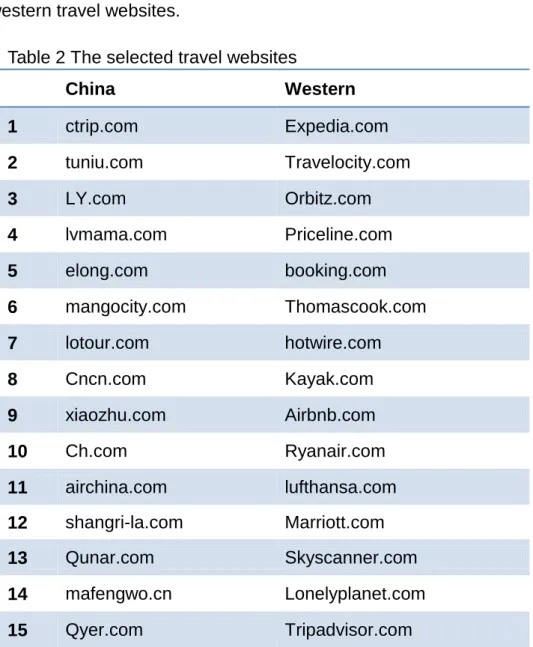
(7) research is to analyze the usability of travel websites.. 3. Methodology The methodology used in this study comprised a comparative content analysis of selected websites that offer travel service between Chinese and western countries. In this paper, from the perspective of empirical research, the most commonly used search engine Baidu in China and Google in western countries were used by typing keywords TRAVEL to search out the very top list of most visited travel websites and also refer to the real list of Top 15 Most Popular Travel Websites on eBizMBA Rank. Finally, 15 Chinese travel websites and 15 western travel websites are chosen. The primary select standard was workable websites that engaged in online travel services. In addition, according to the typology of travel websites, these websites included nine online travel agencies, three directing selling websites (one budge airline website, one airline websites and one luxury brand hotel websites), one meta-search websites and two user-generated content websites on Chinese and west part, respectively .(see table 2). Furthermore, prior to the website evaluation process and drawing on the findings of prior studies, a framework on travel websites usability comparison was formulated, which hypothesized that the overall usability of a travel website is determined by certain criteria. In consideration of all the selected travel websites that have characteristics in common, for the general comparison, the criteria were further divided into two dimensions, namely 1) Completeness of Information, 2) user interface and navigation. Moreover, each of these dimensions consists of multiple attributes that measure the usability of travel website. The list of attributes for the proposed framework was developed by adapting related prior studies. The division of dimensions was consulted the checklist developed by Rob Law (2006),who carried out an empirical research by comparing the online hotel reservation information quality among north American-based, European-based, and Asia pacific-based websites. The dimensions of overall quality of information were divided into information completeness, navigation quality, and ease of use. Each dimension comprised several attributes such as customer support, member, advanced search, etc. This report adopted certain attributes for reference, for example, member and customer support and mainly integrating the survey target established the framework. After the research attributes were designed, visits and investigation were paid to the 30 travel websites one by one. Within this context, Using statistics and induction method to the research, the results of the survey were analyzed. At the same time, the research methods such as comparison, deductive reasoning were also carried on to make the comparative study through the two dimension, completeness of information such as language selection, basic 7.
(8) information, customer support, destination information ,etc and user interface and navigation such as, search filter, payment method, friendly Image ,etc. Then, aiming at the specialties of the four types of tourism websites, the sectional comparisons will be applied to go deep through of each kind of websites and make more accurate and detailed contrasts between Chinese and western travel websites. Table 2 The selected travel websites China. Western. 1. ctrip.com. Expedia.com. 2. tuniu.com. Travelocity.com. 3. LY.com. Orbitz.com. 4. lvmama.com. Priceline.com. 5. elong.com. booking.com. 6. mangocity.com. Thomascook.com. 7. lotour.com. hotwire.com. 8. Cncn.com. Kayak.com. 9. xiaozhu.com. Airbnb.com. 10. Ch.com. Ryanair.com. 11. airchina.com. lufthansa.com. 12. shangri-la.com. Marriott.com. 13. Qunar.com. Skyscanner.com. 14. mafengwo.cn. Lonelyplanet.com. 15. Qyer.com. Tripadvisor.com. 8.
(9) 4. Findings and discussion The website evaluation process conducted in the period from March to May of 2016. And each of the selected websites was visited and investigated for the usability. 4.1. General comparisons 4.1.1. Information Completeness The US intelligence expert Peter Morville (2003) considered that information architecture is an art and science of information organization and interface, including the design of organizational systems, identification systems, navigation and retrieval systems. It aims to help users more successfully search and manage information more effectively to meet the information needs of users. Therefore, as a tourist website , plenty of repeated revisiting consumers are an important manifestation of the website’s popularity, and the key to attract the consumer is the service content and information the website provided are able to meet the various requirements levels of different customers. The first dimension, information completeness, comprised 11 attributes, with respect to the information architecture of the website and the extent to which users can find the information they needed. The table 3 presents the evaluative empirical findings of the 30 websites. Table 3 Result of the Completeness of Information Number and percentage the website offers China Western Countries Attributes Number Percentage Number Percentage n=15 % n=15 % 1 Member Not necessary 13 86.7 14 93.3 Necessary before information search 1 7 1 7 Necessary after information search 1 7 0 0 & reservation stage 2 Language 1)Language selection Only one version 9 60 1 7 Between 2-5 3 20 3 20 More than 5 3 20 11 73.3 2)Correct spelling and grammar 15 100 15 100 3 Basic information(Obvious name/Logo,address,contact number) Yes 15 100 15 100 No 0 0 0 0 9.
(10) 4 Customer Support(Clear contact information to offer feedback). Available Not available. 15 100 15 0 0 0 5 Destination information (Transportation, Weather, Exchange rate) Yes 12 80 8 No 3 20 7 6 Promotion plan Partner Link 10 66.7 7 Point Reward 10 66.7 8 Others 7 46.7 2 7 Brand publicity Yes 6 40 5 No 9 60 10 8 Updated information Constantly 14 93.3 12 Sometimes 1 7 3 Seldom 0 0 0 9 Online community(Forum) Yes 10 66.7 5 No 5 33.3 10 10 Service range International & Domestic 14 93.3 15 Only Domestic 1 7 0 11 After-sale service Leaving message 8 53.3 11 Contact number 14 93.3 12 Email address 14 93.3 12 Online window 4 26.7 2 Others (social network) 10 66.7 3. 100 0 53.3 46.7 46.7 53.3 13.3 33.3 66.7 80 20 0 33.3 66.7 100 0 73.3 80 80 13.3 20. The empirical results indicated that the Chinese and western travel websites achieved different levels of quality on providing information. A significant difference among these two regions was seen regard to the attribute of language. The rates of travel websites that own more than five language settings are 20% and 73.3%, China and western countries respectively, which is the biggest difference among all the attributes of information completeness. Western travel websites normally automatically converted local language basing on the users IP address, but for Chinese travel websites, users need to change the language themselves on the language setting area. In particular, 80% of Chinese websites offered destination information no matter just in short form of weather and time o edited into a local guide book, whereas the corresponding figures for western countries was 53.3%. Similarly, around 66.7% Chinese travel websites establish online community for users to share travel experience or offer local travel information, comparing with 33.3% 10.
(11) among western travel websites. In addition, significant difference between the two parts was seen in attributes 11, Chinese travel websites prefer to offer obvious contact number information to after-sale service with figure of 93.3% and provide the connected social network as a channel for customer to solve after-sale service with figure of 66.7%, nevertheless, the western travel websites accounting for 73.3% normally hope customer to leave message. And as for after-sale service or consultation, Chinese travel websites occupying 26.7% offer live chat service while western travel websites up to 13.3%. Generally speaking, most websites provided an adequate level of usability on dimension of information completeness included attributes. Travel websites normally do not require users to be members to search for information, although registered members can obtain more discounts while purchasing the travel products on certain websites or enjoy the personalized content recommendation. As for the big gap of selectable language amount, in the majority of destinations, potential clients come from very different cultures and China has become the fourth most visited country in the world according to the data collected by UNWTO. It is recommended that Chinese websites pay much attention to the establishment of multiple language offering, also regular inspections of spelling and textual accuracy should be carried out to maintain the credibility of the travel websites to meet the language needs of external tourists, which is demonstrated by Catherine (2009) that correct spelling and grammar had a higher impact on website users. Trust can also be developed if website designers can fulfill the expectations of users. In terms of destination information and online community, the destination travel information relating to transportation, weather, currency rate, gourmet, etc. is vital to independent tourists. Normally, if the travel websites are able to provide more abundant travel information, it is more attractive to users, which work in increasing user stickiness, namely the user’s loyalty to websites. Nowadays, Chinese websites are trending to establish one-stop service websites so that users can achieve destination information collection, product comparison, booking confirmation, comments sharing, and all other aspects of the decision-making behavior within the same platform. Therefore, establishing online community can be considerate a way to facilitate the users and increase user stickiness. Moreover, the travel websites that offer live chat consultation and real-time mutual communication service can help to solve the problem while the users encountered questions that needed urgent answer. This interactive function makes users feel the overall complete functionality of the website, to be precise, the website information content are provided with availability, interactivity and use efficiency, which meet the different needs of the different users, and give users excellent user experience. But as we can see from the result above seldom Chinese and western travel websites pay attention to this 11.
(12) aspect.. 4.1.2. User Interface and Navigation The second dimension, user interfaces and navigation, refers to the simplicity of moving through the content around the website and the availability of simple and clear directions for use. Six attributes that were included indicating significant differences between the Chinese and western websites performance. The results of user interface and navigation dimension among 30 travel websites are indicated in Table 2.. Table 4 Results of user interface and navigation Number and percentage the website offers China Western Countries Attributes Number Percentage Number Percentage n= 15 % n= 15 % 1 Friendly Image (Key information, easy to read, images, printer friendly). Friendly 15 100 15 100 So-so 0 0 0 0 Not friendly 0 0 0 0 2 Search filter amount (Detailed filter, quick result ) Less than 5 10 66.7 7 46.7 Between 5-10 5 33.3 7 46.7 More than 10 0 0 1 7 3 Easy Navigation (clear text links, consistent, search tool and sitemap) Yes 15 100 15 100 No 0 0 0 0 4 Custom Search Available 14 93.3 9 60 Not available 1 6.7 6 40 5 Payment method Credit card 15 100 15 100 E-payment 13 86 11 73.3 Offline payment 6 40 5 33.3 Others(gift cards, etc) 7 46 3 20 6 Preference recommendation Available 6 40 11 73.3 Not available 9 60 4 26.7. 12.
(13) Somewhat similar to the first dimension, the empirical results indicated that the Chinese and western travel websites achieved different levels of quality on provided information. As we can see from the table, both the Chinese and western travel websites maintain the excellent performance on attributes of friendly imagine and easy navigation. The obvious difference take place among the attributes search filter, custom search, and another payment method and preference recommendation. The amount of search filter is calculated based on the hotel reservation interface. The percentage of Chinese travel websites that set less than five filtering selection account for 66.7% while western travel websites offer more filtering choice for users to get targeted information in less time with the figure of 46.7%. With respect of custom search, the percentage of availability for custom search of western travel websites is lower than Chinese travel websites with figure of 93.3% and 60%, respectively. Also, implying online payment to purchase online booking product is an important driving force to online booking development, and the backward of the means of payment will impede the online booking website development. As expected, credit cards were the mostly commonly accepted means of payment. All the travel websites support the credit card as a way to guarantee the travel products purchase; most websites accept E-payment and some websites take in offline payment. Whereas, Chinese travel websites are available another newly payment methods such as installment payment plan up to 26.7% of selected travel websites. Final attributes of preference recommendation,73.3% western travel websites now apply the network technical support, recording, seeking, filtering and notifying information for the users based on individual preferences, compared by a low ratio of 40% among Chinese travel websites.. 13.
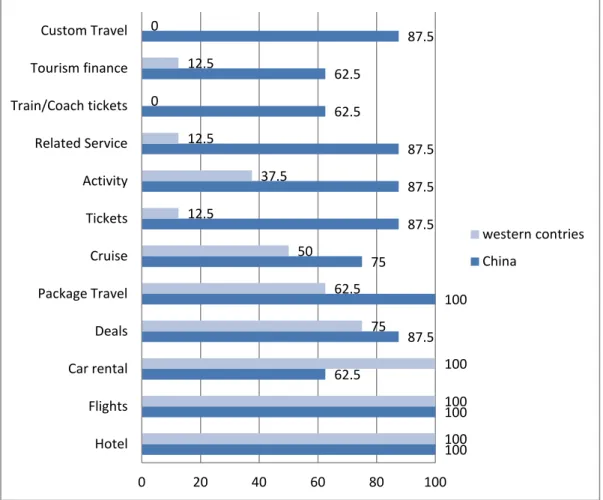
(14) 4.2. Sectional comparisons 4.2.1. Online Travel Agency Product type and bundle deal are taken into consideration on online travel agencies section through the comparison among eight online travel agencies (due to single rental apartment service, airbnb.com and Xiaozhu.com these two websites were excluded).. 0. Custom Travel. 87.5 12.5. Tourism finance. 62.5. 0. Train/Coach tickets. 62.5 12.5. Related Service. 87.5 37.5. Activity. 87.5. 12.5. Tickets. 87.5 50. Cruise. China. 75 62.5. Package Travel. 100 75. Deals Car rental. western contries. 87.5 100. 62.5. Flights. 100 100. Hotel. 100 100 0. 20. 40. 60. 80. 100. Figure 1 Comparison of Product Type. In terms of product type on online travel agency section, twelve common travel products were taken into consideration to compare the product range between Chinese websites and western websites. As is shown in the Figure 1, all the Chinese OTA and western OTA provide the basic hotel and flights products. However, the car rental in western countries has become one basic and mature travel purchase product, so all the western OTA offer the car rental service, but the car rental service is a newly developing travel product, therefore as we can see from the graph, only 62.5% OTA present this service on their webpage. To the contrary, all the Chinese OTA operate package travel product but the figure for western OTA was 14.
(15) 62.5%. The main differences were among three attributes, namely related service, bus/train tickets and custom travel. The related service referring to the service customers needed when plan and go ahead their travel, includes insurance purchase, visa processing, transfer car ,guide, etc. The figure 87.5% (china) and 12.5 % (western countries) obviously indicated that Chinese OTA offer more complete service than the western OTA to satisfy various needs of customers. Secondly, it is somewhat surprising to note that 62.5% Chinese OTA are able to agent to sell bus or train tickets, whereas the figure for the western OTA is 0. Personalized travel is the trend of online travel, as we can see; none of the western OTA offered this service, but the service was available on up to 87.5% Chinese OTA. Recent two years, the Chinese OTA launched the custom travel service aiming at company incentive travel and individual personal tailor travel. It also should not be ignored that tourism finance as a new product in China develops early and deeply than the west. After the tourism joining the finance, tourists will pay less on the travel fees when paying by certain bank card and bring in interests through deposit while traveling. Tourist can enjoy more convenient and efficient travel services also enhance the travel experience of the tourists. The combination between Internet finance and online travel can contribute to good benefit, so the western OTA can consider the possibility to develop similar service. The rest attributes achieved a similar level of service provision. On the other hand, the bundle deal is one of market strategy for OTA to sell travel products. Such a product was made available on 50% and 75% of the Chinese OTA and western OTA, respectively.. 4.2.2. Directing selling websites Then, a comparable performance in terms of usability on directing selling websites between the two regions was generally seen through the comparison of Ch.com, airchina.com and shangri-la.com with ryanair.com, lufthansa.com and Marriott.com Firstly, after the visiting of two luxury hotel websites, it can be seen that both two websites own clear navigation for users to select the time and place to check the availability of room. Chinese websites tend to use slide show to present broadsheet picture to encourage the purchase desire of customers with text as less as possible. In contrast, western luxury hotel websites prefer to use several pictures and obvious text to present the top deals to attract the customers. Then, for the airline websites,the home page design of large-scale airline websites generally is simple and neat and includes three categories highlight content, namely flight ticket inquiring service, deals advertisement, online check-in service. The feedback and after-sale service are important for airline 15.
(16) companies to maintain the customers, it is remarkable that the customer support items are put on the evident location of home page and is very effective for customers to obtain help in time. Moreover, the home page is normally organized in single-screen page and easy operation to availably afford the information the visitors demand. Especially, the budge airline websites offer more information than the large-scale airline websites. They adopt bold text to emphasize the price to attract the attention of visitors and several colorful pictures presenting service deals such as caterings, luggage purchase and gift cards to encourage the consumptions. The home page commonly can drop down a few screens and offer more discount information. The results clearly indicate that airline websites, especially the bigger ones, are getting more prominence in websites establishments. But the empirical findings of this study show the different organization between Chinese airline websites and western airline websites. Firstly, it refers to the home page publicity that western airline websites pay much attention to promote its own brand image or characteristics, but Chinese airline mainly spread promotion activities to promote its products. Next, as for the horizontal menu design, the western airline websites perform better to be more concise comparing the lower degree of distinction of Chinese airline websites.. 4.2.3. Meta-search websites According to the essay of Michael McCartan(2014) ,in a study by TripAdvisor, 50% of respondents indicated that meta-search saves their time and helps to find the right price for their preferred hotel. The meta-search makes it possible to build an intelligent platform, through strategic alliances with different channels of product providers, meta-search developer are adopting semantic search, and ensuring near accurate customized price comparisons based on user preferences in an easy-on-the-eye display. So that consumers have more facilities to know and to choose what they prefer. The performance of meta-search websites in the dimension of download time and relevancy were fairly similar among the websites in the two regions from the comparison between Qunar.com and Skyscanner.com. Garbani (2001) stated that a slow download response time would have a negative impact on e-commerce. As for download time, both these two websites successfully download the asked search information in ten seconds under the same circumstance, which is benefit the user experience to lead the visitors continue the following steps. And the relevancy indicates the correlation between the search request (such as keywords) and search results (such as pages). Both websites come out the accurate information the tester needed when typing in Shangri-la hotel Ningbo and Melia palma respectively.. 16.
(17) 4.2.4. User-generated content websites Lastly, the UGC websites section discussed authenticity, amount of comments and service providers these three attributes among Mafengwo.cn, Qyer.com, Lonelyplanet.com and TripAdvisor.com The problem with authenticity noted earlier is one of the key challenges faced by user-generated content websites. Several reports call into question the legitimacy of reviews posted on the site (O’Connor 2010, Keates, 2007). It is considerate that many reviews are not genuine—posted in some cases by jealous competitors to decrease a hotel’s rating, or in others by the hotel itself in an effort to improve its scores. (O’Connor 2010) The UGC travel websites also attempts to minimize the fake comments appearing on their websites. According to O’Connor (2010), TripAdvisor is doing a good job of policing its system, thus avoiding fake commentaries. This observation is corroborated by Jeong and Jeon (2008), who confirm that TripAdvisor has implemented various methods of improving its integrity and credibility such as sophisticated algorithms, periodic checks and investigation of abuse by readers. Mafengwo and Qyer also post notices prominently warning that fake reviews will not be tolerated and that hotels attempting to manipulate the system will be penalized in their rankings and have a notice posted on their listing indicating that they have tried to post fake reviews. Table 5 The Amount of Comments and Service providers China Western countries Qyer.com mafengwo.cn Lonelyplanet.com Tripadvisor.com 40million 21millon 60million 320million Comments 800,000 920,000 500,000 1,760,000 Service Providers The table 5 above expresses the difference of the number of comments and service providers the UGC websites own between two parts. It can clearly noticed that the western region offers more information than China with more comments and cooperated service providers.. 17.
(18) 5. Conclusion Websites should offer tourists information that is comprehensive, personalized and up-to-date. (Vich-I-Martorell, 2003) However, travel websites should not only present large amount of travel products information on the websites platform to sell to the users and ignore the user experience during the browsing, which is easy to lead the user dissatisfaction about the overall construction of the websites. As such, it is very unfavorable to the long-term planning and improvement of the travel websites. Poor usability not only makes it inconvenient for users to use travel websites, but also badly affects the professional image and reputation of travel companies. Therefore, the travel companies should pay attention to improve the usability in all dimensions of their travel websites. Meanwhile, several authors highlight that national cultural values are of vital importance in explaining users’ behavior toward information and communications technologies (ICTs) (Karahanna, Evaristo & Srite, 2005; Srite & Karahanna, 2006) Usability should be discussed and compared in the specified context of use. Therefore, what is usable that is perceived by users has evolved over time, and also can vary among different cultural groups. Though different culture background have some effect on the design of websites between China and west, with the globalization tend, a question may arise of how can we transcending the boundaries to adapt to the globalized context, and to users with so different cultural backgrounds. The notion of “culturability” has been proposed also by Barber and Badre(1998), which extends traditional usability to take into consideration usage preferences deriving from multiple cultural conventions, much like a new dimension in the usability matrix. It is defined as the usability in presence of influential cultural factors, i.e., cultural markers. When applied to web design, culturability is capable of capturing the cultural nuances of a targeted audience to enhance usability. Still,regardless of the culturability, this empirical findings demonstrated the existence of disparities among the travel websites on usability between Chinese and west regions. Therefore, the conclusions of this research are expected to help hospitality and tourism practitioners to better understand the performance of their websites as compared to the international standard. Generally, several appropriate advices on the future websites establishment can then be proposed accordingly as follows. A. Conforming to the globalization trend, Chinese websites should update more selectable language for visitors to choose. B. The depth and breadth of online booking product line needed to be expanded. Especially the western travel websites add more new type of products. For example, installment payment, tourism finance, scenic spot tickets service. 18.
(19) C. Website development needs to develop loyal customer base. Apparently, opening online community benefits to provide convenient service for tourists. D. According to own characteristics and resources advantages, websites can carry out personalized travel, which help to avoid the similarity in the target market, services contents, functions compared with other websites. The implementation of custom travel and online consulting service will also help travel websites expand customers. This empirical research carried out the analysis of difference on usability between Chinese and western websites, and aim to inspire the exploration on how to improve the websites usability, assist users to save time and effort when browsing the WebPages and meet the users’ browsing habits to gain needed information. As a whole, the good user experience websites have the ability for users to obtain demanded information quickly and accurately with the concise interface. Normally, disorder and huge amount of information, complicated and crossed options, missing photos interface are not suitable for good usability. It should be noticed that a number of limitations may exist in this research. First, the 30 travel websites are non-random sample selection and the result may vary when selecting the websites from different perspectives basing on the complicated select criteria. There may exist potential mismatch between the small selected sample and the large general travel websites, so the limited sample size adopted in this study make it uneasy to come to general comparative conclusions about travel websites at large scope. Some findings and discussions remain to go deep analysis. Then, all the results are conducts by the own efforts of the author, some comparative results may omit some points and be not too object in consideration of the limitation of knowledge and subject acknowledge of author. In the further study, it can be considerate to have some participants joined to collect more object opinion and carry out more accurate results. Finally, the information content and function design the of travel websites vary continuously because of the technical development, and a longitudinal study should be carried out to examine the usability and perfect the comparative results of travel websites between China and western countries at different points in time so as to obtain a more comprehensive level of evaluation.. 19.
(20) 6. Acknowledgment The author appreciate the academic help provided by the tutor Vicente Ramos and also would like to thank the anonymous reviewers for their constructive comments about an earlier version of this paper.. 7. References Buhalis, D. & Law, R. (2008). Progress in information technology and tourism management: 20 years on and 10 years after the Internet—The state of e-Tourism research. Tourism management, 29(4), 609–623. Barber, W. and Badre,(1998) A. Culturability: The Merging of Culture and Usability in Proceedings of the 4th Conference on Human Factors and the Web. Catherine,C.,Tao,H.&Rob,L.(2009)Does the Usability Experienced Performance of Travel Websites in China Meet Users’ Expectation? Hong Kong:Asia Pacific Journal of Tourism Research, 14(3) Chiu, Y. B., Lin, C. P., & Tang, L. L. (2005). Gender differs: Assessing a model of online purchase intentions in e-tail service. International Journal of Service Industry Management, 16, 416–435 Garbani, J.P. (2001). The Business Impact of Slow Web Pages. Forrester Research: Techstrategy [Online]. Retrieved on August 10, 2004 at: http://www.forrester.com/ER/Research/Report/Summary/0,1338,16853,FF.ht ml. O’Connor, P. (2010). Managing a hotel’s image on TripAdvisor. Journal of Hospitality Marketing & Management, 19(7), 754-772. Petti, C. & Ndou, V. (2004). Virtual networks in the tourism industry. In A.J. Frew (Ed.), Information & communication technologies in tourism.New York: Springer Wien. 446–457 IET (2013) Movimientos turísticos en fronteras (FRONTUREGATUR). Madrid: Ministerio de Industria, Turismo y Comercio. ISO (2015) ISO 9241-11 Ergonomics of human-system interaction -- Part 11: Usability: Definitions and concepts.[Online]. Retrieved on March 15, 2016 at: http://www.iso.org/iso/home/store/catalogue_ics/catalogue_detail_ics.htm?csn umber=63500 20.
(21) Jeong, M. & Jeon, M. M. (2008). Customer reviews of hotel experiences through consumer generated media (CGM). Journal of Hospitality & Leisure Marketing, 17(1-2), 121-138. Michael McCartan(2014) OTA vs Meta Search: The Battle Gets Bloodier [Online]. Retrieved on March 15, 2016 at: http://www.hospitalitynet.org/news/4066748.html Kate Fitzpatrick (2014) Digital Trends for the travel industry in 2015 and beyond. Trave & Technology. [Online] Retrieved March 18, 2016, from http://www.e3.co.uk/~/media/files/pdfs/travel_trends_whitepaper_2015.ashx Karahanna, E., Evaristo, J.R, & Srite, M. (2005). Levels of culture and individual behavior: an integrative perspective. Journal of Global Information management, 13(2), 1-20. Louis, R.&Peter,M.(2003)Information Architecture for the world wide web, Qinghua University,2rd. 46 Leporini. B. & Paterno, F. (2003). Criteria for Usability of Accessible Web Sites. In Carbonell, N. & Stephanidis, C. (Eds.), Universal Access: Theoretical Perspectives, Practice, and Experience: 7th ERCIM International Workshop on User Interfaces for All, 43-55 Nielsen, J. (1993). Professional.. Usability. engineering.. Boston:. Academic. Press. Wootton, C. (2003). Principles of usability. In M. Bordash,P. Fletcher, A. Foley, R. Goodyear, A. Homer, P.P. Koch, B. Mason, A. Roselli & C. Wootton (Eds.), The web professional’s handbook, (pp. 326–351). Birmingham: Glasshaus. Wong, J., & Law, R. (2005). Analysing the intention to purchase on hotel websites: A study of travelers to Hong Kong. International Journal of Hospitality Management, 24, 311–329 Law, Rob and Cheung, Andrew (2006) A Study of Online Hotel Reservations on Asia Pacific-Based, European-Based, and North American-Based Travel Websites ,Hospitality Review: Vol. 24: Iss. 1, Article 4 Souza, R., Manning, M., Goldman, H.,&Tong, J. (2000).The best of retail site design. Forrester Research: Techstrategy, [Online] Retrieved March 18, 2016, from http://www.forrester.com/ER/Research/Report/Summary/0,1338,10003,FF.ht 21.
(22) ml. Srite, M. & Karahanna, E. (2006). The influence of national culture on the acceptance of information technologies: an empirical study. MIS Quarterly, 30(3), 679-704.. Travis, D. (2003). E-commerce usability: Tools and techniques to perfect the on-line experience. London: Taylor & Francis. Vich-I-Martorell. G.A. (2003). The internet and tourism principals in the Balearic Islands. Tourism and Hospitality Research, 5(1), 25–44.. 22.
(23)
Figure

Documento similar
This way, given a list of root domain websites, i.e., those websites of interest for business purposes, we construct their associated DNS foot- prints that will be used to search
The objective to be achieved is the development of generic indicators of transparency applied to the information available on the websites of public televisions, to rehearse
Introduction: The impact of ICT on the media and the political communication model has given a growing centrality to the official websites of political parties to determine
1) A database that presents the results of the analysis of the websites of 947 Catalan municipal governments, according to 41 basic indicators about the identity
Thus this study seeks to identify, from a quantitative point of view, the communicative skills of the public biomedical research centres from Castile and León, based on
In short, websites are a communication tool that must be consistent with the institutional aims, must contribute to the transmission of information, and especially have to attract
In this line we can say that usability and accessibility will have an outstanding role since any communication strategy that a company can design, will not be
Ulloa Óptico c/ Azalea 1, Ed.. Source: Own ellaboration based upon the databases from the magazines Franchise Today, Spanish Franchising Yearbook 2008 by Tormo
