
Bead releasing agents used in the preparation of solid samples as beads for WD XRF measurement
13
0
0
Texto completo
(2) Sample preparation in the form of beads has the advantage of suppressing the effects of particle size and mineralogical structure, and of minimising the matrix effects in the WDXRF measurement, which are present when the sample is prepared in the form of pellets [1]. Beads are prepared by mixing the sample with a flux and a bead-releasing agent in a platinum crucible, and subjecting the mixture to high-temperature treatment in a fusion bead machine or a muffle kiln, after which the resulting melt is cooled in a platinum-rhodium alloy mould. Pellets are prepared by mixing the sample with a binding agent, followed by pressing in a suitable die. A number of problems can occur in bead preparation: the fused sample may adhere to the crucible, the beads may adhere to the platinum-rhodium mould in which they have been cooled and then break, etc. To avoid such problems, bead-releasing agents are used to increase the surface tension of the melt, in order to facilitate bead release from the mould and obtain suitable beads for WD-XRF measurement [5]. A literature search showed that the following additives are used as bead-releasing agents: NaI, LiBr, NH4I, LiI, and LiF [5-8]. However, studies also show that the use of a release agent may interfere in the WD-XRF measurement of a fused bead sample if the release agent contains an analyte element, or if it produces matrix effects (absorption and strengthening) or line overlap [9]. Thus, when sodium iodide (NaI) is used, this produces sodium interference. Sodium cannot be analysed, therefore, in samples prepared with NaI, while interference is also caused by iodine overlap with titanium. When lithium bromide (LiBr) is used, the bromine interferes mainly as a matrix effect in the analysis of zirconium [10], though also to a lesser extent in that of calcium, iron, and silicon, while it overlaps with aluminium [11]. Lithium fluoride (LiF) contains fluorine, which can react with the silicon contained in the samples to be analysed to form silicon tetrafluoride (SiF4) and, since this is a volatile compound, part of the silicon may be lost in the sample preparation process. Since the samples involved in this study contained Si, LiF was excluded from the present work.. 2.
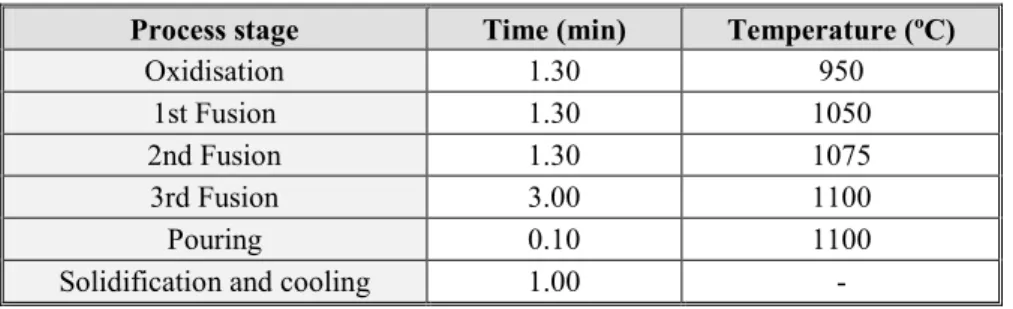
(3) With regard to possible interferences caused by NH4I and LiI, however, no studies were found in the literature on the effects of their use as bead-releasing agents, though release agents other than NaI, LiBr, and LiF need to be used, given the interferences that they cause. The present study examines the interferences caused by the use of NH4I and LiI, as well as those of NaI and LiBr, in the WD-XRF measurement of fused bead samples of clays and zirconium silicates. Each release agent was incorporated in different quantities (as a solid and/or in a solution), together with a flux, into the samples. The minimum quantity of release agent required to obtain reproducible beads for WD-XRF measurement was determined.. 2. Experimental part. 2.1. Experimental technique. 2.1.1. Sample preparation. To obtain fused beads for the study, appropriate quantities of sample and flux were mixed with a bead-releasing agent and heat treated at high temperature. The samples were prepared by weighing between 0.4 and 0.7 g sample into a platinum crucible, using an analytical balance with a weighing uncertainty of 0.1 mg. The flux was then added in an appropriate sample:flux ratio (1:10) for the study, in addition to the bead-releasing agent. The mixture was heat treated in a fusion bead machine with previously programmed working times and temperatures. The working conditions are presented in Table 1. Various quantities of each release agent, incorporated as a solid and/or in an aqueous solution into the respective samples, were tested. The additions and tests conducted were as follows: 1) NaI was incorporated in solid form, in a quantity of 0.09 g NaI/bead. 2) LiBr was added in an aqueous solution with a concentration of 250 g·L-1 [12]. Five drops of the solution (≈0.25 mL) were added to each bead, corresponding to 0.06 g LiBr/bead.. 3.
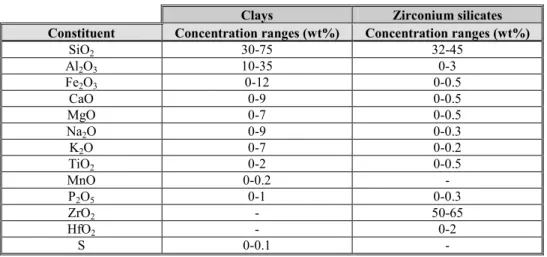
(4) 3) NH4I was added both as a solid and in an aqueous solution. Table 2 lists the quantities of NH4I used in the various tests. 4) LiI was added in an aqueous solution with a concentration of 250 g·L-1. The test quantities are shown in Table 3. To establish the optimum quantities of the bead-releasing agents being studied, different quantities of each were used in bead preparation until the melt no longer adhered to the crucible or platinum mould, the beads no longer broke (owing to stresses produced during cooling), and beads were obtained that provided accurate and reproducible WD-XRF measurement results.. 2.1.2. Sample measurement. In order to determine whether bead preparation had been appropriate, WD-XRF measurements were made of the element concentrations in the unbroken beads obtained, when no melt had remained adhered to the crucible or mould during the preparation process. Table 4 details the elements analysed, as well as the WD-XRF measurement conditions for each element. Once the preparation conditions had been established under which reproducible beads were obtained, calibration curves were prepared with each studied bead-releasing agent. In order to verify measurement accuracy, the element concentrations of reference materials prepared under identical conditions were measured by WD-XRF. Calibrations were prepared for the WD-XRF measurement of two substantially differing types of ceramic materials: clays and zirconium silicates. Different calibrations were prepared for the two types of materials, since the elements to be analysed and their concentration ranges did not coincide. The concentration ranges of the calibrations, for every analysed element, are shown in Table 5.. 4.
(5) In the calibration process, the values of ‘α’ [13] corresponding to the matrix effect of bromine on silicon, iron, calcium, and zirconium were calculated, together with the overlaps of the first-order Kα line of aluminium (2θ = 145.12) with the first-order Lα line of bromine (2θ = 146.66), and of the Kα line of titanium (2θ = 86.14) with the Lβ line of iodine (2θ = 86.17).. 2.2. Materials and equipment. The following materials were used as bead-releasing agents: NaI from Panreac (Ref.: 131726), LiBr from Merck (Ref.: 1.05669, Lot: K29338969), NH4I from Fluka (Ref.: 09874, Lot: 0100859190), and LiI from Aldrich (Ref.: 223816, Lot: 13503TC). A 50:50 mixture of lithium metaborate and lithium tetraborate (LiBO2: Li2B4O7) from Alfa Aesar (Ref.: 583001, Lot: 40866) was used as a flux. The flux was controlled using a moisture determination and a blank. The calibration curves were constructed from mixtures of reference materials. Table 6 lists the reference materials used to prepare the calibration curves for each type of material. The validation was performed by measuring the following reference materials: GBW 03122 Kaolin, SRM 98b Plastic Clay, and GBW 03103 Shale and Clay for the clay calibration, and BCS-CRM 388 Zircon for the zirconium silicate calibration. The beads were prepared using a PHILIPS Model PERL X’3 automatic fusion bead machine. Element analysis was performed with a PHILIPS Model PW 2400 XRF wavelength-dispersive X-ray fluorescence spectrometer with Rh target tube and PW 2540 VTC sample changer.. 5.
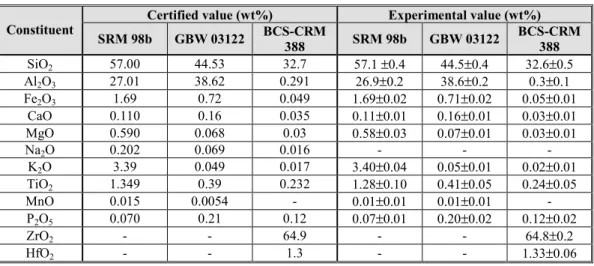
(6) 3. Results. 3.1. Results of the effect of each tested release agent. The experiments performed with the bead-releasing agents and the state of the resulting beads are detailed in Table 7. The table also shows which tested release agent concentrations were suitable for bead preparation. Thus, the table shows that NaI and LiBr yielded suitable beads for WD-XRF measurement with less than 0.1 g release agent/bead. In the case of NH4I, however, a very large quantity (approximately 2 g NH4I/bead) was needed to obtain reproducible beads, while it was also observed that the NH3 emission during fusion had damaged the fusion bead facility. When LiI was used, a small quantity (0.11g LiI/bead) sufficed to obtain suitable beads for WD-XRF measurement.. 3.2. Results obtained in the validation. The validation was conducted by preparing beads of reference materials with the different release agents, and measuring the resulting beads in their corresponding calibrations by WDXRF. The validation results are shown in Tables 8 to 11. The measurement uncertainty was estimated in accordance with ISO/TAG 4WG3:95 [14, 15]; at least three replicates were analysed per test sample. When NaI was used as release agent, good results were obtained in the analysis of most major and minor elements, though Na could not be analysed owing to its presence in the release agent. Furthermore, titanium displayed a greater uncertainty than an identical quantity of any other element as a result of the overlap of the Kα line of titanium with the Lβ line of the residual iodine in the bead after bead preparation. The use of LiBr as release agent required making a series of corrections. First, there was an overlap of the first-order Kα line of aluminium with the first-order Lα line of bromine, which 6.
(7) led to an error by excess in the measurement of aluminium; however, once this error had been corrected, good results were obtained. Secondly, there was the matrix effect of bromine on zirconium, which was harder to correct, so that the uncertainty obtained in zirconium analysis was high. It may be noted that, when NH4I was used as release agent, better results were obtained in zirconium analysis than when LiBr was used, since there was no interference on zirconium. The use of NH4I entailed a serious drawback, however, in that much of the sulphur present in the clay samples was lost during fusion, making it impossible to analyse sulphur in the beads prepared with NH4I. In addition, the evolving NH3 emissions in the bead preparation process seriously damaged the fusion bead facility. Good analytical results were obtained when LiI was used as release agent in the tested ceramic raw materials. There were no problems in the analysis of sulphur or zirconium, though titanium analysis of course required calculation of the overlap with iodide, especially with small titanium concentrations (less than 0.1%). Thus, of the bead-releasing agents tested, LiI provided the best results.. 4. Conclusions. The effect of the use of NaI, LiBr, NH4I, and LiI as bead-releasing agents in preparing fused bead samples for WD-XRF measurement and their interference with the resulting measurement have been studied. The results allow the following conclusions to be drawn: -. NaI can be used, incorporated as a solid, in an addition of 0.09 g NaI/bead, in beads prepared with a sample:flux ratio of 1:10, and sample weight of approximately 0.5 g. However, the use of NaI is restricted to samples in which sodium is not analysed, since sodium is introduced with the release agent. It addition, the interference of iodine on titanium in the WD-XRF measurement needs to be corrected, especially for low concentrations of titanium, at which the interference is highest.. 7.
(8) -. LiBr provides good analytical results with small additions (0.06 g LiBr/bead), but displays a number of limitations. After fusion, a residual quantity of bromine remains in the bead, causing an important overlap with aluminium, in addition to matrix effects on several elements, such as zirconium, silicon, calcium, etc., thus generating considerable measurement uncertainties.. -. NH4I provides good analytical results for most elements, though it poses a serious problem in sulphur analysis, since sulphur is lost during bead preparation. In addition, the evolving NH3 emission in bead preparation damages the fusion bead facility. Further, just as with NaI, the residual iodine in the bead interferes with titanium and needs to be corrected.. -. LiI provides the best results: a relatively small addition (0.11 LiI g/bead) yields reproducible beads with no matrix effect on any studied analyte element, while the overlap of iodine with titanium is not significant, since the residual iodine content in the bead is very low.. -. The fact that LiI is added in an aqueous solution is a further advantage because the release agent need not be weighed (as is the case when additions are made in solid form), thus making the bead preparation process more rapid and reproducible. The relatively small quantity of LiI required to prepare the beads also makes its use reasonable from a cost-efficiency point of view.. 5. References 1.. Bennett H, Oliver GJ. XRF analysis of ceramics and allied materials. Wiley: Chichester, 1992.. 2.. Anderson R. Sample pre-treatment and separation. Wiley: Chichester, 1987.. 3.. Zyl C van. X-Ray Spectrom. 1982; 11: 29-31.. 4.. Conture RA, Smith MS, Dymek RF. Chem. Geol. 1993; 110: 315-328.. 8.
(9) 5.. Buhrke E, Jenkins R, Smith DK (eds.). A practical guide for the preparation of specimens for x-ray fluorescence and x-ray diffraction analysis. Wiley-VCH: New York, 1998.. 6.. Fusion. In Handbook of sample preparation and handling. Spex CertiPrep: Metuchen, 2000; 68-80.. 7.. Baker JW. Adv. X. Ray Anal. 1982; 25: 91-94.. 8.. King BS, Vivit D. X-Ray Spectrom. 1988; 17: 85-87.. 9.. Bertin EP. Principles and practice of X-Ray spectrometric analysis. Plenum: New York, 1984.. 10. Gazulla MF, Gómez MP, Barba A, Jarque JC. X-Ray Spectrom. 2004; 33: 421-430. 11. Gazulla MF, Ochandio E, González T. Téc. Cerám. 1991; 197: 674-678. 12. Gazulla MF, Gómez MP, Barba A, Orduña M Glass Sci. and Technol. 2002; 75: 184-190. 13. Rousseau RM, Bouchard M. X-Ray Spectrom. 1986; 15: 207-215. 14. ISO/TAG 4WG3. 1995. Guide to the expression of uncertainty in measurement. 15. Rashmi UD, Suri DK. X-Ray Spectrom. 1999; 28: 157-162.. 9.
(10) Table 1: Working conditions of the fusion bead machine.. Process stage Oxidisation 1st Fusion 2nd Fusion 3rd Fusion Pouring Solidification and cooling. Time (min) 1.30 1.30 1.30 3.00 0.10 1.00. Temperature (ºC) 950 1050 1075 1100 1100 -. Table 2: Tests conducted using 4H4I as bead-releasing agent.. Form of addition. Concentration (g·L-1). 4umber of drops. 4H4I addition (g/bead). -. -. 0.10 0.20 0.30 0.40 0.60 0.80 1.00 1.50 2.00. 42 42 8 30 60 90 100 50 33 12 25 40 17 28. 0.26 0.42 0.10 0.38 0.75 1.12 1.25 1.25 1.25 0.60 1.25 2.00 1.28 2.10. Solid. 125 200. 250. Solution. 500 750 1000. 1500. Table 3: Tests conducted using LiI as bead-releasing agent.. Concentration (g·L-1) 250. 4umber of drops. LiI addition (g/bead). 4. 0.05. 9. 0.11. 10.
(11) Table 4: WD-XRF measurement conditions.. Element. Line. Crystal. Detector. Voltage (kV). Intensity (mA). Angle (2θ θ). Time (s). Si Al Fe Ca Mg Na K Ti Mn P S Zr Hf Br I. Kα Kα Kα Kα Kα Kα Kα Kα Kα Kα Kα Kα Lα Kα Kα. InSb 111-C PE 002 LiF 200 LiF 200 PX 1 PX 1 LiF 200 LiF 200 LiF 200 Ge 111 Ge 111 LiF 200 LiF 200 LiF 220 LiF 220. Flow Flow Flow Flow Flow Flow Flow Flow Flow Flow Flow Scintillation Scintillation Scintillation Scintillation. 30 30 60 45 30 30 45 45 60 30 25 45 60 60 60. 90 90 45 60 90 90 60 60 45 90 90 30 40 45 40. 144.3508 144.9730 57.4992 113.1276 22.4820 27.1592 136.6762 86.1264 62.9554 141.0248 110.6866 32.0832 45.9226 42.7706 17.4300. 30 30 20 10 10 10 10 10 10 10 10 10 10 10 10. Table 5: Concentration ranges used for each element (expressed as oxide wt%) in the calibrations made for the studied clays and zirconium silicates. Clays Concentration ranges (wt%) 30-75 10-35 0-12 0-9 0-7 0-9 0-7 0-2 0-0.2 0-1 0-0.1. Constituent SiO2 Al2O3 Fe2O3 CaO MgO Na2O K2O TiO2 MnO P2O5 ZrO2 HfO2 S. Zirconium silicates Concentration ranges (wt%) 32-45 0-3 0-0.5 0-0.5 0-0.5 0-0.3 0-0.2 0-0.5 0-0.3 50-65 0-2 -. Table 6: Reference materials used to construct the calibration curves. Clays. Zirconium silicates. BCS-CRM 348 Ball Clay CAS 5 Ball Clay GBW 03118 Graphite Ore GBW 03102 Clay GBW 07404 Soil. SARM 13 (Zircon Concentrate) BCS-CRM 313/1 High Purity Silica BCS-CRM 358 Zirconia BCS 394 Calcined Bauxite. 11.
(12) Table 7: Results of the tested bead-releasing agents.. NaI. Form of addition Solid. LiBr. Solution. Release agent. Solid. NH4I. Solution. Concentration in the State of the resulting bead bead (g/bead) and crucible 0.09 Good bead and clean crucible 0.06 0.10 0.20 0.30 0.40 0.60 0.80 1.00 1.50 2.00 0.26 0.42 0.10 0.38 0.75 1.12 1.25 0.60 2.00 1.28 2.10. LiI. Solution. 0.05 0.11. Good bead and clean crucible. Result Suitable Suitable. Broken bead and melt adhered to the Unsuitable crucible. Unbroken bead and melt adhered to the crucible. Unsuitable. Broken bead and melt adhered to the Unsuitable crucible Unbroken bead and melt adhered to the crucible Good bead and clean crucible Unbroken bead and melt adhered to the crucible Good bead and clean crucible Unbroken bead and slight amount of melt adhered to the crucible Good bead and clean crucible Unbroken bead and melt adhered to the crucible Good bead and clean crucible. Unsuitable Suitable Unsuitable Suitable Unsuitable Suitable Unsuitable Suitable. Table 8: Results of the WD-XRF measurements of beads made, respectively, with SRM 98b Plastic Clay, GBW 03122 Kaolin, and BCS-CRM 388 Zircon, using 4aI as release agent. Constituent SiO2 Al2O3 Fe2O3 CaO MgO Na2O K2O TiO2 MnO P2O5 ZrO2 HfO2. Certified value (wt%) BCS-CRM SRM 98b GBW 03122 388 57.00 44.53 32.7 27.01 38.62 0.291 1.69 0.72 0.049 0.110 0.16 0.035 0.590 0.068 0.03 0.202 0.069 0.016 3.39 0.049 0.017 1.349 0.39 0.232 0.015 0.0054 0.070 0.21 0.12 64.9 1.3. Experimental value (wt%) BCS-CRM SRM 98b GBW 03122 388 57.1 ±0.4 44.5±0.4 32.6±0.5 26.9±0.2 38.6±0.2 0.3±0.1 1.69±0.02 0.71±0.02 0.05±0.01 0.11±0.01 0.16±0.01 0.03±0.01 0.58±0.03 0.07±0.01 0.03±0.01 3.40±0.04 0.05±0.01 0.02±0.01 1.28±0.10 0.41±0.05 0.24±0.05 0.01±0.01 0.01±0.01 0.07±0.01 0.20±0.02 0.12±0.02 64.8±0.2 1.33±0.06. 12.
(13) Table 9: Results of the WD-XRF measurements of beads made, respectively, with GBW 03103 Shale and Clay, GBW 03122 Kaolin, and BCS-CRM 388 Zircon, using LiBr as bead-releasing agent. Constituent SiO2 Al2O3 Fe2O3 CaO MgO Na2O K2O TiO2 MnO P2O5 ZrO2 HfO2 S. Certified value (wt%) BCS-CRM GBW 03103 GBW 03122 388 66.64 44.53 32.7 13.28 38.62 0.291 4.64 0.72 0.049 3.23 0.16 0.035 1.84 0.068 0.03 1.81 0.069 0.016 2.50 0.049 0.017 0.66 0.39 0.232 0.088 0.0054 0.106 0.21 0.12 64.9 1.3 0.0108 0.048 -. Experimental value (wt%) BCS-CRM GBW 03103 GBW 03122 388 66.5±0.4 44.5±0.3 32.8±0.4 13.2±0.2 38.5±0.2 0.30±0.05 4.65±0.02 0.71±0.02 0.05±0.01 3.21±0.08 0.16±0.01 0.04±0.01 1.84±0.05 0.07±0.01 0.03±0.01 1.80±0.05 0.07±0.01 0.02±0.01 2.48±0.08 0.05±0.01 0.02±0.01 0.66±0.05 0.38±0.04 0.23±0.04 0.09±0.01 <0.01±0.01 0.10±0.01 0.21±0.09 0.12±0.02 64.7±0.5 1.24±0.10 0.011±0.003 0.048±0.004. Table 10: Results of the WD-XRF measurements of beads made, respectively, with GBW 03103 Shale and Clay, and BCS-CRM 388 Zircon, using 4H4I as bead-releasing agent. Constituent SiO2 Al2O3 Fe2O3 CaO MgO Na2O K2O TiO2 MnO P2O5 ZrO2 HfO2 S. Certified value (wt%) BCS-CRM 388 GBW 03103 32.7 66.64 0.291 13.28 0.049 4.64 0.035 3.23 0.03 1.84 0.016 1.81 0.017 2.50 0.232 0.66 0.088 0.12 0.106 64.9 1.3 0.0108. Experimental value (wt%) BCS-CRM 388 GBW 03103 32.7±0.4 66.7±0.4 0.3±0.1 13.3±0.2 0.05±0.01 4.68±0.08 0.04±0.01 3.20±0.05 0.03±0.01 1.86±0.03 0.02±0.01 1.82±0.03 0.02±0.01 2.51±0.04 0.23±0.02 0.66±0.02 0.09±0.01 0.12±0.02 0.11±0.01 65.0±0.1 1.35±0.08 <0.005. Table 11 Results of the WD-XRF measurements of beads made, respectively, with GBW 03103 Shale and Clay, and BCS-CRM 388 Zircon, using LiI as bead-releasing agent. Constituent SiO2 Al2O3 Fe2O3 CaO MgO Na2O K2O TiO2 MnO P2O5 ZrO2 HfO2 S. Certified value (wt%) BCS-CRM 388 GBW 03103 32.7 66.64 0.291 13.28 0.049 4.64 0.035 3.23 0.03 1.84 0.016 1.81 0.017 2.50 0.232 0.66 0.088 0.12 0.106 64.9 1.3 0.0108. Experimental value (wt%) BCS-CRM 388 GBW 03103 32.5±0.4 66.7±0.4 0.3±0.1 13.2±0.2 0.05±0.01 4.62±0.05 0.04±0.01 3.25±0.05 0.03±0.01 1.84±0.03 0.02±0.01 1.82±0.02 0.02±0.01 2.52±0.05 0.21±0.04 0.69±0.04 0.09±0.01 0.11±0.02 0.11±0.02 64.9±0.1 1.32±0.06 0.011±0.005. 13.
(14)
Figure

Documento similar
Parameters of linear regression of turbulent energy fluxes (i.e. the sum of latent and sensible heat flux against available energy).. Scatter diagrams and regression lines
It is generally believed the recitation of the seven or the ten reciters of the first, second and third century of Islam are valid and the Muslims are allowed to adopt either of
In the preparation of this report, the Venice Commission has relied on the comments of its rapporteurs; its recently adopted Report on Respect for Democracy, Human Rights and the Rule
Keywords: iPSCs; induced pluripotent stem cells; clinics; clinical trial; drug screening; personalized medicine; regenerative medicine.. The Evolution of
Astrometric and photometric star cata- logues derived from the ESA HIPPARCOS Space Astrometry Mission.
The photometry of the 236 238 objects detected in the reference images was grouped into the reference catalog (Table 3) 5 , which contains the object identifier, the right
Even though the 1920s offered new employment opportunities in industries previously closed to women, often the women who took these jobs found themselves exploited.. No matter
In the “big picture” perspective of the recent years that we have described in Brazil, Spain, Portugal and Puerto Rico there are some similarities and important differences,
