
TítuloMathematical modeling and simulation of volatile reduced sulfur compounds oxidation in biotrickling filters
9
0
0
Texto completo
(2) 144. G. AROCA, M. CÁCERES, S. PRADO, C. SÁNCHEZ AND R. SAN MARTÍN. industry the origin of this problem is the presence of odorous volatile organic compounds (VOC) and particularly volatile reduced sulfur compounds (VRSC) also called TRS (Total Reduced Sulfur), like hydrogen sulfide, methylmercaptane, dimethylsulfur and dimethyldisulfur and other sulfur volatile compounds in the emissions. These compounds can be found in the gaseous emissions of several industrial operations, like Kraft pulp mills, petroleum refineries, tanneries, some food industries; particularly fish canning and animal rendering operations, and also in waste water treatment plants, landfills, composting and solid waste treatment plants. Although a number of microorganisms are known for degrading VRSC, the treatment of a mixture of reduced sulfur compounds remains challenging for several reasons. Firstly, H2S is preferentially degraded over dimethyl sulfide or other organic sulfur compounds (Cho et al., 1992; Wani et al., 1999; Zhang et al., 1991) because H2S oxidation is the energy yielding process (Smet et al., 1998). Secondly, the degradation of MM, DMS and DMDS is carried out with high efficiency at neutral pH, but decreases at low pH (Smet et al., 1996). Thirdly, the degradation rates decrease in the order H2S > MT > DMDS > DMS (Cho et al., 1991; Smet et al., 1998). To resolve these problems, a few two-stage systems have been proposed (Park et al., 1993; Ruokojarvi et al., 2001). The most recent one, developed by Ruokojarvi et al. (2001) consisted out of two biotrickling filters, connected in series, inoculated with a microbial consortium enriched from sludge water from a refinery, with H2S or DMS, respectively. The reactors were operated at different pH levels, to allow efficient removal of organic sulfur compounds at neutral pH in the second reactor. HBr:2S and DMS elimination capacities as high as 47.9 and 36.6 g S m-3 h-1, respectively, were obtained for the whole two-stage biotrickling filter. Sercu et al. (2005) shown that the two-stage biofiltration system is an efficient system for the treatment of waste gases containing a mixture of reduced sulfur compounds, because it optimizes the potential of DMS degradation. Maximum elimination capacities obtained for DMS in this study were 57 g m-3 h-1 (120 s. EBRT, D = 92%) and 58 g m-3 h-1 (60 s. EBRT, D = 89%). In the systems described the complete oxidation of H2S must be performed in the first reactor, if some H2S pass through out the first reactor without been oxidized it would have an effect on the bio-oxidation of the other VRSC present in the mixture in the second bioreactor. This situation was modelled and simulated, and is presented in this article.. 2 MATHEMATICAL MODELING Steady-state and dynamic models have been developed to provide a description of degradation mechanisms and biomass accumulation in biofiltration processes (Dehusses et al., 1998; Ottengraf and van den Oever, 1995; Song and Kinney, 2002;.
(3) MATHEMATICAL MODELING AND SIMULATION OF VOLATILE REDUCED SULFUR. 145. Zarook et al., 1993, 1998). Simplified first- and zero-order kinetic expressions were initially introduced to model the degradation process (Ottengraf and van den Oever, 1995). More recently, Monod-type kinetic models (Monod, 1942), including substrate inhibition (Andrews, 1968), were applied (Zarook and Shaik, 1997). Zarook et al (1993) have also included expressions for the reaction rate which explicitly take into account the potential limiting effects of oxygen. The bio-oxidation of H2S and DMS in a biotrickling filter is described through a model of the mass transfer and chemical reaction processes. The biotrickling filter is modeled as a fixed bed of packing material which supports the growth of microorganisms as biofilms. When air flows in the bed, H2S and DMS are continuously transferred from the gas phase to the biofilm, where they diffuse and are oxidized by aerobic microbial activity. ASSUMPTIONS All mass transfer and reaction processes occurring in the biofilter are considered to be at steady state. This assumption is justified by considering that that the time scale of biofilm growth (δ2/Db) is up to two orders of magnitude less than the residence time, and, as a consequence, time variations in the biofilm can be neglected (Zarook and Shaikh, 1997). In particular, the rate of biomass accumulation in the reactor is small compared to the overall H2S and DMS degradation rate, allowing to neglect biomass mass balances in the model. The biofilm is fully developed and biomass accumulation does not occur. At steady state, the sorption of H2S and DMS on the packing material (adsorption onto the solid plus absorption in the water retained in the pores of solid) is in equilibrium and need not to be taken into consideration in the mass balances. Other assumptions made to derive the model equations are as follows: – Oxygen is present in excess in relation to H2S and DMS. – The biofilm forms on the external surface of the packing material and no reaction occurs in the pores. – The biofilm forms as patches on the support. The extent of the patches is much larger than depth, and H2S and DMS are transported into the biofilm perpendicularly to the biofilm–gas interface. – Gas–solid mass transfer is fast compared to diffusion and reaction in the biofilm. As a consequence, H2S and DMS concentration at the biofilm gas interface are calculated through Henry’s law, assuming the same distribution coefficient as in water. – The effective diffusivities in the biofilm is calculated from the corresponding values in water through a correction factor which depends on biofilm porosity..
(4) 146. G. AROCA, M. CÁCERES, S. PRADO, C. SÁNCHEZ AND R. SAN MARTÍN. – The biofilm properties (i.e. thickness, density, specific surface area) are uniform along the bed height, and constant under different operating conditions. – The thickness of the biofilm is small relative to the main curvature of the solid particles and can be assumed as flat. As a consequence, model equations are derived for a planar geometry. – Gas mixing in vapour phase bioreactors is described using a dispersion model (Levenspiel, 1999). – The rate of oxidation of H2S can be described by Monod’s expression. – The rate of oxidation of DMS can be described using modified Monod’s expression with competitive inhibition due to the presence of H2S. EQUATIONS General Mass balance for the compound i in the gaseous phase:. General Mass balance for the compound i in the liquid phase:. Kinetic equations for the rate of bioxidation of H2S. Kinetic equations for the rate of bioxidation of DMS. BOUNDARY CONDITIONS Boundary conditions for gaseous phase:.
(5) MATHEMATICAL MODELING AND SIMULATION OF VOLATILE REDUCED SULFUR. 147. Where λ = biofilm width [m]. Boundary conditions for the liquid phase:. H = biofilter height [m]. 3 SIMULATION The system of equations was solved using the method of divided finite differences using Mathlab 7.0. The values of the parameters included in the model are shown in Table 1. These values were collected from different references or estimated. Table 1. Model parameters. Parameter Kinetic parameters Monod constant H2S (KS) Maximun oxidation rate (Vm) H2S Monod constant DMS (KS) Maximun oxidation rate (Vm) DMS Yield coefficient (Yx/H2S) Yield coefficient (Yx/DMS) Inhibition constant (KI) Mixing, transport and equilibrium characteristics Diffusion coefficient of H2S in air (DH2S) Diffusion coefficient of DMS in air (DDMS) Air–water H2S partition coefficient (m) Air–water DMS partition coefficient (m) Packing material Specific surface area (a,) Porosity (ε) Fraction of surface covered with biofilm (α) Biofilm properties Density (Xb,) Porosity (εb) Thickness (δ). Value. Units. 1 0.04 5 0.025 0.03 0.007 0.01 – 0.0001. g.m–3 h-1 g.m–3 h-1 g biomass g–1 H2S g biomass g–1 DMS g.m–3. 1.35 × 10⁻⁹ 1.93 x 10⁻⁹ 0.41 0.07. m2 s–1 m2 s–1 dimensionless dimensionless. 300 0.3 0.4. m–1 dimensionless dimensionless. 30 0.8 30. kg.m–3 dimensionless μm.
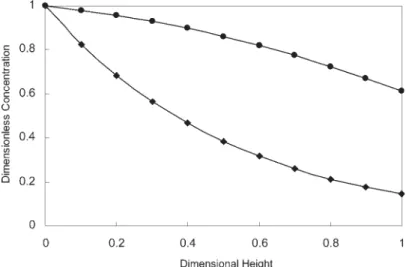
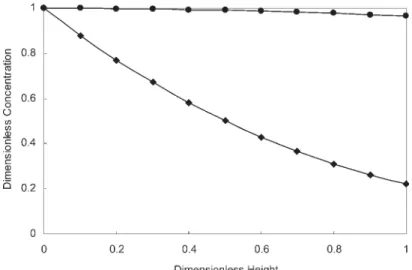
(6) 148. G. AROCA, M. CÁCERES, S. PRADO, C. SÁNCHEZ AND R. SAN MARTÍN. Figure 1 shows the profile of DMS through out the column without the presence on H2S. Figures 2 and 3 shown the results of the simulations considering different ratio of inlet concentration of DMS and H2S. From these graphs it is possible to observe the effect of H2S in the bio-oxidation of DMS.. Figure 1. Dimensionless concentration of DMS ( ) along the column. Simulation for inlet concentrations of DMS 1,5 g/m3, and inlet concentration of H2S : 0 g/m3. EBRT: 60 s.. Figure 2. Dimensionless concentration of DMS ( ) and H2S ( ) along the column. Simulation for inlet concentrations of DMS 1,5 g/m3, and inlet concentration H2S 0.1 g/m3. EBRT: 60 s..
(7) MATHEMATICAL MODELING AND SIMULATION OF VOLATILE REDUCED SULFUR. 149. Figure 3. Dimensionless concentration of DMS ( ) and H2S ( ) along the column. Simulation for inlet concentrations of DMS 1,5 g/m3, and inlet concentration H2S 1 g/m3. EBRT 60 s.. Figure 4. Effect of the values of the inhibition constant on the removal capacity of DMS for an inlet concentration of H2S 0.1 g/m3..
(8) 150. G. AROCA, M. CÁCERES, S. PRADO, C. SÁNCHEZ AND R. SAN MARTÍN. According to the results obtained from the simulations, the model represents the expected situation of inhibition in the bio-oxidation of DMS due to the presence of H2S. The results are sensible to the value of the inhibition constant as is also expected. Figure 4 shows the effect of the inhibition constant in the removal capacity of DMS when H2S is loaded at an inlet concentration of 0.1 g/m3 at an EBRT of 60 s. The validation of these simulations will be done with experimental results.. REFERENCES Andrews, J.F. (1968) A mathematical model for the continuous culture of microorganisms utilizing inhibitory substrates. Biotech. Bioeng. 10: 707-714. Cho K.S., Hirai M. and Shoda M. (1991) Degradation characteristics of hydrogen sulfide, methanethiol, dimethyl sulfide and dimethyl disulfide by Thiobacillus thioparus DW44 isolated from peat biofilter. J. Ferment. Bioeng. 71(6): 384-389. Cho K.S., Hirai M. and Shoda M. (1992) Enhanced removability of odorous sulfur-containing gases by mixed cultures of purified bacteria from peat biofilters. J. Ferment. Bioeng. 73: 219-224. Deshusses, M.A., Hamer, G. and Dunn, I.J. (1995) Behavior of biofilters forwaste air and biotreatment. 1. Dynamic model development. Environ. Sci. Technol. 29: 1048-1058. Levenspiel, O. (1999) Chemical Reaction Engineering, 3rd Ed., Wiley, New York, 665 pp. Monod, J. (1942) Recherches sur la croissance des cultures bacteriennes. Hermann et Cie, Paris. Ottengraf, S.P.P. and van den Oever, A.H.C. (1983) Kinetics of organic compound removal from waste gases with a biological filter. Biotechnol. Bioeng. 25: 3089-3102. Park, S.-J., Hirai, M. and Shoda, M. (1993) Treatment of exhaust gases from a night soil treatment plant by a combined deodorization system of activated carbon fabric reactor and peat biofilter inoculated with Thiobacillus thioparus DW4. J. Ferment. Bioeng. 76: 423-426. Ruokojärvi, A., Ruuskanen, J., Martikainen, P.J. and Olkkonen, M. (2001) Oxidation of gas mixtures containing dimethyl sulfide, hydrogen sulfide, and methanethiol using a two-stage biotrickling filter. J. Air Waste Manage. Assoc. 51: 11-16. Sercu, B., Nuñez, D., van Langenhove, H., Aroca, G. and Verstraete, W. (2005) Operational and microbiological aspects of a bioaugmented two-stage biotrickling filter removing hydrogen sulphide and dimethylsulfide. Biotechnol. Bioeng. 90: 259-269. Smet, E., Chasaya, G., van Langenhove, H. and Verstraete, W. (1996) The effect of inoculation and the type of carrier material used on the biofiltration of methyl sulphides. Appl. Microbiol. Biotechnol. 45 (1-2): 293-298. Smet, E., Lens, P. and van Langenhove, H. (1998) Treatment of waste gases contaminated with odorous sulphur compounds. Crit. Rev. Environ. Sci. Technol. 28: 89-117..
(9) MATHEMATICAL MODELING AND SIMULATION OF VOLATILE REDUCED SULFUR. 151. Song, J. and Kinney, K.A. (2002) A model to predict long term performance of vapor-phase bioreactors: a cellular automation approach. Environ. Sci. Technol. 36: 2498-2507. Wani, A.H., Lau, A.K. and Branion, R.M.R. (1999) Biofiltration control of pulping odors – hydrogen sulfide: performance, macrokinetics and coexistence effects of organo-sulfur species. J. Chem. Technol. Biotechnol. 74: 9-16. Zhang, L., Hirai, M. and Shoda, M. (1991) Removal characteristics of dimethyl sulfide, methanethiol and hydrogen sulfide by Hyphomicrobium sp. I55 isolated from peat biofilter J. Ferment. Bioeng. 72 (5): 392-396. Zarook, S., Baltzis, B.C., Oh, Y.S. and Bartha, R. (1993) Biofiltration of methanol vapor, Biotechnol. Bioeng. 41: 512-524. Zarook, S. and Baltzis B.C. (1994) Biofiltration of toluene vapor under steady-state and transient conditions: theory and experimental results. Chem. Eng. Sci. 49(24A): 4347-4360. Zarook, S., Shaikh, A.A. and Azam, S.M. (1998) Axial dispersion in Biofilters. Biochem. Eng. J. 1: 77-84. Zarook, S. and Shaikh, A.A. (1997) Analysis and comparison of biofilter models. Chem. Eng. J. 65: 55-61..
(10)
Figure
Documento similar