
Development and validation of a RP HPLC method for the quantifi
7
0
0
Texto completo
(2) Ars Pharmaceutica Development and validation of a RP-HPLC method for the quantification of sparfloxacin in pharmaceutical dosage forms. Sultan Z1, Zia-Ul-Huda G2, Hossain A2, Mazid A2, Rashid A2. 1. Drug Research Laboratory. Centre for Advanced Research in Sciences, University of Dhaka (Bangladesh); 2. Department of Pharmaceutical Chemistry. Faculty of Pharmacy, University of Dhaka (Bangladesh).. Original Paper Artículo Original. ABSTRACT. Correspondence/Correspondencia: Md. Abdur Rashid Department of Pharmaceutical Chemistry, Faculty of Pharmacy, University of Dhaka, Dhaka-1000, Bangladesh Tel.: 880-2- 9661900-73, Extn. - 8130, 8137; Fax: 880-2-8615583 mail: [email protected]. developed for quantitative analysis of sparfloxacin in pharmaceutical preparations. The method was. A rapid and sensitive reversed phase high performance liquid chromatographic method has been validated according to FDA, ICH and USP guidelines with respect to accuracy, precision, specificity and linearity. The method was developed using the mobile phase comprising 1% aqueous solution of acetic acid and acetonitrile in the ratio of 71: 29% (v/v) at a flow rate of 0.7 mL/min over C-8 bonded silica column at ambient temperature. The recovery was found to be more than 97% for each spiked samples of sparfloxacin demonstrative of accuracy of the protocol. Intraday and interday precision of the new method were less than the maximum allowable limit (RSD% 2.0) according to FDA. The method showed linear response with correlation coefficient value of 0.998. Therefore, the method was found to be accurate, reproducible, sensitive and less time consuming, and can be successfully applied for the assay of sparfloxacin formulations. . KEY WORDS: Sparfloxacin; HPLC; method development; validation. RESUMEN Received: 26/012012 Accepted: 15/02/2012. Un método rápido y sensible de cromatografía líquida en fase reversa de alta resolución ha sido desarrollado para el análisis cuantitativo de sparfloxacino en preparaciones farmacéuticas. El método fue validado de acuerdo a las normas de precisión, especificidad y linealidad aportadas por la FDA, ICH y USP. El método fue desarrollado utilizando la fase móvil compuesta por solución acuosa de ácido acético al 1% y acetonitrilo en la proporción 71:29% (v/v) bajo una velocidad de flujo de 0.7 ml/min sobre una columna de sílice c-8 a temperatura ambiente. La recuperación fue de más del 97% para cada muestra adicionada de sparfloxacino lo que demuestra la precisión del protocolo. La precisión intradía e interdía fue inferior al límite máximo permitido (RSD≤ 2.0), de acuerdo a la FDA. El método mostró una respuesta linear con un coeficiente de correlación del 0.998. Por lo tanto, el método fue preciso, reproducible, sensible y rápido, por lo que puede ser utilizado para el análisis de formulaciones de sparfloxacino. PALABRAS CLAVE: Sparfloxacino, HPLC, desarrollo de métodos, validación.. Ars Pharm. 2012; 53(1): 11-16.. 11.
(3) Sultan Z, Zia-Ul-Huda G, Hossain A, Mazid A, Rashid A.. INTRODUCTION Sparfloxacin, a fluoroquinolone antibiotic, has been reported to be more active than other fluoroquinolones against some Gram-positive organisms such as Streptococcus pneumoniae, Staphylococcus aureus, Mycobacterium and Chlamydia species. Sparfloxacin is a potential antibiotic for use in the treatment of upper and lower respiratory tract infections including sinusitis, acute exacerbation of chronic bronchitis, community and hospital acquired pneumonia; urinary tract infections such as gonococcal and non-gonococcal urethritis, chancroid and other sexually transmitted diseases; skin and soft tissue infections, and prophylactic use in different urological and ophthalmic surgical procedures1-4. Like other drugs sparfloxacin also requires some absolute quality parameters like quality, potency etc. to serve its best activities. It is obvious that a little change in the formulation or variations in the manufacturing process or use of low quality materials can affect the product stability and efficacy. It has been reported that due to inadequate therapeutic content in antibiotic formulations, susceptible organisms gain resistant tremendously and many pathogenic organisms have already shown resistance to a number of antimicrobial drugs5. Therefore, quality and efficacy assessment and maintenance of proper dosage schedule of the antimicrobial agents are strongly emphasized to ensure their efficacy and safety which can be ensured by analyzing the products during and after manufacturing and at various intervals during the shelf life of the product. Effective process validation contributes significantly to assuring drug quality. The basic principle of quality assurance is that a drug should be produced that is fit for its intended use and does not expose the consumers to risks6. Although several methods have been reported previously in the literature for determination of sparfloxacin in the pharmaceutical formulations7-12, among them many articles have described the use of buffers to develop reversed-phase high pressure liquid chromatographic (RP-HPLC) method. The use of buffer as a mobile phase in HPLC has many limitations as it requires filtration before use, crystallization may occur when the organics come in contact with leftover buffers in system which may damage the pump and column, and also produce corrosion of stainless steel lines. Besides these buffers require to prepare everyday because especially phosphate buffer is a good medium for bacterial and fungal growth. To overcome the limitations of buffers, the objective of this work was to develop a more simple, accurate and. 12. rapid liquid chromatographic analytical method for the assay of sparfloxacin in pharmaceutical formulations and to validate the method in accordance with the guidelines of FDA (Food and Drug Administration, United States of America), USP (United States Pharmacopoeia) and ICH (International Conference on Harmonization) with respect to accuracy, reproducibility, linearity and specificity 13-15. We, herein, describe an isocratic HPLC method using 1% aqueous solution of acetic acid and acetonitrile (71: 29) with UV detection instead of buffer. To the best of our knowledge, this is the first report of using non-buffer containing 1% aqueous solution of acetic acid with acetonitrile to assay sparfloxacin of pharmaceutical preparations. MATERIALS AND REAGENTS Working standard of sparfloxacin (potency 99.93%) was a kind gift of Drug International Ltd., Dhaka, Bangladesh. For the estimation of sparfloxacin formulated as tablets, samples were purchased from different manufacturers and from retail pharmacies on random basis and were coded as Sample-1, Sample-2 and Sample-3. HPLC grade acetic acid and acetonitrile were procured from local sources. Apparatus HPLC system High Performance Liquid Chromatographic system (Shimadzu-UFLC Prominence), equipped with an auto sampler (Model- SIL 20AC HT) and UV-Visible detector (Model-SPD 20A) was used for the analysis. The data was recorded using LC-solutions software. Column Analytical reversed phase C-8 column [Luna C-8(2), 5 μ, 150 x 4.6 mm, Phenomenex, Inc] was used to analyze the samples. Mobile phase Aqueous solution of 1% acetic acid and acetonitrile were prepared and sonicated for 10 minutes and then it was filtered through a 0.22 μm millipore filter. HPLC grade actonitrile was also filtered and degassed before using. Chromatographic conditions All analyses were done at ambient temperature under isocratic condition. The mobile phase consisted of 1% aqueous solution of acetic acid and acetonitrile in the ratio of 71% and 29% (v/v) at a flow rate of 0.7 mL/ min. The injection volume was 20 μL for standard and samples. Before analysis, every standard and sample were filtered through 0.45 μm filter tips. The column eluate was monitored at 290 nm.. Ars Pharm. 2012; 53(1): 11-16..
(4) Development and validation of a RP-HPLC method for the quantification of sparfloxacin in pharmaceutical dosage forms. Preparation of standard solutions Solutions of the standard drug was prepared by dissolving 25.02 mg of sparfloxacin powder (equivalent to 25.0 mg sparfloxacin) in a 25 mL volumetric flask using 10 mL of the mobile phase. Then the volume was made up to the mark with the same solvent. The final concentration obtained was 1.0 mg/mL. Appropriate volume from this solution was further diluted to get standards of varying concentrations (25, 30, 35, 40, 45, 50, 60 μg/mL). Preparation of test sample Ten tablets in each of the samples (Sample-1, Sample-2 and Sample-3) were weighed, made into fine powder in a mortar with pestle and average weight was taken. Accurately weighed powder equivalent to average weight of each tablet (25 mg of sparfloxacin) was taken in a 25 mL volumetric flask and 10 mL of mobile phase was added and sonicated to mix uniformly. The final volume was adjusted with mobile phase to get the concentration of 1.0 mg/mL. The solution was further diluted 20 times to get the concentration of 50 μg/mL, filtered through 0.45 μm filter tips, and aliquots of 20 μL from this solution was injected into the HPLC by using an auto injector. The average content of the tablets was determined using the calibration curve.. both repeatability and reproducibility. The precision of an analytical method is the degree of agreement among individuals test result where the method is applied repeatedly to multiple samplings. It was checked by intraand inter-day repeatability of responses after replicate injections and expressed as RSD % amongst responses using the formula [RSD (%) = (Standard deviation/Mean) x 100 %]. In the current method development and validation protocol, precision was determined by three replicate analyses of each of the concentrations of 40 μg/mL, 50 μg/ mL, 60 μg/mL of standard sparfloxacin solutions using the proposed method. Linearity Five different concentration levels (25 μg/mL, 30 μg/mL, 35 μg/mL, 40 μg/mL and 45 μg/mL) were prepared from standard solution by diluting with the 1% aqueous acetic acid solution. Then 20 μL from each solution was injected into the HPLC using auto-sampler and the analyses were monitored at 290 nm and repeated four times. The average peak areas were plotted against concentrations. The linearity of the proposed method was evaluated by using calibration curves to calculate coefficient of correlation, slope and intercept values.. Method validation. RESULTS AND DISCUSSION. Specificity The specificity of the LC method was evaluated to ensure that there was no interference from the excipients present in the pharmaceutical product. The specificity was studied by injecting the excipients, standard solution and pharmaceutical preparation of sparfloxacin.. A reversed phase HPLC method has been developed and validated as per ICH, USP and FDA guidelines for determination of sparfloxacin in pharmaceutical formulations by using the mobile phase comprising aqueous solution of 1% acetic acid and acetonitrile in the ratio of 71% and 29% (v/v) at ambient temperature at flow rate of 0.7 mL/min with UV detection at 290 nm. The injection volume was kept at 20 μL for standard and all samples. The retention time of sparfloxacin was obtained at 3.1 ± 0.1 min (Figure 1).. Accuracy/ Recovery The accuracy of an analytical method expresses the nearness between the expected value and the value found. It is expressed by calculating the percent recovery (R%) of analyte recovered by assay of spiked samples. In this case, aliquot equivalent to 100 μg/mL of sparfloxacin tablet solution was taken in three 10 mL volumetric flasks and 20 μg/mL, 40 μg/mL and 60 μg/mL standard sparfloxacin solutions were added to get the final concentrations as 60 μg/mL, 70 μg/mL and 80 μg/mL, respectively. These three solutions were analyzed in successive analysis (n = 3) using the proposed method to evaluate the accuracy of the method. The data of the experiment were statistically analyzed to study the reproducibility and validity of the proposed method. Precision/ Reproducibility Precision of the assay was investigated with respect to. Ars Pharm. 2012; 53(1): 11-16.. The specificity of the method was monitored by analyzing the placebo (containing all the ingredients of the formulation except the analyte), standard solution and market preparation containing sparfloxacin. No peak was detected close to the retention time of sparfloxacin hence proving the high degree of specificity of the method. The accuracy was evaluated at three different concentrations with spikes which were conducted in successive analysis (n = 4) using the proposed method and the value was expressed as percentage of recovery between the mean concentrations found and added concentration for sparfloxacin. The average percentage of recovery was found to be 97.65%, 97.41% and 98.11% for 60 μg/. 13.
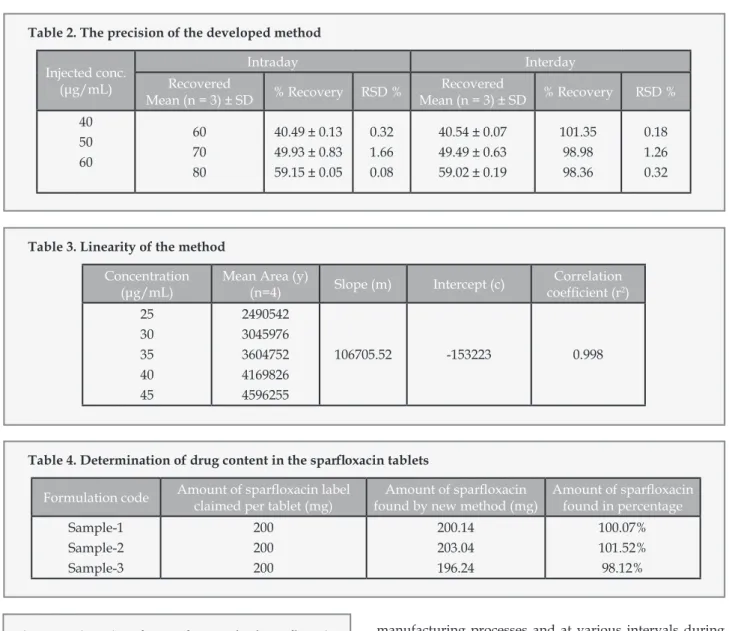
(5) Sultan Z, Zia-Ul-Huda G, Hossain A, Mazid A, Rashid A.. Figure 1. HPLC chromatogram of sparfloxacin standard. Table 1. Accuracy of the developed method Standard sparfloxacin + Spike (μg/mL). Total concentration for analysis (μg/mL). Recovered Mean (n = 3) ± SD. % Recovery. 10 + 50 20 + 50 30 + 50. 60 70 80. 58.59 ± 0.20 68.19 ± 0.10 78.49 ± 0.31. 97.65 97.41 98.11. mL, 70 μg/mL and 80 μg/mL, respectively (Table 1). All experimental results were in the range of the acceptability for precision and accuracy15, which indicated that the developed method is sensitive enough and accurate for determination of sparfloxacin.. was obtained as 0.998 which was within the accepted range of guidelines and showed good linear relationship of the newly developed method with the slope (m) and intercept (c) of the calibration curve as 106705.52 and -153223, respectively (Table 3, Figure 2).. The precision of the method was evaluated by repeatability of sample application and measurement of peak area using three replicates of each of the 40 μg/mL, 50 μg/mL, and 60 μg/mL standards, where the mean concentrations were found as 40.49 μg/mL, 49.93 μg/mL and 59.15 μg/ mL with associated %RSDs of 0.32%, 1.66%, and 0.08%, respectively. The %RSD values for intra- and inter-day assays of sparfloxacin performed in the same laboratory did not exceed more than 1.3% (Table 2).. By employing this method, the content of sparfloxacin was determined in marketed tablets. The sparfloxacin formulations available in Bangladesh were purchased from different manufacturers on random basis from retail pharmacies and coded as Sample-1, Sample-2, and Sample-3, and the content of drug was found as 100.07%, 101.52% and 98.12%, respectively (Table 4), which were also in the acceptable range13-16.. When peak area (y) was plotted against concentration levels of 25 μg/mL, 30 μg/mL, 35 μg/mL, 40 μg/mL and 45 μg/mL, a good correlation coefficient was obtained. For the equation of calibration curve, correlation coefficient (r2) 14. CONCLUSION The activity of a drug depends on some absolute requirements such as quality, potency etc. It is obvious that a little change in the formulation or variations in the Ars Pharm. 2012; 53(1): 11-16..
(6) Development and validation of a RP-HPLC method for the quantification of sparfloxacin in pharmaceutical dosage forms. Table 2. The precision of the developed method Intraday. Injected conc. (μg/mL). Interday. Recovered Mean (n = 3) ± SD. % Recovery. 60 70 80. 40.49 ± 0.13 49.93 ± 0.83 59.15 ± 0.05. 40 50 60. RSD %. Recovered Mean (n = 3) ± SD. % Recovery. RSD %. 0.32 1.66 0.08. 40.54 ± 0.07 49.49 ± 0.63 59.02 ± 0.19. 101.35 98.98 98.36. 0.18 1.26 0.32. Table 3. Linearity of the method Concentration (μg/mL). Mean Area (y) (n=4). Slope (m). Intercept (c). Correlation coefficient (r2). 25 30 35 40 45. 2490542 3045976 3604752 4169826 4596255. 106705.52. -153223. 0.998. Table 4. Determination of drug content in the sparfloxacin tablets Formulation code. Amount of sparfloxacin label claimed per tablet (mg). Amount of sparfloxacin found by new method (mg). Amount of sparfloxacin found in percentage. Sample-1 Sample-2 Sample-3. 200 200 200. 200.14 203.04 196.24. 100.07% 101.52% 98.12%. Figure 2. Linearity of curve for standard sparfloxacin. manufacturing process or use of low quality materials including API (Active Pharmaceutical Ingredients) and fake or expired drugs can affect the efficacy of the drug as well as may produce harmful effect to the patient to a high risk level. Therefore, quality and efficacy assessment and maintenance of proper dose schedule are strongly emphasized to ensure the effectiveness of the drug. To ensure the requisite quality, drug manufacturers are required to test their products during and after Ars Pharm. 2012; 53(1): 11-16.. manufacturing processes and at various intervals during the shelf life of the product. Hence, we planned to study and determine the potency and efficacy of most commonly used antimicrobial preparations like sparfloxacin, a broad spectrum antibiotic which is widely prescribed in Bangladesh. To attain this objective, a rapid and sensitive reversed phase high performance liquid chromatographic method was developed and validated according to the guidelines of FDA, ICH and USP with respect to accuracy, precision, specificity and linearity. The developed method was found to be simpler, accurate, reproducible, efficient and less time consuming, and was applied successfully for the study of sparfloxacin formulations. ACKNOWLEDGEMENTS The authors thank Drug International Ltd., Bangladesh for the kind gift of sparfloxacin standard for research, and Drug Research Laboratory, Centre for Advanced Research in Sciences, University of Dhaka and Department 15.
(7) Sultan Z, Zia-Ul-Huda G, Hossain A, Mazid A, Rashid A.. of Pharmaceutical Chemistry, Faculty of Pharmacy, University of Dhaka for providing all facilities to carry out the present work.. Development and validation of a stability-indicating RPUPLC method for the quantitative analysis of sparfloxacin. J Chromatogr Sci. 2010; 48:1-6. 9. Sreekanth N, Awen BZ, Rao CB, Raju NJ. A new. REFERENCES 1. Ito T, Otsuki M, Nishino T. In vitro antibacterial activity of Q-35, a new fluoroquinolone. Antimicrob Agents Chemother. 1992; 35:1708-1714. 2. Thomson KS, Sanders CC, Hayden ME. In vitro studies with five quinolones: evidence-for changes in relative potency as quinolone resistance rises. Antimicrob Agents Chemother. 1991; 35:2329-2334. 3. Chin NX, Gu JW, Yu KW, Zhang YX, Neu HC. In vitro activity of sparfloxacin. Antimicrob Agents Chemother. 1991; 35:567-557. 4. Rastogi N, Labrousse V, Goh KS, Carvalho DSJP. Antimycobacterial spectrum of sparfloxacin and its activities alone and in association with other drugs against mycobacterium avium complex growing extracellularly and intracellularly. spectrophotometric method development and validation of sparfloxacin in bulk and pharmaceutical dosage forms by sodium dichromate chromogen. Int J Pharmacy Technology. 2010; 2: 465-471. 10. Sreekanth N, Awen BZ, Rao CB. A new colorimetric determination and validation of sparfloxacin based on ferric nitrate chromogen. Res J Pharm Biol Chem Sci. 2010; 1: 9-13. 11. Sharma MC, Sharma S. UV-densitometric determination of sparfloxacin and its application to the assay in pharmaceutical dosage forms. J Optoelectron Biomed Materials. 2010; 2:191195. 12. Kamles P, Badmanaban R, Patel CN. Development and validation of spectrophotometric methods for the estimation of sparfloxacin in tablet dosage forms. J Chem Pharm Res. 2010; 2:528-532.. in murine and human macrophages. Antimicrob Agents. 13. United States Pharmacopoeia 30 - National Formulary 25. Chemother. 1991; 35:2473-2480.. (USP 30 - NF 25), United States Pharmacopeial Convention,. 5. Sultan MZ, Lee KM, Moon SS. Antibacterial effect of naturally. Rockville, MD, 2007.. occurring unsaturated fatty acids from Prunus japonica against. 14.. Propionibacterium acnes. Orient Pharm Exp Med. 2009; 9: 90-96.. Harmonized Tripartite Guideline- Validation of Analytical. 6. Kahsay G, Egziabher AG. Quality assessment of the commonly. International. Conference. on. Harmonization:. ICH. Procedures: Text and Methodology Q2 (R1): 2005.. prescribed antimicrobial drug, ciprofloxacin tablets, marketed. 15. USA Food and Drug Administration, Methods, method. in Tigray, Ethiopia. Momona Ethiopian J Sci. 2010; 2:93-107.. verification and validation; Document No.: ORA-Lab. 5.4.5,. 7. Rahman NN, Ahmad S. Development of quantitative analysis. version No.: 1.5 (2009).. of sparfloxacin by high performance liquid chromatography.. 16. British Pharmacopoeia (BP)-2009, The Stationary Office,. Dhaka Univ J Pharm Sci.2007; 6:21-23.. London, 2002.. 8. Gupta H, Aqil M, Khar RK, Ali A, Sharma A, Chander P.. 16. Ars Pharm. 2012; 53(1): 11-16..
(8)
Figure

Documento similar