UNIVERSIDAD TÉCNICA DE AMBATO
DIRECCIÓN DE POSGRADO
MAESTRÍA EN LA ENSEÑANZA DEL IDIOMA INGLÉS
COMO LENGUA EXTRANJERA
Tema:
THE EFFECTS OF METACOGNITIVE STRATEGIES ON READING SKILLS
Trabajo de Investigación, previo a la obtención del Grado Académico de Magíster en la Enseñanza del Idioma Inglés como Lengua Extranjera.
Autora: Licenciada Miryan Consuelo Salazar Tobar, Magíster
Directora: Licenciada Lorena Monserrath Meléndez Escobar, Magíster
Ambato – Ecuador 2018
A LA UNIDAD DE TITULACIÓN DE LA UNIVERSIDAD TÉCNICA DE AMBATO
El Tribunal receptor del Trabajo de Investigación presidido por Doctor Héctor Fernando Gómez Alvarado, Presidente del Tribunal e integrado por las señoras: Doctora Judith Alexandra Silva Chávez Magíster, Licenciada Cristina del Rocío Jordán Buenaño Magíster, Doctora Elsa de los Ángeles Hernández Chérrez Magíster, miembros de Tribunal designados por la Unidad de Titulación de la Universidad Técnica de Ambato, para receptar el Trabajo de Investigación con el tema: “THE EFFECTS OF METACOGNITIVE STRATEGIES ON READING SKILLS”, elaborado y presentado por la Licenciada Miryan Consuelo Salazar Tobar Magíster, para optar por el Grado Académico de Magíster en la Enseñanza del Idioma Inglés como Lengua Extranjera; una vez escuchada la defensa oral del Trabajo de Investigación el Tribunal aprueba y remite el trabajo para uso y custodia en las bibliotecas de la UTA.
………..……..….
Dr. Héctor Fernando Gómez Alvarado Presidente del Tribunal
………..……..…..….
Dra. Judith Alexandra Silva Chávez, Mg. Miembro del Tribunal
………..…………..………..… Lcda. Cristina del Rocío Jordán Buenaño, Mg. Miembro del Tribunal
……….…..…………..…..……..… Dra. Elsa de los Ángeles Hernández Chérrez, Mg. Miembro del Tribunal
AUTORÍA DEL TRABAJO DE INVESTIGACIÓN
La responsabilidad de las opiniones, comentarios y críticas emitidas en el Trabajo de Investigación presentado con el tema: “THE EFFECTS OF METACOGNITIVE STRATEGIES ON READING SKILLS”, le corresponde exclusivamente a: Licenciada Miryan Consuelo Salazar Tobar Magíster, Autora bajo la Dirección de la Licenciada Lorena Monserrath Meléndez Escobar Magíster, Directora del Trabajo de Investigación; y el patrimonio intelectual a la Universidad Técnica de Ambato.
……….. Lic. Miryan Consuelo Salazar Tobar, Mg.
C.C. 180284083-3 AUTORA
……… Lic. Lorena Monserrath Meléndez Escobar, Mg.
C.C. 1802190239 DIRECTORA
DERECHOS DE AUTOR
Autorizo a la Universidad Técnica de Ambato, para que el Trabajo de Investigación, sirva como un documento disponible para su lectura, consulta y procesos de investigación, según las normas de la Institución.
Cedo los Derechos de mi trabajo, con fines de difusión pública, además apruebo la reproducción de este, dentro de las regulaciones de la Universidad.
……… Lic. Miryan Consuelo Salazar Tobar, Mg.
C.C. 180284083-3 AUTORA
ÍNDICE GENERAL DE CONTENIDOS
Portada... i
A la Unidad de Titulación de la Universidad Técnica de Ambato ... ii
Autoría del Trabajo de Investigación ... iii
Derechos de Autor... iv
Índice General de Contenidos ... v
List of Tables... ix
List of Figures ... xi
Agradecimiento ... xii
Dedicatoria ... xiii
Resumen Ejecutivo... xiv
Executive Summary ... xvi
Introduction ... 1 CHAPTER I RESEARCH PROBLEM 1.1. Research Topic ... 3 1.2. Problem Statement ... 3 1.2.1 Contextualization ... 3 1.2.2 Critical Analysis ... 7 1.2.3 Prognosis ... 8
1.2.4 Research Problem Formulation ... 9
1.2.5 Research Questions ... 9
1.2.6 Delimitation of the Research Problem ... 9
1.3. Justification ... 10 1.4. Objectives ... 11 1.4.1 General Objective ... 11 1.4.2 Specifics Objectives ... 11 CHAPTER II THEORETICAL FRAMEWORK
2.2 Philosophical Foundation ... 13
2.3 Legal Basis ... 14
2.4 Key Categories ... 15
2.4.1 Fundamental Categories Network ... 16
2.4.2 Independent Variable Differentiated Instruction ... 17
2.4.3 Dependent Variable Reading skills ... 18
2.4.1 Independent Variable: Metacognitive Strategies ... 19
2.4.2 DEPENDENT Variable: Reading skills ... 37
2.5 Hypothesis ... 51
2.6 Signaling hypothesis variables ... 51
2.6.1 Independent variable ... 51
2.6.2 Dependent variable ... 51
CHAPTER III METHODOLOGY 3.1 Basic Method of Research ... 52
3.1.1 Correlational ... 53 3.2 Research design ... 53 3.2.1 Quasi-experimental research ... 53 3.3 Population y sample ... 55 3.3.1 Population ... 55 3.3.2 Sample ... 56 3.4 Operationalization of variables ... 57
3.4.1 Independent variable: Metacognitive Strategies. ... 57
3.4.2 Dependent variable: Reading skills. ... 58
3.5 Data Collection Plan ... 59
3.6 Information processing and analysis ... 59
CHAPTER IV ANALYSIS AND INTERPRETATION 4.1 Analysis of results and data interpretation ... 61
4.1.1 The pre- test and post- test results ... 61
4.2 Hypothesis verification ... 74
4.2.1 Hypothesis approach ... 74
4.2.2 Variables ... 74
4.2.3 Mathematical model ... 74
4.2.4 Specification of the regions of acceptance and rejection ... 75
4.2.5 Decision making ... 75
4.2.6 Selection of the level of significance ... 75
4.2.7 Degrees of freedom ... 76
4.2.8 Data collection and calculation of statistics ... 76
4.2.9 Student T-test results ... 77
4.2.10 Control group analysis ... 79
4.2.11 Selection of the level of significance ... 79
4.2.12 Degrees of freedom ... 79
4.2.13 Data collection and calculation of statistics ... 80
4.2.14 Student T-test results ... 81
CHAPTER V CONCLUSIONS AND RECOMMENDATIONS 1.1 Conclusions ... 83
1.2 Recommendations ... 84
CHAPTER VI THE PROPOSAL 6.1 Informative data ... 86
6.2 Background of the proposal ... 86
6.3 Justification ... 87 6.4 Objectives ... 88 6.4.1 General ... 88 6.4.2 Specific objectives ... 88 6.5 Feasibility analysis ... 89 6.6 Theoretical foundation ... 90
References ... 115 Annexes ... 122
LIST OF TABLES
Table Nº 1. Levels of Autonomous Learning. ... 25
Table Nº 2. Types of Graphic Organizers. ... 32
Table Nº 3. Language skills. ... 50
Table Nº 4. Population of A1 English level students. ... 56
Table Nº 5. Sample of A1 English level students. ... 56
Table Nº 6. Operationalization of the independent variable. ... 57
Table Nº 7. Operationalization of the dependent variable. ... 58
Table Nº 8. Data collection plan. ... 59
Table Nº 9. Comparison of pre-test and post-test Predicting and Summarizing Effectiveness. ... 63
Table Nº 10. Comparison of pre-test and post-test Scanning/Skimming Effectiveness. ... 64
Table Nº 11. Comparison of pre-test and post-test top-down Effectiveness. ... 65
Table Nº 12. Comparison of pre-test and post- test Bottom-up Effectiveness. .... 66
Table Nº 13. Comparison of pre-test and post-test Pre-reading Stage Development. ... 67
Table Nº 14. Comparison of pre-test and post-test While-reading Stage Development. ... 68
Table Nº 15. Comparison of pre-test and post-test Post-reading Stage Development. ... 69
Table Nº 16. Comparison of pre-test and post-test Comparing and contrasting effectiveness. ... 70
Table Nº 17. Comparison of pre-test and post-test Synthesizing and Summarizing effectiveness. ... 71
Table Nº 18. Comparison of pre-test and post-test Comprehensive Reading Performance effectiveness. ... 72
Table Nº 19. Reading Skills Overall Performance. ... 73
Table Nº 22. Student t test to paired sample statistics. ... 78
Table Nº 23. Data collection control group... 80
Table Nº 24. Paired sample statistics – Control group. ... 81
Table Nº 25. Student t test to paired sample statistics. ... 82
Table Nº 26. Basic questions. ... 114
LIST OF FIGURES
Figure Nº 1. Problem Tree Analysis. ... 6
Figure Nº 2. Fundamental Categories. ... 16
Figure Nº 3. Graphics Independent. ... 17
Figure Nº 4. Graphics Dependent. ... 18
Figure Nº 5. Smith Model of a Teaching Best Practice. ... 19
Figure Nº 6. Classification of language learning strategies. ... 22
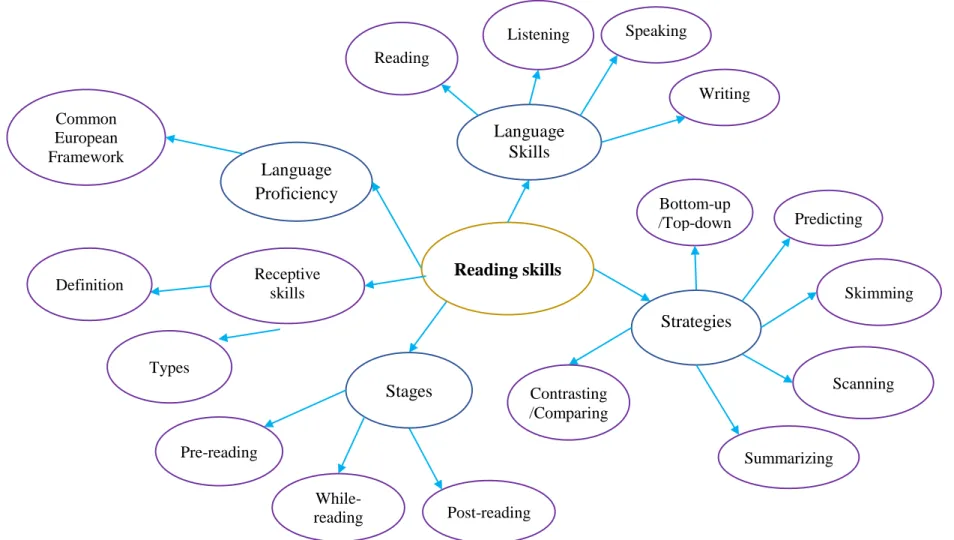
Figure Nº 7. Reading skills. ... 38
Figure Nº 8. Reading Strategies. ... 39
Figure Nº 9. Language skills. ... 49
Figure Nº 10. Predicting and Summarizing Effectiveness. ... 63
Figure Nº 11. Scanning/Skimming Strategies Effectiveness. ... 64
Figure Nº 12. Top-down Strategies Effectiveness. ... 65
Figure Nº 13. Bottom-up Strategies Effectiveness. ... 66
Figure Nº 14. Pre-reading Stage Development. ... 67
Figure Nº 15. While-reading Stage Development. ... 68
Figure Nº 16. Post-reading Stage Development. ... 69
Figure Nº 17. Comparing and contrasting effectiveness ... 70
Figure Nº 18. Analysis and synthesis effectiveness. ... 71
Figure Nº 19. Comprehensive Reading Performance effectiveness ... 72
Figure Nº 20. Reading Skills Overall Performance. ... 73
Figure Nº 21. Student t test distribution. ... 79
AGRADECIMIENTO
Mi agradecimiento a la Universidad Técnica de Ambato, por ser la institución que me brindó la oportunidad de asistir a este programa de Maestría lo que contribuyó a mejorar mi formación profesional. Mi reconocimiento y agradecimiento muy especial a mi directora de tesis quien con su profesionalismo y experiencia supo encaminarme en el desarrollo y consecución del presente trabajo de investigación y cumplir así con este anhelado objetivo.
DEDICATORIA
A Dios quien es la luz que guía los pasos en mi vida. A mis padres que siempre están con su apoyo incondicional junto a mi en la concesión de mis más grandes metas. A mis hijos que son la razón de mi vida y el impulso para cumplir con mis sueños y metas. Gracias hijos por su paciencia y comprensión los llevo en mi corazón.
UNIVERSIDAD TÉCNICA DE AMBATO DIRECCIÓN DE POSGRADO
MAESTRÍA EN LA ENSEÑANZA DEL IDIOMA INGLÉS COMO LENGUA EXTRANJERA
TEMA:
“THE EFFECTS OF METACOGNITIVE STRATEGIES ON READING SKILLS”
AUTORA: Licenciada Miryan Consuelo Salazar Tobar, Magíster
DIRECTORA: Licenciada Lorena Monserath Meléndez Escobar, Magíster FECHA: 19 de junio de 2018.
RESUMEN EJECUTIVO
El propósito de este trabajo de investigación es determinar los efectos de las estrategias metacognitivas en las habilidades lectoras de los estudiantes universitarios de nivel A1 del Programa Regular en el Centro de Idiomas de la Universidad Técnica de Ambato. Estos estudiantes participaron en un estudio experimental que consistió en darles a los estudiantes una prueba previa y una posterior. El estudio se realizó bajo un enfoque cuasi experimental diseñando dos grupos de trabajo; el denominado grupo de control conformado por 37 estudiantes y un segundo grupo denominado experimental con un número de 35 estudiantes, a los cuales se les aplicó un plan de intervención con el uso de estrategias metacognitivas para el desarrollo de las habilidades de lectura durante seis semanas. Los resultados obtenidos a través de este estudio evidenciaron que los participantes expuestos a una instrucción de lectura efectiva en el aula están más motivados para leer, tomar más responsabilidad y control de su aprendizaje a medida que desarrollan estrategias efectivas durante el proceso y las fuentes que los respaldan para convertirse en mejores lectores. Además, son conscientes de que su proceso está construyendo el significado del texto al predecir, escanear, rozar, comparar, contrastar y resumir. Además, se diseñó un folleto con diferentes estrategias de instrucción metacognitiva para ayudar a los estudiantes a descubrir su capacidad y como entrenarse en el uso de las estrategias metacognitivas pues éstas tienen efectos
positivos en la mejora de la comprensión lectora. Las habilidades de comprensión de lectura mostraron una mejora significativa con el grupo experimental. Estos hallazgos respaldan muchos otros estudios que afirman que los lectores de un segundo idioma que son conscientes y utilizan diferentes estrategias metacognitivas para convertirse en lectores eficientes.
Descriptores: Aprendizaje autónomo, comprensión de lectura, estrategias de lectura, estrategias metacognitivas, habilidades de lectura, instrucción de lectura, lectores eficientes, motivación, proceso de aprendizaje, proceso de metacognición.
UNIVERSIDAD TÉCNICA DE AMBATO DIRECCIÓN DE POSGRADO
MAESTRÍA EN LA ENSEÑANZA DEL IDIOMA INGLÉS COMO LENGUA EXTRANJERA
THEME:
“THE EFFECTS OF METACOGNITIVE STRATEGIES ON READING SKILLS”
AUTHOR: Licenciada Miryan Consuelo Salazar Tobar, Magíster
DIRECTED BY: Liencada Lorena Monserrath Meléndez Escobar, Magíster DATE: June 19th, 2018.
EXECUTIVE SUMMARY
The purpose of this research work is determining the effects of metacognitive strategies on the reading skills at A1 English level university students of the Regular Modality at the Language Center in Universidad Técnica de Ambato. These students participated in an experimental study which consisted of giving learners a pre and a post- test. The study was conducted under a quasi-experimental approach designing two working groups; the one denominated control group conformed by 37 students and a second one named experimental group with a number of 35 students, to which a plan of intervention with the use of metacognitive strategies for the development of the reading skills was applied during six weeks. The results obtained through this study evidenced that the participants exposed to an effective reading instruction in the classroom are more motivated to read, take more responsibility and control of their learning as they developed effective strategies and reflect the process and sources that support them to become better readers. Additionally, they are conscious of their process constructing meaning of the text by predicting, scanning, skimming, comparing, contrasting and summarizing. Furthermore, a booklet with different metacognitive instruction strategies was designed to help learners to their ability to discover that metacognitive strategies have effective effects on their reading comprehension improvement. The reading comprehension skills showed a significant improvement with the experimental
group. These findings support many other studies which assert that L2 readers who are aware of different metacognitive strategies for use become skillful readers
Keywords: Autonomous learning, effective readers, learning process, metacognition process, metacognitive strategies, motivation, reading comprehension, reading instruction, reading skills, reading strategies.
INTRODUCTION
Metacognition is an important concept in pedagogical theory since the end of the last century. Metacognition is the reflection on one's cognition, that is, the action and effect of knowing. In teaching it is about the student reflecting on their own learning. This includes an awareness of one's own mental processes and how this knowledge can be used to learn more and better. Studies show that metacognition influences the student's ability to learn and especially in the process of becoming autonomous, a quality that characterizes the good language learner.
Teachers play a key role in developing engaged students. By understanding their students learning process teachers can help students to overcome their difficulties by applying and instructing them with different effective strategies. One of these strategies is metacognitive strategies which involve a reflection on the learning process and allow students towards optimize learning results. Moreover, according to some studies and research in the field of English teaching metacognitive strategies are a feasible tool to facilitate and enhance reading comprehension that’s why universities have to actively improve students’ metacognitive reading strategies by understanding some principles of how students learn. One important fact, about metacognitive strategies is that it demands teaching preparation and knowledge of how learners plan, monitor and control their own comprehension in order to internalize their learning and make it more meaningful. Furthermore, the importance of metacognitive strategies in developing reading skills with university students is a key element to promote both performance and understanding of their reading skills. It also contributes to the fact that if learners read with comprehension and are metacognitive aware of the reading strategies to support their learning process they will success in their learning process. Moreover, these strategies allow readers to take more responsibility in their learning. The present investigative work consists of six chapters as follows:
CHAPTER I: Includes the research problem, its approach, the theoretical and practical justification, its temporal and spatial delimitation, as well as the working
and alternating hypotheses that were subjected to verification, contrasting them with the objectives of the realization of the draft.
CHAPTER II:It consists of the antecedents related to previous investigations, the theoretical referents of the dependent variables that consist of the writing process and of the independent variable that is the feedback of learning. Within the theoretical reference have been included the dimensions that make up each of the variables with their respective indicators; as well as a list of the vocabulary of basic terms used during the theoretical investigation.
CHAPTER III: In this section of the study, the research design is included, the level and type of research selected according to the objectives set out above, and the data collection techniques and instruments are pointed out precisely.
CHAPTER IV: This section contains the results obtained from the control and experimental group through the instruments and they are represented in a visual and statistical way that allows illustrating the readers about the relationship between the study variables.
CHAPTER V: This chapter includes the conclusions and recommendations prepared and extracted from the presentation of data and collated with the objectives of the investigation.
CHAPTER VI: Finally, this section of the investigative work presents a didactic intervention plan of metacognitive strategies for the improvement of the reading process.
The final section of this report includes the bibliographic references that are the source of the theoretical framework and of the theoretical supports in general of the work in an integral manner; In addition, the annexes are included as evidence and support for the work carried out.
CHAPTER I
RESEARCH PROBLEM
1.1. Research Topic
The effects of metacognitive strategies on reading skills.
1.2. Problem Statement
1.2.1 Contextualization
English has been the leading world language on the internet and printed materials around the world, consequently most people have to be able to read English texts. People are required to have the ability to read and comprehend texts in order to acquire knowledge as well as to conduct their life in different settings: academic, work places and everyday activities (Argaez, 2010).
According to Vicent (2015) reading in English has a lot of benefits for example reading is one of the best ways for EFL learners to increase vocabulary and consolidate grammar understanding during their learning process by being exposed to different graded and authentic materials which encourage learners to make reading more enjoyable and they use a variety of strategies to construct meaning.
Ching and Lin (2015) also state that reading has been an important component for EFL learners during the last forty years due to reading comprehension is useful for language acquisition. However, reading is a complex and interactive process for learners of extracting meaning from a context. In this process learners face a lot of challenges and difficulties which make them to struggle understanding what they read.
According to Yadav (2014) learners try to understand the reading content by translation because of the difficulty level of the texts provided and the extend and unfamiliar vocabulary which make their reading difficult and boring. As a consequence of this, learners feel demotivated about reading, have low grades and fail their English courses.
Current teaching practice is the result of combining a variety of effective methodologies, techniques and teaching materials which have had a significant impact in the teaching learning process over the years (Freeman, 2011). In this context, understanding some important facts about reading instruction and implementing different learning strategies to enhance reading comprehension is essential for EFL teachers.
One of these strategies is the metacognitive strategy which offers valuable opportunities for learners to enhance their understanding of a text which has been. The application of metacognitive strategy during reading and comprehension lessons helps students to think logically in all the three levels of the reading process before reading, during reading and after reading by developing engaged readers as they provide readers with the strategies they need for effective communication in English. Additionally, recent researchers in second language reading learning have focused on the implementation of metacognitive strategies and the relationship among perception of the strategies, strategy use and reading comprehension (Karbalaei, 2011).
In Ecuador the process of teaching and learning English as a foreign language is not satisfactory. Despite all the efforts and investments that the government has done to improve English among Ecuadorian language learners from grade 2 EGB to 6th year of bachelor, they haven’t reached the B1 level as the authorities’ expectations. (Ministerio de Educacion del Ecuador, 2016) In this context, there a lot of challenges that teachers face in their instruction. One of them is that learners do not like reading texts. For example, university students struggle when they read texts in English as they have not been trained to use effective comprehension reading
strategies to understand, summarize, recall and infer information from printed texts and enjoy as well. As a result, they find difficulties in developing this skill in English as a foreign language and they have some low-level skills. (Ministerio de Educacion del Ecuador, 2016).
According to the diagnostic test results sent by the teachers to the Evaluation Center of Starter students in the semester April –August 2016, 65% of the students got less than 7 in Reading which is the minimum acceptable. These findings showed that starter students from the Regular Program at the Languages Center have not developed effective reading strategies to understand general and specific information from a text.
Based on the findings mentioned above teaching effective reading strategies is essential for students’ success in acquiring a second language. In this regard, reading instruction is a key component and a big concern for teachers that work at the Languages Center at Universidad Técnica de Ambato.
Furthermore, recent researches in teaching English suggest that anything that teachers can do to make reading easier and enjoyable for students is a good idea as it would benefit greatly from a strong focus on reading.
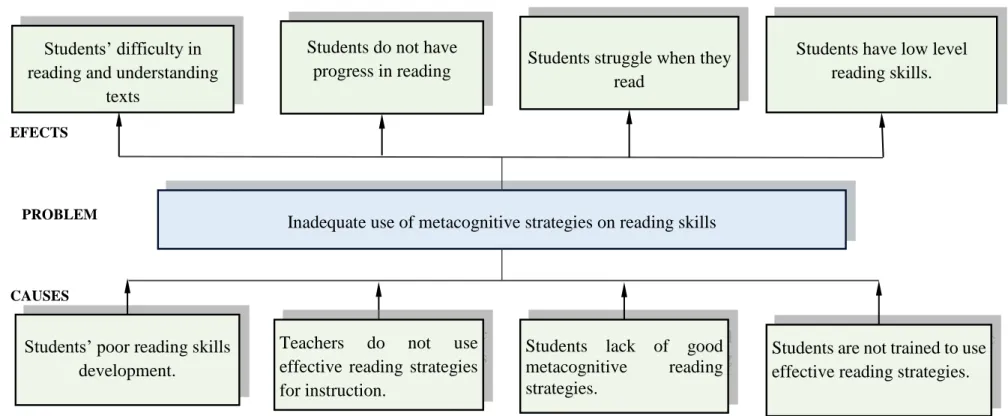
1.2.2.1Problem Tree Analysis
Figure Nº 1. Problem Tree Analysis. Made by: Miryan Salazar
CAUSES EFECTS
PROBLEM
Students do not have progress in reading
Inadequate use of metacognitive strategies on reading skills
Students have low level reading skills.
Students are not trained to use effective reading strategies. Students lack of good
metacognitive reading strategies.
Students’ difficulty in reading and understanding
texts
Students’ poor reading skills development.
Students struggle when they read
Teachers do not use effective reading strategies for instruction.
1.2.2 Critical Analysis
There are some causes and effects that provoke the inadequate use of metacognitive strategies on reading skills. First, students’ poor reading skills development causes their difficulty in reading and understanding texts. If teachers do not use effective reading strategies for instruction, as a result student do not have progress in reading. McShane (2005) tells us that mid-level readers who are often the largest percentage of adult learners, have extremely varied reading needs, and although they have learned some word identification skills, they often do not make good use of these skills when reading. Additionally, students’ lack of metacognitive reading strategies provokes that they struggle when they read. Proficiency in reading involves many variables, for example, automaticity of word recognition, familiarity with text structure and topic, awareness of various reading strategies, and conscious use and control of these strategies in processing a text (Pang, 2008).
Reading correctly is more than simply running through the words of a text. It is to establish a link with the text that involves the reader intellectually and emotionally. It is to develop the ability to fully understand and feel a writing, a capacity that develops as one attends and exercises the intellectual ability to read, which is something much more complex than simple literacy (Argudin & Luna, 1995). Learning to read can only be achieved by reading. There is no other way. At present, young people have a culture that is very different from the paths that lead to the pleasures of reading. In the past, most people usually went from a childhood of addiction to television to an adolescence addicted to the computer; so they arrived at youth without the motivation of reading selected printed materials, their interests and needs are made up of images as they belong to the age of the technology. According to Gardea (1994), reading has lots of benefits for English learners as it is one of the best ways to increase vocabulary and consolidate their grammar understanding. Furthermore, reading helps learner to improve their language learning process by
Finally, if students are not trained to use effective reading skills students will have a deficient low-level of reading skill. Based on these causes and effects it is necessary for teachers to investigate the most effective EFL reading strategies for students in order to find out what reading strategies they need to use to comprehend what they read, to develop reading skills, and to become effective readers.
1.2.3 Prognosis
If teachers do not use engaging reading strategies to enhance reading skills, students will face some problems. First, learners will not be successful in understanding a text when they read. In addition, students will not feel motivated to read texts in English neither for their careers, for study purposes or simply for pleasure. In addition, students w develop vocabulary knowledge, improve writing and speaking skills. Furthermore, students will have a low reading performance because they are not aware which reading strategies and how to employ them in order to read accurately printed information. Finally, metacognition is a key element in reading comprehension if learners do not use their own metacognitive process they will not become effective readers.
In contrast, if teachers instruct using different meaningful strategies like metacognitive reading strategies into reading instruction effectively, students will ensure their success in reading English comprehension. Consequently, they will be able to develop their academic achievement and their reading skill development as well. Finding ways to help students to learn effective reading strategies is a big teachers’ concern to make learners more active and autonomous over their own learning by developing students´ metacognitive awareness of specific reading strategies for proficient reading.
1.2.4 Research Problem Formulation
What are the effects of metacognitive strategies on the reading skills development of the A1 students of the Regular Program at the Languages Center at Universidad Técnica de Ambato?
1.2.5 Research Questions
Which features from the metacognitive strategies favor students’ reading process?
How metacognitive strategies are implemented during reading development?
In which extent reading strategies are related to metacognitive strategies?
Which metacognitive strategies can be used by teachers to develop reading skills?
1.2.6 Delimitation of the Research Problem
1.2.6.1 Content Delimitation
Field: Education
Area: Teaching English in high Education
Aspect: Learning and teaching
1.2.6.2 Time Delimitation
1.2.6.3 Spatial Delimitation
This research was carried out at the Language Center of the Universidad Técnica de Ambato, Campus Huachi Chico.
1.3. Justification
This research is of great importance for English teachers because its findings will have valuable implications for teachers that need to use and implement effective strategies to develop students reading ability and to respond to their learning needs. In this context, language teachers need to help students not only to know what strategies to use but also how and when to apply them to encourage them reading to learn using successful reading strategies.
The level of interest which this project will provoke in the academic circle of English teachers and instructors is expected to be of high relevance, since the implication of metacognitive strategies during the development of reading skills will facilitate students’ cognitive skills improvement. To contribute with practical ideas and clear examples of the use of strategies will encourage learners to be active participants during the instruction process due the clearness of their role and the responsibility they might assume within the application of the metacognitive strategies.
In addition, this research will have a positive impact on the group of students that are going to be exposed to the use of metacognitive strategies as one solution to the problem of their poor reading comprehension. These strategies also motivate learners to read more and better texts by organizing content which facilitate their comprehension of the new acquired information. In this regard, students ‘reading progress will be showed in the effectiveness of the results of developing their reading skill and in the form of getting higher scores of their reading comprehension tests as well.
This project is also feasible as it is based on current issues of learning and teaching in reading skills and it has the collaboration of authorities, teachers and students at Languages Center at Universidad Técnica de Ambato.
Additionally, this research is original since a research about metacognitive reading strategies has not been developed yet at the Language Center de la Universidad Técnica de Ambato. The main contribution of this research is to challenge teachers to conduct studies in the field of metacognitive strategies as they have positive effects on reading comprehension.
Furthermore, this research will benefit students with low level reading skills by supporting them to develop their reading comprehension in a more effective way through the use of effective metacognitive strategies to success in reading.
1.4. Objectives
1.4.1 General Objective
To analyze the effects of metacognitive strategies on students’ reading skills development.
1.4.2 Specifics Objectives
To identify the features from metacognitive strategies which favor students’ reading process.
To describe how metacognitive strategies are implemented during reading skills development.
To stablish a relation between reading strategies and metacognitive strategies.
CHAPTER II
THEORETICAL FRAMEWORK
2.1 Research Background
After reviewing some different studies, research findings and issues about using metacognitive organizers are mainly used as a reading strategy these studies have important implications for developing this research.
Maryam Habibian in the year 2015 for her Doctoral thesis from Putra University Malaysia, observed two main points in the study: the effectiveness of teaching metacognitive strategies and the increasing use of these strategies. Additionally, she concluded that the explicit instruction of metacognitive strategies has contributed to improve the students’ ability in reading comprehension by practicing and applying these skills effectively.
Mohammad Reza et al. (2013) study corroborates that metacognitive reading strategy is one of the main important factor to facilitate reading comprehension in university and school learners. Readers who use metacognitive reading strategies in their reading comprehension are more successful than the ones that do not use them.
Maruja Burgos in the year 2016 developing her thesis work, at Universidad Católica del Ecuador for obtaining the Grad Degree in Education, entitled Basic Reading Strategies, found that reading strategies used by teachers for the teaching process in the classroom are traditional and they do not encourage comprehension. The results showed that the reading level was low. The application of new reading strategies will contribute to improve reading comprehension and, also, to the teaching task to propose the development of these metacognitive strategies.
Muso Edwin and Quispe Isidro in their thesis work for getting the degree of Teaching and Education from Universidad Tecnica de Cotopaxi in the year 2015 which name is “Metacognition strategies in reading comprehension in the fifth year of basic general education in Miguel Rivadeneira General School Emilio Terán of Mulliquindil Santa Ana parish of Salcedo canton, Cotopaxi province”, concluded that reading comprehension is linked to metacognition strategies students can develop higher and better reading comprehension and reduce their difficulties when understanding a text.
Quintana Samantha in the year 2012 in her thesis work, for achieving the degree in Education from Universidad Casa Grande, entitled “The development of metacognitive learning strategies during an intensive English course for EFL teachers”, concluded that metacognitive strategies helped learners to be more organized during reading process development as well as they were able to identify their own mistakes to set up a new goal for its improvement.
It can be concluded that by teaching metacognitive strategies students can learn more effectively by improving their understanding of the target language and to accomplish their goals in learning how to comprehend a text. Furthermore, teachers need to provide with multiple and repeated opportunities to practice the new strategies on a variety of learning tasks and activities. Furthermore, it is essential for teachers to incorporate effective reading strategies in their instruction to make reading more enjoyable and easier for their students especially when they are starting to learn a foreign language.
Finally, these study findings can help to this research by showing some useful issues about the benefits of using metacognitive strategies as an effective reading strategy for teaching a second language.
2.2 Philosophical Foundation
This research will be focused on the Critical-Positivism paradigm which will develop a quantitative and qualitative analysis rating description and interpretation
of the problem to obtain the truth and the hypothesis testing. Paradigm is a term frequently used in the social sciences, but one which can lead to confusion because it tends to have multiple meanings. The definition used here is that as paradigm is a way of examining social phenomena from which particular understandings of these phenomena and provide solutions to specific social issues.
In addition, the Critical-Positivism paradigm develops a descriptive proposal paradigm which is considered as a philosophical and theoretical framework solve to a researching problem in the field of social research (Aram & Salipante, 2003).
The Critical Proactive Paradigm is a transformative paradigm that focuses in the learners’ holistic education by developing their knowledge, skills, values, active critical thinking and responsibility for their learning to become successful.
As the social constructivist perspective is considered to be an integrated perspective, Robson (2002) contends that it is appropriate to also use mixed methods and approaches. It might use qualitative methods in the form of case studies to create an in-depth, rich account (Yin, 2003, Scholz and Tietje, 2002; Rubin and Rubin, 1995) of how institutions implement their codes of conduct and what educators think about their effort.
2.3 Legal Basis
Higher Education is regulated by the following bodies in the Constitution of the Republic of Ecuador 2008 and CES (Higher Education Council).
The Organic Act of higher education academic regime regulations (CES) in its title I about the scope and objectives and in its article 2 the Objective, states that: This Act aims to define its principles, guarantee the right to quality higher education that promotes excellence, universal access, permanence, mobility and graduation without any discrimination, also in Article 30.- Learning a foreign language. - The subjects destined to the learnings of the foreign language may or may not be part of the curriculum of the career. However, the LOES will guarantee the level of
proficiency of the language to meet the graduation requirement of the technical, higher technological or equivalent levels and third grade level, they must organize or approve the corresponding subjects from the beginning of the career. The sufficiency of the foreign language must be evaluated once the student has completed and approved 60% of the subjects of the course; such proof will be enabled for the continuation of their studies, without prejudice to the fact that this requirement can be fulfilled previously.
For careers at the technical and higher technological levels, proficiency in the use of a foreign language shall be the level corresponding to A2 of the Common European Framework of Reference for Languages. For third level or degree courses, proficiency in the use of a foreign language will be understood as the level corresponding to Bl of the Common European Framework of Reference for Languages. In order for regular students enrolled in undergraduate programs to meet the requirement of proficiency in a foreign language, higher education institutions, if they so require, may enter into agreements with institutions that, although not part of the System of Higher Education, provide programs or language courses, provided that they issue certificates of sufficiency with international recognition.
Higher education institutions, in addition to their own teachers, may have teaching technicians to carry out regular language courses, which serve students in the purpose of learning a foreign language.
2.4 Key Categories
Independent Variable: Metacognitive strategies
2.4.1 Fundamental Categories Network
Independent Variable Dependent Variable Figure Nº 2. Fundamental Categories.
Made by: Miryan Salazar
Teaching Learning Process Learning strategies Autonomous Learning Metacognitive strategies Language Proficiency Language skills Receptive skills Reading skills Influences
2.4.2 Independent Variable Differentiated Instruction
Figure Nº 3. Graphics Independent. Made by: Miryan Salazar
Cognitive Learning Strategies Metacognitive Task- based Reading awareness Declarative knowledge Procedural Knowledge Teaching Learning Process Conditional knowledge Metacognitive strategies Autonomous Learning Principles Factors and levels Definition Importance Graphic organizers Humanistic Integrative Types comprehension reading strategies Meaning-based
2.4.3 Dependent Variable Reading skills
Figure Nº 4. Graphics Dependent. Made by: Miryan Salazar
Receptive skills Language Proficiency Common European Framework Post-reading Strategies Skimming Scanning Stages Summarizing Bottom-up /Top-down Predicting Contrasting /Comparing Reading skills Language Skills Listening Speaking Reading Writing Definition Pre-reading While-reading Types
2.4.1 Independent Variable: Metacognitive Strategies
2.4.1.1 Teaching learning process
Teaching cannot be understood except in relation to learning; and this reality relates not only to the processes linked to teaching, but also to those linked to learning. The learning arising from the conjunction, the exchange of the performance of teacher and student in a specific context and with some means and strategies concrete constitutes the beginning of the research to be carried out. The constant reconsideration of what are the processes and strategies through which students come to learning (Zabalza, 2011).
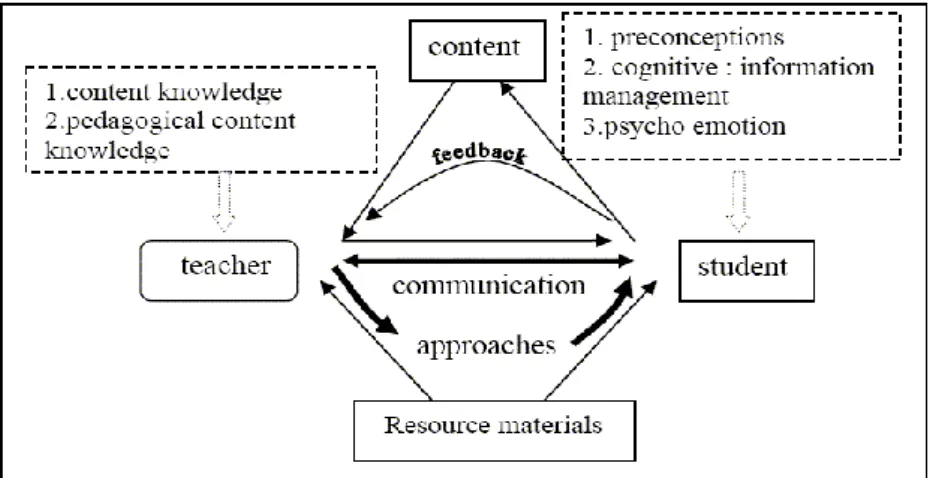
There are three important elements in the process; the teacher, the student and the content. It considers that both teacher and the students are participants of the teaching learning process. The teacher characteristics are the content knowledge and the pedagogical knowledge while the student characteristics are preconceptions, cognition of information management and the psycho-emotional state of the students. It is communication that determines the effectiveness of the teaching learning process (Smith, 2011). This in turn is determined by the teaching approaches and the feedback between students and teachers.
Figure Nº 5. Smith Model of a Teaching Best Practice. Source: Science teaching for enlightenment (Smith, 2011).
Methods and Approaches for teaching EFL
According to Hammer (2010) there have been lots of teaching methods and approaches through the history of teaching languages like Grammar-translation, Audio-lingualism, PPP, CLT, TBL,TPR. They have been tried and debated in order to see which methods or approaches help students to learn more effectively.
Current teaching practice is the result of combining some techniques and teaching materials which have had a significant impact in the teaching learning process over the years.
Approaches to EFL Reading
Cheol (2013) states in his study about the Developmental approaches to the teaching of EFL reading, there are some reading instruction key issues for learners’ reading proficiency that teachers must consider in their instruction to help learners to become more effective readers. These approaches included:
Humanistic Approaches: This is a humanistic and learner-centered approach. In this approach learners are willing to being exposed and read interesting and meaningful materials. They have intrinsic motivation and positive attitudes towards reading in this context, reading acquisition occurs naturally as they are really motivated to learn.
Meaning-based approaches: In this approach, reading is meaning-focused, not form centered. Learners read for pleasure not for obligation so they are really motivated to choose what to read, at their own level and pace. Through reading they get more knowledge of the world and develop their critical thinking skills as well. In addition, they can expand their vocabulary.
Task-based approaches: One main principle of this approach is that learners are able to understand texts in meaningful situations in which they are asked to record important ideas and details to produce and comprehend instructions effectively.
Integrative approaches: Reading should be meaningful for learners in natural and meaningful settings. Teaching reading requires learners’ exposure to interesting reading materials and the teacher should create a pleasant environment where learners can interact about their opinions and ideas about what they have read. In addition, learners have to be able to integrate reading with the other skills like writing and speaking in a more effective way.
2.4.1.2 Learning strategies
According to Valls (1993) and Gargallo (2000), and as we pointed out in the summary of this same communication, it should be considered that the strategies of learning are procedural contents that belong to the field of knowing to do. It could be said that they are the meta-abilities or skills of skills that humans use to learn any type of content from learning.
Learning strategies are characterized by their intentionality, this refers to a learner who is characterized as strategic, knows that the strategies are aimed at achieving an objective, either to receive information, to develop that information, to organize it or to evoke it at the time of requesting it to resolve a situation problem (Astudillo & Rivarosa, 2010) .
Zare (2012) defines language learning strategies as the specific actions taken by the learner to make his learning process easier, faster, and more enjoyable and more effective. The ability to employ these strategies are the tactics we use to learn new things. Research has shown us that the difference between good learners and poor learners is their ability to employ these strategies in learning situations. The acquisition of learning strategies is particularly important for your ELL students, because they’re likely to already have a lot of natural abilities in their own native language which they can draw from. The goal will be to have them improve these same abilities in English.
While ELL has multiple definitions, here we are referring to ELL students who are studying in an English-language school or institute and need additional support to
help them understand subject matter taught in English. Language strategies and learning styles are among the main factors to determine how and how well students learn a second language.
In this regard, language teachers need to train the students to apply the appropriate strategy for a specific purpose or a specific skill area and encourage them to use the strategies as frequently as possible. Students can learn to use language learning strategies to improve their language skills.
Figure Nº 6. Classification of language learning strategies. Source: Asia-Pacific Forum on Science Learning (Oxford, 1990).
Cognitive strategies
According to Ratna (2014) cognitive strategies are the ones that students use for performing a learning task and manipulating information to understand a text. There are a lot of cognitive strategies which include analyzing, contrasting, summarizing. The research shows that these strategies help teachers in the classroom instruction for successful learning.
Affective strategies
These strategies are related to the learners’ social behavior and the interaction with others. The main social affective strategies include cooperation and question for clarification.
Social Strategies
According to Louisane (2013) these strategies help learners to work with others and understand their culture and language as well. These include the development of some language functions like: asking questions to get verification, asking for clarification, asking for help in doing a language task. Moreover, learning is a social activity and socializing their learning requires them to recognize the benefits of working with others and to be able to share and negotiate with other learners
2.4.1.3 Autonomous learning
According Moore (2018) to Autonomous learning is one important key element for teachers to be considered in their students’ language learning process as it allows them to personalize and take control of their learning according to their needs, interests and learning styles. In the context of Higher Education effective autonomous learning his involves developing tolerance, empathy and understanding of other values and cultures; and to be able to explain, discuss and negotiate in an acceptable manner.
Autonomy at learning should be considered as one of the main keys of the formative success in Higher Education, as one of its main products. In this sense, it is considered that the level of training does not come from the amount of what a student is capable of compiling, but from the quality of what they process and the way they do it Rué (2009). This concept is based in the natural tendency for learners to take control over their learning.
According to Davood Asadinik (2016) autonomous learning is a key concept in ELT that emphasizes the assistance of students into taking control of their leaning by the development of their metacognitive learning strategies. These strategies are really important to help their progress and developing their learning more effectively.
Additionally, autonomy may be displayed in different ways and to different degrees depending on each learner and learning situation. Learners who lack autonomy are capable of developing it given appropriate conditions and preparation. Autonomous learning is more effective than non-autonomous learning.
Principles of Autonomous learning
As Davood as cited Zelina and Kosová (2000), in his study there are some principles to motivate students to be more autonomous in their learning:
To teach students according to their own choice.
To teach students to plan their own progression, divide their time and routines.
To teach students ways to motivate themselves.
To teach students how to relax.
Based on the above mentioned facts, an important characteristic of autonomous learning is that students are able to be responsible of developing their own learning, translates into a collective intellectual growth where the starting point is the student himself, who through his knowledge, formulas, concepts and ideas is taking interest in situations of daily life, being able to understand and explain them using their own words, thus leading to the transformation from spectator to actor facing and proposing new solutions to existing problems and that are to come.
Factors to be considered for autonomous learning
Davood Asadinik (2016) states in his research that there some factors that contribute to the students autnomous leaning like motivation, self confidence, interaction, collaboration and social factors elements that allow students to build possitive attitudes towards autonomous learning. In this context, teachers play an important role to foster learners in lauching them into autonomous learning leaning.
In connection with these ideas the success of implementing autonmous learning can be more beneficial if students are trainned in the use of metacognitve strategies to learn to learn more effectively without the guiadance of the teacher.
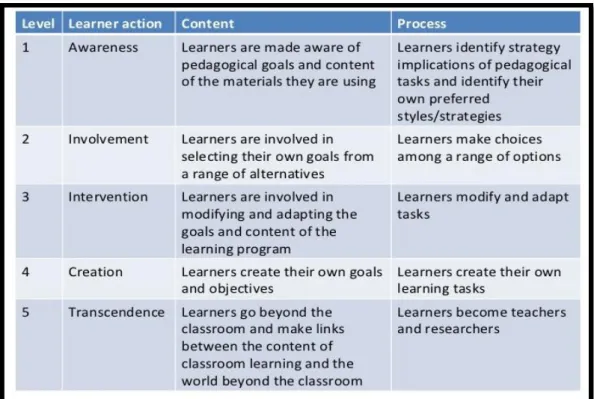
Table Nº 1. Levels of Autonomous Learning.
Source: Approaches to learner autonomy in language learning (Nunán, 1996).
2.4.1.4 Metacognitive strategies
Metacognitive strategies are key factors to encourage autonomous learning because students take more responsibility on their learning process and as they know how to plan, evaluate their own progress.
Inclusive Schools Network (2014), define metacognitive strategies as the strategies used to support students’ understanding and their way of learning which means to ‘think’ about their 'thinking'.” Teachers who use metacognitive strategies can positively impact students to developing their reading comprehension by helping them to develop an appropriate plan for learning information, as students become aware of how they learn, they will use these processes to efficiently acquire new information, and consequently, become more independent thinkers.
Metacognitive strategies work on awareness of the learning process itself (how it is learned), and it is, together with planning and planning strategies, and study techniques, a fundamental aspect for the acquisition of meaningful learning and achieving autonomy and self-regulation of the learning process. Therefore, it is necessary to teach to learn.
It is a didactic method that aims, ultimately, for the student to self-regulate their physical and cognitive behavior to acquire a learning or solve a particular problem. It consists of teaching the students a guide or guideline of questions that can help them make the right decisions when facing a learning task, highlighting those elements, parameters, dilemmas and dilemmas of the task that are most relevant to their resolution.
Karbalaei in the year 2010 in his study showed significant differences in the metacognitive awareness use in the EFL and ESL Indian and Iranian college students while using reading academic materials. These findings revealed that Indian students are more interested in using top down strategies for better reading comprehension while Iranians used more focused on bottom up strategies.
Based on the study findings Tavakoli (2014) entitled metacognitive strategies for Iranian ELL leaners, it has useful implications for learners as the awareness and use of metacognitive strategies have positive implications on reading comprehension. In this regard, using appropriate reading strategies had a positive and strong correlation with reading comprehension achievements.
Mohammad Reza et al. (2013) study also corroborates that metacognitive reading strategy is one of the main important factor to facilitate reading comprehension in university and school learners. Readers who use metacognitive reading strategies in their reading comprehension are more successful than the ones that they don’t use them.
Different kinds of metacognitive reading strategies
Mohammad Reza et al. (2013) state that there are three types of metacognitive reading strategies which are used by learners to regulate their cognition. There strategies include:
a) Declarative knowledge: It refers to the individual knowledge of the learner which
helps him to know how to do things in order to achieve his learning by using strategies that affect his performance.
b) Procedural Knowledge: According to Veenman (2005) procedural knowledge
refers to the knowing that the learner has to know how to do things by using some sequence strategies effectively.
c) Conditional Knowledge: This knowledge improves students’ performance, as a
result learner selects the best strategies for each learning situation.
Based on the above findings mentioned some researchers claimed that skilled learners are able to use the three metacognitive strategies are more motivated readers because their learning and reading performance are better.
Metacognitive Reading strategy regulation skills
Metacognitive appeal to the knowledge of the subject of their own cognitive processes and thus fulfill a regulating function of learning; Cognitive strategies fulfill a function of processing of learning materials; the socio-affective, meanwhile, are constituted by the processes of interaction and affective control associated with learning. They depend on several language purposes as follows:
Planning Purposes
Anticipate the concept or organizing principles of a learning task (anticipated organization); proposing strategies to carry out a future task, it generates a plan for the stages, the sequence, the main ideas or the functions of the language that will be used in the accomplishment of a task.
Attention Purposes
This is to direct the attention to decide, in advance, to pay attention in general to a learning task and ignore irrelevant distractors; maintaining attention during the execution of the task. It requires the selective attention: decide, in advance, to pay attention to specific aspects of the linguistic input or to situational details that help in the realization of a homework; Pay attention to specific aspects of the linguistic input during the execution of the task.
Self-regulation Purposes
It demands self-administration which means to be aware of the conditions that help to carry out linguistic tasks successfully and ensure the presence of those conditions; control linguistic performance to maximize the use of what is already known. Besides, it reviews, verifies or corrects the understanding or action during the development of a task. This strategy has been coded in the following ways:
Self-regulation of comprehension: revises, verifies or correct comprehension.
Self-regulation of production: reviews, verifies or correct production.
Auditory self-regulation: using "the ear" (how something sounds) to make decisions.
Visual self-regulation: use "the eye" (how you see something) to make decisions.
Self-regulation of style: revise, verify or correct on the basis of an internal register.
Self-regulation of strategies: to monitor the effectiveness of the operation of a strategy.
Self-regulation of the plan: monitors the effectiveness of a plan.
Self-regulation of verification: follows-up, throughout the development of a task, of actions undertaken or possibilities previously considered (O'Malley & Chamot, 1990).
Self-assessment Purposes
The identification of problems helps to explicitly identify the central point that requires solution in a task or identify an aspect of it that hinders the successful conclusion. Demands self-evaluation and examining the results of a learner´s linguistic performance in relation to an internal measure of perfection and accuracy; it judges the linguistic repertoire, the use of strategies or the ability to perform the task undertaken. This strategy has been codified in the reflection tasks aloud in the following terms:
Self-evaluation of production: examines students’ own work when the task is finished.
Self-evaluation of the action: judges the general execution of the task itself.
Self-evaluation of strategies: judges the own use of strategies when the task has been completed.
Self-assessment of the linguistic repertoire: judge your own knowledge of L2 at the word, phrase, sentence or concept levels. (O'Malley & Chamot, 1990).
Metacognitive reading comprehension strategies
According to Herrera, Kavimandan, and Holmes (2011) there are some metacognitive strategies that support learners when they interact with the text and they’re also enable them to be critical information consumers. Moreover, these strategies encourage readers to develop active reading which requires: predicting, questioning, imagining, clarifying and summarizing.
These strategies include:
Active Bookmarks
Extension Wheel
Tri Fold
The U C ME strategy
Relevance Scale
The Heart Activity It’s all in the Box
Venn diagram
Another very useful metacognitive strategy according to Condidorio (2012) are graphic organizers which are effective strategies for checking students’ comprehension of a text. Moreover, Condidorio (2010) states that graphic organizers support readers to process and retain information more effectively. Additionally, students pointed out in her study that graphic organizers was effective in recalling information on tests as on tests they have to retain longer information. Furthermore, graphic organizers assist readers to arrange information systematically and maximize some of the challenges when they go deeper into the text. In addition to helping students organize their thinking and writing process, graphic organizers can act as teaching tools. Teachers can use graphic organizers to illustrate the student's knowledge of a topic or section of key areas.
Graphic organizers
Research studies show that graphic organizers are a great metacognitive strategy for organizing key ideas and supporting details related to a text. Students are also able to become more proficient independent learners as they develop their comprehension and compare their understandings and learnings with other learners.
Polyxeni Manoli, Maria Papadopoulou (2012) findings provided further evidence that graphic organizers are an effective strategy for checking students’ comprehension of a text. Moreover, Condidorio (2010) states that graphic organizers support readers to process and retain information more effectively. Additionally, students pointed out in her study that graphic organizers was effective in recalling information on tests as on tests they have to retain longer information. Furthermore, graphic organizers assist readers to arrange information systematically and maximize some of the challenges when they go deeper into the text. In addition to helping students organize their thinking and writing process, graphic organizers can act as teaching tools. Teachers can use graphic organizers to illustrate the student's knowledge of a topic or section of key areas.
Table Nº 2. Types of Graphic Organizers.
Source: Graphic organizers: Power tools for teaching students (Ellis & Howard, 2005).
Graphic Organizers Features
One of the main characteristics of the graphic organizers is that they allow the processing of information through images and a small text, where detailed and concise information is shown according to the subject matter.
They have connectors that facilitate their interpretation.
Keywords join with their connectors making the information accurate.
The information is complemented with images according to the organizer that is being used.
The information presented there does not leave unknowns in the reader (Páez, 2016).
However, for the classroom application of these graphic organizers to be really effective, it is necessary on one hand, to know the main characteristics of each of them and on the other, to be clear about the learning objectives that are desired. the students reach. For example, if you want them to locate, within a certain period of time, the events related to the discovery of America, so that they visualize and understand the temporal relationship between them, the ideal method or graphic organizer to use is a Line of time. On the contrary, if what is desired is for students to understand the relationship between the most important concepts related.
Therefore, within the cognitive system appear two subsystems differentiated by their capacity for perception and representation of images (non-verbal objects) and verbal representation from the logos. The visual subsystem encodes and processes information through forms and images, while the verbal subsystem encodes and processes information through logical ideas. The information allows to establish referential connections or of concepts between the verbal and non-verbal sources, as it is noticed in the graph. The theory of double coding has been taken from the field of multimedia design as a basis in the construction of contents that operate through dual stimuli, that is, transmitting, simultaneously, visual and verbal information.
Graphic Organizers should be simple, and clearly show the relationships between concepts or propositions. They go from the general to the specific, the more general or inclusive ideas, occupy the apex or upper part of the structure and the more
specific and the lower part examples. Even though many authors argue that these do not necessarily have to be symmetrical.
They should be colorful, the more visual the map is made, the amount of material that is memorized increases and the duration of that memorization increases, since perception is developed, benefiting with the visualization activity of students with attention problems.
The concepts, which are never repeated, go inside ovals and the words link are located near the lines of relationship Barraza and Barraza (2014). It is convenient to write the concepts with a capital letter and the words of lowercase link, which may be different from those used in the text, as long as the meaning of the proposal is maintained. For the words link it can be used verbs, prepositions, conjunctions, or another type of conceptual link, the words link give meaning to the map even for people who do not know much about the subject. If the main idea can be divided into two or more equal concepts these concepts must go in the same line or height.
Procedural Features
A graphic organizer is a brief way to represent information. Errors in the graphic organizers are generated if the relations between the concepts are incorrect. It is fundamental to consider that in the construction of the conceptual map, the important thing is the relationships that are established between the concepts through the words-link that allow to configure a truth value on the subject studied (Barraza & Villareal, 2012).
To develop graphic organizers, it is necessary to master the information and knowledge (concepts) with which you are going to work, which indicates that if you do not have prior knowledge of the subject to be exposed, we could not try to make a map on the subject, and to dare to do so, the following faults can be generated in its construction:
That it is an arbitrary, illogical graphic representation, product of chance and without a relevant structure. That they are only linear sequences of events, where the relation of the most general to the specific is not evident. That the relationships between concepts are confusing and prevent finding meaning and logical order to the conceptual map.
According to Bass (2011) the concepts are isolated, or what is the same thing that I do not know about the interrelation between them. The theory of cognitive load suggests that the load or capacity of the working memory has a maximum limit on the amount of information that can be processed. If that load is exceeded, learning does not occur. If the graphic organizers are used appropriately, the cognitive load can be reduced and consequently, allow more resources of the working memory to be dedicated to learning.
Didactic Features
The Theory of the schemes states that within the human memory there are schemas or networks of information. The use of Graphic Organizers can help students to link existing knowledge, organized in schemes, with new knowledge.
A scheme is an abstract structure of knowledge. This is intended to explain how the prior knowledge of people affects understanding. The schemes are constituted by concepts that provide slots to be filled with specific information (Bernhardt, 2010). There are specifications of the type of information that each slot can contain. In order to understand a message, it is necessary to activate or construct a scheme that takes good account of the objects and events described. Each segment of information can be placed in a slot without violating the specifications. All-important slots must contain information. When a text does not contain information for a slot it can be filled in by inference.
Schema Theory highlights the fact that more than one interpretation of a text is possible. The outline that will be formulated with respect to a text depends on the