TESIS DOCTORAL
FACULTAD DE FILOSOFÍA Y LETRAS DEPARTAMENTO DE CIENCIAS HISTÓRICAS
UNIVERSIDAD DE CANTABRIA
Estructura social de los cántabros occidentales y su evolución
durante el Imperio Romano según la documentación epigráfica.
Concomitancias y diferencias con los demás cántabros y sus
vecinos astures.
MARÍA LUISA PÉREZ GUTIÉRREZ
Memoria presentada para la obtención del Título de Doctor por la Universidad de Cantabria Dirigida por el Dr. D. JOSÉ LUIS RAMÍREZ SÁDABA
Estructura social de los cántabros occidentales y su evolución
durante el Imperio Romano según la documentación epigráfica.
Concomitancias y diferencias con los demás cántabros y sus
vecinos astures.
MARÍA LUISA PÉREZ GUTIÉRREZ
Memoria presentada para la obtención del Título de Doctor por la Universidad de Cantabria
Dirigida por el Dr. D. JOSÉ LUIS RAMÍREZ SÁDABA FACULTAD DE FILOSOFÍA Y LETRAS
DEPARTAMENTO DE CIENCIAS HISTÓRICAS UNIVERSIDAD DE CANTABRIA
SUMARIO Página
AGRADECIMIENTOS 11
ABSTRACT. SUMMARY and OBJECTIVES. CONCLUSIONS 13
Cap. 1 INTRODUCCIÓN. OBJETIVOS DE LA TESIS, ESTADO DE LA
CUESTIÓN, METODOLOGÍA Y ESTRUCTURA Y DESARROLLO DEL TRABAJO 23
1.1.) Objetivo e hipótesis de trabajo 24
1.2.) Estado de la cuestión 25
- Los cántabros occidentales: orgenomescos y vadinienses 26
- Fuentes clásicas 27
- Estudios modernos 27
- Los cántabros meridionales 32
- Los astures 32
1.3.) Metodología 34
1.4.) Código de colores 38
Cap. 2 DISTRIBUCIÓN GEOGRÁFICA 39
2.1.) Fuentes clásicas 39
2.2.) La arqueología: las ciuitates de los Orgenomescos y los Vadinienses 43
2.3.) Monumentos epigráficos 44
2.4.) El fenómeno urbano 54
2.5.) Límites de nuestro campo de estudio 56
Cap. 3 DOCUMENTACIÓN EPIGRÁFICA 60
3.1.) Número 61
3.2.) Carácter epigráfico o anepigráfico del monumento 62
3.3.) Cronología 78
3.4.) Distribución 92
3.5.) Estado del monumento 92
Cap. 4 EL MONUMENTO EPIGRÁFICO: EL SOPORTE Y LA ESCRITURA 93
4.1.) Estereometría de los soportes 93
4.1.1.) Tipos y tipologías 126 - Aras/Árulas 127 - Estelas 129 - Otros 135 - Elementos funcionales 139 4.1.2.) El material 142 4.1.3.) Las medidas 156 4.1.4.) Cuerpos y zonas 176 4.1.5.) La decoración 178 4.1.5.1.) Sin decoración 179 4.1.5.2.) Ornamentales 180 4.1.5.3.) Simbólicos 187 4.1.6.) Talleres 222
- Trabajo y estatuto jurídico de los artesanos 256
4.2.) El estudio de los caracteres internos 258
4.2.1.) Organización del espacio y ordinatio 258
4.2.1.1.) Las medidas de los campos epigráficos 275
4.2.1.2.) Número de líneas 284
4.2.1.3.) La medida de las letras 286
4.2.2.) Paleografía 291
4.2.3.) Los formularios 331
4.2.4.) Los nexos 347
4.2.5.) Las interpunciones y los travesaños 354
- Interpunciones 355
- Travesaños 360
4.2.6.) Abreviaturas anómalas de nombres propios y comunes 363
Cap. 5 CONTENIDO DEL TEXTO EPIGRÁFICO 364
5.1.) La onomástica: Origen de los antropónimos, usos y género 364
5.1.1.) Antroponimia prerromana 366 5.1.2.) Antroponimia romana 425 5.1.3.) Decknamen 453 5.1.4.) Antropónimos griegos 456 5.1.5.) Antropónimos inciertos 461 5.1.6.) Dudosos 462 5.1.7.) Comparativa onomástica 466 - Área onomástica 478
5.1.8.) Etimología de los populi, unidades suprafamiliares,
étnicos y tribus 489 - Populi y ciuitates 490 - Entidades suprafamiliares 492 - Étnicos 507 - Tribu de adscripción 509 5.2.) Estructura jurídico-social 512
5.2.1.) El nombre personal completo de los individuos 512
5.2.2.) La filiación/condición jurídica 544
5.2.2.1.) La filiación 544
- Transmisión onomástica y homonimia 549
- Nombres en función del orden de nacimiento,
mes del año y numerales 550
5.2.2.2.) La condición jurídica 551
- Una tésera y un príncipe de los cántabros 560
- Onomástica y condición jurídica 562
- La antroponimia como parte de las relaciones políticas 564
- La movilidad social 564
- Las mujeres 565
- Libertas 565
5.2.3.) Usos onomásticos 565
- El nombre personal y la adopción de la fórmula onomástica
romana 581
- Estructura jurídica: ciudadanos romanos, ciudadanos latinos,
y peregrinos 582
- Integración y tradicionalismo 593
5.2.4.) Populi/ciuitates, unidades suprafamiliares, étnico y tribus
de adscripción: estructura, interpretación y funcionamiento 593
- Quirina tribus 594
- Orgullo cívio y origo 595
- Origo intra ciuitatem 596
- Las estructuras sociales indígenas 598
- El parentesco y las entidades suprafamiliares 607
- El tamaño de los grupos 615
5.2.5.) Las relaciones familiares 616
- Los matrimonios, los hijos y los grupos poblacionales 647
5.2.6.) Las relaciones interpersonales 649
- Amici: las relaciones de afectividad 649
- Heres 651
- Los compañeros de armas 652
- Adjetivos que califican al difunto 653
5.3.) La demografía 658
- Estadística 676
- Esperanza de vida 677
- Anotaciones a la demografía 677
- La expresión de la edad del difunto 678
5.4.) Los movimientos naturales 682
5.5.) Los movimientos migratorios 692
- ¿Un vadiniense en Lusitania? 698
5.6.) Estructura social 700
- El aquilegus de Boñar 700
- Un adsertor 701
- De profesión: militar 701
5.7.) Estructura económica 705
- Orgenomescos en las minas de Jaén 705
5.8.) El pensamiento y la cultura 707
5.8.1.) Las creencias 707
- Análisis de las dedicatorias 710
- Las creencias religiosas a través del soporte 716
- El nombre de las divinidades a las que se consagran los
monumentos 716
- El cristianismo: ¿inscripciones vadinienses paleocristianas? 731
- En conclusión… 734
- Religión y étnia 735
5.8.2.) La lengua 756
- Usos paleográficos 757
- Usos epigráficos 758
- Rasgos lingüísticos y fonéticos 759
5.9.) Evolución, “romanización” y pervivencias 771
Cap. 6 CONCLUSIONES 777 ADDENDA A BIBLIOGRAFÍA 784 Abreviaturas 784 Fuentes 786 Fuentes contemporáneas 790 Publicaciones periódicas 791 Bibliografía 792 Páginas web 852 ÍNDICES 854 Índice toponímico 854 Índice onomástico 855 Nomina 855 Cognomina 858
Consules aliaeque anni determinationes 863
Res militaris 863
Dii deaque et res sacra 863
a) Divinidades indígenas 863
b) Divinidades romanas 863
c) Divinidades sincréticas 864
Geographica. Populi, gentes, gentilitates 864
ÍNDICE DE PIEZAS, FIGURAS Y TABLAS
Fig. 1: Relación de ciudades del interior de la Cantabria romana según el geógrafo Ptolomeo. Fig. 2: Mapa de Hispania de Claudio Ptolomedo por Á. Ocejo Herrero.
Fig. 3: Mapa de la frontera de Cantabria, incluyendo las diferentes teorías.
Fig. 4: Localización de los monumentos epigráficos de los orgenomescos y distribución geográfica de éstos y los vadinienses.
Fig. 5: Localización de los monumentos epigráficos de los vadinienses.
Fig. 6: (izquierda) Mapa del limes vadiniense en base a la dispersión epigráfica con mención de origo y los castros situados en el cauce de los ríos Esla y Ponga.
Fig. 7: Mapa general del trazado de la vía vadiniense.
Fig. 8: Mapa de ubicación de asentamientos de la Edad del Hierro/Segunda Edad del Hierro en Cantabria, a partir de la información de Bohigas, González Echegaray y Peralta.
Fig. 9: Las ciudades del s. II d.C. según Ptolomeo y la Epigrafía.
Fig. 10: Vías romanas de montaña entre Asturias y León. La n.º 8 es la Vía de La Carisa.
Fig. 11: Recorrido de la vía Carisa y del cordal de la Mesa, y localización de enclaves romanos en Asturia Transmontana.
Fig. 12: Mapa de la distribución de las inscripciones de nuestra Tesis.
Fig. 13: Ubicación general y de detalle de la zona estudiada por Campo Lastra.
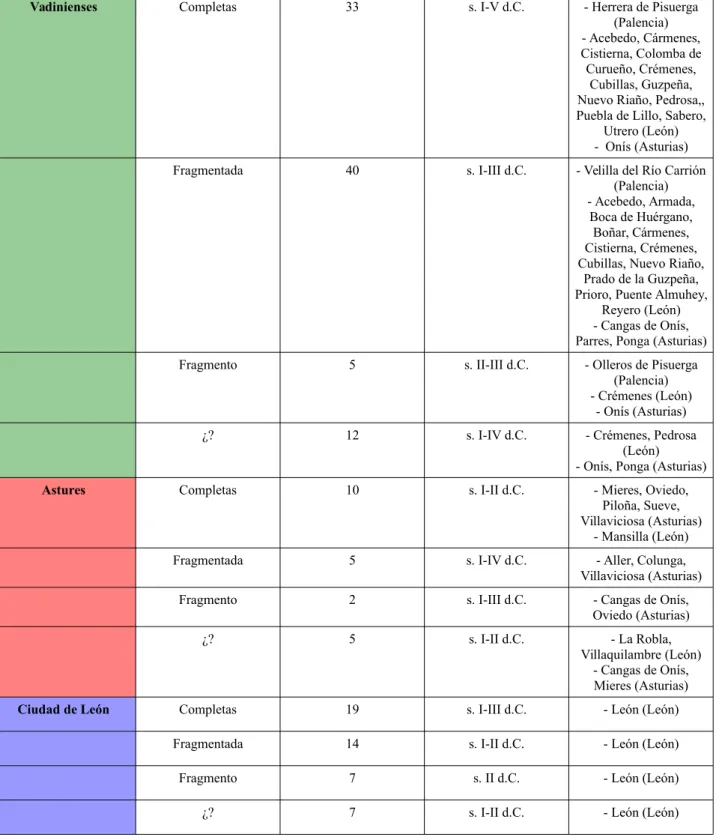
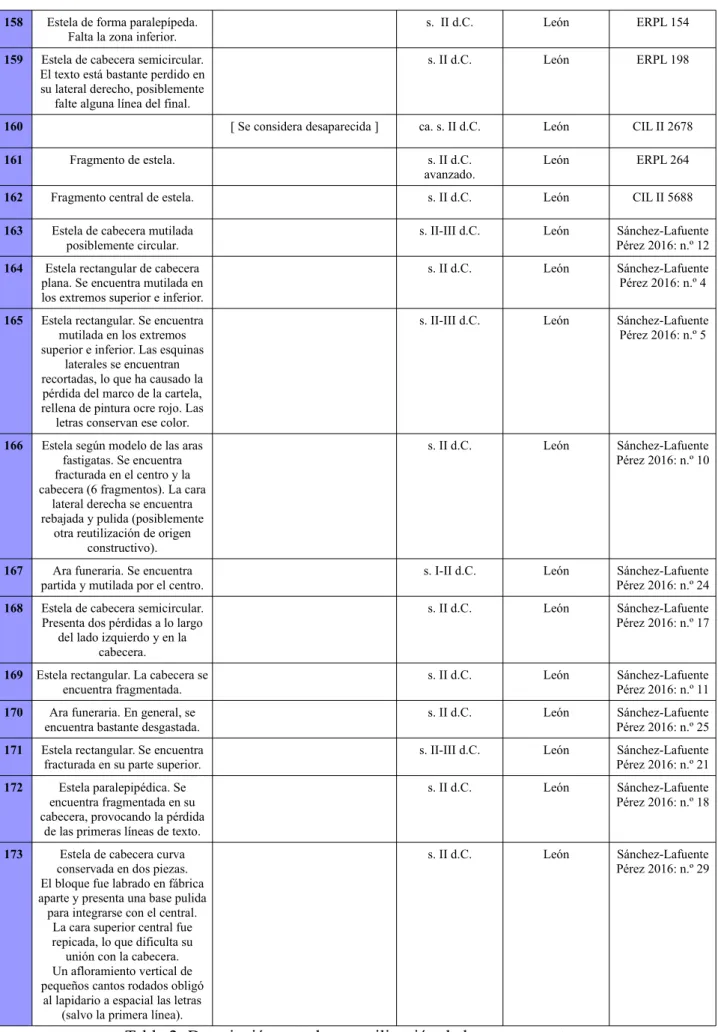
Diagrama 1: Número y estado de conservación de la epigrafía estudiada. Comparativa. Tabla 1: Número y estado de conservación de la epigrafía estudiada. Comparativa. Tabla 2: Descripción, estado y reutilización de los monumentos.
Tabla 3: Inscripciones no cristianas datadas por la era consular hispana.
Fig. 14: Mapa de la Cantabria Romana con los lugares de hallazgo de las inscripciones datadas por la era consular.
Fig. 15: Distribución de las inscripciones no cristianas con mención de la era consular hispana (numeración correspondiente a la tabla anterior).
Tabla 4: El cambio del sistema de datación consular en los siglos IV y V d.C.
Fig. 16: Distribución de las inscripciones datadas por la era hispanica y era consular en Hispania. Tabla 5: Criterios internos para la datación de las inscripciones.
Tabla 6: Cronología. Comparativa. Tabla 7: Cronología. Comparativa (II).
Tabla 8: Estereometría. Tabla descriptiva de los soportes y onomástica y condición jurídica de los individuos.
Fig. 17: Ejemplos tipológicos de aras. Fig. 18: Ejemplos tipológicos de estela. Fig. 19. Ejemplos de otras tipologías.
Tabla 9: Tipos y tipologías de monumentos según la función. Comparativa.
Diagrama 2 a y b: Tipos y tipologías de monumentos según la función. Comparativa. Diagrama 3: El material. Del total monumentos.
Diagrama 4-8: El material. Orgenomescos, Vadinienses, Astures, Ciudad de León y Cántabros Meridionales (respectivamente).
Diagrama 9: El material. Comparativa.
Fig. 20: Principales unidades geológicas de la Península Ibérica y Baleares. Fig. 21: Disposición de las canteras de Castilla y León.
Fig. 23: Mapa Geológico de Asturias.
Fig. 24: Disposición de las canteras en Hispania. Tabla 10: Aras: medidas en altura. Comparativa. Tabla 11: Estelas: medidas en altura. Comparativa. Tabla 12: Aras: medidas en anchura. Comparativa. Tabla 13: Estelas: medidas en anchura. Comparativa. Tabla 14: Aras: medidas en grosor. Comparativa. Tabla 15: Estelas: medidas en grosor. Comparativa. Tabla 16: Medidas y proporciones.
Tabla 17: Cuerpos y zonas. Comparativa.
Fig. 25: Variantes de los motivos de banda, escuadras y mixtos. Tabla 18: Elementos decorativos. Comparativa.
Diagrama 10: Elementos decorativos. Comparativa. Diagrama 11: Elementos decorativos. Comparativa (II). Tabla 18: Composiciones. Comparativa.
Diagrama 12: Labra de monumentos. Comparativa.
Fig. 26: Estelas con decoración antropomorfa de Aguilar de Codés. Fig. 27: Estelas de Pallantia.
Fig. 28: Estelas discoideas de tradición indígena que demuestran el carácter prerromano de las dos estelas discoideas de los orgenomescos.
Fig. 29: Decoración astral geométrica y plano de dispersión de las estelas discoideas gigantes de Cantabria.
Fig. 30: Estelas gigantes de Cantabria en el Museo de Prehistoria y Arqueología de Cantabria. Fig. 31: Reconstrucción de la estela de San Vicente de Toranzo.
Fig. 32: Estelas tabulares y discoideas con iconografía indígena de carácter astral de Vizcaya y plano de dispersión.
Fig. 33: Escuelas de las estelas discoideas de Lara de los Infantes. Fig. 34: Estela discoidea de Alcalá del Río.
Fig. 35: Estelas del grupo Pelendón.
Fig. 36: Estela de Auitiano Petracio de Mérida.
Fig. 37: Ejemplos y comparativa de cantos rodados vadinienses junto con tipos cántabros orgenomescos y astures.
Fig. 38: Estelas discoideas de tradición indígena que demuestran el carácter prerromano de las estela discoidea vadiniense y de las dos estelas discoideas de los orgenomescos.
Fig. 39: Cipos-pedestales de Trás-os-Montes. Fig. 40: Ara de Júpiter de Aller y estela de Máximo.
Tabla 19: Características de cada taller de la ciudad e León. Fig. 41: Estelas encontradas en Picote.
Fig. 42: Estelas de Pallantia.
Fig. 43: Estelas de Lara de los Infantes.
Fig. 44: Fragmento de la estela funeraria de Nieva de Cameros. Fig. 45: Estelas de Salamanca.
Fig. 46: Estela antropomorfa de León y muñeco de Baelo. Fig. 47: Monumentos epigráficos de Navarra.
Fig. 48: Comparativa de estelas.
Tabla 21: Ordinatio de las estelas. Comparativa.
Tabla 22: Aras: medidas del campo epigráfico en altura. Comparativa. Tabla 23: Estelas: medidas del campo epigráfico en altura. Comparativa. Tabla 24: Aras: medidas del campo epigráfico en anchura. Comparativa. Tabla 25: Estelas: medidas del campo epigráfico en anchura. Comparativa. Diagrama 13: Número de líneas. Comparativa.
Diagrama 14: Número de líneas restituidas. Comparativa. Tabla 26: Aras: altura de las letras. Comparativa.
Tabla 27: Estelas: altura de las letras. Comparativa.
Tabla 28: Tipo de letra, rasgos epigráficos y paleográficos, características internas y descripción y disposición del texto.
Diagrama 15: Tipos de letras. Comparativa. Figs. 49-70: Comparativa paleográfica.
Tabla 29: Fórmulas de inicio de las aras de los vadinienses. Tabla 30: Fórmulas de inicio de las aras de los astures.
Tabla 31: Fórmulas de inicio de las aras de los cántabros meridionales. Tabla 32: Fórmulas finales de las aras de los vadinienses.
Tabla 33: Fórmulas finales de las aras de los astures.
Tabla 34: Fórmulas finales de las aras de los cántabros meridionales. Tabla 35: Fórmulas sepulcrales de las aras. Comparativa.
Tabla 36: Fórmulas de las aras. Comparativa.
Tabla 37: Fórmulas de inicio de las estelas de los orgenomescos. Tabla 38: Fórmulas de inicio de las estelas de los vadinienses. Tabla 39: Fórmulas de inicio de las estelas de los astures.
Tabla 40: Fórmulas de inicio de las estelas de los astures de la ciudad de León. Tabla 41: Fórmulas de inicio de las estelas de los cántabros meridionales. Tabla 42: Fórmulas de inicio de las estelas. Comparativa.
Tabla 43: Fórmulas finales de las estelas de los orgenomescos.
Tabla 44: Tipos de fórmulas sepulcrales documentadas entre los orgenomescos. Tabla 45: Fórmulas finales de las estelas de los vadinienses.
Tabla 46: Tipos de fórmulas sepulcrales documentadas entre los vadinienses. Tabla 47: Fórmulas finales de las estelas de los astures.
Tabla 48: Tipos de fórmulas sepulcrales documentadas entre los astures. Tabla 49: Fórmulas finales de las estelas de los astures de la ciudad de León.
Tabla 50: Tipos de fórmulas sepulcrales documentadas entre los astures de la ciudad de León. Tabla 51: Fórmulas finales de las estelas de los cántabros meridionales.
Tabla 52: Tipos de fórmulas sepulcrales documentadas entre los cántabros meridionales. Tabla 53: Fórmulas finales. Comparativa.
Tabla 54: Fórmulas de las estelas. Comparativa. Tabla 55: Nexos entre los orgenomescos. Tabla 56: Nexos entre los vadinienses. Tabla 57: Nexos entre los astures.
Tabla 58: Nexos entre los astures de la ciudad de León. Tabla 59: Nexos entre los cántabros meridionales. Tabla 60: Nexos. Comparativa.
Tabla 61: Tipos de nexos. Comparativa.
Tabla 62: Tipos de interpunciones. Comparativa. Diagrama 17: Interpunciones. Comparativa.
Tabla 63: Interpunciones de sección triangular. Variantes documentadas. Tabla 64: Interpunciones mixtas. Variantes documentadas.
Tabla 65: Travesaños. Comparativa. Diagrama 18: Travesaños. Comparativa. Tabla 66: Nombres prerromanos. Comparativa. Tabla 67: Nombres latinos. Comparativa. Tabla 68: Decknamen. Comparativa. Tabla 69: Nombres griegos. Comparativa. Tabla 70: Nombres inciertos. Comparativa.
Tabla 71: Comparativa onomástica. Repetición de antropónimos. Fig. 71: Regiones antroponímicas de la Hispania indoeuropea.
Fig. 72: Tabla → Regiones antroponímicas de la Hispania indoeuropea. Fig. 73: Regiones antroponímicas de la Hispania indoeuropea.
Fig. 74: Nombres típicamente cántabro-astures. Fig. 75: Nombres típicamente astur-cántabros. Fig. 76: Hápax entre los cántabros.
Tabla 72: Unidades suprafamiliares y sus terminaciones en Q.
Fig. 75: Organización social de los galaicos y las poblaciones castreñas.
Fig. 76: Distribución de las unidades suprafamiliares y entidades poblacionales de los cántabros. Tabla 73: Duo nomina. Orgenomescos.
Tabla 74: Nombre único. Orgenomescos. Tabla 75: Tria/duo nomina. Vadinienses.
Tabla 76: Cognomina y nombre único. Vadinienses. Tabla 77: Tria/duo nomina. Astures.
Tabla 78: Cognomina y nombre único. Astures.
Tabla 79: Tria/duo nomina. Astures de la ciudad de León.
Tabla 80: Cognomen y nombre único. Astures de la ciudad de León. Tabla 81: Tria/duo nomina. Cántabros meridionales.
Tabla 82: Cognomen y nomen unicum. Cántabros meridionales. Tabla 83: Nombre personal de los individuos. Comparativa. Tabla 84: Filiación. Comparativa.
Tabla 85: Transmisión onomástica y homonimia. Tabla 86: Promoción cronológica de los peregrini. Tabla 87: Modelos de usos onomásticos. Evolución. Tabla 88: Categoría jurídica de los individuos.
Tabla 89: Categoría jurídica de los individuos. Comparativa. Tabla 90: Categoría jurídica de los individuos. Comparativa (II).
Fig. 77: Distribución de los grupos de parentesco en la Hispania indoeuropea según Untermann. Fig. 78: Distribución de las entidades étnicas de los cántabros.
Fig. 79: Las estructuras sociales indígenas en los pueblos del norte. Fig. 80: Evolución de los tipos onomásticos.
Fig. 81: Tipos onomásticos.
Tabla 92: Tribus y unidades suprafamiliares.
Tabla 93: Las relaciones familiares entre los orgenomescos.
Diagrama 19: Las relaciones familiares entre los orgenomescos: dedicantes y dedica. Tabla 94: Las relaciones familiares entre los vadinienses.
Diagrama 20: Las relaciones familiares entre los vadinienses: dedicantes y dedicados. Tabla 95: Las relaciones familiares entre los astures.
Diagrama 21: Las relaciones familiares entre los astures: dedicantes y dedicados. Tabla 96: Las relaciones familiares entre los astures de la ciudad de León.
Diagrama 22: Las relaciones familiares entre los astures de la ciudad de León: dedicantes y dedicados. Diagrama 23: Las relaciones familiares. Comparativa.
Tabla 97: Las relaciones familiares entre los cántabros meridionales.
Diagrama 24: Las relaciones familiares entre los cántabros meridionales: dedicantes y dedicados. Diagrama. 25: Dedicantes. Comparativa.
Diagrama. 26: Dedicados. Comparativa.
Tabla 98: Las relaciones familiares y estatuto jurídico. Comparativa. Diagrama 27: Relaciones filiales. Comparativa.
Diagrama 28: Relaciones matrimoniales. Comparativa. Tabla 99: Los compañeros de armas.
Tabla 100: Adjetivos que califican al difunto entre los orgenomescos. Tabla 101: Adjetivos que califican al difunto entre los vadinienses. Tabla 102: Adjetivos que califican al difunto entre los astures.
Tabla 103: Adjetivos que califican al difunto entre los astures de la ciudad de León. Tabla 104: Adjetivos que califican al difunto entre los cántabros meridionales. Tabla 105: Adjetivos que califican al difunto. Comparativa.
Diagrama 29: Demografía y periodo histórico. Orgenomescos. Tabla 106: Intervalos de edad. Orgenomescos.
Diagrama 30: Intervalos de edad. Orgenomescos.
Diagrama 31: Intervalos de edad por sexos. Orgenomescos. Diagrama 32: Demografía y periodo histórico. Vadinienses. Tabla 107: Intervalos de edad. Vadinienses.
Diagrama 33: Intervalos de edad. Vadinienses.
Diagrama 34: Intervalos de edad por sexos. Vadinienses. Diagrama 35: Demografía y periodo histórico. Astures. Tabla 109: Intervalos de edad. Astures.
Diagrama 36: Intervalos de edad. Astures.
Diagrama 37: Intervalos de edad por sexos. Astures.
Diagrama 38: Demografía y periodo histórico. Astures de la ciudad de León. Tabla 110: Intervalos de edad. Astures de la ciudad de León.
Diagrama 39: Intervalos de edad. Astures de la ciudad de León.
Diagrama 40: Intervalos de edad por sexos. Astures de la ciudad de León. Diagrama 41: Demografía y periodo histórico. Cántabros meridionales. Tabla 111: Intervalos de edad. Cántabros meridionales.
Diagrama 42: Intervalos de edad. Cántabros meridionales.
Diagrama 43: Intervalos de edad por sexos. Cántabros meridionales. Tabla 112: Intervalos de edad. Comparativa.
Diagrama 45: Rango de edades: varones. Comparativa. Diagrama 46: Rango de edades: mujeres. Comparativa.
Tabla 113: Fórmulas que expresan la edad del difunto entre los orgenomescos. Tabla 114: Fórmulas que expresan la edad del difunto entre los vadinienses. Tabla 115: Fórmulas que expresan la edad del difunto entre los astures.
Tabla 116: Fórmulas que expresan la edad del difunto entre los astures de la ciudad de León. Tabla 117: Fórmulas que expresan la edad del difunto entre los cántabros meridionales. Tabla 118: Fórmulas que expresan la edad del difunto. Comparativa.
Diagrama 47: Movimientos naturales: hombres, mujeres. Orgenomescos.
Diagrama 48: Movimientos naturales: hombres, mujeres, desconocidos. Vadinienses. Diagrama 49: Movimientos naturales: hombres, mujeres, desconocidos. Astures.
Diagrama 50: Movimientos naturales: hombres, mujeres, desconocidos. Astures de la ciudad de León. Diagrama 51: Movimientos naturales: hombres, mujeres, desconocidos. Cántabros meridionales. Diagramas 52-54: Movimientos naturales: hombres, mujeres, desconocidos. Comparativa. Tabla 119: Emigrantes orgenomescos.
Tabla 120: Emigrantes vadinienses. Tabla 121: Emigrantes astures.
Tabla 122: Emigrantes astures de la ciudad de León. Tabla 123: Emigrantes entre los cántabros meridionales. Tabla 124: Emigrantes. Características generales. Comparativa.
Fig. 82: Emigrantes desplazados a larga distancia (>150 km) en Hispania, exceptuando los obligados por cargos administrativos, según epígrafes con registro de origo, en relación con áreas mineras hispanas de época alto-imperial.
Fig. 83: Estela de Lupus.
Fig. 84: Mapa de dispersión de epígrafes en el Alto Guadalquivir realizados en diferentes soportes. Tabla 124: Concepción de permanencia de la memoria del individuo.
Tabla 125: Dedicatorias.
Tabla 126: Divinidades, dedicantes, condición y motivo. Comparativa. Tabla 127: Divinidades prerromanas.
Tabla 128: Divinidades romanas. Tabla 129: Divinidades sincréticas.
Fig. 85: Testimonios de cultos y usos de las aguas. Fig. 86: Estructura de un templo.
Fig. 87: Configuración del motivo de la rosa hexapétala con compás.
Fig. 88: Evolución del motivo de rosa hexapétala al de la rueda de seis radios curvos o rueda hexaradial Fig. 89: La “romanización” y otros cambios culturales.
Fig. 90: Epigrafía y “romanización”.
En este índice excluimos las menciones de figuras de los monumentos recogidos en nuestro catálogo y en el corpus de Campo Lastra, tanto solas como comparadas con otras imágenes extraídas de las bases de datos online. Excluimos también las tablas explicativas de los rasgos lingüísticos y fonéticos y de la comparativa onomástica por tratarse de un recurso para facilitar el análisis y la comprensión de cada uno de ellos.
AGRADECIMIENTOS
Esta Tesis doctoral no hubiera sido posible sin la ayuda, consejos, la motivación y el apoyo de mi director y maestro el dr. don José Luis Ramírez Sádaba, que durante todos los años que ha durado esta investigación ha estado presente, atendiendo todas mis dudas, preocupaciones y vivencias. Siendo él quién me propuso el tema de esta Tesis a raíz de mis inquietudes personales, cada comentario, enseñanza y sugerencia me han ayudado a llevarla a cabo.
En especial expreso mi agradecimiento al dr. don Jesús García Rodríguez, Técnico de Infografía del Dep. de Ciencias Históricas, quien ha hecho posible la elaboración de los mapas incluidos en este trabajo y los artículos publicados. A don Juan Luis Ordóñez Tascón por la fotografía de la estela de
Turromo de Verdiago, cortesía de don Jorge Sánchez-Lafuente Pérez. Al personal de los Museos
Arqueológicos de Santander, Oviedo y León, quienes, con enorme amabilidad e interés, me descubrieron curiosidades de las inscripciones y su historia y me recomendaron bibliografía. Al personal de la Biblioteca de la Universidad de Cantabria por su disposición para facilitarme el acceso a la documentación y a los servicios de la misma.
Gracias a mi familia, por su ayuda, cariño y comprensión.
Y sobre todo a Mario, por empujarme sin cesar hasta mi meta y acompañarme durante todo este largo viaje, soportándome con infinita paciencia. In dunklen Wassern brennt ein Licht.
Social structure of the western Cantabri and their evolution during the Roman Empire according to the epigraphic documentation.
Concomitances and differences with the other Cantabri and their neighbors astures. SUMMARY AND OBJECTIVES
The arrival of Rome in the Iberian Peninsula, specially the wortwest, entailed a cultural shock that intensified during the conquest of the territory, when the Romans began to implant their culture, customs and traditions (this process is traditionally known as “romanization”). The most simple idea of the romanization implies that the conquered societies abandoned their customs and traditions (during a – more or less – harsh and long term process) to integrate in between the Imperial structure. But, as we shall see, the cantabri were belatedly “romanized” and survived in time, with their own pre-roman features and manners.
This thesis gets close to the pre-roman Cantabri that inhabited the north of the Iberian Peninsula, and, with the Astures were so long studied, particularly since the XIX century and specially during the last decades. Scholars, collectors, ethnographers, anthropologists, historians and archaeologists have been curious about this issue, and all of them have given visibility to this people (and its cultural wealth). We can have access to (relatively plenty) literary and epigraphic sources (located in the current provinces of Cantabria, Asturias, León, and Palencia).
Our knowledge and interest has grown up thanks to various studies (we have always act with caution and critical thinking: a lot of this studies had been elaborated just following the classical authors – word by word -, recomposing this History keeping on the classical narratives without subjoining the archeaelogical, epigraphic and numismatic data.
The cantabri and astures were the last subjected to the Roman power, and they acquiered a legendary status since ancient times, that differentiated both of them from another populi. Currently this point of view has encouraged a social and political differentiation of the current Cantabria (and Asturias) with the rest of Spain.
We’ll focus on the western cantabri. The vadinienses occupied the Sella and Esla valleys (in León); the orgenomesci occupied Liébana (west region of Cantabria), limited east by the Nansa valley. And we’ll also study the more inmediate astures, from the uia Carisa to Gijón (Asturias) and to the junction of rivers Porma and Bernesga with the river Esla (southeast). And finally, we’ll make a comparison with the southern cantabri, which were studied by Campo Lastra.
This explains our interest in studying their historical characteristics, which made it necessary, methodologically, to overcome some of the existing deficiencies with respect to the sources used like, for example, the epigraphical corpora. For this reason, one of the volumes of our work includes all of the documented inscriptions for the area of study (which covers the western frontier of the Cantabrians) to which we add (for a later comparison with the results of the Cantabrian territory) the southern frontier and the asturian bounded area (including the city of Legio VII).
To achieve this end the votive and funerary inscriptions (all belonging to the Ist to the IVth century A.D., centuries of full roman presence) had been studied as well as all the existing bibliography and, consequently, we have achieved the following objectives to determinate and discover their sociocultural characteristics, general structure and evolution, in addition to check if their nature and character are different from the other cantabri and the eastern astures or if they operate in a similar way. We’ll focus on:
1. The analysis of the classical narrations to delimit geographically the cantabri and astures. 2. The formal analysis of the inscriptions, and the different types and typologies, stereometry
and ornamentation.
3. The analysis of the content of the inscription, focusing on the forms, onomastic, legal structure, social organization, family relationships, demographic data and use of Latin. 4. The integration and adaptation of the pre-roman society into the new roman reality, and the
impact of this new roman structure.
We will also add a systematic catalog of the epigraphy of this territory.
The epigraphic data is the main source of information to rebuild the organization of the pre-roman communities in roman times. But the roman inscriptions make impossible to know the reality before A.D. (except for the classics). We can approach this astur-cantabri-roman society from the Ist to the Ivth century.
We’ll compare the cantabri orgenomesci et uadinienses with the rest of the Cantabrians (the southern ones, studied in 2011 by PhD. Raquel Campo Lastra in the Thesis En la frontera de los
Cántabros. Características sociales de la población, según la documentación epigráfica; in this
book they compared the southern cantabrians with the vaccaei, turmogi et autrigones). With the comparison of the results of both Thesis we can notice the
concomitances and differences between the the orgenomesci and the uadinienses, the western and southers cantabrians, and between the cantabrians and their nearest asturians neighbours. In this way, this Thesis is a complementary book, which principal objective is to create an overview of the whole social structure of the ancient cantabri and the similarities and differences with those who lived together.
The comparison will also demonstrate how effective the romanization was and how the romans acted in the southern and/or western frontiers.
The conclusions will help us draw precise and new borders in between the pre-roman populations and know the acceptance of the romanization: we’ll be able to discover the new roman elements and structures and the pre-roman perviances. After a bibliographic review, we can say there are no other studies related to this objectives and field: our hypotesis and results are, mostly, newfangled.
The manifestations most prone to changes and fashions are the cultural manifestations. Both
Cantabri and Astures adopted the two most idoneous Roman funery monuments for the two
documented functions, altar stones to fulfill their religious veneration and stelas to honour their dead. What was more distinctive was the size, the typology, the location of the text and the
decoration. This folks preferred taller stelas and altar stones, with the double stela being almost exclusive to the southern cantabri. Neither was there uniformity in the location of the epigraphical fields nor in the size of the letters, so there was no defined or preferred mode. These differences are more evident with the type of decoration, with the Cantabrians and Asturians being those that employed a greater richness: wheels, discs, torcs, triangular top, roses with six petals, waxing moons, straight radii, swastikas, arches, human figures, animal figures, etc. With respect to the funerary formulas, this population has a routine as much in the denomination of the Manes as in the final formulas or the manner of expressing the age.
The differences are more obvious in the most profound structure: the individual names and the anthroponomastic structure. The survival of the extrafamily entities (because of their conditions as Indo-European peoples), and some demographic characteristics which are quiet similar (although only a relatively modest sample is available), including between the Cantabrians and Asturians are common traits. But the respective anthroponomastic repertoires hardly repeat names. Equally interesting is the fact that both the Roman and the indigenous structures coexisted in all of the peoples but with different significances. Although the diffusion of the Roman structure spread, it was normal to find the combination of roman names with indigenous names.
The differences are also seen in the most profound sentiments (cultural beliefs and manifestations). Each people worshipped their own indigenous gods, although the Roman gods were also assimilated (especially Jupiter, the god whose name appears most frequently). The devotees correspond, generally, to the expected stereotypes: the people of Latin origin and the Romanized indigenous people worshipped the Roman and syncretized gods, whereas the indigenous peoples adored their ancestral gods. Within the cultural manifestations the main evidence is the type of language employed by the people. They all expressed themselves with clear characteristics of Vulgar Latin, with great variety and frequency. In fact some of the linguistic phenomenons (pronunciation of voiceless intervocalic, close o>u) occurred late and were consolidated in the Romance Castilian. Consequently, it appears that, within the general tendency, they both were the last to be Romanized, learnt a Latin unlike classical Latin.
In summary, as well as the material manifestations, the traits corresponding to their idiosincracies (anthroponomastics, symbology), and to the profound sentiments of their beliefs and the culture reveal greater differences of the Roman standards among the Cantabrians and Asturians. It seems evident that Romanization did not eliminate the features which differentiated them from their neighbours, which was seen in greater primitivism according to the description of them by the Romans in the Cantabrian Wars.
The existing inscriptions and monuments let us talk abour the continuity, upkeep and survival of ancient pre-roman traditions, adapted to the roman ones; if new epigraphic data appear, we guess we’ll get the same conclusions. The pre-roman elements are the dominant ones: typology, material, ornamentation and content; we can still notice pre-roman form of organization, whose disappearance would have been logic after the roman dominion, but they are still alive in the late Empire.
This Thesis is written in a easygoing, straighforward and descriptive way: we want it to be accessible to everyone (with or without specific History knowledge). All the people mentioned in the inscriptions of our catalog were like us: they guide us to the society they lived, developed and died in. We must get History out of the scholarly environment and we should bring it close to other ambiences to be more useful and well-valued (as it deserves). However, in some sections and/or paragraphs the explanations and exposition of the historical data could be complex, but they are needed and requiered to be successful.
Were the Cantabri so different, so special?
CONCLUSIONS
The epigraphy is such a living and expressive source for the social and cultural study of the pre-roman populations during the Empire: this is a direct testimony of their daily life and makes possible to identify individuals, their names, their ambiances and activities, their familiar relationships, as well as their ethnic and cultural identities. It shows (significantly) the most important aspects of the society and help us scout the romanization (and its ways). The majority of this monuments are simple (syntactically, semantically, formally and stylistically) but useful to introduce us in the Roman world. But the information doesn’t explain us the characteristics of the global population: it only shows us the data from the people who could afford the monumentum. At the beginning of this thesis we pointed out that our basic objective was to gain knowledge about the Cantabrian society on the western frontier (the orgenomesci and vadinienses) in the Roman era, according to their epigraphy (religious and funerary) with a later comparison with their neighbouring peoples (including the southern cantabrians studied by Campo Lastra and the asturians delimited by the uia Carisa to Gijón (Asturias, the northeast asea) to the confluence of the Porma and Bernerga valleys with the Esla river at the southern area, including the inscriptions of the roman city of Legio VII, the ones with indigenous elements) to discover how the Romans influenced this area and its people as well as to know whether there were substantial differences between them and their neighbors.
For this we studied a total of 173 pieces (15 orgenomesci, 89 uadinienses, 22 astures and 47 from
Legio VII), compared with 94 southern cantabrians, all of these with different levels of conservation
and with a chronology which covers the Ist century to the IVth century A.D. although it is concentrated, basically, in the 1st to the 3rd century A.D. The analysis of these societies is complex because of the characteristics of the late roman written sources, literary and epigraphic ones. The
orgenomesci and uadinienses inscriptions (the ones preserved) are mostly funerary: the information
at our hand is limited.
This study is basic to understand this new phenomenon, the spread and impact of the roman culture into the pre-roman (and now conquered) cultures. Thanks to the personal data identified in the inscriptions (names, relationships, age, origo, suprafamily organizations, tribus, etc.) we can approach the different types and typologies, the way these monuments were made and the accuracy of the data.
The first objective is the analysis of the fonts for the location of the western cantabri. The classical texts and the epigraphic distribution help us to establish that the orgenomesci inhabited the western part of the actual Cantabria, from the core in the Nansa river, continuing by the seacost until the riversides of the Sella river on the west, a geographical space defined by natural accidents, maybe used as territorial limits, getting over the north of the Sierra del Cuera range and Liébana, and accesses to the Cantabrian mountain range (in Guardo, Palencia, inhabited the camarici); the
uadinienses occupied the ager from the high valleys of the Esla river and its inflowings Porma and
Cea (actual León) and the high valley of the Sella riven and its inflowings Ponga and Güeña (actual Asturias), excluding the valleys of the Curueño (León), Carrión (Palencia) and Sella (Asturias) rivers from Arriondas. The origo outside these limits corresponds to emigrants: ones moved to
Asturia and the ager uadinienses, others, to Monte Cildá and Jaén (to El Centenillo mine, in Baños
de la Encina), making reference to a natural migration, linked with marriage exchanges or job search. It’s impossible to know the accurate location and limits, but thanks to the interpretation of the classical texts and the distribution of the monuments we propose a map with the possible extentions and borderlands of the western cantabri and the limits with their neighbors. It’s also impossible to know the location of the ciuitas or urban nucleus.
We found the most ancient references to the Spanish era or era of Caesar amongst the orgenomesci and uadinienses (of the asturian slope). Between the I-V centuries there is a pagan and funerary epigraphy surviving in rural areas which maintain roman habits in late moments and the presence of
orgenomesci and uadinienses as ciuitates and gentile organization (its existence shows a change and implies a foreing cultural expression, the roman one): the roman epigraphic habit and the indigenous substrate overlap the individual, creating a particular reality and conscience. The pre-roman indoeuropean onomastics (or assimilated) is usual.
The Roman conquest meant the interruption of the indigenous lifestyles and accelerated the changes; it also created a new submission model to reorganize the pre-roman world in benefit of the roman administration. The Roman presence set up the local mountainous populations down to the flat lands, approaching these rural lifestyles to urban ones (ciuitates) by order of the emperor: this had to provoke a real transformation.
The second objective was the formal analysis of the inscriptions by types, stereometry and ornamentation. This allow to know the types, character and evolution of the monuments, used to point the tombs, the spaces to honor the deads or fulfill a vote.
All the cantabri and astures (mostly) used fully roman monuments, altar stones and funerary stelae (with some exception). In general, within the cantabri we see little variety, compared to the astures: we document altar stones, a pedestal, plates and a landmark.
For all these peoples, the material used to “build” these monuments was the typical stone of the area of residence of the buyer of the piece and their measurements did not appear to have been standardized both with the piece as a whole and with the epigraphical fields and letters.
Its measures weren’t standarized: there is no patter, but they repeat some trends. Most of the stelae were destined to kneel: the usual monument sizes are small and medium. Most of monuments are
simple (as for measure and decor), but the most elaborated ones distribute their content in areas. Only amidst the orgenomesci and Legio VII there are 4 zoned monuments.
About the typology of these pieces, the altar stones maintained the typically Roman structure of plinth, dado and top. The stelas showed a great diversity with the predominant pieces being those irregular ones (“cantos rodados”), especially amongst the uadinienses, the parallepipedic one (within the cantabrians and the asturians from rural ambiances) and the ones with a similar circular top in which the text appeared in the central part (mostly from Legio VII and Monte Cildá). In the southern cantabrian cases (that includes one orgenomesci), there is an elevated number of stelae wit two epigraphical fields. There is a big disparity with the western cantabri and astures.
The decoration showed a certain primitivism. We have documented motifs from the Roman world (carpenter’s square, tabula ansata, arcades, etc.) although the indigenous motifs clearly make up the majority. Despite this and the geographical proximity, the decorative elements used (although they may have had the same significance) were not usually the same. Neither was there uniformity as far as the situation of the pieces is concerned. Nevertheless, there are elements which were exclusive to each people like the use of horses, trees and torcs by the uadinienses, riders by the cantabrians and astral elementrs by the asturians. They didn’t repeat symbolic compositions, although they repeated the use of ornamental elements framing the text, al symbological elements with a symbolic sense.
They have an indigenous tradition: tecnically, the relief dominates; morphologically, the circular tops and the rectangular bodies; frontalism, stylization, roughness technique and local materials are the most important features. The ornamentation showes the contact between local artisans (alien to officinae) and greco-roman elements. The rural artisans are modest (in their technics): they did not exist professional workshops, unlike in Monte Cildá and Legio VII. There are only 3 elaborated stelae amongst the orgenomesci and uadinienses, versus 28 from León and 45 from Monte Cildá. Between the uadinienses prevail the irregular stones.
The “romanization” didn’t push out the indigenous traditions: Rome gave these populations a new expression form. We can perceive a miscegenation between both worlds in an attempt of cultural syncretism or imitatio: Rome didn’t alter the bases but took advantage to secure its social and economic domain.
Ligatures, the use or absence of interpunctions and crossbars and abbreviations belong to the Latin world. All these elements are documented as much in Cantabrian and Asturian society although with differences in the preferences of use. It is usual the existence of ligatures among the cantabri and astures, but it is not midst the southern cantabri. They are also usual the interpunctions and crossbars; there are curious examples of interpunctions separating letters and syllables in between the uadinienses, astures and legio VII (respectively). The paleography shows irregularity, asymmetry and particularitie among the orgenomesci and uadinienses, whereas that there is a greater regularity in Legio VII and the southern Cantabria. These groups also showed a great diversity in the ordinatio of the texts,.
First, we studied the etymology. Among all, the anthroponomastics was mostly of indigenous origin, although there were Latin names well represented. The women who showed a greater preference for indigenous names (the Latin names were more common among males) which reflects the conservative tendency of this group. The repetition of indigenous names was not usual (this means that two people did not usually have the same name), something which we do not find with Latin names.It must also be pointed out that they all had their own individual indigenous names whereas they all shared Latin origin names. They had decknamen (in all cases, a minority) while only the uadinienses and asturians used Greek names. Attending the indigenous anthroponymy, we can consider the existence of two name areas: astur-cantabri and cantabri-vettones.
There are plenty of epigraphic testimonies of the indigenous organization among the orgenomesci and uadinienses, proving its permanency during the late Empire: populi, ciuitates and supra-family units. The ethnics (Alisstegiani and Deobrigi; Arronidaeci, Coliacini and Luggoni Arganticaeni) are unusual, only between the uadinienses and astures. About the Quirina tribus, there is only one example for the uadinienses: it is more common in Legio VII and Monte Cildá.
Todos los grupos poblacionales no emplean una estructura canónica (son múltiples las variables). La vitalidad del nombre indígena queda manifiesta por su funcionamiento en cualquier posición de la estructura onomástica romana.
Closely related to the anthroponomastics is the structure of the names (the roman system is the reference). It is usual the unique name; the tria/duo nomina is regular but frequently wrong because not always the praenomina, nomina and cognomina ocuppy the place that corresponds, and they also tend to use the doble indigenous name system. It is also natural the combination of different origin names (and that shows the non-latin parentage). None of the poblational groupes use a cannonical structure: the vitality of the indigenous onomastics is manifested by its working in every position of the roman onomastics structure.
In general, the society was hierarchized in different social groups, almost exclusively free. There we individuals with some kind of citizenship and peregrini (the most numerous). There is one attestation of a liberta amid the orgenomesci: so, the non-free population existed. According the onomastics, the social promotion was not banned (there was a general promotion too).
The romanization broke through, but the native population still preserving their onomastic pre-roman traditions: the uadinienses and astures shows a large number of individuals with citizenship rights, including the roman one. A priori, the most part of the population had latin rights.
The filiation or signalment was patrilineal, in an indigenous way (father’s name in genitive + the words filius, -a, usually shortened, and the name of the person; there are few cases of the father’s name, al alone, in genitive), but in between the astures there are few mentions in the latin way. The name transmission (from father to sons/daughters) is not common (it is in Legio VII, amid individuals with a totally roman structure). The society is patrilineal, but the onomastics and social structure go beyond the nuclear family.
There are few documents about the roman organization: there is not an urban center nor magistrates. Thanks Ptolemy and Pliny we know that there were nine cities amongst the cantabri (Pliny knows them as populi), only highlights Iuliobriga. There ir indirect data that help us to study the juridical organization of these populations: the social promotion of the peregrini, the mention ex praecepto
conuiuentiu, the existence of a princeps cantabrorum, the unusual roman tribus, the explicit
mention of the ciuitas orgenomescorum and uadiniensis, and finally the anthroponimic structure
tria/duo nomina. The vertebrate element midst the orgenomesci and uadinienses is the community,
the habitat and the political rights, all depicted by the roman concept of ciuitas, as a cohesion agent and the assertion of the community itsefl.
About the estructure, interpretation and working of the supra-familiar entities: it remind us of an indigenous past. It was related to the secondary reorganization by Rome and the progressive integration in urban life. The latin terms should be the words more appropriate for appointing the indigenous units, along with the cohesión related to the family relationships. We can’t know the relationships among the astures: the should have been important, but they weren’t the only one: they also existed the neighborhood and territoriality.
There is little difference in favor of women as devotees of the monuments (the men are more numerous in between the western cantabri and astures). The men are the main devoted. Amidst the
orgenomesci and uadinienses there are marital, filial, fraternal, affective, libertus-patronus,
avuncular, grandparenthood, hereditary and ethnic-princeps relationships; midst the astures, in-laws and grandparenthood; and between the southern cantabri, also for one-self. The more common relationships are the filial and matrimonial ones. It implies people of the same and different juridical and social category.
Related to the demography, it is appreciated a young population, with peaks in between 30-40-year-old, with low death levels (among men and women), but the women had a high life expectancy. The
cantabry had a big amount of long-lived people.
It is not common to record the professional work. There is an orgenomescus mine worker in Sierra
Morena, a uadiniensis aquilegus and also two militaries (legio Augusta and IX Hispana) and one veteran (XX leg.), four asturians militaries (one with cursus honorum and an armorum custodi; from the VII Gemina) and a veteran (VII leg.), and three militaries from the South Cantabria (IX and X
leg.). They all had a local origin: the roman army was nourished by natives. Otherwise, we don’t
know neither the ritual nor the indigenous cults.
The few votive altars show us the participation of this populations and individuals in the public religion. The uadinienses register a high participation in an intimate religion. There are not many recorded divinities; there are pre-roman amidst the rural astures and southern cantabri, roman among all of them, oriental between the southern cantabri and syncretism among the uadiniensis,
astures and southern cantabri). The diversity of cults is also showed in the symbology of the
Concerning the language, the latin form is used, although with a great variety in purpose and form, even with unusual abbreviations). Writting errors should be the result of a careless artisan, the ignorance of the roman rules or a possible evolution to the romance.
So, we can conclude that the situation of the Cantabrian and Asturian society in the area studied was a little complicated because it conserved indigenous elements together with others characteristic of the Roman world, and although it appears that the Roman culture penetrated the society, it did it in an incorrect and very slow way. As far as the elements characteristic of the indigenous world which are present in the three groups are concerned, it does not appear that there are many similarities so we can affirm that, in spite of the geographic proximity, it appears that each people functioned with their own codes. At the end of the IVth century A.D., the autonomy and the adherence to traditions (which preserve social significance) bring the coexistence and syncretism of the indigenous and roman, as we see in the mountings (the roman mountings have a pre-roman ornamentation) and it’s also manifested in the anthroponymic and toponymics. The new system will give the pre-roman population a roman facies and new customs and traditions, in a process of aculturation or interpretatio. Rome didn’t alter the bases but took advantage to secure its social and economic domain.
We show a mixed society with ancient proper elements, as we can appreciate in the inscriptions and the preservation of the filiation, gentilitas and/or the clan, and also the survival of indoeuropean pre-latin onomastics. At the end of the IVth century A.D. the tribal organizacion had not lost social significance, exemplifying a connivance and coexistence by the mountings and onomastic.
Cap. 1 INTRODUCCIÓN. OBJETIVOS DE LA TESIS, ESTADO DE LA CUESTIÓN, METODOLOGÍA Y ESTRUCTURA Y DESARROLLO DEL TRABAJO
La llegada de Roma a la Península Ibérica, en especial al Noroeste peninsular, supuso un choque de culturas que se fue intensificando en el momento de la conquista del territorio, cuando los romanos comienzan a implantar su cultura y costumbres (en un proceso tradicionalmente conocido como “romanización”). La idea más tradicional y simplista de la romanización implica que “las sociedades conquistadas abandonan sus costumbres y adoptan las romanas (en un proceso más o menos violento, más o menos largo en el tiempo) para integrarse dentro de la estructura del Imperio”1. Pero, como veremos, los cántabros occidentales fueron más tardíamente “romanizados”
y pervivieron en el tiempo características y costumbres prerromanas en muchos aspectos de su vida. Esta tesis versa sobre el pueblo prerromano de los Cántabros, un pueblo que desde hace años, particularmente desde la 2º mitad del siglo XIX y con especial fuerza en las últimas décadas, ha atraído el interés de eruditos, coleccionistas, etnógrafos, antropólogos, historiadores y arqueólogos, pero sobre todo, de amantes de la Historia y curiosos en general, que quieren dar visibilidad a este pueblo y a su riqueza cultural. Existen fuentes literarias y, sobre todo, una documentación epigráfica relativamente abundante, gracias al notable número de inscripciones halladas en las actuales provincias de Cantabria, Asturias, León y Palencia.
Nuestro conocimiento e interés ha crecido2 con estudios de diversa índole, siempre con cautela y
mentalidad crítica, ya que muchos se han realizado desde una fe absoluta en las palabras de los autores clásicos “recomponiéndose la Historia siguiendo estrictamente sus narraciones sin que se añadiesen, apenas, los datos suministrados por la arqueología, por la epigrafía y la numismática”3.
Los cántabros y astures fueron los últimos pueblos en someterse al poder de Roma, adquiriendo un estatus legendario desde tiempos antiguos. De este modo, se avivó una imagen característica de los cántabros bien diferenciados de otros pueblos peninsulares, imagen que ha llegado a nuestros días para fomentar, desde un punto de vista social y político, una diferenciación de la actual Cantabria y sus habitantes con el resto de España.
Nos centraremos en el espacio ocupado por los cántabros occidentales, delimitado al oeste por los valles del río Sella y Esla, territorio de los vadinienses, y por la comarca de Liébana hasta el límite con el valle del Nansa por el este, territorio de los orgenomescos. Estudiaremos también los astures, pero nos ceñiremos a los vecinos más inmediatos, los que ocuparon el territorio limítrofe de los vadinienses, el espacio desde la frontera de los cántabros hasta la antigua vía Carisa hasta Gijón (por el noroeste) y hasta la confluencia de los ríos Porma y Bernesga con el Esla (por el suroeste). Y nos referiremos a los cántabros estudiados por Campo Lastra en su Tesis Doctoral.
1 CAMPO LASTRA 2011: 23.
2 Esta tesis no surge de ningún Trabajo de Investigación previo, si no que es el resultado de la vocación y el particular interés por la Historia y la sociedad de la Cantabria antigua, que siempre me ha rondado en la cabeza, y el empujón que me dio mi director el dr. don José Luis Ramírez Sádaba para lanzarme a ello.
3 AJA SÁNCHEZ, CISNEROS CUNCHILLOS y RAMÍREZ SÁDABA 2008: 15. En ocasiones, la información aportada por la arqueología, epigrafía y numismática ha sido utilizada para verificar lo narrado por las obras clásicas, ajenas a un estudio crítico de las mismas.
1.1.) Objetivo e hipótesis de trabajo
El objetivo de esta Tesis Doctoral es el estudio a fondo de la información que podemos obtener a través de la epigrafía (fundamentalmente de las inscripciones de tipo funerario y votivo, sin obviar cualquier otro tipo de datos que podamos obtener de otros campos y ámbitos de estudio como la arqueología, la literatura, la antroponimia y toponimia, etc.) para determinar las características socioculturales de la población de los cántabros occidentales entre los siglos I y V d.C. (época de plena presencia romana, a la que pertenecen los epígrafes y monumentos estudiados, a pesar de que mayoritariamente se datan entre los s. II-III d.C.) y conocer su estructura general y evolución en el tiempo, además de comprobar si su carácter y naturaleza es distinto al de los demás cántabros y al de sus vecinos inmediatos astures, o si funcionan de una manera similar pero con algún grado de diferencia. Para ello es necesario:
1. El análisis de las fuentes clásicas para la delimitación geográfica de los grupos poblacionales a estudiar.
2. El análisis formal de las inscripciones, atendiendo a los diferentes tipos y tipologías de soportes, su estereometría y decoración.
3. El análisis del contenido de la inscripción, centrándonos en los formularios, en la onomástica, las estructuras jurídicas y formas de organización social, así como en las relaciones personales, junto con un análisis demográfico de los individuos y del latín utilizado, reflejo de la integración social de los indígenas y del dominio de la nueva lengua. 4. La integración y adaptación de la sociedad indígena a la nueva realidad romana y el impacto
romano sobre las comunidades prerromanas.
Añadiremos un catálogo sistemático de la epigrafía del territorio estudiado.
La documentación epigráfica constituye la principal fuente de información que nos permite conocer cómo se organizaba la sociedad de estas comunidades indígenas en época romana. Su análisis es necesario para intentar ofrecer una visión lo más rigurosa posible de la estructura sociocultural de estos grupos. Sin embargo, plantea un importante problema para el historiador: las inscripciones latinas tienen una cronología posterior al s. I d.C., lo que hace prácticamente imposible conocer qué sucedía en estas regiones antes del cambio de la era, a excepción de lo que narran las fuentes clásicas (que debemos utilizar con cautela).
Es posible realizar una aproximación rigurosa a la sociedad astur-cántabro-romana desde finales del s. I d.C. hasta fechas avanzadas entre los s. IV-V d.C.
Haremos una comparación con el resto de cántabros, particularmente con los meridionales, estudiados por la dra. dña. Raquel Campo Lastra en su tesis doctoral defendida en 2011 en la Universidad de Cantabria, En la frontera de los Cántabros. Características sociales de la
población, según la documentación epigráfica, dirigida también por d. José Luis Ramírez Sádaba,
en la que se compara a los cántabros meridionales con sus vecinos inmediatos, los vacceos, turmogos y autrigones. De este modo, el nuestro será un trabajo complementario: se obtendrá una
visión de conjunto de toda la estructura social de los cántabros de la antigüedad y sus semejanzas o diferencias con los otros pueblos antiguos limítrofes que les rodeaban y con los que convivían. También podremos trazar una frontera más precisa entre estos pueblos y conocer el grado de aceptación de la “romanización” de cada grupo poblacional: sabremos hasta qué punto fue efectiva en estos territorios (o mejor dicho, hasta qué punto los romanos actuaron sobre las gentes nativas e indígenas que habitaron estos lugares y qué elementos propios de dichas sociedades, previas a la conquista, sobrevivieron a la presencia y conquista romana) y el grado de la misma en comparación con la frontera meridional de los cántabros y los astures orientales.
Una vez revisada la bibliografía referente a estos pueblos, hemos constatado la ausencia de trabajos que hayan tratado estos objetivos de forma conjunta, por lo que las hipótesis y resultados planteados son, en su mayoría, novedosos4.
Aunque sigan apareciendo nuevas inscripciones, los hallazgos existentes nos permiten hablar de la continuidad, mantenimiento y pervivencia de tradiciones indígenas adaptadas a la presencia y administración romanas; de aparecer nuevos monumentos epigráficos, suponemos que seguirán esta tónica. El componente prerromano era predominante, tal y como refleja la tipología, el material, la decoración y el contenido de las estelas, en las que nos encontramos menciones a formas de organización de clara tradición indígena (cuya desaparición hubiera sido lógica a partir de la conquista romana, pero que siguen vigentes en momentos avanzados del Imperio).
Hemos pretendido una redacción sencilla y descriptiva para que esta Tesis Doctoral pueda ser accesible para todo el mundo, tengan o no conocimientos específicos de estas materias. Las personas mencionadas en las inscripciones de nuestro estudio eran en su mayoría gentes de a pie sin grandes cargos o atribuciones; son ellas las que nos han acercado a la sociedad en la que vivieron y se desarrollaron. Por este mismo motivo, debemos sacar la Historia de su tradicional ámbito académico y erudito y acercarla a todo el mundo, para que sea útil y valorada como se merece. No obstante, en determinados capítulos la redacción y las explicaciones pueden resultar algo densas, algo inevitable para llevar a buen fin el objetivo y desarrollo de esta tesis.
Finalmente, nos repetimos la pregunta que Campo Lastra5 ya planteó en la introducción de su Tesis: ¿fueron los cántabros tan diferentes, tan especiales?
1.2.) Estado de la cuestión
El primer problema a la hora de plantear un estado de la cuestión reside en las distintas corrientes que han tratado el tema de los cántabros y astures.
4 Ya hemos avanzado los resultados de la tesis en varias publicaciones propias: PÉREZ GUTIÉRREZ 2016 y 2017. 5 CAMPO LASTRA 2011: 25.
- Los cántabros occidentales: orgenomescos y vadinienses
La epigrafía de la provincia de Cantabria, ya desde comienzos del s. XX, ha tenido repercusión en las publicaciones científicas, destacando las relacionadas con las estelas discoideas gigantes6.
La primera recopilación sistemática fue elaborada por el profesor don J. Manuel Iglesias Gil en 1976 (Epigrafía cántabra: estereometría, decoración, onomástica, Santander7 = EC), que recogió
44 inscripciones vadinienses y 6 de los orgenomescos. Tres décadas más tarde, junto con A. Ruiz Gutiérrez recogerían toda la epigrafía de la actual provincia de Cantabria8, en el que incluirían 6
estelas orgenomescas de la parte occidental de la provincia.
En 1977 la profesora doña M. C. González Rodríguez realizó un estudio concreto (Los astures y los
cántabros vadinienses, Bilbao), el cual amplía la información que nos aporta el anterior trabajo de J.
M. Iglesias Gil, pero no es ni un estudio de conjunto ni sistemático, centrándose en aspectos concretos como las organizaciones sociales y las relaciones interpersonales. También incluye en su trabajo un mapa de la distribución de la epigrafía vadiniense conocida a finales de los años setenta. Los trabajos de F. Diego Santos siguen esta línea: el profesor elaboró estudios epigráficos en el marco del conuentus Asturum y la elaboración de los corpora de inscripciones de Asturias y la provincia de León9, que serán dos obras de referencia para el estudio de estos territorios y de los
cántabros occidentales. Ya desde los años 50 venía publicando hallazgos y análisis de estelas, tanto de Asturias10 como de los orgenomescos11, junto a obras relacionadas con la romanización de
Asturias a través de la Epigrafía12. Esta visión complementó con un nuevo catálogo de epigrafía de
la provincia de León, elaborado en 2001 por S. M. García Martínez y M. A. Rabanal Alonso, quienes llevaron a cabo una revisión, actualización y análisis minucioso de la epigrafía leonesa13.
En esta obra se incluye un apartado específico para la epigrafía vadiniense.
La obra de J. González Echegaray14 es fundamental para el conocimiento del pueblo de los
cántabros, quién trata las fuentes, distribución, aspectos histórico-cultural-social y, cómo no, la epigrafía, aunque no de manera sistemática ni distribuida por grupos poblacionales. Para las fuentes de los astures acudiremos a Roldán Hervás15.
6 FRANKOWSKY 1920; CALDERÓN y RUEDA 1934 y 1945; CARBALLO 1948; FERNÁNDEZ 1966, 1967 y 1968-70-71; FERNÁNDEZ ALLER 1978; PERALTA LABRADOR 1989 y 1990.
7 Este trabajo es la consecuencia de su primer trabajo de investigación, bajo el título de Onomástica prerromana en
la epigrafía cántabra, Santander, publicado en 1974 e iniciador de los estudios de epigrafía cántabra de este autor.
Derivaría en uno posterior, interesante para el conocimiento de la Cantabria antigua: (1977).
8 IGLESIAS GIL y RUIZ GUTIÉRREZ 1998 = ERCan. En 1993 C. Martín Gutiérrez se acercó a este campo de estudio con su artículo “Las estelas funerarias de Cantabria: su epigrafía”, Codex Aquilarensis, 9, pp. 59-64. 9 DIEGO SANTOS 1972, 1985 = ERAsturias y 1986 = IRPLeón. Cf. FERNÁNDEZ ALLER 1984.
10 DIEGO SANTOS 1956, 1958, 1960b. 11 DIEGO SANTOS 1959 y 1960. 12 DIEGO SANTOS 1963.
13 RABANAL ALONSO Y GARCÍA MARTÍNEZ 2001 = ERPL. Es interesante la guía del lapidario del claustro del Museo de León (MUSEO DE LEÓN y GRAU 1992) como un complemento sencillo y educativo a este catálogo. 14 GONZÁLEZ ECHEGARAY 1966 = 2004, 5º ed., 1969, 1970, 1979, 1988, 1998; GONZÁLEZ ECHEGARAY y
CASADO SOTO 1979-1980. Mención especial a PERALTA LABRADOR 2003, obra referencia para conocer la situación, contexto y fuentes materiales y literarias de los cántabros prerromanos.
Con el paso de los años se han ido hallando nuevos documentos epigráficos, lo que hace necesario estudiar todo el conjunto y obtener una síntesis completa y sistemática.
- Fuentes clásicas
Aunque las referencias literarias no son ni abundantes ni precisas, los autores clásicos transmiten algunos datos de los que se pueden deducir sus fronteras y características socioculturales16.
El más antiguo, Estrabón (Geog. III, 4, 20) describe la costa septentrional, pero lamentablemente los datos que aporta no nos permiten conocer nada más. Mela (Chor., III 1, 12-15) describe la costa de oeste a este y permite identificar accidentes geográficos. Como ya hemos adelantado, de sus palabras se conoce el nombre del río que separa a los astures y cántabros, al tiempo que menciona por primera vez a los orgenomesci y describe esta parte de Hispania. El pueblo de los orgenomescos vuelve a ser mencionado por Plinio (N.H., IV 34, 110-111), quien complementa el testimonio de Mela, y en cuyas palabras se presentan nuevos datos sobre la labor organizativa de Roma en el norte Peninsular. Este autor describe la costa en sentido este-oeste, enumerando topónimos, hidrónimos, etnónimos y términos de carácter administrativo. Sin embargo, Mela sitúa entre orgenomescos y astures otros dos pueblos cántabros: los salaenos y otros, cuyo nombre no podemos reconocer, entre los cuales discurre un río denominado Saunium. Gracias a Ptolomeo (Geog., II, 6, 50) se sabe que dos de las ciudades de los cántabros son Argenomescon y Vadinia, las dos ciudades de los pueblos de nuestro estudio. Todo esto lo veremos más adelante de manera más detallada.
La epigrafía ayuda a puntualizar los datos aportados por las fuentes clásicas. Pero según el uso que se haga de la misma, las interpretaciones serán diferentes.
- Estudios modernos
Entre los orgenomescos las noticias siempre han sido menos numerosas debido al reducido número de hallazgos, todo lo contrario que con los vadinienses, cuyas investigaciones han sido más fructíferas y las publicaciones más abundantes y considerables.
El interés de los nuevos descubrimientos en historia y arqueología siempre han ocupado páginas en los periódicos locales, que se hacían eco, de manera sencilla y poco precisa, de las novedades. Será en estos diarios donde nos encontraremos, desde comienzos del s. XX, las primeras noticias de hallazgos epigráficos17.
F. Fita Colomé desde finales del s. XIX y comienzos del XX escribió artículos sobre la epigrafía, no sólo de la provincia y ciudad de León18, sino también de Cantabria, con la presentación de tres
estelas inéditas de los orgenomescos19. En estos años tan tempranos de la investigación J. López
Castrillón siguió este interés por las inscripciones romanas publicando las estelas conocidas de 16 Para el estudio de las fuentes literarias nos servimos especialmente de FONTES HISPANIAE ANTIQUAE, (ed.
Bejarano Sánchez 1987) y Estrabón (Geog.), JONES 2001. (cf. Bibliografía, Fuentes clásicas) 17 Cf. Bibliografía.
18 FITA COLOMÉ 1866, 1875, 1891 y 1918. 19 FITA COLOMÉ 1904 y 1912.