The Amino-Terminal Fragment of Pro-Brain Natriuretic Peptide in
Plasma as a Biological Marker for Predicting Mortality in
Community-Acquired Pneumonia: A Cohort Study
Manuel Antonio Tazón-Varela1, Pedro Muñoz-Cacho2, Héctor Alonso-Valle3, Jaime Gallo-Terán4, Luis Angel Pérez-Mier1, Luis Fernando Colomo-Mármol5 1Laredo Hospital Emergency Room, Spain
2Public Health Service Technician Cántabro de Salud, Cantabria, Spain 3Marqués de Valdecilla University Hospital Emergency Room, Cantabria, Spain 4Radiodiagnosis Department Ponferrada Hospital, Cantabria, Spain
5Clinical Biochemistry Department Laredo Hospital, Cantabria, Spain
Introduction
Community-Acquired Pneumonia (CAP) is the most common cause of mortality caused by infectious disease in developed countries. Over the last few years, hospital emergency rooms (HER) have been using se-verity prognostic scales (predictive scales) that help determine the need for hospitalization. The two most robust, often used, and validated clin-ical severity scales are PSI and CURB-65 (1, 2). However, these severity indexes have limitations, as shown by the fact that up to 16% of patients admitted to the ICU for CAP belong to PSI risk groups I–III (3).
Over the last few years, Brain Natriuretic Peptide (BNP) has been investigated as a prognosis marker for CAP in emergency rooms,
internal medicine, and intensive care units (4-9). Of these studies, few have compared the predictive capacity between biomarkers, and none have compared NT-ProBNP with one of the infectious markers most often used in the HER, procalcitonin (PCT). There are no studies on the capacity of NT-ProBNP to detect severe CAP when associated with other biomarkers.
As there is an established relationship between pneumonia and cardiovascular events and NT-ProBNP is a biomarker for cardiac stress, the purpose of our study was to 1) evaluate the relationship between the plasma concentration of NT-ProBNP at the time of di-agnosis of CAP in the emergency room with the severity of CAP, de-fined as mortality at 30 days; 2) compare the prognostic capacity of NT-ProBNP with predictive scales and biomarkers normally used in Correspondence to: Hector Alonso-Valle e-mail: [email protected]
Received: 15.02.2016 Accepted: 24.02.2016
©Copyright 2016 by Emergency Physicians Association of Turkey - Available online at www.eajem.com DOI: 10.5152/eajem.2016.09068
Abstract
Aim: Community-acquired pneumonia (CAP) is an infectious disease that causes the highest mortality rates in developed countries. The primary endpoint of this study was to evaluate the relationship between the plasma concentration of the amino-terminal fragment of pro-brain natriuretic peptide (NT-ProBNP) at the time of CAP diagnosis in a hospital emergency room (HER) and its severity, determined as mortality at 30 days.
Materials and Methods: A prospective, observational cohort study was used to determine NT-ProBNP (ng/L) in patients with CAP, with a follow-up over 30 days and analysis of the mortality rate.
Results: A total of 338 patients were assessed. Thirty patients died within the first 30 days (10.5%). The mean NT-ProBNP values in the deceased patients were 14,035 ng/L (SD: 19,271) compared to 1,711 ng/L (SD: 3,835) in survivors (p<0.0001). The cut-off point of 1,769 ng/L showed a negative predictive value (NPV) of 95.3%, whereas 10,808 ng/L showed a positive predictive value (PPV) of 73.3%. The diagnostic performance of NT-ProBNP reached an AUC of 0.783 (95% CI: 0.731–0.829). Entering the potential confounding variables in a logistic regression model revealed that NT-ProBNP behaved like an independent risk factor. Grouping the NT-ProBNP values by every 300, 500, 1,000, and 2,000 ng/L increased the risk of mortality at 30 days by 3%, 5.1%, 10.5%, and 22%, respectively. Conclusion: The NT-ProBNP values at the time of CAP diagnosis are significantly higher among patients that die than those that survive the first 30 days, and it could be a good predictor of early mortality. NT-ProBNP has good overall accuracy and behaves like an independent risk factor. (Eurasian J Emerg Med 2016; 15: 30-8) Keywords: Amino-terminal fragment of pro-brain natriuretic peptide (NT-ProBNP), community-acquired pneumonia, emergency room, mortality, biomark-ers, severity prognostic scales
the emergency room; 3) study the strength of association between NT-ProBNP and severity prognostic scales and biomarkers normally used in the emergency room; 4) evaluate whether the association of NT-ProBNP with predictive scales and biomarkers results in improved predictions; 5) analyze the increased risk of mortality from CAP with the grouped increase of NT-ProBNP levels; and 6) perform survival analysis.
Materials and Methods
Study design
A prospective, longitudinal cohort trial was designed with the inclusion of subjects between February 2012 and 2013 with a clinical diagnosis of pneumonia and radiographic confirmation. Consider-ation is given to CAP if the process takes place for a patient who has not been hospitalized during the last 14 days; in the event that the patient was already in hospital, it was diagnosed within the first 48 h of the hospital stay.
The inclusion criteria were that the patient must be over 14 years of age and comply with the definition of pneumonia and CAP. The predictor variable was considered to be the result of the determi-nation of NT-ProBNP in blood (in ng/L); the dependent variable was mortality at 30 days.
The case report form should be completed by at least two emer-gency room physicians. A specialist in radiodiagnosis made a blind a posterior examination of each of the x-rays as he had no clinical knowledge of the patients. A contact interview took place at one month, either in person, by phone, or through the electronic clinical record depending on the patient’s final destination, to determine the patient’s progress.
This study was designed in accordance with the ethical princi-ples of the Declaration of Helsinki. The study protocol was approved by the Institutional Review Board of our region, Cantabria (IEC/IRB act 8/2012), as well as by the training commission of Laredo Hospi-tal, a public hospital in the north of Spain covering a population of 95,000 people.
Data collection
The following baseline data was obtained from the patients: demographic (age and sex), comorbidity, personal history (alcohol and tobacco use and body mass index), physical examination (heart and respiratory rate, pulsoximetry, and systolic and diastolic blood pressure), laboratory tests (leukocytes, neutrophils, hematocrit, hae-moglobin, platelets, glucose, urea, creatinine, sodium, bilirubin, pro-thrombin time, activated partial thromboplastin time, arterial oxy-gen and carbon dioxide partial pressure, arterial pH), chest X-ray, and biomarkers (C-reactive protein (CRP), procalcitonin (PCT), lactate, D-dimer (D-D), high-sensitivity troponin T, and NT-ProBNP). The se-verity of the CAP was assessed using sese-verity prognostic scales (PSI, CURB-65, and ATS/IDSA).
Blood samples
Blood samples were obtained on arrival of the patient in the emergency room. The physicians responsible for the patient request-ed NT-ProBNP and all determinations considerrequest-ed necessary for cor-rect care of the patient.
Determinations of NT-ProBNP and other biomarkers
The NT-ProBNP sample was collected in a biochemistry tube and analyzed using the proBNP II-Elecsys 2010 kit (Roche Diagnos-tics GMBH, SandhoferStrasse 116, D-68305 Mannheim, Germany). The analytical technique used was an electrochemiluminescence im-munoassay (ECLIA) using the sandwich principle. The measurement range of the assay was between 5 and 35,000 ng/L; however, mea-surements of up to 70,000 ng/L could be performed using appropri-ate dilutions.
Statistical analysis
For statistical analysis, categorical variables were described as absolute value and percentage, and continuous variables were de-scribed by their means, standard deviations, and 95% confidence intervals (95% CI) and/or medians and interquartile ranges. The anal-yses were performed using the SPSS Statistics Package for Windows (version 20.0) and MedCalc (version 11.7).
A comparison was made for each variable between the surviv-ing and non-survivsurviv-ing groups. The assessment of differences be-tween the NT-ProBNP concentrations of patients with CAP, survivors, and non-survivors with different biomarkers and SPS as quantitative variables was performed by bivariate analysis using Student’s t-test if they followed a normal distribution or the Mann–Whitney non-para-metric U test if not. The type of distribution for quantitative variables was first checked using the Kolmogorov–Smirnov Z test. The differ-ences between groups for qualitative variables were evaluated using the Chi-square or Fisher’s test.
NT-ProBNP was analysed as a predictor of mortality by calcu-lating the ideal cutoff point optimised by multiplying sensitivity by specificity using mortality at 30 days as a reference and plotting the receiver operating characteristic (ROC) curve. The strength of the re-lationship between numerical variables was evaluated using Spear-man’s non-parametric coefficient of correlation test.
Survival was analysed using the Kaplan–Meier method, compar-ing curves by the Log-Rank test. Logistic regression analysis and the Enter method were then applied to estimate whether the variable of interest, NT-ProBNP, provided any additional predictive improvement to consolidated predictive scales. The personal history of ischaemic cardiopathy, heart and kidney failure, and age were included as cat-egorical confusion variables. Multivariate analysis using NT-ProBNP as a dichotomous variable according to the cutoff point was used to calculate the raw risk after including the confounders in the mod-el. The prediction models were compared using the Hosmer–Leme-show test.
Results
General characteristics of the patients with pneumonia in cluded to the study
A total of 338 patients were assessed, 287 being included in the study (84.9%). In total, 2% of the rejected patients had nasocomial pneu-monias, 8% were pediatric patients, 20% had no request for NT-ProBNP, 22% had a final diagnosis other than CAP, and 48% were rejected by the radiologist as they had no clear radiological condensation.
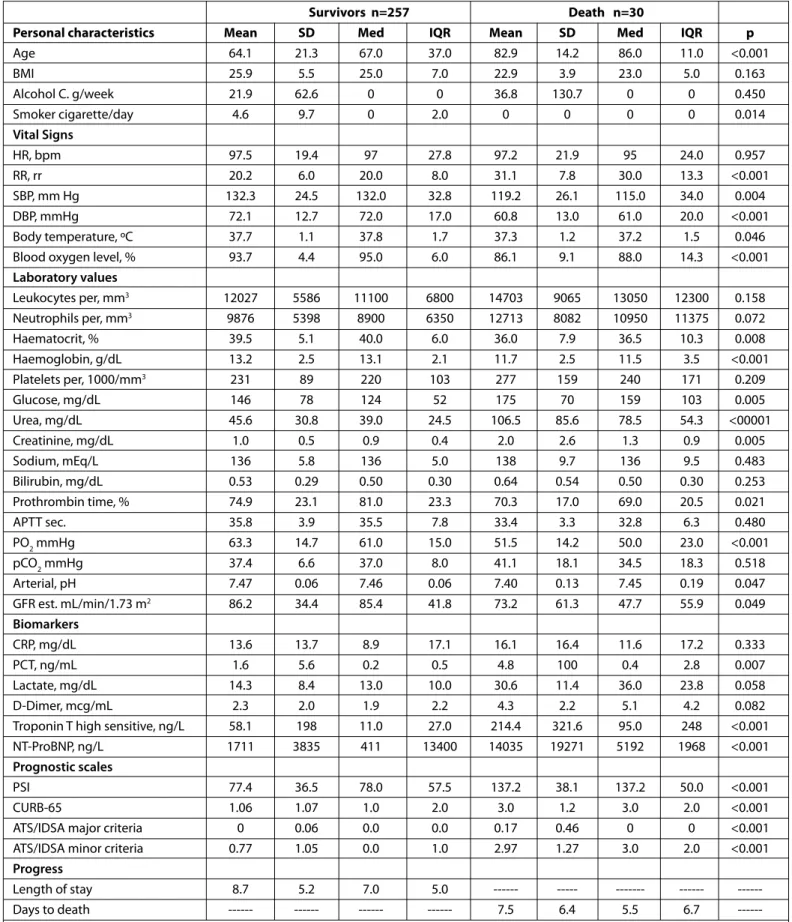
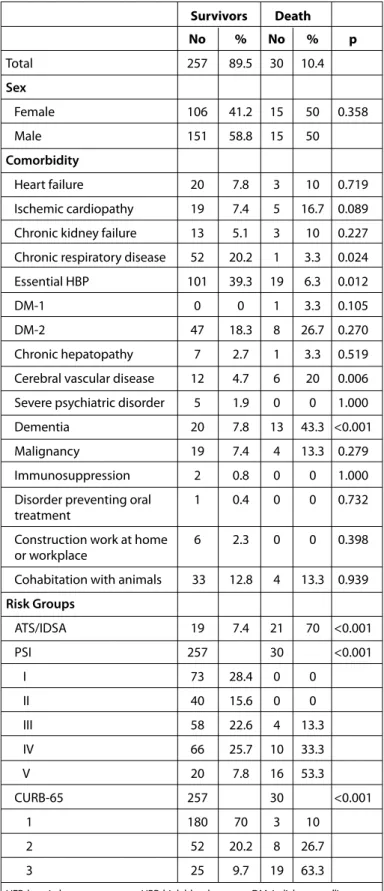
Overall, 42.2% of patients included in the study were women. The mean age was 66±21 years (min. 14, max. 104). The main demographic characteristics, comorbidity, clinical and radiological variables, prognos-tic scales, and biomarkers for each group are shown in Tables 1 and 2.
Survivors n=257 Death n=30
Personal characteristics Mean SD Med IQR Mean SD Med IQR p
Age 64.1 21.3 67.0 37.0 82.9 14.2 86.0 11.0 <0.001 BMI 25.9 5.5 25.0 7.0 22.9 3.9 23.0 5.0 0.163 Alcohol C. g/week 21.9 62.6 0 0 36.8 130.7 0 0 0.450 Smoker cigarette/day 4.6 9.7 0 2.0 0 0 0 0 0.014 Vital Signs HR, bpm 97.5 19.4 97 27.8 97.2 21.9 95 24.0 0.957 RR, rr 20.2 6.0 20.0 8.0 31.1 7.8 30.0 13.3 <0.001 SBP, mm Hg 132.3 24.5 132.0 32.8 119.2 26.1 115.0 34.0 0.004 DBP, mmHg 72.1 12.7 72.0 17.0 60.8 13.0 61.0 20.0 <0.001 Body temperature, ºC 37.7 1.1 37.8 1.7 37.3 1.2 37.2 1.5 0.046
Blood oxygen level, % 93.7 4.4 95.0 6.0 86.1 9.1 88.0 14.3 <0.001
Laboratory values Leukocytes per, mm3 12027 5586 11100 6800 14703 9065 13050 12300 0.158 Neutrophils per, mm3 9876 5398 8900 6350 12713 8082 10950 11375 0.072 Haematocrit, % 39.5 5.1 40.0 6.0 36.0 7.9 36.5 10.3 0.008 Haemoglobin, g/dL 13.2 2.5 13.1 2.1 11.7 2.5 11.5 3.5 <0.001 Platelets per, 1000/mm3 231 89 220 103 277 159 240 171 0.209 Glucose, mg/dL 146 78 124 52 175 70 159 103 0.005 Urea, mg/dL 45.6 30.8 39.0 24.5 106.5 85.6 78.5 54.3 <00001 Creatinine, mg/dL 1.0 0.5 0.9 0.4 2.0 2.6 1.3 0.9 0.005 Sodium, mEq/L 136 5.8 136 5.0 138 9.7 136 9.5 0.483 Bilirubin, mg/dL 0.53 0.29 0.50 0.30 0.64 0.54 0.50 0.30 0.253 Prothrombin time, % 74.9 23.1 81.0 23.3 70.3 17.0 69.0 20.5 0.021 APTT sec. 35.8 3.9 35.5 7.8 33.4 3.3 32.8 6.3 0.480 PO2mmHg 63.3 14.7 61.0 15.0 51.5 14.2 50.0 23.0 <0.001 pCO2mmHg 37.4 6.6 37.0 8.0 41.1 18.1 34.5 18.3 0.518 Arterial, pH 7.47 0.06 7.46 0.06 7.40 0.13 7.45 0.19 0.047 GFR est. mL/min/1.73 m2 86.2 34.4 85.4 41.8 73.2 61.3 47.7 55.9 0.049 Biomarkers CRP, mg/dL 13.6 13.7 8.9 17.1 16.1 16.4 11.6 17.2 0.333 PCT, ng/mL 1.6 5.6 0.2 0.5 4.8 100 0.4 2.8 0.007 Lactate, mg/dL 14.3 8.4 13.0 10.0 30.6 11.4 36.0 23.8 0.058 D-Dimer, mcg/mL 2.3 2.0 1.9 2.2 4.3 2.2 5.1 4.2 0.082
Troponin T high sensitive, ng/L 58.1 198 11.0 27.0 214.4 321.6 95.0 248 <0.001
NT-ProBNP, ng/L 1711 3835 411 13400 14035 19271 5192 1968 <0.001
Prognostic scales
PSI 77.4 36.5 78.0 57.5 137.2 38.1 137.2 50.0 <0.001
CURB-65 1.06 1.07 1.0 2.0 3.0 1.2 3.0 2.0 <0.001
ATS/IDSA major criteria 0 0.06 0.0 0.0 0.17 0.46 0 0 <0.001
ATS/IDSA minor criteria 0.77 1.05 0.0 1.0 2.97 1.27 3.0 2.0 <0.001
Progress
Length of stay 8.7 5.2 7.0 5.0 --- --- --- ---
---Days to death --- --- --- --- 7.5 6.4 5.5 6.7
---Med: median; IQR: inter-quartile range; Alcohol C: alcohol use consumption; Smoker: tobacco use HR: heart rate; RR: respiratory rate; BMI: body mass index; bpm: beats per minute; rr: respiratory rate; SBP: systolic blood pressure; DBP: diastolic blood pressure; ºC: degrees centigrade; GFR: glomerular filtration rate; APTT: activated partial thromboplastin time; CRP: C-reactive protein; PCT: procalcitonin; ATS/IDSA: American Thoracic Society/Infectious Diseases Society of America; PSI: pneumonia severity index; CURB-65: acronym for Confusion; BUN: Blood Urea Nitrogen, Respiratory rate, Blood pressure, age over 65 years
Description of the outcome predictor variable
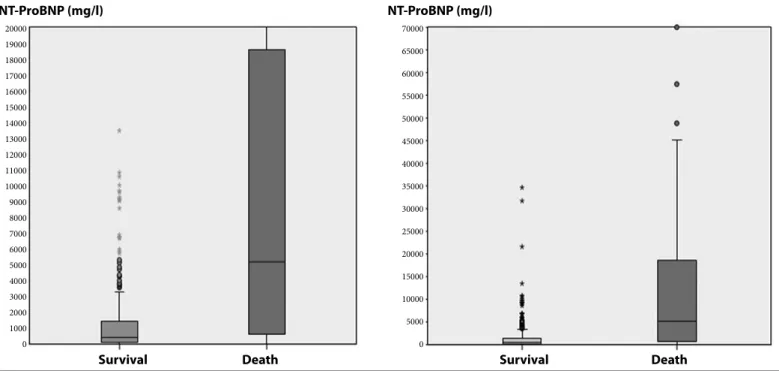
The results interval found was between 8 and 70,000 ng/L, with an arithmetic mean of 3,000 ng/L (SD 8,068 ng/L) and a median of 492 ng/L (IQR: 138–2.003). The values for survivors and death are shown in Figure 1.
There were statistically significant differences between the sur-viving and deceased patients at 30 days (median 5,192 ng/L; IQR 19,685 vs. median 411; IQR 1,340 ng/L, p<0.001).
Prognostic capacity of NT-ProBNP in CAP
The cutoff points were calculated depending on the mortality at 30 days. The cutoff point was 1,769 ng/L to optimize sensitivity (66.7%; 95% CI: 47.2–82.7), specificity (78.2%; 95% CI: 72.7–83.1), positive predictive value (PPV, 26.3%), and negative predictive value (NPV, 95.3%). For a cutoff point of 232 ng/L, the sensitivity was 93.3% (95% CI: 77.9–99.2), specificity was 39.3% (95% CI: 33.3–45.6), PPV was 15.2%, and NPV was 98.1%. For a cutoff point of 10,808 ng/L, the sensitivity was 36.7% (95% CI: 19.9–56.1), specificity was 98.4% (95% CI: 96.1–99.6), PPV was 73.3%, and NPV was 93% (Figure 2).
When proposing mixed models with demographic variables (age), predictive scales (PSI, CURB-65 and ATS/IDSA 2007), and bio-markers (CRP, PCT, and NT-ProBNP), the most advantageous model combines ATS/IDSA with PCT and NT-ProBNP with an AUC of 0.94.
The diagnostic performance of NT-ProBNP, some other markers such as procalcitonin, and diverse scoring systems used for pneumo-nia are depicted in Table 3.
Correlation between NT-ProBNP and predictive scales
A study was made of the correlation between NT-ProBNP and the PSI, CURB-65 predictive scales, and minor ATS/IDSA criteria. There was a good association between NT-ProBNP and the PSI scales (Rho 0.71 p=0.0001) and CURB-65 (Rho 0.65 p=0.0001) and a slight associ-ation with the ATS/IDSA minor criteria (Rho 0.48 p=0.0001).
Logistic regression model
a. NT-ProBNP as an independent risk factor for early mortality
Initially, a univariate analysis was performed depending on mortality for the following variables as dichotomous variables: age, background of heart failure, ischaemic cardiomyopathy and chronic kidney failure, serum creatinine, NT-ProBNP, PSI score, CURB-65 score, minor ATS/IDSA criteria score, and ATS/IDSA scale. The variables with p<0.25 (age, ischaemic cardiomyopathy, creatinine, NT-ProBNP, PSI, CURB-65, minor ATS/IDSA criteria, and ATS/IDSA as dichotomous variables) were entered into a logistic regression model. Furthermore, forced multivariate analysis was performed on the personal history of heart failure and chronic kidney failure, as these variables have an established relationship with NT-ProBNP levels and therefore could be confusion factors. After adjustment for all these variables, the only ones that maintained statistical significance were age (p=0.002), ATS/ IDSA 2007 (p=0.001), and NT-ProBNP (p=0.001).
b. Assess improved outcome prediction by associating NT-ProBNP and other biomarkers
A univariate analysis of NT-ProBNP and the CRP and PCT bio-markers revealed that only PCT (p=0.043) and NT-ProBNP (p<0.0001) showed significant differences between patients that died and sur-vived at 30 days.
Table 2. General characteristics of the sample. Comparison between
survivors and deaths in the first 30 days
Survivors Death No % No % p Total 257 89.5 30 10.4 Sex Female 106 41.2 15 50 0.358 Male 151 58.8 15 50 Comorbidity Heart failure 20 7.8 3 10 0.719 Ischemic cardiopathy 19 7.4 5 16.7 0.089 Chronic kidney failure 13 5.1 3 10 0.227 Chronic respiratory disease 52 20.2 1 3.3 0.024
Essential HBP 101 39.3 19 6.3 0.012
DM-1 0 0 1 3.3 0.105
DM-2 47 18.3 8 26.7 0.270
Chronic hepatopathy 7 2.7 1 3.3 0.519
Cerebral vascular disease 12 4.7 6 20 0.006 Severe psychiatric disorder 5 1.9 0 0 1.000
Dementia 20 7.8 13 43.3 <0.001
Malignancy 19 7.4 4 13.3 0.279
Immunosuppression 2 0.8 0 0 1.000
Disorder preventing oral 1 0.4 0 0 0.732 treatment
Construction work at home 6 2.3 0 0 0.398 or workplace
Cohabitation with animals 33 12.8 4 13.3 0.939
Risk Groups ATS/IDSA 19 7.4 21 70 <0.001 PSI 257 30 <0.001 I 73 28.4 0 0 II 40 15.6 0 0 III 58 22.6 4 13.3 IV 66 25.7 10 33.3 V 20 7.8 16 53.3 CURB-65 257 30 <0.001 1 180 70 3 10 2 52 20.2 8 26.7 3 25 9.7 19 63.3
HER: hospital emergency room; HBP: high blood pressure; DM-1: diabetes mellitus type 1; DM-2: diabetes mellitus type 2; ATS/IDSA: American Thoracic Society/Infectious Disea-ses Society of America; PSI: pneumonia severity index; CURB-65: acronym for Confusion, BUN: Blood Urea Nitrogen, Respiratory rate, Blood pressure, age over 65 years
Survival analysis
It was observed that 20% of patients died within the first 48 hrs and 50% within the first 5 days. Comparison of the survival curves de-pending on the cutoff point showed significant differences between the patients that died for values over 1,769 ng/L [(hazard ratio 6.2 (CI 2.9-13.2, p=0.0001)], as can be seen in Figure 3.
The survival curves were also compared depending on sex, back-ground of heart failure, ischaemic cardiomyopathy and chronic kid-ney failure, and creatinine serum levels above and below 1.2 mg/dL.
The only significant differences were found for the latter variable (p<0.001).
Discussion
The World Health Organisation estimates that infections of the lower airways are the most common cause of death by infectious disease in the world, with close to 3.5 million deaths a year (10). Ear-ly assessment of the severity of pneumonia is crucial to the correct management of these patients. Over the last few years, a multitude
Figure 1. NT-ProBNP values on a scale of 0–20,000 ng/L (left) and on a scale of 0–70,000 ng/L (right) NT-ProBNP (mg/l) NT-ProBNP (mg/l) 20000 19000 18000 17000 16000 15000 14000 13000 12000 11000 10000 9000 8000 7000 6000 5000 4000 3000 2000 1000 0 70000 65000 60000 55000 50000 45000 40000 35000 30000 25000 20000 15000 10000 5000 0 Survival
Survival Death Death
Table 3. Comparison of diagnosis performance curves
Models ROC Curves
CRP 0.56 PCT 0.66 NT-ProBNP 0.78 CRP + NT-ProBNP 0.79 PCT + NT-ProBNP 0.85 CRP + PCT + NT-ProBNP 0.82 PSI + NT-ProBNP 0.90 CURB65 + NT-ProBNP 0.91 ATS/IDSA + NT-ProBNP 0.93 PCT + ATS/IDSA + NT-ProBNP 0.94 Age + PCT + NT-ProBNP 0.86
Age + PCT + ATS/IDSA + NT-ProBNP 0.95
ROC: receiver operating characteristic; PCT: procalcitonin; CRP: C-reactive prote-in; ATS/IDSA: American Thorax Society/Infectious Diseases Society of America; CURB-65: acronym for Confusion, BUN: Blood Urea Nitrogen, Respiratory rate, Blood pressure, age over 65 years
Figure 2. NT-ProBNP ROC curves. AUC 0.783; CI 95%: 0.731–0.829; p<0.001
NT-ProBNP (ng/L) 100-Specificity cut-off: 10.808 ng/L cut-off: 1769 ng/L cut-off: 232 ng/L Sensitivit y 0 20 40 60 80 100 100 80 60 40 20 0
of clinical tools have been designed and developed to predict mortali-ty and help decide the care site, with PSI and CURB-65 being the most reliable and most often used in the HER (1-2). However, these scales are quite often not applied, either because they are simply not used or be-cause objective data such as low blood oxygen level or subjective data such as poor family support recommend admission of the patient (11).
Biological markers and their role in the inflammatory response and relationship to the severity of pneumonia are undering study. Biomark-ers may be an alternative to assess the seriousness of pneumonia and predict mortality. These biomarkers include natriuretic peptides (NP) (12-14). The first team to assess NT-ProBNP as a predictor of early mortal-ity at 30 days were Jeong et al. (4), who in 2011 conducted a retrospec-tive study of hospitalized patients, obtaining promising results in their series of 167 patients. According to our information, this NP was recently studied as a prognosis marker for CAP in different scenarios: emergency room (5, 9), hospitalized patients (6), and intensive care units (7, 8).
Description of the outcome predictor variable
We found large differences between NT-proBNP values in survi-vors and deaths within the first 30 days; there were statistically
signif-icant differences between both groups, as in other studies conduct-ed to date.
Prognostic capacity of NT-ProBNP in CAP
The ideal cutoff point balancing sensitivity and specificity found in our study was 1,769 ng/L. This result is in line with that of stud-ies by Jeong (1,795.5 pg/mL), Nowak (1,935 ng/L), and Chang (1,860 ng/L) in patients diagnosed in the Emergency Room and admitted to a conventional hospital ward (4-6). Our cutoff point differs from that of the cohort by Lin et al. (7) (2,177.5 ng/L). Their patients had more severe CAP, with 83% of patients meeting ATS/IDSA criteria compared to 14% in our series. They also evaluated other types of pneumonia, including hospital-acquired (25%) and that associated with social and health care (40%). We also found differences with the cutoff point established by Xiao et al. (8), almost certainly because this group reduced the cutoff point to obtain a sensitivity of 98.7%.
As severe CAP is a dangerous, but treatable, disease whose se-verity should be assessed as soon as possible, lowering the cutoff point to 232 ng/L would provide a sensitivity of 93.3% (95% CI: 0.78– 0.99), higher than 90% (95% CI: 0.87–0.92), in reference to the Fine’s score in the above meta-analysis. This could therefore be useful in the HER to identify patients with non-severe pneumonia and low risk of death who could be safely discharged. Our sensitivity is very close to those of the studies by Jeong and Nowak when they dropped their cutoff points to 235.6 ng/L and 628 ng/L, respectively (4, 5).
A higher cutoff point (10,808 ng/L) would indicate patients re-quiring a more aggressive initial treatment.
Assessment of the diagnostic performance of NT-ProBNP
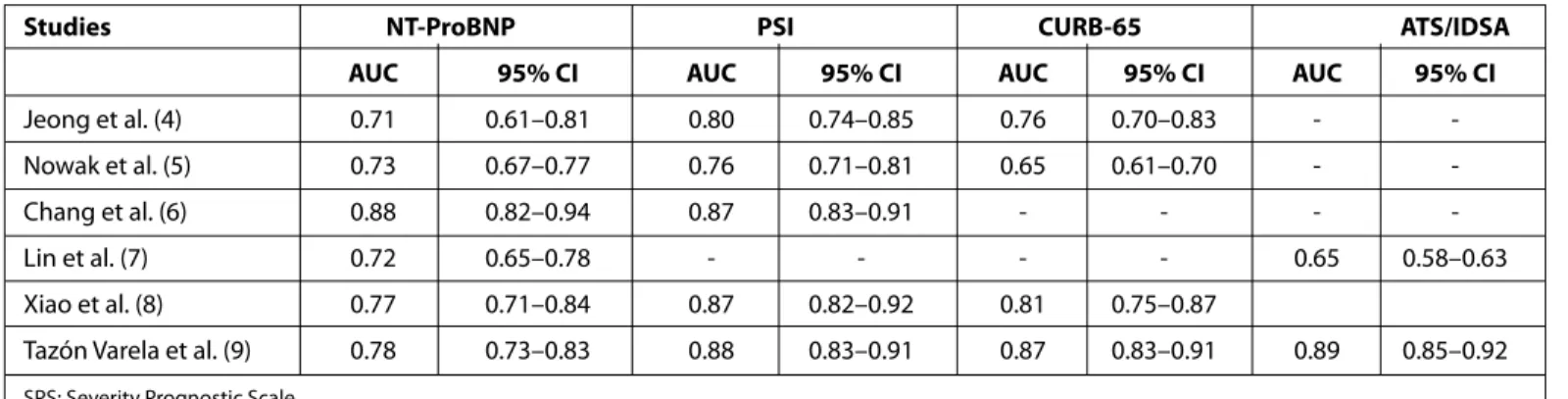
After studying the general accuracy of the diagnostic test using ROC curves, NT-ProBNP has good capacity as a diagnostic test to pre-dict mortality at 30 days, with an AUC of 78%. The studies performed to date found an AUC of between 71% and 88% (Table 4).
Comparison of the prognostic capacity of NT-ProBNP compared to a scale to predict severity
The accuracy of these two prediction scales has been compared in various reviews and meta-analyses, resulting in a high NPV in popu-lations with a low prevalence of death, a PSI sensitivity of about 90%, a CURB-65 specificity of close to 80%, and suitable diagnostic capacity with an AUC of around 80% (15-17).However, in spite of the value of these tools, approximately 30%–60% of low risk CAP patients are hos-pitalized, there being considerable disagreement between the recom-mendations of the scales and the final destination of the patient (18).
Figure 3. Comparison of the survival curves Days until death
< 1769 > 1769 < 1769-censured > 1769-censured A ccumula ted sur viv al 0 1 2 3 4 5 6 7 8 9 10 11 12 13 14 15 16 17 18 19 20 21 22 23 24 25 26 27 28 29 30 1,0 0,8 0,6 0,4 0,2 0,0
Studies NT-ProBNP PSI CURB-65 ATS/IDSA AUC 95% CI AUC 95% CI AUC 95% CI AUC 95% CI
Jeong et al. (4) 0.71 0.61–0.81 0.80 0.74–0.85 0.76 0.70–0.83 -
-Nowak et al. (5) 0.73 0.67–0.77 0.76 0.71–0.81 0.65 0.61–0.70 -
-Chang et al. (6) 0.88 0.82–0.94 0.87 0.83–0.91 - - -
-Lin et al. (7) 0.72 0.65–0.78 - - - - 0.65 0.58–0.63
Xiao et al. (8) 0.77 0.71–0.84 0.87 0.82–0.92 0.81 0.75–0.87
Tazón Varela et al. (9) 0.78 0.73–0.83 0.88 0.83–0.91 0.87 0.83–0.91 0.89 0.85–0.92
SPS: Severity Prognostic Scale
In our sample, the two scales to predict severity showed better diagnostic performance than the biomarker. Nevertheless, the AUC obtained in our study for the predictive scales was at the same height of the upper range of the AUC found in systematic reviews and me-ta-analyses (16, 17). We therefore understand that the diagnostic ca-pacity of NT-ProBNP could be useful in the same terms as the use of PSI and CURB-65 scales.
Comparison of the prognostic capacity of NT-ProBNP compared to other biomarkers
Over the last few years, medical literature has accepted the useful-ness of PCT to differentiate acute systemic bacterial infections in CAP to assess the response to treatment or predict hospitalization (19, 20). However, there is still controversy regarding its capacity to predict ear-ly mortality. Some studies, such as those by Krüger et al. (21), Horie et al. (22), or Park et al. (23), attribute good capacity to PCT. However, in a systematic review of 30 publications, the ability of PCT to predict early mortality was found to be very similar to our results (24). In our sam-ple, the association of NT-ProBNP with PCT, a combination not used to date, provided high specificity (98%) to detect severe CAP. This combi-nation of infectious and cardiovascular stress biological markers could be useful in the HER or ICU to detect potentially severe patients.
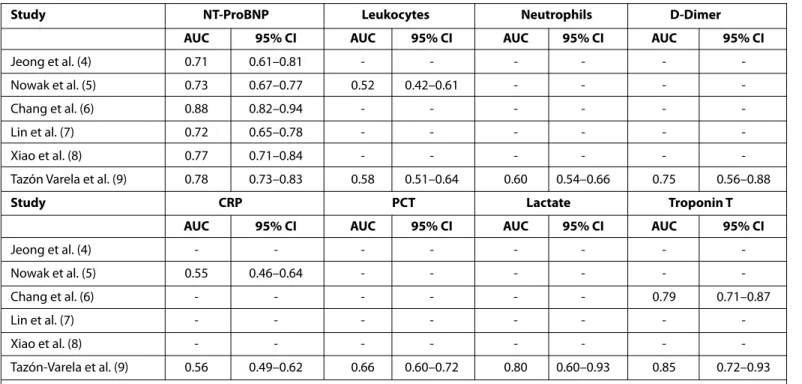
Among the studies that analyze NT-ProBNP and its relationship to CAP, there are very few that study and compare other biomarkers. Only Jeong et al. (4) and Nowak et al. (5) assessed infectious-inflam-matory biological markers (leukocytes and CRP); they obtained re-sults very similar to ours, attributing a low predictive capacity to both variables (Table 5).
Correlation between NT-ProBNP and predictive scales
A study was made of the association between NT-ProBNP and predictive scales such as quantitative variables. There was positive and significant interdependence between the severity of pneumonia
and the PSI and CURB-65 scales and minor ATS/IDSA 2007 criteria, the strongest association being with Fine’s score (Rho 0.71 p<0.0001). These findings are in agreement with Nowak et al. (5), who also found a significant interrelationship between early mortality and the PSI scale (Rho 0.53 p<0.001).
Correlation between NT-ProBNP and other biomarkers
A study was made of the strength of the association between NT-ProBNP and the analyzed biomarkers. Except for troponin T, the correlation was weak with the other inflammatory markers normally used in an emergency room, such as leukocytes (Rho 0.14 p=0.02), CRP (Rho 0.18 p=0.003), and PCT (Rho 0.33 p=0.001). Of special note is the low interrelationship between NT-ProBNP and CRP. Nowak et al. (5) also did not find any correlation between NT-ProBNP, leukocytes, and CRP.
Logistic regression model
a. NT-ProBNP as an independent risk factor for early mortality
A logistic regression analysis was performed, adjusting for pos-sible confusing factors. Only age, the ATS/IDSA scale, and NT-ProBNP maintained statistical significance. However, NT-ProBNP was the only factor maintaining statistical significance in all models. Therefore, age, meeting ATS/IDSA 2007 criteria, and high NT-ProBNP levels are independent predictors of early mortality. These results are consis-tent with the literature, where NT-ProBNP is also highlighted as an independent risk factor (4-6).
From the evolutionary point of view, an increase of 1 ng/L is not relevant for the clinician; therefore, we grouped the increases of NT-ProBNP as 300, 500, 1,000 and 2,000 ng/L, noting that the risk of death with the first 30 days increased from 3% to 22%. Future studies will be required to determine the solidity of these results and wheth-er this biomarkwheth-er could be a useful tool in HER and obswheth-ervation units to determine the progress of patients with CAP.
Study NT-ProBNP Leukocytes Neutrophils D-Dimer AUC 95% CI AUC 95% CI AUC 95% CI AUC 95% CI
Jeong et al. (4) 0.71 0.61–0.81 - - -
-Nowak et al. (5) 0.73 0.67–0.77 0.52 0.42–0.61 - - -
-Chang et al. (6) 0.88 0.82–0.94 - - -
-Lin et al. (7) 0.72 0.65–0.78 - - -
-Xiao et al. (8) 0.77 0.71–0.84 - - -
-Tazón Varela et al. (9) 0.78 0.73–0.83 0.58 0.51–0.64 0.60 0.54–0.66 0.75 0.56–0.88
Study CRP PCT Lactate Troponin T AUC 95% CI AUC 95% CI AUC 95% CI AUC 95% CI
Jeong et al. (4) - - - -Nowak et al. (5) 0.55 0.46–0.64 - - - -Chang et al. (6) - - - 0.79 0.71–0.87 Lin et al. (7) - - - -Xiao et al. (8) - - - -Tazón-Varela et al. (9) 0.56 0.49–0.62 0.66 0.60–0.72 0.80 0.60–0.93 0.85 0.72–0.93
AUC: area under the curve; CI: confidence interval; CRP: C reactive protein; PCT: Procal citonin
b. Assess improved prediction of outcome by associating NT-ProBNP and predictive scales
Some studies are headed in the direction of adding a biomarker to predictive scales to improve the predictive capacity for mortality and the absence of severe complications (25, 26). Several biochemical markers improve the prediction of mortality at 30 days for predictive scales in hospitalized patients, including vitamin D status with PSI (27), CRP with PSI, CURB-65 and CRB-65 (28), CRP and PCT with CURB-65 (29), cortisol with CRB-65 (30), or albumin with PSI and CURB-65 (31).
In our sample, NT-ProBNP improves the prognostic capacity of all three scales. It improves PSI by 3% and CURB-65 by 4%. It is important to note the predictive improvement of the ATS/IDSA scale improved by 11% when associated with NT-ProBNP, reaching an AUC of 93% with a correct classification of 91%. The results in this regard are dis-similar in different studies. When Jeong et al. associated NT-ProBNP with PSI and CURB-65, they found no statistically significant improve-ment; nor did Lin et al. find an improvement in critical patients when associating NT-ProBNP with the ATS/IDSA scale, although there was an improvement when NT-ProBNP was associated with the APACHE II scale (4, 7). Therefore, this subject is still open to debate.
c. Assess improved outcome prediction by associating NT-ProBNP and other biomarkers
To our knowledge, there is no study using the assessment of di-agnostic tests to improve the predictive of a prognosis of mortality by combining NT-ProBNP with another biomarker.
In our study, NT-ProBNP improves the diagnostic performance of classic inflammatory-infectious biomarkers by 24% for CRP and 19% for PCT. It is worthy of note that the PCT model together with NT-ProBNP reaches an AUC of 85%, greater than the AUC provided for PSI (15, 16). Furthermore, in this sample, these two biomarkers had a specificity of 98% in detecting mortality at 30 days, an extreme-ly valuable combination for detecting high risk patients.
d. Assess improved prediction of outcome by associating NT-ProBNP with predictive scales and biomarkers
A study of predictive improvement by associating predictive scales with NT-ProBNP has already been analyzed, with inconsis-tent results. Jeong et al. did not find that NT-ProBNP improved PSI, CURB-65, or APACHE II (4). Lin et al. (7) did not find that association of NT-ProBNP with minor ATS/IDSA 2007 criteria improved these predic-tions, although it did do so with APACHE II.
Nowak et al. (5) considered that associating NT-ProBNP with the categorical value of PSI provided additional information. They observed that NT-ProBNP helps detect high or intermediate risk pa-tients when PSI alone marked them as high risk.
In our sample, of all the logistic regression models proposed that included age together with biomarkers and predictive scales, the simplest and most profitable variant would be to use the ATS/ IDSA scale and NT-ProBNP, which would give a sensitivity of 80%, a specificity of 92%, good classification of 91% of patients, and an AUC of 93%. That is, in our study, NT-ProBNP combined with the ATS/IDSA 2007 scale is the best combination between biomarkers and predic-tive scales for detecting severe CAP.
Survival analysis
In the case of CAP, mortality is concentrated within the first few days, with 20% of patients dying in the first 48 h and 50% within the
first week. Corrales-Medina et al. (32) detected the majority of car-diovascular complications in the first week. As these complications have a very early onset, the patient may be in the emergency room, observation area, or short stay ward, thus reasserting the importance of early diagnosis and treatment in the HER but also the need for tools that help predict mortality. In our study, survival analysis also revealed that 20% of patients die within the first 48 h and 50% within the first 5 days. Apart from the patients that died, those with NT-ProB-NP values above the 1.769 ng/L cutoff point showed statistically sig-nificant differences in survival time compared to those that died with values below the cutoff point (Figure 3).
Study limitations
The limitations are basically those derived from a single-center followup study. This study did not include patients with suspected CAP treated in primary healthcare without being referred to the hos-pital for assessment.
No analytical controls of NT-ProBNP or any other biomarker were performed during the month of followup, thus limiting our conclu-sions to assess the evolutionary prognostic capacity. Although we analyzed eight biomarkers, the sample numbers were low for lactate, high-sensitivity troponin T, and D-dimer.
Conclusion
In our sample, elevation of NT-ProBNP at the time of diagnosis in the emergency room was associated with increased short term mortality. This biomarker could be an independent risk factor to predict this mortality. These findings are in agreement with current literature; NT-ProBNP is a prognosis tool that has begun to appear in review articles as an emerging biomarker (33). Until its individual prognostic value is confirmed, this marker could be useful in the ini-tial assessment of CAP patients and be included as a tool in addition to predictive scales; also, it could perhaps be used in the future to design individual treatment strategies.
Ethics Committee Approval: Ethics committee approval was received for this study from the ethics committee of Cantabria University.
Informed Consent: All the patients who entered in the study fulfilled an informed consent
Peer-review: Externally peer-reviewed.
Conflict of Interest: No conflict of interest was declared by the authors. Financial Disclosure: Roche diagnostics provide the kits of NT-Pro BNP for the study.
References
1. Fine MJ, Auble TE, Yealy DM, Hanusa BH, Weissfeld LA, Singer DE, et al. A prediction rule to identify low-risk patients with community-acquired pneumonia. N Engl J Med 1997; 336: 243-50. [CrossRef]
2. Lim WS, Van der Eerden MM, Laing R, Boersma WG, Karalus N, Town GI, et al. Defining community-acquired pneumonia severity on presenta-tion to hospital: an internapresenta-tional derivapresenta-tion and validapresenta-tion study. Thorax 2003; 58: 377-82. [CrossRef]
3. Aujesky D, McCausland JB, Whittle J, Scott D, Yealy DM, Fine JM. Reasons why emergency department providers do not rely on the pneumonia
severity index to determine the initial site of treatment for patients with pneumonia. Clin Infect Dis 2009; 49: e100-8.
4. Jeong KY, Kim K, Kim TY, Lee CC, Jo SO, Rhee JE, et al. Prognostic value of N-terminal pro-brain natriuretic peptide in hospitalised patients with com-munity-acquired pneumonia. Emerg Med J 2011; 28: 122-7. [CrossRef] 5. Nowak A, Breidthardt T, Christ-Crain H, Bingisser R, Meune C, Tanglay Y, et
al. Direct comparison of three natriuretic peptides for prediction of short and long-term mortality in community-acquired pneumonia. Chest 2012; 141: 974-82. [CrossRef]
6. Chang CL, Mills GD, Karalus NC, Jennings LC, Laing R, Murdoch DR, et al. Biomarkers of cardiac dysfunction and mortality from community-ac-quired pneumonia in adults. PLoS One 2013; 8: e62612.
7. Lin SC, Tsai YJ, Huang CT, Kuo YW, Ruan SY, Chuang YC, et al. Prognos-tic value of plasma N-terminal pro B-type natriurePrognos-tic peptide levels in pneumonia patients requiring intensive care unit admission. Respirolo-gy 2013; 18: 933-41. [CrossRef]
8. Xiao K, Su LX, Han BC, Yan P, Yuan N, Deng J, et al. Analysis of the severity and prognosis assessment of aged patients with community-acquired pneumonia: a retrospective study. Thorac Dis 2013; 5: 626-33.
9. Tazón-Varela M, Alonso-Valle H, Muñoz-Cacho P, Colomo-Mármol LF, Gallo-Terán J, Hernández-Herrero M. N-terminal fragment of pro-brain natriuretic peptide plasma concentration: a new predictive biomarker for community acquired pneumonia? Emergencias 2014; 26: 94-100. 10. WHO. The top 10 causes of death. Geneva: World Health Organization,
2013 Available at: http://www.who.int/mediacentre/factsheets/fs310/ en/index.html
11. Wunderink RG, Waterer GW. Community-acquired pneumonia. N Engl J Med 2014; 370: 6.
12. Brueckmann M, Huhle G, Lang S, Haase KK, Bertsch T, Weiss C, et al. Prognostic value of plasma N-terminal pro-brain natriuretic peptide in patients with severe sepsis. Circulation 2005; 112: 527-34. [CrossRef] 13. Hartemink KJ, Twisk JW, Groeneveld AB. High circulating N-terminal
pro-B-type natriuretic peptide is associated with greater systolic cardiac dys-function and nonresponsiveness to fluids in septic vs nonseptic critically ill patients. J Crit Care 2011; 26: 108.e1-8.
14. Yang S, Li L, Cao J, Yu H, Xu H. The differential diagnostic value of serum NT-proBNP in hospitalized patients of heart failure with pneumonia. J Clin Lab Anal 2015; 29: 37-42. [CrossRef]
15. Loke YK, Kwok CS, Niruban A, Myint PK. Value of severity scales in pdicting mortality from community-acquired pneumonia: systematic re-view and meta-analysis. Thorax 2010; 65: 884-90. [CrossRef]
16. Chalmers JD, Singanayagam A, Akram AR, Mandal P, Short PM, Choud-hury G, et al. Severity assessment tools for predicting mortality in hos-pitalised patients with community-acquired pneumonia. Systematic review and meta-analysis. Thorax 2010; 65: 878-83. [CrossRef]
17. Singanayagam A, Chalmers JD, Hill AT. Severity assessment in communi-ty-acquired pneumonia: a review. QJM 2009; 102: 379-88. [CrossRef] 18. Hunter B, Wilbur L. Can emergency physicians safely increase the
propor-tion of patients with community-acquired pneumonia who are treated in the outpatient setting?. Ann Emerg Med 2012; 60: 106-7. [CrossRef]
19. Martin-Loeches I, Valles X, Menendez R, Sibila O, Montull B, Cilloniz C, et al. Predicting treatment failure in patients with community acquired pneumonia: a case-control study. Respir Res 2014; 15: 75.
20. Krüger S, Ewig S, Papassotiriou J, Kunde J, Marre R, von Baum H, et al. Inflammatory parameters predict etiologic patters but do not allow for individual prediction of etiology in patients with CAP-Results from Ger-man competence network CAPNETZ. Respir Res 2009; 12: 10:65. 21. Krüger S, Ewig S, Marre R, Papassotiriou J, Richter K, von Baum H, et al.
Procalcitonin predicts patients at low risk of death from community-ac-quired pneumonia across all CRB-65 classes. Eur Respir J 2008; 31: 349-55. [CrossRef]
22. Horie M, Ugajin M, Suzuki M, Noguchi S, Tanaka W, Yoshihara H, et al. Di-agnostic and prognostic value of procalcitonin in community-acquired pneumonia. Am J Med Sci 2012; 343: 30-5. [CrossRef]
23. Park JH, Wee JH, Choi SP, Oh SH: The value of procalcitonin level in com-munity-acquired pneumonia in the ED. Am J Emerg Med 2012; 30: 1248-54. [CrossRef]
24. Berg P, Lindhardt BO. The role of procalcitonin in adult patients with community-acquired pneumonia. A systematic review. Dan Med J 2012; 59: A4357.
25. Torres A, Ramirez P, Montull B, Menéndez R. Biomarkers and commu-nity-acquired pneumonia: tailoring management with biological data. Semin Respir Crit Care Med 2012; 33: 266-71. [CrossRef]
26. Viasus D, Simonetti A, Garcia-Vidal C, Carratalà J. Prediction of prognosis by markers in community-acquired pneumonia. Expert Rev Anti Infect Ther 2013; 11: 917-29. [CrossRef]
27. Remmelts HH, van der Garde EM, Meijvis SC, Peelen EL, Damoiseaux JG, Grutters JC, et al. Addition of vitamin D status to prognostic scores im-proves the prediction of outcomes in community-acquired pneumonia. Clin Infect Dis 2012; 55: 1488-94. [CrossRef]
28. Menéndez R, Martínez R, Reyes S, Mensa J, Filella X, Marcos MA, et al. Biomarkers improve mortality prediction by prognostic scales in com-munity-acquired pneumonia. Thorax 2009; 64: 587-91. [CrossRef] 29. Espa-a PP, Capelastegui A, Bilbao A, Díez R, Izquierdo F, López de
Goicoe-txea MJ, et al. Utility of two biomarkers for directing care among patients with non-severe community-acquired pneumonia. Eur J Clin Microbiol Infect Dis 2012; 31: 3397-405. [CrossRef]
30. Kolditz M, Höffken G, Martus P, Rohde G, Schütte H, Bals R, et al. Serum cortisol predicts death and critical disease independently of CRB-65 score in community-acquired pneumonia: a prospective observational cohort study. BMC Infect Dis 2012; 12: 90. [CrossRef]
31. Viasus D, Garcia-Vidal C, Simonetti A, Manresa F, Dorca J, Gudiol F. Car-ratalá: Prognostic value of serum albumin levels in hospitalized adults with community-acquired pneumonia. J Infect 2013; 66: 415-23. [CrossRef] 32. Corrales-Medina VF, Musher DM, Wells GA, Chirinos JA, Chen L, Fine MJ.
Cardiac complications in patients with community-acquired pneumo-nia: incidence, timing, risk factors, and association with short-term mor-tality. Circulation 2012; 125: 773-81. [CrossRef]
33. Remington LT, Sligl WI: Community-acquired pneumonia. Curr Opin Pulm Med 2014; 20: 215-24. [CrossRef]