La adopción de las aplicaciones de banca móvil desde
una perspectiva dual
*The adoption of mobile banking applications from a dual
perspective
CAYETANO MEDINA-MOLINA Facultad de Ciencias Jurídicas y Económicas Universidad ISABEL I
Fernán González, nº 76, Burgos [email protected]
ORCID: http://orcid.org/0000-0003-2322-777X
MANUEL REY-MORENO Facultad de Turismo y Finanzas Universidad DE SEVILLA
Avda. San Francisco Javier s/n, Sevilla [email protected]
ORCID: https://orcid.org/0000-0002-7542-1542
VICTOR CAZURRO-BARAHONA Universidad Internacional de la Rioja Av. de la Paz, 137, 26006 Logroño, La Rioja [email protected]
ORCID: https:// orcid.org /0000-00020342-13987
SERGIO PARRONDO
Facultad de Ciencias Jurídicas y Económicas Universidad ISABEL I
Fernán González, nº 76, Burgos [email protected]
ORCID: https:// orcid.org /0000/0002/8026/0368
RECIBIDO: 12/11/2018 ACEPTADO: 20/02/2019
Este artículo está sujeto a una: ia "Creative Commons Reconocimiento-No Comercial" (CC-BY-NC).
DOI: 10.24197/st.2.2019.1-22
* Este trabajo se ha realizado en el marco del Proyecto de Investigación “Las plataformas multilaterales
y banca digital”, Programa de Becas TFG/TFM – Convocatoria 2017/18 de la Universidad Isabel I.
Resumen: El surgimiento de las Fintech provoca un incremento de la competencia para el sector bancario ya que, además de
ofrecer servicios más orientados a los clientes y optimizar el uso de las tecnologías, en muchas ocasiones centran su actividad en ofertar en productos que venía ofreciendo la banca tradicional. Por su parte, la banca tradicional encuentra en las apps una herramienta fundamental y una vía para contrarrestar la presión de los nuevos competidores. El presente trabajo se dirige a analizar, a través de un modelo de factor dual los favorecedores e inhibidores de la adopción de las apps de banca móvil. Basado en un trabajo de campo de 240 encuestas, y tras aplicar Modelos de Ecuaciones Estructurales, de acuerdo con los resultados, entre los facilitadores de la adopción de las apps de banca móvil juega un papel fundamental la expectativa de resultado, mientras que la satisfacción y los costes hundidos generan la inercia en el uso de la banca digital.
Palabras clave: app, banca móvil, modelo de factor dual, facilitadores, inhibidores.
oriented toward customers and optimizing the use of technologies, they often centered their activity on proposing products which traditional banking had offered. For its part, traditional banking finds in apps a fundamental tool and a way to counteract the pressure of the new competitors. This is why this work is aimed at analyzing, through a dual factor model, the facilitators and inhibitors of the adoption of mobile banking apps. Based on a field work of 240 surveys, and after applying Structural Equation Modeling, according to the results among the facilitators of the adoption of mobile banking the performance expectation plays a fundamental role, while satisfaction and sunk costs generate inertia in the use of digital banking.
1.INTRODUCTION
The advances in communication favor the consolidation of online banking, teeming with benefits for banks and their users (Al-Otaibi, Aljohani, Hoque & Alotaibi, 2018; Khan, Hameed & Khan, 2017; Susanto, Lee & Ciganek, 2013). Its development rests with the pledge of financial institutions for digitalization, which, in the case of Spain, has meant between 2010 and 2016 an increase in its number of users from 9.1 to 15 million (Arellano & García, 2017). Within online banking, mobile banking is fundamental in the growth strategies of the banking industry (Dapp, 2015; Goswami & Raghavendran, 2009). Mobile banking applications (apps) make it possible for financial institutions to increase the services offered, provide a greater knowledge of their clientele and also reinforce their competitive position (Dapp, 2017). Their success requires establishing a critical mass of users who modify their habits and integrate them into their daily routines (Goswami & Raghavendran, 2009; Laukkanen, Sinkkonen, Kivijärvi & Laukkanen, 2007).
In spite of this, banks experience problems in transferring their customers to electronic channels, as a significant number of them opt for offices or ATMs (Hoehle, Scornavacca & Huff, 2012; Kuisma, Laukkanen & Hiltunen, 2007; Susanto et al., 2013). In Spain, where 92% of bank customers are habitual users of Internet, the figure of online banking users is around 46% (Carbó, Cuadros & Rodríguez, 2017) and of Internet users 54.6% (Fundación Telefónica, 2017), of whom only 8% carry out financial activities by Internet (Arellano & García, 2017). The preferences of customers, the ICT innovations and the services offered by non-banking agents lead to a greater customer orientation by the financial industry, causing traditional banks to have less power to prevent competition (Alt & Puschmann, 2012).
In this scenario, the Fintech are beginning to transform the financial sector and its relation with its customers (Fundación Telefónica, 2017). In Spain, the adoption of the Fintech is 37% of the active digital population, the forecast being to reach 56% (EY, 2017). And what is more relevant, in Spain 50% of the Fintech are centered on services traditionally provided by financial institutions (KPMG, 2017). That is to say, the financial institutions, with the emergence of mobile technologies, find themselves in a scenario which means, as well as opportunities for the provision of services, the rise of a new competitor: the Fintech. In the light of this situation it is of special relevance for banks to know the factors that determine the adoption of the mobile apps of financial institutions.
do not desire a change, research should be centered on identifying the inhibitors which prevent using a technology (Hoehle, et al., 2012), especially for those banking customers who, being able to use digital banking, opt for traditional channels (Kuisma et al., 2007). In spite of the advantages which it offers, the use of a mobile for banking activities is scant. This is why it is estimated that inhibitors must exist that slow down the use of mobile channels for banking transactions (Laukkanen, 2007)
As adopting mobile banking is influenced by external factors beyond facilitators (Sarfaraz, 2017), there is a call to investigate the motivators (Benoit, Baker, Bolton, Gruberd & Kandampully, 2017; Veríssimo, 2016) and inhibitors of the adoption of mobile banking apps (Laukkanen, 2011; Maroofi, Kahrarian & Dehghani, 2013). The dual factor follows this proposal, offering a theoretical bridge that unites inhibitor factors and use in an integrated model (Hsie, 2016; Polites & Karahanna, 2012; Rey-Moreno, Felício, Medina-Molina & Rufín, 2018). This work’s aim is therefore to analyze the functioning of an explanatory dual model of the intention of using mobile-banking apps which considers facilitator and inhibitor elements.
In the following section we set out the theoretical elements that are fundamental for this article. After, we present the dual models, the facilitator and inhibitor elements and the hypotheses to be verified. The next sections have the methodology and the results, after which comes the analysis of the results. The article concludes with the implications, conclusions and limitations.
MOBILE BANKING APPS AND THE RISE OF THE FINTECH
The increase of competitive intensity and of the sensitivity of banking customers to the cost and convenience is causing banks to reinforce their pledge for the use of technological solutions (Alalwan, Dwivedi, Rana & Algharabat, 2018), depending on the competitiveness of banks, such as the satisfaction and loyalty of their customers, and the speed and flexibility with which they respond to these challenges (Alalwan et al., 2018; Boonsiritomachai & Pitchayadejanant, 2017; Dapp, 2017). The financial sector has a broad history in the development of ways to interact with their customers using multi-channel strategies (Babat, 2017; Cortiñas, Chocarro & Villanueva, 2010). The growing availability of electronic self-service technologies in the banking industry has modified how banks serve customers (Hoehle et al., 2012).
personal finances, and access banking services through different means and technologies (Prodanova, San-Martín & Jiménez, 2015). These have different names, Internet banking and mobile banking being the most frequent. Internet banking is a banking channel that enables consumers to develop a wide variety of financial and non-financial services in any place through the bank’s webpage. Mobile banking is defined as the use of mobile devices to access banking networks and carry out both financial and non-financial transactions through apps (Al-Otaibi et al., 2018; Goswami & Raghavendran, 2009; Hoehle et al., 2012; Muñoz-Leiva, Climent-Climent & Liébana-Cabanillas, 2017; Prodanova et al., 2015; Veríssimo, 2016). It is seen as an extension of Internet banking with unique characteristics (Laukkanen & Passane, 2008).
The financial services of the future will not only replicate the existing banking channels but will bear in mind that mobile and social technologies mold and create new financial services (Alt & Puschmann, 2012). To transform smartphones into pocket bank offices and create an omnipresent bank will require intelligent businesses and solid alliances (Goswami & Raghavendran, 2009). To be competitive, banks must reconfigure their digital business model (Boonsiritomachai & Pitchayadejanant, 2017; Dapp, 2017).
Mobile banking means an innovative form of offering a broad range of financial services, embodied in banking apps which enable accessing services and carrying out transactions in the best conditions of time and place (Alalwan et al., 2018; Goswami & Raghavendran, 2009; Laukkanen & Lauronen, 2005). Banks, highly dynamic entities, convert the apps into the most effective channel to offer their products and services, as they allow the diversification of their offer via a broad range of functionalities (Ghazawneh & Henfridsson, 2013; Laukkanen & Lauronen, 2005; Muñoz-Leiva et al., 2017). Their use in mobile banking is supported by a continuous, comfortable and swift service; easy, having cover and quality, functional, intuitive and safe (Muñoz-Leiva et al., 2017; Prodanova et al., 2015). Those banking institutions that take advantage of the potential of the apps will be in a good competitive position (Goswami & Raghavendran, 2009; Laukkanen & Lauronen, 2005). Two options have been suggested to increase the diffusion of mobile banking: a pull strategy, fostering the benefits of banking innovations and a push strategy, increasing the commissions charged in other channels (Laukkanen, 2016).
combine innovative business models and technology to facilitate, reinforce and create financial services, redefining a new way of understanding banking services (EY, 2017). The sector covers a wide range of activities from payments to financial information and analysis, digital processes and payment platforms (Barberis, 2014; Shim & Shin, 2016).
The Fintech cement their business model by offering alternative services to those of banks (EY, 2017; KPMG, 2017). In comparison with traditional banking, the Fintech focus on proposing more efficient low-cost customer-centered financial services (Funcas, 2017; Fundación Telefónica, 2017). They are established not only as significant actors in the market but as a reference for financial services. Their new value proposals are attractive for those consumers underserved by the existing offers of financial services (EY, 2017). Fruit of this movement, retail banks are losing market quota in the face of these agile competitors foreign to the banking sector (Fundación Telefónica, 2017).
2.MODEL
2.1. Dual models
There exists a gap in the knowledge of how users evaluate the option of changing or resisting online services that can be answered in in theories such as the dual factor, which integrates acceptation and resistance to the Information System (IS). While adoption is produced by facilitators, rejection is due to inhibitors (Hsie, 2016). Facilitators are those beliefs which favor or brake the use of the IS, depending on their valence. Inhibitors are those factors which discourage the use of the IS when they are present, but do not necessarily favor it when absent. They are different and independent constructs that can coexist, differentiated by having different antecedents and consequences (Hsie, 2016; Rey-Moreno et al., 2018).
Figure 1. Conceptual model
Facilitator factors
Inhibitor factors
2.1. Main factors intervening in the model. Facilitators, inhibitors and Intention of Use
This work sets out from Hsie’s (2016) model for facilitators and Khedhaouria, Thurik, Gurau & van Heck’s (2016) for inhibitors. According to Hsie (2016), the intention of use is determined by performance expectation, effort expectation, social influence and facilitating conditions. For Khedhaouria et al., (2016) inertia has a direct effect on intention of use, the same as habit and satisfaction, at the same time as it mediates the impact on intention that satisfaction, switching costs, sunk costs and habit have.
Venkatesh, Morris, Davis, & Davis (2003) unify the facilitators identified in previous models through the UTAUT model. This proposes four key determinants in the acceptation and use of new technologies: performance expectation, the degree to which people consider that the use of the technology will help them to achieve their aims, improving the performance in an activity; effort expectation, the extent to which the possible user of a technology expects that its use will not involve effort; social influence, the perception that those who are important for people believe that they should use the technology; and facilitating conditions, the degree to which people consider that there exists a technical infrastructure that will help them in the case of need.
2.3. Justification of the hypotheses
Perceived usefulness refers to the evaluation of mobile transactions as convenient and efficient and is related with the use of mobile banking being advantageous and facilitating operations. When consumers perceive that using mobile banking allows them to carry out their tasks more quickly and that it is an advantage, they develop a positive attitude toward mobile banking (Maroofi et al., 2013), performance expectation having been verified as being among the determinants of the adoption of mobile banking (Bankole et al., 2017; Sarfaraz, 2017; Khan et al., 2017; Silva, Muñoz-Leiva & Liébana-Cabanillas, 2013), or even of its apps (Veríssimo, 2016). Thus, we propose:
H1: the perceived performance expectation is directly related with the intention of use of mobile banking apps.
The perceived ease of use refers to the expectation that the use of mobile banking will take place without effort. When the consumers perceive that learning and using mobile banking is easy, they increase their positive perception of usefulness (Maroofi et al., 2013), effort expectation being establishing as related with the intention of use of mobile banking (Bankole et al., 2017; Sarfaraz, 2017), or even of its apps (Veríssimo, 2016). So, we put forward:
H2: the perceived effort expectation is directly related with the intention of use of mobile banking apps.
It is considered that the facilitating conditions have a great influence on the perception and attitude of the users towards mobile banking services, affecting the intention of use of mobile banking (Bankole et al., 2017; Khan et al., 2017). Therefore, we postulate:
H3: the facilitating conditions are directly related with the adoption of mobile banking apps.
There is a controversy about the impact of social influence on the intention of adoption of mobile banking. Thus, while at times it is considered to be the factor which most influences the adoption of mobile banking, other cases establish the inexistence of this (Sarfaraz, 2017). So, the next hypothesis is:
H4: social influence is not significantly related with the adoption of mobile banking apps.
the inhibitor factors of the adoption of electronic banking (Hoehle et al., 2012). Two conscious sources of inertia are identified through SQB: sunk costs and switching costs, people’s tendency being to justify their previous commitments (Kim & Gupta, 2012; Ng & Kwakh, 2010, Lucía-Palacios et al., 2016; Polites & Karahanna, 2012). Hence, we propose:
H5: sunk costs are directly related with inertia in the use of digital banking. H6: switching costs are directly related with inertia in the use of digital banking.
One of the dimensions of resistance is the incompatibility of innovation with the consumers’ practices and habits (Kuisma et al., 2007; Ram & Sheth, 1989). Though inertia implies a rational choice to maintain oneself with the current supplier, its antecedents can include unconscious factors such as habit. It is accepted that habit concerning a current system is among the determinants of inertia (Ng & Kwakh, 2010; Polites & Karahanna, 2012). The users of different banking channels do not appreciate novelty, but rather prefer their existing habits regarding the interaction channel with the bank (Kuisma et al., 2007). Satisfied consumers develop an affective commitment that increases their inertia (Kim & Gupta, 2012; Ng & Kwakh, 2010). We therefore put forward:
H7: habit is directly related with inertia concerning banking.
H8: satisfaction with digital banking is directly related with inertia concerning digital banking.
The incorporation of additional variables in the explanation of the intention of use is supported, indicating habit (Khan et al., 2017). When people acquire habits, they develop automatic behaviors that at times serve to maintain the status quo (Ng & Kwakh, 2010). Habit is a significant antecedent of the intention of adopting mobile banking (Khan et al., 2017), or a barrier to its use emerges when the innovation is incongruent with the habits (Laukkanen, 2016). We hence propose:
H9: habit is directly related with the intention of use of mobile banking apps.
Satisfaction is an antecedent of the intention of behavior (Kim & Gupta, 2012; Ng & Kwakh, 2010), a relevant factor in the success of Internet banking (Susanto et al., 2013). Banks must make improvements in the quality of their mobile banking apps to achieve the satisfaction of their customers as a way of encouraging their loyalty. In spite of the satisfaction of the user being among the factors which have a greater influence on the adoption of mobile banking services (Bankole et al., 2017), there is no significant relation between satisfaction and loyalty toward mobile banking. We therefore postulate:
Inertia negatively influences the disposition to interact with innovative technologies and is conceptualized as a characteristic which affects the disposition of consumers to try out new technologies (Falk et al., 2007). Among these new technologies we can include e-services. Inertia is an unconscious determinant of intention (Lucía-Palacios et al., 2016; Kim & Gupta, 2012). So, we establish: H11: inertia in the use of digital banking is related with the intention of use of mobile banking apps.
3.METHODOLOGY
3.1. Constructs and variables
The scales used have already been validated in previous works, assuming their validity of content. The sources of the scales are: effort expectation, performance expectation, facilitating conditions, social influence (Venkatesh et al., 2003); inertia (Khedhaouria et al., 2016; Polites & Karahanna, 2012); habit (Khedhaouria et al., 2016); satisfaction (Venkatesh, Thong, Chan, Hu & Brown, 2011); intention of use (Taylor and Todd, 1995); switching costs and sunk costs (Kim & Kankanhalli, 2009; Polites & Karahanna, 2012).
In the field work we gathered 240 valid questionnaires between April 12th. and May 30th. 2018. 95% of the respondents use digital banking. In the case of interacting with the bank, 20% of the respondents state that they exclusively use digital banking; 5% exclusively the bank office; 12% the bank office mainly and digital banking at times; 64% digital banking mainly and the bank office at times. The statistical analysis was carried out via structural equation modelling (SEM), applying the Partial Least Squares (PLS) technique with SmartPLS 3.2.7.
4. RESULTS
4.1. Analysis of the measurement model
We eliminated those indicators which had a loading less than 0.707. Those shown in Table 1 remained. We used the composite reliability index as a measurement of the internal composite reliability (Table 1). 0.7 is suggested as an acceptable value of reliability in the initial stages of research, and stricter levels of 0.8 for advanced stages. As we can note in Table 1, all the constructs surpassed the strict criterion. The convergent validity is established through the analysis of the Average Variance Extracted (AVE), proposing that the AVE values must be over 0.5. Having surpassed this value, the convergent validity of the constructs used is accepted. Likewise, the criterion linked to the VIF is met.
Construct1 Composite
reliability
AVE Indicator Loading VIF
FCon 1.000 1.000 CFac1 1.000 1.000 SuCo 1.000 1.000 CHun1 1.000 1.000 SwCo 1.000 1.000 CTran2 1.000 1.000
EffE
0.851 0.657 EffE 1 0.762 1.405 EffE 2 0.800 1.529 EffE 3 0.866 1.521
PerE
0.842 0.643 PerE 1 0.901 1.748 PerE 2 0.783 1.526 PerE 3 0.709 1.299
Hab
0.861 0.674 Hab1 0.844 1.721 Hab2 0.866 1.834 Hab3 0.749 1.330 SInf 1.000 1.000 SInf1 1.000 1.000
IUse
0.902 0.754 IUse1 0.865 2.168 IUse2 0.889 2.415 IUse3 0.851 1.688 Ine 1.000 1.000 Ine2 1.000 1.000
Sat
0.904 0.760 Sat1 0.907 1.927 Sat2 0.870 2.286 Sat3 0.836 2.022
To confirm the discriminant value, the AVE must be higher than the variance shared between the construct and the other constructs represented. The constructs analyzed surpass this criterion as well as that linked to the VIF, which is exceeded for the five models developed. Likewise, we employed the hetero-trait-monotrait (HTMT) ratio of correlations (Henseler, Ringle & Sarsted, 2015). The constructs pass the HTMT criterion.90, except for the relation of PerE with IUse.
Table 2. Discriminant validity (Fornell & Larcker/HTMT criterion)
FCon SuCo SwCo EffE PerE Hab SInf IUse Ine Sat FCon 1.000 0.174 0.330 0.477 0.435 0.492 0.151 0.339 0.180 0.379 SuCo 0.174 1.000 0.214 0.337 0.436 0.360 0.036 0.236 0.296 0.249
1 Intention of Use (IUse); Performance Expectation (PerE); Effort Expectation (EffE);
SwCo -0.330 -0.214 1.000 0.592 0.459 0.570 0.341 0.434 0.308 0.584 EffE 0.424 0.284 -0.513 0.811 0.787 0.787 0.173 0.654 0.375 0.589 PerE 0.387 0.358 -0.394 0.586 0.802 0.752 0.249 0.967 0.311 0.562 Hab 0.429 0.315 -0.498 0.598 0.562 0.821 0.129 0.652 0.447 0.764 SInf -0.151 -0.036 0.341 -0.151 -0.215 -0.112 1.000 0.149 0.067 0.199 IUse 0.313 0.220 -0.398 0.535 0.778 0.527 -0.137 0.868 0.212 0.539 Ine 0.180 0.296 -0.308 0.320 0.254 0.385 -0.067 0.200 1.000 0.431 Sat 0.360 0.236 -0.560 0.499 0.469 0.637 -0.195 0.477 0.421 0.872 Note: inferior diagonal Fornell & Larcker criterion; inferior diagonal HTMT criterion.
4.2. Analysis of the structural model
The first criterion to use is the coefficient of determination of the endogenous constructs (R2), measured from the predictive power and indicator of the quantity of variance of the construct explained by its antecedent variables in the model. An R2 value above 0.10 is recommended. This criterion is surpassed by IUse (R2=0.633) and by Ine (R2=0.232). According to the SRMR, it can be considered that the model has a good fit as it has a value less than 0.08 (SRMR=0.073).
Next, we analyze the paths, or estimated standardized regression coefficients, bearing in mind the sign, magnitude and significance (Table 3). Those significant paths (p) whose sign follows the direction marked in the hypotheses support the proposed relations.
Table 3. Structural model
Path t-statistic P-value 2.5% 97.5% Result FCon ->IUse -0.037 0.891 0.373 -0.121 0.043 Non-significant
SuCo ->Ine 0.180 2.680** 0.007 0.053 0.319 Significant
SwCo ->Ine -0.057 0.785 0.433 -0.188 0.089 Non-significant EffE ->IUse 0.079 1.327 0.185 -0.036 0.204 Non-significant PerE ->IUse 0.675 11.831*** 0.000 0.560 0.782 Significant
Hab ->IUse 0.064 1.120 0.263 -0.040 0.175 Non-significant Hab ->Ine 0.133 1.415 0.157 -0.054 0.326 Non-significant SInf ->IUse 0.042 1.095 0.274 -0.028 0.123 Non-significant Ine ->IUse -0.067 1.425 0.155 -0.155 0.023 Non-significant Sat ->IUse 0.130 2.158* 0.031 0.012 0.246 Significant
Sat ->Ine 0.262 2.695** 0.007 0.062 0.441 Significant
If we begin by the antecedents of inertia, the impact of SuCo (path=0.180, t=2.680) and that of Sat (path=0.262, t=2.695) are significant but not that of SwCo (path=-0.057, t=0.785), or that of Hab (path=0.133, t=1.415). Among the favored antecedents of the intention of use, the impact of PerE (path=0.675, t=11.831) is significant, but not that of EffE (path=0.079, t=1.327), that of SInf (path=0.042, t=1.095), or that of FCon (path=-0.037, t=0.891). Finally, among the inhibitors of IUse only the relation with Sat (path=0.130, t=2.158) is significant, not the relation with Hab (path=0.064, t=1.120) or with Ine (path=0.064, t=1.120).
Table 4. Relations measured
Path t-statistic P-value 2.5% 97.5% Result SuCo -> Ine -> IUse -0.012 1.134 0.257 -0.043 0.001 Non-significant SwCo -> Ine -> IUse 0.004 0.584 0.559 -0.005 0.024 Non-significant Hab -> Ine -> IUse -0.009 0.983 0.326 -0.040 0.002 Non-significant Sat -> Ine -> IUse -0.018 1.189 0.235 -0.058 0.004 Non-significant
As we can note in the table above, none of the relations measured contained in the model is significant. That is to say, the relations of SuCos (t-statistic=1.134), SwCo (t-statistic=0.584), Hab (t-statistic=0.983) and Sat (t-statistic=1.189) are not significant.
Figura 2. Result structural model Sat SwC o SuC o Hab
Ine IUse
PerE
EffE
FCon
SInf H
1 H2
5. ANALYSIS OF THE RESULTS
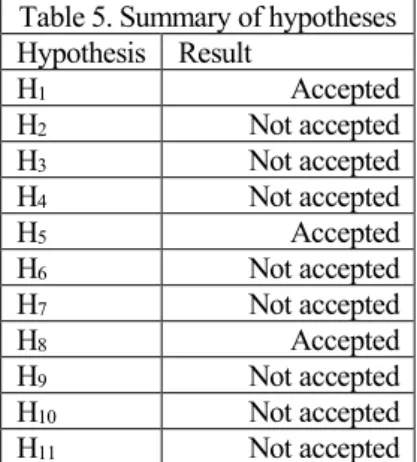
According to the results, among the facilitators of the intention of use of mobile banking apps, only the performance expectation has a significant result, so H1 is accepted but not the effort expectation, facilitating conditions or social influence, so H2, H3 and H4 are not accepted.
This work is therefore in line with those which present an effect of the performance expectation on the intention of use of mobile banking (Bankole et al., 2017; Khan et al., 2017; Lin & Shiquan, 2018; Silva et al., 2013). This is in spite of the large number of functionalities that users recognize in mobile banking (Ghazawneh & Henfridsson, 2013; Laukkanen & Lauronen, 2005; Muñoz-Leiva et al., 2017). On the other hand, the effort expectation is not significant. In this case, it appears that the users consider the mobile banking service to be sufficiently convenient, easy and intuitive (Muñoz-Leiva et al., 2017; Prodanova et al., 2017). This situation is reproduced for the facilitating conditions, as they are penalized by mobile banking services being sufficiently convenient. Finally, the lack of impact of social influence had already been proposed (Sarfaraz, 2017).
If we analyze the antecedents of inertia, this is determined significantly by satisfaction, H8 being accepted, and by sunk costs, not accepting H6 and H7. Hence, it is again verified how satisfied consumers develop an affective commitment which increases their inertia (Kim & Gupta, 2012; Ng & Kwakh, 2010). Nevertheless, habit and switching costs not being linked with inertia goes against previous proposals in line with the SQB (Ng & Kwakh; Polites & Karahanna, 2012).
It seems that consumers experience, as determinants of their habit, the costs that they have incurred in learning the current system more than those linked to adapting to a new situation. That is to say, although the effort expectation is not linked with the intention of use, the sunk costs, close to risk, end up determining the users’ habits.
Causal independence between facilitators and inhibitors in the dual factor models is consistent with previous works which show that different motivations lead to the adoption of and resistance to a technology (Hsie, 2016).
Table 5. Summary of hypotheses Hypothesis Result
H1 Accepted
H2 Not accepted
H3 Not accepted
H4 Not accepted
H5 Accepted
H6 Not accepted
H7 Not accepted
H8 Accepted
H9 Not accepted
H10 Not accepted
H11 Not accepted
6. IMPLICATIONS, CONCLUSIONS AND LIMITATIONS 6.1. Implications for banking
In 2020 mobiles will surpass computers as a means of carrying out activities of balance enquiries and other banking information (Carbó et al., 2017). The applications which enable the use of mobiles in this area play a fundamental role in the growth strategy of traditional banks. In Spain, the suitability of mobile banking as a channel for the distribution of banking services is based on the preferences of citizens with respect to the access channel for banking operations. Thus, in 2016, 15.5% of Internet users used a Tablet, 56.7% a smartphone and 59.8% a computer (Fundación Telefónica, 2017).
The pressure to operate with lower margins increases the need to identify profitable and diverse services, there being highly efficient banks along with others in niches that will end up eliminating those which, having an undefined strategy, are trapped “halfway” (Alt & Puschmann, 2012). In the implementation of these new services, apps play a bridging role as a way of adoption for users. That is, the greater the adoption of the apps, the greater will be the possibility of bank achieving a cross-sell of new services
banks such as Abanca, EVO and Openbank. It is striking that the first bank with an exclusive online license (N26) is at the same level of downloads (threshold of 500,000) as the exclusively online initiative of Caixabank (Imaginabank). The improved valuation of the users in Play Store (Imaginabank) and in Apple Store (N26) corresponds to these two experiences.
The analysis of the evolution of the downloading of banking apps shows how, in Spain, two of the three major banks maintain their position (BCSH appears to distance itself from this strategy with its Digilosofía), while the Fintech climb positions with regards to banks of a smaller size.
If the app is going to be, in line with Dapp (2015, 2017), the bridge for the offer of additional services, many medium-sized and small entities can see their competitive position in danger in the market compared to large banks and the Fintech. That is why the traditional banks will have to work to effectively manage the impact of satisfaction with the channels of service provisions as, though it determines the intention of use of banking apps, its impact on inertia is greater. Likewise, if they show the apps as a “natural evolution” of the traditional channels, this can manage to mitigate the impact that it has on that inertia.
With respect to the facilitators, the ease of use and convenience of Internet banking, together with privacy in the use of the apps, causes only the performance expectation to significantly determine the intention of use of banking apps. In this way, the conditions are established for the application of the diffusion strategies presented by Laukkanen (2016).
6.2. Conclusions
The services of mobile banking apps are linked with the carrying out of financial activities by Internet, only used by 8% of the population in the case of Spain (Arellano & García, 2017). If we add the need for the platform to attain a critical mass (Goswami & Raghavendran, 2009), all this endows with special relevance the study of the factors which determine the adoption of mobile banking apps.
Setting out from a dual model, we establish that the intention of use of mobile banking apps is determined by facilitator and inhibitor elements. Among the former, the performance expectation and among the latter the satisfaction with system in use. Likewise, inertia is determined by satisfaction and by sunk costs.
6.3. Limitations
between users and non-users of these apps, as a way to identify the elements which determine this adoption.
REFERENCIAS BIBLIOGRÁFICAS.
Alalwan, A. A., Dwivedi, Y. K., Rana, N. P., & Algharabat, R. (2018). Examining factors influencing Jordanian customers’ intentions and adoption of internet banking: Extending UTAUT2 with risk. Journal of Retailing and Consumer Services, 40, 125-138. https://doi.org/10.1016/j.jretconser.2017.08.026
Al-Otaibi, S., Aljohani, N.R., Hoque, R., & Alotaibi, F.S. (2018). The Satisfaction of Saudi Customers Toward Mobile Banking in Saudi Arabia and the United Kingdom. Journal of Global Information Management, 26 (1). DOI: 10.4018/JGIM.2018010105
Alt, R. & Puschmann, T. (2012). The rise of customer-oriented banking - electronic market share paving the way for change in the financial industry. Electron Markets, 22, 203–215. https://doi.org/10.1007/s12525-012-0106-2
Arellano, A., & García, J.R. (2017). Determinantes de la adopción de la banca
digital. BBVA Research.
https://www.bbvaresearch.com/publicaciones/determinantes-de-la-adopcion-de-la-banca-digital-en-espana/
Babat, D. (2017). Exploring the antecedents of loyalty in the context of multi-channel banking. International Journal of Bank Marketing, 35(2), 174-186. https://doi.org/10.1108/IJBM-10-2015-0155
Bankole, F. O., Bankole, O. O., & Brown, I. (2017). Influences on Cell Phone Banking Adoption in South Africa: An Updated Perspective. Journal of Internet Banking and Commerce, 22(3), 1-16. https://doi.org/10.1108/IJBM-10-2015-0155
Barberis, J. (2014). The rise of Fintech: Getting Hong Kong to lead the digital financial transition in APAC. Fintech Report. Fintech HK.
Boonsiritomachai, W., & Pitchayadejanant, K. (2017). Determinants affecting mobile banking adoption by generation Y based on the Unified Theory of Acceptance and Use of Technology Model modified by the Technology Acceptance Model concept. Kasetsart Journal of Social Sciences, https://doi.org/10.1016/j.kjss.2017.10.005
Carbó, J., Cuadros, P., & Rodríguez, F. (2017). ¿Cómo toman los españoles sus decisiones financieras digitales? Funcas ODF KPMG.
https://www.funcas.es/_obsdigi_/DownLoadObs.aspx?Id=1002
Chiu, C.-M., & Huang, H.-Y. (2015). Examining the antecedents of user gratification and its effects on individuals’ social network services usage: the moderating role of habit. European Journal of Information Systems, 24(4), 411-430. https://doi.org/10.1057/ejis.2014.9
Cortiñas, M., Chocarro, R., & Villanueva, M.L. (2010). Understanding multi-channel banking customers. Journal of Business Research, 63, 1215–1221. https://doi.org/10.1016/j.jbusres.2009.10.020
Dapp T (2015) Fintech reloaded—traditional banks as digital ecosystems. With proven walled garden strategies into the future. Current Issues. Digital economy and structural change. Deutsche Bank Research, Frankfurt am Main
Dapp, T.F. (2017). Fintech: The Digital Transformation in the Financial Sector, in T. Osburg, C. Lohrmann (eds.), Sustainability in a Digital World, CSR, Sustainability, Ethics & Governance, 189-199.
EY (2017). EY FinTech Adoption Index 2017. The rapid emergence of FinTech.
Falk, T., Schepers, J., Hammerschmidt, M., & Bauer, H. H. (2007). Identifying Cross-Channel Dyssinergies for Multichannel Service Providers. Journal of
Service Research, 10(2), 143-160.
https://doi.org/10.1177/1094670507306683
Fundación Telefónica (2017). Sociedad Digital en España 2017. Ariel. Madrid.
Goswami, D., & Raghavendran, S. (2009). Mobile-banking: can elephants and hippos tango? Journal of Business Strategy, 30(1), 14-20. https://doi.org/10.1108/02756660910926920
Henseler, J., Ringle, C. M., & Sarstedt, M. (2015). A new criterion for assessing discriminant validity in variance-based structural equation modeling. Journal
of the Academy of Marketing Sciences, 43(115).
https://doi.org/10.1007/s11747-014-0403-8
Hoehle, H., Scornavacca, E., & Huff, S. (2012). Three decades of research on consumer adoption and utilization of electronic banking channels: A literature analysis. Decision Support Systems, 54, 122–132. https://doi.org/10.1016/j.dss.2012.04.010
Hsie, P-J. (2016). An empirical investigation of patients` acceptance and resistance toward the health cloud: The dual factor perspective. Computers in Human Behavior, 63, 959-969. https://doi.org/10.1016/j.chb.2016.06.029
Jun, J., & Yeo, E. (2016). Entry of FinTech firms and competition in the retail payments market. Asia-Pacific Journal of Financial Studies, 45(2), 159-184. https://doi.org/10.1111/ajfs.12126
Khan, I.U., Hameed, Z., & Khan, S.U. (2017). Understanding Online Banking Adoption in a Developing Country: UTAUT2 with Cultural Moderators.
Journal of Global Information Management, 25(1), 43-65. DOI:
10.4018/JGIM.2017010103
Khedhaouria, A., Thurik, R., Gurau, C., & van Heck, E. (2016). Customers' continuance intention regarding mobile service providers: A status quo bias perspective. Journal of Global Information Management, 24(4), 1-21. DOI: 10.4018/JGIM.2016100101
Kim, H.-W., & Gupta, S. (2012). Investigating Customer Resistance to Change in Transaction Relationship with an Internet Vendor. Psychology & Marketing, 29(4), 257-269. https://doi.org/10.1002/mar.20519
Kim, H-W., & Kankanhalli, A. (2009). Investigating user resistance to information systems implementation: A status quo bias perspective. MIS Quarterly, 33(3), 567-582. DOI: 10.2307/20650309
Kuisma, T., Laukkanen, T., & Hiltunen, M. (2007). Mapping the reasons for resistance to Internet banking: A means-end approach. International Journal
of Information Management, 27, 75-85.
https://doi.org/10.1016/j.ijinfomgt.2006.08.006
Laukkanen, T. (2007). Internet vs. Mobile banking: comparing customer value perceptions. Business Process Management Journal, 11(6), 788-797. https://doi.org/10.1108/14637150710834550
Laukkanen, T. (2016). Consumer adoption versus rejection decisions in seemingly similar service innovations: the case of the Internet and mobile banking.
Journal of Business Research, 69, 2432-2439.
https://doi.org/10.1016/j.jbusres.2016.01.013
Laukkanen, T., Sinkkonen, S., Kivijärvi, M., & Laukkanen, P. (2007). Innovations resistance among mature consumers. Journal of Consumer Marketing, 24(7), 419-427. https://doi.org/10.1108/07363760710834834
Laukkanen, T., & Lauronen, J. (2005). Consumer value creation in mobile banking services. International Journal of Mobile Communications, 3(4), 325-38. DOI: 10.1504/IJMC.2005.007021
Laukkanen, T., & Passanen, M. (2008). Mobile banking innovations and early adopters: how they differ from other online users? Journal of Financial
Services Marketing, 23(2), 86-94.
https://doi.org/10.1057/palgrave.fsm.4760077
Lee, K., & Joshi, K. (2017). Examining the use of status quo bias perspective in IS research: need for re-conceptualizing and incorporating biases. Information Systems Journal,27(6), 733-752. https://doi.org/10.1111/isj.12118
Lucía-Palacios, L., Pérez-López, R., & Polo-Redondo, Y. (2016). Enemies of cloud services usage: inertia and switching costs. Service Business, 10, 447-467. https://doi.org/10.1007/s11628-015-0277-y
Maier, E. (2016). Supply and demand on crowdlending platforms: connecting small and medium-sized enterprise borrowers and consumer investors. Journal of
Retailing and Consumer Services, 33, 143-153.
Maroofi, F., Kahrarian, F., & Dehghani, M. (2013). An investigation of initial trust in mobile banking. International Journal of Academic Research in Business and Social Sciences, 3(9), 394-403. DOI: 10.6007/IJARBSS/v3-i9/228
Muñoz-Leiva, F., Climent-Climent, S., & Liébana-Cabanillas, F. (2017). Determinants of intention to use the mobile banking apps: An extension of the classic TAM model. Spanish Journal of Marketing –ESIC, 21, 25-38. https://doi.org/10.1016/j.sjme.2016.12.001
Ng, E. H., & Kwakh, K.-Y.(2010). Examining the determinants of Mobile Internet service continuance: A customer relationship development perspective.
International Journal of Mobile Communications, 8(2), 210-229.
Doi:10.1504/IJMC.2010.031448
Oliver, R.L. (1980). A cognitive model of the antecedents and consequences of satisfaction decisions. Journal of Marketing Research, 17, 46-59. https://doi.org/10.1177/002224378001700405
Polites, G.L., & Karahanna, E. (2012). Shackled to the Status Quo: the inhibiting effects of incumbent system habit, switching costs, and inertia on new system acceptance. MIS Quarterly, 36(1), 21-42. DOI: 10.2307/41410404
Prodanova, J., San-Martín, S., & Jiménez, N. (2015). The present and the future of m-banking according to Spanish bank customers. Universia Business Review, 46, 94-117
Ram, S. (1987). A model of innovation resistance. Advances in Consumer Research, 14(1), 208–212.
Ram, S., & Sheth, J. N. (1989). Consumer resistance to innovations: The marketing problem and its solutions. Journal of Consumer Marketing, 6(2), 5–14. https://doi.org/10.1108/EUM0000000002542
Rey-Moreno, M., Felício, J.A., Medina-Molina, C., & Rufín, R. (2018). Facilitator and inhibitor factors: Adopting e-government in a dual model. Journal of Business Research, 88 (July), 542-549.
Schueffel, P. (2016). Taming the Beast: A Scientific Definition of Fintech. Journal
of Innovation Management, 4(4), 32-54.
http://dx.doi.org/10.2139/ssrn.3097312
Shim, Y., & Shin, D-H. (2016). Analyzing China’s Fintech industry from the perspective of actor–network theory. Telecommunications Policy, 40 (2-3), 168-181. https://doi.org/10.1016/j.telpol.2015.11.005
Silva, S. H., Muñoz-Leiva, F., & Liébana-Cabanillas, F. (2013). Analysis and modelling of the determinants of mobile banking acceptance. The International Journal of Management Science and Information Technology, 8(Apr-Jun), 1-27.
Susanto, A., Lee, H.Z., & Ciganek, A.P. (2013). Factors Affecting Internet Banking Success. A comparative Investigation between Indonesia and South Korea.
Journal of Global Information Management, 21(2), 72-95. DOI:
10.4018/jgim.2013040104
Venkatesh, V., Morris, M.G., Davis, G.B., & Davis, F.D. (2003). Use Acceptance of information technology: Toward a unified view. MIS Quarterly, 27(3), 425-478. doi:10.2307/30036540
Venkatesh, V., Thong, J.Y., Chan, F.K., Hu, P.J.H., & Brown, S.A. (2011). Extending the two-stage information systems continuance model: Incorporating UTAUT predictors and the role of context. Information Systems Journal, 21(6), 527-555. https://doi.org/10.1111/j.1365-2575.2011.00373.x