Computer Vision Based General Object Following
for GPS-denied Multirotor Unmanned Vehicles
Jesu´s Pestana, Jose Luis Sanchez-Lopez, Srikanth Saripalli and Pascual Campoy
I. INTRODUCTION
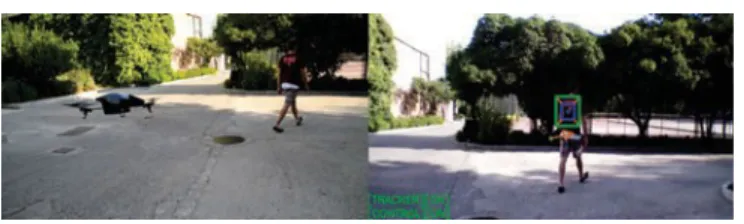
This research showcases visual object tracking for Un- manned Air Vehicles (UAV) to perform GPS-denied object following tasks, on a big variety of objects in outdoors suburban environments. Navigation is more challenging for a flying robot than for ground robots because it requires feedback to stabilize itself. This fact provides a second objective, which is to show that visual servoing or visual based object following is possible and reliable for a great variety of objects. The capability of autonomous tracking and following of arbitrary objects is interesting by itself; because it can be directly applied to visual inspection among other civilian tasks. So far, this work has been a feasibility project to showcase the possibilities of visual servoing to operate in relatively spacious unknown outdoors environ- ments in suburban areas. The proposed architecture addresses these objectives through the knowlegeable choice of robust reliable components, namely: the open-source object tracker OpenTLD [1], [2], and the AR Drone 2.0 (see Fig. 1-left).
The Vertical Take-Off and Landing (VTOL) UAV platform used in the experimental work is the multirotor Parrot AR.Drone 2.0, shown in Figs. 1 & 2. Recent research has demonstrated that the the AR Drone is a realiable platform for VTOL UAV vision based navigation algorithm proto- typing. For instance, the AR Drone has been used on the following research: autonomous navigation of hallways and stairs [3], visual SLAM based navigation [4] and reactive obstacle avoidance in natural environments [5].
Fig. 1. (left) Image of the AR Drone 2.0 during one of the object tracking and following experiments. The drone is equiped with the outdoors hull to improve the system’s wind disturbance rejection.
(right) Modified front image of the drone to show the controller (green) depth reference, (blue) feedback, and (orange) the altitude and lateral movement control error. The drone is controlled from an off-board computer through a WiFi link, and the target object is selected by the experimenter. The utilized tracker features online learning which causes problems if the target’s tracked part includes background. This is the reason why, for person following tasks, a logo on the person’s outfit is selected as the tracker’s target.
Research on Image Based Visual Servoing (IBVS) has shown that the performance of the robot depends on the set of used image features, which should be decoupled [6] or based on computing image moments on a group of points on the target [7]. Recent research has included non-overlaping multi-camera robotic systems [8]. More specific to our work the research [9] discusses “eye-in-hand” systems where the camera is fixed to a rigid body with actuated dynamics.
When compared to prior research, the main advantage of our system is that OpenTLD allows to perform visual servoing with a large number of different targets, which is a big improvement compared to targets marked with blobs of different sizes [10]; or to balloons [11], [12]. However, our architecture is not able to estimate the depth at which the target is located as in [13], or the relative attitude of the target with respect to the drone, as in [14].
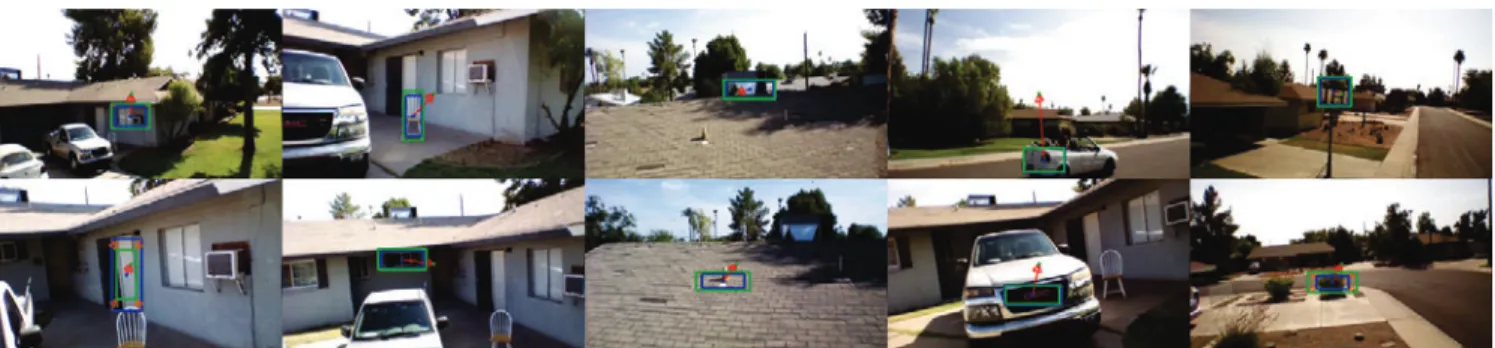
Fig. 6. Selection of on-board camera images showing targets upon which our system was tested: (house elements) a window with an AC machine, a chair, a door and a small window; (roof elements) AC machinery on the roof and a roof part; (car elements) a moving car and a car logo; (street elements) a basketball basket and a plant. The red arrow shows the target centroid tracking error on the image plane.
Fig. 7. Selection of on-board camera images, showing a person following test and how the system handles target occlusion. When target occlusion occurs the AR Drone 2.0 starts hovering until the target is detected again, and then it proceeds with the visual servoing task. The first three images show target occlusion by a tree, and the second three images show occlusion by another person. The learning feature of the tracker is used at the beginning of every experiment and then it is switched off. Otherwise the tracker may not be able to recognize the occlusion event appropriately.
Fig. 8. Selection of on-board camera images from another person following test, which is explained in subsection III-A. The robot tracks and follows a person along a street corridor in a suburban area. The experiment lasted 45 seconds where the AR Drone 2.0 covered a distance of about 120-140 m, thus navigating at an average speed of 2.65-3.10 m/s. The orange arrow shows the decoupled altitude and lateral movement control actions.
which experimental flight videos can be watched online at the ASTRIL lab website: http://robotics.asu.edu/ardrone2 ibvs/. The available videos show: two tests where the target
matches the Aexp and dexp parameters used to calculate
the controller gains (Fig. 5); testing against various objects present on suburban areas; a car and a person following tests along suburban area streets; two tests where people were followed from close distances showing occlusion handling; the videos in the section 3.5 of the website show people following tests where the outdoors hull and the decou-pling heuristics were utilized including the test presented in Sec. III-A.
Various tests were performed to ascertain what kind of objects could be tracked visually. A selection of images acquired during test flights is shown in Fig. 6. The selected targets ranged from a quarter of the tunned size to more than
ten times the tunned target surface,Aexp. The drone was able
to visually track all these targets even when the objects were at a distance, relatively far from the stable visual tracking position.
A second battery of tests was performed to showcase moving object following, mainly including people following and some car following tests. For small moving targets, such as logos on people’s t-shirts, the best performance was
achieved when no background is included in the bounding box. However, for big moving targets, the bounding box can be chosen including some background and the tracker and system will still work successfuly. The reason for this is that big targets tend to evolve slowly in the image plane, which accounts for the tracker’s better performance.
People following was highly succesful. As shown in Fig. 7, our solution can handle occlusion by objects such as trees and also by other people. In this kind of situation, the system will automatically switch to hovering mode until the target is detected again; and then it will proceed with the visual servoing task. On these experiments, the learning feature of the tracker was switched off after a 10-30 seconds period of learning. Occlusion handling was highly degraded if the tracker still had the learning feature enabled.
The flight time, when including target loss, second de-tection, etc; can reach battery depletion provided that the outdoors environment is spacious.
A. Quantitative performance during a person following task
videos of the tests, which in our opinion show a clear improvement.
As discussed in the paper and supported by the exper-imental videos, the system as a whole has demonstrated to be robust to temporary loss of the visual tracking. This fact is provided by the flying mode switching strategy and by the reliability of the AR Drone 2.0 hovering mode. The OpenTLD algorithm, to the extent of our limited group of experiments, has shown to be very reliable for target tracking and detection and it has only rarely detected a wrong object.
IV. FUTUREWORK
There are two main research lines to improve the perfor-mance of the system. The first line is to use another tracking algorithm like [14] which provides the projective transfor-mation in the image plane; instead of OpenTLD which provides the position and size of the object in the image. The second line is to improve the reliability of the architecture by implementing an active target recovery scheme. For instance a target and drone 3D position estimation could be used to feedback a position controller in order to recover the target.
V. CONCLUSIONS
In this paper, a visual based object tracking and following architecture for multirotor vehicles is presented. The exper-imental work was performed using an AR Drone 2.0, and the algorithms where run on an off-board laptop computer via a WiFi link. Our system is able to follow and stabilize itself and it is able to track a large variety of different ob-jects. Additionally, safety is assured even when the wireless connection is suddenly degraded, the tracking is lost or the target is occluded; by using a multirotor platform that can attain on-board autonomous hovering using floor optical flow based odometry. Our system has been able to perform visual servoing with targets of varying size, from a quarter to more than ten times the tunned target size, at varying distances from 1-2 m to 10-15 m of distance from the target, and it has has achieved person following at speeds up to 2.5-3.0 m/s for a period of 45 seconds.
The contributions of this paper are two-fold. First, it has been demonstrated that current tracking algorithms, such as OpenTLD, can reliably work on a fixed camera multirotor vehicle to feedback an Image Based Visual Servoing (IBVS) controller, even during high velocity autonomous navigation. Second, our architecture has been able to follow a large variety of unmarked targets of different sizes and from a wide range of distances. Moreover, the algorithm is validated using a low-cost platform, the Parrot AR Drone 2.0, in outdoor conditions while tracking and following people. The system has succesfuly and repeatedly handled occlusion events and tracked fast moving targets, such as a person running; showing the robustness of our system against wind disturbances and illumination changes.
REFERENCES
[1] Z. Kalal, “Tracking Learning Detection,” Ph.D. dissertation, University of Surrey, April 2011. [Online]. Available: http://www.ee.surrey.ac. uk/CVSSP/Publications/papers/Kalal-PhD Thesis-2011.pdf
[2] Z. Kalal, K. Mikolajczyk, and J. Matas, “Tracking-learning-detection,” IEEE Transactions on Pattern Analysis and Machine Intelligence, vol. 34, no. 7, pp. 1409–1422, 2012.
[3] C. Bills, J. Chen, and A. Saxena, “Autonomous MAV flight in indoor environments using single image perspective cues,” 2011, pp. 5776–5783. [Online]. Available: http://ieeexplore.ieee.org/xpls/ abs all.jsp?arnumber=5980136
[4] J. Engel, J. Sturm, and D. Cremers, “Camera-based navigation of a low-cost quadrocopter,” in Proc. of the International Conference on Intelligent Robot Systems (IROS), Oct. 2012.
[5] S. Ross, N. Melik-Barkhudarov, K. S. Shankar, A. Wendel, D. Dey, J. A. Bagnell, and M. Hebert, “Learning monocular reactive uav control in cluttered natural environments,”CoRR, vol. abs/1211.1690, 2012.
[6] O. Tahri, Y. Mezouar, F. Chaumette, and P. Corke, “Decoupled image-based visual servoing for cameras obeying the unified projection model,”Robotics, IEEE Transactions on, vol. 26, no. 4, pp. 684–697, 2010.
[7] O. Tahri and F. Chaumette, “Point-based and region-based image moments for visual servoing of planar objects,” Robotics, IEEE Transactions on, vol. 21, no. 6, pp. 1116–1127, 2005.
[8] A. Comport, R. Mahony, and F. Spindler, “A visual servoing model for generalised cameras: Case study of non-overlapping cameras,” in Robotics and Automation (ICRA), 2011 IEEE International Conference on, 2011, pp. 5683–5688.
[9] T. Hamel and R. Mahony, “Visual servoing of an under-actuated dynamic rigid-body system: an image-based approach,”Robotics and Automation, IEEE Transactions on, vol. 18, no. 2, pp. 187–198, 2002. [10] O. Bourquardez, R. Mahony, N. Guenard, F. Chaumette, T. Hamel, and L. Eck, “Image-based visual servo control of the translation kinematics of a quadrotor aerial vehicle,”Robotics, IEEE Transactions on, vol. 25, no. 3, pp. 743–749, 2009.
[11] I. Mondragon, P. Campoy, M. Olivares-Mendez, and C. Martinez, “3d object following based on visual information for unmanned aerial vehicles,” in Robotics Symposium, 2011 IEEE IX Latin American and IEEE Colombian Conference on Automatic Control and Industry Applications (LARC), 2011, pp. 1–7.
[12] H. Zhang and J. Ostrowski, “Visual servoing with dynamics: control of an unmanned blimp,” inRobotics and Automation, 1999. Proceedings. 1999 IEEE International Conference on, vol. 1, 1999, pp. 618–623 vol.1.
[13] R. Mahony, A. Brasch, P. Corke, and T. Hamel, “Adaptive depth estimation in image based visual servo control of dynamic systems.” in Decision and Control, 2005 and 2005 European Control Conference. CDC-ECC ’05. 44th IEEE Conference on, 2005, pp. 5372–5378. [14] C. Mart´ınez, I. F. Mondragn, P. Campoy, J. L. S´anchez-L´opez, and
M. A. Olivares-M´endez, “A hierarchical tracking strategy for vision-based applications on-board uavs,”Journal of Intelligent & Robotic Systems, pp. 1–23, 2013.
[15] M. Quigley, B. Gerkey, K. Conley, J. Faust, T. Foote, J. Leibs, E. Berger, R. Wheeler, and A. Ng, “ROS : an open-source Robot Operating System,” inIEEE International Conference on Robotics and Automation (ICRA 2009), no. Figure 1, 2009.
[16] Mani Monajjemi, “ardrone autonomy : A ros driver for ardrone 1.0 & 2.0,” https://github.com/AutonomyLab/ardrone autonomy, 2012, Autonomy Lab, Simon Fraser University.
[17] G. Nebehay, “Robust Object Tracking Based on
Tracking-Learning-Detection,” Master’s thesis, Vienna University of Technology, Austria, 2012. [Online]. Available: http://gnebehay. github.io/OpenTLD/gnebehay thesis msc.pdf
[18] “Opentld object image tracker source repositories: (2011)
Kalal, Z (PhD Thesis); matlab opentld implementation
https://github.com/zk00006/OpenTLD , (2012)
Nebe-hay, G (Msc. Thesis); C++ opentld implementation
https://github.com/gnebehay/OpenTLD , (2013) Chauvin, R; C++ ROS opentld wrapper https://github.com/Ronan0912/ros opentld.” [19] J. Pestana, I. Mellado-Bataller, J. L. Sanchez-Lopez, C. Fu, I. F.
Mon-drag´on, and P. Campoy, “A general purpose configurable controller for indoors and outdoors gps-denied navigation for multirotor unmanned aerial vehicles,”Journal of Intelligent & Robotic Systems, vol. 73, no. 1-4, pp. 387–400, 2014.