High-peak-power pulse generation from a monolithic
master oscillator power amplifier at 1.5
μ
m
P. Adamiec,* B. Bonilla, A. Consoli, J. M. G. Tijero, S. Aguilera, and I. Esquivias
Universidad Politécnica de Madrid, ETSI Telecomunicación-CEMDATIC, Ciudad Universitaria, Madrid 28040, Spain*Corresponding author: [email protected]
Received 6 June 2012; revised 4 September 2012; accepted 6 September 2012; posted 7 September 2012 (Doc. ID 170116); published 11 October 2012
We present an experimental study on the generation of high-peak-power short optical pulses from a fully integrated master-oscillator power-amplifier emitting at 1.5μm. High-peak-power (2.7 W) optical pulses with short duration (100 ps) have been generated by gain switching the master oscillator under optimized driving conditions. The static and dynamic characteristics of the device have been studied as a function of the driving conditions. The ripples appearing in the power-current characteristics under cw conditions have been attributed to mode hopping between the master oscillator resonant mode and the Fabry–Perot modes of the entire device cavity. Although compound cavity effects have been evidenced to affect the static and dynamic performance of the device, we have demonstrated that trains of single-mode short optical pulses at gigahertz frequencies can be conveniently generated in these devices. © 2012 Optical Society of America
OCIS codes: 140.3070, 140.5960, 320.5550.
1. Introduction
The requirement of eye safety for important applica-tions like lidar or free space optical (FSO) communi-cations makes the generation of high-power short optical pulses at 1.5 μm specifically interesting. Moreover, a short rise time of such pulses would re-duce the distance error and the measurement time in applications involving pulsed time-of-flight (TOF) measurements, as range finders, three-dimensional (3D) scanners, or traffic velocity controls [1].
The master oscillator power amplifier (MOPA) architecture is a rather natural choice for high-power pulse generation because a large and fast change in the output power can be obtained with a relatively small change in the master oscillator (MO) current. In this respect, in addition to the well-known advan-tages of semiconductor lasers (i.e., compactness, ef-ficiency, and reduced cost), monolithically integrated MOPAs offer the possibility of a versatile selection of the pulse repetition frequency by using the
gain-switching (GS) technique to drive the MO. Thus far, hybrid semiconductor MOPAs consisting of two separate devices coupled through additional optics have been preferred over monolithically integrated MOPAs because of the possibility of an independent optimization of each section. Recently, a 1060 nm hy-brid MOPA based on a tapered power amplifier (PA) delivering pulses with 50 W peak power and 80 ps pulse width has been reported [2].
Monolithically integrated MOPAs are devices of reduced size and mechanical complexity with respect to their counterparts, hybrid MOPAs. They have demonstrated 10 W at 977 nm in cw together with a nearly diffraction limited beam and narrow emis-sion bandwidth [3]. At an eye-safe wavelength close to 1.5μm, 700 mW cw from a single-mode fiber mod-ule and 50 ns pulses with 10 W peak power have been reported [4].
Although in an integrated MOPA, the laser and the amplifier are ideally independent devices, different studies have shown that they are prone to compound cavity effects because of the residual reflectance of the amplifier front facet [5,6]. These effects have been theoretically analyzed [5,7–9], 1559-128X/12/307160-05$15.00/0
and the results indicate that they produce modal instabilities, such as self-pulsations and coupled cavity mode competition. These effects are more relevant at low injection levels of the MO, producing ripples in the power-current (P-I) characteristics as a consequence of longitudinal mode hopping [5].
The dynamic response of monolithic MOPAs under modulation of the oscillator section has been studied by Dzurkoet al.[10]. They reported 2.2 GHz modula-tion bandwidth in 944 nm flared amplifier MOPAs, corresponding to the bandwidth of the distributed Bragg reflector master oscillator. As far as we know, there are no previous reports on the response of monolithic MOPAs when the MO is driven in GS con-ditions and, a priori, it is not clear whether com-pound cavity effects affect their temporal response. In this paper, we report on the generation and characterization of high-power short optical pulses from a monolithic MOPA emitting around 1.5 μm. The pulses are generated in the MO by GS techni-ques, whereas the power amplifier is driven in cw conditions. The temporal response of the MOPA as reflected in the pulse characteristics is analyzed as a function of the driving conditions. We show that stable and powerful pulses can be generated at the oscillator wavelength by properly choosing the GS parameters.
This paper is organized as follows. In Section2, the device geometry and some relevant details of the ex-perimental setup are briefly described. Section3 ex-amines and discusses the P-I characteristics, the generation of different type of pulses as a function of the GS parameters, and the analysis of the opti-mum conditions for generating short- and high-power pulses. Conclusions are drawn in Section4.
2. Experimental Techniques
The measured device is a commercially available MOPA with emission wavelength close to 1.55 μm (QPC Lasers 4715-0000). It consists of a distributed feedback (DFB) MO and a tapered power amplifier. The total device length is around 2.5 mm, and its output facet width is 250 μm. The device is p-up mounted on a c-mount.
The output power under cw operation of both sec-tions was measured using a thermal detector (Gentec UP19K-H) placed close to the output facet. A slight tilting of the thermal detector was necessary to avoid optical feedback. The optical pulses were obtained by GS the DFB laser while driving the amplifier with cw current. The DFB laser was fed through a bias-tee with a cw bias current and a sinusoidal RF signal (Agilent 8648B), which was amplified up to 23 dBm. A microstrip circuit was used to supply the RF signal to the DFB laser to decrease the electrical parasitics. All the measurements were performed at a constant temperature of 20°C.
In pulsed conditions, a fraction of the optical power was collected by a lensed optical fiber. The pulse shapes were then measured with the optical module of a 20 GHz digital sampling oscilloscope (Tektronix
DSA8000), whereas the optical spectra were simultaneously measured with an optical spectrum analyzer (OSA) ANDO AQ-6315B (50 pm resolution). The absolute power of the optical pulses was cali-brated by comparing the average power measured with the thermal detector in pulsed conditions with the mean value of the pulse profile measured in the oscilloscope. We ensured that the measured temporal profiles were repetitive and independent of the posi-tion of the fiber with respect to the laser facet.
3. Results and Discussion
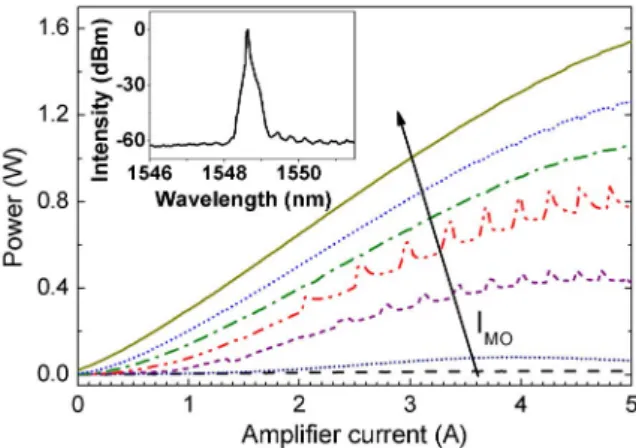
Figure 1 shows the output power Pout versus the power amplifier current (IPA) for different currents of the master oscillator (IMO) in cw operation. At low oscillator injection (IMO≤10mA), the output power is negligible; for higher oscillator injection (IMO30mA and IMO50mA), ripples in the
Pout-IPA characteristic are apparent. Similar (but not identical) ripples were previously reported by Spreeman [5] in 1060 nm MOPAs. The origin of these ripples is analyzed in the following paragraphs. At high oscillator current (IMO≥100mA), the ripples disappear. The Pout-IPA characteristics are affected by thermal rollover, as it was confirmed by the mea-sured redshift of the lasing wavelength when in-creasing the amplifier current. The thermal rollover is more pronounced for low oscillator injec-tion (compare IMO30mA with IMO500mA in Fig. 1). This is due to the change in the balance between the total electrical power supplied to the device and the output optical power: At high IMO, the output power is higher than the output power at low IMO, and therefore the dissipated electrical power is lower, thus reducing the chip temperature and the rollover effects.
The inset in Fig.1shows as an example the optical spectrum measured at a high output power, Pout
1.3 W (IMO500mA and IPA4 A). The distance between secondary modes, ∼0.38nm, is attributed to the resonances of the DFB cavity, which is around 900μm long. The FWHM is∼50pm, corresponding
to the OSA resolution. The main peak shows two shoulders, attributed to secondary modes, indicating a side mode suppression ratio (SMSR) of about 28 dB in these driving conditions. The spectra measured at a constant high oscillator injection for different amplifier currents are similar to that of Fig. 1, showing only a slight redshift caused by self-heating (∼90pm∕A at IMO500mA).
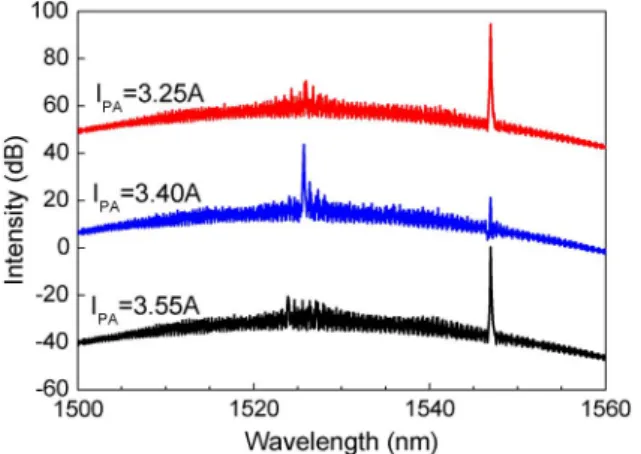
At low oscillator injection, mode hopping was observed. Figure 2 shows the spectra measured at a constant IMO30mA and three closely spaced values of the amplifier current, corresponding to consecutive valley, peak, and valley regions of the ripples in the Pout-IPA characteristics (see Fig. 1). At the peaks of the ripples, the lasing wavelength jumps 20 nm with respect to the laser wavelength at the previous valley, from ∼1547nm down to
∼1527nm, and again it jumps back to its initial va-lue when increasing the current up to the vava-lue cor-responding to the next valley. This is interpreted as the result of mode competition between the DFB re-sonance at ∼1547nm and the Fabry–Perot (FP) modes of the complete MOPA cavity. In detail, when the device is working as a real MOPA, the oscillation of the DFB, at around 1547 nm, is amplified by the tapered gain section, and this is the lasing wave-length. The residual front facet reflectance of the power amplifier, which cannot be totally suppressed, may make the entire MOPA device behave as an FP two-section tapered laser, with a resonator length gi-ven by the total MOPA cavity. In this case, the lasing takes place in an FP mode at the maximum of the gain spectrum at 1527 nm (as shown in Fig. 2). In fact, the wavelength separation between secondary modes at low oscillator current is 0.14 nm, which corresponds to the total cavity length of 2.5 mm. The relatively large wavelength shift is due to the large detuning of the DFB wavelength from the wa-velength of maximum gain. A rich spectral dynamics is also observed at low oscillator injection, including pulsations at 18 GHz as evidenced in the RF spectra
(not shown). This frequency corresponds to the round-trip time of the complete cavity, and it there-fore is attributed to longitudinal mode beating. This type of spectral dynamics has been studied pre-viously in lasers with active optical feedback [11].
A similar behavior, periodic ripples in thePout-IPA characteristics correlated with mode hopping has been observed in 1060 nm DFB MOPAs [5]. Its origin has been clearly explained and theoretically repro-duced [5,9] as arising from compound cavity effects and thermal tuning of the mode wavelength. The wa-velength jump was much smaller than in our experi-ments and corresponded to the spacing between the neighboring modes of the compound cavity. In our case, we attribute the periodicity of the ripples and the corresponding mode hops to the different thermal shifts of the compound and DFB cavity modes when increasing the amplifier current. This produces a periodicity of the coincidence of both frequency combs, which promotes lasing at the compound cav-ity mode closest to the maximum gain. A more de-tailed analysis of the emission spectra is under progress and will be further reported.
The characteristics of the pulses obtained by GS the DFB laser were studied for different driving conditions, that is, RF amplitude and repetition frequency, and oscillator and amplifier currents. Figures 3(a) and 3(b) show the pulses obtained by GS the oscillator section with an RF nominal power of 23 dBm at 1 GHz repetition rate and varying oscillator and amplifier currents, respectively. The increase of the oscillator current at constant ampli-fier current shortens the turn-on time and produces faster relaxation oscillations, thus reducing the dura-tion of the output pulse arising from the first relaxa-tion oscillarelaxa-tion spike [see Fig. 3(a)]. This is the standard behavior in single-section gain-switched semiconductor lasers when the bias current is in-creased [12,13]. The peak power increases up to a maximum level atIMO30mA. At this bias, the sec-ond spike of relaxation oscillations manifests as a pulse tail. At higherIMO, the second peak increases and the power of the first peak decreases, leading
Fig. 2. (Color online) Optical spectra for a master oscillator cur-rent of 30 mA and diffecur-rent amplifier curcur-rentsIPA, corresponding
to a valley of the ripples in Fig.1(top), to a peak (center), and to the consecutive valley (bottom). The curves have been vertically shifted for clarity.
eventually to a direct modulation regime at oscillator currents higher than 100 mA.
The evolution of the pulses as a function of the am-plifier current at constant oscillator current, shown in Fig.2(b), indicates the absence of linear amplifica-tion of the pulses generated by the oscillator, as we will discuss later. For a low current in the amplifier section (1.5 A), the pulses generated have a long duration (220 ps) and low peak intensity (0.3 W). As the amplifier current is increased, shorter pulses with higher peak power are obtained up to 4 A. At higher currents, the pulse broadens and its peak power decreases, which is attributed to thermal effects.
The peak-power and duration of the pulse obtained as a function of the oscillator and amplifier currents with an RF nominal power of 23 dBm at 1 GHz repetition rate are respectively shown in Figs. 4(a) and 4(b). The increase of the bias current in the DFB section leads to pulses of higher intensity and shorter duration, until long-tailed pulses appear, because of the second spike of the relaxation oscil-lations. The most powerful (2.7 W) and shortest pulses (100 ps) are obtained for IPA4 A and
IMO30mA.
The dependence of the pulse amplitude and dura-tion on the amplifier current shows a similar beha-vior for the three values of the oscillator current shown in Fig. 4(b). The pulse duration decreases from more than 200 ps down to around 100 ps, while the peak power has a maximum at aroundIPA4A. If the optical pulse were linearly amplified, the peak power would be expected to increase as a function of the amplifier bias, with no variation of the pulse shape and duration [14]. Contrarily, in our
experiments, the pulse duration decreases rapidly forIPA between 1.5 A and 3 A. Therefore, we inter-pret this behavior as a consequence of a compound cavity effect. Namely, the optical pulse is generated by the complete cavity (DFB plus amplifier) behaving more as a two-section tapered laser than as an ideal MOPA. In fact, a similar dependence of the pulse width on the tapered section current has been re-ported in 1060 nm two-section tapered lasers [15].
In the range of currents from 3 to 4.5 A, the pulse duration is almost constant, as expected in MOPA devices [14]. We attribute the power degradation and the slight pulse broadening for amplifier cur-rents above 4 A to thermal effects, as previously com-mented. The rollover of the pulse power as a function of the amplifier current is more pronounced than in the cw regime [compare Fig.4(b)with Fig.1] because of the lower optical power leaving the device in pulsed conditions. This result suggests that higher peak-power levels could be reached if the amplifier section were driven with a pulsed current with low duty cycle, thus reducing the pulse degradation be-cause of internal heating.
Figure 5 shows the pulse train generated by GS obtained at IPA4A and IMO30mA. The peak power is 2.7 W, and FWHM is about 100 ps. Its rise time, 78 ps, is an interesting value for TOF applica-tions, in which the rise time is the main parameter and the pulse tail is not relevant. The pulses are stable and repetitive in shape and output power.
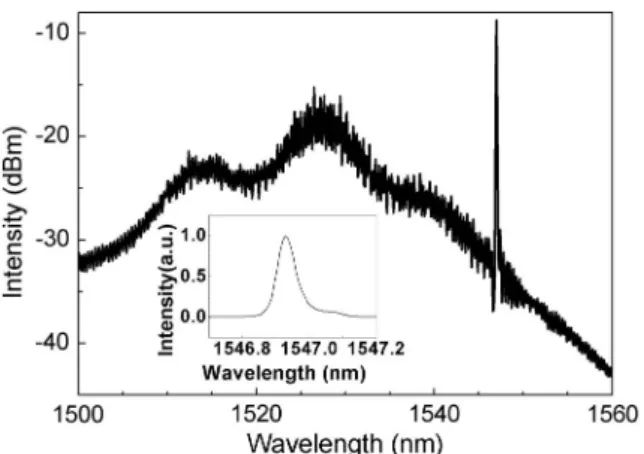
The spectrum of the pulses in Fig. 5 is shown in Fig. 6 where it has been plotted in logarithmic scale in a large wavelength range and in a linear scale around the emission peak (inset). It shows a single longitudinal mode close to the DFB emission wavelength ∼1547nm. This indicates that under these driving conditions the amplifier is amplifying the pulses generated by the gain-switched DFB. This was not always the case, however, and under some driving conditions, especially at low repetition fre-quencies, longitudinal mode hopping was observed, and also the temporal profile of the pulses was not
Fig. 4. (Color online) Peak power and FWHM of the pulses as a function of the (a) oscillator and (b) amplifier currents at a repeti-tion frequency of 1 GHz.
the standard in gain-switched single emitters, indi-cating again compound cavity effects.
The spectral width of the pulse in Fig.6is 80 pm FWHM. The broadening is attributed to the well-known chirp of gain-switched laser diodes [13], indicating a relatively low chirp level. The small shoulder at ∼15dB at the high wavelength side of the pulse (see the inset of Fig. 6) is attributed to a secondary compound cavity mode. The SMSR is
∼10dB, with the main secondary mode at the semi-conductor gain maximum. These results indicate that the pulses generated by GS the DFB oscillator of a tapered MOPA are promising candidates for a broad range of applications requiring high-peak-power short pulses at eye-safe wavelengths.
4. Conclusion
We have demonstrated for the first time, to the best of our knowledge, the generation of high-power pulses at 1.5μm by GS the MO of a fully integrated MOPA device. 2.7 W peak-power pulses with 100 ps duration (FWHM) and 78 ps rise time have been attained. Compound cavity effects have been evi-denced, and their influence on the device perfor-mance on cw and GS operation has been studied. At low oscillator current in cw operation, the device shows competition between FP modes of the com-plete cavity and the amplified DFB resonance. In spite of these compound cavity effects, we have de-monstrated that it is possible to drive the device in GS operation to produce stable single-frequency pulses. The procedure has demonstrated to be an easy, versatile, and low-cost method for obtaining high-power pulses in the picoseconds range at con-trolled repetition rates from a fully integrated com-mercial MOPA. Such pulses may find application in technologies requiring high-power short-rise-time pulses at low cost in the eye-safe spectral range.
The authors gratefully acknowledge the support of the Ministerio de Ciencia e Innovación (Spain)
through project TEC2009-14581 and European pro-gram PEOPLE—Marie Curie Actions IEF, project No. E100945552.
References
1. S. Donati,“Laser telemeters,”inElectro-Optical Instrumenta-tion, Sensing and Measuring with Lasers (Prentice Hall, 2004), Chap. 3, pp. 39–89.
2. S. Schwertfeger, A. Klehr, T. Hoffmann, A. Liero, H. Wenzel, and G. Erbert,“Picosecond pulses with 50 W peak power and reduced ASE background from an all-semiconductor MOPA system,”Appl. Phys. B103, 603–607 (2011).
3. H. Wenzel, K. Paschke, O. Brox, F. Bugge, J. Fricke, A. Ginolas, A. Knauer, P. Ressel, and G. Erbert,“10 W continu-ous-wave monolithically integrated master-oscillator power-amplifier,”Electron. Lett.43, 160–161 (2007).
4. M. L. Osowski, Y. Gewirtz, R. M. Lammert, S. W. Oh, C. Panja, V. C. Elrade, L. Vaissié, F. D. Patel, and J. E. Ungar, “High-power semiconductor lasers at eye-safe wavelengths,” Proc. SPIE7325, 73250V (2009).
5. M. Spreemann, M. Lichtner, M. Radziunas, U. Bandelow, and H. Wenzel, “Measurement and simulation of distributed-feedback tapered master-oscillator power-amplifiers,”IEEE J. Quantum Electron.45, 609–616 (2009).
6. M. W. Wright and D. J. Bossert, “Temporal dynamics and facet coating requirements of monolithic MOPA semiconduc-tor lasers,” IEEE Photon. Technol. Lett. 10, 504–506 (1998).
7. A. Egan, C. Z. Ning, J. V. Moloney, R. A. Indik, M. W. Wright, D. J. Bossert, and J. G. McInerney,“Dynamic instabilities in master oscillator power amplifier semiconductor lasers,” IEEE J. Quantum Electron.34, 166–170 (1998).
8. S. O’Brien, D. F. Welch, R. A. Parke, D. Mehuys, K. Dzurko, R. J. Lang, R. Waarts, and D. Scifres,“Operating characteris-tics of a high-power monolithically integrated flared amplifier master-oscillator power-amplifier,” IEEE J. Quantum Electron.29, 2052–2057 (1993).
9. M. Radziunas, V. Z. Tronciu, U. Bandelow, M. Lichtner, M. Spreeman, and H. Wenzel,“Mode transitions in distributed-feedback tapered master-oscillator power amplifier: theory and experiments,”Opt. Quantum Electron. 40, 1103–1109 (2008).
10. K. M. Dzurko, R. Parke, D. F. Welch, and R. J. Lang,“ Modula-tion characteristics of MFA-MOPAs,”inProceedings of IEEE Conference on Lasers and Electro-Optics Society(IEEE, 1993), pp. 536–537.
11. S. Bauer, O. Brox, J. Kreissl, B. Sartorius, M. Radziunas, J. Sieber, H. J. Wünsche, and F. Henneberger, “Nonlinear dynamics of semiconductor lasers with active optical feed-back,”Phys. Rev. E69, 016206 (2004).
12. P. Paulus, R. Langenhorst, and D. Jager, “Generation and optimum control of picosecond optical pulses from gain-switched semiconductor lasers,”IEEE J. Quantum Electron. 24, 1519–1523 (1988).
13. A. Consoli, I. Esquivias, F. J. López Hernandéz, J. Mulet, and S. Balle, “Characterization of gain-switched pulses from 1.55μm VCSEL,”IEEE Photon. Technol. Lett.22, 772–774 (2010).
14. V. Z. Tronciu, S. Schwertfeger, M. Radziunas, A. Klehr, U. Bandelow, and H. Wenzel, “Numerical simulation of the amplification of picosecond laser pulses in tapered semicon-ductor amplifiers and comparison with experimental results,” Opt. Commun.285, 2897–2904 (2012).
15. P. Adamiec, A. Consoli, J. M. G. Tijero, I. Esquivias, S. Schwertfeger, A. Klehr, H. Wenzel, and G. Erbert,“Short pulse generation byQ-switching two section tapered lasers,”Proc. SPIE8277, 82771N (2012).