Article
Simultaneous Recognition and Relative
Pose Estimation of 3D Objects Using 4D
Orthonormal Moments
Sergio DominguezID
Centre for Automation and Robotics UPM-CSIC, Universidad Politécnica de Madrid, Jose Gutierrez Abascal, 2, 28006 Madrid, Spain; [email protected]; Tel.: +34-91-336-3061
Received: 30 June 2017; Accepted: 12 September 2017; Published: 15 September 2017
Abstract:Both three-dimensional (3D) object recognition and pose estimation are open topics in the research community. These tasks are required for a wide range of applications, sometimes separately, sometimes concurrently. Many different algorithms have been presented in the literature to solve these problems separately, and some to solve them jointly. In this paper, an algorithm to solve them simultaneously is introduced. It is based on the definition of a four-dimensional (4D) tensor that gathers and organizes the projections of a 3D object from different points of view. This 4D tensor is then represented by a set of 4D orthonormal moments. Once these moments are arranged in a matrix that can be computed off-line, recognition and pose estimation is reduced to the solution of a linear least squares problem, involving that matrix and the 2D moments of the observed projection of an unknown object. The abilities of this method for 3D object recognition and pose estimation is analytically proved, demonstrating that it does not rely on experimental work to apply a generic technique to these problems. An additional strength of the algorithm is that the required projection is textureless and defined at a very low resolution. This method is computationally simple and shows very good performance in both tasks, allowing its use in applications where real-time constraints have to be fulfilled. Three different kinds of experiments have been conducted in order to perform a thorough validation of the proposed approach: recognition and pose estimation under z axis (yaw) rotations, the same estimation but with the addition of y axis rotations (pitch), and estimation of the pose of objects in real images downloaded from the Internet. In all these cases, results are encouraging, at a similar level to those of state-of-the art algorithms.
Keywords:3D object recognition; relative pose estimation; orthonormal moments
1. Introduction
Three-dimensional (3D) object recognition and pose estimation are two open problems in the scientific community. There are many algorithms to solve them separately and some to solve them concurrently. In fact, both problems are deeply related, since a 3D object can be observed from different points of view, showing different shapes in each case. Knowing the point of view is equivalent to knowing the relative pose estimation between the object and the observer; once the point of view is known, recognizing the object is much simpler as the observer can explore the set of known objects only under this same point of view. Conversely, knowing the object simplifies pose estimation as well, since the problem is reduced to the exploration of different points of view for this given object.
The complexity of solving both problems increases dramatically when moving from an independent to a concurrent resolution. Therefore, this kind of algorithm is of great value in many applications where object recognition and pose estimation are critical, as is the case of, for instance, object manipulation using a robotic arm.
There have been many proposals to solve each problem separately, since, as stated before, they are critical to many applications. Due to the importance of both topics, reviews are published from time to time regarding them, so there are many sources of information for learning about the state of the art in these two areas.
Recent reviews of available techniques dealing with object recognition can be found in [1] or [2]. A more comprehensive review can be found in [3], or, for a more theoretical point of view, in [4]. Finally, in [5] there is an extensive review of approaches and algorithms.
With respect to pose estimation, the case is much the same, as reviews can be easily found. For instance, in [6] the reader can find an up-to-date review of the most important pose estimation techniques, while in many other sources the reader can find surveys on deeply related techniques as is the case of SLAM [7]. In terms of concurrent solutions of both problems, there have been some remarkable contributions. In [8] the authors introduce an algorithm which uses tensors to generate systems of linear equations that are solved to estimate the affine transformation leading to an object view. In [9], an algorithm using appearance representation is introduced; for a given 3D object, it is coded by extracting brightness information of different views corresponding to different poses. Afterwards, authors perform a dimensionality reduction by applying a PCA to the database. An algorithm for object recognition and pose estimation based on keypoints (SIFT) that builds object models based on pairing keypoints in different views, camera calibration and structure from motion is introduced in [10]. A very similar approach is presented in [11], but in this case no camera calibration is provided. In [12], authors introduce the Viewpoint Feature Histogram, a descriptor based on point clouds that simultaneously encodes geometry and pose, which requires depth information collected with a stereo vision system in order to work. In [13] authors present a probabilistic framework for object recognition, combined with a pose estimation by means of Hu moments applied to the segmented image of tip-shaped objects. In [14] authors combine features describing depth, texture and shape for object recognition, and solve the pose estimation problem by successive steps, using 3D features to find a coarse solution and ICP for fine estimation. In [15], the authors combine 3D CAD descriptions and two-dimensional (2D) texture information to generate a model suitable for the recognition and pose estimation stage, using an approach based on generating multiple virtual snapshots from many different points of view. The authors of [16] introduce an approach based on point cloud alignment, using an RGB-D camera to get a point cloud that is matched against point clouds describing the known 3D objects stored in a database; pose estimation is computed from the alignment process. In [17], authors present an algorithm to estimate the pose of a reduced set of known colored objects; for that purpose, once the colored object is detected in the image and segmented, it is identified by its color and then its 3D model is used to perform a point-of-view sampling process. Finally, in [18], the authors present an algorithm based on template matching and candidate clustering for object recognition and point cloud processing techniques for pose estimation.
and pose estimation are achieved by means of a matrix product, whose results are straightforwardly interpretable. All these features make it a good candidate for real-time implementations.
The remainder of this paper is organized as follows: related work is reviewed in Section2. In Section3the proposed algorithm is thoroughly explained, first for a simplified case that allows an easier introduction to the underlying concepts where pose estimation is limited to a rotation angle, and after that for the complete case. Section4describes how the problem of angular description and balancing has been solved in the proposed approach. In Section5experimental results are presented and discussed. Finally, conclusions extracted out of this work are presented in Section6.
2. Related Work
Moments have been used for object recognition and pose estimation, and sometimes for performing both tasks at the same time. Since object recognition is probably the most classical application of moments, the reader is advised to read a comprehensive review on the topic in [4]. Their application for pose estimation is not that extensive, and therefore it is worth mentioning the most significant efforts in this direction. In [19], authors introduce an algorithm to estimate the pose of a satellite by means of computing Zernike moments and comparison with different views of the spacecraft described in the same way. In [20], authors present two alternative methods to estimate the full pose of planar objects, combining the definition of the interaction matrix, central moments, and invariant definition. In [21] authors calculate the moments of a 3D object with known geometry as it moves freely in 3D space, and compile them in a table whose entries are the rotation angles; observed moments are matched against tabulated descriptions. In [22], the author propose invariants to translation, rotation and scaling departing from shifted geometric moments. In [23] the authors propose a method for IBVS based on a set of moments and the definition of an interaction matrix for that set of moments. Finally, there have been some other methods for object recognition based on the characterization of a 3D object by means of the definition of its projections from multiple points of view. Examples of these works are presented by, for example, Ansary et al. [24], who present the selection of multiple views as an adaptive clustering problem; Daras and Axenopoulos [25], who introduce a 3D shape retrieval framework based on the description of an object by means of multiple views; Rusu et al. [12], who introduce an algorithm to recognize an object and estimate its pose using point clouds captured from different points of view; Rammath et al. [26], who describe and recognize cars based on matching 2D and 3D curves that can be observed in different views; Sarkar et al. [15], who present an object recognition algorithm based on feature extraction from a set of computer generated object views; and finally, Liu et al. [27], who introduce a combination of 3D and 2D features obtained from different captures of an object using RGB-D cameras.
3. Simultaneous Recognition and Pose Estimation
In this section the derivation of the algorithm for simultaneous 3D object recognition and relative pose estimation is presented. In the first subsection, and for the purpose of explaining the basic ideas on a simpler case, a reduced version is presented, defining a 3D problem in terms of cylindrical coordinates. Afterwards, in the second subsection, the algorithm is generalized to the 4D case, allowing for the determination of an arbitrary relative pose of the observer with respect to the unknown 3D object.
3.1. The Problem of a Radial Section in Cylindrical Coordinates
3.1.1. Derivation of the Algorithm
Let the analytic model of a 3D object be expressed asI(ρ,θ,z):Ω7→ {0, 1}, whereΩstands for the unit cylinder defined as:
withρbeing its radius,θthe angle around its axis, and z its height.
Normalization is required if the original 3D object does not fit and therefore cannot be defined intoΩ.
Let the scalar product between a pair of functions in this region be defined as:
<x(ρ,θ,z),y(ρ,θ,z)>= Z
Ωx(ρ,θ,z)y(ρ,θ,z)dv (2) wherexstands for the complex conjugate ofxanddvfor the differential of volume withinΩ.
Given this expression for the scalar product, the pair of functionsBnmp(ρ,θ,z)andBqrs(ρ,θ,z)are said to be orthonormal inΩif and only if:
<Bnmp(ρ,θ,z),Bqrs(ρ,θ,z)>=δmqδnrδps (3)
where
δab= (
1 a=b
0 a6=b (4)
In the same region, let the generic basis function for the moment definition be expressed as:
Bnmp=Πm(ρ)Zn(z)eipθ (5)
providing that given two different functions of the basis Bnmp(ρ,θ,z) and Bqrs(ρ,θ,z) they are orthonormal, i.e., they behave as expressed in Equation (4).
Given these definitions, the 3D moment of order{m,n,p}of the 3D solidI(ρ,θ,z)with respect to the base functionBnmp(ρ,θ,z)is defined as:
Vnmp = Λ1 Z
ΩI(ρ,θ,z)Bnmp(ρ,θ,z)dv= 1 Λ
Z
ΩI(ρ,θ,z)Πm(ρ)Zn(z)e
−ipθdv (6)
whereΛis a normalizing factor that ensures orthonormality.
As the basis functions are orthonormal, the original function defining the 3D solid can be reconstructed from the set of moments by applying the following expression:
I(ρ,θ,z)≈
∑
∀mnp
VmnpBmnp(ρ,θ,z) =
∑
∀mnp
VmnpΠm(ρ)Zn(z)eipθ (7)
Given the definition of the 3D function characterizing the volume and the approximation stated in Equation (7), a radial section of the volume can be expressed and approximated in the following way:
I(ρ,θ,z)|θ=θ0 = I(ρ,θ0,z)≈
∑
∀mnp
VmnpBmnp(ρ,θ0,z) =
∑
∀mnp
VmnpΠm(ρ)Zn(z)eipθ0 (8)
This section is a 2D object defined in the regionΨ={(ρ,z)/ρ∈[0, 1],z∈[0, 1]}, so on reducing the 3D basis functions to the 2D case by removing the term depending onθin Equation (5), the 2D momentSklof this radial section can be defined as:
Skl=
Z
ΨI(ρ,θ0,z)Πk(ρ)Zl(z)dS (9) wheredSstands for the differential of surface inΨ.
Now, replacing in Equation (9) the radial section by its approximation and particularizing for θ=θ0in the Equation (8), it can be stated that:
Skl≈
R
Ψ
h
∑∀mnpVmnpΠm(ρ)Zn(z)eipθ0
i
and, taking into account the orthonormality of the basis functions, most of the pairs under the integral sign in Equation (10) cancel out, resulting in:
Skl≈
∑
∀mnp
Vmnpeipθ0δ
mkδnl =
∑
pVkl peipθ0 (11)
Extending this approximation to a set of moments, withm ∈ {0 . . .M}, n ∈ {0 . . .N}and p ∈ {0 . . .P}, and then reordering 2D moments in a vector, it results in a column vector S with dimensions(M+1)(N+1)×1:
S(M+1)(N+1)×1=
h
S00 . . . S0N S10 . . . SM0 . . . SMN iT
(12)
and 3D moments in the following matrix:
V(M+1)(N+1)×(P+1)=
V000 V001 . . . V00P ..
. ... . .. ... V0N0 V0N1 . . . V0NP
V100 V101 . . . V10P ..
. ... . .. ... VM00 VM01 . . . VM0P
..
. ... . .. ... VMN0 VMN1 . . . VMNP
(13)
and finally the angular terms particularized forθ=θ0:
Γ(P+1)×1=
ei0θ0 ei1θ0 .. . eiPθ0
(14)
In this way, computing an approximate set of 2D moments of a radial section of a 3D object that has been approximated by the given set of orthonormal 3D moments can be expressed in matrix form as:
S≈V·Γ (15)
Posing the inverse problem, i.e., finding the angle of a radial section of the volume knowing the 3D set of moments and the computed 2D moments of the section (assuming(M+1)(N+1)≥(P+1)) it is reduced to solve a least squares problem expressed by:
Γ≈[VT·V]−1VT·S (16)
Recalling the structure of vectorΓfrom Equation (14), the solution to Equation (16) is such that:
logΓ=
log(ei0θ0) log(ei1θ0)
.. . log(eiPθ0)
=iθ0
0 1 .. . P
=iθ0[i−1]P+1 (17)
3.1.2. Application to Object Recognition and Pose Estimation
Let us consider a problem where a 3D object among a set ofKelements must be recognized departing from a 2D moment representation of one of its radial sections, that will be calledSobs. In this scenario, not only is the 3D element unknown, but also the angleθ0that defines the observed section. LetVkbe the 3D moment representation matrix of thek-th element of the 3D object set, that has been computed off line. Then, applying Equation (16) to everyVkusingSobsa correspondingΓkresults in:
Γk= [VTk ·Vk]−1VTk ·Sobs (18)
A new vector is derived from eachΓkin the following way:
∆k= logΓk logγ2k
(19)
whereγ2kstands for the second element of the vectorΓk. Then, the following distance for every∆kis computed:
D(k) =d ∆k,[i−1]P+1
(20)
whered(u,v)stands for the Euclidean distance between vectorsuandv.
Therefore, the best candidate for the 3D object that has generated the observed section represented bySobsisk∗if:
D(k∗) =min
∀k D(k) (21)
and it will be accepted as the actual solution ifD(k∗)<τ, beingτa threshold that is used to prevent false positives.
Once the 3D object has been identified, the angleθ0that generates the observed section can be computed as well; recalling the structure ofΓfrom Equation (14), it is easy to see that:
θ0=|logγk ∗
2 | (22)
3.2. The Problem of an Arbitrary Projection
3.2.1. Derivation of the Generalized Algorithm
The orthogonal projection of a 3D object in a given direction results in a 2D projection whose definition depends on a set of four coordinates: two angles to define the projection vector and two surface coordinates for the projected 2D object. Therefore, the projection function, which depends on those four parameters, can be defined as P(φ,λ,x,z) : Ω 7→ {0, 1}, where Ω stands for the hypervolume defined by:
Ω={(φ,λ,x,z)/φ∈[−π/2,π/2],λ∈[0, 2π],x ∈[−1, 1],z∈[−1, 1]} (23)
where the pair(φ,λ)stands for the latitude and longitude that defines the projection direction, and the pair(x,z)stands for the Cartesian coordinates where the 2D object that results from the projection by the given direction is defined. It is worth noting that both Cartesian coordinates range from−1 to 1 due to the orthonormality condition in the plane, so the 2D projection has to be normalized to fit into this region.
The functionχ : R4 7→ R2 can be represented by the method of moments as well as other
linear, flat or volumetric functions, and the moment basis for this representation can be chosen to be orthonormal, as in the previous case. Let a 4D orthonormal basis in the given coordinates be:
Bmnpq(φ,λ,x,z) =Pm(x)Pq(z)einφeipλ (24)
where Pm(x) stands for the m-th element of a family or orthonormal functions in x ∈ [−1, 1], such as, for instance, in Legendre or Tschebychev polynomials; the Fourier basis has been chosen for the transformation of the angular magnitudes(φ,λ).
Once again, to generate the moment of ordermnpqof the functionχ(.), its transformation on the 4D elements of the corresponding moment basis is done by means of the scalar product:
Hmnpq=hProj(φ,λ,x,z),Bmnpq(φ,λ,x,z)i= 1 Φ
Z
Ωχ(φ,λ,x,z)Bmnpq(φ,λ,x,z)dhV (25) whereΦstands for a normalization factor,Hmnpqstands for the 4D moment, anddhVstands for the differential of the hypervolume inΩ.
As in Equation (7), since functions in the base are orthonormal, it is possible to build a reconstruction of the 4D function using the computed moments:
χ(φ,λ,x,z)≈
∑
∀{mnpq}
[HB]mnpq(φ,λ,x,z) (26)
where[HB]mnpq(φ,λ,x,z) =HmnpqBmnpq(φ,λ,x,z).
In this way, a projection of the 3D object through a given direction(φ0,λ0)can be approximated by:
χ(φ,λ,x,z)|{φ
0,λ0} ≈
∑
∀{mnpq}
[HB]mnpq(φ0,λ0,x,z) =
∑
∀{mnpq}
HmnpqPm(x)Pq(z)einφ0eipλ0 (27)
The 2D moments of this projection will be given, as in Equation (9), by:
Skl= Z
Ψχ(φ0,λ0,x,z)Pk(x)Pl(z)dS (28) beingΨ={(x,z)/x∈[−1, 1],z∈[−1, 1]}.
Replacing the analytic expression of the projection function by its 4D moment-based approximation:
Skl≈ Z
Ψ
∑
∀{mnpq}
[HB]φ0λ0mnpq
Pk(x)Pl(z)dS=
∑
∀{mnpq}
Z
Ψ[HB]
φ0λ0
mnpqPk(x)Pl(z)dS (29)
where[HB]φ0λ0mnpq=HmnpqBmnpq(φ0,λ0,x,z). Then, following the same reasoning as in Equation (11):
Skl ≈
∑
∀{mnpq}
Hmnpqeinφ0eipλ0δ
mkδlq =
∑
∀{np}
Hmnpqeinφ0eipλ0 (30)
As in the previous section, extending this approximation to the whole set of 2D moments, withm∈[0 . . .M],n∈[0 . . .N],p∈[0 . . .P]andq∈[0 . . .Q]and reordering 2D moments in a vector and 4D moments in a matrix, the following matrices can be defined:
H(M+1)(Q+1)×1=
h
where
Hmq1×(N+1)(P+1)=h Hmq00 Hmq01 · · · Hmq0P Hmq10 · · · Hmq1P · · · HmqNP i
(32)
so H is a (M+1)(Q+1)×(N+1)(P+1) matrix containing the complete set of 4D moments. In addition:
Γ(N+1)(P+1)×1=
h
ei0φ0ei0λ0 ei0φ0ei1λ0 · · · ei0φ0eiPλ0 ei1φ0ei0λ0 · · · ei1φ0eiPλ0 · · · eiNφ0eiPλ0 iT
(33)
Then, the vector containing the set of 2D momentsS, defined in Equation (12), of a projection of a 3D object through the direction defined by the pair(φ0,λ0)can be expressed as:
S≈H·Γ (34)
Therefore, given a projection of a known 3D object, whose 2D moments are inS, the matrix containing the angular terms particularized for the pair(φ0,λ0)that defines the projection can be computed as:
Γ≈hHT·Hi−1HT·S (35)
whenever(M+1)(Q+1)≥(N+1)(P+1).
It is straightforward that the solution to Equation (35) be transformed as:
logΓ=
log ei0φ0ei0λ0 log ei0φ0ei1λ0
.. . log ei0φ0eiPλ0 log ei1φ0ei0λ0
.. . log ei1φ0eiPλ0
.. . log eiNφ0eiPλ0
=
0(iφ0) +0(iλ0) 0(iφ0) +1(iλ0)
.. . 0(iφ0) +P(iλ0) 1(iφ0) +0(iλ0)
.. . 1(iφ0) +P(iλ0)
.. .
N(iφ0) +P(iλ0)
(36)
Therefore, givenΓP, that is built taking the firstPelements ofΓ:
logΓP=
0(iφ0) +0(iλ0) 0(iφ0) +1(iλ0)
.. . 0(iφ0) +P(iλ0)
=iλ0
0 1 .. . P (37)
andΓN, that is built taking the elements in positions 1+n(P+1),n∈ {0,N}, ofΓis:
logΓN=
0(iφ0) +0(iλ0) 1(iφ0) +0(iλ0)
.. . N(iφ0) +0(iλ0)
=iφ0
0 1 .. . N (38)
3.2.2. Application to Object Recognition and Pose Estimation
extracted from the observed projection, andHk the 4D moment matrix corresponding to thek-th element of the 3D object set. Applying the expression in Equation (35) to everyHk, a correspondingΓk will be found:
Γk =h HkTHk
i−1
HTkSobs (39)
Then, for eachΓk, the following pair of vectors can be built:
∆k P =
logΓkP logγk2
, ∆kN= logΓ k N logγkP+2
(40)
whereγ2kandγkP+2correspond to the second and(P+2)-th elements of vectorΓk.
In order to find out which is the 3D object that is observed in the given 2D projection, the following expression is computed for each candidatek:
D(k) =u d(∆Nk,[i−1]N+1) +v d(∆kP,[i−1]P+1) (41)
where againd(u,v)stands for the Euclidean distance among vectorsuandv,[i−1]Xis a vector with Xelements whosei-th element takes the valuei−1, and(u,v)are a pair of scalars used to give weights to the estimation for each angle in the pair(φ,λ).
Then, the best candidate for being the observed 3D object isk∗if:
D(k∗) =min
∀k D(k) (42)
and it will be accepted as the solution ifD(k∗)<τ, whereτis a threshold used to reject false positives. Once the 3D object has been identified, recovering the pair(φ0,λ0)that defines the projection direction is straightforward; recalling the structure ofΓfrom Equation (33) it is easy to see that:
φ0=|logγk ∗
P+2|, λ0=|logγk ∗
2 | (43)
It is worth highlighting that although obtaining 4D moments is a computationally demanding step, as is the computation of the pseudoinverse for eachHk, both are computed off-line; therefore, the object identification and the latitude and longitude determination are achieved by the product of a precomputed matrix with a vector, and computing two Euclidean distances, making this algorithm well suited for on-line applications. The more complex on-line computation is due to calculating the observed moments vector that can be obtained in real time as has been demonstrated in the literature, for instance in [28].
4. Section vs. Projection: Projected Pseudo-Volume
In Section3.1it has been proven that, departing from the orthogonal moment representation of an unknown section of a 3D object in a given set, it is possible not only to recognize what the original object is, but also the angle determining that section. Nevertheless, in any application a common situation is not having the image of a section but of a projection of the whole object that will be assumed to be parallel to a given direction, as is the case of the Radon transform. Yet, in Section3.2it is supposed that the projection through a given direction is already defined.
Therefore, in order to make the algorithm work with projections instead of with sections, a transformation of the 3D object must be carried out. This transformation will yield another 3D object gathering all the considered projections through directions at differentθangles for the case of cylindrical coordinates, and will yield a 4D tensor comprising projections from every pair(φ0,λ0)in the case of considering any projection direction.
that when this object defined in a Cartesian discrete grid has to be defined through polar coordinates used in the derivation of the algorithm for both cases, the resulting representation is unbalanced in the angular coordinates. To illustrate this point a simple test has been conducted: a simple grid of 60×60 pixels has been defined, and the angles of every pixel with a radius under or equal to 60 have been collected in a histogram, where each bin has a width ofπ/40 rad. The result of this simple test can be seen in Figure1.
0 π
5
2π
5
3π
5
4π
5 π
6π
5
7π
5
8π
5
9π
5 0
10 20 30 40 50
Angle value
Number
of
voxels
Figure 1.Histogram of angle values in a 60×60 grid.
As can be easily observed, the numbers of pixels assigned to each bin are clearly unbalanced. This causes different representation strengths for different angles, affecting the moment transformation as it is based on angular coordinates.
In the recognition stage, the unknown projection image will be represented within a normalized flat grid, with a fixed number of pixels, but, as can be seen from Figure1, each section for every known object is represented with a varying number of pixels depending on the angle. Obviously, this mismatch will cause the algorithm to perform poorly.
Therefore, as the problem stated herein is defined in angular coordinates, some strategy must be provided in order to balance the pixels contributing to each angle bin, as there is no strength mismatch between unknown projection and object representation.
The solution adopted for this case consists of building a transformed pseudo-volume that packs all these projections into a Cartesian grid, though some axes describe the angles at which the object has been rotated in order to generate a given projection. The construction of this pseudo-volume for cylindrical coordinates is as follows. Let the rotation of the objectI(ρ,θ,z)by an angleθiaround thez axis be defined as:
Iθi(ρ,θ
0,z) =I(
ρ,θ+θi,z):Ω7→ {0, 1} (44)
so the rotated object is defined in the same domain as the original object,Ω, defined in Equation (1), andθi∈[0,θmax],θmax<π. The upper limit forθiwill be explained later on.
In order to make the next steps clearer, the rotated object is now converted to Cartesian coordinates:
Iθi(ρ,θ0,z)→Iθi(x,y,z),
x=ρcosθ0 y=ρsinθ0 z=z
(45)
whereIθi(x,y,z):Ω
∗7→ {0, 1}, as
as a result of the change in the coordinate system.
Now, after the object has been rotated, its projection through theyaxis is generated:
PIθi(x,z) =
Z 1
−1Iθi
(x,y,z)dy, ∀{x∈[−1, 1],z∈[0, 1]} (47)
This projected image, PIθi(x,z), is then binarized to bring it back to its original range, i.e.,{0, 1}:
ˆ
PIθi(x,z) =
(
0 PIθi(x,z) =0
1 PIθi(x,z)6=0 (48)
Extending this process to everyθi ∈[0,θmax], and gathering all the resulting binarized projections, a new 3D object, called the projected pseudo-volume, PV(x,z,θ): ˜Ω7→ {0, 1}, is generated:
PV(x,z,θ) =PIˆθ(x,z) (49)
being:
˜
Ω={(x,z,θ)/x∈[−1, 1],z∈[0, 1],θ∈[0,θmax]} (50)
Once the new 3D object, PV(x,z,θ), is defined, the upper limit for rotation angles,θmax, can be explained; it is set in order to avoid that any projection, or its reflected image, be represented more than once, as this fact would lead to multiple solutions in a pose estimation problem. Therefore, this upper limit will have a maximum value ofθmax<π, as both sides of any object have the same (reflected) projections. In case of symmetric objects this upper limit will have to be reduced in order to avoid a multiplicity of projections within PV(x,z,θ). The limit case corresponds to objects having central symmetry around itszaxis, for whichθpose estimation cannot be computed as the projections from every rotation angle are the same.
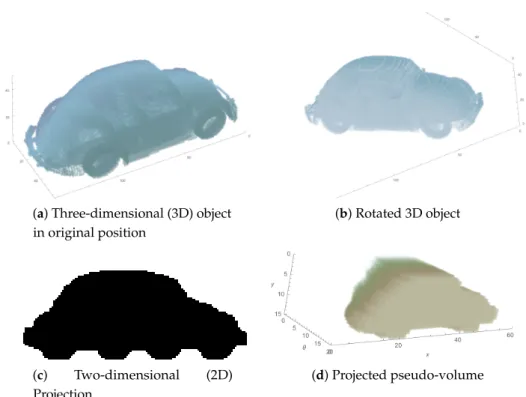
The process of generating this transformed object is resumed in Figure2. It starts with the 3D object with no rotation (a), i.e., with an initial alignment withxandyaxes, and then it is rotatedθi around thezaxis (b). The resulting image has shifted its alignment with the original axes, so once it is projected through theyaxis, the result will be different for each rotation (c). This projection is included in the new object, as a slice with coordinate valueθion theθaxis (d).
In this way, the projected pseudo-volume, that has the same number of pixels assigned to each angle view, collects information about parallel projections in the sense of a Radon transform, instead of simple object sections.
The same idea has been applied to the generation of a 4D object that will be used in the general case as depicted in Section3.2.
Starting from the initial definition of the 3D object, I(ρ,θ,z)in Ω, it is initially converted to Cartesian coordinates to make the next steps clearer, using an expression similar to Equation (45). As a result, the object is now defined inΩ∗, described in Equation (46). Then, the 3D object is rotated an angleφiaround thexaxis, so it is now represented as:
Iφi(x, ˆˆ y, ˆz),
ˆ x ˆ y ˆ z =
1 0 0
0 sinφi cosφi 0 cosφi −sinφi
x y z (51)
After that, the object is rotated an angleλjaround thezaxis, so the object is redefined as:
Iφi,λj(x, ˜˜ y, ˜z),
˜ x ˜ y ˜ z =
cosλj −sinλj 0 sinλj cosλj 0
0 0 1
(a) Three-dimensional (3D) object in original position
(b) Rotated 3D object
(c) Two-dimensional (2D) Projection
(d) Projected pseudo-volume
Figure 2. Generation of the projected pseudo-volume: (a) Original 3D object, I(ρ,θ,z); (b) Object
rotated at the θi angle around the z axis and converted to Cartesian coordinates, Iθi(x,y,z);
(c) Binarized projection through theyaxis, ˆPIθi(x,z); (d) Complete PV(x,z,θ)object, after gathering all
the projections.
From this point on, the algorithm progresses as in the previous case, starting from the projection through theyaxis, as in Equation (47):
PIφi,λj(x,z) =
Z 1
−1Iφi,λj(x, ˜˜ y, ˜z)dy,˜ ∀{x˜∈[−1, 1], ˜z∈[0, 1]} (53) then there is binarization to bring the image back to its original range, as in Equation (48):
ˆ
PIφi,λj(x,z) =
(
0 PIφi,λj(x,z) =0
1 PIφi,λj(x,z)6=0
(54)
and, finally, extending the rotation process to every φi ∈ [φmin,φmax] and λj ∈ [0,λmax] and gathering all the resulting projections in a new 4D object, the so-called projected pseudo-hypervolume PH(x,z,φ,λ): ˜Ω7→ {0, 1}is generated:
PH(x,z,φ,λ) =PIˆφ,λ(x,z) (55)
where,
˜
Ω={(x,z,φ,λ)/x∈[−1, 1],z∈[0, 1],φ∈[φmin,φmax],λj∈[0,λmax]} (56)
5. Experimental Results
5.1. Recognition and Pose Estimation in Cylindrical Coordinates
and therefore is ill-posed for pose estimation. These 70 objects have been transformed from their original CAD format to a voxel-based representation, and are included in a grid of 60×60×15 (width, depth, height) voxels, in such a way that the object’s centroid is placed in the center of the grid, and it is touching some of the grid walls.
Once all these objects have been normalized in this way, a projected pseudo-volume has been defined for all of them, covering 20 equally spaced rotations between 0 andπ/2 radians. The angle limit has not been extended to 2πbecause of the observed four-fold symmetry: symmetric objects produce the same projection for different rotation angles (views), leading the algorithm to the impossibility of choosing the right orientation. In mathematical terms, symmetry leads the presented algorithm to ill-posedness, so the pseudoinverse suffers from numeric instability due to a very bad condition number. In this way, the pseudo-volume generated for each original 3D object is defined in a grid of 60×15×20 (x,z,θ).
For every projected pseudo-volume in the collection, the orthogonal moment representation for each coordinate is by:
• Legendre moments up to the 19th order for the Cartesian coordinatesxandz. The Legendre polynomial of orderninxis defined as:
Pn(x) = 1 2n
n
∑
k=0n k
2
(x+1)n−k(x−1)k (57)
• Fourier base. Note that although this coordinate is defined in a Cartesian grid, it represents an angle in the real world so it can be easily transformed using the Fourier basis that on the other hand allows this algorithm to determine the rotation angle of the observed pose. The Fourier base is up to 19th order forθas well, i.e.,:
Bmnp=Pm(x)Pn(z)eipθ (58)
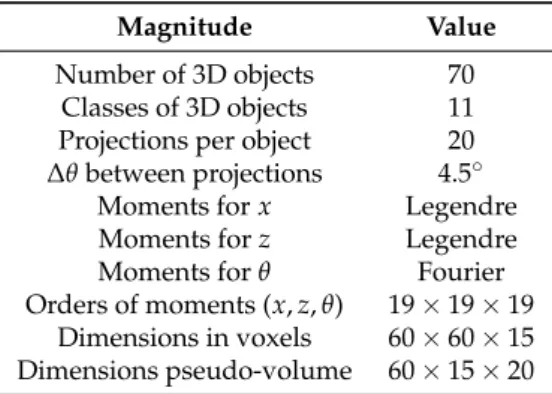
In this way, each pseudo-volume has been represented with 8000 descriptors with a total of 18,000 voxels in the pseudo-volume that represent a 3D object initially defined through 54,000 voxels. All these data have been gathered in Table1.
Table 1.Summary of data representation.
Magnitude Value
Number of 3D objects 70
Classes of 3D objects 11
Projections per object 20
∆θbetween projections 4.5◦
Moments forx Legendre
Moments forz Legendre
Moments forθ Fourier
Orders of moments (x,z,θ) 19×19×19
Dimensions in voxels 60×60×15 Dimensions pseudo-volume 60×15×20
Once the moments for each object have been generated and stored in the database, a set of unknown side views is generated. For this purpose, each of the 70 objects has been rotated 10 times at random angles in the intervalθ∈[0,π/2]and their projections along theyaxis have been computed. Each projection has been represented through its Legendre moments up to the 19th order inxandz.
rotation. Then, a second test has been conducted to evaluate the accuracy, estimating the rotation angle that has been used to generate each projection.
5.1.1. Recognition Tests
Two different rounds of precision tests have been conducted. In the first one, the orders ofxandz moments have been varied from 0 to 19, keeping the order of moments onθfixed to 19. Mathematically, this means that calling back the general expression in Equation (16), matrixVhas been reduced in terms of its number of rows, keeping constant its number of columns, i.e., the least squares problem to be solved has been defined using fewer equations. This fact can be easily seen going back to the definition of matrixVin Equation (13). In this way, for this round the problem has been reformulated in reduced versions through:
Γ(19) = [V(m,n, 19)T·V(m,n, 19)]−1V(m,n, 19)T·S(m,n), m,n∈[0 . . . 19] (59)
whereV(m,n, 19)stands for a matrixVconstructed using moments forxandzup to ordermandn respectively. Also, according to the general expression in Equation (13),S(m,n)stands for a matrix of 2D moments constructed up to ordersmandnas well. Finally,Γ(19)stands for a matrix of Fourier basis elements up to order 19, and is particularized forθ=θ0, whereθ0is the unknown angle used for generating the projection image under analysis.
In a second round of tests the orders of the moments inxandzwere fixed to 19, and the order inθ was varied from 0 up to 19. Mathematically, this means that the least squares problem in Equation (16) has been defined by always using the same number of equations given by the constant number of rows in matrixV, but with an increasing number of unknowns to be estimated, given by the varying number of columns and the corresponding number of elements in vectorΓ(p):
Γ(p) = [V(19, 19,p)T.V(19, 19,p)]−1V(19, 19,p)T.S(19, 19), p∈[0 . . . 19] (60)
Before starting both rounds of tests, 2D moments for each unknown projection image have been computed, obtainingSobs,u, u∈[1 . . . 700]. After that, tests have run in the following way:
• First, the order of moments inx,yandθis set.
• MatrixVkis reconfigured according to those moment orders toV(m,n,p)k.
• Next,Γ(p)k,uis computed, according to Equations (59) or (60).
• VectorS(m,n)k,uis computed for each object in the database:
Sk,u=VkΓk,u (61)
• The |RMS| is computed between the observed and estimated sets of moments:
|RMS|k,u =
v u u
t 1
(m+1)(n+1)
(m+1)(n+1)
∑
i=0(Sk,u(i)−Sobs,u(i))2
(62)
• The objectk∗is obtained, for which the minimum RMS is chosen from the database:
|RMS|k∗,u=min
k,u (|RMS|k,u) (63)
• Theu-th projection image is recognized as having been generated by objectk∗
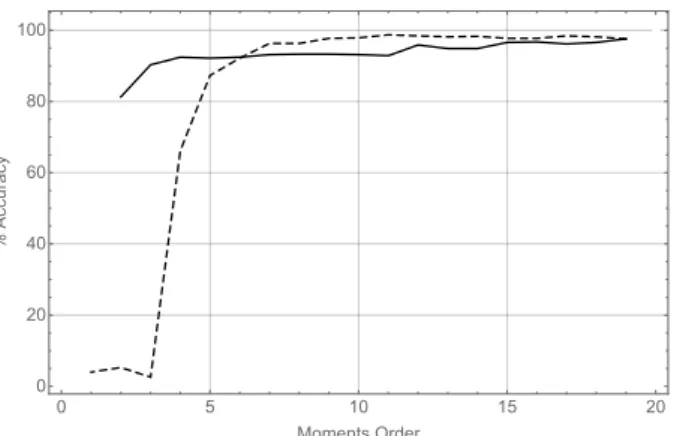
The results of running these two tests are summarized in Figure3.
0 5 10 15 20
0 20 40 60 80 100
Moments Order
%
Accuracy
Figure 3.Results of the precision in the recognition tests. The dashed line represents varying moment order inθwhile keeping the orders inxandzconstant in 19. The solid line represents varying moment
order inxandzwhile keeping the 19th order constant inθ.
• The evolution of the precision using different orders for theθcoordinate, while keeping constant the orders of moments for thexandzcoordinates both fixed to 19 has been represented using a dashed line. It can be seen how for very low moment orders the performance is very poor, as there is not enough data to estimate 2D moments. However when the order in theθreaches 7, precision in recognizing the unknown object is above 95%, reaching at the end of the series a maximum value of 98%. This reveals that, in terms of precision, it is sufficient to keep a very low order in the angular moments, given a rich representation inxandz.
• The evolution of the precision varying the orders forxandz(taking both the same value in each case), and keeping the order inθalways equal to 19, is represented using a solid line. It can be seen that the precision degrades smoothly but continuously as the moment order decreases. It is then clear that for good results in terms of precision, a rich representation inxandzis mandatory.
5.1.2. Pose (Angle) Estimation Tests
Following on from the results obtained for the unknown projection images in the tests explained in the previous section, the evaluation is now focused on the accuracy in the estimation of the relative pose of the 3D object (angleθ) that has been used to generate each of the 100 unknown projections. For this, the starting point has been the recognition accomplished in the previous experiment, even if it is wrong. Once the projected 3D object is known, this experiment proceeds by estimating the relative angle between object and observer. Recall that in this simplified case only rotations around thezaxis are allowed.
Given the structure of vectorΓgiven in Equation (14), the estimated angle θ0,u is computed following Equation (22), and then it is compared to the actual angleθuthat was used to generate each unknown projection. This angle estimation has been carried out, as in the experiment explained above, in two different rounds: first, keeping orders of moments forxandzfixed to 19 while varying order forθfrom 0 to 19, and the second one keeping order forθin 19 and varying orders forxandzat the same time from 0 to 19 as well.
The error between the actual angle,θu, and the estimation, θ0,u has been computed for each combination of orders in both rounds, and for each one of the one hundred unknown projections, yielding a grand total of 28,000 analysis. Then, for each combination of orders, the RMS errors corresponding to the measured error for each one of the 100 unknowns has been computed:
RMS=
v u u t 1
100 100
∑
u=1The results of this experiment can be observed in Figure4.
5 10 15
0.0 0.1 0.2 0.3 0.4
Moments Order
RMS
error
[
rad
]
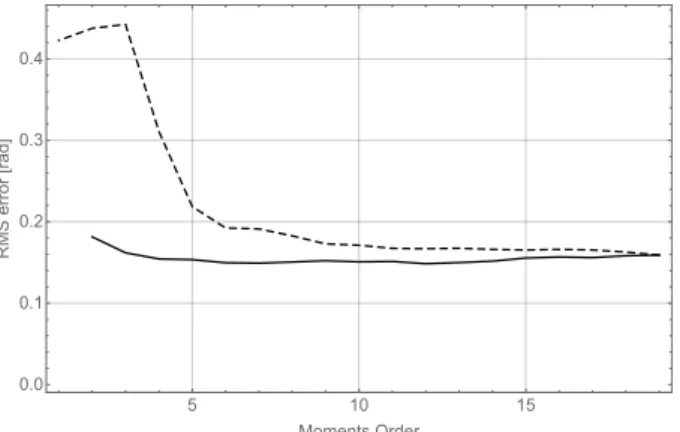
Figure 4.Results of the angle estimation tests. The dashed line shows varying moment order inθwhile
keeping orders inxandzconstant in 19th, while the solid line shows varying moment order inxandz
while keeping the 19th order constant inθ.
The conclusions of this experiment confirm the behavior observed in the experiments explained in the previous section. It can be seen (dashed line), that although for very low orders inθresults are very poor, they improve quickly to reach very good values for order 8 without significant enhancements as order 19 is reached. On the other hand, it can be seen as well (dashed line) that the behavior of varying orders inxandzkeeps almost constant; nevertheless, as seen before, maintaining good precision in object recognition requires a high moment order for both coordinates.
In order to make a comparison with algorithms in the literature presenting results working with the same 3D object database, the overall results have been computed separately for each category. Two recently presented algorithms, by Su et al. [30] and Tulsani et al. [31], have been chosen as the basis for comparison; moreover, in those papers the reader can find further references to previous results. Although both of them use median error to evaluate the results and in this paper RMS is used instead, Table2provides a good comparison of all these methods.
Table 2.Summary of estimation accuracy for each database category.
Aero Bike Boat Bottle Bus Car Chair Table Mbike Sofa Train TV Total
Su et al. 15.4 14.8 25.6 9.3 3.6 6.0 9.7 10.8 16.7 9.5 6.1 12.6 11.7
Tuls. TNet 14.7 18.6 31.2 13.5 6.3 8.8 17.7 17.4 17.6 15.1 8.9 17.8 15.6
Tuls. ONet 13.8 17.7 21.3 12.9 5.8 9.1 14.8 15.2 14.7 13.7 8.7 15.4 13.6
Ours 7.7 7.6 8.0 - 9.5 10.6 7.5 11.9 12.2 7.6 7.1 11.3 9.3
Quantitatively, the most remarkable result that can be observed is that the RMS value for the complete set has a value of 9.3, being in the same range, or even slightly better, than similar algorithms found in the literature. Nevertheless, it can be observed that the presented algorithm performs worse for some classes.
As an overall conclusion, from these two experiments it can be stated that it is important to keep high orders inxandz, both in terms of precision and pose estimation, whilst order inθcan be reduced to fairly low values without degrading the outcome of the recognition and pose estimation significantly.
5.2. Recognition and Pose Estimation in 4D
can completely hold the 3D object in any relative position. In these tests, the center of gravity of each 3D object has been placed in the center of the voxel grid, i.e.,(30, 30, 30).
In this case, the projected pseudo-object, defined in 4D, has been built using 10 equally spaced rotations in the range[0,π/2]; once again, this restriction in the total span of the rotations is due to the symmetric nature of the 3D objects in the database. As a result, the dimensions of the 4D object are (60, 60, 10, 10).
The definition of moments along each dimension is found in:
• Cartesian coordinates, i.e.,xandz, and Legendre moments, based on the Legendre polynomials defined in Equation (57), up to the 19th order
• Angular coordinates, i.e., latitude and longitude, and a Fourier basis, as in Equation (58), up to the 9th order. Therefore, the elementmnpqof the basis is defined as:
Bmnpq=Pm(x)Pn(z)eipφeiqλ (65)
Computing the volume of data in each stage (3D object, pseudo-object in 4D and moment set), we find that the initial object is defined through 216,000 voxels, that leads to a pseudo-object in 4D of 360,000 elements, represented through 40,000 moments. All this information is gathered in Table3.
Table 3.Summary of data representation.
Magnitude Value
Number of 3D objects 55
Classes of 3D objects 11
Projections per object 10×10
∆θbetween projections 9◦
Moments forx Legendre
Moments forz Legendre
Moments forφ Fourier
Moments forλ Fourier
Orders of moments (x,z,φ,λ) 19×19×9×9
Dimensions in voxels 60×60×60 Dimensions, pseudo 4D object 60×60×10×10
The decision to set the order of moments in each dimension in this manner has been guided by the results shown in the previous section, where it was demonstrated that keeping angular moments in low orders is enough to achieve good results in the pose estimation (in fact, results do not seem to improve when increasing this order). On the other hand, moments in the Cartesian coordinates have been kept at the same order as in the previous section, even though there are more pixels representing each section (recall that now each projection has 60×60 pixels, whereas in the previous experiments the size was 60×15). This means that having four times the amount of data per projection, the number of moments to represent it is kept the same. The reason is twofold: first, the data volume must kept as low as possible in order to favor computing time and therefore keep the algorithm as close as possible to real time; and second, the resilience of the algorithm should be checked in a situation of data starvation, as the problem now is much more complex than before.
Therefore, in this experimental moment orders have been kept fixed in every case. Once again, it has been split in two stages: object recognition and pose estimation. For the recognition stage, the procedure was the same as in the previous section:
• One hundred different projections of the 3D objects in the database have been generated through randomly selectedφandλangles.
• For each projectionuand each objectkin the database, the estimation of vectorΓk,u has been computed, following Equation (39).
• With each computed estimationΓk,u, vectorSk,uhas been reconstructed, using the expression in Equation (34).
• The RMS error between each estimated and observed vectors has been computed, as in Equation (62).
• The recognition is carried out by selecting the object that has generated a reconstruction with minimum RMS error, as in Equation (63).
Finally, for the pose estimation stage, as in previous section, the angles defining the relative pose estimation have been computed following on from the assumption that the previous recognition is right, therefore, the calculations include the false positives. Anglesφ0andλ0are computed following Equation (43), and after that, RMS error has been computed for each angle separately, taking into account all the test projections that were generated.
Results for both experiments are summarized in Table4.
Table 4.Summary of recognition and pose estimation results.
Magnitude Value
Precision in recognition 91% RMS inφestimation 11.93◦
Mean error inφestimation 7.72◦
RMS inλestimation 13.59◦
Mean error inλestimation 9.21◦
First, it is worth noting the recognition accuracy rate results, which are notably lower than the rate in the cylindrical coordinates problem presented before. The main reason is that many of 3D objects selected, for instance cars or buses, share almost the same look from above, being in every case roughly rectangle-shaped. Therefore, it is hard to precisely recognize which object is seen, leading to some misclassifications.
In Table4the RMS values are significantly greater than mean values, showing that there could be outliers in the error series that can largely distort results. In Figure5the module of the error value for both angle estimations and each test projection in the ‘Cars’ category can be observed in order to illustrate this fact.
0 20 40 60 80 100
0 10 20 30
Test projection
Error
value
Figure 5.Results of the angle estimation tests for the ‘Cars’ category: in the solid line, the module of the error series forλangle, and in the dashed line, the module of the error series for theφangle.
keep errors to under 10 degrees. Table5shows the updated results from Table4after removing these false positives from the series.
Table 5.Results computed removing false positives.
Magnitude Value
RMS inφestimation 10.37◦
Mean error inφestimation 6.81◦
RMS inλestimation 11.77◦
Mean error inλestimation 8.04◦
It can be seen that the values obtained for pose estimation are similar to those observed in the reduced cylindrical problem in the previous section.
These results show that the proposed algorithm achieves the same quality as other approaches in the literature in which angle estimation accuracy have been reported, such as in [32] or [17], or a better tradeoff between computing time and quality of estimation, as compared to the work in [14].
5.3. Results on Real Images
In order to qualitatively test the algorithm in a real world scenario, in the same way as introduced in [30], images depicting the same car models as those stored in the database were downloaded from the Internet. The only concerns in selecting them were, on one hand, the absence of a strong perspective effect, since the algorithm works under the assumption that projections are orthogonal (parallel), while on the other hand, lens distortions were avoided as well for the same reason. In a real application, these requirements should not be an issue, as the chosen camera can be calibrated previously.
Images were manually segmented and binarized. After that, they were converted to the same size as the projections defining each pseudo-volume stored in the database, i.e., 60×15 pixels, and normalized in the same way as they were, i.e., with the full height and x coordinate of the CDG of the object in the middle of the image. After that, 2D moments up to the 19th order in each dimension,xandz, were computed and passed to the algorithm. The results obtained in this experiment are consistent with the observer evaluation, though, obviously, no ground truth data were available in order to quantitatively evaluate the outcome.
Real images, segmentation results, and projections from the 3D objects in the database using the pose estimation obtained with the algorithm, are collected in Figure6. Numerical results are gathered in Table6.
Table 6.Results of tests with real images.
Car Model Classic VW Beetle Peugeot 207 Ambulance 2011 Ford Focus
Rotated Angle 183.29◦ 42.54◦ 26.35◦ 179.83◦
Figure 6.Results of tests on real images. In the first row, the original images as downloaded from the Internet. Second row, 3D objects rotated in the estimated angle and seen from above. Third row, projections after manually segmenting, centering and reducing the scale to 15×60 pixels. Fourth row, projections generated applying the estimated rotation angle to the 3D model in the database.
6. Discussion
In this paper, a new method for simultaneous 3D object recognition and pose estimation based on the definition of a set of 4D moments is introduced. The proposed moment set combines Cartesian and angular representations to extract the maximum information of the polynomial approximation achieved by using orthonormal moment bases.
Four-dimensional tensors comprise all the information regarding projection generation, including the 2D Cartesian definition of the projection itself and two angular components to define both latitude and longitude defining the relative pose of the observer.
Cartesian moments allow an efficient representation of object projection, while Fourier moments ease the computation of pose angles through exponential terms. In this way, 3D objects are defined by compact matrices that can be computed off line, leaving recognition and pose estimation stages to rely on simple matrix calculations. Moreover, recognition and pose estimation are accomplished using very low-definition projection images and low-order moments, that allow this algorithm to run in real time. In addition, this algorithm works for textureless objects, as it is only based on contours, this being a great advantage as opposed to algorithms that need textured objects in order to define keypoints to be matched against known sets.
Results show that both the recognition and pose estimation precision rates are at the level of the state-of-the-art algorithms, proving that this approach is a valuable option for performing both tasks with the advantage of doing it simultaneously.
Conflicts of Interest:The author declares no conflict of interest.
References
2. Cupec, R.; Grbic, R.; Nyarko, E.K.Survey of State-of-the-Art Methods for Object Recognition in 3D Point Clouds; Technical Report; Josip Juraj Strossmayer University of Osijek: Osijek, Croatia, 2016.
3. Handbook of Robitcs; Siciliano, B., Khatib, O., Eds.; Springer: Berlin/Heidelberg, Germany, 2016.
4. Flusser, J.; Suk, T.; Zitová, B. 2D and 3D Image Analysis by Moments; John Wiley and Sons: Hoboken, NJ, USA, 2017.
5. Hoiem, D.; Savarese, S. Representations and Techniques for 3D Object Recognition and Scene Interpretation; Morgan and Claypool Publishers: San Rafael, CA, USA, 2011.
6. Marchand, E.; Uchiyama, H.; Spidler, F. Pose estimation for Augmented Reality: A hands-on survey.
IEEE Trans. Vis. Comput. Graph.2016,22, 2633–2651.
7. Cadena, C.; Carlone, L.; Carrillo, H.; Latif, Y.; Scaramuzza, D.; Neira, J.; Reid, I.; Leonard, J. Past, Present, and Future of Simultaneous Localization And Mapping: Towards the Robust-Perception Age. IEEE Trans. Robot.
2016,32, 1309–1332.
8. Cyganski, D.; Orr, J. Applications of Tensor Theory to Object Recognition and Orientation Determination.
IEEE Trans. Pattern Anal. Mach. Intell.1985,PAMI-7, 662–673.
9. Nayar, S.K.; Nene, S.A.; Murase, H. Real-time 100 object recognition system. In Proceedings of the 1996 IEEE International Conference on Robotics and Automation, Minneapolis, MN, USA, 22–28 April 1996; pp. 2321–2325.
10. Gordon, I.; Lowe, D.G. What and where: 3D object recognition with accurate pose. InToward Cathegory-Level Object Recognition; Springer: Berlin/Heidelberg, Germany, 2006; pp. 67–82.
11. Collet, A.; Berenson, D.; Srinivasa, S.S.; Ferguson, D. Object recognition and full pose registration from a single image for robotic manipulation. In Proceedings of the 2009 IEEE International Conference on Robotics and Automation, Kobe, Japan, 12–17 May 2009; pp. 3534–3541.
12. Rusu, R.B.; Bradski, G.; Thibaux, R.; Hsu, J. Fast 3D recognition and pose using de viewpoint feature histogram. In Proceedings of the 2010 IEEE/RSJ International Conference on Intelligent Robots and Systems, Taipei, Taiwan, 18–22 October 2010; pp. 2155–2162.
13. Shukla, D.; Erkent, Ö.; Piater, J. General object tip detection and pose estimation for robot manipulation.
Lect. Notes Comput. Sci.2015,9136, 364–374.
14. Lee, S.; Wei, L.; Naguib, A.M. Adaptive bayesian recognition and pose estimation of 3D industrial objects with optimal feature selection. In Proceedings of the 2016 IEEE International Symposium on Assembly and Manufacturing, Fort Worth, TX, USA, 21–22 August 2016; pp. 50–55.
15. Sarkar, K.; Pagani, A.; Stricker, D. Feature-augmented trained models for 6DOF object recognition and camera calibration. In Proceedings of the 2016 11th Joint Conference on Computer Vision, Imaging and Computer Graphics Theory and Applications, Rome, Italy, 27–29 February 2016; Volume 4, pp. 632–640. 16. Do Monte Lima, J.P.S.; Teichrieb, V. An efficient global point cloud descriptor for object recognition and
pose estimation. In Proceedings of the 2016 29th SIBGRAPI Conference on Graphics, Patterns and Images, Sao Paulo, Brazil, 4–7 October 2016; pp. 56–63.
17. Wojke, N.; Neuhaus, F.; Paulus, D. Localization and pose estimation of textureless objects for autonomous exploration misions. In Proceedings of the 2016 IEEE International Conference on Image Processing, Phoenix, AZ, USA, 25–28 September 2016; pp. 1304–1308.
18. He, R.; Rojas, J.; Guan, Y. A 3D object detection and pose estimation pipeline using RGB-D images.arXiv
2017, arXiv:1703.03940v1.
19. Gandía, F.; Casas, A.G. Fast spacecraft pose estimation based on Zernike moments. In Proceedings of the 7th International Symposium on Artificial Intelligence, Robotics and Automation in Space, Nara, Japan, 19–23 May 2003.
20. Tahri, O.; Chaumette, F. Complex objects pose estimation based on image moments invariants. In Proceedings of the 2005 IEEE International Conference on Robotics and Automation, Barcelona, Spain, 18–22 April 2005; pp. 436–441.
21. Komuro, T.; Ishikawa, M. A moment-based 3D object tracking algorithm for high-speed vision. In Proceedings of the 2007 IEEE International Conference on Robotics and Automation, Roma, Italy, 10–14 April 2007.
23. Sahu, U.K.; Patra, D. Shape features for image-based servo-control using image moments. In Proceedings of the 2015 Annual IEEE India Conference, New Delhi, India, 17–20 December 2015.
24. Ansary, T.F.; Daoudi, M.; Vandeborre, J.P. A bayesian 3D search engine using adaptive views clustering.
IEEE Trans. Multimedia2007,9, 78–88.
25. Daras, P.; Axenopoulos, A. A 3D shape retrieval framework supporting multimodal queries. Int. J. Comput. Vis.2010,89, 229–247.
26. Rammath, K.; Sinha, S.N.; Szeliski, R.; Hsiao, E. Car make and model recognition using 3D curve alignement. In Proceedings of the 2014 IEEE Conference on Applications of Computer Vision, Steamboat Springs, CO, USA, 24–26 March 2014; pp. 285–292.
27. Liu, Z.; Zhao, C.; Wu, X.; Chen, W. An effective 3D shape descriptor for object recognition with RGB-D sensors. Sensors2017,17, 451.
28. Yap, P.T.; Paramesran, R. An efficient method for the computation of Legendre moments. IEEE Trans. Pattern Anal. Mach. Intell.2005,27, 1996–2002.
29. Xiang, Y.; Mottaghi, R.; Savarese, S. Beyond PASCAL: A Benchmark for 3D Object Detection in the Wild. In Proceedings of the IEEE Winter Conference on Applications of Computer Vision (WACV), Steamboat Springs, CO, USA, 24–26 March 2014.
30. Su, H.S.; Qi, C.R.; Li, Y.; Guibas, L.J. Render for CNN: Viewpoint Estimation in Images Using CNNs Trained with Rendered 3D Model Views. In Proceedings of the IEEE International Conference on Computer Vision (ICCV), Santiago, Chile, 13–16 December 2015.
31. Tulsiani, S.; Malik, J. Viewpoints and Keypoints. In Proceedings of the IEEE International Conference on Computer Vision and Pattern Recognition (CVPR), Santiago, Chile, 13–16 December 2015.
32. Tahri, O.; Araujo, H.; Mezouar, Y.; Chaumette, F. Efficient iterative pose estimation using an invariant to rotations. IEEE Trans. Cybern.2014,44, 199–207.
c