Late Variscan remagnetization of Devonian carbonates
in the Moravo-Silesian zone (Czech Republic):
implications for dating tectonic deformation
Abstract: New paleomagnetic data from the Moravo-Silesian Zone (Eastern Variscides, Czech Republic) confirmed the presence of strong Late Variscan overprint. Data from four localities indicate syn-folding to post-folding age of remagnetization, which was acquired throughout a time span between 335-288 Ma. This implicates that deformation in the area started as early as the Visean (Lower Carboniferous) and continued to the lowermost Permian. Remagnetization was coeval with the same process reported from Ardennes and partially also Cantabrian arc.
Keywords: Moravo-Silesian Zone, paleomagnetism, remagnetization, Devonian.
1Polish Geological Institute-National Research Institute, Rakowiecka 4, 00-975 Warszawa, Poland.
2Institute of Geological Sciences, Masaryk University, Kotlá ska 2, 61137 Brno, Czech Republic.
3Institute of Geology of the Academy of Sciences of the Czech Republic, v. v. i., Rozvojová 269, 165 00 Praha 6, Czech Republic.
4Institute of Geophysics, Polish Academy of Sciences, Ks. Janusza 64, 01-452 Warsaw, Poland.
5Czech Geological Survey Brno, Leitnerova 22, 658 69 Brno, Czech Republic.
*e-mail: [email protected]
J. G
RABOWSKI1*, O. B
ABEK2, J. H
LADIL3, P. P
RUNER3, P. S
CHNABL3, T. W
ERNER4, M. G
ERSL5AND
J. O
TAVA5The paleomagnetic method is widely used for paleo-tectonic reconstructions of fold-and-thrust belts. Investigations performed in the Moravo-Silesian Zone (MSZ) more than 10 years ago (Krs and Pruner, 1995; Tait et al., 1996) proved a strong late Variscan remagnetization of the Devonian carbonate rocks. The remagnetization took place when the Variscan tectonic structures existed in their present shape. Secondary magnetizations of similar age were noted also in other parts of Variscan Europe, e.g. in Ardennes (Molina-Garza and Zijderveld, 1996; Marton et al., 2000; Zegers et al., 2003) and northern Spain (Weil et al., 2001). In this paper we present new paleomagnetic results from MSZ, focused on more
detailed dating of Late Variscan remagnetization in relation to deformations and timing of magnetic over-print in some other parts of Variscan Europe.
Geological setting
tionary wedge, which developed between the overrid-ing nappe stack of the Moldanubian and Tepla-Barrandian units, and the subducted Brunovistulian crystalline basement (Fritz and Neubauer, 1995).
Paleomagnetic data from four localities of Middle to Late Devonian carbonate rocks are presented (Fig. 1). Samples (total number of 46) were taken either from long, weakly deformed sections (Josefov, Celechovice) or well developed mesofolds of several meters of ampli-tude (Mokra, Hranice). The Devonian rocks in the MSZ rocks were moderately heated with CAI indexes from 3-3.5 in the Brno area through 4 in Josefov, to 5-6 in Hranice. The results must be considered as prelim-inary, since the project is still active and new paleomag-netic data will be obtained in the next few months.
Results
Paleomagnetism
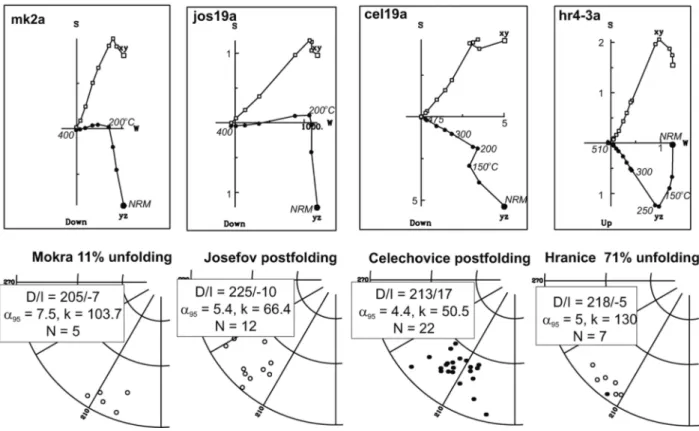
Thermal demagnetization revealed the presence of two magnetization components in each locality. A
Baltica (Van der Voo and Torsvik, 2004), while between 350 and 300 Ma Baltic APW of Torsvik
and Cocks (2005) was applied (Fig. 3). It appears that component A in Josefov, Hranice and Mokra Figure 2.Upper row: orthogonal projection of thermal demagnetization path for typical specimens (before tectonic correction). Squares: horizontal plane projection; dots: vertical plane projection; NRM intensities in mA m-1. Lower row: stereographic projection of characteristic magnetizations. White (black) dots: upper (lower) hemisphere projection; D/I: declination/inclination; α95, k: Fisher statistics parameters (Fisher, 1953); N: number of samples.
Figure 3.Paleoinclinations of the component A (this study – black dots) compared to the reference Carboniferous-Permian paleoin-clination curve for Europe (recal-culated from paleopoles for geo-graphic coordinates 49ºN, 17ºE).
is roughly of the same age and might be dated as 300-294 Ma, which corresponds to the uppermost Carboniferous-lowermost Permian. Component A in Celechovice is apparently older and might be acquired at 330 Ma or even earlier. As component A in this locality is late syn-folding to post-folding, this implies that deformations of the Devonian car-bonates in MSZ started as early as the late Early
Carboniferous and they continued probably beyond the Carboniferous-Permian boundary.
AMS
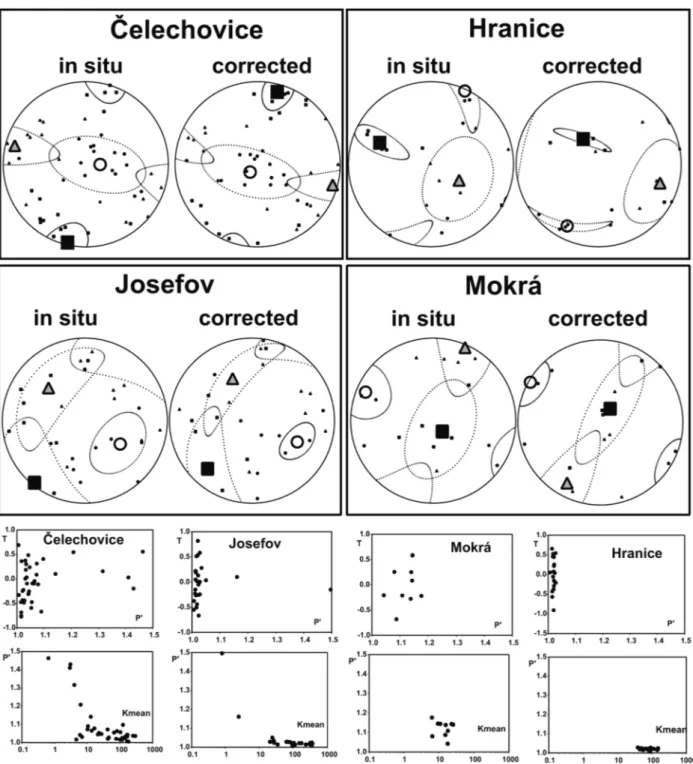
In 4 localities in the vicinity of Brno (Fig. 4) the AMS fabric shows a moderately to well developed clusters of magnetic lineations (k1). k1(for two exposures) and
Figure 4.AMS fabric for 4 localities. Upper row: AMS mean axes (in situand after tectonic correction, k1-squares, k2-triangles, k3
k2 (for one exposure) trend subhorizontally to NW-SW along the general trend of Devonian exposures. Magnetic foliation dip steeply in 3 sites and is rather subhorizontal in another one. The correlation of dif-ferent AMS axes (k1 and k3 respectively) between sites (e.g. Hranice and Mokrá) can be due to multi-stage AMS fabric at given localities or due to miner-alogical control (inverse fabric). The effects of local
and regional deformation on the AMS and correla-tion with other AMS studies (Chadima et al., 2006) need to be yet clarified. The 100% unfolding at the locality scale slightly improves the clustering of AMS although some more studies with partial unfolding are required. Anisotropy degree is strongly dependent on bulk susceptibility (P’ is higher for more diamag-netic samples due to larger measurement errors). Rock magnetic studies revealed two phases of mag-netite (SD+SP) and a high potential to growth of sec-ondary magnetite upon heating. The AMS fabric rather seems not to affect the paleomagnetic record due to very low susceptibility mostly carried by para-and diamagnetic minerals.
Conclusions
Late Variscan remagnetizations in the MSZ, like tec-tonic deformations, were significantly extended in time
spreading between 330 and 290 Ma. Two extreme results falling between 340 and 350 Ma are from Hady Limestone (Tait et al., 1996) and are poorly con-strained. We can not be sure if remagnetization was a continuous process. The presence of three phases might be postulated from figure 3: 1) between 335 and 325 Ma, 2) between 310 and 315 Ma, and 3) between 300 and 288 Ma. This might be an artifact resulting from
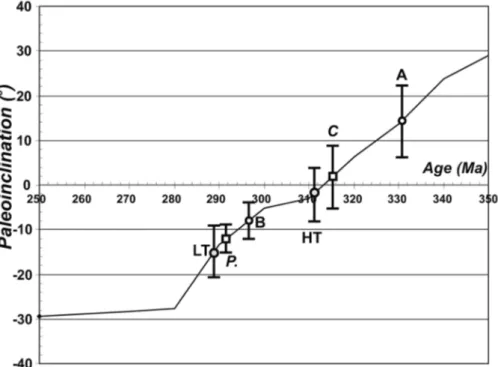
paucity of data. However, the remagnetization phases distinguished in Ardennes (Fig. 5) seem to have their counterpart in MSZ. The first phase corresponds to magnetization A of Marton et al. (2000), the second might be compared to phases HT (Molina-Garza and Zijderveld, 1996) and C (Zegers et al., 2003), while the third phase was distinguished by all the authors (B of Marton et al., 2000; P of Zegers et al., 2003; LT of Molina-Garza and Zijderveld, 1996). The second and third remagnetization phases are also present in Devonian rocks of the Cantabrian arc (component C and B, Weil et al.2001).
Acknowledgements
This research was carried out within a Polish-Czech bilateral cooperation, financially supported by Polish Ministry of Science and Education (project CZECHY/262/2006), and by the Institutional Research Plan of the Institute of Geology AS CR, v. v. i. No. CEZ AV0Z30130516.
Figure 5.Paleoinclinations of the Late Variscan magnetization components from Ardennes (after various authors) recalculat-ed for geographic coordinates 49ºN, 17ºE and plotted against reference Carboniferous-Permian paleoinclination curve for Europe. Grey dots: data after Molina-Garza and Zijderveld (1996); white dots: after Marton et al.(2000); squares: after Zegers et al.(2003).
References
CHADIMA, M., HROUDA, F., and MELICHAR, R. (2006): Magnetic fabric study of the SE Rhenohercynian Zone (Bohemian Massif ): Implications for dynamics of the Paleozoic accretionary wedge. Tectonophysics, 418: 93-109.
FISHER, R. A. (1953): Dispersion on a sphere. P. Roy. Soc. Lond. A
Mat., 217: 295-305
FRITZ, H. and NEUBAUER, F. (1995): Moravo-Silesian Zone; Autochthon; Structure. In: R. D. DALLMEYER, W. FRANKEand K. WEBER(eds): Pre-Permian geology of Central and Eastern Europe.
Springer, Berlin: 490-494.
KRS, M. and PRUNER, P. (1995): Paleomagnetism and Paleogeography of the Variscan Formations of the Bohemian Massif, comparison with other European regions. J. Geol. Soc. Czech, 40: 3-46.
MARTON, E., MANSY, J. L., AVERBUCH, O. and CSONTOS L.
(2000): The Variscan belt of Northern France-Southern Belgium: geodynamic implications of new paleomagnetic data. Tectonophysics, 324: 57-80.
MCFADDEN, P. L. (1990): A new fold test for paleomagnetic
stud-ies. Geophys. J. Int., 103: 163-169.
MOLINA-GARZA, R. S. and ZIJDERVELD, J. D. A. (1996):
Paleomagnetism of Paleozoic strata, Brabant & Ardennes Massifs, Belgium: implications of prefolding and postfolding Late Carboniferous secondary magnetizations for the European apparent polar wander. J. Geophys. Res., 101, B7: 15799-15818.
TAIT, J. A., BACHTADSE, V. and SOFFEL, H. C. (1996): Eastern Variscan fold belt: paleomagnetic evidence for oroclinal bending. Geology, 24: 871-874.
TORSVIK, T. H. and COCKS, R. M. (2005): Norway in space and
time: a centennial cavalcade. Norw. J. Geol., 85: 73-86.
VAN DERVOO, R. and TORSVIK, T. H. (2004): The quality of the Permo-Triassic paleopoles and its impact on Pangea Reconstructions. In: J. E. T. CHANNELL, D. V. KENT, W. LOWRIE
and J. G. MEERT (eds): Timescales of the paleomagnetic field.
Geophysical Monograph, 145, Am. Geophys. Union.
WEIL, A. B., VAN DERVOO, R. andVAN DERPLUIJM, B. (2001): Oroclinal bending and evidence against the Pangea megashear: The Cantabrian-Asturias arc (northern Spain). Geology, 29: 991-994.
ZEGERS, T. E., DEKKERS, M. J. and BAILLY, S. (2003): Late