1
Methanol electrosynthesis from CO
2at Cu
2O/ZnO prompted
1
by pyridine-based aqueous solutions
2Jonathan Alboa, c*, Garikoitz Beobideb, Pedro Castañoa and Angel Irabienc
3 4
aDepartment of Chemical Engineering, University of the Basque Country, Apdo. 644, 48080, 5
Bilbao, Spain 6
b
Inorganic Chemistry Department, University of the Basque Country, Apdo. 644, 48080, Bilbao, 7
Spain 8
cDepartment of Chemical & Biomolecular Engineering, University of Cantabria, Avda. Los 9
Castros s/n, 39005 Santander, Spain 10
*Corresponding author; e-mail: [email protected]
11 12
Abstract 13
In this study we examine the electrochemical-driven reduction of CO2 to methanol at
14
Cu2O/ZnO gas diffusion electrodes in soluble pyridine-based electrolytes at different
15
concentrations. The process is evaluated first by cyclic voltammetric analyses and then,
16
for the continuous reduction of CO2 in a filter-press electrochemical cell. The results
17
showed that the use of pyridine-based soluble co-catalysts lowered the overpotential for
18
the electrochemical reduction of CO2, enhancing also reaction performance (i.e. reaction
19
rate and Faradaic efficiency). Reaction outcome is discussed on the basis of the role that
20
N-ligands play on the mechanism and the inductive effect caused by the
electron-21
releasing or electron-withdrawing substituents of the aromatic ring.
22
In particular, the maximum methanol formation rate and Faradaic efficiency reached at
23
the 2-methylpyridine (with electron-releasing substituents)-based system with a pH of 7.6
24
and an applied current density of j= 1 mA·cm-2 were r= 2.91 µmol·m-2·s-1 and FE=
25
16.86%, respectively. These values significantly enhance those obtained in the absence
26
of any molecular catalyst (r= 0.21 µmol·m-2·s-1 and FE= 1.2%). The performance was
27
further enhanced when lowering the electrolyte pH by adding HCl (r= 4.42 µmol·m-2·s-1
28
and FE= 25.6% at pH =5), although the system showed deactivation in the long run (5 h)
29
which appears largely to be due to a change in product selectivity of the reaction (i.e.
30
formation of ethylene).
2 Keywords: Electrochemistry, CO2 reduction, pyridine-based molecular catalysts, copper
32
oxide, methanol
33
1. Introduction 34
The idea that CO2 can be captured [1-3] and reconverted to fuels in a Carbon Capture and
35
Utilisation (CCU) approach, sounds like a perfect solution that potentially could help to
36
solve global warming and energy shortage issues [4, 5]. Among the available technologies
37
for the activation and conversion of CO2 into value-added chemicals [6], the
38
electrocatalytic alternative is appealing since it could enable an economically competitive
39
industrial production of CO2-based fuels by using renewable energy [7, 8].
40
Moreover, from the spectrum of possible CO2-reduced species, the formation of methanol
41
(CH3OH) is of great interest since it is liquid at ambient conditions and can be readily
42
integrated into the existing liquid fuel transportation infrastructure [9, 10]. However, an
43
effective and selective production of CH3OH (with 6 exchanged e- required) by
44
electrochemical methods is a chemical challenge that still remains unsolved. Despite the
45
significant contributions that have been recently made in this reaction [9, 11-13], most of
46
the CO2 electroreduction reports have been largely confined to 2 e- products such as CO
47
and formate (HCOOH) and, in many cases, with low productivities. Besides, even though
48
proton-coupled electron transfers to CO2 are thermodynamically facile, these reactions
49
require large overpotentials [9]. In order to help solving those limitations, organic
50
molecules have been found to be beneficial to promote the electrochemical reduction of
51
CO2 [14, 15]. In particular, nitrogen-containing heterocycles such as pyridine (Py) appear
52
to lower overpotentials (indicating lower reaction barriers) and increase Faradaic
53
efficiencies (indicating higher selectivities toward CO2 reduction products) in
54
electrochemical CO2 conversion reactions as largely demonstrated by Bocarsly et al.
[16-55
22]. Their first results evidenced that CO2 is catalyzed at hydrogenated Pd electrodes in
56
10 mM aqueous Py solutions [19, 22]. CH3OH was detected with efficiencies up to 30%
57
at overpotentials of uniquely ~200 mV [22]. Py was found to act as electron shuttle
58
implying the formation of a carbamate as intermediate during the electron transfer to CO2
59
[19]. In 2008, the same group exported this chemistry to a p-GaP photoelectrochemical
60
cell to yield 96% Faradaic efficiency (FE) for CH3OH. They showed evidence of the key
61
role of Py to catalyze the selective formation of CH3OH from CO2 in a series of
one-62
electron steps at underpotentials of about 300 mV [21]. Based on the interesting results
3
for the electro-and-photoelectrocatalytic CO2 reduction using Py developed by the group
64
of Bocarsly, recent reports from other groups have been advancing on the application of
65
Py-based molecular catalyst [23-29], demonstrating the benefits of using molecular
66
catalysts for the reduction of CO2 to CH3OH.
67
While the mechanisms of the reduction process seem to be still subject of debate, the
68
results clearly show that the identity of the soluble heterocycle and the metal electrode
69
influences the yield and product selectivity of the reaction [23, 30-34]. For example, the
70
use of Py with a p-GaP or a Pt cathode results in selective CH3OH formation, while Py
71
with a Fe-pyrite cathode favours HCOOH production [15, 17, 22]. Among the available
72
catalytic materials, copper has been found to be unique to synthesize CH3OH and >C1
73
hydrocarbons, such as ethanol and propanol [11-13, 35-37]. The performance of this
74
metal, however, generally implies large overpotentials and low selectivities [38].
75
Nevertheless, copper(I) oxide surfaces (i.e. Cu2O) present both intermediate hydrogen
76
overpotentials and CO adsorption properties, which allows higher CH3OH yields in
77
aqueous solutions to be produced [12, 13, 39-41]. Moreover, our previous work [13]
78
demonstrated that ZnO is able to stabilize Cu2O in the hydrogenation reaction,
79
maintaining the stability of the catalyst for longer reaction times.
80
Therefore, with the present study we sought to address the use of Py-based aqueous
81
solutions for CO2 conversion at Cu2O/ZnO-based working electrodes. Previous works
82
have pointed that N-donor ligands like pyridine play a crucial role in the electron transfer
83
to CO2 by forming a carbamate intermediate. Herein, a handful of pyridine derivatives
84
were used in this study in order to assess the inductive effect caused by electron-releasing
85
(I+) and electron-widthdrawing (I–) substituents into the overall reaction outcome.
86
Precisely, we selected unsubstituted pyridine as reference and 2-methylpyridine,
4-87
ethylpyridine, 2,4,6-trimethylpyridine, 2-chloropyridine, and 4,4'-bipyridine as
88
representative cases for I+ and I– effect. Influence of parameters such as Py type and its
89
concentration was preliminarily addressed by cyclic voltammetry. Thereafter, continuous
90
reduction of CO2 to CH3OH was conducted in a filter-press electrochemical cell at low
91
current densities (j= 0.01 - 5 mA·cm2) in a pH range from ca. 7.6 to 4.
92 93 94
4 2. Materials and methods
95
2.1. Py-based molecular catalysts
96
Pyridine (Py, 99%), 2-methylpyridine (2mPy, 98%), 4-ethylpyridine (4ePy, 98%),
2,4,6-97
trimethylpyridine (246tmPy, 99%), 2-chloropyridine (2ClPy, 99%), and 4,4'-bipyridine
98
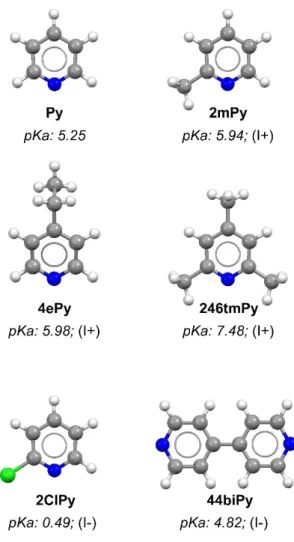
(44biPy, 99%) of reagent grade were used as commercially obtained. Figure 1 depicts the
99
selected pyridines, together with the pKa values of the corresponding pyridinium. It must
100
be noted that the pKa value can be correlated with inductive effect of the ring substituents.
101
When compared to the unsubstituted Py, the alkyl derivatives (2mPy, 246tmPy and 4ePy)
102
display an electron-releasing effect towards the N atom, making it a more basic position
103
(i.e. a greater pKa of the pyridinium). 44biPy and 2ClPy exhibit somewhat lower and
104
markedly lower pKa values according to their mild and strong electron-withdrawing
105
effects. These features will be considered in the discussion section, as they are also closely
106
related to the ability of the pyridinic ring to mediate the electron transfer through the
107
formation of a carbamate intermediate by the nucleophilic addition to CO2.
5
Figure 1. Selected pyridines (colour codes: C grey, H white, N blue, and Cl
green) including pKa values of the corresponding pyridinium. Nature of the inductive effect in parentheses.
109
2.2. Cyclic voltammetry characterization
110
The electrochemical behaviour was evaluated with a PGSTAT 302N potentiostat
111
(Metrohm, Autolab B.V.) under GPES software control employing a conventional three
112
electrode electrochemical cell. A glassy carbon and Ag/AgCl (sat. KCl) were used as a
113
counter and reference electrode, respectively. Portions of the Cu2O/ZnO-based materials
114
were used as cathodes. The aqueous electrolyte (0.5 M KHCO3) containing the different
115
molecular catalysts at different concentrations (i.e. 10, 25 and 50 mM) was saturated with
116
ultrapure CO2 (99.99%) by bubbling for 20 min before the tests. The current-voltages
117
curves were obtained with a scan rate of 50 mV·s-1 at potentials ranging from 0 to -1.2 V
118
vs. Ag/AgCl. Current density is expressed as the total current divided by the geometric
119
surface area, A, of the electrodes.
6
2.3. Electrochemical cell for CO2 reduction
121
The continuous electrochemical measurements for CO2 reduction were carried out in a
122
filter-press electrochemical cell (Micro Flow Cell, ElectroCell A/S) at ambient
123
conditions. A cation exchange membrane (Nafion® 117) separated the cathode and anode
124
compartments of the cell. The membrane presented a phase-segregated structure that
125
allows the selective transport of H+ ions from the anode to the cathode chamber with a
126
low permeability to CH3OH [42]. A platinised titanium electrode was used as a counter
127
electrode and Ag/AgCl (sat. KCl), assembled close to the cathode, was used as reference
128
electrode. The Cu2O/ZnO-catalyzed carbon papers were employed as working electrodes
129
(A= 10 cm-2). The preparation of the Cu2O/ZnO electrodes has been described in detail
130
in our previous works [12, 13]. Basically, Cu2O (Sigma Aldrich, particle size < 5 µm,
131
97% purity) and ZnO particles (ACROS organic, < 45 µm, 99.5%) were mixed with a
132
Nafion® dispersion 5 wt.% (Alfa Aesar) and isopropanol, IPA (Sigma Aldrich), with a
133
70/30 catalyst/Nafion mass ratio and a 3% solids (catalyst + Nafion). The ink was
134
airbrushed onto a porous carbon paper (TGP-H-60, Toray Inc.) to form a gas diffusion
135
electrode (GDE) with a catalytic loading of 1 mg·cm-2. All electrodes were dried and
136
rinsed with deionised water before use.
137
The filter-press electrochemical system possesses three inputs (catholyte, anolyte and
138
CO2 separately) and two outputs (catholyte-CO2 and anolyte). The GDE cell
139
configuration allows the electroreduction of CO2 supplied directly in gas phase [12, 43,
140
44]. The cathode side of the reactor was fed with CO2 gas (99.99%) with a flow/area ratio
141
of Qg/A= 20 ml·min-1·cm-2, adjusted by a rotameter. A 0.5 M KHCO3 (Panreac, >97%
142
purity) aqueous solution containing different concentrations of the Py-based molecular
143
catalysts (i.e. 10, 25 and 50 mM) was used as catholyte. The anolyte was a 0.5 M KHCO3
144
aqueous solution. Prior to the experiments, the aqueous electrolyte was saturated with
145
CO2 by bubbling for 20 min. The pH of the saturated solution was measured with a
pH-146
meter PH 25 (Crison, PAIS). The pH before the tests was adjusted to 4, 5 and 6 by adding
147
HCl (Panreac, 37%).
148
The electrolytes were pumped from catholyte and anolyte tanks to the cell by two
149
peristaltic pumps (Watson Marlow 320, Watson Marlow Pumps Group) at a flow rate of
150
Qe/A= 1 ml·min-1·cm-2. The experiments were performed at galvanostatic conditions in a
151
current density range of j= 0.05 - 5 mA·cm-2, using an AutoLab PGSTAT 302N
7
potentiostat (Metrohm, Autolab B.V.) The experimental time was 90 min, where
pseudo-153
stable conditions are reached [12, 13]. Liquid samples were taken every 15 min from the
154
catholyte tank.
155
The concentration of products in each sample was analysed by duplicate in a headspace
156
gas chromatograph (GCMS-QP2010 Ultra Shimadzu) equipped with a Flame Ionization
157
Detector (FID). Compounds were separated on a DB-Wax 30 m x 0.25 mm x 0.25 µm
158
column, with an injection and detector temperature of 250 ºC and 270 ºC, respectively.
159
Helium was used as a carrier gas at a flow rate of 50 ml·min-1. The identification of
160
obtained products was further confirmed by headspace gas chromatography-mass
161
spectrometry (GCMS-N5975B) using a 60 m x 250 µm x 1.40 µm DB-624 capillary
162
column. An averaged concentration was obtained for each point from the performance of
163
three separate runs with an experimental error less than 17.3%.
164
The performance of the process is evaluated by the rate of CH3OH production, r (i.e.
165
CH3OH obtained per unit of cathode area and time), and the FE (i.e. selectivity of the
166
reaction to produce CH3OH). FE is calculated assuming that 6 e- are required per
167
molecule of CH3OH.
168
3. Results and discussion 169
3.1. Cyclic voltammetric analyses
170
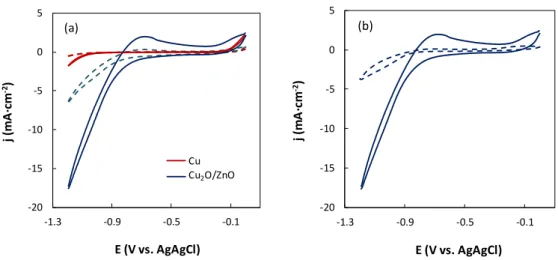
Figure 2a reveals the current-voltage response after 5 electrochemical scans for the
171
Cu2O/ZnO GDEs in a CO2-saturated 0.5 M KHCO3 aqueous solution, and the response
172
upon adding 25 mM concentration of 2mPy in the electrolyte solution. This Py-based
co-173
catalyst was firstly selected due to its ability to significantly reduce the activation
174
overpotential (i.e. its role in the activation energy due to electron transfer) for CO2
175
reduction [45]. The results are compared to those responses obtained at a Cu plate. To
176
further analyse the activity for CO2 reduction, Figure 2b shows the curves for Cu2O/ZnO
177
and Cu electrodes under CO2 and N2 saturation. Current densities, j, are normalized to the
178
geometric area (A) of the electrodes.
8
Figure 2. Cyclic voltammograms for: (a) Cu2O/ZnO and Cu-based systems in CO2-saturated 0.5 M KHCO3 aqueous electrolytes in the presence and absence (dotted line) of 2mPy (25 mM) and, (b) Cu2O/ZnO in CO2 and N2 (dotted line) saturated 0.5 M KHCO3 + 2mPy (25 mM) solution.
180
Figure 2a shows that higher activities are reached for both Cu-based catalysts by
181
employing Py-based molecular co-catalysts, as denoted by the large differences between
182
voltammetry profiles in the absence/presence of 2mPy solubilised in the electrolyte. In
183
fact, a very remarkable enhancement can be obtained in case of incorporating 25 mM of
184
2mPy in the Cu2O/ZnO-based system, denoting the synergic co-catalytic effect of copper
185
oxide species and Py in the activity response, in contrast with the restricted improvements
186
at the Cu plate in the absence/presence of the molecular catalyst.
187
The main characteristic of the voltammograms is a reduction process starting at around
-188
0.8 V vs. Ag/AgCl, which can be initially associated with the reduction of CO2 and partial
189
formation/decomposition of the oxides at the electrode surface. The oxidative peak at
-190
0.7 V in the reverse scan of Cu2O/ZnO curves might be initially assigned to the transition
191
of remaining Zn to ZnO. However, the peak remains after the fifth scan, and so it probably
192
has more to do with the formation of oxidized subproducts in the CO2 reduction reaction.
193
In addition, the curves in Figure 2b show that in the presence of both, 2mPy and CO2, a
194
substantial enhancement of the reduction wave, in comparison to that response in a N2
-195
saturated solution, was observed at more negative potentials than -1 V. Thus, this
196
reduction peak is mainly attributed to CO2 reduction rather than the oxidation-reduction
197
of the catalytic materials. In fact, the reduction response occurs at around 200 mV lower
198
overpotential in the presence of pyridine (compared to the system with a CO2-saturated
199
electrolyte without 2mPy). This denotes the important co-catalyst and synergic effect of
200
2mPy in the reduction of CO2.
201 -20 -15 -10 -5 0 5 -1.3 -0.9 -0.5 -0.1 j (m A ·c m -2) E (V vs. AgAgCl) Cu (25 mM) Cu2OZnO(25mM) Cu Cu2O/ZnO (a) -20 -15 -10 -5 0 5 -1.3 -0.9 -0.5 -0.1 j (m A ·c m -2) E (V vs. AgAgCl) (b)
9
For the sake of evaluating the effect of the releasing (I+) or
electron-202
withdrawing (I-) character on CO2 reduction activity, cyclic voltammograms were
203
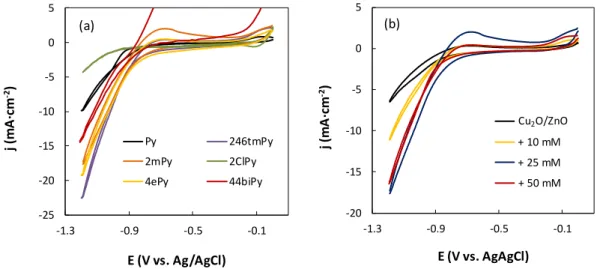
acquired for the other Py derivatives (i.e. 4ePy, 246tmPy, 2ClPy, 44biPy) in a
204
concentration of 25 mM (Figure 3a). The results are compared to the electrochemical
205
activity of unsubsituted Py as a reference. Besides, Figure 3b shows the effect of adding
206
different concentrations of 2mPy (i.e. 10, 25 and 50 mM) in the CO2 reduction response.
207
Figure 3. Cyclic voltammograms for Cu2O/ZnO GDEs in a 0.5 M KHCO3 aqueous solution containing: (a) 25 mM of the different Py-based molecular catalyst and, (b) different concentrations of 2mPy molecular catalyst (i.e. 10, 25 and 50 mM).
208
Compared to the reference Py, substituted ones show accused shifts on either onset of the
209
reduction wave (i.e. lower activation overpotential) and its intensity. The lowering of the
210
overpotential observed for 2mPy, 4ePy and 246tmPy can be rationalized by the electron
211
releasing short alkyl groups (I+ effect). This makes the Py-N atom a better σ-donor and
212
thus, more prone to form the carbamate through an addition reaction to the electrophilic
213
C atom and, ultimately, to transfer the electron to CO2.
214
On the contrary, the presence of a strong inductively electron-withdrawing group (I–
215
effect) on the orto substituted 2ClPy, worsens σ-donor ability of N atom and hinders
216
somewhat the formation of the carbamate and the resulting electron transfer. As a result,
217
its voltammogram reveals a reduced current intensity and a shift towards greater
218
overpotentials compared to referential Py. In the case of 44biPy, despite a slight
219
worsening of the activity might be expected according to its moderate I– effect, its onset
220
is somewhat lower than that of Py. Such behaviour might be attributed to the presence of
221
two aromatic rings and two equivalent σ-donor N-atoms per molecule ready to transfer
222 -25 -20 -15 -10 -5 0 5 -1.3 -0.9 -0.5 -0.1 j (m A ·c m -2) E (V vs. Ag/AgCl) Py 246tmPy 2mPy 2ClPy 4ePy 44biPy (a) -20 -15 -10 -5 0 5 -1.3 -0.9 -0.5 -0.1 j (m A ·c m -2) E (V vs. AgAgCl) Cu2OZnO Cu2OZnO(10mM) Cu2OZnO(25mM) Cu2OZnO(50mM) (b) Cu2O/ZnO + 10 mM + 25 mM + 50 mM
10
two electrons. It is noticeably that the marked oxidation peak found for the
223
voltammogram measured in presence of 44biPy points to the formation and subsequent
224
oxidation of reduced intermediates different to those rendered by other pyrdinic
co-225
catalysts (i.e. a change in selectivity). This fact can be also related to the ability of 44biPy
226
to promote 2 e- transfer which would imply mechanistic changes (see Figure S1 in
227
Supplementary information). In any case, apart of influencing in the CO2 reduction, it
228
must be considered that Py ring mediated electron transfer prompts also the catalytic
229
generation of hydrogen [46], being also responsible of the reduction wave behaviour. This
230
process follows also the above described trend, as the I+ effect caused by electron
231
releasing groups leads to more basic N atom (higher pKa of the corresponding
232
pyridinium), resulting in a molecular catalyst more prone to bind a proton and transfer
233
the electron.
234
Moreover, Figure 3b demonstrated that with increases in Py ions in the solution, the
235
catalytic current-response is enhanced up to a concentration of 25 mM. Further increases
236
in concentration did not lead to higher voltammetric responses. Hence, the redox CO2
237
reaction is limited by the high concentration of Py, suggesting that CO2 has become the
238
limiting reagent as the concentration of Py increases [18, 26].
239
3.2. Filter-press electrochemical cell
240
To further explore the performance of these co-catalysts, Table 1 presents the data for the
241
continuous transformation of CO2 in the filter press electrochemical cell equipped with a
242
Cu2O/ZnO GDE and the Py derivatives tested at different concentrations (i.e. 10, 25 and
243
50 mM) in the supporting electrolyte (0.5 M KHCO3). The results are compared with
244
those obtained in the absence of any Py molecular catalyst. The pH of the electrolytes
245
ranged from 6.8 to 7.6 on dependence of the Py-based co-catalyst applied. The analysis
246
is carried out in terms of r and FE at a low current density (j= 1 mA·cm-2) where a better
247
CO2 electroreduction performance is expected in Py-based CO2 co-catalyzed reactions
248
[45].
249
The electroreduction process led to CH3OH formation, with also traces of C2H5OH, in
250
accordance to previous results at copper oxides surfaces [9, 21, 22] and recent reports on
251
the application of pyridines for CO2 electroreduction [27-29]. No other liquid products
252
were detected. Control experiments for the reduction of CO2 at low overpotentials
11
catalyzed by the carbon paper (without sprayed Cu2O/ZnO particles) did not produce any
254
measurable liquid product.
255
Table 1. r and FE at Cu2O/ZnO in the presence/absence of Py-based co-catalysts at different
256
concentrations. j= 1 mA·cm-2, Qe/A= 1 ml· min-1·cm-2, Qg/A= 20 ml· min-1·cm-2.
257
Molec. Catalyst
(substituents) Py conc., mM E, V vs. Ag/AgCl r, µmol· m
-2·s-1 FE, % - - -1.35 0.21 1.2 Py 10 -1.21 2.6 15.06 25 -1.24 2.24 12.95 50 -1.17 0.94 5.42 2mPy (I+) 10 -1.03 2.91 16.86 25 -1.12 1.98 11.44 50 -1 1.46 8.43 4ePy (I+) 10 -1.02 1.35 7.83 25 -0.95 1.2 6.93 50 -1.14 0.73 4.22 246tmPy (I+) 10 -0.94 2.18 12.65 25 -0.99 2.24 12.95 50 -1.03 1.51 8.73 2ClPy (I-) 10 -1.41 0.73 4.22 25 -1.41 0.78 4.52 50 -1.15 0.42 2.41 44biPy (I-) 10 -1.16 0.26 1.51 25 -1.21 0.21 1.20 50 -1.19 0.16 0.90 258
The results indicated that by employing Py-based co-catalysts, an enhancement in
259
CH3OH formation rates was observed in all cases, with values in general notably higher
260
than those obtained at Cu2O/ZnO GDEs in the absence of Py (r= 0.21 µmol·m-2·s-1)
261
independently of the Py concentration applied. Besides, the cathodic voltages were in
262
general more positive in case of adding Py-based molecular catalysts than those results
263
in the absence of Py, being in concordance with the role that Py co-catalysts play in the
264
electron transfer. For example, at an applied constant current of j= 1 mA·cm-2 (E=- 1.03
265
V vs. Ag/AgCl), an averaged FE for CH3OH formation of 16.86% was observed with
266
2mPy (10 mM) as co-catalyst. Significantly higher voltage (E= -1.35 V vs. Ag/AgCl) was
267
required under similar conditions in the absence of Py and only a FE= 1.2% was achieved.
268
Moreover, the relative overpotential lowering follows the same trend that the one
269
observed from cyclic voltammetric analyses (Figure 3a), according to the inductive effect
270
caused by the substituents (see discussion in Section 3.1). Only 2ClPy shows an
271
overpotential comparable to that provided by the Cu2O/ZnO in the absence of co-catalyts,
12
indicating that electron-withdrawing effect caused by the Cl– substituent renders Py ring
273
less active towards electron transfer (see above discussion).
274
As a rule, the lower voltages required in the Py-based co-catalysts are consistent with the
275
faster kinetics to produce CH3OH. The enhanced production rate is evident from
276
comparison of r= 2.91 µmol·m-2·s-1 obtained at 2mPy (10mM)-based system, which is an
277
order of magnitude higher than r= 0.21 µmol·m-2·s-1 in the absence of Py. Therefore,
Py-278
based co-catalysts are able to reach higher r and FE at lower cathode potentials. Despite
279
the relative low yields, the FE results are comparable to recent results (4-35%) for the use
280
of pyridinium (protonated Py) and related aromatic nitrogen-heterocycles as
281
electrocatalysts for CH3OH production [28, 29, 47-49]. Despite Py derivatives cause, in
282
general, an improvement in r and FE, the results do not match the expectations
283
considering only the inductive effect. For instance, the overpotential reduction caused by
284
I+ substituents is not strictly correlated with the CH3OH production rate and Faradaic
285
efficiency, since 4ePy and 246tmPy co-catalysts, possessing electron-releasing groups,
286
reduce the overpotential with respect the unsubstituted Py, but lead to slightly worse r
287
and FE values, which is probably due to the complexity of the multiple steps involved,
288
stability of the intermediates and the formation of non-liquid subproducts [19, 46].
289
Further evidences are inferred from the case of 44biPy, that sets an overpotential
290
comparable to referential Py, but leads to r and FE values as low as those provided in
291
absence of co-catalyst. Again, such efficiency lowering is attributable to a change in
292
product selectivity as previously inferred from the anomalous peak observed in the
293
voltammogram for 44biPy (Figure 3a).
294
Increase in pyridine concentration from 10 to 25 mM led to a noticeable lower CO2
295
conversion performance. These results are unexpected according to the higher CO2
296
reduction activity observed from cyclic voltammetric analyses (Figure 3b), but agree well
297
with previous observations, where redox CO2 reactions were found to be limited at high
298
concentrations of Py. Apparently, as pointed in the previous section, availability of CO2
299
is the limiting factor, in such a way that an excess of Py co-catalyst can induce the
300
catalytic generation of H2 [46], resulting in lower r and FE for CH3OH. In particular, a
301
recent report for the photocatalytic reduction of CO2 in Ru-phenanthroline complex
302
photosensitizers, concluded that when Py concentration was higher than 6.35 mM,
303
another unidentified redox reaction, apart from the conversion of CO2 to CH3OH, took
304
place [50]. Further increases in molecular catalyst concentration led to a drastic reduction
13
in CH3OH yield and FE, which can be explained by a combination of CO2 and proton
306
reduction, the latter process dominating as the concentration of pyridinium increased [18].
307
Overall, the results denoted the benefits of using a Cu2O/ZnO-Py-based system with an
308
optimum molecular catalyst concentration of 10 mM for the electroreduction of CO2,
309
although the results for CH3OH concentration are limited to a sub-mg·L-1 level,
310
irrespectively of the Py-based co-catalyst concentration.
311
In order to identify kinetic limitations for CH3OH formation, Figure 4 presents the
312
production rate and selectivity for CH3OH formation in a current density range of j= 0.05
313
- 5 mA·cm-2 for the 2mPy (10 mM)-based system, where the best performance can be
314
achieved.
315
Figure 4. r(○) and FE(●) for Cu2O/ZnO-2mPy (10 mM)-based system in a current density range of j= 0.05 - 5 mA·cm-2.
316
The figure shows that FE for CH3OH generally increased as the current density lowered.
317
The same was observed by Barton et al. [21] and Frese et al. [51], where FE for CH3OH
318
increased as current density was reduced at Ga-based electrodes, due to the competing H2
319
evolution in conjunction with CO2 reduction. The same was recently reported by
320
Rybchenko with Pt electrodes at high CO2 pressure [27]. On the other hand, CH3OH
321
production rate is remarkably reduced at low current densities (j= 0.05 - 0.5 mA·cm-2)
322
but then remains almost invariable at increasing currents (j= 1 - 5 mA·cm-2), indicating a
323
reaction-limited rate. Overall, with 2mPy as soluble electrocatalyst and a semi-optimum
324
current density of j= 1 mA·cm-2 the performance of the Py-co-catalyzed process seems to
325 be enhanced. 326 327 0 1 2 3 4 0 5 10 15 20 25 30 0 1 2 3 4 5 r ( µ m o l·c m -2 ·s -1 ) F E ( % ) j (mA·cm-2)
14
3.3. Influence of pH and long-term stability
328
Previous literature demonstrated that CO2 reduction is enhanced by pyridinum in aqueous
329
solutions of pH ranging from 5.2 to 5.4 [19, 22, 23, 29, 47, 49, 52], which can be related
330
to the pKa of Py [53]. It seems that at these pH conditions pyridinium exists in a higher
331
concentration than the free proton, enabling the Py to function as proton source ([PyH+])
332
as well as intermediates stabilizer via hydrogen bonding, enhancing also catalytic current
333
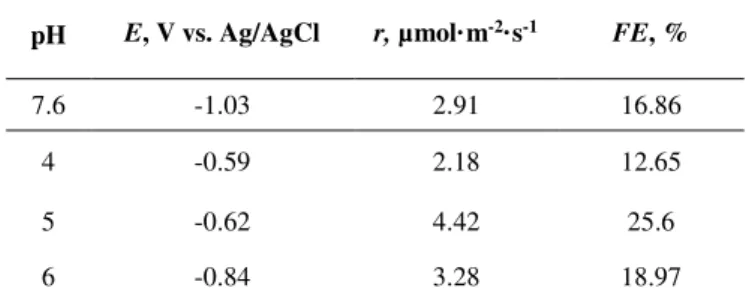
[26, 30]. Table 2 shows the quantitative information (r and FE) regarding the production
334
of CH3OH at a pH ranging from 4 to 6 in the Cu2O/ZnO-2mPy (10 mM) system. The pH
335
was adjusted by adding HCl to the solution. Trace amounts of C2H5OH were also
336
detected. The values are compared to the performance found at a pH of 7.6.
337
Table 2. r and FE at Cu2O/ZnO-2mPy (10mM) for a pH range of 4 -7.6. j= 1 mA·cm-2. Qe/A= 1 ml· min
-338
1·cm-2, Qg/A= 20 ml· min-1·cm-2
339
pH E, V vs. Ag/AgCl r, µmol· m-2·s-1 FE, %
7.6 -1.03 2.91 16.86
4 -0.59 2.18 12.65
5 -0.62 4.42 25.6
6 -0.84 3.28 18.97
340
As observed, a mild acidification (pH= 5-6) led to increases in CH3OH production,
341
indicating that reaction kinetics depend on the concentration of pyridinium ions ([PyH+])
342
and/or hydrons available in the solution [26, 54, 55]. In fact, the marked lowering in the
343
overpotential points to a change in the reaction mechanism which necessarily needs to go
344
by a different transition state as the protonated pyridinium cannot directly form the
345
carbamate [19]. Specifically, the rate for CH3OH formation is as high as r= 4.42 µmol·m
-346
2·s-1 at an optimum pH value of 5, which is around 1.5 times higher than the production
347
rate observed for Cu2O/ZnO-2mPy (10 mM) at pH=7.6. In the same manner, the
348
efficiency of the process is significantly raised by reducing the pH of the solution, with a
349
value as high as FE= 25.6% for an applied voltage of E= -0.62 V vs. Ag/AgCl (j= 1
350
mA·cm-2), thus corresponding to a overpotential of ca. 150 mV more than the
351
thermodynamic potential needed for CH3OH formation (-0.47 V vs. Ag/AgCl) at pH of
352
5.4 [22]. It is important to note that the reaction outcome improvement can be also
353
attributed to the partial dissolution of ZnO at mild acidic pHs, which would render more
15
Cu2O exposed at the surface of the cathode. It is also noteworthy to mention that this FE
355
to CH3OH formation is comparable to that maximum value obtained in our previous
356
report for the same Cu2O/ZnO-based catalyst in the absence of any Py molecular catalyst
357
(FET= 27.5%) [12], although in this latter a current density of j= 10 mA·cm-2 was
358
required. This indicates the relevance of using Py-based molecular catalysts to enhance
359
the energy efficiency of the electrocatalytic reduction of CO2.
360
Further reductions in pH to 4 produced a severe decrease in process efficiency, which
361
could be initially interpreted by reductions in CO2 solubility when decreasing the pH [18,
362
54]. Nonetheless, previous reports demonstrated the formation of copper(I) chloride
363
(CuCl) in the presence of HCl when evaluating Cu-based electrocatalysts for CO2
364
reduction [56]. CuCl compound has been proven to preferentially promote the formation
365
of ethylene (C2H4) from the electrocatalytic reduction of CO2, due to the ability of CuCl
366
to reversibly combine with CO and C2H4 [56]. This will also explain the drastic reduction
367
in FE to CH3OH observed at pH= 4.
368
Finally, an evaluation of the Cu2O/ZnO-2mPy (10 mM)-based system performance for
369
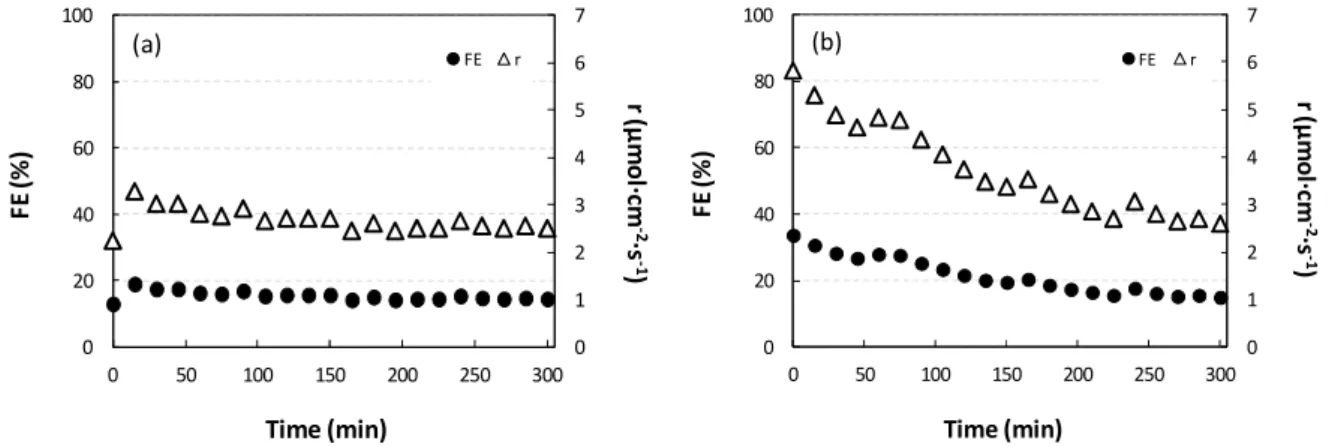
CO2 electroreduction at ambient conditions is evaluated in the long-run (5 h). The results
370
for r and FE evolution are presented in Figure 5a and Figure 5b in a pH of 7.6 and 5,
371
respectively. The stability of the co-catalyzed reduction was tracked while continuously
372
sparging the solution with CO2 at a constant current density of j= 1 mA·cm-2, where a
373
good balance between FE and r is observed (Figure 4, Table 1).
374
Figure 5. Time-dependence on r and FE for the Cu2O/ZnO-2mPy (10 mM)-based system at (a) pH= 7.6 and (b) pH=5.
j=1 mA·cm-2, Qe/A= 1 ml· min-1·cm-2, Qg/A= 20 ml· min-1·cm-2.
375
As observed, the Cu2O/ZnO-2mPy (10mM)-based system (pH= 7.6) showed only a slight
376
activity decrease in the long run with a CH3OH formation rate of r= 2.5 µmol·m-2·s-1 and
377 0 1 2 3 4 5 6 7 0 20 40 60 80 100 0 50 100 150 200 250 300 r ( µ m o l·c m -2 ·s -1 ) F E ( % ) Time (min) FE r (a) 0 1 2 3 4 5 6 7 0 20 40 60 80 100 0 50 100 150 200 250 300 r ( µ m o l·c m -2 ·s -1 ) F E ( % ) Time (min) FE r (b)
16
FE= 14.45% at the end of the test (Figure 5a). We speculate that pairing a Py-based
co-378
catalyst with a Cu2O/ZnO cathode could potentially mitigate the limited stability
379
observed in the electroreduction of CO2 for CH3OH production [9]. In fact, previous
380
literature demonstrated that a stable electroreduction of CO2 to HCOOH over 5 days can
381
be reached at Sn-2mPy-based electrocatalytic system for a current applied of j= 1 mA·cm
-382
2 in a membrane-separated cell [45]. In contrast, when the pH decreased to 5 (by the
383
addition of HCl) a significant drop in process performance is clearly observed at the initial
384
3 h of experimental time with a 49% loss of activity (Figure 5b). Then, the production
385
seems to slightly decrease (or stabilize) until the end of the test (r= 2.6 µmol·m-2·s-1, FE=
386
15.1%). In fact, the FE after 5 h is similar to that steady-state value observed for a pH =
387
7.6 (FE= 14.45%), which may probably indicate that the process performance is limited
388
by the pyridine-Cu2O/ZnO combination itself, rather than the pH of the electrolyte
389
solution.
390
This reduction in process performance at pH= 5 is unexpected if we observe the stable
391
CH3OH formation rates reached at long reactions times in photo-and-electrocatalytic
392
systems based on Ga, Pd and Ru metals at a similar pH level [21, 25, 26]. For example,
393
Barton et al. found that the production of CH3OH was linear with a charge passed ranging
394
from 3 to 10 C at pH= 5.2 and 7 h of operation using a p-GaP-based photo-electrochemical
395
cell. The Py concentration was also observed to be invariant over the time of the
396
experiments, indicating that it is not consumed by the CH3OH formation reaction [21]. In
397
the same manner, Wang et al. [26] observed a stable production of CH3OH, as solo
398
product, from CO2 in aid of Ru-phenanthroline complex photosensitizer. The yield of
399
CH3OH reached 60 µmol·L-1 after 6 h of reaction time. Literature shows, however, that
400
certain metals, such as Zn [57] and Cu [58], corrode more easily and give up electrodes
401
when exposed to an acidic solution, which lead to a reduced performance. From our
402
analyses a striking feature is that cathodic voltage rose only slightly after 5 h of
403
electrolysis, from -0.62 V (after 15 min.) to -0.76 V vs. Ag/AgCl to maintain a current
404
density of j= 1 mA·cm-2 (Figure 5b). This limited increase in potential over time can be
405
attributed to the consumption of the acid during the reduction process [47], since the pH
406
of the aqueous electrolyte solutions increased from 5 to 5.69 after electrolysis. In any case,
407
the limited increase in E probably indicate that the electrocatalytic system maintains its
408
CO2 reduction activity after 5 h of operation and thus, we hypothesized that the reduction
409
in r and FE to CH3OH observed has probably more to do with a variation in product
17
selectivity (C2H4 formation with CuCl) [56], rather than the degradation of the catalytic
411
material in the presence of HCl. Overall, the stable formation of CH3OH at the
412
Cu2O/ZnO-2mPy (10 mM)-based system at a pH of 7.6, with a FE= 14.45% and moderate
413
r= 2.5 µmol·m-2·s-1, show the potential of using Py-based molecular catalyst in the
414
electroreduction of CO2 to CH3OH.
415
The outstanding scientific challenge seems to be in the understating of the underlying
416
reaction mechanisms of Py-catalyzed CO2 reduction processes to form CH3OH, not only
417
to exhaustively elucidate the role of Py but also to develop related catalysts that exploit
418
the fundamental phenomena at play in the reduction reaction. It is suggested that the
419
reduction mechanisms of the reduction proceed through various coordinative interactions
420
between the Py radical and CO2 to form carbamate-like species, which are proposed to be
421
the rate determining step for the process [18, 59], and then a subsequent sequential
422
electron and proton transfer processes to ultimately yield CH3OH. In the current work,
423
the inductive effect caused by the electron-withdrawing and releasing substituents on
σ-424
donor N atom of the Py ring seems to play an important role in the electron transfer to
425
CO2 and thus, in the reaction outcome. However, there is a delicate balance between
426
kinetics and thermodynamics underlying the observed reactivity. While increased
427
electron-releasing ability of the Py-based molecular catalyst is predicted to favour the
428
electron transfer to the electrophilic C atom of the CO2 and increase reaction rate
429
corresponding to this stage, at the same time this would also stabilize the carbamate
430
species, which is not desired for the subsequent CH3OH formation [18]. Certainly, further
431
experimental work is required to fully elucidate CO2 reduction steps to CH3OH in the
Py-432
based catalysed reaction, including the analysis of charge-transfer proccesses and the
433
governing physical and chemical phenomena taking place in the electrochemical systems
434
[60], although significant research efforts have been recently made [16, 26, 30-32, 54,
61-435
66].
436
4. Conclusions 437
This work demonstrated the beneficial use of pyridine-based molecular catalysts
438
containing electron-releasing or electron-withdrawing groups (i.e. 2-methylpyridine,
4-439
ethylpyridine, 2,4,6-trimethylpyridine, pyridine, 2-chloropyridine, 4,4-bipyridine), to
440
reach enhanced energy efficiencies for the electrocatalytic reduction of CO2 to methanol
441
at Cu2O/ZnO-based surfaces.
18
The results showed that all the applied pyridine-based soluble co-catalysts lowered the
443
overpotential for the electrochemical reduction of CO2. In particular, the reduction
444
response occurred at around 200 mV lower overpotential in the presence of
2-445
methylpyridine (compared to the electrocatalytic system with a CO2-saturated electrolyte
446
without it). The overpotential reduction with respect to the unsubstituted Py is explained
447
by electron-releasing alkyl groups (I+ effect) that makes the pyridinic ring more prone to
448
transfer an electron through a nucleophilic addition and consequent formation of a
449
carbamate intermediate.
450
The continuous electroreduction of CO2 to methanol tests in a filter-press electrochemical
451
cell, showed a maximum methanol formation rate when using 2-methylpyridine (10 mM),
452
r= 2.91 µmol·m-2·s-1 (Faradaic efficiency= 16.86%), which is significantly higher than
453
that value in the absence of any molecular catalyst, r= 0.21 µmol·m-2·s-1 (Faradaic
454
efficiency= 1.2%). Importantly, process efficiency was significantly raised by reducing
455
the pH of the electrolyte to 5, with Faradaic efficiencies as high as FE= 25.6% for an
456
applied voltage of E= -0.62 V vs. Ag/AgCl (j= 1 mA·cm-2) in the 2mPy (10 mM)-based
457
system. This system, however, showed deactivation at longer reaction times, which may
458
be associated to a change in the selectivity of the reaction (i.e. formation of ethylene).
459
Acknowledgements 460
The authors gratefully acknowledge the financial support from the Spanish Ministry of
461
Economy and Competitiveness (MINECO), under the projects CTQ2013-48280-C3-1-R,
462
CTQ2014-55716-REDT and Juan de la Cierva program (JCI-2012-12073).
463
References 464
[1] Albo J., Yoshioka T., Tsuru T., Porous Al2O3/TiO2 tubes in combination with
1-ethyl-465
3-methylimidazolium acetate ionic liquid for CO2/N2 separation. Sep. Purif. Technol. 122
466
(2014) 440-448.
467
[2] Albo J., Irabien A., Non-dispersive absorption of CO2 in parallel and cross-flow
468
membrane modules using EMISE. J. Chem. Technol. Biot. 87:10 (2012) 1502-1507.
469
[3] Albo J., Luis P., Irabien A. Carbon dioxide capture from flue gases using a cross-flow
470
membrane contactor and the ionic liquid 1-ethyl-3-methylimidazolium ethylsulfate. Ind.
471
Eng. Chem. Res. 49:21 (2010) 11045-11051.
19
[4] International Energy Agency (IEA). (2015). CO2 emissions from fuel combustion:
473
Highlights.
474
[5] Aresta M., Dibenedetto A., Angelini A., Catalysis for the valorization of exhaust
475
carbon: From CO2 to chemicals, materials, and fuels. Technological use of CO2. Chem.
476
Rev. 114 (2014) 1709-1742.
477
[6] Centi G., S. Perathoner S., Opportunities and prospects in the chemical recycling of
478
carbon dioxide to fuels. Catal. Today. 148 (2009) 191-205.
479
[7] Martín A. J., Larrazábal G. O., Pérez-Ramírez J., Towards sustainable fuels and
480
chemicals through the electrochemical reduction of CO2: lessons from water electrolysis.
481
Green Chem. 17 (2015) 5114-5130.
482
[8] Dominguez-Ramos A., Singh B., Zhang X., Hertwich E. G., Irabien A., Global
483
warming footprint of the electrochemical reduction of carbon dioxide to formate. J.
484
Cleaner Prod.104 (2015) 148-155.
485
[9] Albo J., Alvarez-Guerra M., Castaño P., Irabien A., Towards the electrochemical
486
conversion of carbon dioxide into methanol. Green Chem. 17 (2015) 2304-2324.
487
[10] Olah G. A., Goeppert A., Prakash G. K. S., Beyond oil and gas: the methanol
488
economy. Wiley-VCH, Weinheim, 2006.
489
[11] Albo J., Vallejo D., Beobide G., Castaño P., Cu-based metal-organic porous
490
materials for CO2 electroreduction to alcohols. ChemSusChem. (2016).
491
doi: 10.1002/cssc.201600693.
492
[12] Albo J., Irabien A., Cu2O-based catalysts for the electrochemical reduction of CO2
493
at gas-diffusion electrodes. J. Catal. 343 (2016) 232-239.
494
[13] Albo J., Sáez A., Solla-Gullón J., Irabien A., Production of methanol from
495
CO2 electroreduction at Cu2O and Cu2O/ZnO-based electrodes in aqueous solution. Appl.
496
Catal. B-Environ. 176-177 (2015) 709-717.
497
[14] Lim R. J., Xie M., Ska M. A., Leea J-M., Fisher A., Wang X., Lim K. H. A review
498
on the electrochemical reduction of CO2 in fuel cells, metalelectrodes and molecular
499
catalysts. Catal. Today. 233 (2014) 169-180.
20
[15] Oha Y., W. A. Organic molecules as mediators and catalysts for photocatalytic and
501
electrocatalytic CO2 reduction. Chem. Soc. Rev. 42 (2013) 2253-2261.
502
[16] Yan Y., Zeitler E. L., Gu J., Hu Y., Bocarsly A. B., Electrochemistry of aqueous
503
pyridinium: exploration of a key aspect of electrocatalytic reduction of carbon dioxide to
504
methanol. J. Am.Chem. Soc. 135 (2013) 14020-14023.
505
[17] Bocarsly A. B., Gibson Q. D., Morris A. J., L’Esperance R. P., Detweiler Z. M.,
506
Lakkaraju P. S., Zeitler E. L. Shaw T. W., Comparative study of imidazole and pyridine
507
catalyzed reduction of carbon dioxide at illuminated iron pyrite electrodes, ACS Catal. 2
508
(2012) 1684-1692.
509
[18] Morris A. J., McGibbon R. T., Bocarsly A. B., Electrocatalytic carbon dioxide
510
activation: the rate-determining step of pyridinium-catalyzed CO2 reduction.
511
ChemSusChem. 4 :2 (2011) 191-196.
512
[19] Barton C. E., Lakkaraju P. S., Rampulla D. M., Morris, A. J., Abelev, E., Bocarsly,
513
A. B., Using a one-electron shuttle for the multielectron reduction of CO2 to methanol:
514
kinetic, mechanistic, and structural insights, J. Am. Chem. Soc. 132: 33 (2010)
11539-515
11551.
516
[20] Rosen B. A., Salehi-Khojin A., Thorson M. R., Zhu W., Whipple D. T., Kenis P. J.
517
A., Masel R. I., Ionic liquid−mediated selective conversion of CO2 to CO at low
518
overpotentials, Science. 74: 2 (2009) 487-498.
519
[21] Barton C. E., Rampulla D. M., Bocarsly A. B., Selective solar-driven reduction of
520
CO2 to methanol using a catalyzed p-GaP based photoelectrochemical cell, J. Am. Chem.
521
Soc. 130 (2008) 6342-6344.
522
[22] Seshadri G., Lin C., Bocarsly A. B., A new homogeneous electrocatalyst for the
523
reduction of carbon dioxide to methanol at low overpotential, J. Electroanal. Chem. 372:
524
1-2 (1994) 145-150.
525
[23] Boston D. J., Xu C., Armstrong D. W., MacDonnell F. M., Photochemical reduction
526
of carbon dioxide to methanol and formate in a homogeneous system with pyridinium
527
catalysts. J. Am. Chem. Soc. 135: 44 (2013)16252-16255.
21
[24] Dongmei X., Magana D., Dyer R. B., CO2 reduction catalyzed by mercaptopteridine
529
on glassy carbon. J. Am. Chem. Soc. 2014, 136:40 (2014)14007-14010.
530
[25] Yang H., Qin S., Wang H., Lu J., Organically doped palladium: a highly efficient
531
catalyst for electroreduction of CO2 to methanol. Green Chem. 17 (2015) 5144-5148.
532
[26] Wang W., Zhang J., Wang H., Chen L., Bian Z., Photocatalytic and electrocatalytic
533
reduction of CO2 to methanol by the homogeneous pyridine-based systems. Appl. Catal.
534
A-Gen. 520 (2016) 1-6.
535
[27] Rybchenko S., Touhami D., Wadhawan J, Haywood S., Study of Pyridine-Mediated
536
Electrochemical Reduction of CO2 to Methanol at High CO2 Pressure. ChemSusChem.
537
9:13 (2016) 1660-1669.
538
[28] Yang H., Qin S., Yue Y., Liu L., Wang H., Lu J.Entrapment of a pyridine derivative
539
within copper-palladium alloy: a bifunctional catalyst for electrochemical reduction of
540
CO2 to alcohols with excellent selectivity and reusability. Catal. Sci. Technol. 6 (2016)
541
6490-6494.
542
[29] Yang H., Yue Y., Qin S., Wang H., Lu J., Selective electrochemical reduction of CO2
543
to different alcohol products by an organically doped alloy catalyst. Green Chem. 18
544
(2016) 3216-3220.
545
[30] Ertem M. Z., Konezny S. J., Araujo C. M., Batista V. S., Functional Role of
546
Pyridinium during Aqueous Electrochemical Reduction of CO2 on Pt(111). J. Phys.
547
Chem. Lett. 4: 5 (2013) 745-748.
548
[31] Lim C. H., Holder A. M., Musgrave C. B., Mechanism of homogeneous reduction
549
of CO2 by pyridine: proton relay in aqueous solvent and aromatic stabilization. J. Am.
550
Chem. Soc. 135 (2013) 142-154.
551
[32] Keith J. A., Carter E. A., Theoretical insights into pyridinium-based
552
photoelectrocatalytic reduction of CO2. J. Am. Chem. Soc. 134: 18 (2013) 7580-7583.
553
[33] Keith J. A., Carter E. A., Electrochemical reactivities of pyridinium in solution:
554
consequences for CO2 reduction mechanisms. Chem. Sci. 4 (2013) 1490-1496.
555
[34] Yasukouchi K., Taniguchi I., Yamaguchi H., Shiraishi M. J., Cathodic reduction of
556
pyridinium ion in acetonitrile. J. Electroanal. Chem. 105 (1979) 403-408.
22
[35] Qiao J., Liu Y., Hong F., Zhang J., A review of catalysts for the electroreduction of
558
carbon dioxide to produce low-carbon fuels. Chem. Soc. Rev. 43 (2014) 631-675.
559
[36] Peterson A. A., Abild-Pedersen F., Studt F., Rossmeisl J., Nørskov J. K., How copper
560
catalyzes the electroreduction of carbon dioxide into hydrocarbon fuels, Energy Environ.
561
Sci. 3 (2010) 1311-1315.
562
[37] Gattrell M., Gupta N., Co A., A review of the aqueous electrochemical reduction of
563
CO2 to hydrocarbons at copper. J. Electroanal. Chem. 594 (2006) 1-19.
564
[38] Kuhl K. P., Cave E. R., Abram D. N., Jaramillo T. F., New insights into the
565
electrochemical reduction of carbon dioxide on metallic copper surfaces. Energy Environ.
566
Sci. 5 (2012) 7050-7059.
567
[39] Aeshala L. M., Uppaluri R. G., Verma A., Effect of cationic and anionic solid
568
polymer electrolyte on direct electrochemical reduction of gaseous CO2 to fuel. J. CO2
569
Util. 3-4 (2013) 49-55.
570
[40] Le M, Ren M., Zhang Z., Sprunger P. T., Kurtz R. L., Flake J. C., Electrochemical
571
Reduction of CO2 to CH3OH at copper oxide surfaces. J. Electrochem. Soc.158: 5 (2011)
572
E45-E49.
573
[41] Frese K. W., Electrochemical reduction of CO2 at intentionally oxidized copper
574
electrodes. J. Electrochem. Soc. 138: 11 (1991) 3333-3344.
575
[42] Heinzel A., Barragan V. M., A review of the state-of-the-art of the methanol
576
crossover in direct methanol fuel cells. J. Power Sources. 84:1 (1999) 70-74.
577
[43] Del Castillo A., Alvarez-Guerra M., Irabien A., Continuous electroreduction of CO2
578
to formate using Sn gas diffusion electrodes. AIChE J. 60:10 (2014) 3557-3564.
579
[44] Merino-García I., Alvarez-Guerra E., Albo J., Irabien A., Electrochemical membrane
580
reactors for the utilisation of carbon dioxide. Chem. Eng. J. 305:1 (2016) 104-120.
581
[45] Parajuli R., Gerken J. B., Keyshar K., Sullivan I., Sivasankar N., Teamy K., Stahl S.
582
S., Barton C. E., Integration of anodic and cathodic catalysts of earth abundant materials
583
for efficient, scalable CO2 reduction. Top. Catal. 58:1 (2015) 57-66.
23
[46] Baumgartel H., Retzlav K. J., Heteroaromatic Compounds. In Encyclopedia of
585
Electrochemistry of the Elements; Bard A. J., Lund H., Eds.; Marcel Dekker: New York,
586
1984; Vol. XV, p 194.
587
[47] Lee H. Q. J., Lauw S. J. L., Webster R. D., The electrochemical reduction of carbon
588
dioxide (CO2) to methanol in the presence of pyridoxine (vitamin B6). Electrochem.
589
Commun. 64 (2016) 69-73.
590
[48] Cole E. E. B., Baruch M. F., L’Esperance R. P. L., Kelly M. T., Lakkaraju P. S.,
591
Zeitler E. L., Bocarsly A. B., Substituent effects in the pyridinium catalyzed reduction of
592
CO2 to methanol: further mechanistic insights. Top. Catal. 58 (2015) 15-22.
593
[49] Portenkirchner E., Enengl C., Enengl S., Hinterberger G., Schlager S., Apaydin D.,
594
Neugebauer H., Knör G., Sariciftci N. S., A comparison of pyridazine and pyridine as
595
electrocatalysts for the reduction of carbon dioxide to methanol. ChemElectroChem. 1
596
(2014) 1543-1548.
597
[50] Ponnurangam S., Yun C. M., Chernyshova I. V., Robust electroreduction of CO2 at
598
a poly(4-vinylpyridine)-copper Electrode. ChemElectroChem. 3 (2016) 74-82.
599
[51] Frese K. W., Canfield D., Reduction of CO2 on n‐GaAs electrodes and selective
600
methanol synthesis. J. Electrochem. Soc. 131:11 (1984) 2518-2522.
601
[52] Lebégue E., Agullo J., Morin M., Bélanguer D., The role of surface atoms in the
602
electrochemical reduction of pyridine and CO2 in aqueous electrolyte.
603
ChemElectroChem. 1 (2014) 1013-1017.
604
[53] Hanai T., Koizumi K., Kinoshita T., Arora R., Ahmed F., Prediction of pKa values
605
of phenolic and nitrogen-containing compounds by computational chemical analysis
606
compared to those measured by liquid chromtography. J. Chromatogr. A. 762 (1997)
55-607
61.
608
[54] Yuan J., Hao C., Solar-driven photoelectrochemical reduction of carbon dioxide to
609
methanol at CuInS2 thin film photocathode. Sol. Energ. Mat. Sol. C. 108 (2013) 170-174.
610
[55] Appel A. M., Bercaw J. E., Bocarsly A. B., Dobbek H., DuBois D. L., Dupuis M.,
611
Ferry J. G., Fujita E., Hille R., Kenis P. J. A., Kerfeld C. A., Morris R. H., Peden C. H.
612
F., Portis A. R., Ragsdale S. W., Rauchfuss T. B., Reek J. N. H., Seefeldt L. C., Thauer
24
R. K., Waldrop G. L., Frontiers, opportunities, and challenges in biochemical and
614
chemical catalysis of CO2 fixation. Chem. Rev. 113 (2013) 6621-6658.
615
[56] Ogura K., Yano H., Shirai F., Catalytic reduction of CO 2 to ethylene by electrolysis
616
at a three-phase interface. J. Electrochem. Soc. 150(9) (2003) D163-D168.
617
[57] Qi J., Zhang K., Ji Z., Xu M., Wang Z., Zhang Y., Dissolving behavior and electrical
618
properties of ZnO wire in HCl solution. RSC Adv. 5 (2015) 44563-44566.
619
[58] Sherif E-S. M., Corrosion behavior of copper in 0.50 M hydrochloric acid pickling
620
solutions and its inhibition by 3-amino-1,2,4-triazole and
3-amino-5-mercapto-1,2,4-621
triazole. Int. J. Electrochem. Sci. 7 (2012) 1884-1897.
622
[59] Kamrath M. Z., Relph R. A., Johnson M. A., Vibrational predissociation spectrum
623
of the carbamate radical anion, C5H5N-CO2-, generated by reaction of pyridine with
624
(CO2)m-. J. Am. Chem. Soc. 132 (2010) 15508-15511.
625
[60] Ehsani A., Mahjani M.G., Jafarian M., Naeemy A., Electrosynthesis of polypyrrole
626
composite film and electrocatalytic oxidation of ethanol. Electrochim. Acta. 71 (2012)
627
128–133.
628
[61] Lim C-H., Holder A. M., Hynes J. T., Musgrave C. B., Reduction of CO2 to methanol
629
catalyzed by a biomimetic organo-hydride produced from pyridine. J. Am. Chem. Soc.
630
136 (2014) 16081-16095.
631
[62] Keith J. A., Carter E. A., Theoretical insights into electrochemical CO2 reduction
632
mechanisms catalyzed by surface-bound nitrogen heterocycles. J. Phys. Chem. Lett. 4
633
(2013) 4058-4063.
634
[63] Costentin C., Canales J. C., Haddou B., Saveant J. M., Electrochemistry of acids on
635
platinum. Application to the reduction of carbon dioxide in the presence of pyridinium
636
ion in water. J. Am. Chem. Soc. 135 (2013) 17671-17674.
637
[64] Lessio M., Cartes E. A., What is the role of pyridinium in pyridine-catalyzed CO2
638
reduction on p‑GaP photocathodes? J. Am. Chem. Soc. 137 (2015) 13248-13251.
639
[65] Senftle T., Lessio M., Carter E., Interaction of pyridine and water with the
640
reconstructed surfaces of GaP(111) and CdTe(111) photoelectrodes: Implications for CO2
641
reduction. Chem. Mater. 28:16 (2016) 5799-5810.
25
[66] Schneider T., Ertem M., Muckerman J., Angeles-Boza A., Mechanism of
643
Photocatalytic Reduction of CO2 by Re(bpy)(CO)3Cl from Differences in Carbon Isotope
644
Discrimination. ACS Catal. 6 (2016) 5473-5481.