
Methodology for Speaking Skill to Overcome the B2 Level According to the Common European Framework of Reference in the Students at 8th Semester “A”, Language Career In The Universidad Nacional De Chimborazo, In The City of Riobamba, Chimborazo Province Du
82
0
0
Texto completo
(2) i.
(3) AUTHORSHIP. “The content responsibility of this graduate work belongs exclusively to: Paola Cristina Herrera Ochoa, Johanna Maritza Arrobo Coronel and Mgs. César Augusto Narváez Vilema; and its intellectual heritage to Universidad Nacional de Chimborazo.”. ii.
(4) Acknowledgments Every failure is a step to success –William Whewell This work has been an effort, due to the time, resources and hard work we have spent developing it; however this research could not be succeed, without the help of our tutor; Mgs. César Augusto Narváez Vilema, for this reason I want to say thanks, for each recommendation, and suggestion. Also, my sincere thanks to my parents, Angel. Enrique. Herrera. Vinueza. and. Carmen Susana Ochoa Paladines my sister Sofia Herrera, my grandmother Dora Paladines and my aunt Mariana Herrera who have supported me throughout my career. with. advices. and. economic. resources, as well. Paola Cristina Herrera Ochoa. iii.
(5) First, I am thankful with God, because he has provided me with health and strength for getting this great achievement, thanks to my parents Angel Gabriel Arrobo Vega y Rosa Elena Coronel Jimenez, my uncles Jorge, Walter, Julio Coronel Jimenez and my grandmother Rosa Jimenez, who in one way or another supported me throughout my academic life, for all their efforts and hopes, today it is possible to say that I have not defrauded them. Thanks to Mgs. César Narváez Vilema for believing in my intelligence, for his motivations, patience and knowledge such a wise way, because more than a tutor he was a guide. Thanks to my best friend Bladimirt Rojas, for all advice, moral support, and being with me always without conditions. Finally thanks to all people, who collaborate with me with a bit, for getting today this great dream. Johanna Maritza Arrobo Coronel. iv.
(6) Dedication The human being, always need to surround good energy for getting new things, goals, and rewards. My daughter Alejandra has been my motor, because she has let me become in mother, thanks to her, I overcome some situations that happened in my personal and academic life, my baby was my inspiration along my career, for this reason this research work is dedicated to her and my parents too, because they play an important role in my life, they have supported and given me some tools for facing life every day. Paola Cristina Herrera Ochoa To all my family, especially to my parents Angel Gabriel Arrobo Vega y Rosa Elena Coronel. Jimenez,. because. with. great. efforts, they have guided and supported me throughout this journey, for all work and effort put in this research I dedicate it to them with love. Johanna Maritza Arrobo Coronel. v.
(7) INDEX Authorship............................................................................................................................................... ii Acknowledgments .................................................................................................................................. iii Dedication ................................................................................................................................................v Introduction .............................................................................................................................................ix CHAPTER I ............................................................................................................................................1 3. REFERENCIAL FRAMEWORK ................................................................................................. 1 3.1Research Problem .......................................................................................................................1 3.2 Problem Statement .....................................................................................................................1 3.3 Problem formulation ..................................................................................................................4 3.4 Questions Guidelines ..................................................................................................................4 3.5 OBJECTIVES: ............................................................................................................................. 5 3.5.1 General Objective ....................................................................................................................5 3.5.2 Specific Objectives ..................................................................................................................5 3.6 Justification...................................................................................................................................6 CHAPTER II ..........................................................................................................................................8 4. THEORETICAL FRAMEWORK ................................................................................................ 8 4.1. Background investigations regarding to the Problem to be investigated .....................................8 4.2. THEORETICAL FOUNDATION .............................................................................................. 9 4.2.1 The Common European Framework of Reference (CEFR) ......................................................9 4.2.2 B2 English Level According To The Cefr ................................................................................9 4.2.3 Speaking Skill In The Level B2 According To The Cefr ........................................................ 10 4.2.4 International English Proficiency Tests .................................................................................. 12 4.2.5 English Speaking Levels According To The Common European Framework Of Reference ... 28 4.2.6 Speaking ............................................................................................................................... 30 4.2.7 Techniques For Improving The Speaking Skill ...................................................................... 31 4.3. HYPOTHESIS ........................................................................................................................... 35 4.4 VARIABLES .............................................................................................................................. 36 4.4.1 Dependent variable ................................................................................................................ 36 4.4.2 Independent variable ............................................................................................................. 36 4.5 DEFINITION OF BASIC TERMS ............................................................................................ 36 CHAPTER III ....................................................................................................................................... 38 5. METHODOLOGICAL FRAMEWORK .................................................................................... 38 5.1. Research Design ...................................................................................................................... 38 6. Conclusions and recommendations ............................................................................................. 49 6.1 Conclusions .............................................................................................................................. 49 6.2 Recommendations .................................................................................................................... 50 7. BIBLIOGRAPHY ........................................................................................................................ 51 8. ANEXES ....................................................................................................................................... 55. vi.
(8) LIST OF TABLES AND FIGURES TABLES TABLE 1: Keys for Giving Opinions .......................................................................... 19 FIGURE FIGURE 1: Diagnostic Results ..................................................................................... 42 FIGURE 2: Diagnostic Test Results ............................................................................. 43. vii.
(9) viii.
(10) Introduction This research is a gathering of information in which, there are some investigations, that help and support this work such as: “A multifaceted approach to investigating pre-task planning effects on paired oral test Language Testing”, by Elder, C., Iwashita, N., & McNamara, T. (2002), “The Language Teacher Readers‟ Forum 33 Learning to speak English: Japanese junior high school, student views” By: Douglas James Rapley Kawasaki Medical School (2010.), “Estimating the difficulty of oral proficiency tasks: What does the test-taker have to offer?” by Elder, C., Iwashita, N., & McNamara, T. (2002) and “Rethinking Assessment of Thai EFL Learners' Speaking Skills Language Testing in Asia” by Kemtong Sinwongsuwat (2012), also these researches allow us to understand some problems at the moment to acquire the English language, developing process in the speaking area. Other bibliography which supports this study are: the “Common European Framework of Reference for Languages: Learning, Teaching, Assessment” (2014, p.24), First Certificate in English Guide (Cambridge English First, 2015), THE TOEFL-iBT Test Guide (Speaking Section Academic Speaking Skills, 2014), International English Language Testing System (IELTS-Exam.net, 2014), and “Improving Adult English Language Learner´s Speaking Skills” by Brown, 1994; Burns & Joyce, 1997. In this research it has been evidenced some difficulties in speaking skill, by means of interviews and surveys applied to students at 8 th semester in the Languages Career at Universidad Nacional de Chimborazo ; for this reason, the research entitle “Methodology for speaking skill to overcome the B2 level according to the Common European Framework of Reference in the students at 8th semester, Language Career in the Universidad Nacional de Chimborazo”, was proposed for helping students. ix.
(11) to improve their speaking skill through the use of some strategies that teacher may use in the classroom. This research explains the importance of speaking and the characteristics of a speaker in the level B2 according to the Common European Framework of Reference (CEFR) moreover; it contains a sort of strategies that may help learners to improve their English speaking skill that could be meaningful tools at the moment to face a B2 iBT test. The main goal of this research is focused on describing some strategies, processes, activities, policies, resources, etc. to help students face successfully an international test, thereby, learners can practice the target language, and develop new approaches for learning. The present investigation is divided into three chapters and each one of them contents meaningful information based on the development of the research‟s variables (B2 level and speaking skill) so the first chapter contains the research problematic where is explained clearly the different drawbacks in the speech area, why and how these affect undergraduates, the second chapter shows us a set of definitions, concepts, and strategies that supports the investigation, and finally the third chapter covers the analysis and interpretation of data, also this part includes the techniques and instruments used to get information from the population and the most relevant criteria here are; data procedure and processing.. x.
(12) CHAPTER I. 3. REFERENCIAL FRAMEWORK 3.1Research Problem “Methodology for speaking skill to overcome the B2 level according to the Common European Framework of Reference in the students at 8th semester “A”, Language Career in the Universidad Nacional de Chimborazo, in the city of Riobamba, Chimborazo Province during the academic term April-August 2015. 3.2 Problem Statement The Universidad Nacional de Chimborazo is an Educational Institution, which forms professional in the field of research and entrepreneurship with scientific and axiological foundations that contribute to the solution of problems of the society and the country (UNACH-mision, 2013 p. 2). It has four faculties which are: Ciencias de la Salud, Ingeniería, Ciencias Políticas y Administrativas and Ciencias de la Educación, Humanas y Tecnologías; the last one is located at Eloy Alfaro Avenue and 10 de Agosto Street, where Carrera de Idiomas is and its mission is forming high quality teachers of English Language with a broad knowledge on the areas of science, technology and, human studies to successfully overcome the challenges of today`s globalized world (Idiomas Career-mission, 2013 p. 2). There are 130 undergraduates studying therein who come from different parts of the country and have a middle Socio-economic status. (Dep. Tutoría-Facultad Ciencias de la Educación-Unach 2015) One of those challenges is the necessity of a thorough knowledge of English Language, not only because, it is considered the current Lingua Franca but, as cited in the National Curriculum Guidelines of Ecuadorian (2014, p. 3), most of the technological, scientific, academic, and social information is written in English; at the same time, it is an 1.
(13) obligatory entrance requirement in all of the prestigious universities around the world (TOEFL Official Guide, 2009, p.2). Ecuador‟s government is conscious of this reality, that is why, the Ministry of Education set a new curriculum in the area based on standards of the Common European Framework of Reference for language: Learning, teaching, assessment (CEFR) and the Communicative Approach (National English Curriculum Guidelines, 2014), the same department in 2012 established the Ecuadorian in-service English teacher and the English Language learning standards and, foster some academic programs to give English teachers the opportunity to improve their language proficiency, such as: “Go Teacher”. Also, it is set as a national obligatory requirement to be an English teacher, to have the B2 level of English according to the Common European Framework of Reference as minimum (Acuerdo Ministerial 153-13, 2013, Arts. 5, 8). All of these policies are due to the negative results got in a test taken to the English teachers by the Ministry of Education; as Freddy Peñafiel Vice-Minister of Education (2014) explained “less than the 2% of teachers who were evaluated have the B2 level”.. This problem is evidenced in the local educational environment too; after some observations and the application of a sample test for evaluating speaking skill developed by the Cambridge University (2009), to students at 8th semester "A" in 2015 by professors in charge of the research study entitled “Programa de Refuerzo Académico para vencer un examen nivel B2 según el Marco Común Europeo o su equivalente” which this research is part of, it was possible to identify that the 92% of the students at 8th semesters “A” are under the desired level (B2). The main cause is the lack of knowledge of how to face an international test like FCE, TOEFL-iBT and IELTS, etc. The students do not know what kind of materials and 2.
(14) activities are used for evaluating the macro skills of English in these tests, the strategies, techniques, resources, processes that they have to follow in order to deal with them successfully. In addition, they have just superficial ideas about where they can take these tests; the time assigned for each skill, the general policies and the requirements a candidate has to fulfil in order to take an international test. What was exposed before is assumed by the application of a survey to the same population in 2014. The results reflect that the 65% of students do not have any single idea about the tests; the 35% of them have isolated ideas about the materials and activities which are used in the tests but no more than that. In the same survey, the students affirm that, other factors that affect the development of their English proficiency are the lack of vocabulary and their conformist attitude to practice speaking by themselves, which in the case of international tests are essential aspects to be evaluated. In the academic area, the 82% of the students consider that, the methodology used by professors at the University is mostly focused on training the undergraduates as teachers rather than helping them to use speaking for real communicational purposes, forgetting the importance of this skill because through speaking, people can share ideas, feelings and, emotions, as Brown, (1994) and Burns & Joyce (1997) stated. Because of the reasons described above, the research study entitle “Methodology for speaking skill to overcome the B2 level according to the Common European Framework of Reference in the students at 8th semester “A”, Language Career in the Universidad Nacional de Chimborazo, in the city of Riobamba, Chimborazo Province during the academic term April-August 2015” is proposed to provide students a methodology (strategies, processes, activities, policies, resources, etc.) to deal successfully with an in international test in the level of B2 according to the CEFR.. 3.
(15) 3.3 Problem formulation How to help students at 8th semester “A”, Language Career in the Universidad Nacional de Chimborazo, in the city of Riobamba, to deal successfully with an international test in speaking at level B2 according to the CEFR, during the academic term April- August 2015? 3.4 QUESTIONS GUIDELINES . How does the review of specialized bibliography help to understand deeply international language proficiency tests?. . How can the students at 8th semester “A” in Language Career of the UNACH, deal successfully with an international test in speaking at level B2 according to the CEFR?. . Which are the suitable activities to improve students‟ speaking proficiency in order to overcome the level B2 according to the CEFR?. . How is the Methodology (strategies, processes, activities, policies, resources, etc.) for speaking in the level B2 according to the CEFR applied in an EFL classroom?. 4.
(16) 3.5 OBJECTIVES: 3.5.1 GENERAL OBJECTIVE To describe the Methodology (strategies, processes, activities, policies, resources, etc.) for speaking skill to help students at 8th semester “A”, Language Career, in the Universidad Nacional de Chimborazo, in the city of Riobamba; to deal successfully with an international test in speaking at level B2 according to the CEFR, during the academic term April- August 2015. 3.5.2 SPECIFIC OBJECTIVES . To understand deeply how international tests like: FCE, TOEFL, and IELTS work, through a bibliographic analysis.. . To look for strategies, processes, activities, policies, resources, etc. which can be used for helping students at 8th semester “A” in Language Career of UNACH, to deal successfully with an international test in speaking at level B2 according to the CEFR.. . To select the most suitable activities which would help students at 8th semester “A” in Language Career of the UNACH to get the level B2 in speaking.. . To assemble a manual where the Methodology (strategies, processes, activities, policies, resources, etc.) for speaking in the level B2 is explained and how it should be applied in an EFL classroom.. 5.
(17) 3.6 JUSTIFICATION The main goal of this research is to describe the Methodology (strategies, processes, activities, policies, resources, etc.) for speaking skill trough the assemblage of a manual, to help students at 8th semester “A”, Language Career, in the Universidad Nacional de Chimborazo, in the city of Riobamba; to deal successfully with an international test in the level B2 according to the CEFR, during the academic term April- August 2015. This project is pertinent because, it helps the students at 8 th semester of language career; to study, prepare and improve their speaking proficiency through the use of the resources presented in the methodological manual proposed; thereof, it has some authentic activities, techniques and strategies about the speaking area in the level of B2. The students are going to know exactly what kind of activities and resources the international tests use for evaluating the speaking skill, and how to manage them. They also are going to be exposed to a variety of speaking tasks proper for the level B2, in the module the most important strategies, processes, activities, policies, resources, etc. are provided to deal successfully with an international test in the level B2. The instruments and all the resources used were taken from some of the most experienced universities around the world in training for international tests, such as: Cambridge, Oxford, University of Wisconsin-Madison, University of Arizona, etc. as well as the strategies they use for helping their students to have an excellent speaking skill. Those resources were adapted to the population reality taking into account, their weaknesses and strengths, aptitudes and attitudes, needs and interests, etc. The beneficiaries of this project are: the students because, with the use of this manual, probably learners will be able to overcome the B2 test in the speaking area, professors, because they may get new teaching approaches at the time of teaching English, the researchers because, it is possible to get a thorough knowledge about B2 level and 6.
(18) improve the four English macro skills and specially in speaking one; the Language Career (UNACH) if undergraduates have this level of English proficiency, the career will accredit and this would be the first step or the opportunity to have international deals with recognized Universities around the world. This is a social research due to the knowledge of English language open doors in the life of English undergraduates, giving them some opportunities to success, at the same time, it is closely related to the 9th objective of the “Plan Nacional del Buen Vivir 20132017”. This research is feasible because the learners at 8 th semester “A” of Language Career, professors and the authorities are willing to cooperate and help with the researchers, also there are, the necessary physical, human, economic, bibliographic, and technological resources to accomplish the research goals.. 7.
(19) CHAPTER II 4. THEORETICAL FRAMEWORK 4.1. Background investigations regarding to the Problem to be investigated In the Universidad Nacional de Chimborazo there is no similar research to the present one, but around the world there are some related studies which will be the theoretical base of this study, like: A multifaceted approach to investigating pre-task planning effects on paired oral test performance Language Testing, by Elder, C., Iwashita, N., & McNamara, T. (2002) in which the authors investigate the impact of performance conditions on perceptions of task difficulty in a test of spoken language. The Language Teacher Readers‟ Forum 33 Learning to speak English: Japanese junior high school, student views, By: Douglas James Rapley Kawasaki Medical School (2010.) This research helps native- English teachers to better understand the current condition of EFL and EFL learners in Japanese JHSs. The author concludes that making learning English “fun” and to give learners the satisfaction of retelling a story in English at the end of the lesson encourage independent reading. Rethinking Assessment of Thai EFL Learners' Speaking Skills Kemtong Sinwongsuwat Language Testing in Asia (2012). This paper reassesses the mainstream tasks used for evaluating Thai ELF learners' speaking skills: face-to-face interview and role-play also, help to improve the students' ability to converse in naturally with better proficiency in English conversation. The author concludes that the goal as teachers and practitioners is to develop learners who possess not only linguistic but also conversational competencies.. 8.
(20) 4.2. THEORETICAL FOUNDATION 4.2.1 The Common European Framework of Reference (CEFR) The result of over twenty years of research is the Common European Framework of Reference for Languages: Learning, teaching, assessment (CEFR); is exactly what its title says it is: a framework of reference. It was designed to provide a transparent, coherent and comprehensive root for the elaboration of language syllabuses and curriculum guidelines, the design of teaching and learning materials, and the assessment of foreign language proficiency. (Council of Europe, 2014) Also, it divides the language proficiency in six levels: . A1-beginner,. . A2-basic user,. . B1 and B2 independent user,. . C1 advance level and,. . C2 proficient level.. 4.2.2 B2 ENGLISH LEVEL ACCORDING TO THE CEFR People who are placed in this level “B2” or are Independent Users as described in the CEFR, they can understand the main ideas of complex text on both concrete and abstract topics, including technical discussions in his/her field of specialization. They can interact with a degree of fluency and spontaneity that makes regular interaction with native speakers quite possible without strain for either party. They can produce clear, detailed text on a wide range of subjects and explain a viewpoint on a topical issue giving the advantages and independent disadvantages of various options. (Common 9.
(21) European Framework of Reference for Languages: Learning, Teaching, Assessment, 2014, p.24) In simple words; learners who have this level “B2” are able to generate clear and organized ideas immediately they receive input; so they produce output, and are able to stablish a fluent communication even with foreign people.. 4.2.3 SPEAKING SKILL IN THE LEVEL B2 ACCORDING TO THE CEFR In oral production (speaking) activities the language user produces an oral text which is received by an audience of one or more listeners. Examples of speaking activities include: . Public address (information, instructions, etc.)The students have to develop a dialogue where they express ideas, opinions or feeling using a suitable vocabulary. It is essential to be conscious of the tone of voice, accuracy and fluency, for giving a correct message in an accurate way.. . Addressing audiences (speeches at public meetings, university lectures, sermons, entertainment, sports commentaries, sales presentations, etc.). One of the most important point here is listening, because learners have to pay attention about what the other person is talking about.. The CEFR establishes specific criteria to the oral proficiency in the level of B2, thus the tests taker must give clear, systematically developed descriptions and presentations, with appropriate highlighting of significant points, and relevant supporting detail. They have to give clear, detailed descriptions and presentations on a wide range of subjects related to his/her field of interest, expanding and supporting ideas with subsidiary points and relevant examples.. 10.
(22) The person at this level can develop a clear argument, expanding and supporting his/her points of view at some length with subsidiary points and relevant examples, they can construct a chain of reasoned argument and explain a viewpoint on a topical issue giving the advantages and disadvantages of various options, can deliver announcements on most general topics with a degree of clarity, fluency and spontaneity which causes no strain or inconvenience to the listener. Also, they can give a clear, systematically developed presentation, with highlighting of significant points, and relevant supporting detail, depart spontaneously from a prepared text and follow up interesting points raised by members of the audience, often showing remarkable fluency and ease of expression; can give a clear, prepared presentation, giving reasons in support of or against a particular point of view, take a series of follow up questions with a degree of fluency and spontaneity which poses no strain for either him/herself or the audience. (Common European Framework of Reference for Languages: Learning, Teaching, Assessment, 2014, pp.58-61). Because of the last, it is a good idea to consider activities where students can be involved with: . Reading a written text aloud;. . Speaking from notes or from a written text or visual aids (diagrams, pictures, charts, etc.); where learners have to use some notes in order to organize their ideas at the moment of speaking, thus generate a fluent, coherent and cohesive conversation.. . Acting out a rehearsed role; it allows simultaneous interaction among students, they may prepare their own dialogues and study before to present it in the class, this is a good strategy for losing the fear.. 11.
(23) . Speaking spontaneously; it allows students use vocabulary they already know; it helps students develop their linguistic capabilities and the production of oral language as well.. . Singing; this strategy helps learners in listening, pronunciation, vocabulary, and; it is good for getting familiarized with the language (English). Singing also may help for improving student´s speech.. 4.2.4 INTERNATIONAL ENGLISH PROFICIENCY TESTS. It is essential to know how the different kinds of international English proficiency tests as First Certificate in English (FCE), Test Of English as a Foreign Language (TOEFLiBT) and International English Language Testing System (IELS) evaluate the English macro skills, especially the speaking one; that is why in the next pages will be explained the methodology (strategies, processes, activities, policies, resources, etc.) for acquiring a B2 level in the speaking skill, as well as, in a general way, what students have to know about the evaluation of the rest of the skills.. 4.2.4.1 First Certificate in English (Cambridge English First 2015) The First Certificate in English is a test which measure some capacities or skills such as listening, speaking, writing, vocabulary, grammar and reading. The exam takes about three hours and twenty nine minutes; by the way each proficiency has set time and sections.. For instance Listening has four sections with forty questions which have to be answered in thirty minutes; Speaking for interview has a set time of fifteen minutes; Reading has three sections with forty questions to be completed in sixth minutes, and Writing where. 12.
(24) the candidate has to write two pieces of writing in sixty minutes. Generally the test include questions formats like: . Multiple-choice questions; where the candidate has to choose the correct or best alternative, avoiding incorrect or inferior alternatives, known as distractors. (Cynthia J. Brame, 2016).. . Missing words or Completing; it asks learners to think about the topic and make an analysis of the text for completing it with logical words or phrases.. . Open cloze; it consists in reading intently and after filling some spaces with a word according to the context.. . Jumbled order; the learners have to put in order, sentences or phrase mearing in mind coherence.. . Key word transformation; it consists in a sentence followed by a key word and a second sentence which has a gap in it. The learner have to use the key word to complete the second sentence so that it means the same as the first sentence. . Word formation; The Chinese University of Hong Kong (2014) states that “…this kind of words are built by two parts which are; bound morphemes(dis, pre, in,un, ful, etc) and free morphemes (test, content, tolerable, etc), so it allows the formation on new words E.g; pretest, discontent, intolerable.”. . Gapped text; the candidates need to put back paragraphs that have been removed from a text. It is important to be concentrated for understanding the text and be able to order the reading with cohesion and coherence.. . Matching questions; it is a series of statements followed by a text divided into sections or several short texts. The candidates have to match each statement to the section or text in which they can find the information. (Cambridge English Language Assessment, 2016) 13.
(25) . Spoken questions; here the speakers ask some questions and their interlocutors have to answer them with accuracy and fluency.. . Visual and written stimuli with spoken instructions; the test taker presents some pictures and the participants have to look at them and, write what they observed with details.. In addition, it is important to mention that the Cambridge English test is aimed at learners who want to: . Start working in an English-speaking environment. . Study at an upper intermediate level, such as foundation or pathway courses. . Live independently in an English-speaking country.. This exam has different parts for each skill: SPEAKING FCE Test in speaking area has four parts (Part One Interview, Part Two Describing, Part Three Collaborative Task, and Part Four Discussion) in which candidates develop some activities that the tester explain at the moment the aspirants participate. Part One Interview: A conversation between the interlocutor and each candidate (spoken questions). Candidates are expected to be able to respond to questions and to interact in conversational English. Part Two Describing: An individual „long turn‟ for each candidate, followed by a response from the second candidate (visual and written stimuli with spoken instructions). Part Three Collaborative Task: A two-way conversation between the candidates (written stimuli, with spoken instructions).. 14.
(26) Part Four Discussion: A discussion on topics related to Part three (spoken questions). Candidates are expected to be able to respond to questions and interact in conversational English. MARKS AND RESULTS Cambridge English: First gives detailed, meaningful results. All candidates receive a Statement of Results. Candidates whose performance ranges between CEFR Levels B1 and C1 will also receive a certificate. Candidates sometimes show ability beyond Level B2. If a candidate achieves a grade A in their exam, they will receive the First Certificate in English stating that they demonstrated ability at Level C1. Grade B or C.- If a candidate achieves grade B or C in their exam, they will be awarded the First Certificate in English at Level B2. CEFR Level B1.- If a candidate‟s performance is below Level B2, but falls within Level B1, they will receive a Cambridge English certificate stating that they demonstrated ability at Level B1. Some strategies for working on the speaking skill to the level B2 are listed next: . Recording. . Debates. . Learn a New Word Everyday. . Describe pictures. . Silent viewing activity. . Prediction. . Role play. . Exchanging information. . Conversation 15.
(27) . Sharing cultural information. . Dialogue based on guidelines. . Discovering stages. Bellow it is presented two useful strategies that can help learners to develop their speaking proficiency, the rest of them are detailed in the proposal of this study: Recording This strategy can have advantages for blended and online distance learning due to the revision and the re-use of materials. With advances in technology, this practice is becoming increasingly popular with many classroom learning and teaching activities now being stored on university servers (Edinburgh Napier University, 2014). Through this strategy candidates may listen again and again the record for improving their speaking and listening skills; it allows candidates get better results when they interact with others, because; if they practice listening skill, they may be able to understand and interpret oral information into their mind and at the same time produce oral speech. Learn a New Word Everyday Learning new words is not a magical process. And it is not rocket science. It just takes a willingness to learn and an appreciation of how useful words can be. It is important to remember that the best words are not necessarily the longest ones- or the strangest ones. Indeed, most great writers agree that the best words are the simple ones that express thoughts in plain language that is sincere and direct. (Learning Express 2009). Practicing a word every day, it is a good way to increase vocabulary; also this strategy helps students improve each day their oral language skill so be able to differentiate the langue functions and meanings of words.. 16.
(28) 4.2.4.2 THE TOEFL (Speaking Section Academic Speaking Skills, 2014) This test measures the ability of non-native English speakers to use and understand English as it is read, written, heard and spoken in the university classroom. More over each part of the test has been set limited according to the skill, because each one of them involves different criteria and activities. This examination tests the four English skills (reading, listening, speaking and writing), the timing is set for each skill: Reading 60-80 minutes for 36-56 questions; Listening 60-90 minutes for 34-51 questions; Speaking twenty minutes to complete six tasks, Writing fifty minutes to complete two tasks. For each skill to be evaluated the material to be used are: academic passages, listen to the lecture or a classroom discussion, speak about familiar topics and discuss material that the participant read and listen too, and listen to a recording then type the written response. According to Educational Testing Service (2014) there is no passing or failing score, marks requirements are set by individual colleges and universities, the test taker will receive after ten days, and can view them easily online, they will also be mailed to personal e-mail accounts if it is selected that option when registering, the results are valid for two years after the test date. TOEFL Speaking The Test of English as Foreign Language (internet based test) TOEFL-iBT speaking section has six tasks. There are only 3 kinds of question formats though. It will take about twenty minutes in total to complete the Speaking section. Each of the questions is 17.
(29) given a mark of 0-4. Your total score is then scaled to a value out of thirteen. For a decent score you must get at least three out of four for all six speaking tasks. Speaking responses is based on three factors: delivery, language use and topic development. . Delivery means how well speaking.. . Language use means how well it can use grammar and vocabulary.. . Topic development refers to how well to answer the question.. Academic Speaking Skills. The TOEFL speaking section takes twenty minutes to complete and it contains six sections (Part 1.Personal Preference, Part 2.Choice, Part 3. Fit And Explain, Part 4.Academic Course Topic: General/ Specific, Part 5.Campus Situation Topic: Problem/ Solution and Part 6.Academic Course Topic: Summary). It is done on a computer. The answers are recorded and sent to Educational Testing Service (ETS) for marking.. The TOEFL speaking tests contain academic situations set both inside and outside the classroom. In classrooms, there are situations where the candidate must: . Respond to questions,. . Contribute to class discussions,. . Read or listen to something and then summarize it,. . Give opinions of topics under discussion.. In situations outside the classroom, you need to: . Take part in conversations with administrative staff, such as at the library, restaurant, stores, etc. 18.
(30) . Take part in casual conversations with other students to talk about future professional plan, family, personal opinions about academic topics, politics, social problems, etc.. Some key phrases for giving personal opinions are. presented in the following table:. Table 1 Keys for Giving Opinions I agree. I disagree / I do not agree. I think so, too.. I do not think so. I feel that…. I do not feel …. I believe…. I do not believe …. In my opinion… Source: NorthStart 2 “Listening and Speaking” (p; 70) Authors: Johanna Arrobo and Paola Herrera. Description of the speaking tasks. Independent Tasks. 1. Personal Preference.-. General features: . Preparation time: fifteen seconds.. . Response time: forty and five seconds.. This question will ask you to speak about a person, place, object or event that is familiar to you.. 2. Choice.-. General features: 19.
(31) . Preparation time: fifteen seconds. . Response time: forty and five seconds. The candidates will be presented with two situations or opinions.. Integrated Tasks (Read, Listen and Speak). 3. Campus Situation Topic: Fit and Explain.. General features . Preparation time: thirty seconds. . Response time: sixty seconds. . A reading passage (75–100 words) presents a campus-related issue.. . A listening passage (sixty–eighty seconds, 150–180 words) comments on the issue in the reading passage.. . The question asks the test taker to summarize the speaker‟s opinion within the context of the reading passage.. 4. Academic Course Topic: General/ Specific. . Preparation time: thirty seconds. . Response time: sixty seconds. . A reading passage (75–100 words) broadly defines a term, process, or idea from an academic subject.. . An excerpt from a lecture (sixty–ninety seconds; 150–220 words) provides examples and specific information to illustrate the term, process, or idea from the reading passage.. 20.
(32) The question asks the test taker to combine and convey important information from the reading passage and the lecture excerpt.. Listen/Speak. 5. Campus Situation Topic: Problem/ Solution. . Preparation time: twenty seconds. . Response time: sixty seconds.. . The listening passage (sixty–ninety seconds; 180–220 words) is a conversation about a student-related problem and two possible solutions.. . The question asks the test taker to demonstrate an understanding of the problem and to express an opinion about solving the problem.. 6. Academic Course Topic: Summary. . Preparation time: twenty seconds. . Response time: sixty seconds.. . The listening passage is an excerpt from a lecture (ninety–one hundred and twenty seconds; 230–280 words) that explains a term or concept and gives concrete examples to illustrate that term or concept.. The question asks the test taker to summarize the lecture and demonstrate an understanding of the relationship between the examples and the overall topic. (TOEFLiBT Speaking Section Academic Speaking Skills, 2014). 21.
(33) STRATEGIES. Next there is a list of some strategies for improving speaking skill for facing successfully the TOEFL test. . Interview a native speaker. . Choose the topics. . Memorable events. . Getting opinions. . Reading news. . Develop speaking skill with description. . Motivation phrase. . Documentary. . Music Message. . Guessing meaning from context. . Jigsaw. . Reading passage. . Listen to the entire message without judging or refuting. . Using body language. . Create a passage, improving to speak. . Broken Phone. . Listener and Talker. . Storytelling. Next, it is presented two important strategies that would help learners to develop their speaking proficiency:. 22.
(34) Motivation phrase This strategy consists in that learners have to find a quotation, and presents it in front of the class, in order to reflect about it, and make students share their points of view, thus they develop their critical thinking. Students can share information by means of questions, opinions, experiences, etc,; moreover, while interacting they create authentic communication so develop their speaking proficiency. This strategy is helpful because students can generate new ways of thinking. going further and open their minds. Documentary This strategy consists in involving students in real facts, and relate directly with the target language, because they may understand the documentary and use some expressions for explaining their ideas at the end; documentary could be a film, an audio and a text. Applying this strategy, it is possible to find two ways for improving in three important English skills, first listen the audio documentary, second read the text, third speak about what they understood or giving a summary of the principle ideas presented in the documentary; bearing in mind always the linguistic competence (coherence. and. fluency).. 4.2.4.3 IELTS (Exam.net, 2014) IELTS, the International English Language Testing System, is designed to assess the language ability of candidates who need to study or work where English is the language of communication.. In this test there are four sub-tests, or modules, to the IELTS test: Reading, Writing, Listening and Speaking. Students must sit all four sub-tests. While all students take the 23.
(35) same Listening and Speaking tests, they sit different Reading and Writing tests, depending on whether they have selected the Academic Module or the General Training Module. Also in testing listening there are four sections with forty items and a set time around thirty minutes. Generally, Training Reading has three sections with forty items and a set limit of sixty minutes; Academic Reading has three sections with forty items and a set time limit of about sixty minutes. General training writing contains two tasks (150 and 250 words) with set limit sixty minutes, academic writing contains two tasks (150 and 250 words) with set limit sixty minutes. Finally speaking section with a set time limit of eleven to fourteen minutes. (IELTS - International English Language Testing System IELTS- Exam.net, 2014) IELTS speaking – band scores explained How is the IELTS speaking band score calculated? This is an important question for any IELTS candidate because many mistakes can be avoided by knowing what the examiner is looking for and how the speaking test is graded. This study gives a brief outline of the grading criteria, how band scores are calculated and how examiners typically grade the speaking skill. In this area the test has three part (Part 1 Introduction and Interview, Part 2 Individual Long Turn, Part 3 Two – Way Discussion), in which the candidates have to develop some accomplishments. Part 1 Introduction and Interview: In this first part, the examiner will ask to the candidates a number of general questions, so they should be prepared to introduce theirselves and talk about things which are personal, for example, their country and home town, their family, his studies or work, what he likes doing in his free time and what he might do in the future. 24.
(36) Part 2 Individual Long Turn (3-4 Minutes): In this part, the examiner will give to candidates a card that asks them to talk about a person, place, event or object. The candidates have 1 minute to prepare to speak, and then talk for 1-2 minutes, during which the examiner will not speak. The examiner will then ask one two rounding- off questions. Part 3 Two – Way Discussion: In the last part, the candidate will talk with the examiner about issues related to the topic on the card. However, the discussion will be on less personal topics. For example, in Part 2, the candidate may talk about a teacher, he/ she had at school, but in Part 3 the aspirant might talk about education in her country. THE FOUR GRADING CRITERIA according to the “DC IELTS Your guide to exam success and better English IELTS speaking – band scores” (2014). Fluency and coherence: How fluently the test taker speaks and how well he/she links his/her ideas together. Where fluency is a combination of: Speed of speech, Length of answer and Pausing correctly; while Coherence is the ability to: expand your answers, answer the questions directly, add relevant detail to explain or illustrate your answers and connect your sentences by using tenses and connectors Pronunciation: How accurate the test taker‟s pronunciation is. The main point here is how easy to understand the candidates‟ pronunciation is, and whether it is able to make a clear meaning. Features of good pronunciation include: basic word pronunciation, linked speech sounds, correct sentence stress, and correct use of intonation (rising and falling). There is no need to have a “British” or “American” accent.. Lexical resource: How accurate and varied the vocabulary used is. Once again the key concept here is clarity which means to have enough vocabulary to discuss a range of 25.
(37) topics, use vocabulary accurately, and be able to explain yourself when you do not have the right word. A common mistake here is to use long words without really knowing what they mean.. Grammatical range and accuracy: How accurate and varied the grammar used is. There are two key points to understand here: it is necessary to avoid grammar mistakes especially with tenses and it is important to use a range of grammatical structures and should not just use simple sentences all the time.. Some strategies to deal successfully this test are mentioned below.. STRATEGIES . Development of full skill. . Improvisation. . Draw sequence activity. . Development of central area of memory. . Hidden pictures. . Activate the thinking system. . Collating ideas. . Speaking collage. . Presenting and solving real problems. Following, it is presented two important strategies that may help learners to develop their speaking proficiency:. 26.
(38) Hidden pictures Francis Bacon The great English philosopher, statesman and advocate of the scientific method, wrote in 1605, “Critical thinking is the desire to seek, patience to doubt, fondness to meditate, slowness to assert, readiness to consider, carefulness to dispose and set in order; and hatred for every kind of imposture”. With this approach this strategy catches students‟ attention; and asks students to be concentrated for finding hidden draws, also they have to relate the pictures with a specific environment for giving an opinion at the end. This strategy is helpful, because students improve their concentration and logical part of their brain, also leaners use the target language for talking what they look up, and thus they can develop their critical thinking, and the most important use authentic language for expressing their ideas. Presenting and solving real problems This strategy makes students interact with people outside the classroom, and discover possible problems that are affecting their environment, and then think about some solutions for solving them. This strategy helps the learners participate with others and get information, thus they become in positive social entities, and at the same time they develop their speaking skill, because they use English as a medium for communication, so that they put in practice the L2.. 27.
(39) 4.2.5 ENGLISH SPEAKING LEVELS ACCORDING TO THE COMMON EUROPEAN FRAMEWORK OF REFERENCE In the next paragraphs are exposed the levels of English speaking and the CEFR Level, Equivalent Exams Level, the ability and the corresponding course, that a person should take to improve the English proficiencies.. For beginner level the equivalent exams are: level IELTS one-two, TOEIC 0-150, it means that the participant is able to speak and understand English in a very limited way, may be able to shop or travel with Basic English. It possible to know the fundamentals of English pronunciation; the corresponding course are: Beginners English and Vacation and Travel English.. For Elementary level, CEFR corresponding at A1 level; the equivalent exams level are: IELTS two-three, TOEIC 151-300, CAMBRIDGE KET. People placed in this level can understand language used in everyday situations if the speaker speaks slowly and clearly; make simple sentences and reply to simple questions; talk about likes/dislikes, family and routines; order a meal in a restaurant/go shopping and understand and write basic text; the corresponding courses are: General English, Vacation and Travel English.. For Pre-Intermediate level, CEFR corresponding at A2 level. The equivalent exams level are: IELTS three-four, TOEFL-iBT zero – thirty-one, TOEIC 301-400; who are in this level can communicate in a range of everyday social and travel contexts. By the end of this level: talk with confidence (go shopping, book a hotel room); make conversation in English; write & understand simple written text and understand a wider range of grammar and. vocabulary, the. corresponding courses. are. General. English,. Communication Skills, English for University, and Language Semester Abroad. The. 28.
(40) corresponding courses are: General English, Communication Skills, and English for University, and Language Semester Abroad.. For Intermediate level, CEFR corresponding at B1 level; the equivalent exams level are: IELTS four-five, TOEFL-iBT thirty-one – thirty-two, TOEIC 401-525 and CAMBRIDGE PET; the participant can speak English with some confidence, take part in routine conversations; write & understand simple written text; make notes & understand most of the general meaning of lectures, meetings, TV programs and extract basic information from a written document. The corresponding courses are: General English, Communication Skills, Language Semester Abroad, FCE Exam, and English for University.. For Upper intermediate level, CEFR corresponding at B2 level; the equivalents exams are IELTS five-six , TOEFL iBT thirty five-fifty nine , TOEIC 526-750, CAMBRIDGE FCE, the participant can use English effectively. By the end of this level: take part in extended conversations; write &. understand most text, including a simple essay;. understand most of a TV programs, presentation or lecture, but not technical or theoretical information. The corresponding courses are English in Action CAE Exam, General English Communication Skills, English for University, Language Semester Abroad.. For Advanced level, CEFR corresponding at C1 level; the equivalents exams are: IELTS. six-seven,. TOEFL-iBT. sixty. –. ninety-three,. TOEIC. 751-900,. and. CAMBRIDGE CAE. The participant can use English in a range of culturally appropriate ways, take part in lengthy conversations & discussions; write and understand most text including formal, academic and professional documents; easily understand TV, plays, films, lectures and presentations. The corresponding courses are: English in Action, General English, Communication Skills, and English for University 29.
(41) For Proficient level, CEFR corresponding at C2; the equivalents exams are: IELTS seven-eight,. TOEFL-iBT. ninety-four. –. one-hundred-and-nine,. TOEIC. 901+. CAMBRIDGE CPE. The participant can use English in a range of culturally appropriate ways, take part in lengthy conversations & discussions; write and understand most text including formal, academic and professional. (Study Group Embassy English, 2015). 4.2.6 SPEAKING Speaking is an interactive process of constructing meaning that involves producing and receiving and processing information. (Brown, 1994; Burns & Joyce, 1997) In other words, speaking is considered as the ability which is acquire since childhood, also; it is a process in which the brain order the ideas and reproduce as message by means of vocal cavity, these words have to be produced in a coherent and wellarticulated way in order to create a clear communication. To acquire a good speaking in a foreign language, it is necessary to practice again and again, also knowing and using authentic vocabulary because for producing a good communication is essential the use a wide range of words by the speaker and receptors.. The importance of communication skills is clearly defined in the conception of a communication as a two-way process involving the speaker and the listener. Communication just can be considered effective if both aspects are achieved successfully. In order to objectively assess one‟s speaking skill, there has to be a basic understanding of the speaking assessment criteria, which are enumerated below. Gauge your speaking skill based on these:. 30.
(42) • Pronunciation - This refers to the way each word is uttered correctly and clearly. • Stressing and Intonation - This refers to how certain words and phrases are given emphasis, as well as the correct rise and fall of pitch. • Correctness - This refers to grammar, syntax, and construction. These aspects need to be correctly used; errors and mistakes can give a negative impression on the listeners and create confusion. • Vocabulary - This refers to the choice of words; the speaker must have a wide vocabulary to effectively verbalize thoughts and ideas. • Voice Quality - Aside from the speaker‟s physical appearance, the quality of his voice also affects the impression of the listener on him. The voice must be clear, crisp, and full because, it is the medium by which the message is relayed to the listener. • Fluency - This refers to the ability to use the required language in a manner that is smooth and spontaneous. (Exforsys, 2010). 4.2.7 TECHNIQUES FOR IMPROVING THE SPEAKING SKILL Oral proficiency interviewing Ross and Berwick (1992, p. 160) define an oral proficiency interview as “a sample of extended discourse, as a fusion of interview and conversational interaction, and as an instance of communication across cultures”. Central to this apparently simple definition are the fascinating Communicative Language Teaching (CLT) words “interaction” and “communication across cultures”.. Oral proficiency goes further than the production of words, it is a kind of mix for interaction with other people, for stablishing communication and sharing ideas about 31.
(43) cultures (costumes, religions, festivities, traditions, etc.), where the educators have an important role into educational environment, due to the students can learn in the classroom. Stein (1999) in her research work entitled “Developing oral proficiency in the immersion classroom” proposes some techniques to improve students‟ oral skill; which are described below:. Familiarize yourself with the linguistic structures in the target language (phonology, morphology and syntax). Knowledge of the linguistic structures enables to assess your students‟ needs. Some examples of specific phonological differences and linguistic structures include: • The difference between the sound of “p” in Spanish and in English (phonology), article-noun-adjective agreement features (syntax and morphology), subject-verb agreement (syntax and morphology), use of prepositions (syntax), and the verb system (tenses, aspects, moods) (syntax and morphology).. Encourage use of non-academic vocabulary in the classroom. Many of the daily activities in the lower elementary grades lend themselves well to the development of non-academic vocabulary, such as “show and tell.” The challenge becomes greater in the upper elementary grades at which time the teacher needs to be creative and specifically plan to incorporate activities that include everyday vocabulary. For example, it can organize activities around the topics of food and nutrition (recipes), shopping, traveling, and clothes, relating them to the different seasons and situations. By making use of storybooks and activities that emphasize everyday vocabulary teachers can strategically support its use.. 32.
(44) There are some strategies that teachers can use into the classroom, through application of authentic activities, teachers can encourage their students with extrinsic motivation, so get positive results, and learners would acquire the English language not by memorization but as meaningful learning.. Encourage more oral production in classes. Research shows that teachers in immersion classes do most of the talking (Allen et al., 1990). Use a recorder to record and listen to how much talking students do and how much talking do in the day. Here is a list of helpful tips to guide these teacher-student interactions: . Relate to questions or points of discussion to students‟ lives. (E.g. What do you do in your free time?, What is your favorite subject? Why? Do you practice any sport?, etc.). . Ask students what they did the day before, for example, especially if it was a weekend. (E.g.: Did you travel anywhere?, Did you play with your family or friends?, What activities did you perform on Saturday/Sunday?, etc). . Encourage students to tell about their families, their friends, their siblings, what they are wearing and what their preferences are for food, movies, TV programs, etc.. Bashir, Azeen and Hussain (2011, p. 39-41) in the study “Factors Effecting Students‟ English speaking skills” published in the British Journal of Arts and Social Science suggest other useful techniques like:. 33.
(45) Using Minimal Responses. Language learners who lack confidence in their ability to participate successfully in oral interaction often listen in silence while others do the talking. One way to encourage such learners to begin to participate is to help them build up a stock of minimal responses that they can use in different types of exchanges. Such responses can be especially useful for beginners. Minimal responses are predictable, often idiomatic phrases that conversation participants use to indicate understanding, agreement, doubt, and other responses to what another speaker is saying. Having a stock of such responses enables a learner to focus on what the other participant is saying, without having to simultaneously plan a response.. Recognizing Scripts. Some communication situations are associated with a predictable set of spoken exchanges a script. Greetings, apologies, compliments, invitations, and other functions that are influenced by social and cultural norms often follow patterns or scripts. So do the transactional exchanges involved in activities such as: obtaining information and making a purchase. In these scripts, the relationship between a speaker's turn and the one that follows it can often be anticipated. Instructors can help students develop speaking ability by making them aware of the scripts for different situations, so that they can predict what they will hear and what they will need to say in response. Through interactive activities, instructors can give students practice in managing and varying the language that different scripts contain.. Using Language to Talk About Language. Language learners are often too embarrassed or shy to say anything when they do not understand another speaker or when they realize that a conversation partner has not 34.
(46) understood them. Instructors can help students overcome this reticence by assuring them that misunderstanding and the need for clarification can occur in any type of interaction, whatever the participants' language skill levels. Instructors can also give students strategies and phrases to use for clarification and comprehension check. By encouraging students to use clarification phrases in class when misunderstanding occurs and by responding positively when they do, instructors can create an authentic practice environment within the classroom itself. As they develop control of various clarification strategies, students will gain confidence in their ability to manage the various communication situations that they may encounter outside the classroom.. These three techniques mentioned before, allows to follow student´s progress since an elementary until an intermediate English level, they can develop speaking skill putting in training these keys in order to learners loss the fear, and practice oral language for stablishing a coherence conversation with their partners; first with minimal responses, or developing of short dialogues, for producing into the students´ brain modifications about English language structure, after they develop their linguistic capability for communication. Also these techniques are useful by teachers and students to improve/develop speaking skill as target language, for getting a good speech it is necessary practicing, because it allows to develop cohesion, coherence, fluency, and accuracy, aspects of pretty importance at the moment to stablish communication.. 4.3. HYPOTHESIS The Methodology for speaking skill helps students at 8th semester “A”, in Language Career of the Universidad Nacional de Chimborazo, in the city of Riobamba, Chimborazo Province, to be prepared for facing successfully a B2 level test according to the Common European Framework of Reference. 35.
(47) 4.4 VARIABLES. 4.4.1 Dependent variable B2 level according to the Common European Framework 4.4.2 Independent variable Methodology for speaking skill. 4.5 DEFINITION OF BASIC TERMS B2 level: In this level, the one in which the present study is focused on, the participants can understand the main ideas of complex text on both concrete and abstract topics, including technical discussions in his/her field of specialization. Candidate: is the person who takes a test for measuring his/her English proficiency. FCE: The First Certificate in English is a test which measure some capacities or skills such as listening, speaking, writing, vocabulary, grammar and reading.. IELS: The International English Language Testing System, it is designed to assess the language ability of candidates who need to study or work where English is the language of communication.. Manual: it is a tool thereof there are some useful techniques to help undergraduates face successfully a B2 English test. Methodology: are the strategies, processes, activities, policies, resources, etc. to follow in the application of the different techniques set in a manual. Overcome: is the successful result of an examination. Proficiency: It is ability or capacity to develop a determined skill for instance writing, listening, reading or speaking. 36.
(48) Speaking Proficiency: is the ability to use the language orally with fluency, accuracy, cohesion and coherence. TOEFL-iBT: a test which measures the ability of non-native English speakers to use and understand English as it is read, written, heard and spoken in the university classroom. Undergraduate: is a person who is studying in a university.. 37.
(49) CHAPTER III 5. METHODOLOGICAL FRAMEWORK 5.1. RESEARCH DESIGN This research is descriptive with a quanti-qualitative approach, because it helps to explain and characterize the level of speaking proficiency relative to B2 level according to the Common European Framework of Reference, in students at 8 th semester “A” of Language career at UNACH. In addition because, it is described the methodology (strategies, processes, activities, policies, resources, etc.) for helping the population of the present study to deal successfully with an international proficiency test in the level of B2. It was used the inductive-deductive method which let to understand the problem and to generalize the empiric data collected along the research process; the statistic method helped to organize the information obtained through the application of the data collection instruments in the diagnostic stage thorough sample tests developed by the Cambridge University (2009) and a survey applied to students at 8 th semester “A”; the hermeneutic and bibliographic methods let the collection and interpretation of bibliography to build up the theoretical framework and analyze the empirical data obtained based on it. The data was gathered through the revision of different scientific bibliography, presented by some of the most important universities around the world which offer and prepare students for taking these kinds of tests. The present research is not applied because the policies of the Universidad Nacional de Chimborazo stablish that all the studies must have the quality of descriptive, so the hypothesis will not be proved. Therefore, the final product of this study is the assemble of a methodological manual (strategies, processes, activities, policies, resources, ways 38.
(50) of evaluation, etc.) based on the results obtained in the diagnostic stage and the contrast of the same with the scientific knowledge compiled in the theoretical framework, that will probably contribute in the acquirement of B2 level in the speaking skill.. a. TYPE OF RESEARCH This is a field and descriptive research. Field research. - Because this allows collecting basic information, this was effective, since the researchers were involved with reality; it was possible to establish a thorough knowledge over the problem at 8th semester “A”. Descriptive research.- Because it helped to analyze and explain the research problem from a scientific approach.. b. POPULATION AND SAMPLE The population for this research was formed by 17 students of 8th semester “A”, Language Career in the Universidad Nacional de Chimborazo. As the population was relatively small it was not necessary to take a sample. Techniques and Instruments for Data Collection In this investigation, it was used the Survey, Testing and Interview techniques.. TECHNIQUES Survey: It is a method of data collection for research purposes of sociological investigation (WebFinance, Inc, 2015) where the researcher seeks for trust information about how undergraduates think and act, as well as the way they perceive the educational process where they are in.. 39.
(51) Testing: Testing is verifying procurement specifications and managing risk (Washington, DC: 2007), and by means of this it can be verified and diagnosed some students‟ failure in the area of speaking. Interview: According to Dr. S. M. Amunuzzaman, “Interview is a very systematic method by which a person enters deeply into the life of even a stranger and can bring out needed information and data for the research purpose”. It was used to know the student‟s English speaking proficiency level. These techniques were applied to students at 8 th semester of Language career at UNACH in 2015, for obtaining true information which are analyzed and interpreted based on the theoretical framework in the results of this research and which is the base for the proposal of the same.. INSTRUMENTS Questionnaire is a tool used to get physical information that helps to focus on the problem and give possible solutions, so it is an act of recognizing and noting a fact or occurrence measurement with instruments. Test: this is a kind of tool where there are series of questions, problems, or physical responses designed to determine knowledge, intelligence, or ability, moreover; to find some problems and solutions related to the research theme. Interview guide: According to Gary Dessler, “An interview is a procedure designed to obtain information from a person‟s oral response to oral inquiries.” In the same way as the techniques these instruments were applied to students at 8 th semester of Language career at UNACH in 2015.. 40.
(52) c. . PROCEDURE. Critical analysis of bibliographic information related with international English proficiency tests and speaking skill development.. . Identification of strategies used to practice English speaking skill to face international English proficiency tests in this area.. . Selection of the most suitable strategies which help students to develop the speaking skill to the level B2, considering the environment where the population live in and based on the diagnostic phase results.. . Analysis of the strategies and description of their use in a manual based on the theoretical framework.. Conclusions and recommendations.. d. PROCESSING,. ANALYSIS. AND. INTERPRETATION. OF. RESULTS The results of this research have been gotten through the application of pertinent research tools like: questionnaire, test and interview guide. These instruments helped us to understand the problematic statement of this project. In order to the researchers have some ideas for focusing toward this exploration, also in this research has been used some techniques for collecting data like: survey, testing and interview. All of these tools and techniques played an important role at the moment to get true information.. 41.
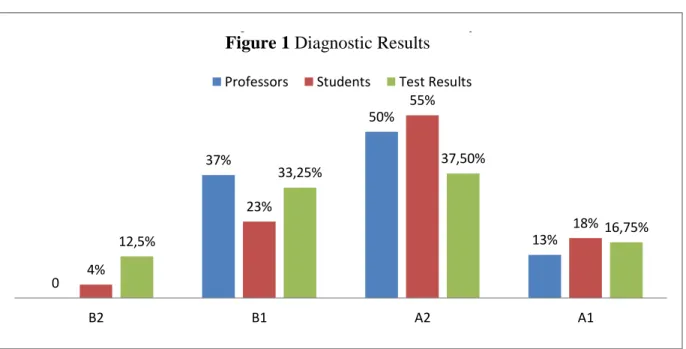
(53) It is important to mention that the diagnostic test and its results were took from the research study entitled “Programa de Refuerzo Académico para vencer un examen nivel B2 según el Marco Común Europeo o su equivalente” which this study is part of. Next, it is presented some of the most relevant results. The survey was applied to professors and students in 8th semester of the Languages Career at UNACH, with the purpose of knowing exactly their perspective of the level of speaking students have. The survey contained aspects like: opinions about students´ English level, factors influencing or affecting English proficiency in students, previous experiences in teaching-learning process, factors that have facilitated teacher‟s role, students‟ listening, speaking, reading and writing level, methodology influence in developing communicative competence, importance of international English certificates, knowledge about Common European Framework tests, etc.. Figure Results Graph 1.-1 Diagnostic Diagnostic Results Professors. Students. Test Results 55%. 50% 37%. 37,50%. 33,25% 23%. 13%. 12,5% 0. 18% 16,75%. 4% B2. B1. A2. A1. Source: Diagnostic Stage (survey, interview and test) Authors: Johanna Arrobo and Paola Herrera. The results reflect that, the 4% of students consider themselves have the B2 level, while the 32% of them consider be under this level. The survey applied to the professor shows 42.
(54) that, they consider that the 100% of their students do not have the desired level B2. The diagnostic test (FCE sample test, 2009) disclosed a different reality, placing the 12, 5% (that corresponds 2 students) of students in a B2 level, and the rest of learners are located in the lower levels, 33,25% (that corresponds 7 students). in the B1 level,. 37,50% (that corresponds 5 students) at A2, and 16,75% (that corresponds 3 students) at A1. The survey also reflected that professors and students have their own criteria about the possible causes which are affecting their speaking development. Thus, professors argued that the lack of practice and self-education strategies of learners are the principal reasons; while, the students assume that, the lack of speaking practice, the poor vocabulary they have, and the miss of interaction opportunities with native speakers are the main problems to overcome to have a good English level.. . Figure 2: Diagnostic Test Results B2 A2. B1 A1. Basic Speaker A1 beginner. 50%. A2 elementary. 44% 39%. 39%. 28% 22%. 33% 28% 22% 17%. 28% 16%. 17%. 11%. . Independent Speaker B1 intermediate. 6% 0%. B2 upper intermediate Grammar and Vocabulary. Discourse Management. Pronunciation. Interactive Communication. Source: Diagnostic Stage Authors: Johanna Arrobo and Paola Herrera. The test applied to the population evaluated factors like: Grammar and Vocabulary, Discourse Management, Pronunciation and Interactive Communication; these criteria were an adaptation from a sample test of First Certificate in English (FCE) developed 43.
Figure
Documento similar
Keywords: iPSCs; induced pluripotent stem cells; clinics; clinical trial; drug screening; personalized medicine; regenerative medicine.. The Evolution of
Astrometric and photometric star cata- logues derived from the ESA HIPPARCOS Space Astrometry Mission.
The photometry of the 236 238 objects detected in the reference images was grouped into the reference catalog (Table 3) 5 , which contains the object identifier, the right
Government contacted the authors of this paper and stressed the need to have an accreditation system for knowledge of the Basque language which was capable of
Keywords: Metal mining conflicts, political ecology, politics of scale, environmental justice movement, social multi-criteria evaluation, consultations, Latin
teriza por dos factores, que vienen a determinar la especial responsabilidad que incumbe al Tribunal de Justicia en esta materia: de un lado, la inexistencia, en el
Even though the 1920s offered new employment opportunities in industries previously closed to women, often the women who took these jobs found themselves exploited.. No matter
In the “big picture” perspective of the recent years that we have described in Brazil, Spain, Portugal and Puerto Rico there are some similarities and important differences,
