
Fostering Listening Skills and Initial Intercultural Communicative Competence in EFL Pre Service Teachers Through the Use of ICT
199
0
0
Texto completo
(2)
(3)
(4) Fostering Listening Skills and Initial Intercultural Communicative Competence in EFL Pre-Service Teachers Through the Use of ICT.
(5)
(6) Luz Dary Arias Soto, PhD Luis Fernando Gómez Rodríguez, PhD Esperanza Vera Rodríguez, M. Sc.. Fostering Listening Skills and Initial Intercultural Communicative Competence in EFL Pre-Service Teachers Through the Use of ICT.
(7) Catalogación en la fuente - Biblioteca Central de la Universidad Pedagógica Nacional Arias Soto, Luz Dary Fostering Listening Skills and Initial Intercultural Communicative Competence in EFL Pre-Service Teachers Through the Use of ICT / Luz Dary Arias Soto, Luis Fernando Gómez Rodríguez, Esperanza Vera Rodríguez. — 1a. ed. — Bogotá: Universidad Pedagógica Nacional, 2015. 196 p. Incluye referencias bibliográficas Incluye apéndices ISBN: Impreso: 978-958-8908-36-6 ISBN: Digital: 978-958-8908-37-3 1. Innovaciones Educativas. 2. Tecnología Educativa. 3. Inglés - Enseñanza – Aprendizaje. 4. Educación – Innovaciones Tecnológicas. 5. Formación Profesional de Maestros. 6. Inglés - Metodología. 7. Enseñanza con Ayuda de Computadores. 8. Lenguas Extranjeras – Enseñanza – Aprendizaje. 9. Tecnologías de la Información y la Comunicación. I. Arias Soto, Luz Dary II. Gómez Rodríguez, Luis Fernando. III. Vera Rodríguez, Esperanza. IV. Tít. 372.65. Cd. 21 ed.. © Universidad Pedagógica Nacional. © Luz Dary Arias Soto, PhD © Luis Fernando Gómez Rodríguez, PhD © Esperanza Vera Rodríguez, M. Sc. ISBN: Impreso: 978-958-8908-36-6 ISBN: Digital: 978-958-8908-37-3 Primera edición, 2015 Grupo Interno de Trabajo Editorial Universidad Pedagógica Nacional Alba Lucía Bernal Cerquera Coordinadora editorial William Ezequiel Castelblanco Caro Editor. Adolfo León Atehortúa Cruz Rector Sandra Patricia Rodríguez Ávila Vicerrectora de gestión universitaria. Laura Rodríguez Mejía Apoyo editorial. María Cristina Martínez Pineda Vicerrectora académica. Martha Janneth Mendez Correctora de estilo. Luis Alberto Higuera Malaver Vicerrector Administrativo. Mauricio Salamanca Diseño y diagramación Impreso en Xpress Estudio Gráfico y Digital S.A. Bogotá, D.C., 2015. Helbert Augusto Choachí González Secretario General Nydia Constanza Mendoza Romero Subdirectora División de Gestión de Proyectos de la Universidad Pedagógica Nacional, ciup.
(8) Acknowledgements. T. here are many people whom we want to thank. We are heartily thankful to all the members of the research group Hypermedia, Testing, and efl Teaching, whose work and compromise with the research process and the design of the hypermedia material enabled us to present the findings in this book. We are also endlessly grateful to Doctor Clelia Pineda who served as expert and consultant in the development of this project. Similarly, we want to thank Universidad Pedagógica Nacional (upn) and Centro de Investigaciones de la upn (ciup) for having sponsored and supported our research work. Finally, we are equally grateful with the language learners who served as participants of this study and with all of those who supported us in any respect during the completion of the project, including designers, assistants, and those teachers and native speakers who helped us with the voices of the audios for the hypermedia proposal A Journey Through the us Culture. To all of them, thanks..
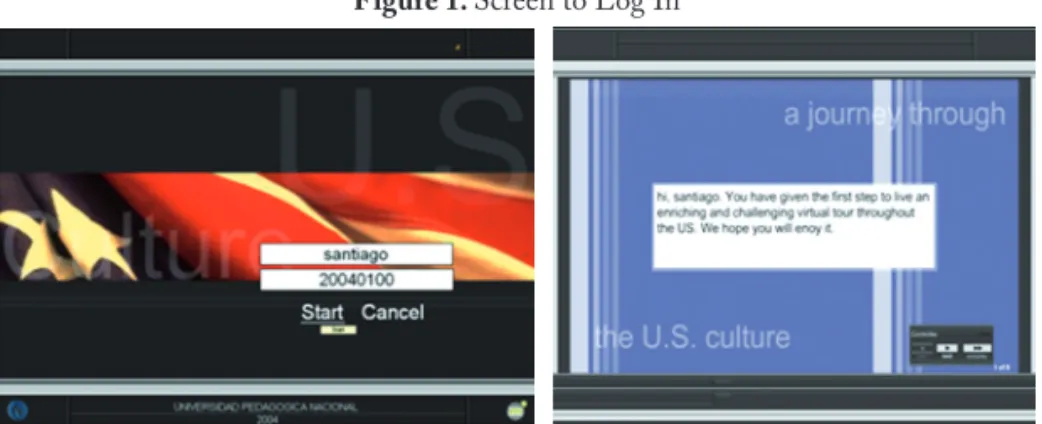
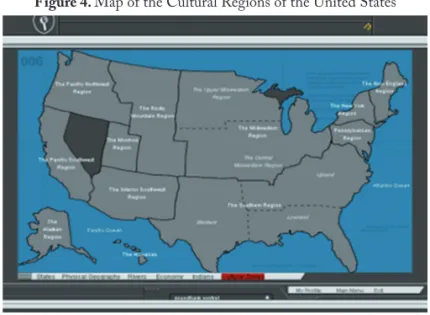
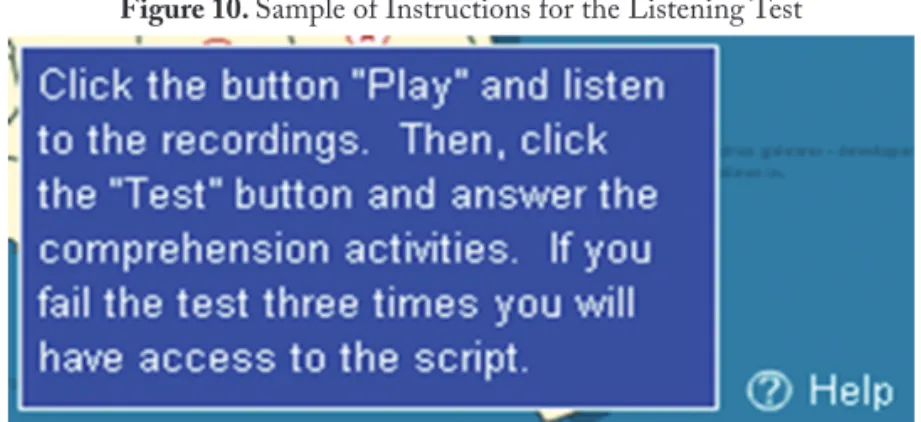
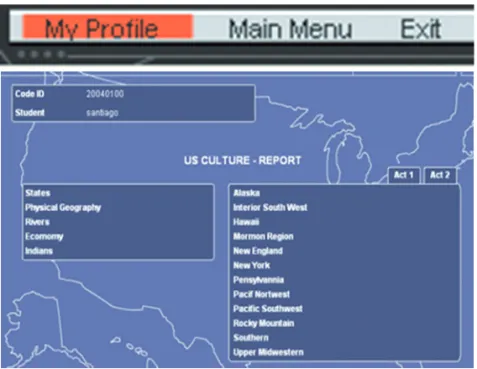
(9)
(10) Table of Contents. Acknowledgements.......................................................................................................7 Introduction.................................................................................................................13 CHAPTER 1 Problem and Context..................................................................................................17 Statement of the Problem................................................................................................... 17 Research Questions............................................................................................................. 19 Context and Participants.................................................................................................... 19 Expected Impact.................................................................................................................. 20. CHAPTER 2 Theoretical Perspectives and State of the Art..........................................................23 Theoretical Perspectives..................................................................................................... 23 Listening Comprehension in EFL.................................................................................................23 The Use of Hypermedia in Language Learning..........................................................................27 Cooperative and Collaborative Learning....................................................................................31 Notions of Culture..........................................................................................................................33 Intercultural Communicative Competence................................................................................36 Learning Autonomy.......................................................................................................................39 Learning Strategies.........................................................................................................................42. State of the Art..................................................................................................................... 43 Research on Culture and Technology..........................................................................................43 Research on Fostering Listening in EFL Education...................................................................56. [9].
(11) CHAPTER 3 Design and Implementation of the Hypermedia Proposal A Journey Through the US Culture.............................................................................65 Conceptual Design.............................................................................................................. 67 Graphic Design.................................................................................................................... 68 The Listening Design.......................................................................................................... 77 The Intercultural Design..................................................................................................... 82. CHAPTER 4 Research Design and Data Analysis Procedure.......................................................87 Research Methodology: A Qualitative Case Study......................................................... 87 Instruments for Data Collection....................................................................................... 88 Researchers’ Role................................................................................................................. 90 Data Analysis Procedures................................................................................................... 92. CHAPTER 5 Research findings........................................................................................................95 Findings for the First Research Question......................................................................... 95 First Category: The Graphic and Methodological Design of the Hypertext Generates Motivation and Facilitates Listening Comprehension of Cultural Content............................96 Second Category: The Methodological Design Fosters the Development of Intercultural Competence.......................................................................................................109 Third Category: The Hypermedia Learning Environment Fosters the Consolidation of Linguistic Knowledge, the Integration of Language Skills, and the Awareness of Teaching Strategies.................................................................................117 Fourth Category: The Hypermedia Learning Environment Promotes Cooperative and Collaborative Learning..................................................................................125. Findings for the Second Research Question.................................................................. 130 First Category: Learners are Aware of Task Demands.............................................................133 Second Category: Learners Use Strategic Knowledge About Themselves to Regulate the Learning Process................................................................................................145 Third Category: Learners are Aware that Dialog, Interaction, and Joint Work Enhance Their Learning...................................................................................152. [10].
(12) CHAPTER 6 Conclusions, Pedagogical Implications, Limitations, and Further Research....157 Pedagogical Implications.................................................................................................. 163 Limitations......................................................................................................................... 164 Further Research............................................................................................................... 165. References...................................................................................................................167 APPENDIXES Appendix A........................................................................................................................ 175 Appendix B......................................................................................................................... 177 Appendix C........................................................................................................................ 179. Biodata........................................................................................................................183 Author Index..............................................................................................................185 Subject Index..............................................................................................................191. List of Figures Figure 1. Screen to Log In........................................................................................................ 69 Figure 2. Menu of Thematic Maps ......................................................................................... 70 Figure 3. Sample of Menu Button to Listen to the Audios.................................................. 70 Figure 4. Map of the Cultural Regions of the United States................................................ 70 Figure 5. Brief Description of a Cultural Region.................................................................. 71 Figure 6. Sample of Images of Cultural Facts About Alaska............................................... 72 Figure 7. Sample of a Navigation Bar Within Each Region ................................................ 72 Figure 8. Example of the Links to the Audios in Each Region............................................ 72 Figure 9. Sample of the Access to Audios and Listening Tasks.......................................... 73 Figure 10. Sample of Instructions for the Listening Test..................................................... 74 Figure 11. Sample of “Soundtrack Control” Button............................................................. 74 Figure 12. Sample of Visual Material Incorporated in the Hypermedia Environment... 75. [11].
(13) Figure 13. Sample of Reflection Questions About Cultural Content................................. 75 Figure 14. Sample of the Users’ Technical File...................................................................... 76 Figure 15. Sample of a Semantic Map (Ohio)....................................................................... 82. List of Tables Table 1. Examples of Operations and Tasks Performed by Students................................78 Table 2. Students’ Perceptions of the Methodological Proposal Developed in A Journey Through the us Culture........................................................................ 96 Table 3. Learners’ Strategies Used to Solve Listening Tasks.............................................132. [12].
(14) Introduction. M. edia, computers, and technology have played a critical role in our contemporary society. Many of the daily activities we do in life are mediated by technological resources such as computers, tablets, cell phones, and 2.0 web tools, including e-mail, learning management systems, applications, and social networks. For this reason, it is unquestionable to assert that many times we depend on technological resources to communicate and to establish social relationships with other people. In the same way that we use media and technology in our daily life, students in general, as in the case of language learners, expect to find and use media and technology in the classroom. Brinton (2001) has stated that teachers and students seem to agree that technology can help to enhance language teaching and learning, and that incorporating technology in our teaching implies bringing the outside world into the language classroom. Within the context of globalization and the ongoing era of computer technology development, or the so-called Digital Age, this book describes a research experience carried out in an efl classroom at Universidad Pedagógica Nacional, a public university in Bogotá, in which students were given the opportunity to interact with a hypermedia learning environment named A Journey Through the us Culture. The purpose of the study was to help students of English to improve their listening skills and foster their intercultural competence as they simulated taking a virtual trip through which they met and listened to several native and nonnative speakers talking about the main cultural regions of the us and found documents and information presenting cultural aspects. This study responds to our claim regarding the urgent necessity of incorporating technology into the efl classroom as a means to facilitate students’ [13].
(15) 14 | Introduction. learning processes. It also responds to one of the main goals of Plan Decenal de Educación, carried out by Ministerio de Educación Nacional (2006-2016) which seeks the pedagogical modernization and implementation of ict (Information and Communication Technology) in many institutions all around the country. One of its aims is to strengthen teaching processes that acknowledge cross-curricular uses of ict based on research on education. In fact, one of the pillars of the current policies of the national government of Colombia is to improve teacher professional development through the efficient domain and implementation of technological tools, so that teachers can upgrade their pedagogical practices. This professional development program proposes two main phases. The first one focuses on helping teachers to become aware of the use of technology and its implications in their teaching practices. The second phase seeks a more professional appropriation of ict, so that teachers can transform old, traditional curricular practices into new ones through the use of technology. This research intended to raise pre-service language teachers’ awareness of the pedagogical use of ict in such a way that they incorporate technology later into their teaching careers once being in-service teachers. The tendency to teach English communicatively through computer-based materials has become a necessity in the language classroom. In contrast to the traditional and mechanical study of grammar tasks, English teachers have increasingly introduced to learners authentic communicative tasks supported by diverse hypermedia resources, including video, audio, images, the Internet, and flash animation. The importance of using these multimedia resources has been recognized by the national curriculum of many nations because media-based language lessons and materials are seen as an ideal means to facilitate the learning process. In order to contribute with the Colombian educational concerns about the inclusion of technology in the classrooms, and being aware of learners’ language needs and interests in technology, the members of the research group Hypermedia, Assessment, and English Learning1 decided to design and implement the hypermedia learning environment named A Journey Through the us Culture (Vera et al. unpublished) as a means to enhance students’ listening comprehension 1 Hipermedia, Evaluación y Aprendizaje del Inglés. Research group from Universidad Pedagógica Nacional, Colombia, recognized and categorized by Colciencias..
(16) Introduction | 15. in English and foster their intercultural competence. This hypermedia environment aims at achieving such purposes by having students work in a collaborative way through the use of the computer as a mediator in the learning process. It also aims at breaking with the traditional listening activities done in regular classrooms, which are often based on audio recordings, and that request students to answer questions related to factual information. Thus, this book presents the results drawn from the research project “Exploration of Two Methodological Hypermedia Proposals for the Development of Listening Comprehension and Intercultural Competence,” conducted at Universidad Pedagógica Nacional (upn), and sponsored by ciup, the Research Center of this university. The first hypermedia proposal designed was A Journey to Britannia, which was a role-play game that aimed at helping efl learners to learn and use learning strategies so as to improve their listening skills. It also was created to foster intercultural competence based on the legend of King Arthur and several cultural aspects of the United Kingdom. The second proposal, called A Journey Through the us Culture, focused on fostering listening skills and intercultural competence based on the main cultural regions of the us, including traditions, historical, cultural and geographical facts analyzed from the viewpoints of some North American people, and presented not only in readings and visual material, but mainly in audios, allowing learners to listen to and interpret some cultural content, to relate it to their previous knowledge about that nation’s cultures, to reframe their views about that big mixture of cultures and to compare them with our own cultures. This book will focus on describing the research experience with the second hypermedia learning environment, which was implemented twice by pre-service teachers of the Language Department at upn. The first implementation was made with an intermediate English class in 2004. The second implementation was carried out in 2013 because, after having used the learning environment as in-home material for several years, the research team wanted to confirm if it was still relevant, useful, and innovating for the purposes originally stated in 2004: to enhance listening skills and intercultural competence in the efl class. In other words, because this environment had contributed to helping efl learners over the last eight years, we considered that it was necessary to update the findings in 2013. We attempted to explore once more the validity and pedagogical value.
(17) 16 | Introduction. of A Journey Through the us Culture in our Language Department through an updated research procedure. Departing from those decisions, the authors of this book also intend to provide the efl community with explanations of the key concepts that underlie this study as to understand their nature, and to suggest some strategies and tools that have proved to be effective when seeking to develop listening skills and intercultural competence in pre-service teachers, some of which are having learners take a virtual trip (simulated real life tasks) by letting them visit different cultural regions of the usa and listen to people of that country talking about their own culture. Another intention when presenting this research experience is to help teachers to become aware of the difficulties learners might face when learning a foreign language, particularly for the development of the aforementioned skills and competence. The concepts underlying this study can guide teachers to overcome such difficulties and help their leaners to improve their language competences. We also believe that the experience described in this book may give ideas to computer-based material designers and people in charge of selecting these kinds of resources for higher education institutions as to what to take into consideration to design or choose the most appropriate materials related to listening and culture. In the following chapter we will describe the problem we identified in our teaching context which led us to carry out this research study..
(18) CHAPTER 1. Problem and Context. Statement of the Problem The research group detected that efl learners of the Language Department at upn had four had academic needs: First, English subjects failed and university dropouts in the Language Program were the result of students’ lack of learning strategies to monitor their own learning process and overcome academic problems. It was observed that many students failed the English courses and were demotivated because they realized that learning a foreign language was complicated, even more when they were preparing to become English teachers. That is why the first learning environment, A Journey to Britannia, was created to help students to learn and use learning strategies through the use of technological resources. Second, efl learners had difficulties in acquiring listening skills. Learners complained about the fact that they could not understand the aural material that they had to listen to in the language lab, and that listening was the most challenging skill to improve. This problem was increased because the students had limited access to the language lab, once a week, and therefore teachers had to do listening activities in the regular classroom through the use of a cd player or a tape recorder. Unfortunately, the use of the cd player was not enough practice, and many times this type of listening did not work well because the recordings were too faint, unclear, and low, affecting listening comprehension. Also, students who were in the back of the classroom were not able to listen clearly to the material as those who were in the front. These situations caused a lack of. [17].
(19) 18 | Fostering Listening Skills and Initial Intercultural Communicative Competence in EFL Pre-Service Teachers Through the Use of ICT. motivation because students thought they were not given the appropriate material and the ideal conditions to improve listening. Third, teachers still needed to promote more collaborative and cooperative learning environments through which learners could get actively involved. Even though students worked with their partners when doing grammar, reading, and speaking communicative tasks, they had a tendency to work individually. The class was directed to answer activities from the textbooks and to complete tasks, but there was not a real commitment to work on projects that encouraged learners to work collaboratively in groups. Moreover, it was observed that when students did listening tasks in the language lab, they mostly worked alone by the help of study guides. Once they had answered the questions individually according to the listening material (a dialog, a story, a news report, etc.), they reported the answers orally to the teacher. So, there was a not real collaborative interaction when they worked on listening tasks. Fourth, there was a great need to foster intercultural competence. It was observed that the English classes focused primarily on the study of the language forms and communicative functions as well as on the practice of the four communicative skills, but there was limited time to study the target culture. The cultural contents were mostly related to elements of surface culture such as food, tourist places, and geographical sites, and they were studied from an informative perspective rather than from a more critical standpoint. Therefore, learners were not actually building cultural competence, but storing cultural information in a received and passive way. As we detected these problems, we decided to implement the hypermedia learning environment A Journey Through the us Culture in the English courses. It is a technological tool that intends to help learners to not only overcome limitations in listening comprehension, but to promote intercultural competence and collaborative and cooperative learning. Thus, learners were expected to do different listening tasks in the learning environment by getting acquainted with five main cultural groups of the United States. The main task was to have students engage in a virtual trip to the United States as if they were tourists visiting this country. They visited important and representative parts of the country and learned about the cultural traditions of many American ethnic groups such as the Mormons, the native-American people, and African-Americans. Learners were expected to not only read documents that appeared on the screen, but.
(20) Problem and Context | 19. to listen to lectures, tourist guides, and conversations among speakers in the audios. The cultural regions and the listening tasks were introduced in this environment through diverse technological modes such as audio, texts, photographs, and animation, all of which are ideal to improve language learning. The detailed description of this hypermedia material is in chapter 3.. Research Questions This project was led by two main research questions: 1. How do participants perceive the methodological proposal developed in the hypermedia environment A Journey Through the us Culture? 2. How do intermediate English learners face listening tasks related to culture when they use this hypermedia proposal?. Context and Participants The Language program at upn aims to prepare efl learners to work as English teachers in public and private schools in Colombia. This implies that they learn English as a foreign language and are provided with the pedagogical foundations and practice to teach it. In other words, they are pre-service teachers who are trained and educated to undertake teaching professions in the future. As it was explained before, there were two moments in which this research was carried out and in which data was collected. The participants involved in the first experience in 2004 were a group of 13 efl learners, 6 female and 7 male students, who worked in pairs to do the listening tasks with the hypermedia environment. In terms of their proficiency, only one of the students was an advanced English speaker; three were upper-intermediate, seven were intermediate, and two were low-intermediate English learners. However, all of them were aware of the need they had to improve their listening skill, which was the most challenging skills for them. They used the computer lab two hours a week for 16 weeks to interact with the hypermedia environment A Journey Through the us Culture. The participants who were involved in the second experience carried out in 2013 were a group of 27 female and 4 male students whose ages ranged from18.
(21) 20 | Fostering Listening Skills and Initial Intercultural Communicative Competence in EFL Pre-Service Teachers Through the Use of ICT. to 30 years. Although they were expected to be in an advanced level, the majority was in an upper-intermediate level and a few were in intermediate. They went to the computer lab one or two hours a week for 13 weeks to interact with the hypermedia environment. At these two moments of the implementation almost all the students participated in the experience and provided relevant data, except for one student who decided to withdraw from the study because he was more interested in learning grammar. Participants signed a Consent Form (Appendix A), which informed them about all the specific details of the study, requested their consent to participate in the research study, and asked them to answer the interviews and the logs as main data to be collected during the experience.. Expected Impact We expected the results of this research study would contribute with the language teaching community in different ways: 1. To provide upn students with the possibility of using computer-based resources that can help them to improve their listening skills and their knowledge of the culture of English speaking countries; that is to say, the enhancement of their intercultural competence. 2. To support language teachers, in general, to open their spectrum of possibilities in terms of other sources they may be able to resort to in order to help their students to improve different skills and who can give culture the importance it deserves when teaching and learning a language. 3. To inform teachers, the Ministry of Education, and other institutions that have to do with decision-making related to the acquisition of materials and to material designers, about considering the development of intercultural competence. It is one of the basic aspects that the teaching and learning process of a language must enhance and thus, it needs to be included in the materials adopted or designed by these institutions. 4. To lead other researchers who might add to the results of this research further development of listening skills, intercultural competence, collaborative and cooperative work, and the use of icts in the process of language teaching and learning..
(22) Problem and Context | 21. Having given a general view of this research study, in the following chapter the reader will find the explanation of the theoretical perspectives that are the basis of the study and that comprise five main theoretical constructs: listening comprehension, culture in the language classroom, the use of hypermedia in language teaching, cooperative/collaborative learning, and learning strategies. Additionally, the chapter will present some studies related to the constructs mentioned..
(23)
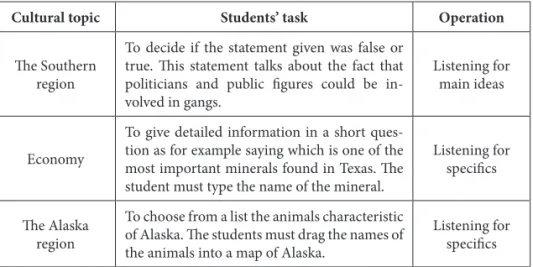
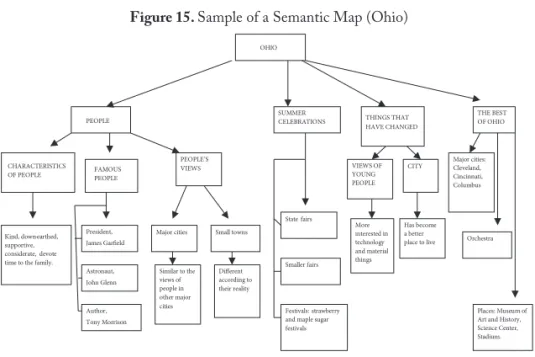
(24) CHAPTER 2 Theoretical Perspectives and State of the Art. Theoretical Perspectives The conceptual and technical design of A Journey Through the us Culture is framed within six theoretical foundations: the theories on listening comprehension in efl, the use of hypermedia in language teaching, the principles of collaborative and cooperative learning; the notion of intercultural communicative competence, the fundamentals of autonomous learning, and the importance of learning strategies. Through the articulation of these six perspectives, efl learners were expected to foster listening skills and intercultural competence. A description of each theoretical view is presented below.. Listening Comprehension in efl For a long time in the history of efl teaching, listening has been considered a passive skill and an enabling skill for speaking activities. That is to say, listening is practiced at the moment the teacher speaks to the students in the classroom. Call (1985, cited in Osada, 2004) asserts that listening is poorly taught in the language classroom because of teachers’ belief that exposing students to the spoken language on the spot provides enough instruction for listening comprehension. There is also the influence of the behaviorist audiolingualism of the early 50s, a traditional approach that privileged imitation and repetition of what students heard as effective factors for listening comprehension. This view started to change when Rivers (1966, p. 196) claimed that “Speaking does not of itself [23].
(25) 24 | Fostering Listening Skills and Initial Intercultural Communicative Competence in EFL Pre-Service Teachers Through the Use of ICT. constitute communication unless what is being said is understood by another person.” Nowadays, listening is seen as an active skill which involves a “highly complex problem solving activity” (Byrnes, 1984, cited in Osada, 2004) through which learners become active listeners during the learning process. They listen to, do, and perform authentic tasks of real life, instead of just repeating, imitating, and confirming understanding. Listening is indeed a complex task. Brown (1994) and Nunan (1999) state that there is a series of psychomotor, linguistic, paralinguistic and social processes that inevitably intervene in listening comprehension in a foreign language (L2). Those processes are simultaneously interwoven and cause listening to become one of the most difficult skills to be developed in the learning process of L2. As stated by Brown (1994), oral discourse has eight aspects that complicate non-native speakers’ listening comprehension: The first aspect deals with chunking and clustering which refer to the division or fragmentation of speakers’ sentences and clauses during the natural communication process due to memory limitations. Speakers usually break or divide pieces of verbal information into smaller units such as sentences or a series of words in order to recall the information they are given. Redundancy is the second aspect. It involves speakers’ repetitions or restatements of ideas during the communicative act in order to express them in a better way or clarify something that has been said. In English, speakers often use expressions such as I mean and you know, markers to indicate that an idea is being restated, clarified, or rephrased. Third, the use of phonological, morphological, and syntactic constructions can affect aural comprehension. Such is the case of the contraction of the verbs to be and to have for the third person (She’s going to . . ., and she’s gone to), or words such as poured and pored or aloud and allowed that can confuse the listeners. Similarly, a fourth aspect that makes listening difficult can be those unplanned variables during the speaking process such as slips of tongue, pauses speakers make in hesitant discourse, corrections of what has been stated, and unfinished sentences when speakers decide to utter a new idea. A fifth obstacle involves colloquial and idiomatic expressions which listeners might find difficult to understand because they are not familiar with them. Poor cultural knowledge becomes the sixth problem in aural comprehension because being unaware of cultural meanings might cause complete misunderstanding, even though the individuals involved in the communicative interaction might have.
(26) Theoretical Perspectives and State of the Art | 25. efficient listening skills. Seventh, difficulty has to do with native speakers’ speed, which can cause misunderstanding just because the listener is not able to follow and retain all the information being said. Finally, phonological aspects such as accent and intonation are likely to affect the non-native speaker when he/she listens to oral discourse in L2. Because of these complex features in aural production, several theoretical alternatives provided by L2 scholars in order to overcome the complications of L2 speakers’ listening skills were taken into account when we designed the learning environment A Journey Through the us Culture: Nunan (1999) points out that a competent listener in L2 requires fostering several strategies to divide oral discourse into meaningful words and sentences: the listener must (1) recognize word categories (article, noun, verb, adjective, etc.), (2) identify the rhetorical and functional intention of oral discourse, (3) interpret accent and intonation in order to identify the main ideas and the emotional appeal with which speech is produced, and (4) understand the essential information without necessarily recognizing every word uttered. Similarly, Brown (1994) provides a list of listening types that can help efl learners to practice listening tasks in a more purposeful way: • Reactive listening—although the least practiced in communicative language classrooms— is a task that requires learners to listen to and repeat what is said. • Intensive listening refers to that practice that allows learners to focus on components of discourse such as phonemes, words, intonation, and markers. • Restrictive listening demands listeners’ on-the-spot answers through physical response or verbal production. • Selective listening, as its name suggests, requires learners to scan the listening material selectively. This type of listening is usually extensive, including stories, anecdotes, news reports, and tv programs from which students have to summarize or identify the main facts. • Extensive listening asks listeners to extract the main message or purpose from extensive material. It requires additional strategies such as note-taking and discussion..
(27) 26 | Fostering Listening Skills and Initial Intercultural Communicative Competence in EFL Pre-Service Teachers Through the Use of ICT. •. Interactive listening challenges learners to understand oral production in order to respond and interact in a communicative process. It includes discussions, debates, and role-plays.. The hypertext environment A Journey Through the us Culture promoted the use of all of these six types of listening, except reactive and intensive listening, since the attempt was to involve students in authentic communicative tasks rather than in repetition and identification of components of oral discourse. In addition to the different types of listening, Brown (1994) suggests a set of principles that teachers should know in order to design listening tasks: 1. Listening tasks must be supported by listening techniques (listening for main ideas, listening for details, and listening for making inferences) because the mere exposure to oral discourse does not guarantee listening comprehension. The students need to complete a task when they listen to focus their attention on the information being said. 2. Listening tasks must be motivating, involving students’ interests, needs, and academic goals. Learners’ personal experiences, prior knowledge, and skills become a central issue in teaching listening due to the fact that they can influence on the learning process. 3. Listening must contain authentic contexts, language, and tasks taken from the real world to enable learners to accomplish communicative goals. 4. Learners’ answers must indicate that they have listened to and answered correctly. Listening for main ideas, listening for details, and listening for making inferences became central operations in the listening tasks proposed in the hypermedia learning environment A Journey Through the us Culture, given the fact that they were practiced through the activities and questions along the journey. All the aural texts were set within authentic contexts, depicting real life situations and tasks such as having tours around different cities in the United States and listening to tourist guides, lectures, and interviews about the different cultural regions of the country. Thus, the learners listened to authentic aural material such as interviews and speeches, as it can be seen in the explanation of the listening design of the software in chapter 3..
(28) Theoretical Perspectives and State of the Art | 27. Additional pedagogical suggestions dealing with the way listening tasks should be addressed in efl education are provided by Lund (cited in Brown 1994). He provides several ways to enhance students’ comprehension: learners can be asked to do authentic tasks such as answering a phone call, asking for information, or following directions. They can also be asked to choose one single answer from different options, to transfer information from one format to another, to answer close or open questions, to take notes or fill out tables, to complete a text with their own ideas, to repeat the exact words of a text, to translate a text into the native language, to hold a conversation based on what has been listened to, and to help learners to enhance listening strategies. Accordingly, the listening tasks of the hypermedia environment were designed in the light of Lund’s suggestions as learners were not only exposed to listening to native and non-native speakers, but were asked to do tasks in order to process the information they heard. Thus, they answered close and open questions, transferred aural information into semantic maps that appeared after the listening activities, summarized aural texts, and took notes in order to write a final essay. Moreover, they used learning strategies to facilitate the understanding of the tasks. All the listening activities included in the hypermedia environment A Journey Through the us Culture were designed in light of the previous theoretical framework. A detailed description of these listening tasks will be presented in chapter 3, which relates the design of the hypertext.. The Use of Hypermedia in Language Learning Since A Journey Through the us Culture is a hypermedia proposal, it is relevant to clarify that hypermedia and hypertext are not actually the same. Although they share similar characteristics, they can be different in various features. Their differences can be understood as follows: A hypertext is a text displayed on the computer, usually containing hyperlinks to other texts to which readers can access immediately. It differs from the standard lineal restrains of written texts because it consists of a variety of linked texts, allowing users to select buttons or icons to move from one text to another without necessarily following an orderly procedure. Bush and Nelson (referred.
(29) 28 | Fostering Listening Skills and Initial Intercultural Communicative Competence in EFL Pre-Service Teachers Through the Use of ICT. by Noci & Salaverría, 2003) coined the term hypertext in 1963 to refer to the interconnection and non-linear structure of texts and materials (reports, notes, data-bases, computer documentation) which provide links from one page to another. Thus, when a user clicks on a link, he/she is taken to another page. Foltz (1996) points out that in hypertexts, information can be represented in a semantic network where diverse sections of the text are related to each other. A user can browse through or “jump” from one text section to another by choosing the way through according to his/her own personal interest and purposes. Carlson and González (1993) explain that hypermedia expands the notion of hypertext because the former uses more additional media than the latter to present information visually and aurally. Although both represent a non-linear organization, the hypertext is limited to text, while hypermedia adds animation, graphics, audio, and video. While in a hypertext the user can move from one text to another, in hypermedia the user can move from one medium to another. For instance, Underwood (1989) describes an experiential geography hypermedia program in which the user can fly over a world map displayed on the computer screen while the video monitor shows a synchronized image of the corresponding overhead view. The user can click on any part of the map and bring to the screen video images of a particular region. This hypermedia could additionally include music and voice. Similarly, several universities have created hypermedia projects such as the case of Harvard University, which developed Project Perseus (1988). This program integrates classic Greek literature, history, maps, images of monuments, and works of art. It incorporates several media formats and allows users to move through links “that are made possible by the non-linear, relational approach to computer programming characteristics of hypertext technology” (Neuman, 1991, p. 240). Project Shakespeare (Frielander, 1991) is another hypermedia proposal created at Stanford University, which combines drawings, photos, and both animated and still images. In regards to hypermedia in the field of language learning, The Zarabanda Notebook, as Underwood (1989) explains, is a multimedia proposal for the teaching of Spanish as a foreign language. This hypermedia resource or HyperCard program offers the student the possibility to follow a story and see, for example, a drawing of a main character’s room. Each object of the room, for example a book, a newspaper, and a map on a table, is a HyperCard button which represents a link to further information. When the user clicks on the map that is.
(30) Theoretical Perspectives and State of the Art | 29. on the table, for instance, the program immediately brings to the screen a map of the village where the main characters live. Each item or place that appears on the map is not only labeled, but represents in turn a button which, when clicked, brings to the video screen a picture of that part of the village. By clicking on other icons, the student can bring to the screen additional information such as a brief description of the characters in the story or a story map, referring to the sequence of events in the story. Liu, Moore, Graham, and Lee (2002) indicate that educators have become more interested in the use of technological tools to improve foreign language teaching practices, and that much of the reviewed literature regarding technological proposals relate to software tools designed to foster learners’ reading and writing skills. These authors state that numerous software programs have been created in foreign languages such as English, French, Spanish, Italian, German, Japanese, and Russian, being English the most discussed and reviewed target language in the available literature on software programs. Likewise, Arono (2014) notes that hypermedia and interactive multimedia programs in language teaching can help students to acquire listening skills through the use of pictures, animation, and video. Liu et al. (2002) equally assert that Inter Change, a component of Daedalus Integrated Writing Environment (diwe) in second language-learning classrooms, is a tool that allows users to have real-time written conversations, Although it was originally developed to teach English composition and literature for native speakers of English, it has been used in second language instruction, including languages such as French, Spanish, and English. One of the reasons why Inter Change has received a good deal of attention in efl teaching is that it enables students to have meaningful and authentic conversations with other users in the target language. As Liu et al. (2002) explain, there are broader software categories that include word processors, the Internet, and speech recognition software. Word-processing, considered the most “low-tech” of the tools, “... is perhaps the most accepted and universal use of computers in education today” (Hyland, 1993, p. 21). Word processing software usually provides features such as spelling checkers, thesauri, dictionaries, style checkers, and grammar checkers. By citing Levy (1990), these authors affirm that some researchers stressed that word processors tended to increase student enjoyment of assignments in the classroom. Internet-based.
(31) 30 | Fostering Listening Skills and Initial Intercultural Communicative Competence in EFL Pre-Service Teachers Through the Use of ICT. tools such as e-mail, synchronous chat, bulletin boards, html, dhtml, xml, and digital video are salient facilities currently being used in second/foreign language teaching and learning. Liu et al. (2002) point out that e-mail, for example, has been reported as a facilitating tool to hold realistic communication that enables learners to use real language as it happened with the projects of e-mail exchange done by Hellebrandt (1999) and Kroonenberg (1994/1995). The pedagogical benefits that hypermedia programs have are that they possess a great variety of devices such as audio, text, images, and animation and diverse resources available, naming dictionaries, files, folders, and e-mail access. They equally contain different types of activities in computer-based learning environments that can satisfy learners’ visual, auditory, kinesthetic, and analytical learning styles. These devices provide immediate feedback and allow users to work individually or in group. Hypermedia also provides playful activities, increases inquiry-based learning, enhances computer abilities, and facilitates mental processes and knowledge construction. Indeed, Foltz (1996) claims that the associative, retrieval, and interconnected paths hypertexts and hypermedia offer users are similar to the way ideas are associated and linked in human memory. For that reason, hypermedia environments develop learners’ ability to find, use, recover, and acquire information because more than a reading process, it requires users to do problem-solving tasks. Rueda and Quintana (2004) assert that the characteristics of ict in terms of interactivity, connectivity, and hypertextuality offer possibilities to improve learning based on the interactive relationship between the individual and the content/information. These two authors think that hypertextuality enriches the study of language due to the possibility to configure the text and thus, to modify language processes and activities such as reading and writing. They mention that hypertexts have implications in the learning process because of their relationship with cognitive science, the human brain, and constructivist learning theories. It is important to point out that most software programs have been designed to improve grammar, word pronunciation, vocabulary and language skills (listening and writing) in esl/efl, but few proposals have been focused on intercultural competence development. Despite the delimited material, some research studies exploring how technology-based materials can enhance cultural competence will be discussed in the State of the Art section of this book..
(32) Theoretical Perspectives and State of the Art | 31. In regards to the particularities of the hypermedia learning environment A Journey Through the us Culture, it is a material that consists of a variety of linked devices including texts, images, pictures, sound, animation, and listening tasks as it is explained later in chapter 3.. Cooperative and Collaborative Learning The pedagogical implementation of A Journey Through the us Culture was supported by the principles of cooperative and collaborative learning, two instructional processes in which learners work together on learning tasks with the purpose of acquiring knowledge through mutual help and reciprocal interaction. Cooperative and collaborative learning have several similarities, yet they also have certain differences. Their similarities mainly rely on accomplishing a specific goal by working together. It is a learning process through which learners acquire knowledge through social interaction, a perspective envisioned from Vygotsky’s (1978) view of social constructivism. It also attempts to replace students’ competitive and independent attitudes to learning into team-based work and cooperative efforts. In terms of differences, Panitz (1996) explains that the definitions and principles of cooperative and collaborative learning generally overlap and intermingle. However, Richards and Rodgers (2001) state that cooperative learning is part of a more general instructional approach also known as collaborative learning. Thus, Panitz (1996) clarifies that while collaborative learning is a philosophy of interaction defined by a set of principles to promote socially structured situations, cooperative learning embraces a set of practical procedures and processes to help learners to accomplish desired learning goals. Matthew, Cooper, Davidson and Hawkes (1995) indicate that in cooperative learning, students are given a specific activity, usually by the teacher, so that each member of a group has different responsibilities or roles to complete a whole task. The teacher controls to some extent most of the learning process in the class, even if the students are working in groups. On the contrary, in collaborative learning, students organize and negotiate efforts themselves without the teacher’s intervention. Students are more independent and make decisions about their own learning. They take full responsibility for solving problems and building knowledge. According to Dooly.
(33) 32 | Fostering Listening Skills and Initial Intercultural Communicative Competence in EFL Pre-Service Teachers Through the Use of ICT. (2008), proponents of collaborative learning, and in extent cooperative learning, claim that these processes help students to be active learners because they can exchange, debate, and negotiate ideas within their groups. They increase students’ interest in learning because they are engaged in discussion and are encouraged to become critical thinkers. During the implementation of the hypermedia environment A Journey Through the us Culture, collaborative learning, as proposed by Matthew, Cooper, Davidson, and Hawkes (1995) was carried out. Learners decided, organized, and assigned specific tasks among themselves, so that they had different duties to achieve a common goal. In this sense, learners helped each other to solve tasks through social interaction and meaning negotiation without depending completely on the teachers’ aid. Their progress was determined by their sense of responsibility for doing the listening tasks in the hypermedia environment. The teacher was there as a facilitator in case they needed assistance or further clarification in regards to the work they had to do. Following Lucero’s (n. d.) notion of collaborative learning, two or more learners were engaged to work on A Journey Through the us Culture weekly. The pedagogical purpose was to engage learners to solve activities and tasks collaboratively. They worked in pairs, usually, one having more knowledge and strategies than the other, so that the student with limited knowledge could develop his/her zone of proximal development (Vygotsky, 1978a) from the social interaction with a more advanced learner. However, in other occasions both students had similar levels of language proficiency, but had dissimilar expertise in certain cognitive and language skills. All the tasks were solved in pairs through cognitive processes such as classification, comparison, evaluation, synthesis, and critical analysis, and other social processes such as discussion, negotiation, and mutual agreement for decision making. This is one of the main innovations of this learning environment as learners coached, assisted, and monitored each other and developed teamwork skills to complete the tasks. Clear examples of how students enhanced collaborative learning will be presented in the findings section in chapter 5..
(34) Theoretical Perspectives and State of the Art | 33. Notions of Culture The inclusion of cultural content has become a central issue in efl education for the last three decades. In the process of globalization, the efl community is becoming aware of the intertwined relationship between language and culture. It is impossible to teach language without culture in the present because people all over the world establish more and more cross-cultural spaces and international communication. Kramsch (1993) states that culture should be seen as a language practice and as the core of language teaching. Sowden (2007) explains that in the past, culture was conceived as a body of social, artistic, and intellectual traditions associated historically with a particular social, ethnic, or national group. However, nowadays the term culture is used in a more complex sense, since it has become a problematic term to define. Smith (2005) affirms that culture is a difficult term to describe because it has been defined from different perspectives. For instance, he explains that in the nineteenth century the term culture was considered as improvement of the individual human mind and personal manners. Another definition sees culture as the development of society as a whole and the advance of civilization. Similarly, in the period of Industrial Revolution and the Romanticism, culture designated spiritual development as it referred to intellectual and artistic activities, becoming a synonym of the Arts. From an anthropological point of view, Smith (2005) affirms that culture is to be found in every human expression and not just in the high arts or in Western civilization. From the area of history, culture is seen as “a heritage . . . passed on over time through the generations” (Smith, p. 3); while psychological definitions conceive culture as a problem-solving device that allows people to communicate, learn or fulfill material and emotional needs. In short, there is a great number of definitions that make it difficult to describe culture, a term that is subject to ongoing discussion. A more recent definition of culture which seems to be suitable for the teaching of culture in efl education is given by psychologist and linguist Spencer-Oatey (2008): Culture is a fuzzy set of basic assumptions and values, orientations to life, beliefs, policies, procedures, and behavioral conventions that are shared by a group of people, and that influence (but do not determine) each member’s.
(35) 34 | Fostering Listening Skills and Initial Intercultural Communicative Competence in EFL Pre-Service Teachers Through the Use of ICT. behavior and his/her interpretations of the ‘meaning’ of other people’s behavior. (p. 9). This definition refers to the basic values, beliefs, and conventions shared by a group of people who may want to accept them or who may not necessarily agree, approve, and follow them. Individuals of a group may be influenced by the norms and values of their culture, but not completely dependent on it. That is why culture is transformative and is inclined to change over time. Prieto (1998) observes that culture is mediated by a process of communication because knowledge, ideas, and beliefs are codified and assimilated by the members of a particular community who share the same linguistic code. Thus, culture is necessarily acquired through language and through a process of social and collective communication. In this sense, when people learn a language, they simultaneously assimilate cultural behaviors, beliefs, values, and conventions that are mostly expressed through linguistic signs. However, the fact that an individual understands a set of cultural expressions and norms does not mean that he/she must embrace them. Despite the interest in incorporating culture in the English classroom, there has been little attempt to study it in actual teaching. Most teachers and students are more concerned about the teaching of grammar forms, vocabulary, and the practice of communicative functions than in being familiar with aspects of the target culture (Byram, 1997). Efl education has not only emphasized the study of linguistic and lexical forms of language, but has seen culture from a received outlook. Atkinson (1999) asserts that a received view of culture sees the most typical characteristics of a community as relatively unchanging and homogeneous, and as a system of rules that substantially determine the personal behavior of all individuals that belong to a given community. Atkinson claims that this view of culture needs to be reexamined in language education in order to understand it as an entity that undergoes transformation through time. Hinkel (2001) claims that most of the cultural topics addressed in efl classes deal primarily with surface culture, naming geographical information, tourist sites, famous people, celebrations, and food, among other aspects. Nevertheless, Hinkel identifies more complex meanings of culture such as sociocultural norms, distinct individual and collective beliefs, values, and actions that are part of deep culture, and that are rarely studied in the English classroom. The.
(36) Theoretical Perspectives and State of the Art | 35. problem is that most people from other cultural backgrounds, like in the case of efl learners, cannot understand easily the deep meaning presented in the target culture, and this can cause misunderstanding and cultural clash. In contrast to the notion of received and surface culture, Atkinson (1999) explains that culture should be seen as a heterogeneous and transformative entity because it embraces the inner differences, inequalities, and innumerable points of view toward life and established norms among the members of one cultural site. Considering culture from generalizations, surface views, and oversimplifications can cause the misunderstanding of culture. This idea becomes meaningful for the efl teaching practices because students should not continue having simplistic, reduced, and generalized opinions of the target culture. Culture has become an evolving, always transforming and dynamic entity that changes and modifies through time and from one generation to another. Differences, diversity, identity, the influence of one culture on another, and the blend of cultural groups coexisting in the same space in this growing globalized world, make notions of culture complex and problematic. If the efl area does not adopt an evolving transformative view of culture, learners will continue creating stereotypes and generalizations of the target culture. Taking into account the previous insights of culture, one of the main purposes of the piece of software A Journey Through the us Culture was to help students to observe a great variety of cultural material and expressions so that they stopped having homogeneous and reduced stereotypes of American people. They were expected to discover during the virtual trip the particularities and differences among the cultural regions and witness how people, behaviors, traditions, and beliefs change from one region to another in just one nation. Therefore, A Journey Through the us Culture intended to help students to see that the people of the us are not homogeneous and that whites are not only the legal citizens of this country, as many students still believe, but that there are complex and diverse cultural groups with particular features, as it happens for instance with the Mormons, the Native-Americans, and those living in the south or New England. As teachers-researchers, we were aware that this was an initial step to teach deep cultural content of the us, since it was a trip. Therefore, a complete understanding of all the complex cultural expressions was not going to be identified during the trip, but it was going to be an initial attempt to start seeing culture with a different approach: involving learners in tasks that allowed them the.
(37) 36 | Fostering Listening Skills and Initial Intercultural Communicative Competence in EFL Pre-Service Teachers Through the Use of ICT. possibility to make comparisons among the cultural regions in order to establish their differences and particular characteristics.. Intercultural Communicative Competence Intercultural communicative competence (icc) was a fundamental theoretical construct to develop this project. It has been defined as “the ability to interact with ‘others,’ to accept other perspectives and perceptions of the world, to mediate between different perspectives, [and] to be conscious of their evaluations of difference” (Byram, Nichols, Stevens, 2009, p. 5). However, it is crucial to understand that the notion of intercultural competence, as conceived in efl education, is still in an early stage of exploration. Foreign language teaching has generally focused more on communicative competence, that is to say, on developing learners’ linguistic and communicative skills to speak English fluently and accurately, than on intercultural competence. Byram (1997) seeks to complement the notion of communicative competence by incorporating the intercultural component. Thus, he asserts that intercultural communicative competence is an extension of communicative competence. While communicative competence refers to the speaker’s ability to convey and interpret messages and to negotiate meaning within a particular speech community, intercultural communicative competence entails the speaker’s ability to interact effectively with people from other cultures that he/she recognizes as being different from his/her own through a process of communication. That is, intercultural communicative competence implies the ability to identify cultural aspects that are necessarily expressed through real language in use when efl learners have the opportunity to practice the four language skills: reading, speaking, listening, and writing. In this sense, icc is not strictly limited to the social interaction of individuals through oral communication and conversations. icc can also be enhanced through “documents” and “cultural products” created, written, and produced by the human beings of another culture or the native one. Byram (1997) asserts “the intercultural speaker can ‘read’ a document or event for the implicit references to shared meanings and values . . . can identify or elicit different interpretations and connotations and establish relationships of similarity and difference between them” (p. 62). He clarifies that the intercultural person can use sources such as.
(38) Theoretical Perspectives and State of the Art | 37. reference books, newspapers, stories, television programs, and even kitchen recipes to understand and analyze social relationships among cultures and societies. Taking into account that it is very difficult for English teachers and learners to have daily opportunities to socially interact with native speakers in efl settings, this clarification was an important input for this study. It is a fact that A Journey Through the us Culture is a computer-based product containing reading materials, videos, maps, and audios with native speakers’ dialogs with which learners could become intercultural, since all these resources, including the virtual trip itself, included content of the target culture that aimed at enhancing icc. This hypermedia proposal attempted to represent a cultural experience through the trip to the us, even though it was clear that the learners were not going to have direct social interactions with any people of the target culture. However, through the resources or products that the proposal possessed, learners could become more intercultural as being aware of differences among the distinct cultural regions and their people. According to Byram (1997) and Lee (2005), intercultural competence not only involves interaction and understanding, but also the ability to become critical of differences. In fact, Byram (1997) proposes a model of intercultural communicative competence which leads learners of a foreign language to become critical individuals. His model consists of three main aspects or savoirs: (1) knowledge about cultural information, (2) skills to deal with cultural similarities or differences, and (3) positive attitudes toward cultural discovery. These three aspects are acquired through the process of building language competence and will ultimately prepare learners to become critical. Regarding the first savoir, Byram (1997) explains that being culturally competent implies acquiring knowledge about “social groups and their products and practices in one’s own and in one’s interlocutor’s country, and of the general processes of societal and individual interaction” (p. 51). Knowledge involves being conversant with aspects such as beliefs, historical relationships, definitions of geographical space, emblematic characteristics of a group, its institutions, and its religious values, etc. The second aspect to develop intercultural competence is skills (savoir comprendre), which Byram subdivides into three skills: interpreting, relating, and discovering. In regard to the skill of interpreting, an individual gives sense to.
(39) 38 | Fostering Listening Skills and Initial Intercultural Communicative Competence in EFL Pre-Service Teachers Through the Use of ICT. specific information and general knowledge which will allow him/her to discover the allusions and meanings present in the foreign culture. For Byram, the skill of interpreting necessarily relates to the skill of relating which involves the capacity to establish relationships by identifying common or uncommon grounds, and comparing cultural similarities and/or differences. The skill of interpreting and the skill of relating equally connect to the third skill: the skill of discovery. The learner is able to discover new aspects and knowledge that he/she did not know before. The skill of discovery is “the skill of building up specific knowledge as well as the understanding of the beliefs, meanings, and behaviors which are inherent in particular phenomena, whether documents or interactions” (Byram, p. 38). From this perspective, being interculturally competent requires learners to develop the three skills previously mentioned which all together necessarily take place during the development of intercultural competence. The third aspect (savoir être) involved in the building of intercultural competence is the ability to create positive attitudes such as openness, empathy, tolerance, readiness, and curiosity for cultural expressions and behaviors that may be similar or quite different, even “strange,” from our own. According to Byram, these attitudes oppose to popular negative attitudes as prejudice, stereotypes, discrimination, and intolerance which very often cause unsuccessful interaction and cultural misunderstanding among people from diverse backgrounds. With the acquisition of these three aspects, individuals can be prepared to deal with other groups different from their own and to become more critical and analytical to understand why differences exist. Byram points out that being a critical intercultural speaker (Savoir s’engager) targets several directions: (1) being critical about the beliefs, behaviors, and meanings of a group to better understand and deal with them based on reflection and analysis, (2) identifying “the ways in which particular cultural practices and beliefs maintain the social position and power of particular groups” (p. 20), and (3) discussing power relations in communication, such as that “the native speaker is always right” or when members of the dominant group have the possibility of “exercising power over the foreign speaker” (p. 21) just because he/she is not a native speaker. That is why it is necessary to help efl students to not only acquire language competence, but to develop their critical intercultural awareness. One of our.
(40) Theoretical Perspectives and State of the Art | 39. responsibilities as educators is to empower students with knowledge, skills, and attitudes, aiming at helping them to become more critical and interpretive of cross-cultural, social, and political meanings in this increasing globalized society. Because intercultural competence has become a fundamental aspect in efl, one of the main goals of the hypermedia learning environment, A Journey Through the us Culture, was to create cultural awareness and enhance critical opinions about the cultural aspects that the students found through their virtual trip along the different cultural areas of the us represented in the journey.. Learning Autonomy The term learning autonomy has been used through history in all aspects of life, and has been object of study in many fields of the development of human beings. In the past decades it has been given diverse definitions according to the discipline or the context in which it is studied. In general, Winch (2006) defines Autonomy as “the ability of individuals to choose and follow their own conception of a life that they judge to be suitable for themselves, an indispensable condition of individual well-being” (p. 1). It means that autonomy depends on the individual himself, and it is not something imposed by others. Since it is a concept that has permeated all the disciplines, as already stated, it has been considered a key aspect in the educational field, especially in relation to life-long learning skills. Moreover, many definitions have been given to it. Autonomy is the capacity and critical ability to reflect on one’s experience and to take charge of one’s own learning. It takes the individual to be an independent learner and to be able to solve learning problems (Holec, 1981). Autonomy is the capacity to take control of one’s own learning. It is a multidimensional capacity that takes different forms for different individuals in different contexts at different times. Autonomy implies recognition of the learners’ rights within educational systems (Benson, 2001). “Autonomy is a capacity for detachment, critical reflection, decision making and independent action. It presupposes, but also entails, that the learner will develop a particular kind of psychological relation to the process and content of his learning” (Little, 1991, p. 4). It is a situation in which the learner is totally responsible for and conscious of all the decisions concerned with his learning and their implementation (Dickinson, 1987)..
Figure


+7


Documento similar
examining the degree of effectiveness of inclusive education programs in private, semi-private and public centers for the neurodiverse L2 classroom; exploring students’
In this chapter we have presented three theoretical proposals regarding the feed-forward flow of the activation through the speech production system. These
In the previous sections we have shown how astronomical alignments and solar hierophanies – with a common interest in the solstices − were substantiated in the
Igual que había ocurrido en el cronograma de la primera actividad académica dirigida, se establecieron horas de tutorías colectivas especializadas y grupos de trabajo, así
This thesis is framed within the RFID technology and has been focused on the design of tags and near field communication devices to operate within the UHF-RFID frequency band,
Smith’s adding-up theory proposes to determine the natural price of the commodity by adding up the labor required to produce it multiplied by the natural level of the wage, the
The expansionary monetary policy measures have had a negative impact on net interest margins both via the reduction in interest rates and –less powerfully- the flattening of the
Jointly estimate this entry game with several outcome equations (fees/rates, credit limits) for bank accounts, credit cards and lines of credit. Use simulation methods to
