
Blending with M learning to enhance EFL writing
108
0
0
Texto completo
(2) PÁGINA DE ACEPTACIÓN. Nota de Aceptación __________________________________ __________________________________ __________________________________ __________________________________ __________________________________ __________________________________ __________________________________ __________________________________. Presidente del Jurado. ____________________________ Jurado ____________________________ Jurado ____________________________ Jurado. Bogotá D.C., October 2018.
(3) FORMATO RESUMEN ANALÍTICO EN EDUCACIÓN - RAE Código: FOR020GIB Fecha de Aprobación: 10-10-2012. Versión: 01 Página 2 de 108. Tipo de documento. 1. Información General Trabajo de grado. Acceso al documento. Universidad Pedagógica Nacional. Biblioteca Central.. Título del documento. Autor(es). Blending with M learning to enhance EFL writing. Mezclando Con Apredizaje Móvil Para Desarrollar La Escritura En Inglés Como Lengua Extranjera. Reyes Marimón, Jonathan David.. Director. Mellizo Guaqueta, Nelson.. Publicación. Bogotá. Universidad Pedagógica Nacional, 2018. 108 p.. Unidad Patrocinante. Universidad Pedagógica Nacional.. Palabras Claves. M-LEARNING, B-LEARNING, SMARTPHONES, WRITING SKILLS, PROCESS BASED APPROACH.. 2. Descripción Éste proyecto da cuenta de una investigación-acción de tipo cualitativo realizado con estudiantes que pertenecían a un grupo A2 en lengua extranjera (Inglés) que tenían baja producción escrita en Inglés. El objetivo del presente estudio es identificar y documentar cómo la habilidad escrita de estos estudiantes es desarrollada a través del uso de aplicaciones móviles. Para ello se implementa el uso del Process Based Approach bajo una metodología basada en el proceso, donde la habilidad escrita de los estudiantes es observada a lo largo de tres semestres con el propósito de examinar cambios en esta. Para llegar a ese fin, se realiza una investigación acción, recolectando información con diferentes instrumentos y analizando datos de la producción escrita de los estudiantes..
(4) FORMATO RESUMEN ANALÍTICO EN EDUCACIÓN - RAE Código: FOR020GIB Fecha de Aprobación: 10-10-2012. Versión: 01 Página 3 de 108. 3. Fuentes Abdel-Hack, E. M., & Helwa, H. S. A. A. (2014). Using digital storytelling and weblogs instruction to enhance EFL narrative writing and critical thinking skills among EFL majors at faculty of education. Educational Research, 5(1), 8-41. Abrams, M. H., & Harpham, G. (2011). A glossary of literary terms. Cengage Learning. Applebee, A.N. (1981). Looking at writing. Educational Leadership, 458-462. Badger, R., & White, G. (2000). A process genre approach to teaching writing. ELT journal, 54(2), 153-160. Buenaño Palacios, Y. (2013). Design and Implementation of Quality Indicators for Obtaining Digital Identity and Individualization of Learning. RED-REVISTA DE EDUCACION A DISTANCIA, (39). Bryman, A. (2006). Integrating quantitative and qualitative research: how is it done? Qualitative research, 6(1), 97-113. Cook, S. (2013). Providing Feedback on Student Writing. U.S Department of Education. AANAPISII Grant. Cope, B., &Kalantzis, M. (2009). Ubiquitous learning: An agenda for educational transformation. Ubiquitous learning, 3-14. Cohen, L., Manion, L., & Morrison, K. (2002). Research methods in education. Routledge. Council of Europe. Council for Cultural Co-operation. Education Committee. Modern Languages Division. (2001). Common European Framework of Reference for Languages: learning, teaching, assessment. Cambridge University Press..
(5) FORMATO RESUMEN ANALÍTICO EN EDUCACIÓN - RAE Código: FOR020GIB Fecha de Aprobación: 10-10-2012. Versión: 01 Página 4 de 108. Chinnery, G. M. (2006). Emerging technologies. Going to the mall: mobile assisted language learning. Language learning & technology, 10(1), 9-16. Crompton, H. (2013). A Historical Overview of M-Learning. Routledge. De Leeuw, E. D., Hox, J., & Dillman, D. (2012). International handbook of survey methodology. Routledge. Denzin, N. K., & Lincoln, Y. S. (1994). Handbook of qualitative research. Sage publications, inc. Elias, T. (2011). Universal instructional design principles for mobile learning. The International Review of Research in Open and Distributed Learning, 12(2), 143-156. Ellis, R. K. (2009). Field guide to learning management systems. ASTD Learning Circuits, 1-8. Espinosa Díaz, J. J. (2016). Plataformas E-learning una cuestión de perspectivas. Fiallo Hernández, H. (2016). Desarrollo de ComputerAssistedLanguageLearning (CALL) estado del arte. Garrison, D. R., &Kanuka, H. (2004). Blended learning: Uncovering its transformative potential in higher education. The internet and higher education, 7(2), 95-105. Gau, E., Hermanson, J., Logar, M., & Smerek, C. (2003). Improving Student Attitudes and Writing Abilities through Increased Writing Time and Opportunities. Godwin-Jones, R. (2011). Mobile apps for language learning. Goundar, S. (2011). What is the potential impact of using mobile devices in education? In Proceedings of SIG GlobDev Fourth Annual Workshop (Vol. 3, pp. 1-30)..
(6) FORMATO RESUMEN ANALÍTICO EN EDUCACIÓN - RAE Código: FOR020GIB. Versión: 01. Fecha de Aprobación: 10-10-2012. Página 5 de 108. Halliday, M. A. K., and Hasan, R. (2013). Cohesion in English. Abingdon/New York, NY: Routledge. Harmer, J. (2007). The practice of English language teaching. London/New York. Hattie, J., & Timperley, H. (2007). The power of feedback. Review of educational research, 77(1), 81-112. Hinze, A., Vanderschantz, N., Timpany, C., Cunningham, S. J., Saravani, S. J., & Wilkinson, C. (2017). Use of mobile Apps for Teaching and Research. Hipfner-Boucher, K. (2011). A comparative study of ELL and EL1 narrative competence during the kindergarten years (Doctoral dissertation). Hosseini, M., Taghizadeh, M. E., Abedin, M. J. Z., & Naseri, E. (2013). In the importance of EFL learners' writing skill: Is there any relation between writing skill and content score of English essay test. International Letters of Social and Humanistic Sciences, 6, 1-12. Hyland, K. (2006). English for Academic Purposes: An Advanced Resource Book. Abingdon: Routledge. Ivanič, R. (1998). Writing and identity. John Benjamins Publishing Company. Independent Learning Resources. Cohesive Writing. Learning Assistance Centre. The University. of. Sydney.. Retrieved. November. 10,. 2018,. http://sydney.edu.au/stuserv/documents/learning_centre/COHW2.pdf Kim, H., & Kwon, Y. (2012). Exploring smartphone applications for effective mobileassisted language learning. Multimedia-Assisted Language Learning, 15(1), 31-57. Kukulska-Hulme, A. (2009). Will mobile learning change language. from.
(7) FORMATO RESUMEN ANALÍTICO EN EDUCACIÓN - RAE Código: FOR020GIB Fecha de Aprobación: 10-10-2012. Versión: 01 Página 6 de 108. learning? ReCALL, 21(2), 157-165. Klimova, B. F. (2014). Approaches to the teaching of writing skills. Procedia-Social and Behavioral Sciences, 112, 147-151. Leki, (1989). Academic writing. New York: St. Martin’s Press. Levy, M. (1997). Computer-assisted language learning: Context and conceptualization. Oxford University Press. Lucke, M. (1999). Schaum's quick guide to writing great short stories. McGraw-Hill. Mishra, S., Yadav, M., & Choudhary, K. (2013) Ubiquitous learning: Future of e-Learning. McCloud-Bondoc, L. (2009). Writing effective paragraphs. Onozawa, C. (2010). A Study of the Writing Process Approach: A Suggestion for an Eclectic Writing Approach. Research note N. Picciano, A. G. (2009). Blending with purpose: The multimodal model. Journal of asynchronous learning networks, 13(1), 7-18. Phillips, D. K., &Carr, K. (2014). Becoming a teacher through action research: Process, context, and self-study. Routledge. Richards, J. C., & Rodgers, T. S. (2014). Approaches and methods in language teaching. Cambridge university press. Sánchez Burbano, J., Castañeda Vega, A., & Londoño Velásquez, A. F. (2016). Uso de aplicaciones móviles para el aprendizaje de una lengua extranjera. Sariçoban, A., & Küçükoğlu, H. (2011). Using literature in EFL classes: short story. Sarwar, M., & Soomro, T. R. (2013). Impact of Smartphone’s on Society. European journal.
(8) FORMATO RESUMEN ANALÍTICO EN EDUCACIÓN - RAE Código: FOR020GIB Fecha de Aprobación: 10-10-2012. Versión: 01 Página 7 de 108. of scientific research, 98(2), 216-226. Seow, A. (2002). The writing process and process writing. Methodology in language teaching: An anthology of current practice, 315-320. Squires, D., & Preece, J. (1999). Predicting quality in educational software. Interacting with computers, 11(5), 467-483. Steele, V. (1992). Product and process writing: a comparison. URL: http://www. teachingenglish. org. uk/article/product-process-writing-a-comparison. Struthers, L., Lapadat, J. C., & MacMillan, P. D. (2013). Assessing cohesion in children’s writing: Development of a checklist. Assessing Writing, 18(3), 187-201. Taras, M. (2010). Student self-assessment: processes and consequences. Teaching in Higher Education, 15(2), 199-209. Traxler, J. (2005, June). Defining mobile learning. In IADIS International Conference Mobile Learning (pp. 261-266). Tessier, S. (2012). From field notes, to transcripts, to tape recordings: Evolution or combination? International Journal of Qualitative Methods, 11(4), 446-460. Widodo, H. P. (2008). Process-based academic essay writing instruction in an EFL context. IKIP Negeri Malang: Jurnal Bahasa dan Seni Tahun, 36. Witte, S. P., & Faigley, L. (1981). Coherence, cohesion, and writing quality. College composition and communication, 32(2), 189-204. Wride. M. Guide to Self-Assessment. Retrieved October/November, 2018, from https://www.tcd.ie/CAPSL/assets/pdf/Academic Practice Resources/Guide to Student Self.
(9) FORMATO RESUMEN ANALÍTICO EN EDUCACIÓN - RAE Código: FOR020GIB Fecha de Aprobación: 10-10-2012. Versión: 01 Página 8 de 108. Assessment.pdf Yahya, S., Ahmad, E. A., & Jalil, K. A. (2010). The definition and characteristics of ubiquitous learning: A discussion. International Journal of Education and Development using Information and Communication Technology, 6(1), 1..
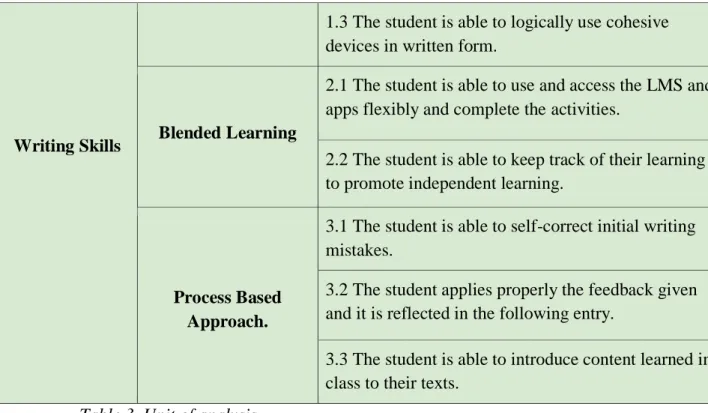
(10) FORMATO RESUMEN ANALÍTICO EN EDUCACIÓN - RAE Código: FOR020GIB. Versión: 01. Fecha de Aprobación: 10-10-2012. Página 9 de 108. 4. Contenidos La presente investigación se organiza por capítulos que corresponden al procedimiento hecho en este estudio. El capítulo 1 de introducción que se refiere a la contextualización de los estudiantes del Centro de Lenguas de la Universidad Pedagógica y al problema diagnosticado en ellos en cuanto a sus habilidades en inglés. Adicionalmente, se menciona el objetivo general que examina cómo la habilidad escrita de los estudiantes de Básico 1 es moldeada al utilizar aplicaciones móviles dentro de un enfoque basado en el proceso. En el capítulo 2 se registra el marco teórico y conceptual sobre los constructos utilizados en la investigación tales como “Writing” (Escritura), “Mobile Learning” (Aprendizaje Móvil), y “Process Based Approach” (Aprendizaje Basado en el Proceso). El capítulo 3 contiene el diseño de la investigación, la cual es de tipo “Investigación-acción” con enfoque cualitativo. Además, los instrumentos de recolección de datos son presentados, los cuales son diario de campo, encuesta y borradores de los libros de los estudiantes. El capítulo 4 concierne a la intervención pedagógica, en este capítulo se trata la metodología pedagógica como la manera de aplicar las clases siguiendo el modelo de Process Based Approach propuesto por Harmer (2007). El capítulo 5 registra el análisis de resultados, en el cual se presentan 3 categorías cada una con sus correspondientes indicadores que muestran los logros que los estudiantes debían lograr para detectar el nivel de éxito de la intervención. Finalmente, en los capítulos 6, 7 y 8 se exponen los resultados, las conclusiones y recomendaciones a la comunidad educativa y a futuras investigaciones relacionadas.. 5. Metodología El método investigativo usado es cualitativo y el tipo de estudio es investigación acción. Este tipo de estudio es utilizado para asumir, interpretar y estudiar el problema de investigación. Bajo esta metodología, se realizan etapas de planeación, acción, observación y reflexión como indicado por Phillips and Carr (2014). Finalmente, se establecen un cuadro con las unidades de análisis (producción escrita), las tres categorías (Writing Skills, Blended Learning y Process Based approach) y sus respectivos indicadores además de los anexos de los instrumentos utilizados..
(11) FORMATO RESUMEN ANALÍTICO EN EDUCACIÓN - RAE Código: FOR020GIB. Versión: 01. Fecha de Aprobación: 10-10-2012. Página x de 108. 6. Conclusiones En general, todos los constructos utilizados en las intervenciones influyeron en el desarrollo de la habilidad de escritura en Inglés como lengua extranjera de los estudiantes que participaron en la investigación. El enfoque basado en proceso con el propósito de crear textos narrativos desarrolla micro habilidades tales como el uso de dispositivos cohesivos que a su vez facilitan la escritura cohesiva y coherente. El uso de aplicaciones móviles y la retroalimentación provista por estas, el profesor y los estudiantes lograron un cambio positivo en la habilidad de escritura en los estudiantes. Finalmente, los resultados fueron positivos, los objetivos se lograron y la intervención pedagógica fue lograda de manera satisfactoria. La intervención con el propósito de abordar el problema diagnosticado durante la fase de observación tuvo resultados favorables. Estos resultados prueban ser destacables para futuras investigaciones en habilidades de escritura a través del enfoque de aprendizaje basado en el proceso a través de aplicaciones móviles.. Elaborado por: Revisado por:. Reyes Marimón, Jonathan David Mellizo Guaqueta, Nelson. Fecha de elaboración del Resumen:. 21. 11. 2018.
(12) ii. BLENDING WITH M-LEARNING TO ENHANCE EFL WRITING. ACKNOWLEDGEMENTS First and foremost, I would like to thank my mother, whose resilience will forever be my inspiration to overcome anything. To my brother, who always encourages me to achieve greater things. To the Universidad Pedagógica Nacional and all the amazing teachers that guided me into becoming a better teacher every day. I would like to thank all of my students, since without their support and participation this would not have been possible. My thesis Director Nelson Mellízo, who steered my passion toward meaningful shores. Last but not least, I would like to thank all my colleagues, my friends and classmates at the Universidad Pedagógica Nacional, for their wisdom and unforgettable words..
(13) ii. BLENDING WITH M-LEARNING TO ENHANCE EFL WRITING Table of Content Chapter I 1. Introduction ………………………………………………………………………………… 1 1.1 Institutional context ………………………………………………………………….……. 1 1.2 Population …………………………………………………………………………..……... 2 1.3 Diagnosis …………………………………………………………………………..……… 3 1.4 Problem statement …………………………………………………………….…………… 6 1.5 Rationale of the study ………………………………………………………………………7 1.6 Research question ………………………………………………………...………………...8 1.7 Research objective …………………………………………………………..……………...8 Chapter II 2.1 Literature Review …………………………………………………...……………….…….. 9 2.2 Theoretical framework …………………………………………………………………… 14 2.2.1 Writing Skill ………………………………………..…………………………………...14 2.2.1.1 Short Story, Narrative Writing …………….…….……………………………………16 2.2.1.2 Cohesive Writing ……………………………………………………………..……….18 2.2.2 Blended Learning………………………………………………………………………...20 2.2.3 M-learning and Applications…………………………………………………………….21 2.2.4 Computer Assisted Language Learning (CALL)………………………………………..24 2.2.5 Mobile Assisted Language Learning (MALL)…………………………………………..24 2.2.6 Thinker: Learning Management System (LMS)…………………………………………24 2.2.7 Process Based Approach…………………………………………………………….......25 2.2.7.1 Color Coding and Virtual Feedback…………………………………………………..26 Chapter III 3.1Type of study ………………………………………………………………………………...28 3.2Action research ……………………………………………………………………..………..28 3.3Analysis Categories ………...………………………………………………………………..29 3.4 Instruments and procedures for data collection ………..………………………………….. 30 3.5Population and Sample ………………………………………………………………………32 Chapter IV 4.1Vision of language ………………………………………………...……….………………33 4.2Vision of learning ………………………………………………………………………… 33 4.3Teaching approach ……………………………………………………………….……..….34 4.4 Unit planning ……………………………………………………………………….……..35 4.4.1 Intervention phases ……………………………………………………………………...36 4.4.2 Academic Program…………………………………………………………….…………37 4.4.3 Unit Planning…………………………………………………………………………….39 Chapter V 5.1 Category 1. Writing Skills……………………….………………………………….…...…..42 5.2 Category 2. Blended Learning………………………………………………….…………..53 5.3 Category 3. Process based Approach……….………………………….………..……...… 57.
(14) ii. BLENDING WITH M-LEARNING TO ENHANCE EFL WRITING Chapter VI 6.1 Writing Skills…………………………………………………...……………………………62 6.2 Blended Learning …………...……………………………………………………………….62 6.3Process Based Approach …..………………………………………………………………....64 Chapter VII 7. Conclusions …………………………………………………………………...………………66 Chapter VIII 8. Recommendations ………………………………………………………………...…………..69 References …………………………………………………..…………………………………..71 Annexes …………………………………………………………………………………………74.
(15) BLENDING WITH M-LEARNING TO ENHANCE EFL WRITING. iii. ABSTRACT The current paper is dedicated to the analysis of a problem observed in a basic English course in the Centro de Lenguas de la Universidad Pedagógica Nacional. Additionally, a pedagogical intervention is proposed in order to help these students overcome their difficulty with writing micro skills through Mobile Learning (M-Learning). This methodology in schools can and should be implemented in a more mainstream fashion since the features of smartphones, such as downloadable applications, in the English as second language classroom provide a communication environment where the teacher can propose a plan of action to help students enhance their communicative skills. This research is focused on helping developing writing skills to narrate through smartphone applications and analyzes how Basic 1 EFL students' written communication skills are shaped when using mobile applications within a process based approach. RESUMEN EJECUTIVO Este documento está dedicado al análisis de un problema observado en un curso de Inglés básico en el Centro de Lenguas de la Universidad Pedagógica Nacional. Adicionalmente, una intervención pedagógica es propuesta en aras de ayudar a estos estudiantes a sobreponerse a su dificultad frente a micro habilidades de escritura a través de Aprendizaje Electrónico Móvil (MLearning). Esta metodología innovadora puede y debería ser implementado de una manera más regular ya que las funciones que esta ofrece, tales como aplicaciones descargables, proveen un ambiente comunicativo a la clase de Inglés donde el profesor puede proponer un plan de acción para ayudar a los estudiantes a desarrollar sus habilidades comunicativas. Esta investigación se enfoca en la asistencia para mejorar la habilidad de escritura para narrar a través de aplicaciones móviles y analiza cómo esta habilidad es moldeada cuando se utilizan estas aplicaciones desde un acercamiento basado en el proceso. Key words: M-learning, B-learning, smartphones, writing skills, process based approach.
(16) 1. CHAPTER I 1. Introduction The current paper registers the implementation process of a research that seeks to help EFL students enhance written communication skills. It explores the integration of portable technologies like smartphones or tablets to the classroom. This chapter presents the characterization of the participants, the identified problem in terms of English learning as a second language. Additionally, it shows the rationale of the study, the research question, and the objectives. 1.1 Institutional context To ascertain the issue within the classroom, three dimensions were kept in mind community surroundings, students’ context, and classroom context. In terms of community surroundings, the UPN’s Centro de Lenguas (Named CLE hereafter) is divided in three branches. The main branch of the CLE is located at Calle 79 #16-32, Bogotá. The other two branches are located at Calle 127 #20-11A, Bogotá within the Instituto Pedagógico Nacional, and at Calle 72 #11-86, Bogotá within the facilities of the Universidad Pedagógica Nacional. This research was conducted at the branch inside the Universidad Pedagógica Nacional. The university complex is surrounded by a commercial zone in which it is possible to find banks, companies, a church, supermarkets, and a mall. The high amounts of noise and movement can affect the students’ learning process. Within this branch of the CLE, the students have access to Wi-Fi and a computer lab, although, these amenities are not offered to students on a regular basis. The classrooms were supplied with televisions, projectors, and sound system. In terms of Pedagogy, the CLE focuses on the Communicative Approach, for this reason language is perceived as a tool that enables communication. The CLE focuses on sub.
(17) 2. competences such as grammar, speech, use of language in context, and negotiation of meaning. Furthermore, the grading system relies on three main components, three term evaluations, classwork and online work. To conclude, in this institution, students must attend classes every Saturday for a period of six months. The students are asked to complete thirty minutes of online autonomous homework in an online platform such as Schoology or Edmodo. It is important to mention as well that the facilities offer Wi-Fi but students of the CLE do not have access to it, and the computer lab needs to be booked since it is shared. Furthermore, in this level the CLE utilizes the book Live Beat by Pearson. This book contains grammar topics that belong to the level A1 of the Common European Framework of Reference. These grammar topics are evaluated in the term evaluations held every two months, therefore, the teachers are asked to follow these books’ guidelines as part of the didactic sequence. 1.2 Population The observed students are from the Centro de Lenguas de la Universidad Pedagógica in the basic 1 course. Their ages range from 10 to 12. There are 24 students in total, eighteen girls and 6 boys. In terms of cognitive background, it is possible to state that their English level is basic. All of them assist to the CLE as a complementary formation program additional to their private and public schools. For this reason, their knowledge of English varies but none of them were making first contact with the foreign language. Moreover, the students had to present a placement test in order to be classified accordingly to their knowledge of English and due to their results all of them were enrolled in the A1 level of the CLE. Regarding students’ English skills, it is reasonable to think that they are beginners and are not used to communicating in English all the time. Additionally, the majority of them tend to ask for repetitions to their more advanced classmates often since they do not understand the instructions of a task if it is given to them completely in English..
(18) 3. In relation to a socio-emotional perspective, pupils have a good relationship with each other in the group and with the teachers. They seem to bond easily and there is no evident sign of antisocial behavior. Furthermore, there is an environment of respect and composure, their behavior is rather attentive toward the class. All of the students live with their families. They interact with each other playing sports and video games on their tablets or smartphones and listen to music while in their free time. The totality of them have electronic devices such as tablets and smartphones. In addition, in terms of cultural background, the students stated that they enjoy subjects that they study at their schools such as Arts, English, Music, and Physical Education. Besides, they also claimed to be interested in drawing, reading and playing instruments. As part of their pastime activities, they spend time using social networks and like to watch pop culture related movies and series. 1.3 Diagnostic To identify the object of analysis, the term evaluations applied once every two months were analyzed under the parameters of evaluation of the CEFR (Common European Framework of Reference for Languages). With the results of this test, that evaluated listening, writing, and speaking, it was determined that the observed students had weaknesses in several language skills (see annex 1). The first section was listening. During this part of the evaluation the students had to follow the instructions that the evaluation prompted to them. There were two fill in the blanks type questions and an audio that lasted around 1 minute. The objective was to evaluate the students’ listening comprehension of basic information like nationalities and phone numbers. Students had to write the nationalities and numbers correctly in English in the answer sheet. As a result of the analysis of these evaluations, it stands to reason to think that students were able to understand an acceptable percentage of the information asked, understanding the numbers and.
(19) 4. the nationalities was not particularly challenging for them, nevertheless, writing the nationalities with correct spelling tended to be a problem. The second section was focused on grammar and the students needed to use the possessive adjectives and conjugate the verb to be in present simple according to the context given to them in the fill in the blanks questions. The students’ grammar results in this evaluation were acceptable and some students achieving a very good performance in this category while failing in other communicative skills. In the writing section the students wrote a short paragraph describing a person’s basic information such as age, name, nationality, and birthday. This particular part of the exam was in general the lowest score among the students. In some students it was evident that this ability was deficient. The students were not able to convey a message in the form of a paragraph and had difficulties in terms of cohesion. Furthermore, the students struggled with the introduction of punctuation into their texts. Owing to these results, it was evident that the students performed badly at the written part of the evaluation. Additionally, in the speaking evaluation students were asked information questions such as name, age, nationality, and physical description. In this particular oral evaluation, the majority of students were more proficient than in the other skills (Annex 1). The results of the students in this skill was in general the highest, the students knew how to answer these questions by heart due to the repetition done during class. It is possible to state that students tended to be more proficient in this skill than in other evaluated aspects. In conclusion, analyzing the results, it is safe to conclude that the writing skill was the weakest skill in the majority of the students. Furthermore, while in average the oral performance of the students was rated the highest, their writing skill was rated the lowest. They were asked to create a paragraph however the majority created a list of sentences with no connection to each other. In a general view, it was evident that in their texts the students lacked knowledge and.
(20) 5. appropriateness in the use of some writing skills’ elements such as the use of punctuation, capitalizations, and orthography. This caused that their texts were insufficient for the paragraph structure that they were asked to do. This analysis revealed that the students have a deficient use of cohesive devices and therefore cannot create a complete paragraph in order to successfully communicate their ideas. Additionally, some learners also used words in Spanish in this activity showing that students needed a higher vocabulary input. As a conclusion, according to the information provided by the diagnosis, the majority of students had more difficulties achieving the goals of the writing part of the evaluation than in the others (Annex 1). 1.4 Statement of the problem/ problem description. Following the analysis mentioned in the previous section and the Centro de Lenguas’ vision of language. An effective language speaker must be able to communicate successfully in both oral and in written form, thus, it is essential to highlight that the communicative approach and objectives that the CLE has are intrinsically related to writing skills. Considering this vision, the students had problems when describing in written form. As part of the term evaluations, students were asked to describe a person’s basic information in a paragraph, they could follow the instructions given but many failed to create a paragraph and committed grammar and cohesion mistakes while completing the task. Furthermore, the CEFR states that an A1 EFL student is supposed to write isolated sentences and in the A2 level they must be able to write sentences connected with linkers such as and and but. Bearing this in mind, this problem that involves cohesive writing and paragraph creation, was part of a process to be tackled and evaluated during the following year as part of the course at the CLE. Following the previous outline stated by the CEFR, it is concluded that the students failed to accomplish a writing skill objective set for Basic level in their terms..
(21) 6. To continue, there are grounds for believing that the causes of the students’ low performance in writing skills may be rooted in the fact that these students do not spend enough time for the development and improvement of the writing skills. According to Gau (2003), providing participants with more writing time and opportunities to write results in a significant progress in their writing ability. The author states “when students are given routine journal writing opportunities, as well as frequent opportunities to write throughout the content areas, their attitudes toward writing will improve and the amount they write will increase.” (p.48). For this reason, this research looks for enabling students to spend more time writing in order to see significant changes in their writing skill. Additionally, this deficiency in the students’ writing skill may be rooted in the fact that the number of students there are, when considering the amount of hours of class, makes giving each student some minutes of individual writing skills tutoring highly time consuming during the face to face sessions. Furthermore, the students are often more exposed to input by listening or reading material brought to them than to expressing themselves freely in order to communicate their own thoughts (see annex 9, Class 11). In conclusion, the issue relies on the fact that students need an alternate environment to write with a real communicative intention and receive feedback of their texts in order to strengthen this particular skill. 1.5 Rationale Developing Writing Skills is essential for achieving a higher proficiency in their communicative skills as well as accomplishing objectives for the CLE. Following Hosseini (2013) “Writing skills are the primary tools for communicating knowledge, especially in educational settings. The capacity to communicate specifically may prove to be an achievement in life chances” (p. 10). Due to this, with this study that focuses on Writing Skills, it is expected.
(22) 7. to provide tools to students to develop specific micro skills and an environment in which the students receive and express information actively. Furthermore, recognizing the importance of the smartphone in the social, educational and personal life, Sarwar (2013) states “Smartphone can certainly be smart if the vendors, society and technologists understand their responsibility towards usage of these devices smartly in order to get more benefit in business, education, health and social life . . ., the benefits of Smartphone are tremendous and negative impacts are minor” (p. 224). Continuing Sarwar’s reflection on Smartphones, the current research seeks to promote the development of writing micro skills by means of the M-Learning approach and, as complementary purpose, educating the students to have a responsible attitude when self-learning through Mobile Applications. Moreover, this research searches to take advantage of the potential of the smartphones, to offer the previously mentioned students of English in the Centro de Lenguas de la Universidad Pedagógica of level A1 an environment where they can learn grammar and vocabulary through PDFs, galleries, games, and videos to posteriorly engage in narration tasks through forums, chats, and evaluation. Blended learning is an innovative proposal in Education that continuously grows. On top of that, the observed students evidently like to use this technology in their free time (see annex 8) which makes using this approach engaging for students. Additionally, providing them with individual feedback can be an effective strategy in assisting written error correction. Hattie (2007) claimed that providing feedback at a process level is very effective for achieving a deeper learning. Bearing this in mind this research agrees with that perception and searches to provide feedback for developing writing skills and to individualize feedback through smartphone applications in which all the participants of the class can interact outside of the face to face sessions and write paragraphs to communicate original ideas..
(23) 8. 1.6 Research Question How are Basic 1 EFL students' written communication skills shaped when using mobile applications within a process based approach? 1.7 Research objectives ●. To assess students in the creation of narrative-descriptive texts of events, past activities and personal experiences, family, living conditions, and simple imaginary biographies and stories.. ●. To analyze changes in students' cohesion in terms of basic cohesive devices in written discourse such as contrast and addition linking words.. ●. To evaluate the usage and changes in grammar systems, patterns and rules according to the content of the didactic sequence..
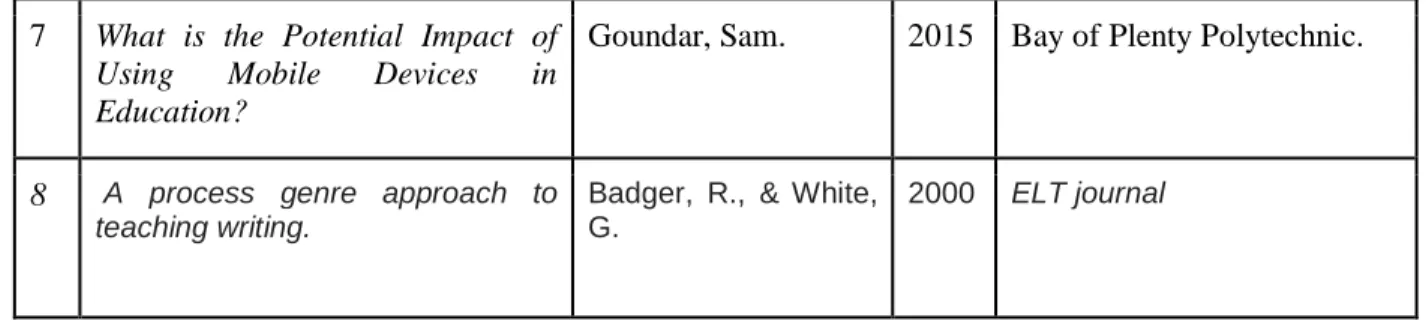
(24) 9. CHAPTER II THEORETICAL FRAMEWORK This section is dedicated to the presentation of the selected studies taken as background for this research. These studies share vision, theoretical bases, and objectives with this research. Therefore, important concepts and conclusions of these works on Technology and Education are highlighted and described in the following paragraphs, as well as the definition of key concepts and the communicative skill focus that this research has. 2.1 Literature review #. Title. Author. Year. Source. 1. Desarrollo de Computer Assisted Fiallo Language Learning (CALL) Hernan. estado del arte.. Hernández, 2016. Bogotá. Universidad Pedagógica Nacional.. 2. Plataformas E- learning. Una Espinosa Díaz, José 2016 cuestión de perspectivas. Javier.. Bogotá. Universidad Pedagógica Nacional.. 3. Uso de aplicaciones móviles para Sanchez el aprendizaje de una lengua Jennyfer. extranjera.. Burbano, 2016. Universidad de la Salle.. 4. Design and Implementation of Buenaño Quality Indicators for Obtaining Yamil Digital Identity and Individualization of Learning. Palacios, 2013 Red-revista De Educacion A Distancia. 5. Emerging Technologies Mobile Godwin-Jones, Apps For Language Learning. Robert.. 2010. 6. Exploring Smartphone Heyoung, Kim. 2011 Applications for Effective Mobile- Yeonhee, Kwon. Assisted Language Learning.. Virginia Commonwealth University. Chung-Ang University..
(25) 10. 7. What is the Potential Impact of Goundar, Sam. Using Mobile Devices in Education?. 8. A process genre approach to teaching writing.. 2015. Badger, R., & White, 2000 G.. Bay of Plenty Polytechnic.. ELT journal. Table 1: Literature review. Nowadays, new technologies like smartphones and tablets have reached numerous aspects of the human life such as social, educational, and communicative due to its portability and instrumental potential in many fields. In Colombia this technology is in a constant growth. Therefore, it is predicted that this portable technology is going to become the next frontline of technology and will outrace other technologies in the field of computer assisted language learning. In order to analyze the history that Technology and English as Foreign Language (EFL) have together and understand the current trends of this relationship, this document will rely on the research in a state-of-the-art done in 2016: Desarrollo de Computer Assisted Language Learning (CALL) estado del arte. The general objective of this paper is to explore the evolution of computers in language learning and its evolution toward M-Learning (MALL), which is the last item mentioned since it is a state-of-the-art technology done in 2018. The author documents how throughout the years and in the advent of new technologies Education has found a way to integrate these innovations to the classroom. This document concludes that it has become impossible to teach a foreign language without using technology directly or indirectly. For this reason, this paper is used to establish the current state of CALL, and it is used as a base to say that the future of this relationship lies within the smartphones’ potential. The main focus with working with new technologies is reconceiving the interdependent relationships established in the classroom, the objective of using smartphones in classes is to create a new vision of Education and new ways or strategies to access and build knowledge. For.
(26) 11. this reason, this research considers accurate the thoughts and conclusions proposed in “Plataformas E- learning. Una cuestión de perspectivas. (2016). This study, which focuses on the implementation of an e-learning platform in a natural science class to allow students to access different natural environments, concludes that no platform or smartphone application successfully enhances teaching or learning processes without reflecting on their pedagogical potential. Bearing in mind the previous statement, this research agrees with the principle that the aim of any technology innovation used in Education should be allowing the community to rethink what learning is and the dynamics of the classroom in order to find new strategies to improve the learning process with this technology. In 2016. a group of undergraduates lead by Jennyfer Sanchez carried out a research which was documented in her paper Uso de aplicaciones móviles para el aprendizaje de una lengua extranjera. On her paper she explains that in order to fully engage students and achieve meaningful learning teachers need to include their intrinsic motivations. Using smartphones apps proved to be really engaging and motivating for the students in her study due to the interactivity and excitement that these apps introduced to her classroom. This perspective matches the vision of this research, since both agree that successful learning is heavily shaped by the desire to learn and this technology can raise this level of engagement. Furthermore, the article Design and Implementation of Quality Indicators for Obtaining Digital Identity and Individualization of Learning becomes really informative for teachers that want to explore the potential of smartphones in the classroom. This paper presents a review of several studies done with smart mobile technology in the classroom. Its objective is to contribute to designing and implementing high quality learning and teaching strategies with smartphones in order to achieve an individualization of learning. The author reflects on individualization of Learning and concludes that this tool promotes self-learning through Ubiquitous Learning (U-.
(27) 12. Learning) because it drifts apart from the teacher-centered traditional model and moves into a type of Education where the students becomes autonomous. This perspective is shared by this research and even though this study is developed and shaped under the dynamics of Blended Learning (B-Learning), the researcher agrees that U-Learning is a very important goal of using smartphones in the classroom. On the paper Emerging Technologies Mobile Apps for Language Learning. GodwinJones highlights the fact that this emerging technology (smartphones) is a great opportunity to integrate face to face classes with an intelligent tutoring system (ITS). He mentions Blended Learning works such as the TenseITS project (Cui & Bull, 2004) which featured a mobile ITS using context and location of the user to determine which verbs to use in drill exercises. GodwinJones continues with the idea that smartphones are ideal for individualized informal learning. Since it is the user who chooses which apps to acquire and how to use them. This research agrees to the idea that language educators should encourage and assist the learners’ autonomy by providing contextualized means to learners to combine formal and informal learning. Moreover, on the paper Exploring Smartphone Applications for Effective Mobile-Assisted Language Learning, Heyoung and Kwon aim to explore the applications to learn English in the iOS App store, an Apple webpage, in order to analyze how to implement appropriate pedagogical strategies and activities to work with these apps. They focus on each communicative skill and state the strategies behind each type of exercise proposed and later their results. This research focuses on writing skills, therefore, it is a matter of interest when it comes to their analysis on writing skills. They conclude that some applications effectively facilitate users with writing practices from various writing approaches, such as process writing, self-editing and interactive writing. This paper becomes a great source of information when looking for understanding the factors to take into account when creating the strategies behind the writing exercises to give to students..
(28) 13. Furthermore, Goundar on his paper What is the Potential Impact of Using Mobile Devices in Education? develops the idea that mobile assisted language learning (MALL) offers pedagogical benefits that are underrated and that teachers should explore them and not deny to students. Also, he discusses the challenges that Education faces with the growth of this technology. This part in particular is useful to take into consideration for this research since not all schools or institutes have the appropriate facilities, internet connectivity or technological devices needed for this approach. Goundar, concludes by stating the advantages of introducing MALL since the learning environment can be enhanced by the use of quizzes to test knowledge, summary of main learning points, and interaction with other students and the tutor via instant messages. The latter perk, instant message interconnectivity between the teacher and the students, became very important in the development of this research since one of the goals of this research is to individualize feedback and this technology helps to achieve this purpose. Furthermore, to outline the concept of Process Based Approach, this research relies on the study done A process genre approach to teaching writing by Badger and White (2000). What they are mainly concerned with in this research, is to define Process, Product, and Genre Based Approaches and to observe their overlapping points in order to establish a delimitation for each concept. Badger and White comment on Process Based Approach by saying that “In process approaches, the teacher primarily facilitates the learners’ writing . . ., Like babies and young children who develop, rather than learn, their mother tongue, second language learners develop, rather than consciously learn, writing skills. Teachers draw out the learners’ potential. (p. 154). This research done by Badger and White concludes that an effective writing methodology has to be able to become flexible in order to integrate aspects of all approaches such as Product, Process, and Genre. They continue mentioning that when one approach lacks aspects that are necessary, the teacher must adapt the approach in order to match these needs. They exemplify by mentioning that the Process Approach does not focus on input, which can be problematic.
(29) 14. especially in Basic levels. Furthermore, this study follows by suggesting techniques such as group work, where input is provided by other learners, and conferencing. This study provides to this research a deep insight into different ways to teach Writing. Also it feeds this research by introducing this flexibility in approaches which they further on name Process Genre Approach, which is a synthesis of these three approaches. Finally, the authors mention that within the Process Approach there are different opinions in terms of the stages that the students needed to go through when producing a paper, but a typical model identifies four stages: prewriting; composing/drafting; revising; and editing (p. 154). These stages were considered as a starting point for the design of the stages to be completed in this research. In conclusion, the previously mentioned documents allow this research to be set in the current state of Blended Learning as well as integrating concepts such as MALL and CALL. These papers contribute to the research by providing a theoretical background for introducing technology to the classroom as well as a theoretical base in order to design a Process Based Approach methodology to assist students in their Writing Skills. 2.2 Theoretical framework This part of the study comprehends the theoretical framework that supports the research. Firstly, Writing Skills which was the target language skill developed through the research is defined as well as the subcategories of Narrative and Descriptive Writing, and Cohesive Writing. Following, Blended Learning and its implications such as Computer Assisted Language Learning (CALL), Mobile Assisted Language Learning (MALL) and Learning Management Systems (LMS) are described as they are a main component of the implementation of technology in the study, finally, the concepts of Process Based Approach, Color Coding, and Feedback are developed to understand the methodology used throughout the study. 2.2.1 Writing skills.
(30) 15. To start defining what writing skills are, it is necessary to contrast different conceptions. Therefore, several authors are mentioned in order to set the perspective of the current research. According to Ivanič (1998) writing is not just about conveying content but also about the identification with the text and how this action plays a part in reproducing interests. This perspective sees writing as a self-discovery of a writer self. This vision of writing follows an important angle shared by this research which is connected to the creation of a creative text in form of a short story, feeding in way this rather artistic point of view toward writing. It is also important to contrast this definition with the Common European Framework of Reference (CEFR). In this perspective writing skills are defined from a task completion regard, as it is defined by writing skills requirements or objectives the students must achieve. In this framework a 6 level scale was created in order to classify the EFL learners, being A1 the lowest level and C2 the highest in terms of language knowledge. Following, these writing requirements for A1 and A2 are described. According to the CEFR, writing should be categorized in three components: overall written production, creative writing, and reports and essays (Annex 3). Furthermore, the CEFR explain that in A1 and A2 levels, learners must be able to write simple isolated phrases and sentences and write a series of simple phrases and sentences linked with simple connectors like and, but, and because. Additionally, they must be able to write about everyday aspects of their environment such as people, places, a job or study experience in linked sentences. Learners of these levels should also be able to write very short, basic narration of events, past activities and personal experiences; write a series of simple phrases and sentences about their family, living conditions, educational background; write short, simple imaginary biographies, where they live and what they do. In order to articulate these definitions, it is possible to say that Ivanič was centered in writing as a subjective performance connected to a cultural phenomenon that allows the writers.
(31) 16. to represent their values and beliefs, whereas the CEFR focuses on a final product that is related to the complexity in the use of language and the students’ knowledge to fulfill specific tasks. For this specific paper it is important to follow the guideline of the CEFR since in the Centro de Lenguas a didactic unit is used and the content of it was planned according to the CEFR. Moreover, the objectives of this research are set to support students to meet these requirements established by both the Centro de Lenguas and the CEFR (Annex 3). For this reason, the research focuses on assisting students in writing short narrative texts with descriptions about everyday activities and experiences using linked sentences in the form of a short story. This objective introduces the concept of Narrative and Cohesive Writing which are key elements of this research. These concepts are explained in the following subcategories. 2.2.1.1 Short Story. Narrative and Cohesive Writing. Following the idea of the creation of a narrative descriptive text, it is important to mention that the final stage of their process involved the creation of a book. This book contained a short story which is defined by Abrams (2011) as “s a brief work of prose fiction . . ., the various narrative techniques of the novel are applicable to the short story as well . . ., and as in the novel, the plot form may be comic, tragic, romantic, or satiric” (p.286). According to this author the short plot can be narrated from one or more points of view; and it may be written in the mode of fantasy or realism. This definition by Abrams works accordingly to the perspective that this research has toward Short Stories and for this reason the students were asked to create their short stories considering main aspects like protagonist, plot, and genre. Moreover, this type of texts was selected as it is appropriate for the EFL Basic students due to the length and complexity of the narration. The Short Story is the shortest genre of fiction, hence, it can be a preferable form when focusing in developing students' narrative writing..
(32) 17. Following the definition of short story, this research agrees with the reflection that Sariçoban (2011) does about this genre “short story with its setting, characters and compelling plot, captures and holds the attention of the learners which is an important part of the learning process. The use of short stories to teach English has several other benefits including motivational, literary, cultural and higher –order thinking benefits”. (p.161). This perception of short stories highlights motivation and attention as important aspects of engaging in writing and adds a more creative perspective when compared to Abram’s definition. Furthermore, this literary genre also matches the expectation from the CEFR of the A2 level in terms of text production (Annex 3) when it is established that students should be able to write short narration of events, past activities and personal experience. When it comes to creative writing, the CEFR indicates that introducing imaginative writing is considered an indicator of the level B1 even if the past event narration is considered since the level A1. Because this research follows the process of the children from A1 to B1, assisting students in the creation of imaginative narrative-descriptive texts becomes of high importance in order to achieve the indicators of the CEFR and the CLE during all the stages of the process. Additionally, this definition is also observed by Boucher (2011) who proposes that narrative writing may be used to inform, persuade and socialize. With this definition Boucher states that the main structural components of Narrative Writing are the orientation, the complication and the resolution. Taking into consideration these components and the authors’ definitions, this research set as the literary genre to develop the Short Story, understanding this type of texts as a short narrative text in which past imaginative events are described. In this process, the short story was organized in 5 chapters or moments such as Chapter 1: Introduction, Chapter 2: Problem, Chapter 3: Plot Twist, Chapter 4: Problem Solution, and Chapter 5:.
(33) 18. Conclusion. These chapters followed the stages set by Boucher (2011) named orientation, complication and resolution. This short story is focused on a main plot seen from the point of view of a main character and the chapter organization was used as the rafting submissions stages. Each student submitted a draft of their chapters as part of the Process Based Approach and later needed to edit and resubmit them taking into consideration the feedback given by Apps, classmates, and teacher. Incidentally, the creation of this text also involves the Narrative writing. These two concepts are different but complementary for the creation of short stories. When it comes to outlining Narration, this concept is understood as stated by Abdel-Hack (2014) “reporting events that happened or telling stories. Two skills involved in this kind of communication are the placement of events in appropriate sequence and the selection of details to include in the story”. Following this definition, Narration focuses on writing a time-ordered text that is used to narrate events, create, or entertain. This definition is evidently connected to the CEFR A2 and CLE’s Basic writing requirements objectives due to the fact that they focus on past event narration and basic description of people and places where the events occur. 2.2.1.2 Cohesive Writing In this matter, this research understands Cohesive Writing as writing in a manner that enables text unity and enables the reader to successfully follow the logical relationships between sentences and paragraphs. About this concept, Halliday & Hasan (2013) coined it as “the continuity provided by cohesion that enables the reader or listener to supply all the missing pieces, all the components of the picture which are not present in the text but are necessary to its interpretation” (p. 299). Taking into consideration this definition, this research focuses on.
(34) 19. Cohesive Writing as it is essential to organize ideas logically in the students’ short stories through a combination of grammar and vocabulary systems. This brings us to the concept of Coherence. For understanding the meaning of this concept in this research, Hyland (2006) is quoted as he defines Coherence as “The ways a text makes sense to readers through the relevance and accessibility of its configuration of concepts, ideas and theories” (p. 311). With this concept, it is implied that the student not only needs to have a cohesive writing but also needs to convey the message in a coherent manner to successfully express itself in written form. These definitions make reference to correct use of cohesive devices to logically connect sentences but also regard the concept of coherence as they are related in terms of logical writing. For this reason, this research follows Witte (1981) idea as the author states that “Cohesion defines those mechanisms that hold a text together, while Coherence defines those underlying semantic relations that allow a text to be understood and used”. (p.206). According to this definition both Cohesion and Coherence are properties that allows the creation of the structure of a paragraph and are considered important aspects to be observed in the process of the students. Furthermore, to develop the point out the concept of paragraph, this study understands a paragraph as a body of text composed of five to seven sentences that develop a single topic. McCloud (2009) outlines paragraphs as “much more than a collection of connected sentences” (p.2). The author indicates that paragraphs provide the structure needed to develop the thesis of a paper by presenting the topic sentence, middle or body called the supporting details and end or conclusion named the concluding sentence. In this perspective, a paragraph is related to academic writing..
(35) 20. In conclusion, it is important to mention that students were not analyzed under this definition, instead, students needed to create a Narrative Paragraph, which is more connected to creative writing as students created a short story. This type of paragraph is defined by McCloud (2009) as a type of paragraph that focuses on an experience or an event, “narrative uses transitions of time and space . . ., The unique feature of this type of development is that it tells a story” (p. 9-10). Within this perspective, the focus of a paragraph is connected to how events are narrated in terms of chronological order or sequence of events.. 2.2.2 Blended Learning For this concept, two authors are cited to give define Blended Learning. Firstly, Garrison and Kanuka (2004) define blended learning as “the thoughtful integration of classroom face-toface learning experiences with online learning experiences. There is considerable intuitive appeal to the concept of integrating the strengths of synchronous (face-to-face) and asynchronous (textbased Internet) learning activities” (p. 96). It is possible to agree that this is the commonly accepted definition that several authors provide. Regarding Blended Learning, Picciano, who is a recurrent researcher on this topic, partially agrees with this definition. He accepts this conception of blended learning but he also states that the definition of blended learning is not hermetically defined. There are many forms of blended learning, nevertheless, a taxonomic table is still currently discussed. In his words “One school's blended is another school's hybrid, or another school's mixed-mode… Without a clear definition, blended learning is perceived as some nebulous combination of online and face-toface instruction”. (Picciano. 2014). (p.8)..
(36) 21. While both definitions agree on the fact that Blended Learning in essence is the combination of face to face learning and online learning, for this paper the dynamic and flexible perspective of Picciano toward Blended Learning suits the best. Since taxonomically speaking there is no consensus yet about the types of Blended Learning, this study does not consider any tentative classification of Blended Learning as a starting point. Instead, it provides a case study for posterior analyses and determination for a possible classification of M-learning in the EFL classroom. In conclusion, Blended Learning is a concept that is outlined as an approach that implies the integration of technology to the classroom. This study relies in M-learning as part of its blended component. 2.2.3 M-learning and Apps The M in M-learning stands for ‘mobile’, which means portable and personal like a mobile phone or a tablet. Traxler (2005) defines it as “any educational provision where the sole or dominant technologies are handheld or palmtop devices” (p. 262) Crompton (2013) on the other hand said M-learning is “learning across multiple contexts, through social and content interactions, using personal electronic devices” (p.4). It is possible to state that both agree in the portability aspect of M-learning. Moreover, M-learning consists in using smart devices that allow students to get information regardless of time and place like smartphones and tablets. This is why Traxler emphasizes that mobile learning, in terms of learners’ experiences, help them identify some key attributes of mobile learning such as personalized, situated, authentic, spontaneous and informal. The definition by Traxler results relevant for this research because the research is student centered as students are encouraged to regulate their own learning using their smartphones to achieve autonomous learning..
(37) 22. Currently, smartphones in Colombia are more widely available than computers. According to the Ministerio de Tecnologías de la Información y la Comunicación (MINTIC) in its research “Diseño y medición Indicador Terminales por cada 100 habitantes. 2014-2018 revealed that in the year 2016 there were 54.5 smartphones per 100 Colombian people, and in the year 2017 there were 69.55 (Annex 13). According to MINTIC, it is expected that this number will continue increasing and by the year 2020 the amount of people that will own a smartphone will grow up to 90%. With this statement which argues that currently more than 50% of Colombian people have smartphones it is logical to think that the access to this technology proved to be broader than computers not only in terms of portability but in numbers as well, since this study also revealed that there is one computer per four people in Colombia. Moreover, it is important to set the boundaries of the conception of M-Learning within this research. This vision of learning stands in the middle of informal and formal education and it is connected to the concept of Ubiquitous Learning (U-learning) and it is in essence learning anything, anywhere, and in any moment through mobile technologies. Furthermore, Mishra (2013) mentions different relevant aspects of U-learning such as the fact that the System recognizes the learner’s location and its surrounding and based on the environment situation it provides contextualized information and that learners can store their work in these platforms and follow their own progress as it is stored into the database permanently. It becomes significant to set boundaries when talking about U-learning and Blended Learning. This study recognizes the value of autonomous learning and understands U-learning as a more individual learning. This learning approach was encouraged to students by asking them to download and use Apps for practicing Writing Skills and other grammar related topics but this autonomous work did not constitute a requirement of the course in terms of grading. For this reason, this research leans more on Blended Learning (B-learning). The difference in these two concepts becomes evident as U-Learning omits the teacher from the.
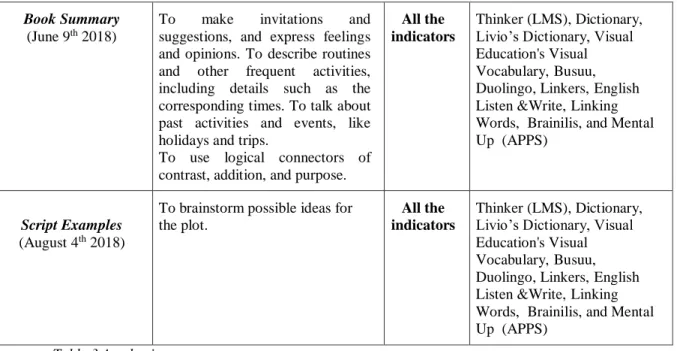
(38) 23. learning process and the face to face time that this study implements. Both concepts are regarded as complementary as feed the vision of use of M-learning in this study as students could use the apps to learn in class when permitted (B-learning), and using the teacher selected or self-selected Applications everywhere they had internet connection (U-learning). Furthermore, when people think of smartphones and M-learning, the concept of Applications is often mentioned. In order to define Applications or Apps, this study relies on the definition by Hinze (2017). The author stated that a mobile app is “a software application developed primarily, although not exclusively, for use on small computing devices, such as smartphones or tablets” (p. 2). From this research’s point of view, a mobile app or mobile application is a software created to execute in smartphones, tablets. To continue with this definition, when Apps are created for the specific purpose of assisting teaching or self-learning in different subjects they are categorized within the concept of Educational Software. For the outlining of Educational Software this study agrees with Squires (1999) as the author stated “educational software is designed to support teaching and learning in new and innovative ways, such as by developing and exploring models . . ., or by supporting collaboration at a distance via the internet” (p.1). This type of software has been used since the introduction of computers to EFL classrooms and this pedagogical approach was named Computer Assisted Language Learning (CALL). Currently, applications aimed at autonomous language learning is a fast growing field as it can be seen in Apple’s App store or Android’s Play store. The main use of these Apps is to allow individual self-paced learning and individualized feedback. Moreover, one of the components of the M-learning in this research is the apps for EFL students. For this study, the applications were selected by the teacher bearing in mind the students’ objectives in terms of grammar to assist students achieve the goals set by the CLE, and.
(39) 24. Writing Skill as a way to tackle the identified problem among the students. These applications (Annex 11) were chosen as they assisted students in autonomous learning through grammar practice (Busuu, Duolingo and Thinker), vocabulary learning (Visual Vocabulary). Furthermore, other applications were considered as an optional tool for the face to face classes such as an offline dictionary (Livio’s Dictionary) and an Internet Browser. Finally, these applications also aimed to allow students learn logical connectors by providing examples and exercises (Linkers, English Listen &Write, and Linking Words). Students were encouraged to search and use these and other applications in English that were not strictly EFL related as part of autonomous informal learning (Brainilis, Word Connect, MentalUP, etc.).. 2.2.4 CALL It is possible to state that CALL (Computer Assisted Language Learning) evolved into MALL (Mobile Assisted Language Learning). This paradigm proposes that learning a language is not solely linked to a formal institutional teaching, instead, people can access to a device such as a computer or smartphone and be exposed to an ever increasing amount of resources and applications that do not depend neither on space or time (Cope. 2009). Nowadays, there are very few educational functions that smartphones cannot do when they are compared to a computer, for this reason, the concept of MALL becomes the next step in CALL. 2.2.5 MALL Mobile assisted language learning (MALL), is an approach to learning language through the use of portable devices such as mobile phones, MP3 and MP4 players, Personal Digital Assistants (PDAs), smartphones, tablets and electronic dictionaries (Chinnery. 2006). In this sense, M- learning and MALL are in essence the same, being M-Learning the general concept.
Figure
Documento similar
De las respuestas a estas preguntas puede surgir el inicio de un plan de recuperación personal y algunas ideas para encontrar una red de personas que puedan y estén dispuestas
Government policy varies between nations and this guidance sets out the need for balanced decision-making about ways of working, and the ongoing safety considerations
No obstante, como esta enfermedad afecta a cada persona de manera diferente, no todas las opciones de cuidado y tratamiento pueden ser apropiadas para cada individuo.. La forma
The analysis revealed significant differences in categories such as word count, clout, emotional tone, or analytical thinking when comparing the texts written by an
With the aim to check the impact and usefulness of these mobile learning environments in education (focusing on helping students with time management by recommending them
As Pajares (2003) suggests, at high school, which is equivalent to the levels studied here, these differences tend to disappear, especially when writing self-efficacy beliefs are
In fact, data mining techniques have already been used in E-learning systems, but most of the times their application is oriented to provide better support to students; little work
Due to the great sensibility of the E x curves versus the " 00 observed, three different sample categories have been considered during the learning procedure in order to
