
Is translation studies the Cinderella of the spanish university sector, or is it its new milkmaid?
17
0
0
Texto completo
(2) Francisco J. Vigier-Moreno. undergraduate and postgraduate) are currently enjoying the utmost popularity in Spanish universities, to the extent that they have become, by far, some of the most sought-after degrees in the realm of Humanities. This spectacular boom has accordingly brought about significant increase in research in Translation in Spain, with an ever increasing number of scholars, journals, projects, dissertations and conferences focussing on Translation. New subdisciplines have consequently emerged and consolidated, like technical translation, scientific translation, medical translation, legal translation, conference interpreting, public service interpreting, screen translation... and many more. Translation can be, thus, seen as a cinderella in Spanish universities. For many, it started as the maid of Humanities, ignored and even sometimes scorned by other close, traditional disciplines which did not grant it a truly academic or scientific standing. However, in a couple of decades, Translation has evolved into a very powerful commander, with an increasingly greater number of students enrolling in translation programmes and a thriving research agenda, whereas some of those long-standing disciplines must now struggle to survive due to the lack of students’ applications. Translation, as can be argued, has somehow become a safe bet for universities at a time when most degrees in the realm of Humanities seem to be in serious decline in Spain (and probably worldwide). But can this growth last forever? Is there real demand for so many translators? Can the job market, especially the translation industry, absorb all these graduates? How comes that Translation degrees have become so popular in Spain and this boom has not taken place in other European countries with a longer tradition in translator training? Why are there so many students in Spain willing to apply for a Translation degree after their secondary education? In short, are current degrees really giving response to students’ expectations, on the one hand, and market needs, on the other? In the following, we purport to partially answer these questions by describing in detail the evolution, current status and foreseeable future of Translation in Spain. Firstly, we will recount the background and booming of the discipline, with greater emphasis on the determinants and the curricula of the first degrees which were offered. Secondly, we will provide a general overview on the current situation in Spain’s Translation schools, paying special attention to curricular design and diversification. Then, we will refer to the employability rates of Translation graduates in Spain and take account of the motivations and expectations of students who enrol in Translation programmes. Finally, bearing in mind some of the challenges which Translation is to face in Spanish universities, we envisage what the future may hold for Translation in Spain, and. 168.
(3) Translation in Spanish Universities: a Cinderella or a Milkmaid?. question whether Translation could fatally go from being that cinderella of Humanities in Spanish universities to becoming a victim of its own success, for instance, by offering specialised translator training to students who eventually do not want to follow a career as translators, that is, to becoming a milkmaid who is building a financial empire selling milk which, if proper care is not taken, will soon get sour.. 1. Translation in Spanish universities: from its earliest days till Bologna In the geographical context that concerns us, i.e. Western Europe2, Heidelberg (1930) and Geneva (1941) are reported to be the first schools to train translators from a professional viewpoint. Subsequently, translator training gained great importance due to the significant increase in the demand for translations after II World War (Caminade and Pym, 1998) and thanks to the professionalisation and specialisation process fostered by the first translators’ professional associations (Hurtado, 1999: 9). This is how it should come as no wonder that new establishments were set up in Graz (1946), Gemersheim (1947), Saarbrücken (1948) and Paris (1950), to name but a few. The opening of these new schools, in turn, hailed the emergence of Translation as an academic discipline, with scholars devoted to developing theoretical and methodological frameworks which could sustain this activity. In Spain, however, Translation was not born as a university discipline until the mid 1970s and, as Calvo puts it (2009: 196), has had a complex lifecycle. Two schools claim to be the pioneers providing state-regulated, public, profession-oriented training for translators that traditional philological studies could not cater for. On the one hand, the School for Modern Languages of the Universitat Autònoma de Barcelona, which was set up in 1972, offered threeyear undergraduate studies leading to a degree in Translation. On the other hand, since its creation in 1974, the Institute for Modern Languages and Translation of the Complutense University of Madrid, offered state-regulated postgraduate courses, mainly specialised in literary translation3. In 1979, the University of Granada turned its Institute for Modern Languages into a Escuela Universitaria de Traductores e Intérpretes or EUTI (University School for Translators and 2. 3. For a non European-centred overview on translator training evolution, see Pym (2002). Retrieved from https://www.ucm.es/iulmyt/historia [25/04/2018]. 169.
(4) Francisco J. Vigier-Moreno. Interpreters), and in 1984 the then Polytechnic University of the Canary Islands opened its new EUTI. As pointed out by Way (2005: 15), the work undertaken by these three EUTIs4 helped Translation develop its own distinctive identity and consolidate in the Spanish university spectrum. These schools, nonetheless, could only offer the minor three-year degree then known as diplomatura, and not the full four-year or five-year licenciatura. Obviously, this had a number of drawbacks. In these degrees, students had to choose a first foreign language (B language), which they had to know beforehand, and a second foreign language (C language), which they would learn ab initio, but obviously it was virtually impossible for prospect graduates to reach a professional command in this C language in those three years. Besides, as Calvo argues (2009: 202), Spanish graduates could not compete with other European counterparts for international posts, as a full university degree was required, and nor could they engage in postgraduate research on the same grounds. It was thanks to the arduous negotiations held between those three EUTIs and the Spanish Ministry of Education that the new Licenciatura en Traducción e Interpretación (henceforth LTI), that is, a full-fledged four-year university degree in Translation, was eventually allowed in 1991. Those three original EUTIs shortly adopted the new LTI, and many other universities started offering this new degree very soon too. In fact, in little more than a decade, Translation experienced a meteoric rise in Spanish universities, which, according to Muñoz Martín (1996), can only compare to that undergone by Computing. The LTI was soon studied in more than 20 universities (both public and private) and the number of Translation students trebled — already in 2002 there were more than 9000 students registered in Spanish Translation schools (Muñoz Raya, 2004: 49). There were so many students applying for that degree that most universities had to establish a numerus clausus method to limit the number of students. Hence, in order to be admitted in many universities, applicants had to pass a test in order to prove their command in the respective B language. In other universities, however, only applicants’ grades in secondary education were considered. And others applied both previous criteria. At any rate, this selection subsequently resulted in very high-performing students being admitted to Translation courses, which, in turn, contributed to the prestige of the discipline in general. As authors like Kelly (2000) and Way (2005: 61) argue, this phenomenal demand can be 4. The Translation school of the Universitat Autònoma de Barcelona gained such status in 1984.. 170.
(5) Translation in Spanish Universities: a Cinderella or a Milkmaid?. explained, too, because in Spain there was a lack of university degrees related to modern languages with an applied (and not philological) approach, like Applied Languages or International Business, and this new degree also filled this vacuum soon. According to Calvo (2009: 203), the study plan of this LTI was comprehensive, somewhat kaleidoiscopical, clearly profession-oriented and flexible, which was extraordinary at the Spanish university sector of the time, which used to have rigid curricula. Only about one third of the modules comprising the LTI were compulsory and common for all universities in Spain, which meant that every university could devise its own curriculum for the remaining two thirds. But this curricular freedom and flexibility soon became a double edged sword, as it allowed every university to offer the degree under its own constraints in terms of facilities, funding and teaching force, and, thus, training under this LTI wound up varying greatly from university to university. In terms of language pairs, all schools offered this LTI with Spanish as the A language5; as far as the B language is concerned, English was taught in all schools, German and French in a smaller number, and only one school had Arabic as well. As Mayoral (1998) clearly states, there were more problematic issues regarding this degree in addition to this training disparity. In our opinion, four of those problems have been crucial to understand the development of Translation in Spain. First, as its very name indicated, this degree encompassed both translation and interpreting, but there were only two compulsory modules in interpreting, which accounted for 160 hours of face-to-face tuition. Therefore, even if the name of the degree might indicate that graduates can work as interpreters, this training was obviously insufficient for the adequate training of interpreters, and that is why the name of the degree was fiercely criticised by professional associations and international translation and interpreting services. Second, despite the flexibility of this degree, it could only enable graduates’ semispecialisation in certain fields (e.g., legal translation), and hence could not meet the market’s expectations that this new programme could equip graduates with the skills required for specialised translation sectors. Third, despite the urgent need to train researchers and trainers in Translation as a result of its quick expansion (Monteagudo and Vigier, 2005: 2), many of the lecturers needed to offer this training in the new schools had little or no previous professional 5. The schools located in Autonomous Communities with another official language also offered this degree with one of these languages (namely, Catalan, Basque and Galician) as an A language.. 171.
(6) Francisco J. Vigier-Moreno. experience as translators themselves. Evidently, in spite of their praiseworthy efforts to retrain and go from being philologists or foreign language teachers to becoming translator trainers, their teaching was frequently rather distant from the reality of the profession. And fourth, and most importantly, the opening of so many new Translation schools would lead to a subsequent phenomenal increase in the number of graduates which could not be absorbed by the job market (especially in translation-related posts, which are very often held by unqualified people), as Mata also argued (2002: 24).. 2. Translation in Spanish universities today: Bologna’s aftermath In 2010, the European Higher Education Area (EHEA) was finally launched during the Budapest-Vienna Ministerial Conference, just a decade after the Bologna Declaration was signed, with the main objective of strengthening the competitiveness and attractiveness of European higher education and fostering student mobility and employability6. In order to ensure more comparable, compatible and coherent systems of higher education in Europe, the former undergraduate/postgraduate structure was replaced by a three-cycle system with easily readable programmes and degrees, and a common ECTS-credit system was introduced. Despite this uniformity, every country has had a relatively high degree of freedom at adapting its higher education system to the EHEA. Most European countries have adopted a system whereby undergraduate programmes take 180 ECTS (three years) and postgraduate programmes take 120 ECTS (two years). However, in Spain the qualifications framework, in force since 2010, has been different. The first cycle is covered by the qualification named grado, which encompasses 240 ECTS, equivalent to four years, and is mostly aimed at the students’ acquisition of generic and transversal competences. Second cycle programmes have 60 to 120 ECTS (one or two years), lead to the degree of máster and address specialisation, that is, the development of specific competences. Finally, third cycle programmes lead to the degree of doctor, which is awarded after (normally) at least three years of study and research and the submission of a thesis. Before this system was adopted, there was a heated debate in Translation academia as to the degrees that should be offered. Some authors (like Muñoz 6. Information retrieved from http://www.ehea.info [25/04/2018].. 172.
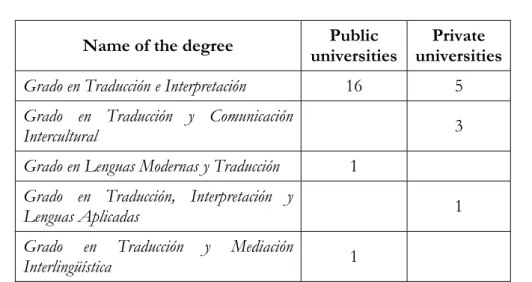
(7) Translation in Spanish Universities: a Cinderella or a Milkmaid?. Martín, 2005: 631) advocated three-year grados, focussed on general languagerelated activities, like international relations, intercultural mediation, international correspondence and tourism, leaving specialisation for two-year másteres. However, Translation schools, when preparing a libro blanco (or white paper) which would play a determining role in the qualifications adaptation, eventually opted for a four-year programme too. According to this document, the new degree would focus on general translation with insights into specialised translation and liaison interpreting, considering professional profiles such as professional generalist translator; language and culture mediator; liaison interpreter; reviser and proof-reader; lexicographer, terminologist and language project manager; and, surprisingly, language teacher (Muñoz Raya, 2004). Accordingly, greater diversification, and thus specialisation, was intended for one-year postgraduate programmes (Borja and García, 2008: 156). Translation was, naturally, no exception to this change in the degrees and programmes were modified to fit this new system. According to the Spanish Ministry of Education7, there are currently 27 240-ECTS undergraduate degrees being offered by Spanish universities: the Grado en Traducción e Interpretación (undergraduate degree in Translation and Interpreting) is being taught in 21 universities; the Grado en Traducción y Comunicación Intercultural (undergraduate degree in Translation and Intercultural Communication) is offered by three universities; the Grado en Lenguas Modernas y Traducción (undergraduate degree in Modern Languages and Translation), the Grado en Traducción, Interpretación y Lenguas Aplicadas (undergraduate degree in Translation, Interpreting and Applied Languages) and the Grado en Traducción y Mediación Interlingüística (undergraduate degree in Translation and Interlingual Mediation) are offered by only one university each8.. 7. 8. Information retrieved from the Register of Universities, Schools and Degrees of the Spanish Ministry of Education, Culture and Sports: https://www.educacion.gob.es/ruct/consultaestudios.action?actual=estudios [Accessed 25/04/2018]. As regards postgraduate courses, more than 40 programmes are offered across Spain.. 173.
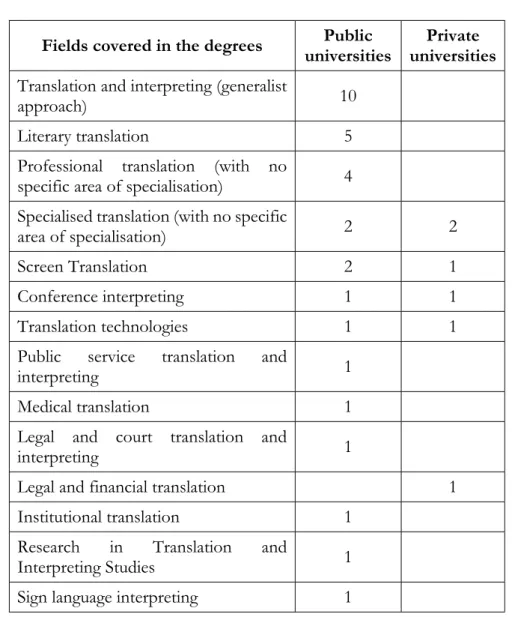
(8) Francisco J. Vigier-Moreno. Name of the degree Grado en Traducción e Interpretación. Public universities. Private universities. 16. 5. Grado en Traducción y Comunicación Intercultural Grado en Lenguas Modernas y Traducción. 3 1. Grado en Traducción, Interpretación y Lenguas Aplicadas Grado en Traducción Interlingüística. y. Mediación. 1 1. Table 1. Grado degrees in Translation in Spain today. As to the curricular design of most current Translation programmes in Spain, training is mostly focussed on language and culture (in language A, B and C), translation theory, general translation (from B or C into A), introduction into specialised translation (mainly scientific, technical, legal and economic), terminology and liaison interpreting. It can be concluded, then, that the degree of diversification fostered (at least in theory) by the new degree system has failed to be achieved yet, as most universities have stuck to a newer version of the former LTI, which basically replicates its curricular design with a slight reduction in specialised translation training. Three private universities offer a different programme (namely, the Grado en Traducción y Comunicación Intercultural) and only a handful of public universities are now offering new degrees, such as the Grado en Lenguas Aplicadas and the Grado en Traducción y Mediación Interlingüística –their curricular content, nonetheless, do not differ greatly from those of the widespread grados either. As far as master degrees are concerned, there are currently more than 30 universities, both public and private, offering Translation-related postgraduate programmes. However diverse these degrees may be, the biggest number of courses (10) cover generalist translator and interpreting training, precisely targeted at graduates in disciplines other than Translation, with the purpose of teaching these outsiders the basics of the profession and discipline. Besides this, it must be noted that even if many other master’s degrees are ideally addressed to Translation graduates many of those who eventually enrol in them come from different academic (and professional) backgrounds.. 174.
(9) Translation in Spanish Universities: a Cinderella or a Milkmaid?. Fields covered in the degrees. Public universities. Translation and interpreting (generalist approach). 10. Literary translation. 5. Professional translation (with specific area of specialisation). no. Private universities. 4. Specialised translation (with no specific area of specialisation). 2. 2. Screen Translation. 2. 1. Conference interpreting. 1. 1. Translation technologies. 1. 1. Public service interpreting. translation. and. 1. Medical translation. 1. Legal and court translation and interpreting. 1. Legal and financial translation. 1. Institutional translation Research in Translation Interpreting Studies Sign language interpreting. 1 and. 1 1. Table 2. Máster degrees in Translation in Spain today. 3. Employability in Translation graduates in Spain In Spain, many argue that the job market, which has long been described as saturated (Mata, 2002: 25), cannot absorb an ever increasing number of Translation graduates. As has been discussed, Translation is a relatively young. 175.
(10) Francisco J. Vigier-Moreno. discipline, and Spanish universities have not really kept track of their graduates’ professional performance until quite recently. Therefore, there have not been so many studies specifically focussed on Translation graduates’ employability. However, the results obtained by those which have been carried out (see Calvo, Kelly and Vigier, 2007) seem to be quite encouraging, especially for Spain, a country with one of the highest graduate unemployment rate in Europe9. Three different studies carried out in the 2000s will be referred to in the following to describe the main sectors where Translation studies most frequently enter the job market. A study carried out at the Universitat Autònoma de Barcelona, in which two surveys were conducted in 2001 and 2003, revealed that more than 85.3% of respondents had already joined the job market. Among these, 34% claimed to be working in the translation sector, 34.2% were working in clerical positions, 15.1% were language teachers and 15.1% had found a job in other areas. Another study conducted at the University of Granada (De Manuel et al, 2005) in the time period between 1997 and 2002 showed that 94% of the respondents had entered the job market in the following sectors: translation (35.4%), language teaching (13.4%), foreign trade (11%) and other language-related fields including, among others, international administration, tourism, international cooperation and banking (13.3%). Finally, another similar graduate employability survey was carried out for the above mentioned Libro Blanco (Muñoz Raya, 2004: 64), and showed that 74.2% of Translation graduates were employed at the time the survey was conducted. According to sectors, 86% of respondents revealed that they had professionally engaged in translation activities, the other most significant employability sectors being language teaching (29.6%), private companies (28,3%), interpreting (14.3%), multilingual services (12.1%) and other areas (35.4%). As can be easily inferred, all results provide a quite similar overview in relation to Translation graduates’ employability and the most frequent sectors in which they engage professionally. Even if general employability figures are positive (especially when compared to those of graduates in most Humanities degrees in Spain), translation only accounts for a third of graduates’ career paths, whilst other sectors as varied as foreign trade, multilingual administration and language teaching absorb nearly 60% of graduates. A positive approach to these data leads to the conclusion that Spain’s Translation schools are currently equipping their students with some of the most sought9. Recent studies seem to confirm the high levels of employability among Translation graduates, with almost full employment figures three years after graduation (Galán Mañas, 2018).. 176.
(11) Translation in Spanish Universities: a Cinderella or a Milkmaid?. after competences in today’s market (to wit, team work, adaptability and research skills), which make their graduates highly versatile and subsequently employable (Morón, 2011 and 2017). Nonetheless, it cannot be denied that, from a more negative perspective, results would reveal dire employability rates for Translation graduates, who in spite of being trained to work as professional translators end up working as such in a low proportion. In order to shed some light to this discussion, these figures must be assessed bearing in mind the motivations for students to register in Translation programmes at university and their professional expectations after graduation.. 4. Translation students’ motivations and expectations in Spain Most lecturers in Translation in Spain will agree that most of their first-year students claim to have chosen to study Translation simply because they were good at foreign languages (probably just English) at secondary education but do not want to wind up working as foreign language teachers, which is the career prospect they most frequently associate with Philologies. They will not be surprised either when many of those, after four years of translator training, state that they do not have the slightest intention of pursuing a career as translators. This obviously has to do with the (somewhat biased) information about Translation degrees that secondary students receive in Spain as many already argued years ago (Mayoral, 1998; Mata, 2002) and with their slanted (very often negative) vision about the translation industry too, which makes them face their impending entry into the job market with considerable uncertainty and unfounded pessimism. In a very interesting contribution, Arrés and Calvo (2009) analyse the reasons why students want to study Translation in Spain by comparing, on the one hand, more than 2000 posts written on the forum created by the former author (in which prospect students discussed why they should, or not, join a university Translation programme) and, on the other hand, the results obtained by the latter in her PhD thesis, in which she surveyed 326 first-year Translation students’ motivations and expectations. These authors mention the following motivations for students to choose a Translation degree in Spain, which are in line with those pinpointed by other authors (Kelly, 2005: 50). First and foremost, students want to study Translation because they want to study a degree focussed on (foreign) languages with a practical approach, and they refuse to study other related degrees such as Philology or Tourism because they do not like the careers. 177.
(12) Francisco J. Vigier-Moreno. opportunities associated with them (mainly, language teaching and the hospitality sector respectively). They have the belief that in Translation degrees foreign language training is broader and more specialised than in others and, in general, they will acquire more practical and specialised skills which, in turn, will enhance their career prospects. Prospect students also associate Translation with a cosmopolitan lifestyle and an international career. Even if most students who choose Translation have little or no knowledge as to the translator profession or the contents of Translation degrees, they believe that many translators work overseas and travel very regularly, which undoubtedly becomes an appealing factor for them. Furthermore, as the authors confirm, studying Translation is simply in fashion in Spain, as students see it as the only alternative to traditional Philology and associate it with careers of a better standing than conventional foreign language (Secondary) teaching. Besides, the above mentioned numerus clausus effect, as the authors continue, has led to Translation stand as elite studies in Spanish universities. Therefore, high-performing Secondary Education students who have no clear professional inclination become eventually interested in Translation, since they identify the high grades required to study the degrees with better careers prospects and hence with greater prestige10. Arrés and Calvo (2009) also analyse Translation students’ expectations in connection to their university training. As they conclude, most of them expect to expand their language skills and learn new languages. Somehow, they want to turn their hobby (watching films or reading books in English, or downloading manga in Japanese) into their profession. They think that by the end of their degree they will have a bilingual command in their B language and a very sound knowledge (if not as high) in their C language. As to subjects, many prospect students state that they would like to do subjects related to literary translation. However, they do not understand why some schools include modules in Law or Science, for example, in their study plans. This again reveals how little they know not only about the degrees themselves but especially about translators’ professional activity. This can be explained by some of the results highlighted by these authors: only 23% of students received information about university. 10. Most Philology and Tourism degrees require much lower grades. In fact, these degrees, to a great extent, feed off students who originally wanted to enrol in a Translation degree but were not admitted because their grades were not as high as required or because they had not passed the test organised in some Translation schools.. 178.
(13) Translation in Spanish Universities: a Cinderella or a Milkmaid?. degrees in secondary schools and 48.8% of students claimed to have been advised by family and friends who have no relationship with Translation. Finally, Calvo (2009: 487-508) surveyed the professional expectations of Translation final year students, with the belief that their opinions would be more informed than those of first year students. According to her study, even if most students mention translating and interpreting as career opportunities, virtually 30% of shortly to-be graduates identify language teaching as a professional prospect and only 8.9% mention international relations and administration as a possible career path. Besides, 60.2% stated that they believed to have good professional prospects, but not precisely in the translation sector (an astonishing 75.4% of respondents claimed to be pessimistic as to their careers as translators). These results, in turn, show students’ lack of information as to the reality of the job market and explain why, despite the above mentioned positive employability rates, many graduates have a negative approach as to their possibilities of finding a (good) job.. 5. Challenges for Translation programmes in Spain Translation has undergone an astonishing boom in Spain in just three decades, which has made it one of the most thriving disciplines within Humanities in terms of student numbers, research output and graduate employability rates. This success cannot be denied. Nonetheless, as discussed above, there are some unresolved issues which may jeopardise its future: firstly, the job market is believed not to be able to absorb this ever increasing number of Translation graduates; secondly, Translation programmes have not been designed (and are not being adapted) to provide, in black and white, an adequate response to many of their students’ expectations and needs, as these programmes are attracting not only students who consciously want to be trained in the skills that will allow them to engage professionally in the translation industry but also many others who are simply interested in foreign languages but do not consider teaching as a careers prospect. Thirdly, there seems to be an unproductive homogeneity in the degrees which are being offered across Spain, with little differentiation in contents, approaches and language combinations. In our opinion, the 4+1 system which has been in force in Spain since the creation of the EHEA has been rather counterproductive when it comes to Translation undergraduate and postgraduate degrees, as it is meeting neither. 179.
(14) Francisco J. Vigier-Moreno. students’ expectations nor market needs. In the four-year grados, for example, these programmes very often include modules in semi-specialised areas of translation which really do not satisfy any kind of students, since they are insufficient for those who really want to be trained as professional translators and they are overspecialised for those who do not intend to pursue a career in the translation sector. As to postgraduate courses, this system offers very limited time (just one year) for specialisation degrees, and therefore students cannot develop in depth all the specific competences required by specialised areas within the translation industry. The Spanish Government has recently passed legislation11 which will allow for more freedom as to course duration, as universities will now be authorised to offer 180 to 240 ECTS undergraduate degrees. Going back to Translation, this means that universities will have to decide whether their undergraduate courses will last three or four years, and accordingly their postgraduate degrees will take one or two years. From a strictly academic point of view12, this new system can increase universities’ room for manoeuvre to better adapt their degrees to both market needs and students’ expectations while increasing the diversification in languagerelated programmes currently needed and long cried for (Kelly, 2000: 8; Kelly, 2005: 50; Calvo, Kelly and Vigier, 2007: 144; Calvo and Arrés, 2009: 624). Hence, a generalist three-year grado (which could be perhaps named Grado en Lenguas Modernas Aplicadas – Applied Modern Languages) would focus on students’ development of linguistic and cultural competences and also other generic competences (like research skills, intercultural skills, IT skills, team work, adaptability and so forth) which are highly demanded at the job market. The graduates of this type of degrees could engage professionally in many of the foreign language-related jobs described above (for example, in the international administration sector). As far as postgraduate programmes are concerned, this new system would enable Spanish universities to offer full-fledged specialisation degrees not only in sectors within the translation industry (such as localization, audiovisual translation, conference interpreting, public service translation and interpreting, 11. 12. Royal Decree 43/2015, 2nd February, published in the Spanish Official Gazette on the 3rd February 2015. We understand (and endorse) criticism triggered by this governmental measure that this new 3+2 system is mainly based on economic grounds as from now on students will have to pay for undergraduate fees for three years and postgraduate fees (which are normally much higher than the former) for two years.. 180.
(15) Translation in Spanish Universities: a Cinderella or a Milkmaid?. etc.) but also in other specialised sectors where foreign languages play a key role (namely, foreign trade, diplomacy or international relations). These specialised degrees would attract chiefly those students who really want to be trained –and pursue a professional career once graduated– in those sectors, thus increasing intrinsic motivation amongst students and preventing their frustration. In other words, those students would only enrol in a máster in specialised translation out of their professional and educational interests and not because there is nothing else (or better) to do with foreign languages. If eventually most universities opt for continuity in the realm of Translation (four-year grados and one-year másteres) and translation schools do not adapt to this reality, it is likely that these problems will also continue, and fester, until a new foreign language-related degree which really takes account of students’ needs and expectations and responds market needs will allure post-Secondary students and stop them from joining Translation programmes. Then two scenarios are possible for Translation in Spain: it will gain its balance and translation schools will focus on the training of real translators –the demand for translations will always be out there– or our discipline will fall into decline, at least initially in terms of student numbers and probably subsequently in prestige, interest and funding. In the latter event, this will, accordingly, frustrate the hordes of trainers and researchers currently working in and for the discipline, who may end up seeing how Translation was not able to manage its phenomenal success and became a victim of it. If this is seen as a far-fetched idea, see the case of philologies.. References Arrés López, E. and Calvo Encinas, E. (2009). ‘¿Por qué se estudia Traducción e Interpretación en España? Expectativas y retos de los futuros estudiantes de Traducción e Interpretación.’ ENTRECULTURAS, 1, pp. 613-625. [Online] April 2018] [Accessed on 25th http://www.entreculturas.uma.es/n1pdf/articulo31.pdf Borja Albi, A. and García Izquierdo, I. (2008). ‘La universidad española ante el reto de la convergencia. Algunas reflexiones sobre los posgrados en Traducción e Interpretación’. In Pegenaute, L., Decesaris, J. and Tricás, M. (eds.) La traducción del futuro: mediación lingüística y cultural en el siglo XXI. Barcelona: Promociones y Publicaciones Universitarias, pp. 153-167.. 181.
(16) Francisco J. Vigier-Moreno Calvo Encinas, E. (2009). Análisis curricular de los estudios de Traducción e Interpretación en España: Perspectiva del estudiantado. Doctoral thesis: University of Granada [Online] April 2018] http://0[Accessed on the 25th hera.ugr.es.adrastea.ugr.es/tesisugr/1852574x.pdf Calvo, E., Kelly, D. and Vigier, F. (2007). ‘Diseño curricular en TI: reflexiones a la luz de los datos de inserción laboral.’ In Navarro, F. et al. (eds.) La traducción: balance del pasado y retos del futuro. Alicante: Aguaclara, pp. 137-147. Caminade, M. and Pym, A. (1998). ‘Translator-training institutions’. In Baker, M. (ed.) Routledge Encyclopedia of Translation Studies. London: Routledge, pp. 280-285. De Manuel Jerez, J. et al (2005). Evaluación de la titulación: Traducción e Interpretación. Granada: Vicerrectorado de Planificación, Calidad y Evaluación Docente, Universidad de Granada [unpublished] Hurtado Albir, A. (1999). Enseñar a traducir: metodología en la formación de traductores e intérpretes. Teoría y fichas prácticas. Madrid: Edelsa. Kelly, D. (2000). La traducción y la interpretación en España hoy: perspectivas profesionales. Granada: Comares. Kelly, D. (2005). A Handbook for Translator Trainers. Manchester: St Jerome. Mata Pastor, M. (2002). ‘La formación de traductores en España: cuando no hay pan.’ La linterna del traductor, 2, pp. 19-27. Mayoral Asensio, R. (1998). ‘Aspectos curriculares en de la enseñanza de la Traducción y la Interpretación en España.’ In García I. and Verdegal, J. (eds.) Los estudios de Traducción: un reto didáctico. Castellón de la Plana: Universitat Jaume I, pp. 117-130. Monteagudo, M. Á. and Vigier, F. (2005). ‘Los programas de doctorado en Traducción e Interpretación en la Universidad española.’ Forum Recerca, 10, pp. 1-10. [Online] April 2018] [Accessed on 25th http://repositori.uji.es/xmlui/bitstream/handle/10234/79111/forum_2004_43.p df?sequence=1 Morón Martín, M. (2007). ‘La figura del Traductor-Intérprete en procesos de internacionalización: el caso de las convocatorias de becas del ICEX.’ SENDEBAR, April 2018] 23, pp. 251-274. [Online] [Accessed on 25th http://revistaseug.ugr.es/index.php/sendebar/article/viewFile/38/38 Morón Martín, M. (2017). ‘Del «texto» al «contexto» en la traducción comercial: bases de un modelo para la transversalidad de la traducción.’ SENDEBAR, 28, pp. 95April 2018] 112. [Online] [Accessed on 25th http://revistaseug.ugr.es/index.php/sendebar/article/view/5423/5641. 182.
(17) Translation in Spanish Universities: a Cinderella or a Milkmaid? Muñoz Martín, R. (2005). ‘The life to come. Another story. El proceso de convergencia europea, España y la traducción y la interpretación.’ Actas del II Congreso Internacional AIETI 2005, pp. 623-640. Muñoz Martín, R. (1996). ‘El lugar de los estudios de traducción e interpretación en la universidad española.’ Actes del III Congrés Internacional sobre Traducció. Març 1996. Bellaterra: Servei de Publicacions de la UAB. Muñoz Raya, E. (coord.) (2004). Libro Blanco. Título de Grado en Traducción e Interpretación. Agencia Nacional de Evaluación de la Calidad y Acreditación (ANECA). [Online] April 2018] [Accessed on 25th http://www.aneca.es/var/media/150288/libroblanco_traduc_def.pdf Pym, A. (2002). ‘Translator Training: A Global Overview.’ [Online] [Accessed on 25th April 2018] http://usuaris.tinet.cat/apym/on-line/training/stauffenberg.pdf Way, C. (2005). Proyecto docente. Universidad de Granada [unpublished].. 183.
(18)
Figure
Documento similar
The study of second language acquisition is always being updated and new data about the students and teachers’ attitudes towards the use of Spanish in ELT
Diego Velázquez y otros, La Reina Doña Margarita de Austria, a caballo, Museo Nacional del
The aim of the Academic Activity Index (AAI) is to measure in a single value the different activities of teaching, research and management of teachers in a Spanish university,
Additionally, we investigate the effects of Spanish morphology in English→Spanish Ngram-based translation modelling, showing that even though it is positive to reduce Spanish
Since the aim of this chapter is to analyse the role of third mission proxies in the evaluation of Spanish universities through efficiency analyses, we have performed eight
We analysed the prevalence of gross (GH) and microscopic (mH) haematuria in 19,895 patients that underwent native renal biopsies from the Spanish Registry of Glomerulonephritis..
However, growth is not always good for a company, and firms should therefore always make sure that the real growth ratio is close to the sustainable growth ratio; otherwise, a
The Spanish Ministry of Defence established in the law of Military Career 39/2007 the development of military training that will include a university degree taught by the so-
