UNIVERSIDAD LAICA VICENTE ROCAFUERTE DE GUAYAQUIL FACULTAD DE EDUCACIÓN
CIENCIAS DE LA EDUCACIÓN MENCIÓN INGLÉS
RESEARCH PROJECT:
THE USE OF CAMBRIDGE EDUCATIONAL SOFTWARE FOR THE DEVELOPMENT OF EFL LITERACY IN 2ND GRADE STUDENTS AT UNIDAD
EDUCATIVA JAVIER. SCHOOL YEAR 2016-2017
PREVIO A LA OBTENCIÒN DEL TÌTULO DE:
LICENCIADO EN LENGUA INGLESA MENCIÓN EN ENSEÑANZA Y ADMINISTRACIÓN DE SISTEMAS EDUCATIVOS EN TEFL
AUTHORS:
KEYLA NATHALIA HOLGUIN VANEGAS SAMUEL EDUARDO QUIMI MORA
TUTOR:
MTEFL. JANETH MORA ZAPATER
GUAYAQUIL – ECUADOR 2016
DEDICATION
Firstly, I dedicate this research thesis to our Lord because he gave
me healthiness, brightness, and patience to structure this proposal
in spite of the short period of time we had to form it properly. He
always stays by my side guiding me each second of my existence.
It is also dedicated to my lovely family who always made me feel
sure about myself in order to have a professional and successful
lifestyle, starting with finishing this research in order to get my
degree. In addition, their values and love taught made me feel
blessed of having a beautiful family. They also gave me important
and unforgettable lessons such as effort in despite to get everything
I propose. To my parents that they encourage me to follow a career
and they give a big economical support at the beginning of this new
challenge
I also say thanks to my soulmate, Samuel, because he is also part of
this project and without him, finishing on time this project would
have not been possible. Likewise, his supporting words motivate me
make a good job.
I want to dedicate my research project to my beautiful grandmother
Carmen Amelia, for being so patience and lovely with me all these
years and I pray Lord that help me showing her alive the result of
their pieces of advice finished with a career degree.
DEDICATION
Thanks my Supreme God because of giving me healthiness,
brightness, and patience to structure this life dream in spite of the
adversities to form it properly. He always stays by my side guiding
me each second of my existence.
It is also dedicated to my amazing family who always made me feel
safe about myself in order to have a professional and successful
lifestyle, finishing this research in order to get my degree. In
addition, their values and love taught made me feel blessed of
having a beautiful family. They also gave me important and
unforgettable lessons such as effort in despite to get everything I
propose. To my parents that they encourage me to follow a career
and they give a big economical support at the beginning of this new
challenge
I also say thanks to my soulmate, Keyla, because she is also part of
this project and without him, finishing on time this project would
have not been possible. Likewise, her supporting words motivate
me make a good job.
I want to dedicate my research project to my marvelous parents, for
being so patience and lovely with me all these years and I pray Lord
that help me showing her alive the result of their pieces of advice
finished with a career degree.
ACKNOWLEDGEMENTS
After this project, our life will have a different connotation,
because it is the beginning of our goals, of our ascendancy and of
our dreams. It has been a long and exhaustive series of steps, and
now we are here with the expectancy of receiving our degrees with
the satisfaction of knowing we have worked to get this, but there
are some members of the society who needs to be shown our
regards and thankfulness from us.
We owe a big gratitude to our parents and relatives, angels that our
Lord sent to the Earth to take care of us, thank you for giving us
advice and strength in each step to be here.
To our teachers and to our tutor, because of their time, patience
and desire of sharing their knowledge with each of their students.
To our principals and career directors, for focusing their attention
and always supporting the correct development of this prestigious
Institution.
LIST OF CONTENT VIII
INTRODUCTION
1
1.
STUDY APPROACH
2
1.1. Background of the problem
2
1.2. Statement of the problem
7
1.3. Objectives: Broad and specific
7
1.3.1 Broad Objective:
7
1.3.2 Specific Objective:
7
1.4. Significance or justification of the study
8
1.5. Scope and Delimitations of the Study
14
1.6. Hypotheses or Research questions
18
1.7. Variables and Indicators Variables
20
2. THEORETICAL FRAMEWORK
21
2.3.10 Course Management System (CMS).
47
2.3.11 Research Methodology
47
3. RESEARCH METHODOLOGY
49
3.1. Type of research description
49
3.2. Methods and techniques
52
3.3. Research instruments
54
3.1.1 Class Observation Form
55
3.1.2 Survey for the students and teachers
55
3.1.3 Interviews
56
3.4. Research population and sample
56
3.5.1. Sources
59
3.5.2. Timeline
60
3.5.3. Resources
61
3.6. Data analysis methods
62
3.6.1. Subdivisions of Descriptive Statistics
62
3.6.2. Graphical Descriptions of Data
62
3.7 Results/Findings: Presentation and Analysis
64
3.7.1 Results and analysis of the surveys applied to the students
from fifth basic year at “Unidad Educativa Javier”
64
4. PROPOSED PROJECT PLAN
73
4.4. Content Framework of the Proposed Project Plan
78
4.5 The Proposed Project Plan
81
4.6 Validation of the proposed project plan
82
4.7. Impact/benefits of the proposed project plan
85
LIST OF FIGURES
X
Figure 1. Unidad Educativa Javier
5
Figure 2. English Lab
5
Figure 3.Cambridge Platform session into Javier English Lab 9
Figure 4.Students practicing into the platform inside English Lab 15
Figure 5. Students into a lab session 57
Figure 6 Students’ Survey Question 1. Results
65
Figure 7. Students’ Survey Question 2. Results
66
Figure 8. Students’ Survey Question 3. Results
67
Figure 9. Students’ Survey Question 4. Results
68
Figure 10. Students’ Survey Question 1. Results
69
Figure 11. Students’ Survey Question 6. Results
70
Figure 12. Students’ Survey Question 7. Results
71
LIST OF TABLES XI
Table 1. Independent and Dependent Variables
20
Table 2. Resources and their Usage
59
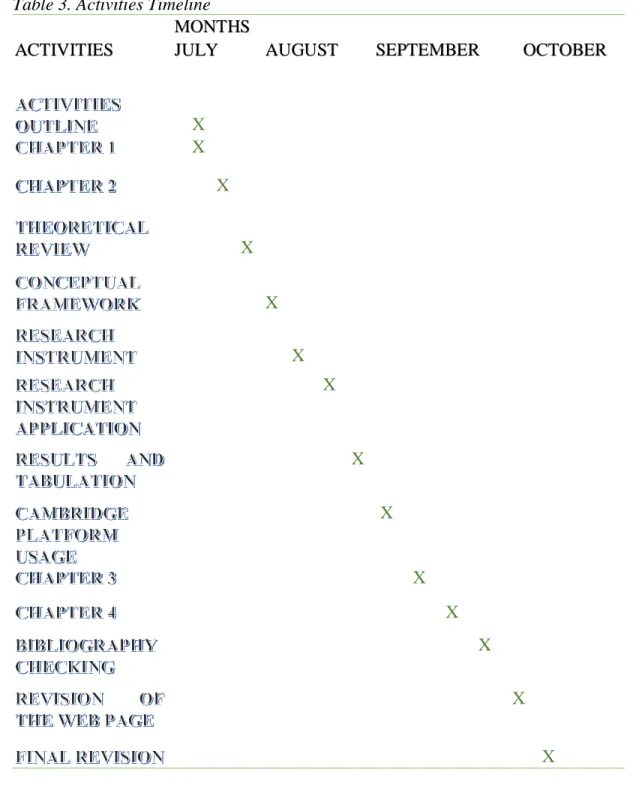
Table 3. Activities Timeline
60
Table 4. Resources Description and total amount to be invested
61
Table 5. Students’ surveys questions
64
Table 6. Do you like your English Class?
65
Table 7. Do you like to write in English?
66
Table 8. Do you like to listen to music in English?
67
Table 9. Do you like to speak English outside the classroom? 68
Table 10. Do you like to read stories in English? 69
Table 11. Do you like to work with Cambridge Platform? 70
Table 12. Do you use Cambridge Platform at home?
71
ABSTRACT
INTRODUCTION
“Since we live in an age of innovation, a practical education must prepare a man for work that does not yet exist and cannot yet be clearly defined.”–Peter F.
Drucker. This influential quote can be enough reason to devote efforts and start looking for modern, efficient and helpful technological tools with the principal aim of focusing attention into education system able to contribute an integral child preparation.
The application of multiple tools to connect them into real-life situations can be a great impact, especially with tools whose impact make students start developing their 21-century skills, such as Communicative Approach, Critical Thinking and Collaborative Learning within their school social group. (Rotherham & Willingham, 2010).
Due to this, it is essential to find an assistant method in order to make students develop proficiency frequently without having doubts from anterior topics. In addition, the fact they are kids support the theory the assistant should be interesting and funny, so students feel pleasured and not pressured, being technology one of the most current and contemporary options.
1. STUDY APPROACH
1.1. Background of the problem
Considering that our country is a non-English-speaking society, and that many of the students’ skills developed at Unidad Educativa Javier are inside the classroom
hours, it becomes a necessity to reinforce the skills outside the class with the purpose of connecting a balanced educational system beyond the school area.
This need is due to the low presence of the target language in our learning environment. According to Trent, Gao, and Gu (2013), despite of changing constantly with the purpose of being part of this modern decade, there are still traditional strategies among teachers such as memorization, content-based drive and other activities which are components of the lowest level of knowledge acquirement.
Because of what it was stated above, researchers have put some effort in order to notice how influential a technological software can become a useful tool on students’
learning process, which can be noticed through the production of their different skills. This can also relate through a combination of teachers and students working plan formulated to cause a deep impact in students’ second learning acquisition.
According to Selwyn (2013) “Education is positioned as a continuous concern –reflecting the ethos of “lifelong learning” that embraces not only compulsory phases
of schooling but also education and training throughout the life-course”. This defines what exactly models the education principles during this net generation.
into the classroom. That is a powerful reason why investigators have designed this research based on a useful digital platform whose function is to catch students’ attention to English learning since an early age.
For this reason, we had a series of observations at elementary English lab at Unidad Educativa Javier in order to obtain the permission to do an exhaustive project in order to determine the effectiveness of a technological tool offered among little kids.
Unidad Educativa Javier, an Ignaciana institution founded in Guayaquil in 1956 by Alfonso Villalba SJ at Tomas Martinez and General Cordova Street, started with the objective to be part of Guayaquil educational field offering morning classes.
That has been its incentive since 1958, the year when the Institution was moved from Guayaquil’s downtown to the north of the city, with the name of San Francisco
de Javier, which finally changed some years later to its current name, Unidad Educativa Javier, waiting until 1962 to graduate their first student’s promotion with 34 students.
Currently, Unidad Educativa Javier continues with the fervent purpose to educate young people committed to the gospel and shapers of Ecuador equitable, visionary and solidarity.
Jesuits mode proceed discovers traces of God in all parts. Jesuits are recognized people because of their purity and joy, in addition of being people called to be Jesus followers; which consider faith and promotion of justice not just a simple society value, but also the integrating factor of all our ministries and not only these, but our inner life.
Their presence have been marked by ideas, doctrines and actions, positive or negative that have affected, directly or indirectly, in the socioeconomic and political life of the country.
Moreover, Jesuits have a close link with the search and affirmation into their social reform. In the Andes contributed to the Quichua generalization to evangelize and indoctrinate better to indigenous people.
This religious and prestigious school has as a mission "Evangelizing men and women with comprehensive Ignaciana leadership and excellence in the service of others, with high spirit of solidarity, intercultural respect who are committed to global development."
Likewise, presents as its vision to the world "Being an educational community of international excellence for children and young people strengthened in Ignaciana pedagogy , science and justice , with a profound experience of God , able to take on challenges , build and contribute to a more just and equitable society " .
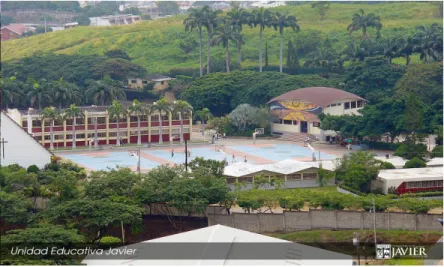
Figure 1. School Building
Source: http://uejavier.com/uejavier/infraestructura/
According to analyzers’ experience, they can determine that this group of students are
very enthusiastic and offer enough motivation into their English classes. However, some factors cause students not to receive an appropriate English learning attainment.
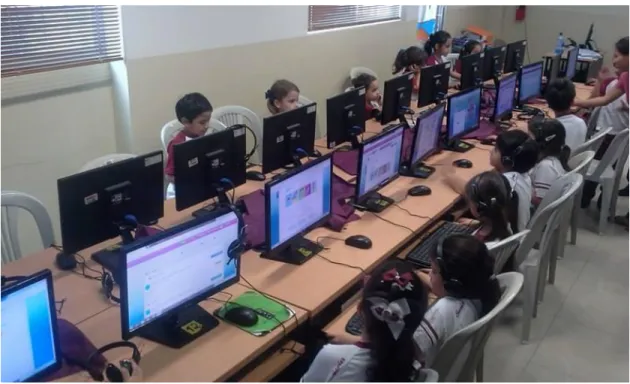
Figure 2. Students in the English lab Elaborated by: Researchers.
to perform oral exercises and games, but they present some difficulties to initiate into doing written tasks.
Another difficulty they present is that because of their early age they cannot speak correctly, so they produce chunks or one-syllable words, which make understanding of their performance a little bit complex for this reason.
The situation already explained among students and their learning process, is reflected specifically into a poor development for producing proficiency through ludic skills, becoming this a barrier for producing a correct second language performance. That is why it is a need for reinforcing topics already learned inside the classroom, using technology as a basic tool.
1.2. Statement of the problem
How can an online software become a useful tool in groups of 6-7 age students?
1.3 Objectives: Broad and specific
1.3.1 Broad Objective:
● To provide information about the effectiveness that an online website offers in the development of EFL Literacy in students from second basic year at “Unidad Educativa Javier”
1.3.2 Specific Objective:
● To analyze encouragement this website promotes among short age students.
● To identify this site’s influence as an assistant from their educational target language purchase.
1.4. Significance or justification of the study
According to White, King and Tsang (2011) “new online communication tools,
especially the so-called social media that emphasize active participation, connectivity, collaboration and sharing ideas among users, is expected to enhance social interaction in CSCL environments and support learner-centered pedagogical approaches”
According to their study, students’ educational process should be complemented into a series of technological sites able to reinforce outside the class hours pieces of knowledge acquired by children into the schoolroom.
Furthermore, it is indispensable to analyze the application and effectiveness of an online tool used in the Institution such as CAMBRIDGE PLATFORM in order to have a clear diagnostic about their functions into the development of EFL literacy among students.
Figure 3: Cambridge Platform session into Javier English Lab Elaborated by: Researchers
In addition, the constant use of a target language outside class hours will promote students a constant involvement into new idioms, words, expressions and accents, becoming students into constant natural learners of a second language, increasing their curiosity and desires to learn about facts and real situations in life.
According to White (2011) “learning into real-life context like outside the
classroom generates opportunities to construct links between theoretical part and practical section, supplying daily learning topics as a valuable aim from childhood provisions, being school, communities, and students by themselves responsible of engendering collaborative process.”
As Albert Einstein quoted “I never teach my pupils; I only attempt to provide the conditions in which they can learn”. This research can be easeful in order to start
transforming traditional teaching process into an independent and entertaining series of reviews chosen by the same student in order to accomplish successful understanding of topics they feel interested in their own pace and style.
Likewise, according to De Vines (2009), technological literacy can be a relevant skill in this new digital generation in which we live. That should remind researchers that this group of students are immersed since a very early living existence period in a globalized world, so it is really obligatory that they start training their senses involving websites or software in their normal curricula process, feeling identified with the learning development they are obtaining. Besides that, this research offers many benefits among parents, institution and authorities of this prestigious school located in the north of Guayaquil city.
FOR PARENTS:Parents require to be involved into their children's progress in this platform, because they receive through technological links such as their emails the notifications of assignments or quizzes that the teacher has already sent.
In addition of this, this online tool gives the opportunity to join and improve parent-child personal relationships because students can take the opportunity of showing their results to their parents, and parents start introducing into magic education world that their children enjoy.
educational field, which can be a complement for an appropriate physical and psychological problem.
FOR TEACHERS: Teachers receive constant preparation like seminars, webinars and workshops in order to analyze, create and solve different terms and topics related to an appropriate webpage functioning and development, in addition of preparing for hypothetical students problems with the website.
Also, Cambridge Platform brings a great benefit for the teachers because instructors can take the different exercises that this online tool offers with the purpose to make a summary and a review guide prior to taking quizzes, having as a responsibility just registering school groups to achieve this specific aim. Moreover, this is the reason students attempt for the games and make a review by themselves.
This is a great opportunity to start introducing students inside a world where they can identify, experiment, inform and motivate using their own tools. In other words, they can become into Independent Learners.
FOR SCHOOL: The institution gains prestige at the same measure from their students, showing that the schooling’s style in the institution is updated and the people
who study there will have a high level of language proficiency.
What is more, the school gains credibility because with this practice outside the classroom, students are able to achieve specific goals related to getting a correct acquisition of their target language; achieving a specific level of English following, in this case, the Common European Framework standards delimited by the Institution, in addition of a better development into second language native environment.
According to the Ministry of Education, one of the terms they supervise is the design, implementation and constant monitoring from an English curriculum framed into international standards to promote an effective and significant learning inside the classroom, so Unidad Educativa Javier can establish the correct functioning of its entity following Ministry of Education parameters.
FOR AUTHORITIES:Managers and authorities having as a priority that all members of their Institution are well trained people in academic, personal and professional aspects, they support the idea that their coworkers are always in seminars and workshop.
The advantage instructors can get from these activities in terms of technology and education, is the complete understanding on every single detail from the program, which will make the learning of the language an easy matter for students.
“The challenges of our society and our country are many. We're not going to
and knowing in the country do in the forge that just society, brothers, we crave as citizens and Christians.” (Alaña, n.d.)
1.5. Scope and Delimitations of the Study
The ongoing area the investigators chose in order to make this research is located in the north of the city in a particular Institution. As teachers and observers, investigators have noticed that these little second-grade kids between 6 and 7 years old are able to distinguish basic phonemes and letters into their mother and target language.
While checking their performances during their lab sessions researchers notice that a big part of the students are more interested in developing every single exercise in the platform rather than employing the traditional form.
Because of these argumentations, these kind of exercises on Cambridge platform are easy in terms of identification through pictures and sounds. Another good and helpful characteristic on this website for students is based on the speaking skill and how the method influences students’ oral production.
Figure 4. Students practicing into the platform inside English Lab. Elaborated by: Researchers
That is related to the listening of words through songs or chants, causing influence among students who start repeating or even using the words involuntarily; even without noticing they are speaking into a new language.
After listening the section, they have to record their voices to achieve phonetic production. While students are using their microphones in order to record their practice, it appears some waves where students will see if they are repeating the words in a good way, if they made it correctly they get points and they unlock a new level of exercises.
This series of exercises help students in order to develop their strengths and effort into academic and personal life, because they have to dedicate time and desire of doing their best in order to pass their current levels.
The period for developing this contribution to the community is estimated in two and a half months, where each week during lab hours will be checked students’
development following the website pattern according to the level and age from the children.
Finally, some members of the school like teachers and students will share their experiences and their feelings using this foreign site, in addition of some coworkers and the director of the area and project, whose function will be to observe our researchers’ development.
Teachers and authorities also have specific roles into the appropriate application of this online platform to benefit students as well institution. To get this benefit, teachers will have to create different groups in the platform similar to the real life situations they have in the course.
1.6. Hypotheses or Research questions
“Creativity is becoming increasingly recognized as a means for personal growth, as well as for social progress and survival of the community.” (Ladislav,
Fakultet & Osijeku, 2012)
Robinson (2011) supports that the actual century brings companies desire people able to think creatively, expecting to innovate permanently, displaying excellent communication and teamwork performances. According to this, educators have to model future professional people in order to work effectively into different scenarios in real-life situations.
Based on this series of supporting ideas, teachers can remark their compromise with social relations and encourage students to show initiative, allowing them to commit errors and guiding them with the idea that instructors cannot solve all problems. Moreover, this point of view requires the application of methods and techniques able to perform students creativity such as organizational models with the purpose of analyzing, organizing and determining classroom activities as teacher normally does.
Likewise, “If you’re going to bring new concepts to children in the world, you must make them laugh” (Klasek,2013). This theory given as a collaboration into Create
Captivating Classes: Why NCLB Should Mean No Child Left Bored book is what researchers have invested multiple resources in order to identify the correct method to do it.
This series of details give researchers a clue toward an appropriate approach to catch students’ attention and improve skills already practiced in classes according to
Thus, in order to increase creativity and positive feelings into this language, this research is done as a way to identify how kids from 2nd Basic Year will be able to use this network activity naturally using a facilitator such as an online link.
Being interaction and practice what can make students improve their English levels on their different skills; they get easily involved into a clear and comprehensible experience with English. Thus, some interrogative sentences appear at the beginning of this project as a source of looking for an answer.
How do online software motivate English language learning on students?
What is the role from Educational Software into EFL Literacy Acquisition?
What is the effectiveness online platforms use into EFL development process inside
the classroom?
1.7. Variables and Indicators Variables Table 1. Independent and Dependent Variables
NOTE: This chart refers the different details taken from researchers period of observation, where Cambridge Platform promotes its service becoming the
2. THEORETICAL FRAMEWORK
2.1. Literature review
Jones & McBrien (2009) into Virtual Spaces: Employing a Synchronous Online Classroom to Facilitate Student Engagement in Online Learning affirms that the use of different synchronous techniques attempt chances to live into social interaction using implicit classroom space. An educational software, a web page or a platform are the new ways of teaching things in easily; these kind of technological resources catch students’ attention intrinsically; this means, that they do not know that they are learning a specific skill or series of skills just by playing or having fun.
Furthermore, using databases on the Internet promotes enjoyable and engaging general learning environments for teachers and pupils, becoming teaching steps into fundamental moment to introduce students into this new net generation. (Garrick, Villasmil, Dll, and Hart). In addition, these researchers employed and analyzed different hardware and software devices in order to recognize the effectiveness into students with low grades, giving positive results.
As a real advantage from using online resources, students can feel desires of looking for more intercommunication and skills tools independently, in order to continue developing their skills already obtained from inside school topics and practice. Hunter (2015) contributes to this research saying that electronic components afford efficient, concise and real-life assessment registration with the purpose of noticing students’ evolution using this new learning system style. According to Thorne
Theories, Technologies, and Language Learning”, affirm, “The key issue to emerge was that many in a group felt much more comfortable with technology and technology-related pedagogies than they did with theories and research associated with second language acquisition.”
Likewise, Liang (2011) affirms in his analysis of his study Synchronous Online Peer Response Groups that “Synchronous Web technology adds a valuable tool for facilitating and recording the dynamics of group interaction.” This definition makes a
good analysis about what the purpose of this English resource is, in terms of combining in-class proficiency with interactive resources able to promote a complete acquisition of the language and also promote collaborative learning among little pupils.
However, Hamilton (2015) affirms the principal role is not from students but from the teachers, due to the connection they should provide among relationships between students and technology and give frequent feedback to each action pupils make. According to him, the way that instructors introduce technology as a friend is more relevant than the website itself. Also. Leon (2014) affirms that ICT is not just the bloom of the educational activities, but also a secondary option to improve the effective and meaningful educational process, confirms this hypothesis
into their educational target language process. This is correlated to the fact that we are living into a generation where the centered attention into educational process is not the teacher but students themselves. It could be a fact that teacher should guide kids constantly but that can contrast with the purpose of this research project. Thus, we can define online softwares as self-study materials selected according to learners’ needs, specific learning goals, and proficiency in the target language from students. (Nielsen, 2011)
According to Scalise and Giffor (2006) into their job Computer-Based Assessment in E-Learning: A Framework for Constructing “Intermediate Constraint” Questions and Tasks for Technology Platforms certifies that in this actual moments technology provided multiple ideas in order to enrich education using non-traditional and real practical assessment exercises to get feedback appropriately.
To sum up, online platforms have a principal role into the integral education process in this period of time, so teachers and Institutions have as a mission to invest their effort, time and patience in spite of getting recognition from their interactive students.
On the other hand, Communication is an essential component into childhood’s educational process stage. This skill is able to become a principal factor for learning, establishing relationships and building social interactions with others as well as involve infants to notice world’s details around them. However, it is not just a concern of
forms their professional and practical knowledge is fundamental into educators’ role
when working with little kids.
Learning to express their ideas using their different skills is one of the most important and noticeable accomplishments of early childhood. In a determined period, infants can progress from single words to the structure of innovative sentences and creation of their first short paragraphs, using words students can acquire until six every day (Johnston, 2010). That can mean new chances for social understanding, learning about the real world and sharing new likes, experiences and exigencies.
But prior to start developing their reading and writing skills, children need to progress into their abilities to talk, listen, watch, recognize and draw. According their age and exposure period into these skills, infants can be able to understand the different relationships between words from single letters and spoken phonemes. Interacting constantly with children create a confident environment in them, and promotes a feeling of developing their first social context actions.
However, the principal stage of language acquisition is significant to others due to the need of absorbing, listening and them practicing and imitating. Their answers are natural and unconscious, so imitation process has a fundamental role for involving students into communication stage. In addition, their answers are strengthened by multiple patterns, which appear to compose a more realistic version from what kids are already talking. Progressively children manage the chance to display sounds and words whose role of huddling ideas and establishing understanding of how communicational skills work in terms of adding words, sounds and sentences together properly.
Language and communication list components to perform their skills, which are keys to learn and understand about different situations into their real-life situations. Moreover, kids learn effectively being exposed in enjoyable understanding and playful activities promoted through funny ideas. Adults have also an important role into literacy acquisition and development due to the joining they should have in terms of listening and talking with children, providing a pattern of context and the magnificent opportunity to use their skills already acquired for a multiple amount of purposes.
In addition, short age children are not bringing in vocabulary but also they are already focusing on learning about concepts and analyzing different situations deeply around their environment and routine situations. However, that is not all the components into communicative process researchers can identify. Likweise, young children have to generate multiple sounds, words and meaning in order to group them in the correct order structure. Pragmatics of language use are some factors involved in social interaction such as vocabulary, grammatical constructions, pronunciation, accent and dialect.
Progressively, children will find out more they can display and demonstrate the appropriate significance in everyday language usage. By the end of five years old, children language place a vocabulary of several thousand single words, evidencing the chance to hear and use language for multiple purposes, receptors and contexts affected directly to future language process.
Thus, there are single discoveries that talk strongly about information interchange and development. Children start producing their first pieces of complete sentences based on a variety of aspects that they involve during their language acquisition development; one of the most common and important aspect is the introduction of language examples according their age, environment and cognitive resources and by selecting different aims already taught with the common course of development.
language experience development such as hearing expressions, writing a new paragraph, speaking fluently and reading a new context.
Because of this, researchers assume technology use can be a complement into EFL Literacy acquisition and development because of the multiple target language experiences they can pick up as they learn a new language. That is the reason why computer-assisted instruction (CAI) supplement teaching tools for second language educators.
Thus, developing literacy skills in a target language can begin as early as external dialect direction starts. According to Shin (n.d.), it is not useful to postpone integral EFL literacy to focus just in oral approach; that is because reading and writing skills are the principal components of target language literacy skills. For this reason, English teachers can implement different strategies and methodologies in order to form stages to build literacy in a second language.
One method in order to catch short-age student’s attention into these two skills is the use of printed material in order to generate traditional schemes able to done as an initial stage to construct EFL Literacy among students. For example, teachers can read catching-attention textbooks and use auditive material such as songs and chants to explore different English sounds. In terms of writing, simple commands like forming letters and coloring cause effective and entertaining influence which motivate students into this second language, building early second language literacy since early age into their lives.
have to develop Language Arts classes for little kids, it is fundamental to focus on integral EFL literacy curriculum rather than oral skills performance for young learners. This is because of the importance in emphasizing reading skills since the beginning of educational program due to the fact this skill promotes a quick progress not only in reading learning but also in acquiring vocabulary and flourishing speaking skill.
Shin and Crandall (2014) complement their theory explaining that children learn language exposing, practicing and learning meaningfully rather than focusing on memorization and other unconnected parts and skills of the language. In terms of phonemes, educators should develop curiosity using authentic context to help children use reading strategies. Dembacher (2010) supports that two specific reading skills can promote better understanding of reading section just by focusing on a specific topic or predicting the purpose of reading section having as a concept the term bottom-up, and developing their own ideas from topics already learned using bottom up reading strategy. According to Shin (2014), these strategies are the most realistic forms to teach literacy since transforming printed words in dynamic processes able to flow progress skills.
In terms of technology use, it presents as a motivational and modern factor because of its immediate and effective performance feedback. According to Atlas (2014), literacy conception has varied into emails, websites, online grammar software and word processors. Thus, we can define new children reading skill trend focus on critical thinking and identify research topics they can be interested in; in addition, interactive reading can cause a deep impact among learning styles such as visual and auditory. Moreover, readers establish clear paradigms related to get consistent comprehension skills through the creation of different organizing makers such as diagrams, graphic organizers and definition from unknown words.
In terms of writing development, young EFL learners can obtain clear strategies from a variety of resources able to be a guide to understand and generate different kinds of text. According to Peterson (2010), students writing able to support students’
development should incorporate written and verbal feedback in order to improve their management of ideas for next compositions.
Likewise, the same researcher provides information related to the influence students’ writing development can perform among students if teachers invest a great
amount of time providing timely, concise and clear information about the impact and improvements writings should present.
Similarly, Yance (2009) affirms that digital devices and web 2.0 can influence into global audiences’ perception; this perception is related to writing and its function
Moreover, writing marks the beginning of the called Age of Composition (Blake 2010) here composers can create authentic texts in digital context; maybe they don’t use historical writing rules but they achieve their need of expressing their ideas having their tutors as a guider but not as an imposer. Thus, 21° century writers’ impulse
to write digitally, context expand, organized, socialized and networked putting emphasis into individual and collective writing.
Similarly, young EFL Literacy learners need to reinforce basic pieces of knowledge related to organization and identification from some skills such as phonics, spelling words and listening. This is a vital requirement to focus on because of the similarity among the sounds, due to more than 500 ways to spell 26 words, which are able to produce 44 sounds. This specific performance into phonics study depend on the writing system and practices from their mother tongue (Shin, 2014).
Basheer (2013) affirms that the use of computers or another technological device generates visual and voice information, able to intensify and improve their cognitive data collection process about a specific case already provided. Computer-based listening tests, CD ROM Computer-based learning movies and Internet voice from social networks like Facebook, Snap chat or Twitter may be a factor to consolidate this skills.
In addition, listening on TV and radio educational and innovative programs is another effective technique to develop understanding ability. New satellite TV channels and representative radio display specific programs able to fulfill second language learners’ needs. Besides, lectures and listening comprehension examinations
Moreover, DeVito (2000) supports clearly with these aspects and adds five principal and progressive staged-process to succeed on Listening Process. First, develop the perception of sound and hear to listen can stimulate your sensory reception from your ears, caused by sound waves audience receive, achieving Hearing process. When hearing occurs, the specific selection brains choose to pay attention and select in order to come into few stimuli into Attention process.
Next, identify, analyze and organize useful significance from information already learned and the components we have ever seen and heard. In order to achieve this aim, researchers have to stay in the appropriate context and understand the deep message already provided. To get this, students should perceived and analyzed the stimuli provided in order to stay in the specific context able to understand the hidden message. This process is Understanding, which is the prior step to the next three essential stages which help people achieve their Auditory process.
Then, after individuals receive, interpret the message and kept into mind’s memory, which means information will remember in our minds they will achieve the fourth stage whose name is Remembering and that is complemented by Evaluating, or the ability of evaluating the messages already received. Here, listeners clarify their ideas and can determine the different pros and cons from a series of displayed options.
In terms of Speaking, technology has provided a 360° change in terms of stop displaying the traditional techniques in order to start taking advantage of technology and prepare students to deal with it. One current method used in order to start introducing this skill into EFL students is to provide audiobooks in order to create an oral summary for each other as a first step to develop this skill.
Next, the employment of technological software such as Skype or Snapchat can increase the possibility of start sharing words with a native speaker, who intrinsically can influence EFL students’ accuracy and lexi among the target language. Besides, the
2.2. Theoretical foundations
One of the theories researchers have taken in order to support this research project is Behaviorism or a psychological theory supported by American psychologist J.B. Watson, whose principal support is related to the analysis from human being behavior in terms of stimuli-response interaction and the study from causing factors from this interaction pattern. According to Rivers (1968), this theory was created based on the operant conditioning model Skinner provided to the world, considering learning because of study habits establishments and reinforcements. In addition, behaviorism formulated the hypothesis learning with behaviors is a possible form to identify, acquire, observe a measure pieces of knowledge.
Likewise, one of the principles from behaviorism theory is the fact that the first way of communicating human beings present is oral, which is formed by short chunks and rhymes without using written forms, due to human beings learn to talk first rather than reading or writing. According to this principle, spoken language should be a priority in language teaching.
As a second principle, behaviorism presents as one of its hypothesis that language is controlled consequently from behavior. The reason for this hypothesis is due to the need to establish a pattern in terms of target language teaching and learning, leading EFL acquisition as a mechanical process whose amount of information students can acquire depends on the habits pupils can reflect.
positively, the huddle between the stimulus and response is strengthened, causing that the relationship between stimulus and response joined into a strong relationship.
According to behaviorism, when responses to stimuli is acquired positively, habit formation establishment is done. Likewise, learning process can be acquired equally for different individuals who share the same demographic, social and conditioned nature. To sum up, each member from the society can learn equally if the conditions are the same for everybody.
To sum up, it seems to be predictable that the basic aspect to learn according to Behavioristic supports this theory is related to imitation, habituation, practice and constant positive and negative reinforcement sustained by reward or punishment. In terms of learning a specific language, behavioristic people settles the basic principle of stimulus and response as a basic pattern to acquire or develop a new language into oral or written skill. Moreover, this theory was able to influence different theories such as Total Physical Response, Silent Way or Audio-lingual Method based on similar principle factors.
Moreover, another doctrine properly applied into this research project, is Connectivism, related to the combination of chaos, self-organization and web theories (Siemens, 2005). Moreover, the main basis is that specialized data are interrelated and in constant actualization and do not stop processing information but also motivate human beings to achieve their active knowing state.
Stephenson (n.d.) recites into Connectivism: A Learning Theory for the Digital Age case study that “Experience has long been considered the best teacher of knowledge. Since we cannot experience everything, other people’s experiences, and hence other people, become the surrogate for knowledge. ‘I store my knowledge in my friends’ is an axiom for collecting knowledge through collecting people (undated).”
That talks clearly about the necessity of reinforcing students exploration and curiosity skills they start creating during the first years of their existence; and where teacher is not the center of the class but the own students’ free and detailed job inside and outside
the classroom.
Likewise, the mentioned pathology flourishes undergraduates’ abilities to take decisions and understand unexpected pieces of information in which they will have to analyze and solve situations in short periods of time. In addition, they should be independent and adaptable kinds of people able to alter their opinion and points of view according environment alterations presented among real-life.
precise ideas into companies and institutions, removing constantly methodologies and techniques previously learned into their childhood school experiences.
Bell (2011) into his study project Connectivism: Its place in theory-informed research and innovation in technology-enabled learning supports that massive free wired learning sessions (MOOCs) influences connectivism in order to be practiced by attendees and those who aspire a proficient application in learning and teaching. Although different authors recognize the complexity in grueling in this relevant approach which have the notion to be applied in contexts by instructors with the mission of change research and evaluation association developing different theories about it.
Despite of this, the choosing of theories depends on the outlook and determination from the research study, and from the metaphysical and involvement from researchers who are the responsible and in charge of developing different strategies in order to match practical with theoretical properties.
One of the theories in which this research project reflects is 21st Century Skills. According to Gladwell (2000), when society arrives to the most critical group of circumstances is the appropriate moment to display new trends and changes in order to obtain new perspectives completely different from the old ones. Education is not the exception, and the constant evolution globalization provides chances for prepared people in order to take advantage and display their labor around the world.
relationships whose function was fundamental during 20° century is not available anymore. The trendy social relationship has varied and just people who have the measured skills and pieces of knowledge to negotiate their situations constantly will succeed. Global aptitudes presented during this marvelous generation generate the possibility people to continue learning in order to be available to multiple changes. Bellanca (2010) also affirms that people with not enough amount of preparation during this generation is forced to low jobs, due to the need to move up into this economic balance companies present frequently.
Due to the fact the current century is 21°, education moves into frequent outcome barrier breakers in terms of proficiency and expected new skills highly approved by humanity. Furthermore, critical thinking, problem solving, creativity and other 21! Century skills are the principal techniques new generations need to continue into this challengeable society.
Students will take advantage of their knowledge and they will prepare thir minds to brainstorm ideas, express their points of view, work with other individuals i¿to get a specific goal, and generate thought and new trends to contribute actively into their communities. Likewise, the frequent topics into 21° century skills might seem unfamiliar and not linked to the reality; but those themes are growing into everyday routines across the world. That is the reason why educators have the responsibility to form prepared civilization members in order to manage their psychical, psychological and mental resources in a soft but complex planet.
and organizational advances, giving students control over their decisions and actions, and also to express clearly their opinions in school, work, and the community in general.
Berry (2013) affirms that twenty-first century skills has a great significance the central children development in terms of producing, evaluating and summarizing information from a wide variety of subjects or topics with a clear understanding of respect for another point of views and/or cultures. This series of skills also provide the combination between traditional topics such as civic participation and background information into a new field where digital literacy is part of students’’ achievements.
Thus, Cator (2010) also affirms that this century skills and their success depend on how educator are prepared to teach and cause social and educational impact among students. In addition, she affirms that fluent, interconnected and interactive world must be connected into the strong development of strong critical thinking and interpersonal communication skills in order to acquire success.
Thus, this new trend in term of education has the purpose of maintaining students joined to their own educational progress in terms of becoming a learner-driven (Hargadon, 2011). This theory also supports the fact Internet is providing multiple resources in order to list generation as a frequent participant into society decisions due to the preparation they are receiving to raise their voices and hands.
In addition, this theory gives the opportunity of increasing creativity and proficiency into a second language acquisition, due to the employment from an useful technique where a learner can use technology in order to practice and notice their mistakes by themselves; giving authorities, teachers and partners the opportunity of identifying methodologies, techniques and specific materials adapted to cause an appropriate correction to their mistakes.
According to Beatty (2010), “Computer-based language tools are beginning to become both pervasive and invisible”. This quote said by Beatty comprehends the
needs of looking for technological ways in order to persuade real life situations cases, such a grammar and spelling correction we can find into the processing of emails, Google autocompleted scheme and other techniques none commonly used.
Another theory we can employ as a support to our variables is related to Computer Supported Collaborative Learning (CSCL), which talks about the use technological tools or devices to guarantee an integral studying process from a person with the help of computers or any other device.
Thus, this theory is concerned into educational field because its facilities of combining collaborative learning and computer guide into single activities already done using small groups, which is a challenging topic this theory can mix perfectly in order to get a better language acquisition since early age.
Thus, this tool proposes constant actualization of softwares and tools as a form of bringing ingenious exercises based on intellectual thinking and social and human interaction. Furthermore, this theory and its activities have as an aim to involve students not only as individuals and group members but also in their management of real-life situations reached with this theory approaches through online individual and group learning.
Likewise, EFL Literacy achieves a role into the development of a second language acquisition. This is because the most fundamental aim into this project is the early motivation and improvement of natural aptitudes into a group of children. Having as an objective that educational system promotes an early age involvement into target language, technology and EFL Literacy are good complements in terms of reaching actual piece of knowledge.
On the other hand, English is not an isolated subject but a global, cognitive and cultural background, so it is essential to research the affairs and the multiple aspects of the language such as speaking, listening, reading and writing. That is because the early childhood forms the base of a literacy expansion. In addition, a teacher aims a fundamental role in order to catch students’ attention on literacy-building activities and find out teaching characteristics correlated to offer early literacy activities in schools.
educational adjustments, it becomes a need to check and contemplate different aspects about child, familiar and educational field. This is related to identify the proper kind of methodology employed by early age teachers and educational programs to build up early literacy aptitudes and explore relevant factors to increase literacy and language promotion.
As we can identify from this research, small periods of constant learning process can influence our connection-recognition personal and professional advancement. Brown (n.d.) prompts a refreshing perception about technology and their influence within human beings, giving us the opportunity to know that students were able to acquire pieces of knowledge when they were included into different learning session preparations rather than large and ineffective efforts made by teachers by themselves, showing researchers the real connectivism essence.
Another theory is Critical Literacy, which is the theory able to connect people and their relationship with the world where they already live through identification, differentiation and access into multiple pieces of knowledge, skills and resources. According to (2013), a critical theory notice language produces our world in different aspects such as social, environmental, political and geographical. This is correlated because the world and human beings are connected in order to cause an effect on different aspects.
between social, cultural and environmental field with EFL Students general point of view about.
Secondly, these learning events present elements into three proportions into cognitive –linked to skills and knowledge acquisition-, psychodynamic –motivational and emotional fields-, and societal – associated with interaction and communication with the real world. The mixture of these proportions differ a unique mix of these three elements with the firm purpose of generating different approaches.
Likewise, this theory confirms the need to start preparing children for real-life situations into a knowledge society, related to conjugate ideas, ask clear and concise questions, analyze and report others’ viewpoints in order to stand with a worldwide
society relationship. Critical literacy presents a rich base in social movements as a set of skills, methods and strategies that set up challenge life offers using resources already acquired, having as a purpose to be analytic information users and providers.
This theory offers the opportunity to categorize students’ ideas, interests,
questions and experiences from prior situations with the purpose of generate chances to think critically and take measurements for future similar situations. Moreover, critical thinking build the unique characteristics and perspectives represented in school and classroom as a model to confront realistic cases.
The impact of innovative and catching communication technology resources on students’ ideas generation and evolution served as the first stage recognition of the need
specific textbook. Now, it does not matter the visual, auditive or kinesthetic activities, reading comprehension contains ideas, which reflect authors’ ideas, offering their ideas to use their own prior experience and knowledge in order to interpret and predict what the authors’ reading purpose is. The purpose of this section is that students take out the
majority of information and form their own interpretations in benefit of their own knowledge and points of view to find the most convenient form to report their thinking skills idea.
As global society realizes geographic and demographic factors like age, socio-cultural status and culture can become an influence when interprets a message. Critical thinking employs a method to indicate EFL learners to assume texts always intends to say a specific detail intrinsically, so pupils need to be consider different aspects from them and agree or disagree in order to take specific demographic hypothesis and ideas around the world, even with the faculty of generating alternative perspectives to prior adjusted problems.
“Before we can teach our students to become critically literate, we must become critically literate ourselves” (Mclaughling & DeVood, 2004). Following this
quote, teachers need to flourish their personal understanding of the language to assess students’ questions and explain how a new language develops and uses resources to
obtain particular benefits.
planning and delivering commands, reflected on routinely interaction process into globalized society with the firm purpose of displaying impact and supervising personal society progress in order to grow culture among nations.
Mulcahy (2010) affirms that the first step before supporting a comprehension text about a specific topic, individuals should have some background cultural knowledge about the context society refers currently. For this reason, education during first years is not just developing basic skills but also to generate significant supported point of view to specify terms applied into globalized daily routines. Thus, we can obtain cultural literacy educates with the firm purpose not to know information from a specific topic, but to explain moral and values impartially.
Polistina (n.d.) affirms that Cultural Literacy refers to integral beliefs, values, attitudes and customs represented into real competence added to the skill to reflect on a specific situation critically and bringing solutions to common problems occurred in students’ own culture. This literacy theory also incorporate the behaviors from
dominant cultures with their partner ones in specific terms such as globalization; in addition to obtain a valuable result from the multiple relationships between cultures around the world.
2.3. Conceptual Framework
2.3.1 Proficiency: Strengths in the development of requests directed by practicing and closeness to the subject. In addition, the constant reinforcement produces better results into the proficiency term.
2.3.2 Target Language: Additional communication skills learners study beyond its mother tongue; in order to develop a different serie of abilities in oral and written comprehension and understanding.
2.3.3 Teaching Process: Individual factors people want to learn or teacher want to teach their pupils. The tutors’ function into teaching process is the advancement of
abilities personally using their own resources.
2.3.4 Learning Platform: It conforms a serie of Information and Communication Technology used in order to sustain and flourish learning process. An educational platform also mixes different objectives such as delivering, registering and combining educational activities, being an easy tool used by teachers, parents and students to match roles among pupils education process.
2.3.5 Independent Learning: This is an education style provided outside the classroom able to expand students’ curiosity. Besides that, this kind of learning is an
innovative form in order to catch students’ attention through the use of technology for projects, producing a high self-esteem and a feeling of confidence superior to a normal individual person who follows the traditional educational rhythm.
being teamwork their registered work style and having online social relationship as their influence, forming part of their personal and professional life.
2.3.7 Common European Framework: The Common European Framework of Reference for Languages (CEFR) is a foreign regulation used in order to categorize
different language standards and specify learner’s language skills learning proceeding designing clear and specific language curriculums. It helps to describe learners’
proficiency into six specific categories: A1-A2;B1-B2:C1 and C2.
2.3.8 EFL Literacy Acquisition: In this serie of steps, English is developed into the four main accomplishments such as listening, speaking, reading and writing fundamental to satisfy basic endurance needs. In addition, it is a nice method in order to progress critical thinking using social topics in fields such as healthy, civics, employment, technology and marketing. It focuses on vocabulary and grammar receptively.
2.3.9 Cambridge English: Young Learners: It is group of attractive English exams and quizzes based on the development of activities. It introduces beginners and intermediate students level to frequent oral and printed foreign communication, being a helper in terms of achievement motivation and determination in the acquisition stage.
2.3.10 Course Management System (CMS): It is recognized as learning management system, and it is related with technological course used to post important details, to generate opinions and topics, deliver and send assignments, report students’ progress and publish grades, having interrelation among students, parents and institution authorities.
3. RESEARCH METHODOLOGY
3.1. Type of research description
This exploration will be developed through the use of observations and daily dialogues with students. These tools -observations and dialogues- which form part of Qualitative data, will help researchers to notice the different strengths and weaknesses at the moment kids start practicing with the software in order to see how these educational software will influence on their learning.
Cohen, Manion & Morrison (2013) affirm that organization, accounting and explanation from the data already collected involves a Qualitative data analysis, which main characteristic is the series of multiple interpretations general audience can give to a process from this category. Likewise, according to Taylor (2015) “Qualitative researches are concerned with the meaning people attach to thongs in their lives”. This
terms used by this author express what the purpose of this case study is; in terms of identifying how beneficial can be the use of extra-material in a target language in favor of written and oral proficiency.
Flexibility into this proposal is another distinctive researchers have established to maximize the effectiveness they can obtain from their own experience period. Taylor (2015) also suggests that we can get satisfactory results from this project after observing participants’ development among the use of the researched topic, in this case the online platform. Qualitative method can be used to “describe in detail what a programme consists of and what assumptions and theories underpin the belief that it will lead particular outcomes” (Ritchie, Lewis, Ormston & Mc. Naughton Nichols,
As a form of supporting this idea, this research wants to show that even when students get bored in classes a small change in their normal routine in the classroom can change everything. For example: a change like taking them to the laboratory and showing a different way to learn the content of the unit have benefits on their learning.
Besides, Ritche et al, (2014) says that the use of small amount of people into a group of participants can be a good opportunity to get positive and clear results, because researchers can notice how ideas and strategies to succeed into the research process are flowing, giving a correct direction to follow the established parameters. For this reason, this research will be based on a case-control study, because researchers expect find how big the influence of these educational software in the learning process of the students is. Furthermore, this will be useful to compare how the beginning of the students was and how significant will be their progress at the end of the same.
This project will also have the characteristic of a qualitative research because we will describe, explore and explain the real use and significance of this software in the learning process of the students, giving the pattern of how may in a future could be easier to teach a target language with technological resources like this software.
According to Lapan, Quartaroli & Riemer (2012), people can be able to set up their own objectives in intercommunication with global population around them. In other words, everyday experiences and topics already learned and discovered by them can be a principal circumstance in order to get their highest development, because each human being is an exclusive individual around the world.