PENINSULA OF SANTA ELENA STATE UNIVERSITY
FACULTY OF EDUCATION AND LANGUAGES
LANGUAGE SCHOOL
ENGLISH TEACHING CAREER
"A READING CLUB TO IMPROVE THE LEARNING OUTCOMES IN ENGLISH FOR STUDENTS IN TENTH YEAR OF BASIC EDUCATION FROM COLEGIO MIXTO PARTICULAR UPSE, LA LIBERTAD, PROVINCE OF SANTA ELENA. SCHOOL YEAR 2014 - 2015 ".
RESEARCH PAPER
As a requisite to obtain a:
BACHELOR´S DEGREE IN ENGLISH
AUTHOR: CARLOS LUIS TOMALÁ POZO
ADVISOR: Ec. CECILIA ALEXANDRA JARA ESCOBAR, MSc
LA LIBERTAD – ECUADOR
UNIVERSIDAD ESTATAL
PENÍNSULA DE SANTA ELENA
FACULTAD DE CIENCIA DE EDUCACION E IDIOMAS
CARRERA DE LICENCIATURA EN INGLÉS
“ UN CLUB DE LECTURA PARA MEJORAR LOS RESULTADOS DE APRENDIZAJE DEL IDIOMA INGLÉS EN LOS ESTUDIANTES DEL DECIMO AÑO DE EDUCACIÓ BÁSICA DEL COLEGIO MIXTO PARTICULAR UPSE, LA LIBERTAD, PROVINCIA DE SANTA ELENA. AÑO LECTIVO 2014 – 2015”.
TRABAJO DE TITULACIÓN O GRADUACIÓN PREVIO A LA
OBTENCIÓN DEL TITULO DE:
LICENCIADO EN IDIOMA INGLÉS
AUTOR: CARLOS LUIS TOMALÁ POZO
TUTORA: Ec. CECILI ALEXANDRA JARA ESCOBAR, MSc
LA LIBERTAD – ECUADOR
La Libertad, July 09th, 2015
ADVISOR´S APPROVAL
In my role as Advisor of the research paper under the title “A READING CLUB
TO IMPROVE THE LEARNING OUTCOMES IN ENGLISH FOR STUDENTS IN TENTH YEAR OF BASIC EDUCATION FROM COLEGIO MIXTO PARTICULAR UPSE, LA LIBERTAD, PROVINCE OF SANTA ELENA. SCHOOLYEAR 2014 – 2015” prepared by Carlos Luis Tomalá Pozo, undergraduate student of the English Teaching Career, Faculty of Education and Languages at Peninsula of Santa Elena State University, I declare that after oriented, studied and reviewed the project, I approve it in its entirety, because it meets the requirements and is sufficient for its submission to the evaluation of the board of examiner.
Sincerely,
__________________________________
La Libertad, July 09th, 2015
STATEMENT OF AUTHORSHIP
I, Carlos Luis Tomalá Pozo with ID number 092137601-8 undergraduate student from the Peninsula of Santa Elena State University, Faculty of Education and Languages, as a requisite to obtain a Bachelor´s degree in English, in my role as
author of the research paper “A READING CLUB TO IMPROVE THE
LEARNING OUTCOMES IN ENGLISH FOR STUDENTS IN TENTH YEAR OF BASIC EDUCATION FROM COLEGIO MIXTO PARTICULAR UPSE, LA LIBERTAD, PROVINCE OF SANTA ELENA. SCHOOL YEAR 2014 – 2015” ", certify that this work is of my own authorship, except for the quotes and reflections used in this research paper.
Carlos Luis Tomalá Pozo
Author´s name ID: (092137601-8)
BOARD OF EXAMINERS
_________________________________ ___________________________________
Dra. Nelly Panchana Rodríguez, MSc. Lcda. Glenda Pinargote parra M.A. Ed. FACULTY OF EDUCATION ENGLISH TEACHER CAREER AND LANGUAGES DEAN DIRECTOR
_________________________________ ___________________________________
Ec. Cecilia Jara Escobar, MSc. Lcda. Jeannette Cevallos Alcívar,MSc.
ADVISOR SPECIALIST PROFESSOR
______________________________________________________
Ab. Joe Espinoza Ayala.
DEDICATION
First of all I dedicate this work to my God and Lord. Also, I dedicate this work to my wife, Pamela, who has been next to me as support and encouragement during all this time of my study. I am really thankful for having her in my life. Finally, it is dedicated to my sons Carlos, Joseph and my beautiful daughter Elizabeth for being my great motivation and inspiration.
ACKNOWLEDGEMENT
I am ever grateful to God, creator and giver of wisdom. I would like to express the deepest gratitude to the principal of UPSE university, MSc Jimmy Candel Soto, who has fought hard to keep the UPSE high school alive. Furthermore, I would like to thank to the principal of the Colegio UPSE, Emilio Bernabé who has given me the opportunity to work as a teacher in this prestigoius intitution.
I would like to thank to all teachers of the Language School of UPSE University, whose teaching related to the learning of the English language and the new technology. It allowed me to improve my language skills and apply them in the education field and in my life in general. In addition, a great thank to all people who supported me in this research; authorities, teachers and students of the UPSE high school. Also, to my tutor who has been a patient person with me.
TABLE OF CONTENTS
Advisor´s approval ... iii
Statement of the authorship ... iv
Board of examiners ... v
Dedication ... vi
Acknowledgement ... vii
General contents ... viii
Charts ... xi
Figure ... xii
Graphs ... xiii
Appendix ... xiv
Abstract ... xv
Introduction ... 1
CHAPTER I ... 3
STATEMENT OF THE PROBLEM ... 3
1.1. Title of the research paper ... 3
1.2. Statement of the problem ... 3
1.2.1. Context ... 3
1.2.1.1 Contextualization ... 4
1.2.1.2 Prognosis ... 5
1.2.1.3 Main problem: ... 5
1.2.1.4. Description of the causes: ... 6
1.2.1.5. Description of the effects: ... 7
1.2.2. Critical analysis ... 8
1.2.3 Problem formulation ... 8
1.2.4 Guideline questions ... 8
1.2.5 Problem limitation ... 9
1.3. Significance ... 10
1.4. Objective ... 11
1.4.2. Specific objectives... 11
CHAPTER II ... 12
THEORETICAL FRAMEWORK... 12
2.1 Previous research ... 12
2.2 Philosophical basis ... 13
2.2.1 Philosophical foundation ... 13
2.2.2 Psychological Foundation ... 14
2.2.3 Pedagogy Foundation ... 15
2.2.4 Sociological Foundation ... 16
2.3 Legal basis ... 17
2.3.1 Political Constitution of the Republic of the Ecuador ... 17
Relevant rules of the Constitution of the Republic of Ecuador... 17
2.4 Fundamental categories ... 18
2.5 Hypothesis ... 31
2.6 Variables of study ... 31
CHAPTER III ... 32
METHODOLOGY... 32
3.1 Research approach ... 32
3.2 Level or type o research ... 32
3.2.1 Level of research ... 32
3.2.2 Types of research ... 33
3.2.2.1 Research field ... 33
3.2.2.2 Bibliographical research ... 33
3.2.2.3 Descriptive research ... 33
3.3 Population and sample ... 34
3.3.1 Population ... 34
3.3.2 Sample ... 34
3.5 Techniques of data collection ... 37
3.5.1. The survey ... 37
3.5.2 Interview ... 37
3.6 Data collection plan ... 37
3.8 Analysis and interpretation of results ... 39
3.9. Conclusions and recommendations ... 65
3.9.1 Conclusions ... 65
3.9.2 Recommendations ... 66
CHAPTER IV ... 67
PROPOSAL ... 67
4. Information data ... 67
4.1. Proposal background ... 68
4.2 Significance ... 68
4.3. Objectives ... 69
4.3.1. General objective ... 69
4.3.2 Specific Objectives ... 69
4.4 Desig, development and implementationT of the proposal ... 70
4.5 Strategies improvement ... 125
4.6 Conclusions and recommendations ... 125
CHAPTER V ... 127
ADMINISTRATIVE FRAMEWORK ... 127
5.1.1 Institutional ... 127
5.1.2 Human ... 127
5.1.3 Materials ... 127
5.1.4 Technology ... 128
5.1.5 Economic ... 128
SOURCE MATERIALS ... 129
1. Timetable ... 129
2. Bibliography ... 130
2.1 Web page ... 132
2.2 Virtual library bibliography UPSE ... 133
CHARTS
Chart No. 1 Piaget´s stages of cognitive development 14
Chart No. 2 Bloom´s Taxonomy 23
Chart No. 3 The six levels of Boom´s Taxonomy 24
Chart No. 4 Common European Framework levels: Global Scale 26
Chart No. 5 Exit Profile Level A2 29
Chart No. 6 Communicative Competence and Proficiency Level for 10th year of
Educación General Básica ( A2.1 ) 29
Chart No. 7 Language skill A2 and proficiency level 30
Chart No. 8 The populations used in this project is as follows: 34
Chart No. 9 Independent variables 35
Chart No. 10 dependent Variable 36
Chart No. 11 Data collection plan 37
Chart No. 12 To consult of level of Knowledge in English language 39
Chart No. 13 To determine if the English classes are sufficient 40
Chart No. 14 Improving the learning by interacting with native people 41
Chart No. 15 To determine if the school has tools to learn English 42
Chart No. 16 The teaching ´s level of the teacher 43
Chart No. 17 Condition of the infrastructure at school 44
Chart No. 18 The conditions of technology tools to teach English 45
Chart No. 19 Participate in activity that helps to learn English language 46
Chart No. 21 Participation in a Reading Club to improve the learning outcome 48
Chart No. 22 Opinion of teacher about the level of students´ knowledge 49
Chart No. 23 The classes taught by teacher are sufficient to learn English 50
Chart No. 24 The interaction improve the English level 51
Chart No. 25 Adequate didactic resources 52
Chart No. 26 English language that school offers 53
Chart No. 27 Condition of infrastructure 54
Chart No. 28 Condition of the technological tools 55
Chart No. 29 Participation in Extracurricular activity 56
Chart No. 30 Extracurricular activity helps to get better level of English 57
Chart No. 31 Acceptance of an implementation of a Reading Club 58
Chart No. 32 Result chart-students 62
Chart No. 33 Analysis of result chart-teachers 64
FIGURES
GRAPHIC PAGE
Graphic No. 1 To consult the level of Knowledge in English Language 39
Graphic No. 2 To determine if the English classes are sufficient 40
Graphic No. 3 Improving the learning by interacting with native people 41
Graphic No. 4 To determine if the school has tools to learn English 42
Graphic No. 5 The teaching ´s level of the teacher 43
Graphic No. 6 Condition of the infrastructure at school 44
Graphic No. 7 The conditions of technology tools to teach English 45
Graphic No. 8 Participate in activity that helps to learn English language 46
Graphic No. 9 Participation in extracurricular activity to improve of English 47
Graphic No.10Participation in a Reading Club to improve the learning outcome 48
Graphic No. 11 Opinion of teacher about the level of students´ knowledge 49
Graphic No. 12 The classes taught by teacher are sufficient to learn English 50
Graphic No. 13 The interaction improve the English level 51
Graphic No. 14 Adequate didactic resources 52
Graphic No. 15 English language that school offers 53
Graphic No. 16 Condition of infrastructure 54
Graphic No. 17 Condition of the technological tools 55
Graphic No. 18 Participation in Extracurricular activity 56
Graphic No. 19 Extracurricular activity helps to get better level of English 57
APPENDIX
Appendix No. 1 Survey directed to students of tenth basic year ... 135
Appendix No. 2 Interview directed to the teachers of the Colegio UPSE ... 136
Appendix No. 3 interview directed to the authorities of the Colegio UPSE ... 137
Appendix No. 4 Picture of the field research ... 138
Appendix No. 5 Pictures of the application of the project ... 139
Appendix No. 6 Diagnostic test ... 141
Appendix No. 7 Result of the diagnostic test ... 143
Appendix No. 8 Academic performance ... 144
Appendix No. 9 Learning outcomes after the application of the reading club ... 144
Appendix No.10Request to institution to implementation of the Reading Club. ... 145
Appendix No. 11 Acceptance for the implementation of the Reading Club ... 146
Appendix No. 12 Anti plagiarism certification... 147
PENINSULA OF SANTA ELENA STATE UNIVERSITY FACULTY OF EDUCATION AND LANGUAGES
LANGUAGE SCHOOL ENGLISH TEACHING CAREER
"A READING CLUB TO IMPROVE THE LEARNING OUTCOMES IN ENGLISH FOR STUDENTS IN THE TENTH YEAR OF BASIC EDUCATION FROM COLEGIO MIXTO PARTICULAR UPSE, LA LIBERTAD, PROVINCE OF SANTA ELENA. SCHOOL YEAR 2014 - 2015 ".
Author:Carlos Luis Tomalá Pozo
Advisor:Ec. Cecilia Jara Escobar, MSc.
ABSTRACT
Today, the Ministry of Education, through agreement 41-14, allows the implementacion of Clubs as tools to reinforce the knowledge acquired by students and improve their development in different fields of education. It is considered that with the implementation of clubs for the “good living” in such extracurricular classes, students will be able to reinforce their learned knowledge in the classroom thought different strategies and teaching applied by teachers according to the contents and general competence proposed.The following research has as purpose of showing how the learning outcomes in English language in the students of Tenth Basic Year from Colegio Mixto Particular UPSE is improved through the implementation of a Reading Club. A manual of a reading club was designed, and applied in the classrooms of the institution. It used six texts related to the contents, grammar and vocabulary of the students´ English book of the Minstry of Education. Also, strategies were implemented to teach and are vocabulary, grammar, discussion and writing, and techniques such as looking for the main idea and looking for details that made it easier, more entertaining and interactive the students’ learning process. The strategies and techniques applied helped the students to develop their language skills. In addition, a reading club was created on Facebook in order to improve their writing skills, to keep in touch between teacher and students, and to promote the dialogue and interaction among themselves. It gave the teacher clear ideas about students’ learning outcomes. The Reading Club allowed to get better learning outcomes in the English subject in students of the tenth year of basic education. Then, they assimilated the contents of the student´s English book. Moreover, they developed their language skills ,and finally, they got a good proficiency level according to the exit profile.
INTRODUCTION
Learning the English language is a complex process that students must face to
assimilate and domain the most accurately. Success in learning English depends on the
domain of the language, strategies used, and the activities. The student must have also
an interest in learning the language, to be willing to learn it, understand and dominate it.
Learning the English language becomes very important today because it is one of the
most used in the world, that is why in our country it is taught in schools as a English
language. However, the mastery of this language is not so significant because the
techniques, strategies, and resources are not used to make the learning process effective.
In addition to that, the students do not perform extracurricular activities in which the
English language could be used.
This research work aims to detect the most relevant problems in learning the English
language, and establishes solutions to improve the academic performance of students in
the tenth year of basic education. The following allows us to set the question of
research: How does the implementation of reading clubs favor to improve the learning
outcomes of the English language in students in the tenth year from "UPSE" high
Chapter I: The problem, sets the objectives pursued in this research, in addition to the justification and importance of the subject in study.
Chapter II: The theoretical framework, is based on documentary research, indicating a history of research, theoretical basis and other foundations that endorse this research
process.
Chapter III presents the methodology to be followed in the process of research, methods, design, population and sample, techniques, instruments of data collection,
processing of data, analysis and interpretation of result from the application of the
instruments with their respective data and statistical tables.
In Chapter IV, the proposal, provides a guide to the Reading Club, the alternative solution to the problem, a proposal to improve academic performance in the English
subject in students of the tenth year of basic education in the "UPSE" high school.
Finally, Chapter V refers to the Administrative framework, which includes resources
used to comply with the investigation.
CHAPTER I
STATEMENT OF THE PROBLEM
1.1.TITLE OF THE RESEARCH PAPER
"A READING CLUB TO IMPROVE THE LEARNING OUTCOMES IN ENGLISH FOR STUDENTS IN THE TENTH YEAR OF BASIC EDUCATION FROM COLEGIO “UPSE”, LA LIBERTAD, PROVINCE OF SANTA ELENA. SCHOOL YEAR 2014 – 2015.”
1.2.STATEMENT OF THE PROBLEM
1.2.1.Context
The level of development of basic education in foreign language reading skills has been affected by the lack of effective teaching of teachers towards students in the province of Santa Elena; it has been observed that in general students have not strengthened the reading skills in English.
Students in the tenth year of basic education from "UPSE” high school are not the exception, and they have not developed in full the four communicative skills of English which are writing, speaking, reading, and listening.
In the didactic part, the English teaching only focuses on content such as learning new phrases, words, and sentence patterns. Also there is lack of interaction between the teacher and the student, turning the student into passive, weak, or obedient attitude.
certain technological instruments affecting the growth of the communication skills of the students.
The main deficiency of the learning problems is the lack of application of techniques, strategies and learning methods that exist for the teaching of a language.
Observations made an inspiration to carry out a project that would enable to apply tools that improve and strengthen the communication skills and learning outcomes of the students in the English subject, and improve their school performance.
It was considered speaking with the school authorities and English teachers to proceed with the investigation, and they provided all the necessary adaptations and resources that support the implementation of the research project.
1.2.1.1Contextualization
In Ecuador, the subject of English has been incorporated in the curriculum, but through the years it has not provided great satisfaction due. To lack of pedagogical teaching tools, a good curriculum and the application of traditional methods have been affecting the teaching of the English language. The Ministry of Education is implementing educational policies to improve the learning of the English language, among them there are teacher training and improvement of the curriculum guidelines based on the Common European Framework.
Also, the lack of other factors such as motivation, teaching resources and their bad application, in some cases, are obvious factors that have failed to inspire creativity in the process of teaching the English language; the excess of the number of students per classroom is not adequate in the process of teaching and learning within the Ecuadorian education framework.
1.2.1.2Prognosis
A methodological guide to reading clubs in the English subject would help students to their individual and collective development; they would develop language skills which also improve learning outcomes. Also, it will be of great benefit for teachers to apply English reading clubs in the institutions immersed Ecuadorian education system.
1.2.1.3Main problem:
Students have not developed the sufficient English skills
Causes:
a)Inadequate teaching resources
b)Application of old traditional methods
c)Excess of students per classrooms
d) Lack of motivation
Effects:
a) Students cannot communicate in English
b) Itis difficult to do research in English
c)Force to learn English as a requirement
d)Traditional cultural factor does not inspire to learn another language
1.2.1.4.Description of the causes:
Inadequate teaching resources. - Despite the fact that the technology is in our country, there are institutions that do not have the adequate resources, or the teachers do not use them. Also the English text books are not well used, many teachers refer to the book as something that must be followed and do not realize that this is only a guide for teaching.
The application of traditionalist methods.- Despite the fact that modern education focuses on the constructivist method, today teachers still do not adapt themselves to the new methods, and continue applying traditional methods. Many teachers still send homework as a way of facilitating understanding and learning.
Lack of motivation. - Motivation is the impulse that a person has to achieve a goal, but within the English language teaching it is considered that students are not motivated by teachers. This lack of motivation in students do not allow them to have a positive attitude towards the English subject.
1.2.1.5.Description of the effects:
Students cannot communicate in English. Students do not like to study
English because it is a subject that is very difficult to learn, but it is also considered that lack of motivation exists because teachers do not apply special techniques or interactive and entertaining methods. Teachers must apply creative techniques that motivate students to appreciate this subject. The low motivation of students and lack of creativity of teachers are not making the students to communicate in English in a simple and easy way.
Difficulty of doing research in English. - Today, most of research that is published in books and on the Internet are written in English as well as in English speaking countries, or in other countries which have English as their second official language. Students when doing research into certain subject, find necessary information in English. But by the lack of knowledge of this language, they seek only information in Spanish making their research scientifically limited.
English learning as a requirement. - This is what many students expressed on this subject. But one of the problems is that they end up studying English because it is an obligation to pass the academic year. It is true that in our country the official language is Spanish, but obviously it is a necessity to learn English to do research since most of the books on the internet are in English and printed books are very expensive.
1.2.2.Critical analysis
The purpose of teaching the English language is that students will speak another language and can communicate easily with people from other countries. It also converts into an economic support in life and that indirectly contribute to social development. Teachers have been aware of this and have sought to focus on the needs of the students and in the social demands by applying new educational approaches, without positive results.
It is important to analyze the drawbacks of learning the English language and then seeking to waste all the resources that are necessary in order to improve this process of teaching English language.
1.2.3Problem formulation
How feasible and relevant will be the implementation of a Reading Club to improve the learning outcome of the English in students of the tenth year of basic education from UPSE high school?
1.2.4 Guideline questions
What is the theoretical foundation of the English Reading Club for students in
the tenth year of basic education?
What methodology is applied in the English reading club for students in the
tenth year of basic education of the “UPSE” high school?
What are the methodological guidelines for a Reading Club that teacher must
master in basic education?
Would the contents help to improve the performance of English language
Do you think that the resources used in class for the teaching of English are appropriate?
Do you consider that the lessons taught in class are not sufficient for learning
the English language?
Do you believe that values such as respect and tolerance are needed to learn
the English language?
Do you think that comprehensive readings are tools that facilitate the learning
of the English language?
Do you know the most common phrases and words used in the English
classes?
1.2.5Problem limitation
This research will take place in the UPSE high school located within the UPSE University in the city of La Libertad, province of Santa Elena, and will work directly with the 10th year students of basic education and teachers.
The estimated time for this research is 6 months depending on the inconveniences that may occur during the investigation
Observation units
Spatial delimitation
This investigative work will have the duration of 6 months from June to December of 2014.
Temporal delimitation
For the purpose of this research, it is considered 134 students from tenth year of basic education, 5 teachers and 2 authorities from “UPSE” high school.
1.3.SIGNIFICANCE
Nowadays, the communicative approach of English teaching allows developing reading skills through communicative strategies and making learning more meaningful, it also has methods and teaching techniques that allow development and strengthens the knowledge in the learning of the English language. The purpose of this research is help to students to improve theirs learning outcomes of the English language through a Reading club.
In addition, a Reading Club allows the implementation of topics related to the social context to generate a change in the activity of teaching the English language and pass from the traditional way to the creative way, from the monotonous to the extraordinary, by applying strategies that provoke a chance of positive attitude in the students towards the English language in order to reinforce the students´ communicative ability and improve the model of teaching of English within the educational institutions.
The research is aimed at students in the tenth year of the “UPSE” high school and will be a model of structure to improve the learning outcome of English subject.
English Reading Clubs as strategies of teaching resources, in order to participate actively in the school.
The project has the assistance of administrators, teachers, and educational community in each of the students in the tenth year of basic education of the “UPSE” high school.
The direct beneficiaries will be the students of the educational community of the “UPSE” high school.
1.4.OBJECTIVE
1.4.1.General objective
To improve the learning outcomes of English subject through the implementation of a reading club in students in the tenth year of basic education of UPSE high school. School year 2014-2015.
1.4.2.Specific objectives
To identify the theoretical foundation in the learning of English in students through comprehensive reading language.
To Establish the appropriate methodology to improve the result of learning through a Reading Club strategy in order to learn to speak English in students in the tenth year of basic education.
CHAPTER II
THEORETICAL FRAMEWORK
2.1 PREVIOUS RESEARCH
The English language is the most spoken language in the whole world and is essential in the field of education, communication, research and the world of work. It allows personal and social development. (Arias, 2012)
In our country the Government is aiming at improving the quality of education of the English language, the educational curriculum has been modified from 1897 to 1946 where English was included within the area of languages whose curiculum was based on the Bachelor's degree in classical humanities. In 1966, a new innovation divided the degree in basic and diversified education which implemented the subject of foreign language in the two cycles in the area of general culture (national educational systems, 1994). In July of 1992, the Ecuadorian Government and Great Britain signed an agreement of bilateral technical cooperation for the implementation of a new curriculum to improve the teachings of English at the public institutions in the country.
The Government, through the Ministry of Education, has declared mandatory the teaching of the English language within the curriculum up to the eighth, ninth and tenth year of basic education and the first, second and third year of Bachillerato with the goal of improving the learning and teaching process of the English language. It also expresses that the teaching of the English language can be used in extracurricular clubs in basic education institutions according ministerial agreement 0041-14 issued on
March 11th, 2014 of the Ministry of Education of the Ecuador. In addition, the teachers
are being trained through the program Go Teacher to improve English language teaching.
development tries to introduce the teaching of the English language to strengthen the proficiencies of the human talent in the employment system. In the same way private institutions such as the Foreing Language Center offers English classes to improve the communicative skills through reading, dialogue and practice.
Currently, projects for the implementation of extracurricular English clubs within the educational institutions of basic education as a means of a further education are being designed.
2.2 PHILOSOPHICAL BASIS
2.2.1 Philosophical Foundation
This research focuses on the constructivist model of current philosophy, i.e., focuses on the person, in their ability to learn, the way of how he interacts in the environment that surrounds him to develop his cognitive ability, and how that learned knowledge is significant. It is considered that the students learn more when they build their own knowledge. (MBATY, 2013)
Richard & Rodgers ( 2014 ) Of the Approaches and Methods in language teaching book expressed that:
Constructivism emphasizes that learners are actively involved in their own process of learning. It is a dynamic process that has both cognitive dimensions, as the organizer reorganizes new knowledge on the basis of existing knowledge, and to social dimensions as learner interacts with others and solves problems through dialogues. (p.27).
the communication as an important tool to solve problems and the acquisition of new knowledge.
2.2.2 Psychological Foundation
Constructivist psychology explains the cognitive ability of the learner. The learner with his prior knowledge of manipulation and discovery, creates systems of understanding that allow you to learn new knowledge, develop skills and individual abilities. By such causes, this research takes as the psychological foundation as the formal operation of the theory of cognitive development in Piaget´s period to be able to explain in what capacity the students could be and to take this stage of cognitive development in them.
(Dumbar, 2007) from Occupational Theraphy Model for Intervention with Children and Families has presented:
Chart No. 1 Piaget´s stages of cognitive development
Stages of Cognition Description
Sensorimotor 0 to 2 years
A progression from reflex-dominated activity to mental representation of objects that leads to cognitively combining and manipulating items in play. This stage is dominated by prectice play. Preoperational Thought Period
2 to 7 years
First level of stage to 4 year is caracterized by dependence on perception, rather that on logic problem solving. Egocentric speech is present. The second level of the stage is caracterized by a transition to dependence on logical thought for problem solving. Symbolic play to sociodramatic play is observed during this stage.
Concrete Operations Period 7 to 11 years
Formal Operation Period 11 to 15
Imagination of past, present, and future conditions that will influence a situation logic used to hypothesize multiple ways of solving a problem.
Souce: Occupational Therapy Models for Intervention with Children and Familiy, P 7
For Piaget, formal operations period is the period where the subject is independent of reality and internalize over itself, creates reality and build their knowledge through formal operations. Knowledge is the result of operational structures that are organized internally by the individual. This is the stage where knowledge is increasing through reasoning.
2.2.3 Pedagogical Foundation
Jean Piaget's theory "Theory of cognitive development"; and the best known concept of Lev Vigotsky "Zone of proximal development" are not conflicting points of learning, they are complementary theories:
The two positions are correlative and considere that learning depends on the evolution of the subject, occurs within the cognitive system of the subject, and it is determined by social interaction. But to complement them, this research will focus on cooperative learning method of the theory of Slavin (1985).
Slavin, (1985)( p.5-6), quoted by (Rosenfild, 2009)Book Instructional Consultation has
extracted the definition of Slavin (1985) on the method of cooperative learning:
"Structure system instructional strategies capable of being used at any grade level and in most school subjects. All of the methods involve having the teacher assign the students to four-to-six member group learning... Each group is a microcosm of the class in academic achievement level, sex, and ethnicity”. (p. 141).
subjects. It also allows for cooperative learning for students learn more, remember more, build relationship, and learn group skills that they can make inside or outside the classroom. It also enables the subject to learn and solve problems through cooperation while maintaining individual and group responsibility inspired towards a common goal. This project is focused on the cooperative constructivism and considers that in the learning of the English languag the interaction between people who surround them is essential. This way, it can verify as an influence the help of one or a group of people in the process of learning a language.
2.2.4 Sociological Foundation
In the same way it is considered to the Sociological Model Constructivist as another main focus of learning since it is of a social nature, i.e., allows us to socialize into the world in which we interact and cooperate because it allows us to interact with other people.
About the Zone of Proximal Development (ZPD),Vygostsky (cited by Bogeli, 2010), it is considered that this as a space between the learner´s knowledge ( activities that the learner can do by himself) and potential knowledges of the learner ( activities that the learner can do with assistance or guide from other people) (p. 364).
For Vygotsky, development skills and potential of a person is determined by the interaction without discriminating knowledge already acquired by the subject. The next development zone determines the need to learn another. Knowledge is the product of the interaction, i.e. learning among subjects who exchange information is more significant and permanent, this exchange of information with the help of a competent subject will help to make the learning more meaningful and allow having new structures that facilitate the acquisition of new skills and competencies.
speech, develops collective habit, integration of knowledge and skills, and influences on personality.
2.3 LEGAL BASIS
2.3.1 Political Constitution of the Republic of Ecuador
Relevant rules of the Constitution of the Republic of Ecuador
Article 26.- Education is a right for all people and without any descrimination and an inescapable and unavoidable duty that is guaranteed by State . It constitutes a priority area of public policy and state investment. All people who live in this country have the right and the responsibility to participate in the educational process.
To emphasize this right and the responsibility that we have within the educational process as Ecuadorians, people, authorities, teachers, parents and community have this duty in common.
Article 27.- Education's focus on the human being; will stimulate the critical sense, community initiative and the development of skills and abilities to create and work.
Having learned that the Constitution supports the individual initiatives when it comes to developing skills and abilities within the educational process, this research will focus on the development of the same through the teaching of English as a medium that allows a comprehensive training for the students.
To highlight the need to develop skills and potential through the English language, this
research takes as a point of reference which refers to the Plan Nacional Del Buen
The PNBV emphasizes the need to learn another language of international character from early education up to the higher level in such a way that the most optimum is the English language since it is a global language that enables communication between people of different nationalities.
In addition there are guarantees that are based low general principles of education that not only allows us to learn our language, but it also allows us to train in other languages to interact with international communities as the Article 2 of the intercultural education Act stated: "…recognizes the right of all persons, municipalities, communities, peoples and nationalities to form their own language and in the official languages of intercultural relationship; as well as in other relationship with the international community."
This general principle of education recognizes natural circumstance in which the human being unfolds and need to communicate in other languages with different people and nations, so that a right that is inherent and own cannot be separated from the man. In our country, much priority is given to education at all levels allowing having an education of quality and warmth.
Because of the above, the Ministry of Education, through the Subsecretaria Nacional para la Innovación y el Buen Vivir "seeks to contribute to the integral development of the person" through the implementation of clubs for the good living to contribute to the development of skills, capabilities and potential, and within it allows the "practical application of clubs of English within the field of action and life". Granda (2014).
2.4 FUNDAMENTAL CATEGORIES
2.4.1 Club (Extracurricular Activities)
end, the term "club" took the meaning of a group of people with common purposes.
Roberto (2012).
Today the word club is used to refer to groups of people who have a common purpose, develop and share their interest with non-profit activities. This word has been used to make societies, groups, and applied it in education to pedagogical purposes.
2.4.2 Clubs in the Ecuadorian education
In Ecuador, the Ministry of Education is implementing clubs inside the program of basic education as an opportunity that contributes to the formation of students, through experimental recreational activities that contribute to the discovery and development of the skills and potential students, respecting their preferences, having interests and differences as individuals”. Then, clubs are considered tools for the integral formation of the students in the teaching-learning process and are applicable in any area of the field of education. In addition, clubs allow complimentary training and are different from what they traditionally received within the classroom.
2.4.3 Reading
Reading is considered as an internal, dynamic and participatory process where the subject not only interprets the information but also encodes and incorporates it in his intellectual area of current development. In the same way, it makes the individual to have, on reading, not only passive but also active posture that allows the creation of new schemes from understanding and comprehension/interpretation of a written text. Santisteban, (2012)
In addition, (M.E.E., Leer Periódico en Casa. Guia para la familia, 2011) from the book Leer Periódico en Casa: Guia para la familia, from Spanish Ministery of Education considered that:
The reading is an important tool within the learning process. It allows the development of thinking and reading abilities as speaking and writing.
2.4.4. Reading in the teaching of English as a second language
English is used in the media information that is spread and written in a scientific nature, sporting, cultural, and recreational, news, etc. Either in an English speaking country or because it is the most spoken language in the world. For these reasons, within the teaching of languages, reading is considered an effective tool to the development and evolution of abilities or skills, communicative and linguistic competences (mastering of spelling, vocabulary, grammar, etc.) and our knowledge based on the communicative approach.
2.4.5. The benefit of reading in teaching and learning of English subject as a second language
The benefit that is acquired in reading within the process and an English language learning is that it allows to acquire vocabulary, it activates prior knowledge, acquires fluency, recognizes grammatical points, sees different styles of reading, acquires information about the Anglo-Saxon culture, acquires fun, entertainment, and above all motivation to continue learning English.
2.4.6 Intensive reading and extensive reading
2.4.6.1 Extensive reading
According to(Jeremy, 2011) from the book How to Teach English, makes a definition of
extensive reading and says:
In the same way this type of extensive reading according to (Xiao-lei, 2011) in the book Learning to read and write in the Multilingual Family expresses that:
"it helps to: children to build confidence, to increase motivation to read, to facilitate in predicting ability, and automatically to develop reading, extensive vocabulary and to increase knowledge".(P.93)
2.4.6.2 Intensive reading
Similarly expresses the intensive reading: is understand of a detailed way about the content and structure of the text. The teachers may ask the students to look at articles from magazines, poems, Internet website, novels, newspapers and others.
(Palmer, 1921 / 1964) quoted by (S.Hedgcock & Ferris, 2009) argues that the purpose
of the intensive reading is:
"to take a text, study it line by line, referring at every moment to our dictionary and our grammar, comparing, analyzing, translating and retaining every expression that it contains". (P.161)
2.4.7 Reading Clubs
It consists of a group of readers who meet one face, blended or virtual way to socialize and share a book they have read previously.
2.4.8 The Importance of a Reading Club as a extracurricular program.
Today the implementation of English clubs in extracurricular programs at schools are becoming increasingly necessary and important for learning English.
“English Club in school, as stated earlier, is the first structure to provide English learning through entertainment after class”. (P.11).
Implementing an English Club, as an extracurricular reinforcement within the educational institutions is as important as it is a very determinated tool in the process of teaching and learning of the English language.
2.4.9 Benefit of a Reading Club
An English club allows to create spaces for individual and social learning through practice and improvement of the English language. Then, it promotes relationships between students from different social and cultural status. In consequence, it allows to develop and disseminate innovative techniques to facilitate learning the English language. Finally, it inspires students to develop the linguistic skills to communicate in an easy, simple and fluent way in English.
2.4.10 Previous Research on English Clubs
At the University of Colimas in 2009 it was proposed to implement a literacy club in the area of English Advanced II students from eighth semester with complementary activities for reading and use of technology to be applied as an effective tool for the student to see throuh reading as an enjoyable activity.
2.4.11 Learning Outcomes
For productive positive outcomes it is put into consideration Bloom's Taxonomy as a tool that sets targets for learning outcomes according to the degree of complexity of the activities within the classroom. Nelson, (2014).
Chart No. 2 Bloom´s Taxonomy BLOOM´S RESEARCH
DOMAINS OF LEARNING PSYCHOMOTOR
Categories
EFFECTIVE Categories
COGNITIVE Categories
Complex overt response Organization Knowledge
Adaptation Internalising value Comprehension
Origination Responding to Phenomena Application
Mechanic Receiving phenomena Analysis
Set Valuing Synthesis
Guided response Evaluation
Perception
Sourse: (http://www.educatorstechnology.com/2011/09/blooms-taxonomy-21st-century-version.html, 2011)
In this picture the three domains of learning according to Bloom (1956) are showing how the abilities and knowledge acquired by students according to the objectives of the learning process planned by teachers are classified. Then, it is a simple classification of cognitive thinking skills.
2.4.11.1. Affective Domain
This learning domain aims to assess the growth of attitude, emotion and feeling of the students. Furthermore, it is shown as the emotional part of the person should be encouraged for the students to demonstrate a positive attitude.
In this domain the objective is directed to how the student develops his behavior and motor skills. Also, it allows us to identify the emotional and personality development. 2.4.11.3 Cognitive Domain
It provides high capacity and human ability to transform reality. It also presents how the cognitive process of students works for knowledge acquisition. Finally, it explains how
the learning objectives are defined according to the process of acquiring knowledge.
Chart No. 3 The six levels of Bloom´s Taxonomy
Evaluation
Synthesis
Analysis
Application
C Comprehension
K Knowledge
Sourse: Stanley, (2010) of Critical Thinking and Formative Assessment: Incrising Rigor in Your Classroom. ( P. 2)
2.4.11.3.1 Knowledge
This is the lowest level and involves recall of facts of information. Here includes words such as: who, what, when, how, why, where, which, choose, find, define, lavel, show spell, list name, select and tell.
This is the level of understanding of a fact or idea. In this level the student can demostrate a limit understanding about that a teacher has taught. Here includes words such as: illustrate, translate, extend, infer, compare, outline, interpret, summarize, show and classify.
2.4.11.3.3 Application
In this level the student can solve problems by applying the asbtract knowledges in
concret situations. It is the level which includes words such as: apply, build, choose,
construct, develop, interview, experiment, plan, select, solve, identify and model.
2.4.11.3.4 Analysis
In this level the student analyzes information by examining different component in parts and identify causes or motives. The key word to consider when using analysis are: categorize, classify, compare, inspect, simplify, survey, take part in, test for, relationships, function, motivate, inference and to form conclusions.
2.4.11.3.5 Synthesis
In this level the students can consolidate adquired knowledge to propose solution or create something new. The key words to consider when using synthesis are: choose, propose combine, compose, solution, design, develop, estimate, imagine, make up, suppose, modify, change, improve, theorize, create, invent, formule, and build
2.4.11.3.6 Evaluation
(Himmele, 2009)from the Language-rich Classroom: A Research-based Framework for
English Language learner´s book is taken the definition of Bloom ( p.207) about evaluation:
It is the highest level of the category. It is a demostrated learning. The key words to consider when using evaluation are: criticize, determine, judge, compare, recommend, agree, estimate, choose, decide, dispute, mark, interpret, evaluate, assess, conclude, influence, perceive, justify, select, prioritize, explain, value and deduct.
2.4.12 The English Language Learning Standard and Proficiency Level
According to Ministerio de Educación del Ecuador,( 2012 ) the ELLS are expected to achieve at the end of the proficiency level in term or Knowledge and skill gained throughout the process. It means that they will show “knowledge acquired by the student and can be demonstrated at the end of a class period”
The Common European Framework has designed a descriptive scheme with a global scale to demostrate the proficiency level required for each existing standard to facilitate the system of qualifications.
Chart No. 4 Common European Framework levels: Global Scale
Proficient User C2 Can understand with easy virtually everything heard or read. Can sumarize information from different spoken and written sourses, reconstructing
arguments and accounts in a coherent presentation. Can express him/ herself
spontaneously, very fluently and precisely, differentiating finer shades of
meaning even in more complex situations.
C1 Can understand a wide range of demanding, longer text, and recognize implicit meaning. Can express him / herself f naturally without much
expressions. Can use language easily for personal, social, academic and
profesional purposes. Can produce clear, well-structured, detailed text on
complex subjects, showing controlled use of organisational patterns,
connectors and cohesive devices.
Independent User
B2 Can understand the main ideas of complex text of both concrete and abstrat topics, including technical discussion in him/ her field of specialisation. Can
interact with native speakers and of a spontaneus way. Can produce clear,
detailed text on a wide range of subjects and explain a viewpoint on a topical
issue giving the advantages and disadvantages of various options
leisure, etc. Can deal with most situations likely to arise whilst travelling in a
area where the language is spoken. Can produce simple connected text on
topics which are familiar or of personal interest and describe about
everything of the real life like dream, events, ambitions, etc and give reasons
of opinions and plans.
Basic User A2 Can understand sentences related to (e.g. personality and familiar information, shopping, food and local geography). Can communicate using
simple direct exchange of information on familiar and routine matters. Can
describe in simple terms aspects of his/ her background, immediate
environment and matters in areas of imnediate need.
A1 Can understand and use familiar everyday expressions and very basic phrases aimed at the satisfaction of need of a concrete type. Can introduce himself /
herself and others and can ask and aswer question about personal details such
as where he/she lives, people he/she knows and things he/she has. Can
interact with other person of a slowly and clearly way. It will help to identify
what level a person have about English language.
Sourse: Common European Framework Level: Global Scale. From Common European Framework of Reference for Languages: Learning, Teaching, assessment book. Cambridge Universite Press ( p. 24)
It is considered that The ELLS are established on the Common European Framework of reference to the language. Then, The CEFR provides stablished program according to the level such as description of the objective, contents and methods.
2.4.13 Ecuador Proficiency Level
In Ecuador the proficiency levels established in the public educational system according to CEFR are:
Level A1 will be obtained at the end of the 9th year EBG.
Level A2 will be obtained at the end of the 1st year Bachillerato (High School).
Level B1 will be obtained at the end of the 3rd year Bachillerato (High School).
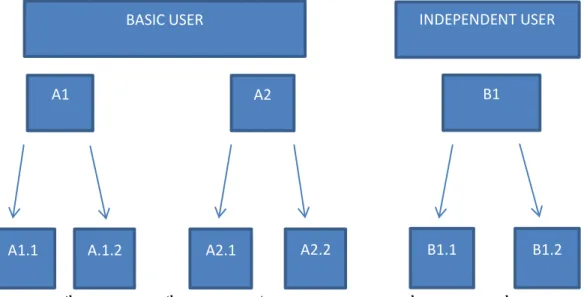
Figure No. 1 Levels of proficiency: Branshing approach
A
8th EGB 9th EGB 10th EGB 1st BACH 2nd BACH 3rdBACH
SOURCE: National English Curriculum Guideline adapted from Common European Framework of Reference for languages: Learning, Teaching, assessment, by the Counsil of Europe, 2003}
The Ministry of Education has designed an exit profile level A1, A2 and B1 with specific objectives and essential assessment indicators per school year. Then, the National Curriculum Overall Objectives are to ensure high school graduates to reach a minimun B1 language proficiency level according to the CEFR, and to build learner comunicative language competences with linguistic, socialinguistic and pragmatic component through the development of the four language skills: listening, speaking, reading and writing.
2.4.13.1 Exit Profile Level A2
According to National English Curriculum Guidelines of Ministry of Education by the end of the level A2 the students will have to achieved the communicative competence of A2 proficiency, and they will be able to:
A1 A2 B1
A1.1 A.1.2 A2.1 A2.2 B1.1 B1.2
Chart No. 5 Exit Profile Level A2
Understand sentences and the most useful expression related to the topic.
Communicate in simple way and make easy the exchange of information
on familiar and routine matters;
Describe in simple terms aspects of the background, immediate
environment and matter in area of immediate need;
Understand, identify, and prodice longer, more detailed informational,
transactional, and expository texts;
Forms, formal letters, biographies, etc. as well as simple procedural,
description and narrative;
Forms, formal letters, biographies, etc. as well as simple procedural,
description and narrative;
Be aware of some features that make their culture and the foreign culture
different as well as develop attitudes to cope with such dissimilarities. Source: Exit profile level A2.1 of National English Curriculum guidelines from Ministerio de Educación del Ecuador ( P. 15
Chart No. 6 Communicative Competence and Proficiency Level for 10th year of Educación General Básica ( A2.1 )
COMMUNICATIVE COMPETENCE PROFICIENCY LEVEL
A2.1 by the end of the 10th year EGB, students will be
able to:
Linguistic componet
Have a limit repertoire of short memorized phrases covering predicable survival situation at the personal and educational level; frequent breakdowns and misurderstandings occurred in routine situation.
Produce brief, everyday expressions, in order to satisfy simple need of concrete types: personal and educational details, daily routines, wants and needs, requests fro information at home or school.
Socioloinguistic componet
Perform and respond to simple language funtion, such as exchanging information and requests.
Pragmatic componet
Adapt and build well- rehearsed simple, memorized phrases to particular circumstances through limited lexical substitution.
2.4.13.2 Language skill A2 and proficiency level
Chart No. 7 Language skill A2 and proficiency level
Language Skills
Proficience level
A2.1 by the end of the 10th year EGB,students
will be able to:
Listening
Perceive, memorize, and note down words and
expressions not proviously encountered in the
personal, educational, and public domain as well as
note their situation context and functional value.
Make use of clues such as stress and intonation to
identify and understand relevant information in
orally produced text within the personal and
educational domains.
Reading
Understand and identify longer, more complex
transactional and expository text ( e.g. formal
letters, biographies, etc.). The text should contain
the highest frequency vocabulary and include a
proportion of shared international vocabulary items
(e.g. hamburgers, restaurant, hospital, etc.)
Speaking
Use a serie of phrases and sentences linked onto a
list to communicate in simple and routines within
the personal and educational domain.
Handle very short social exchanges within the
personal ans educational domain even though they
can usually understand enough to keep the
conversation going by themselves.
Writing Produce longer, more detailed, complex
transactional and expository texts ( e.g. formal
email, imaginary biographies, etc.) than those
presented in 9th year EGB with more variety in
sentences extructure and lexical range.
Source: Specific objectives per school year ( 10th year and 1st year Bachillerato A2.1) of National English Curriculum guidelines
2.5 HYPOTHESIS
With the design of a Reading Club the learning outcomes will be improved in the English Language in the students of the tenth basic year of the UPSE high school.
2.6 VARIABLES OF STUDY
2.4.1 Independent variable
Designing a reading club
2.4.2 Dependent variable
CHAPTER III
METHODOLOGY
3.1 RESEARCH APPROACH
A composite perspective was used in the research: quantitative – qualitative, these methods will allow to obtain specific results about implementation of a reading club to improve the learning outcome of the language learning in the students of the tenth basic year from UPSE high school; There will also be a predominance of the numerical, statistical and mathematical, checking the data obtained to determine the problem and then formulate the proposal and its solution.
3.2 LEVEL OR TYPE OF RESEARCH
3.2.1 LEVEL OF RESEARCH
The scientific method which is based on the enunciation of questions and exploration of answers must have validation that was used in the research process. Starting from this information, the methods used were: deductive, descriptive, from which formulated the problem, through direct observation of actions that students in the tenth year of basic education of the "UPSE" high school performed.
Scientific methods are interconnected procedures and guides scientific research for obtaining objective knowledge by using rules and principles. Quintero, (2010)
3.2.2 TYPES OF RESEARCH
3.2.2.1 Field research
Through the field techniques and use of the scientific method, the obtained data on the social reality, it is the study of a situation; diagnose needs and problems for applying the knowledge for practical purposes". Hernandez G. (2011).
In this research field it was applied the observation that allowed to establish actions at "UPSE" high school in the teaching – learning process, and the data collection techniques that facilitated the compilation of accurate data about the topic that was explored, such as observation, surveys and interviews that were made to students and teachers and authorities of the institution.
3.2.2.2 Bibliographical research
It was the information from documents, which are the main part to fulfill the inquiry. Paramount in a bibliographic research is to choose the basic documents to fulfill it. Information in journals, articles and books were used to sustain this search. It was in this investigation, analysis and interpretation of the contents with the assistance and contribution of bibliographic material of some authors that allowed the creation of the theoretical framework, in addition to be very useful compared to the environment arising from the established field research.
3.2.2.3 Descriptive research
For the compilation of the data, the technique of the survey was used, which was carried out to the students in the tenth year of basic education and teachers; and the interview with the directors of the institution, on the implementation of a reading club in English to improve the learning outcome of the English language of the students.
3.3 POPULATION AND SAMPLE
3.3.1 Population
Chart No. 8 The populations used in this project are as follows:
N ° Description Population %
1 Authorities 2 1.41
2 English Teacher 5 3.54
3 Tenth year of basic education students 134 95.00
TOTAL 141 99.95
Source: Secretariat of the "UPSE" high school. Made: Carlos Tomalá
3.3.2 Sample
As the population is limited, it is considered that the size of the population is
35 3.4 OPERATIONALIZATION OF VARIABLES
Chart No. 9 Independent variables
VARIABLES
CONCEPTU ALIZATIO
N
DIMENSION INDICATORS
ITEMS INSTRUMENTS
Topics Subtopics
INDEPENDE NT
Reading
club-is a
group of
people who
gather to
read and
comment on a text with
the same
purpose
Resources
Human
Do you think that students should be involved in readings in English clubs to improve learning outcomes?
Survey
Materials Do you think that the materials used in class for the
teaching of the English language are appropriate?
Contents
Texts Do you think that the contents of the texts will help
improvement of learning of the English language?
Tales Do you consider the stories used in classes help to
improve the reading in English language?
Short stories Do you think that the short stories help with
reading comprehension in English language?
Articles Do you think that research articles help to improve
reading in English?
Curriculum Blocks of
didactic units
Do you consider that the content taught in classes is adequate for learning the English language?
Values Respect
Tolerance
Chart No. 10 dependent Variable
VARIABLE CONTEXTUALIZATION
DIMENSION
INDICATORS
ITEMS INSTRUMENTS
Topics Subtopics
DEPENDEN T
Learning outcome. Are
statements about what is expected that the student is
capable of doing,
understand, and/or is able to demonstrate after a process of learning
Strategies
Vocabulary Do you know the basic words used in
within the English classes?
Survey Reading
comprehension
Do you think that comprehensive readings are tools that facilitate the learning of the English language?
Techniques
Skimming
Do you think that you have the ability to understand the main idea of a reading?
Scanning
Do you think that you have the ability to obtain specific information in a particular text?
Methods
Communicative approach
Are the methods applied in English classes based on the communicative approach? Organizationa l forms Cooperative work
Do you think that working in a group improves the learning outcomes in the English language?
3. APPENDIX
3.5 TECHNIQUES OF DATA COLLECTION
3.5.1. The survey
The survey was carried out on the basis of the operationalization of variables; it was aimed to students in the tenth year of basic education, teachers and principals of the "UPSE" high school. The collected data was analyzed by tabulation and then, the computer tool of Excel was used to obtain the results in statistical charts that allowed the illustration of the data.
3.5.2 Interview
The interview was applied to the directors of the institution; support materials such as computer and video-camera, were required to comply with it in order to preserve the tests that were then included in the final report of the thesis.
3.6 DATA COLLECTION PLAN
Chart No. 11 Data collection plan
BASIC QUESTIONS EXPLANATION
1. What for? To improve the results of learning the English 2. Which people or objects? Tenth year of basic education students 3. About what? Learning the English language. 4 Who? Authorities, teachers and students 5. What to whom? Authorities, teachers and students 6 When? During the academic year 2014-2015 7 Where? Colegio Mixto Particular "UPSE" 8 How many times? Several
9 How? Scientific research work 10. What research techniques? Observation, survey, interview
11 With what? Tab, questionnaire