
TítuloMagnetic field strength and reproducibility of neodymium magnets useful for transcranial static magnetic field stimulation of the human cortex
5
0
0
Texto completo
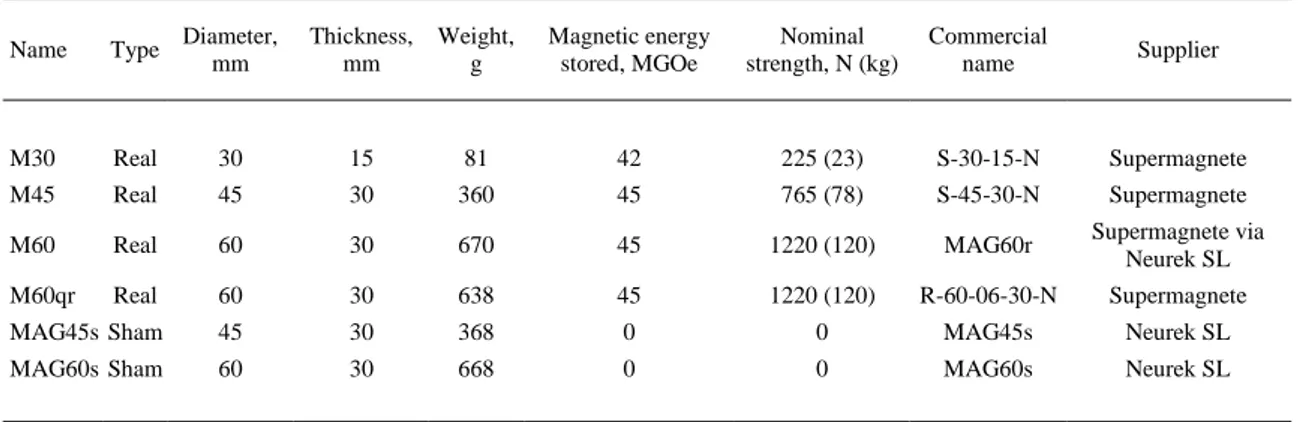
(2) field will not reach the target. In order to properly design new tSMS protocols in human and animal studies, it would be practically helpful to know the actual strength of the magnetic field as a function of the distance from the magnet base surface. Moreover, it would be important to know the consistency (in terms of strength of the magnetic field) of the magnets that can be found on the market. To address these issues, in the present experiments we measured the strength of the static magnetic field produced by four different types of neodymium cylindrical magnets using a magnetic field-tovoltage transducer. We verified the reproducibility of the results (i.e., the consistency of the field strength across magnets of the same size and type) by testing at least two magnets of each size and type. Methods Magnets We measured the strength of the static magnetic field produced by 10 magnets and two inert steel cylinders (useful for sham stimulation). The characteristics of the magnets and of the steel cylinders are summarized in Table 1.. Table 1. Characteristics of the Magnets and of the Steel Cylinders (for Sham Stimulations). Name. Type. Diameter, mm. Thickness, mm. Weight, g. Magnetic energy stored, MGOe. Nominal strength, N (kg). Commercial name. Supplier. M30. Real. 30. M45. Real. 45. 15. 81. 42. 225 (23). S-30-15-N. Supermagnete. 30. 360. 45. 765 (78). S-45-30-N. Supermagnete. M60. Real. 60. 30. 670. 45. 1220 (120). MAG60r. Supermagnete via Neurek SL. M60qr. Real. 60. 30. 638. 45. 1220 (120). R-60-06-30-N. Supermagnete. MAG45s Sham. 45. 30. 368. 0. 0. MAG45s. Neurek SL. MAG60s Sham. 60. 30. 668. 0. 0. MAG60s. Neurek SL. Magnetic energy stored and nominal strength values are provided by the suppliers.. We used three different sizes of cylindrical magnets, which will be referred to as magnets 30, 45, and 60 (M30, M45 and M60). The number indicates the diameter (in millimeters). We also tested a 60-mm magnet with a quasi-ring shape. We will refer to this magnet as M60qr (see Fig. 1a). For all magnets, the magnetization direction was parallel to the height axis. All the magnets were cylindrical nickel-plated (Ni-Cu-Ni) NdFeB magnets..
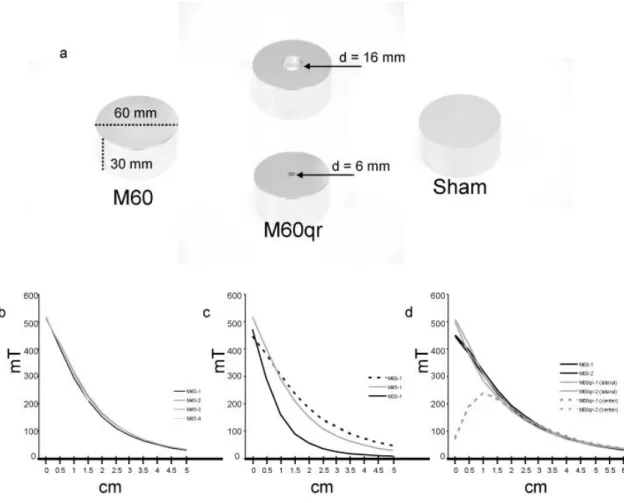
(3) Figure 1. a. Pictures of the two different magnets with a main diameter of 60 mm (M60 and M60qr) and the sham. M60qr has a quasi-ring shape with internal hole diameters of 6 mm on one side and 16 mm on the other side (d, diameter). Sham is a nonmagnetic metal cylinder (nickel-coated steel) that has the same size and appearance as M60. b. The graph shows the magnetic field strength of four different M45 magnets tested at different distances from the magnet base surface. The reproducibility of the results (i.e., the consistency of the field strength across magnets of the same size and type) was very high (standard deviations <10 mT). c. The graph shows the magnetic field strength of three different magnets (M30, M45, and M60) tested at different distances from the magnet base surface. Not surprisingly, at distances that are relevant for cortical stimulation in humans (i.e., 2– 3 cm from the magnet base surface) the magnetic field strength was dependent on the magnet size. d. The graph shows the magnetic field strength of four different magnets (two M60 and two M60qr) tested at different distances from the magnet base surface. The reproducibility of the results was very high. At a distance smaller than 1.5 cm from the base surface, the magnetic field strength of M60qr was much smaller than M60, due to the central holes. Conversely, at a distance of at least 1.5 cm the results for M60qr were similar to M60. Interestingly, M60qr lateral measurements (i.e., parallel to the cylinder axis, 1.5 cm off the center) were comparable to the measurements performed with the M60 (along the cylinder axis) at all distances.. M30 was 30 mm in diameter and 15 mm thick, with a weight of 81 g (Model S-30-15-N, Supermagnete, Gottmadingen, Germany [http://www.supermagnete.de]). The maximum amount of magnetic energy that can be stored in this magnet is 42 MGOe (megagauss-oersteds), with a nominal strength of 225 N (23 kg). M45 was 45 mm in diameter and 30 mm thick, with a weight of 360 g (Model S-45-30-N, Supermagnete). The maximum amount of magnetic energy that can be stored in this magnet is 45 MGOe, with a nominal strength of 765 N (78 kg). M60qr was 60 mm in diameter and 30 mm thick, with a weight of 638 g (R-60-06-30-N, Supermagnete). The internal hole diameters are 6 mm on one side and 16 mm on the other side. The maximum amount of magnetic energy that can be stored in this magnet is 45 MGOe, with a nominal strength of 1220 N (120 kg). We considered this magnet shape useful for some brain stimulation applications, as it makes it possible to pass an electrode cable through the magnet and record from an electrode very close to the contact surface between the magnet and the scalp (e.g. to record electroencephalograms). All the data on M30, M45, and M60qr were provided by the manufacturer (Supermagnete). M60 was a customized cylindrical nickel-plated (Ni-Cu-Ni) NdFeB magnet of 60 mm in diameter and 30 mm in thickness (supplied by Supermagnete to Neurek SL, Toledo, Spain.
(4) [http://www.neurek.com]). The maximum amount of magnetic energy stored in this magnet and the nominal strength should be similar to the M60qr. Nonmagnetic metal cylinders potentially useful for sham stimulation were also tested. These steel nickel-coated cylinders (MAG45s and MAG60s, Neurek SL) had the same size as and similar weight and appearance to M45 and M60. Measurement procedures The magnetic field strength was measured using a magnetic field-to-voltage transducer with an integrated Hall probe. The sensor is a complementary metal-oxide semiconductor one-axis Hall probe (model I1A) integrated into a transducer (YM12-3-5-5T) (SENIS GmbH, Zurich, Switzerland). The Hall element in the probe occupies an area of 150 μm × 150 μm, providing a very high spatial resolution and angular precision. The Hall probe measures along a single axis perpendicular to its surface. All measurements represent the strength of the magnetic field vector (usually represented with the international symbol B) along the axis perpendicular to the base surface of the cylinder. An integrated temperature sensor on the probe provides temperature compensation for better accuracy. The sensor is also protected against inductive currents that could disturb the measurement. The decay of the static magnetic field with distance was measured by increasing the distance between the Hall probe and the magnet surface, keeping the base of the sensor parallel to the surface of the magnet. For M60qr we performed measurements both on the cylinder axis and parallel to the cylinder axis. Note that because the magnetic field is normal to surface of the magnet only along the cylinder axis, our measurements parallel to the cylinder axis represent a lower bound of the actual strength of the magnetic field. The magnetic permeability of human tissues is similar to air or vacuum [8], so any differences in magnetic field strength between air and human tissues are negligible for the purpose of tSMS. Results Figure 1 (b–d) shows the magnetic field strength of the different magnets tested at different distances from the magnet base surface. The reproducibility of the results was very high for all magnet sizes (Fig. 1b,d): Specifically, the standard deviation for all measurements performed on the four M45 magnets at different spatial points (Fig. 1b) was <10 mT. As expected, at distances that are relevant for cortical stimulation in humans (i.e., 2–3 cm from the magnet surface), the magnetic field strength was dependent on the magnet size (Fig. 1b–d), and the nonmagnetic metal cylinder had a null magnetic field strength (<0.001 mT). At a distance smaller than 1.5 cm from the base surface, the magnetic field strength of M60qr was much smaller than M60, due to the central holes (Fig. 1a,d). Conversely, at a distance of at least 1.5 cm the results of M60qr were similar to M60, and both center measurements (i.e., on the cylinder axis) and lateral measurements (i.e., parallel to the cylinder axis, 1.5 cm off the center) were comparable (Fig. 1d). Discussion We believe that tSMS can play a role in the development of future strategies for noninvasive neuromodulation. Herein, we measured the magnetic field strength of permanent magnets of different size and shape at different distances from the magnet base surface. The most important result is that there is good reproducibility of the magnetic field strength when similar magnets are compared. Furthermore, at 2–3 cm from the magnet surface the magnetic field strength is in a range between 120 and 200 mT. Therefore, tSMS using relatively small magnets produces a magnetic field that is strong enough to reach most of the cortical targets with strength between 120 and 200 mT. It seems that this range is enough to obtain biological effects [5]. For a magnetic cylinder, the magnetic flux is such that at the center of the base surface of the cylinder the magnetic flux lines are perpendicular to the surface. Moving toward the periphery of the surface, the flux lines come out at an angle that deviates from the cylinder axis, and they diverge at increasing distance from the surface. A simple strategy to increase the overall strength of the magnet—and thus to decrease the spatial decay of the magnetic flux density—is to increase the diameter of the magnet. The drawback of this strategy is a loss of focality. An alternative strategy to increase the overall strength of the magnet while maximizing focality is to increase its thickness. The optimal magnet in each specific clinical application would therefore depend on the desired tradeoff between overall strength and focality. These results should also be considered when performing tSMS in animal laboratories, where tSMS could represent an alternative neuromodulatory tool to current available techniques. In animals (monkey,.
(5) cat, rat) the distance from the magnet to the cortex is shorter and the total cortical surface is smaller; hence, it is important to adjust both magnet size and distance in order to achieve the optimal stimulation parameters. The measurements presented here offer a quantitative empirical reference for the development of tSMS protocols in both human and animal studies. Acknowledgements We would like to thank Francisco Rivadulla (CIQUS, University of Santiago) for useful technical help during the measurements. This work was partially supported by the Ministerio de Educacion y Ciencia (MEC) (BFU2009-08169). Authorship Statement Drs. Casto Rivadulla, Guglielmo Foffani, and Antonio Oliviero designed and conducted the study, including data collection and data analysis. Dr. Antonio Oliviero prepared the manuscript draft with important intellectual input from Drs. Casto Rivadulla and Guglielmo Foffani. All authors approved the final manuscript. The University of A Coruña and Hospital Nacional de Parapléjicos provided funding for the study; statistical support in analyzing the data, with input from Drs. Casto Rivadulla, Guglielmo Foffani, and Antonio Oliviero; and funding for editorial support. Drs. Casto Rivadulla, Guglielmo Foffani, and Antonio Oliviero had complete access to the study data. References 1 Kuo MF, Paulus W, Nitsche MA. Therapeutic effects of non-invasive brain stimulation with direct currents (tDCS) in neuropsychiatric diseases. Neuroimage 2013; doi:pii: S1053-8119(13)00627-7. 10.1016/j.neuroimage.2013.05.117. [Epub ahead of print] 2 Schulz R, Gerloff C, Hummel FC. Non-invasive brain stimulation in neurological diseases. Neuropharmacology 2013;64:579–587. 3 Oliviero A, Mordillo-Mateos L, Arias P, Panyavin I, Foffani G, Aguilar J. Transcranial static magnetic field stimulation of the human motor cortex. J Physiol 2011;589:4949–4958. 4 Silbert BI, Pevcic DD, Patterson HI, Windnagel KA, Thickbroom GW. Inverse correlation between resting motor threshold and corticomotor excitability after static magnetic stimulation of human motor cortex. Brain Stimul 2013;6(5):817–820. 5 Rosen A. Mechanism of action of moderate-intensity static magnetic fields on biological systems. Cell Biochem Biophys 2003;39:163–173. 6 Coots A, Shi R, Rosen A. Effects of a 0.5-T static magnetic field on conduction in guinea pig spinal cord. J Neurol Sci 2004;222:55–57. 7 Rosen AD, Lubowsky J. Magnetic field influence on central nervous system function. Exp Neurol 1987;95:679– 687. 8 Morrish AH. The physical principles of magnetism. New York: John Wiley & Sons, 1965..
(6)
Figure
Documento similar
Precession frequency, also known as Larmor frequency, is closely related to the strength of the external magnetic field and can be obtained using the following equation
The axial magnetic effect describes the generation of an energy current parallel to an axial magnetic field B 5 (i.e., a magnetic field coupling with opposite signs to the left
Examples of molecular switching in inorganic solids, due to temperature, light, pressure, and magnetic field*..
Nevertheless, the helical nature of the generated magnetic field warrants that the effect of the primordial plasma would be that of pre- serving and even amplifying the magnitude of
As a result we present the temperature dependence of the electronic part of the heat capacity, the magnetic field dependence of the Sommerfeld coefficient, the temperature dependence
The magnetic configuration and magnetization reversal process of cylindrical shaped magnets (nanowires and nanodots) have been studied using Magnetic Force
This behavior is attributed to the specific order parameter and magnetic field distributions, which favors the formation of superconducting vortices and order
When we apply a magnetic field above the upper critical field, we do not find any signature for the magnetic impurities. This shows that there is no strong exchange cou- pling
