
Saragossa Sites Education from the city through heritage routes
13
0
0
Texto completo
(2) Journal for Educators, Teachers and Trainers, Vol. 6 (1) ISSN 1989 – 9572 http://www.ugr.es/~jett/index.php. Saragossa Sites. Education from the city through heritage routes Los sitios de Zaragoza. Itinerarios patrimoniales para educar en la ciudad Ricardo Huerta, University of Valencia, Spain [email protected]. Abstract This paper reviews the efforts of the municipality of Zaragoza to promote an innovative heritage education project. This project adds value to the archaeological ruins discovered a few years ago (Teatro Romano, Public Baths) and other urban spaces musealized (Forum Museum, Museo del Puerto Fluvial). Heritage education is based on a city tour that culminates in the splendid Museo Pablo Gargallo. In this proposal we are interested in the part relating to education in museums. But we also found important to have integrated different parts of the city in a real urban route. This route connects different places imbued with tradition, art, history and memory. To understand and analyze this reality we have relied on key methodological case studies, using interviews and surveys of the main groups involved: teachers, technical and cultural mediators. We have also observed numerous live group visits. Thanks to this formula (which includes several urban areas) is achieved increasing the participation of many groups, especially school visits and families. Resumen El presente trabajo revisa el esfuerzo que se ha llevado a cabo desde la municipalidad de Zaragoza para impulsar un proyecto de educación patrimonial que pone en valor tanto los restos arqueológicos hallados hace unos años (Teatro Romano, Termas Públicas) como otros espacios urbanos (Museo del Foro, Museo del Puerto Fluvial) en base a un recorrido urbano que culmina en el espléndido Museo Pablo Gargallo. De esta propuesta nos interesa tanto la vertiente referida a la educación en museos como al atractivo que supone haber integrado diferentes partes de la ciudad en una verdadera ruta urbana que aglutina así diferentes lugares impregnados por la tradición, el arte, la historia y la memoria. Para conocer y analizar esta realidad nos hemos basado en las claves metodológicas de los estudios de caso, utilizando entrevistas y encuestas a los principales colectivos implicados: profesorado, mediadores y técnicos culturales. Hemos observado en directo numerosas visitas de grupos. Entre los resultados obtenidos destacamos que con esta fórmula que integra varios espacios urbanos se ha conseguido potenciar y reactivar la participación de numerosos públicos. Keywords. Education; City; Heritage; Art; Saragossa Palabras clave Educación; Ciudad; Patrimonio; Arte; Zaragoza. Journal for Educators, Teachers and Trainers JETT, Vol. 6 (1); ISSN: 1989-9572. 53.
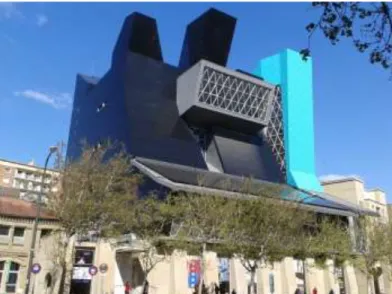
(3) 1. Introduction The name of the city of Saragossa comes from the original Roman “Caesaraugusta”. The importance of this city, both in the imperial era and the historical development until the present, makes it one of the most important cities in Spain. Its strategic role in the course of the river Ebro is reinforced by economic and industrial potential. Saragossa has made visible presence in the early twenty-first century through the Universal Exposition held in 2008 under the slogan “The Water Expo”. This global event coincided with the start of the economic crisis that has affected so cruel especially to Spain and other southern European countries. Some local analysts have detected that the crisis came a year after this city, precisely because the splendor of the Expo were very occupied and entertained different social strata of its citizens. Saragossa is the capital of the region called Aragon, an interior territory that connects the Pyrenees and the French border and neighboring Navarra, Castilla, Valencia and Catalonia. During the years of democracy, the city government has maintained a progressive trend, which is now combined with the conservative majority in the region, an area which is reference and administrative, cultural and political capital. The cultural thrust of the city has been strengthened in November 2013 with the celebration of the Congreso Iberoamericano de Cultura, an event that brought together representatives of countries of the OEI (www.culturaiberoamerica.org) by the title "Digital Culture, Networked Culture", using possibilities to enhance contacts and link different areas of cultural expressions among more than twenty Latin American countries. The cultural offer of Saragossa is broad, and its proposals in theater, music, film, dance and exhibitions are an important reference, considering that it is equidistant between two cities like Madrid or Barcelona. The leg of the journey have been shortened since the line of high-speed rail, opened a railway network that allows people reach Madrid or Barcelona in less than two hours. The figure of Goya has been and continues to be the name of the character's most recognized art culture of Aragon. Film director Luis Buñuel is also very popular, along with singer Bunbury, who was formerly part of the group Heroes del Silencio. The film is part of the popular stage, to the extent that in one of the most modern village in the periphery neighborhoods the streets are named after film, so when we took the tram to The Wizard of Oz destination or find map the routes dedicated to The Seventh Seal or East of Eden. Among the museums include regional (www.patrimonioculturaldearagon.es/museos) and the IAACC (http://iaacc.es) the Aragon Institute of Contemporary Art and Culture Pablo Serrano (Abad y Escamilla, 2011) and the Museum of Saragossa (www.museodezaragoza.es) composed of multiple sites, because their collections ranging from prehistory to the twentieth century, including sections as diverse as fine arts, ceramics, ethnology, and even archaeological sites. The architecture of the IAACC is spectacular and visually highlights both the walk and contemplating the skyline of the city, as we can see in Figure 1.. Figure 1. Facade of the Aragon Institute of Contemporary Art and Culture Pablo Serrano.. Journal for Educators, Teachers and Trainers JETT, Vol. 6 (1); ISSN: 1989-9572. 54.
(4) The so-called Museum System managed by the Government of Aragon includes other museums with offices in different cities, among which we could mention both located in the city of Huesca: the Pedagogical Museum of Aragon and the Museum of Huesca. In Huesca is located the Master in Museums: Education and Communication (www.mastermuseos.es). This is a pioneer in the Spanish universities, with 25 consecutive years of experience. Other interesting museums in the city of Saragossa are those with private or shared ownership, as the dependent entity Ibercaja or those that are part of private collections. The most significant of all, for their dedication to the figure of Francisco de Goya, is the Ibercaja Camon Aznar Museum (http://museo.ibercaja.es) "A museum of Goya and about Goya", as its slogan says, which contains a permanent exhibition of the Aragonese artist. In addition to having a good network of museums, the rich heritage of Aragon becomes relevant examples of UNESCO World Heritage: Mudéjar Teruel (declared by UNESCO in 1986 and expanded in 2000), a part of the “Camino de Santiago” (declared in 1993), and their contribution to Prehistoric Mediterranean Art. In religious monuments, a key element of this territory is the Basilica of Pilar, located in the northern part of what was two thousand years before the Forum of the Roman city of Caesaraugusta. Aware of the assets and wealth of museums in this city, we have chosen to analyze in our study educational activities programmed under the "Museums Caesaraugusta Road" name, because it is a very attractive proposition. An effort that has been shown in recent years an impressive ability to appeal to different audiences, offering quality programming and educational component of great consistency (Aguarod & Erice, 2011). Five sites have this name: the Museum of the Forum, the River Port Museum, the Museum of Public Baths, the Theatre Museum, and the Pablo Gargallo Museum. Of these museums we can obtain valuable information through the website (www.zaragoza.es/ciudad/museos).. 2. Methodology We develop a methodology based on case studies (Hubard, 2008). We address the processes of education in heritage (Csikszentmihalyi, 1990) and the urban environment (Alderoqui, 2012; Romano, 2008) using the theoretical framework of visual culture (Aguirre 2004; Duncum, 2007; Mirzoeff, 2006; Rogoff 2000), and arts education (Freedman, 2008). We understand the urban heritage as a border territory, an entity that facilitates communication between groups in the area where they occur. Working watching and sharing experiences with students and teachers we approach the proposals of the Artographies (Irwin & O'Donoghue, 2012). Artographies involve open processes and redefine the role of students and teachers rethinking their relationships with equity. Artographies encourage the professional educator to integrate the different parts of artist, researcher and teacher. The city is complex and the way to approach looks toward the city can not be reduced to a written dating. For data collection is essential to direct observation of the activities undertaken. The hybrid methodology than we use introduces texts and images generated from the involvement of the researcher with all participants. It encourages the group to participate and confidence between the parties based on negotiation is established. We theorize from visual culture and we rely on the discourse of critical reflection on the visual artifacts (Heritage) that the city (Urban Geographies) offers.. 3. A theater play with a Roman maid and her mistress One activity that has captivated us for cultural and educational offerings Saragossa was the interpretation of the actress Maria Angeles Parroqué. We saw Maria Angeles in his dual role of servant and master in a play that takes place on Monday morning at the Museum of Public Baths. This museum is located in a small, narrow street, San Juan and San Pedro, which was found in 1980 the ruins of this impressive Roman complex. Given the importance of the archaeological find, the city negotiated with the owners of the land (a place that has built a highrise building) the preservation of these ruins, which are now in the basement (where it was. Journal for Educators, Teachers and Trainers JETT, Vol. 6 (1); ISSN: 1989-9572. 55.
(5) intended underground parking). It has retained the impressive public structure of the Roman baths. The Public Baths Museum opened in 1999, after the excavations carried out between 1982 and 1990. Along with the remains of the pool stands a great showcase reproductions of objects for personal hygiene. Heritage conservation actions are managed and scheduled further consistently to value activities such cultural infrastructure. We were able to attend live performances of this archaeological site (Calaf, 2013). It has been preserved and musealized a part of what was the pool Public Baths. Beside the pool is a fragment of the wastewater conveyance. Viewers of that day were a group of twenty children nine years of concerted religious school in the city. His teacher had booked two months before the activity. The actress goes dressed as a Roman servant, representing a maid called Selene. Maid tells her own life, and thanks to this dramatic action is to involve the students get to achieve the educational objectives. The objectives pursued are: recognizing the archaeological remains that were found in the Baths of Cesaraugusta, placing the hot springs in the urban space, getting to the place and role of bathhouses, knowing their performance or systems of water pipe that developed both the Romans. We were thrilled we function and was fascinated by the work of the protagonist, who spoke to Roman society and estates disputes. Through these representations children actively participate and have fun while learning. Halfway through the performance, in a big screen we see an audiovisual fiction that tells a story between a Roman politician Caesaraugusta and a friend. We see beautiful images with calligraphic texts that integrate many cultural and artistic references of the Roman empire. The narrator of the story is a citizen who holds public office of mayor. He wrote a letter to his friend to tell the excellence of the baths. It leads to the different rooms that had their facilities (cold, warm, hot tubs, saunas, gym, massage room, library). We know the administrative part of it was this public building, daily life, bodily exercise and the relationships that were established in these thermal resorts. After the actress goes again but this time with a more sophisticated dress and hairstyle. Now is Valeria Maxima, twin sister Selene, married with a major hero of the city. The writer chose to make them twins, which gives much more play to representation, adding drama to the theatrical action. In his role as Valeria Maxima, the actress tells us daily grooming utensils body that were used in Roman times. These utensils are compared with existing objects (combs, nail clippers, Q, ...). It calls attention to a gender differential detail: Some chil dren have volunteers come and actress painted their eyes with makeup pencil. Some girls tease the student who has completed makeup. And yet do the same with the girl or with another student who takes the joke situation. In this situation the teacher did not react. However, when the actress asks the children: "What do you prefer, to sell my sister into slavery to earn some money or the free" and most say "Sell your sister to make money!”, the teacher immediately take up the matter and asked to be sensible and decide to give freedom to the slave Selene. We note therefore a very different educational treatment which imposes religious school teacher in the case of gender issues or other aspects (Huerta, 2012). The representation seduces us by the good work of the actress, who engaged in a historic setting of the first magnitude, is able to value these impressive archaeological remains of Roman public baths. In addition, it has been able to talk openly about issues such as personal hygiene or body parts, comparing systems from Roman times with some not so different current practices.. 4. Two thousand years buried under the city By accessing the Theatre or the Roman baths are aware that the Roman heritage of this city has been virtually hidden or buried for many centuries. The historic part of the city remains treasures stratigraphic two millennia. We can imagine that some influential people in recent times were especially insensitive to this rich architectural history. Between 1960 and 1980 many buildings were constructed in the city razed the historic possibility of a reunion with the past, especially when the buildings integrated cross underground parking. There has been little care, both by builders and by some politicians with regard to urban land use. This has led to the irretrievable loss of valuable archaeological sites. It has been for democracy when it has. Journal for Educators, Teachers and Trainers JETT, Vol. 6 (1); ISSN: 1989-9572. 56.
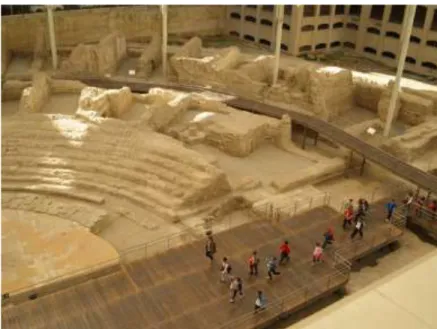
(6) revitalized the respect for history, and for this reason have recovered sites analyzed in Caesaraugusta Road. The deposits musealized disclosed archaeological remains found in situ. The Forum Museum was built to house the remains of the excavations in 1989. It was inaugurated and opened to the public in 1995 after a complex investigation that led preserve traces found. It is a striking geometric structure that is located on one side of the Plaza del Pilar, in the so-called Plaza de la Seo. From this square you can access a data input space, where we went down some stairs, entering the museum area that overlaps between the remains of the Roman city. Through models, objects we see was the commercial and civic activity of the Forum. In addition we see a movie projected on the walls. We exposed several original lead pipes that historic period belonging to the network of water supply of the city. Next to the Roman sculptural remains found pipes and fragments of columns. Are attractive basis grounded belonging to the western side of the double doors surrounding the large square of the ForumAnd basements of commercial buildings, open to the Cardus Maximum shaft or artery of the city. We can appreciate the reuse of spaces through history, thanks to an Arab drinking water well. The museum organizes educational activity (www.zaragoza.es/ciudad/museos/es/foro) titled "From market to table Caesaraugusta" which explains what the Romans ate, how they cooked food or carrying, or what were the delicacies that were consumed at that time. You can visit a triclinium where you can see the outfit that was used in the tables and protocol indicating how to accommodate guests. The River Port Museum opened in 2000 (www.zaragoza.es/ciudad/museos/es/puerto). The site was discovered after excavations undertaken between 1989 and 1991. Also located on the ground floor of a modern apartment building. The preserved monument consists of an arcaded facade facing the river and the steps that connected the docks with the Forum. The set is dated between the first century BC and the first century AD. The museum features a sound demo with the hypothetical reconstruction of the set, along with a series of dioramas that allow imagine what this space was in antiquity. Are marked stonemason marks left by the veterans of the legions when some stones were built.. Figure 2. Archaeological ruins of the Roman Theatre in Saragossa, seen from the Theatre Museum. The most striking of which was the Roman city architectural recovery is undoubtedly the Theater, which we see a part in Figure 2 during a school visit to the site. The Theatre Museum opened in 2003. It is located in a stunning location allowing us to see the remains of the spectacular theater that was built here in the first half of the first century AD. It features the best preserved Roman city public building. For conservation was protected with a covering of translucent polycarbonate, 25 meters high, resting on a sustained spatial mesh by metal poles. The visit to the theater is done through walkways that run through the lower gallery or crypta. Journal for Educators, Teachers and Trainers JETT, Vol. 6 (1); ISSN: 1989-9572. 57.
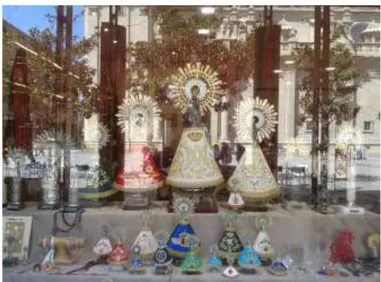
(7) building and pulpitum or wooden stage. The facade of the new building has a large windows allowing a panoramic view of the archaeological remains from different heights. On the floor of the museum through drawings see how was the evolution of the site along history as well as data on their discovery after almost two thousand years, through a research. In the basement we have many models, computer graphics and scenes that reveal the architectural achievements of the Roman era. In these spaces impregnated educational activities of the rich past of this city are developed. They have such catchy titles as "Cradle Will Rock" (as the Roman theater curtains limp down the floor) or "If the stones speak" about how they built a building. It explains the visitor how to build the foundation, how to build a bow and dome, or the mode of raising materials to the top of the theater.. 5. The importance given to accessibility and education in museums Responsible Service of Culture of the City of Saragossa tell us that despite the crisis and the harsh economic policies that are suffering, in the politics of the city has always defended and maintained the interest in heritage and education. Is strongly committed to preserving the level to avoid cuts. It is the spirit of the headquarters of the Museum and Exhibition Unit, where they struggles to maintain the level of the performances. For the head of the Department of Teaching Museum Saragossa these political decisions are important. It is carrying out activities that are offered to various audiences: school, families, tourists, or seniors. Despite their differences and particularities, all the museums of the route have lots of published materials. Most of these materials are freely available through the corporate website, in which we can easily find information about education and heritage. With the web we have access to an impressive array of heritage sites (www.zaragoza.es/ciudad/artepublico/buscar_ArtePublico). We can take a tour or select and also know each of the pieces. The city website www.zaragoza.es has developed a system that allows accessibility to users, and most especially the disabled, both information and services through clear and structured content, improving navigation and user experience. These patterns and levels of accessibility have deserved to be granted quality certification from AENOR, CTIC and ESI Tecnalia, and the TAW prize for the most accessible public web of local government. The design was made to be compatible with as many and different online platforms. One of the attractions of the city is the religious claim. Millions of pilgrims and faithful to the Virgen del Pilar come each year to see the image. The religious souvenir shops flooded the neighboring area to the cathedral and the Basilica, as shown in Figure 3.. Figure 3. Reflection from the Basilica del Pilar in crystals of a building. Each museum has its own path projections to explain to visitors how people lived in Roman times, adjusting the picture and sound presentations to the walls and columns of the enclosure. They have the technology to access a maximum of information and accessibility through the. Journal for Educators, Teachers and Trainers JETT, Vol. 6 (1); ISSN: 1989-9572. 58.
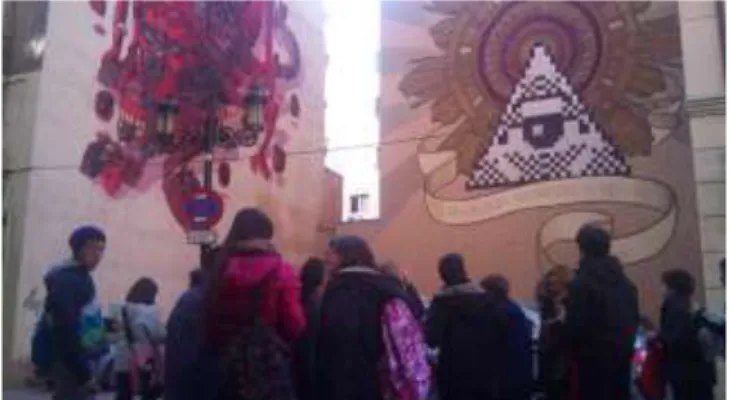
(8) virtual online space. The spaces of the route have a system that allows access to all transit users, caring for people with disabilities. There are ramps and elevators in all venues visited, to improve access for people with reduced mobility. We see a great display of mechanisms that are designed for people with impaired vision or hearing, so that both the models and other elements such as texts and tactile sound environments appear in all courses. The City Council Education Service has published documents and dossiers for both teachers and for students of all educational levels. The documentation is available online. Reading the dossiers is very comfortable even when reviewed on the computer screen. The use of typography is clarifier, images and illustrations are adequate. Can we imagine each of the times that has led to changes and developments in the city (Roman period, after the empire populations, medieval, renaissance and baroque, and recent centuries to the present). Printed brochures and paper documents remain good allies for visitors. The small drop of the "Route of Caesaraugusta" has such easy to carry which enables orientation in the city during our tour. The effort to properly reach different audiences and users has a positive effect in a better understanding of the educational opportunities that we provide the museums of Saragossa.. 6. What teachers say about the heritage urban routes To know what you think about teachers and museum offer Saragossa urban routes have interviewed several teachers from schools in the city. We searched professionals who bring their students to the activities. They are high school teachers, who teach in their institutions varied subjects as philosophy, history, literature, art, or are responsible as guardians of student groups with different problems. We have collected ten surveys and have personally interviewed eight teachers, we have also shared with them the activities in museums. We propose this research from a qualitative perspective, valuing the advice from heritage education we provide the latest research (Gutiérrez & Calaf, 2013; Fontal & Vallés, 2013). We have introduced aspects that come from critical pedagogy (Duncum, 2008; Giroux, 2013; Housen, 2007) and we are interested in the reflections of aspects of heritage (Falk, 2008; Reis, 2007; Wexler, 2007). Educational approaches should be accompanied by civic and social reflections (Dewey, 1969; Donaire, 2012; Errázuriz, 2006), by which we will develop arguments for use in the formation of a critical citizenship (Huerta, 2008; Huerta & de la Calle, 2013). Two of the teachers we interviewed work with pupils with special educational needs. They use the press as a resource to work multiple issues ranging from the environment to the history or mathematics. While not personally practice artistic activities do use art as a common means to impregnate their classes (Huerta, 2010; Marzilli, 2008). They think that heritage is part of the culture, the way of being and acting of a people and of each society (Lachapelle, 2007; Augustowsky, 2012). Organize visits to museums so that students learn differently where you live, to be able to understand and comprehend how other people lived before they had their customs, habits that did not resemble the current. Prepare the visit in advance, explaining to the students the activity and use the resources that facilitate the institutions that organize visits (Irwin, 2013; Franco & Huerta, 2011). They like to develop their own materials and motivate students with documentaries or movies that deal with the subject being treated. The experience gained during these years of teaching facilitates the organization of school activities (Sennett, 2008). They have the advantage of being in a school situated in a central area of Saragossa, so movements are usually quite simple. They claim that this effort compensates them personally. Professionally they are convinced that the activities do better if more resources are used. Every year a large gathering of graffiti called Festival Asalto. Artists paint murals on the walls of buildings. Teachers travel with his students the streets to teach these artworks, as shown in Figure 4.. Journal for Educators, Teachers and Trainers JETT, Vol. 6 (1); ISSN: 1989-9572. 59.
(9) Figure 4. Students transiting Alfonso I street listening to the explanations of a teacher. Believe that the outcome of each activity will depend on the students with whom you work. Anecdotes are what matters most to students, for that reason, when the activity is led by instructors, ask them to impact on these details, because they have proven that they keep the details (Huerta, 2013), and from the stories can be linked to issues of more entity. These teachers believe that the educational activities of Caesaraugusta museums are interesting when dramatizations are done, because the visualization and pure and simple explanation is extensive. This course have been lucky that much of the visit to the Theatre Museum consisted of a skit with direct involvement of students, which proved even more interesting. Of heritage sites are interested in what they can convey to students, focusing on the idea that the city in which we live has been inhabited by other people from different cultures and we are the result of them all. Other teachers interviewed say that the fact of organizing visits to museums and heritage education activities promotes the interest and curiosity of students by all nearby cultural issues. Explain that information on this type of activity reaches them through the campaigns of City Council, and also to a lesser extent by what they read in the press or online. The hardest part is to organize the transfer from the center to the museum, whether it is a school that is out of town. After making the visit address the issue in class through a discussion on what has been seen, while working some specific aspect if it is necessary. They understand that the educational offerings of the City of Saragossa is interesting, comprehensive, recalling an aspect that favors and interest to students is the opportunity to leave the classroom for an activity. The city tour of four spaces of the Roman Empire will be completed later with a visit to a museum dedicated to a sculptor who has a certain tendency classicist. In Figure 5 we can see a work of classical period of Pablo Gargallo.. Figure 5. Pablo Gargallo sculpture at the museum dedicated to the artist in Saragossa.. Journal for Educators, Teachers and Trainers JETT, Vol. 6 (1); ISSN: 1989-9572. 60.
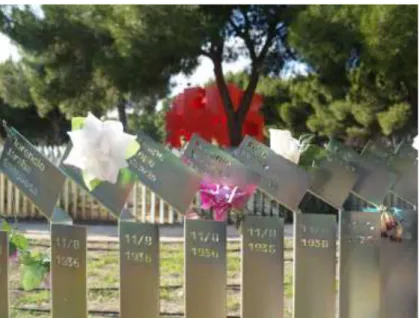
(10) Of heritage sites are especially motivated by knowledge the history of the city. Commenting each travel options that include "Breakfast in the forum" was very nice, because all the students participated in what will be proposed at the Museum Forum. Teachers give a positive assessment of theatrical approach Public Baths Museum. Remember that there was much student participation in all proposals for the theatrical tour guides during the Theatre Museum. They believe that there is a particular look of teachers towards the city, because for them the city and its heritage sites are a prime element in the training of students. As aspects to review to improve visitors insist on giving a more playful and less academic view, betting on theatrical visits. They define Saragossa as a city with great historical interest. When speaking with the staff of a center where there is a group of Greco-Roman theater they convey their enthusiasm to discuss these rituals heritage education. Using Art as a crosscutting issue in disciplines such as philosophy, because it is part of the agenda, and that is very suitable for the training of students item. They have created an educational theater project called "Moon Classics", coordinated by several teachers. These teachers believe that both arts education and heritage education are not adequately addressed at the time of teacher training, and so each teacher must constantly formed in this area. They say that the information to be transmitted to students is simple: the important thing is how, valuing the "love" of art and heritage that is transmitted. The Teaching Unit of Saragossa Museums provides many resources to get these achievements. They consider it very important that young people feel their city as their own. To achieve this it is necessary to know the password. So organize heritage education activities. The theatrical educational project of the school revolves around the Greco-Roman theater, and assure us that the City Council are always willing to assist in these tasks. The topics that the teacher knows are of interest to most students, especially those in which the activity is participatory. Who organized programming museums Saragossa know it very well. They prefer the Roman Theatre Museum, for its beauty and spectacular as it is attractive as a museum and building. Saragossa is defined as a living city and good for human relationships, a town with Roman Heritage Live: Caesaraugusta. The tradition of having the host city Zaragoza is also expressed in recent monuments. As a city on the crossroads has had to suffer many attacks at various times in history. The monument dedicated to the victims of the Franco dictatorship is a beautiful example of this, as shown in Figure 6.. Figure 6. Monument to Franco victims in Torrero Cemetery. Teachers who are assigned groups PCPI (Initial Vocational Training Programs) give classes to high school groups, using art in disciplines that are not the visual arts. For them is fundamental the heritage knowledge. They believe that arts education is abandoned in the initial training of teachers. These teachers organize visits to heritage education activities in order to bring. Journal for Educators, Teachers and Trainers JETT, Vol. 6 (1); ISSN: 1989-9572. 61.
(11) students to the art. They are teachers who prepare the visit in advance and take advantage of the visit to continue influencing the topics discussed, doing work on notebook, discussions, viewing videos, expanding the information on the computer. They tell us that it has raised the price of activities. Teachers say well worth the effort when students perform activities outside the classroom, knowing that the interests of students are varied, and depend on the motivation prior development activity. In the opinion of the teachers, the activities taking place in museums are well planned and quite well developed by professionals who make them. Of heritage sites are especially interested in understanding the history of the city. They see the city and its heritage sites as a prime element in the training of students. Saragossa defined as an ideal for any activity related to art and history set. A language teacher specializing in Latin culture is in favor of using paintings and sculptures to illustrate the myths. She believes that the way to respect our cultural heritage through heritage education (Fontal, 2007; Palacios, 2010). They complain that their training as teachers have not been sufficiently addressed arts education or heritage education, and because of their lack of education about trust in the professionalism of the experts working in museums. She wants that future students can assess the archaeological heritage. To achieve this mission prepares the visit in advance, organizing the activity and subsequently generating discussions on what they have visited. Her students perform work on aspects of the visit that interested them. This teacher thinks that students are interested to enjoy with explanations on archaeological sites, aided throughout by expert guides in the art and psychology of adolescents. She proposes broadening the educational opportunities of the City of Saragossa. Currently there is a limit for each school. She would like that the activities were completely free, and confesses that in some cases have to pay the tickets to students with limited financial resources. For secondary school students she prefers the theatrical visits. This teacher define Saragossa as archaeologically rich city, but little exploited for tourism in general. We interviewed a group of teachers who love to paint with watercolor and oil at your leisure. They choose education in heritage to transmit values and generate passion for history and respect for the works of arts. They do not feel sufficiently trained in arts and heritage education and therefore considered very necessary to have guides. Are encouraged to organize activities for students to know the heritage of Aragon, and prepare for it in the classroom visit with the basic ideas that will be developed. After the experience they like to hear the opinions of students, based on the assessment made of each activity. Are convinced that these visits are of interest to students when it is dramatized experiences, securing intensely conceptual content. The educational offer of the City seems them wide, but believe it could consider new specific needs for students with diversity. Highlights include the tour and projection River Port Museum, very well done, thanks to which students ends with several very clear concepts. They also appreciate the theatrical visit to the Museum of Theater as particularly good. Considered essential to talk about the story, because "he does not know their history are doomed to repeat it", they say. Therefore dramatization valued as a very interesting way of conceptual transmission. Saragossa defined as the city of three cultures.. 7. Conclusions The courses offered by urban routes is a first-rate mechanism to promote heritage education. For Route Caesaraugusta recovery heritage has become a firm choice of the municipality of Saragossa is added. We have not tried other options here are also extremely valid. For example the routes of street art. Or sculptures in public spaces, with an impressive catalog that is available to make visits, as well as works which provided Asalto (www.zaragoza.es/ciudad/artepublico/buscar_ArtePublico), the International Festival of Urban Art of Saragossa, a sign that for years has offered cutting-edge artistic proposals, participatory and shocking, developed by urban and international artists collective (https://www.facebook.com/festivalasalto). We could have talked about the heritage in the Cemetery Torrero tour (www.zaragoza.es/ciudad/cementerios/torrero), but the fact is that all these options are also taken into account by teachers, a group that through his efforts training the younger citizen brings out the necessary appreciation of the heritage that every society. Journal for Educators, Teachers and Trainers JETT, Vol. 6 (1); ISSN: 1989-9572. 62.
(12) needs. the important offer from the University of Saragossa on issues of heritage and education means "vindicate the enormous human capital that we have in Aragón now that economic capital is scarce" (Lorente, 2011).. 8. Research Project This research is part of R+D+i Project “Educación Patrimonial en España: Consolidación, evaluación de programas e internacionalización del Observatorio de Educación Patrimonial en España (OEPE)” ("Heritage Education in Spain: Consolidation, Program Evaluation and Internationalization Heritage Education Observatory in Spain") with reference number EDU2012-37212. Ministerio de Ciencia y Tecnología.. 9. Referencies Aguirre, I. (2004). Beyond the Understanding of Visual Culture: A Pragmatist Approach to Aesthetic Education. International Journal of Art & Design Education, 23 (3), 256-269. Alderoqui, S. (2012). Paseos urbanos. El arte de caminar como práctica pedagógica. Buenos Aires: Lugar Editorial. Abad, S. & Escamilla, A. (2011). La acción didáctica en los museos de Aragón: dos ejemplos significativos. Her&Mus, 8, 115-121. Aguarod, C. & Erice, R. (2011). Museos arqueológicos aragoneses. Her&Mus, 8, 38-48. Augustowsky, G. (2012). El arte en la enseñanza. Buenos Aires: Paidós. Calaf, R. (2013). Tránsitos en el paisaje y desplazamiento de bienes culturales hacia el museo. En Huerta & de la Calle (eds) Patrimonios migrantes. Valencia, PUV, 39-48. Csikszentmihalyi, M. (1990). The art of seeing. An interpretation of the aesthetic encounter. California: The J. Paul Getty Trust. Dewey, J. (1969). Democracy and Education. New York: Macmillan. Donaire, R. (2012). Los docentes en el siglo XXI: ¿Empobrecidos o proletarizados?. Buenos Aires: Siglo XXI Editores. Duncum, P. (2007). Aesthetics, Popular Visual Culture, and Designer Capitalism, International Journal of Art & Design Education, 26 (3), 285-295. Duncum, P. (2008). Holding Aesthetics and Ideology in Tension, Studies in Art Education, 49 (2), 122-135. Errázuriz, L. H. (2006). Sensibilidad estética. Un desafío pendiente en la educación chilena. Santiago de Chile: PUC. Falk, J. H. (2008). Viewing Art Museum Visitors Through the Lens of Identity, Visual Arts Research, 34 (2), 25-34. Fontal, O. & Vallés, J. (2013). Mucho más que… Ampliando horizontes para la educación patrimonial. En Huerta & de la Calle (eds) Patrimonios migrantes. Valencia, PUV: 149158. Fontal, O. (2007). ¿Se están generando nuevas identidades? Del museo contenedor al museo patrimonial. En Calaf, Fontal & Valle (coords.) Museos de arte y educación. Construir patrimonios desde la diversidad (pp. 27-52). Gijón: Trea. Franco, C. & Huerta, R. (2011). La creación de una mirada urbana. La ciudad de Santiago de Compostela interpretada por el alumnado de magisterio, Educatio Siglo XXI, 29 (2), pp. 229-246. Freedman, K. (2008). Leading Creativity: Responding to Policy in Art Education. Eça, T. & Mason, R. (eds.) International Dialogues about Visual Culture, Education and Art (pp. 3947). Bristol: Intellect. Giroux, H. (2013). When Schools Become Dead Zones of the Imagination: A Critical Pedagogy Manifesto. Truthout. Recuperado 14 agosto 2013:http://www.truthout.org/opinion/item/18133-when-schools-become-dead-zones-of-the-imagination-acritical-pedagogy-manifesto Gutiérrez, S. & Calaf, R. (2013). La evaluación pedagógica: una realidad en el museo. Pulso, 36, 37-53.. Journal for Educators, Teachers and Trainers JETT, Vol. 6 (1); ISSN: 1989-9572. 63.
(13) Housen, A. (2007). Art viewing and aesthetic development: Designing for the viewer. En st Vileneuve, P. (ed.) From Periphery to center: Art museum education in the 21 century (pp. 172-179). Reston, VA: National Art Education Association. Hubard, O. (2008). The Act of Looking: Wolfgang Iser’s Literary Theory and Meaning Making in the Visual Arts, International Journal of Art and Design Education, 27 (2), 168-180. Huerta, R. (2008). Museo Tipográfico Urbano. Paseando entre las letras de la ciudad. Huerta, R. (2010). I Like Cities; Do You Like Letters? Introducing Urban Typography in Art Education, International Journal of Art & Design Education, 29 (1), 72-81. Huerta, R. (2012). Mujeres maestras. Identidades docentes en Iberoamérica. Barcelona, Graó. 2012. Huerta, R. (2013). La identidad como geografía liminar. Nuevas ideas para la educación en artes visuales. Aula de Innovación Educativa, 220, 11-17. Huerta, R. & De la Calle, R. (eds.) (2013) Patrimonios migrantes. Valencia: PUV. Irwin, R. (2013). Becoming A/r/tography. Studies in Art Education: A Journal of Issues and Research, 54 (3), 198-215. Irwin, R. & O’Donoghue, D. (2012). Encountering Pedagogy trough Relational Art Practices. International Journal of Art & Design Education, 31 (3), 221-236. Lorente, J. P. (2011). Presentación monográfico Museos de Aragón: novedad y análisis. Her&Mus, 8, 5-6. Lachapelle, R. (2007). Aesthetic dispositions and hypotheses formulation as evaluations of nonexpert viewers’ responsis to public contemporary art. En Nardi, E. (comp.) Thinking, evaluating, re-thinking. Milano: Franco Angelli Marzilli, K. (2008). Attitudes of Preservice General Education Teachers Toward Art. Visual Arts Research, 34 (1), 53-62. Mirzoeff, N. (2006). On Visuality. Journal of Visual Culture, 5 (1), 53-79. Palacios, A. (2010). Educación artística comunitaria en Finlandia: entrevista a Timo Jokela. Pulso, 33, 109-127. Reis, R. (2007). Arte pública como recurso educativo. Contributos para a abordagem pedagógica de arte pública. Tesis doctoral. Universidad de Lisboa. Rogoff, I. (2000). Terra Infirma: Geography’s Visual Culture. New York: Routledge. Romano, M. (2008). La città come opera d’arte. Torino: Giulio Einaudi Editore. Sennett, R. (2008). The craftsman. London: Penguin Press. Wexler, A. (2007). Museum Culture and the Inequities of Display and Representation, Visual Arts Research, 33 (1), 25-33.. Journal for Educators, Teachers and Trainers JETT, Vol. 6 (1); ISSN: 1989-9572. 64.
(14)
Figure
+2
Documento similar