
Método Dáder para el seguimiento farmacoterapéutico
29
0
0
Texto completo
(2) 310. GRUPO DE INVESTIGACIÓN EN ATENCIÓN FARMACÉUTICA DE LA UNIVERSIDAD DE GRANADA. de un profesional, no es menos cierto que dicha intervención requiere que sea realizada con el máximo de información posible. Es decir, aspirar a que algo tan poco previsible como la respuesta y el beneficio de una acción en un paciente, se produzca con la mayor probabilidad de éxito. Los profesionales clínicos necesitan de protocolos, de guías de actuación, consensos, etc, para sistematizar aquella parte de su trabajo que pueda realizarse así. El SFT, como cualquier otra actividad sanitaria, necesita para ser realizada con la máxima eficiencia, de unos procedimientos de trabajo protocolizados y validados a través de la experiencia, y que permitan una evaluación del proceso y sobre todo, de los resultados. 2 El Documento de Consenso en Atención Farmacéutica3, auspiciado por el Ministerio de Sanidad y Consumo, define seguimiento farmacoterapéutico, como la práctica profesional en la que el farmacéutico se responsabiliza de las necesidades del paciente relacionadas con los medicamentos. Esto se realiza mediante la detección, prevención y resolución de problemas relacionados con la medicación (PRM). Este servicio implica un compromiso, y debe proveerse de forma continuada, sistematizada y documentada, en colaboración con el propio paciente y con los demás profesionales del sistema de salud, con el fin de alcanzar resultados concretos que mejoren la calidad de vida del paciente. El Método Dáder de SFT fue diseñado por el Grupo de Investigación en Atención Farmacéutica de la Universidad de Granada en al año 1999, y actualmente está siendo utilizado en distintos países por cientos de farmacéuticos asistenciales en miles de pacientes. El método Dáder4 se basa en la obtención de la historia farmacoterapéutica del paciente, esto es los problemas de salud que presenta y los medicamentos que utiliza, y la evaluación de su estado de situación a una fecha determinada, para identificar y resolver los posibles problemas relacionados con medicamentos (PRM) que el paciente pueda estar padeciendo. Tras esta identificación se realizan las intervenciones farmacéuticas necesarias para resolver los PRM, tras las que se evalúan los resultados obtenidos. Ars Pharm 2005; 46 (4): 309-337.. responsible decision making process taken by health care professionals, it is no less true to say that such an action should be made with as much information as possible. Even though the benefit and response of a carried out action in a patient may be unpredictable, the aim of any such action should be to achieve the highest possible probability of success. Clinicians require protocols, practice guidelines, consensus, etc, in order to systematize the area of their work that can be carried out in that way. Pharmacotherapy follow up, as any other health care activity, requires standardised working procedures which should have been validated through experience. The procedure should enable the assessment of both, process and above all outcomes, in order to be carried out with maximum efficiency. So, pharmacotherapy follow up should be made with the maximum efficiency and should permit the assessment of the process and, what it is more important, the assessment of the outcomes.2 The document of Consensus on Pharmaceutical Care3, backed by Spanish Health and Consumption Ministry, defines pharmacotherapy follow up as a professional practice, in which the pharmacist takes responsibility for a patient’s medication related needs. This is carried out by means of detecting, preventing and solving drug related problems or drug therapy problems (DRP o DTP). This service implies a commitment and should be provided on a continuous basis, in a systematic and documented way. Such process should be carried out in collaboration with the patient himself and other health care professionals, with the aim of achieving specific outcomes that improve patient’s quality of life. The Dáder method for pharmacotherapy follow up was designed and developed by the Pharmaceutical Care Research Group of the University of Granada in 1999, and is currently being used in different countries, by hundreds of pharmacists treating thousands of patients. The Dáder method4 is based on the evaluation of the patient’s pharmacotherapy record, which includes all of his health problems and the medicines used to treat them, and its assessment at a determined point in time, as a means of identifying and solving any possible drug related problems (DRP) that.
(3) 311. MÉTODO DÁDER PARA EL SEGUIMIENTO FARMACOTERAPÉUTICO DADER METHOD TO PROVIDE PHARMACOTHERAPY FOLLOW UP. El concepto de problemas relacionados con medicamentos (PRM) queda enunciado en el Segundo Consenso de Granada5 como problemas de salud, entendidos como resultados clínicos negativos, derivados de la farmacoterapia que, producidos por diversas causas, conducen a la no consecución del objetivo terapéutico o a la aparición de efectos no deseados. Así pues, el PRM es una variable de resultado6 clínico, un fallo de la farmacoterapia que conduce a la aparición de un problema de salud, mal control de la enfermedad o efecto no deseado 7,8 Estos PRM son de tres tipos, relacionados con la necesidad de medicamentos por parte del paciente, con su efectividad o con su seguridad. El Segundo Consenso de Granada establece una clasificación de PRM en seis categorías, que a su vez se agrupan en tres supra categorías, tal y como se refleja en la tabla 1.. the patient may be suffering from. Once the relevant problems have been identified, the necessary pharmacist’s intervention should be carried out to solve the identified DRP, followed by a subsequent assessment of the outcomes achieved. The concept of drug therapy problems or drug related problems (DTP or DRP) was defined in the Second Consensus of Granada5 as «health problems, understood as negative clinical outcomes, resulting from pharmacotherapy, that for different causes, either do not accomplish therapy objectives, or produce undesirable effects». Therefore, a DRP can be considered as a clinical outcome;6 being a pharmacotherapy failure leading to the appearance of a health problem, the poor management of an illness, or an undesirable effect.7 8 There are three types of such DRPs, which are concerned with the patient’s medication needs, effectiveness or safety. The Second Consensus of Granada establishes a classification of DTPs into six categories, which at the same time are grouped into three domains, as shown in table 1.. TABLA 1. Clasificación de Problemas Relacionados con los Medicamentos. Segundo Consenso de Granada. TABLE 1. Classification of Drug Therapy Problems. Second Consensus of Granada NECESIDAD NECESSITY PRM 1 DTP 1. El paciente sufre un problema de salud asociado a no recibir una medicación que necesita The patient suffers from a health problem associated to not receiving the medicine that he needs.. PRM 2 DTP 2. El paciente sufre un problema de salud asociado a recibir un medicamento que no necesita The patient suffers from a health problem associated to receiving a medicine that he does not need.. EFECTIVIDAD EFFECTIVENESS PRM 3 DTP 3. El paciente sufre un problema de salud asociado a una inefectividad no cuantitativa de la medicación The patient suffers from a health problem associated to a non-quantitative ineffectiveness of the medication.. PRM 4 DTP 4. El paciente sufre un problema de salud asociado a una inefectividad cuantitativa de la medicación The patient suffers from a health problem associated to a quantitative ineffectiveness of the medication.. SEGURIDAD SAFETY PRM 5 DTP 5. El paciente sufre un problema de salud asociado a una inseguridad no cuantitativa de la medicación The patient suffers from a health problem associated to a non-quantitative unsafety of the medication.. PRM 6 DTP 6. El paciente sufre un problema de salud asociado a una inseguridad cuantitativa de la medicación The patient suffers from a health problem associated to a quantitative unsafety of the medication.. Ars Pharm 2005; 46 (4): 309-337..
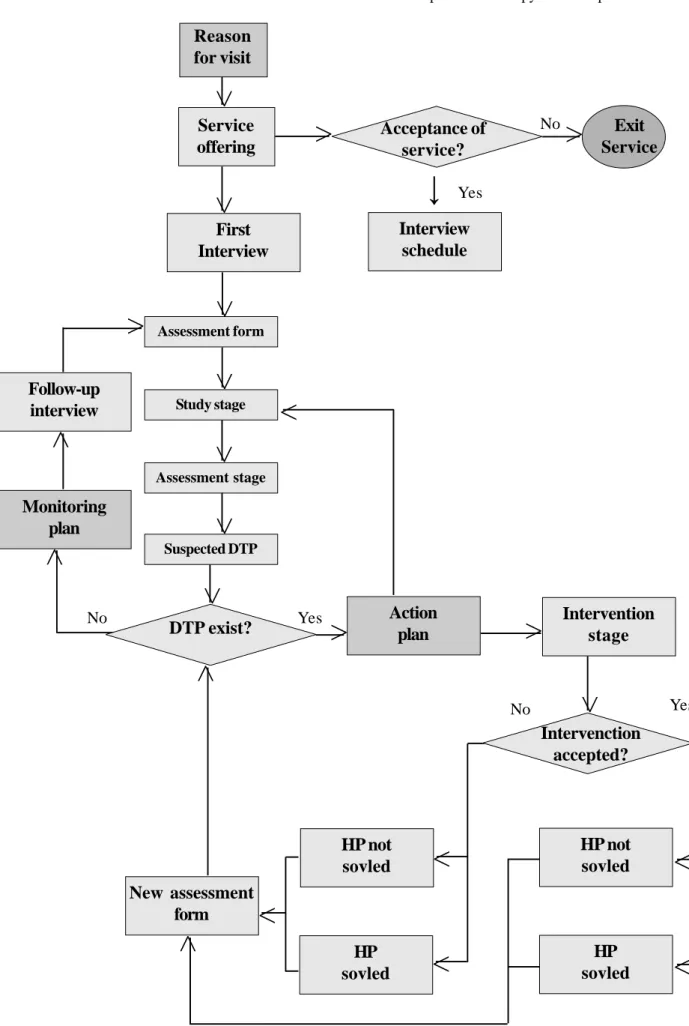
(4) 312. GRUPO DE INVESTIGACIÓN EN ATENCIÓN FARMACÉUTICA DE LA UNIVERSIDAD DE GRANADA. Se entiende por problema de salud (PS) la definición que de éste recoge la WONCA 9, «cualquier queja, observación o hecho que el paciente y/o el médico perciben como una desviación de la normalidad que ha afectado, puede afectar o afecta a la capacidad funcional del paciente». Se define intervención farmacéutica (IF) como la acción del farmacéutico tendente a mejorar el resultado clínico de los medicamentos, mediante la modificación de la utilización de los mismos. Esta intervención se enmarca dentro de un plan de actuación acordado previamente con el paciente. Plan de actuación es el conjunto de intervenciones que paciente y farmacéutico acuerdan realizar, para resolver los PRM detectados por éste. Plan de seguimiento es el proyecto de encuentros acordado por paciente y farmacéutico, para asegurar que los medicamentos que toma el paciente siguen siendo sólo aquellos que necesita y que continúan siendo lo más efectivos y seguros posible.. 2. PROCEDIMIENTO DEL MÉTODO DÁDER El Método Dáder de SFT tiene un procedimiento concreto, tendente a elaborar un estado de situación objetivo del paciente, del que luego se deriven las correspondientes intervenciones farmacéuticas, en las que ya cada profesional clínico, conjuntamente con el paciente y su médico, decida qué hacer en función de sus conocimientos y las condiciones particulares que afecten al caso. El procedimiento de SFT, que se ilustra en el diagrama 1, consta de las siguientes fases: 1. Oferta del servicio. 2. Primera entrevista. 3. Estado de situación. 4. Fase de estudio. 5. Fase de evaluación. 6. Fase de intervención 7. Resultado de la intervención. 8. Nuevo estado de situación. 9. Entrevistas sucesivas.. Ars Pharm 2005; 46 (4): 309-337.. A health problem is understood, in accordance with that stated in the WONCA 9 , as «any such complaint, observation or event that the patient and/or the physician perceives as a deviation from normality, affecting, or apparently affecting the functional capacity of the patient «. Pharmacist Intervention (PI) is defined as the action taken by pharmacists, which tends to improve the clinical outcomes of medicines, through the modification of their use. The framework for such an intervention is outlined within an action plan previously agreed with the patient. The action plan is the total amount of actions that the patient and the pharmacist agree to carry out, as a means of solving DRPs identified by the pharmacist. The Follow up Plan is the schedule of meetings agreed by the patient and the pharmacist that aim to ensure that the medicines taken by the patient, are still needed, and still being as effective and as safe as possible.. 2. PROCEDURE OF DADER METHOD Dader Method of pharmacotherapy follow up has developed a tool that has been called ´assessment form’, from which the corresponding ‘pharmacist’s interventions’ are subsequently derived. Each clinician, jointly with the patient and his doctor, will decide upon the action to be taken, in accordance with the knowledge and the particular conditions affecting each particular case. The pharmacotherapy follow up procedure, which is shown in diagram 1, is comprised of the following stages: 1. Service offering. 2. First interview. 3. Assessment form. 4. Study stage. 5. Assessment stage. 6. Intervention stage. 7. Intervention outcomes. 8. New assessment form. 9. Follow-up interviews..
(5) 313. MÉTODO DÁDER PARA EL SEGUIMIENTO FARMACOTERAPÉUTICO DADER METHOD TO PROVIDE PHARMACOTHERAPY FOLLOW UP. DIAGRAMA 1. Diagrama de Flujo de Proceso del Método Dáder de Seguimiento Farmacoterapéutico.. <. Razón de consulta. <. <. 9. Salida del Servicio. Si. Programación de la Entrevista. <. Primera Entrevista. Estado de situación. <. < Visitas sucesivas. No. ¿Aceptación del servicio?. <. Oferta del servicio. Fase de estudio. <. <. <. Fase de evaluación. <. Plan de seguimiento. <. <. Sospechas de PRM. <. Si. ¿Existe PRM?. Plan de actuación. <. Fase de intervención. < No. <. No. Si. ¿Intervención aceptada?. Nuevo estado de situación. <. PS no resuelto. <. PS no resuelto. <. PS resuelto. <. PS resuelto. <. <. Ars Pharm 2005; 46 (4): 309-337..
(6) 314. GRUPO DE INVESTIGACIÓN EN ATENCIÓN FARMACÉUTICA DE LA UNIVERSIDAD DE GRANADA. DIAGRAM 1. Process flow chart for Dader Method pharmacotherapy follow up.. <. Reason for visit. <. <. 9. Exit Service. Yes. Interview schedule. <. First Interview. Assessment form. <. < Follow-up interview. No. Acceptance of service?. <. Service offering. Study stage. <. <. <. Assessment stage. <. Monitoring plan. <. <. Suspected DTP. <. Yes. DTP exist?. Action plan. <. No. Intervention stage. <. < No. Yes. Intervenction accepted?. New assessment form. < Ars Pharm 2005; 46 (4): 309-335.. HP not sovled. <. HP not sovled. <. HP sovled. <. HP sovled. <. <.
(7) 315. MÉTODO DÁDER PARA EL SEGUIMIENTO FARMACOTERAPÉUTICO DADER METHOD TO PROVIDE PHARMACOTHERAPY FOLLOW UP. Oferta del servicio. Service offering. El servicio de seguimiento farmacoterapéutico se ofrece cuando el farmacéutico percibe que se pueden mejorar los resultados de la farmacoterapia de un paciente. En el caso que el paciente acepte, se le cita para la primera entrevista, en fecha y hora pactadas con él, para la cual se le solicita que traiga todos los medicamentos que usa y que tiene en su casa. Esta fase está descrita en el diagrama 2.. A pharmacotherapy follow up service is offered when a pharmacist perceives that the outcomes of the pharmacotherapy of a patient can be improved. On patient’s acceptance of the offer, a first appointment is arranged at an agreed time and date, to which the patient is requested to bring all the medicines that he/ she is using and possesses at home. This stage is described in diagram 2.. DIAGRAMA 2. Diagrama de flujo de la oferta del servicio.. <. Razón de consulta. <. OFERTA DE SERVICIO. <. No. <. ¿El paciente acepta SFT?. Salida del servicio. Si. <. Programación y requisitos de la primera entrevista. PRIMERA ENTREVISTA. Ars Pharm 2005; 46 (4): 309-337..
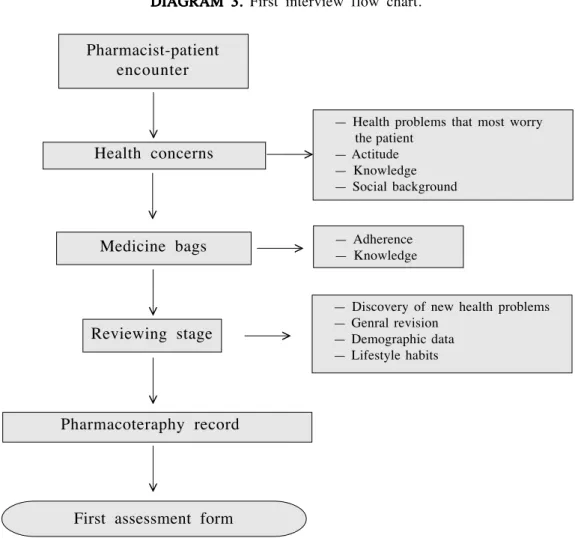
(8) 316. GRUPO DE INVESTIGACIÓN EN ATENCIÓN FARMACÉUTICA DE LA UNIVERSIDAD DE GRANADA. DIAGRAM 2. Service offering flow chart.. <. Reason for visit. <. SERVICE OFFERING. <. <. No. Patient accepts PF?. Exit from service. Yes. <. Programing and requirements for first interview. FIRST INTERVIEW. Primera entrevista. First interview.. El objetivo es obtener un estado de situación del paciente, o sea una relación, a la fecha de la entrevista, entre sus problemas de salud y la medicación que toma. Esta entrevista se realiza en tres fases (diagrama 3) que son:. The objective at this stage is to build a patient assessment form, that is to say, the relationship between his health problems and the medication that is being taken by the patient at the time of the interview. The interview is carried out in three stages (diagram 3), outlined as follows:. Ars Pharm 2005; 46 (4): 309-337..
(9) 317. MÉTODO DÁDER PARA EL SEGUIMIENTO FARMACOTERAPÉUTICO DADER METHOD TO PROVIDE PHARMACOTHERAPY FOLLOW UP. DIAGRAMA 3. Diagrama de flujo de la primera entrevista.. Encuentro farmacéutico-paciente <. — Problemas de salud que preocupan más al paciente — Actitud — Conocimiento — Entorno social. Preocupaciones del paciente. <. <. Bolsa de medicamentos. — Cumplimiento — Conocimiento. <. <. — — — —. <. <. Fase de repaso. Decubrir nuevos problemas de salud Repaso general Datos demográficos Hábitos de vida. <. HISTORIA FARMACOTERAPÉUTICA. PRIMER ESTADO DE SITUACIÓN DIAGRAM 3. First interview flow chart.. <. Pharmacist-patient encounter. Health concerns. <. <. — Health problems that most worry the patient — Actitude — Knowledge — Social background. Medicine bags. <. <. — — — —. Discovery of new health problems Genral revision Demographic data Lifestyle habits. <. <. Reviewing stage. — Adherence — Knowledge. <. Pharmacoteraphy record. First assessment form Ars Pharm 2005; 46 (4): 309-337..
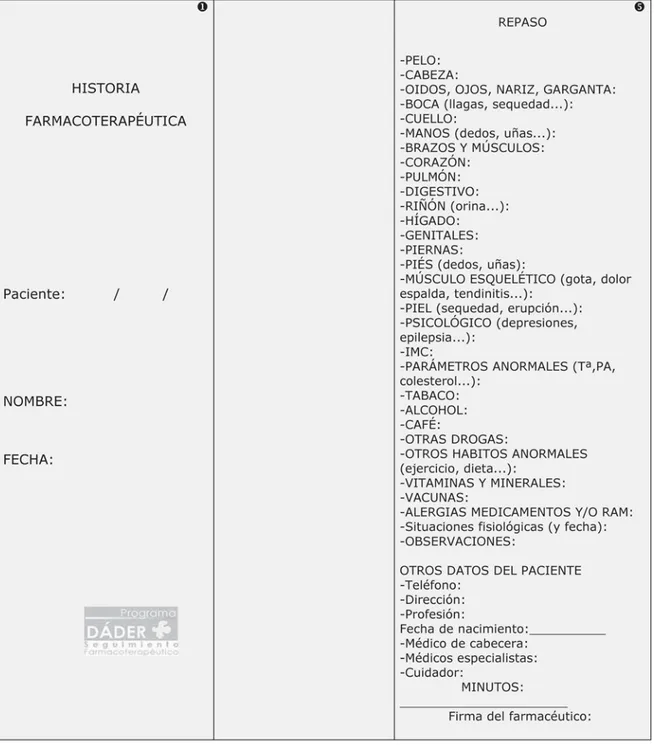
(10) 318. GRUPO DE INVESTIGACIÓN EN ATENCIÓN FARMACÉUTICA DE LA UNIVERSIDAD DE GRANADA. Preocupaciones de salud salud: en esta fase se pregunta al paciente sobre aquellos problemas que más le preocupan. Medicamentos Medicamentos: especialmente los que está tomando pero también la medicación anterior. Se hace una batería de 10 preguntas por medicamento, para evaluar el grado del conocimiento y cumplimiento de la medicación. Se pregunta si lo toma actualmente o no y desde cuándo, para qué, quién se lo indicó, cómo le va, cuánto y cómo lo toma, hasta cuándo, y si tiene alguna dificultad o siente algo extraño. Fase de repaso repaso: se revisa la información anterior profundizando en algún aspecto que no haya quedado claro, y se recorre el organismo de la cabeza a los pies mediante preguntas, con el objetivo de descubrir nuevos problemas de salud y medicamentos que no hayan aparecido hasta ahora. En la primera entrevista hay que documentar y registrar la información recibida por el paciente. Para ello, se utiliza el modelo de historia farmacoterapéutica del paciente que aparece en la figura 1.. Ars Pharm 2005; 46 (4): 309-337.. Health concerns: at this stage the patient is asked about the problems that he is most worried about. Medicines: especially those currently being taken, but including previously taken medicines also. A set of 10 questions are asked about the medicine used, in order to assess the degree of the patient’s knowledge and compliance with medication. Questions are asked to find out whether the drug is currently being taken or not, for how long, for what reason, who it was prescribed by, how much and how it is being taken, until when, and if he is experiencing any kind of difficulty or feels anything unusual. Reviewing stage: the previous information is reviewed and more detail is sought on any aspect that was not clear from the previous stage. A complete questioning on the whole body from top to bottom is carried out, with the aim of discovering any new health problem and any medicine use that was not previously mentioned. In the first interview, the information obtained should be registered and documented. In order to do so, the model used to build the patient’s pharmacotherapy record as shown in figure 1, should be used..
(11) MÉTODO DÁDER PARA EL SEGUIMIENTO FARMACOTERAPÉUTICO DADER METHOD TO PROVIDE PHARMACOTHERAPY FOLLOW UP. 319. FIGURA 1. 1 Historia farmacoterapéutica.. Ars Pharm 2005; 46 (4): 309-337..
(12) 320. Ars Pharm 2005; 46 (4): 309-337.. GRUPO DE INVESTIGACIÓN EN ATENCIÓN FARMACÉUTICA DE LA UNIVERSIDAD DE GRANADA.
(13) MÉTODO DÁDER PARA EL SEGUIMIENTO FARMACOTERAPÉUTICO DADER METHOD TO PROVIDE PHARMACOTHERAPY FOLLOW UP. 321. Ars Pharm 2005; 46 (4): 309-337..
(14) 322. GRUPO DE INVESTIGACIÓN EN ATENCIÓN FARMACÉUTICA DE LA UNIVERSIDAD DE GRANADA. Estado de situación. Assessment form. Una vez finalizada la entrevista, se dispone la información en un resumen para estudiar los problemas de salud y la farmacoterapia correspondiente, que se denomina estado de situación (figura 2). En el estado de situación deben quedar registrados los problemas de salud (fecha de inicio, si está controlado o no y si le preocupa o no al paciente) y, en la misma línea en la que se describe el problema de salud, los medicamentos (inicio de su utilización, principios activos que componen el medicamento o la estrategia terapéutica, pauta posología del medicamento, si el paciente cumple y conoce los medicamentos. El modelo del estado de situación que actualmente se utiliza ha sido adaptado a partir de la propuesta de Aguas y cols10 (figura 3).. Once the interview has been finalised, a summary of the information is used to study the health problems and the corresponding pharmacotherapy. This stage has been termed as «assessment form» (figure 2). In the assessment form, the health problems (commencement, its control or lack of control, and whether the problem worries the patient or not) should be recorded. Similarly, data concerning the medicines used (commencement of use, active ingredient/drug composition, therapeutic strategy, dosage schedule, and patient compliance and knowledge about the medicines) should be gathered. The assessment form model which is currently being used is an adaptation of that proposed by Aguas et al10 (figure 3).. Ars Pharm 2005; 46 (4): 309-337..
(15) 323. MÉTODO DÁDER PARA EL SEGUIMIENTO FARMACOTERAPÉUTICO DADER METHOD TO PROVIDE PHARMACOTHERAPY FOLLOW UP. FIGURA 2. Concepto del estado de situación. FIGURE 2. Assessment form concepts.. FIGURA 3. Modelo del estado de situación.. FIGURE 3. Assessment form model.. Ars Pharm 2005; 46 (4): 309-337..
(16) 324. GRUPO DE INVESTIGACIÓN EN ATENCIÓN FARMACÉUTICA DE LA UNIVERSIDAD DE GRANADA. La construcción del estado de situación se convierte en el soporte del método, pues las fases siguientes dependen del establecimiento de una adecuada y correcta relación entre los problemas de salud y los medicamentos. El estado de situación permite visualizar el panorama de salud que presenta el paciente en un momento determinado, y da al farmacéutico la información estructurada para estudiar los problemas de salud que dan pie a la medicación y los fallos que pueden suceder con la farmacoterapia. En el estado de situación aparece la identificación del paciente, la fecha, características como el sexo, edad, índice de masa corporal (IMC) y las alergias. En cada línea, se enfrentan los problemas de salud a los medicamentos que los tratan. Así problemas de salud que no se traten con medicamentos tendrán vacía su línea en la zona derecha, y viceversa. 1. Problemas de salud: se describe el problema de salud del paciente. A continuación se completan los apartados del mismo: i. Desde: fecha de inicio del problema. ii. Controlado: si se cumplen los objetivos deseables. Se puede escribir S (SÍ) ó N (No), o indicar una cifra si es el parámetro de control del problema de salud es cuantificable. iii. Preocupa: se escribe S (Sí) ó N (No) en función de que al paciente le inquiete o no el problema. 2. Medicamentos: en la misma línea del estado de situación en la que se describe el problema de salud, se adjuntan los datos de el/ los medicamentos que tratan dicho problema. Se señalan los siguientes aspectos: i. Inicio: fecha de comienzo de la toma del tratamiento descrito a continuación. ii. Medicamento (p.a.): se escriben los principios activos de los medicamentos que tratan el problema. Si es un documento interno y se piensa que puede facilitar el trabajo, o son medicamentos de composición muy compleja, se puede escribir el nombre de la especialidad farmacéutica. iii. Pauta: posología del medicamento. iv. Cu/Co: se señala S (Sí) ó N (No) para cada uno de los dos apartados en función de si el farmacéutico piensa que el paciente cumple (Cu) y conoce (Co) los medicamentos que se señalan. Ars Pharm 2005; 46 (4): 309-337.. The development of the assessment form is the mainstay of the method, given that the following stages depend upon the establishment of an appropriate and correct relationship between health problems and medicines taken. The assessment form provides a global view of the patient’s health status in relation with medicine use, and additionally, provides the pharmacist with structured information from which the possible failings of pharmacotherapy, and the corresponding negative clinical outcomes, associated to the medication, may be studied. Other information also included in the assessment form are the identity data about the patient, the date, other characteristics such as sex, age, body mass index (BMI) and allergies. Within the model itself, information on the health problem and the medicine used to treat it are entered into the lines facing each other. Therefore health problems which are not treated with medicines will have a vacant space on the right hand side and vice versa. 1. Health problems the patient’s health problems are described. The following sections are completed: i. From: date of diagnosis of the health problem. ii. Controlled: if goals in therapy are achieved. Responses of Y (yes) or N (no) can be made, and figures may be stated, if the control indicator of the health problem is quantifiable. iii. Worries: Y (yes) or N (no) responses can be made in accordance with whether the patient is worried or not about the problem. 2. Medicines: On the same line where the health problem is described, the medicines used to treat the problem are recorded. The following aspects are registered: i. Commencement: date of treatment initiation is described below. ii. Medicine (a.p.): the active ingredient of the medicines used to treat the problem are recorded. If it is an internal document and it is considered necessary to facilitate working procedures, or very complex medicines are being used, the brand or trade name of the drug may be used. iii. Dose: dosage schedule of the medicine..
(17) 325. MÉTODO DÁDER PARA EL SEGUIMIENTO FARMACOTERAPÉUTICO DADER METHOD TO PROVIDE PHARMACOTHERAPY FOLLOW UP. A la derecha están las columnas correspondientes a la evaluación, en la que se anotarán las sospechas de PRM detectadas en la fase de evaluación, así como las fechas de intervención previstas para resolver estos problemas. En la parte inferior pueden anotarse observaciones, datos relevantes que puedan ser útiles para evaluar mejor y un apartado para parámetros, tales como presión arterial, glucemia, colesterol, etc. Un ejemplo de un estado de situación se observa en la figura 4.. iv. Com/Knw: Y (yes) or N (no) are marked in each of the two sections if the pharmacist considers that the patient complies (Com) and Knows (Knw) about the medicines that have been entered. The assessment columns are situated on the right hand side, where suspected DRPs identified at the assessment stage may be recorded together with the scheduled dates for intervention to solve such problems. The lower section can be used to record observations, relevant data which may be useful for making an improved assessment, and a section for such parameters as blood pressure, cholesterol, etc. An example of a assessment form is shown in figure 4.. FIGURA 4. Ejemplo de un estado de situación.. Ars Pharm 2005; 46 (4): 309-337..
(18) 326. GRUPO DE INVESTIGACIÓN EN ATENCIÓN FARMACÉUTICA DE LA UNIVERSIDAD DE GRANADA. FIGURE 4. Assessment form example.. Fase de estudio. Study stage. La fase de estudio tiene como propósito obtener la información necesaria de los problemas de salud y los medicamentos reflejados en el estado de situación para la evaluación posterior. Se basa en la revisión bibliográfica de los problemas de salud y los medicamentos que se han diferenciado en el estado de situación. Respecto del problema de salud — Características del problema de salud: trata de estudiar sus causas, para conocer su abordaje no farmacológico, y sus consecuencias, y saber a qué puede conducir y otros problemas de salud con pronóstico similar. — Parámetros de efectividad: signos, síntomas y parámetros cuantificables (bioquímicos, fisiológicos, etc) que sean los objetivos terapéuticos a conseguir. — Estrategias farmacológicas: medicamentos de mayor nivel de evidencia que se utilizan para tratar el problema.. The objective of the study stage is to obtain the necessary information on the health problems and the medicines obtained from the assessment form, for subsequent evaluation. The study is carried out on the basis of a literature review on the health problems and medicines which have been obtained from the assessment form.. De los problemas de salud se deben establecer: objetivos a conseguir en el control del problema, hábitos higiénico- dietéticos saludables y tratamiento no farmacológico coadyuArs Pharm 2005; 46 (4): 309-337.. The health problem — Characteristics of the health problem: an attempt to study causes, to find out the possible non-pharmacological causes of illness and its consequences, to predict possible future problems and other health problems with a similar prognosis. — Effectiveness parameters: signs, symptoms and quantifiable parameters (biochemical, physiological, etc), which represent the goals of therapy to be achieved. — Pharmacological strategies: Higher level evidence-based medicines used to treat the problem. Factors to be established from the health problem: goals of therapy to be achieved in.
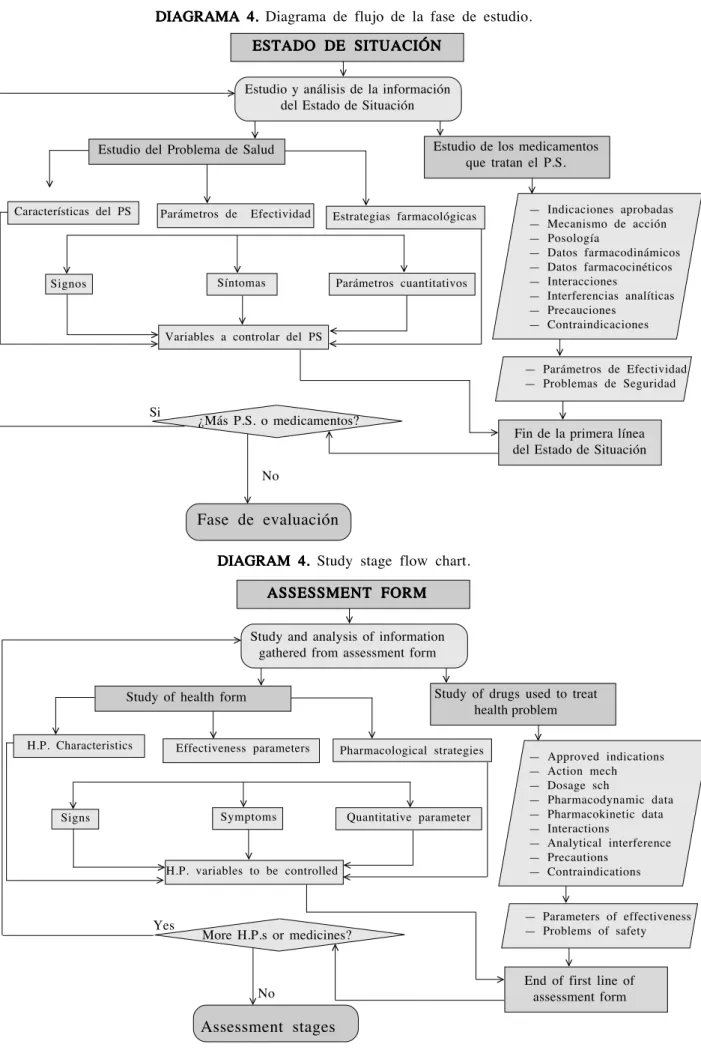
(19) MÉTODO DÁDER PARA EL SEGUIMIENTO FARMACOTERAPÉUTICO DADER METHOD TO PROVIDE PHARMACOTHERAPY FOLLOW UP. vante, otros problemas de salud relacionados que puedan contribuir al agravamiento de las consecuencias del problema de salud y sus indicadores correspondientes, prevención primaria de los problemas de salud relacionados (lo que sumado a las actividades de prevención primaria del problema de salud en estudio, constituyen todos los aspectos de educación sanitaria del paciente), consecuencias posibles de la falta de control del problema de salud (lo puede llevar y obligar a hacer prevención secundaria) y estrategias farmacológicas habituales (para determinar los medicamentos de los que existe un mayor grado de evidencia de sus beneficios en el tratamiento del problema de salud). Luego se estudian los medicamentos que el paciente toma, partiendo de las características generales del grupo terapéutico, hasta las particularidades del fármaco que está siendo empleado para tratar los problemas de salud. La fase de estudio de los medicamentos tiene en cuenta: (1) Indicaciones autorizadas, (2) Mecanismo de Acción, (3) Rango de utilización, (4) Datos farmacocinéticos, (5) Datos farmacodinámicos, (6) Interacciones, (7) Interferencias analíticas, (8) Precauciones y (9) Contraindicaciones. Esta fase se ilustra en el diagrama 4.. 327. the control of the problem, relevant diet habits and contributory non-pharmacological treatments, other related health problems, which may contribute to a deterioration in health and its corresponding indicators, primary prevention of related health problems (which in addition to primary prevention activities of the health problem under study, constitute all aspects of patient health education), possible consequences of not controlling the health problem (which may lead to or oblige secondary prevention) and standard pharmacological strategies (to determine whether better evidence-based medicines exist to treat the health problem). A study of the patients habitual drug usage is then carried out, starting from the general characteristics of the medicines’ therapeutic group, to the specific peculiarities of the drug used to treat the health problem. The study stage of medicines takes into account the following criteria: (1) authorised indications, (2) mechanism of action, (3) dose range, (4) pharmacokinetic data, (5) pharmacodynamic data, (6) interactions, (7) analytical interferences, (8) precautions and (9) contraindications. This stage is illustrated in diagram 4.. Ars Pharm 2005; 46 (4): 309-337..
(20) 328. GRUPO DE INVESTIGACIÓN EN ATENCIÓN FARMACÉUTICA DE LA UNIVERSIDAD DE GRANADA. DIAGRAMA 4. Diagrama de flujo de la fase de estudio.. <. ESTADO DE SITUACIÓN <. <. <. Estudio y análisis de la información del Estado de Situación Estudio de los medicamentos que tratan el P.S.. Efectividad. <. Parámetros cuantitativos. Variables a controlar del PS. < <. Indicaciones aprobadas Mecanismo de acción Posología Datos farmacodinámicos Datos farmacocinéticos Interacciones Interferencias analíticas Precauciones Contraindicaciones. <. <. Síntomas. Signos. — — — — — — — — —. Estrategias farmacológicas. <. Parámetros de. <. Características del PS. <. <. <. <. Estudio del Problema de Salud. < <. Si. <. — Parámetros de Efectividad — Problemas de Seguridad. ¿Más P.S. o medicamentos?. <. <. Fin de la primera línea del Estado de Situación. <. No. Fase de evaluación DIAGRAM 4. Study stage flow chart.. <. ASSESSMENT FORM <. <. <. Study and analysis of information gathered from assessment form Study of drugs used to treat health problem. Effectiveness parameters. — — — — — — — — —. <. <. <. Pharmacological strategies. Symptoms. Quantitative parameter. <. Signs. <. H.P. Characteristics. <. <. <. Study of health form. < <. <. < H.P. variables to be controlled <. Approved indications Action mech Dosage sch Pharmacodynamic data Pharmacokinetic data Interactions Analytical interference Precautions Contraindications. Yes. — Parameters of effectiveness — Problems of safety. More H.P.s or medicines?. <. <. <. Assessment stages Ars Pharm 2005; 46 (4): 309-337.. <. No. End of first line of assessment form.
(21) MÉTODO DÁDER PARA EL SEGUIMIENTO FARMACOTERAPÉUTICO DADER METHOD TO PROVIDE PHARMACOTHERAPY FOLLOW UP. 329. En todos los casos se debe tener claridad sobre los siguientes aspectos: — PARA QUÉ: indicaciones aprobadas. — QUÉ LE HACE EL FÁRMACO AL ORGANISMO, CÓMO ACTÚA, EFECTOS y CUÁNDO: mecanismo de acción, efectos generados y tiempo que debe transcurrir para que se presenten. Alteraciones que puede generar sobre resultados de pruebas analíticas (interacciones medicamentos-pruebas de laboratorio) o en la disponibilidad o efectos de nutrientes (interacciones fármaco-nutrientes), al igual que problemas de salud o estados fisiológicos en los que sus efectos pueden variar cuantitativa o cualitativamente (interacciones medicamento-enfermedad, definidas habitualmente como precauciones y contraindicaciones). Otros fármacos que pueden potenciar o antagonizar sus efectos deseados o no deseados (interacciones farmacodinámicas). — QUE LE HACE EL ORGANISMO AL FÁRMACO (COMO LO ABSORBE, DISTRIBUYE Y ELIMINA): aspectos claves que determinan las concentraciones plasmáticas que se alcanzan con la pauta utilizada del fármaco, incluyendo los factores que pueden generar cambios biofarmacéuticos o farmacocinéticos y favorecer el aumento o disminución en sus concentraciones, lo que puede conducir (causas) de problemas de efectividad o seguridad (interacciones farmacocinéticas).. For all cases the following aspects should be clear: — FOR WHAT REASON IS THE DRUG BEING TAKEN: approved indications. — WHAT THE DRUG DOES TO THE ORGANISM, HOW IT WORKS, ITS EFFECTS AND WHEN THIS OCCURS: the mechanism of action, generated effects and the time required for these to occur. Alterations that may be anticipated from the results of analytical tests (interactions, laboratory drug tests) or the availability or effects of nutrients (drug-nutrient interactions). Equally, health problems or physiological states OR SITUATIONS, from which effects may variety qualitatively or non-quantitatively (drug-disease interactions, usually defined as precautions and contraindications). Other drugs that may enhance or worsen its desired or undesirable effects (pharmacodynamic interactions). — WHAT THE ORGANISM DOES TO THE DRUG (HOW IT IS ABSORBED, DISTRIBUTED AND ELIMINATED): the key aspects that determine plasmatic concentrations as the result of the dosage schedule of the drug applied, including those factors that may generate biopharmaceutical or pharmacokinetic changes, favouring an increase or decrease in its concentrations, which may lead to (or be the cause of) effectiveness or safety problems (pharmacokinetic interactions).. Con la información recolectada y analizada, se procede a identificar las sospechas de PRM o riesgos de PRM que pueda presentar el paciente (fase de evaluación). En este sentido, los PRM son fallos de la farmacoterapia que están ocurriendo, es decir existen indicadores que lo avalan y objetivos terapéuticos que no se están consiguiendo. Mientras que en los riesgos de PRM los indicadores no son observables en el momento de su valoración para evidenciar que la farmacoterapia esté fallando, pero que a juicio del farmacéutico se debe intervenir antes que este fallo se produzca.. The information gathered and analysed is subsequently used in the identification of suspected DRPs or the possible risk of suffering from a DRP at the evaluation stage. In one sense, a DRP may be considered as an actual pharmacotherapy failure which is occurring, either where concrete indicators are apparent as proof of its existence, or where goals in therapy are simply not being achieved. With regard to risk of DRP, on evaluation, there are no directly observable indicators to show that the pharmacotherapy is failing. The basis, from which preventative intervention should be carried out, relies on the pharmacist’s own judgement.. Ars Pharm 2005; 46 (4): 309-337..
(22) 330. GRUPO DE INVESTIGACIÓN EN ATENCIÓN FARMACÉUTICA DE LA UNIVERSIDAD DE GRANADA. Fase de evaluación. Assessment stage. Una vez realizada la fase de estudio, se verifica el estado de situación planteado. El cumplimiento de esta fase requiere de la revisión y documentación bibliográfica (fase de estudio) de los aspectos claves sobre problemas de salud y medicamentos, en una situación clínica concreta definida por el estado de situación. El farmacéutico tendrá una visión de conjunto que le permitirá analizar las circunstancias en que se encuentra el paciente y dar inicio a la fase de evaluación, que pretende valorar si se cumplen los objetivos establecidos para la farmacoterapia y, si ésta falla, detectar los correspondientes PRM. Con la información de obtenida, se hace la evaluación de cada estrategia y de cada medicamento según la sistemática propuesta por Fernández- Llimós y col 11 , 12 (diagrama 5), haciendo tres preguntas que permiten establecer sospechas de PRM: (1) El o (los) medicamento(s), ¿es(o son) necesario(s)?. Se acepta que el medicamento es necesario cuando existe un problema de salud que justifique su uso; en caso contrario se consideraría innecesario.Y sólo si el medicamento es necesario se pasa a la siguiente pregunta, ya que un medicamento no necesario no tiene sentido evaluar la efectividad, porque no trata un problema de salud que tenga el paciente, ni se evalúa la seguridad porque un medicamento no necesario siempre constituye, al menos, un riesgo. (2) El o (los) medicamento(s) ¿Está o están siendo efectivo (s)?.Se contesta afirmativamente cuando se han conseguido los objetivos terapéuticos recogidos en el estudio del estado de situación, y se contesta no, cuando no se han alcanzado. (3) El medicamento ¿Está siendo seguro? La seguridad se evalúa para cada medicamento porque cada uno tiene características propias en este aspecto. Se considera que un medicamento es inseguro cuando aparece un nuevo problema de salud que se relaciona con su uso o se agrava uno ya existente.. After the study stage, the assessment form is to be considered. In order to comply with the requirements of this stage, a revision of the key aspects concerning the health problems and medicines used should be carried out in relation to the specific clinical situation of the patient, as defined by the assessment form. This stage aims to assess whether the established pharmacotherapy objectives goals are achieved, and where they are not, identifying the corresponding DRPs or the risk of them to happen. The information obtained is used to assess every therapeutic strategy and every drug used in accordance with the system proposed by Fernández- Llimós et al11,12 (diagram 5), which is based on three basic questions used to establish suspected DRPs: (1)Is/are the medicine(s) in use really necessary? A medicine is considered to be necessary when a specific health problem justifies its use. When not, it is to be considered as unnecessary. The use of an unnecessary drug is a problem in the process of use of drugs. Whereas the harm produced, or the risk of its appearance, after the use of an unnecessary pharmacotherapy is a negative clinical outcome, or a risk of it to happen. Only in the cases where a medicine is considered as necessary will the following question be made, given that it is not worth assessing the effectiveness of an unnecessary medicine. Neither it is necessary to evaluate safety, because an unnecessary drug will always constitute a risk of harm. (2)Is/are the medicine(s) being effective? Once it has been excluded the lack of harm from an unnecessary treatment, effectiveness must be study.The Second Consensus of Granada estates that a drug therapy is effective when the outcomes that it was prescribed for are sufficiently achieved. Effectiveness must be assessed for every set of drugs used for each health problem. (3)Is the medicine proving to be safe? Safety of each drug should be evaluated separately, because each drug has its own particular safety pattern. A drug is to be considered as unsafe, when it causes or worsen any of the health problems that must be on the assessment form.. Ars Pharm 2005; 46 (4): 309-337..
(23) 331. MÉTODO DÁDER PARA EL SEGUIMIENTO FARMACOTERAPÉUTICO DADER METHOD TO PROVIDE PHARMACOTHERAPY FOLLOW UP. DIAGRAMA 5. Diagrama de la sistemática de identificación de PRM.. <. PRM2. PRM5. <. DTP3. <. DTP5. <. PRM3. <. No. ¿Es un problema cuantitativo?. <. No. ¿El/los medicamento/s es/son efectivo/s?. <. <. Si. <. No. ¿El paciente necesita el/los medicamentos?. Si. No. No. ¿Es un problema cuantitativo? <. ¿El medicamento es seguro?. <. <. PRM4 <. Si <. PRM6. ¿Más medicamentos para este PS? No <. <. <. Si. ¿Existe un PS que no esté siendo tratado?. Si. PRM1. <. <. No <. Fin de la evaluación. Sospechas de PRM. <. DIAGRAM 5. Systematic DTP identification chart. DTP2. <. No. Is it a quantitative problem?. No. <. Is/are medicine (s) effective?. <. <. Si. <. No. Does patient need medicine(s)?. Si. No. Is it a quantitative problem?. No. <. Is the medicine safe?. <. <. DTP4 <. Si <. DTP6. More medicines needed for this H.P.? <. <. No. <. Untreated H.P. exist?. Si. <. DTP1. <. No <. End of assessment. <. Si. Suspected DTP. Ars Pharm 2005; 46 (4): 309-337..
(24) 332. GRUPO DE INVESTIGACIÓN EN ATENCIÓN FARMACÉUTICA DE LA UNIVERSIDAD DE GRANADA. Al finalizar estas preguntas por cada medicamento, se formula una cuarta pregunta: (4) ¿Hay algún otro problema de salud, que no esté relacionado con la toma de alguno de los medicamentos del paciente, y necesite ser tratado?. Si hay tal sospecha será necesario tratar el problema. Una vez anotadas todas las sospechas de PRM, el farmacéutico debe priorizar en función de la probabilidad y la gravedad, para establecer el plan de actuación a acordar con el paciente.. After answering all of these previous questions for each drug, an additional fourth question should be considered: (4)Does any other health problem exist, which is not related to the patient’s intake of his/her medicines, but needs treatment? In such a case the problem will need to be treated. Once all the suspected DRPs have been recorded, the pharmacist should prioritise the action to be taken on the basis of probability, concerns and seriousness, before establishing with the patient, the action plan to be carried out.. Fase de intervención Intervention stage Después de detectar los PRM, el farmacéutico establece un plan de actuación para resolver aquellos que se han manifestado o prevenir la aparición de los que puedan suceder, según las circunstancias particulares del paciente. El plan de actuación debe ser individual y debe adaptarse a las circunstancias del caso, en función de las preocupaciones del paciente, el criterio del farmacéutico y las características de la atención sanitaria que se dispone. El farmacéutico debe dar prioridad a aquellas intervenciones sobre PRM que sean más graves para el paciente. De no estar en un alto riesgo, se elige intervenir sobre los PRM que estén entre las principales preocupaciones del paciente y que tengan posibilidad de solución. Se efectúa una intervención farmacéutica cuando se actúa para intentar solucionar un PRM detectado, llevando a cabo la alternativa escogida. Esta fase se describe en el diagrama 6. — El Método Dáder ha diseñado la documentación de la intervención farmacéutica que contiene: — Fecha en que se realiza — Tipo de PRM según la clasificación del Segundo Consenso de Granada. — PRM manifestado o riesgo de PRM. — El problema de salud consecuencia del PRM — El o los medicamentos implicados en el mismo — Descripción del PRM y causa del PRM — Que se pretende hacer para resolverlo — Vía de comunicación empleada. Ars Pharm 2005; 46 (4): 309-337.. After detecting a DRP, the pharmacist should draw up an action plan to either resolve the problems that have become apparent, or to prevent those that may occur, in accordance with the particular circumstances presented by each patient. Such plan should be suited to each individual and adapted to the particular circumstances presented by each case. These may be considered on the basis of the patient’s own particular worries, the pharmacist’s own judgement and the characteristics of the health care available. Priority for intervention should be given to the most serious DRPs affecting the patient. Where a high risk case does not exist, intervention should be carried out on those DRPs which most concern the patient and which are more likely to be treated successfully. Pharmaceutical intervention is to be carried out as a means of trying to solve a detected DRP on the basis of the alternative chosen. This stage is described in diagram 6. The design for documentation of the Dáder Method contains the following sections: — Date for carrying out intervention — DRP type classified in accordance with the classification developed from the Second Consensus of Granada. — DRP or risk of DRP. — The medicine(s) involved in each case. — Description and cause of the DRP. — Intended action to solve the problem. — Communication channel used..
(25) 333. MÉTODO DÁDER PARA EL SEGUIMIENTO FARMACOTERAPÉUTICO DADER METHOD TO PROVIDE PHARMACOTHERAPY FOLLOW UP. DIAGRAMA 6. Diagrama de flujo de la fase de intervención.. Sospechas de PRM >. >. No. ¿Existen PRM?. Plan de Seguimiento. >. >. Si. Plan de actuación >. Fase de intervención >. Acuerdo con el paciente >. >. Intervención F-P-M. Intervención F-P >. P.S. resuelto. No. >. Si. ¿Acepta intervención? <. P.S. no resuelto. > >. Nuevo estado de situación. DIAGRAM 6. Intervention stage flow chart.. Suspected DTP >. >. No. DTP exists?. Monitoring plan. >. >. Yes. Action plan >. Intervention stage >. Agreed with patient >. >. Intervention P-P-P. Intervention P-P. H.P. Solved. >. Yes. >. No. Accepts intervention? <. >. H.P. not solved. >. New assessment form Ars Pharm 2005; 46 (4): 309-337..
(26) 334. GRUPO DE INVESTIGACIÓN EN ATENCIÓN FARMACÉUTICA DE LA UNIVERSIDAD DE GRANADA. La intervención farmacéutica se completa una vez se ha observado el resultado de la estrategia en la fecha pactada, registrando si la intervención fue aceptada y si se resolvió el problema de salud, describiendo brevemente lo que ocurrió tras resolver o no el PRM. — Resultado (expresado en intervención aceptada o no aceptada y problema de salud resuelto o no resuelto) — ¿Qué ocurrió? — Número de medicamentos que estaba tomando a la fecha de la intervención y número de visitas anteriores a la resolución. En la figura 5 se observa un ejemplo de intervención farmacéutica.. Resultado de la intervención. Nuevo estado de situación El desenlace de la intervención da lugar a otro estado de situación del paciente (nuevo estado de situación). En función de que continúen existiendo PRM ó no, se continuará el plan de actuación, susceptible de ser modificado con el paciente si no está dando resultado, o se realizará un plan de seguimiento, con la monitorización adecuada de los problemas que tenga el paciente, de acuerdo a las características de dichos problemas y a la idiosincrasia de la persona que los sufre (visitas sucesivas). La hoja de registro de las visitas sucesivas corresponde a la figura 6. A partir de este nuevo estado de situación el farmacéutico se enfrenta a su análisis, y debe retomar los pasos anteriores para continuar con el procedimiento de seguimiento farmacoterapéutico.. Ars Pharm 2005; 46 (4): 309-337.. The pharmacist’s intervention stage will have been completed once the results of the strategy used have been achieved within the agreed time scale. The degree of acceptance of the intervention and whether or not the health problem had been solved should be recorded, with a brief description of what happened after solving or not solving the DRP. — Result (expressed in terms of the intervention being accepted or not accepted and the health problem as solved or unsolved). — What happened? — The number of medicines that were being taken when intervention first took place and the number of encounters having taken place prior to solution of the problem. Figure 5 shows an example of a pharmacist’s intervention.. Intervention outcomes. New assessment form The finalisation of an intervention process will produce a change in the patient’s assessment form (new assessment form). Depending on whether a DRP is still existing or not, the action plan will be carried out. Modifications of the plan will have to be made in cases where no positive result in the patient is being achieved. In cases where a need for intervention continues to exist, a monitoring plan should be carried out, with appropriate monitoring of the patient’s problems. The particular characteristics of such problems and the particular idiosyncrasies of the person suffering from them should be taken into account (follow-up visits). An example of the record sheet of follow-up visits is in shown in figure 6. On the basis of this new assessment form, the pharmacist should carry out a further analysis, which will involve going over the previous stages in order to be able to continue with appropriate pharmacotherapy follow up..
(27) 335. MÉTODO DÁDER PARA EL SEGUIMIENTO FARMACOTERAPÉUTICO DADER METHOD TO PROVIDE PHARMACOTHERAPY FOLLOW UP. FIGURA 5. Ejemplo de intervención farmacéutica.. Ars Pharm 2005; 46 (4): 309-337..
(28) 336. GRUPO DE INVESTIGACIÓN EN ATENCIÓN FARMACÉUTICA DE LA UNIVERSIDAD DE GRANADA. FIGURE 5. Pharmacist intervention example.. FIGURA 6. Hoja de visitas sucesivas. Visitas P.Salud Denominación Fecha. 2. 3. 4. 5. 6. 7. 8. 9. Ars Pharm 2005; 46 (4): 309-337.. P.Salud. P.Salud. P.Salud. P.Salud. P.Salud.
(29) 337. MÉTODO DÁDER PARA EL SEGUIMIENTO FARMACOTERAPÉUTICO DADER METHOD TO PROVIDE PHARMACOTHERAPY FOLLOW UP. FIGURE 6. Follow up interviews.. AGRADECIMIENTOS. AKNOWLEDGMENTS. Los autores quieren agradecer a Dña Mara Guerreiro, farmacéutica comunitaria portuguesa, por su revisión de la versión inglesa de este trabajo.. The authors want to thank Ms. Mara Guerreiro, Portuguese community pharmacists, for her revision of the English version of this paper.. BIBLIOGRAFÍA/BIBLIOGRAPHY 1. Cipolle R. Strand L. Morley P. Pharmaceutical Care Practice. The Clinician´s Guide. New York: McGraw-Hill; 2004 2. Martin Calero M. Machuca M, Murillo MD, Casino J. Gasteurrutia MA, Faus MJ. Structural Process and Implementation Programas of Pharmaceutical Care in diferent countries. Curr Pharm Design 2004; 10 (31): 3947-3967 3. Grupo de Consenso. Documento de Consenso en Atención Farmacéutica. Ars Pharmaceutica 2001; 42 (3-4): 223-243 4. Machuca M, Fernández-Llimós F, Faus MJ. Método Dáder. Guía de seguimiento farmacoterapéutico. Granada: GIAFUGR; 2003. Disponible en: http://www.giaf-ugr.org/docu-giaf.htm consultado el 20-12-05. 5. Panel de Consenso. Segundo Consenso de Granada sobre Problemas Relacionados con Medicamentos. Ars Pharmaceutica 2002; 43(3-4):175-184. 6. Fernández-Llimós F, Faus MJ, Caelles N, Espejo J, Gastelurrutia MA, Ibáñez J, Machuca M, Tuneu L. Seguimiento Farmacoterapéutico y dispensación activa: diferencias y similitudes. Pharm Care Esp 2002; 4(3): 179-185. 7. Espejo J, Fernández Llimós F, Machuca M,Faus MJ. Problemas relacionados con medicamentos: definición y propuesta de inclusión en la Clasificación Internacional de Atención Primaria (CIAP) de la WONCA. Pharm Care Esp 2002;4(2):122-127. 8. Fernández-Llimós F. Tuneu L, Baena MI, García-Delgado A, Faus MJ. Morbidity and Mortality associated with pharmacotherapy. Evolution and Current Concept of Drug-Related Problems. Curr Pharm Design 2004: 10 (31): 3947-3967 9. WONCA Classification Committee. An international glossary for general/family practice. Fam Pract 1995; 12(3): 341-369. 10. Aguas Y, De Miguel E, Suárez de Venegas C. Modelo para presentación de casos adaptado a la metodología Dáder. Pharm Care Esp 2002; 4(1): 60-63. 11. Fernández–Llimós F. Problemas Relacionados con los Medicamentos. Conceptos y Clasificación. Seguimiento Farmacoterapéutico (Método Dáder). El farmacéutico 2002; 275: 54-61 12. Fernández–Llimós, F. Faus MJ, Gastelurrutía MA, Baena MI, Tuneu L, Martínez Martínez F. Identificación sistemática de resultados clínicos negativos de la farmacoterapia. Seguim Farmacoter 2004; 2 (3): 195-205.. Ars Pharm 2005; 46 (4): 309-337..
(30)
Figure
Documento similar
