
Blogging to Foster Critical Reading
124
0
0
Texto completo
(2) DOCUMENTO DIGITAL PARA REPOSITORIO El presente formulario debe ser diligenciado en su totalidad como constancia de entrega del documento para ingreso al Respositorio Digital (Dspace). Blogging to Foster Critical Reading TITULO SUBTITULO Cuellar Guayambuco, Elizabeth AUTOR(ES) Apellidos, Nombres (Completos) del autor(es) del trabajo Lectura PALABRAS CLAVE (Mínimo 3 y máximo 6). Estrategias de lectura crítica Blogs. RESUMEN DEL CONTENIDO (Mínimo 80 máximo 120 palabras). Este estudio de investigación acción usando un blog de clase para promover la lectura crítica del inglés como lengua extranjera, fue realizado con un grupo de quince estudiantes de séptimo grado del colegio San Bartolomé La Merced en Bogotá. Este estudio se centró en la promoción de estrategias para desarrollar la lectura crítica a través del uso de un blog. La investigación se realizó con la implementación de un blog que contenía lecturas y actividades de pre-, durante y después de lectura y la implementación de preguntas para fomentar la lectura crítica. Todas las actividades de pre-lectura fueron desarrolladas en clase y las demás se asignaron como trabajo personal para la casa. Los resultados de este estudio mostraron las numerosas ventajas del uso de blogs, para desarrollar las estrategias de lectura crítica de pre visualización, contextualización y reflexión de creencias personales y sociales. De otra parte, los participantes de éste estudio mejoraron sus procesos de lectura y mostraron una actitud positiva hacia el uso de blogs para desarrollar lectura. Estudios futuros en esta área podrían incluir el uso de blogs para promover lectura intensiva y pensamiento crítico. Autorizo (amos) a la Biblioteca Octavio Arizmendi Posada de la Universidad de La Sabana, para que con fines académicos, los usuarios puedan consultar el contenido de este documento en las plataformas virtuales de la Biblioteca, así como en las redes de información del país y del exterior, con las cuales tenga convenio la Universidad. De conformidad con lo establecido en el artículo 30 de la Ley 23 de 1982 y el artículo 11 de la Decisión Andina 351 de 1993, “Los derechos morales sobre el trabajo son propiedad de los autores”, los cuales son irrenunciables, imprescriptibles, inembargables e inalienables..
(3) Running head: BLOGGING TO FOSTER CRITICAL READING. Blogging to Foster Critical Reading. Elizabeth Cuellar Guayambuco. Master in English Language Teaching-Autonomous Learning Environments Department of Foreign Languages and Cultures Universidad de La Sabana Chia, 2012. 1.
(4) BLOGGING TO FOSTER CRITICAL READING. 2. Blogging to Foster Critical Reading. By: Elizabeth Cuellar Guayambuco. Submitted in Fulfillment of the requirement for the degree of Master in English Language Teaching –Autonomous Learning Environments. Directed by: Andrés Guerrero. Master in English Language Teaching-Autonomous Learning Environments Department of Foreign Languages and Cultures Universidad de La Sabana Chia, 2012.
(5) BLOGGING TO FOSTER CRITICAL READING. 3. This Research report is the result of my own work and includes nothing that was done in collaboration with others. Name: Elizabeth Cuellar Guayambuco Signature:.
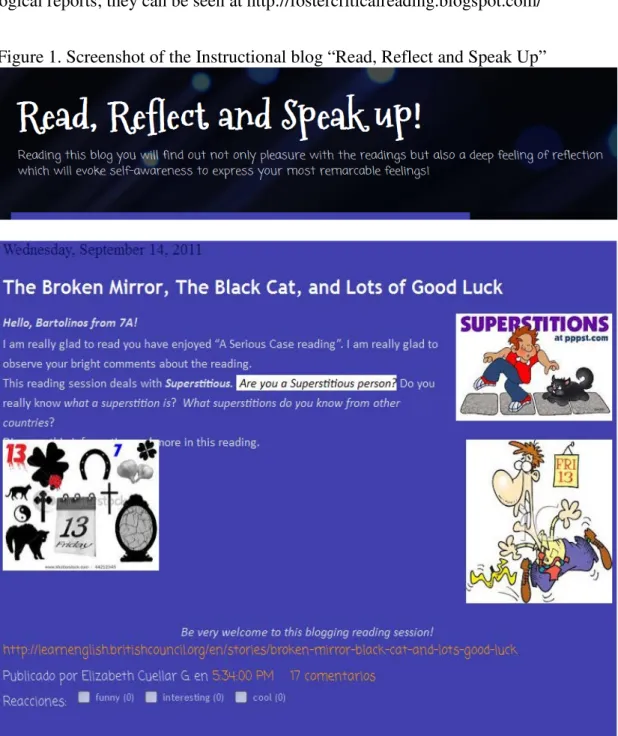
(6) BLOGGING TO FOSTER CRITICAL READING. 4. Abstract This action research study on blogging to foster EFL critical reading was conducted with a group of fifteen seventh-grade students at San Bartolomé La Merced School in Bogotá, and focused on promoting critical reading strategies throughout the use of a blog. The study took into account the implementation of a reading class-blog with a set of critical reading questions in the pre-, while and after reading format to develop critical reading processes. All the pre-reading activities were developed in class and the remaining reading activities were carried out as independent work at home. Findings demonstrated the advantages of blogs with the critical reading questions offered to develop certain critical reading strategies such as previewing, contextualizing, and reflecting on beliefs and values. In addition, participants improved their reading practices and showed a positive attitude towards the use of blogs for reading purposes. Further research on this area should include the use of blogs to promote intensive reading and critical thinking.. Keywords: Reading, Critical reading strategies, Blogs..
(7) BLOGGING TO FOSTER CRITICAL READING. 5. Resumen Este estudio de investigación acción usando un blog de clase para promover la lectura crítica del inglés como lengua extranjera, fue realizado con un grupo de quince estudiantes de séptimo grado del colegio San Bartolomé La Merced en Bogotá. Este estudio se centró en la promoción de estrategias para desarrollar la lectura crítica a través del uso de un blog. La investigación se realizó con la implementación de un blog que contenía lecturas y actividades de pre-, durante y después de lectura y la implementación de preguntas para fomentar la lectura crítica. Todas las actividades de pre-lectura fueron desarrolladas en clase y las demás se asignaron como trabajo personal para la casa. Los resultados de este estudio mostraron las numerosas ventajas del uso de blogs, para desarrollar las estrategias de lectura crítica de pre visualización, contextualización y reflexión de creencias personales y sociales. De otra parte, los participantes de éste estudio mejoraron sus procesos de lectura y mostraron una actitud positiva hacia el uso de blogs para desarrollar lectura. Estudios futuros en esta área podrían incluir el uso de blogs para promover lectura intensiva y pensamiento crítico. Palabras clave: Lectura, estrategias de lectura crítica, blogs.
(8) BLOGGING TO FOSTER CRITICAL READING. 6. Contents CHAPTER………………………………………………………………….…………… I.. Introduction………………………………………………….…… Purpose of the study…………………………………………….. Research question………………………………………………... Objectives…………………………………………………………… Rationale…………………………………………………………….. 9 11 14 14 14. II.. Theoretical Framework…………………………………………. Reading…………………………………………………………….. Reading in EFL context considerations…………………….. Critical reading……………………………………………………. Strategies to foster critical reading…………………………… Blogs…………………………………………………………………. Features that EFL or ESL blogs should have…………….. State of the art……………………………………………………... 18 20 20 21 28 31 33 35. III.. Research Design…………………………………………………. Methodology………………………………………………………… Type of study………………………………………………………. Research setting…………………………………………………… Participants………………………………………………………… Researcher’s role………………………………………………….. Instruments………………………………………………………… Students’ questionnaires………………………………………... Teacher Journal log………………………………………………. Learning logs………………………………………………………. Students’ artifacts………………………………………………… Ethical Considerations…………………………………………… Action Plan…………………………………………………………. Validation of the Instruments…………………………………... 47 47 48 51 52 54 57 57 57 58 58 59 60 63. IV.. Pedagogical Intervention………………………….…………….. Instructional goals………………………………………………… Instructional Method…………………………………………….. Instructional lesson plan……………………………………….. Timetable……………………………………………………………. Evaluation…………………………………………………………... 65 65 66 67 68 69. V.. Data Analysis and Findings………….………………………... Data Analysis Approach…………………………………………. Data management………………………………………………… Data reduction…………………………………………………….. Data display and verification……………………………………. 70 70 71 72 74.
(9) BLOGGING TO FOSTER CRITICAL READING. VI. References Appendix. 7. Core Category……………………………………………………… Main Category 1…………………..………………………………. Main Category 2……………………………………………………. 74 76 82. Conclusions……………………………………………………….. Implications for Pedagogical and Research practice………. Limitations………………………………………………………….. 84 86 87. ………………………………………………………………………… …………………………………………………………………..……. 83 93.
(10) BLOGGING TO FOSTER CRITICAL READING. 8. Chapter 1 Introduction. This research is intended to determine the effect that the use of blogs, as ICT -Web 2.0 tools, might have in the learning process of a language, and its impact to develop critical reading of English as a Foreign Language of students from a private school in Bogotá. This project emerged both as a result of a personal experience with the use of web 2.0 tools in the teaching of English, and as a way to cope with the new cross-curricular project (presented in the Annual Planning from the school) San Bartolomé La Merced (SBLM hereafter). This project aims to use the ICT strategies in the classroom in order to enrich, complement and enhance foreign reading processes; teaching practices therefore, meaningful experiences for the new generation of digital students the school has. Prensky (2001) claims that these “new generations of skillful technology students –digital nativeshave a big gap with -the digital foreigners-, these prior generation of not skillful teachers in technology” (p.1). Furthermore, this research emerged as a concern to transform the reading process in a group of 20 students from seventh grade, with an A2 English level according to the Common European Framework and studying at SBLM. These students took a need-analysis questionnaire where the learners were asked to comment on elements including reading processes, reading problems and reading skills. As a result, the majority of students answered that they were not good readers in English due to their difficulties to understand all the words in the texts, the lack of enthusiasm and interest to practice this skill because of.
(11) BLOGGING TO FOSTER CRITICAL READING. 9. the passiveness of the reading activity, the monotony in doing it and the content they were asked to read. Moreover, a large number of students from this grade showed a great interest in reading outside the classroom. Comments like: “I like reading out of the classroom”, “I like to go the reading room” “I like to read comics” (answers from three different students from 7A grade) showed the great interest this group have to transform the reading from a passive to an active activity. They argued that in the reading room they were able to choose their readings, sit wherever they wanted and read at their pace. In terms of the question related to doing electronic readings, almost all of the students showed great interest in them because they could deal with the computer, have a different reading experience and learn more vocabulary: “Yes, it’s another way to read and I like it”, wrote some of them. Few of them agreed to know some aspects from blogs, but expressed the uncertainly regarding the use of blogs in the English language class. Conversely, two students showed rejection to reading through the use of the computer arguing that they get tired reading from computers. Finally in this ten-question need-analysis questionnaire, students argued to like reading in English because they were able to learn vocabulary and study the language. Answering the last question, they presented as reading preferences: stories, comics, short narrations, documentaries and fairy tales. On the other hand, in May 2010, the school applied the Key English Tests (KET) mock exam to these seventh-grade students. The purpose of this test was to provide data about the English language level in the school to determine strategies to prepare students to take the International English exams established to reach the Common European Framework (CEF) standards. This would also provide students with tools to face the.
(12) BLOGGING TO FOSTER CRITICAL READING. 10. challenges of the university and a globalized knowledge society in which information and communication skills are a must to be handled. Results showed a lack of analysis and inference in their reading processes. In these kinds of exams, the examinee is assessed not only in terms of language knowledge but also in their ability to trigger their processes of analysis and inference of information from the text. Results showed that in their reading, they only answered questions related to language usage, scanning and sometimes skimming sub-skills processes. With this in mind the research concern was to identify tools which might help these students emphasize in aspects such as inference, analysis, synthesis and evaluation of the reading process in the Foreign Language. The outcome gathered from this KET mock raised concerns about the FL poor reading processes students at SBLM have, which do not fulfill the criteria required by the CEF to the “Colombia bilingüe” project (Zarate and Alvarez, 2005). Besides, this outcome was the teacher-researcher’ main concern to improve the language learning quality of these Colombian students, on one hand, and include technological teaching techniques in the classroom which may also help improve teaching quality of Colombian teachers. Statement of the Problem EFL language teachers and students in general focus their attention on reading comprehension skills due to the social and personal development this process has not only to acquire knowledge and different ideas to understand the world, but also to as a way to see the world and interpret the issues stated in it to then socialized it through the writing process. In view of the fact that In SBLM teaching reading in EFL is recognized as a way to facilitate learning of the language and identify main ideas to give accounts of what the reading says. Additionally, considering the need these students have to acquire a deeper.
(13) BLOGGING TO FOSTER CRITICAL READING. 11. reading comprehension to infer, determine, deduce and analyze texts to restate them and tackle the reading requirements the KET exams asks for therefore, help these students to acquire more tools to comprehend readings and self-reflect on the effects these have to analyze and see world, this research project intended to search for new and different ways of presenting and accessing to the readings not only to review and practice the grammar and vocabulary of the language or give accounts of the contents of the reading passages but also to help them to identify, infer and deduce assumptions, facts and beliefs from these readings which let them create own assumptions to accept or reject ideas presented in these readings. Consequently, this research study and the researcher is part of those Colombian teacher-researchers who aim to help their community to improve the quality of the reading comprehension of the EF language to teach and the language to learn to reach international language standards. These standards not only prepare students to face a globalized world but also offer them the communicative tools needed to help their country be more competitive, and more committed to reach better educational standards and therefore better standards of life ( Zarate and Alvarez, 2005). Locally, the application of this research project in SBLM school aims to modify the students’ reading processes and be a motivation for other colleagues to start using and discovering the vast amount of information the Internet and especially the use of blogs may offer in the teaching of a foreign language (in this case, EFL), and especially in the instruction of reading skills. In relation to this point, Dudeney (2000) suggests: “Internet is not merely a source of authentic material in English, but also home to encyclopedic information about all sorts of topics to engage students within the classroom” (p.1). In fact,.
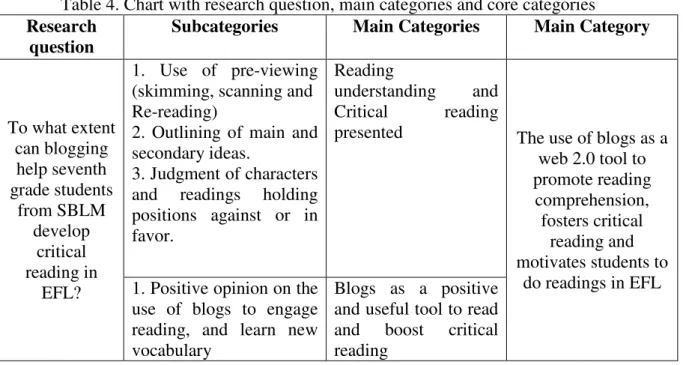
(14) BLOGGING TO FOSTER CRITICAL READING. 12. the use of the internet in the classroom might possibly be the way to present readings in a variety of formats, styles and designs to produce engagement and therefore increase motivation in students at SBLM. The idea of this project is to promote reading in a class blog for a group of students from seventh grade and determine whether their critical reading skills are developed with the use of this technological tool. Besides, results emerged from this reading blog might certainly show the reading comprehension changes expected to appear in these students’ reading processes and the effects in their learning process. Equally important, this reading blog is expected to have a considerable impact on students’ technological management and ideas to use during their free time. Since the implementation of this project was to be carried out through the use of a blog, students were required, to be trained to use it accurately and encouraged to participate in their reading process outside the classroom. Students were expected to read in English out of the classroom and use them as an excuse to share beliefs, ideas, assumptions and points of view with classmates, hence enriching their social and personal language skills. Other expected reactions this study might show are related to the increase of students’ technological strategies to work independently, and with autonomy, which are really valuable skills for their personal growth. In consequence, this qualitative Action Research addresses the following research question with the corresponding objectives: Research question:.
(15) BLOGGING TO FOSTER CRITICAL READING. 13. To what extent can blogging help seventh grade students from San Bartolomé La Merced develop critical reading in EFL? Objectives To determine whether these students’ critical reading process is affected by the use of blogging To determine the benefits of blogging in these students’ reading comprehension skill To identify these students' perceptions about the use of blogs to read in EFL Rationale The implementation of this research project is expected to have a relevant impact in SBLM students’ mental processes to confront readings in EFL not only to give accounts of what reading says but also to offer personal judgments, deductions and state what the reading does on them. On one hand, results from this study estimate to provide insights into the reading processes at SBLM School to be a referent for the teaching community due to the potentially large number of benefits high levels of reading comprehension may offer to the cognitive process in one hand and to the proficiency of the foreign language on the other hand. Since participants are to use web 2.0 tools technology, reading styles and their motivation to use technology for learning purposes, are aspects expected to be affected with this study, apart from the expected improvement of critical reading or the development of this aspect this study expects to have. On the other hand results from this study are expected to have an impact on the teaching community at SBL due to the use of technology in the teaching process. The use of this web 2.0 tool has to connect language, language.
(16) BLOGGING TO FOSTER CRITICAL READING. 14. learning and learning strategies with students’ language needs and interests. This ICTs implementation is expected to provide substantial improvements in terms of technology usage in the English curriculum. In fact, with the use of technology in the classroom students’ reading process and students’ language proficiency is expected to have an improvement. In addition, participants’ learning strategies to study the language to transform the learning process into meaningful experience (Prensky, 2001; Rojas 2011), are other kinds of outcomes this study intends to obtain. Other contributions this study involves the use of blogs not only as a way to help students in their reading skills but also to be considered as tools to promote critical reading and therefore critical thinking skills. The use of reply options in blogs can offer the possibility to know others’ ideas, beliefs, judgments, and exteriorize them in their written comments which can be nourished with others therefore leave the place to deep reflection and analysis, acceptance or rejection. Regarding this aspect Luehmann, (2008) asserts that: “blogging culture, in which frequent updating is expected and ideas and arguments are judged on merit, may encourage constant and thoughtful writing and reflection”; and that making thinking visible makes it available for critique and comment by oneself as well as others” (p. 289). Furthermore, this study might have an important impact on research teachers in the classroom who are looking for special strategies which involve reading practices, technology in the classroom and its effects on students’ behaviors and cognitive processes. The English teaching community might also enrich teaching practices and hence close the gap between the use of technology and English language teaching in the classroom..
(17) BLOGGING TO FOSTER CRITICAL READING. 15. In summary, this study intends to show a relevant impact on this group of students’ critical reading skills; for colleagues at SBLM as a purposeful way to present reading tasks; for the school as an institutional aim of using ICTs in the teaching process; and for the researcher community for further and deeper studies in this area of blogging in the EFL reading process. The principle theory which supports this research project is mainly based on the constructs related to reading comprehension, critical reading theory and Computer Assisted Language Learning specifically the use of blogging. These constructs are supported by the following authors: Brown (1996), Wallace (2003), Nuttall (1996) and Aebersold (2007) present conceptions and general ideas of what reading in EFL is. Nuttall (1996), Aebersold and Lee (2007) and Hedge (2000) focus on elements and approaches related to reading in a foreign language. In addition, Kurland (2000), Aebersold and Lee (2007), and Hedge (2000) present concepts, ideas, strategies and ways in which critical reading can be fostered and instructed to EFL students. Finally, Campbell (2003), Nacht and Chaney (2006), Eastmen (2007), Quintero (2008), Rashtchi and Hajihassani (2010), and Carney (2009) help the reader become aware of the importance that utility blogs have in the reading and writing English language learning process. The subsequent chapter presents the literature which support and provide a clear perspective of the theory related in this study. It also presents similar studies done on the use of blogging, and critical reading, the impact these studies have had in the learning of a language and special considerations about the research study..
(18) BLOGGING TO FOSTER CRITICAL READING. 16. Chapter 2 Theoretical framework This chapter deals with the theory, concepts, definitions and ideas related to the main constructs presented in the study “blogging to foster critical reading”. In the same way, the chapter presents the state of the art, with outcomes from similar studies done on the use of reading blogs and critical reading, and the impact this study might have in teaching contexts. Many studies have been carried out with the use of blogs to learn a foreign or a second language, and about reading comprehension skills. Several research studies on blogging for writing purposes have been performed, but a number of studies have been conducted on boosting reading comprehension skills with blogs and none on blogs to foster critical reading processes. Examples of this are the Blog-assisted language learning study, an Iranian study aimed to teach reading (Rashtchi & Hajihassani, 2010), and the Colombian study on Examining reading comprehension through the use of continuous texts and hypertexts, conducted by Coscarelli (2009). Furthermore, critical thinking studies have been carried out with the purpose of helping students to develop critical thinking but none on critical reading. “A Guided Reading of Images: A Strategy to Develop Critical Thinking and Communicative Skills” is one of these studies conducted by Sarmiento (2010) to develop critical reading in EFL contexts. With this view, results from this study are expected to have an impact in the use of blogs for critical reading purposes and be a basis for further studies in this area..
(19) BLOGGING TO FOSTER CRITICAL READING. 17. The constructs are presented in the following order: reading comprehension, critical reading and web blogs. The state of the art presents case studies carried out on the use of blogging to foster EFL reading skills, blogs to interchange cultures among EFL and native speakers from Colombia and Canada, and the use of web blogs in the educational field. Reading Chamot and O’Malley (1995) and Brown (1996), present EFL/ESL (English as a Foreign Language / English as a Second Language) reading as a process where “the reader uses a series of steps to obtain meaning from the written text” (p. 284). Indeed, these steps are the mental processes the reader uses not only to decode information to say what the text says, but to understand the assumptions, bias and perspectives underlying the discussion. Here the reader can see how the world is portrayed by a text and reading comes to mean understanding the writer’s representation of reality (Kurland, 2000). Furthermore, reading involves the reader, the text, and the interaction between reader and text (Aebersold & Lee, 2007). According to this claim, this study embraces reading not only the interaction the reader might have with the text in the blog but what the reader is expected to do with the text or what the text might provoke on his/her personal reflection: arguing, judging, appealing for sympathy, contrasting, and inferring what the text as a whole means (Kurland, 2000). In addition, apart from the reader’s interaction with the text to get the best of it, a reader also has external and internal reasons to read. Grellet (2002) and Harmer (1999) argue that readers can read for pleasure, to get informed or for academic purposes. In addition, Harmer (1999) also highlights the use of EFL reading texts to “expose the reader.
(20) BLOGGING TO FOSTER CRITICAL READING. 18. to authentic materials to stick some of the language in the reader’s minds as part of the process of language acquisition” (p 68). This means that reading in EFL will not only offer pleasure, information or ideas but also will help the English Language learner to retain language to be internalized unconsciously in the learning process. Hence, the text will serve as a model of grammar, vocabulary, punctuation and syntax, and will also serve as the primary tool to stimulate discussion, excite imaginative responses and be the base of inspiration to stimulate the writing process, if the reading text is of great interest (Harmer, 1999, p. 68). A final aspect about reading in this study is the difference between the written language and the rhetorical structures of the native language and the target language which may affect FL reading processes (Aebersold & Lee, 2007, p. 28). These differences need to be considered when presenting readings to students to ensure that students enjoy (or at least feel comfortable with) reading in a foreign language and reading, without help, unfamiliar authentic texts, at appropriate speed, silently and with adequate understanding (Nuttall, 1996, p.31). Other considerations when presenting readings to FL learners include cognitive development and style orientation, due to the fact that age and level of cognition at the time they begin language study shape their ability to grasp concepts, use strategies and the basic ways to approach the text. Aebersold and Lee (2007) and Nuttall (1996) also claim that teachers can only try to: promote reading ability in the student by using interesting material selected by them (this can help to overcome difficulties presented when reading in EFL), promote the use meta-cognitive strategies that assist them to self-develop their ability to read, prepare students to tackle texts that they have never seen before by helping them to understand.
(21) BLOGGING TO FOSTER CRITICAL READING. 19. language differences from L1 and FL and then empowering them to use the target language to become proficient readers. Finally, teachers need to know, and let their students know, that the reader does not need to understand everything to suit the purpose of a read text. Critical Reading According to Kurland (2000) critical reading is an analytical activity where the reader identifies patterns of elements such as information, values, assumptions, and language usage throughout the discussion. Critical reading also involves bringing outside knowledge, biases, and values to bear to evaluate the presentation and decide what ultimately to accept as true. Critical reading then appears to be a skill highly required in both academic and everyday life (Pardede, 2007). A critical reader is able to detect bias, prejudices (adverse judgments or opinions formed beforehand or without knowledge), misleading opinion and illogical conclusions in a text. As a reading skill which involves critical thinking competence, critical reading can be defined as the process of understanding, questioning, and evaluating a text, which is carried out actively and consciously, in order to assess the accuracy and validity of a writer’s ideas successfully (Pardede, 2007). Altogether, critical reading in this study is referred to as those special actions or strategies that the reader has to recognize what the text says about the topic and what the text does on the reader. Readers also have to recognize the sense given to this text by the sequence of thoughts, to understand the information, ideas, and opinions stated within the text from sentence to sentence and paragraph to paragraph to take control of the read text..
(22) BLOGGING TO FOSTER CRITICAL READING. 20. They should not only repeat what the text asserts, but also to become the author of one’s own understanding. Paratore and McCormack (2007) relate critical reading with effective readers. In this sense they state that: The strategies used by successful readers are continually evolving. Research provides new and confirmatory knowledge about how reading “works” and reading theories change in relation to this knowledge. As we learn more about the nature of reading strategies, including generating and monitoring predictions, making inferences, summarizing and synthesizing text information, and critiquing the author’s arguments, this knowledge can inform effective reading instruction (p. 11).. Therefore, the successful reader is the one who knows the reading strategies and use them to not simply synthesize text information, but also to critique author’s arguments and takes own positions based on the knowledge found in the text. As a consequence, in this study effective reader and critical reader are considered as this reader who uses special actions or strategies to recognize what the text says about the topic and what the text does on the reader. In other words, effective reader and critical reader will be taken as synonyms indistinctively. Some other actions established by Aebersold and Lee (2007) to become effective readers, include the speedy recognition of words, use of text features (subheadings, transitions, etc), use of title(s) to infer what information might follow, use of world knowledge, analyze unfamiliar words, and distinguish main ideas from minor ideas, among others to be a critical reader (p. 16)..
(23) BLOGGING TO FOSTER CRITICAL READING. 21. Aesbersold and Lee (1997) also argue that: Identify the grammatical functions of words, read for meaning, concentrate on construction meaning, guess about the meaning of the text, evaluate guesses and try new guesses if necessary, monitor comprehension, keep the purpose of reading the text in mind, adjust strategies to the purpose of reading, identify or infer main ideas, understand the relationship between the parts of a text and tolerate ambiguity in a text (at least temporarily), paraphrase, use context to build meaning and aid comprehension, continue reading even when unsuccessful, at least for a while. (p. 16) Regarding this ideas it can be said participants in this study could be called effective readers or critical readers if in their reading practices they read for meaning, guess about the meaning of the text, monitors comprehension, identify and infer main ideas, paraphrase, use the context to build the meaning and present own believes and points of view on the readings done. On the other hand, Johnson, (2004) argues that critical readers are those who experience, and not simply “encounter” or react to what they read – but they engage in a dialogue with the text, ask questions about it and make demands on it. In all, being an effective reader is an ongoing process that involves experience, practice, and reflection, taking an active role is what “effective reading” is all about. In the same way, Hedge (2000) claims that a critical reader views reading as a social process where texts are constructed in certain ways so that these texts shape perceptions of readers towards the acceptance of text’s ideologies (p.197). Certainly, texts should widen horizons by introducing readers to unfamiliar values and cultures, but teachers should be.
(24) BLOGGING TO FOSTER CRITICAL READING. 22. aware of avoiding presenting texts that try to persuade readers to identify the writer’s own moral vision; or, in addition, help students to value these perspectives. For the purpose of this study critical reading is taken as an individual act of analyzing and evaluating readings as the reading action progresses, reflecting back on it. Critical reading in the blogs will be discovered by those further steps in which the participants have to recognize what a text says, reflecting on what the text has: values, assumptions, information and language usage to decide what ultimately to accept as true (Kurland, 2000). Craving to find out ways and strategies to determine whether practitioners develop critical reading in this study, Hedge (2000) and Kurland (2000) provided insightful ideas useful to foster critical reading. Hedge suggests the use of critical questions and Kurland promotes seven strategies to foster critical reading. Hedge (2000) underlines several critical questions which can be built into reading materials to foster critical reading development in readers by supporting the application of critical questions in the texts. For what purpose and for what audience is this intended? What knowledge and attitudes does the author presume of the audience? Are you convinced by the evidence presented by the author to support the claims made? Does your own experience support the conclusions reached by the author? And do you share the author’s point of view? (p. 56) The modification of these questions and their implementation in the reading blog was a significant source to determine practitioners’ critical reading steps. In addition,.
(25) BLOGGING TO FOSTER CRITICAL READING. 23. Hedge (2000) cites a detailed set of questions to be used in the pre-reading phase to help readers tackle texts. Before reading text: Ask yourself the following questions: Why I am reading this? What is my purpose? Why is it in my reading list? What do I know about the author, the publisher, the circumstances of publication and the type of text? How do these affect my attitude towards an expectation of what I am about to read? Why? What are my own views of the event(s) or topic before I start reading this particular text? What other texts (written and spoken) on this similar topics am I familiar with? What are my views about them? (p. 120) The previous ideas described by Aebersold and Lee (2007) and Paratore and McCormack (2007) regarding the strategic reader, the one who reads and learns from the reading, and Wallace’s (2003) point of view about reading as a social, critical and interpretative process rather than as a skill or set of skills which no longer present what the text says are crucially linked. It can therefore be argued that there are certain kinds of texts, which are more appropriate and highly help students in the processes of getting the meaning from reading, learning a foreign language and highly crucial to develop learners’ critical and social skills, therefore allowing them to interpret the world. These kinds of texts are expository texts, and include biographies, essays, how-to books, encyclopedias, reference books, experimental books, scientific reports and newspaper articles among others. These texts can offer throughout the reading comprehension, learning of the language and development of critical reading process (Iwai, 2007 & Baldwin, 1990)..
(26) BLOGGING TO FOSTER CRITICAL READING. 24. The prior thoughts on expository texts, and the structure these have (descriptive, listing, comparison contrast, cause/effect, problem and solution and retelling among others) (Moss, 2004), and considering Aebersold and Lee (2007) and Nuttall (1996), claims on students’ interests when reading in EFL, the blog in this study will consider these authors’ assumptions, selecting a series of readings based on students’ interests in reading. This information was collected from the need-analysis questionnaire applied to start this research project and results showed that their reading interests are: fairy tales, comic strips, scientific texts and narrations in general. The prior information is presented in detail in the Instructional design for the selection of texts. In the Instructional design there is also presented the questions and strategies presented by Hedge (2000), Kurland (2000) and Pardede (2007) as ways to help students to develop critical reading. Thus far in our discourse reading and critical reading have clear definitions and are stated accordingly with what this study intends. Additionally, tools to determine the critical reading process in participants of the study were stated as well. The subsequent paragraphs deal with the third construct in this research: blogs. Concepts, kinds of blogs, special features and ways in which blogs can be used in EFL/ESL contexts are presented below. Blogs With the rapid expansion of the Internet and the vast technological advances, blogging tools have been spread not only to social, political and commercial contexts but have also reached the teaching context, offering teachers multiple possibilities to present information to students, and store deep reflections about teaching practices. To the learner,.
(27) BLOGGING TO FOSTER CRITICAL READING. 25. blogging has offered virtual forms to learn collaboratively, sharing information, ideas, beliefs and thoughts with others to agree, disagree and keep information so that students, or readers, can use it in the process of learning the language (Campbell, 2003). Many definitions can be found for the concept of blogs, web blogs or blogging, terms which can be used synonymously. According to Nacht and Chaney (2006) a blog is “an easy-to-use Web-based content management system. It is a software platform that allows people with little or no technical background to publish, maintain, and update content” (p.1).. Campbell (2003) argues that Weblogs are like online journals that an. individual can continuously update with his or her own words, ideas and thoughts. He also adds that these weblogs are interactive in the sense that readers can respond to any given comment or discussion. The author offers three Weblogs to use in the ESL classroom: The tutor blog, run by the tutor for learners; the learner blog, run by individual learners themselves or by small collaborative groups, and the class blog, the result of the collaborative effort of an entire class. Finally, Quintero (2008), links blogs with an English learning tool and refers to blogs as a personal web space where learners can spot any kind of information they want. Thousands of blogs can be created and are now easily accessible to anyone who thinks these can be useful to their own life. In terms of its utility and usage that a teacher, researcher or student can give to blogging, Campbell (2003) has categorized blogs in the ESL classroom, according to their use. Thus, there are, for example, blogs as Tutors which promote exploration and support for the learning process. Secondly, as a tool to learn, they have been found useful to read and write, as means of a platform where many or just one student can manage it and conduct the learning process. Finally, as class blogs to activate.
(28) BLOGGING TO FOSTER CRITICAL READING. 26. learners’ conversations, language classroom exchange and to read and write in classes. The author presents nine features an ideal blogging tool should have in the processes of ESL or EFL language learning. This ESL/EFL blog should: 1. Have a simple, user-friendly, intuitive interface, allowing learners to post, edit, and comment with ease. 2. Have a WYSIWYG1 text editor, making formatting and hyper-linking text as simple as possible, while eliminating the need to use HTML entirely. 3. Give learners the ability to set access levels and to moderate comments as they see fit, thus creating a sense of control and privacy if needed. 4. Offer an extensive variety of template themes and colors, allowing learners to customize pages. 5. Come with built-in, easy-to-use social networking features, like personal profiles, friends lists, tags and tag searching, user communities, etc., so that learners can easily find conversation partners who have something in common with them and are willing to interact. 6. Have a built-in aggregator, making it possible for learners to subscribe to weblogs of interest, thus giving them relevant and stimulating reading material. 7. Allow learners to easily post and share photo, sound, and video files, thereby extending and enhancing their means of expression. 8. Have a spell check function. 9. Be web-based, totally free of service charges and advertising, and have an easy sign-up process..
(29) BLOGGING TO FOSTER CRITICAL READING. 27. Consequently, Campbell (2003) reports three useful blog platforms which offer these features mentioned by the author: Blogger, MSN Spaces and Live journal, established like the large usage communities; Yahoo! 360 blog because its recent appearance and the last four: Elgg, Learnerblogs, Blogmeister, and Free ESL blogs because of their purpose in teaching and learning. From this selection presented by Campbell (2003), the use of www.blogger.com was the chosen option in the selection of the blog for this research. This selection was made based on the components that a good blog should have, according to Campbell (2003), the well-known name a blogger has, its free usage and although its creation is not easy, the easy posting on it. On the other hand, Camilleri, Ford, Leja and Sollars (2007) highlight the multiple uses and building techniques teachers can develop with the use of blogs, as for instance, posting references to useful websites on teacher blogs offering student’s concurrent learning opportunities outside the classroom and encouraging students to comment. The author also suggests that blogs are for reading purposes in the classroom specially, because they promote “self expression and highly personalized content” (p. 20). In a review of existing blogs, Camilleri et al, (2007) summarize some advantages offered by the blogging medium, suggesting that bloggers can collect news and stories to write about them and then edit/react to each other’s work; bloggers can both add comments or critiques to share class readings. Having offered a definition to the term blog and having offered a description of the special features and ways in which blogs can be used in EFL and ESL contexts, the.
(30) BLOGGING TO FOSTER CRITICAL READING. 28. subsequent paragraphs deal with the impact this study might have in this community of practice and the studies done in this area of knowledge that is critical reading through the use of blogs. State of the Art Several studies have been carried out on the use of blogs web 2.0 tool for the Teaching of English, as an essential technique to catch students’ attention, motivate them in their learning process, interchange cultural experiences with two different language cultures, and help students to develop writing and reading language skills and deal with technology in their classrooms (Eastmen, 2007 ; Camilleri et al, 2007). Conversely, very few studies have been presented about blogs for reading purposes. Examples of them are: “Blogs: web journals in language Education” by Camillery (2007), “Language study through Blog Exachange” by Carney (2009) and “Blogging an Emerget L2 literacy development in an urban elementary school” study conducted by Gehhard (2011) among others. Less for the boost of critical reading (e.g. “Develp practices of resistance: critical reading for students of Politics” by Clarck, 1993), In the Internet, readers can find hundreds of blogs with a gamut of readings, and reading activities to help net readers in any specific need they might have. In addition, several studies have been carried out to foster blogs in the classroom. However, no more than a small number of studies have focused on reading using blogs, or in the use of blogs to foster critical reading to EFL seventh-grade students in a school. Thus, this study gains interest and importance due to the innovation in the teaching technique to present readings to a technological.
(31) BLOGGING TO FOSTER CRITICAL READING. 29. generation, and to engage students to improve the boring foreign reading skill (as they perceive it), and therefore become competent bilingual language readers. The kind of blog used in this study is classified according to what Campbell (2003) defines as a class blog: “type of blog, which is the result of the collaborative effort of an entire class and can be used for reading and writing classes” (Three Types of Weblogs for Use in ESL Classrooms). Consequently, there have been several studies carried out with the purpose of presenting class blogs in the teaching field and for EFL educational purposes. There is the case of the study to foster the use of blogs to improve writing skills in foreign language classes, by means of starting with an in-depth analytical reading to then edit and add personal reflection to give it a written context (Camilleri et al., 2007). In this study, presented thorough statements which support the idea of using blogs to boost critical reading processes to the users due to higher order thinking skills (evaluate and synthesize) bloggers need to read other ideas, connect them to other ideas and to content and decide what is important and worth (Camilleri et al., 2007). In the same way, some studies carried out using blogs for educational purposes present the reward that this tool has in the teaching of English to help students develop writing processes. The first is the Action Research study conducted in Bogotá, Colombia by Quintero (2008). In this study the researcher aimed to gain insights into EFL writing and to analyze the role that feedback played in the process of writing. The experience was implemented through the interaction of two groups of students, one group in a public university in Colombia and the other a group in Canada. The last group had regular interactions with the former group through the use of blogs. The use of blogs was a medium.
(32) BLOGGING TO FOSTER CRITICAL READING. 30. to exchange experiences and interests in a writing community, and so then receive feedback from this process. As a result, there was understanding of writing and feedback in writing but there appeared poor interaction among the participants (eight students from a public university and students at a Canadian university), and lack of meaningful writing in their blogs, whose purpose was the creation of a community where interests, objectives and constant interaction could motivate the participants to produce thoughtful writings. Strengths presented in her study were the use of blogs where the written process took place and the role of the Canadian’ feedback, native speakers, and teachers’ feedback provided to the language learners students in Bogotá, which was fundamental to improve these students’ writing to some extent. It is important to notice the great benefit this web blog tool offered to the exchange of information from cities highly apart. Furthermore, the reading blog appeared to be a highly motivational tool to engage reading processes and to provoke a written interaction with the reading and with the readers’ community in this study. Following the same writing pattern, Rojas (2011) conducted a study on the implementation of a blog with activities, strategies, suggestions and links to increase written communication in English of a group of 43 ninth grade students from a school in Bogotá. The purpose of this author was focused on the presentation of enough interesting input through the use of webquest activities to the participants so that they were motivated to write and then develop the writing skill. Students were instructed and motivated to create their own blogs about free students’ interested topics. Group work was allowed and students’ engagement in the blog and the writing process was presented due to the chance participants had to use different technological tools (e.g. cameras, mobiles, and computers).
(33) BLOGGING TO FOSTER CRITICAL READING. 31. in their blogs and writings. As a result participants tried to write more and of a higher standard. They showed great engagement not only in writing but also in using the technology to learn English because it was a different way to learn. The researcher also confirmed the claim about the substantial help that technology can offer to teachers in the classroom, and acquired a vast knowledge required to create and maintain blogs in EFL contexts. Sun and Chang (2012) used blogs to demonstrate that this tool allowed EFL graduates to scaffold each other in navigating their writing tasks and processing academic writing knowledge. Taiwanese TESOL (Teaching English to Speakers of Other Languages) students helped each other to understand the academic writing process and build their identity as EFL writers. Results also showed the kind of roles blogs can play in the writing instruction, and how these can be incorporated in pedagogic practices. Overall, this study reinforced the positive effect technology, especially blogs, may offer to the writing process and the support and engagement this tool may offer to learn a foreign language. Similarly, Rashtchi and Hajihassani (2010) conducted a study aimed at determining whether the use of blog-assisted improved the reading comprehension processes for a group of 52undergradute Iranian EFL students and their attitude towards EFL reading skill. Participants, with a homogeneous reading comprehension performance, were divided into two groups: The control and the experimental group. Both groups received 10 classes, onehour and a half each. The experimental group had reading through a designed blog to this purpose, and linked to answer different reading comprehension activities (e.g. questions, quizzes and vocabulary tests) to finally write the summary of the text. The control group.
(34) BLOGGING TO FOSTER CRITICAL READING. 32. did the same procedure with the same readings but using the traditional form (paper and dictionary). Results showed a slight and no significant improvement in the reading comprehension process in students who used weblogs in the reading rather than in the control group. Moreover, the significance this study had was presented in the time students used to do the activities which was less than the control group, and the increase of positive attitude and motivation towards weblog in EFL reading. Using weblogs in language classes could encourage learners to actively participate in classroom discussions and activities while promoting cooperation and cultivating peer learning, group work activities, and autonomy in the learning process Rashtchi and Hajihassani (2010). Rashtchi and Hajihassani’s results and those found in the study conducted by Ahluwalia, Gupta and Aggarwal (2011) with Engineering students in India, presented the same positive results on the acceptance and positive attitude towards the use of blogs to learn the language. These results are part of the further findings this study intends to find: effects on the use of weblogs in the critical reading process. Though not dealing with the same population, or the same kind of study, these Iranian and Indian studies support the positive possible outcomes that this critical reading weblogs intend to find. By the same token, a study conducted by Gebhard, Shin and Seger (2011) in Massachusetts, United States, analyzed the use of a designed blog-mediated writing curriculum based on systematic functional linguistics, to support second grade English language learners’ (ELLs) literacy development and abilities to use computer-mediated communication tools for social and academic purposes in and out of an urban school. This study, framed under Halliday and Vigotsky’s language learning approach, lasted two years.
(35) BLOGGING TO FOSTER CRITICAL READING. 33. and was focused on one of five second graders. This girl was a Puerto Rican second language learner who had problems with reading and writing in English. Born in USA, and a speaker of mainly Spanish at home, she was involved in a project where parents and relating family stories, letters, and arguments were part of the narrative project. These five students were instructed on how to write drafts and post them in the blog. During the second year data was gathered exclusively on the blog posts that students produced –more independently. This study reported the highly positive result which this blog had to help a second language learner to communicate, expand audience for academic and social purposes and according to her semiotic resources. Students developed sophisticated ways of responding to each other’s writing using the class blog, and literacy was expanded in regards to lexicography and discourse semantics. The Puerto Rican learner appropriated the class blog to transcend the physical limits of the classroom to communicate with an expanded audience for a wide range of primarily social functions. She used the blogging in interpersonal ways to perform identity work by constructing and displaying social roles as a technological expert and a valued peer, and as a result her reading and writing processes were significantly developed as the framework supported. Results from this study are of a significant impact on the present action project, due to the fact that the researchers used the same kind of blog (class blog), had similar language needs and learner contexts “foreign reading practices” and aimed to have similar results, this study intends: “improve foreign reading and language learning processes”. This study also both supports and anticipates positive technological outcomes on the use of blogs in the classroom, and offers a way to engage students in the learning process..
(36) BLOGGING TO FOSTER CRITICAL READING. 34. Equally important, Carney (2009) presents two interesting studies conducted in Japan with students from California, New York and Japan. These studies presented blogging as a medium of communication and thought-sharing, and as a language cultural exchange and collaboration tool over a regular course for these students. The idea of using this blogging was to exchange language competence and intercultural competence with two classes of students, both maintaining blogs, either individually or as a group and then commenting on each others’ blogs over the course of a certain amount of time. One study linked the author and one student from New York, referred to as “New York Exchange”; the other linked students from Japan and intermediate EFL learners of Japanese in California, in the United States, named as “California exchange”. As a conclusion Carney (2009) claims widespread potential improvement in student’s linguistic abilities, though the blog comments were full of grammatical and orthographic errors. On the other hand, related to intercultural competence, lack of willingness to exchange culture, and “cultural factors” was evident, which restricted the exchange of intercultural competence. Therefore, conclusions were drawn towards the drawbacks blogging has when being used for cultural language exchange in a continuous way because these exchanges took place weekly and therefore the need to change subject and not to discuss in a deeper way previous thoughts stated in the blog were indentified. With similar blog usage purpose, Alm (2009) carried out a study in New Zealand using blogs as a way of protecting spaces for language learners. This study was conducted with 15 learners of German as a foreign language who used blogs for self-reflection and peer-to-peer interaction. The experience showed that blogging can provide language learners with a personal space in which they feel save to express themselves and to interact.
(37) BLOGGING TO FOSTER CRITICAL READING. 35. with other learners. Blogs could offer positive effect on their willingness to communicate in real-life. Alm’s methodology is the one used in this study: weekly readings administered by the researcher, based on class-related topics and interests (e.g. current affairs), grammar exercises and chosen topics. This can be called the text or input for practitioners to read and then answer some critical reading questions and comment on each other’s answers in the blog. Although this study did not use students’ own blogs, the blog format from Alm’s blog has the same format: a free-domain blog created for them. The reading blog in this study has a text for 15 students to read, answer, comment and they are encouraged to restate, describe and interpret the reading, and then post comments about those interpretations, statements and descriptions obtained. These reflections were the product of answering reflective questions prepared to try to find students’ evidences of the kind of reading they have done, and offer comments to their classmates’ posts likewise. Thus far, several studies have been cited regarding the implementation of blogs to help students in their foreign language learning process, reading and writing. It has been stated the worthiness weblogs have had in the classroom to help students: develop writing when boosting the study of the grammar and vocabulary in a different way from the typical way in which grammar is presented in the classroom; change students’ attitude towards reading in EFL settings and link cultural awareness with the EFL language usage. At this stage it is appropriate to investigate whether the use of blogging can help participants from a school develop their critical reading process, and take advantage of the functions this tool has in the learning of a foreign language in different aspects such as language structures, vocabulary, grammar and in an overall way comprehension. Despite the fact that a few.
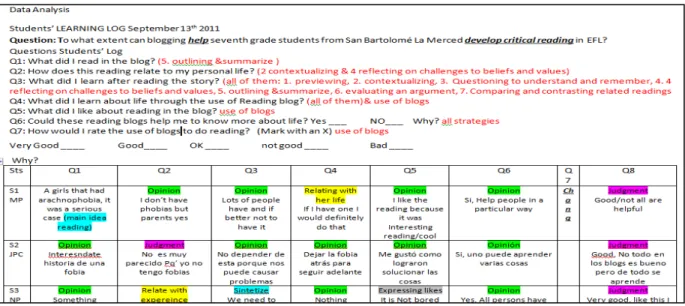
(38) BLOGGING TO FOSTER CRITICAL READING. 36. blogs have been designed for reading purposes, Johnson’s (2004) words gain value when presenting the role of an active reader in his article Student writing guide, from the University of Minnesota. In summary, there seems to be a predictable positive impact on the use of blogs to develop reading and writing skills therefore critical reading processes. Researchers such as Brown (2007), Krashen (1997), Harmer (1999), and Oxford (1990) have agreed on the fact that students need to enjoy what they do, reduce levels of anxiety and find the activities interesting so that the learning can be more effective. Rashtchi and Hajihassani (2010), Ahluwalia, Gupta and Aggarwal (2011), Gerbhard, Shin and Seger (2011) and Alm (2009) also found in their studies the positive acceptance of blogs by their students in the classroom and to learn the English language. In addition, these research reports lead the reader to draw conclusions on the positive perspective of using this technological tool in the class to enrich teaching practices and engage students to learn differently. Now, there is a clear view and an eager desire to conduct this study with SBLM students to find out whether critical reading processes might be afforded by the use of this valuable teaching tool and, in turn, offer possible better understanding of EFL reading learning process to a new technological generation with rather low levels of reading comprehension in EFL contexts. Reading not only for the mere product of a conscious, reflective, and valuable text but in the study of those exceptional mental actions taken to interpret, define, and extract the main corpus of a text and express them and make them alive through the writing process (ideas put in writing) in a tool mainly used to develop writing skills..
(39) BLOGGING TO FOSTER CRITICAL READING. 37. The following chapter presents the entire process carried out to design instruments, literature about the methodology to follow, description of the target population whose study is to be applied and the procedure considered to conduct this study..
(40) BLOGGING TO FOSTER CRITICAL READING. 38. Chapter 3 Research Design This chapter deals with the type of study used to conduct this research: action research, the description of the setting where it was conducted, principles of ethical considerations to guaranty participants’ anonymity, the role of the researcher, the description of the instruments and their validation triangulation and reliability process to gather data. Finally, an action plan is presented as guide for the stages and time spent during the implementation period. Methodology This study was developed based on the qualitative descriptive approach defined as a scientific and systematic search for pertinent information on a specific topic Kothari (2008). According to the nature and the core of this research, it is framed into the qualitative approach, because it included the diagnosis of the problem, the implementation of a proposal and the evaluation of this proposal, basic aspects qualitative research should have (Cohen & Manion, 1994). Furthermore, Kothari (2008) claims that Qualitative approach to research is concerned with subjective assessment of attitudes, opinions and behavior and adds the function of researcher’s insights and impressions. Such research generates results either in non-quantitative form or in the form which is not subjected to rigorous quantitative analysis. Techniques such as group interviews and depth interviews are used. In a similar manner, this study, described as qualitative research due to the inquire method to find out answers to a natural behavior appeared in a natural setting (Burns, 1999). Diagnosis of a.
(41) BLOGGING TO FOSTER CRITICAL READING. 39. problem, implementation of a proposal its intervention and evaluation are features of this research (Cohen, Manion and Morrison 2007). In this research type a variety of datagathering instruments are used. These include subjective assessment of information, attitudes, opinions, behaviors and judgments of the participants when dealing with the reading blog. In addition, the researcher’s insights and impressions from the information presented in the reading blogs, the learners log and the teacher’s log, are used to generate some observable results. These were partly quantitative but subjected to qualitative analysis due to the fact that it is required the description, interpretation and clarification of these human behaviors to get the best information from it (Burns, 1999). Type of study This research study is framed as a qualitative Action Research because it used everyday methods, such as observing, reflecting on events and behaviors to then present a problem, a proposal in order to try to solve the problem and an implementation with the corresponding evaluation (Cohen & Manion, 1994).. Since action research is placed in. natural settings and using methods of qualitative research (Burns, 1999), the natural setting used to apply this proposal was the school SBLM. After having observed, analyzed and made decisions to design a proposal which could help students from this school develop critical reading, the pedagogical intervention and the research results were supported by the process of theorizing and supporting researcher’s ideas with alternative ideas and theories. Action Research then has approaches essentially participatory in that they are conducted by and with members of the actual community under study (Burns, 1999). Special characteristics from the AR are: reflective practice to produce professional growth.
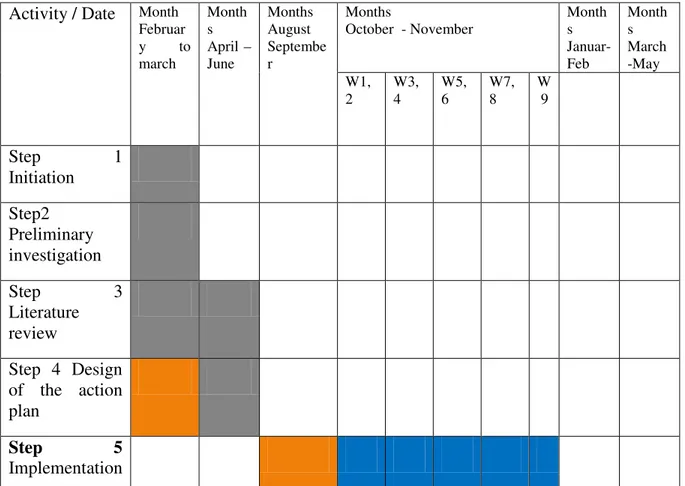
(42) BLOGGING TO FOSTER CRITICAL READING. 40. and development, presented for classroom teachers, the possibility to triangulated -process in which data gathered from different sources-, so that the findings or insights can be tested or compared against each other (Burns, 1999). Additionally, AR is defined as “the application of a systematic process of investigating practical issues or concerns which arise within a particular social context” (Burns, 1999, p. 27). Therefore, this reading blog study looks for -by following some moments-, insights or features that show how useful and accurate the implementation of the reading blog has resulted in helping participant to discover their language problem or their reading needs. In this sense, Burns (1999) claims that: Action research occurs through a dynamic and complementary process, which consists of four essential moments: planning, action, observation and reflection. These moments are the fundamental steps in a spiraling process through which participants in AR group undertake to follow these actions: •. Develop a plan of critically inform action to improve what is already happening,. •. Act to implement the plan,. •. Observe the effects of the critically informed action in the context in which it occurs, and. •. Reflect on these effects as the basis of further planning, subsequent critically informed action and so on, through a succession of stages (p.32).. Under this perspective, this research study was entitled as Action Research because it had a designed plan to help students improve their reading skills in the EFL by presenting.
(43) BLOGGING TO FOSTER CRITICAL READING. 41. a new way to see reading in EFL, a new way to react to their reading by presenting expected personal reflections based on the critical reading process the selected participants might have. This plan was implemented during a certain time established to observe, infer and lately analyze the gathered data to finally produce the findings and implications. With the mentioned aim this study sought– through the use of a technique and three instruments to collect data– analyze, reflect and evaluate the whole process to determine whether there was a prevalent change in the language reading process presented in the community under study. Research Setting The described stages presented above were the basic framework considered in the implementation of this research project. It set the everyday actions taken by the researcher with the participants involved in this implementation. Below there is described in detail the context and the setting in which the study took place. Context The setting where the pedagogical intervention of this study took place was San Bartolomé La Merced Catholic School, in Bogotá, Colombia. This school follows an educational philosophy based on Saint Ignacio de Loyola’s ideas. This means, to educate students in their eight human dimensions (ethic, cognitive, communicative, corporal, spiritual, affective, esthetic and socio-political dimensions) in order to have holistic educated human beings, willing to help their surrounding community. The teaching practices in this school are followed by the Personalized Education that takes into account the person as a particular and unique human being. For this reason, during their school life,.
Figure

+3
Documento similar
The independent variables that best relate to the bulk density of metallic pieces produced by selective laser melting and are therefore included in the dimensional analysis
Method: This article aims to bring some order to the polysemy and synonymy of the terms that are often used in the production of graphic representations and to
The dialogs acquired with the automatic generation technique are statistically shorter, as they provide 1.17 actions per user turn instead of the 1.06 actions provided by the real
The Dome of the Rock does attest the existence, at the end of the seventh century, of materials immediately recognisable as Koranic in a text that not infrequently
English borrowed an immense number of words from the French of the Norman invaders, later also from the court French of Isle de France, appropriated a certain number of affixed
In the preparation of this report, the Venice Commission has relied on the comments of its rapporteurs; its recently adopted Report on Respect for Democracy, Human Rights and the Rule
Keywords: iPSCs; induced pluripotent stem cells; clinics; clinical trial; drug screening; personalized medicine; regenerative medicine.. The Evolution of
Therefore, the instrument could be useful for several reasons: (a) to carry out studies on the degree of perception of the competencies that students have at the end of
