Removal of formaldehyde, methanol, dimethylether and carbon
monoxide from waste gases of synthetic resin-producing industries
Ó.J. Prado, M.C. Veiga, C. Kennes
Chemosphere, Volume 70, Issue 8, February 2008, Pages 1357–1365 DOI: 10.1016/j.chemosphere.2007.09.039
Abstract
The removal of mixtures of gas-phase pollutants released from formaldehyde- and formaldehyde resin-producing industries was studied in different bioreactor systems. The waste gases contained formaldehyde, methanol, dimethylether and carbon monoxide. The use of a hybrid two-stage bioreactor, composed of a biotrickling filter and a conventional biofilter connected in series, led to very high elimination capacities and removal efficiencies close to 100% for overall pollutant loads exceeding 600 g m−3 h−1. The presence of low concentrations of dimethylether in the gaseous mixture did not have a significant effect on the removal of formaldehyde or methanol under our operating conditions, although moderate concentrations of these compounds did negatively affect the biodegradation of dimethylether. When a mixture of all four compounds, at concentrations around 100, 100, 50 and 50 mg m−3 for formaldehyde, methanol, carbon monoxide and dimethylether, respectively, was fed to a conventional biofilter, removal efficiencies higher than 80% were obtained for the first three pollutants at empty bed retention time values above 30 s. On the other hand, dimethylether was removed to a lower extent, although its reduced environmental impact allows to conclude that these results were satisfactory.
Keywords
Biofilter; Biotrickling filter; Carbon monoxide; Dimethylether; Methanol; Waste gas
1. Introduction
A series of previous studies have been developed by our research group in order to implement bioreactor technologies for the treatment of off-gases from formaldehyde- and formaldehyde resin-producing industries. The number and global amount of waste gases emitted to the atmosphere from such facilities has increased to a great extent over the past four decades. Our previous work focused on the biological treatment of the two major compounds present in off-gases of these industries, namely formaldehyde and methanol. Those pollutants are released from fugitive emissions as well as from unit operations during production processes. However, other pollutants as dimethylether and carbon monoxide appear in some gaseous emissions together with formaldehyde and methanol. Although all four compounds have proven to be biodegradable (Meyer and Schlegel, 1979, Prado et al., 2005a and Eiroa et al., 2006), the elimination of mixtures of two or more of them in gas-phase bioreactors has hardly been studied. While several studies have been published on the treatment of formaldehyde (Máckowiak, 1992 and Prado et al., 2003) and methanol (Shareefdeen et al., 1993, Krailas et al., 2000 and Mohseni and Allen, 2000) as single pollutants in gas-phase bioreactors, works reporting the microbial removal of carbon monoxide in such systems are much scarcer (Wolfrum and Watt, 2002 and Wolfrum et al., 2002) and, as far as we know, no research studies have been performed on the removal of dimethylether in bioreactors. The aim of the present research was to study the biological treatment of gaseous mixtures of formaldehyde, methanol, dimethylether and carbon monoxide in batch assays and, subsequently, in biological reactors, with the purpose of understanding the effect that some of the most important operational parameters (as the waste gas load and composition, the empty bed residence time or the supply of a liquid solution) can have on their performance and in order to eventually implement the technology in actual formaldehyde- and resin-producing industries. Even though, commonly, low pollutant concentrations are emitted from these sources, these may correspond to very high pollutant loads when small bioreactors are employed as treatment technology. Most of the experiments presented herein were carried out under relatively high pollutant loads, corresponding to small bioreactors treating low pollutant concentrations. These bioreactors are generally preferred over bigger systems, as both the investment and the operation costs are significantly reduced.
2. Materials and methods 2.1. Bioreactors
2.2. Biocatalysts
Two different inocula were used for the batch studies. In most of the experiments, sludge from the wastewater treatment plant of a formaldehyde resin-producing facility was employed. The main physico-chemical characteristics of the sludge have been described earlier (Prado et al., 2004a). No in-depth microbiological analysis was performed on this sludge, though microscope observations showed that it contained a wide variety of microorganisms, predominantly bacteria. The sludge was also employed as inoculum in all the bioreactor studies described herein. Additionally, a pure
Oligotropha carboxidovorans OM5 culture was employed for a series of batch studies.
O. carboxidovorans OM5 is a carboxidotrophic Gram-negative bacillus able to catalyze the biodegradation of carbon monoxide ( Meyer and Schlegel, 1979).
2.3. Batch experiments
The batch assays were carried out in 635-ml glass vials, containing 100 ml inoculum and the same nutrient solution as for the bioreactor studies (Estévez et al., 2005). Before starting the experiments, the pH was adjusted at 7.5 and distilled water was added until a final volume of 150 ml was reached. After adding the substrate (formaldehyde, methanol, dimethylether or carbon monoxide), the vials were sealed and maintained at 30 °C with constant shaking at 200 rpm. Gas samples of the headspace were periodically taken in order to measure the substrate concentration. Pollutant concentrations in the liquid could be calculated by means of Henry’s law. All the vials were prepared in duplicate, including “blank” and “control” assays. “Blank” vials were identical to the experimental vials with the highest pollutant concentration, but had been previously submitted to sterilization at 120 °C for 30 min. “Control” vials had also that same composition, but contained distilled water instead of sludge.
2.4. Analytical methods
3. Results and discussion 3.1. Batch studies
It may be expected that sludges generated in the wastewater treatment plants of facilities in which specific pollutants are produced contain considerable amounts of microorganisms able to perform their biodegradation, as long as those compounds are to some extent biodegradable and have a natural tendency to transfer to the liquid phase. The first study presented herein was aimed at evaluating the capacity of a sludge obtained from the wastewater treatment plant of a formaldehyde resin-producing industry to perform the biodegradation of formaldehyde, methanol, dimethylether and carbon monoxide individually. All these compounds commonly appear in the gaseous emissions of the afore mentioned industry, up to concentrations of about 100 mg m−3 for formaldehyde and methanol and 50 mg m−3 for dimethylether and carbon monoxide. In previous research carried out in our group, this sludge has proven to efficiently biodegrade mixtures of formaldehyde and methanol in bioreactors (Prado et al., 2004a and Prado et al., 2006). Still, its capacity to eliminate dimethylether and carbon monoxide had not been evaluated nor reported so far. A series of batch assays was set-up, using the sludge as biocatalyst, and each of the four mentioned pollutants as carbon source. Additionally, a pure culture of the carboxidotrophic bacterium, O. carboxidovorans OM5, was tested as carbon monoxide-degrader. The removal pattern of each compound during these batch studies is shown in Fig. 1.
Fig. 1.
The results presented in Fig. 1a–d prove that the sludge can efficiently carry out the biodegradation of all four pollutants, being formaldehyde and methanol the most readily eliminated. Initial concentrations of those compounds exceeding 300 mg l−1 (in liquid phase) were degraded in less than 12 h, even though the microbial culture had not previously been exposed to their presence in the laboratory. On the other hand, the biodegradation of dimethylether and carbon monoxide by the sludge was significantly slower. Initial dimethylether concentrations around 300 μg l−1 (in liquid phase) needed 20 days to be fully degraded. Also, initial carbon monoxide concentrations around 40 μg l−1 (in liquid phase) were totally eliminated only after 10 days. It can be hypothesized that, in the sludge, a more significant growth of formaldehyde- and methanol-degraders takes place than for the other two pollutants. This is a consequence of the lower air/water partition coefficient and higher solubility in water of formaldehyde and methanol compared to dimethylether and carbon monoxide. Their biodegradability by the biomass in the sludge is presumably also higher. Additionally, Fig. 1d and e show that the removal of carbon monoxide significantly improved when a pure O. carboxidovorans OM5 culture was employed as biocatalyst instead of the sludge, even though the VSS concentration of the pure culture was 10 times lower than for the sludge in these experiments. No elimination of any of the substrates was observed in the “blank” and “control” vials (data not shown).
3.2. Optimization of the treatment of formaldehyde and methanol in a two-stage bioreactor
The results obtained in previous studies performed with different formaldehyde- and methanol-degrading bioreactor configurations (Prado et al., 2004a, Prado et al., 2005b and Prado et al., 2006) showed that biotrickling filters can commonly achieve higher maximum elimination capacities than conventional biofilters for the elimination of these compounds. Maximum, stable formaldehyde elimination capacities around 40 and 110 g m−3 h−1 were obtained when working with conventional and trickling biofilters, respectively. Also, maximum, stable methanol elimination capacities around 300 and 700 g m−3 h−1 were attained, respectively, in conventional and trickling biofilters. This shows the advantage of continuously supplying a liquid solution, which may serve as a nutrient source but which is also useful to control the pH of the medium and to remove acidic and toxic metabolites. However, in biotrickling filters, removal efficiencies rarely reach 100%, even at low inlet pollutant loads. In the previously mentioned studies, average removal efficiencies commonly ranged from 70% to 90% for both compounds in biotrickling filters. This is probably a consequence of an increased pollutant transfer limitation from the gas phase to the biofilm, due to the presence of a thicker liquid layer than in conventional biofilters. Similar effects have been observed in studies published by other authors (Pedersen et al., 1997, Okkerse et al., 1999, Wolfrum et al., 2002 and Gabriel and Deshusses, 2003). On the other hand, removal efficiencies close to 100% could generally be achieved in conventional biofilters (Prado et al., 2005b), in which the mass transfer limitation is diminished, at low or moderate inlet pollutant loads.
Considering the previous studies, it was expected that most of the removal would take place in the first stage, the biotrickling filter, while the rest of the waste gas would be fully degraded in the second one, the conventional biofilter. The use of multistage bioreactor configurations has proved to be useful in other researches, e.g., when complex mixtures of pollutants, some of which show inhibitory effects when present together, have to be degraded (Chitwood et al., 1999, Ruokojarvi et al., 2001, Li et al., 2003 and Hsu et al., 2004). These systems have also been applied to processes in which the metabolites generated in a first stage have to be treated (Philip and Deshusses, 2002), or for the optimization of the removal of a single compound (Lee, 2003, Spigno et al., 2003 and Choi et al., 2004).
Fig. 2.
Pollutant loads vs elimination capacities of both substrates for the two-stage bioreactor: (a) formaldehyde, (b) methanol. MEC: methanol elimination capacity, ML: methanol load, FEC: formaldehyde elimination capacity, FL: formaldehyde load.
3.3. Treatment of dimethylether-containing mixtures
Once the ability of the sludge to biodegrade dimethylether had been proven in batch assays, a new series of studies were started, aimed at evaluating its capacity to treat dimethylether-containing mixtures in bioreactors. As dimethylether alone is not a critical air pollutant, no bioreactor studies were carried out with this compound alone. Instead, its biodegradation was studied in the presence of formaldehyde and methanol, the main compounds emitted from formaldehyde resin-producing industries.
Table 1.
Effect of the methanol load on the elimination capacities and removal efficiencies of methanol and dimethylether (start-up phase data not shown)
Stage ML
(Average value ± standard deviation). ML: Methanol load. MEC: Methanol elimination capacity. MRE: Methanol removal efficiency. DL: Dimethylether load. DEC: Dimethylether elimination capacity. DRE: Dimethylether removal efficiency.
The results presented in Table 1 show that the elimination of methanol remained close to 100% even at the highest methanol load of 100 g m−3 h−1. This was already expected, as critical loads up to 280 g m−3 h−1 have been obtained in analogous experiments performed with methanol alone (Prado et al., 2005b). No significant differences were found between those studies and the present one, showing that the supply of low dimethylether loads does not affect the biodegradation of methanol under our operating conditions. This was also observed in batch studies carried out with mixtures of the two pollutants (results not shown). On the other hand, as Table 1 shows, the removal of dimethylether was very low during the study, reaching maximum elimination capacities around 2 g m−3 h−1 only, with removal efficiencies below 10%. This is a consequence of its high Henry’s constant and low solubility. A possible option to improve dimethylether treatment could be the supply of substances that improve its transfer to the liquid phase, as proposed by Hekmat and Vortmeyer (2000). Also, as observed in batch studies, dimethylether biodegradability is significantly lower than those of formaldehyde and methanol. A slight negative effect of the methanol load on the dimethylether removal efficiency is suggested by the data in Table 1.
limitation in the pollutant mass transfer from the gas phase to the biofilm. Under our working conditions, the formaldehyde load had no effect on the removal of dimethylether. However, according to batch studies performed with mixtures of dimethylether and formaldehyde (not presented herein), it is expected that, at higher formaldehyde concentrations, the removal of dimethylether would be negatively affected.
Table 2.
Effect of the formaldehyde load on the elimination capacities and removal efficiencies of formaldehyde and dimethylether (start-up phase data not shown)
Stage FL
(Average value ± standard deviation). FL: formaldehyde load, FEC: formaldehyde elimination capacity, FRE: formaldehyde removal efficiency, DL: dimethylether load, DEC: dimethylether elimination capacity, DRE: dimethylether removal efficiency.
Fig. 3.
Long-term removal of mixtures of formaldehyde, methanol and dimethylether in a biotrickling filter. FL: formaldehyde load, FEC: formaldehyde elimination capacity, ML: methanol load, MEC: methanol elimination capacity, DL: dimethylether load, DEC: dimethylether elimination capacity.
120, its biodegradation restarted immediately, proving the high stability of the dimethylether-degrading strains under unfavourable conditions. Afterwards, on day 157, the recirculation of the nutrient solution was stopped for three weeks. Hence, during this period the bioreactor was operated as a conventional biofilter. As shown in Fig. 3, no clear effect on its performance was observed. Although this proves that a reactor packed with an inert support can keep a constant performance for long periods of time with no liquid nor nutrient addition, long-term stability cannot be assured under such conditions (Prado et al., 2002). Finally, on day 183, the system was reinoculated with 2 l fresh, non-adapted sludge. This resulted in an immediate decrease in the dimethylether elimination capacity, which remained low for the next 10 days. The removal of formaldehyde and methanol was not affected, as the sludge was already adapted to them.
3.4. Treatment of mixtures of formaldehyde, methanol, dimethylether and carbon monoxide
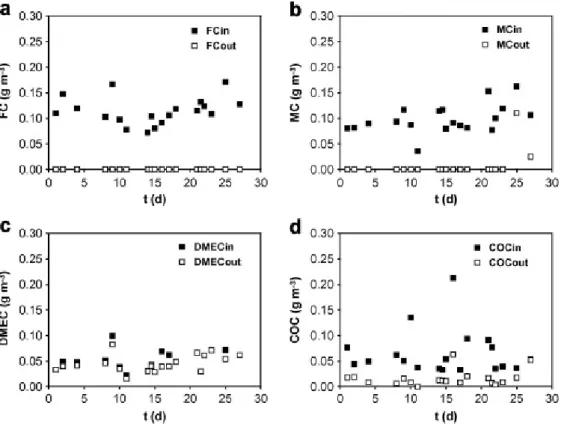
In a last study, the removal of mixtures of formaldehyde, methanol, dimethylether and carbon monoxide was studied in a conventional biofilter. Similar concentrations were fed to the reactor as those emitted from actual formaldehyde resin-producing industries, reaching up to 100 mg m−3 each for formaldehyde and methanol, and up to 50 mg m−3 each for dimethylether and carbon monoxide. The biofilter was packed with 1 l lava rock and operated with a downward flow, at room temperature, for one month. As in the previous studies, it was weekly fed a nutrient solution. Three different EBRTs were assayed during this experiment, namely 58 s (between days 0 and 14), 41 s (days 14– 21), and 30 s (days 21–28). Fig. 4 shows the removal of all four compounds during the experimental run.
The results presented in Fig. 4 show that both formaldehyde and methanol were degraded with efficiencies close to 100% during most of the experiment. This is consistent with the results obtained in the previous studies. Also, the elimination of low concentrations of carbon monoxide was possible with removal efficiencies always above 60%, proving that, at low inlet loads, its removal is feasible in biofilters, even when mixed with organic compounds. However, the performance of a series of similar bioreactors inoculated with pure cultures of O. carboxidovorans OM5 was not successful, as the strain was quickly overgrown by other invading organisms ( Prado et al., 2005a). On the other hand, the elimination of dimethylether was quite low during the study, as a consequence, mainly, of its poor biodegradability, and probably also due to its relatively low solubility in water. However, it is worth recalling that the toxicity and environmental impact of dimethylether is much weaker than that of the other compounds of the mixture. Fig. 5 shows how the decrease in the EBRT, from its original value of 58 s to 30 s, led to a slight decay in the removal efficiencies of methanol, dimethylether and carbon monoxide. The removal of formaldehyde, however, was not clearly affected, which is consistent with results presented elsewhere ( Prado et al., 2004a).
Fig. 5.
Effect of the EBRT on the removal efficiency of the four compounds. RE: removal efficiency. 4. Conclusions
sludge obtained from the wastewater treatment plant of one of these industries was employed as biocatalyst, demonstrated that the removal of formaldehyde and methanol is significantly faster than for dimethylether and carbon monoxide under similar conditions. An additional set of experiments, in which a pure culture of O. carboxidovorans OM5 was employed as biocatalyst for carbon monoxide removal, showed that the elimination of this compound was significantly enhanced with this specific microbial culture, even though its initial VSS concentration was around 10 times lower than that of the sludge used in the previous assays. However, the performance of conventional biofilters inoculated with a pure culture of this strain was worse than with sludge, due to the inability of this microorganism to effectively attach to the packing material and to compete with invading microorganisms.
It was proven that the use of hybrid two-stage bioreactors can overcome some of the problems commonly associated with the use of conventional biofilters (low or moderate maximum elimination capacities) and biotrickling filters (suboptimal removal efficiency) alone. When a mixture of formaldehyde and methanol, with average global loads around 20 and 270 g m−3 h−1, respectively, was fed to a hybrid biotrickling filter– biofilter system, average removal efficiencies above 99% were obtained for both pollutants in the two-stage bioreactor. As expected, even though both reactors had the same volume, more than 70% of the degradation took place in the first stage, the biotrickling filter, while the remainder off-gas was fully depurated in the second stage, the conventional biofilter.
The results obtained with a series of bioreactors fed gaseous mixtures of formaldehyde, methanol and dimethylether under different conditions allow to conclude that the elimination capacity of the latter is significantly lower than those of formaldehyde and methanol, as a consequence of its lower solubility in water and slow biodegradation. Maximum dimethylether elimination capacities around 10 g m−3 h−1 were obtained and maintained during a few weeks, although during most of the study, the average dimethylether elimination capacity was usually below 5 g m−3 h−1. However, considering the relatively low toxicity and environmental impact of the compound, these results can be considered satisfactory.
Acknowledgements
The present research was funded by project PPQ 2001-0557 of the Spanish Ministry of Education and Culture. The authors are also indebted to Dr. O. Meyer of the University of Bayreuth, Germany, for supplying the original Oligotropha carboxidovorans OM5 culture.
References
J.M. Chen, J. Wang, J.F. Ma
Effects of gas flow-rate and inlet concentration on nitric oxide removal in a autotrophic biofilter
D.E. Chitwood, J.S. Devinny, F.E. Reynolds
Evaluation of a two-stage biofilter for treatment of POTW waste air Environ. Prog., 18 (1999), pp. 212–221
D.S. Choi, J.S. Devinny, M.A. Deshusses
Behavior of field-scale biotrickling filter under nonsteady state conditions J. Environ. Eng. – ASCE, 130 (2004), pp. 322–328
M. Eiroa, A. Vilar, C. Kennes, M.C. Veiga
Formaldehyde biodegradation in the presence of methanol under denitrifying conditions J. Chem. Technol. Biotechnol., 81 (2006), pp. 312–317
E. Estévez, M.C. Veiga, C. Kennes
Biodegradation of toluene by the new fungal isolates Paecilomyces variotii and
Exophiala oligosperma
J. Ind. Microbiol. Biotechnol., 32 (2005), pp. 33–37 D. Gabriel, M.A. Deshusses
Retrofitting existing chemical scrubbers to biotrickling filters for H2S emission control Proc. Natl. Acad. Sci., 100 (2003), pp. 6308–6312
D. Hekmat, D. Vortmeyer
Biodegradation of poorly water-soluble volatile aromatic compounds from waste air Chem. Eng. Technol., 23 (2000), pp. 315–318
Hsu, S.K., Lai, T.J., Hsu, T.H., 2004. Performance study of a two-stage biofilter on volatile organic compounds from a polyurethane resin manufacturing factory. In: Devinny, J.S. (Ed.), Proceedings of the 2004 Conference on Biofiltration for Air Pollution Control, Redondo Beach, CA, USA, pp. 67–72.
Y. Jin, M.C. Veiga, C. Kennes
Bioprocesses for the removal of nitrogen oxides from polluted air J. Chem. Technol. Biotechnol., 80 (2005), pp. 483–494
C. Kennes, F. Thalasso
Waste gas biotreatment technology
J. Chem. Technol. Biotechnol., 72 (1998), pp. 303–319 C. Kennes, M.C. Veiga
Bioreactors for Waste Gas Treatment
Kluwer Academic Publisher, Dordrecht, The Netherlands (2001) p. 312 C. Kennes, M.C. Veiga
Inert filter media for the biofiltration of waste gases – characteristics and biomass control
Rev. Environ. Sci. Biotechnol., 1 (2002), pp. 201–214 C. Kennes, M.C. Veiga
S. Krailas, Q. Tuan Pham, R. Amal, J.K. Jiang, M. Heitz
Effect of inlet mass loading, water and total bacteria count on methanol elimination using upward flow and downward flow biofilters
J. Chem. Technol. Biotechnol., 75 (2000), pp. 299–305 E.Y. Lee
Continuous treatment of gas-phase trichloroethylene by Burkholderia cepacia G4 in a two-stage continuous stirred tank reactor/trickling biofilter system
J. Biosci. Bioeng., 96 (2003), pp. 572–574
H. Li, J.R. Mihelcic, J.C. Crittenden, K.A. Anderson
Field measurements and modeling of two-stage biofilter that treats odorous sulfur air emissions
J. Environ. Eng. – ASCE, 129 (2003), pp. 684–692 J. Máckowiak
Abschiedung von formadehyd aus der abluft im biofilter
A.J. Dragt, J. van Ham (Eds.), Biotechniques for Air Pollution Abatement and Odour Control Policies, Elsevier, Amsterdam, The Netherlands (1992), pp. 273–278
O. Meyer, H.G. Schlegel
Oxidation of carbon monoxide in cell extracts of Pseudomonas carboxydovorans
J. Bacteriol., 137 (1979), pp. 811–817 M. Mohseni, D.G. Allen
Biofiltration of mixtures of hydrophilic and hydrophobic volatile organic compounds Chem. Eng. Sci., 55 (2000), pp. 1545–1558
T. Nash
The colorimetric estimation of formaldehyde by means of the Hantzch reaction Biochem. J., 55 (1953), pp. 416–421
W.J.H. Okkerse, S.P.P. Ottengraf, R.M.M. Diks, B. Osinga-Kuipers, P. Jacobs
Long term performance of biotrickling filters removing a mixture of volatile organic compounds from an artificial waste gas: dichloromethane and methylmethacrylate Bioprocess Eng., 20 (1999), pp. 49–57
A.R. Pedersen, S. Møller, S. Molin, E. Arvin
Activity of toluene-degrading Pseudomonas putida in the early growth phase of a biofilm for waste gas treatment
Biotechnol. Bioeng., 54 (1997), pp. 131–141
Philip, L., Deshusses, M.A., 2002. Biological treatment of NOx and SO2. In:
Proceedings of the 95th Air and Waste Management Association’s Annual Conference and Exhibition. Baltimore, MD, USA.
Ó.J. Prado, J.A. Mendoza, M.C. Veiga, C. Kennes
Optimization of nutrient supply in a downflow gas-phase biofilter packed with an inert carrier
Ó.J. Prado, M. Eiroa, M.C. Veiga, C. Kennes
Bioreactors for the treatment of industrial waste gases containing formaldehyde and other aliphatic compounds in: S.N. Agathos, W. Reineke (Eds.), Focus on Biotechnology, Biotechnology for the Environment: Wastewater Treatment and Modeling, Waste Gas Handling, vol. 3C, Kluwer Academic Publishers, Dordrecht, The Netherlands (2003), pp. 259–273
Ó.J. Prado, M.C. Veiga, C. Kennes
Biofiltration of waste gases containing a mixture of formaldehyde and methanol Appl. Microbiol. Biotechnol., 65 (2004), pp. 235–242
Prado, Ó.J., Veiga, M.C., Kennes, C., 2004b. Biofiltration of waste gases from a synthetic resin-producing industry. In: 2004 USC-CSC-TRG Conference on Biofiltration. Redondo Beach, CA, USA.
Prado, Ó.J., Veiga, M.C., Kennes, C., 2005a. Biological treatment of mixtures of toxic compounds emitted from formaldehyde resin-producing industries. In: Kennes, C., Veiga, M.C. (Eds.), Proceedings of the International Congress on Biotechniques for Air Pollution Control. Servizo de Publicacións da Universidade da Coruña. A Coruña, Spain, pp. 391–396.
Ó.J. Prado, M.C. Veiga, C. Kennes
Treatment of gas-phase methanol in conventional biofilters packed with lava rock Water Res., 39 (2005), pp. 2385–2393
Ó.J. Prado, M.C. Veiga, C. Kennes
Effect of key parameters on the removal of formaldehyde and methanol in gas-phase biotrickling filters
J. Hazard. Mater., 138 (2006), pp. 543–548
A. Ruokojarvi, J. Ruuskanen, P.J. Martikainen, M. Olkkonen
Oxidation of gas mixtures containing dimethyl sulfide, hydrogen sulfide, and methanethiol using a two-stage biotrickling filter
J. Air Waste Manage., 51 (2001), pp. 11–16 Z. Shareefdeen, B.C. Baltzis, Y.S. Oh, R. Bartha Biofiltration of methanol vapor
Biotechnol. Bioeng., 41 (1993), pp. 512–524
G. Spigno, C. Pagella, D. Fumi, R. Molteni, D.M. de Faveri
VOCs removal from waste gases: gas-phase bioreactor for the abatement of hexane by
Aspergillus niger
Chem. Eng. Sci., 58 (2003), pp. 739–746
E.J. Wolfrum, A.S. Watt
Bioreactor design studies for a hydrogen-producing bacterium Appl. Biochem. Biotechnol., 98 (2002), pp. 611–625