
GREEN CORROSION INHIBITIONS FOR 1045 AND 1080 CARBON STEELS BY GARLIC IN DYNAMIC CONDITIONS FOR IN SULPHURIC ACID MEDIA
11
0
0
Texto completo
(2) XXIV INTERNATIONAL MATERIALS RESEARCH CONGRESS 2015 NACE International Congress-Mexican Section. Presenting author’s email: [email protected] 1. INTRODUCTION Corrosion is a general due to the alteration and destruction the most of metallic materials made for men. In recent years many searches are development to this type of damage for gives control alternatives and reduction of solutions (Ramírez-Reyes, 2005). Actually one of the most versatile methods is the use of inhibitors to reduce corrosion velocity. The corrosion reduces the time services of metallic components, these aspects is the most importance for control (Guang-Ling, 2014). The inhibitors are substances used at low concentration to control the corrosion effects in industrial process thought come in contact of aqueous solutions (). The inhibiting action of inhibitors is attributed to their adsorption to the metal/solution interface. It has been observed that adsorption depends mainly on certain physico-chemical properties of the inhibitor group. Like functional groups, aromaticity, electron density at the donor atoms and π-orbital character of donating electrons and also the presence of hetero-atom such as N, O and S, as well as multiple bonds in their molecular structure, are assumed to be active centers of adsorption (Rodríguez-Valdez et al, 2005). On the other hand, there are several reports showing that the inhibition efficiency of heteroatom containing compounds increase in the order O < N < S < P (Hmamou et al 2012a; Ghazoui, et al 2013; Guendouz, 2013). But the toxic of most corrosion inhibitors made us heading for the use of environment-friendly inhibitors (Barouni, 2008). This is the one of most important reason for search to green corrosion inhibitors, because they are friendly to the environmental and safe to man. Some studies made to the natural compound as corrosion inhibitors have proven this fact. In this way, organic and aqueous natural extracts of different plants are tested. Chenopodium ambrosioides (Rodríguez-Clemente et al 2011); Rosmarinus officinalis (Velázquez-González et al, 2014); Prosopis laeavigata (Ramírez-Arteaga et al, 2013); Eucalyptus globulus (Rekkab et al, 2012), Chamomile (Hmamou et al, 2012b). As well some fruits and species such as Grape pomace (da Rocha et al, 2012), Thymus vulgarise (Fouda et al, 2014); Avocado (Belkhaouda et al, 2013) and Capsicum annum (Ji et al, 2012) are studied as green corrosion inhibitors.. The natural and green corrosion inhibitors tested have been reported to be excellent inhibitors for metals and alloys in acid solutions. The inhibition efficiency effect of the Página. 2.
(3) XXIV INTERNATIONAL MATERIALS RESEARCH CONGRESS 2015 NACE International Congress-Mexican Section. natural extract can be attributed to adsorption of organic substances on the metals and alloys surface consequently blocking active sites or even forming a protective barrier (Amitha and Basu, 2012). This would be especially important if additives used from green extracts to be do oxidative stabilization (antioxidants) or corrosion protection as green corrosion inhibitors (Sulaiman et al, 2012). Many vegetal species know as antioxidants such as “garlic” (Allium sativum). For it reported at least 33 sulphur compounds which are responsible for pungent odour garlic and some important biological effects (Rahman and Lowe, 2006). The garlic bulb contains approximately 1% of alliin, moreover if the garlic is crushed or cut activates the enzyme allinase, which metabolizes alliin to allicin (Lawson, 1998). In order to contributing with the green corrosion inhibitors in the present work, the behavior of hexane extract of Allium sativum was evaluated at different concentrations as green corrosion inhibitor on carbon steel in 0.5 M sulfuric acid thought using some electrochemical techniques as potentiodynamic polarization and electrochemical impedance spectroscopy measurements.. 2. EXPERIMENTAL METHODOLOGY 2.1. Green organic inhibitor The Allium sativum, commonly known as garlic, was purchased commercially. The garlic bulbs were cleaned and cut in small pieces and put it in Erlenmeyer flask and extracted by maceration used hexane and left 24 h at room temperature. The solvent was eliminated by rotary evaporator. The solvent recovered was place back into the glass container with the garlic again this process was repeated twice times. The organic residue was considered hexane garlic extract. 2.2 Electrochemical measurements Prior to experiment, 1045 and 1080 carbon steel was cut into coupons of dimension 7.0 cm large and 1.0 cm diameter. Employed electrochemical techniques included potentiodynamic polarization curves and impedance spectroscopy measurements, EIS.. 2.3 Polarization curves and electrochemical impedance spectroscopy (EIS) Polarization curves for 1045 and 1080 carbon steels in acidic media were recorder at two different concentrations of A. sativum as green corrosion inhibitor; 400 ppm for 1045 carbon steel and 800 ppm for 1080 carbon steel. At a constant sweep rate of 1 mV/s at the interval from -300 to 300 mV respect to the Ecorr value. Measurements were obtained by using a conventional three electrodes glass cell with two graphite electrodes Página. 3.
(4) XXIV INTERNATIONAL MATERIALS RESEARCH CONGRESS 2015 NACE International Congress-Mexican Section. symmetrically distributed and saturated calomel electrode (SCE) as reference with a Lugging capillary bridge. EIS measurements were done at Ecorr by applying a sinusoidal signal with amplitude of 10 mV in the frequency range of 0.05-20000 Hz. Corrosion current density values, Icorr, were obtained by using Tafel extrapolation by taking an extrapolation interval of 250 mV around the Ecorr value. Inhibitor efficiency was calculated according the equation 1. (1) were icorr, and Icorrb are the corrosion current density values with and without inhibitors respectively.. A Zanher zenium potentiostat controlled by a desk top computer was used for the polarization curves, whereas for the EIS measurements. Electrochemical impedance spectroscopy (EIS) test carried out at Ecorr by using signal amplitude of 10 mV in a frequency interval of 100 mHz - 100 KHz. A VerSAT potentiostat controlled by a desk top computer was used for the polarization curves. Then data EIS can be calculated, the charge transfer resistance (Rct) and capacitance of the double electrochemical layer (Cdl) and the Rf represents the resistance of the corrosion products film and Cf its capacitance. However, the double-layer capacitance Cdl can also be calculated from the equation 2. (2) Were the frequency value at which the imaginary component of the impedance is maximal.. 3. RESULTS AND DISCUSSION 3.1 Electrochemical curves in dynamic conditions for corrosion inhibition employed A. sativum at 25 °C. The resistance to corrosion characterization were carried out polarization curves and EIS for 1045 and 1080 carbon steels in acid medium at 25 °C and at different rotations velocities as 0 to 2000 rpm. A. sativum was employed the optimal concentration of green corrosion inhibitor at 400 ppm to 1045 carbon steel and 800 ppm 1080 carbon steel. The rotatory dish is a dynamic test that allows to determining the mass transfer on the surface electrode, the solution flow makes a resisting to formation of the diffusion layer and the thickness depending on the speed. 3.2 Corrosion inhibition of 1040 carbon steel in acid media using 400 ppm of A. sativum as green inhibitor in dynamics conditions at 25 °C The polarization curves shown in the graphic 1, it is possible see the corrosion potential values (Ecorr) move to less negative values (-0.427 to -0.418 V), with the Página. 4.
(5) XXIV INTERNATIONAL MATERIALS RESEARCH CONGRESS 2015 NACE International Congress-Mexican Section. increased of rotational speed. Indicating that corrosion slows, the corrosion density do not affect with the rotational speed. However, the anodic current increase a little bet when the cathode current decreases (Lahhit et al 2011).. 0RPM 250RPM 500RPM 1000RPM 2000RPM. 0,6 0,4 0,2. E(V). 0,0 -0,2 -0,4 -0,6 -0,8 -1,0 1E-6. 1E-5. 1E-4. 1E-3. 0,01. 0,1. 2. Log i (A/cm ). Graphic 1. Polarization curves for 1045 carbon steel in 0.5 M H2SO4 employing 400 ppm of A. sativum at 25 °C in dynamic conditions. From the graphic 1 were extracted some dates and some other were calculated there were corrosion current (Icorr), corrosion potential (Ecorr), Tafel slopes for the anodic and cathode branches (a, c) and the corrosion velocity (Vcorr). All dates is displaying on the table 1. The best corrosion inhibition efficiency (IE %) was obtained at 2000 rpm. Table 1. Electrochemical parameters from polarization curves of 1045 carbon steel at 25 °C using 400 ppm of A. sativum as green corrosion inhibitor in dynamic conditions. Rotational speed (rpm) 0 250 500 1000 2000. Ecorr Icorr a c 2 (mVECS) (mA/cm ) (mV/dec) (mV/dec) -0.414 -0.427 -0.414 -0.418 -0.418. 0.068 0.986 0.214 0.214 0.947. 305 390 418 418 558. 590 625 405 405 540. IE (%) -93.1 68.2 68.2 72.4. The Nyquist diagrams were obtain with the same experiments and showing in the graphic 2. Is possible see a capacitive depressed semicircle, with shaft in the real center. The semicircle diameter decreased to increase the rotational speed; it was suggest the Página. 5.
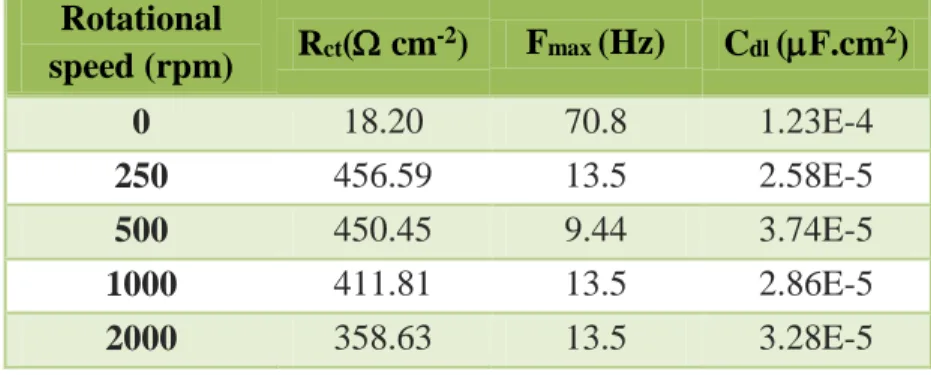
(6) XXIV INTERNATIONAL MATERIALS RESEARCH CONGRESS 2015 NACE International Congress-Mexican Section. velocity corrosion increased. Could be the oxygen mass transport increased on the metal surface by the rotation and producing a general oxidation (Pascale Bommersbach et al 2005, W. Stephen Tait 1994). -500. 0RPM 250RPM 500RPM 1000RPM 2000RPM. -450 -400 -350. Z"(). -300 -250 -200 -150 -100 -50 0 0. 50. 100. 150. 200. 250. 300. 350. 400. 450. 500. Z´(). Graphic 2. Nyquist diagram for 1045 carbon steel employed 400 ppm of A. sativum as green corrosion inhibitor at 25°C in dynamic conditions.. From the graphic 2 were obtained some dates and others were calculated as the resistance of charger transfer (Rct), maximum frequency (Fmax), and the double layer capacitance (Cdl), everything dates shown on table 2. Could observe the increased of rotational speed to denoted the efficiency of the inhibitor. (Bouckamp, 1993; Mac Donald, 1997). Table 2. Electrochemical parameters from EIS of 1045 carbon steel at 25 °C using 400 ppm of A. sativum as green corrosion inhibitor in dynamic conditions. Rotational speed (rpm). Rct( cm-2). Fmax (Hz). Cdl (F.cm2). 0 250 500 1000. 18.20 456.59 450.45 411.81. 70.8 13.5 9.44 13.5. 1.23E-4 2.58E-5 3.74E-5 2.86E-5. 2000. 358.63. 13.5. 3.28E-5. 3.3 Corrosion inhibition of 1080 carbon steel in acid media using 800 ppm of A. sativum as green inhibitor in dynamics conditions at 25 °C. Página. 6.
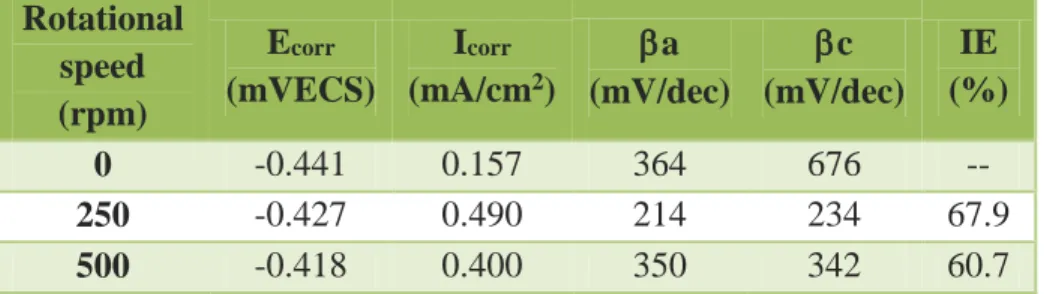
(7) XXIV INTERNATIONAL MATERIALS RESEARCH CONGRESS 2015 NACE International Congress-Mexican Section. In the polarization curves shown on graphic 3, the current density moves to anodic portion when the potential tends to take positive values. Because a desorption processes occurs of the layer formed for the corrosion products. However, when the potential is less it seems that the inhibitor reached to stable state, observe the cathodic branch, it was controlled by mass transport. It is possible see to change the low values current density when the rotational spped of electrode increased, this change correspond by hydrogen evolution, because the flow velocity don’t made effect. Is possible appreciate that the inhibitor affect the potential of corrosion in all cases, because it moves to noble potentials and it could probability formed a protecting layer on material surface and protects the metal of aggressive environment, it effect describes an anodic inhibitor, that the anodic reaction was modified. 0RPM 250RPM 500RPM 1000RPM 2000RPM. 0,6 0,4 0,2. E(V). 0,0 -0,2 -0,4 -0,6 -0,8 -1,0 1E-6. 1E-5. 1E-4. 1E-3. 0,01. 0,1. 2. Log i (A/cm ). Graphic 3. Polarization curves for 1080 carbon steel in 0.5 M H2SO4 employing 800 ppm of A. sativum at 25 °C in dynamic conditions. The electrochemical parameters obtained to polarization curves were processes and build the table 3. Is possible to seen that the 250 rpm produced the best inhibition efficiency percentage for the good corrosion current. Table 3. Electrochemical parameters from polarization curves of 1080 carbon steel at 25 °C using 800 ppm of A. sativum as green corrosion inhibitor in dynamic conditions. Rotational speed (rpm) 0 250 500. Ecorr Icorr a c 2 (mVECS) (mA/cm ) (mV/dec) (mV/dec) -0.441 -0.427 -0.418. 0.157 0.490 0.400. 364 214 350. 676 234 342. IE (%) -67.9 60.7. Página. 7.
(8) XXIV INTERNATIONAL MATERIALS RESEARCH CONGRESS 2015 NACE International Congress-Mexican Section. -0.427 -0.396. 1000 2000. 0.410 0.413. 323 342. 331 331. 61.7 61.9. The EIS dates show on the graphic 4. Depressed and flatter semicircles are observed in all rotation velocities employed. Diameter of semicircles decreases gradually according to increasing rotational speed (500, 1000 and 2000 rpm), only at 250 rpm shown the biggest semicircle (Rct = 350 cm-2) indicates the major opposition to charge by mass transportation control.. -350. 0RPM 250RPM 500RPM 1000RPM 2000RPM. -300. Z"(). -250. -200. -150. -100. -50. 0 0. 50. 100. 150. 200. 250. 300. 350. Z´(). Graphic 4. Nyquist diagram for 1080 carbon steel employed 800 ppm of A. sativum as green corrosion inhibitor at 25°C in dynamic conditions.. The organized and classified date’s derivatives of Nyquist diagram are showing on table 4. Table 4. Electrochemical parameters from EIS of 1080 carbon steel at 25 °C using 800 ppm of A. sativum as green corrosion inhibitor in dynamic conditions. Rotational speed (rpm) 0 250 500 1000 2000. Rct (cm-2). Fmax (Hz). Cdl (F.cm2). 59.18 299.72 300.95 258.95 253.36. 13.5 18.7 13.5 13.5 13.5. 1.99E-4 2.83E-5 3.91E-5 4.55E-5 4.65E-5. Página. 8.
(9) XXIV INTERNATIONAL MATERIALS RESEARCH CONGRESS 2015 NACE International Congress-Mexican Section. Total results of all experiments obtained by EIS could be observed better on the table 5. Observing that the dynamic conditions that give the best corrosion efficiency inhibition, in both metals was at 250 rpm. Nothing that the A. sativum produced 95.4% corrosion efficiency inhibition to 1045 carbon steel and 82.3% corrosion efficiency inhibition to 1080 carbon steel. Table 5. EIS results from A. sativum as green corrosion inhibitor in dynamic conditions for both metals. 1045 carbon steel with 400 ppm of green inhibitor. 1080 carbon steel with 800 ppm of green inhibitor. V(rpm). EI (%). V(rpm). EI (%). 250. 95.4. 250. 82.31. 500. 95.4. 500. 79.74. 1000. 94.1. 1000. 79.74. 2000. 95. 2000. 77.35. CONCLUSIONS In dynamic conditions was possible inhibit the corrosion of 1040 and 1080 carbon steels in acid media thought employed A. sativum as green corrosion inhibitor at room temperature. The bets corrosion efficiency inhibition was obtained by EIS at 250 rpm for both metals, there were 82.3% for 1040 carbon steel and 82.3% for 1080 carbon steel.. BIBLIOGRAPHY Amitha Rani, B. E. and Basu, B. B. J. (2012) Green Inhibitors for Corrosion Protection of Metals and Alloys: An Overview, International Journal of Corrosion, Article ID 380217, 15 pages, 2012. doi:10.1155/2012/380217 Barouni, K., Bazzi, L., Salghi, R., Mihit, M., Hammouti, B., Albourine, A., El Issami, S. (2008) Some amino acids as corrosion inhibitors for copper in nitric acid solution. Materials Letters, 62(19): 3325-3327. Belkhaouda, M., Bammou, B., Salghi, R., Zarrouk, A., Ebenso, E. E., Zarrok, H., Hammouti, B. (2013) Inedible avocado extract: an efficient inhibitor of carbon steel corrosion in hydrochloric acid. International Journal of Electrochemical Science, 8: 10987-10999. da Rocha, J. C., Ponciano Gomes, J. A. C., D’Elia, E., Gil Cruz, A. P. and Cabral, L. M. Página. 9.
(10) XXIV INTERNATIONAL MATERIALS RESEARCH CONGRESS 2015 NACE International Congress-Mexican Section. C. (2012) Grape pomace extracts as green corrosion inhibitors for carbon steel in hydrochloric acid solutions. International Journal of Electrochemical Science, 7: 11941-11956. Fouda, A. S., Shalabi, K., Idress, A. A. (2014) Thymus vulgarise extract as nontoxic corrosion inhibitor or copper and -Brass in 1M HNO3 solutions. International Journal of Electrochemical Science, 9: 5123-5154. Ghazoui, A. Bencaht, N., Al-Deyab, S. S., Zarrouk, A., Hammouti, B., Ramdani, M., Guenbour, M. (2013) An investigation of two novel pyridazine derivatives as corrosion inhibitor for C38 steel in 1M HCl. International Journal of Electrochemical Science, 8: 2272-2292. Guang-Ling S. (2014) The grand challenges in electrochemical corrosion research. Frontiers in materials, 1(2): 1-3 Guendouz, A., Mossoum, N., Chetouani, A., Al-Deyab, S. S., Cheikhe, B. B., Boussalah, N. Hammouti, B., Taleb, M., Aouniti, A. (2013) Quantum chemical studies on the inhibition effect of new synthesized bipyrazols of C38 steel corrosion in 1M HCl. International Journal of Electrochemical Science, 8: 4305-4327 Hmamou, D. B., Aouad, M. R., Salghi, R., Zarrouk, A., Assouag, M., Benali, O., Messali, M., Zarrok, H., Hammouti, B. (2012a) Inhibiting effects 4,5-diphenyl-1Himidazole-2-thiol for C38 steel in 1M HCl: electrochemical study. Journal of Chemical and Pharmaceutical Research, 4(7): 3489-3497. Hmamou, D. B., Salghi, R., Zarrouk, A., Hammouti, B., Al.Deyab, S. S., Bazzi, L. Zarrok, H., Chakir, Bammou, L. (2012b) Corrosion inhibition of steel in 1M hydrochloric acid medium by Chamomile essential oils. International Journal of Electrochemical Science, 7: 2361-2373. Ji, G., Shukla, S. K., Dwivedi, P., Sundaram, S., Ebenso, E. E., Prakash, R. (2012) Green Capsicum annuum fruit extract for inhibition of mild steel corrosion in hydrochloric acid solution. International Journal of electrochemical Science, 7: 12146-12158 Lawson LD. (1998) Garlic: a review of its medicinal effects and indicated active compounds. In: Lawson LD, Bauer R, eds. Phytomedicines of Europe: Chemistry and Biological Activity. Washington, D. C. American Chemical Society: 177-209 Rahman K. and Lowe, G. M. (2006) Garlic and cardiovascular disease: a critical review. Journal of Nutrition, 136(3): 7365-7405. Ramírez-Arteaga, M, Valladares, M. G., González Rodríguez, J. G. (2013) Use of Prosopis leavigata as a corrosion inhibitor for Al in H2SO4. International Journal of Electrochemical Science, 8: 4305-4327 Ramírez Reyes J. L., Métodos Experimentales en la Ciencia de la Corrosión, Ed. Instituto de Ingeniería, UV, Veracruz (2007). Rekkab, S., Zarrok, H., Salghi, R., Zarrouk, A., Bazzi, Lh., Hammouti, B., Kabouche, Z., Touzani, R., Zougagh, M. (2012) Green corrosion inhibition from essential oil of Página. 10.
(11) XXIV INTERNATIONAL MATERIALS RESEARCH CONGRESS 2015 NACE International Congress-Mexican Section. Eucalyptus globulus (Myrtaceae) for C38 steel in sulfuric acid solution. Journal Materials and Environmental Science, 3(4): 613-627. Rodríguez-Clemente, E., González-Rodríguez, J. G., Valladares, G., Domínguez-Patiño, G. F. (2011) Corrosion inhibition of carbon steel in H2SO4 by Chenopodium ambrosioides. International Journal of Electrochemical Science, 6: 6360-6372. Rodríguez-Valdez, L. M., Martínez-Villafañe, A. and Glossman-Matnik, D. (2005) Computational simulation of the molecular structure and properties of heterocyclic organic compounds with possible corrosion inhibition properties. Journal of Molecular Structure: THEOCHEM. 713(1-3): 65-70. Sulaiman, S., Nor-Anuar, A., Abd-Razak, A. S. and Chelliapan, S. (2012) A study of using Allium cepa (Onion) as natural corrosion inhibitor in industrial Chilli wasterwater system. Research Journal of Chemical Sciences, 2(5): 10-16 Velázquez-González, M. A., González-Rodríguez, J. G., Valladares-Cisneros, M. G. and Hermoso-Díaz, I. A. (2014) Use of Rosmarinus officinalis as Green corrosion inhibitor for carbon steel in acid medium. American Journal of Analytical Chemistry, 5: 55-64.. Página. 11.
(12)
Figure


+2

Documento similar
The electrochemical properties of the compounds were analyzed in order to use as corrosion inhibitors for the iron steel surface; in addition, a relationship between the
We derive a simple analytical closed expression for the dissipated power versus the oscillation amplitude which is in good agreement with the results of numerical simulations..
Carbon corrosion is considered as a major cause for meso- and macroscale loss in performance. Further, the corrosion can also lead to the dissolution of active sites,
critical pitting potential (E pit ), which is characterized by a sharp and irreversible increase in the current density. In the case of stainless steels, due to their high
Reviewing the challenges for the participation in international trade and possible integration into GVCs by Tanzania’s SMEs, the results show that the major challenges for
8-10, are depicted wind speed sequence, the simulated rotor speed and the output power, respectively, for the wind turbine simulated. The characteristics of the wind turbine
Interrelation between modes of carbon assimilation and energy production in photosynthetic purple and green bacteria.. University Park
In this guide for teachers and education staff we unpack the concept of loneliness; what it is, the different types of loneliness, and explore some ways to support ourselves
