Effect of High Pressure Carbon Dioxide (HPCD)
Treatment on Enzyme Inactivation and Other Properties
of Tomato Juice
E. Trigueros, A. E. Illera, M. T. Sanz, R. Melgosa, Á. G. Solaesa and S. Beltrán*
Dep. Biotechnology and Food Science. Chemical Engineering Section. Faculty of Science. University of Burgos. Plaza Misael Bañuelos s/n. 09001 Burgos Spain. *[email protected]
ABSTRACT
Among the recent non-thermal technologies developed, HPCD treatment has been shown to be effective for the inactivation of microorganisms and enzymes avoiding food exposure to the adverse effects of high temperatures. Processing of tomato juice can result in a modification of its consistency and a decrease of its viscosity due to the activity of enzymes such as pectinmethylesterase (PME), polygalacturonase (PG). Peroxidase (POD) catalyzes oxidation reactions related to the production of undesirable flavours and colours. The main objective of this work was to study the effect of the HPCD technology on tomato juice. The influence of HPCD process parameters such as pressure (8.5 - 20 MPa) and temperature (35 and 45 ºC) on the inactivation kinetics of PME, PG and POD and physical parameters such as pH and particle size distribution was evaluated. Results showed that increasing pressure and temperature decreased the residual activity of the enzymes evaluated. The results obtained showed a higher efficiency of the HPCD technology regarding the high pressure processing (HPP) technology since the pressure required to achieve enzymatic inactivation by HPCD (8.5 – 20 MPa) are well below the pressure required by HPP (600-800 MPa) for the same purpose. HPCD technology uses much softer processing conditions that modify the tomato juice to a lesser extent and achieve a greater degree of enzymatic inactivation. The tomato juice pH value (4.1 ± 0.1) did not change significantly (p ≤ 0.05) before and after HPCD treatment. The particle size distribution (PSD) of the tomato juice was bimodal, with a particle diameter that shifted towards lower sizes after HPCD treatment, indicating that homogenization is favoured by this treatment.
INTRODUCTION
The food industry has begun to develop new non-thermal technologies to produce healthy, nutritious and minimally processed products due to the changing demands of the consumers and to tackle with some of the drawbacks of the traditional technologies for food preservation. Among the recent non-thermal technologies developed, high-pressure carbon dioxide (HPCD), also known as dense phase carbon dioxide (DPCD) or cold pasteurization, is a method that is effective in inactivating microorganisms and enzymes by avoiding exposing food to the adverse effects of high temperatures (1,2). The effect of pressurized carbon dioxide on the activity of some enzymes will depend on the source and type of enzyme, the nature of the substrate, the pressure used, the treatment time and the process temperature (2).
affecting the texture of the juice (3). PME modifies the pectin structure by catalysing its de-esterification, thereby releasing methanol and pectic acid with lower degree of de-esterification, while PG hydrolyzes α-ᴅ-(1-4)glycosidic bonds in pectin, decreasing the degree of polymerization of the pectin and thus increasing its solubility, which decreases the viscosity and causes destabilization of the cloud or turbidity characteristic of the juice. The actions of these enzymes are synergistic, since the de-methylated pectin is the preferred substrate for the catalytic action of PG. The loss of turbidity is related to the interaction of the de-esterified pectin with the calcium ions present in the juice causing the formation of calcium pectate, which precipitates together with the particles of the pulp. A low consistency will not help to retain the solid fraction in suspension, resulting in the separation of pulp and serum. This is known as "syneresis" (4). These enzymes are usually totally or partially inactivated by heat treatments, such as hotbreak (75-100ºC) or coldbreak (60ºC), which, as mentioned above, implies losses of quality on taste, colour and nutritional value (5,6). Alternatively, high pressure technologies carried out at room temperature allow quality preservation as well as enzymatic inactivation, thus avoiding the undesirable effect of syneresis (7). Peroxidase (POD) is an enzyme found in tomato that catalyses a large number of reactions in which peroxides are reduced while an electron donor is oxidized. The presence of this enzyme has been related to the production of undesirable flavours and colours in raw vegetables; thus, its inactivation will prolong vegetables shelf life (8).
The HPCD technology, which uses lower temperatures than those used in heat treatment, allows enzymes inactivation and food quality preservation; however, despite promising applications featuring HPCD technology, more research is needed to support it as a routine application technology for processing different juices. Specifically, this work focuses on the HPCD processing of tomato juice that, to our knowledge, has not been reported so far. The effect of some HPCD parameters (pressure and temperature) on the inactivation kinetics of PME, PG and POD and certain properties (pH and particle size distribution) of tomato juice are analysed.
MATERIALS AND METHODS Sample preparation
Tomato juice was prepared from fresh, red tomatoes of the "Canary" variety acquired in the local market with a homogeneous size, colour and appearance. They were crushed with a blender after removing the upper and lower parts. The resulting juice was filtered with a homemade strainer for removing seeds and peels. The resulting juice was transferred to flaks to kept it in the freezer until treatment and analysis.
Tomato juice processing
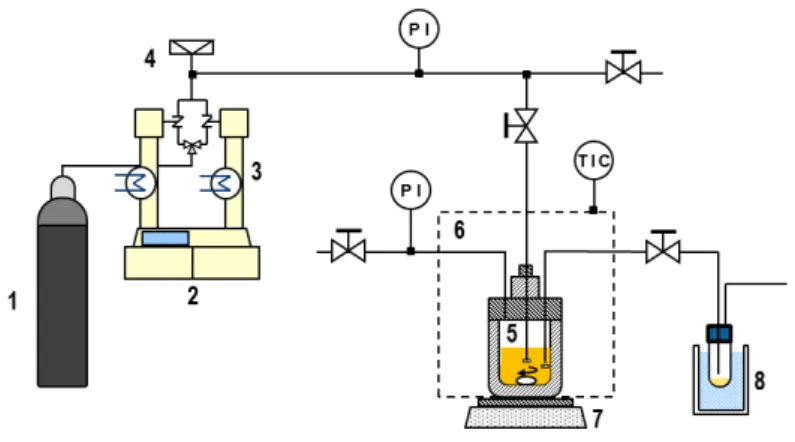
The tomato juice was introduced into a 100 mL capacity stirred vessel connected to a pressure set (see Figure 1). Once the vessel was closed, it was placed in a thermostatic bath at the working temperature. Subsequently, CO2 was introduced up to achieving the working pressure. Samples were withdrawn at regular intervals to determine the inactivation kinetics of PME, PG and POD. Some samples were only treated with heat for comparison.
Determination of enzymatic activity
Figure 1. Schematic diagram of the high pressure system used for HPCD treatment. 1: CO2 supply; 2: Syringe
pump and controller (ISCO 260D); 3: Cooling system; 4: Rupture disc; 5: High pressure vessel; 6: Thermostatic bath; 7: Magnetic stirrer; 8: Sampling system.
Determination of Physical properties
pH was determined with a pH meter (Crison GLP 22) and particle size distribution (PSD) with a particle analyser (Malvern®Mastersizer 2000). The equipment employs laser diffraction techniques which provide a volume distribution of the sample. The laser operates at a wavelength of 750 nm to measure the light diffraction produced by particles with a diameter between 0.4 μm and 2000 μm.
Statistical analysis
An analysis of variance (ANOVA) was used to establish statistically significant differences between treatments at p ≤ 0.05. For this purpose Statgraphics Centurion XVI.II was used.
RESULTS
Enzymatic inactivation by HPCD
Effect of temperature
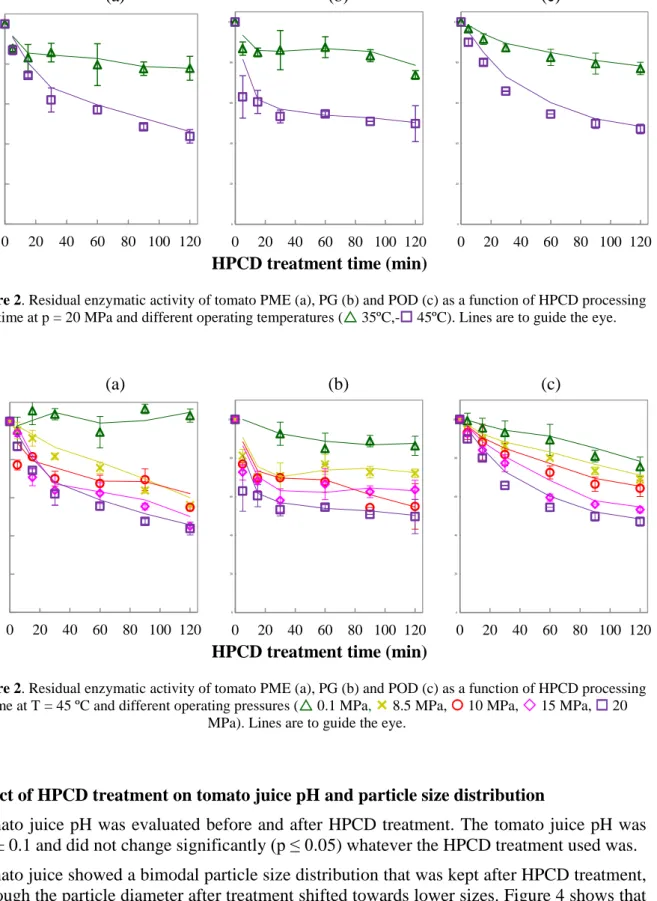
The inactivation kinetics of tomato PME, PG and POD at 20 MPa and two different operating temperatures (35 & 45 °C) are presented in Figure 2. As can be observed, at constant pressure, the higher the working temperature the faster are the inactivation kinetics in all cases. The enzymatic inactivation increases with temperature due to the intrinsic effect of temperature and to the increase of CO2 diffusivity that can accelerate the molecular collisions between CO2 and enzymes.
The effect of temperature on conventional thermal treatments has been widely reported in the literature, always proving that increasing temperature results in greater inactivation (10,13,14).
Effect of pressure
Figure 3 presents the inactivation kinetics of PME, PG and POD in the pressure range of 0.1 to 20 MPa at the working temperature of 45 °C. It can be observed that as the pressure increases, the residual activity of the enzymes decreases.
to achieve a significant reduction of the PG activity by HPP at mild temperatures, pressures should be higher than 400 MPa (3,10,14,16,17). The pressure levels required to inactivate POD seem to be lower than those required for PME or PG inactivation (18,19).
(a) (b) (c)
HPCD treatment time (min)
Figure 2. Residual enzymatic activity of tomato PME (a), PG (b) and POD (c) as a function of HPCD processing
time at p = 20 MPa and different operating temperatures ( 35ºC,- 45ºC). Lines are to guide the eye.
(a) (b) (c)
HPCD treatment time (min)
Figure 2. Residual enzymatic activity of tomato PME (a), PG (b) and POD (c) as a function of HPCD processing
time at T = 45 ºC and different operating pressures ( 0.1 MPa, 8.5 MPa, 10 MPa, 15 MPa, 20
MPa). Lines are to guide the eye.
Effect of HPCD treatment on tomato juice pH and particle size distribution
Tomato juice pH was evaluated before and after HPCD treatment. The tomato juice pH was 4.1 ± 0.1 and did not change significantly (p ≤ 0.05) whatever the HPCD treatment used was.
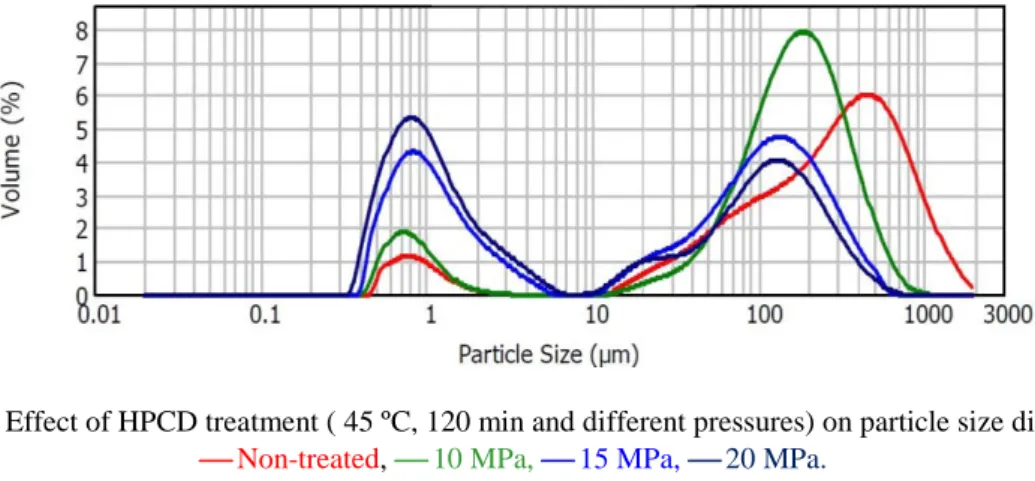
Tomato juice showed a bimodal particle size distribution that was kept after HPCD treatment, although the particle diameter after treatment shifted towards lower sizes. Figure 4 shows that
there is an increase in the number of smaller particles, while the size of the larger particles decreased, so that HPCD seems to favour juice homogenization.
Figure 4. Effect of HPCD treatment ( 45 ºC, 120 min and different pressures) on particle size distribution.
Non-treated, 10 MPa, 15 MPa, 20 MPa.
CONCLUSION
HPCD technology is a clean alternative to traditional heat treatments, which mainly affects non-covalent bonds, so nutritional quality will hardly be affected. In addition to not generating adverse effects, this technology has demonstrated the potential of inactivating PME, PG and POD, the main enzymes responsible for the deterioration of tomato juice. Besides inactivating these enzymes, HPCD is also capable of favouring the homogenization of the product without modifying the juice pH, thus achieving a product of higher quality and better visual appearance, which presents greater appeal to the consumer. However, there is a lack of research on the effects of this technology, which makes explicit the need of studies with the objective of determining the effects of the different HPCD parameters on the tomato juice properties.
ACKNOWLEDGEMENTS
To the Spanish Government (MINECO) and the European Regional Development Fund (ERDF) for financial support of project CTQ2015-64396-R and AEI’s contract. To MINECO for RM’s doctoral contract (BES-2013-063937). To University of Burgos for AGS’s pre-doctoral contract
REFERENCES
[1] ZHOU L, BI X, XU Z, YANG Y, LIAO X. Crit. Rev. Food Sci. Nutr. 2015; 55(6):750–68.
[2] GARCIA-GONZALEZ L, GEERAERD AH, SPILIMBERGO S, ELST K, VAN GINNEKEN L,
DEBEVERE J, ET AL. Int. J. Food Microbiol. 2007; 117(1):1–28.
[3] SHOOK CM, SHELLHAMMER TH, SCHWARTZ SJ. J. Agric. Food Chem. 2001; 49(2):664–8.
[4] PORRETTA S, BIRZI A, GHIZZONI C, VICINI E. Food Chem. 1995; 52(1):35–41.
[5] GOULD WA. Tomato Production, Processing and Technology. Baltimore, Maryland, USA: CTI
PUBLICATIONS INC.; 1992.
[6] ANTHON GE, SEKINE Y, WATANABE N, BARRETT DM. J. Agric. Food Chem. 2002; 50(21):6153–
9.
[7] KREBBERS B, MATSER AM, HOOGERWERF SW, MOEZELAAR R, TOMASSEN MMM, BERG
[8] ERCAN SS, SOYSAL Ç. Ultrason Sonochem. 2011; 18(2):689–95.
[9] WOOD W, KELLOGG S. Methods in Enzymology, Volume 161. Biomass, Part B: Legnin, Pectin, and
Chitin,. Academic Press Inc.; 1988.
[10] FACHIN D, VAN LOEY AM, LY NGUYEN B, VERLENT I, INDRAWATI A, HENDRICKX ME.
Innov. Food Sci. Emerg. Technol. 2003; 4(2):135–42.
[11] PRESSEY R. Eur J Biochem. 1984; 144(2):217–21.
[12] SOYSAL Ç, SÖYLEMEZ Z, BOZOǦLU F. Eur. Food Res. Technol. 2004; 218(2):152–6.
[13] BOULEKOU S, MALLIDIS C, TAOUKIS PS, STOFOROS NG. Procedia Food Sci. 2011; 1(0):800–4.
[14] VERLENT I, VAN LOEY A, SMOUT C, DUVETTER T, HENDRICKX ME. Biotechnol Bioeng. 2004;
86(1):63–71.
[15] VAN DEN BROECK I, LUDIKHUYZE LR, VAN LOEY AM, HENDRICKX ME. J. Agric. Food
Chem. 2000; 48(2):551–8.
[16] TANGWONGCHAI R, LEDWARD DA, AMES JM. J Agric Food Chem. 2000; 48(5):1434–41.
[17] CRELIER S, ROBERT M, CLAUDE J, JUILLERAT M. J Agric Food Chem. 2001; 49:5566–5575.
[18] HERNÁNDEZ A, CANO MP. J Agric Food Chem. 1998; 46(1):266–70.