Organic &
Biomolecular Chemistry
PAPER
Cite this:DOI: 10.1039/c4ob00444b
Received 26th February 2014, Accepted 9th May 2014
DOI: 10.1039/c4ob00444b
www.rsc.org/obc
Experimental and theoretical studies on the e
ff
ect
of the oxo group in 1,4-benzodiazepines
Q1
†
Pablo Pertejo,
aMaría García-Valverde,*
aPablo Peña,
aNicolás A. Cordero,
bTomás Torroba
aand Alfonso González-Ortega
Q2 c
Two families of regioisomeric 1,4-benzodiazepines, 4-benzyl-3H-benzo[e][1,4]diazepin-5-ones and 4-benzoyl-4,5-dihydro-3H-benzo[e][1,4]diazepines, have been synthesized through a similar Ugi/ reduction cyclization sequence. Their conformation and stability depend on the position of the tauto-meric imine/enamine equilibrium present in the diazepine nucleus, which in turn depends on the relative position of the carbonyl group adjacent to the nitrogen at the 4-position in the benzodiazepine system. Moreover, the electrophilic center on the imine tautomer is essential for the antitumor activity of some benzodiazepines as a DNA binding position. The mechanism of tautomerization in the presence or absence of the oxo group has been studied computationally using DFT methods (B3LYP/6-31G** level).
Introduction
The Ugi reaction followed by post-condensation transform-ations constitutes a powerful synthetic tool for the preparation of pseudopeptidic structures.1 The synthesis of peptidomi-metics capable of mimicking β-turn structures has gained interest for the discovery of new therapeutic agents, since the interaction between the peptide ligands and their receptor targets usually implies these structures.2An approach to con-struct peptidomimetics involves the design of conformation-ally restricted analogs by incorporation of heterocycles to improve the characteristics of the receptor-bound confor-mation of the endogenous peptide.3
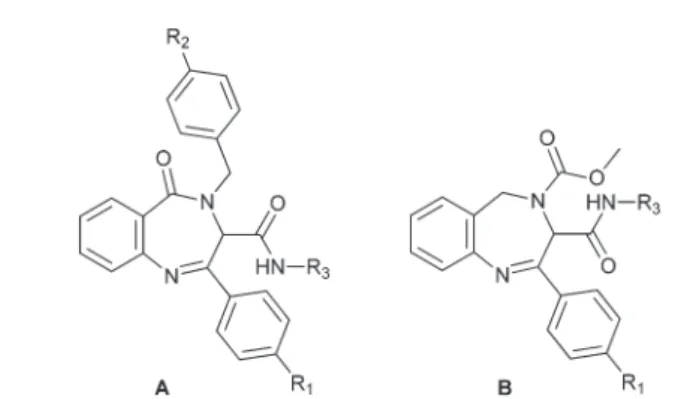
Following this strategy, we recently described the synthesis of a new group of pseudopeptidic 3H-benzo[e ][1,4]diazepin-5(4H)-onesA(Fig. 1) by a sequential Ugi reaction–Staudinger/ aza-Wittig cyclization.4 Interestingly, the backbone of these heterocycles superimposes well with β-turn motifs, such as those in the δ antigen, LDL receptor module, acetyl-CoA carboxylase and erabutoxin B,5 which makes them useful candidates for designing new drugs.
Additionally a new series of 4-methoxycarbonyl-4,5-dihydro-3H-benzo[e][1,4]diazepines B (Fig. 1) has been described as
intermediates in the synthesis of fused hydantoin– benzo-diazepines.6The synthesis of these intermediates was carried out by a sequential Ugi reaction–deprotection cyclization employing an Ugi-5-component CO2 mediated condensation. We thought that the similitude of intermediatesBwith benzo-diazepinesAwould be a good starting point in the design of new pseudopeptidic structures.
Following this idea, we planned the synthesis of two different families of regioisomeric benzodiazepines, 4-benzyl-3H-benzo[e][1,4]diazepin-5(4H)-ones typeA and 4-benzoyl-4,5-dihydro-3H-benzo[e][1,4]diazepines analogous to intermediate
B, following a similar strategy. In the course of this work, we have observed that the position of the carbonyl group is crucial in the evolution of the imine–enamine tautomeric equi-librium present in the diazepine nucleus, which in turn is crucial for the conformation and stability of these systems and therefore for the development of new drugs. On the basis of the experimental results, we have carried out computational
Fig. 1 1,4-Benzodiazepines synthesized using the Ugi reaction.
†Electronic supplementary information (ESI) available: Spectra of all new compounds and computational data. See DOI: 10.1039/c4ob00444b
aChemistry Department, Faculty of Science, University of Burgos, 09001-Burgos,
Spain Q3
b
Physics Department, Higher Polytechnic School, University of Burgos, 09001-Burgos, Spain
c
Organic Chemistry Department, Faculty of Science, University of Valladolid, 47011-Valladolid, Spain
1
5
10
15
20
25
30
35
40
45
50
55
1
5
10
15
20
25
30
35
40
45
50
studies to explain the different behaviors of these regioisomers.
Results and discussion
Looking for a general method for the synthesis of both families of benzodiazepines we thought that the method-ologies previously developed for the synthesis of benzo[e ][1,4]-diazepine-5-ones A4 or 4,5-dihydro-3H-benzo[e][1,4]diazepines
Bhad several drawbacks. On the one hand, the Ugi– Staudin-ger/aza-Wittig methodology described in the synthesis of A
used 2-azidobenzoic acid as the starting material for the Ugi reaction. This reagent had to be synthesized from anthranilic acid and sodium azide7and the potential explosion hazard of azides discourages the use of this process.8Moreover the Stau-dinger/aza-Wittig sequence requires anhydrous conditions, an inert atmosphere and generates large quantities of triphenyl-phosphine oxide which had to be eliminated by chromato-graphy.9 On the other hand, the sequence Ugi/deprotection cyclization described in the synthesis of 4,5-dihydro-3H -benzo-[e][1,4]diazepines B6 used ortho-N-Boc-benzylamine as the starting amine in the Ugi reaction, an amine that had to be synthesized from 2-aminobenzylamine in a three-step sequence resulting in a global process with a poor atom economy.10
These drawbacks prompted us to attempt a new sequence to overcome them, looking for a more ecofriendly, simple and scalable methodology, and basically a methodology easily applicable to the synthesis of both families of benzodiazepines under study in order to be able to compare the results obtained from their syntheses.
In this way we decided to use the Ugi reaction followed by a reduction cyclization sequence, choosing the nitro group as a masked amino group for subsequent cyclizations. Therefore, in the synthesis of benzo[e][1,4]diazepine-5-onesA, we selected the commercially available 2-nitrobenzoic acid in place of 2-azidobenzoic acid as the carboxylic acid component in the Ugi reaction. Following the most common procedure,11 the corresponding imine was pre-formed by mixing substituted benzylamine2a–e(1 equiv.) with a solution of arylglyoxal1a–b
(1 equiv.) in methanol. Alkyl isocyanide 4a–b (1 equiv.) and 2-nitrobenzoic acid3(1 equiv.) were then added to the imine solution and the mixture was stirred at room temperature for one day until precipitation of Ugi products 5. Filtration and recrystallization of the solid afforded the Ugi adduct exclu-sively as an enol tautomer on the basis of NMR spectra (Table 1).4
The conversion of Ugi adducts5to 5-oxobenzo[e ][1,4]diaze-pin-3-carboxamides 6 was accomplished by reduction of the nitro group with subsequent cyclization. The key factor in the choice of the reduction methodology was the tolerance toward
Table 1 Synthesis of benzo[e][1,4]diazepine-5-ones from 2-nitrobenzoic acid
Entry 1(R1) 2(R2) 4(R3) 5a(%) Metal/acid 6a(%)
1 1a(H) 2a(H) 4a(cC6H11) 5a(65) Fe/AcOHb 6a(41)
2 Fe/HClc 6a(89)e
3 SnCl2/HCld 6a(85)
4 1a(H) 2b(CH3) 4a(cC6H11) 5b(64) SnCl2/HCld 6b(84)
5 1a(H) 2c(OCH3) 4a(cC6H11) 5c(66) SnCl2/HCld 6c(91)
6 1a(H) 2d(F) 4a(cC6H11) 5d(65) SnCl2/HCld 6d(84)
7 1a(H) 2e(Cl) 4a(cC6H11) 5e(65) SnCl2/HCld 6e(87)
8 1b(F) 2a(H) 4a(cC6H11) 5f(57) SnCl2/HCld 6f(82)
9 1a(H) 2a(H) 4b(CH2C6H5) 5g(66) SnCl2/HCld 6g(83)
10 1a(H) 2b(CH3) 4b(CH2C6H5) 5h(63) SnCl2/HCld 6h(81)
11 1a(H) 2c(OCH3) 4b(CH2C6H5) 5i(69) SnCl2/HCld 6i(83)
12 1a(H) 2e(Cl) 4b(CH2C6H5) 5j(61) SnCl2/HCld 6j(87)
aIsolated yields.bFe (10 equiv.), acetic acid, 70 °C, 3 h.
Q5 cFe (10 equiv.), HCl (3 equiv.), ethanol, reflux, 45 min.dSnCl
2(10 equiv.), HCl (3 equiv.),
ethanol, reflux, 45 min.eIsolated yield of benzodiazepine6awhen the reduction was quantitative.
1
5
10
15
20
25
30
35
40
45
50
55
1
5
10
15
20
25
30
35
40
45
50
other functional groups present in reactants and/or products such as ketones, imines, benzyl amides or aryl halides.
Initially we investigated the use of iron in acetic acid,12but the reduction took place with poor conversion (Table 1, entry 1). We then tried the reduction with iron and hydro-chloric acid in hot ethanol,13and although the initial results were promising (Table 1, entry 2), conversions were not consistent from run to run, depending on several factors such as temperature, concentration or stirring efficiency.14
Looking for a more robust method, we studied the reducing ability of stannous chloride in the presence of hydrochloric acid.15Fortunately the reduction using this system took place with high reproducibility and high yield for many different substituents (Table 1). The typical procedure followed was treatment of the suspension of the Ugi adducts5 in ethanol with stannous chloride (10 equiv.) and hydrochloric acid solu-tion 0.6 M (3 equiv.). These reacsolu-tions were performed at reflux with full conversion within 45 minutes.
We found several advantages in the reduction methodology chosen, such as the cost and ready availability of the reducing agent which can tolerate a variety of reducible functionalities, the high yields and short reaction times, the simple
purifi-cation of products by recrystallization, the lack of need for an inert atmosphere or dry solvents as that required for the Stau-dinger/aza-Wittig reaction, the high efficiency of the reaction, relatively insensitive to small changes in reagents concen-tration or time, and the relatively easy disposal of the non-toxic residues. Additionally, this methodology was readily applicable to the synthesis of other series of benzodiazepines we were interested in.
In this way, the second family of benzodiazepines, the 4-benzoyl-4,5-dihydro-3H-benzo[e][1,4]diazepines, was syn-thesized by applying a similar methodology to that described above, in only two steps from the commercial products. We started from commercial 2-nitrobenzylamine 7 as the amine component containing the nitro group for further cyclization. Its reaction with phenylglyoxal 1a, alkyl isocyanide 4a–band carboxylic acid8a–cin the typical procedure10yielded the Ugi adducts9. The similar characteristics of Ugi adducts5and 9
allowed us to apply the optimized reduction conditions for the former, yielding benzodiazepines10(Table 2). When the ter-ephthalic acid was used as the carboxylic component, double Ugi adduct9dand double benzodiazepine10dwere obtained with higher yields than simple Ugi adducts 9a–c and benzo-Table 2 Synthesis of 4-benzoyl-4,5-dihydro-3H-benzo[e][1,4]diazepines from 2-nitrobenzylamine
Entry 4(R3) 8(R4) 9a(%) 10a(%)
1 4b(CH2C6H5) 8a(H) 9a(46) 10a(59)
2 4a(cC6H11) 8b(Br) 9b(38) 10b(61)
3 4b(CH2C6H5) 8b(Br) 9d(41) 10c(62)
aIsolated yields.
.
1
5
10
15
20
25
30
35
40
45
50
55
1
5
10
15
20
25
30
35
40
45
50
diazepines10a–cdue to their lower solubility. The high sym-metry of compounds9dand10dsimplifies their NMR spectra (see ESI†).
Interestingly, the tautomer observed by NMR spectra of10
was not the 4,5-dihydro-3H-benzo[e][1,4]diazepine as has been proposed for compounds of type B (Fig. 1)6 but the 4,5-dihydro-1H-benzo[e][1,4]diazepine10. Moreover, this tautomer underwent an oxidative cleavage on standing in CDCl3in the presence of air (Scheme 1) as has been described for fused hydantoinbenzodiazepines,6 probably through the formation of unstable 1,2-dioxetanes generated in a [2 + 2] singlet oxygen addition over the double bond in the enamine.16This means that the tautomerism is important not only for the confor-mation but also for the stability of these systems. Moreover, the electrophilic center on the imine tautomer is essential for the antitumor activity of some benzodiazepines as a DNA binding position.17 For these reasons it is very important to understand the effect of the presence of a carbonyl group on the benzodiazepine system.
Comparing the structure of benzodiazepines 6 and10 we could establish that the presence of the oxo group at the 5-position in the benzodiazepine nucleus is critical in the tautomeric equilibrium imine/enamine. In order to under-stand the observed results DFT quantum chemical calculations were carried out using Gaussian 0918on two models, benzo-diazepines6gand10a. The geometries of all species were fully optimized at the B3LYP/6-31G** level.
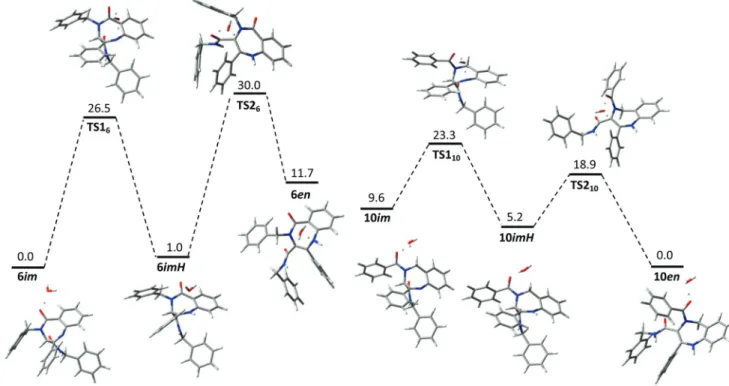
First, we studied the stability of these benzodiazepines under neutral conditions; the calculations showed the different stability of tautomers depending on the relative posi-tion of the carbonyl group adjacent to the nitrogen at the 4-position in the benzodiazepine system. The imine tautomer in the benzo[e][1,4]diazepine-5-one6gis 7.0 kcal mol−1more stable than the enamine component in ethanol, whereas in the 4,5-dihydrobenzo[e][1,4]diazepine 10a the enamine is 2.3 kcal mol−1more stable than the imine tautomer. However, our calculations demonstrate that the interconversion between tautomers is not possible at moderate temperatures under neutral conditions because the free energy of activation calcu-lated for the tautomerization in both cases is too high (58.7 and 49.0 kcal mol−1for6gand10arespectively for the tauto-merization in a water-assisted process).19
Then, the experimental results should be explained as a consequence of the acidic method employed in the reduction process; otherwise, both benzodiazepines should be obtained as the same tautomer due to the high barrier of interconver-sion which prevents the tautomerization from the initial tauto-mer formed in the cyclization. Under these acidic conditions in ethanol, the benzo[e][1,4]diazepine-5-one6gis again more stable as imine than as enamine (11.7 kcal mol−1), whereas the 4,5-dihydrobenzo[e][1,4]diazepine10ais again more stable as enamine (9.6 kcal mol−1). However, the free energies of acti-vation calculated for each stage of the tautomerization in acid medium, protonation of imine and formation of enamine, are significantly lower in both families of compounds than the interconversion barrier under neutral conditions (Fig. 2).
For the benzo[e][1,4]diazepine-5-one 6g the activation energy decreases from 58.7 kcal mol−1 under neutral con-ditions to 26.5 and 29.0 kcal mol−1in acidic medium for the protonation of imine and the enamine formation respectively (Fig. 2). These values allow us to calculate the reaction rate at each stage from the Eyring–Polanyi equation indicating that tautomerization is not possible at room temperature (k1= 2.45 × 10⁻⁷s−1,k2= 3.35 × 10⁻⁹s−1) and it is a very slow process in boiling ethanol (k1 = 3.26 × 10⁻³ s−1, k2 = 1.09 × 10⁻⁴ s−1). Additionally, the conversion of imine to enamine is thermo-dynamically unfavorable, especially in the second stage with an equilibrium constant of 1.57 × 10⁻⁸. Although we have con-sidered only one water molecule as a proton shuttle molecule and the real tautomerization barriers for 6(as for the tauto-merization in10) could be much smaller, this would not influ-ence the conclusions, since only the thermodynamic product
6imwould be obtained. With these results in hand it is inter-esting to note that these benzodiazepines are then potential drug candidates, not only because of their conformation4but also due to their stability at high temperature and under acidic conditions.20
The behavior of 4-benzoyl-4,5-dihydrobenzo[e ][1,4]diaze-pines 10 is quite different. For the benzodiazepine 10a the enamine is the most stable tautomer under acidic conditions in ethanol (thermodynamically favorable) with equilibrium constants for the conversion of imine to enamine of 1.87 × 10³ and 6.23 × 10³ (calculated using the Arrhenius equation), for protonation and generation of enamine respectively, and besides, the tautomeric interconversion under acidic con-ditions is fast at room temperature (kinetically favorable) with reaction rates ofk1= 6.51 × 10²s−1andk2= 5.50 × 10²s−1for each stage, calculated from the free energies of activation in both stages (about 13.7 kcal mol−1, Fig. 2). The higher stability of the enamine tautomer is a problem, as these regioisomers undergo an oxidative cleavage of the double bond in the pres-ence of oxygen (Scheme 1). Thus, in contrast with benzo[e ][1,4]-diazepine-5-one, these regioisomers would have several pro-blems as pharmaceutical products due to their low stability in air.
The process of tautomerization is similar for both families of regioisomeric benzodiazepines. It starts with the protona-tion on the nitrogen atom of the imine groups (Scheme 2). The Scheme 1 Oxidative cleavage of 4,5-dihydro-1H-benzo[e
Scheme 2 Process of tautomerization for benzodiazepines6gand10a.
Fig. 2 Energy diagrams for the imine–enamine interconversion of6g(left) and10a(right) in acidic medium. The energy values reported in the diagram are in kcal mol−1and refer to calculations performed in ethanol
Q6 .
1
5
10
15
20
25
30
35
40
45
50
55
1
5
10
15
20
25
30
35
40
45
50
similar charge distribution calculated for structures6im and
10imby NBO analysis explains the similarity between the acti-vation complexes (TS16 and TS110, Fig. 2) found in the first stage.
However the second stage seems to be dependent on the regioisomer under study. This is supported by the fact that the NBO analysis of10imHreveals a more negative charge in the oxygen of the carbonyl group adjacent to the nitrogen at the 4-position in the 1,4-diazepine ring (−0.66e) than in the oxygen of the 3-aminocarbonyl substituent (−0.63e). This difference favors the participation of the former group in a seven-member ring transition stateTS210in which a molecule
of water acts as a“hydrogen bridge”.
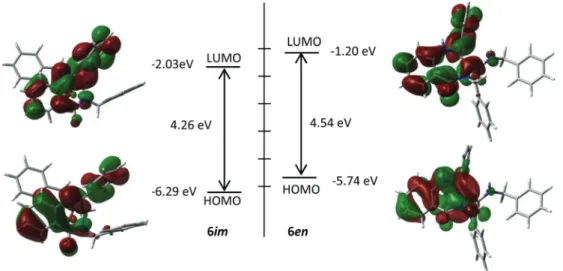
The electronic distribution of the HOMO of the imine tau-tomers depends on the presence of the oxo group in the benzodiazepine ring, the HOMO in 6im is delocalized along
the benzodiazepine system from the amide group to the benzene ring and the CvN π-bonding, whereas in 10imit is mainly localized on CvN π-bonding and the benzene ring. The HOMO surfaces for the enamine tautomers6enand10en
are similarly delocalized over the CvC π-bonding and the benzene ring. The HOMO–LUMO gap is similar for all the tau-tomers (Fig. 3 and 4).
The calculated bond lengths reveal some differences between tautomers of benzo[e][1,4]diazepine-5-ones6and 4,5-dihydrobenzo[e][1,4]diazepines 10. The C2vN1 bonds in the imine tautomers 6imand10imhave similar lengths and the N1–C7and C5–C6bonds are slightly shorter in6im. This diff er-ence can be explained by the conjugation between the imine and the amide group through the benzene ring only possible in benzodiazepines6. In the enamine forms, the C2–N1bond is much shorter in 10enthan in 6en due in this case to the Fig. 3 Frontier molecular orbitals surfaces of the imine (left) and enamine tautomers (right) of6which have been constructed by using the B3LYP/ 6-31G** level of theory.
Fig. 4 Frontier molecular orbital surfaces of the imine (left) and enamine tautomers (right) of10which have been constructed by using the B3LYP/ 6-31G** level of theory.
1
5
10
15
20
25
30
35
40
45
50
55
1
5
10
15
20
25
30
35
40
45
50
more favored conjugation with the carboxamide group in 3-position through the double bond C2vC3 of the enamine (Fig. 5).
Conclusions
In summary, we have developed a simple and scalable method-ology for the synthesis of regioisomeric pseudopeptidic benzo-diazepines from economical and available reagents in only two steps. The tautomerism present in the 1,4-benzodiazepines is crucial to understand the different behaviors of 4-benzyl-3H -benzo[e][1,4]diazepin-5(4H)-ones and 4-benzoyl-4,5-dihydro-3H-benzo[e][1,4]diazepines in acidic medium, their confor-mation and stability as well as to evaluate their potential use as drug candidates. The experimental results have been con-firmed by DFT quantum calculations at the B3LYP/6-31G** level of theory.
Experimental section
General informationMelting points are not corrected. Infrared spectra were regis-tered in potassium bromide tablets.1H and 13C NMR spectra were recorded in CDCl3and DMSO-d6at 400 and 100 MHz or at 300 and 75 MHz on a Varian Inova 400 or a Varian Mercury 300, respectively. Chemical shifts are reported in parts per million with respect to residual solvent protons, and coupling constants are reported in hertz. Low resolution mass spectra and HRMS were recorded in the positive ion mode by elec-tronic impact at 70 eV.
General procedure for the synthesis of Ugi adducts 5a–j
A solution of arylglyoxal1a–b(1 mmol) and substituted ben-zylamine2a–e(1 mmol) in methanol was stirred for 15 min at room temperature. Then, 2-nitrobenzoic acid 3 (0.167 g, 1 mmol) and isocyanide 4a–b (1 mmol) were added and the mixture was stirred for 1 day until a solid precipitated. The solid was filtered and recrystallized from i-PrOH–i-Pr2O.
(E)-N-Cyclohexyl-2-[N-benzyl-N -(2-nitrobenzoyl)amino]-3-hydroxy-3-phenylacrylamide 5a. White solid, m.p. 192–193 °C. (conformational isomersE1/E2: 77/23).4 IR (KBr, cm−1): 3418 (OH), 2937, 2855, 1651 (CvO), 1538, 1350.1H NMR (300 MHz, CDCl3) δ: 15.97 (s, 0.23H, OH E2), 15.36 (s, 0.77H, OH E1), 8.35–6.80 (m, 13H, HArE1/E2), 6.36 (d,J= 8.1 Hz, 0.77H, NH
E1), 5.87 (d, J = 8.1 Hz, 0.23H, NHE2), 5.86 (d, J = 13.6 Hz, 0.23H, CH2benzE2), 4.12 (d,J= 13.8 Hz, 0.77H, CH2benzE1), 3.77 (d,J= 13.8 Hz, 0.77H, CH2benzE1), 3.62 (d,J= 13.6 Hz, 023H, CH2 benz E2), 3.70–3.55 (m, 0.77H, CHE1), 3.25–3.10 (m, 0.23H, CH E2), 2.05–0.30 (m, 10H, E1/E2). 13C NMR (75 MHz, CDCl3)δ: 171.4, 169.0, 168.5, 168.4, 145.5 (CqE1/E2), 135.0 (CHAr), 133.7 (CqE1/E2), 133.5 (CHAr), 132.0 (Cq), 131.6, 130.6, 130.5, 130.4, 130.2, 130.1, 129.4, 129.3, 128.8, 128.7, 128.1, 127.9, 127.7, 127.6, 125.6, 125.1 (CHAr E1/E2), 105.1 (Cq), 56.2 (CH2), 54.0 (CH2), 49.0 (CH), 48.7 (CH), 32.8 (CH2), 32.7 (CH2), 32.0 (CH2), 31.8 (CH2), 25.6 (CH2), 25.4 (CH2), 25.2 (CH2), 25.2 (CH2). MS (EI)m/z(relative intensity): 499 (M+, 5); 349 (20); 224 (10); 150 (53); 105 (49); 91 (100); 77 (19). HRMS (EI): calcd for C29H29N3O5[M+] 499.2107 found 499.2094.
(E)-N-Cyclohexyl-2-[N-(4-methylbenzyl)-N -(2-nitrobenzoyl)-amino]-3-hydroxy-3-phenylacrylamide 5b. White solid, m.p. 185–186 °C (conformational isomers E1/E2: 63/37). IR (KBr, cm−1): 3425 (OH), 2928, 2856, 1651 (CvO), 1538, 1349. 1H NMR (300 MHz, CDCl3) δ: 15.96 (s, 0.37H, OH E2), 15.37 (s, 0.63H, OHE1), 8.33–6.66 (m, 13H, HArE1/E2), 6.33 (d,J= 8.3 Hz, 0.63H, NHE1), 5.89 (d,J= 13.9 Hz, 0.37H, CH2benzE2), 5.82 (d,J= 8.3 Hz, 0.37H, NHE1), 4.08 (d,J= 13.9 Hz, 0.63H, CH2benz E1), 3.73 (d,J= 13.9 Hz, 0.63H, CH2benzE1), 3.58 (d,J= 13.9 Hz, 0.37H, CH2benzE2), 3.70–3.60 (m, 0.63H, CH
E1), 3.30–3.06 (m, 0.37H, CHE2), 2.33 (s, 1.11H, CH3E2), 2.28 (s, 1.89H, CH3 E1), 2.02–0.21 (m, 10H, E1/E2). 13C NMR (75 MHz, CDCl3)δ: 171.3, 169.0, 168.3, 145.4, 138.5 (CqE1/E2), 135.1 (CHAr), 134.5 (Cq), 133.5 (CHAr), 133.4 (Cq), 131.6, 130.6, 130.5, 130.4, 130.1, 130.0, 129.4, 128.6, 128.1, 127.9, 127.7, 127.6, 125.6, 125.1 (CHArE1/E2), 105.0 (Cq), 55.9 (CH2), 53.7 (CH2), 48.9 (CH), 48.7 (CH), 32.8 (CH2), 32.7 (CH2), 31.9 (CH2), 31.8 (CH2), 25.6 (CH2), 25.5 (CH2), 25.4 (CH2), 25.3 (CH2), 25.2 (CH2), 21.4 (CH3). MS (EI)m/z(relative intensity): 513 (M+, 4); 363 (16); 269 (9); 150 (71); 105 (100); 77 (13). HRMS (EI): calcd for C30H31N3O5[M+] 513.2264 found 513.2258.
(E)-N-Cyclohexyl-2-[N-(4-methoxylbenzyl)-N -(2-nitrobenzoyl)-amino]-3-hydroxy-3-phenylacrylamide 5c. White solid, m.p. 192–193 °C (conformational isomers E1/E2: 57/43). IR (KBr, cm−1): 3425 (NH), 2937, 2855, 1651 (CvO), 1538, 1351. 1H NMR (300 MHz, CDCl3) δ: 15.95 (s, 0.43H, OH E2), 15.37 (s, 0.57H, OHE1), 8.33–6.63 (m, 13H, HArE1/E2), 6.36 (d,J= 7.9 Hz, 0.57H, NHE1), 5.86 (d,J= 7.9 Hz, 0.43H, NHE2), 5.80 (d, Fig. 5 Relevant bond lengths in the diazepine system calculated at the
B3LYP/6-31G** level of theory.
1
5
10
15
20
25
30
35
40
45
50
55
1
5
10
15
20
25
30
35
40
45
50
J= 13.7 Hz, 0.43H, CH2benzE2), 4.07 (d,J = 13.9 Hz, 0.57H, CH2benzE1), 3.79 (s, 1.3 H, CH3E2), 3.76 (s, 1.7 H, CH3E1), 3.73 (d,J= 13.9 Hz, 0.57H, CH2benzE1), 3.69–3.62 (m, 0.43H, CH E2), 3.58 (d, J = 13.7 Hz, 0.43H, CH2benz E2), 3.31–3.16 (m, 0.57H, CH E1), 2.10–0.27 (m, 10H, E1/E2). 13C NMR (75 MHz, CDCl3) δ: 171.3, 169.5, 169.0, 168.4, 168.3, 168.1, 160.0, 159.8, 146.7, 145.4 (Cq E1/E2), 135.1, 135.0, 133.8, 133.6, 133.5, 132.0, 131.6, 131.4, 131.3, 130.6, 130.5, 130.4, 129.4, 128.8, 128.7, 128.5, 128.1, 127.9, 127.7, 127.6, 125.7, 125.6, 125.1, 114.7, 114.1 (CHAr E1/E2), 107.9, 104.9 (Cq E1/
E2), 55.5 (CH2), 53.3 (CH3), 49.3, 48.9, 48.7 (CHE1/E2), 32.8, 32.0, 32.0, 25.7, 25.6, 25.4, 25.2 (CH2E1/E2). MS (EI)m/z (rela-tive intensity): 529 (M+, 4.4), 408 (9), 285 (14), 150 (45), 121 (100), 105 (22). HRMS (EI): calcd for C30H31N3O6[M+] 529.2213 found 529.2208.
(E)-N-Cyclohexyl-2-[N-(4-fluorobenzyl)-N -(2-nitrobenzoyl)-amino]-3-hydroxy-3-phenylacrylamide 5d. White solid, m.p. 182–183 °C (conformational isomers E1/E2: 56/44). IR (KBr, cm−1): 3419 (OH), 2927, 2855, 1651 (CvO), 1530,1347. 1H 128.9, 128.6, 128.2, 127.9, 127.7, 127.6, 125.6, 125.1 (CHArE1/
E2), 116.0 (d,2J= 21.5 Hz), 115.8 (d,2J= 21.5 Hz, CHArE1/E2), 107.8, 104.7 (CqE1/E2), 55.2, 53.2 (CH2E1/E2), 49.0, 48.7 (CH
E1/E2), 32.8, 32.1, 32.0, 25.7, 25.6, 25.4, 25.3, 25.2, 24.9, 24.9 (CH2E1/E2). MS (EI)m/z(relative intensity): 517 (M+, 4.6), 367 (13), 150 (87), 109 (100), 105 (54). HRMS (EI): calcd for C29H28FN3O5[M+] 517.2013 found 517.2002.
(E)-N-Cyclohexyl-2-[N-(4-chlorobenzyl)-N -(2-nitrobenzoyl)-amino]-3-hydroxy-3-phenylacrylamide 5e. White solid, m.p. 197–198 °C (conformational isomers E1/E2: 55/45). IR (KBr, cm−1): 3424 (OH), 2930, 2857, 1651 (CvO), 1538, 1350. 132.1, 131.7, 131.6, 131, 3, 130.7, 130.6, 130.5, 129.5, 129.4, 128.9, 128.6, 128.1, 127.9, 127.7, 127.5, 125.7, 125.2 (CHAr), 107.7, 104.5 (CqE1/E2), 55,3, 53.3 (CH2E1/E2), 49.0, 48.7 (CH
E1/E2), 32,9, 32.1, 32.0, 25.6, 25.4, 25.3, 25.3, 25.2 (CH2E1/E2). MS (EI)m/z(relative intensity): 533 (M+, 27), 535 (M++ 2, 10),
408 (16), 410 (13), 383 (100), 288 (39), 245 (44), 150 (83), 125 (74), 105 (51). HRMS (EI): calcd for C29H28ClN3O5 [M+] 533.1717 found 533.1717.
(E)-N-Cyclohexyl-2-[N-benzyl-N -(2-nitrobenzoyl)amino]-3-hydroxy-3-(4-fluoro)phenylacrylamide 5f. White solid, m.p. 154–155 °C (conformational isomers E1/E2: 63/37). IR (KBr, cm−1): 3422 (OH), 2928, 2855, 1651 (CvO), 1538, 1403, 1349.
E1/E2), 135.2, 133.6, 133.5, 133.5, 133.4, 130.7, 130.5, 130.2, 130.0, 129.8, 129.7, 129.4, 128.8, 128.7, 127.7, 127.6, 116.3 (d, 2J= 21.5 Hz), 116.0 (d,2J= 21.5 Hz, CHArE1/E2), 107.6, 104.7 (CqE1/E2), 56.0, 53.9 (CH2E1/E2), 49.1, 48.7 (CHE1/E2), 32.8, 32.8, 32.0, 31.8, 25.6, 25.4, 25.4, 25.3, 25.2, 25.2 (CH2 E1/E2). MS (EI)m/z(relative intensity): 517 (M+, 4); 367 (20); 278 (22); 277 (31); 150 (53); 123 (50); 98 (25); 91 (100). HRMS (EI): calcd for C29H28N3O5F [M+] 517.2013 found 517.2009.
(E)-N-Benzyl-2-[N-benzyl-N-(2-nitrobenzoyl )amino]-3-hydroxy-3-phenylacrylamide 5g. White solid, m.p. 148–149 °C (conformational isomers E1/E2: 58/42). IR (KBr, cm−1): 3427 (OH), 3064 (CAr), 3032, 2923, 1651 (CvO), 1529, 1402, 1346.1H 170.2, 170.0, 168.5, 146.8, 145.5, 137.9, 137.2, 136.1 (Cq E1/
E2), 135.1, 134.8, 133.4, 133.3, 131.8, 130.7, 130.6, 130.2, 130.1, 129.9, 129.5, 128.8, 128.7, 128.2, 128.1, 128.0, 127.6, 127.4, 125.6, 125.4 (CHArE1/E2), 107.6, 105.0 (Cq E1/E2), 56.1, 53.6, 43.4, 43.1 (CH2E1/E2). MS (EI)m/z(relative intensity): 507 (M+, 6.6), 357 (17), 150 (43), 91 (100). HRMS (EI): calcd for C30H25N3O5[M+] 507.1794 found 507.1796.
benz E2), 3.60 (d, J = 13.5 Hz, 0.36H, CH2 benz E2), 2.30 (s, 1.08H, CH3 E2), 2.28 (s, 1.92H, CH3 E1).13C NMR (75 MHz, CDCl3)δ: 171.5, 170.0, 169.9, 168.5, 145.5, 138.4, 138.4, 137.9, 137.2 (CqE1/E2), 135.1 (CHAr), 134.8, 133.6, 133.4, 131.1 (Cq
E1/E2), 131.7, 130.7, 130.5 (CHAr E1/E2), 130.4 (Cq), 130.2, 130.0 (CHAr E1/E2), 129.8, 129.8 (Cq E1/E2), 129.5, 129.4, 128.7, 128.7, 128.6, 128.2, 128.0, 128.0, 127.6, 127.5, 127.4, 125.6, 125.3 (CHArE1/E2), 107.7, 105.0 (Cq E1/E2), 55.8, 53.4, 43.5, 43.2 (CH2 E1/E2), 21.5, 21.4 (CH3 E1/E2). MS (EI) m/z
(relative intensity): 521 (M+, 6.4), 371 (14), 269 (10), 150 (73), 105 (100), 91 (26). HRMS (EI): calcd for C31H27N3O5 [M+] 521.1951 found 521.1937.
(E)-N-Benzyl-2-[N-(4-methoxybenzyl)-N-(2-nitrobenzoyl) amino]-3-hydroxy-3-phenylacrylamide 5i. White solid, m.p. 142–143 °C (conformational isomers E1/E2: 57/43). IR (KBr, cm−1): 3440 (OH), 1658 (CvO), 1526, 1398, 1348. 1H NMR
167.8, 159.8, 159.7, 146.8, 145.5, 137.9, 137.1, 135.2, 134.9 (Cq
E1/E2), 133.6 (CHAr), 133.5, 133.2 (Cq) 131.7, 131.4, 131.1, 130.6, 130.2, 129.4, 128.8, 128.7, 128.7, 128.6, 128.1, 128.0, 127.9, 127.6, 127.6, 127.5, 127.4, 125.6, 125.5, 125.3, 114.3, 114.0 (CHAr E1/E2), 107.7, 104.9 (Cq E1/E2), 55.5 (CH3), 55.4 (CH2), 55.3 (CH3), 53.1, 44.2, 43.5, 43.3 (CH2 E1/E2). MS (EI)
m/z(relative intensity): 537 (M+, 0.6), 121 (32), 105 (100), 91 (48).
(E)-N-Benzyl-2-[N-(4-chlorobenzyl)-N -(2-nitrobenzoyl)amino]-3-hydroxy-3-phenylacrylamide 5j. White solid, m.p. 152–153 °C (conformational isomers E1/E2: 58/42). IR (KBr, cm−1): 3427 (OH), 1651 (CvO), 1538, 1393, 1353. 1H NMR 171.8, 170.1, 169.9, 168.7, 168.6, 167.9, 145.5, 137.8, 137.0 (Cq
E1/E2), 135.2 (CHAr), 134.7 (Cq), 133.4 (CHAr), 133.2 (Cq), 131.9 (CHAr), 131.8 (Cq), 131.5, 131.2, 130.8, 130.7, 130.4, 129.5, 129.3, 128.9, 128.7, 128.2, 128.1, 127.8, 127.6, 127.6, 125.7, 125.4 (CHAr E1/E2), 107.7, 104.6 (Cq E1/E2), 55.2, 53.2, 43.5, 43.4 (CH2E1/E2). MS (EI)m/z(relative intensity): 541 (M+, 24), 543 (M++ 2, 10), 391 (65), 393 (23), 253 (26), 150 (100), 125(98), 105 (63), 91 (57), 77 (30). HRMS (EI): calcd for C30H24ClN3O5 [M+] 541.1404 found 541.1412.
General procedure for the synthesis of Ugi adducts 9a–c
The o-nitrobenzylamine hydrochloride 7 (0.207 g, 1.1 mmol) was treated with a solution of KOH (1.0 mmol) in ethanol for 10 min, after which the phenylglyoxal hydrate 1a (0.152 g, 1 mmol) was added. The mixture was stirred for 15 min at room temperature. Then, the corresponding carboxylic acid
8a–b(1 mmol) and isocyanide4a–b(1 mmol) were added and the mixture was stirred for 2 days until a solid precipitated. The solid was filtered and recrystallized from i-PrOH–i-Pr2O.
(E)-N-Benzyl-2-[N-(2-nitrobenzyl)-N -benzoylamino]-3-hydroxy-3-phenylacrylamide 9a. White solid, m.p. 177–178 °C. IR (KBr, cm−1): 3483 (OH), 1670 (CvO), 1543, 1393. 1H NMR (300 MHz, DMSO-d6) (as a mixture of tautomers and confor-mers)δ: 15.38 (s, 0.50H, OH enolE1), 15.34 (s, 0.13H, OH enol
E2), 9.46 (t,J= 5.3 Hz, 0.50H, NHE1), 9.24 (t,J= 5.0 Hz, 0.37H, NH keto), 9.06 (t,J= 5.1 Hz, 0.13H, NH enolE2), 8.00–6.63 (m, 19H, HAr), 6.08 (s, 0.37H, CH keto), 5.39–4.78 (m, 2H), 4.58–3.65 (m, 2H). 13C NMR (75 MHz, DMSO-d6) δ: 194.7, 193.2, 173.1, 172.9, 171.6, 170.6, 165.4, 148.5, 147.9, 138.6, 138.4, 135.8, 135.5, 135.1, 134.5, 134.3, 134.0, 133.9, 133.7, 130.7, 129.6, 129.4, 129.3, 129.1, 129.0, 128.9, 128.6, 128.5, 128.4, 128.1, 128.0, 127.7, 127.1, 126.6, 125.5, 125.0, 109.2, 68.0, 64.8, 49.6, 46.0, 43.1. MS (EI)m/z(relative intensity): 400 (18), 104 (100), 90 (36).
(E)-N-Cyclohexyl-2-[N-(2-nitrobenzyl)-N -(2-bromobenzoyl)-amino]-3-hydroxy-3-phenylacrylamide 9b. White solid. M.p. dec. (>180 °C). (E1/E2: 61/39). IR (KBr, cm−1): 3393 (OH), 1651
E2), 133.6, 133.5, 133.1, 131.0, 130.8, 127.7, 129.6, 129.5, 128.8, 128.6, 128.1, 128.0, 127.8, 127.7, 127.6, 126.8, 125.1, 124.9 (CHAr enol E1/E2), 109.9 (Cq), 50.7 (CH2), 48.9 (CH), 46.9 (CH2), 33.3, 32.7, 32.2, 31.9, 25.6, 25.4, 25.3, 25.2, 24.7 (CH2 enolE1/E2). MS (EI)m/z(relative intensity): 577 (M+, 0.07), 579 (M + 2, 0.09), 269 (28), 183 (92), 185 (88), 105 (100), 77 (28). HRMS (EI): calcd for C29H28BrN3O5577.1212 found 577.1202.
131.3, 131.0, 130.9 (CHAr E1/E2), 130.0 (Cq), 129.7, 129.6, 129.5, 129.0, 128.9, 128.8, 128.6 (CHAr E1/E2), 128.5 (Cq), 128.4, 128.2, 128.1, 128.0, 127.9, 127.7, 127.6, 126.9, 125.1, 125.0 (CHArE1/E2), 120.5, 120.0, 106.9, 104.0 (CqE1/E2), 50.6, 46.6, 44.1, 43.0 (CH2 E1/E2). MS (EI) m/z(relative intensity): 585 (M+, 0.3), 587 (M + 2, 0.28), 185 (100), 105 (86), 91 (53), 77 (29). HRMS (EI): calcd for C30H24BrN3O5 585.0899 found 585.0903.
Procedure for the synthesis of Ugi adduct 9d
Theo-nitrobenzylamine hydrochloride 7 (0.207 g, 1.1 mmol) was treated with a solution of KOH (1.0 mmol) in ethanol for 10 min, after which the phenylglyoxal hydrate 1a (0.152 g, 1 mmol) was added. The mixture was stirred for 15 min at room temperature. Then, the terephthalic acid 8c (0.083 g, 0.5 mmol) and the cyclohexylisocyanide4a(0.109 g, 1 mmol) were added and the mixture was stirred for 2 days until a solid precipitated. The solid was filtered and recrystallized from MeOH–DMF.
N1,N4-Bis((E
)-1-cyclohexylaminocarbonyl-2-hydroxy-2-phenyl-ethenyl)-N1,N4-bis(2-nitrobenzyl)terephthalamide 9d. White solid, m.p. 214–216 °C. IR (KBr, cm−1): 3333 (OH), 1650 (CO), 1609, 1377, 1530, 1314.1H NMR (400 MHz, CDCl3) δ: ( princi-pal conformer) 15.32 (s, 2H, OH enol), 8.42–6.70 (m, 22H, HAr), 5.88–5.78 (m, 3H), 4.16 (d,J = 15 Hz, 2H), 3.62–3.40 (m, 2H), 1.62–0.72 (m, 20H).13C NMR (100 MHz, CDCl3)δ: ( princi-pal conformer) 171.2 (Cq), 169.7 (Cq), 169.5 (Cq), 137.3 (Cq), 133.8 (CHAr), 132.2 (CHAr), 131.2 (CHAr), 131.0 (CHAr), 129.5 (CHAr), 129.1 (CHAr), 129.0 (CHAr), 127.7 (CHAr), 127.7 (CHAr), 126.9 (CHAr), 125.1 (CHAr), 108.5 (Cq), 49.0 (CH2), 48.4 (CH2), 48.3 (CH), 33.0 (CH2), 32.5 (CH2), 32.3 (CH2), 25.3 (CH2), 25.0 (CH2), 24.8 (CH2). MS (FAB+)m/z(relative intensity): 921 (M++ 1, 32), 922 (M++ 2, 23), 822 (100), 823 (49), 526 (54).
General procedure for the synthesis of benzodiazepines 6a–j
To a suspension of enol5a–j (0.5 mmol) in ethanol (10 mL) and hydrochloric acid solution 0.6 M (1.5 mmol) was added stannous chloride (5 mmol). The reaction was refluxed for 45 min, cooled and concentrated under reduced pressure. The residue was dissolved in dichloromethane and washed with a diluted KOH solution and then with water. The organic extract was dried with Na2SO4 and concentrated. The crude residue was recrystallized from methanol.
Compounds6a–ehave been previously described.4
N -Cyclohexyl-4-benzyl-5-oxo-2-(4-fluorophenyl)-4,5-dihydro-3H-benzo[e][1,4]diazepino-3-carboxamide (6f ). White solid, m.p. 176–177 °C. IR (KBr, cm−1): 3323 (NH), 3065 (CAr), 2931, 163.6 (Cq), 146.1 (Cq), 136.4 (Cq), 132.3 (CHAr), 130.7 (CHAr), 129.9 (CHAr), 129.8 (CHAr), 129.4 (CHAr), 129.0 (CHAr), 128.7 (CHAr), 127.2 (CHAr), 126.4 (CHAr), 125.8 (Cq), 115.8 (d, 2J =
21.7 Hz, CHAr), 59.2 (CH), 52.9 (CH2), 48.1 (CH), 32.3 (CH2), 32.2 (CH2), 25.2 (CH2), 24.7 (CH2), 24.5 (CH2). MS (EI) m/z
(relative intensity) 469 (M+, 6.9), 344 (100), 253 (48), 227 (15), 197 (16), 91 (45). HRMS (EI): calcd for C29H28FN3O2 [M+] 469.2166 found 469.2168.
N,4-Dibenzyl-5-oxo-2-phenyl-4,5-dihydro-3H-benzo[e ][1,4]di-azepino-3-carboxamide (6g). White solid, m.p. 180–181 °C. IR (KBr, cm−1): 3327 (NH), 3027, 1682 (CvO), 1633. 1H NMR (300 MHz, CDCl3) δ: 8.03–6.67 (m, 19H, HAr), 5.67–5.48 (m, 1H, NH), 5.34 (s, 1H), 5.08 (d,J= 14.6 Hz, 1H, CH2benz), 4.70 (d,J= 14.6 Hz, 1H, CH2benz), 3.95–3.79 (m, 2H, CH2 benz). 13C NMR (75 MHz, CDCl3)δ: 167.5 (Cq), 165.6 (Cq), 164.2 (Cq),
146.0 (Cq), 137.7 (Cq), 136.7 (Cq), 136.3 (Cq), 132.3 (CHAr), 131.2 (CHAr), 130.7 (CHAr), 129.2 (CHAr), 128.9 (CHAr), 128.8 (CHAr), 128.6 (CHAr), 128.5 (CHAr) 127.8 (CHAr), 127.6 (CHAr), 127.4 (CHAr), 126.6 (CHAr), 125.8 (Cq), 59.1 (CH), 52.9 (CH2), 43.8 (CH2). MS (EI) m/z (relative intensity) 459 (M+, 11), 326 (24), 325 (16), 235 (11), 91 (100). HRMS (EI): calcd for C30H25N3O2[M+] 459.1947 found 459.1943.
N-Benzyl-4-(4-methylbenzyl)-5-oxo-2-phenyl-4,5-dihydro-3H -benzo[e][1,4]diazepino-3-carboxamide (6h). White solid, m.p. 139–140 °C. IR (KBr, cm−1): 3327 (NH), 3027, 1682 (CvO), 136.7 (Cq), 133.2 (Cq), 132.2 (CHAr), 131.0 (Cq), 130.7 (CHAr), 129.9 (CHAr), 128.9 (CHAr), 128.7 (CHAr), 128.6 (CHAr), 128.4 (CHAr), 127.8 (CHAr), 127.6 (CHAr), 127.5 (CHAr), 127.4 (CHAr), 126.5 (Cq), 58.9 (CH), 52.5 (CH2), 43.8 (CH2), 21.2 (CH3). MS (EI)m/z(relative intensity) 473 (M+, 27), 340 (33), 235 (31), 105 (100), 91 (36). HRMS (EI): calcd for C31H27N3O2[M+] 473.2103 found 473.2108.
N -Benzyl-4-(4-methoxybenzyl)-5-oxo-2-phenyl-4,5-dihydro-3H-benzo[e][1,4]diazepino-3-carboxamide (6i). White solid, m.p. 144–145 °C. IR (KBr, cm−1): 3333 (NH), 3027; 1673 (CvO), (Cq), 138.0 (Cq), 136.9 (Cq), 132.4 (CHAr), 131.2 (CHAr), 130.8 (CHAr), 130.5 (CHAr), 128.9 (CHAr), 128.8 (CHAr), 128.4 (Cq), 128.2 (CHAr), 127.9 (CHAr), 127.8 (CHAr), 127.5 (CHAr), 126.7 (CHAr), 126.0 (Cq), 114.7 (CHAr), 59.1 (CH), 55.4 (CH3), 52.3 (CH2), 44.0 (CH2). MS (EI)m/z(relative intensity) 489 (M+, 13), 356 (12), 235 (19), 121 (100), 91 (22). HRMS (EI): calcd for C31H27N3O3[M+] 489.2052; found 489.2042.
CH2benz).13C NMR (75 MHz, CDCl3)δ: 167.7 (Cq), 165.7 (Cq), 164.3 (Cq), 146.0 (Cq), 137.6 (Cq), 136.9, 134.9, 134.5, 132.5, 131.4, 130.9, 130.4, 129.3, 128.9, 128.9, 128.0, 127.8, 127.7, 127.6, 126.9, 125.9, 59.6 (CH), 52.5 (CH2), 44.1 (CH2). MS (EI)
m/z (relative intensity): 493 (M+, 30), 360 (72), 235 (57), 179 (31), 150 (31), 127 (32), 125 (100), 121(90), 91 (68). HRMS (EI): calcd for C30H24N3O2Cl [M+] 493.1548; found 493.1557.
General procedure for the synthesis of benzodiazepines 10a–c
To a suspension of enol9a–c(0.5 mmol) in ethanol (10 mL) and hydrochloric acid solution 0.6 M (1.5 mmol) was added stannous chloride (5 mmol). The reaction was refluxed for 45 min, cooled and concentrated under reduced pressure. The residue was dissolved in dichloromethane and washed with a diluted KOH solution and then with water. The organic extract was dried with Na2SO4 and concentrated. The crude residue was purified by chromatography (hexane–AcOEt).
4-(Benzoyl)-N-benzyl-2-phenyl-4,5-dihydro-1H-benzo[e ][1,4]-diazepino-3-carboxamide (10a). Yellow oil (enam1/enam2: 69/ 31). IR (KBr, cm−1): 3423 (NH), 3280 (NH), 1653, 1628. 1H 172.9, 171.5, 169.1, 164.2, 146.2, 145.4, 139, 138.2, 137.7, 137.1, 136.6, 136.0, 134.2 (Cq), 132.9, 131.3, 130.6, 130.2, 130.1, 129.4, 129.2, 129.1, 129.0, 128.9, 128.8, 128.7, 128.4, 128.1, 128.0, 127.5, 127.4, 127.3, 127.1, 127.0, 125.5, 122.8, 122.3, 119.6 (CHAr), 115.3, 114.4, 85.0 (Cq), 53.6, 48.8, 43.8, 43.8 (CH2). MS (EI) m/z (relative intensity): 459 (M+, 7), 460 (M + 1, 4), 370 (22), 264 (24), 105 (100), 91 (24), 77 (40). HRMS (EI): calcd for C30H25N3O2459.1947, found 459.1943.
N-Benzyl-4-(bromobenzoyl)-2-phenyl-4,5-dihydro-1H -benzo-[e][1,4]diazepino-3-carboxamide (10b).. Yellow solid, m.p. 96–97 °C (enam1/enam2: 20/80). IR (KBr, cm−1): 3404 (NH), 168.8, 164.1, 140.5, 138.8, 137.8, 137.6, 133.5, 132.4, 131.5, 131.0, 130.4, 130.2, 129.9, 129.6, 129.4, 129.1, 128.9, 128.6, 128.5, 128.4, 127.7, 127.6, 127.3, 127.2, 122.1, 119.9, 119.2, 113.6, 53.8, 53.4, 47.9, 33.0, 32.2, 25.8, 25.5, 25.0, 24.8. MS (EI)
m/z(relative intensity): 529 (M+, 4), 531 (M + 2, 4), 456 (5), 458 (5), 378 (34), 183 (39), 185 (39), 105 (100), 77 (27). HRMS (EI): calcd for C29H28BrN3O2529.1365, found 529.1362.
4-(Bromobenzoyl)-N-cyclohexyl-2-phenyl-4,5-dihydro-1H -benzo[e][1,4]diazepino-3-carboxamide (10c). Yellow solid, m. p. 124–125 °C (enam1/enam2: 20/80). IR (KBr, cm−1): 3434 (NH), 3296 (NH), 1650, 1644, 1633, 1606, 1591, 753, 699.1H NMR (400 MHz, CDCl3) δ: 7.60–6.66 (m, 18.8H, HAr + NHenam2), 6.22 (d, J = 7.3 Hz, 0.2H, NHenam1), 6.04 (s, 0.8
Henam2), 5.93 (s, 0.2 Henam1), 5.66 (d,J= 14.1 Hz, 0.8 Henam2), 4.71 (d, J = 15.6 Hz, 0.2 Henam1), 4.50 (d, J = 15.6 Hz, 0.2 Henam1), 4.42–3.86 (m, 2.8H). 13C NMR (100 MHz, CDCl3) δ: 182.8, 182.1, 169.3, 137.8, 137.4, 132.7, 130.7, 130.4, 129.99, 129.2, 128.9, 128.6, 128.5, 128.1, 127.5, 127.0, 122.4, 119.8, 119.2, 112.9, 57.0, 53.4, 43.9. MS (EI) m/z(relative intensity): 537 (M+, 19), 539 (M + 2, 19), 407 (18), 405 (18), 246 (30), 219 (42), 183 (61), 185 (60), 105 (100), 91 (75). HRMS (EI): calcd for C30H24BrN3O2537.1052, found 537.1047.
Procedure for the synthesis of benzodiazepine 10d
To a suspension of enol9d(0.5 mmol) in ethanol (10 mL) and hydrochloric acid solution 0.6 M (3.0 mmol) was added stan-nous chloride (10 mmol). The reaction was refluxed for 45 min, cooled and concentrated under reduced pressure. The residue was dissolved in dichloromethane and washed with a diluted KOH solution and then with water. The organic extract was dried with Na2SO4 and concentrated. The crude residue was recrystallized from diisopropyl ether.
4,4′-Terephthaloylbis(N-cyclohexyl-2-phenyl-4,5-dihydro-1H -benzo[e][1,4]diazepine-3-carboxamide) (10d). White solid, m.p. 176–177 °C (enam1/enam2: 85/15). IR (KBr, cm−1): 3324 (NH), 1693, 1681, 1651.1H NMR (300 MHz, CDCl3) ( principal conformer)δ: 8.33–6.89 (m, 23H, HAr + NH), 4.56 (d,J= 14.8 Hz, 2H), 4.35 (d,J= 14.8 Hz, 2H), 3.71–3.61 (m, 2H), 1.79–0.85 (m, 20H).13C NMR (75 MHz, CDCl3) ( principal conformer)δ: 190.2 (Cq), 171.8 (Cq), 136.8 (Cq), 135.9 (Cq), 133.1 (CHAr), 129.2 (CHAr), 129.0 (CHAr), 128.5 (CHAr), 127.4 (CHAr), 125.5 (CHAr), 123.3 (Cq), 84.8 (Cq), 48.8 (CH), 32.5 (CH2), 32.1 (CH2), 25.6 (CH2), 24.5 (CH2), 24.4 (CH2). MS (EI)m/z(relative inten-sity): 388 (25), 361 (26), 256 (78), 235 (87), 149 (100), 105 (93).
Computational methods
The geometries of all species were fully optimized at the B3LYP/6-31G** level. The environmental effects were taken into account by the Polarizable Continuum Mode (PCM) using the integral equation formalism variant (IEFPCM).21 The nature of all optimized structures was determined using har-monic frequency analysis as true minima with no imaginary frequencies or transition states with only one imaginary fre-quency. All transition state structures and reaction paths were further validated by intrinsic reaction coordinate (IRC) calcu-lations in both forward and reverse directions. All reported energy differences correspond to Gibbs’free energies. All cal-culations were performed using the Gaussian 09 program.18
Acknowledgements
Notes and references
1 S. Marcaccini and T. Torroba,Multicomponent Reactions, ed. J. Zhu and H. Bienaymé, Wiley-VCH, 2005, pp. 33–75. 2 (a) J. A. Robinson, Acc. Chem. Res., 2008, 41, 1278;
(b) Y. Che and G. R. Marshall, Expert Opin. Ther. Targets, 2008, 12, 101; (c) K. Suat and S. D. S. Jois, Curr. Pharm. Des., 2003,9, 1209.
3 (a) I. Cerminara, L. Chiummiento, M. Funicello, A. Guarnaccio and P. Lupattelli, Pharmaceuticals, 2012, 5, 297; (b) J. Vagner, H. Qu and V. J. Hruby,Curr. Opin. Chem. Biol., 2008,12, 292.
4 M. Sañudo, M. García-Valverde, S. Marcaccini, J. J. Delgado, J. Rojo and T. Torroba,J. Org. Chem., 2009,74, 2189. 5 D. P. Leader and J. Milner-White, Motivated Proteins
(http://motif.gla.ac.uk/motif/index.html). Code reference: delta antigen (1A92), LDL receptor module 5 (1AJJ), acetyl-CoA carboxylase (1BDO), and erabutoxin B (3EBX).
6 S. Gunawan, G. S. Nichol, S. Chappeta, J. Dietrich and C. Hulme,Tetrahedron Lett., 2010,51, 4689.
7 A. V. Budruev, L. N. Karyakina, O. P. Levina and A. V. Oleinik,Russ. J. Coord. Chem., 2005,31, 181.
8 S. Bräse, C. Gil, K. Knepper and V. Zimmermann, Angew. Chem., Int. Ed., 2005,44, 5188.
9 S. Eguchi,ARKIVOC, 2005,ii, 98.
10 B. M. Trost,Angew. Chem., Int. Ed. Engl., 1995,34, 259. 11 S. Marcaccini and T. Torroba,Nat. Protocols, 2007,2, 632. 12 S. Marcaccini, M. Miliciani and R. Pepino, Tetrahedron
Lett., 2005,46, 711.
13 A. L. Korich and T. S. Hughes,Synlett, 2007, 2602. 14 B. Morgan and O. Lahav,Chemosphere, 2007,68, 2080. 15 W.-K. Xing and Y. Ogata,J. Org. Chem., 1982,47, 3577. 16 (a) J. E. Huber, Tetrahedron Lett., 1968, 9, 3271;
(b) C. S. Foote, A. A. Dzakpasu and J. W.-P. Lin,Tetrahedron Lett., 1975,16, 1274; (c) M. García-Valverde, R. Pedrosa and M. Vicente,Synlett, 2002, 2092.
17 (a) K. M. Rahman, C. H. James and D. E. Thurston, Org. Biomol. Chem., 2011, 9, 1632; (b) J. Seifert, S. Pezeshki, A. Kamal and K. Weisz,Org. Biomol. Chem., 2012,10, 6850. 18 M. J. Frisch, G. W. Trucks et al., GAUSSIAN 09 program
package, Gaussian, Inc., Wallingford CT, 2009.
19 (a) A.-P. Fu, H.-L. Li, D.-M. Du and Z.-Y. Zhou,Chem. Phys. Lett., 2003, 382, 332; (b) S. Tolosa, A. Hidalgo and J. A. Sansón,J. Phys. Chem. B., 2012,116, 13033.
20 The WHO stability guideline, Stability testing of active pharmaceutical ingredients and finished pharmaceutical pro-ducts, WHO Technical Report Series, No. 953, Annex 2, 2009.
21 J. Tomasi, B. Mennucci and R. Cammi,Chem. Rev., 2005,
105, 2999. 1
5
10
15
20
25
30
35
40
45
50
55
1
5
10
15
20
25
30
35
40
45
50
![Table 1 Synthesis of benzo[ e][1,4]diazepine-5-ones from 2-nitrobenzoic acid](https://thumb-us.123doks.com/thumbv2/123dok_es/3924706.666695/2.892.69.843.588.1037/table-synthesis-benzo-e-diazepine-ones-nitrobenzoic-acid.webp)