
Technology reshaping the EFL classroom
85
0
0
Texto completo
(2) Running head: TECHNOLOGY RESHAPING THE EFL CLASSROOM. Technology Reshaping The EFL Classroom Diana Gabriela Prieto Sánchez. Research Report submitted in partial fulfillment of the requirements for the degree of Master in English Language Teaching for Self-Directed Learning. Directed by Nohora Bryan and Ana María Ternent de Samper Department of Foreign Languages and Cultures Universidad de La Sabana Chía, Colombia October 2015.
(3) TECHNOLOGY RESHAPING THE EFL CLASSROOM Declaration. I hereby declare that my research report entitled: Technology Reshaping The EFL Classroom •. is the result of my own work and includes nothing which is the outcome of work done in collaboration except as declared and specified in the text;. •. is neither substantially the same as nor contains substantial portions of any similar work submitted or that is being concurrently submitted for any degree or diploma or other qualification at the Universidad de La Sabana or any other university or similar institution except as declared and specified in the text;. •. complies with the word limits and other requirements stipulated by the Research Subcommittee of the Department of Foreign Languages and Cultures;. •. has been submitted by or on the required submission date.. Date: October 30, 2015 Full Name: Diana Gabriela Prieto Sánchez. Signature:.
(4) TECHNOLOGY RESHAPING THE EFL CLASSROOM Acknowledgements I would like to thank my professors, Nohora Bryan and Ana María Ternent de Samper. Thanks to my family and friends. Above all, I want to give thanks to God for blessing me in many ways. I mostly wish to thank my amazing boyfriend Felix Andrés Burgos. He is my best friend and stronger supporter.. i.
(5) TECHNOLOGY RESHAPING THE EFL CLASSROOM. ii. Abstract Technology Reshaping the EFL Classroom is a systematic review focused on recent studies from 2011 onwards which analyses the relationship between Computer Assisted Language Learning (CALL), Self- directed learning (SDL) and/or Self- regulated learning (SRL) in the foreign language classroom. The research is divided in two phases. The first phase provides a characterization of the studies selected. The second phase is an in-depth review of the definitions of SDL and/or SRL, and an analysis of the evidence of learning outcomes that these studies present. In regards to phase I there are positive and negative results. On the positive side there are compelling analyses and explanations of the positive effects of the implementation of CALL (or its associated areas) in learning environments. For instance, a few investigators argued that there had been an important improvement in language skills, metacognitive competence, or in lexical knowledge. On the negative side, the studies fail to report crucial information about their methodological designs. The in-depth review results (phase II) demonstrate that the majority of studies employ mostly SRL rather than SDL. The term autonomy also appears as part of the aim of two of the studies analyzed. Regarding the evidence of learning outcomes in studies mediated by CALL with respect to SRL and/or SDL in foreign language teaching and learning environments, it was found that only four studies (out of the eight investigations selected for this review) provided research models where outcomes were identifiable. The outcomes of interest in the studies fall broadly into 3 categories: improvement of reading comprehension and annotation abilities, improvement in vocabulary learning and co-sharing, and improved self-study behaviors..
(6) TECHNOLOGY RESHAPING THE EFL CLASSROOM. iii. Key words: Computer Assisted Language Learning; Self directed learning ; Self regulated learning; Learning Outcomes. Resumen Esta tesis es una revisión sistemática de la literatura en estudios que se han producido en el periodo 2011-2015. Se analiza la relación Aprendizaje del Lenguaje Asistido por Computador (CALL, por su acrónimo en inglés), Aprendizaje Auto-Regulado (SRL), y/o Aprendizaje AutoDirigido (SDL) en ambientes de aprendizaje del estudio de la lengua extranjera. La investigación se divide en dos fases. La primera de ellas ofrece una caracterización de los estudios seleccionados. La segunda fase es una revisión detallada de las definiciones de SDL y / o SRL y un análisis de la evidencia de los resultados de aprendizaje que ofrecen dichos estudios. En lo que respecta a la fase I hay resultados positivos y negativos. Algunos de los aspectos positivos es que los estudios contienen análisis y explicaciones convincentes sobre la implementación de CALL (o de sus áreas asociadas) en ambientes de aprendizaje. Por ejemplo, los investigadores aseguran que ha habido una mejora importante en las habilidades de lengua, competencias meta-cognitivas, o en áreas de conocimiento lexical. En cuanto a los aspectos negativos, los estudios no informan sobre elementos cruciales relacionados con los diseños metodológicos. Los resultados de la revisión detallada (fase II) demuestran que la mayoría de los estudios están relacionados directamente con SRL en lugar de SDL. El término autonomía también aparece como parte de los objetivos de dos de los estudios analizados. Con respecto a la evidencia de resultados de aprendizaje en estudios mediados por CALL con respecto a SRL y/o SDL en ambientes de enseñanza o aprendizaje de la lengua extranjera, se encontró que sólo cuatro estudios (de las ocho investigaciones seleccionadas para esta revisión de literatura) proporcionan modelos de investigación donde los resultados fueron identificables. Los resultado de interés de los estudios caben dentro de tres categorías: mejoramiento de.
(7) TECHNOLOGY RESHAPING THE EFL CLASSROOM comprensión lectora y habilidades de anotación, promoción del aprendizaje de vocabulario y colaboración, y la promoción de conducta de autoestudio.. Palabras claves: Aprendizaje del Lenguaje Asistido por Computador (CALL); Aprendizaje Auto-Regulado (SRL) y/o Aprendizaje Auto-Dirigido (SDL); Resultados de aprendizaje.. iv.
(8) TECHNOLOGY RESHAPING THE EFL CLASSROOM. v. Table of Contents Acknowledgements .......................................................................................................................... i Abstract ........................................................................................................................................... ii Resumen ......................................................................................................................................... iii List of Figures ............................................................................................................................... vii List of Tables ................................................................................................................................ vii List of Abbreviations ................................................................................................................... viii Chapter 1: Introduction ................................................................................................................... 1 1.1. Introduction to the study ............................................................................................ 1. 1.2. Problem statement ...................................................................................................... 2. 1.3. Problem’s significance ............................................................................................... 5. 1.4. Strategy selected to address problem ......................................................................... 7. 1.5. Review question(s) and objective(s) .......................................................................... 8 1.5.1 General objective ........................................................................................ 8 1.5.2 Specific objectives ...................................................................................... 8. Chapter 2: Relevant Theoretical Bases for the Review and Other Reviews................................. 10 2.1. Introduction .............................................................................................................. 10. 2.2. Theoretical framework ............................................................................................. 10 2.2.1 Defining Computer Assisted Language Learning (CALL) ....................... 10 2.2.1.1. Research on CALL .................................................................... 12. 2.2.2 Self-directed learning (SDL) ..................................................................... 12 2.2.3 Self-regulated learning (SRL) ................................................................... 15 2.3. Conclusion ............................................................................................................... 17. Chapter 3: Research Design .......................................................................................................... 18.
(9) TECHNOLOGY RESHAPING THE EFL CLASSROOM 3.1. vi. Introduction: What is a systematic literature review?.............................................. 18 3.1.1 Framing questions and purpose of the review........................................... 19 3.1.2 Protocol design for the systematic review ................................................ 20 3.1.2.1. Search Criteria ........................................................................... 20. 3.1.2.2. Searching the literature .............................................................. 21. 3.1.2.3. Inclusion and exclusion criteria ................................................. 22. 3.1.2.4. Data extraction ........................................................................... 23. 3.1.2.5. In-depth review .......................................................................... 24. 3.1.3 Writing the review..................................................................................... 25 Chapter 4: Results and Data Analysis ........................................................................................... 26 4.1. Introduction .............................................................................................................. 26. 4.2. Results of the database search.................................................................................. 26. 4.3. Phase 1: Characterization of the studies and interpretation of findings................... 27. 4.4. Phase 2: In-depth review results .............................................................................. 40 4.4.1 Review question 1: How are the concepts of SDL and SRL defined and used in studies focused on CALL?............................................................ 40 4.4.2 Review Question 2: What is the evidence of learning outcomes in studies mediated by CALL with respect to SRL and/or SDL in foreign language teaching and learning environments? ........................................................ 46 4.4.2.1. Additional considerations .......................................................... 49. Chapter 5: Conclusions and Pedagogical Implications ................................................................. 52 5.1. Significance of the results ........................................................................................ 52. 5.2. Limitations of the present study ............................................................................... 53.
(10) TECHNOLOGY RESHAPING THE EFL CLASSROOM. vii. 5.3. Further research ....................................................................................................... 53. 5.4. Conclusion ............................................................................................................... 54. References ..................................................................................................................................... 58 Appendix A: Flow charts that presents the database results of the search conducted between January to July 2015 (Scopus, Proquest and EBSCO) ................................................................. 64 Appendix B: Appendix B: Studies included (n=8) with reasons for inclusion............................. 66 Appendix C: Studies excluded (n=12), with reasons for exclusion .............................................. 67 Appendix D: Data Extraction Sheet – Summary characteristics .................................................. 68 Appendix E: Primary characteristics of in-Depth Analysis (Second Question) ........................... 72. List of Figures Figure 1 Zimmerman's model for self-regulated processes .......................................................... 16 Figure 2 Comparisons and similarities between SDL and SRL ................................................... 17 Figure 3 Flow diagram of studies included in the review ............................................................. 28. List of Tables Table 1 Warschauer's chart of evolution of CALL ....................................................................... 11 Table 2 Databases available for the search ................................................................................... 21 Table 3 Inclusion and exclusion criteria ....................................................................................... 23 Table 4 General aspects of the included studies ........................................................................... 29 Table 5 Theoretical constructs of CALL in the included studies ................................................. 31 Table 6 Aims and findings as reported in the studies ................................................................... 33 Table 7 Methodological characteristics in the studies .................................................................. 37 Table 8 Definitions of SDL and/or SRL as reported in the studies .............................................. 40.
(11) TECHNOLOGY RESHAPING THE EFL CLASSROOM. List of Abbreviations. CALL. Computer Assisted Language Learning. CELL. Computer-Enhanced Language Learning. CBLT. Computer-based language testing. CMC. Computer Mediated Communication. CRI. Computer Supported Reading Instruction. DRASS. Digital Reading Annotation System. FLL. Foreign Language Learning. FLT. Foreign Language Teaching. FLTL. Foreign Language Teaching and Learning. LLSs. Language Learning Strategies. SDL. Self-directed learning. SLR. Systematic Literature Review. SRL. Self Regulated- learning. TELL. Technology-Enhanced Language Learning. VLSs. Vocabulary Learning Strategies. viii.
(12) TECHNOLOGY RESHAPING THE EFL CLASSROOM. 1. Chapter 1: Introduction 1.1. Introduction to the study Advances in new technologies and a growing access to the Internet have produced a. series of changes in the classroom as they provide opportunities for learning and interaction that have not been available in the past. In the field of the foreign language teaching and learning, teachers are currently using and implementing technological tools that aim to promote effective teaching and to improve students’ learning processes. In this context, Computer Assisted Language Learning (CALL) appears as a unique discipline in the current educational field, which constitutes “any process in which a learner uses a computer and, as a result, improves his or her language” (Beatty, 2010, p. 7). Over the past few years, CALL has received considerable scholarly attention, which is demonstrated by the important number of publications and conferences in the field. Such reports have not only reflected the field’s accomplishments and its influence on the teaching profession, but they have also offered pertinent observations about the uses of technology in the foreign language classroom. Therefore, it is important to note that CALL is a rich and diversified field that continues to evolve. The intent of this thesis is to analyze the manner in which research informs our understanding of the impact of CALL in the classroom. In other words, if teachers are using CALL tools to foster students’ motivation, creativity and enthusiasm to become more active and committed to their learning process, it is important to gain a better understanding of the evidence that empirical research offers concerning the impact and outcomes of CALL. In particular, this thesis explores recent literature on foreign language teaching and learning that investigates how CALL is related to self-directed learning (SDL) and/or self-regulated learning (SRL), two concepts commonly associated with learning autonomy..
(13) TECHNOLOGY RESHAPING THE EFL CLASSROOM. 2. The research employs a systematic literature review in order to pursue such exploration. Systematic reviews “focus attention on the quality (or lack of quality) of existing research; help prevent duplication of research efforts; and provide additional insights through the comparison of individual pieces of research” (Victor, 2008, p. 1). Therefore, this systematic review targets recent studies on CALL, SDL, and/or SRL, identifies their main theoretical and methodological constructs, informs how researchers define SDL and SRL in their studies, and analyses the evidence of learning outcomes of such reports. The thesis is divided into five chapters. Chapter 1 outlines the need for analysis, provides a problem statement and problem significance. At the same time, the chapter gives the main research question and objectives of the research. Chapter 2 provides a literature review focusing specifically on CALL, SRL, and SDL, as these constitute the main theoretical concepts behind this thesis. Chapter 3 explains the importance of systematic reviews and offers the steps followed to obtain the data for analysis in this research. Chapter 4 offers a characterization of the studies obtained and provides an analysis of the findings, which is divided into two phases. The first phase identifies key aspects of the studies selected to present a general perspective of the topic. The second phase is an in-depth analysis on the results of the body of literature on the topic. Finally, Chapter 5 offers the main conclusion and the pedagogical implications of this research. 1.2. Problem statement Learners in the 21st century learn differently from students of older generations due to. their constant interaction with computer and mobile-mediated environments. In the digital age, technology has modified standard forms of reading and writing that challenge the traditional notion of literacy, and drive the attention to digital and multimodal literacies (Dudeney, Hockly, & Pergun, 2013). Therefore, one good reason for teachers to consider integrating technology into.
(14) TECHNOLOGY RESHAPING THE EFL CLASSROOM. 3. their classroom is that it allows learners to engage in tasks that resemble the technological and social world where they now live. In the context of foreign language teaching and learning, technology-based tasks should not only focus on the development of students’ linguistic and communicative competences, but also include computer- mediated contexts where communication and interaction take place. In the words of McLouhglin and Lee (2008), new pedagogies that emphasize such development involve “engaging learners in apprenticeship for different kinds of knowledge practice, new processes of inquiry, dialogue, and connectivity” (p. 12). However, the plethora of technological tools, such as, multiplayer online gaming environments, discourse facilitation systems (e.g., chat or email software), learning platforms (e.g., Blackboard or Moodle), relation management systems (or social networks), among others (McLouhglin & Lee, 2008) represents a great challenge for teachers who constantly look for options to engage students in effective learning processes. Chapelle (2003) argues that different trends in CALL have helped to provide a general understanding about the practices and potential possibilities in the field. Among those trends, a technologist vision of language teaching predicts that, “much of the instructional time learners spend will consist of interaction with a computer” (Chapelle, 2003, p. 4). The main implication of this prediction is that an online learning environment in itself guarantees that learners will become autonomous by entering into processes of self-direction and self-regulation. This perspective towards technology, therefore, raises questions about issues of autonomy and self learning because students struggle while getting accustomed to a technology-based learning process that requires more responsibility, dedication, and reflection..
(15) TECHNOLOGY RESHAPING THE EFL CLASSROOM. 4. Given the need forintegration of technology to teaching and learning processes, research in CALL has produced a considerable body of literature that analyzes the development of the field, recommends the implementation of tools in learning environments, and proclaims the positive impact of technologies in language learning tasks (Levy & Stockwell, 2006). However, as Felix (2005) and Hubbard (2005) warn, it is difficult to determine the real effectiveness of technology in the L2 classroom if research lacks rigorous methodologies that, in turn, provide ambiguous and overgeneralized results. Reviews of CALL literature have critiqued the lack of information about the subjects’ previous experience before tasks or applications being investigated are introduced into the classroom (Hubbard, 2005). This deficit of information is problematic as the researchers do not report what level of computer proficiency the students have that could have had a direct impact on the results. Another issue in such studies is that the experiments were conducted with only a brief exposure to the tasks used for the investigations. By the same token, Felix (2005) found that common issues of CALL research are related to misleading titles, poor description of research design, failure to investigate previous research, and overambitious reporting of the results. Moreover, Felix considered that the replication of well-designed studies and realistic projects based on the effectiveness of CALL needed to be addressed in the future. In a more recent systematic review of CALL, Macaro, Handley, and Walter (2012) found that studies that have focused on CALL and ESL have lacked of “sufficient evidence of its effectiveness” (p. 24). One of the most critical aspects of the review is that there is little evidence of the impact of technology on vocabulary development, grammar and writing. Finally, most reviews have concluded that the majority of the studies under scrutiny presented issues of generalizability and validity..
(16) TECHNOLOGY RESHAPING THE EFL CLASSROOM. 5. As the literature in CALL continues to be profusely produced, it is pivotal that research be characterized by rigorous methodologies and evidence of the results to help teachers to “make decisions about whether and how to use (technological tools)” (Ducate & Arnold, 2011, p. 14). In other words, research results must allow practitioners to become aware of the practices and pedagogical principles inside and outside the new computer-mediated environments. In addition, studies must provide effective means of understanding how students become successful learners by self-regulating and self-directing tasks in environments mediated by technology. Therefore, there is a need to constantly evaluate the theoretical considerations, research designs, methodologies and language in CALL-based reports. 1.3. Problem’s significance The field of Foreign Language Learning (FLL) has not been unaware of the opportunities. and challenges that computers and technology provide. One of the main benefits of technology for FLL is that it “helps shape how interactions take place and how language is used in each setting” (Levy & Stockwell, 2006, p. 2). In other words, if society as a whole implements new forms of communication through the use of technology, language teaching and learning must effectively respond to such new communicative environments. Therefore, it is necessary to reflect on the real impact of CALL on teaching and learning a foreign language. The introduction of Web 2.0 learning platforms has meant a transition from structured tasks towards interaction and collaboration (Beatty, 2010). In this stage it is worth highlighting the perception towards learners’ relation with technology. Chapelle (2003) draws attention to how present-day English language learners constantly move in physical and virtual spaces of collaboration (for instance, by using forums, blogs, or social networks). At the same time, the.
(17) TECHNOLOGY RESHAPING THE EFL CLASSROOM. 6. current technological trends have allowed language learners to be exposed to a variety of technology-shaped registers, which function in virtual spaces such as chats or email. Chapelle (2003) explains that research and results of studies on CALL must provide answers to teachers, students, and lab developers regarding the best ways to structure learning tasks, successful strategies for using technology, and successful software design strategies. Moreover, the responsibility of CALL researchers is to equip policy makers with ideas and concepts that aim to transform educational curricula (Macaro et al., 2012) and national and international standards (Lord & Lomicka, 2011). As has been explained in the previous section, systematic reviews of CALL research have identified gaps that affect the way in which different audiences understand the role of technology in the classroom. In the words of Ducate and Arnold (2011), “it is important to take stock and reflect on our field’s accomplishments as well as identify questions that remain not or only partially answered” (p. 13). Therefore, while this research paper recognizes the labor of investigators on CALL, it intends to identify potential problems that such studies display. Besides focusing on the structure of the reports, the thesis directs its attention to the manner in which CALL, SDL, and SRL have been integrated. It is important to consider that although self-regulation and self-direction are theoretical models that preceded computermediated environments, such models provide essential information about how students can take control over their own learning. In the context of new educational environments mediated by technology, “pedagogic change and greater personalization of learning are both necessary for student centered, self regulated and independent learning” (McLoughlin & Lee, 2010, p. 30). In other words, teachers must be able provide students the necessary scaffolding to support their learning. Therefore, integrating SDL and/or SRL as part of a learning process mediated by.
(18) TECHNOLOGY RESHAPING THE EFL CLASSROOM. 7. technology should empower learners to define, create and shape their own learning trajectories. 1.4. Strategy selected to address problem This paper uses a systematic literature review of papers published between 2011 and. 2015 in order to identify evidence based on rigorous research of the relationship between CALL, SDL, and/or SRL. Traditional literature reviews allow investigators to understand and give an account of previous research on a topic being researched. As Okoli and Schabram (2010) explain, there are four purposes of a literature review: “it synthesizes the understanding a student has on their particular subject matter, it stands as a testament to the student’s rigorous research dedication, it justifies future research (including the thesis itself), and it welcomes the student into scholarly tradition and etiquette” (p. 3). However, a stand-alone literature review does not collect or analyze any primary data. Therefore, in order to conduct a rigorous review of the methodologies, theories and empirical evidence of results in different studies, a systematic literature review is preferred. Different from traditional literature reviews that focus on the state of the art of an specific field or concept, the systematic review aims to inform practitioners about issues that may affect the quality of reporting rigorous research. Systematic reviews are also an alternative for researchers who want to be rigorous while identifying, selecting and explaining previous research on a given topic. More specifically, this paper explores a body of research on CALL, SDL and SRL using a systematic method of literature review that provides specific steps to maximize results in the search of scholarly articles, apply categories of exclusion and inclusion, and provide a succinct report on the findings..
(19) TECHNOLOGY RESHAPING THE EFL CLASSROOM 1.5. 8. Review question(s) and objective(s) This systematic review has been developed into two phases. The first phase focuses. specifically on the following research question: ● What are the main characteristics (i.e., the population, study dates, education sector, country of studies, and aims and findings) found in studies on CALL, SDL and/or SDL from 2011 onwards? The second phase, which considers the in-depth review of the research addresses the following questions: 1. How are the concepts of SDL and SRL defined and used in studies focused on CALL? 2. What is the evidence of learning outcomes in studies mediated by CALL with respect to SRL and/or SDL in foreign language teaching and learning environments? 1.5.1. General objective. To give an account of the key aspects, definitions of SDL and SRL, and learning outcomes of research studies from 2011 onwards focused on CALL in the foreign language classroom 1.5.2. Specific objectives. ● To characterize aspects of research studies from 2011 onwards focused on CALL in the foreign language classroom. Specifically, the population, study dates, education sector, country of studies, aims and findings. ● To identify the definitions of SRL and SDL present on studies focused on CALL in the foreign language classroom..
(20) TECHNOLOGY RESHAPING THE EFL CLASSROOM. 9. ● To analyze the evidence of learning outcomes and pedagogical principles present on the studies mediated by CALL with respect to SRL and/or SDL in foreign language teaching and learning environments..
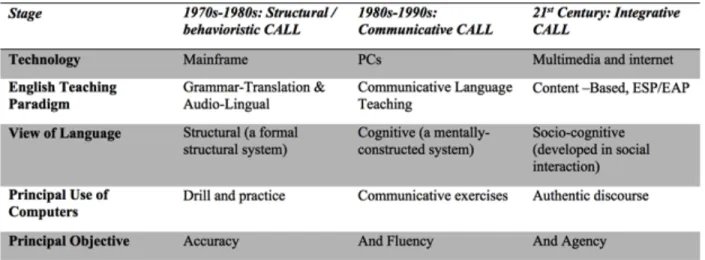
(21) TECHNOLOGY RESHAPING THE EFL CLASSROOM. 10. Chapter 2: Relevant Theoretical Bases for the Review and Other Reviews 2.1. Introduction This section presents a general outline of three conceptual areas: CALL, self- directed. learning, and self- regulated learning. The chapter provides a theoretical overview and general constructs and definitions of the aforementioned terms. 2.2. Theoretical framework 2.2.1. Defining Computer Assisted Language Learning (CALL). Beatty (2010) defines CALL as “any process in which a learner uses a computer and, as a result, improves his or her language” (p. 7). However, one of the major issues in the field is that, due to the advances and transformations in technology and education, publishing companies, researchers, and educators have labeled CALL in different ways. For instance, it is worth mentioning teaching techniques such as computer-enhanced language learning (CELL), technology-enhanced language learning (TELL), and applications such as computer-based language testing (CBLT) and computer-supported reading instruction (CRI). These labels show the viewpoint from which these different approaches are located and their active interaction within the field. The different ways in which CALL has been traditionally understood suggest that conceptualizing the term is a demanding process. The introduction of computers in language learning can be traced back to the early 70s, when the American government provided resources to the teaching and translation of Russian during the Cold War (Beatty, 2010). Since then, the relationship between the computer and language tasks has evolved according to the technological advances of the former and the pedagogical principles of the latter. Table 1 displays a general description of the historical development of CALL..
(22) TECHNOLOGY RESHAPING THE EFL CLASSROOM. 11. Table 1 Warschauer's chart of evolution of CALL. Taken from: Yang (2010, p. 909) From Warschauer’s chart it is possible to say that the evolution of CALL is mainly determined by teaching approaches that have benefited from the use of computer at different proficiency levels. In the first stage of CALL development, structural-behavioral approaches, which emphasized the use of repeated drilling and practice, are mediated through the use of simple tasks that “provide positive or negative feedback to learners on the formal accuracy of their responses” (Yang, 2010, p. 910). The introduction of desktop or personal computers played an important role in the second historical stage, These new machines allowed universities and other institutions to use storage devices, such as video disks or CD-ROMs, that provided complex language programs of instruction that went beyond textual approaches (Beatty, 2010). In this stage, there was a transition from behaviorism to a constructivist model of instruction that allowed learners to construct meaning from the different tasks offered. Finally, the third stage in Warschauer’s chart focused on current and future computer technologies. More than focusing on the machine, this stage points to the development of word processors, the access to and use of internet, and the proliferation of mobile applications related to language learning..
(23) TECHNOLOGY RESHAPING THE EFL CLASSROOM 2.2.1.1. 12. Research on CALL. Ducate and Arnold (2011) explain that CALL research started to appear in the late 1980s and the early 1990s. According to the authors, the CALL research agenda mainly focused on technological, psycholinguistic, sociocultural and ecological approaches. The difference among these approaches resides in the analysis of the relation between computational tools and language learning processes. For instance, technological approaches explore capabilities of hardware and software, and how students and teachers employ and react to new technologies. Psycholinguistic approaches have analyzed the cognitive perspectives related to input, output and interaction that takes place in language learning. Sociocultural theories have influenced CALL research as they have aimed to analyze the “social aspect of learning facilitated by the mediation of tools, including language” (p. 11). Finally, the ecological approach, which should be considered a new trend in CALL research, aims to provide explanations in regards the unity between computers, networks, and the social activities around learning. 2.2.2. Self-directed learning (SDL). Originating at the core of adult education and socio-pedagogical theories (Pilling-Cormik & Garrison, 2007; Saks & Leijen, 2014), SDL is a model that explains the processes that help the student take control over her/his own learning. In other words, SDL provides a conceptual framework to understand the manner in which learners’ make decisions and intuitively follow steps to reach their own learning objectives. SDL is part of a broader conceptual framework called self-direction in learning, which encompasses SDL and self-direction as concepts. According to Saks and Leijen (2014), self-direction in learning refers to “both the external characteristics of an instructional process and the internal characteristics of the learner, where the individual assumes primary responsibility for a learning experience” (p. 191). Therefore, SDL.
(24) TECHNOLOGY RESHAPING THE EFL CLASSROOM. 13. must be understood as the interaction between internal and external processes that impact the learner’s experience and attitudes towards learning. Adult education theorist Malcolm Knowles explains that SDL “is a process in which individuals take the initiative, with or without the help of others, in diagnosing their learning needs, formulating learning goals, identifying human and material resources for learning, choosing and implementing appropriate learning strategies, and evaluating learning outcomes” (Knowles, 1975, as cited in Peters, 1998, p. 163). Knowles’ definition integrates three dimensions that constitute SDL: self-management, self-monitoring, and motivation (Garrison, 1997; Pilling-Cormik & Garrison, 2007). Self-management refers to the contextual or external activities that occur within the learning process. In this dimension, SDL learners are able to identify which materials, approaches, and time constraints will potentially appear while developing their tasks. In this sense, self-management provides the connection between the specifics of the task and its objectives with metacognitive strategies that are used. Self-monitoring appears as part of the realm of the cognitive responsibilities within the leaning process (Pilling-Cormik & Garrison, 2007). Self-monitoring indicates the metacognitive processes that are applied while carrying out tasks. In other words, it is the learner’s capacity to identify what works and what does not, and to make decisions regarding the strategies that might not be fulfilling their function. Garrison (1997) explains that to self-monitor “is to ensure that new and existing knowledge structures are integrated in a meaningful manner and learning goals are being met” (p. 24). In this model, responsibility to construct meaning (or cognitive responsibility) appears as an essential component of SDL. This means that new learning must assimilate and accommodate new concepts with previous knowledge (Garrison, 1997)..
(25) TECHNOLOGY RESHAPING THE EFL CLASSROOM. 14. Motivation is an essential dimension of SDL as it manifests itself in the interest and focus that learners show during the learning process. In the SDL model proposed by Garrison (1997), the distinction between entering motivation and task motivation is important. In the former type of motivation, learners connect their intrinsic motivation with external factors, that is, the learner analyses whether tackling the task with help him/her reach specific objectives. Task motivation is the stage where there is a direct connection with self-management, which means that the learner has initiated a process of active learning (Garrison, 1997). One aspect that enters into this complex description of SDL dimensions is the one on personal autonomy. Candy (1991) explains that personal autonomy must be seen as the overall goal of education at all levels. Within SDL, personal autonomy indicates independence, freedom of choice, and reflection. It is necessary to clarify, however, that autonomy must not be considered as a separate process of the external conditions of the learning environment. As Garrison (1997) suggests, SDL processes are characterized by constructive processes of learning where there is a constant negotiation between the learner and the teacher. It is important to return to the properties of the learning strategies that the learner proposes, as they are key aspects of SDL. According to Loyens, Magda and Rikers (2008), two levels of processing occur as the learner applies his/her own learning strategy: “deep-level processing is aimed at seeking meaning in the subject matter, while in surface learning the reproduction of the content is the first matter of importance” (p. 415). On the one hand, the main attributes of deep-level processing are metacognitive processes of elaboration and identification of the principles behind the subject matter. On the other hand, surface learning is characterized by rehearsal and memorization..
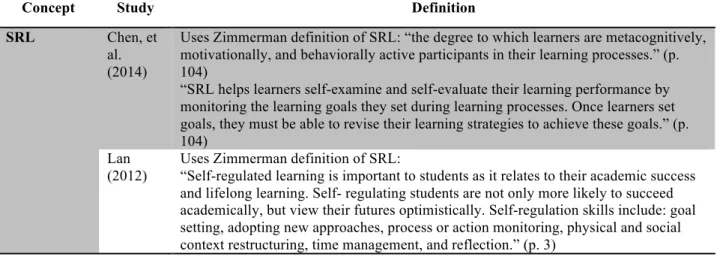
(26) TECHNOLOGY RESHAPING THE EFL CLASSROOM. 15. In sum, self-directed learners are able to independently create a series of strategies that have an impact on their learning process. It is worth indicating that by making decisions in an autonomous manner, applying, revising and modifying specific learning processes, and by reincorporating such strategies in future tasks, learners actively engage in self-direction. 2.2.3. Self-regulated learning (SRL). SRL traces its origins back to the fields of cognitive psychology. Therefore, SRL has traditionally focused on the cognitive and behavioral aspects that take place during the learning process. In this sense, individuals are considered to be self-regulated “to the degree that they are metacognitively, motivationally, and behaviorally active participants in their own learning process” (Zimmerman, 2001, p. 5). In other words, SRL is a learning process in which learners establish their learning goals and plans and subsequently regulate and determine the results of such process (Narciss, Proske & Koerndle, 2007) In addition to this definition, two other components have characterized the conceptual framework of SRL, namely the feedback loop and the aspects related to how and why learners self-regulate. Zimmerman (2001) explains that learning processes are characterized by feedback loops. Put differently, this loop refers to processes of monitoring where the learner determines the effectiveness of the strategies used when completing a task. By doing so, the learner responds to this feedback “in a variety of ways ranging from covert changes in self-perception to overt changes in behavior” (p. 5). The second common component within definitions of SRL refers to “how and why students choose to use a particular self-regulated process, strategy or response” (p. 6). In this regard, theoretical perspectives on psychology and education have provided a rich variety of answers to such inquiry. However, it is certain that motivation plays an essential component in such attempts to understand how and why students self-regulate..
(27) TECHNOLOGY RESHAPING THE EFL CLASSROOM. 16. The different aspects that constitute the main definition of SRL are mainly supported in a model for self-regulated learning proposed by Zimmerman in the late 90s. Such model is based on a cycle based on phases of forethought, volition, and self-reflection (Figure 1). This model provides three essential characteristics of a self-regulated learner. First, a self-regulated learner is able to improve his/her ability to learn through the selection of metacognitive and motivational strategies. Second, the learner is able to select, create and/or organize learning environments that allow him/her to reach learning objectives, Finally, SRL learners are able to determine the form and amount of instruction they need (Sha, Looi, Chen & Zhang, 2011). Figure 1 Zimmerman's model for self-regulated processes Forethought Performance or volitional control Self-reflection. Influential processes and beliefs that precede efforts to learn and set the stage for such learning. Processes that occur during learning efforts and affect concentration and performance. Processes that occur after learning efforts and influence learners’ reactions to that experience. Adapted from: Lewis & Vialleton, (2011, p. 207). Something that must be added about Zimmerman’s model is that in SRL there is a constant back and forth between the personal realm (or private world) and the external environment (Pilling-Cormik & Garrison, 2007). This means that SRL is affected not only by the individual’s thought process but also by the immediate learning environment, that is, the school. It is important to note that, in current SRL models, school systems are considered essential to accompany self-regulating processes. Beishuizen and Steffens (2011) argue that learning institutions must change their methods of traditional apprenticeship towards cognitive apprenticeship, which consists in equipping learners with processes where work which models cognition and metacognition . For the authors, such cognitive modeling helps students and instructors to develop ideal learning environments..
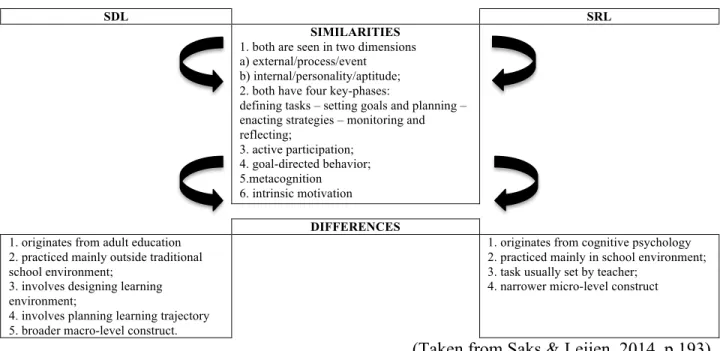
(28) TECHNOLOGY RESHAPING THE EFL CLASSROOM. 17. In sum, in SRL students have a proactive role in the control over their own learning when they select their own learning goals, adapt their learning environments, and use cognitive and meta-cognitive strategies. In this process, the interaction between the learner’s cognitive processes and the instruction that the school offers is based on constant negotiation and accommodation. 2.3. Conclusion The appearance of computers and, therefore, the constant development of digital. technologies has produced an increased awareness of the need to understand how new tools can assist language education. Thus far, several empirical studies have investigated CALL, and the opportunities the field offers to engage learners in new learning environments. As computers are now an integral part of language education there is a common inquiry as to how SDL and SRL can be linked to e-learning, but the terms are not clearly distinguished in literature. As a matter of conclusion of this section Figure 2 displays a comparison between both terms (Saks & Leijen, 2014). Figure 2 Comparisons and similarities between SDL and SRL SDL. SRL SIMILARITIES 1. both are seen in two dimensions a) external/process/event b) internal/personality/aptitude; 2. both have four key-phases: defining tasks – setting goals and planning – enacting strategies – monitoring and reflecting; 3. active participation; 4. goal-directed behavior; 5.metacognition 6. intrinsic motivation DIFFERENCES. 1. originates from adult education 2. practiced mainly outside traditional school environment; 3. involves designing learning environment; 4. involves planning learning trajectory 5. broader macro-level construct.. 1. originates from cognitive psychology 2. practiced mainly in school environment; 3. task usually set by teacher; 4. narrower micro-level construct. (Taken from Saks & Leijen, 2014, p.193).
(29) TECHNOLOGY RESHAPING THE EFL CLASSROOM. 18. Chapter 3: Research Design 3.1. Introduction: What is a systematic literature review?. Instead of traditional reviews, which provide a general overview of literature on a given topic (Boote & Beile, 2005), a systematic literature review is a method of investigation that allows identifying and evaluating research. Gough, Oliver, and Thomas (2012) explain that “reviewing research systematically involves three key activities: identifying and describing the relevant research (‘mapping’ the research), critically appraising research reports in a systematic manner, and bringing together the findings into a coherent statement, known as synthesis” (p. 5). Although it is true that any type of published research must follow specific protocols that are valid and reliable, it is important to determine if investigations available to the public were conducted in a consistent and rigorous manner. In this sense, systematic reviews not only provide an explicit account of methods implemented on studies, but also they become means to accumulate solid evidence from research (Victor, 2008). Literature on systematic reviews (Gough et al., 2012; Okili & Schabram, 2010; Khan, et al., 2003; Torgerson, 2003) strongly suggest following a sequence of steps or stages in the review process. The following list specifies the steps to follow in this systematic review. 1. Framing questions and purpose of the review: This stage includes the research question(s) and purpose of the systematic review. As Khan, et al., (2003) explain such questions must be specified in a clear and unambiguous manner. This is one of the most important steps since it allows the configuration of the search protocol. 2. Protocol Design: At this stage the researcher establishes the bases of the search in the following way:.
(30) TECHNOLOGY RESHAPING THE EFL CLASSROOM. 19. a. Search criteria: Includes the terms to be identified within the search and the type of databases where the search will be performed. b. Searching for the literature: Mainly conducted electronically, this stage involves performing the search by including the criteria previously established. c. Inclusion and exclusion criteria: In this step categories of inclusion or exclusion are identified in the studies selected. It is important to mention that the criteria are established before the search of literature. d. Data extraction: Once the articles for the review have passed through the inclusion/exclusion filter, the information they contain is extracted according to preestablished categories on a data extraction sheet. This stage is where reviewers determine the quality of the studies under scrutiny. e. Synthesis of studies: Researchers summarize the information and the evidence obtained from the data extraction stage. 3. Writing the review: The data obtained is interpreted in the form of a report to be published. 3.1.1. Framing questions and purpose of the review. The following section presents the manner in which this systematic review was conducted after following the steps previously explained. This stage includes the research question(s) and purpose of the systematic review. As Khan, et al., (2003) explain such questions must be specified in a clear and unambiguous manner. This is one of the most important steps since it allows the configuration of the search protocol. Establishing the research question and refining the objectives for this review (see section 1.3 in this paper) allowed conceiving and implementing the main protocol of this investigation..
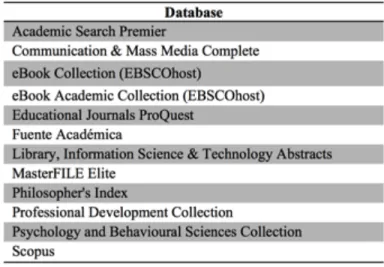
(31) TECHNOLOGY RESHAPING THE EFL CLASSROOM 3.1.2. 20. Protocol design for the systematic review. Before initiating the review, and to guarantee transparency in the process, the researcher established the search and the inclusion and exclusion criteria. Based on the main objective and research question of this thesis, the protocol allowed determining procedures of search and retrieval of articles, application of inclusion and exclusion criteria, extraction of data, and synthesis of the studies. 3.1.2.1. Search Criteria. For the purposes of this investigation, the search was limited to articles published between 2011 and 2015. The reason behind this decision is that, due to the rapid technological advances in interfaces applied to foreign language learning/teaching, articles that extend back several years are considered dated information. In terms of the language of search, English was preferred rather than other languages. Based on the research question and objectives for this paper, the researcher selected six terms to be implemented in the search to obtain the data for this systematic review. These terms aim to narrow down the search in the fields that databases provide: ● ● ● ● ● ●. “Computer Assisted Language Learning”(“CALL”) “Foreign language learning”(“FLL”) “Foreign Language Teaching” (“FLT”) “Foreign Language Teaching and Learning” (“FLTL”) “Self directed learning” (“SDL”) “Self regulated learning” (“SRL”) The databases selected specialize in fields that potentially include research in foreign. language teaching, computer assisted language learning and technology. The databases presented in Table 2 include peer-review journals focused in the fields of education, linguistics, computing and technology, and psychology..
(32) TECHNOLOGY RESHAPING THE EFL CLASSROOM. 21. Table 2 Databases available for the search. 3.1.2.2. Searching the literature. Mainly conducted electronically, this stage involves performing the search by including the criteria previously established. The researcher conducted the search for 6 months from January to July 2015 by using databases provided in the library systems of two universities: Universidad de La Sabana (Bogota, Colombia) and the University of Maryland, Baltimore County - UMBC (Baltimore, MD). Working with the databases of both universities allowed the researcher to maximize and compare the results of the search. Based on the instructions provided in the databases’ search manuals, and after an informal interview with a reference librarian at UMBC, the terms were introduced as free-text searches. This means that, the terms would be searched for in the main records (abstracts and keywords) that the databases provide. Different search combinations were performed, but, in the end, the search was conducted by using quotation marks (“ ”) to limit it to the terms that were introduced. Following the main objective of this systematic review, the search sets combined the terms as it follows: ● “Foreign language learning” OR “foreign language teaching” OR “foreign language teaching and learning”.
(33) TECHNOLOGY RESHAPING THE EFL CLASSROOM. 22. AND “Computer assisted language learning” AND “Self-directed learning “AND OR “Self-regulated learning” In order to ensure optimum precision and recall, the search also included strategies such as deleting sections of the terms. For instance, at the beginning the researcher only introduced terms without quotation marks. This proved to be a difficult search because the databases looked for each word in the databases records (i.e., foreign AND language AND learning). As has been explained before, the use of quotation marks prevents retrieving articles that include only a word of the ‘phrase’ introduced. The results of the search (Appendix A) appear in a flow chart that presents the database (Scopus, Proquest and EBSCO) and the results at every stage of the search when using the different combination of the terms mentioned above. 3.1.2.3. Inclusion and exclusion criteria. The criteria established earlier in the protocol design restricted the selection of articles focused on contents only to those bearing on the research question of this thesis. More specifically, the articles needed to address research on CALL, SDL, and/or SRL in the context of foreign language teaching and learning. Articles that would potentially refer to the use of computerbased learning in other educational contexts were immediately discarded. Other criteria of inclusion required articles with qualitative, quantitative, or mixed methods. Thus, theoretical or reflective studies would be considered inappropriate for this review. Also, articles to be included in the review needed to focus only on populations located in the educational sector. Table 3 displays the specific criteria of inclusion and exclusion implemented in this review. As will be further discussed in Chapter 4, after the search of literature and the application of the inclusion and exclusion criteria, twenty articles were considered for subsequent steps of analysis..
(34) TECHNOLOGY RESHAPING THE EFL CLASSROOM. 23. Table 3 Inclusion and exclusion criteria. 3.1.2.4. Data extraction. Once the articles for the review passed through the inclusion/exclusion filter, the information they contained was extracted according to pre-established categories on a data extraction sheet. It is at this stage where the researchers determined the quality of the studies under scrutiny. Retrieved reports that met the inclusion and exclusion criteria were analyzed by using the data extraction sheet in Appendix B. This sheet, adapted from the Evidence for Policy and Practice Information (EPPI) Centre (2007), aims to identify contextual information, purposes and theoretical constructs of the studies under scrutiny. At the same time, the instrument helps to assess the methodological quality of the studies by paying close attention to data collection and analysis methods of the reports..
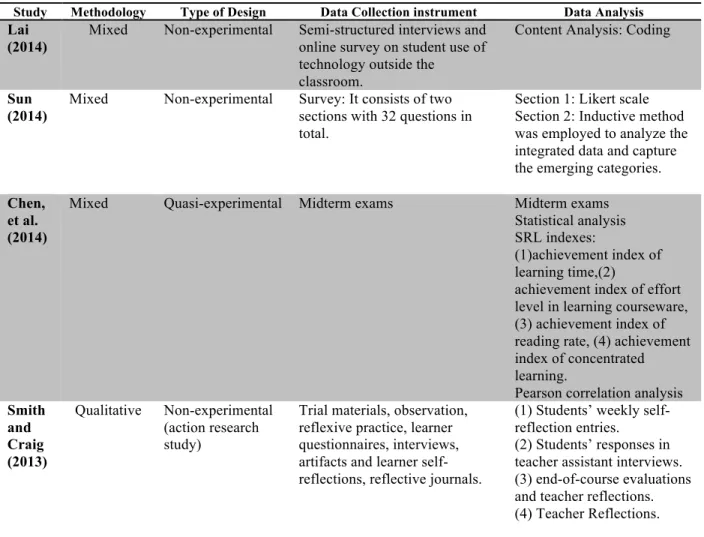
(35) TECHNOLOGY RESHAPING THE EFL CLASSROOM. 24. It is worth noting that the EPPI Centre’s data extraction tool was adapted in order to focus on the research question and objectives of this paper. In other words, the main objective of this investigation required focusing on the theoretical and methodological constructs, the definition of concepts, as well as on the learning outcomes that the selected studies provided. Twenty (20) articles were finally obtained after conducting the search within the databases and were assessed by using the inclusion and exclusion criteria. Ultimately, eight papers remained and were considered relevant for this systematic review. In order to provide the analysis for Phase 1, a characterization of the studies (i.e., to identify population, study dates, education sector, country of studies, research methods, data collection, instruments and analysis, aims and findings), was applied on the eight studies by using a data extraction sheet (Appendix B). 3.1.2.5. In-depth review. The main procedure to include studies in the in-depth review consisted in establishing two filters that correspond to the research questions and the objectives of this thesis. In the first filter, and after passing through the inclusion and exclusion criteria, the studies had to provide a theoretical framework or discussion concerning the concepts of SDL and SRL. It is necessary to specify that at this level the interest of the systematic review is to establish how the selected studies defined the concepts of SDL and/or SRL within contexts mediated by CALL. The second filter aims to answer the question if the studies provide evidence of learning outcomes. Therefore, through a characterization of the aims, constructs, technology used, pedagogical principles, outcomes and data collection instruments, it is possible to present whether studies show proof of learning outcomes or not..
(36) TECHNOLOGY RESHAPING THE EFL CLASSROOM 3.1.3. 25. Writing the review. Researchers summarize the information and the evidence obtained from the data extraction stage. The data obtained is interpreted in the form of a report to be published..
(37) TECHNOLOGY RESHAPING THE EFL CLASSROOM. 26. Chapter 4: Results and Data Analysis 4.1. Introduction This chapter provides an account of the screening procedures applied to the studies. obtained for this review. The following sections describe in detail the two phases implemented for this investigation. The first phase reports on the characteristics of studies that have been included in this systematic review, that is, research studies from 2011 onwards related to CALL, SDL and/or SRL focused on second/foreign language. The second phase provides an in-depth review that focuses on the definitions of SDL and/or SRL, and presents the evidence of learning outcomes in the selected studies. 4.2. Results of the database search The initial database search strategy provided 1,151 results of CALL articles only. Once. the search within the databases continued, and according to the pre-established search criteria, 248 reports were excluded as they did not focus on foreign language learning, leaving 903 reports for further consideration. After implementing the final search filter, which was focused on the terms CALL, FLL, SRL and/or SDL, 883 reports were excluded. In other words, 20 articles, for which full hard or digital copies were sought through library loans or other means, were selected for the screening of titles and abstracts. From a search yield of 1,151 articles, a characterization of 20 studies of empirical research seems dramatic. However, it is important to remember that the review questions are specifically looking at language learning in CALL studies related to SDL and/or SRL. The 20 reports were assessed for eligibility by using the inclusion and exclusion criteria that was designed prior to the search (Table 3). A full list of the studies with reasons for.
(38) TECHNOLOGY RESHAPING THE EFL CLASSROOM. 27. inclusion and exclusion are found in Appendix B and C respectively. After the application of the inclusion and exclusion criteria, eight papers were considered relevant for this systematic review. In order to provide the analysis for Phase 1, a characterization of the studies (i.e., to identify population, study dates, education sector, country of studies, research methods, data collection, instruments and analysis, and aims and findings) was applied to the 8 studies by using a data extraction sheet (Appendix D). This characterization provides a general picture of the different contexts in which research on CALL has been pursued. Finally, for the in-depth review, or Phase 2, the 8 studies were analyzed to answer the two questions proposed for this stage. The first question aimed to analyze how the investigations selected theoretically conceptualize SDL and SRL in the context of CALL. The second question intended to obtain evidence of learning outcomes that the studies presented. Figure 3 displays a flowchart outlining the procedure used for the selection of articles for the review. 4.3. Phase 1: Characterization of the studies and interpretation of findings As it has been previously mentioned, there has been a growing interest in the. investigation of the impact of technology in the classroom. In fact, the initial search results for this review demonstrated that the entries of CALL articles in different databases generated a wide number of results, (e.g., 1.151 studies were found during this search by following the preestablished protocol). However, the number of entries is significantly reduced when the concepts SDL and SRL are added to the search (see Figure 3). It is interesting to notice that, despite the fact that learning mediated by computers is highly characterized by self-learning, only few studies deal directly with SDL and SRL as essential contributors to students’ independent learning..
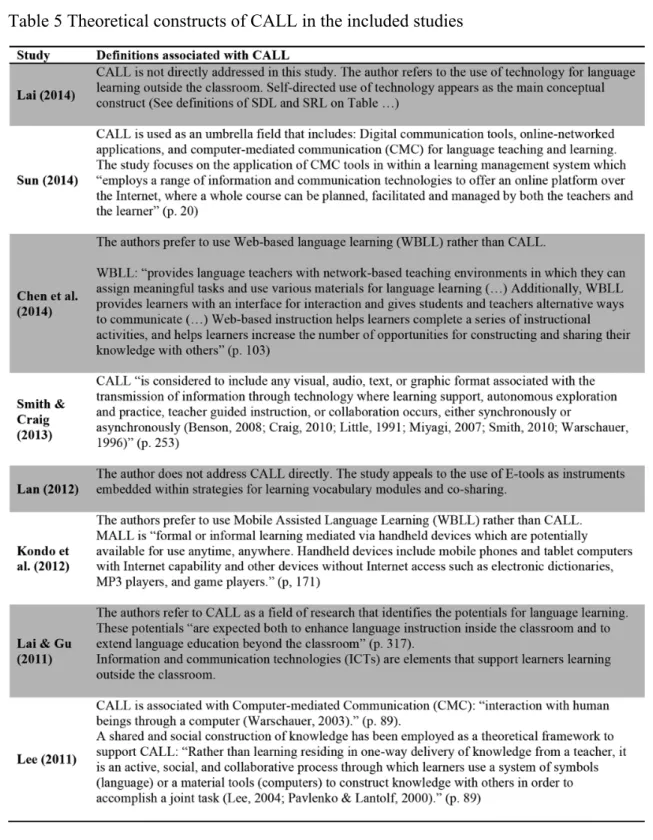
(39) TECHNOLOGY RESHAPING THE EFL CLASSROOM. 28. Figure 3 Flow diagram of studies included in the review. It is important to identify some general characteristics of the studies in regards to years and place of production, population, and educational settings. Table 4 provides information about general aspects of the studies reviewed..
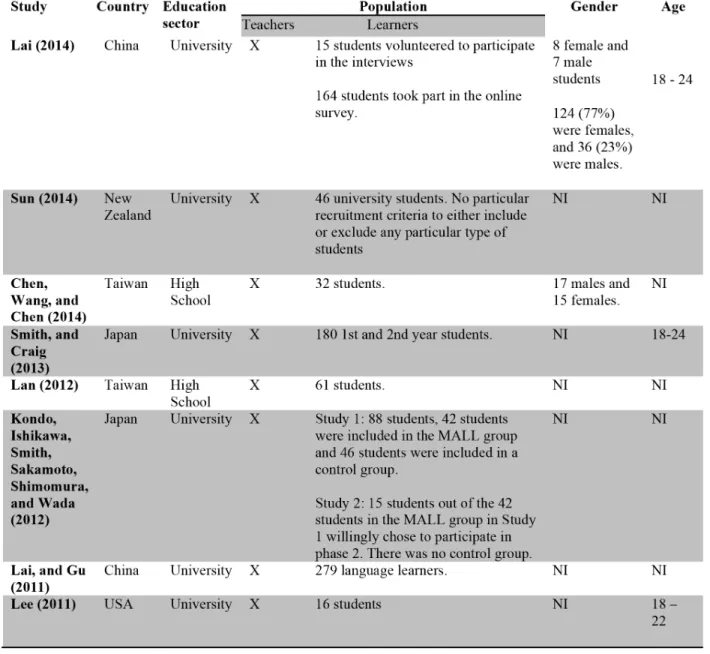
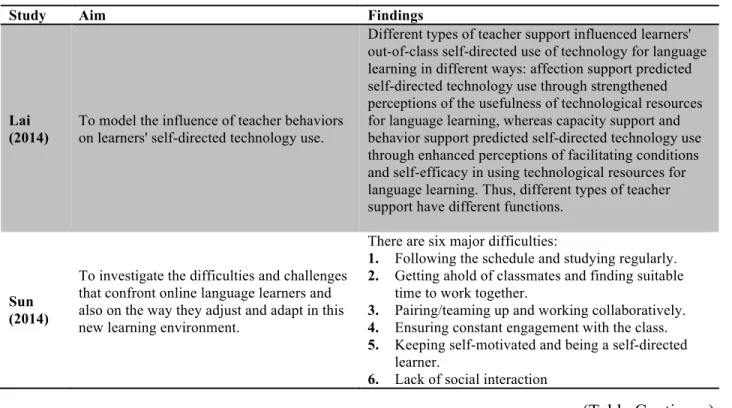
(40) TECHNOLOGY RESHAPING THE EFL CLASSROOM. 29. Table 4 General aspects of the included studies. It is worth noticing that that there is a predominance of research in Asian countries, as 6 out of the 8 studies were conducted in Japan, Taiwan or Korea. This fact relates to Macaro et al.’s review (2012) which stated that research in CALL in these countries aims to evaluate educational policies related to the use of technology in the classroom. Regarding the educational setting in which the reviewed studies were implemented, most of these were conducted in higher education rather than in high school or in lower levels of instruction. Another important aspect of.
(41) TECHNOLOGY RESHAPING THE EFL CLASSROOM. 30. this characterization is that the main focus of these studies was on learners’ attitudes or development of skills in relation to the use of technologies. With reference to the structure of the studies, the researchers presented the main theoretical information related to CALL (Table 5). In the majority of the reports, the investigators emphasized the importance of technology in the context of foreign language learning. Nonetheless, only one of the studies (Craig & Smith, 2013) defined CALL in a more traditional manner. Put differently, the authors considered that CALL is the sum of technological tools “associated with the transmission of information through technology” (p. 253). Lai and Gu (2011) did not provide an exact definition of CALL; however, they considered that the field offers possibilities of research to identify the manner in which ICTs support students’ learning outside the classroom. Six articles located their research not specifically in CALL but in associated fields of technology-based learning. For instance, Sun (2014) and Lee (2011) put emphasis on computermediated communication (CMC) as they considered that the computer is a medium of communication between human beings rather than the objects that students use to interact with. Kondo et al. (2010) referred to Mobile Assisted Language Learning (MALL), a growing field that highlights the potential of mobile technologies (e.g. smartphones, tablets, and mp3 players, among others) in formal and informal language learning contexts. Web-Based Language Learning (Chen et al., 2014) also appeared as a field associated with CALL. The importance of web-based tasks is not the use of the computer or other technologies, but the learning potential that network-based teaching environments offer for both teachers and students. Lai (2014) and Lan (2012) did not offer a clear working definition of CALL. However, they located their research at the heart of the debates and challenges, or the application of computer-mediated.
(42) TECHNOLOGY RESHAPING THE EFL CLASSROOM. 31. learning strategies beyond the classroom. For instance, Lan’s study reported on the analysis and implementation of a co-sharing based strategy-learning system embedded within the context of students’ learning through computers. Table 5 Theoretical constructs of CALL in the included studies.
(43) TECHNOLOGY RESHAPING THE EFL CLASSROOM. 32. The aims of the studies analyzed (Table 6) are consistent with traditional inquiries about CALL (Felix, 2005; Hubbard, 2005). Put differently, the aims of the reports can be divided into three categories: 1) the implementation of technologies and the potential changes in learners’ abilities, 2) general attitudes towards the use of technology, and 3) curriculum evaluation. Regarding the first group, the works of Lee (2011), Kondo et al. (2012), Chen et al. (2014), and Lan (2014) analyzed results obtained after the introduction or practice of a specific technologybased learning tool. More specifically, the work of Lee (2011) analyzed how the use of blogs supported students’ autonomous ability to interact with L1 speakers. One of the most interesting aspects of Lee’s research is the emphasis given to social processes that do not only have an impact in language learning, but also promote intercultural competence. Kondo et al. (2012) analyzed how advanced self-study abilities are potentially fostered by the implementation of a Nintendo DS device. Similarly, the work of Chen et al. (2014) explored how Digital Reading Annotation System (DRAS) techniques, in the form of an HTML-based tool, promoted reading comprehension and annotation abilities. One of the interesting features of this study was its emphasis on social aspects related to the use of the tool, as the authors tried to correlate gender differences with reading comprehension. Finally, the third study in the group, Lan (2012) analyzed the effects of a vocabulary tool (i.e., Mywordtools) on lexical learning. The second group of aims dealt with the general attitudes, perceptions and challenges towards specific or general uses of technological tools in the language learning process. Lai and Gu (2011), for example, intended to determine the perceptions, beliefs, and values towards the use of technology outside the classroom. Moreover, the authors analyzed, through surveys and interviews, the levels of students’ computer literacy and their relationship with learning goals. Lai (2014) examined how students perceived teachers’ modeling of SDL reflected in the use of.
(44) TECHNOLOGY RESHAPING THE EFL CLASSROOM. 33. technologies. In this sense, the author aimed to explain how SDL is not an individual process that precedes learning, but a kind of strategy that can be instilled from external sources. Finally, in this second group of research, Sun (2014) identified variables related to the difficulties and challenges that occur in new online learning environments. These variables appear to be in relation to collaboration, behaviors, and strategies implemented toward language learning in such computer mediated spaces. In the last group of research aims, the work of Smith and Craig (2013) evaluated a CALL learning autonomy course. In this research, the main objective was to analyze the curriculum design of a course characterized by the implementation of CALL and self-access materials. Similarly to the second category of aims, Smith and Craig’s evaluation was based on the perceptions that learners in the course provide. Table 6 Aims and findings as reported in the studies Study. Aim. Lai (2014). To model the influence of teacher behaviors on learners' self-directed technology use.. Sun (2014). To investigate the difficulties and challenges that confront online language learners and also on the way they adjust and adapt in this new learning environment.. Findings Different types of teacher support influenced learners' out-of-class self-directed use of technology for language learning in different ways: affection support predicted self-directed technology use through strengthened perceptions of the usefulness of technological resources for language learning, whereas capacity support and behavior support predicted self-directed technology use through enhanced perceptions of facilitating conditions and self-efficacy in using technological resources for language learning. Thus, different types of teacher support have different functions. There are six major difficulties: 1. Following the schedule and studying regularly. 2. Getting ahold of classmates and finding suitable time to work together. 3. Pairing/teaming up and working collaboratively. 4. Ensuring constant engagement with the class. 5. Keeping self-motivated and being a self-directed learner. 6. Lack of social interaction. (Table Continues).
(45) TECHNOLOGY RESHAPING THE EFL CLASSROOM Study. Aim. Chen et al. (2014). To evaluate how the proposed DRAS with SRL mechanisms can promote reading comprehension and annotation abilities of individual learners, whether gender difference and correlation between reading comprehension and reading annotation ability exist, and how different SRL abilities affect reading comprehension and annotation abilities of individual learners.. Smith & Craig (2013). To enhance learners’ autonomous use of CALL in the acquisition of English as a Foreign Language (EFL). Lan (2012). To develop and evaluate a co-sharing-based strategy learning system for L2 vocabulary learning known as “Mywordtools” that is designed specifically for lexical learning. 34. Findings 1. The proposed DRAS with the SRL mechanism efficiently promoted reading comprehension of learners who set learning goals and self-monitored their progress for reading English-language texts online. 2. Analytical results prove that the proposed DRAS with the SRL mechanism encouraged learners to contribute high-quality annotations, thereby enhancing the reading comprehension of other learners. 3. . Analytical results confirm that gender differences in reading comprehension and annotation ability existed when using the proposed DRAS with and without the SRL mechanisms to read Englishlanguage texts online. 4. Learners had a positive attitude towards collaborative learning behavior as they cared about the rank of their annotations via the annotation reward mechanism. 5. The SRL abilities of learners in the experimental group were positively correlated with their reading comprehension, indicating that reading comprehension of learners in the experimental group can be evaluated according to their SRL indexes assessed by the proposed system. 6. Although the proposed DRAS with SRL mechanism support positively affects learners to contribute rich reading annotations, the quality of learner-generated annotations cannot be guaranteed. This may affect learner’s reading performance. 1. Teachers and learners’ consciousness was raised about what is expected of users in the autonomous use of CALL in a classroom environment and in a Self-Access Centre. 2. There is improvement in learners' planning, organizing, tracking, and evaluation of their autonomous use of CALL resources, and that regular and critical learner self-reflection is a key factor contributing to a positive shift in study culture. 1. Students using Mywordtools practice and share vocabulary learning strategies 2. VLSs outperformed both those who did not use Mywordtools and those who used the platform but without sharing. 3. The sharing strategy helped L2 learners to construct more VLSs, and they consequently performed significantly better than those who did not implement strategy sharing. 4. The use of co-sharing with Mywordtools not only benefits the development of VLSs by EFL students but also helps them to gain more in L2 vocabulary learning.. (Table continues).
(46) TECHNOLOGY RESHAPING THE EFL CLASSROOM Study. Aim. 35. Findings Features of self-study in the MALL group were stronger than in the control group. 2. Self-regulated learning was also more evident in the MALL group than in the control group in terms of the specificity of the students’ goals, the customized creation of learning tasks, and in-class applications compared with the students’ self-reported previous learning behavior. Four factors affected the participants’ selective use of technology for language learning: 1.. Kondo et al. (2012). To discover whether certain MALL practices would foster an advanced form of self-study, self-regulated learning (SRL).. 1.. 2.. Lai & Gu (2011). To understand learners’ self-regulated use of technology outside the classroom for language learning.. 3.. 4.. 1.. Lee (2011). To identify how using combined modalities of asynchronous computermediated communication (CMC) via blogs and face-to-face (FTF) interaction through ethnographic interviews with native speakers (L1s) supports autonomous learning as the result of reflective and social processes.. 2. 3.. 4.. First, participants’ self-regulated language learning dispositions were found to be strongly associated with their use of technology to plan and monitor their learning progress. Second, participants’ language learning beliefs were associated with their technology-enhanced selfregulation: a stronger belief in seeking language use opportunities beyond the classroom was positively associated with participants’ likelihood of using technology to regulate their learning, especially to expand learning resources and to commit to learning goals. Third, learners’ proficiency levels, or rather their perceptions thereof, affected whether they used technology to seek language learning resources and opportunities. Participants who had been studying the language for more than four years were found to show a greater tendency, although not statistically significant, to use technology to regulate their social connections and support than those with less than four years of learning experience The participants’ limited knowledge about and access to useful technology-enhanced learning materials and venues also constrained their active engagement with technology to support their language learning outside the classroom. Blogs afforded students the opportunity to work independently (e.g., content creation) and reflect upon cross-cultural issues. Using blogs gave students a sense of belonging, as they collaboratively shared and exchanged cultural perspectives. Critical reflection relied on the teacher’s guidance and feedback, as most of the students were cognitively challenged by not being able to clearly articulate different points of view. It is likely that students were not accustomed to reflecting. Task type fostered autonomy in different ways. While free topics gave students more control of their own learning, teacher-assigned topics required them to critically think about the readings..
Figure

+7

Documento similar
On the other hand at Alalakh Level VII and at Mari, which are the sites in the Semitic world with the closest affinities to Minoan Crete, the language used was Old Babylonian,
Here we can verify what we believe constitutes a paradox: the necessity of con- siderations of an ethical kind is imposed, but from that tradition of Economic Theory whose
The aim of this paper is to demonstrate that reading authentic literary material in the English as a Foreign Language (EFL) classroom can improve students’ language learning skills as
As the chart illustrates, the majority of the class passed the poster’s task using the passive voice satisfactorily, thanks to the explanations and the exercises
As previously stated, the Motivation Self-Assessment Questionnaire (Table 1) was used to measure students' level of interest in the subject matter, satisfaction
To this end, the activities and teaching materials comprised in the following Didactic Unit are designed following the three-model approach by Carter & Long
My main concern in this paper is to reflect on the pedagogical possibilities that technology may offer to autonomous language teaching-learning procedures, that is: in which ways
The analysis revealed significant differences in categories such as word count, clout, emotional tone, or analytical thinking when comparing the texts written by an
