
Bioleaching of Arsenic Bearing Copper Ores
19
0
0
Texto completo
(2) Minerals 2018, 8, 215. 2 of 19. gangrene and malignant neoplasms, and liver, lung, bladder, kidney, prostate, and skin cancer [8–13]. Therefore, due to this toxicity, the presence of As in Cu concentrates is not desired. Cu rocks extracted normally exhibit low percentages of Cu (less than 1%); therefore, to raise the Cu grade, minerals are processed by separating Cu from other metals, gangue (not valuable material), and impurities. After years of Cu exploitation, scarcity in recent decades of Cu oxides forced Cu sulfide exploitation with a decreasing Cu content to ~1% [14]. Furthermore, the presence of highly refractory minerals in As-bearing Cu sulfides, such as enargite and tennantite, has had a negative impact on the quality of the Cu concentrates produced. With Cu content decreasing and As remaining in Cu rocks, the As/Cu ratio has increased from 100% to 140% in the last two decades [15], the major concern being that As associated with sulfide ores is only separated from Cu through smelting and other conventional technologies with higher economic and environmental costs. Most Cu companies do not have sufficient smelting capacity to process all of their extracted ores, so they produce concentrates with Cu content near 30% and sell them to smelters. However, during smelting, As may be released as hazardous volatile compounds, such as As2 O3 and As4 O6 [16]. This has caused importer countries to impose financial penalties depending on the Cu concentrate’s As content. Japan taxes Cu concentrates that have over 0.2% As content, while China, the world’s largest Cu importer, does not allow the entrance of Cu concentrates with As concentrations higher than 0.5%. For example, Table 1 shows the value of penalty fees that China smelters impose on Cu concentrates and its comparison with Cu concentrate’s average price in December 2017, which was 86 USD per ton [17,18]. If a concentrate has 0.2% As content, its value would decrease 1.7%. However, if it has a 0.7% As grade, the penalty is 15 USD/ton, losing more than 17% of its value. Since Cu mining represents the main productive sector in a group of countries, every penalty fee applied to their sales is an important economic loss. Therefore, Cu concentrates with higher As content should be pretreated to avoid losing a significant part of its value. Table 1. Penalty fees for Cu concentrates with high As-grade. As-Grade (%). Penalty Fee (USD/ton). Percentage from Concentrate Price (%). <0.2 0.2 0.3 0.4 0.5 0.6 0.7 0.8 0.9 1.0. 0 1.5 3.0 4.5 6.0 7.5 15 22.5 30.0 37.5. 0 1.7 3.5 5.2 7.0 8.7 17.4 26.2 35.0 43.6. Selective As bioleaching based on biohydrometallurgy is a novel and promising alternative to reduce the As content from Cu concentrates that has been developed for remote mine sites without smelting capacity [15]. In some countries, it has obtained successful results in processing Cu oxides and Cu sulfides [19–22]. Research of As bioleaching has focused on finding a group of microorganisms capable of enhancing Cu ore leaching with high As content, but few studies have addressed the selective release of As. In this work, biohydrometallurgy and the recent processes and mechanisms of As bioleaching from As-rich Cu ores are reviewed. 2. Conventional Technologies in Processing Copper Ores Typical processing techniques in Cu mining are leaching and smelting, associated with complex processes of hydrometallurgy and pyrometallurgy, respectively. Hydrometallurgy is the main activity of recovering Cu from oxides like cuprite (Cu2 O), delafossite (CuFeO2 ), and tenorite (CuO). It consists of the use of acid leaching to dissolve and release Cu from.
(3) Minerals 2018, 8, 215. 3 of 19. rocks. Currently, this technique has three main configurations and implementations: heap leaching, dump leaching, and in situ leaching. Heap leaching is the use of acid leaching in designed stacks of ores to separate gangue from acid-soluble elements. The solution with Cu percolates to the bottom and is collected in a drainage system. Finally, solvent extraction and electrowinning (SX-EW) techniques produce the formation of London Metal Exchange (LME) grade Cu cathodes from dissolved Cu [23,24]. Dump leaching can be considered as a subset of heap leaching, because this avoids sophisticated and costly ore crushing and designed heaps, since ores are staked in over 18-m piles without an advanced configuration and design [23–26]. As in heap leaching, after collecting percolated solution in the drainage system, SW-EX is applied to obtain Cu. In situ mining is the least efficient method. It only consists of acid injection to the subsurface of underground Cu ores and the extraction of the solution with dissolved Cu. When Cu oxides started to become scarce, Cu sulfides became the main Cu minerals to be mined. Pyrometallurgy is a processing technique for these ores via the smelting route. In pyrometallurgy, metals can be extracted by the conversion of sulfides into oxides. Then, metal oxides are smelted by heating in the presence of a reducing agent, such as carbon or carbon monoxide, which reduces the oxides into metals. Smelting has the highest kinetic rates and can separate gangue and impurities from Cu sulfides. Initially during this process, low-grade Cu ores (with less than 2% Cu content) are ground and crushed. Afterwards, flotation processes are required for the Cu concentrate production (over 26%–30% Cu grade) by separating Cu minerals from gangue and impurities [27–29]. Later, Cu concentrates are sent to furnaces where the smelting process occurs. After melting concentrates, pure Cu and Cu cathodes are also obtained. However, the presence of certain minerals can affect the pyrometallurgical process. For example, enargite presents complications in the flotation process because it is strongly floatable with thiol-type collectors and at the same time it is difficult to separate selectively with standard depressants such as cyanide, sulfide, lime, and permanganate. Usually, sulfides do not float selectively, which impedes easy separation of enargite from the rest of the ore, resulting in high As–Cu concentrates [30,31]. Mining Process Techniques Used to Remove Arsenic from Copper Concentrates Arsenic is one of the major impurities in Cu concentrates, causing several environmental, economic, and productive problems. During the roasting and smelting processes, As may be sublimated, releasing it as volatile compounds that are highly toxic, harming the health of operators and causing environmental pollution [16,31]. In terms of production, the presence of As affects the metallurgical process, reducing the quality of the final products [32]. To address this problem, Cu mining companies use several procedures and techniques to decrease As content. Specifically, three process techniques have been used to directly reduce As content in Cu ores based on physicochemical processes: pressure leaching, roasting treatment, and alkaline digestion. Pressure oxidation utilizes autoclaves that produce solutions with high Cu content while As remains stable in a solid residue. Pressure-leach Cu concentrates are oxidized in autoclaves at an intermediate temperature of 140–180 ◦ C with a leaching solution (acid or alkaline) and high pressure (~300 psi). During the process, the Cu released produces a Cu-bearing solution, which is treated by EW to recover Cu. This technology has been successfully implemented in Canada, Chile, Bulgaria, and other countries, achieving Cu dissolution from enargite and tennantite in 3 h [5,33,34]. Roasting is a technology that oxidizes Cu concentrates at high temperatures, in which As is released by volatilization [35]. The lower melting points of As species in enargite and tennantite, between 640 and 690 ◦ C, allow separation of the As species from the sulfur minerals in a reductive atmosphere. Also, As can be removed from enargite and Cu concentrates in alkaline media [36]. Recently, researchers have explored As leaching using sulfide as an electron donor [37–41]. Ruiz et al. [38] removed more than 97% of the As in 12 min of digestion at 80 ◦ C using an alkaline solution (Na2 S–NaOH) followed by water leaching. In alkaline digestion (with Na2 S–NaOH), As from enargite is released as tetrathioarsenate ion (AsS4 3− ) and Cu remains as a sulfide precipitate [40]. Although traditional.
(4) Minerals 2018, 8, 215. 4 of 19. methods such as pressure leaching, roasting, and alkaline leaching satisfactorily solve the problem of separating As from low-grade Cu ores or concentrates, these methods have not shown a suitable performance in medium- and small-sized mining operations and generate a negative environmental impact. Alternative hydrometallurgical methods or other innovative technologies such as Cu–As bioleaching could optimize the selective removal of As from high As–Cu concentrates, thus reducing negative impacts. 3. Copper Biohydrometallurgy Biohydrometallurgy refers to the industrial mining activity of metal release from ores through microbial activity. Since ancient times, biohydrometallurgical processes have been exploited empirically but without knowledge of the microbiological mechanisms [42]. It started in Cu mining, when miners noted that piles of sulfidic ores or ore tailings were mobilizing Cu naturally in percolating solution [43]. It could be recovered as Cu sulfate or as metallic Cu after appropriate further chemical treatment [44]. In the decade between 1990 and 2000, bacterial leaching of sulfide ores began developing rapidly [45]. Microbial-assisted recovery of heavy metals is now an established biotechnology [45]. The main processes involved in this activity are bioleaching and bio-oxidation. Bioleaching refers to the mobilization of metal cations from ores by biologically mediated leaching and oxidation, and mineral bio-oxidation is used for extraction of target metals that are locked or entrapped by a mineral matrix [45]. Then, after biooxidation of the sulfide mineral matrix, target metals are leached with chemical lixiviants [46–49]. In bioleaching, microorganism inoculation can be used in bioreactors and heap, dump and in situ leaching [32,50,51]. Watling [25] proposed that heap leaching starts to be heap bioleaching when it is performed with these considerations: (1) crushing has to produce smaller particles, 100% of them must be less than 6 mm; (2) stacked heaps are 5–6 m in height; (3) leach effluents contain 2–3 g/L soluble Fe, 20–30 g/L sulfate, and 106 bacteria cells per milliliter; (4) pH is controlled; (5) heap modeling and optimization; and (6) an effective aeration system. A large number of microorganisms that naturally accelerate mineral and rock weathering have been identified such as Acidithiobacillus ferrooxidans (formerly knows as Thiobacillus ferrooxidans), Acidianus brierleyi, Thiobacillus caldus, Leptospirillum ferrooxidans, Acidimicrobium ferrooxidans, Sulfobacillus thermosulfidooxidans, Sulfolobus BC, and Leptospirillum ferriphilum [48,52–63]. Microorganisms that participate in bioleaching mineral oxidation are mostly chemolithoautotrophs, which use inorganic compounds as energy and carbon sources [44]. Many biomining bacteria and archaea use ferrous iron and reduced sulfur compounds as electron donors and generate ferric iron and sulfuric acid which attack sulfide minerals. An example of this is the oxidation of chalcopyrite using Fe3+ as an electron acceptor (Reaction 1). CuFeS2 + 4Fe3+ → Cu2+ + 2S0 + 5Fe2+. (1). Moreover, these microorganisms use carbon dioxide obtained from the air as a carbon source, and from the bioleaching environment they obtain phosphate, nitrogen, potassium and other nutrients [25]. Usually, these microorganisms have genetic capabilities and metabolic mechanisms to grow and survive under mining site conditions. However, several abiotic factors are restrictive for the growth of different microorganisms. -. Acidophilic bioleaching microorganisms require low pH for growth and activity. For example, for Cu sulfides, typical bioleaching occurs at pH 1.8 [64,65]. In terms of temperature, the oxidation rates are increased with temperature [66]. In particular, the leaching of primary sulfides has been more successful with thermophiles than mesophiles [64]. Tolerance of high concentrations of iron (Fe) and Cu are very common in bacteria that has sulfide-oxidation activity in the mine environment or natural rock weathering [67]. However, in enargite or tennantite bioleaching, dissolved As may become inhibitory to bioleaching.
(5) Minerals 2018, 8, 215. 5 of 19. microorganisms. Hence, for bioleaching Cu from As-bearing ores, microorganisms need to be also resistant to As [61,68,69]. Recent advances in leaching of non-As and As-bearing Cu sulfides have demonstrated that, typically, the electron acceptor is a ferric ion. The general reaction that represents the bioleaching of a generic metal “M” sulfide is: 2M-Sulfide + 2H2 O + 4Fe3+ + 3O2 → 2M* + 4H+ + 2SO4 2− + 4Fe2+. (2). *Metal “M”. However, it is possible that “M” is oxidized in solution, which depends on redox conditions (Dold [70]). Although Reaction 2 is not a stoichiometrically balanced reaction, it can show which species participate in the oxidation of a sulfide generic metal and how acid mine drainage (AMD) is generated. Many biological redox reactions are sensitive to redox potential and sometimes have intermediate or parallel reactions [25]. For example, for chalcopyrite oxidation, elemental sulfur appears as an intermediate (Reaction 1). Peters [71] found higher reaction rates at lower potentials like +450 to +650 mV vs. standard hydrogen electrode (SHE). Nicol and Lazaro [72] demonstrated that, parallel to chalcopyrite leaching (Reaction 3), there occurs a nonoxidative dissolution reaction that enhances its kinetics and is also sensitive to redox potential. CuFeS2 + 4H+ → Cu2+ + 2H2 S + Fe2+ (3) The electron donor is predominantly sulfide from the ore and the electron acceptor will always be a ferric ion, but after reduction to Fe2+ , it needs to be reoxidized to the other form. Iron oxidizing microorganisms catalyze the oxidation of ferrous iron to ferric iron (Reaction 4): 1 2Fe2+ + 2H+ + O2 → 2Fe3+ + H2 O 2. (4). Two pathways of sulfide mineral bioleaching have been discovered. Acid soluble sulfide minerals, such as CoS, Cu2 S, CuS, ZnS, NiS, and CdS are leached via the polysulfide pathway, where protons generated by sulfur oxidizing microorganisms and ferric iron generated by iron oxidizers attack the minerals [73]. Acid non-soluble sulfides are leached via the thiosulfate pathway, in which ferric iron is the only leaching agent [73]. Fe-oxidizing bacteria enhance sulfide mineral’s oxidative dissolution, keeping free ferric ions in the solution. In this case, sulfide is oxidized via the thiosulfate pathway [73]. In non-contact mechanisms, microorganisms are suspended in solution, whereas in contact mechanisms microbial cells are attached to mineral surfaces. Extracellular polymeric substances (EPS) secreted by microorganisms can increase the concentration of ferric iron near the mineral surface [74–78]. Also, microbial activity removes some solids that passivize the mineral, such as elemental sulfur [64]. Cu and As will be released to the bulk solution with both mechanisms, but secondary mineral precipitates will occur differentially with each mechanism [77]. 4. Enargite Oxidation Enargite is the most common Cu–As sulfide present in high-sulfidation epithermal deposits and porphyry Cu systems [78]. Tennantite also appears in Cu rocks, but with much less abundance. Enargite is a blackish-gray mineral that has a metallic luster, 4.5 g·cm−3 of density, and a Mohs hardness of 3 [78]. Also, it crystallizes in the orthorhombic system, pyramidal class, and space group Pnm21 [78]. Typical analysis with X-ray absorption near-edge spectroscopy (XANES) and electron paramagnetic resonance spectroscopy (EPR) shows that chemical states of enargite elements are +1 for Cu, +3 or +5 for As and −2 for S. However, Di Benedetto et al. [79] found opposite results with enargite paramagnetic analysis by superconducting quantum interference device (SQUID) magnetometry. With this technique, chemical states are +2 for Cu, +3 for As and −1 and −2 for S. Based on this, it is not possible to ensure that the oxidation states of the elements in enargite are unique, and the As bioleaching processes can include both.
(6) Minerals 2018, 8, 215. 6 of 19. oxidation and reduction processes. However, as sulfur was determined to be in −1 or −2, it appears like sulfide [79]. Therefore, a bioleaching alternative can be the sulfide oxidation from enargite to release Cu and As into the solution. Sasaki et al. [80] evaluated the abiotic leaching in As–Cu ores. They used H2 O2 and O2 bubbling to leach pure enargite, chalcopyrite, and tennantite of different pHs. They obtained a different predominance of dissolved species and several solid phases. In the case of enargite, at pH 5 after total oxidation of S occurs, precipitation of As as Cu arsenate (Cu3 AsO4 ), and the concentrations of dissolved Cu and dissolved As, were low. This represents a complication to the leaching process because Cu and As remain in a solid phase. Also, Curreli et al. [81] investigated enargite leaching under abiotic conditions. They demonstrated that the grain size of the enargite concentrate samples influenced the success of the leaching process. The specific area of the surface was varied in diameter between 0.02, 0.05, and 0.15 mm. Surface areas were 1.04, 1.75, and 2.37 m2 /g, respectively. The leaching tests consisted of adding 32.5 g/L Na2 S and 100 g/L NaOH at 115 ◦ C in a high-pressure laboratory reactor. Pulp density was 1% w/v. Results showed the percentages of As removal after 120 min around 52.4%, 77.5%, and 97.7%, respectively. As they expected, As dissolution increased with decreasing particle size because of the greater surface area exposed [81]. 5. Arsenic-Bearing Ores Bioleaching Arsenic is a highly toxic element that affects the metabolic functions of different microorganisms, which restricts the application of bioleaching strategies for As-bearing ores. However, some microorganisms have developed mechanisms of resistance to As toxicity that may have great potential for bioleaching. Arsenic occurs in four oxidation states (−3, 0, +3, and +5) and in organic and inorganic forms [7]. However, in natural systems, its inorganic forms predominate as oxyanions of trivalent arsenite or pentavalent arsenate [82]. Furthermore, the As toxicity depends on the its chemical form [83]. Arsenate is a molecular analog of phosphate and inhibits oxidative phosphorylation, directly affecting the energy-generation system of the cells. On the other hand, arsenite is more toxic than arsenate because it can bind to sulfhydryl groups, damaging the function of proteins. Thus, some microorganisms can change the oxidation state of As as a mechanism of resistance to toxicity. Arsenic oxidation is mainly used by microorganisms as a detoxification strategy, although there have been isolated bacteria that use As in their metabolic processes linked to cellular respiration and energy conservation [84]. Biotic oxidation of As is mediated by enzymes known as arsenite oxidases, such as AroA/B, AsoA/B, and AoxA/B [85–87]. Likewise, other microorganisms can also catalyze the reduction of arsenate to arsenite [88]. The biotic mechanism of arsenate reduction is mediated by enzymes known as arsenate reductases [89]. It has been demonstrated that these enzymes reduce arsenate intracellularly and extracellularly [89,90]. Therefore, bioleaching of As-bearing ores such as enargite should necessarily be coupled with a mechanism of tolerance or microbial resistance to As. 5.1. Enargite Bioleaching Mechanisms Jiang et al. [91] simulated and modeled enargite bioleaching, with both iron- and sulfur-oxidizing microorganisms. In the first case, after Fe-oxidizing bacterial activity (Reaction 4), ferric iron is oxidized from enargite (Reaction 5). This reaction is optimal above +700 mV vs. Ag/AgCl of redox potential and contributes to 95.5% of enargite oxidation under these conditions [91]. Cu3 AsS4 + 9Fe3+ + 2H2 O → AsO2 − + 3Cu2+ + 9Fe2+ + 4S0 + 4H+. (5). Enargite leaching with biogenic protons proceeds as follows [91] (Reaction 6): Cu3 AsS4 + 2.25 O2 + 5H+ → AsO2 − + 3Cu2+ + 4S0 + 2.5H2 O. (6).
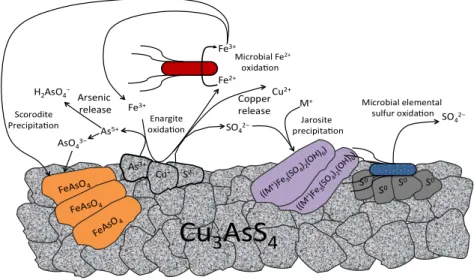
(7) Minerals 2018, 8, 215. 7 of 19. Arsenite produced during enargite solubilization is oxidized to arsenate [92,93] (Reaction 7). According to Jiang et al. [91], optimal redox potential is +479 mV vs. Ag/AgCl. AsO2 − + 2Fe3+ + 2H2 O → AsO4 3− + 2Fe2+ + 4H+. (7). Arsenate can precipitate as ferric arsenate (Reaction 8): AsO4 3− + Fe3+ → FeAsO4. (8). The bioleaching of enargite is impaired by the formation of layers of secondary solids in the mineral surface (passivating layer). Elemental sulfur (S0 ) is formed after sulfide oxidation mediated Minerals 2018, 8,the x FORenargite PEER REVIEW 7 of 18 by iron, passivizing surface and impeding dissolution [64,94]. Nevertheless, some microorganisms,Arsenate such ascan Sulfolobus BC, are able to oxidize elemental sulfur and remove the passivation precipitate as ferric arsenate (Reaction 8): layer [64,94]. AsO43− + Fe3+ → FeAsO4 (8) Other studies propose that a multilayer of different secondary solids formed after enargite The bioleaching of enargite is impaired by the formation of layers of secondary solids in the oxidation could impede antipassivation activity [95–97]. et al. [97] suggest mineral surface this (passivating layer). Elemental sulfur of (S0)microbes is formed after sulfide Takatsugi oxidation mediated + that jarosite ((M )Fepassivizing (FeAsO cupric arsenate (FeAsO by iron, the enargite surface and impeding dissolution Nevertheless, some 3 (SO4 )2 (OH) 6 ), scorodite 4 ·2H 2 O), and[64,94]. 4 ) would such as Sulfolobus BC, are impeding able to oxidize elementalbrierleyi sulfur and remove the be producedmicroorganisms, rapidly during enargite oxidation, Acidianus from reaching the sulfur passivation layer [64,94]. passivation layerOther [97].studies propose that a multilayer of different secondary solids formed after enargite oxidation this antipassivation of microbes Takatsugi et al. [97] suggestunder acidic Scorodite is thecould mostimpede common secondaryactivity As mineral of [95–97]. the ferric-arsenate system that This jarosite ((M+)Fe3(SO4)2mineral (OH)6), scorodite (FeAsO 4·2H2O), and cupric arsenate (FeAsO4) would be conditions [98]. crystallized belongs to the orthorombic system and persists in waters with produced rapidly during enargite oxidation, impeding Acidianus brierleyi from reaching the sulfur pH less thanpassivation 3, controlling the concentration of dissolved As [99]. Under reducing conditions (redox layer [97]. is thedissolved most common secondary As mineral of the increase ferric-arsenate system under acidic potential below Scorodite +100 mV), As concentrations can dramatically due to reductive conditions [98].and This Fe, crystallized mineraloxidizing belongs to the orthorombic system and persists in waters dissolution of both As but under conditions, scorodite has low solubility [100]. with pH less than 3, controlling the concentration of dissolved As [99]. Under reducing conditions Scorodite is important in enargite it stabilizes As indramatically its solid phase (redox potential below +100bioleaching mV), dissolvedbecause As concentrations can increase due to and forms a reductive dissolution of both As and Fe, but under conditions, scorodite in hasacidic low solubility passivating layer when it precipitates (Reaction 9). oxidizing Arsenate is protonated conditions. [100]. Scorodite is important in enargite bioleaching because it stabilizes As in its solid phase and forms a passivating layer when it precipitates (Reaction 9). Arsenate is protonated in acidic 2H2 O + H3 AsO4 + Fe3+ → FeAsO4 ·2H2 O + 3H+ conditions.. (9). 2H2O + H3AsO4 + Fe → FeAsO4·2H2O + 3H The main processes associated with the oxidation of enargite and the formation(9)of passivating The mainin processes with the oxidation of enargite and the formation of passivating multilayers are shown Figureassociated 1. 3+. +. multilayers are shown in Figure 1.. Fe3+. Microbial Fe2+ oxida on. FeAs. O4. Cu+. Jarosite precipita on. SO42−. S2+. O4 FeA s. O4 As Fe. M+. ((M. ( 3 )Fe. ) 6) OH ) 2(. O4. S. Microbial elemental sulfur oxida on SO. 2− 4. H) 6). As3+. Cu2+. 4) 2 (O. As5+. Enargite oxida on. Copper release. O. AsO43−. Fe3+. 3 (S. Scorodite Precipita on. Fe2+ Arsenic release. ((M + )F e. H2AsO4−. S0. SS00. S0. S0 S0. Cu3AsS4. Figure 1. Mechanism of enargite bioleaching and secondary solids formation. Microorganisms. Figure 1. Mechanism bioleaching solidsof formation. regenerate Fe2+of to enargite Fe3+ which oxidizes enargiteand with secondary concomitant release arsenate, copperMicroorganisms and 2+ to Scorodite, sulfate. jarositeoxidizes and elemental sulfur with phases concomitant form passivatingrelease layers onof thearsenate, surface of copper and regenerate Fe Fe3+ which enargite enargite, reducing rates. Sulfur-oxidizing microorganisms remove elemental sulfur on layers. sulfate. Scorodite, jarositeoxidation and elemental sulfur phases form passivating layers the surface of However, jarosite and scorodite formation may impede microbial elemental sulfur oxidation [97]. enargite, reducing oxidation rates. Sulfur-oxidizing microorganisms remove elemental sulfur layers. Bioleaching Enargite with Acidophilicmay Microorganisms However,5.2. jarosite andofscorodite formation impede microbial elemental sulfur oxidation [97]..
(8) Minerals 2018, 8, 215. 8 of 19. 5.2. Bioleaching of Enargite with Acidophilic Microorganisms A number of studies have evaluated bioleaching of enargite by various acidophilic microorganisms. The studies discussed below use Fe-oxidizing and S-oxidizing microbes to evaluate the capacity to release Cu. The objective was to recover the largest amount of Cu while avoiding As release. The desirability of this is due to the environmental risk of releasing As in heap or dump bioleaching, considering possible damage caused to the environment. 5.2.1. Mesophiles Mesophile species were the first to be studied in laboratory bioleaching research. The most extensively studied microorganism is Acidithiobacillus ferrooxidans (previously known as Thiobacillus ferrooxidans). It was isolated from mine drainage water in one of the major bituminous coal deposits in the United States [53]. This autotrophic gamma-Proteobacterium oxidizes both ferrous iron and reduced sulfur compounds at 0–35 ◦ C [101]. Two other mesophilic autotrophic bacteria also appear to be important: Acidithiobacillus thiooxidans (formerly known as Thiobacillus thiooxidans) and Leptospirillum ferrooxidans. The first one was discovered by Walksmann [102] in 1922 and was described as a S-oxidizer [103]. The second was first isolated by Markosyan [104] in 1972, but this one oxidizes ferrous ions to ferric ions [103]. Escobar et al. [105] explored the bioleaching of 5 g of enargite sample (104–147 µm) with an Acidithiobacillus ferrooxidans inoculum in MC medium acidified to pH 1.6. Erlenmeyer flasks were shaken at 30 ◦ C and the pulp density of leaching was 5% w/v. Tests with the addition of 3 g/L Fe3+ obtained a 9% of Cu recovery from the mineral after 21 days. Although, these results duplicated the Cu recovery compared with acid leaching at same conditions, they were still insufficient to scale the experience [105]. Also, Muñoz et al. [64] studied the Cu recovery from Cu concentrates with a mixed culture of Acidithiobacillus ferrooxidans, Acidithiobacillus thiooxidans, and Leptospirillum ferrooxidans in 9K medium at 33 ◦ C, pH 1.8, and +500 mV vs. normal hydrogen electrode (NHE) of redox potential. The cell density of inoculum was 1 × 10⁷ cells/mL and the mineral sample size ranged from 38 to 75 µm with 1% w/v concentrate. Their results showed a recovery of 8% of Cu in 34 days, due to the formation of Fe and a potassium basic phosphate layer, which passivized the mineral surface [64]. Sasaki et al. [77] leached pure enargite (38–77 µm particle size) using mesophilic Acidithiobacillus ferrooxidans in 0.9K medium at pH 2, 25 ◦ C and 500 mV vs. NHE. They obtained in 20 days 13.7% and 13% of Cu and As recovery, respectively. Despite the potential of Acidithiobacillus ferrooxidans to bioleach metal sulfides, its application was not effective in the leaching of enargite under acid conditions [76]. 5.2.2. Thermophiles In Cu–As bioleaching, thermophiles have the advantage of tolerating high temperatures so higher kinetic rates of mineral oxidizing reactions are achieved [106]. Escobar et al. [94] evaluated the dissolution of 2 g of enargite (2% w/v) of a granulometric size between 104 and 147 µm. Bioleaching tests were mediated by 5 mL inoculum of Sulfolobus BC in shake flasks at pH 1.6 and 70 ◦ C. This archaeal strain was isolated by Brierley [107] from a high-temperature environment and it oxidizes metal sulfides, sulfur, or ferrous iron at 65–75 ◦ C. Tests done by Escobar et al. [94] using 1 g/L Fe3+ showed in 23 days 52% of Cu released compared with 8% for abiotic control. Only 3.9% As was dissolved by acid leaching, but with biotic culture the release was greater, reaching 17% [94]. Also, iron-free bioleaching was tested, demonstrating that the addition of FeSO4 to the solution enhances the Cu dissolution rate. They proposed that Sulfolobus BC follows the polysulfide pathway or direct sulfide oxidation. However, with Fe dissolved, cells oxidize enargite indirectly by recycling Fe. Another thermophilic but Fe-oxidizing microorganism was proposed—Sulfolobus metallicus. This archaeon was studied by Huber et al. [108] and was shown to grow autotrophically at 65–70 ◦ C. Sulfolobus metallicus was used by Muñoz et al. [64] to bioleach a pure enargite and Cu concentrates. The Cu concentrate was composed of 38% pyrite, 23% gangue, 16% enargite, 11% grey Cu, 11% chalcopyrite, and traces.
(9) Minerals 2018, 8, 215. 9 of 19. of other Cu oxides. The tests were performed with a mineral sample ranging from 38 to 75 µm, pulp density 10% w/v, and 100 mL bacterial inoculum in shake flasks. At pH 1.8 and 70 ◦ C and after 34 days of operation, 84% of total Cu was leached, much more than the results obtained in the same study with mesophilic mixed culture (8%), highlighting better performance associated with thermophilic microorganisms [64]. Segerer et al. [109] were the first researchers who isolated thermoacidophilic Acidianus brierleyi. This species was discovered in fumarole fields and marine hydrothermal systems and represents one of the most important thermophilic sulfur-oxidizing archaea. Acidianus brierleyi has been tested in bioleaching of sulfide ores like pyrite, sphalerite, and chalcopyrite in several studies [56,57,110]. Takatsugi et al. [97] used Acidianus brierleyi in enargite bioleaching experiments and obtained nearly 91% Cu leached but only 6% As extraction. In this experiment, 0.5 g of enargite were added to 50 mL 9 K media, 2.7 g/L FeSO4 , and 107 cells/mL inoculum in shake flasks, at initial +500 mV vs. NHE redox potential. The temperature was 70 ◦ C, redox potential remained at +830 mV vs. NHE after 10 days, and pH was adjusted to 1.5. The low rates of As leaching suggest the influence of a multipassivation layer, which was confirmed by the presence of ferric arsenate, jarosite, and scorodite onto the enargite surface [97]. On the other hand, Sasaki et al. [106] examined the effects of different pulp densities and initial Fe2+ added in enargite bioleaching with Acidianus brierleyi. For these experiments, mineral mass, pH, temperature, redox potential, basal media, and cell inoculum were set. Initial concentrations of Fe2+ (as FeSO4 ·H2 O) varied between 0.9, 1.8, 2.7, and 3.6 g/L, while pulp densities used were 0.5%, 1%, and 2% w/v. The highest Cu leaching yields were reached with 1.8–2.7 g/L of Fe (91% in 27 days) and 1% w/v pulp density. Also, As release changed with initial Fe. For 0.9 and 3.6 g/L of Fe added, enargite was poorly oxidized and As remained mainly in its mineral phase. The highest Cu and As dissolution was obtained at initial ferrous iron concentrations of 1.8 and 2.7 g/L. Initial Fe2+ concentration of 1.8 g/L was not sufficient to drive the formation of scorodite or ferric arsenate, as 40% of As remained dissolved. However, with 2.7 g/L of Fe2+ , optimal results were achieved because As was predominantly immobilized as scorodite, with about 15% of As remaining as dissolved. In addition, with Fe2+ initial concentrations higher than 3.6 g/L, the formation of potassium jarosite (KFe3 (SO4 )2 ·(OH)6 )) occurred, which impeded enargite oxidation. In terms of pulp densities, high densities impair the mineral oxidation by increased microbial stress and Fe3 + -AsO4 3 -complexation. Similarly, Ai et al. [111] cultivated different thermophilic Metallosphaera strains and tested their enargite bioleaching capacity at pH 2, +350 mV vs. Ag/AgCl, and 75 ◦ C. Metallosphaera species were isolated by Huber et al. [112] from a solfataric field in Italy. These S-oxidizing archaea are facultative autotrophs, and can use organic matter such as yeast extract. Also, they grow in temperature ranges from 50 to 80 ◦ C, meaning they are extremely thermophilic [112]. In Ai et al. [111] each Metallosphaera sedula DSM 5348T, M. sedula CuR1, M. sedula copA, M. sedula ARS50-1 and ARS50-2, and finally, Metallosphaera hakonensis HO 1-1 (108 cells/mL) were inoculated in 50 mL of basal salts medium (BSM) adjusted with H2 SO4 and then were disposed in shake flasks. The concentrate composition was 60% enargite, 30% pyrite, 5% nowackiite, and balance quartz, as indicated by X-ray diffraction (XRD) analyses. By employing adaptive laboratory evolution (ALE), they obtained different As and Cu tolerances and leaching yields at different pulp densities (1%–3% w/v) for each mutant culture. The best leaching yield of 61.6% of Cu was obtained at 1% w/v pulp density using a cross-resistant Metallosphaera sedula consortium, which reached +540 mV Ag/AgCl redox potential [111]. Additionally, another process that has been investigated was enargite bioleaching catalyzed by silver. Oyama et al. [113] used a culture of bacteria Acidimicrobium ferrooxidans, Sulfobacillus sibiricus, and Acidithiobacillus caldus and archaea Ferroplasma acidiphilum to bioleach a concentrate of 34% enargite. They explored the catalytic mechanism of silver sulfide in enargite bioleaching, adding 0.04% silver sulfide to the enargite reactor. For this, 107 cells/mL of each strain was inoculated in a basal salts medium containing 2% w/v enargite (particle size P80 was 90 µm) and operated at pH.
(10) Minerals 2018, 8, 215. 10 of 19. 2 and 45 ◦ C. Their results show an enhancement in Cu recoveries when silver sulfide was added, from 43% to 96% in 72 days [113]. Redox potential was reduced from +750 mV to under +700 mV vs. Ag/AgCl with silver addition. Also, secondary solids such as trisilver As sulfide (Ag3 AsS4 ) and intermediate layer (Ag,Cu)3 AsS4 were formed. The authors suggested that both solids did not passivize the energite surface. By contrast, silver could substitute Cu in enargite, enhancing its dissolution. Moreover, Córdova et al. [114] proposed that the silver-catalyzed process also enhances chalcopyrite bioleaching as Ag substitutes Cu and increases its release. These results support the idea of using silver sulfide in enargite bioleaching, but the costs of this addition should be studied to consider its large-scale application. In summary, the biotic factors improve the release of Cu and As, but it is not enough for a productive result. In some cases, enhancing As release could be considered a disadvantage because it would require the application of As treatment systems from Cu solutions. In turn, As-bearing sulfide minerals oxidation produces not only the As release but also an enrichment in sulfate, heavy metals, and water acidification, which can harm its large-scale application [115]. 5.3. Enargite Bioleaching with Neutrophilic Microorganisms Other microbial species such as sulfur-oxidizers could be used in Cu–As sulfide bioleaching, but there is no data from studies associated with these processes in enargite. Fe-oxidizers and S-oxidizers are microorganisms that naturally oxidize sulfide minerals like pyrite (FeS2 ), generating AMD or acid rock drainage (ARD) [52]. However, microorganisms that oxidize As and sulfur simultaneously can be a feasible alternative for bioleaching As–Cu sulfides and Cu concentrates in stirred tank reactors. In this regard, strain WAO, an autotrophic bacterium known as both an arsenite and sulfur oxidizer, has been studied. Rhine et al. [116] isolated strain WAO and characterized it with another five novel bacterial strains, which can couple As(III) oxidation to CO2 fixation under denitrifying or aerobic conditions. Strain WAO, after named Bosea WAO, was found in high-As shales from the Newark Basin in New Jersey, USA [116]. This was the first microorganism that has been reported to be able to mobilize and transform As from minerals under circumneutral pH [117]. Phylogenetic characterization found that this bacterium is grouped with the class alpha-Proteobacteria, specifically with Bosea thiooxidans, within 99% of shared identity. Bosea thiooxidans is a reported heterotrophic, strict aerobe, and inorganic sulfur oxidizer [118]. After isolating, mineral studies with arsenopyrite and pyrite-bound As confirmed that Bosea WAO oxidizes sulfide and arsenite [119]. Arsenic mobilization from the mineral phase should have been enhanced by oxidation of sulfide in the pyrite lattice, and also by aqueous arsenite oxidation through the removal of it from the surface layer or by decreasing arsenite concentration from the solution [117]. Bioleaching tests were carried out to evaluate the As dissolution mediated by Bosea WAO culture. This culture was grown in a mineral salts medium under aerobic conditions with pH adjusted to 7.2. The medium consists of 10% (w/v) of pulverized high-As black shale from an outcrop of the Newark Basin’s Lockatong formation. These were dispensed in a 250 mL Erlenmeyer flask and incubated on a shaker at 30 ◦ C in the dark. Results showed that the activity of strain WAO generated an additional sulfate concentration 3.5 times greater than in the abiotic sterile controls, confirming S-oxidation. In addition, after 14 days of operation, 0.27 mM soluble As was detected in the sterile cultures, whereas in the active cultures, 1.01 mM total As was measured [117]. This study shows the As release from a sulfide mineral, and although ferric iron was present in the solution, As was mostly soluble and only small amounts of Fe–As minerals were precipitated [117]. Bioleaching tests on enargite, tennantite, and other Cu sulfides could achieve good results in both As and Cu dissolution due to complete sulfide oxidation. The absence of passivating layers of scorodite, ferric arsenate, or jarosite would be an excellent condition that enhances bioleaching kinetics, and finally suggests that Bosea WAO or similar microorganisms can be one of the best alternatives to use in bioleaching of high As–Cu ores. The potential use of this must only be in consideration of the environmental risk of releasing As. Stirred tank reactors could be an option that controls As release,.
(11) Minerals 2018, 8, 215. 11 of 19. avoiding it dissolution in natural water courses. However, a greater understanding of the mechanisms of Bosea WAO related to As and S oxidizing capacity is still needed. 5.4. Bioleaching Pre-Treatment Releasing Arsenic Bioleaching microorganisms have mainly been applied to the leaching of base metals and biooxidation of refractory gold ores, however they could also potentially be applied to remove As as a pre-treatment before roasting, pressure oxidation or alkaline digestion. Pre-treatment emerged as an idea to release only As from Cu concentrates, avoiding Cu releasing into the solution. Complete Cu sulfide bioleaching depends on mineral-sulfide oxidation; therefore, a high percentage of Cu is released into the solution. For pre-treatment, Cu must remain in its solid phase, but As must be released to the solution. According to that, a Cu concentrate pre-treatment would need a selective oxidative/reductive dissolution of As. Hence arsenite-oxidizing or arsenate-reducing microorganisms could be a solution for selectively leaching As from As-bearing Cu ores or Cu concentrates. It is known that bacteria are capable of naturally mobilizing As by redox reactions, thus reducing or oxidizing it [119–123]. The proposed idea of As-recovery by bio-oxidation from enargite or As-rich Cu concentrates comes from studies on arsenopyrite dissolution. Drewniak et al. [124] studied heterotrophic microorganisms hypertolerant to As (up to 500 mM of arsenate) from Gertruda Adit, a gallery within the Zloty Stok mine, south-west Poland. In the rocks of this site, As occurs as loellingite (FeAs2 ) and arsenopyrite. Selective microbial oxidation tests were performed with a culture of bacteria (106 cells/mL) isolated from the mine site. Loellingite and arsenopyrite mineral samples were added in an MSM medium at pH 7.2. The results indicated that some bacterial strains could release around 254 mg As3+ /mg protein per minute. Also, the presence of siderophores supports the idea of its correlation with As resistance and the increase of the As and ferric iron mobilization from insoluble compounds. Drewniak et al. [125] characterized the bacterial strains involved in the As release process. They found that the dissimilatory arsenate reducers such as Shewanella sp. O23S and Aeromonas sp. O23A play a significant role in direct As mobilization [124,125]. In addition, siderophores produced by As-resistant Pseudomonas spp. were active in indirect As mobilization [126]. Finally, a respiratory process based on the oxidation of arsenite was performed only by Sinorhizobium sp. M14, a chemolithoautotroph [127]. The capability of As-metabolizing strains to release As from arsenopyrite and from a mixture of loellingite and scorodite collected in Zloty Stok mine were also examined. The results are presented as follows [124]: -. Sinorhizobium sp. M14 produced at neutral pH a concentration of As (133.5 mg/L), 33.5% higher than control. Pseudomonas strains (OS8 and OS20) produced 195 and 211.3 mg/L of dissolved As, respectively. Anaerobic As mobilization by Shewanella sp. O23S and Aeromonas sp. O23A (the two dissimilatory arsenate reducers) was much more efficient than the aerobic cultures.. Although dissimilatory arsenate reducers showed better results, the use of these microorganisms would not be cost-effective for enargite selective oxidation. Other microorganisms, such as Sinorhizobium sp. M14 and Pseudomonas spp. have also shown promising results. For the first one, 3.94 µg/L of total dissolved As was detected after 7 days of incubation at 22 ◦ C under aerobic conditions, whereas sterile control only showed 0.73 µg/L of total dissolved As [125]. The medium was slightly alkaline, cell densities were 106 cells/mL and mineral samples weighed 5 g. Drewniak et al. [125] postulated that arsenate released from the arsenite oxidation by strain M14 was coprecipitated with ferric ions (released from arsenopyrite at neutral pH), producing a dark orange scorodite-like precipitate on the surface. Likewise, Pseudomonas OS8 and OS20 exhibit a high capacity for arsenate reduction [124] and, in Fe-limiting conditions, produce different siderophores such as hydroxamate-type (OS8) and catechol-type (OS20) [125]. Siderophores bind ferric ions in complexes that get into the bacterial cell by active transport mechanisms. It is proposed that, while this transport occurs, arsenate is released from the solid to the solution and the.
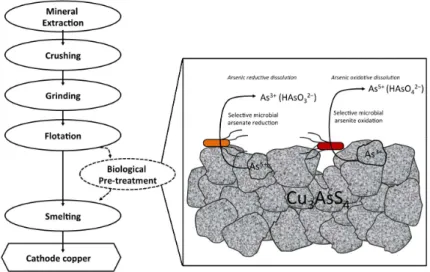
(12) Minerals 2018, 8, 215. 12 of 19. toxic effects of this are neutralized by the activity of the microbial arsenate reductase, then, arsenite is transported out of the cell [125]. Also, Drewniak et al. [121] studied four strains Shewanella sp. OM1, Pseudomonas sp. OM2, Aeromonas sp. OM4, and Serratia sp. OM17. The objective was to evaluate their potential for As removal from primary As minerals through reductive dissolution. They used an arsenopyrite crystal, Cu concentrates and middlings, both with high As grade of 0.37% and 0.029%, respectively, and 1% Minerals 2018, 8, x FOR PEER REVIEW 12 ofenvironment, 18 w/v of pulp densities. The bioleaching experiments, carried out in an anaerobic glove box ◦ were slightly alkaline, with a stable temperature of 10–12 C and cell densities for each culture of Also, Drewniak et al. [121] studied four strains Shewanella sp. OM1, Pseudomonas sp. OM2, 106 cells/mL. Thesp. results as follows: Aeromonas OM4, are and summarized Serratia sp. OM17. The objective was to evaluate their potential for As -. removal from primary As minerals through reductive dissolution. They used an arsenopyrite. With siderophores solution from Serratia sp.high OM17, 4.07ofmg/L of As wasrespectively, detected compared crystal, Cu concentrates and middlings, both with As grade 0.37% and 0.029%, with 0.37 mg/L in sterile medium. and 1% w/v of pulp densities. The bioleaching experiments, carried out in an anaerobic glove box were slightly alkaline, stable temperature of 10–12 °Cobserved and cell densities Theenvironment, highest concentration of As inwith the amiddlings dissolution was when for theeach siderophores culture of 106 cells/mL. The results are summarized as follows: solution of Shewanella sp. OM1 was used (1.47 times higher than the control). middlings, With siderophores solution from sp. was OM17, 4.07 mg/L of 21 Asdays was detected compared From the maximum As Serratia recovery 28.11% after by Aeromonas sp. OM4. with 0.37 mg/L in sterile medium. Pseudomonas sp. OM2 had the maximum recovery of As from concentrates with 2.47% after The highest concentration of As in the middlings dissolution was observed when the 21 days. siderophores solution of Shewanella sp. OM1 was used (1.47 times higher than the control). From the maximum As recoveryhad was an 28.11% after 21level days by sp. OM4. Serratia sp. middlings, OM17 cultured on middlings elevated of Aeromonas Cu leaching (767.50 µg/kg) Pseudomonas sp. OM2 had the maximum recovery of As from concentrates with 2.47% after 21 after 21 days. However, this amount represents only 0.04% of the initial Cu content. days.. Serratia sp. on middlings had an elevated level of from Cu leaching (767.50 μg/kg) In conclusion, theOM17 mostcultured of the strains solubilized As efficiently the As-bearing Cu-minerals. after from 21 days. However, thisoccurs amount represents only 0.04% theindirect initial Cumechanism. content. Arsenic release Cu-minerals selectively and byofan The research In that conclusion, the of most of theprimary strains minerals, solubilized such As efficiently from the As-bearing demonstrated the release As from as Cu ores, is possible under anaerobic Cu-minerals. Arsenic release from Cu-minerals occurs selectively and by an indirect mechanism.of Cu ores. conditions. However, an anaerobic system can be complicated at large-scale for pre-treatment The research demonstrated that the release of As from primary minerals, such as Cu ores, is possible Both Pseudomonas spp. strains and Sinorhizobium sp. M14 are presented in this manuscript as under anaerobic conditions. However, an anaerobic system can be complicated at large-scale for microorganisms thatofcould solve the problem of As content in Cu sulfide ores. In a pre-treatment of pre-treatment Cu ores. Both Pseudomonas spp. strains and be Sinorhizobium sp.the M14activity are presented in this manuscript as Cu concentrates, high As contents would reduced by of these bacteria, releasing As into microorganisms that could solve the problem of As content in Cu sulfide ores. In a pre-treatment of solution. Even so, it is necessary to have a system or technology for As control, stabilization, and water Cu concentrates, high As contents would be reduced by the activity of these bacteria, releasing As treatment. Despite this, Pseudomonas spp. and Sinorhizobium sp. M14 can be a sustainable alternative for into solution. Even so, it is necessary to have a system or technology for As control, stabilization, and enargite-selective As dissolution. water treatment. Despite this, Pseudomonas spp. and Sinorhizobium sp. M14 can be a sustainable Additionally, strain WAO, bothAsa dissolution. sulfur- and arsenite-oxidizer, also appears to have potential for alternative for enargite-selective Additionally, strainCu WAO, both a sulfurand be arsenite-oxidizer, appearsits to have potential the treatment of As-bearing ores, but it would important toalso quantify effects in Cu leaching. the treatment of As-bearing Cu ores, but it would bewith important to quantify its and effectsarsenate-reducer in Cu Thus, Asforrelease from Cu concentrates in pre-treatment arsenite-oxidizer leaching. Thus, As release from Cu concentrates in pre-treatment with arsenite-oxidizer and microorganisms is proposed in Figure 2. arsenate-reducer microorganisms is proposed in Figure 2.. 2. Biological pre-treatment of As-bearing copper sulfide ores processing through reductive Figure 2.Figure Biological pre-treatment of As-bearing copper sulfide ores processing through reductive arsenate dissolution or oxidative arsenite dissolution. arsenate dissolution or oxidative arsenite dissolution..
(13) Minerals 2018, 8, 215. 13 of 19. 6. Conclusions Arsenic is a major impurity in Cu ores and Cu concentrates that hinders the recovery of high-quality products. Thus, the removal of As from As-bearing Cu ores has become a growing challenge for mining companies. Microorganisms that can oxidize enargite and other As-bearing sulfides may offer a potential solution. For example, microorganisms with activity similar to strain WAO isolated from mining sites or extreme natural systems could oxidize enargite successfully and could have the potential to reduce As content from As-bearing Cu ores and Cu concentrates. Nevertheless, laboratory tests into the capacity of these microorganisms to bioleach enargite, tennantite and other Cu sulfides are necessary to determine the rates of As dissolution, tolerance to dissolved metal concentrations (i.e., Cu, As), and potential scaling. On the other hand, high As–Cu concentrates that would be rejected or penalized by smelters are currently pre-treated by conventional technologies like mixing, pressure leaching, roasting and alkaline digestion. The pre-treatment of As-bearing concentrates by bioleaching may be a potential solution. Microorganisms that oxidize (oxidative dissolution) or reduce (reductive dissolution) may help to selectively leach As, improving the quality and value of the concentrates sold to smelters. Also, problems with the volatilization of As species would decrease. Future research should be focused on understanding the mechanisms associated with the bioleaching of As from As-bearing Cu ores, which will allow a better interpretation of the biogeochemical processes responsible for As release. Subsequent advances in the description and characterization of the microorganisms with potential to bioleach As from different minerals will contribute to the understanding of the environmental variables that control As removal rates from As-bearing Cu ores and concentrates. Author Contributions: The manuscript was written by J.A.D. and E.L., and both authors contributed to its preparation. The manuscript was revised by E.L., J.S. and J.A.D. Funding: This research was funded by PIA-UC Eduardo Leiva/DDA-VRA. Conflicts of Interest: The authors declare no conflict of interest.. References 1. 2. 3. 4. 5. 6. 7. 8. 9. 10. 11.. Transparency Market Research. Copper Market: Global Industry Analysis, Size, Share, Growth, Trends and Forecast, 2015–2023; Copper Market: Industry Analysis; Transparency Market Research: Albany, NY, USA, 2015. Davis, J.R. Copper and copper alloys. In ASM Specialty Handbook, 1st ed.; ASM international: Novelty, OH, USA, 2001; ISBN 0-87170-726-8. The Observatory of Economic Complexity. Available online: https://atlas.media.mit.edu/en/visualize/ stacked/hs92/export/show/all/7403/1995.2016/ (accessed on 29 January 2018). Donoso Muñoz, M.J. El mercado del cobre a nivel mundial: Evolución, riesgos, características y potencialidades futuras. Ingeniare 2013, 21, 248–261. [CrossRef] Riveros, P.A.; Dutrizac, J.E.; Spencer, P. Arsenic disposal practices in the metallurgical industry. Can. Metall. Q. 2001, 40, 395–420. [CrossRef] Mandal, B.K.; Suzuki, K.T. Arsenic round the world: A review. Talanta 2002, 58, 201–235. [CrossRef] Cullen, W.R.; Reimer, K.J. Arsenic speciation in the environment. Chem. Rev. 1989, 89, 713–764. [CrossRef] Mondal, P.; Majumder, C.B.; Mohanty, B. Laboratory based approaches for arsenic remediation from contaminated water: Recent developments. J. Hazard. Mater. 2006, 137, 464–479. [CrossRef] [PubMed] Pierce, M.L.; Moore, C.B. Adsorption of arsenite and arsenate on amorphous iron hydroxide. Water Res. 1982, 16, 1247–1253. [CrossRef] Chen, C.J.; Chen, C.W.; Wu, M.M.; Kuo, T.L. Cancer potential in liver, lung, bladder and kidney due to ingested inorganic arsenic in drinking water. Br. J. Cancer. 1992, 66, 888. [CrossRef] [PubMed] Engel, A.; Lamm, S.H. Arsenic exposure and childhood cancer—A systematic review of the literature. J. Environ. Health 2008, 71, 12–16. [PubMed].
(14) Minerals 2018, 8, 215. 12.. 13.. 14. 15. 16. 17.. 18.. 19. 20.. 21. 22. 23. 24. 25. 26. 27. 28. 29.. 30. 31. 32. 33.. 34. 35. 36.. 14 of 19. Smith, A.H.; Goycolea, M.; Haque, R.; Biggs, M.L. Marked increase in bladder and lung cancer mortality in a region of Northern Chile due to arsenic in drinking water. Am. J. Epidemiol. 1998, 147, 660–669. [CrossRef] [PubMed] Wu, M.M.; Kuo, T.L.; Hwang, Y.H.; Chen, C.J. Dose-response relation between arsenic concentration in well water and mortality from cancers and vascular diseases. Am. J. Epidemiol. 1989, 130, 1123–1132. [CrossRef] [PubMed] Gentina, J.C.; Acevedo, F. Copper bioleaching in Chile. Minerals 2016, 6, 23. [CrossRef] Watling, H. Microbiological advances in biohydrometallurgy. Minerals 2016, 6, 49. [CrossRef] Nazari, A.M.; Radzinski, R.; Ghahreman, A. Review of arsenic metallurgy: Treatment of arsenical minerals and the immobilization of arsenic. Hydrometallurgy 2017, 174, 258–281. [CrossRef] Fountain, C. The whys and wherefores of penalty elements in copper concentrates. In MetPlant 2013: Metallurgical Plant Design and Operating Strategies; Australasian Institute of Mining and Metallurgy: Carlton, Australia, 2013; Volume 5, pp. 502–518. Rivera-Vasquez, B.F.; Dixon, D.G. Lixiviando concentrados de cobre con alto contenido de arsénico. Comité de Encuentro de Operadores Procesos Metalúrgicos TT-151. In Proceedings of the XXIX Convención Minera, Arequipa, Peru, 14–18 September 2009. Danus, H. Crónicas Mineras de Medio Siglo, 1950–2000; RIL: Santiago, Chile, 1985; p. 381. (In Spanish) Domic, E.M. A review of the development and current status of copper bioleaching operations in Chile: 25 years of successful commercial implementation. In Biomining; Rawlings, D.E., Johnson, D.B., Eds.; Springer: Berlin, Germany, 2007; pp. 81–95. Acevedo, F.; Gentina, J. Fundamentos y Perspectivas de las Tecnologías Biomineras; Ediciones Universitarias de Valparaiso: Valparaiso, Chile, 2005. Robles, E.; Miller, G.; Readett, D. Recent experience in bacterial assisted heap leaching of copper ores in Chile. Proc. BioMine 1994, 94, 11.1–11.14. Watling, H.R. Review of biohydrometallurgical metals extraction from polymetallic mineral resources. Minerals 2015, 5, 1–60. [CrossRef] Safarzadeh, M.S.; Moats, M.S.; Miller, J.D. Recent trends in the processing of enargite concentrates. Miner. Process. Extr. Metall. Rev. 2014, 35, 283–367. [CrossRef] Watling, H.R. The bioleaching of sulphide minerals with emphasis on copper sulphides—A review. Hydrometallurgy 2006, 84, 81–108. [CrossRef] Gentina, J.C.; Acevedo, F. Application of bioleaching to copper mining in Chile. Electron. J. Biotechnol. 2013, 16, 16. [CrossRef] Rahman, R.M.; Ata, S.; Jameson, G.J. The effect of flotation variables on the recovery of different particle size fractions in the froth and the pulp. Int. J. Miner. Process. 2012, 106, 70–77. [CrossRef] Filippou, D.; St-Germain, P.; Grammatikopoulos, T. Recovery of metal values from copper—Arsenic minerals and other related resources. Miner. Process. Extr. Metall. Rev. 2007, 28, 247–298. [CrossRef] Fornasiero, D.; Grano, S.; Ralston, J. The selective separation of penalty element minerals in sulphide flotation. In Proceedings of the International Congress on Mineral Processing and Extractive Metallurgy, Melbourne, Victoria, 11–13 September 2000. Dalewski, F. Removing arsenic from copper smelter gases. JOM 1999, 51, 24–26. [CrossRef] Baxter, K.; Scriba, H.; Vega, I. Treatment of high-arsenic copper-gold concentrates—An options review. Proc. Copp. 2010, 5, 1783–1802. Du Plessis, C.A.; Batty, J.D.; Dew, D.W. Commercial applications of thermophile bioleaching. In Biomining; Rawlings, D.E., Johnson, D.B., Eds.; Springer: Berlin, Germany, 2007; pp. 57–80. Beer, B.; Evtiminova, K.; Hristov, N. Arsenic-the technological motivator for the Chelopech copper/gold mine. In Proceedings of the Arsenic Metallurgy, TMS, San Francisco, CA, USA, 13–17 February 2005; pp. 283–299. Kappes, R.; Gathje, J. The Metallurgical Development of an Enargite-Bearing Deposit. In Proceedings of the XXV International Mineral Processing Congress (IMPC), Brisbane, Australia, 6–10 September 2010; pp. 6–10. McElroy, R.; Lipiec, T.; Tomlinson, M. Roasting—The neglected option. Hydrometallurgy 2008, 425–430. Schroeder, W.H.; Dobson, M.; Kane, D.M.; Johnson, N.D. Toxic trace elements associated with airborne particulate matter: A review. Japca 1987, 37, 1267–1285. [CrossRef] [PubMed].
(15) Minerals 2018, 8, 215. 37. 38. 39. 40.. 41. 42. 43. 44. 45. 46. 47. 48. 49. 50. 51. 52. 53. 54. 55. 56. 57. 58. 59. 60. 61. 62. 63.. 15 of 19. Baláž, P.; Achimovičová, M.; Bastl, Z.; Ohtani, T.; Sanchez, M. Influence of mechanical activation on the alkaline leaching of enargite concentrate. Hydrometallurgy 2000, 54, 205–216. [CrossRef] Ruiz, M.C.; Grandon, L.; Padilla, R. Selective arsenic removal from enargite by alkaline digestion and water leaching. Hydrometallurgy 2014, 150, 20–26. [CrossRef] Lane, D.J.; Cook, N.J.; Grano, S.R.; Ehrig, K. Selective leaching of penalty elements from copper concentrates: A review. Miner. Eng. 2016, 98, 110–121. [CrossRef] Anderson, C.G.; Twidwell, L.G. The Alkaline Sulfide Hydrometallurgical Separation, Recovery and Fixation of Tin, Arsenic, Antimony, Mercury and Gold; The Southern African Institute of Mining and Metallurgy: Johannesburg, Southern Africa, 2008; pp. 121–132. Ruiz, M.C.; Daroch, F.; Padilla, R. Digestion kinetics of arsenic removal from enargite–tennantite concentrates. Miner. Eng. 2015, 79, 47–53. [CrossRef] Ehrlich, H.L. Past, present and future of biohydrometallurgy. Hydrometallurgy 2001, 59, 127–134. [CrossRef] Ehrlich, H.L. Beginnings of rational bioleaching and highlights in the development of biohydrometallurgy: A brief history. Eur. J. Miner. Process. Environ. Prot. 2004, 4, 102–112. Rohwerder, T.; Gehrke, T.; Kinzler, K.; Sand, W. Bioleaching review part A. Appl. Microbiol. Biotechnol. 2003, 63, 239–248. [CrossRef] [PubMed] Mahmoud, A.; Cézac, P.; Hoadley, A.F.; Contamine, F.; D’Hugues, P. A review of sulfide minerals microbially assisted leaching in stirred tank reactors. Int. Biodeterior. Biodegrad. 2016, 119, 118–146. [CrossRef] Rawlings, D.E. Heavy metal mining using microbes. Annu. Rev. Microbiol. 2002, 56, 65–91. [CrossRef] [PubMed] Rawlings, D.E. Microbially assisted dissolution of minerals and its use in the mining industry. Pure Appl. Chem. 2004, 76, 847–859. [CrossRef] Johnson, D.B. Development and application of biotechnologies in the metal mining industry. Environ. Sci. Pollut. Res. 2013, 20, 7768–7776. [CrossRef] [PubMed] Johnson, D.B. Biomining-biotechnologies for extracting and recovering metals from ores and waste materials. Curr. Opin. Biotechnol. 2014, 30, 24–31. [CrossRef] [PubMed] Acevedo, F.; Gentina, J.C.; Bustos, S. Bioleaching of minerals—A valid alternative for developing countries. J. Biotechnol. 1993, 31, 115–123. [CrossRef] Dixon, D.G. Analysis of heat conservation during copper sulphide heap leaching. Hydrometallurgy 2000, 58, 27–41. [CrossRef] Baker, B.J.; Banfield, J.F. Microbial communities in acid mine drainage. FEMS Microbiol. Ecol. 2003, 44, 139–152. [CrossRef] Temple, K.L.; Colmer, A.R. The autotrophic oxidation of iron by a new bacterium: Thiobacillus ferrooxidans. J. Bacteriol. 1951, 62, 605. [PubMed] Torma, A.E. The role of Thiobacillus ferrooxidans in hydrometallurgical processes. In Advances in Biochemical Engineering; Springer: Berlin, Germany, 1997; Volume 6. Brierley, C.L. Microbiological mining. Sci. Am. 1982, 247, 44–53. [CrossRef] Konishi, Y.; Yoshida, S.; Asai, S. Bioleaching of pyrite by acidophilic thermophile Acidianus brierleyi. Biotechnol. Bioeng. 1995, 48, 592–600. [CrossRef] [PubMed] Konishi, Y.; Tokushige, M.; Asai, S. Bioleaching of chalcopyrite concentrate by acidophilic thermophile Acidianus brierleyi. Process Metall. 1999, 9, 367–376. Dopson, M.; Lindström, E.B. Potential role of Thiobacillus caldus in arsenopyrite bioleaching. Appl. Environ. Microbiol. 1999, 65, 36–40. [PubMed] Zhou, Q.G.; Bo, F.; Bo, Z.H.; Xi, L.; Jian, G.; Fei, L.F.; Hua, C.X. Isolation of a strain of AcidiThiobacillus caldus and its role in bioleaching of chalcopyrite. World J. Microbiol. Biotechnol. 2007, 23, 1217–1225. [CrossRef] Clark, D.A.; Norris, P.R. Oxidation of mineral sulphides by thermophilic microorganisms. Miner. Eng. 1996, 9, 1119–1125. [CrossRef] Plumb, J.J.; McSweeney, N.J.; Franzmann, P.D. Growth and activity of pure and mixed bioleaching strains on low grade chalcopyrite ore. Miner. Eng. 2008, 21, 93–99. [CrossRef] Stott, M.B.; Sutton, D.C.; Watling, H.R.; Franzmann, P.D. Comparative leaching of chalcopyrite by selected acidophilic bacteria and archaea. Geomicrobiol. J. 2003, 20, 215–230. [CrossRef] Nemati, M.; Lowenadler, J.; Harrison, S.T.L. Particle size effects in bioleaching of pyrite by acidophilic thermophile Sulfolobus metallicus (BC). Appl. Microbiol. Biotechnol. 2000, 53, 173–179. [CrossRef] [PubMed].
(16) Minerals 2018, 8, 215. 64.. 65. 66.. 67.. 68.. 69.. 70. 71. 72. 73. 74.. 75. 76.. 77.. 78. 79.. 80. 81. 82. 83. 84.. 16 of 19. Muñoz, J.A.; Blázquez, M.L.; González, F.; Ballester, A.; Acevedo, F.; Gentina, J.C.; González, P. Electrochemical study of enargite bioleaching by mesophilic and thermophilic microorganisms. Hydrometallurgy 2006, 84, 175–186. [CrossRef] Corkhill, C.L.; Wincott, P.L.; Lloyd, J.R.; Vaughan, D.J. The oxidative dissolution of arsenopyrite (FeAsS) and enargite (Cu3AsS4) by Leptospirillum ferrooxidans. Geochim. Cosmochim. Acta 2008, 72, 5616–5633. [CrossRef] Ahonen, L.; Tuovinen, O.H. Effect of temperature on the microbiological leaching of sulfide ore material in percolators containing chalcopyrite, pentlandite, sphalerite and pyrrhotite as main minerals. Biotechnol. Lett. 1989, 11, 331–336. [CrossRef] Dopson, M.; Baker-Austin, C.; Koppineedi, P.R.; Bond, P.L. Growth in sulfidic mineral environments: Metal resistance mechanisms in acidophilic micro-organisms. Microbiology 2003, 149, 1959–1970. [CrossRef] [PubMed] Tuffin, I.M.; Hector, S.B.; Deane, S.M.; Rawlings, D.E. Resistance determinants of a highly arsenic-resistant strain of Leptospirillum ferriphilum isolated from a commercial biooxidation tank. Appl. Environ. Microbiol. 2006, 72, 2247–2253. [CrossRef] [PubMed] Coram, N.J.; Rawlings, D.E. Molecular relationship between two groups of the genus Leptospirillum and the finding that Leptospirillum ferriphilum sp. nov. dominates South African commercial biooxidation tanks that operate at 40 ◦ C. Appl. Environ. Microbiol. 2002, 68, 838–845. [CrossRef] [PubMed] Dold, B. Basic concepts in environmental geochemistry of sulfidic minewaste management. In Waste Management; Kumar, E.S., Ed.; InTech: Rijeka, Croatia, 2010; 232p. Peters, E. Direct leaching of sulfides: Chemistry and applications. Metall. Trans. B 1976, 7, 505–517. [CrossRef] Nicol, M.; Lazaro, I. The role of non-oxidative processes in the leaching of chalcopyrite. In Proceedings of the 5th Copper-Cobre International Conference, Santiago, Chile, 30 November–3 December 2003; pp. 405–417. Schippers, A.; Sand, W. Bacterial leaching of metal sulfides proceeds by two indirect mechanisms via thiosulfate or via polysulfides and sulfur. Appl. Environ. Microbiol. 1999, 65, 319–321. [PubMed] Sand, W.; Gerke, T.; Hallmann, R.; Schippers, A. Sulfur chemistry, biofilm, and the (in) direct attack mechanism—A critical evaluation of bacterial leaching. Appl. Microbiol. Biotechnol. 1995, 43, 961–966. [CrossRef] Gehrke, T.; Telegdi, J.; Thierry, D.; Sand, W. Importance of extracellular polymeric substances from Thiobacillus ferrooxidans for bioleaching. Appl. Environ. Microbiol. 1998, 64, 2743–2747. [PubMed] Fantauzzi, M.; Rossi, G.; Elsener, B.; Loi, G.; Atzei, D.; Rossi, A. An XPS analytical approach for elucidating the microbially mediated enargite oxidative dissolution. Anal. Bioanal. Chem. 2009, 393, 1931. [CrossRef] [PubMed] Sasaki, K.; Takatsugi, K.; Kaneko, K.; Kozai, N.; Ohnuki, T.; Tuovinen, O.H.; Hirajima, T. Characterization of secondary arsenic-bearing precipitates formed in the bioleaching of enargite by AcidiThiobacillus ferrooxidans. Hydrometallurgy 2010, 104, 424–431. [CrossRef] Lattanzi, P.; Da Pelo, S.; Musu, E.; Atzei, D.; Elsener, B.; Fantauzzi, M.; Rossi, A. Enargite oxidation: A review. Earth-Sci. Rev. 2008, 86, 62–88. [CrossRef] Di Benedetto, F.; Pelo, S.D.; Caneschi, A.; Lattanzi, P. Chemical state of arsenic and copper in enargite: Evidences from EPR and X-ray absorption spectroscopies, and SQUID magnetometry. J Miner. Geochem. 2011, 188, 11–19. [CrossRef] Sasaki, K.; Takatsugi, K.; Ishikura, K.; Hirajima, T. Spectroscopic study on oxidative dissolution of chalcopyrite, enargite and tennantite at different pH values. Hydrometallurgy 2010, 100, 144–151. [CrossRef] Curreli, L.; Garbarino, C.; Ghiani, M.; Orrù, G. Arsenic leaching from a gold bearing enargite flotation concentrate. Hydrometallurgy 2009, 96, 258–263. [CrossRef] Smedley, P.L.; Kinniburgh, D.G. A review of the source, behaviour and distribution of arsenic in natural waters. Appl. Geochem. 2002, 17, 517–568. [CrossRef] Oremland, R.S.; Stolz, J.F. Arsenic, microbes and contaminated aquifers. Trends Microbiol. 2005, 13, 45–49. [CrossRef] [PubMed] Santini, J.M.; Sly, L.I.; Wen, A.; Comrie, D.; Wulf-Durand, P.D.; Macy, J.M. New Arsenite-Oxidizing Bacteria Isolated from Australian Gold Mining Environments—Phylogenetic Relationships. Geomicrobiol. J. 2002, 19, 67–76. [CrossRef].
(17) Minerals 2018, 8, 215. 85.. 86. 87. 88. 89. 90. 91. 92. 93. 94. 95. 96.. 97.. 98. 99. 100. 101. 102. 103. 104. 105. 106. 107. 108.. 17 of 19. Inskeep, W.P.; Macur, R.E.; Hamamura, N.; Warelow, T.P.; Ward, S.A.; Santini, J.M. Detection, diversity and expression of aerobic bacterial arsenite oxidase genes. Environ Microbiol. 2007, 9, 934–943. [CrossRef] [PubMed] Kashyap, D.R.; Botero, L.M.; Franck, W.L.; Hassett, D.J.; McDermott, T.R. Complex regulation of arsenite oxidation in Agrobacterium tumefaciens. J. Bacteriol. 2006, 188, 1081–1088. [CrossRef] [PubMed] Lebrun, E.; Brugna, M.; Baymann, F.; Muller, D.; Lievremont, D.; Lett, M.C. Arsenite oxidase, an ancient bioenergetic enzyme. Mol. Biol. Evol. 2003, 20, 686–693. [CrossRef] [PubMed] Bhattacharjee, H.; Rosen, B.P. Arsenic metabolism in prokaryotic and eukaryotic microbes. In Molecular Microbiology of Heavy Metals; Springer: Berlin/Heidelberg, Germany, 2007; pp. 371–406. Mukhopadhyay, R.; Rosen, B.P.; Phung, L.T.; Silver, S. Microbial arsenic: From geocycles to genes and enzymes. FEMS Microbiol. Rev. 2002, 26, 311–325. [CrossRef] [PubMed] Mukhopadhyay, R.; Rosen, B.P. Arsenate reductases in prokaryotes and eukaryotes. Environ. health perspect. 2002, 110, 745–748. [CrossRef] [PubMed] Jian, S.; Jianqun, L.; Ling, G.; Jianqiang, L.; Yinbo, Q. Modeling and simulation of enargite bioleaching. Chin. J. Chem. Eng. 2008, 16, 785–790. Langhans, D.; Lord, A.; Lampshire, D.; Burbank, A.; Baglin, E. Biooxidation of an arsenic-bearing refractory gold ore. Miner. Eng. 1995, 8, 147–158. [CrossRef] Breed, A.W.; Glatz, A.; Hansford, G.S.; Harrison, S.T.L. The effect of As(III) and As(V) on the batch bioleaching of a pyrite- arsenopyrite concentrate. Miner. Eng. 1996, 9, 1235–1252. [CrossRef] Escobar, B.; Huenupi, E.; Godoy, I.; Wiertz, J.V. Arsenic precipitation in the bioleaching of enargite by Sulfolobus BC at 70 ◦ C. Biotechnol. Lett. 2000, 22, 205–209. [CrossRef] Collinet, M.N.; Morin, D. Characterization of arsenopyrite oxidizing Thiobacillus. Tolerance to arsenite, arsenate, ferrous and ferric iron. Antonie Leeuwenhoek J. Microbiol. 1990, 57, 237–244. [CrossRef] Tuovinen, O.H.; Bhatti, T.M.; Bigham, J.M.; Hallberg, K.B.; Garcia, O.; Lindström, E.B. Oxidative dissolution of arsenopyrite by mesophilic and moderately thermophilic acidophiles. Appl. Environ. Microbiol. 1994, 60, 3268–3274. [PubMed] Takatsugi, K.; Sasaki, K.; Hirajima, T. Mechanism of the enhancement of bioleaching of copper from enargite by thermophilic iron-oxidizing archaea with the concomitant precipitation of arsenic. Hydrometallurgy 2011, 109, 90–96. [CrossRef] Drahota, P.; Filippi, M. Secondary arsenic minerals in the environment: A review. Environ. Int. 2009, 35, 1243–1255. [CrossRef] [PubMed] Frau, F.; Ardau, C. Mineralogical controls on arsenic mobility in the Baccu Locci stream catchment (Sardinia, Italy) affected by past mining. Mineral. Mag. 2004, 68, 15–30. [CrossRef] Rochette, E.A.; Li, G.C.; Fendorf, S.E. Stability of arsenate minerals in soil under biotically generated reducing conditions. Soil Sci. Soc. Am. J. 1998, 62, 1530–1537. [CrossRef] Brierley, C.L. Mining biotechnology: Research to commercial development and beyond. In Biomining; Springer: Berlin/Heidelberg, Germany, 1997; pp. 3–17. Waksman, S.A.; Joffe, J.S. Microörganisms Concerned in the Oxidation of Sulfur in the Soil: II. Thiobacillus Thiooxidans, a New Sulfur-oxidizing Organism Isolated from the Soil 1. J. Bacteriol. 1992, 7, 239. [CrossRef] Holmes, D.S.; Bonnefoy, V. Genetic and bioinformatic insights into iron and sulfur oxidation mechanisms of bioleaching organisms. In Biomining; Springer: Berlin/Heidelberg, Germany, 2007; pp. 281–307. Markosyan, G.E. A new iron-oxidizing bacterium, Leptospirillum ferrooxidans gen. Et sp. Nov. Biol. Zh. Arm. 1972, 25, 26. Escobar, B.; Huenupi, E.; Wiertz, J.V. Chemical and biological leaching of enargite. Biotechnol. Lett. 1997, 19, 719–722. [CrossRef] Sasaki, K.; Takatsugi, K.; Hirajima, T. Effects of initial Fe2+ concentration and pulp density on the bioleaching of Cu from enargite by Acidianus brierleyi. Hydrometallurgy 2011, 109, 153–160. [CrossRef] Brierley, C.L.; Brierley, J.A. A chemoautotrophic and thermophilic microorganism isolated from an acid hot spring. Can. J. Microbiol. 1973, 19, 183–188. [CrossRef] [PubMed] Huber, G.; Stetter, K.O. Sulfolobus metallicus, sp. nov., a novel strictly chemolithoautotrophic thermophilic archaeal species of metal-mobilizers. Syst. Appl. Microbiol. 1991, 14, 372–378. [CrossRef].
Figure

Documento similar