Markers in Late Modern English Letters Fátima María Faya Cerqueiro1
Universidade de Santiago de Compostela
Abstract
The nineteenth century witnesses the competition between courtesy markers in requests, with please gaining ground at the expense of older pray. In this paper I will account for the situation of these markers in different stages of the 19th and early 20th centuries: 1860-1889 and 1890-1919, using A Corpus of Late Modern English Prose. Despite its small size, this corpus, comprising epistolary collections and a diary part, enables us to undertake a sociolinguistic study of the use of the markers. We can explore how the renewal of the courtesy marker took place, paying special attention to who requests whom and how they do it.
1. Introduction
The present study focuses on the situation of two courtesy markers, namely please and pray (and their different forms) in late Modern English requests. For this purpose I have used A Corpus of Late Modern English Prose,2 which covers the period 1860-1919 and comprises epistolary collections and some diaries from five English families. This corpus enables the adoption of a sociolinguistic approach to the study of the different courtesy markers analysed.
1 Research for this paper was funded by the Autonomous Government of Galicia
(grant no. PGIDIT05PXIC20401PN and 2006/XA-133 / 73), the Spanish Ministry of Education and Science (grants nos. HUM2007-60706 and BES-2005-9113) and the European Regional Development Fund (ERDF). This support is gratefully acknowledged.
2 I am grateful to the VARIENG Research Unit (University of Helsinki) for providing
270 2. Courtesy markers
Courtesy markers are expressions having politeness functions (cf. Quirk et al., 1985: 569-572 on ‘courtesy subjuncts’). Please is nowadays the preferred courtesy marker in requests, but markers of this kind have experimented a need for change in English. In this way, the verb please was borrowed from Old French in the fourteenth century, but the first instances of the courtesy marker go back to the late eighteenth century (see Faya, 2006, where early examples of the courtesy marker please are unearthed in the Corpus of Late-Eighteenth Century Prose). This is also confirmed by recent additions of the OED (OED s.v. please adv. and int.), in which the first instance of the adverb please functioning as a courtesy marker goes back to 1771. The former default courtesy marker was pray. As was the case with please, pray also goes back to a French verb, which started to be used parenthetically in expressions like I pray you or I pray thee in the early modern English period (OED s.v. pray v.). The marker prithee goes back to the parenthetical I pray thee, and still shows the enclitic T pronoun.
3. Corpus and period
The period selected for the present study may reflect an advanced stage of the courtesy markers considered, since in late modern English the language was nearly established in several respects after a process of standardisation and fixation of the language in previous centuries. The standardization of the language had been encouraged in the eighteenth century through education in the vernacular and the spread of prescriptive norms, and it continued in the nineteenth century (cf. Görlach, 1999: 10).
multigenre corpus like ARCHER, only letters, fiction, drama and journal and diaries show examples of the courtesy marker please. Letters show a high degree of speechlikeness, and at the same time they may also reflect a more advanced stage of the language. In addition, the interaction in correspondence between writer and addressee makes very likely the occurrence of requests. Therefore, we should expect that an epistolary collection such as this would contain a high frequency of courtesy markers in requests. All the decades in the corpus are represented although two of them contain smaller number of words:
– 1860-69: 20,000
– 1870-79: 20,000
– 1880-89: 6,000
– 1890-99: 13,000
– 1900-09: 20,000
– 1910-19: 20,000
The corpus is further divided in two subperiods: 1860-1889 (L86) and 1890-1919 (L89).3 The date of birth range of main contributors is narrower: Lord and Lady Amberley (main writers in the collection) were born in 1842, Bell in 1868, Dowson in 1867, Green in 1837 and the Webbs in 1859 and 1858. (Denison, 1994: 8 and ODNB).
4. Analysis of the data
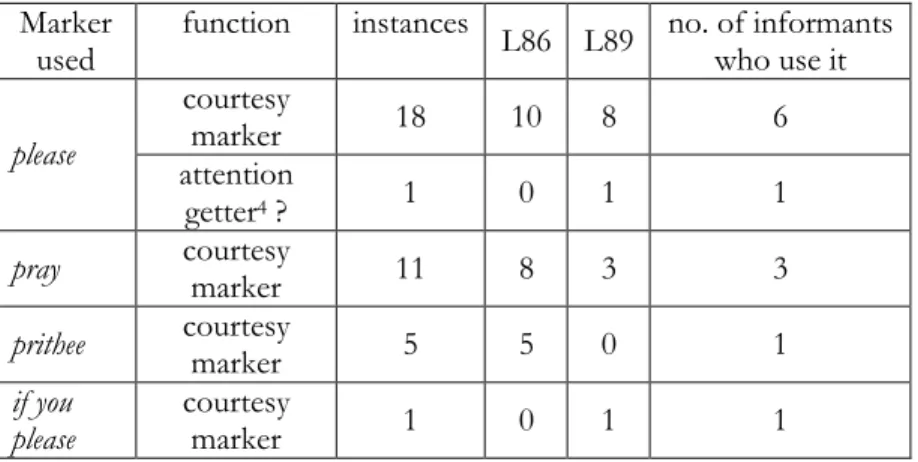
The corpus contains letters and diaries, and as could be expected the markers studied appear only in letters. Although the number of instances is very low, the kind of information provided makes possible to extract interesting conclusions. The overall distribution of markers in the whole period is as follows:
272
If we observe the overall instances, please is the most numerous marker in the corpus, but pray is still quite common. In fact, in the period 1860-1889 the figures do not differ that much (10 vs. 8), while in the period 1890-1919 we witness a clear decrease in the figures of pray (8 vs. 3). This indicates that the competition between the two markers took place all through the nineteenth century and that pray had not been completely abandoned at the beginning of the twentieth century. Last quotation of pray in the OED with this use goes back to 1875 (OED s.v. pray adv.).
Let us now focus on the distribution analysis of both writers and addressees. In Table 2 below the informants are placed chronologically by date of birth, and we observe the markers they use:
Table 2. Authors by date of birth and marker(s) used
Author Date of birth marker(s) used Lady Russel 1815 pray (2)
John Richard Green 1837 pray (6); please (1) Lord John Amberley 1842 please (4)
4 An ‘attention getter’ is a type of ‘alerter,’ which serves the function of “alert[ing] the
Sydney Webb 1859 pray (3); please (1) Ernest Dowson 1867 please (5); prithee (5) Rachel Russel 1868 please (1)
Gertrude Bell 1868 please (6); if you please (1); please (alerter?) (1)
Four writers make use of only one of the markers. Thus, Lady Russel —the oldest informant— uses pray twice, whereas her son, Lord Amberley, and her granddaughter, Rachel Russel, use only please. This is also the case of Gertrude Bell. On the other hand, we find three authors using more than one marker: John Richard Green, Sydney Webb and Ernest Dowson. The case of Ernest Dowson deserves special attention since he is the only author who uses prithee (see section 5 below). As for the other two informants please is used only once and pray is more common in both cases. As regards the addressees of the letters, there are no differences in the selection of the marker depending on this factor. The three informants using more than one marker address always the same person, whereas those using only one marker —more than once― address different people, so the selection of the marker does not depend on the addressee.
In the case of the Amberleys, Lady Russel addresses her son, Lord Amberley, and her daughter-in-law with pray whereas the next generation (Lord Amberley and his daughter Rachel) uses please, as in (1) below:
(1) I shall let you know tomorrow. Please don't telegraph. Yours ever affly. (1874, Lord Amberley to mother-in-law)
In most of the examples recorded in this corpus please functions as a courtesy marker, as in (1) above, in which the request is expressed with an imperative form. Please is placed at the beginning of the utterance, its typical position with imperatives. Only Gertrude Bell uses please in middle position in the request. In this case, the request does not surface as an imperative, but as a question introduced by the modal would, as in (2) below:
274
The only remarkable exception in the use of please is another instance by Gertrude Bell in which please in initial position seems to introduce a question, probably a request.
(3) BAGDAD, May 3rd, 1917. .... Please will Mother have sent to me by post six pairs of thin white thread stockings, and the same of brown - rather dark brown. (1917, Gertrude Bell to father)
Although please as a courtesy marker in initial position is typically followed by an imperative construction (Quirk et al., 1985: 471), in this case it occupies the typical position of an attention getter. This use is similar to instances of pray as an attention getter found in the Corpus of Late-Eighteenth Century Prose, as in (4) below. The present corpus does not contain instances of pray with this use, which is not found with please in the Corpus of Late-Eighteenth Century Prose:
(4) Pray have you done anything Conserning John Merser as time is going on to little or no Purpass for him, (1774, John Orford)
In all the instances in the corpus pray functions as a courtesy marker followed by a request in the imperative, as in (5) below:
(5) the action of bowels he was glad of, as giving a hope that the attack may have been caused by indigestion, torpid liver, or some such cause –wch wd. be a very great relief - Pray make the doctor investigate this well. (1873, Lady Russel to daughter-in-law Kate)
The clausal courtesy marker if you please appears only once in the corpus. This expression, still available in present-day English, has always shown a lower frequency with respect to other markers in requests (Faya, 2006). If you please presents a higher degree of deference towards the addressee, as is clear in (6):
advertisements of Harrods which look nice, specially the cross one. (1917, Gertrude Bell to stepmother)
In this instance negative politeness is increased by the co-occurrence of several politeness strategies5. On the one hand we find a ‘syntactic downgrader’, namely an interrogative introduced by modal may (Blum-Kulka et al., 1989: 281). On the other hand the question contains two ‘lexical downgraders’ the verb oblige, ‘to bind or make indebted [...] by conferring a benefit or kindness’ (OED s.v. oblige 6.a.), and the adverbial phrase very kindly functioning as a ‘downtoner’ (Blum-Kulka et al., 1989: 283-284).
5. Usage of prithee in this corpus
Among the markers used in this corpus we also find the old-fashioned prithee. Although the OED gives some nineteenth century examples of this marker, it is worth noting that not a single example was recorded in the Corpus of Late-Eighteenth Century Prose, a relatively large epistolary collection (c. 300,000 words) from the period 1760-1790 (Faya, 2006). Therefore, the fact that this marker is still used in late nineteenth century letters deserves special attention.
Only one writer makes use of prithee, namely Ernest Dowson. Dowson was born in 1867, which makes him one of the youngest contributors to the corpus, and at the same time an odd user of the form. Instances of prithee occur only in letters from 1889 and 1890 and in all five cases the addressee is the same, Arthur Moore. Ernest Dowson was a poet associated to the Decadent movement and Arthur Moore was his friend and collaborator, with whom correspondence was customary (ODNB). The Decadent movement took place during the late nineteenth century, influenced by French artists and in direct connection with Aestheticism. One of the illustrious members of this movement was Oscar Wilde (Baugh, 1967: 1475-1484). The Decadents contributed to several genres, especially poetry, and their style was characterized by an excessive “taste for artificiality” (Weir, 1995: 61).
5 Negative politeness involves the assumption of a great degree of imposition. There is
276
Akimoto comments on the use of I pray thee by Wilde in the nineteenth century as a “conscious use of archaism” (2000: 76). Thou had already disappeared in the eighteenth century (Denison, 1998: 106), and these forms of pray had fallen into disuse after the decay in use of the pronoun.6
According to Akimoto, prithee seems to have been common from the seventeenth century onwards, and have fallen into disuse by the nineteenth century (2000: 77). However, its usage was probably regarded as archaic in common language already in the late eighteenth century since the Corpus of Late Eighteenth Prose yields no instances, as mentioned above. The last entry for prithee in the OED dates back to 1994, although “[i]n some modern instances [may be] used humorously or to convey ironic politeness” (OED s.v. prithee). Akimoto finds several instances in the eighteenth century (not any in private letters, which are supposed to reflect spoken language closely) and none afterwards.
This deliberately archaic use of the marker in Dowson’s private correspondence could perfectly be a sign of irony or even pedantry from the poet towards another writer with whom the level of intimacy was high. It is worth noting that in one of the letters containing prithee we also find the archaic use of T pronouns, as in (7) below:
(7) What news of thee, thou unconscionable? [...] Write speedily to inform me thereof or give an account of your silence. Yes: (\la grippe\) has gripped me & I stay here wrapped in tarpaulin jackets, consuming handkerchiefs by the score & reading all the trash the Woodford Cirng Library contains. I prithee write. (1889, Ernest Dowson to Arthur Moore)
Therefore this use of prithee in the late nineteenth century could even be related to the author’s membership to a particular literary movement, as was the case of Wilde’s archaic use of I pray thee.
6 The disappearance of thou seems to be related to the avoidance of a Quaker
6. Conclusion
In spite of the low number of instances found in the corpus, we can sketch general tendencies. Please was in the late nineteenth century the most common courtesy marker in requests, although the use of pray was still considerably high by the older generations. Taking as a starting-point the first instances of please as a courtesy marker from the late eighteenth century, the present study would indicate that the consolidation of please as the default marker took place more than one century later.
References
Akimoto, M. 2000. “The Grammaticalization of the Verb ‘Pray’”. Pathways of Change. Grammaticalization in English. O. Fischer, A. Rosenbach, and D. Stein. Eds. 67–84. Amsterdam: John Benjamins.
Baugh, A. C. 1967. A Literary History of England. London and Henley: Routledge and Keagan Paul.
Blum-Kulka, S., J. House and G. Kasper. Eds. 1989. Cross-Cultural Pragmatics: Requests and Apologies. Norwood: N.J. Ablex.
Busse, U. 2002. Linguistic Variation in the Shakespeare Corpus. Morpho-syntactic Variability of Second Person Pronouns. Amsterdam: John Benjamins.
Denison, D. Ed. 1994a. A Corpus of Late Modern English Prose. University of Manchester: Department of English and American Studies, formerly Department of English Language and Literature. (Text of The Letters of Ernest Dowson: Associated University Presses, NJ, USA).
Denison, D. 1994b. “A Corpus of Late Modern English Prose”. Corpora across the centuries. M. Kytö, M. Rissanen, and S. Wright. Eds. 7–16. Amsterdam and Atlanta: Rodopi.
---. 1998. “Syntax”. The Cambridge History of the English Language. Vol. IV: 1776– present. S. Romaine. Ed. 92–329.Cambridge: CUP.
---. and L. van Bergen. Eds. 2003. Corpus of Late Eighteenth-Century Prose. Manchester: University of Manchester, Faculty of Arts, and John Rylands University Library of Manchester.
Faya Cerqueiro, F. M. 2006. On the Origin and Development of the Courtesy Marker Please: A Corpus-Based Analysis. Unpublished MA-thesis. Universidade de Santiago de Compostela.
278
ODNB = Oxford Dictionary of National Biography. 2007.H. C. G. Matthew and B. Harrison. Eds. Oxford: Oxford University Press. November 2007. Online version. <www.oxforddnb.com>.
OED = Oxford English Dictionary. 2008. J. A. H. Murray, H. Bradley, W. A. Craigie, and C. T. Onions. Eds. Oxford: OUP. February 2008. Online version. <www.oed.com>.
Quirk, R., S. Greenbaum, G. Leech and J. Svartvik. 1985. A Comprehensive Grammar of the English Language. London: Longman.
Sönmez, M. J-M. 2005. “A Study of Request Markers in English Family Letters from 1623 to 1660.” European Journal of English Studies 9: 1. 9–19.