i
INSTITUTO TECNOLÓGICO DE COSTA RICA.
ESCUELA DE SEGURIDAD LABORAL E HIGIENE AMBIENTAL.
Proyecto de Graduación para optar por el grado de Bachillerato.
Safety Program for the assembly and disassembly processes of Trópika,
habitation module, in the Solar Decathlon 2014 competition.
Academic advisor professor: Andrés Robles Ramírez.
Industrial advisor professor: Juan Carlos Martí Revelo.
Adelina Ortega Rojas
André Blanco Moraga
iii
DEDICATORY
I dedicate this project to my friends, those people that were there to make this path the best, to Jessica Alfaro Ruiz, the love of my live, to Adelina Ortega Rojas, my sister from another mother, for all your efford and support and my family, that always is there for support me and make this possible. Also, to the new integrant of my family, we are waiting you…
…las joyas no tienen alma, sólo son espejos colores brillantes…”
―Silvio Rodríguez.
André Blanco Moraga.
I dedicate this project to God who has been my guide in all this process, to my family for always believing in me and for their unconditional support at all times but especially for the greater inheritance they have given me, education; to Andre Blanco Moraga, that since the beginning of this project became another member of my family, for his commitment, effort and dedication until the end.
“Hay hombres que luchan un día y son buenos. Hay otros que luchan un año y son mejores. Hay quienes luchan muchos años, y son muy buenos. Pero los hay que luchan toda la vida: esos son los imprescindibles.”
―Bertolt Brecht
Adelina Ortega Rojas
iv
SUMMARY
This project was made for the participation of Team Tec (Tech Team Costa Rica) in intercollegiate competition, Solar Decathlon Europe (SDE), France 2014. In this competition 20 universities from around the world must design, build and test a housing module that works with solar energy and must be sustainable. The organization of the SDE requires compliance with European safety standards, which have a higher level than the ones in Costa Rica.
To meet the level of security that should be, was defined as a general objective to propose a Safety Program for the assembly and disassembly process of the Trópika, habitation module proposed by Tec Team for the competition. In order not only to meet the requirements of the organization, but also to strengthen the safety of team members.
Among the main results are the following:
During assembly the members of the team will be exposed to activities that
involve risks with extreme level.
Any team member has experience about construction works, which increase the
risk of accident or incident.
The knowledge of the team members in construction safety matters is deficient. SDE organization requires higher level of safety during all the stages of the
project but especially during the assembly and disassembly process.
In response to the above a Safety Program for the assembly and disassembly of Trópika was developed, incorporating safety aspects that should be followed during these processes, safe work procedures in order to guide the team members in the work was prepared to be conducted. It also contains a training plan and an emergency plan. With this tool Tec Team is benefited mainly to have a guide document to perform the work of more securely way which helps to protect and care for the integrity of the team members.
v
INDEX
Summary ... iv
I. INTRODUCTION... 1
A. Company identification. ... 1
1. Vision / mission of the company. ... 1
2. Historical background. ... 1
3. Geographic location. ... 2
4. Organization. ... 2
5. Number of participants... 1
6. Product. ... 1
7. Market. ... 1
8. General production process. ... 1
B. Graduation Project Justification ... 2
C. Statement of the problem. ... 4
D. Graduation project objectives. ... 4
General Objective: ... 4
Specific Objectives: ... 4
E. Reaches and Limitations of the Work. ... 5
Reaches... 5
Limitations ... 5
II. THEORICAL FRAMEWORK. ... 5
III. METHODOLOGY. ... 9
A. Kind of study. ... 9
B. Kind of information ... 10
1. Primary sources ... 10
2. Secundary sources ... 10
C. Population and sample ... 11
D. Operationalization of variables ... 11
E. Tools description. ... 16
Diagnosis objective: ... 16
Design Objectives. ... 17
vi
G. Schedule, economic cost and risks analysis of the project. ... 21
IV. CURRENT SITUATION ANALYSIS. ... 21
A. Activities Identification Process. ... 21
B. Process of analysis. ... 28
V. CONCLUSIONS. ... 48
VI. RECOMMENDATIONS. ... 49
VII.
SOLUTION ALTERNATIVES. ... 50
VIII. BIBLIOGRAphy... 183
IX. APPENDIX. ... 186
Appendix 1. Project chronogram. ... 186
Appendix 2. Project budget. ... 187
Appendix 3. Risks analysis of the project. ... 187
Appendix 4. Interview to construction companies. ... 191
Appendix 5. Evaluation Matrix of potential hazards by work phase... 192
Appendix 6. Guide for the development of a Safety work procedure ... 193
Appendix 7. Guide for the development of an Emergency Response Plan. ... 194
Appendix 8. Emergency Response Plan fulfillment Check list ... 195
Appendix 9. Survey of security expertise for construction work during the assembly and disassembly of Trópika. ... 196
Appendix 10. Guide for the development of a Safety Program based on Solar Decathlon 2014 Regulation V. 2.1. ... 199
Appendix 11. Checklist on compliance with the requirements of a Safety Program based on Solar Decathlon 2014 Regulation V. 2.1. ... 202
Appendix 12. Guide to training needs evaluation. ... 203
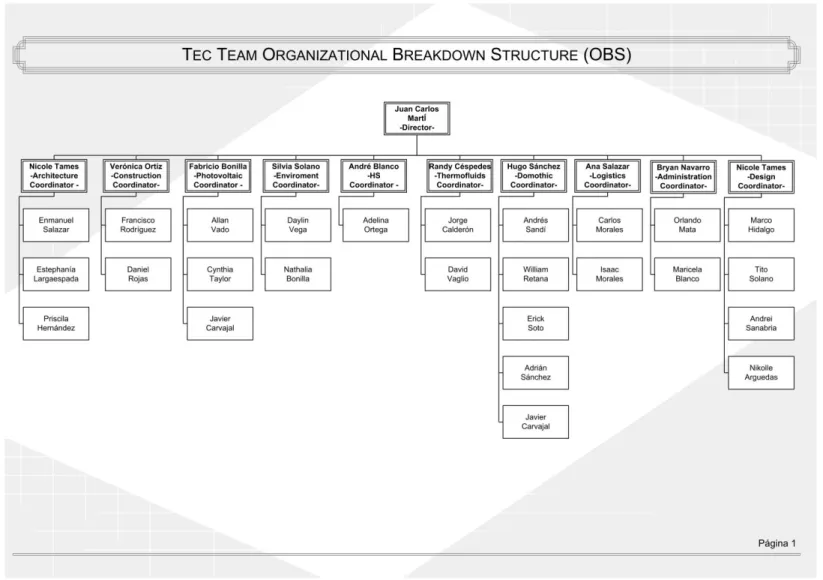
Appendix 13. Organization Breakdown Structure (OBS). ... 204
Appendix 14. Risk analysis during the assembly and disassembly process ... 204
Appendix 15. Risk analysis during the design and materials selection of the module. ... 206
vii
Charts index
Chart 1. First objective variable operationalization……….12
Chart 2. Second objective variable operationalization…………..……….…13
Chart 3. Third objective variable operationalization………….………..14
Chart 4. Fourth objective variable operationalization……….15
Chart 5. Constructive process leaders RAM………..……….21
Chart 6. Assembly process………22
Chart 7. Disassembly process…………..……….26
Chart 8. Risk groups and frequency obtained from the structured interviews…………...29
Chart 9. Summarized data from the brainstorming session……….30
Chart 10. Risk during the constructive process of the housing module……….….32
Chart 11. Risk analysis and mitigation of the project’s development phase……….…….34
Chart 12. Risk analysis and mitigation of previous construction works on the university………..……….35
Chart 13. Risk analysis and mitigation of the assembly of the module………..….35
Chart 14. Disassembly process……….………..…….40
Chart 15. Risk analysis and mitigation of risk during training………..….44
Chart 16. Natural events risk evaluation……….…….45
viii Chart 18. Trainings priority subjects……….48
Figures index
Figure 1.Tec Team’s OBS……….………...1
Figure 2. Analysis Plan………...19
1
I. INTRODUCTION.
A. Company identification.
1. Vision / mission of the company.
Created in 2002 by United States of America (U.S.A) Energy Department, the Solar Decathlon had such a success that inspired the European Union (U.E.) to create their own version: Solar Decathlon Europe (SDE); but the concept is the same: an international competition among which promotes universities to develop efficient houses. The objective of the participating teams is to design and build houses that naturally consume as few resources as possible and produce minimum waste products during their life cycle. Particular emphasis is put on reducing energy consumption and on all the necessary energy obtaining from the sun.
The event has a twofold purpose: educative and scientific. The Decathletes learn how to work in multidisciplinary teams and how to face the challenges of the future of building by developing innovative solutions. On the one hand, the public can see and becomes aware of the real possibilities of reducing the environmental impact and at the same time keeping the comfort and quality of the design in their homes. Also the professionals have access to techniques and processes that they can study and use. In addition, volunteers, who are essential for the development of the SDE, have the opportunity to share experiences with the teams and move ahead in their careers thanks to their work during the competition.
Moreover, universities, companies and public institutions have access to a new way of collaborating, for example, by trying out scientific projects in real conditions to launch them later onto the market or by improving and using existing products in a creative way.
2. Historical background.
2 A similar agreement has recently resulted in the Solar Decathlon China. The European Edition is done in even years and the American competition in odd years; from its first edition in 2013, SD China will take place with some months of difference from the US Solar Decathlon. The three competitions have similar principles and objectives, but they are independently organized and have some differences regarding regulations and contests, adapting in this way to their own circumstances and contexts.
3. Geographic location.
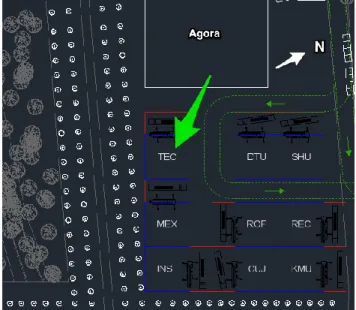
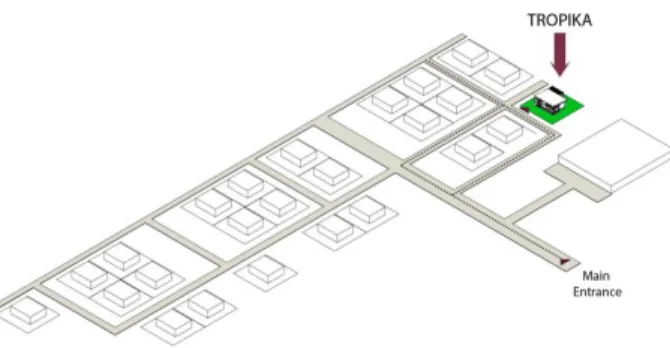
The habitation module Trópika, will be made design and tested at the Tecnológico de Costa Rica, located in Cartago, Costa Rica. Then the house will be sent to the Cite Du Soleil®, Versailles, France; where it will be assembled in a Solar Village, place where the Solar Decathlon Europe 2014 competition will be held.
4. Organization.
1 5. Number of participants.
The Tec Team is integrated by 35 students from 12 fields, all of them from the Tecnológico de Costa Rica. Additionally it has internal consultants as teachers, researchers and external advisors and private sector professionals. The group covers different areas such as administration, construction, architecture and engineering. However, just 30 students are going to be able to work in the construction in France.
6. Product.
Trópika is a tropicalized construction which uses techniques that seek maximize the benefit of our tropical conditions and local materials. This model is proposed in a way that can be replicated in any country in the world that has similar climatic characteristics of Costa Rica, being affordable and with the possibility of being built and vertical residential complex.
Trópika goes far beyond a housing module that works through solar energy, since it is involved in the commitment to produce the least possible environmental impact, not only in performance, but from the design and construction stages, while achieving a high level of comfort without neglecting the needs of the elderly.
7. Market.
People over 65 were elected as target market module to Trópika, who may or may not have special needs. All the module design is thought-out in the accessibility so it comply with the national law 7600 in all it aspects.
8. General production process.
2
B. Graduation Project Justification
Every year large number of deaths and injuries to workers in the construction sector occur as a result of the inherent dangers that have this type of work. In the U.S. 67% of workers in the construction sector believed to be at risk (Suraji, 2006), however only stick to this figure would limit the situation; this belief is shared by workers in the same field worldwide. In Europe each year there are more than 50,000 fatal accidents in the construction industry; for every ten minutes one accident of the same category would be happening (Rubio, 2005).
Although, the above data is not a secret to those in charge of construction processes, the factors that trigger these accidents are not properly controlled. Is noteworthy that not only the direct construction workers are affected, also outsiders to reach work areas suffer due to lack of control of risks in this sector of the industry (Williams, 2006).
As development proceeds on the topic of safety, construction companies have been forced to implement safety standards for the performance of their works, however does not take into account that this issue should be promoted as an organizational culture.
Taking into account the issues raised by previous authors for the competition Solar Decathlon Europe 2014, intercollegiate competition of international prestige, where is designed and built an eco-sustainable solar house, strict rules are set to follow regarding technical safety criteria for the different stages of the project. During the assembly and disassembly of Trópika, the students and all the involved personnel will be protected from an emergency. It is important to mention that none of the team members is a worker of the construction industry and have never worked in this area, many of the team members do not have knowledge on safety for the work to be performed, and so, it is mandatory to provide safety training for jobs in the construction industry. According to Rule 52 of the competition Solar Decathlon Europe 2014 regulation, safety is an area of great importance to the organizers, in which the planning and execution safely is emphasized in the production process, especially in the assembly and disassembly of the module.
3 employees hired because as indicated in the SDE rules Version 2.1, of the competition Solar Decathlon Europe, Rule 3.3: each team is responsible for safety in operations and each team member must work safely throughout the project.
Planning and control in the early stages of the construction process are key to the management and prevention of hazards that may arise during the construction work, in this particular case, this planning must be done in terms of assembly processes and disassembly of the housing. Planning early allows control of hazards related to the type of tasks performed, however also allow better manage any unexpected event that may occur, for which competition is paramount.
Once in France, Trópika assembly, should be done under very strict standards and complying with the time set by the organizers, so it can be exposed and compete in the Solar Village without penalties. Being the assembly and disassembly tasks performed mostly by student members of the team, the procedures must be fully planned because any accident indirectly affects the initial manner stipulated time for these workings, which is a risk that the team cannot afford.
A good risks prevention and the personnel training during the constructive process decrease our risk to have an incident or an accident and that way our risk to be penalized or even disqualified from the competition.
Many studies of accidents in the construction sector indicate that 80% of accidents have causes related to organization errors, planning and control and the remaining 20% is due to runtime errors. Hence, the importance of integrated the prevention from the design, and the need of have everyone involved in the production process inform of the risks that they are exposed (Banchs, González, llacuna& Pujol, 2004).
4 The participation in this event is a unique opportunity to show the potential of our country to the world and also make known the Tecnológico de Costa Rica as a great source of knowledge and science of Latin America. This project also promotes the interdisciplinary with the participation of at least 12 carriers of the university in a unique way due to the fact that the Tecnológico de Costa Rica has never been involved in a competition as big as this one (Chinchilla, 2013). This show the importance to ensure high quality standards in safety and our Safety Plan try to ensure this aspect.
C. Statement of the problem.
The proposal of the Tecnológico de Costa Rica for the Solar Decathlon Europe 2014 competition requires a Safety Program that promotes safe conditions necessary during assembly, disassembly housing module.
D. Graduation project objectives.
General Objective:
Propose the Safety Program for the processes of assembly and disassembly of the habitation module Trópika in the Solar Decathlon Europe- France, 2014 competition.
Specific Objectives:
• Assess the associated hazards with the various stages of assembly and disassembly of the habitation module Trópika.
• Propose the safe work procedures for assembly and disassembly of Trópika.
• Propose the safety training plan in the assembly and disassembly process for the members of Team Tec.
5
E. Reaches and Limitations of the Work.
Reaches
Beyond being a requirement to comply with the Solar Decathlon Europe 2014 regulations, the project offers a proposal for a Safety Program for the stages of assembly and disassembly of the housing module Trópika, to reduce the risks that the team members and workers hired during assembly and disassembly are exposed.
Being a prefabricated home, the Safety Program acts as a guide to perform safely the process of assembly and disassembly of companies of prefabricated construction in different latitudes.
Limitations
Within the program the hazards associated with environmental hygiene and health to which are exposed the people involved in the process of assembly and disassembly are not covered.
This proposal is made in order to prevent hazards during assembly and disassembly processes, because while creating this Safety Program, the housing module continues at the design stage. This is why the identification of hazards in the initial stage of this project is done by collecting information of companies involved in the construction of prefabricated housing, expert input and literature review.
Also are taken into account the endogenous and exogenous factors in Versailles, France. In case Safety Program originally designed for Trópika to be used for other projects should be taken into account the specific characteristics of the projects to perform the necessary technical adjustments.
II. THEORICAL FRAMEWORK.
6 of Trópika, the assembly process for Solar Decathlon Europe 2014 competition include the following conditions:
-The construction works will be in a temporary work center where site characteristics are not known with certainty and the necessary conditions to safeguard the integrity of those who work in it conditions do not exist.
-It is a unique product because it does not correspond to mass production, and therefore it is not possible to test up to improve procedures.
-Safety knowledge of the workers in the construction sector is very low because the total work personnel are students from different careers that are part of the team that will built the house and never has been involved in this activity. (Solar Decathlon Europe, 2013).
-Work will be on public roads, representing interference to others, creating risks that normally would not exist.
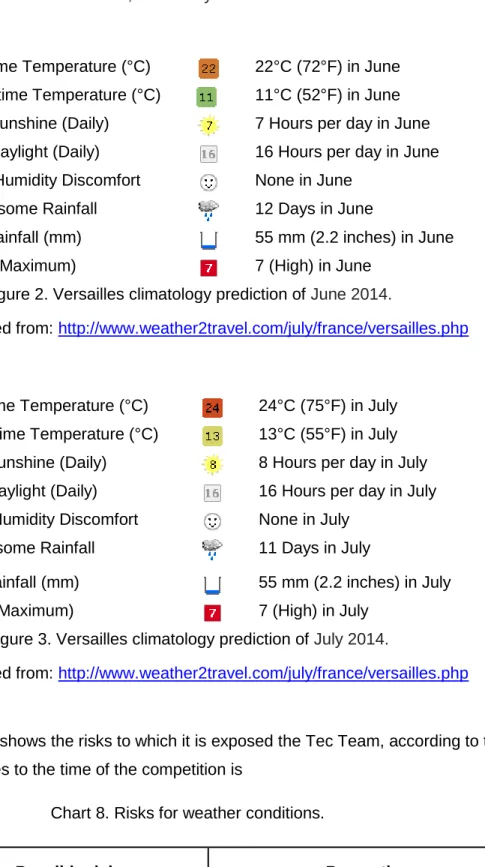
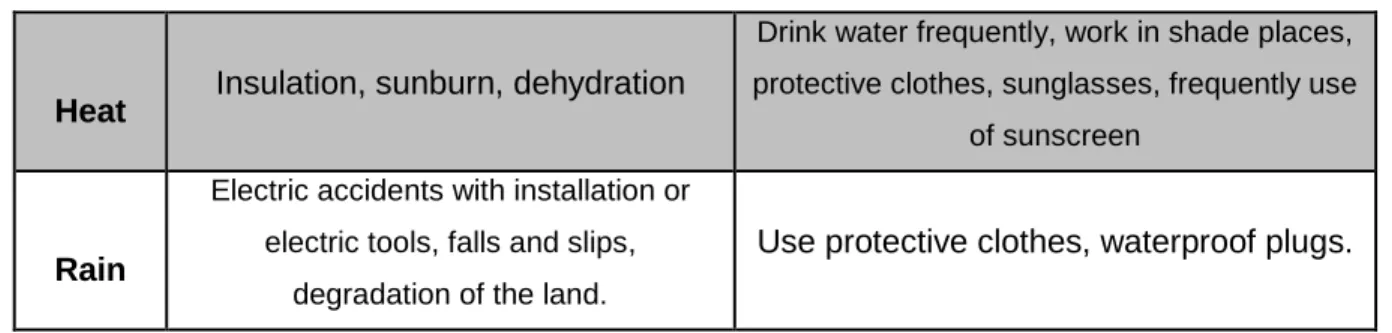
-Outdoor work will be undertaken so that people who are working will be subjected to inclement weather. This factor also affects the activities and can paralyze work for unknown periods (Rubio, 2005).
These aspects are considered an influential factor in the concretization of accidents in the field of construction. The accidents in the construction sector are conceptualized as situations where the integrity of a worker is compromised due to an undesirable event that occurs as a direct result of unsafe conditions and activities that were not controlled by the project managers. The project managers are responsible for creating and maintaining a working environment in which workers can perform their tasks safely (Holt, 2008).
This growing employment sector attracts the attention of specialists in the area of security, this led to many studies and after many years and philosophy the community defined important terms with respect to the possibilities and probabilities that an accident or incident occur; such terms must be analyzed to better understand the issue. The concepts in this paper have focused on the construction industry. The most important are:
7 and/or the structure, material loss, or loss of ability to perform a function described. The possibility that a hazard is realized depends on the conditions of the working environment, preparing workers for the task and preventive measures taken. (Vaidogas, 2010).
-Damage: The result produced by a hazard on the quality of individual or collective lives (NIOSH, 2007).
-Risks: Although the dictionary of the Royal Spanish Academy of Language defines it as the proximity of the damage, in the context of prevention of risk must be understood that the probability of damage occurs in the presence of a hazard and that can therefore, be quantified. The risks may not only affect the health of the people involved in the construction work, also have a direct impact on the quality of construction, direct and indirect costs, delivery times and even damage to third parties. In this particular case any risks that cannot be controlled will affect the rating obtained for the Solar Decathlon competition (Cortés, 2007).
When the concept is understood and the whole people realized that there is always the possibility of harm, the vision of the different workspaces expands and everyone start taking into account that all workspaces are different.
As regards the assembly and disassembly processes work is done at different levels, use of heavy machinery, material handling, handling of hazardous substances, use of dangerous tools, electrical installations, etc., which make these processes in a activity with high levels of risk. According to the Regulations of the 2014 Solar Decathlon competition, assembly is defined as the time between the arrival of the trucks with the materials for the construction of housing and the start of competition in the Solar Village where Trópika will be installed, moreover, the same rules defined disassemble the period of time between the completion of the public tour and the completion of the cleaning of the Village Solar.
8 project costs, penalties, discredit Tec Team and damage to the integrity of students.
The best way to manage risks proactively is through a safety program for assembly and disassembly processes that drives safety performance in the workplace, this is achieved by implementing preventive measures that take care of lower impacts of hazards that may occur in the works, establishing a culture focused on safety, preventing delays in the project and maintaining a good image of the team (Jin & Chen, 2013).
In order to establish a solid program should be considered that the pillars of this must be dynamic and comprehensive. One element that should be taken into account in the construction process, are working procedures. These are formed by a table containing the information to perform a task so that worker´s health is not compromised. A safe work procedure is routine, repetitive and integral to the process, which ensures both a good production and the protection of the person performing the work (Kama, 2009). It should also take into account that emergencies are always present and ignore those can have serious effects.
To anticipate these events is necessary to implement emergency plans. These documents provide and organize the actions of those affected during unexpected events that occur in the workplace (U.S. Department of Labor, sf). By clear and correct definition of the actions to be taken when an adverse event occurs, it creates the possibility to minimize the potential injury and damage to equipment and materials. When an emergency occurs, people have to deal with an exceptional situation in which the actions taken and the time it takes will be crucial for efficient response. Keep in mind that the preparation stage is crucial in the process of emergency management. During this stage the plans are developed based on the analysis of vulnerability and responsiveness with which the team has (Aedo, Yu & Diaz, 2012).
To ensure that workers perform their work safely, trainings should be implemented, which are systematic, that are planned and ongoing activities whose general purpose is to prepare, develop and integrate members of a working group to that in the field of safety, so they can gain optimal performance, providing results in the reduction of the possibility of an accident or incident (Brow & Costa, 2009).
9 protect employees in the workplace from injuries or serious illness that can result from contact with chemical, electrical, mechanical hazards (OSHA, 2010). The industrial safety community prefers to use the PPE as a last resource to which one must resort to cover potential hazards (McDonald, 2004), but it is always important to know that the danger is present and that in spite of preventive controls, the possibility to occur also exist.
The above elements are integrated to create the safety program for habitation module. The union of these concepts, tools of information gathering, consultation with experts and bibliographic revision result in a systematic tool to implement hazard prevention. In the case of housing Trópika must create the program from scratch, because it will be adjusted to the specific needs of the project. Any safety measure should be taken with maturity and seriousness, since the purpose is to protect the integrity of all project workers (Crutchfield, 2007).
The Safety Program for the assembly and disassembly of the housing Trópika is a document that explains in detail the preventive measures to be taken during the process to overcome the hazards associated with each phase. All equipment and reviewers involved must know this Safety Program and therefore all activities under the provisions of it, to reduce the potential occurrence of accidents.
III. METHODOLOGY.
A. Kind of study.
For this project, an exploratory study was made, in this type of study the researcher examines an issue or problem unexplored, which have many doubts. Exploratory studies are used to identify promising concepts (Hernández, Fernández & Baptista, 2010).
10 This project qualifies as a case study type research. This because it is single case study which aims to understand the dynamics present in this context in order to describe and generate theory using different methods for collecting qualitative evidence (Martinez, 2006).
B. Kind of information
1. Primary sources Books
Practical Industrial Safety, Risk Assessment and Shutdown.
Seguridad e higiene del trabajo: Técnicas de prevención de riesgos laborales.
Others
Solar Decathlon Rules V. 2.1.
Occupational Health and Safety Program Manual, City Elevator Ltd.
Seguridad e higiene del trabajo: Técnicas de prevención de riesgos laborales.
2. Secundary sources INTECO
INTE 31-09-09-00 Guía para la elaboración del programa de salud y seguridad en el trabajo.
INSHT
NTP 560: Sistema de gestión preventiva: Procedimiento de elaboración de las instrucciones de trabajo.
NIOSH
Reviews of Research Programs of the National Institute for Occupational Safety and Health.
11 Training and Reference Materials Library - Elements of an Effective Safety and
Health Program.
Hoja de datos: Equipo de Protección Personal.
Others
Manual para la formación de nivel superior en prevención de riesgos laborales.
C. Population and sample
The population of this project are students of the Tecnológico de Costa Rica belonging to the Tec Team, prefab building companies and state entities as EICPSA (first aid training) and the National Emergency Commission. The selection of the sample made with respect to the disposal of companies to work with structured interviews. The chosen construction companies are those who construction process had similarities with the one proposed of Trópika. Therefore, because the selection of the sample is performed at the convenience of the group is classified as unrepresentative type. Companies are informed that the data obtained from the interviews are confidential, and no names will be published.
D. Operationalization of variables
At next we show the operationalization of the variables, where each chart each one of
the Project objectives. Each chart contains the variable of the objective,
conceptualization, the indicator and its respective measures tools. Each tools will be
12 Objective 1. Assess the associated hazards with the various stages of assembly and disassembly of the habitation module, Trópika.
Chart 1. First objective variable operationalization.
Variable Conceptualization Indicators Tools
Evaluation of possible risks during the stages
of assembly and disassembly.
Identification and evaluation of the possible risks that
are going to be present during the
assembly and disassembly which can create negative
consequences for the work process and the health of the
people involved in the project construction.
Risks levels present during the
assembly and disassembly of
the habitation module.
-Expert’s structured interview that
work on homologous
companies. -Brainstorming to
the Tec Team. Possible hazards
per work phase evaluation matrix.
-Risks Administration
Australian Standard AS/NZS
4360: 1999.
13 Objective 2. Propose the safe work procedures for assembly and disassembly of Trópika.
Chart 2. Second objective variable operationalization.
Variable Conceptualization Indicator Tools
Safe Work procedures for the
assembly and disassembly of
Trópika.
Detailed descriptions of the
tasks that will be develop in a safe way during the
assembly and
Amount of safe and unsafe acts.
Frequency of accidents and incidents because
of a safety procedure breach.
Safe and unsafe acts percentage. Fulfillment level of
the safety Safe and unsafe
acts check list Accidents and incidents records. Safety procedures elaboration guide. Check list for the safety procedures
evaluation.
14 Efficiency of the
adopted arrangement Fulfillment level of
the emergency
Source: Blanco & Ortega, 2013
Objective 3. Propose the safety training plan in the assembly and disassembly process for the members of Team Tec.
Chart 3. Third objective variable operationalization.
Variable Conceptualization Indicator Tools
Safety training plan about the assembly and disassembly of
Trópika for the Tec Team members.
The training plan seeks to cover the planned processes,
systematic and organized tasks to modify, improve and
increase the safety knowledge, skills and attitudes
of the team members.
Team member’s knowledge level of safety during the assembly and
disassembly inquiry to the
Tec Team
15 Objective 4. Establish the safety program components for assembly and disassembly of Trópika.
Chart 4. Fourth objective variable operationalization.
Variable Conceptualization Indicator Tool
Safety Program components
Components needed for a safety
program to be effective and has
the ability to improve the health
of the workers involved.
Percentage of fulfillment.
Level of fulfillment of the SDE organization evaluations.
Responsibility level of the construction
processes leaders.
Safety Program Elaboration Guide
provided by the Solar Decathlon 2014 V. 2.1 Rules.
Check list according to the fulfillment of the elaboration of a safety program based on the Solar
Decathlon Europe 2014 V. 2.1 rules. Responsibilities assignation matrix
16
E. Tools description.
Diagnosis objective:
- Experts interview that work on homologous companies.
Specialized information collection method the use a professional dialogue between an interviewer and a interviewed with the purpose of learning through the experience of an expert on the subject, in this case, the construction engineer in a construction company manufactured housing form, the dangers present in the process of assembly and disassembly of prefabricated housing was the main topics of the interview. The frequency will be determinated by the amount of times the interviewee answer positively a question.
- Expert’s structured interview that study natural events.
Specialized information collection method the use a professional dialogue between an interviewer and an interviewed with the purpose of learning through the experience of an expert on the subject, in this case, the National Emergency Commission of Costa Rica, the main topics of the interview is obtain information about natural events that could occur during the construction processes in France, based on the risks given by the SDE organization.
- Brainstorming of the Tec Team.
Tool that allows to generated new ideas in a non-structured way about a specific topic with two or more persons. With this brainstorming we obtain the possible risks presents during the construction process (Ricolfe, 2004). This tool will be used with the Tec Team.
- Possible hazards per work phase evaluation matrix.
This matrix allows to relate each task of the constructive processes to its risk level.
-Australian Risks Administration Standard AS/NZS 4360:1999.
17
Design Objectives.
-Organization Breakdown Structure (OBS). Organizational structure of the Tec Team.
-Responsibilities assignation matrix (RAM).
It is used to relate resources (persons) with activities, this way every one knows his/her role on an activity.
-Check lists.
The checklist is a questionnaire form used to verify the degree of compliance with certain rules set in advance for a particular purpose. For this project the following checklists were developed, which are based on their respective guides:
Emergency plan fulfillment.
Safe and unsafe acts evaluation.
Safety procedures evaluation.
Fulfillment of the elaboration of a safety program based on the Solar Decathlon Europe 2014 V. 2.1 rules.
-Accidents and incidents records.
Data control sheet that have the accidents and incidents that occur during the constructive processes.
- Safe procedures elaboration guide.
18 - Emergency response elaboration guide.
Document containing the components and structure for the development of procedures to follow in case of emergency situations occurring during the process of assembly and disassembly. This is a tool that defines the process to be followed to develop a correct emergency response procedure.
-Construction processes safety knowledge inquiry to the Tec Team members. Structured interview to obtain specific information from a specific population.
The inquiry consists in ten questions that pretends to know the knowing level of safe during a constructive process. The inquiry was applied to the Tec Team members.
- Multi-vote technique.
Allow to sort the issues of safety training for the assembly and disassembly procedures through voting, each person is assigned 9 points to vote for the various training topics, amount of votes allocated to each item per person is limited (1-9), so that the prioritization of topics will be established by the number of votes for each topic, more votes the higher the priority. This technique is developed to provide team members with their knowledge and greater interaction in the training process.
- Training subjects priorization matrix.
Relate the variables that were taking into account to determinate the training topics priority.
- Safety Program Elaboration Guide provided by the Solar Decathlon 2014 V. 2.1 Rules.
19
F. Analysis Plan
21
G. Schedule, economic cost and risks analysis of the project.
For an ordered confection of the project a schedule (appendix 1) was followed. Besides, the economic cost of the project is described on the appendix 2.
Adicional a lo anterior, se estableció un análisis de riesgos del proyecto (ver apéndice 3, con la finalidad de establecer medidas de mitigación o prevención de posibles riesgos que pudieran obstaculizar la realización del proyecto.
IV. CURRENT SITUATION ANALYSIS.
A. Activities Identification Process.
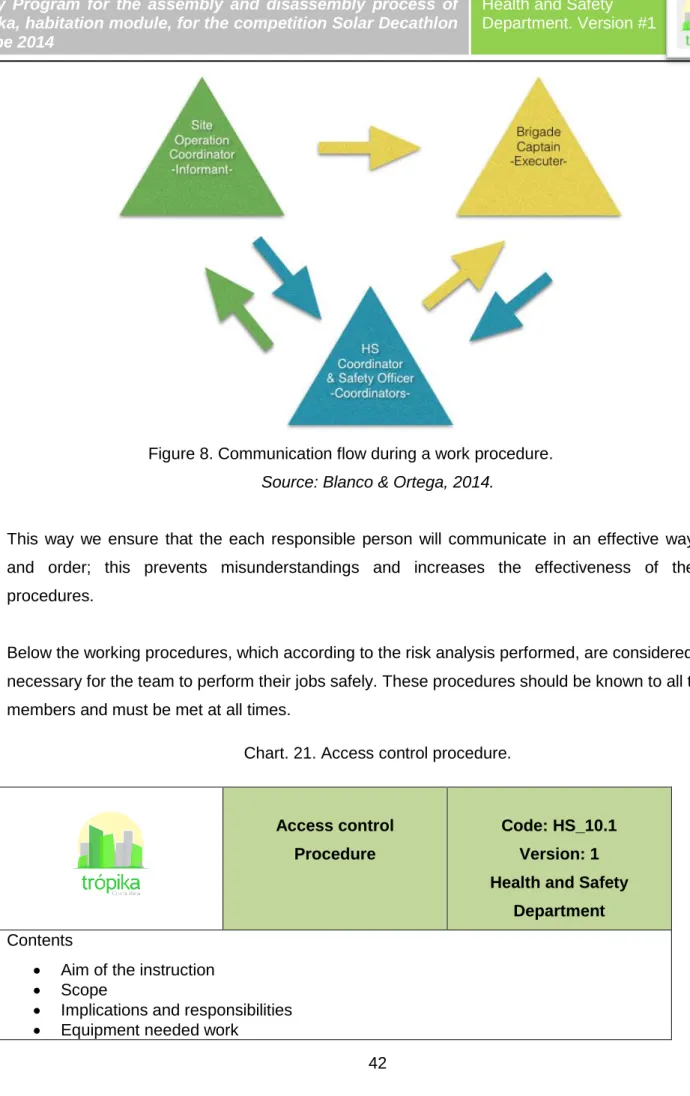
The SDE organization develops several leaders that have to be performing special tasks during the construction process. In this case, the Tec Team leaders are not the same of the assembly and disassembly. There are four important persons that are in charge of the logistic and safety of Trópika, those leaders are: Site Operation Coordinator, Site Operation Officer, Health and Safety Coordinator and the Health, Safety Officer and our department include another leader: Brigade Captain. The respective responsibilities are mention in the chart below:
Chart 5. Constructive process leaders RAM.
Leader
Responsibilities Emergency
Attention
Site Coordination
Risks Prevention Inspection
Site Logistic Coordination
First Aids Attendance
Emergency Communication
Site Operation Coordinator
X X X X
Site Operation
Officer
X X X X
Health and Safety Coordinator
X X X
Health and Safety Officer
X X X
Brigade
Captain X X X X
22 With the leaders tasks assigned the next step is to move forward to the constructive process activities and tasks:
The assembly and the disassembly of the habitation module is going to be divided into activities and tasks as described on the charts below.
Chart 6. Assembly process.
Activity Task
Previous works
-Clean the construction site. -Arrival of the container to the site.
-Install the working areas.
-Place the metallic safety fences to delimit the construction site, crane area and other machinery area.
-Place tends and safety ribbons to delimit the work areas. -Place the signposting.
-Download tools. -Assemble basic equipment. -Installation of heavy equipment.
-Installing the light equipment.
Site preparation
-Checking the ground levels. -Adjust footing level out.
-Determinate the location of the footings. -Level out the footings.
Establishment of the foundation
system
-Transport the footings with the forklift to the site. -Place the footings to its place.
-Check alignment.
Establishment of primary structure
-Transport the columns from container to the site with the forklift. -Attach the column to the crane.
-Hoist the column
Set columns into the foundations. -Place column’s holders.
-Transport the rafter to its site with the forklift. -Attach the rafter to the crane.
23 -Transport the floor’s tie rafters with the forklift.
-Attach the rafters with the floor tie rafters Attach the columns with the floor tie rafters.
-Attach the footings with the floor tie rafter. -Transport the capping rafters with the forklift.
-Install the scaffolding.
-Hoist the capping rafter into position with the crane. -Attach the capping rafter to the columns.
Floor installation
-Transport the floor panel to the site with the forklift. -Classify the panels by its size.
-Attach the floor panels to each other. -Place the floor panels with the crane. -Attach the floor panels to the rafter.
Enclosures
-Placement of the scaffoldings.
-Transport the wall panels to the site with the forklift. -Attach the wall panels to the crane.
-Wall hoisting.
-Place the wall panels between columns. -Attach the wall panels to the columns. -Transport the inner wall to the site with the forklift.
-Assemble the inner wall panels. -Inner walls hoisting with the crane.
-Place the wall panels.
-Attach the inner wall panels with the perimeter. -Transport the windows to the site with the forklift.
-Assemble the windows items. -Place each element of the window -Transport the door to the site with the forklift.
-Doors installations.
Roof installation
-Transport the roof rafter to the site with the crane. -Attach the roof rafters to the crane.
-Hoist the roof rafter.
-Attach the hoist rafter to the columns
24 forklift.
-Attach the roof battens to the roof rafter. -Transport the roof deck to the site with the forklift.
-Attach roof deck’s pieces together. -Attach to the roof battens.
-Install the support structure for the bathroom roof. -Install the water tanks.
-Transport the bathroom ceiling panels to the site. -Attach the bathroom ceiling panels to the crane.
-Hoist the bathroom ceiling panels. -Place the bathroom ceiling panels.
-Attach the bathroom ceiling panels to the structure. -Transport the module ceiling panels to the site. -Attach the module’s ceiling panels to the crane. -Hoist the module ceiling panels with the crane.
-Place the module ceiling panels.
-Attach the module ceilling panels to the structure.
Electrical installation
-Pipes installation under the floor, between the walls and above the ceiling.
-Electrical equipment connection. -System verification. -System connection to energy.
Hall and ramp construction.
-Transport hall columns from container to the site with the forklift. -Attach the columns to the crane.
-Hoist the hall columns -Place the hall columns -Attach hall columns to footing -Transport the rafter with the forklift.
-Place the rafter with the crane. -Attach the rafter to columns
-Transport floor enclosures with the forklift. -Attach floor enclosures to the rafter.
25 -Attach the capping to the column
-Transport the ramp to the site. -Assemble the ramp items
-Place the ramp -Assemble the roof deck
-Place the roof deck -Assemble the garden items
-Place the garden items.
Final details
-Transport the marquee
-Attach the marquee to the capping rafter -Transport the railings
-Place the railings. -Place tensors -Transport the flowerpots
-Place the flowerpots -Place the components -Transport the furniture
-Place the furniture -Transport the grid
-Place the grid -Place the components
-Transport the metallic letters of the module -Place the metallic letters.
-Transport the ramp accessories. -Place the ramp accessories.
-Asssemble the ramp. Source: Blanco & Ortega, 2013
26 Chart 7. Disassembly process
Activity Task
Furniture and
marquee removal
-Remove the marquee from the capping rafter -Remove the railings.
-Transport the railings to the container. -Remove tensors.
-Transport the flowerpots. -Remove the furniture.
-Transport the furniture to the container. -Remove the grid.
-Transport the grid
-Remove the metallic letters of the module. -Remove the ramp accessories.
-Disassembly the ramp.
Hall and ramp
disassembly.
-Disassemble the garden items. -Remove the garden items. -Disassemble the roof deck.
-Remove the roof deck. -Remove the ramp. -Disassemble the ramp items. -Transport the ramp to the container. -Remove the capping from the column.
-Hoist the capping rafter. -Transport the capping rafter. -Remove floor enclosures from the rafter.
-Transport floor enclosures with the forklift to the container. -Attach the rafter from the columns.
-Remove the rafter with the crane.
-Transport the rafter with the forklift to the container. -Remove hall columns from footing.
-Remove the hall columns. -Hoist the hall columns.
27 -Transport hall columns to the container.
Electrical
des-installation
-Pipes uninstall.
-Electrical equipment disconnection
Roof
des-installation
-Remove the module ceiling panels from the structure. -Hoist the module ceiling panels with the crane. -Transport the module ceiling panels to the container. -Remove the bathroom ceiling panels from the structure.
-Hoist the bathroom ceiling panels.
-Transport the bathroom ceiling panels to the container. -Remove the water tanks.
-Remove the support structure from the bathroom roof. -Remove the roof battens.
-Remove the roof’s deck.
-Transport the roof deck to the container. -Remove the roof battens from the roof rafter. -Transport the roof battens to the container with the forklift.
-Remove the roof rafters from the crane. -Transport the roof rafter to the container.
Enclosures
-Doors unistall.
-Transport the door to container. -Remove each element of the window.
-Disassembly the windows items. -Transport the windows to the container.
-Remove the inner wall panels. -Remove the wall panels. - Disassembly the inner wall panels. -Transport the inner wall to the container. -Remove the wall panels from the columns.
-Wall hoisting.
-Transport the wall panels to the crane.
Floor
des-installation
28
Remove the
primary structure
and the foundation
system
-Remove the capping rafter from the columns. -Hoist the capping rafter.
-Remove the scaffolding.
-Remove the columns from the floor tie rafters. -Transport the floor’s tie rafters.
-Remove rafters from the columns. -Remove the rafters.
-Hoist the rafter.
-Transport the rafter to the container. -Remove column’s holders. -Remove columns from the foundations.
-Transport the columns from container to the container. -Transport the footings to the container.
Final works
-Uninstall the light equipment. - Uninstall of heavy equipment. -Disassembly the basic equipment.
-Remove the signposting.
-Remove tends, safety ribbons and fences that delimit the work areas.
-uninstall the working areas. -Departure of the container from the site.
-Clean the construction site. Source: Blanco & Ortega, 2013
B. Process of analysis.
1. Risk identification and evaluation during the assembly and disassembly of the habitation module, Trópika.
The main objective of the Health and Safety department is to keep the integrity of all members of TEC Team, visitors and people of the surroundings in safe. That is why the department had made a compilation of all risk that can happen during the assembly and disassembly.
29 segments that are related to this kind of activity, this way we decrease the uncertainty on the risk evaluation. The strategy we used allows to integrate the opinion from experts by interviews to the Health and Safety department from construction companies, also the opinions of the TEC Team by a brainstorming and the mentioned risks on the Solar Decathlon Europe V 2.1 rules. The results of the different information compilation are:
•
Interviews to construction companies.Structured interviews (appendix 4) were applied to 5 construction companies in Costa Rica. The companies were chosen by their disposal to help. The results are summarized on the next chart. The frequency is determinate by the times a company mention the existence of it during the construction process.
Chart 8. Risk groups and frequency obtained from the structured interviews.
Risks Frequency
1 2 3 4 5
Electrical X
Different level falls X
Same level falls X
Falling objetcs X
Collision with
vehicles X
Minor abrasions X
Hits X
30
Overexertion X
Heatstroke X
Burns X
Fire X
Explosion X
Source: Blanco & Ortega, 2013
With this data we can see that the most frequent risks are the minor abrasions, hits, cutting injuries and overexertion, according to the experience of the Health and Safety department of the construction companies in Costa Rica.
•
Brainstorming.This data compilation technique was applied to the Team to know their perception of the risks that each department is exposed to. On the session we ask: Which risks do you consider that the Team is exposed during the assembly and disassembly of Trópika? The session was very productive and very important data was provided. The data is summarized on the next chart. Each category represents 20% of the frequency that a risk was mentioned.
Chart 9. Summarized data from the brainstorming session.
Risk
Frequency
1 2 3 4 5
Electrical X
Different level falls X
Same level falls X
Falling objetcs X
Collision with
31
Minor abrasions X
Hits X
Cutting injuries X
Overexertion X
Heatstroke X
Burns X
Fire X
Explosion X
Source: Blanco & Ortega, 2013
•
Solar Decathlon Europe 2014 V 2.1 Rules.32 Chart 10. Risk during the constructive process of the housing module.
Risk Frequency Impact Level
Risk
Level Individual Protection Collective Protection
Risk level decrease
Electrical B 5 E
-Dielectric gloves, shoes and tools.
-Prohibition about carrying metallic objects.
-Training in electrical installations. -Earthing of the module.
-Logout-Tagot preventive method.
H
Different level
falls B 4 E
-Protective equipment for working at heights.
-Training in working at heights. -Scaffolds. -Lifelines, anchorage points and ladder use.
M
Falling
objects C 4 E -Helmet use.
-Scaffold with skirting. -Crane’s hook with
safety lock.
M
Collision with
vehicles D 5 E -Reflective vest.
-Delimited zone for trucks and forklift. -Preventive trucks
-Training in material handling. -Ergomic tools. -Active breaks.
H
Fire E 5 E Emergency kit. -Extinguishers.
-Smoke detectors. L
Explosion E 5 E -
-Training in hazardouzs substances handling.
-Safety shoes, safety helmet, safety glasses and
gloves use.
-Training in material handling. -First aid kit
H
Hits A 2 H
-Safety shoes, safety helmet, safety glasses and
gloves use.
-Training in material handling. -First aid kit
M
Cuts B 3 H
-Safety shoes, safety helmet, safety glasses and
gloves use.
-Training in material handling. -First aid kit
M
Heatstroke D 4 H
-Sunblock use. -Work clothes made of
cotton.
-Hydration stations.
-Rest shifts. L
Burns D 4 H -Sunblock use.
-Shirts with sleeves
-Sun shelter.
-Rest shifts. L Same Level
Falls D 2 L Safety shoes use. -Tidiness program. L
33 The information that this chart give to the project is important because provides a better knowledge of the risk that are going to be present during the construction process. It is important to realize that the training of all the team members is very important and the consequences of ignore those can lead to fatal consequences.
Risk evaluation of project phases.
In this section we will define all the fundamentals phases, activities and task that will be part of the competition, including the risk analysis since the beginning of the project until the disassembly of Trópika in France. Each one of this tasks were analyzed to determinate the associated risk and the method to reduce the probability of happening.
This activities has been approved by the Construction Department and the constructive process advisors. Each one of these activities has their own task, resources and specific risks. All this information has been summarized in the next charts, which integrate the most important data of the constructive process. The charts were divided by activities for a better comprehension of the data.
✦
Project’s development:•
Team integration.•
Design.•
Sponsor’s search.34 Chart 11. Risk analysis and mitigation of the project’s development phase.
Activities Resources Associated
risk
Risk Analysis
Risk mitigation
Frequency Impact Level
Team
integration. TEC Team.
-Lack of sessions with the
team. limit dates for
deliverables. -Consultation with the advisors.
Sponsors
Source: Blanco & Ortega, 2013
As we can see, the risk level in this section is severely high. As a solution we tried to involve every team member to the project to ensure the maximum dedication to it. Also we used a lot the advisor’s time to make sure that our direction were right. In every phase of the project we saw everybody’s dedication to the project, which told us that our mitigation method worked.
✦
Previous construction works at the university:•
Material’s evaluation.•
Module’s pre construction tasks.•
Assembly.35 Chart 12. Risk analysis and mitigation of previous construction works on the university.
Activities Resources Associated
risk
Risk Analysis
Risk mitigation
Frequency Impact Level
Material’s sessions with the
team. limit dates for
deliverables. -Consultation with the advisors.
Assembly and disassembly
This section was described on the two next charts.
Source: Blanco & Ortega, 2013
Chart 13. Risk analysis and mitigation of the assembly of the module.
Activities Task Associated risk
Risk Analysis Individual
Protection
-Arrival of the container to the site.
-Install the working areas.
-Place the metallic safety fences to
delimit the construction site, crane area and other
machinery area.
-Place tends, and safety ribbons to delimit the work
areas.
-Installation of heavy equipment.
36
Cuts B 3 H
Site preparation
-Checking the ground levels. -Adjust footing level
out. -Determinate the
location of the footings. footings with the forklift to the site.
-Place the footings to its place. container to the site
with the forklift. -Attach the column to
the crane. -Hoist the column Set columns into the
foundations. -Place column’s
holders. -Transport the rafter
to its site with the forklift. -Attach the rafter to
the crane. -Hoist the rafter with
the crane. -Placement of the
rafters. -Attach rafters to
columns. -Transport the floor’s
tie rafters with the forklift. -Attach the rafters
with the floor tie rafters Attach the columns
with the floor tie rafters. -Attach the footings
with the floor tie rafter. -Transport the capping rafters with
the forklift. -Install the scaffolding. -Hoist the capping rafter into position with the crane. -Attach the capping rafter to the columns.
37
Floor installation
-Transport the floor panel to the site with
the forklift. -Classify the panels
by its size. -Attach the floor panels to each other.
-Place the floor panels with the crane.
-Attach the floor panels to the rafter.
Falling objects C 4 E
-Placement of the scaffoldings. -Transport the wall panels to the site with
the forklift. -Attach the wall panels to the crane.
-Wall hoisting. -Place the wall panels
between columns. -Attach the wall
panels to the columns. -Transport the inner
wall to the site with the forklift. -Assemble the inner
wall panels. -Inner walls hoisting
with the crane. -Place the wall
panels. -Attach the inner wall
panels with the perimeter. -Transport the windows to the site
with the forklift. -Assemble the windows items. -Place each element
of the window -Transport the door to
the site with the
-Transport the roof rafter to the site with
the crane. -Attach the roof rafters to the crane. -Hoist the roof rafter. -Attach the hoist rafter
to the columns -Transport the roof
battens from the container to the site
with the forklift.
38 -Attach the roof
battens to the roof rafter. -Transport the roof deck to the site with
the forklift. -Attach roof deck’s
pieces together. -Attach to the roof
battens. -Install the support
structure for the bathroom roof. -Install the water
tanks. -Transport the bathroom ceiling panels to the site. -Attach the bathroom
ceiling panels to the crane. -Hoist the bathroom
ceiling panels. -Place the bathroom
ceiling panels. -Attach the bathroom
ceiling panels to the structure. -Transport the module
ceiling panels to the site. -Attach the module’s
ceiling panels to the crane. -Hoist the module ceiling panels with the
crane. -Place the module
ceiling panels. -Attach the module ceiling panels to the
structure. under the floor, between the walls and above the ceiling.
-Electrical equipment container to the site
with the forklift. -Attach the columns
39 to the crane.
-Hoist the hall columns -Place the hall
columns -Attach hall columns
to footing -Transport the rafter
with the forklift. -Place the rafter with
the crane. -Attach the rafter to
columns -Transport floor enclosures with the
forklift. -Attach floor enclousures to the
rafter. -Transport the capping rafter -Hoist the capping
rafter. -Attach the capping to
the column -Transport the ramp
to the site. -Assemble the ramp
items -Place the ramp -Assemble the roof
deck -Place the roof deck -Assemble the garden
items -Place the garden
items. -Attach the marquee to the capping rafter -Transport the railings
-Place the railings. -Place tensors -Transport the flowerpots -Place the flowerpots
-Place the components -Transport the
furniture -Place the furniture -Transport the grid -Place the grid
-Place the components -Transport the metallic letters of the
module -Place the metallic
letters. -Transport the ramp
accessories. -Place the ramp
accessories. -Asssemble the ramp.
Different level
40 Chart 14. Disassembly process.
Activities Task Associated risk
Risk Analysis Individual
Protection marquee from the
capping rafter -Remove the railings. -Transport the railings
to the container. -Remove tensors. furniture to the container. -Remove the grid. -Transport the grid -Remove the metallic letters of the module. -Remove the ramp
accessories.
Overexertion B 4 E
Ergonomic B 4 E -Remove the garden
items. -Disassemble the roof
deck. -Remove the roof
deck. -Remove the ramp.
-Disassemble the ramp items. -Transport the ramp
to the container. -Remove the capping
from the column. -Hoist the capping
rafter. -Transport the capping rafter. -Remove floor enclosures from the
rafter. -Transport floor enclosures with the
forklift to the container.
Overexertion B 4 E
Ergonomic B 4 E
Minor
Abrasions A 2 H
41 -Attach the rafter from
the columns. -Remove the rafter
with the crane. -Transport the rafter with the forklift to the
container. -Remove hall columns from footing.
-Remove the hall columns. -Hoist the hall
columns. -Remove the columns
with the crane. -Transport hall columns to the
container.
-Remove the module ceiling panels from
the structure. -Hoist the module ceiling panels with the
crane. -Transport the module
ceiling panels to the container. -Remove the bathroom ceiling
panels from the structure. -Hoist the bathroom
ceiling panels. -Transport the bathroom ceiling
panels to the container. -Remove the water
tanks. -Remove the support
structure from the bathroom roof. -Remove the roof
battens. -Remove the roof’s
deck. -Transport the roof deck to the container.
-Remove the roof battens from the roof
rafter.
Overexertion B 4 E
Ergonomic B 4 E
Minor
42 -Transport the roof
battens to the container with the
forklift. -Remove the roof rafters from the crane.
-Transport the roof rafter to the container.
Hits A 2 H -Transport the door to
container. -Remove each element of the
window. -Disassembly the
windows items. -Transport the windows to the
container. -Remove the inner
wall panels. -Remove the wall
panels. - Disassembly the inner wall panels. -Transport the inner wall to the container. -Remove the wall
panels from the columns. -Wall hoisting. -Transport the wall panels to the crane.
Different level
Overexertion B 4 E
Ergonomic B 4 E
-Remove the floor panels from the rafter.
-Remove the floor panels with the crane.
43
Remove of the primary structure
-Remove the capping rafter from the
columns. -Hoist the capping
rafter. -Remove the
scaffolding. -Remove the columns
from the floor tie rafters. -Transport the floor’s
tie rafters. -Remove rafters from
the columns. -Remove the rafters.
-Hoist the rafter. -Transport the rafter
to the container. -Remove column’s
holders. -Remove columns from the foundations.
-Transport the columns from container to the
container. footings to the
container.
Collision with
vehicles D 5 E -Reflective
vest.
-Uninstall the light equipment. - Uninstall of heavy
equipment. safety ribbons and fences that delimit the
work areas. -uninstall the working
areas. -Departure of the container from the
site.
Overexertion B 4 E
44
Source: Blanco & Ortega, 2013
As we can see there is a lot of risks with high level on the constructive process. This gives us an alert of the serious possible consequences that we have to prevent to occur during the whole project development. To ensure the safety of every team member is obligatory to use safety shoes, helmet and reflective vest at all the working process. The special personal protection equipment will be used only on tasks with a specific risk's presence.
✦
Training.•
Hydraulic tools training.•
First aids attention training.•
Electric system installations training.•
Working at heights training.Chart 15. Risk analysis and mitigation of risk during training. Activities Associated
risk
Risk Analysis Individual Protection
Collective Protection Frequency Impact Level
Safety in
First aid training.
Controlled
45 Due to the controlled environment that the team members will be exposed, the risk will be relatively low level risk, nevertheless, all safety measures will be taken during the training phase.
✦
Construction works. This section were divided in 3 principal phases:•
Assembly.•
Maintenance.2. Natural Events Risk Evaluation.
The natural events risks are usually height that is why we must be prepared to face it. Costa Rica have several events that occur constantly due to the fact that is located in the "Pacific’s Fire Belt”, this is the zone that have more tectonic activity in the whole world, also we are frequently affected by tropical depressions that lead to several events (floods, landslides, etc.). In France with have to ensure everyone safety in case of a natural event so we decided to use our country natural events risk chart to France because that way the safety factor will be higher. To identify and evaluate the risks from natural events we interviewed (appendix 7) several experts of the Emergency National Commission of Costa Rica with the condition that the risks have to be similar to Versailles. To evaluate those risks the HS Department used the Australian’s Risk Administration Standard AS/NZS 4360: 1999, the parameters to apply the evaluation were established on the appendix 16.
The results are summarized on the next chart:
Chart 16. Natural events risk evaluation.
Risk Risk analysis
Frequency Impact Level
Earthquake D 5 E
Hurricane E 4 H
Floods C 3 H
Landslide D 5 H
Tornado E 5 H
Source: Blanco & Ortega, 2013