UNIVERSAL DESIGN FOR LEARNING PRINCIPLES USED AS AN EFFECTIVE TOOL FOR THE DEVELOPMENT OF READING COMPREHENSION
Tesis para optar al Grado de Magister en TESOL
Autor: Karen Cristina Fuentes Zapata Profesor Guía: José Gabriel Brauchy Castillo
DEDICATORY
I dedicate this thesis to two important persons in my life. First, to my love Alfonso who has provided me strength, guidance, patience, love and perseverance when I needed.
ACKNOWLEDGEMENTS
I would like to acknowledge and extend my grateful appreciation to the following persons who have been with me during the process of learning and also who have made the completion of this thesis:
Professor Jose Gabriel Brauchy, my thesis supervisor who supported me in all stages of this study, giving me feedback, advices and encouragement when I was tired.
Professor, Mrs. Jennie Pop Ward who gave me their priceless feedback and orientation. To my sister Yenisfer Fuentes Zapata, thank you for all your support and time, even when you were tired or busy there was time for me and my questions.
To my love Alfonso Gajardo Quintana, thank you for your encouragement, patience, faith and your support as assistance in managing our baby. Truly Honey without your support, this would not have been possible.
To my friend Pilar Navarrete who gave me priceless support during this process attending my questions and giving me orientation.
I would like to thank to Paula Luna, Principal of Colegio Santo Tomas de Los Angeles who provided me material, time and support.
TABLE OF CONTENTS ABSTRACT
CHAPTER 1: BACKGROUND AND STATEMENT OF THE PROBLEM 1
1.0 INTRODUCTION 1
1.1 STATEMENT OF THE PROBLEM 6
1.2 JUSTIFICATION OF THE PROBLEM 8
1.3 RELEVANCE OF THE STUDY 9
1.3.1 Social Relevance. 10
1.3.2 Management Team relevance. 10
1.3.3 Teachers’ relevance. 11
1.3.4 Students’ relevance. 11
1.4 SCOPE AND LIMITATION OF THE STUDY 11
1.5 PURPOSE OF THE STUDY 12
1.6 OBJECTIVES OF THE STUDY 12
1.6.1 General Objective. 12
1.6.2 Specific Objectives. 13
1.7 RESEARCH QUESTIONS 13
1.7.1 Main Question. 13
1.7.2 Subsidiary Questions. 13
CHAPTER 2: REFERENTIAL FRAMEWORK 14
2.0 INTRODUCTION 14
2.1 RESEARCHES ON UDL 14
2.1.1 UDL brain research and the learning process. 16
2.3 CONCLUSION 21
CHAPTER 3: THEORETICAL FRAMEWORK 22
3.0 INTRODUCTION 22
3.1 UDL 22
3.2 YOUNG LEARNERS 26
3.2.1 Characteristics of younger and older learners. 26
3.2.2 How children learn 27
3.3 DEVELOPMENT OF LITERACY IN YOUNG LEARNERS 28
3.3.1 Reading Processes 30
3.3.2 Micro skills for Reading 32
3.3.3 Reading Strategies 34
CHAPTER 4: METHODOLOGICAL FRAMEWORK 36
4.0 INTRODUCTION 36
4.1 TYPE OF STUDY 36
4.2 THE CONTEXT 37
4.2.1 The Community Context 37
4.2.2 The School Community 37
4.3 IMPORTANCE OF ENGLISH 39
4.4 THE PARTICIPANTS 43
4.5 THE INSTRUMENTS 44
4.5.1 The Pretest and Posttest 44
4.5.2 Workshops 45
4.5.3 Teacher classroom direct observation (TDCO). 45
4.7 PROCEDURE 46
4.7.1 The Sample Procedure 46
4.7.2 The Intervention Procedure 47
4.7.3 Lesson Plan 48
4.7.4 Lesson Description 48
CHAPTER 5: RESULTS ANALYSIS 53
5.0 INTRODUCTION 53
5.1 PRETEST DATA ANALYSIS 53
5.1.1 Experimental Group Pretest Analysis 53
5.1.2 Control Group Pretest Analysis 54
5.1.3 Comparison of Pretest total score: EG and CG. 55
5.2 POSTTEST DATA ANALYSIS 56
5.2.1 Experimental Group Posttest Analysis 56
5.2.2 Control Group Posttest Analysis 57
5.2.3 Comparison of Posttest total score: EG and CG. 58
CHAPTER 6: CONCLUSIONS 60
6.0 INTRODUCTION 60
6.1 ANSWER TO MAIN QUESTION OF THE STUDY 60
6.2 ANSWER TO SPECIFIC QUESTIONS 61
APPENDIX F APPENDIX F
ABSTRACT
The purpose of this research project was to explore the Universal Design for Learning (UDL) principles as an effective tool in a EFL class for young learners. A secondary purpose of this investigation is to measure the use of UDL principle and its impact on the development of reading comprehension, considering diversity in the classroom and different learning styles. The investigation was implemented in a third grade primary level class of a subsidized private school in Los Angeles, Chile. The study followed a pretest and posttest experimental - control group design. The study sample consisted of 32 students who were randomly divided into two groups: 16 students were in the experimental group and 16 students for the control group. The
experimental group used UDL principle in every lesson, and the control group used traditional instruction. Findings of the investigation indicate that UDL principle is an effective tool for the development of English as a foreign language in young learners.
RESUMEN
La finalidad de este proyecto de investigación fue explorar los principios del Diseño Universal para el Aprendizaje (DUA) como una herramienta efectiva en una clase de inglés como lengua extranjera en alumnos pequeños. Un segundo propósito de esta investigación es medir el uso de los principios del Diseño Universal para el Aprendizaje y su impacto en el desarrollo de la comprensión lectora, tomando en consideración la diversidad existente en el aula y los diversos estilos de aprendizaje. La investigación fue llevada a cabo con alumnos de tercero básico de un establecimiento educacional particular subvencionado de la ciudad de Los Ángeles, Chile. El estudio optó por la aplicación de un pre test y post test con un grupo experimental y un grupo de control. Los participantes del estudio fueron 32 alumnos quienes fueron divididos en dos grupos: 16 alumnos en el grupo experimental y 16 en el grupo de control. El grupo experimental usó los principios del Desarrollo Universal para el Aprendizaje y el grupo de control usó instrucciones tradicionales como de costumbre. Los resultados de la investigación indican que los principios del Desarrollo Universal para el Aprendizaje son una herramienta efectiva para el desarrollo de inglés como lengua extranjera en alumnos pequeños.
CHAPTER 1: BACKGROUND AND STATEMENT OF THE PROBLEM
1.0 INTRODUCTION
The goal of education in the 21st century is not only the mastery of knowledge but the mastery of learning a foreign language. Education should be the tool to turn inexpert learners into expert learners-individuals who know how to learn, who want to learn, and who, in their own highly individual ways, are well prepared for a lifetime of learning.
Universal Design for Learning (from here UDL) is an approach that addresses barriers to make expert learners. Learners with disabilities are most vulnerable to such barriers, but many students without disabilities also find that curricula are poorly designed to meet their learning need (CAST 2011, p.4).
Universal Design for Learning helps to meet the challenge of diversity by suggesting flexible instructional materials, techniques, and strategies that empower educators to meet these varied needs. A universally designed curriculum is designed from the outset to meet the needs of the greatest number of users, making costly, time-consuming, and after-the-fact changes to curriculum unnecessary (CAST 2011, p. 4).
The professional training of all teachers is one of the bases upon which the quality of education sustains the equity of education that the pedagogical work faces. Based upon on my own teaching extensive experience I can state that English teachers have a little or do not have the training, experience and techniques which are required when working with diversity in a classroom. Initial English Teacher Education Programs offered in the Concepcion area offer little or no training on teaching methodology to work with diverse communities of learners nor
On the other hand,English language is a key area in the curriculum because of its importance as a means of access to different areas of knowledge and its nature of global language of
communication. Through English, students can access a wide range of information through the media and technologies and learn about other cultures and realities.
The General Law of Education, (2009,GLE) defines education as the process of lifelong learning that encompasses various stages ofpeople’s lifeand aims to reach their spiritual, ethical, moral, emotional, intellectual, artistic and physical development through transmission and cultivation of values, knowledge and skills. It is part of the respect and appreciation of human rights and fundamental freedoms, multicultural diversity and peace, and our national identity, enabling people to lead their lives fully, to live and participate in a responsible, tolerant, compassionate, democratic and active in the community, and to work and contribute to the development of the country (Mineduc, Articulo 2, 2009).
By the same the GLE establishes principles, obligations and promotes changes in the way students are educated in Chile, in addition to the rights guaranteed in the Constitution and international treaties of Chile, as well as the right to education and freedom of teaching, the GLE is inspired by some principles such as quality, equity, diversity and integration. These last two are intended to promote and respect the diversity of educational processes and projects and incorporate students in a wide variety of conditions, which are in the ethnic, religious, economic and cultural environment. Educating in and for diversity must be shared among all members of an educational establishment and also in the educational process, having clear responsibilities and obligations.
Needs (SEN) in regular education (Decretos Nº 1/98 and Nº 1300/02) and it is designed under the principles of UDL.
Later in 2009 a modification is made to the Special Education to the School Integration Project, the decree 170 is promulgated, and this set standards for determining students with SEN. This implies a process of changes in terms of health care coverage, stakeholders and strategies for working with students with SEN.
These strategies taken by the Minister of Education 2009 are a support for the attention to diversity and the achievement of quality and equity but if we consider the acquisition of a foreign language such as English, we see that one of the most obvious problems that the Chilean Educational System has to face is that not all students reach high levels of proficiency in reading and listening comprehension (SIMCE 2012) despite of the measures taken by MINEDUC (SIP and decree 170).
For this, the MINEDUC in 2004 designed a program called English Opens Doors in order to design a public policy and establish technical leadership to increase availability, improve quality and make enforceable in Chile teaching English as a foreign language (EFL). In 2006, of the 36 measures taken in education two were directly related to English. Thus, the Chilean school system began experiencing important changes regarding the teaching and learning of English. The English Opens Doors program has three main lines of action:
1. Teacher Professional Development for Teachers of English as a foreign language. 2. Direct actions in the system and children: Support for schools and colleges through the National Volunteer Center Anglophone; summer and winter camps in English, speaking skills in English (Public Speaking) and English Debate Tournament; Scholarships abroad. 3. Measurement of levels of learning and achievement in the subsidized school system.
Despite the existence of English Opens Doors Program the SIMCE results of English are still low and students do not reach the standards set by MINEDUC which are based on the Common European Framework that requires the competences in the four skills but specially in reading and listening comprehension (MINEDUC 2004).
In this context, the Ministry of Education (MINEDUC, 2009), has promoted and enhanced the Universal Learning Development, which aims to contribute to improving the quality of education for all students, is premised on the assessment of individual differences and respect for diversity and the prospect of a more inclusive vision of education (Orientaciones tecnicas para PIE, 2012).
students, objectives, methods, materials and assessments based on the diversity and enable learn and participate at all, not from the simplification or homogenization through a single model for all, "one size fits all", but by the use of a flexible approach to participation, involvement and learning from individual needs and abilities. So this approach encourages teachers to design curricula, learning environments and assessments that are "smart from the start" (Pisha and Coyne, 2001). Designing teaching is necessary from the start given the diversity of students in class, considering its strengths, weaknesses, experiences and interests. Learning environment support the learning process of the students, if the necessary strategies are provided so that each and every one of them to face new challenges.
The importance of the teacher in the classroom is essential when delivering content and reach goals set by the Ministry of Education. Plan considering the diversity in the classroom is the task of the teacher should take into consideration both to develop effective methodologies and thus address the multiple learning differences, as well as in the process of formal and informal assessment.
1.1 STATEMENT OF THE PROBLEM
The purpose of this quasi experimental study is focused on study the effectiveness of the UDL Principle as an effective tool for the development of reading comprehension in EFL class of young learners.
The study subject is a mix class ( 16 students), of YEAR 3(8 years old) students of a private subsidized institution in Los Angeles city, Eighth Region in Chile.
Despite the recently EFL curriculum changes in our country, teaching English to young learners has not received much attention. Little has been written on teaching English to young learners and how an English teacher can work with diversity trying to achieve the same goal in all of them.
As a matter of fact the majority of EFL teachers in Chile have not received qualified training to teach diversity in the classrooms. Teaching English as a foreign language implies the developing on the communicative competences, which are mainly focused in offering learners the tools to face a global world and a wider access to technology.
In traditional EFL classrooms, the teaching of Reading Comprehension could be described mainly as follows:
1. Reading activities are restricted to the teacher reading everything, including instructions, short stories, and rereading what was written on the board.
2. Students’ reading is confined to imitating flash cards and reading very simple sentences after the teacher.
3. Students begin every day with a new letter, learning the shape and memorizing words that start with the same letter
5. Activities are all teacher-centered, and students memorize letter shapes and words (MINEDUC, bases curriculares 2012, pp.17, 18).
Based on the researcher’s own and teaching practice, the implementation of this study is based on UDL principle to be used as an effective tool for the development of reading comprehension in English as a foreign language class for young learners.
In Chile quality of education for all Chilean students is the major goal. One of the highlights was the bilingualism. However, in practice and despite of all, the efforts have not achieved the goals.
The experience would show that one of the aspects involved is diversity in the classroom; it means that each student has individual learning needs to fully learn and develop as a person, requiring a response and individualized and comprehensive care (Warnock Report, 1978).
A second important aspect to be considered is not achieving the objectives proposed by the MINEDUC in English as a subject which is reflected in the results of SIMCE of English, measuring only two of the four linguistic skills.
Within the origins and causes that motivated the interest of this research is notable for revealing the processes of change in education, especially in teaching a foreign language and the implementation of effective strategies for teaching all students considering that these learn differently, have different learning rhythms, develop different skills: Therefore, it is important that teachers also possess expertise in their areas handling methodologies and approaches that target these differences in the classroom.
1.2 JUSTIFICATION OF THE PROBLEM
Learning a language has been a challenge for many years in our country, but it has been essential for globalization which requires bilingual people. In Chile, the Ministry of Education has been working on the development of new improvements to the current English education curriculum (Inglés como Lengua Extranjera, Educacion Primaria, Bases Curriculares 2012).However the compulsory teaching of English starts in Year 5 (children aged nine), therefore the great majority of young learners under nine years do not receive English teaching. Due to this situation, there is limited knowledge about appropriate practices to teach children. Moreover, limited number of research studies have been conducted in this area.
Bases Curriculares (2012) define English as a foreign language because is not used as a communicative language between habitants and students do not have immediately access to its use outside the classroom. On the other hand, Longman Dictionary (2010) defines a foreign language as “a language which is not the native language of a large number of people in a particular country or region, and is taught as school subject for the purpose of communicating with foreigners”(p. 224).
Learning a language has different purposes and motivation, becoming more difficult when this language is not spoken outside the classroom and when teachers do not use effective methodologies. In one hand every student is unique and has his own learning style and needs, and on the other hand, there are students who struggle to learn for any reason including learning disabilities, English language barriers and lack of interest, among others.
where teachers have the responsibility of achieving goals for all learners. It is the teacher’s challenge to provide students suitable tasks and rewards according to their individual needs. As a result, teachers create alternative methods for students which require extra time, are expensive, inefficient, and often ineffective for learning.
From this perspective it is important to consider the use of UDL because is an approach which addresses barriers keeping students from becoming expert learners. A one-size-fits-all curriculum is a barrier to learning (CAST, 2000) and where its principles provide a blueprint for designing a curriculum that addressed the diverse needs of all leaners and its effectiveness has had excellent results in different subjects, including English. For this reason it is important that teachers manage UDL principle as an effective tool for teaching English to young learners in a mixed class where children of all abilities enjoy working individually, in pairs or small groups and where more capable learners can often help weaker ones. Applying UDL to young learners in EFL reading activities will help students to feel confident and motivated to learn a foreign language.
The teacher-researcher designed an exploratory study to prove the effectiveness of UDL principle as an effective tool for the development of English as a foreign language in reading comprehension in young learners.
1.3 RELEVANCE OF THE STUDY
be implemented in an English classroom of young learners developing best practices for educating all students. It is necessary to show that every student is unique and has the right to learn. This study will add to the literature on UDL.
1.3.1 Social Relevance.
In a classroom there is a variety of students with different cognitive characteristics, a particular family and social context. Each of them has specific educational needs and access learning experiences. The UDL helps to be up to the challenge of diversity by suggesting flexible instructional materials, techniques and strategies that empower educators to address and recognize these multiple needs.
Thus the UDL becomes as one of the main methodological strategies to improve the quality of learning for all students, because it uses a universal curriculum designed from the beginning to try to satisfy the educational needs of the greatest number of users, making unnecessary the costly process of introducing changes once designed "for some” the general curriculum.
This is evident in that teaching should be directed to all students and not just a group of them to achieve a learning of quality and equity.
1.3.2 Management Team relevance.
That is, the directive team is the main responsible for knowing what it is and how it should work the UDL and ensure its development in favor of raising the quality of learning for all students, and independent of their physical, economic and social conditions and also in their learning styles.
1.3.3Teachers’ relevance.
This research will be useful for the English teacher because it will show the way how to implement the UDL principles in the classroom. It will allow teachers to deal with diversity, and will guide educators in finding innovative ways to make curriculum accessible and appropriate for individuals with different backgrounds, learning styles, and abilities. This paradigm for teaching and learning will give teachers the focuses on adapting the curriculum to suit the learner and not the learner adapting to the curriculum (Eagleton, 2008).
1.3.4Students’ relevance.
The study will attend students with different learning styles and rhythm of learning in the classroom, allowing them participation and motivation in the learning process. Students will be able to work individually and in groups designed by the teacher- researcher.
1.4 SCOPE AND LIMITATION OF THE STUDY
similar characteristics. Thus, the findings may not represent practices of the teaching of English as a foreign language in public or private schools.
The data gathered for the analysis of the results corresponds to the Pretest and Posttest instruments, and to the treatment given to participants during the study.
The time of study was limited by 8 hours divided in 8 sessions.
One of the limitations of this study was the low number of participants. All of them were in third grade in the same classroom not having a similar group.
1.5 PURPOSE OF THE STUDY
The aim of this study is to explore the efficacy of UDL principles as an effective tool for the development of English as a Foreign Language in reading comprehension for young learners. The study has two important purposes, one is to apply UDL principle in English classes of young learners and the second is to determine the use of UDL principle and its benefits for every student. The study is planned in order to intervene two groups of students of third grade in a Chilean subsidized school in Los Angeles city. The intervention is focused to answer the research questions of the study, based on the given general and specific objectives of this experimental study.
1.6 OBJECTIVES OF THE STUDY
1.6.1 General Objective.
1.6.2 Specific Objectives.
1. To determine the use of UDL principles as an effective tool for the development of Reading comprehension in young learners.
2. To analyze the effects after the application of UDL principle in English classes in an experimental and control group of young learners.
1.7 RESEARCH QUESTIONS 1.7.1 Main Question.
How effective is the application of UDL Principles in the development of Reading Comprehension for Young Learners?
1.7.2 Subsidiary Questions.
1. Which are the effects after the application of UDL principle in an experimental and control group in EFL classes of young learners?
CHAPTER 2: REFERENTIAL FRAMEWORK
2.0 INTRODUCTION
UDL is an educational framework that was defined by Rose of the Harvard Graduate School of Education and the Center for Applied Special Technology (CAST) in the 1990s. UDL has helped teachers to design lessons accessible to all students, sustained in the three overarching principles of engagement, representation, action and expression. It is based on research in the learning sciences, including cognitive neuroscience that guides the development of flexible learning environments that can accommodate individual learning differences.
UDL has had good results in different states in United States and in Europe.
In this chapter several researchers will be exposed in order to demonstrate the effectiveness of UDL principles.
2.1 RESEARCHES ON UDL
UDL was initially proposed as a means for including students with disabilities in the general-education classroom, it is now better understood as a general-general-education initiative that improves outcomes for all learners.
CAST has made available a reference website with useful learning tools and quality resources to help teachers develop UDL strategies. In conjunction with Google, to celebrate World
Literacy Day in 2008, UDL editions of classic works from literature were published, allowing individualized support to many different kinds of learners.
The research that supports UDL falls into four categories: (1) foundational research of UDL, (2) research on the UDL principles, (3) research on promising practices, and (4) research on implementation of UDL.
(1) Foundational research on UDL this draws from a variety of research including the fields of neuroscience, the learning sciences, and cognitive psychology. It is deeply rooted in concepts such as the Zone of Proximal Development, scaffolding, mentors, and modeling, as well as the foundational works of Piaget (1947), Vygotsky( 1978), Bruner(1961), Ross(1976), Wood (1976), and Bloom (1956), who espoused similar principles for understanding individual differences and the pedagogies required for addressing them.
(2) Research on UDL principle is also grounded in modern neuroscience. The three basic principles are built upon the knowledge that our learning brains are composed of three different networks, recognition, strategic, and affective. The Guidelines align these three networks with the three principles (recognition to representation, strategic to action and expression, and affective to engagement). This empirical base in neuroscience provides a solid foundation for understanding how the learning brain intersects with effective instruction.
the framework. It is important that these practices are studied within a UDL environment for them to be considered effective UDL practices.
(4) Implementation research offers specific applications of UDL within learning
environments, including conditions necessary for implementation, common barriers, and lessons from the field. This new area of research is in its early stages but will take a more prominent place as full-scale curricular applications and system-wide implementations are developed (CAST 2012, para. 4).
2.1.1 UDL brain research and the learning process.
Shaywitz and Shaywitz (2004) Shaywitz et al. (2006) found that individuals with reading disabilities, particularly teens and adults with dyslexia, use different areas of the brain to decode words and comprehend passages, compared to non-impaired individuals. Functional magnetic resonance imaging (FMRI) allows real-time imaging of the brain as it processes information and has revealed that there is a difference between the images of non-impaired individuals and individuals with dyslexia.
Each UDL principle is built upon how information is processed during learning activities and the three guiding principles of UDL are the basis for creating a more accessible curriculum (Rose & Meyer, 2002; 2006). Before discussing the UDL principles, it is necessary to understand what brain research revealed regarding neural activity during the learning process. Positron Emission Topography (PET) brain scan images FMRI of individuals given the same task, reveals
differences in brain activity.
networks by terms that reflect the network functions: the recognition, strategic, and affective networks” (p. 12).
The recognition network of the brain receives and analyzes information, and recognizes patterns such as familiar faces, decoding phonetic patterns, and words in context. “Although human brains all share the same basic recognition architecture and recognize things in roughly the same way, our recognition networks come in many shapes, sizes and patterns”.Although PET scans may show the same area of the brain with increased activity during the recognition learning process, “the exact magnitude, location and distribution of the increased activity varies quite a bit” (Rose & Meyer, 2002, pp. 17, 18).
communicate closely through myriad interconnections to create a whole affective impression” (Rose & Meyer, 2002, p. 32). Emotional responses and stimuli create the affective processing inherent in the learning process. Like the recognition and strategic networks, the affective
network differs for each individual. “Affective differences exert powerful influences on learners’ ability to engage with learning and to progress” (Rose & Meyer, 2002, p. 34). Knowing that the affectivenetwork influences a learner’s ability to engage in the learning process, the third principle of UDL supports the need to address the affective network: provide multiple, flexible options for engagement (Coyne et al., 2006; Rose & Meyer, 2002).
2.2 UDL IMPLEMENTATION
UDL has been implemented in different areas with different participants and contexts. UDL implementation is a process of change that tends to occur in a recursive, continuously improving cycle of learning and progressing. Baltimore County Public Schools in Maryland and
Bartholomew Consolidated School Corporation in Indiana, which have had implemented UDL. The implementation was supported by CAST who believes that after integrating systems change research with the UDL principles this could provide school staff with a customized, cascading, series of professional learning opportunities, professional coaching, facilitation, supports, resources and tools needed to assist districts throughout the UDL implementation. This is an important distinction that makes UDL implementation different from other initiatives that attempt to hold participants to a specific, regimented implementation approach. The UDL
structures within their system and anticipated different paths and plans for scaffolds and supports that would meet the needs of their own unique system to move forward toward scaling and optimizing UDL implementation.
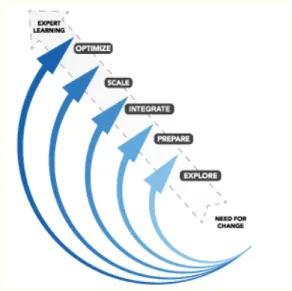
Even though five phases of UDL implementation have been identified, it is also recognized that each school, district or higher education institution will approach the UDL implementation process in a unique manner. The five phases within an integrated dynamic process of UDL implementation, adapted from Fixsen, Naoom, Blase’, Friedman, and Wallace (2005), are: (1) Explore, (2) Prepare, (3) Integrate, (4) Scale, and (5) Optimize. These are not rigid stages but instead are fluid and recursive in nature. The UDL Principles are purposefully infused
throughout the process. For example, each phase includes three focused goal areas aligned with the three UDL principles. Implementation phases may exist as discretely separate, sequential periods of focus for some schools or districts or they may overlap or repeat in an iterative manner. The graphic below offers another way of thinking about the UDL implementation process that highlights its iterative, continuously improving aspects (CAST 2012, para. 3and 4).
UDL implementation
Figure 1.The five phases within an integrated dynamic process of UDL implementation, adapted from Fixsen,
1. Baltimore County Public School (BCPS): is the 26th largest school system in the U.S. It is a geographically and demographically large district that surrounds the city of Baltimore, Maryland. Like most school districts, BCPS is constantly undergoing change. During the year of the project the district hired a new superintendent who brought a different management style, background knowledge and new priorities. An important factor to consider when looking at school districts in Maryland is that the Maryland Department of Education proposed and the Maryland State Board of Education adopted regulations in June 2012 that require all local districts to use Universal Design for Learning in the development of curriculum and selection of instructional materials beginning in the 2014-2015 school year.
BCPS was prepared for this legislation. Since the mid-1990s, UDL has been part of
professional development provided through the Office of Assistive Technology. By collaborating with content offices and instructional technologists, the Assistive Technology (AT) team worked to demonstrate that UDL benefited all students, not only students with disabilities.
Some of the activities that BCPS initiated during the Explore Phase of UDL implementation were: 1) curriculum and instruction staff participated in UDL symposiums, 2) teacher and instructional leaders participated in UDL book studies, 3) all curriculum writers received UDL professional development, 4) school administrators participated in UDL awareness activities and all principals attended a UDL workshop. The Aspiring Leaders Program, a requirement of entering the administrative pool at BCPS, added UDL professional development to its offerings as well (CAST 2012, para. 1and 2).
coordinator, inspired by a presentation at a conference, brought the idea of Universal Design for Learning to BCSC. Even though the district had a high percentage of their special education population integrated into regular classrooms they knew that these students were not
experiencing the successes that were possible. A single pilot school dedicated to using the UDL framework was started as part of a statewide UDL initiative called the PATINS project. Today, UDL principles are applied to some degreein all of the district’s 19 schools. During the UDL Implementation project the district educators at all levels used a self-evaluation tool to help identify areas of need, resources and to find holes in the system. “UDL made sense for our district because the neuroscience behind UDL aligned with the district beliefs about how each student is different and learns differently, “explains Bill Jensen, Director of Secondary
Education. He continues, “For teachers implementing UDL can be daunting, especially today when they have so many pieces they must be accountable for, like the Common Core Standards and high stakes testing where there is a narrow accountability system that is strangling creativity and innovation in the classroom (CAST 2012, para. 1).
2.3 CONCLUSION
CHAPTER 3: THEORETICAL FRAMEWORK
3.0 INTRODUCTION
The theoretical framework provides the background that supports the investigation. This chapter is organized in a manner that helps the reader to understand the researcher’s perspective and purpose of her exploratory research.
This chapter is divided in three main thematic areas which this study is based upon :(1) Universal Design for learning; (2) Young Learners and (3) Development of Literacy in Young Learners.
The first part it is an overview of Universal Design for Learning. The second part the main topic is young learners. In this section all their characteristics are described and how children learn.
The third part the main topic is the Development of Literacy in Young Learners and is related to reading and its processes, micro skills and strategies.
3.1 UDL
In the 1950s, the concept of “universal design”emerges as a necessity in architecture to have building environments free of obstacles, the idea was to remove obstacles for people with physical disabilities.
The presence of UDL in education has gained interest and it has been defined in the Higher Education Opportunity Act as:
Scientifically valid framework for guiding educational practices that:
(A) Provides flexibility in the ways of presenting information to students, ways to respond or demonstrate knowledge and skills, and the ways in which students may be involved in this process and
(B) Reduces barriers in instruction, provides appropriate accommodations, supports, challenges and maintains high achievement expectations for all students, including students with disabilities and students with limited English proficiency (U.S Department of Education, 2008, p. 24).
The approaches of UDL are based on advances in architectural design, evolving technologies for education, and the results of investigations into the brain. As reference, UDL uses concepts from neuroscience and cognitive psychology, influenced by artists such as Bruner (1983), Piaget (1970) and, especially, the Zone of Proximal Development and scaffolding proposed by Vygotsky (1962).
One of the clearest and most important revelations stemming from brain research is that there are no “regular” students. The notion of broad categories of learners- smart, not smart; disabled, not disabled; regular, not regular- is a gross oversimplification that does not reflect reality. By categorizing students in this way, we miss many subtle and important qualities and focus instead on a single characteristic (Rose & Meyer, 2002, p. 38).
Rose and Meyer (2002) describe that the brain has three ways of processing information based on neuroscience research.
1. Recognition networks are specialized to sense and assign meaning to patterns we see; they enable usto identify and understand information, ideas, and concepts. (The “what” of learning).
3. Affective networks are specialized to evaluate patterns and assign them emotional significance; they enable us to engage with tasks and learning and with the world around us. (The “why” of learning).
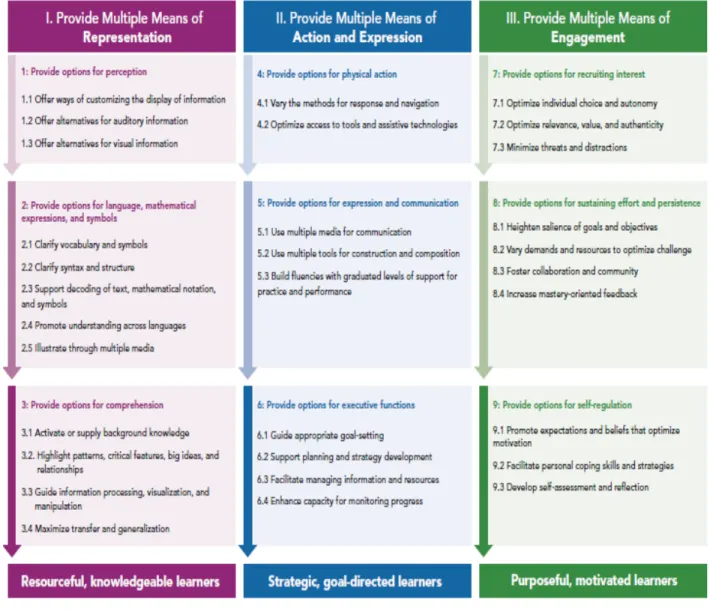
In connection with the brain networks emerge the fundamental principles of Universal
Design for Learning. According to Rose and Mayer (2002), studies made on the UDL show three fundamental principles in the application of this model to education:
• Principle 1: Provide multiple means of representation to give students various ways of acquiring, processing, and integrating information and knowledge.
•Principle 2: Provide multiple means of action and expression to provide students with options for navigating and demonstrating learning.
UDL Guidelines
Figure 1.UDL Guidelines. Source: CAST 2012.http://www.cast.org/research/udl
curriculum and instructions accessible and engaged, curriculum barriers are reduced and learning is supported being an equal and where learning has quality for all.
3.2 YOUNG LEARNERS
Young learners are supposed to be children from the first year of formal schooling (five or six years old) to eleven or twelve years of age. However, the age of children is not crucial for how mature they are.
According to Phillips (1993, p. 38) “there are many factors that influence children’s maturity: for example, their culture, their environment (city or rural), their sex, the expectations of their foreign language for some time, so there are both level one and level two pupils in the eight to ten age groups.
3.2.1 Characteristics of younger and older learners.
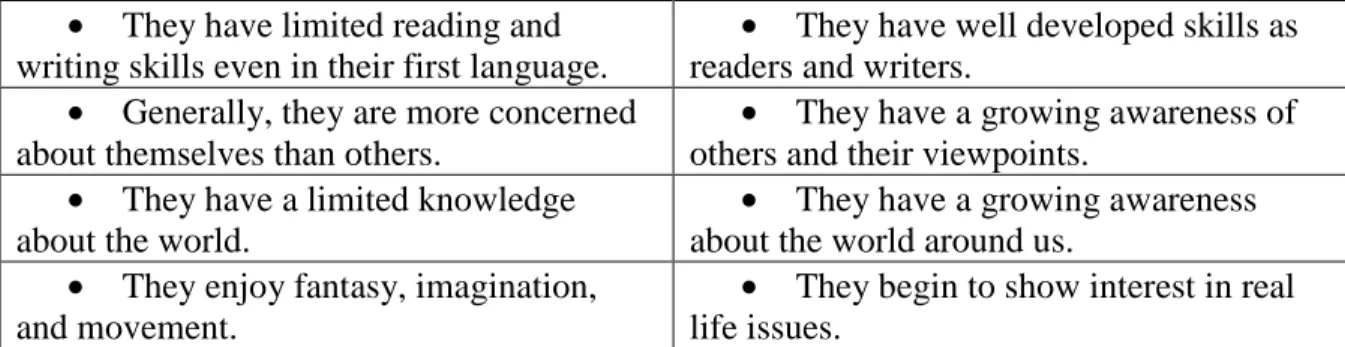
Younger learners (under 7) Older learners (7-12) • Children are at pre-school or in the
first couple of years of schooling.
• These children are well established at school and comfortable with school routines.
• Generally they have a holistic approach to language, which means that they understand meaningful messages but cannot analyse language yet.
• They show a growing interest in analytical approaches, which means that they begin to take an interest in language as an abstract system.
• They have lower levels of awareness about themselves as language learners as well as about process of learning.
• They have limited reading and writing skills even in their first language.
• They have well developed skills as readers and writers.
• Generally, they are more concerned about themselves than others.
• They have a growing awareness of others and their viewpoints.
• They have a limited knowledge about the world.
• They have a growing awareness about the world around us.
• They enjoy fantasy, imagination, and movement.
• They begin to show interest in real life issues.
Figure 1.Teaching Young Language Learners (Pinter, 2006, p. 32)
3.2.2 How children learn
The most important factor in teaching and learning in any setting is the learner. Learners of any age differ from one another in significant ways: Individuals may learn best through listening or reading, they may learn more easily alone or within a small group, they may require heavy visual reinforcement or learn better through verbal explanations, or they may respond better to a sequential or to a random organization of materials.
Each learner’s experiences differ from those of class peers in a variety of ways. Children and young adolescents, however, differ from older learners in certain patterned and predictable ways as they progress through stages of development.
3.3 DEVELOPMENT OF LITERACY IN YOUNG LEARNERS
In most contexts children do not have a strong background in oral English when they start reading or writing. Their oral proficiency is familiar with a wide range of songs, rhymes, and stories in English which carry everyday phrases and words useful for guessing words or for phonic work. The point of similarity is that the children have some understanding about what reading is. With regard to the strategies they bring, how they learn to read in their mother tongue can influence their reading in the second language. They are likely to use strategies that worked in their first language reading, such as spelling, trying to sounds things out, comparing sounds and letters (Pinter 2006, p. 68).
Young learners are in the process of learning to read in their own language and whether or not they master the skill in their own language this will have an effect on the initial stages of teaching reading in English because they will already be familiar with most of the techniques of reading, with word divisions, sentence links, paragraphs, how letters relate to sounds, how the illustrations help them to understand what is going on (Scott and Ytreberg, 1990).
reduced”. Cummins proposes that academic language is related to a “common underlying proficiency”, a set of skills and knowledge that, if learned in one’s L1, can also be used in the development of skills in one’s L2. When children begin school in an L2, it is this academic language that they need to develop, both for engaging in discussion and for the critical analysis of complex ideas and, especially for learning to read and write critically, the means through which they will encounter many of the new concepts they learn in school (Celce-Murcia 20013, p. 156).
According to Scott and Ytreberg (1990) the majority of students between eight and ten years old are able to read a bit in their own language and most seem to have little difficulty in transferring their reading skills to English. This means that teachers can spend much less time teaching the mechanics of reading and concentrate more on content.
L2 literacy is similar to L1 literacy in certain basic ways; thus, English language learners L1 literacy background is helpful for developing L2 literacy. Studies investigating the development of both word-level (word reading and spelling) and text- level (reading comprehension and writing) skills have found that “although some L2 learners may progress at slower rates than native speakers, their growth in literacy generally follows similar developmental paths” (August & Shanahan, 2010, p. 211). Researches generally agree that many of the same skill used to read and writein one’s L1 are also involved in one’s L2. Children who already know how to read and write and their L1 can use it in a variety of ways to learn to read and write English more quickly and easily than children who do not have that knowledge (August & Shanahan, 2006, 2010; Riches & Genesee, 2006).
and how different genres of text use language in specific ways and present information using different system of organization and for different purposes. Children find it easier to write in genres of text they have been exposed to previously, a good argument to introducing them to a variety of reading genres-they can then reflect and build on this when they write (Celce-Murcia, 2013, p. 157).
3.3.1 Reading Processes.
Led by Goodman’swork (1970) the distinction between bottom-up, and top-down processing became a cornerstone of reading methodology for years to come.
1. Bottom-up
Readers must first recognize a multiplicity of linguistic signal (letters, morphemes, syllables, words, phrases, grammatical cues, discourse makers) and use their linguistic data-processing mechanisms to impose some sort of order of these signals. This bottom-up processing operation is analysable as a “mechanical pattern in which the reader creates a piece-by piece mental translation of the information in the text”. In a strict bottom-up view, readers linearly process “each word letter-by- letter, each sentence word-by-word and each text sentence by sentence” (Grabe & Stoller, 2002, p. 32).
A strong proponent of bottom-up account of reading, Gough (1972) claimed that reader recognize symbols (e.g., letters) almost instantaneously, then converting them into phonemic equivalents (p.335).
macro-level processing skills such as grapheme identification in a controlled, deliberate way. With practice, processing skills gradually become automatic, thereby relieving demands on working memory (Anderson, 1995; Nuttall, 1982; Schunk, 2000). The LaBerge and Samuels (1974) models involves perceiving print information which is the sent to various locations in the brain for processing, they held that readers associate the visual representation of spelling patterns, words, phrases, and sentences with phonological memory and then with semantic memory, as in the following schematic:
GRAPHEME PHONEME SEMANTIC REPRESENTATION (MEANING)
2. Top down
A salient feature that distinguishes top-down from bottom-up is that theformer “assume that reading is primarily directed by readers goals and expectations” (Grabe et al.2002, p.32). Readers initiate the reading process with expectation about texts and the information that the texts present. In engaging with texts, readers sample information to determine which expectations were accurate, modifying expectations that do not match text content. In sampling, effective readers direct their eyes to the passages most apt to contain the information they seek, “these expectations might be created by a general monitoring mechanism (i.e., an executive control processor)”Grabe et al (2002, p. 32).
semantic knowledge” (Hudson, 2007, p. 37), Goodman’s top-down model favoured direct interaction between print and meaning, as this schematic shows:
GRAPHEME MEANING.
Goodman nonetheless acknowledged that text decoding could entail three sequential components:
GRAPHEME PHONEME MEANING.
3.3.2 Micro skills for Reading
Alexander and Jetton (2000) described skills as “essential academic habits”(p. 296). For Grabe et al (2002) reading skills “represent linguistic processing abilities that are relatively automatic in their use and their combinations (e.g., word recognition, syntactic processing (p.15). Goodman (1967, 1969, and 1986) and Smith (2004) hold the premise that reading can be broken down into component skills: Top-down perspectives assume that language and literacy are learned as a whole through communication.
Proctor and Dutta (1995) proposed a useful componentialview in which reading skill is “goal directed”, “highly integratedand well organized”, “acquired through practice and training,” and gradually automatized.They also held that “cognitive demands are reduced as skill is acquired” and that reading can be analysed in terms of perceptual, motor, and cognitive operations (p.18).
Hudson (2007, p. 103) identified four reading skill categories: (1) decoding (word attack) skill; (2) comprehension skills; (3) fluency skills; and (4) critical reading skills.
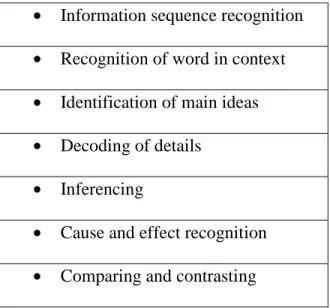
In a synthesis of reading skills research, Rosenshine (1980, p. 47) observed seven sub skills areas which break down the four broad skill categories in more specific functions.
Reading Subskills.
• Information sequence recognition
• Recognition of word in context
• Identification of main ideas
• Decoding of details
• Inferencing
• Cause and effect recognition
• Comparing and contrasting
Figure 1:Teaching Readers of English. Source: Rosenshine (1980, p.47)
Three Level Descriptions of Reading Skills.
LEVEL 1 LEVEL2 LEVEL3
and between text content and what is known
compare, make inferences
Figure 2: Teaching Readers of English. Sources: Hudson (2007), Koda (2004);Lunzer, Waite, and Dolan (1979); Nuttall (2005).
3.3.3 Reading Strategies.
It is important to be clear that a consequence of skills research involves the identification of reading strategies, which many contemporary reading experts believe to be learnable and teachable.
Strategies consists of “actions selected deliberately to achieve particular goals” ( Paris, Wasik, & Turner, 1996,p.611). Strategies are “deliberate, goal/problem-oriented, and reader-initiated/congrolled” (Koda, 2004, p.205) according to Chamont and O’Malley (1994) proposed three strategic categories, commonly referenced in the literature and these are: (1) Cognitive strategies that enable readers to complete cognitive tasks during reading (e.g., inference, word analysis), (2) Metacognitive strategies, in contrast, regulate cognitive processing, as when readers monitor comprehension or correct inaccurate predictions and (3) social and affective strategies permit learners to interact cooperatively with peers and teachers during reading tasks. Socio affective strategies might include seeking the meaning of unfamiliar words from a peer or confirming a prediction with a teacher (pp. 82, 107).
According to Brown (2007) there are ten reading comprehension strategies which can be applied in the classroom in order to improve this skill and these are:
1. Identify the purpose of reading,
4. Skim the text for main ideas,
5. Scan the text for specific information, 6. Use semantic mapping or clustering, 7. Guessing,
8. Analyze vocabulary,
9. Distinguish between literal and implied meanings and
CHAPTER 4: METHODOLOGICAL FRAMEWORK
4.0 INTRODUCTION
This chapter describes the methodology, context, treatments applied in the investigation and procedures of study in order to answer the research questions:
1. How effective is the application of UDL Principle in the development of reading comprehension in Young Learners?
a) Which are the effects after the application of UDL Principle in an experimental and control group in EFL classes of young learners?
b) Does the use of UDL principle helps young learners to achieve the same goal in English class?
4.1 TYPE OF STUDY
This research corresponds to a quasi-experimental method which uses quantitative and qualitative methods. A Quantitative Study since the results gathered at the end were objective and empirical and helped to answer the research question. And a qualitative study since there is a table of observation of each intervention.
According to Cohen and Manion (2007)“the field or quasi-experiment in the natural setting rather than the laboratory, but where variables are isolated, controlled and manipulated” (p. 274). Being, in this case a classroom the setting in which this research is conducted.
Thus, it was decided to use a non-equivalent (pre-test and post-test) where the sample conveyed two groups, this is to say experimental group and control group in order to maintain a reasonable level of objectivity. Both groups were selected keeping in mind their similar characteristics in relation to age, gender, context and level of English.
The research will compare two similar groups (same age, grade and level of English) in where one will be an experimental group and the other will be a control group.
4.2 THE CONTEXT
4.2.1 The Community Context
This study was conducted in a subsidized school called Colegio Santo Tomas, located in Los Angeles, Eighth Region in Chile. According to Censo (2012), the population of Los Angeles is about 187,494 inhabitants. People with a professional degree have been increasing in the last decade, having a significant percentage of the working class. In general terms, the population is classified in a range between high, low-middle and middle class families (Informe completo Censo, 2012).
The education in Los Angeles as the rest of the country is divided into public, private and subsidized schools. There are also universities and institutions which support the development of the city increasing the amount of students in the area.
4.2.2 The School Community.
gives a philosophy of faith and culture. For this educational institution it is essential to promote values such as tolerance, confidence, and respect. Teaching for life is one of the main goals, and also, getting high academic results.
Santo Tomás is a subsidized private school with a monthly parents' financial support of $70.000 where 80% of the payment is done by parents and 20% correspond to students who have got free schooling because of their economic situation.
The school population is formed by 515 female and male students with a level of education that goes from Kindergarten to high school level and with a low percentage of vulnerable students who receive a scholarship. There are 60 students who are part of the Integration Program which start with students from second grade primary school to first secondary education and where most of the cases are students with Attention Deficit Hyperactive Disorder (ADHD).
The community of Santo Tomas is composed by a principal, five inspectors, one technical teacher, a psychologist, a secretary, five assistants, and thirty six teachers. For those students who present special educational needs, there is an integration department which is composed by three specialist teachers and one educational psychologist who work in the class trying to incorporate them as the rest of the students.
As a catholic school, there is a department which prepares monthly activities out of the school. These activities let students; teachers and parents know more about catholic religion and internalize different values. There is also a parents department, which support extracurricular activities being an active group of people within the community.
different activities, supporting projects such as the anniversary of the school and promoting a familiar environment.
Santo Tomas also has different extracurricular classes which help students in other areas such as: athletic, football, volleyball, rugby, gymnastic, ballet and play acting. All these factors support a good and correct educational environment. Each member of the school sees Santo Tomas as a family and warm place where all are important and respected.
4.3 IMPORTANCE OF ENGLISH
English is very important in Santo Tomas having a special English school program which is supported by MacMillan editorial. The MacMillan editorial and special supporters elaborated a project in 2009 to start English learning from kindergarten to fourth secondary education, extending the amount of hours for this subject from the Minister of Education which consists in two hours a week for fifth and sixth grade, three hours a week for seventh and eighth grade and four hours a week for high school students.
After analyzing the reality and needs that the country and Santo Tomas community have based on increasing the level of English and become a bilingual country Santo Tomas decided to extend the amount of hours of English classes and Macmillan editorial designed a special program which consists in having classes of English from kindergarten to eight grade with a total of five hours per week and four hours per week for high school students.
Another important aspect that Santo Tomas considered for its achievements was the use of material and technology (Books, Cd room, computer lab classes). The text books used in English classes are:
7th grade : American Inspiration for teens 3 8th grade : American Inspiration for teens 4 High school
1st : American Inspiration for teens 5 2nd : American Inspiration for teens 6
3rd and 4th : American Inspiration for teens 4.
Every book is divided in two parts: students’ book and workbook. The students’ book has a CD that students can use at home and reinforce dialogues and songs. On the other hand the workbook reinforces grammar, vocabulary and reading comprehension. The teacher’s material for these books has quizzes, extra activities and a CD which allows teachers to work with dialogues and listening comprehensions activities.
The format of Next Move books is based on different countries and through this topic vocabulary, grammar and phonics are taught. The students’ CD is interactive and they have to use a computer at home in order to exercise elements seen in classes. This Cd allows parents and students work as a family and incorporate them into English classes, increasing the participation and interest of the language but also increase knowledge about new cultures.
After that, students have to complete activities and take tests which are supervised by the English teacher but also by an international teacher from United States that works for EF program. Students can also chat with international students from United States and help each other in their process of learning English and Spanish because Santo Tomas students can help American students to learn Spanish.
For students this type of platform is very motivating because they feel that the effort and commitment that they do will help them to reach higher levels of English and use it in the future apart from getting an international certification which can be used in the university and show their level of English letting them omit English as a subject.
Extra material for high school students KET book
PET book EF CD room
As a result MacMillan editorial and their supervisors organize lesson plans for every class in every level elaborating also tests, exams and quizzes. They organize meeting where teachers from every Santo Tomas have to attend. In those meetings native speakers and MacMillan’s members explain activities, in order to develop the four skills. They explain how to work with different learning styles using several tools. For Santo Tomas School it is very important to achieve high levels of English in national and international tests such SIMCE of English, KET and PET. Teachers must have the proficiency in the four skills and manage methodology and take tests which can show their levels such as TKT and First Certificate.
weekly lessons, to share learning experiences, to evaluate and plan improvement projects for those classes in which students do not have a good performance in language learning. During these meetings teachers also have to plan monthly classes and organize activities which increase interest and participation and are promoted by the Minister of Education “English open door” such as Spelling Bee, Public Speaking and Debates but teachers also plan activities inside the school such as English Festivals and Talent Shows which have actively participation.
Admission procedure includes an English language placement writing test which shows their level of English. Students who have a low level of English are assisted by the teacher and advanced students who help them during classes. The idea of using monitors in classes is to achieve in those students with low level a high and better understanding of the language. For this reason, students work in pairs or groups developing cooperative learning.
In the case of students with special needs who are new, the educational psychologist gives them a test where their learning styles, cognitive process and skills are evaluated and then they are located into the special program called PIE (Programa de Integración Educativa) where the integration department composed by three specialist teachers support them during two years but English is a problem for these teachers because they do not have the knowledge and skills of the language and sometimes it is the English teacher who has to adapt English tests or quizzes.
4.4 THE PARTICIPANTS
The participants of this exploratory research are in third grade A Year 3 ( 8 years old) in a subsidized school in Los Angeles city. The class has thirty two students divided into two similar groups: 16 students in the experimental group and 16 students for the control group. The experimental group used UDL principle in every lesson, and the control group used traditional instruction, working only with their books of English.
The teacher-researcher has been their English teacher for two years (year 5 and 6). Due to this fact, she has evidenced that these learners, in particular, show interest and willingness to learn English.
In addition to this fact, teaching and learning English have been an important process during these years but the achievement of goals for all students have had significant differences among students.
For that reason plan and organize classes for diverse students is essential and starting from the beginning is the key where UDL is the tool that gives support to teachers in optimizing teaching and learning for all people based on three principles of how humans learn (multiple means of representation, multiple means of expression and multiple means of engagement) which are the base of these framework (CAST, 2012)
4.5 THE INSTRUMENTS
As a quantitative study a pretest and posttest were used by the teacher researcher in order to gather data and analyze results and to give answer to the following general question of the study: (1) how effective is the application of UDL Principle in the development of Reading Comprehension for Young Learners? And the specific questions: (1) which are the effects after the application of UDL principle in an experimental and control group in EFL classes of young learners? (2) Does the use of UDL principle helps young learners to achieve the same goal in Reading comprehension?
Six workshops were used with the experimental group where each workshop had three items with different kinds of texts and activities based under the principles of UDL.
Finally, a teacher direct classroom observation (TDCO) was applied in order to describe the workshops and its activities.
4.5.1 The Pretest and Posttest.
The pretest and posttest consists of four different texts which have six goals: to identify (1) the main idea and (2) details on different texts. (3) To infer the meaning of words in context. (4) To order sentences according to the sequence of a text. (5) To compare and contrast information with their own context. (6) To infer information that is not explicit in a text.
Each text has been selected according to their level of English (A1) and grade. The texts are familiar for students in their vocabulary and in structure (see appendix C).
3. Reading for gist, 4. Reading for details 5. Inference
6. Comparing and contrasting
The maximum of time for each test (pretest and posttest) is 60 minutes.
4.5.2 Workshops.
The six workshops consist in three items with different activities based on the six micro skills of reading.
The elaboration of the workshops has been according to the student’s age and under the UDL principle.
In each workshop students have to work individually and then in pairs, sharing their opinions after reading a text.
Finally, the time for each workshop is 60 minutes.
4.5.3 Teacher classroom direct observation (TDCO).
4.6 VALIDATION
The validity of the pretest and posttest was made previously to the intervention by piloting the pre and post test in the same institution a year before with students that were in year 3 ( 8 years old) with the same characteristics. Then the tests were validated by an acknowledged professor of a prestigious university in Santiago, during the month of April 2015.
4.7 PROCEDURE
4.7.1 The Sample Procedure.
The intervention was made in the month of June which corresponds to the first semester of the school year 2015. The sample procedure attempts to explore the effectiveness of UDL Principles as an effective tool for the development of reading comprehension in young learners.
The intervention was made in year 3 primary class of a subsidized school in Chile. The class has 32 students and they were randomly divided into two groups: an experimental (n=16) group and a control group (n=16). The experimental group worked using several resources such as computers, worksheets, maps, individual and group work. On the other hand the control group worked using the school book (next move) as usual and with other teacher of English.
4.7.2 The Intervention Procedure.
The procedure of the intervention was divided into eight lessons of 60 minutes. The following chart briefly shows the intervention:
Time Skills Activities
Lesson 1 (60’)
Reading and writing Presentation of the method
Sequence recognition A workshop is presented describing skill 4.
4.7.3 Lesson Plan.
For the purpose of this intervention, the teacher- researcher did not consider the regular book used by the students. New material was presented (workshops) in order to clarify specific content and work with the six micro skills of reading, this include: reading for gist, reading for specific information, recognition of words in context, sequence recognition, inference and comparing and contrasting. Each workshop included all the activities and tasks for each micro skill of reading, and at the same time, participants of this study could be more committed and engaged in the intervention process. All these lessons planning were based under the UDL principles and supported by succeeding in the inclusive classroom k-12 lesson plans using universal design for learning book by Debbie Metcalf, 2011.
4.7.4 Lesson Description Lesson 1.
In the first intervention the teacher-researcher introduces the new method that will be used during six classes, working with reading comprehension micro skills workshops: (1) Information sequence recognition, (2) Recognizing words in context, (3)Reading for gist, (4) Reading for details, (5) Inference and (6) Comparing and contrasting.
Both groups have the same time (60 minutes) to complete the test and both groups receive the same instructions.
The challenge of the three activities is paying attention, Focusing on what is important, Self-confidence and comprehension.
Lesson 2.
The first lesson is presented to the experimental group describing skill 1(Reading for gist or skimming). The teacher activates prior knowledge asking different questions. The teacher shows the new workshop using a power point and pause it for time to time, having students to
summarize what they have just learned. The teacher gives students workshop 1 and then they read activity one “coffee in Colombia”. They answer the questions and work with activity two where they read about the production of coffee.
They answer questions individually and then they share the answer with the rest of the class. Students work in activity three. They look at the illustration to give more information about the topic and try to find out the text main idea of the text.
They read the first and last sentences of each paragraph and answer questions.
Finally, they share their answers and opinion about the three activities with their peers. The challenge of the three activities is language, comprehension, independent work, peer work and transfer information. Multiple means of representation, engagement and expression are worked in the entire lesson.
Lesson 3.