Market Brief for Dried Physalis.
Title Market Brief for Dried Physalis – An introduction to the European market for Peruvian exporters.
Language English
Report Content Within the scope of the project Perubiodiverso, an initiative supported by the State Secretariat for Economic Affairs (SECO) and Deutsche Gesellschaft für Internationale Zusammenarbeit (GIZ) GmbH (german cooperation), in con-vention with the Ministry of Foreign Trade and Tourism (MINCETUR), the Peru Export and Tourism Promotion Board (Promperu) and the Ministry of the Environment (MINAM), SIPPO is mandated to support Peruvian companies in accessing the European market.
In this context, for the following three products Market Briefs were produced with the aim to introduce the European market to Peruvian biotrade companies:
Tara gum
Sacha Inchi
Dehydrated organic and fair trade certified Physalis
Authors ProFound – Advisers In Development Lange Smeestraat 55
3511 PV Utrecht The Netherlands
www.ThisIsProFound.com
Cover picture by www.villaandina.com
1.
Product description ...4
1.1 HS code and tariffs ... 4
2.
European market environment ...6
2.1 Market trends and segments ... 6
2.1.1 Main market segments ... 6
2.1.2 Main trends ... 6
3.
Price ...8
3.1 Price factors and costing ... 8
3.2 Price structure ... 8
3.2.1 Price margins ... 8
3.2.2 Organic and Fairtrade ... 8
4.
Competitor analysis ...10
4.1 Existing competitors ... 10
4.2 New entrants ... 10
4.3 Substitutes ... 10
4.3.1 Substituting products ... 10
4.3.2 Substituting technologies ... 11
5.
Commercialisation channels in Europe ..12
5.1 Trade channels for dried physalis... 12
6.
Marketing and buyer requirements ...13
6.1 Product requirements ... 13
6.1.1 Quality... 13
6.1.2 Labelling and handling ... 13
6.1.3 Legislative requirements ... 13
6.1.4 Relevant standards and certifications requested by the private sector ... 15
7.
Promotion ...16
7.1 Recommendations for product promotion ... 16
7.1.1 Practical tips ... 16
7.1.2 Trade fairs ... 16
7.1.3 Sector associations and other sources ... 16
7.2 Buyer list ... 16
Physalis peruviana1, known as aguay-manto (in Peru), uchuva (in Colombia), Inca berry, Cape gooseberry (Codex Ali-mentarius Standard 226-2001), golden berry or lampion fruit, grows as perennial herb in hot, dry areas near the Amazon and Andes mountains. Aguaymanto is native to the high altitude tropics from Venezuela to Chile where the fruit grows in the wild throughout the 11 ecological
re-gions populated by a very rich range of medicinal and fruit plants. The area planted to aguaymanto has expanded significantly as a result of efforts to tap the great opportunities for Peru resulting from growing increasing interest in this fruit in recent years.
T he plant grows to a maximum of 1 m (though commercial plants are pushed up to 3 m). Its yellowish orange berries are individually protected by an inedible paper-like husk. This exotic fruit, with a bittersweet taste, belongs to the Solanaceae family and is addi-tionally grown in Ecuador, Colombia, India, Australia, Kenya, some Caribbean islands and Zimbabwe. Currently, the main producers are Colombia and the Caribbean.
Originally introduced by the Portuguese in South Africa, where it has a long history being cultivated as Cape gooseberry, this An-dean berry’s wide range of by-products are traded internationally along separate channels, including for seeds, flowers, fresh and dried fruits, vegetable oil and extracts. Their commerce spans further to Asia, Australia, USA, Caribbean and Central America and it can even be cultivated on a non-commerical scale in the South of France, and in glasshouses in UK. Physalis can be found in European markets all year around with Colombia as the main exporting country. Please refer to CBI and SIPPO’s ‘Dried physalis in Switzerland’ for additional information on the Swiss market for dried physalis.
1
Aguaymanto needs to be differentiated from other edible
spe-cies: Physalis c.f. pubescens and Physalis ixocarpa. It must not be mistaken either for the non-edible species: Physalis alkekengi(garden and ornamental plant in Europe), or Physalis pruinosa
from North America.
1.1 HS code and tariffs
Dried physalis is not classified under a specific Harmonised Sys-tem (HS) code, thus belonging to the group of “other dried fuit” (HS code 08134095 in the EU and partida arancelaria 08134090 in Peru. Nonetheless, Peruvian exports of physalis in its fresh form and main forms of processing are recorded and kept up-to-date by the Superintendencia Nacional de Aduanas y de Administración Tributaria (SUNAT), and elaborated by PROMPERU. Dried physa-lis accounted for 21% of total exports of physaphysa-lis in all forms in 2011. Exports for dried physalis and the developments in recent years is shown in Table 1.
Table 1: Peruvian exports of dried physalis, in tonnes
2007 2009 2011 Change 2007-2011
1,356 2,437 12,441 74%
Source: SUNAT, elaborated by PROMPERU
HS codes covering drired physalis vary among different EFTA countries. In Switzerland, dried physalis belongs to HS code 08134099. In Norway, 08134002 covers “other dried fruit”. In Ice-land, dried physalis can be classified under HS code 08134009.
Table 2 shows the tariffs applied to dried physalis in the EU and in the EFTA (with a break down per country).
Table 2: Tariffs applicable to dried physalis in the EU and EFTA
Conventional GSP FTA
EU 2.4% 0% n.a.
EFTA n/a n/a 0%
Switzerland 10.00 Fr. per
Source: http://exporthelp.europa.eu, http://xtares.admin.ch,
http://www.toll.no, http://www.tollur.is
In the EU, Peru is part of the GSP+ (Generalised System of Pref-erences), a special incentive arrangement for sustainable devel-opment and good governance, which offers additional tariff reduc-tions to support vulnerable developing countries. The customs tariff applicable to GSP+ countries exporting dried physalis is 0%.
2.1 Market trends and segments
2.1.1 Main market segments
Currently, the main segment for dried physalis lies in the healthy snack market. In this segment, dried physalis is consumed as a natural product, without the addition of sugar or preservatives, which makes taste and texture very important elements.
Although very small, the breakfast cereal industry is a promising segment for dried physalis. Industry sources indicate that manu-facturers are increasingly using exotic fruits to diversify their prod-ucts from the mass market and competitors, thus offering opportu-nities to products which are not common in the European market.
The confectionery industry is also a promising segment in the European market for dried physalis. There are currently a few companies which offer chocolate-coated dried physalis, but poten-tial for growth is high. Similarly, the bakery industry provides op-portunities, but remains a very small segment.
Table 3: Main market segments for dried physalis in Europe
2.1.2 Main trends
Health trend: European consumers are particularly aware of the benefits of healthy natural products, representing an important market for super fruits such as physalis. Dried physalis are docu-mented to contain one of the highest fibre contents among all dried fruit (19%), and are rich in anti-oxidants (vitamin C). This health trend is expected to continue in the coming years.
Taste: Although Europe represents a fairly open market for exotic fruit, industry sources indicate that it still experiences reluctance from buyers and consumers to purchase dried physalis due to its sharp taste profile. Some dried fruits are infused with a sweet flavour in order to make the taste profile more acceptable to the mainstream consumer. However, due to consumer interest in physalis as a natural and healthy product, the addition of sugar is not advisable. The alternative
found by some European companies is offering choco-late-coated dried physalis to their consumers (Source:
interviews with importers and consultants, 2011).
Promising markets: Although demand for exotic products in Europe remains generally small, higher interest and opportunities for dried physalis is observed in Northwest European markets. Countries such as Germany, the Netherlands and the UK , as well as Scandinavia and Switzerland, have a long tradition of consum-ing dried fruit and have populations which are generally health-orienred and socially-responsible. These are also markets which are most experimental in terms of new tastes and products. East European countries such as Poland represent growing markets where competition is smaller than in Western Europe, but are only interesting for bulk products (Source: interviews with importers and consultants, 2011).
Organic: The growing demand for organic productsin Europe is directly reflected onto the market for exotic products such as dried physalis. Note that the organic sector is not significant in all mar-kets in Europe, but are mostly concentrated in Northwest Euro-pean countries such as in the UK, Germany and Scandinavia.
The Swiss market is one of the most interesting markets in Europe for organic products, which account for around 5% of the total food market. Although it is not a widely spread product in Switzerland, most companies dealing with dried physalis in the country require organic certification (most used is Bio Suisse). The assortment of composite organic food products is also expanding (Source: FiBL, 2012).
Fairtrade: The market for Fairtrade certified products in Switzer-land is one of the most significant in Europe, and expected to grow further in the coming years. Other important fair-trade markets in Europe, which can also be interesting for exporters of dried physa-lis are the UK and France.
2. European market environment
Segment Applications and properties
Dried physalis: end product (snack)
Also as part of tropical/exotic dried fruit mix
Taste is extra important, colour, tex-ture
Certification
Healthy, natural Breakfast cereal
in-dustry
Ingredient in breakfast cereal mix with dried fruit
Natural, healthy
Confectionery industry Ingredient in a (chocolate) fruit/nut bar
Chocolate-coated dried physalis
Improved taste, healthy
Bakery industry Ingredient in fruit cakes, pies, cookies, bread
Since May 2011, the FLO (Fairtrade Labelling Organisation) has developed standards for fresh physalis specifically for drying, which reflects the growing popularity of this product. In order for dried physalis to carry the Fairtrade mark, it must be made com-pletely of this certified fresh physalis. For a food composite product it holds that at least 20% of the content must be Fairtrade certified in order to carry the logo, and all ingredients for which Fairtrade certification exists must be certified (Source: Fairtrade Interna-tional, 2012).
FLO FairTrade is better known in countries such as the UK and Switzerland, while other fair trade schemes such as Ecocert are popular in other European countries such as France (more details on different fair trade certifiers can be found in section 6).
Dual certification: consumer interest in products that are both organic and Fairtrade certified is expected to grow further in Europe in the coming years, specifically in markets where organic and/or Fairtrade are already popular among consumers; Switzer-land is certainly one of the most interesting markets in this respect.
By choosing one certification body which can offer “dual certifica-tion” of Fair Trade and Organic, costs may be reduced whilst entry points to dual certification markets are more easily achieved.
Conclusions:
The main segment for physalis lies in the healthy snack market.
The breakfast cereal, confectionery and bakery industries are promising segments, but still represent a very small part of the market.
The health trend in (Northwestern) Europe drives up the interest for dried physalis, but its taste profile still presents limitations.
The organic and fair trade markets are especially significant in Northwestern Europe, where buyers are increasingly demand-ing certified products. This is especially true for exotic products such as dried physalis.
3.1
Price factors and costing
The price of dried fruits, including physalis, is closely linked to the price of their raw material. Changes in supply due to changeable harvests, weather conditions and natural disasters have a signifi-cant influence on the price of the final product.
Table 4: Referential prices for fresh physalis, in US$/KG
2010 2011 and suitability for drying are among the most important elements. These elements will also determine the quality of the dried prod-uct, consequently having an influence on its price.
Other factors such as certification (organic, Fair Trade), discussed in section 3.2.2, and exchange rate fluctuations are also important in determining the price of the product.
Taking the raw material (fresh fruit) as a basis, it can be roughly estimated that the fruit-drying process adds between 10% and 15% to the costs.
Make sure to take additional costs (commercial and non-commercial) into account, such as customs, loading/unloading, marketing, samples for chemical analysis and internal transport.
In the period 2005-2011, the average FOB price for dried physalis amounted to approximately $ 3.8 /kg. Webshop prices in Europe average around € 29 /kg. However, prices at conventional retailers are generally lower.
3.2
Price structure
3.2.1 Price margins
The price of the dried physalis as a final product is determined by the different costs made by the companies involved in production, trade, processing and sales of the product (see section 5), and their profit margins. The following estimates can be made for the dried fruit sector in Europe:
Agents typically receive a commission of a few percent. However, their actual profit margin strongly depends on volumes sold and gross margin.
Importers add up to 25-30% to the value of the product depending on the activities undertaken, such as re-hydration, cutting and re-packing. Additionally, they will expect to gain a profit margin of 5%.
Packers usually add € 0.05-0.30 to the costs per item
and then add a 5% profit margin.
The profit margins added by the food industry will strongly depend on the nature of the final product/ level of processing required.
Distributors add up to 25-30% to the value of the prod-uct depending on the activities undertaken. Additionally, they will expect to gain a profit margin of 5%.
Retailers typically add a gross margin of 30-50%.
3.2.2 Organic and Fairtrade
In general, an exporter of organic-certified dried physalis can expect a proft margin of roughly 10% compared tothe conventional product.
The price premium for Fairtrade-certified (FLO) physalis for drying, conventional or organic (worldwide, Easy Entrance2), is set at 0.10 USD/kg (FLO, 2012).
2
A new system of “Easy Entrance” should ensure quicker entry
into the Fairtrade system for many small producer organisations seeking to sell dried fruit. Easy Entrance only fixes the FT pre-mium, not the farmgate price.Conclusions:
The price and costing oft he final product (dried physalis) de-pends on the various aspects influencing the raw material pro-duction.
It is important to keep an eye on the quality oft he fresh physa-lis, which also influences the quality and, consequently, the price oft he dried product.
The organic premium is roughly estimated at 10%.
4.1
Existing competitors
When exporting dried physalis to Europe, the main competitors to Peruvian companies can be found in Colombia, which accounts for an estimated 90% of global (fresh) physalis production. In addition to being the largest exporter of physalis worldwide, Colombia’s physalis has very similar properties to the Peruvian product in terms of colour, texture and general quality. The colour of Colom-bian physalis is slightly more orange than Peruvian physalis.
Colombia is also a direct competitor to Peru when it comes to market incentives. In addition to being part of the EU’s GSP+ scheme, the country has also signed a Free Trade Agreement (FTA) with the EFTA countries, which exempts Colombian export-ers from paying tariffs when exporting their dried physalis to these countries.
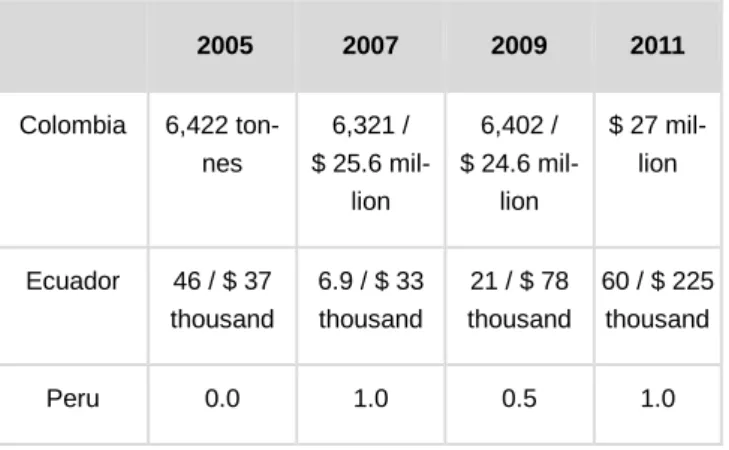
The dominant role of Colombia as an exporter of fresh physalis, showed in Table 5, is reflected onto its role as an exporter of dried physalis as well.
Table 5: Exports of fresh physalis, in tonnes / $
2005 2007 2009 2011
Source: Villa Andina, 2011; SIICEX, 2012; DANE 2012
In spite of representing strong competition, Colombia faces difficul-ties in guaranteeing a consistent supply of organic and Fair Trade-certified physalis to the market, since a very small percentage of Colombian production is certified according to these schemes. In this manner, Peru has become more attractive to buyers active in these premium markets.
Another large producer and exporter of physalis is Ecuador, whose product also presents similar properties as Peru’s. Although
bene-fitting from the EU”s GSP+ scheme, Ecuador does not have an FTA with the EFTA countries.
Smaller producers of physalis such as Bolivia and Mexico, as well as in South Africa, Kenya, and Zimbabwe, do not represent strong competition to Peruvian exporters at this stage.
Although some companies in Spain and Portugal have started with testing physalis production, production in Europe is still insignifi-cant, and is not expected to take off in the near future.
4.2
New entrants
Effective success for new entrants in Europe’s dried physalis mar-ket is fairly difficult at this stage. In the current marmar-ket environment, marked by small demand for dried physalis, even established players face hurdles in marketing their product.
Dried physalis currently caters for a very specialised market, whereby organic and fair trade-certified products are much more important than in the mainstream market. It is very important for a new entrant to adhere to these schemes if they want to remain competitive, especially if they are targeting markets such as Swit-zerland.. Fairtrade certification can also help new entrants to over-come market entry barriers related to export financing, because Fairtrade importers must pre-finance 50% of the order.
In addition to the importance of certification schemes, new en-trants should be able to meet the highest quality requirements described in section 6 consistently.
4.3
Substitutes
4.3.1 Substituting products
Dried physalis is a new product in the European market, which actually acts as a high-end substitute for more common dried fruits such as raisins and apricots.
made pleasant to taste; e.g. açaí, cranberry, goji berry (or wolf berry), blueberry, noni and pomegranate.
4.3.2 Substituting technologies
In terms of processing level and technological advances, the in-creasing industry interest in freeze-dried fruit can form a threat to Peruvian exporters of (conventionally) dried physalis. Freeze-dried physalis could be especially suitable for use in cereal prod-ucts (e.g. cereal bars) or as healthy chips (such as German com-pany Frutero), but it is still an expensive technology to most small and medium-sized companies. Nonetheless, the value added of freeze-dried fruits can exceed 100% in relation to the fresh raw material.
Conclusions:
Peru’s main competitor in the international market is Colombia.
Colombia still faces difficulties in guaranteeing a stable supply of organic and fair trade-certified physalis, which can provide benefits to Peruvian exporters who already comply with such standards.
Dried physalis caters for a niche market, where new entrants need to be especially attentive in meeting quality and certifica-tion requirements.
The sharp taste profile of dried physalis represents a significant threat to this product in terms of substitution.
5.1
Trade channels for dried
physalis
Dried physalis is usually transported to the European market in bulk (by ship), after which it goes through other steps such as packaging or further processing carried out by European industry players. Major importers of dried physalis include Berrico Food, Delinuts, King Nuts & Raaphorst in the Netherlands and Zieler & Co in Germany.
Figure 1: Main market segments for dried physalis in Europe
The most suitable trade channel, particularly for a product such as dried physalis, which is considered exotic in the European market, consists of a specialised importer. Importers have extensive knowledge of the market, strong relationships with buyers in the EU, and are interested in long-term relationships with their suppli-ers. Direct trade between exporters and retailers is not frequent in the dried fruit sector.
It is common for dried physalis to be imported to a centrally lo-cated EU country, such as The Netherlands (port of Rotterdam) or Germany (port of Hamburg), and from there re-exported and dis-tributed to other European countries by vessel, inland barge or truck to storage facilities and customers all over Europe. Regard-ing Switzerland, large scale consignments (e.g. full container
loads) are not tariffed by the EU, but delivered in transit to Switzer-land.
Turkey also acts as a trad-ing hub for dried physalis to the EU market. Whereas the country is a major sup-plier of dried fruits such as sultanas and apricots to the EU, Turkish traders are
increasinly interested in providing one-stop-shop solutions, thus importing other types of dried fruit to complete their local assort-ment and to mix these different types, for instance.
Dried fruit often has to be re-packed for both retailers (consumer packaging) and industrial users. Importers re-pack the dried phy-salis in their own facilities (integrated importer/packer role) or supply the dried fruit to specialised packers.
After having passed through importers, another possible channel for dried physalis is the food industry, whereby dried physalis can be processed further and integrated into products such as choco-lates, cereal bars and bakery products.
After having been re-packed or processed, the final product is distributed to consumers either through retail channels or the food service industry.
5. Commercialisation channels in Europe
Conclusions:
Dried physalis is normally transported to Europe in bulk (by ship), where it goes through further processing/packaging.
The most suitable trade channel for exporters of dried physalis consists of specialised importers/packers.
The most common ports of entry for dried physalis are located in trade hubs such Germany and The Netherlands.
Dried physalis (or final products containing physalis) reach the consumer through retail or food service channels.
Producer/exporter
Importer/agent Packer
Distributor
Food industry
6.1
Product requirements
6.1.1 Quality
Colour: A high quality dried physalis must have an attractive or-ange colour; a darkened product is considered to have a lower quality. However, the more natural the drying process is, the darker the fruit colour. This needs to be better communicated to the buyer, because you could use sulphur
dioxide to achieve a lighter or-ange colour, but that would make your product less natural.
Texture: Ideally, the dried
phy-salis must have a texture similar to that of raisins as would be expected by European consumers. Moisture content should give adequate shelf life whilst also achieving a pleasant mouth feel.
Raw material: In order to reach a high quality dried product, the raw material’s quality is essential. The fresh physalis fruit should be sufficiently large and of a sufficiently sweet taste to meet the buyers’ and consumers’ requirements. Furthermore, the origin of the fresh fruit must be clearly described.
The Codex Alimentarius has set minimum quality requirements concerning fresh physalis:
http://www.codexalimentarius.net/download/standards/368/CXS_2 26e.pdf
6.1.2 Labelling and handling
Product information and documentation: European buyers have specific requirements regarding labelling and documentation of dried fruit. Product specifications for dried physalis should in-clude the following:
a) product description: appearance, aroma, texture and flavour. You can also include a typical photograph of the product. b) packaging size: bag, box and palletisation.
c) recommended storage
d) verifiable intolerance data: information on whether the prod-uct is free from substances such as nuts, peanuts, fish, celery, egg/egg products, lupin.
g) results of metal detection tests
h)results of the quality tests: TVC, Coliform, E. Coli, S.Aureus, yeasts, moulds, salmonella, listeria spp, listeria emnueration.
Shelf life and storage: The average shelf life of the dried physalis is 1 year. The product does not require refrigeration. It should be stored in a dry environment and not be exposed to direct sunlight.
Packaging: Dried physalis supplied in bulk should be packed inside high-density polythene bags inside corrugated cardboard cartons, free from staples (15 kg per carton would be a good size). The carton has to present the lot
number, production and expiry date, as well as the weight in kg. Care is needed to ensure that there is minimum clumping of the fruit during storage.
6.1.3 Legislative requirements
Legislative requirements are the minimum requirements which must be met by dried physalis exporters marketed in the EU and EFTA countries. Products which fail to meet these requirements are not allowed on the EU and EFTA market.
The EFTA States, with the exception of Switzerland, take part in the European Economic Area (EEA). This means that Liechten-stein, Norway and Iceland follow EU food legislation in general.
The main differences between EEA and Swiss legislation applica-ble to dried physalis is shown in Taapplica-ble 3.
Table 6: Legislative requirements applicable to dried physalis
Requirement Description Further information
Legislati on applic ation to E EA countries
Hygiene of foodstuffs tives for use in food-stuffs intended for
Contaminants in food Within the EEA food safety policy, a maxi-mum levels has been set for certain con-pesticides in food
EEA legislation has
Requirement Description Further information
Legislati on applic ation to S witzerland
Ordinance on food hygiene
Establishes the gen-eral hygiene require-ments related to food products regarding: labelling, for fruit and vegetables at various levels of processing.
6.1.4 Relevant standards and certifications requested by the private sector
In addition to minimum legislative requirements applicable to Pe-ruvian exporters of dried physalis , there are additional private sector standards which are relevant in the European market:
Large retailers in Europe often require certification of production processes according to GLOBALG.A.P. (http://www.globalgap.org) standards on food safety, environmental impacts, and worker health and safety.
Depending on your buyer, certain standards recognised by the Global Food Safety Initiative (GFSI) applicable to processed food (e.g. dried fruit) are important:
British Retail Consortium‘s (BRC) Global Standard for Food Safety - http://www.brc.org.uk
Safe Quality Food (SQF) 2000 Code -http://www.sqfi.com
International Featured Standards (IFS) Food - http://www.ifs-certification.com
For more information on GFSI and its recognised standards, please visit: http://www.mygfsi.com. Furthermore, ISO 22000 (http://www.iso.org) is an internationally recognised standard, which that harmonises various existing national and industry certi-fication schemes.
Organic
The EEA has specific requirements on the production and labelling requirements with which an organic product of agricultural origin must comply in order to be marketed as organic. These are laid down in the following provisions:
Organic production and labelling of organic products: EC 834/2007and EC 889/ 2008.
imports of organic products from third countries: EC 1235/2008.
The Swiss industry recognises and accepts EEA standards regard-ing organic products, also havregard-ing its own regulatory framework under the Ordinance on organic food products (RS 910. 18). N onet hel ess, opti mal m arketing of or ganic products in Swit zerl and might approval by Biosuisse
Fair Trade
Fair Trade standards are set and recognised internationally. The Global Network of Alternative Trade Organization (IFAT) (http://www.wfto.com) is a global network of 154 fair trade organi-zations in 49 countries around the world. The European Fair Trade Association (EFTA) (http://www.eftafairtrade.org) consists of 11 member organizations in 9 European countries.
FLO International (http://www.fairtrade.net) is the leading standard-setting and certification organisation for labeled Fairtrade and part of a worldwide network of Fair Trade organizations. Products that carry the Fairtrade label guarantee the consumer that producers have a Fairtrade Minimum Price. A minimum price is currently set for “fresh physalis for drying” (see section 3).
Within Europe, FLO is active in Austria, Belgium, Denmark, Esto-nia, Finland, France, Germany, Ireland, Italy, Luxemburg, Nether-lands, Norway, Spain, Sweden, Switzerland and the UK.
Depending on your target market, other ethical marks may be as well or better recognised and therefore should be considered, such as:
Fair for Life (IMO) - http://www.fairforlife.net
Ecocert - http://www.ecocert.com
Conclusions:
Critical requirements:
HACCP
Technical Data Sheet (TDS)
Traceability
Increasing your competitive edge:
GLOBALG.A.P.
Ensuring consistent quality
Product documentation and information
Recognised quality management system
Organic certification
7.1
Recommendations for product
promotion
7.1.1 Practical tips
Ensure the naturalness of your product; do not use artifi-cial additives to ‘improve’ the dried physalis.
Make sure that the origin of the product is clearly com-municated.
Promote the benefits of your product and make sure that your promotion strategy matches current market trends: super fruit, healthy, high fibre content, anti-oxidants (vit-amin C),organic, fair trade.
Do not make over-claims which cannot be substantiated, e.g. do not assume that properties of fresh physalis au-tomatically translate to those of the dried fruit.
Have your product documentation ready and up-to-date (see section 6 for relevant documentation).
7.1.2 Trade fairs
The main trade fairs in Europe which are relevant for the promo-tion of dried physalis are:
BioFach (http://www.biofach.de) the largest organic trade fair worldwide; highly relevant to meet the main in-dustry players and promote your product in the organic and fair trade markets.
Food Ingredients Europe (FI)
(http://fieurope.ingredientsnetwork.com) leading trade fair in the food ingredient sector; interesting to meet po-tential clients in the food industry.
Anuga (http://www.anuga.com) and Sial
(http://www.sialparis.fr) interesting trade fairs, but more relevant to end products. Could be interesting for export-ers who wish to observe industry trends and make new contacts.
7.1.3 Sector associations and other sources
FRUCOM (http://www.frucom.org) the umbrella organi-sation of the European Institutions of the European Fed-eration of the trade in dried fruit, edible nuts, honey, spices, canned fruits and vegetables and similar food-stuffs.
International nut and dried fruit foundation (http://www.nutfruit.org) .
CAOBISCO (http://caobisco.com) the association of chocolate, biscuit and confectionery industries of the Eu-ropean Union.
FoodAndDrinkEurope
(http://www.foodanddrinkeurope.com) presents the latest trends in the European food market.
7.2
Buyer list
Abbreviation
Explanation
BRC British Retail Consortium
EEA European Economic Area
EU European Union
FLO Fairtrade Labelling Organisations
GSP Generalised System of
Prefer-ences
GFSI Global Food Safety Initiative
HACCP Hazard Analysis and Critical
Control Points
HS code Harmonised Commodity
De-scription and Coding System
IFS International Featured Standards
SQF Safe Quality Food
Osec
Swiss Import Promotion Programme
Stampfenbachstrasse 85 Postfach 2407
CH-8021 Zürich Tel.: +41 44 365 51 51 Fax: +41 44 365 52 21 [email protected]