Biological Research
versión impresa ISSN 0716-9760Biol. Res. v.39 n.2 Santiago 2006
http://dx.doi.org/10.4067/S0716-97602006000200004
Biol Res 39: 221-228, 2006
ARTICLE
Arabidopsis thaliana:
A model host plant to study
plant-pathogen interaction using Chilean field isolates of
Botrytis cinerea
JUAN GONZÁLEZ, FRANCISCA REYES, CARLOS SALAS, MARGARITA
SANTIAGO, YAEL CODRIANSKY, NELSON COLIHEUQUE and HERMAN SILVA
Millennium Nucleus in Plant Cell Biology, Laboratorio de Genética Molecular Vegetal, Departamento de Biología, Facultad de Ciencias, Universidad de Chile and Centro de Biotecnología Vegetal, Facultad de Ecología y Recursos Naturales, Universidad Andrés Bello, Santiago, Chile.
Dirección para Correspondencia
ABSTRACT
One of the fungal pathogens that causes more agriculture damage is Botrytis cinerea. Botrytis is a constant threat to crops because the fungus infects a wide range of host species, both native and cultivated. Furthermore, Botrytis persists on plant debris in and on the soil. Some of the most serious diseases caused by Botrytis include gray mold on vegetables and fruits, such as grapes and strawberries.
Botrytis also causes secondary soft rot of fruits and vegetables during storage, transit and at the market.
In many plant-pathogen interactions, resistance often is associated with the
deposition of callose, accumulation of autofluorescent compounds, the synthesis and accumulation of salicylic acid as well as pathogenesis-related proteins. Arabidopsis thaliana has been used as a plant model to study plant-pathogen interaction. The genome of Arabidopsis has been completely sequenced and this plant serves as a good genetic and molecular model. In this study, we demonstrate that Chilean field isolates infect Arabidopsis thaliana and that Arabidopsis subsequently activates several defense response mechanisms associated with a hypersensitive response. Furthermore, we propose that Arabidopsis may be used as a model host species to analyze the diversity associated with infectivity among populations of Botrytis
cinerea field isolates.
Key terms:Arabidopsis thaliana, Botrytis cinerea, plant-pathogen interaction, PR
genes.
INTRODUCTION
When a plant is infected by a pathogen, one of several possible outcomes can occur. The plant may be unable to control the growth and/or spread of the pathogen, thereby leading to disease and necrosis. Alternatively, the plant may be able to resist pathogen invasion. In some cases, resistance is passive: the plant fails to provide the appropriate environment to support pathogen colonization. In other cases, resistance is an active process in which the plant produces a cascade of defense responses.
Genetic studies of plant-microbe interactions have shown that active resistance usually is conditioned by a plant resistance gene, whose product directly or indirectly recognizes a race-specific avirulence determinant produced by the pathogen (Keen, 1990; Scofield et al., 1996; Tang et al., 1996). One of the most visible signs that a plant is resisting pathogen attack is the development of a hypersensitive response (HR) on the inoculated tissue. The HR is characterized by small necrotic lesions that form around the infection site (Matthews, 1991). These lesions help restrict the growth and spread of the pathogen (Slusarenko et al., 1991). In addition,
antimicrobial compounds (phytoalexins) often are produced (Dixon, 1986), and the cell wall is strengthened as a result of lignification and cross-linking of cell wall proteins (Bowles, 1990). In addition to HR, the uninfected portion of the plant develops increased resistance to secondary infection by the same as well as
unrelated pathogens (Dempsey and Klessig, 1994; Klessig and Malamy, 1994; Ryals et al., 1994; Silva et al., 1999). This non-specific resistance is known as systemic acquired resistance (SAR; Chester, 1933; Ross, 1961). SAR is associated with the systemic expression of SAR-related genes, which include several families of PR genes as well as an increase in the endogenous levels of salicylic acid (SA; Ward et al., 1991; Kombrink and Somssich, 1997).
Various studies have shown that ectopic coexpression of ß-1,3-glucanases (PR-2) and chitinases (PR-3) in transgenic plants can enhance resistance to
phytopathogenic fungi (Broglie et al., 1991; Liu et al., 1994; Yoshikawa et al., 1994; Zhu et al., 1994). Furthermore, constitutive expression of the PR-1a gene in tobacco increases resistance to two oomycete pathogens (Alexander et al., 1993). However, constitutively overexpressing PR genes does not enhance resistance to all
pathogens. Thus although the mechanisms of action of several PR proteins remains to be elucidated, their synthesis serves as a convenient molecular marker for plant disease resistance.
genome (130 Mb) that has been completely sequenced (The Arabidopsis Genome Initiative, 2000). Among the microorganisms that can infect Arabidopsis, fungi are not an exception.
In Chile, Botrytis cinerea infects many important crop species, such as grapes, tomatoes, and strawberries. Muñoz et al. (1999, 2002) have identified Chilean field isolates of Botrytis cinerea from grapes and tomato. These isolates have been reported to have varying levels of sensitivity or resistance to the fungicide dicarboximide (Muñoz et al., 1999). Additionally, PCR-RFLP marker analysis suggests that isolates sampled from grapes and tomatoes are genetically
differentiated. In order to further understand how these different field strains may differentially infect host plants as well as how this may or may not relate to their resistance/susceptibility to the fungicide dicarboximide, we demonstrate in this work, that Arabidopsis thaliana may serve as a good model host species to study the interaction between host plants and Chilean field isolates of Botrytis cinerea.
MATERIALS AND METHODS
Plant material and growth conditions
Wild-type Arabidopsis thaliana (ecotype Columbia) was grown in a mixture of soil-vermiculite (3: 1) in a growth chamber with a 16-h light cycle (140 µE m-2 s-1) at 22ºC. Alternatively, seeds were surface sterilized in 0.1% Triton X-100 for 30 minutes, 0.1% Triton X-100 plus 70% ethanol for 5 minutes and 0.1% Triton X-100 plus 2% commercial bleach for 10 minutes, washed 5 times in sterile distilled water, sown on Murashige-Skoog (MS) media containing 0.8% agar and 0.1% sucrose and grown under the same conditions as soil-grown plants.
Fungal maintenance
Botrytis cinerea Chilean grape field isolate U11 (Muñoz et al., 1999) and Chilean tomato field isolate T50 were obtained from Arturo Muñoz (INIA, Carillanca) and grown at 20ºC on potato dextrose agar under continuous light. Spores were
collected and suspended in 0.03 M K2HPO4, 0.1% glucose and germinated for 3 h at 21ºC.
Fungal infections and fungal growth
Prior to infection, Arabidopsis plants were placed in a growth chamber with a 10-h light cycle (140 µE m-2 s-1) at 18ºC and 90% of relative humidity (RH). Upon
infection, the relative humidity was increased to 99% by placing the trays containing the plants inside plastic bags. Inoculation with Botrytis cinerea was performed on 4-week-old soil-grown plants by depositing 5 µl of a spore suspension (1,000 spores/ µl) on a leaf that previously has been punctured with a needle. Alternatively, the plants were infected by spraying them with a Botrytis suspension of 10,000 spores/ µl. Infection and analysis of fungal growth were performed as described in Govrin and Levine (2000). The growth of Botrytis cinerea was estimated by lactophenol blue staining as describe previously (Govrin and Levine, 2000).
Mock inoculation was done by depositing 5 µl of a suspension solution for spores. This solution is composed of 0.03 M K2HPO4 and 0.1% glucose (Govrin and Levine, 2000). The same solution was used for mock inoculation when the plants were sprayed.
RNA analyses
Total RNA was extracted from leaves of individual plants using the TRIzol reagent (Gibco-BRL) according to the manufacturer's instructions. The final pellet was dissolved in RNase-free water and stored at -80ºC. RNA quality and quantity were determined as described by Meisel et al. (2005). Northern analysis was performed as described by Conrath et al. (1997). Probes specific for the Arabidopsis PR-1 gene were generated by random primer labeling of an insert of a cDNA clone as described previously (Conrath et al., 1997).
Microscopic analysis of cell-wall associated autofluorescent materials and callose accumulation
Leaves from infected plants were analyzed, at 24 and 48 hrs post infection, for cell-wall-associated autofluorescent material as described by Dempsey et al. (1997) and Silva et al. (1999) and callose accumulation as described by Dietrich et al. (1994). An Olympus IX70 epi-fluorescence microscope with a Sony DXC-390 3CCD color camera with a U-MWU2 filter (Olympus, NY, USA; BP330-385, BA420, DM400) was used for these analyses.
RESULTS
Infection of Arabidopsis with Chilean grape field isolates of Botrytis cinerea
In order to further understand how these different Chilean field strains may differentially infect their host plants, we demonstrate in this work that Arabidopsis thaliana may serve as a good model host species to study the interaction between infected plants and native Chilean field isolates of Botrytis cinerea.
Chilean grape Botrytis isolate U11 and Chilean tomato Botrytis isolate T50 were used to infect Arabidopsis plants. The plants were infected with varying concentrations of Botrytis (spores/µl) as described in the materials and method section. The
Figure 1: Infection of four-week-old Arabidopsis thaliana plants (ecotype Columbia) with Botrytis cinerea (Chilean grape isolate U11). A. Lesion formation at the site of inoculation of Chilean grape Botrytis isolate U11 (5 µl of a 1,000 spores/µl suspension). Arrows indicate lesion sites. B. Infection of Arabidopsis plants by spraying (10,000 spores/ µl suspension) reveals general necrosis in the inflorescence stem and floral apex (arrow). Note the string-like substance on the surface of these infected plants, indicative of fungal hyphae.
Temporal analysis of the fungal structures upon infection of Arabidopsis thaliana
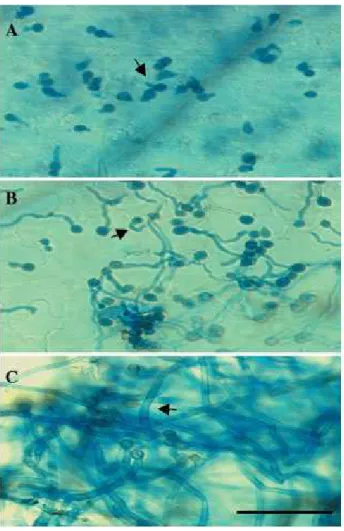
with the Chilean grape Botrytis isolate U11 via aniline blue staining indicated that, at 24 h post inoculation, early signs of fungal germination have occurred (Fig. 2A). At 48 h post inoculation, mycelium form (Fig. 2B), and fungal hyphae formed
Figure 2: Temporal analysis of the fungal structures upon
infection of Arabidopsis thaliana with the Chilean grape Botrytis isolate U11 via aniline blue staining. Infected leaf samples were analyzed at 24 h (A), 48 h (B) and 72 h (C) post inoculation, by staining the fungi with aniline blue followed by microscopic analyses. Arrow in A indicates germinating fungi. Arrow in B indicates mycelium. Arrow in C indicates fungal hyphae (Bar represents 30 µm).
Accumulation of callose and phenolic compounds
Figure 3: Accumulation of callose and phenolic compounds on Arabidopsis leaves infected with the Chilean grape Botrytis isolate U11. Arabidopsis leaves were infected with the Chilean grape Botrytis isolate U11 (A-D) or mock inoculated as a control (E-H) and analyzed 24 h later. (A and E) Light microscopic analysis of infected/inoculated site. The white arrow shows the spores and mycelium; (B and F) Fluorescence of callose. The arrow shows the accumulation of fluorescence compounds around the cells; (C and G). Aniline blue staining reveals fungal structures. The arrow shows the fungal mycelium; (D and H). Fluorescence of phenolic compounds. The arrows show the accumulation of autofluorescence (the bar in A, B, C, D, E, F and G: 125 µm; in D and H: 50 µm).
Induction of PR-1 gene in the interaction Arabidopsis-Botrytis
It has been shown that when Arabidopsis mounts a resistance response, the PR
Figure 4: Northern analysis reveals induced expression of
PR-1 in Arabidopsis (ecotype Columbia) leaves infected with the Chilean grape Botrytis isolate U11. C-:
negative control (mock inoculated leaf). hpi: hours post infection. 18S: ribosomal RNA as a loading control.
DISCUSSION
Botrytis cinerea, a necrotrophic fungal pathogen, infects its host plant, resulting in massive tissue destruction and, depending upon the level of infection, may result in plant death. In this paper, we have demonstrated that Chilean Botrytis cinerea
isolates from grapes (U11) infect Arabidopsis thaliana. Fungal spores germinate on the leaves of Arabidopsis thaliana within 24 hours. Mycelium are seen within 48 hours and hyphae with 72 hours.
Despite the germination and growth of these fungal spores, our results demonstrate that Arabidopsis thaliana has activated several defense strategies to limit or reduce the damage and destruction cause by this necrotrophic fungus. Within 24 hours, we have detected several markers (callose, phenolics compounds, and PR genes, see
Figures 3 and 4) for the activation of the plant defense system. Several of these markers combined to form what is referred to as a hypersensitive response (HR). HR is characterized by a programmed cell-death process that causes necrosis of the cells surrounding the infection site. Together with this necrosis, there is activation of cell wall lignification, callose deposition and the accumulation of phenolic compounds (Dempsey et al., 1998). Additionally, a well-known marker for HR is the expression of pathogenesis related proteins such as PR-1. The HR process has been
resistance response, which in turn triggers a defense response (Govrin and Levine, 2000). Therefore, our results suggest that, although the Chilean Botrytis isolates are able to infect and grow on Arabidopsis, this infection has set off a defense response within the plant.
Still relatively little is know about the plant signal transduction pathways following pathogen infection that lead to the local and systemic activation of defense
responses, such as PR gene expression. However, numerous studies have
demonstrated that SA is an important component of one or more of these pathways. Some of the strongest evidence that SA plays a role in resistance comes from
studies on transgenic tobacco and Arabidopsis plants expressing a salicylate hydroxylase-encoding (nahG) gene from Pseudomonas putida. Salicylate hydroxylase converts SA to cathecol; thus plants expressing the nahG gene are unable to accumulate SA at high levels. Strikingly, these nahG plants fail to develop SAR and exhibit enhanced susceptibility to pathogen infection (Delaney et al., 1994; Gaffney et al., 1993; Lawton et al., 1995).
We detected an increased lesion size and more robust infection of Arabidopsis when the Chilean tomato Botrytis isolate T50 was used in comparison to the Chilean grape Botrytis isolate (U11) (data not shown). Previous molecular analysis of Chilean Botrytis isolates by Muñoz et al. (1999, 2002) have suggested that there is diversity at the molecular level among Botrytis isolates collected from different species. For example, PCR-RFLP marker analysis showed that isolates sampled from grapes and tomatoes were genetically differentiated (Muñoz et al., 2002). Numerous
laboratories have begun characterizing Botrytis isolates at the molecular level (Buttner et al., 1994; Muñoz et al., 2002). Additionally, efforts are underway to sequence the Botrytis genome. However, efforts must be made to establish assays in which the infectivity of these isolates also may be analyzed and associated with the corresponding molecular markers. Therefore, we propose that infection of Arabidopsis with the population of field isolates may serve as a model system to analyze the diversity within the native Botrytis cinerea populations. Additionally, this system also may serve to screen the effectiveness of new anti-fungicidal compounds on the infectivity of various Botrytis isolates as well as the effects of these
compounds on plants.
ACKNOWLEDGEMENTS
This work was supported by the Fondo Nacional de Desarrollo Científico y
Tecnológico (FONDECYT grant number 3990038), ICM P02-009-F and Programa de Inserción de Científicos Chilenos C-13413/7, Fundación Andes. Thanks to Dr. Arturo Muñoz, INIA-Carillanca for providing us with the Botrytis cinerea strains and to Dra. Lee Meisel for her comments, discussion and critical review of the manuscript.
REFERENCES
ALEXANDER D, GOODMAN RM, GUT-RELLA M, GLASCOCK C, WEYMANN K,
BOWLES DJ (1990) Defense-related proteins in higher plants. Annu Rev Biochem 59: 873-907 [ Links ]
BROGLIE K, CHET J, HOLLIDAY M, CRESSMAN R, BIDDLE P, KNOWLTON S, MAUVAIS J, BROGLIE R (1991) Transgenic plants with enhanced resistance to the fungal pathogen Rhizoctonia solani. Science 254: 1194-1197 [ Links ]
BUTTNER P, KOCH F, VOIGT K, QUIDDE T, RISCH S, BLAICH R, BRUCKNER B, TUDZYNSKI P (1994) Variations in ploidy among isolates of Botrytis cinerea: Implications for genetic and molecular analyses. Curr Genet 25: 445-50
[ Links ]
CHESTER KS (1933) The problem of acquired physiological immunity in plants. Q Rev Biol 8: 275-324 [ Links ]
CONRATH U, SILVA H, KLESSIG DF (1997) Protein dephosphorylation mediates salicylic acid-induced expression of PR-1 genes in tobacco. Plant J 11: 747-757
[ Links ]
DELANEY TP, UKNES S, VERNOOIJ B, FRIEDRICH L, WEYMANN K, NEGROTTO D, GAFFNEY T, GUT-RELLA M, KESSMANN H, WARD E, RYALS J (1994) A central role of salicylic acid in plant disease resistance. Science 266: 1247-1250 [ Links ]
DEMPSEY DA, KLESSIG DF (1994) Salicylic acid, active oxygen species and systemic acquired resistance in plants. Trends Cell Biol 4: 334-338 [ Links ]
DEMPSEY DA, PATHIRANA MS, WOBBE KW, KLESSIG DF (1997) Identification of an Arabidopsis locus required for resistance to turnip crinkle virus. Plant J 11: 301-311
[ Links ]
DEMPSEY DA, SILVA H, KLESSIG DF (1998) Engineering disease and pest resistance in plants. Trends Micro 6: 54-61 [ Links ]
DIETRICH RA, DELANEY TP, UKNES SJ, WARD ER, RYALS JA, DANGL JL (1994) Arabidopsis mutants simulating disease resistance response. Cell 77: 565-577
[ Links ]
DIXON RA (1986) The phytoalexin response: elicitation, signaling, and control of host gene expression. Biol Rev Camb Philos Soc 61: 239-292 [ Links ] GAFFNEY T, FRIEDRICH L, VERNOOIJ B, NEGROTTO D, NYE G, UKNES S, WARD E, KESSMANN H, RYALS, J (1993) Requirement of salicylic acid for the induction of systemic acquired resistance. Science 261: 754-756 [ Links ]
GOVRIN EM, LEVINE A (2000) The hypersensitive response facilitates plant infection by the necrotrophic pathogen Botrytis cinerea. Curr Biol 10: 751-757 [ Links ]
KEEN NT (1990) Gene-for-gene complementation in plant-pathogen interaction. Annu Rev Genet 24: 447-463 [ Links ]
KOMBRINK E, SOMSSICH IE (1997) Pathogenesis-related proteins and plant
defense. In: CARROL G, TUDZYNSKI P (eds) Plant Relationships, The Mycota. Vol 5, Part A. Berlin: Springer-Verlag. pp: 108-128 [ Links ]
LAWTON K, WEYMANN K, FRIEDRICH L, VERNOOIJ B, UKNES S, RYALS J (1995) Systemic acquired resistance in Arabidopsis requires salicylic acid but not ethylene. Mol Plant-Microbe Interact 8: 863-870 [ Links ]
LIU D, RAGHOTAMA KG, HASEGAWA P, BRESSAN R (1994) Osmotin overexpression in potato delays development of disease symptoms. Proc Natl Acad Sci USA 91: 1888-1892 [ Links ]
MATTHEWS REF (1991) Plant Virology. 3rd Edition. San Diego: Academic Press
[ Links ]
MEISEL L, FONSECA B, GONZÁLEZ S, BAEZA-YATES R, CAMBIAZO V, CAMPOS R, GONZÁLEZ M, ORELLANA A, RETAMALES J, SILVA H (2005) A rapid and efficient method for purifying high quality total RNA from peaches (Prunus persica) for functional genomics analyses. Biological Research 38: 83-88 [ Links ]
MEYEROWITZ EM, PRUITT RE (1985) Arabidopsis thaliana and plant molecular genetics. Science 229: 1214-1218 [ Links ]
MUÑOZ G, HINRICHSEN P, ÁLVAREZ M (1999) Genetic variability of dicarboximide resistant strains of Botrytis cinerea isolated from grapes and tomato. Agricultura Técnica 59(1) [ Links ]
MUÑOZ G, HINRICHSEN P, BRYGOO Y, GIRAUD T (2002) Genetic characterization of
Botrytis cinerea populations in Chile. Mycol Res 106: 594-601 [ Links ]
REDEI GP (1975) Arabidopsis as a genetic tool. Ann Rev Genet 9: 111-151
[ Links ]
ROSS AF (1961) Systemic acquired resistance induced by localized virus infection in plants. Virology 14: 340-358 [ Links ]
RYALS J, UKNES S, WARD E (1994) Systemic acquired resistance. Plant Physiol 104: 1109-1112 [ Links ]
SILVA H, YOSHIOKA K, DOONER H, KLESSIG DF (1999) Characterization of a new
Arabidopsis mutant exhibiting enhanced disease resistance. Mol Plant-Microbe Interact12: 1053-1063 [ Links ]
SCOFIELD SR, TOBIAS CM, RATHJEN JP, CHANG JH, LAVELLE DT, MICHELMORE RW, STASKAWICZ BJ (1996) Molecular basis of gene-for-gene specificity in bacterial speck disease of tomato. Science 274: 2063-2065 [ Links ]
TANG X, FREDERICK RD, ZHOU J, HALTERMAN DA, JIA Y, MARTIN GB (1996) Initiation of plant disease resistance by physical interaction of AvrPto and the Pto kinase. Science 274: 2060-2063 [ Links ]
THE ARABIDOPSIS GENOME INITIATIVE (2000) Analysis of the genome sequence of the flowering plant Arabidopsis thaliana. Nature 408: 796-815 [ Links ]
WARD ER, UKNES SJ, WILLIAMS SC, DINCHER SS, WIEDERHOLD DL, ALEXANDER DC, AHL-GOY P, MÉTRAUX J-P, RYALS JA (1991) Coordinate gene activity in response to agents that induce systemic acquired resistance. Plant Cell 3: 1085-1094 [ Links ]
YOSHIKAWA M, TSUDA M, TAKEUCHI Y (1994) Resistance to fungal disease in transgenic tobacco plants expressing the phytoalexin elicitor-releasing factor, ß-1,3-endoglucanase from soybean. Naturwissenschaften 80: 417-420 [ Links ]
ZHU Q, MAKER EA, MASOND S, DIXON RE, LAMB C (1994) Enhanced protection against fungal attack by constitutive co-expression of chitinase and glucanase in transgenic tobacco. Bio/Technology 12: 807-812 [ Links ]
Corresponding author: Herman Silva, Centro de Biotecnología Vegetal, Facultad de Ecología y Recursos Naturales, Universidad Andrés Bello, Av. República 217, Santiago, Chile, Tel: (56-2) 661-8648, Fax: (56-2) 661-5832, E-mail:
Received: December 29, 2004. In revised form: August 31, 2005. Accepted: October 28, 2005
Todo el contenido de esta revista, excepto dónde está identificado, está bajo una Licencia Creative Commons
Sociedad de Biología de Chile
Canadá 253, piso 3º, Dpto. F.
PO Box 16164
Santiago - Chile
Tel.: (56-2) 22093503
Fax: (56-2) 22258427