
Development of a qualitative tool to identify leadership styles exercised by construction managers and their impact on construction success = Desarrollo de una herramienta cualitativa para la identificación de los estilos de liderazgo ejercidos por admini
13
0
0
Texto completo
(2) Abstract. This paper investigates the role of leadership style used by construction managers and how the style used relates to the construction manager’s perception of the success of their projects. The range of leadership styles is investigated and the three most relevant and appropriate styles for construction managers are adopted for this research. These styles are transformational, transactional and laissez-faire.. This small-scale study developed a questionnaire applying attitude and appreciation statements regarding the perceptions of construction managers about their leadership style and its relation to the performance of their most recently completed project The results show that construction managers display a mix of all three leadership styles although the greatest use is made of the transformational style. The linkage between leadership style and project success is less clear.. Key words: Construction management, leadership, project success.. Resumen. Este artículo investiga el rol de los estilos de liderazgo ejercidos por administradores de obra, y cómo estos estilos se relacionan con la percepción que dichos administradores tienen del éxito del proyecto. La gama de estilos de liderazgo es investigada. Los tres estilos más relevantes y apropiados para los administradores de obra son incorporados. Estos son el transformacional, el transaccional y el laissez-faire. Este estudio de pequeña escala desarrolla un cuestionario utilizando afirmacio-. nes de actitudinales y de apreciación. Estas afirmaciones permiten relacionar los estilos de liderazgo utilizados por los administradores de obra y el desempeño del último proyecto que han completado. Los resultados muestran que los administradores de obra exhiben una mezcla de los tres estilos más importantes, dentro de los cuales el con mayor presencia es el transformacional. El vínculo entre estilo de liderazgo y éxito del proyecto es menos claro.. Palabras clave: Administración de proyectos, liderazgo, éxito del proyecto.. páginas: 38 - 50. ]. Riley, M. J. - Latorre, V.. [. Revista de la Construcción Volumen 8 No 2 - 2009. [ 39.
(3) Introduction Construction managers have total responsibility for the construction project, being both a manager and a leader. The distinction between manager and leader needs to be clear. This distinction is important as management skills can be formally taught, learnt and developed through training, whereas leadership skills are not so easily acquired. A manager focuses on the process, applies a set of skills and tasks required to co-ordinate the actions of many to achieve a common result; thus including the planning, briefing, controlling, supporting, informing and evaluating the process. A leader, on the other hand, requires a different set of skills, personal attributes and characteristics to succeed at their aims; achieving a goal by agreement, negotiation, conflict management, synergy and team work, amongst others. The leader’s efforts often take place within an environment that does not help; in particular, the Construction Industry’s characteristics present construction managers/leaders with difficult challenges. Project leadership has been identified as an essential requirement for delivering successful construction projects (Clarke, 2009; Constructing Excellence, 2009; Egan, 1998) and also has a positive impact on the organisation (Muller and Turner, 2005). Within the wide spectrum of competencies which are relevant to a construction project’s successful outcome, leadership arises as one of the most relevant (Latorre, 2009). There are, however, different ways in which a person can exercise leadership; these are called leadership styles. A leadership style should be adopted according to each project and its particular circumstances (Crawford, Hobbs & Turner, 2005; Nicolini, 2001). Improved leadership skills, when appropriate to the project in hand, will result in improved performance at an organisational level (Muller, 2007; Nicolini, 2001). However, in order to improve the leadership skills of construction managers it is important to identify a leadership style which will more likely deliver improved project performance, and therefore the most appropriate in the context of construction projects. This study developed a tool to identify the leadership styles utilised by construction managers, and also assesses whether a construction manager’s leadership style is a success factor on a construction project, thus affecting its overall performance.. Research problem Despite extensive research into project success factors, there is disagreement related to the role of the project manager and the efficacy of their leadership style (Muller. 40 ]. Revista de la Construcción Volumen 8 No 2 - 2009. ]. Riley, M. J. - Latorre, V.. et al., 2005). The literature review evidenced scarcity of material focusing exclusively on the impact of leadership styles in the success of a construction project.. Methodology This exploratory study adopted a phenomenological approach to developing a tool which enables a subjective, qualitative insight on construction managers’ attitudes and perceptions to leadership, as well as the relation between the latter and project success. It also had to establish whether there is significant relationship between a construction project manager’s leadership style and overall project performance, and consequently determine whether or not the project manager’s leadership style is a success factor on a construction project. This small-scale study developed this tool by utilising attitude and appreciation statements regarding the perceptions of construction managers, their leadership style and its relation to the performance of their most recently completed project. Levels of agreement were measured by means of numerical Likert scales, to obtain a scaled-response (McDaniel & Gates, 2006). The tool is a questionnaire designed to obtain an initial indication of how project managers believed their leadership style related to their project success. Questionnaires have the ability to target construction managers within a wide geographical area, are less intrusive and time consuming for the respondent than other methods such as interviews or face-to-face questionnaires. Questionnaires, however, can have low response rates (Kumar, 2005). The Multifactor Leadership Questionnaire (MLQ) is the most widely used in leadership assessment (Muller et al., 2005) and is designed to test the dimensions of transactional, transformational and non-transactional laissez-faire leadership. The first section of the questionnaire was developed from the (MLQ) form 6S (Bass, 1990), to determine whether the respondent’s leadership style was mostly transactional, transformational and laissez faire. The second section explored the respondents’ perceptions of how successful their most recently completed project had been. This section was developed based on the Construction Project Success Survey tool (CPSS) (Hughes et al., 2004). One-to-one in-depth semi-structured interviews were conducted to triangulate data obtained from the questionnaires. Interviews allowed testing the consistency and stability of the research, by understanding the views. [. páginas: 38 - 50.
(4) of the respondent with minimal external disturbance or influence (Rubin and Rubin, 1995, cited in McGivern, 2006). Semi-structured interviews allow the interviewer the freedom to react to the respondents replies and adapt the schedule accordingly (Descombe, 2007). The population consisted of site based construction managers with five or more years of experience who were currently working in the UK. This would ensure each participant had appropriate experience assessing the success of a number of projects which they had been responsible for, a requirement needed to complete the survey questionnaire sufficiently. They are considered to be the individuals who are ultimately held accountable for the success or failure of a project (CIOB, 1996). In small scale qualitative research such as this, it is not expected that the sample will be statistically representative of the whole, but it should yield qualitative results reasonably free from selection bias (Wright et al., 2000). Therefore, the size of the target population was not considered essential to this study, as long as theoretical saturation was reached (Schwandt, 2001; Creswell, 1998). The sampling procedure included non-random purposive sampling combined with snowball technique to gain response to a questionnaire survey (Wright & Crimp, 2000), which is considered to be completely compatible with purposive sampling (Kumar 2005); snowball sampling leads, indeed, to a sample made up of people with similar characteristics (Black, 1999). Sindall (2008) assisted during the data gathering process.. Scope This small scale study has included only UK-based construction managers and was carried out in 2008. The questionnaire was administered to members of the survey population via a purposive sampling technique, while in-depth semi-structured interviews were conducted to address the issue of external consistency of the questionnaire; improving the questionnaire’s validity and reliability (McGivern, 2006).. The development of leadership schools and styles Initial research into leadership investigated the qualities that leaders have. The “trait school” looked at the traits that good leaders use to motivate; traits such as vision, integrity, humility, personal courage and general characteristics (Kirkpatrick and Locke, 1991). Six key traits of effective leaders were identified as: drive and ambition; the desire to lead; honesty and integrity; self. páginas: 38 - 50. ]. confidence; cognitive ability; and knowledge of the business. Such an approach might be useful for selection (particularly in a military situation), but not useful for helping to create good leaders, since “traits” were seen as being part of a person’s character and, therefore, not able to be developed. In contrast, the behavioural school of leadership theory developed with a suggestion that leaders should be characterised against a number of parameters related to their behaviour towards the project team, rather than their personal traits (Muller et al., 2005). Turner (1999) identified four styles of behavioural leadership: Laissez-faire, Democratic, Autocratic and Bureaucratic. Situational leadership (or Contingency theory) proposes leadership as a direct outcome and related to the context or situation of the activity (Dulewicz et al., 2005) Through the development of the path-goal theory of leader effectiveness, four leadership styles were identified, each of which were believed to be most functional under different theoretical conditions (Muller et al., 2005). House (1996) explains these four styles as: directive leadership (path-goal leadership), most effective when the task demands of subordinates are satisfying but ambiguous; supportive leadership, most effective when the subordinates tasks or work environment are dangerous, monotonous, stressful or frustrating. Participative leadership is most effective when the work of work unit members is interdependent; and achievement orientated leadership, most effective when individual subordinates have individual responsibility and control over their work. The tasks of a construction manager’s subordinates may be seen as both interdependent, but also having individual responsibility. Consequently, it may be suggested that a project manager within the construction industry must posses both a participative and achievement-orientated leadership style. Frame (1987, cited by Muller et al., 2005) suggests however that during the execution stage of a construction project, (the site construction stage), an autocratic leadership style is necessary. The visionary school of leadership developed from observing successful businesses through change. Bass and Avolio (1990) identified two types of leader: transformational (relationship-focused), and transactional (process-focussed). Bass et al (1990) define four basic components, of transformational leadership, namely: idealized influence (charisma); individualized consideration; intellectual consideration; and inspirational motivation. A transformational style of leadership broadened and elevated the interests of employees, generated awareness and acceptance of. Riley, M. J. - Latorre, V.. [. Revista de la Construcción Volumen 8 No 2 - 2009. [ 41.
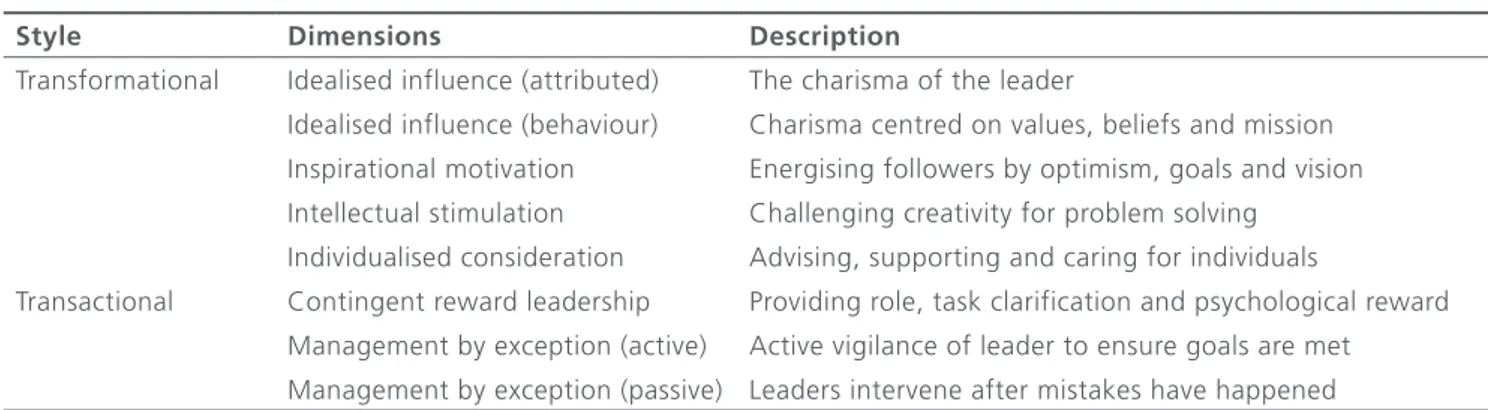
(5) Leadership style as a success factor. the purpose and mission of the group, encouraged employees to look beyond their own self-interest. This, in turn, achieved superior performance (Muller et al, 2005). Transactional leadership, on the other hand, is centred on a model of reinforcement (Bass et al, 1990). Antonakis, Avolio and Sivasubramaniam (2003) define transactional leaders as being dependent on rewarding employees for meeting performance targets, penalising employees who do not achieve, and relying on passive management-by-exception. Muller et al (2007) suggest that a transformational leadership style is appropriate on complex change projects, while a transactional style of leadership is preferred on simple, engineering projects. Table 1 summarises the different dimensions of the Transformational and Transactional leadership styles.. General management literature regards leadership styles as a primary influence on the performance of a project or business. However, despite extensive research into project success factors, the literature largely ignores the role of the project manager and the effect their leadership style has on the overall success of the project (Muller et al., 2005). Belout and Gauvreau (2004) found that although there was a link between project success and the personnel factor, it did not have a significant impact on project success. Cooke-Davies (2002) identified twelve success factors, derived from both ‘hard’ and ‘soft’ data from large national and multi-national organisations, however none of these factors were directly concerned with ‘human factors’. However Cooke-Davies contends that it is becoming accepted wisdom that it is people who deliver projects, and so there are human dimensions to nearly every success factor identified.. Bass et al. (1990) point out that all managers will exhibit all of the styles at some stage. Consequently, Kirkbride (2006) suggested that what is of significance is the frequency with which a manager exhibits these behaviours; and suggests that ideally, a leader’s profile should show higher scores (or high frequency) on the transformational styles and lower scores on the management by exception styles and laissez-faire styles. Even though construction projects are relatively complex, a number of authors have suggested in relation to IT, organisational change and business projects, engineering projects are of low complexity (Muller et al, 2007). This suggests, in turn, that engineering projects require a transactional style of leadership.. Leadership and management have been identified as success factors. Turner’s (1999) Seven Forces Model acknowledged people as one of seven areas of project success, and under this title specifically included leadership and management as success factors. While in a study of project management processes in the IT industry, Kendra and Taplin (2004) identified four groups of success factors: micro-social; macro-social; microtechnical and macro-technical, in which the project manager’s skills and competencies, including leadership behavioural characteristics and attributes are defined as a success factor in the micro-social group.. General management research is now focused on the competence school of leadership, and the competencies leaders exhibit (Muller, 2007). Crawford (2003, cited by Muller et al., 2005) defines competence in a leadership context as ‘knowledge, skills, and personal characteristics that deliver superior results’, suggesting that the competence school encompasses all previous leadership theory.. Muller et al. (2005) suggests the reason why so few studies identify the project manager and their leadership style as a project success factor is that most asked project managers for their opinion, and many project managers. Table 1 Dimensions of the Transactional and Transformational leadership styles (Bass and Avolio, 1990) Style. Dimensions. Description. Transformational. Idealised influence (attributed). The charisma of the leader. Idealised influence (behaviour). Charisma centred on values, beliefs and mission. Inspirational motivation. Energising followers by optimism, goals and vision. Intellectual stimulation. Challenging creativity for problem solving. Individualised consideration. Advising, supporting and caring for individuals. Contingent reward leadership. Providing role, task clarification and psychological reward. Management by exception (active). Active vigilance of leader to ensure goals are met. Transactional. Management by exception (passive) Leaders intervene after mistakes have happened. 42 ]. Revista de la Construcción Volumen 8 No 2 - 2009. ]. Riley, M. J. - Latorre, V.. [. páginas: 38 - 50.
(6) simply do not see themselves as a contributor to project success. Makilouko (2004) supports this view, concluding that out of 47 project managers he interviewed, 40 were found to be solely task orientated. In order to determine whether the project manager’s leadership style has an impact on the performance of a construction project, a number of issues must first be addressed. Firstly, it is evident from the review of current literature that project success is subjective in nature and as a consequence, in order to determine the performance of a project, one must first identify a particular observer from whose perspective to assess. This raises a second issue in that one must determine whether the observer perceives success from a project management perspective, or from a product perspective. Ideally, as Baccarini (1999) proposed, project success should be determined using both project management and product success criteria. However, Turner (1999) points out that success is affected by time. As a consequence, the determination of product success tends to be long-term in nature and often orientated toward the total life span of a completed project, while project management success is measured during and at the end of the project (Munns & Bjeirmi, 1996). A third issue to emerge is that many authors agree that success has both ‘hard’ and ‘soft’ dimensions (Latorre, 2009), and therefore from whichever perspective project success is measured both objective and subjective criteria must be taken into account to gain a complete assessment (Baccarini, 1999; Baker et al., 1988; de Wit, 1988).. The literature has highlighted the need to develop a leadership assessment tool derived from the three alter nate leadership approaches that are either transactional or transformational or Laissez-faire.. Results To ensure respondent eligibility, screening questions were included at the beginning of the questionnaire. Table 2 presents the results of the screening questions. The questionnaire was designed to identify both the preferred leadership style and the reported performance of each of the respondents’ most recently completed project. The questionnaire was analysed firstly by question, allowing significant comparisons or differences between respondents’ perceptions to be identified and discussed; secondly by respondent –in order to identify which style has the highest level of applicability for each respondent. The respondents’ scores to each of the statements regarding project success are then summed up and presented in Table 3. Finally, a correlation analysis using SPSS software was carried out a between the respondents’ total scores for each of the leadership styles, and each of their total project performance scores. This allowed the identification of significant relationships between leadership style and project success. Leadership styles were assessed with fourteen statements using a 5 point Likert scale. The statements were either attitudinal or of appreciation. Statements and responses are presented in Table 4. Twenty-one attitudinal statements examined the performance of the most recent construction project for each respondent. Each statement used a 7 point Likert scale. Table 5 shows overall responses.. Table 2 Questionnaire’s screening question results Subject. Variable. Job Role. Project Manager Senior Project Manager Other. Frequency 6 1 0. No. of Years Experience in Current Role. 0–4 5–9 10 – 14 15+. 0 6 0 1. No. of Projects Involved with in this Role. 0–4 5–9 10 – 14 15+. 5 0 0 2. páginas: 38 - 50. ]. Table 3 Total scores of each respondent for each of the leadership styles Leadership style. Score. Idealised influence Inspirational motivation Intellectual stimulation Individualised consideration Contingent Rreward Management-by-exception Laissez – faire. Riley, M. J. - Latorre, V.. [. R1. R2. R3. R4. R5. R6. R7. 7 6 6 7 6 6 5. 6 7 5 7 4 6 3. 6 7 5 7 5 4 4. 7 7 8 6 6 5 2. 7 6 6 5 5 4 3. 8 7 8 8 6 4 8. 7 5 6 5 5 5 6. Revista de la Construcción Volumen 8 No 2 - 2009. [ 43.
(7) Pearson’s product–moment correlation was used to carry out a 2-tailed analysis between the respondents’ total scores for each of the seven leadership styles, and the respondents’ total project performance scores. This analysis identified relationships between the project manager’s leadership style and overall project performance, the results of which are presented in. Table 6.. Analysis All respondents exhibit behaviour related to the transformational style of leadership more than behaviour related to the transactional style. The idealised influence dimensions of leadership is the most prevalent among the project managers included in this study. This indicates that a majority of the respondents believe that above all, they hold the trust and respect of their colleagues, are centred on a sense of mission, and are perceived as confident and powerful. The results also indicate that behaviour related to the inspirational motivation and individualised consideration. dimensions of leadership are also widespread among respondents. This suggests that a majority of the project managers included in this study believe they use appropriate symbols to help colleagues focus on their work, offer support regarding self development, and pay attention to the individual needs of those within their team. With regard to the intellectual stimulation dimension of leadership, the results suggest that behaviour related to this concept is the least prevalent of the transformational styles among respondents. Although all those included indicate a high level of application to the statement regarding the encouragement of rethinking old problems in new ways; several of those included indicate a less positive level of application to the statement related to the encouragement of colleagues to rethink ideas which have not been questioned before. Although it has been identified that transformational styles of leadership apply more often to the construction managers included in this study, the results show that transactional styles are still employed frequently. This is exemplified by statements 9 and 12 of the questionnaire. Table 4 Overall results for Leadership styles Leadership Style 1 – Idealised Influence. R1 R2 R3 R4 R5 R6 R7. Q1. I believe colleagues feel at ease when they are around me. 4. 3. 3. 4. 4. 4. 4. Q2. I believe colleagues are proud to be associated with me. 3. 3. 3. 3. 3. 4. 3. Q3. I express to my colleagues, in as few words as necessary, what could and should be done 2. 3. 3. 3. 3. 3. 1. Q4. I encourage colleagues to become enthusiastic and find meaning in their work. 4. 4. 4. 4. 3. 4. 4. Q5. I encourage colleagues to consider problems in new ways. 3. 3. 3. 4. 3. 4. 3. Q6. I encourage colleagues to rethink ideas which have not been questioned before. 3. 2. 2. 4. 3. 4. 3. Q7. I assist colleagues in their self-development. 4. 3. 3. 3. 3. 4. 3. Q8. I regularly appraise colleagues on how I believe they are performing. 3. 4. 4. 3. 2. 4. 2. Q9. I provide colleagues with recognition / reward when they reach their goals. 3. 2. 3. 3. 3. 3. 3. Q10. I emphasise the possibility of reward in what colleagues achieve. 3. 2. 2. 3. 2. 3. 2. Q11. I do not believe in change as long as things are working effectively. 2. 2. 0. 1. 1. 0. 1. Q12. I enforce the standards to which I expect work to be carried out. 4. 4. 4. 4. 3. 4. 4. Q13. I am content to let colleagues continue working in the same way as always. 2. 3. 2. 1. 2. 4. 3. Q14. I expect no more of my colleagues than what is absolutely essential. 3. 0. 2. 1. 1. 4. 3. Leadership Style 2 – Inspirational Motivation. Leadership Style 3 – Intellectual Stimulation. Leadership Style 4 – Individualised Consideration. Leadership Style 5 – Contingent Reward. Leadership Style 6 – Management-by-Exception. Leadership Style 7 – Laissez-faire. 44 ]. Revista de la Construcción Volumen 8 No 2 - 2009. ]. Riley, M. J. - Latorre, V.. [. páginas: 38 - 50.
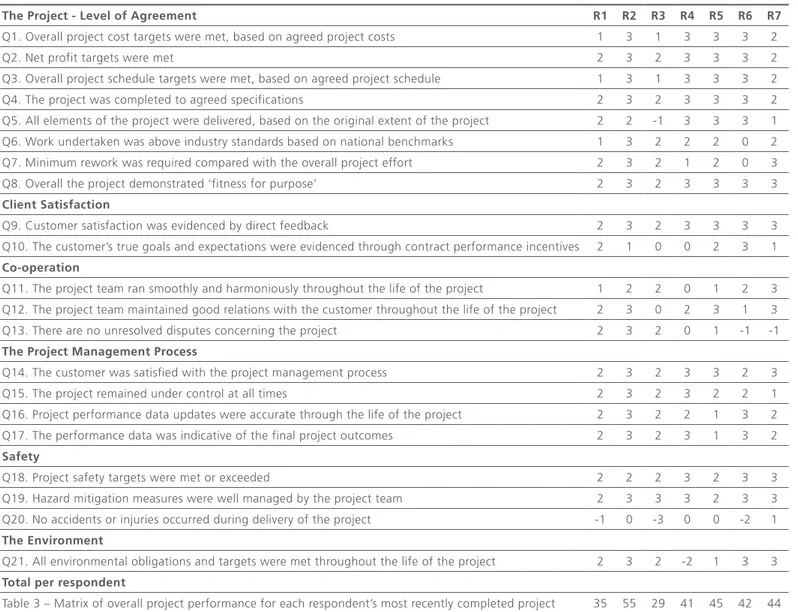
(8) (Table 4), which indicate that a majority of respondents use either materialistic or psychological rewards to clarify role and task requirements ‘fairly often’, while all of the respondents enforce the standards to which they expect work to be carried out ‘fairly often’ or ‘frequently, if not always’. This suggests that respondents’ exhibit behaviour related to the transactional active management-byexception leadership style frequently.. The project performance responses indicate that all of the respondents felt their most recently completed project was a success to some degree, with very few responses indicating a negative sentiment of agreement. Questions 1 to 8 (Table 5) measured how successful the respondent perceived their most recently completed project to be in relation to the traditional ‘iron triangle’ objectives of cost, schedule and quality / performance. The results show that of the 56 responses to these 8 questions, 53 indicate a positive sentiment of agreement. This demonstrates a general consensus among respondents that the projects they considered did meet their targets in relation to these traditional objectives. Questions 9 and 10 (Table 5), regarding customer satisfaction, generally show a positive sentiment of agreement. This indicates that all of. Responses relating to the laissez-faire leadership style are widely varying. The information obtained show that although a majority of respondents exhibit laissez-faire behaviour to a small degree, a number of respondents, most notably respondents 6 and 7, exhibit Laissez-faire behaviour significantly frequently.. Table 5 Overall results for project performance The Project - Level of Agreement. R1. R2. R3. R4. R5. R6. R7. Q1. Overall project cost targets were met, based on agreed project costs. 1. 3. 1. 3. 3. 3. 2. Q2. Net profit targets were met. 2. 3. 2. 3. 3. 3. 2. Q3. Overall project schedule targets were met, based on agreed project schedule. 1. 3. 1. 3. 3. 3. 2. Q4. The project was completed to agreed specifications. 2. 3. 2. 3. 3. 3. 2. Q5. All elements of the project were delivered, based on the original extent of the project. 2. 2. -1. 3. 3. 3. 1. Q6. Work undertaken was above industry standards based on national benchmarks. 1. 3. 2. 2. 2. 0. 2. Q7. Minimum rework was required compared with the overall project effort. 2. 3. 2. 1. 2. 0. 3. Q8. Overall the project demonstrated ‘fitness for purpose’. 2. 3. 2. 3. 3. 3. 3. Q9. Customer satisfaction was evidenced by direct feedback. 2. 3. 2. 3. 3. 3. 3. Q10. The customer’s true goals and expectations were evidenced through contract performance incentives. 2. 1. 0. 0. 2. 3. 1. Q11. The project team ran smoothly and harmoniously throughout the life of the project. 1. 2. 2. 0. 1. 2. 3. Q12. The project team maintained good relations with the customer throughout the life of the project. 2. 3. 0. 2. 3. 1. 3. Q13. There are no unresolved disputes concerning the project. 2. 3. 2. 0. 1. -1. -1. Q14. The customer was satisfied with the project management process. 2. 3. 2. 3. 3. 2. 3. Q15. The project remained under control at all times. 2. 3. 2. 3. 2. 2. 1. Q16. Project performance data updates were accurate through the life of the project. 2. 3. 2. 2. 1. 3. 2. Q17. The performance data was indicative of the final project outcomes. 2. 3. 2. 3. 1. 3. 2. 2. 2. 2. 3. 2. 3. 3. Q19. Hazard mitigation measures were well managed by the project team. 2. 3. 3. 3. 2. 3. 3. Q20. No accidents or injuries occurred during delivery of the project. -1. 0. -3. 0. 0. -2. 1. 2. 3. 2. -2. 1. 3. 3. 35. 55. 29. 41. 45. 42. 44. Client Satisfaction. Co-operation. The Project Management Process. Safety Q18. Project safety targets were met or exceeded. The Environment Q21. All environmental obligations and targets were met throughout the life of the project Total per respondent Table 3 – Matrix of overall project performance for each respondent’s most recently completed project. páginas: 38 - 50. ]. Riley, M. J. - Latorre, V.. [. Revista de la Construcción Volumen 8 No 2 - 2009. [ 45.
(9) the projects considered did satisfy the customer to some degree. The ‘project management process’ questions also relate to customer satisfaction. The results show that all of the respondents reported the project management process on their most recently completed projects a success. Consequently, all of the respondents believed the customer was satisfied with the overall project management process, as indicated by the positive responses to question 14 in section 2 of the questionnaire.. important safety objective. The results indicate a strong positive sentiment of agreement in relation to safety targets being met and hazard mitigation measures being well managed. However, the respondents reported either a negative or neutral sentiment of agreement to question 20. This suggests that none of the respondents most recently completed projects were accident free. It is evident from the correlation analysis that no significant correlation was found between the respondents’ leadership style and overall project performance. This is indicated by a majority of the Pearson’s coefficient numbers in the ‘totalscore’ column of Table 6 being -0.3 to + 0.3. However, the contingent reward style of leadership does show a weak negative association with overall project performance, although this correlation is not sufficiently significant at the 0.05 level (i.e. at the 95 per cent confidence interval).. The results relating to the perceived satisfaction of the project team and its relations with the customer vary. A majority of respondents indicate that the project teams, which they were responsible for, generally ran harmoniously and maintained good relations with the customer throughout the life of the project. However, 4 of the 7 respondents report a negative, neutral or slightly positive sentiment of agreement, highlighting that despite maintaining good relations and feedback systems with the customer, disputes arose upon project completion.. The analysis did identify a significant coefficient between the intellectual stimulation and idealised influence styles of leadership, and the intellectual stimulation and contingent reward styles of leadership, at a significance level of under 0.05 (i.e. over the 95 per cent confidence interval).. Questions 18 to 20 were included in the questionnaire to measure how well the respondents considered their last project performed with regard to the increasingly. Table 6 Leadership Style Correlation Analysis inspirmotiv. indivconsid. intellstimul. continrew. laissez-faire. totalscore. Pearson Correlation Sig. (2-tailed) N. 1. .694 .084 7. -.175 .707 7. -.135 .774 7. .193 .678 7. .040 .932 7. -.234 .614 7. -.044 .925 7. indivconsid. Pearson Correlation Sig. (2-tailed) N. .694 .084 7. 1. .091 .846 7. .070 .881 7. .134 .775 7. .222 .632 7. .406 .366 7. -.193 .679 7. idealinflue. Pearson Correlation Sig. (2-tailed) N. -.175 .707 7. .091 .846 7. 1. -.307 .503 7. .826* .022 7. .730 .062 7. .633 .127 7. -.013 .978 7. manabyex. Pearson Correlation Sig. (2-tailed) N. -.135 .774 7. .070 .881 7. -.307 .503 7. 1. -.253 .584 7. -.175 .707 7. -.230 .620 7. .353 .437 7. intellstimul. Pearson Correlation Sig. (2-tailed) N. .193 .678 7. .134 .775 7. .826* .022 7. -.253 .584 7. 1. .779* .039 7. .266 .564 7. -.019 .968 7. continrew. Pearson Correlation Sig. (2-tailed) N. .040 .932 7. .222 .632 7. .730 .062 7. -.175 .707 7. .779* .039 7. 1. .335 .463 7. -.544 .207 7. laissez-faire. Pearson Correlation Sig. (2-tailed) N. -.234 .614 7. .406 .366 7. .633 .127 7. -.230 .620 7. .266 .564 7. .335 .463 7. 1. -.155 .740 7. Pearson Correlation Sig. (2-tailed) N. -.044 .925 7. -.193 .679 7. -.013 .978 7. .353 .437 7. -.019 .968 7. -.544 .207 7. -.155 .740 7. inspirmotiva. totalscore. 46 ]. Revista de la Construcción Volumen 8 No 2 - 2009. 7. ]. 7. idealinflue manabyex. 7. Riley, M. J. - Latorre, V.. 7. [. 7. páginas: 38 - 50. 7. 7. 1 7.
(10) Discussion The first section of the questionnaire allows identifying several leadership styles exercised by construction managers. The results obtained regarding a project manager’s leadership style show that, from their own selfassessment, the respondents’ exhibit behaviour related to all of the leadership styles at some point. This finding agrees with Bass et al. (1990), who state that all managers demonstrate all of these styles at some stage. The questionnaire identifies how often different leadership styles are exercised. The frequency with which the respondents exhibit these behaviours vary significantly. The results indicate that respondents, with the exception of respondent 6, consistently scored higher in the transformational styles of leadership than the transactional or laissez-faire styles of leadership. The majority of project managers included in this study exhibit behaviour related to the transformational styles of leadership more frequently than they do behaviour related to the transactional styles, a finding substantiated by interviewee number 1, who states that the project manager must ‘guide everyone to where they need to be going… making sure that everyone is moving in the right direction’. This is in agreement with Kirkbride (2006), who suggests that ideally a leader’s profile should show higher scores on the transformational styles and lower scores on the transactional and laissez-faire styles. However, although the respondents, in general, exhibit behaviour related to the transformational styles of leadership more often, the results also show that respondents frequently exhibit behaviour related to the transactional styles of leadership, in particular the contingent reward style. This finding is in agreement with Bass (1985, cited in Hartog et al., 1997) who states that transformational leadership builds on transactional leadership, and goes on to contend that the transformational and transactional leadership styles are not mutually exclusive (Bass and Avolio,1994). Consequently, it may be suggested that project managers within the construction industry exhibit different leadership behaviour in different situations or project contexts. These findings provide evidence to support the proposal that a construction manager within the construction industry must possess both a participative, transformational leadership style and an achievementorientated, transactional leadership style as proposed by House (1996). This questionnaire provides results which can be discussed against the relevant literature in order to provide results.. páginas: 38 - 50. ]. It is evident from the information obtained regarding project performance that all of the respondents felt their most recently completed project was a success to some extent, with regard to the criteria identified previously. As this study was carried out from the perspective of the project manager, and the project manager is normally considered to be the single point of responsibility for a project, this finding is of no surprise. Nonetheless, from the results obtained it is possible to identify those criteria which are perceived to have been fulfilled with a higher degree of success. The criteria with the most positive sentiment of agreement are those related to the ‘iron triangle’, and in particular cost and quality / performance (questions 2, 4 and 8). This finding was substantiated by interviewee number 1. This may suggest that the respondents not only believe, on the one hand, that the projects they considered fulfilled these objectives but on the other hand, these objectives also merit their focus and outweigh other considerations in determining the level of project success. These findings agree with Wateridge (1998), who suggests it is the short-term project management success criteria which project managers are focused upon. With the project managers interpreting failure as not meeting budget and schedule objectives, and Collins et al (2004), who states that these short-term, traditional gauges of performance are a measure of project management success. Hence, the respondents also reported a highlevel of agreement with the statements relating to project management success. Findings show that the questionnaire provides data which can test existing literature. In direct contrast to Wateridge (1998) and Baccarini (1999), who suggests that from a project management perspective, projects end when they meet project objectives, the results related to customer satisfaction suggest that all of the respondents consider this subjective criteria as important, with all reporting to have systems to allow for direct customer feedback. Although the correlation analysis between the performance of the respondents’ most recently completed project and their leadership style did not identify any correlation. I may be suggested from the questionnaire results that as all of the respondents exhibit behaviour related to the transformational styles of leadership more so than the transactional styles, and all reported their most recently completed project to be a success to some degree, a transformational style of leadership may contribute to overall project success. This therefore, would imply that the leadership style of the. Riley, M. J. - Latorre, V.. [. Revista de la Construcción Volumen 8 No 2 - 2009. [ 47.
(11) project manager is a success factor on a construction project. Indeed, interviewee number 1 supports this proposal, stating that the main factor which contributes to project success is that the project manager must ‘lead a team and know what everyone’s responsibilities are…and guide everyone to where they need to be going…making sure that everyone is moving in the right direction’.. Conclusion This exploratory research developed a questionnaire which is effective at relating leadership styles with success rates. This questionnaire also allows identifying the styles of leadership employed by project managers within the construction industry. Despite the small scale of the study, it was found that construction managers exhibit behaviour related to the transformational styles of leadership more frequently than behaviour related to the transactional or laissez-faire styles, with the idealised influence style the most prevalent among respondents. Utilising this questionnaire for a large sample will provide significant results as to if a construction managers leadership style is a success factor on a construction project. The small-scale of this study does not allow. References 1.. 2.. 3.. 4.. 5.. 6.. Akintoye, B. L. A., Edwards. P. J., Hardcastle, C., 2005, Critical Success Factors for PPP / PFI Projects in the UK Construction Industry, Construction Management and Economics, Vol: 23, pp: 459 - 471. Antonakis. J., Avolio. B. J., Sivasubramaniam, N., 2003, Context and Leadership: An Examination of the NineFactor Full-Range Leadership Theory using the Multifactor Leadership Questionnaire, The Leadership Quarterly, Vol: 14, Iss: 3, pp: 261 - 295. Baccarini, D., 1999, The Logical Framework Method for Defining Project Success, Project Management Journal, Vol: 30, Iss: 4, pp: 25 - 32. Baker, B. N., Murphy, D. C., Fisher, D., 1988, Factors Affecting Project Success in Cleland, D. I., King, W. R., Project Management Handbook, New York: Van Nostrand Reinhold. Bass, B. M., 1990, From Transactional to Transformational Leadership: Learning to Share the Vision, Organisational Dynamics, Vol: 18, Iss: 3, pp: 19 - 31. Bass, B. M., Avolio, B. J., 1990, Developing Transformational Leadership: 1992 and Beyond, Journal of European Industrial Training, Vol: 14, Iss: 5, pp: 21 - 27.. 48 ]. Revista de la Construcción Volumen 8 No 2 - 2009. ]. Riley, M. J. - Latorre, V.. generating such insight at this stage. Further qualitative research is needed in order to substantiate the findings made in this study.. Limitations and future research The main limitations are three: - The sole focus on construction managers’ perspective. Further research must complement this study by considering other stakeholders’ views, providing a holistic understanding of leadership styles success factors. These results would provide a holistic approach, and could then be compared with the findings of this study. - The qualitative approach of the research. Future applications of this tool should contemplate quantitative triangulations. - The questionnaire provides a ‘snap-shot’ of respondents’ perceptions regarding project success. However, overall project success has been determined to be affected by time, and ideally project performance should be determined over the total life-span of a completed project. That the determination of project success in any further research should be a long-term assessment. This would provide the researcher with a continuum of perceptions regarding project performance, from which the researcher may draw their own conclusions regarding overall project success.. 7.. 8.. 9.. 10.. 11. 12.. 13.. Bass, B. M., Avolio, B. J., 1994, Transformational Leadership and Organisational Culture, International Journal of Public Administration, Vol 17, Iss: 3 /4, pp: 541 - 554. Bass, B. M., Avolio, B. J., Jung, D. I., 1999, Re-examining the Components of Transformational and Transactional Leadership using the Multifactor Leadership Questionnaire, Journal of Occupational and Organisational Psychology, Vol: 72, pp: 441 – 462. Belassi, W, Tukel, O., 1996, A New Framework for Determining Critical Success/Failure Factors in Projects, International Journal of Project Management, Vol: 18, pp: 327 - 335. Belout, A., Gauvreau, C., 2004, Factors Influencing Project Success: the Impact on Human Resources Management, International Journal of Project Management, Vol: 22, pp: 1 – 11. Black, T. R., 1999, Doing Quantitative Research in the Social Sciences, London: SAGE Publications Ltd. Bryde, D. J., 2005, Methods for Managing Different Perspectives of Project Success, British Journal of Management, Vol: 16, pp: 119 - 131. Chua, D. K. H., Kog, Y. C., Loh, P. K., 1999, Critical Success Factors for Different Project Objectives, Journal. [. páginas: 38 - 50.
(12) 14.. 15.. 16. 17. 18.. 19.. 20.. 21.. 22.. 23.. 24.. 25.. 26.. 27.. 28.. 29.. of Construction Engineering and Management, Vol: 125, pp: 142 - 150. Chartered Institute of Building (CIOB), 2002, Code of Practice for Project Management for Construction and Development, Oxford: Blackwell Publishing. Clarke, P. A., 2009, Leadership, beyond project management, Industrial and Commercial Training, Vol:41 (4), pp:187 – 194. Collins. A. and Baccarini, D., 2004, Project Success - A Survey, Journal of Construction Research, Vol: 5, (2) , pp: 211 - 231. Collinson, O., 1998, Fifty Major Philosophers, London: Routledge. Construction Manager, 2008, About Us: Readership, http://www.construction manager.co.uklhybrid.asp?type Code=6andpubCode=38 [Accessed: 14/01/08]. Cooke – Davies, T., 2002, The ‘Real’ Success Factors on Projects, International Journal of Project Management, Vol: 20, pp: 185 - 190. Crawford, L., Hobbs, J. B., Turner, J. R., 2005, Project Categorisation Systems: Aligning Capability with Strategy for Better Results, Project Management Network, Vol: 19, Iss: 6, p: 75. Creswell, J. W., 1998, Qualitative Inquiry and Research Design: Choosing Among Five Traditions, London: SAGE Publications Ltd. de Wit, A., 1988, Measurement of Project Success, International Journal of Project Manament; Vol; 6, pp:164 -170. Denscombe, M., 2007, The Good Research Guide for Small Scale Social Research Projects, Maidenhead: Open University Press. DTI (Department of Trade and Industry), 1998, Rethinking Construction: The Report of the Construction Task Force, London: DTI, Available: http://www.ciob.org.cn/ resources/download/Rethinking%20construction%20th %20egan%20report.pdf [Accessed: 12/10/07]. Dulewicz, V., Higgs, M., 2005, Assessing Leadership Styles and Organisational Context, Journal 01 Managerial Psychology, Vo: 20, Iss: 2, pp: 106 -123. Dvir, D., Levy, O., Shenhar, A. J., 1997, Mapping the Dimensions of Project Success, International Journal of Project Management, Vol: 28, Iss: 2, pp: 5-13. Egan, Sir J., 1998, Rethinking Construction: The Report of the Construction Task Force, DETR, HMSO, London/ Constructing Excellence Review “Never Waste a Good Crisis” [a ten year review of Egan]/ http://www. constructingexcellence.org.uk/pdf/Wolstenholme_ Report_Oct_2009.pdf. Hartog, D. N. O., Muijen, J. J. V., Koopman, P. L., 1997, Transactional Versus Transformational Leadership: An Analysis of the MLQ, Journal of Occupational and Organisational Psychology, Vol: 70, pp: 19 - 34. Hinkin, T. R., Tracey, J. B., 1999, The Relevance of Charisma for Transformational Leadership in Stable Organisations, Journal of Organisational Change Management, Vol: 12, Iss: 2, pp: 105 - 119.. páginas: 38 - 50. ]. 30. House, R. J., 1996, A Path-Goal Theory of Leader Effectiveness, The Leadership Quarterly, Vol: 7, Iss: 3, pp: 305 - 309. 31. Hoyle, R. H., Harris, M. J., Judd, C. M., 2002, Research Methods in Social Relations, London: Thomson Learning 32. Hughes, S. W., Tippett, D. D., Thomas, W. K., 2004, Measuring Project Success in the Construction Industry, Engineering Management Journal, Vol: 16, Iss: 3, pp: 31 - 37. 33. Jugdev, K., Muller, R. J., 2005, A Retrospective Look at our Evolving Understanding of Project Success, Project Management Journal, Vol: 36, Iss: 4, pp: 19 - 31. 34. Jupp, V., Sapsford, R., 2006, Data Collection and Analysis, London: SAGE Publications Ltd. 35. Kendra, K., Taplin, L. J., 2004, Project Success: A Cultural Framework, Project Management Journal, Vol: 35 (1). 36. Kirkbride, P., 2006, Developing Transformational Leaders: The Full Range Leadership Model in Action, Industrial and Commercial Training, Vol: 38, Iss: 1, pp: 23 - 32. 37. Kirkpatrick. S. A, Locke. E. A, 1991, Leadership: do Traits Matter?, Academy of Management Executive, Vol: 5, Iss, 2, pp: 48 - 60. 38. Krauss, S. E., 2005, Research Paradigms and Meaning Maker, The Qualitative Report, Vol: 10, Iss: 4, pp: 758770. 39. Kumar, R., 2005, Research Methodology: A Step-by-Step Guide for Beginners, London: SAGE Publications Ltd. 40. Latorre, V. (2009) Construction Manager’s Influence on Project Success, PhD , University of Plymouth. 41. Liu, A. M., Walker, A., 1998, Evaluation of Project Outcomes, Construction Management and Economics, Vol: 16 (12) pp: 209 - 219. 42. Makilouko, M., Coping with Multicultural Projects: The Leadership Styles of Finnish Project Managers, International Journal of project Management, Vol: 22, Iss: 5, pp: 387 - 396. 43. Mariampolski, H., 2001, Qualitative Market Research: A Comprehensive Guide, London: SAGE Publications Ltd. 44. Market Research Society, 2008, Standards and Guidelines, http://www.mrs.org.uklstandards/mrs_Quidelines. htm[Accessed 03/02/08]. 45. McDaniel, C., Gates, R., 2006, Marketing Research Essentials, John Wiley and Sons. 46. McGivern, Y., 2006, The Practice of Market and Social Research: An Introduction, Harlow: Pearson Education Ltd. 47. Miles, M. B., Huberman, A. M., 1994, Qualitative Data Analysis, London: SAGE Publications Ltd. 48. Muller, R., Turner, R. J., 2005, The Project Manager’s Leadership Style as a Success Factor on Projects: A Literature Review, Project Management Journal, Vol: 36, Iss: 1, pp: 49 – 61. 49. Muller, R., 2007, Matching the Project Managers Leadership Style to Project Type, International Journal of Project Management, Vol: 25, Iss: 1, pp: 21 -32. 50. Muller, R., Turner, R., 2007, The Influence of Project Managers on Project Success Criteria and Project Success. Riley, M. J. - Latorre, V.. [. Revista de la Construcción Volumen 8 No 2 - 2009. [ 49.
(13) 51.. 52. 53. 54.. 55. 56.. 57.. by Type of Project, European Management Journal, Vol: 25, Iss: 4, pp: 298 – 309. Munns, A. K., Bjeirmi, B. F., 1996, The Role of project Management in Achieving Project Success, International Journal of Project Management, Vol: 14, Iss: 2, pp: 81 – 87. Neuman, W. L., 1997, Social Research Methods: Qualitative and Quantitative Approaches, Allyn and Bacon. Nicolini, D., 2001, In Search of Project Chemistry” CRISP Consultancy Commission 00/9, London. Office of National Statistics, 2007, Labour Force Survey, http://www.statistics.gov.ukldownloads/theme_labour/ UK_all_inemploy_SOC_ Apr_Jun07.xls [Accessed: 14/01/08]. Schwandt, T. A., 2001, Dictionary of Qualitative Inquiry: Second Edition, London: SAGE Publications Ltd. Shenhar, A. J., Dvir, D., Levy, O., Maltz, A. C., Project Success: A Multidimensional Strategic Concept, Long Range Planning Journal, Vol: 34, pp: 699 - 275. Sindall, J. (2008) The Impact of a Project Manager’s Leadership Style on Construction Project Success, BSc, University of Plymouth.. 50 ]. Revista de la Construcción Volumen 8 No 2 - 2009. ]. Riley, M. J. - Latorre, V.. 58. Tejeda, M. J., Scandura, T. A., Pillai, R., 2001, The MLQ Revisited: Psychometric Properties and Recommendations, The Leadership Quarterly, Vol: 12, Iss: 1, pp: 31 - 52. 59. Thody, A., 2006, Writing and Presenting Research, London: SAGE Publications Ltd. 60. Thomas, A. B., 2006, Research Concepts for Management Studies, Oxon: Routledge. 61. Turner, R. J., 1999, The Handbook for Project Based Management: Improving the Processes for Achieving Strategic Objectives, London: McGraw-HiII. 62. Wateridge, J., 1995, IT Projects: A Basis for Success, International Journal of Project Management, Vol: 13, Iss: 3, pp: 169 - 172. 63. Wateridge, J., 1998, How can IS/IT projects be measured for success, International Journal of Project Management, Vol: 16 Iss: 1, pp: 59 - 63. 64. Westerveld, E., 2003, The Project Excellence Model®: Linking Success Criteria and Critical Success Factors, International Journal of Project Management, Vol: 21 , pp: 411 - 418. 65. Wright, L. T., Crimp, M., 2000, The Marketing Research Process, Harlow: Pearson Education Ltd.. [. páginas: 38 - 50.
(14)
Figure
Documento similar
The Dome of the Rock does attest the existence, at the end of the seventh century, of materials immediately recognisable as Koranic in a text that not infrequently
In the preparation of this report, the Venice Commission has relied on the comments of its rapporteurs; its recently adopted Report on Respect for Democracy, Human Rights and the Rule
Keywords: iPSCs; induced pluripotent stem cells; clinics; clinical trial; drug screening; personalized medicine; regenerative medicine.. The Evolution of
Astrometric and photometric star cata- logues derived from the ESA HIPPARCOS Space Astrometry Mission.
The photometry of the 236 238 objects detected in the reference images was grouped into the reference catalog (Table 3) 5 , which contains the object identifier, the right
This article studies the influence of transactional and transformational styles of leadership on Public Service Motivation (PSM) and the extent that the satisfaction of
In addition, precise distance determinations to Local Group galaxies enable the calibration of cosmological distance determination methods, such as supernovae,
At the same time, the study aimed to describe the teachers’ perceptions of their school principal’s leadership style and examine how this related to the more general management
