
Does Methodology Affect the Students’ Perceived Level of English Proficiency? A case Study
16
0
0
Texto completo
(2) Porta Linguarum. Nº 32, junio 2019. 1. Introduction Learning a foreign language is undoubtedly a complex task and, consequently, the factors and specific characteristics which might influence language acquisition should not be overlooked. The differences between individuals, together with the context and conditions in which the learning takes place, are aspects frequently taken into consideration over the course of the research conducted in the field of languages. According to different studies, variables such as motivation, attitude, gender, age, cognitive style and social background, among others, can have both positive and negative effects on the learning process and the ability to communicate suitably (Al-Hosni, 2014; Block,2013; Gardner & Lambert, 1972; Gardner, 1982; Tuan & Mai, 2015; Khattak, Abbasi, Jamshed & Baig, 2011; Marks, 2013; Masgoret & Gardner, 2003; McKay, 2010; Munns, Zammit & Woodward, 2008; Muñoz & Tragant, 2001; Nikolaou, 2010; Oxford, 2011) In Spain, English is the most commonly studied foreign language and it is a compulsory subject at all educational levels, from primary education through to high school. However, and despite the time needed to learn a second language, by the end of the secondary phase of education, many students still have low levels of linguistic competence. This fact was confirmed by the European Study of Linguistic Competence (MECD, 2012), which is the only study to date that has provided information and a comparison of the solid data about the foreign language level of European students at the end of compulsory secondary education. In the mentioned study, Spain ranked 13th out of the 14 countries that participated in the foreign language test and more than 70% of the students were in the Pre-A1, A1 and A2 level of the Common European Framework of Reference for Languages in reference to the three skills tested (González, 2017; Vinuesa, 2016). An issue that concerns teachers, policymakers and society in general is that Spanish students do not attain an optimum level of linguistic competence in at least one foreign language, after studying it for a minimum of twelve years, and this may be due to the use of ineffective methods to develop the communicative aspects of the language. Many of the questions that emerge from this reflection, such as whether it is necessary to spend time in a country in which the language is spoken, whether the number of hours allocated to the study of English at school is not enough and why students who study English over a shorter period in other countries attain higher levels and better communication skills, do not have easy answers; but perhaps the crux of the matter would be to effect changes in the way that the lessons are taught in order to lead to a higher communicative command of the language itself. Since undertaking an analysis of all of the aforementioned variables would clearly be impossible, this paper is aimed at investigating whether methodological aspects, such as the level of exposure to the target language and the activities and learning materials used during the schooling period prior to the commencement of university studies, may have influenced the students’ insights into their foreign language communicative competence. More research into this issue is required for with a view to understanding the students. 152.
(3) Virginia Vinuesa Benítez and Ana Isabel Cid-Did. Does Methodology affect.... and teachers’ attitudes toward English teaching and learning but also to attempt to breaching the gap between the students’ perceptions and the teachers’ preferences in relation to the teaching instructions and learning strategies.. 2. Theoretical. background. The theoretical constructs underpinning the present study were: a) exposure to the target language, b) classroom activities and c) learning resources. The aforementioned factors were deemed to influence English learning, as the purpose of the research conducted was to have a better understanding of the students’ perceptions regarding their English learning experiences and thereby to enable EFL teachers to adopt practical ways to improve their students’ English proficiency. 2.1. Exposure to the target language Although exposure can be explored from several angles, the present research focuses solely on the length of time that the learners have been exposed to the target language in the classroom environment. Exposure to language can be defined as the total amount of time that an individual is in contact with a language in oral or written form, in formal or informal situations in which the learner may have either an active or passive role (Magno, de Carvalho, Lajom, Bunagan & Regodon, 2009). According to the literature, exposure is undoubtedly a key ingredient in the learning of any language. Previous studies have established that exposure to English gives the learner the means to improve their ability to express themselves in the language and eventually to become more proficient (Ellis, 2015; Ji, Zhang & Nisbett, 2004; Jia & Aaronson, 2003; Kim & Margolis, 2000). Those who are more exposed to English and who have frequent language exposure acquire the language more easily (Gökcan & Çobanoğlu Aktan, 2018). Nonetheless, exposure to the target language is not the sole factor that accounts for improvement. If the input received is not comprehensible or if the input received is not noted and consciously registered, then said input does not become a form of intake for language learning (Schmidt, 1990, 2001, 2010). For the learning of a second language to take place, comprehensible input, comprehensible output and interactions are all crucial (Sundqvist & Sylvén, 2016 in Lancaster, 2018). Without understanding, acquisition does not occur (Krashen, 1985) and it is not the form that is important but the message that is being transmitted. The learners must be exposed to the target language in a meaningful context in order to acquire a broad knowledge of it. Once that level of understanding is achieved, they will have acquired the grammar rules implicitly and, that being so, they will be able to use the language to communicate. Needless to say, not all of the inputs received in a foreign language become an intake.. 153.
(4) Porta Linguarum. Nº 32, junio 2019. For communicative competence to be developed, the learners must have the opportunity to put what they have learnt into practice. This production of the target language is what Swain defined as “comprehensible output” (Swain, 1985, 1993, 2000), which is “a message that is transmitted in a precise, appropriate and coherent way” (Swain, 1985: 249). For the transmission of a message to take place, people need to interact with other individuals and through said interaction, the learners are provided with the opportunity to master a new array of social norms, attitudes and patterns that will equip them to become effective speakers of the second language (Brown & Levinson, 1987; Chen, 1993; Levine, Baxter & McNulty, 1987, Ortega & Madrid, 2009). Several studies that have examined the role of output in L2 acquisition (Alobaid, 2017; Baleghizadeh & Arab, 2010; Kazemzadeh, 2013; Keck, Iberri-Shea, Tracy-Ventura & Wa-Mbaleka, 2006; Muranoi 2007; Suzuki, Itagaki, Takagi & Watanabe, 2009) have revealed the beneficial effects on the development of second language productive proficiency. 2.2. Learning activities As for the learning activities, research has revealed the importance of using classroom activities — such as games, role plays, pair work or discussion — as active learning strategies that present the students with hands-on experience to practice their communication skills. Communicative classroom activities are beneficial in several ways since they facilitate learning by doing, as the students put into practice what they are learning while they learn it, allowing for immediate feedback for the students, inducing a high degree of student interest and enthusiasm (Huang & Hu, 2016; Moore, 2011). Communicative activities are of paramount importance in assisting students with language learning by adding appeal to what the students might not find interesting (Makewa, Role & Tuguta, 2013). Spelling games, pair discussion, simulations or competitive games imply meaningful communication, stimulate the students’ inner motivation, enhance the interest of the class (Chou, 2014; Tuan, 2012) and provide learners with the room to practice using language in context, thus resulting in the improvement of communicative competence (Achmad & Yusuf, 2014; Alonso, 2014; Ellis, 2015; Talley & Hui-Ling, 2014;). Additionally, more opportunities arise for the students to be involved in face-to-face interactions and to reinforce their co-operative relationships. These activities will not only improve the students’ social skills (Jacobs & Kline, 1996), but they may help those with a lesser ability to learn from the learners who do not require as many instructions. Previous studies focused on using interactive activities indicate their effectiveness in the context of English teaching. Lu, Hou and Huang (2010), upon investigating the usefulness of the student-centred teaching model using activities, such as pair work, discussion and video-based role-plays, detected that they improved the students’ communicative language abilities, especially their speaking abilities. Moreover, these types of activities have a considerable impact on student motivation, vocabulary acquisition, speech fluency and accuracy (Masmaliyeva, 2014; Ochoa, Cabrera, Quiñónez, Castillo & González, 2016 ; Wang, Shang & Briody, 2011).. 154.
(5) Virginia Vinuesa Benítez and Ana Isabel Cid-Did. Does Methodology affect.... 2.3. Classroom resources Last, but not least, in addition to all of the aforementioned factors that affect the students’ perceived level of language proficiency, the role that the teaching materials play in the language learning scenario must be taken into account. Learning resources are of great importance in the English teaching process due to their contribution to making language learning more effective. The teacher’s responsibility is to ensure that the resources are appropriate, accessible, identifiable and relevant to the students’ learning needs (Waithaka, 1987). In Spain, English textbooks are not only central to the teaching and learning process but they are, regrettably, usually considered to be merely a teaching guide, influencing both what is taught and how it is taught (Ortega & Madrid, 2009). The use of books affords advantages as well as disadvantages. Some of the advantages, which are frequently highlighted, refer to books as providing a syllabus, furnishing the students with a kind of course road map, saving the teacher time concerning finding and developing materials, including other supporting materials, and allowing the teachers to better organise their instructions across a given level. With reference to the limitations of textbook use, the content may not be relevant or reflect the students’ interests. They have been created to teach specific teaching points and consequently, they sometimes contain inauthentic language and, in many cases, the content may not be appropriate for the level in question (Basturkmen, 2010; Graves, 2000). As Garton & Graves (2014) pointed out, the content of the materials plays a significant part in supporting language learning and for interactions to take place in the classroom, the content of the material has to be connected to the students’ lives (Guerrettaz & Johnston, 2013; McGrath, 2002, 2013). Technologies have transformed the available language learning materials and their significance in the classroom (Macaro, Handley &Walter, 2012) and have not only put “the possibilities of the adaptation and creation of a broad range of language-learning materials into the hands of the teacher, but also into the hands of the learners” (Motteram, 2011; 304). Why should teaching be limited solely to course books when there are countless technological tools within reach, such as Web 2.0, Skype, social networking sites, podcasts, web-blogs, digital audio and video, the internet, blogs and Wikipedia? Research points to the advantages and benefits of using dynamic and communicative activities and, consequently, there is a need for teachers to view the use of varied and authentic materials that meet the students’ needs and interests as paramount.. 3. Research. design. This study may be described as an attempt “to understand people’s perceptions, perspectives and understandings of a particular situation or phenomenon” (Offredy & Vickers, 2010; p. 100). The study was conducted through correlation research to predict and describe the relationship between exposure to the target language, classroom activities, learning resources and the students’ perceived level of English proficiency. The research goal entailed gaining. 155.
(6) Porta Linguarum. Nº 32, junio 2019. knowledge of the experiences and perceptions of the participants, their English level and delving into the relationships between the variables to discover the extent they affected one another and how these variables may have given rise to the existing problem of the Spanish students’ poor performance concerning spoken English. 3.1. Sample The target population of the study consisted of the freshmen students enrolled in fulltime degree programmes at the Faculty of Social Sciences and Law at Rey Juan Carlos University in Madrid. The degrees taught in English were not included due to the diversity of the students attending the courses. Many of the participants were from foreign countries, had studied at English schools or their mother tongue was English. Neither was it taken into account regarding the students doing online degrees, owing to their heterogeneity and because many of them had not previously studied in the region. To gather data for the study, a questionnaire was administered during the first semester of the academic year 2013-2014 to the first year students in non-English degrees, eliciting a total of 1,723 responses, corresponding to 48% of the total target population. The respondents were not randomly selected. They had specific features or characteristics. Namely, they had studied English during their primary and secondary stages of education in schools in the region of Madrid, meaning that, on average, they had had twelve years of instruction in the foreign language. These common characteristics permitted a detailed description and exploration in this research study (Makewa, Role & Tuguta 2013). 3.2. Techniques and instruments used in data collection Since a questionnaire or survey is perhaps the most widely used tool in educational research, accordingly, the data in this study was obtained by means of the application of a questionnaire with closed questions administered during the first semester of the academic year 2013-2014. The research questions were divided into three different blocks. The first block considered the issues related to the years that the participants had spent learning the second language, whether they had received private tutoring, mainstream lessons, if they had done courses abroad and their perceived level of English. With respect to this block, we used quantitative variables and dichotomous questions that facilitated the description of the sample and classification of the students. The second block consisted of questions dealing with the methodology used by the teachers. Each item was scored on a five-point Likert scale with the following numerical values and corresponding statements: 1 = Never; 2 = Almost never; 3 = Sometimes; 4 = Almost always; 5 = Always. The third block was comprised of two questions dealing with the data collection related to the participants’ perception of their foreign language learning, to which they had to answer affirmatively or negatively.. 156.
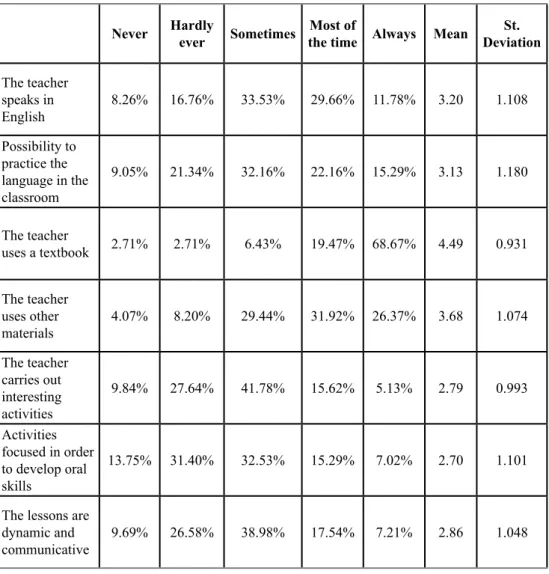
(7) Virginia Vinuesa Benítez and Ana Isabel Cid-Did. Does Methodology affect.... Variables such as their social, economic and cultural aspects, gender, the level of education of their parents and any extracurricular activities in English were not considered, as it was deemed that the data gathered did not permit for the individual calculation of each of the variables. 3.3. Data analysis: statistical methodology Statistical analysis was performed using the Statistical Package for the Social Sciences (SPSS) version 25.0. An initial basic descriptive analysis of the variables, frequency tables, means and standard deviation was conducted. To ascertain whether there was a relationship of dependency between the students’ perceived level of English proficiency - that is, if the participants considered it to be good or bad - and the other variables of the questionnaire, the analysis was carried out through contingency tables and the Chi square test of independence. Furthermore, given that the variables were ordinal, it was also possible to analyse the type of existing relationship between them – be they linear, positive or negative - by means of Kendall Tau-b, Kendall Tau-c and Gamma contrasts. The initial version of the questionnaire was validated by experts in the field and once the data was collected, the Cronbach’s alpha value was calculated for the variables related to the methodology used and of the perception to guarantee internal reliability. The reliability values obtained globally for this sample were considerably high (0.8). According to the results of Cronbach’s alpha coefficient, the questionnaire is considered to be reliable.. 4. Results. and discussion. Firstly, a descriptive analysis of the students participating in the survey was carried out in order to analyse their profile. In total, 100% of the students had studied English during primary and secondary school and 41% of the respondents had begun in preschool, signifying an average of over 12 years studying the subject. In addition, 59% of the respondents had been tutored privately or had additional support with an average duration of 2.72 hours per week, whilst 26% stated that they had taken courses overseas. To tackle issues concerning the methodology or the context of learning the English language, the variables that appeared in Table 1 were taken into account. All of the variables were ordinal qualitative in nature and they were measured on a Likert scale with five options: never, hardly ever, sometimes, most of the time and always. First, the frequencies, means and standard deviations of the seven variables were calculated. The results are as follows:. 157.
(8) Porta Linguarum. Nº 32, junio 2019. Table 1. Frequencies and descriptive statistics for methodology variables. Never. Hardly ever. Sometimes. Most of the time. Always. Mean. St. Deviation. The teacher speaks in English. 8.26%. 16.76%. 33.53%. 29.66%. 11.78%. 3.20. 1.108. Possibility to practice the language in the classroom. 9.05%. 21.34%. 32.16%. 22.16%. 15.29%. 3.13. 1.180. The teacher uses a textbook. 2.71%. 2.71%. 6.43%. 19.47%. 68.67%. 4.49. 0.931. The teacher uses other materials. 4.07%. 8.20%. 29.44%. 31.92%. 26.37%. 3.68. 1.074. 27.64%. 41.78%. 15.62%. 5.13%. 2.79. 0.993. 31.40%. 32.53%. 15.29%. 7.02%. 2.70. 1.101. 26.58%. 38.98%. 17.54%. 7.21%. 2.86. 1.048. The teacher carries out 9.84% interesting activities Activities focused in order 13.75% to develop oral skills The lessons are dynamic and communicative. 9.69%. We cannot fail to note the high score of the variable “the teacher always uses a textbook” with an average of 4.49 points out of 5 and with a standard deviation of 0.9. Close to 90% of students claimed that they always, or most of the time, used a textbook in class, as opposed to 60% who stated that they used other materials and tools in class apart from books. The mean of this variable is lower; 3.68 with a standard deviation of 1.074. Approximately 60% did not have the opportunity to practice the language on a regular basis and they were also not exposed to the target language by the teacher. Both variables have means of 3.13 and 3.2 respectively, with standard deviations of 1.18 and 1.108.. 158.
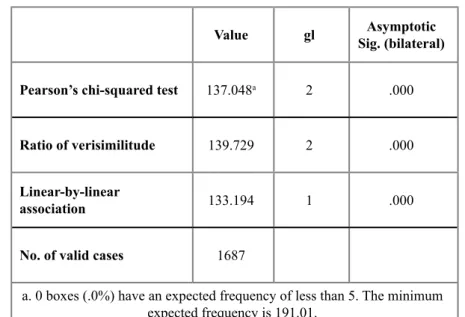
(9) Virginia Vinuesa Benítez and Ana Isabel Cid-Did. Does Methodology affect.... In the last three questions, more than 70% of the students stated that the teacher did not use interesting activities or those focused on developing oral skills, or that they did so only occasionally. These three variables represent a lower average score with values between 2.79 and 2.86. As for the participants’ perceived level of English proficiency, an initial analysis of the variables showed that 45% deemed it to be good, but it should be noted that 83.8% expressed the opinion that they should be more fluent in English after the relatively great length of time spent learning it. To analyse if there was a relationship of dependence between the students’ perceptions of their level of English, in other words, if students believed that it was good or bad, in addition to the other variables of the questionnaire, an analysis was performed using contingency tables and independence contrasts by applying the Chi-square test. The descriptive analysis demonstrates that the student’s perception of their level of English is very different depending on the frequency with which they have been exposed to the target language by the teacher. 73% of the students who never or hardly ever received lessons in English considered that their level was not good, whereas this percentage dropped to 39% in the case of those that were exposed always or most of the time to it. The Chi-square test revealed that there was a significant relationship between the student’s perception of their level of English and the fact that they received lessons in the target language. Table 2. Chi-square test to contrast the independence between the variables ” The teacher speaks English in the classroom and do you think your level of English is good?”. Value. gl. Asymptotic Sig. (bilateral). Pearson’s chi-squared test. 137.048a. 2. .000. Ratio of verisimilitude. 139.729. 2. .000. Linear-by-linear association. 133.194. 1. .000. No. of valid cases. 1687. a. 0 boxes (.0%) have an expected frequency of less than 5. The minimum expected frequency is 191.01.. 159.
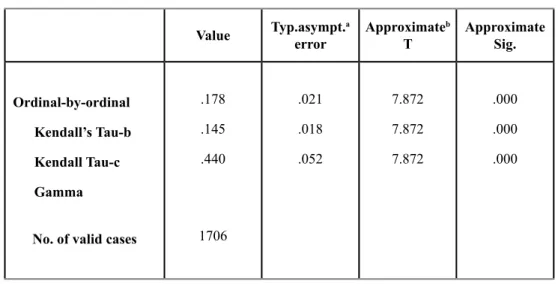
(10) Porta Linguarum. Nº 32, junio 2019. Table 3. Analysis of the consistency between the variables: “The teacher speaks English in the classroom, and do you think your level of English is good?” Asymmetric measures. Value. Typ.asympt.a error. Approximateb T. Approximate Sig.. Ordinal-by-ordinal. .178. .021. 7.872. .000. Kendall’s Tau-b. .145. .018. 7.872. .000. Kendall Tau-c. .440. .052. 7.872. .000. Gamma No. of valid cases. 1706. a. Assuming the alternative hypothesis b. Using typical asymptotic error based on the null hypothesis In addition, given that the variables are ordinal, it was also possible to analyse the type of existing relationship between them, be it linear, positive or negative. Considering that all of the critical levels in the Kendall Tau-b, Kendall Tau-c and Gamma contrasts are lower than 0.05, it can be said that the variables “the students’ perceived level of English” and “the teacher speaks English during the lessons” are dependant. The statistical value was positive, meaning that the greater the exposure to the language, the higher the perceived level, whereas those that had not been exposed with the same frequency believed their level was unsatisfactory. Another variable is the classroom activities, which was significantly correlated with English proficiency. The students’ perceived level of English, as proven by the Chi-square contrast, depends on whether the activities used were, never, hardly ever, sometimes, always or almost always designed to develop oral skills. Almost 67% of the students who never or hardly ever took part in activities designed to develop oral skills expressed the opinion that their level was substandard, in addition to indicating that they did not have the possibility to practise what they were learning. An identical percentage of students who always or almost always took part in communicative activities were of the view that they had a good level of English. The more communicative the activities, the higher they rated their own English proficiency. This implies that for the learners to be proficient in English, they need to practice spoken English on a regular basis (Makewa, Role & Tuguta, 2013).. 160.
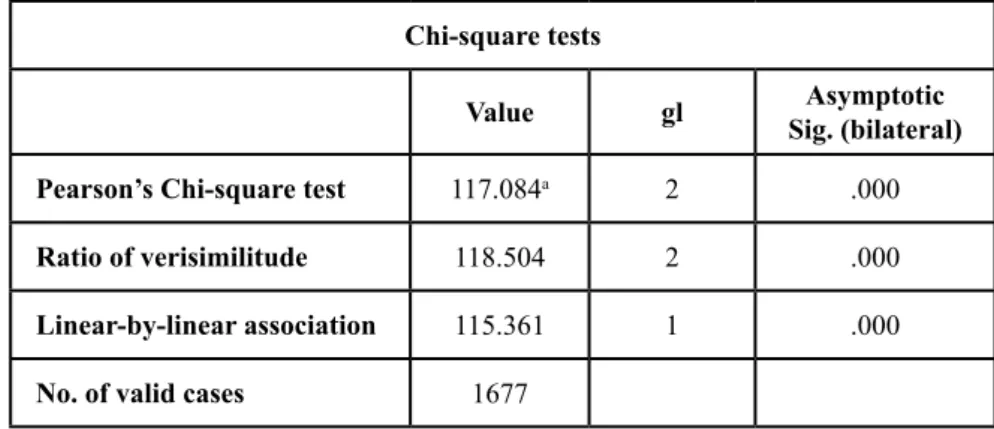
(11) Virginia Vinuesa Benítez and Ana Isabel Cid-Did. Does Methodology affect.... Table 4. Chi-square test to contrast the independence between the variables. ‘Do you think your level of English is good?’ and ‘Were the class activities focused on developing oral skills?’ Chi-square tests Value. gl. Asymptotic Sig. (bilateral). Pearson’s Chi-square test. 117.084a. 2. .000. Ratio of verisimilitude. 118.504. 2. .000. Linear-by-linear association. 115.361. 1. .000. No. of valid cases. 1677. a. 0 boxes (.0%) have an expected frequency of less than 5. The minimum expected frequency is 168.83. Finally, the contingency table that compares the students’ perception of how fluent they are also provides significant statistics. Although all of the participants believed that they ought to be able to speak English more fluently, those that did not take part in the activities designed to develop communication skills were slightly more aware of that. The Chi-square contrast concludes that in this case, both variables have a relationship of dependence. Table 5. Chi-square test to contrast the independence of the variables “fluency in English after the number of years of study and class activities focused on developing oral skills”. Chi-square tests Value. gl. Asymptotic Sig. (bilateral). Pearson’s Chi-square test. 15.193a. 2. .001. Ratio of verisimilitude. 14.236. 2. .001. Linear-by-linear association. 9.969. 1. .002. No. of valid cases. 1672. a. 0 boxes (.0%) have an expected frequency of less than 5. The minimum expected frequency is 59.69.. 161.
(12) Porta Linguarum. Nº 32, junio 2019. 5. Conclusion This study looked at the first year university students’ perception of their English level proficiency once they had finished secondary school and started their university studies. The research was accomplished using self-evaluation instruments to measure the students’ perceived level of English; the results are based on the students’ own report of the previously mentioned variables. In consequence, relying on just what students believe, regarding how they learnt the target language, may not be enough and this can be taken into account as a limitation. Through the research questions, we tried to find a correlation between the methodology used during the English lessons and the students perceived level. In line with previous studies (Coskun, 2016; Feng, 2013; Gökcan & Çobanoğlu Aktan, 2018, 2019; Gudo, 2015; Huang & Hu, 2016; Makewa, Role & Tuguta, 2013), our findings reveal that overall, exposure to the language, classroom activities and learning materials have an impact on the students’ perceived level in the foreign language. First, the students’ perceived level of proficiency in spoken English was average, but in general, many of the respondents believed that they should have a better command of the language after having studied it for an average period spanning twelve years. The factors such as being exposed to the target language or communicative activities have influenced their perception and they blame their lack of fluency on the very few occasions that they were presented with the opportunity to practice what they were learning. The more that they were exposed to the language, the better that they considered their level to be, whereas those that had not been exposed with the same frequency believed that their level was unsatisfactory. Exposure enables the learner to grasp the sounds of the language, thereby improving their pronunciation and their ability to express themselves in the English language, to allow them to eventually become more proficient. In a similar manner, the relationship between classroom activities and perceived level was also significant, since those that were not involved in dynamic activities were focused on developing language skills and had a higher awareness of their low performance. The more communicative the activities, the higher they rated their own English proficiency. This implied that for the learners to be proficient in English, they need to practice the language on a regular basis (Makewa, Role & Tuguta, 2013). Based on the results obtained after analysing the variables and despite this study being constructed based on the opinions and beliefs expressed by the participants, it would be advisable to adapt, as much as possible, the teaching practices to the interests and real needs of the students. This might have a positive impact on the teaching-learning process of a foreign language and might contribute to ensuring the better development of the students’ linguistic competence.. 6. References Achmad, D. and Yusuf, Y. Q. (2014). Observing Pair-work in an English Speaking Class. International Journal of Instruction, 7(1): 151-164.. 162.
(13) Virginia Vinuesa Benítez and Ana Isabel Cid-Did. Does Methodology affect.... Al-Hosni, S. (2014). Speaking difficulties encountered by young EFL learners. International Journal on Studies in English Language and Literature, 2(6): 22-30. Alobaid, M. (2017). Revisiting Comprehensible Input, Output Hypothesis and the Use of the L1 in the L2 Classroom. International Journal of Linguistics, 9 (6): 115-131. Alonso, A. Rosa, (2014). Teaching Speaking: An Exploratory Study in Two Academic Contexts. Porta Linguarum, 22:145-160. Baleghizadeh, S. and Arab, F. (2010). The impact of pair work on promoting noticing among EFL learners. The Southeast Asian Journal of English Language Studies, 17(1): 18-31. Basturkmen, H. (2010). Developing Courses in English for Specific Purposes. New York: Palgrave Macmillan Block, D. (2013). Issues in language and identity research in applied linguistics. Elia: Estudios de lingüística inglesa aplicada, 13(1): 11-46. Brown, P. and Levinson, S. (1987). Politeness: Some universals in language usage. Cambridge, MA: Cambridge University Press. Chen, R. (1993). Responding to compliments: A contrast study of politeness strategies between American English and Chinese speakers. Journal of Pragmatics, 20: 49-75. Chou, M. (2014). Assessing English vocabulary and enhancing young English as a foreign language (EFL) learners’ motivation through games, songs, and stories. Education 3-13, 42(3): 284-297. doi: 10.1080/03004279.2012.680899 Coskun, A. (2016). Causes of the” I Can Understand English but I Can’t Speak” Syndrome in Turkey. Journal on English Language Teaching, 6 (3): 1-12. Ellis, R. (2015). The importance of focus on form in communicative language teaching. Eurasian Journal of Applied Linguistics, 1 (2): 1-12. Feng, Z. (2013). A Study on the Perceptions of Secondary School Students regarding the Form-focused and Communication-focused English Instruction. English Linguistics Research, 2 (2):43-52. Gardner, R.C. (1982). Language attitudes and language learning, in E. Ryan and H. Giles (Eds.), Attitudes towards Language Variation (pp. 132-147), London: Arnold Publishers. Gardner, R. C. and Lambert, W. E. (1972). Attitudes and motivation in second language learning. Rowley, Mass.: Newbury House. Garton, S. and Graves, K. (2014). Materials in ELT: Current Issues, in S. Garton and K. Graves (Eds.). International Perspectives on Materials in ELT (pp.1-15). Basingstoke: Palgrave Macmillan. Gökcan, M. and Çobanoğlu Aktan, D. (2018). Investigation of the variables related to TEOG English achievement using Language Acquisition Theory of Krashen. Pegem Eğitim ve Öğretim Dergisi, 8(3): 531-566. Gökcan, M. and Çobanoğlu Aktan, D. (2019). Development of Exposure to English Scale and Investigation of Exposure Effect to Achievement. International Journal of Assessment Tools in Education. 6: 109-124. González Villarón, M. (2017). El inglés en educación obligatoria. Una mirada comparada a los casos de España y Holanda. Revista Española de Educación Comparada, 30: 61-76. Graves, K. (2000). Designing Language Course: A Guide for Teachers. Boston: Heinle and Heinle. Gudo, B.O (2015). Teaching Speaking Skills in English Language Using Classroom Activities in Secondary School Level in Eldoret Municipality, Kenya. Journal of Education and Practice, 6 (35): 55-63. Guerrettaz, A. M. and Johnston, B. (2013). Materials in the classroom ecology. Modern Language Journal, 97: 779-796.. 163.
(14) Porta Linguarum. Nº 32, junio 2019. Huang, X. and Hu, X. (2016). Teachers’ and Students’ Perceptions of Classroom Activities Commonly Used in English Speaking Classes. Higher Education Studies, 6: 87-100. Jacobs, G. M. and Kline, L. K. (1996). Integrating language functions and collaborative skills in the second language classroom. TESL Reporter, 29: 21-33. Ji, L., Zhang, Z. and Nisbett, R. E. (2004). Is it culture or is it language? Examination of language effects in cross-cultural research on categorization. Journal of Personality and Social Psychology, 87: 57-65. Jia, G. and Aaronson, B. (2003). A longitudinal study of Chinese children and 72 adolescents learning English in the US. Applied Psycholinguistics, 24: 131-161. Kazemzadeh, M. (2013). The Effect of Second Language Proficiency Level on the Output-Input Processing Sequence. International Journal of Linguistics, 5 (5): 253. Keck, C., Iberri-Shea, G., Tracy-Ventura, N. and Wa-Mbaleka, S. (2006). Investigating the empirical link between task-based interaction and acquisition, in J. Norris and L. Ortega (Eds.), Synthesizing research on language learning and teaching (pp. 91-131). Amsterdam: Benjamins. Khattak, Z., Abbasi, M., Jamshed, T. and Baig M. (2011). An Investigation into the causes of English language learning anxiety in students at AWKUM. Procedia-Social and Behavioral Sciences, 15: 1600-1604. Kim, D. D. and Margolis, D. (2000). Korean student exposure to English listening and speaking: Instruction, multimedia, travel, experience and motivation. The Korea TESOL Journal, 3:29-52. Krashen, S. (1985). The Input Hypothesis Issues and Implications. New York Longman. Lancaster, N.K (2018). Extramural Exposure and Language Attainment: The Examination of Input-Related Variables in CLIL Programmes. Porta Linguarum, 29: 91-114. Levine, D.R., Baxter, J., and McNulty, P. (1987). The culture puzzle: Cross-cultural communication for English as a second language. Englewood Cliffs, NJ: PrenticeHall Lu, Z., Hou, L. and Huang, X. (2010). A research on a student-centred teaching model in an ICT-based English audio-video speaking class. International Journal of Education and Development, 6(3): 101-123. Macaro, E., Handley, Z., and Walter, C. (2012). State-of the-art-article. A systematic review of CALL in English as a second language: Focus on primary and secondary education. Language Teaching, 45:1-43. Magno, C., de Carvalho, M., Lajom, A., Bunagan, K. and Regodon, J. (2009). Assessing the Level of English Language Exposure of Taiwanese College Students in Taiwan and the Philippines. Asian EFL Journal, 2: 62-73. Makewa, L. N., Role, E., and Tuguta, E. (2013). Students’ Perceived Level of English Proficiency in Secondary Schools in Dodoma, Tanzania. International Journal of Instruction, 6(2): 35-52. Marks, G. (2013). Education, Social Background and Cognitive Ability: the decline of the social New York: Routledge. Retrieved from: http://www.routledge.com/ books/details/9780415842464/ Masgoret, A. M. and Gadner, R. C (2003). Attitudes, Motivation, and Second Language Learning: A meta–analysis of Studies Conducted by Gardner and Associates. Language learning, 53(S1): 167-210. Masmaliyeva, L. (2014). Using affective effectively: Oral presentations in EFL classroom. Dil Ve Edebiyat Egitimi Dergisi, 2(10): 145-154. McGrath, I. (2002). Materials evaluation and design for language teaching. Edinburgh. UK: Edinburgh University Press. McGrath, I. (2013). Teaching materials and the roles of EFL/ESL teachers. London: Bloomsbury. McKay, S. (2010). English as an International Language, in N. H. Hornberger and S. L. McKay (Eds.), Sociolinguistics and language education (pp.89-113). Bristol: Multilingual Matters.. 164.
(15) Virginia Vinuesa Benítez and Ana Isabel Cid-Did. Does Methodology affect.... MECD (2012). Estudio Europeo de Competencia lingüística. Vol. I. Informe Español. Madrid: Instituto Nacional de Evaluación Educativa. Retrieved from http://www.educacionyfp.gob. es/inee/dam/jcr:4b869d66-f743-4394-9b9d-39007557a4ca/eeclvolumeni.pdf Moore, D. (2011). Effective instructional strategies: From theory to practice. Calif: SAGE Publications, Inc Motteram, G. (2011). Developing language-learning materials with technology, in B. Tomlinson (Ed.), Materials development in language teaching (2nd ed., pp. 303-327). Cambridge: Cambridge University Press. Munns, G., Zammit, K. and Woodward, H. (2008). Reflections from the riot zone: The Fair Go 5 Project and student engagement in a besieged community. Journal of Children and Poverty, 14(2): 157-71. Muñoz, C., and Tragant, E. (2001). Motivation and attitudes towards L2: Some effects of age and instruction”, in S. Forster-Cohen and A. Nizegorodcew (Eds.), Eurosla Yearbook (pp. 211–24). Amsterdam: John Benjamins. Muranoi, H. (2007). Output practice in the L2 classroom, in R. M. DeKeyser (Ed.), Practice in a second language: Perspectives from applied linguistics and cognitive psychology (pp. 51-84). Cambridge: Cambridge University Press. doi: 10.1017/CBO9780511667275.005 Nikolaou, A. (2010). Attitudes and motivation of Greek secondary pupils toward learning English, in A. Psaltou-Joycey and M. Mattheoudakis (Eds.), Advances in research on language acquisition and teaching: selected papers (pp. 349-361). Thessaloniki: Greek Applied Linguistics Association. Retrieved from http://www.enl.auth.gr/gala/14th/Papers/English%20 papers/Nikolaou.pdf Ochoa, C., Cabrera, P., Quiñónez, A., Castillo, L. and González, P. (2016). The Effect of Communicative Activities on EFL Learners’ Motivation: A Case of Students in the Amazon Region of Ecuador. Colomb. Appl. Linguist. J., 18(2): 39-48. Offredy, M. and Vickers, P. (2010). Developing a healthcare research proposal: an interactive student guide. UK: Wiley-Blackwell. Ortega, J.L. and Madrid, D. (2009). ¿Qué técnicas de comunicación oral valoran más los profesores y alumnos en la clase de inglés? Porta Linguarum, 12: 183-204. Oxford, R. L. (2011). Teaching and researching language-learning strategies. Harlow, UK Pearson Education. Schmidt, R. (2010). Attention, awareness, and individual differences in language learning, in W. M. Chan, S. Chi, K. N. Cin, J. Istanto, M. Nagami, J. W. Sew, T. Suthiwan, and I. Walker, Proceedings of CLaSIC 2010, Singapore, December 2-4 (pp. 721-737). Singapore: National University of Singapore, Centre for Language Studies. Schmidt, R. (2001). Attention, in P. Robinson (Ed.). Cognition and Second Language Instruction. Cambridge: CUP. Schmidt, R.W. (1990). The Role of Consciousness in Second Language Learning. Applied Linguistics, 11 (2): 129-158, https://doi.org/10.1093/applin/11.2.129 Suzuki, W., Itagaki, M., Takagi, T., and Watanabe, T. (2009). The effect of output processing on subsequent input processing: A free recall study. Applied Linguistics, 9(1), 1-17. Swain, M. (1985). Communicative Competence: Some roles of Comprehensible Input and Comprehensible Output in its Development, in S. Gass and C. Madden (Eds.), Input in second language acquisition (pp. 235-253). Rowley, MA: Newbury House. Swain, M. (1993). The output hypothesis: Just speaking and writing aren’t enough. The Canadian Modern Language Review, 50: 158-164.. 165.
(16) Porta Linguarum. Nº 32, junio 2019. Swain, M. (2000). The output hypothesis and beyond: Mediating acquisition through collaborative dialogue, in J. P. Lantolf, (Eds). Sociocultural theory and second language learning, pp. 97-114. Oxford: Oxford University Press. Talley, P.C. and Hui-Ling, T. (2014). Implicit and Explicit Teaching of English Speaking in the EFL Classroom. International Journal of Humanities and Social Science, 4 (6): 38-45. Tuan, L. (2012). An empirical research into EFL learners’ motivation. Theory and Practice. Language Studies, 2(3): 430-439. Tuan, N. H., and Mai, T.N. (2015). Factors Affecting Students’ Speaking Performance at LE Thanh High School. Asian Journal of Educational Research, 3(2): 8-23. doi:10.4304/ tpls.2.3.430- 439 Vinuesa, V. (2016). Aprendizaje de lenguas extranjeras: evolución metodológica y apuestas de futuro. Tesis doctoral. Universidad Rey Juan Carlos. Waithaka, J. M. (1987). A Handbook for teachers of English in secondary schools in Kenya. Kenya Institute of Education: Jomo Kenyatta Foundation. Wang, Y., Shang, H., and Briody, P. (2011). Investigating the impact of using games in teaching children English. International Journal of Learning and Development, 1 (1): 127-141. http://dx.doi.org/10.5296/ijld.v1i1.1118. 166.
(17)
Figure
Documento similar