
TítuloImpact of HIV infection on sustained virological response to treatment against hepatitis C virus with pegylated interferon plus ribavirin
12
0
0
Texto completo
(2) Introduction Until a few years ago, standard-of-care treatment against hepatitis C virus (HCV) infection was dual therapy with pegylated interferon (Peg-IFN) plus ribavirin (RBV). Currently, this combination continues to be the backbone for some of the first-line recommended regimens. In addition, it is still recommended in settings where direct-acting antivirals (DAA) are not available due to financial restrictions [1]. Rates of sustained virological response (SVR) to Peg-IFN plus RBV vary considerably according to host and virus-related parameters, such as IL28B genotype, grade of liver damage, baseline plasma HCV RNA concentration, and HCV genotype [2, 3]. It is widely accepted that human immunodeficiency (HIV) coinfection has a negative impact on SVR rates. This belief is based on response rates reported by the Peg-IFN registration trials and several cohort studies, where SVR rates among genotype 1, 2/3, and 4 carriers were in the range 42–46 %, 76–82 %, and 50–77 % in monoinfected patients [4, 5] and in the range 17–29 % and 44–62 % in genotype 1/4 and 2/3 in HIV/HCV-coinfected patients [6, 7], respectively. However, these studies followed different protocols and were conducted in different centers and the results are, thus, not comparable. To date, there are little data available on the impact on HIV infection on SVR to dual therapy coming from studies carried out in the same hospitals, where patients are followed by the same clinicians with a common management protocol. Even though dual therapy has lost importance with the arrival of DAA, the evaluation of the role of HIV infection in the response to antiviral therapy is a crucial step to understanding the singularities of the HIV/HCV-coinfected population. Additionally, it may contribute to optimizing treatment strategies in the era of DAA, where the impact of HIV infection is little studied. The aim of this study was to determine the impact of HIV infection on the response to combination therapy with Peg-IFN plus RBV in a single population.. Materials and Methods Study design This multicentric, prospective study was conducted between 2000 and 2013 at the infectious diseases units of five Spanish hospitals. Each hospital included all HCV-infected patients attending these units, regardless of whether they were HIV-coinfected or not, if the following criteria were met: (i) older than 18 years of age, (ii) naïve for HCV treatment, and (iii) started therapy with Peg-IFN plus RBV. Visits were scheduled at treatment week (TW) 0, 4, 12, and, when applicable, 24 and 48, as well as 24 weeks after the scheduled end of treatment in order to evaluate SVR. At each visit from TW12 onwards, HCV RNA levels were quantified and hematological parameters were determined. HCV RNA determinations at TW4 were included in the protocol after the identification of rapid virological response (RVR) as a predictor of response, and it is, therefore, not available in all patients. Dosing and treatment duration Patients were treated with Peg-IFN plus RBV according to the consensus statements in force during the respective treatment years [8, 9, 10, 11]. All subjects received Peg-IFN-α 2a 180 μg/week or Peg-IFN-α 2b 1.5 μg/kg/week. Oral RBV was administered twice daily according to body weight in those individuals infected with HCV genotype 1/4 or in HIV/HCV-coinfected with genotype 2/3 in a manner that patients weighing <75 kg received 1000 mg/day and patients weighing ≥75 kg received 1200 mg/day, whereas monoinfected patients with HCV genotype 2 or 3 infection received a flat dose of 800 mg of RBV. All patients with genotype 1 or 4, as well as.
(3) HIV/HCV-coinfected individuals with genotype 2 or 3 and without RVR, received therapy during a period of 48 weeks. All the remaining subjects harboring genotype 2 or 3 were treated for 24 weeks. Definition of response SVR was defined as undetectable HCV RNA levels 24 weeks after the scheduled end of therapy. RVR was defined as undetectable HCV RNA levels at TW4. Null response (NR) was assumed when the decline of HCV RNA levels at TW12 was <2 log 10 IU/mL, without reaching undetectability. A ≥2 log10 IU/mL drop in HCV RNA levels at TW12 without presenting undetectable HCV RNA levels at TW12 or TW24 was defined as partial response. Viral breakthrough was assumed at reappearance of HCV RNA levels at any time during treatment after having reached undetectability. Relapse was considered when HCV RNA was undetectable at the end of therapy but detectable at TW24 post-treatment. Laboratory determinations and definition of advanced liver fibrosis Plasma HCV RNA was determined by a quantitative polymerase chain reaction assay according to the available technique at each center and treatment period (Cobas Amplicor HCV Monitor v2.0, Roche Diagnostic Systems Inc., Branchburg, NJ, USA; detection limit: 600 IU/mL; Cobas TaqMan AmpliPrep/TaqMan Test System, Roche Diagnostic Systems Inc., Pleasanton, CA, USA; detection limit: 10 IU/mL; Abbott M2000 RealTime System, Abbott Diagnostic, Chicago, IL, USA; detection limit 12 UI/mL). Plasma HIV RNA was determined by an in vitro nucleic acid amplification test for the quantitation of HIV-1 RNA in human plasma (Cobas AmpliPrep/Cobas TaqMan HIV-1 Test v2.0, Roche, Mannheim, Germany). The HCV genotype was determined using the Versant HCV Genotype 2.0 Auto LiPA or AutoBlot 3000H (Siemens, Frimley, Camberley, UK). IL28B rs12979860 was genotyped from frozen whole blood samples according to the manufacturer’s instructions using the LightMix® Kit IL28B (TIB Molbiol, GmbH, Berlin, Germany) or TaqMan® Genotyping Assay for rs12979860 (Applied Biosystems, Foster City, CA, USA) in a StepOnePlus™ Real-Time PCR System (Applied Biosystems). Advanced fibrosis was defined as F3 or F4 according to liver biopsy [12] or a liver stiffness measurement ≥9.5 kPa [13] if biopsy was not available. Liver stiffness was determined using transient elastometry (Fibroscan, Echosens, Paris, France). Statistical analyses Descriptive statistics were conducted for the study population. Quantitative variables were described by the median [interquartile range (IQR)], whereas qualitative variables were expressed as number [percentage; confidence interval (CI)]. Chi-square or Fisher’s test were used for comparison of qualitative variables. The Student’s t-test or the Mann–Whitney U-test was applied to compare quantitative variables. The primary outcome variable was SVR and was evaluated in an intention-to-treat approach, with missing values considered as failures. Afterwards, an ontreatment approach, where patients who discontinued therapy due to adverse events, those who voluntarily dropped out, and those who were lost to follow-up were not included, was applied to identify predictors of SVR. Those variables associated with a p-value <0.2 in the univariate analysis were introduced in a multivariate logistic regression model to identify independent predictors of SVR. Data analysis was conducted using the SPSS statistical software package release 22.0 (IBM Corporation, Somers, NY, USA) and STATA 9.0 (StataCorp LP, College Station, TX, USA)..
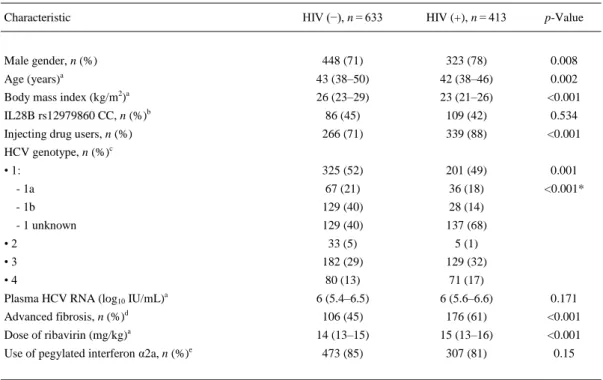
(4) Ethical issues All patients gave their written informed consent to participate in this study. Both the study design and performance complied with the Helsinki declaration and were approved by the local ethics committees of the participating study sites.. Results Study population A total of 1046 patients fulfilled the inclusion criteria. Of these, 413 (39 %) were HIVcoinfected. The median (IQR) age was 43 (38–48) years in the overall population and 771 (74 %) individuals were male. The proportion of patients with IL28B genotype CC among the 450 subjects with this determination available was 43 % (195 patients). Two hundred and thirty-six (40 %) out of 595 patients with these data available showed advanced fibrosis. HIV RNA at baseline was undetectable in 175 (74 %) out of 236 HIV/HCV-coinfected patients in which these data were available. All infectious diseases units of the participant hospitals included HCVmonoinfected and HIV/HCV-coinfected patients. The main baseline characteristics according to HIV coinfection are shown in Table 1.. Table 1. Baseline characteristics of the study population according to human immunodeficiency (HIV) infection status HIV (−), n = 633. HIV (+), n = 413. p-Value. 448 (71). 323 (78). 0.008. Age (years). 43 (38–50). 42 (38–46). 0.002. Body mass index (kg/m2)a. 26 (23–29). 23 (21–26). <0.001. IL28B rs12979860 CC, n (%)b. 86 (45). 109 (42). 0.534. Injecting drug users, n (%). 266 (71). 339 (88). <0.001. Characteristic. Male gender, n (%) a. HCV genotype, n (%)c • 1:. 325 (52). 201 (49). 0.001. - 1a. 67 (21). 36 (18). <0.001*. - 1b. 129 (40). 28 (14). - 1 unknown. 129 (40). 137 (68). •2. 33 (5). 5 (1). •3. 182 (29). 129 (32). •4. 80 (13). 71 (17). 6 (5.4–6.5). 6 (5.6–6.6). 0.171. Advanced fibrosis, n (%)d. 106 (45). 176 (61). <0.001. Dose of ribavirin (mg/kg)a. 14 (13–15). 15 (13–16). <0.001. 473 (85). 307 (81). 0.15. Plasma HCV RNA (log10 IU/mL)a. Use of pegylated interferon α2a, n (%)e. a. Median (interquartile range); available in b450 and c1026 patients; *p-value for the comparison between HCV subtype 1; fibrosis stage in biopsy F3 or F4 or liver stiffness ≥9.5 kPa if biopsy had not been carried out; eavailable in 594 individuals. d.
(5) Response to therapy In an intention-to-treat analysis, SVR was obtained in 515 (49 %) patients, while RVR was achieved in 145 (38 %) out of 378 subjects who had a determination of the viral load in TW4. According to HIV coinfection, SVR was achieved in 341 (54 %, 95 % CI: 50–58 %) of the HCVmonoinfected patients and in 174 (42 %, 95 % CI: 37–47 %) of the HIV/HCV-coinfected patients (p < 0.001). The corresponding figures for RVR were 86 (47 %, 95 % CI: 40–55 %) versus 59 (30 %, 95 % CI: 24–37 %; p < 0.001). Seventy (40 %) of the HIV-infected patients who presented undetectable HIV RNA versus 24 (40 %) of those with detectable HIV RNA achieved SVR (p = 0.975). CD4 cell counts were 488 (702–374) cells/mL in those HIV-infected patients who achieved SVR versus 517 (390–704) cells/mL in those who did not (p = 0.583). Sixty-three (6 %) subjects had partial response, 129 (12 %) subjects showed NR, 26 (2 %) subjects showed virological breakthrough (VB), and 153 (15 %) patients relapsed. The rate of discontinuation due to adverse events was 6 %, accounting for 66 subjects. The number of individuals who voluntary dropped out was 64 (6 %), and 36 (3 %) subjects were lost to follow-up. Treatment outcomes within the HIV/HCV-coinfected and the HCV-monoinfected subpopulations are shown in Fig. 1a. In an on-treatment analysis, 515 (58 %) patients obtained SVR. According to HIV coinfection, 341 (64 %, 95 % CI: 60–68 %) HCV-monoinfected and 174 (49 %, 95 % CI: 44–55 %) HIV/HCVcoinfected patients presented SVR (p < 0.001). Figure 1b shows the treatment outcomes observed within the on-treatment approach..
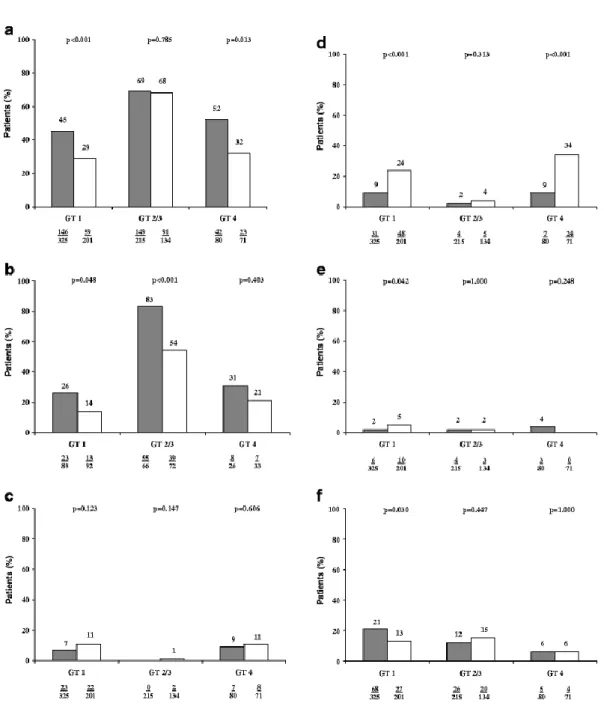
(6) Fig. 1. Treatment outcomes of therapy with pegylated interferon plus ribavirin in an intention-to-treat analysis (a) and an on-treatment approach (b). Gray bars: HCV-monoinfected patients; white bars: HIV/HCV-coinfected; SVR: sustained virological response; RVR: rapid virological response; VB: virological breakthrough; AEs: adverse events. The rates of SVR, RVR, partial response, NR, VB, and relapse according to HCV genotype and HIV infection in an intention-to-treat approach are depicted in Fig. 2. In an on-treatment analysis of the subpopulation of HCV genotype 1/4-infected individuals, the number of HCVmonoinfected patients who obtained SVR was 188/338 (56 %, 95 % CI: 50–61 %) versus 82/225 (36 %, 95 % CI: 30–43 %) of the HIV/HCV-coinfected patients (p < 0.001). Of the HCV genotype 2/3-infected individuals, 149/183 (81 %, 95 % CI: 75–87 %) and 91/121 (75 %, 95 % CI: 66– 83 %) HCV-monoinfected and HIV/HCV-coinfected patients showed SVR, respectively (p = 0.193). The rates of SVR according to HCV genotype 1 or 4 are shown in Fig. 3..
(7) Fig. 2. Intention-to-treat analysis of sustained virological response (a), rapid virological response (b), partial response (c), null response (d), virological breakthrough (e), and relapse (f) according to HCV genotype. Gray bars: HCV-monoinfected patients; white bars: HIV/HCV-coinfected patients; GT: genotype.
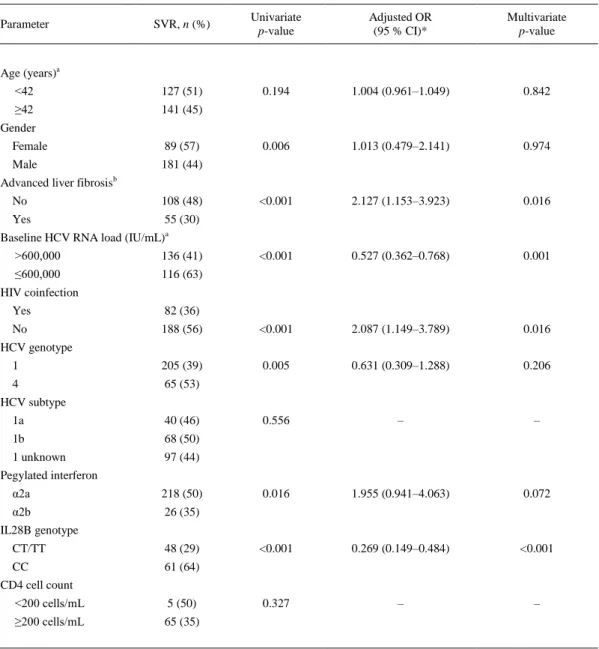
(8) Fig. 3. Rates of sustained virological response (SVR) according to HCV genotype in an intention-to-treat analysis (a) and an on-treatment approach (b). Gray bars: HCV genotype 1; white bars: HCV genotype 4. Predictors of response Given that HIV coinfection did not impact on the rates of SVR in HCV genotype 2/3-infected patients, subsequent analyses of possible confounders and interactions were limited to the HCV genotype 1/4-infected subpopulation. The results of the univariate and multivariate analyses are shown in Table 2. In a second multivariate analysis in which the variable advanced fibrosis was not included, absence of HIV coinfection was also independently associated with SVR [adjusted odds ratio (95 % CI): 1.927 (1.086–3.421); p = 0.025]..
(9) Table 2. Predictors of sustained virological response (SVR) in the univariate and multivariate analyses in the subpopulation of HCV genotype 1 or 4-infected patients (on-treatment analysis) SVR, n (%). Univariate p-value. Adjusted OR (95 % CI)*. Multivariate p-value. <42. 127 (51). 0.194. 1.004 (0.961–1.049). 0.842. ≥42. 141 (45) 0.006. 1.013 (0.479–2.141). 0.974. <0.001. 2.127 (1.153–3.923). 0.016. <0.001. 0.527 (0.362–0.768). 0.001. Parameter. Age (years)a. Gender Female. 89 (57). Male. 181 (44). Advanced liver fibrosisb No. 108 (48). Yes. 55 (30). Baseline HCV RNA load (IU/mL)a >600,000. 136 (41). ≤600,000. 116 (63). HIV coinfection Yes. 82 (36). No. 188 (56). <0.001. 2.087 (1.149–3.789). 0.016. 1. 205 (39). 0.005. 0.631 (0.309–1.288). 0.206. 4. 65 (53) 0.556. –. –. 0.016. 1.955 (0.941–4.063). 0.072. <0.001. 0.269 (0.149–0.484). <0.001. 0.327. –. –. HCV genotype. HCV subtype 1a. 40 (46). 1b. 68 (50). 1 unknown. 97 (44). Pegylated interferon α2a. 218 (50). α2b. 26 (35). IL28B genotype CT/TT. 48 (29). CC. 61 (64). CD4 cell count <200 cells/mL. 5 (50). ≥200 cells/mL. 65 (35). *OR odds ratio; CI confidence interval a Represented as a continuous variable in the multivariate analysis b Fibrosis stage in biopsy F3 or F4 or liver stiffness ≥9.5 kPa if biopsy had not been carried out.
(10) Discussion The results demonstrate that HIV coinfection negatively impacts on both SVR and viral kinetics in the first weeks of therapy with Peg-IFN plus RBV in subjects infected with HCV genotype 1 or 4. In patients with HCV genotype 2/3 infection, HIV does impair early viral kinetics during treatment, but, in spite of this fact, the rate of SVR is similar in HIV-coinfected and HIVuninfected patients. Although a negative impact of HIV on the outcome of HCV treatment with Peg-IFN plus RBV has been assumed for years, the present study shows this for the first time in a single population, followed with the same protocol care and with a large sample size. Also, this study shows that this effect is HCV genotype-dependent. Both HCV genotype 1 and 4-monoinfected patients showed significantly higher rates of SVR than those with HIV coinfection. The baseline characteristics were different for the two populations. Thus, the proportion of patients with advanced liver damage was higher in HIV/HCV-coinfected patients, which could potentially influence the response rates. However, in the multivariate analysis adjusted for advanced fibrosis, HIV was identified as an independent predictor of SVR along with well-known predictors such as IL28B genotype, advanced fibrosis, and baseline HCV RNA load. This observation is in accordance with the findings of a matchedcohort study conducted in 208 patients published by Tural et al. [14]. In contrast to that study, where a monoinfected population was compared to a coinfected population derived from different clinics, in the herein described work, HCV-monoinfected, as well as HIV/HCV-coinfected patients were contributed by the same hospitals and followed by the same clinicians. In the study published by Tural et al., a lower rate of response in TW12, end of treatment, and SVR in the subset of HCV genotype 1-infected individuals was reported. In contrast to the findings of the present survey, in the above-stated study, a significant difference in the rates of RVR was not detected in this subpopulation. The rates of RVR in HCV genotype 1-infected patients are generally low disregarding the HIV infection status. Thus, it is likely that the low sample size resulted in a lack of statistical power, whereas the sample size of the present study overcame this limitation. Although genotypes 1 and 4 were commonly considered as comparable regarding response to dual therapy, it has become clear in the last several years that both response rates, as well as predictors of response, are different for these genotypes [2, 15], which could be confirmed with the observation reported. The analysis of the impact of HIV coinfection in the HCV genotype 2 or 3-infected subpopulation revealed a different effect to that observed for HCV genotypes 1 and 4. In this context, HIV-coinfection primarily impacted on the rates of RVR in HCV genotype 2 or 3-infected individuals, while the rates of SVR did not differ according to the coinfection status. This fact could be because the longer treatment duration in genotype 3-infected patients was made up for the slower viral kinetics. Again, this finding is in accordance with observations from other studies [14, 16]. Interestingly, the suppression of HIV RNA had no influence on the achievement of SVR in the HIV-infected subpopulation. This is somewhat surprising, since it has been demonstrated that HIV infection does impact on the HCV viral load, a potent predictor of SVR, but that this effect is not observed when HIV RNA is undetectable [17]. The impact of HIV infection reported in this study was observed in both an intention-to-treat, as well in an on-treatment approach. This is an important finding since, due to comorbidities and drug–drug interactions, coinfected patients might have been prone to develop adverse events leading to treatment discontinuations. The rates of voluntary dropouts were similar in both groups, suggesting a similar motivation of the patients to undergo treatment and making adherence unlikely to have accounted for the results of this study. There was, however, a significant difference in the rate of null response, which reflects a lower sensitivity to interferon in HIVcoinfection, which is in accordance with the slower HCV RNA kinetics on treatment shown herein..
(11) In summary, we confirm in this direct comparison study that HIV coinfection is associated with lower SVR rates to Peg-IFN plus RBV in HCV genotype 1 or 4-infected patients. In contrast, there was no difference by HIV status in those patients with HCV genotypes 2 and 3, despite lower SVR rates in HIV-infected patients. Furthermore, it impacts on the viral kinetics during the first weeks of therapy in HCV genotype 2 or 3-infected individuals. This finding suggests that HIV coinfection may impair the sensitivity to interferon of HCV infection, which may have implications in explaining the immune response to HCV in HIV coinfection.. Acknowledgments This work was supported by the Red de Investigación en SIDA (ISCIII-RETIC RD06/006 and ISCIII-RETIC RD12/0017) and the Consejería de Salud of the Junta de Andalucía (grant numbers PI-0492/2012 and AC-0095-2013). K.N. is the recipient of a Miguel Servet research grant from the Instituto de Salud Carlos III (grant number CP13/00187). J.A.P. is the recipient of an intensification grant from the Instituto de Salud Carlos III (grant number Programa-I3SNS).. Conflict of interest A.C.-I. has received speaker honorarium from Janssen, Gilead, and AbbVie laboratories. She has lead consultation activities to AbbVie, Gilead, Janssen, and Merck laboratories, and has taken part as advisory committees to AbbVie, ViiH, and Janssen. K.N. has received lecture fees from Janssen-Cilag, Roche, Bristol-Meyers Squibb, and Merck Sharp & Dohme, and has received research support from Janssen-Cilag, Bristol-Meyers Squibb, Merck Sharp & Dohme, Gilead Sciences, and Abbott Pharmaceuticals. J.A.P. reports having received consulting fees from GlaxoSmithKline, Bristol-Myers Squibb, Abbott Pharmaceuticals, Gilead, Merck Sharp & Dohme, Schering-Plough, Janssen-Cilag, and Boehringer Ingelheim. He has received research support from GlaxoSmithKline, Roche, Bristol-Myers Squibb, Schering-Plough, Abbott Pharmaceuticals, and Boehringer Ingelheim, and has received lecture fees from GlaxoSmithKline, Roche, Abbott Pharmaceuticals, Bristol-Myers Squibb, Gilead, Merck Sharp & Dohme, Janssen-Cilag, Boehringer Ingelheim, and Schering-Plough. A.R. has received consultancy fees from Abbott Laboratories, Bristol-Myers Squibb, Boehringer Ingelheim, ViiV Healthcare, and Gilead Sciences. M.D.M. has received speaker and/or consulting fees from Gilead Sciences, Bristol, Janssen, and AbbVie. J.M. has been an investigator in clinical trials supported by Roche, Bristol-Myers Squibb, and Abbott Pharmaceuticals. He has received lecture fees from Roche, Gilead, Boehringer Ingelheim, and Bristol-Myers Squibb, and consulting fees from Boehringer Ingelheim, Bristol Myers-Squibb, and Merck Sharp & Dome.. Ethical approval All procedures performed in studies involving human participants were in accordance with the ethical committee of Valme Hospital and with the 1964 Helsinki Declaration and its later amendments or comparable ethical standards.. Informed consent Informed consent was obtained from all individual participants included in the study..
(12) References 1. World Health Organization (WHO) (2014) Guidelines for the screening, care and treatment of persons with hepatitis C infection. Available online at: http://apps.who.int/iris/bitstream/10665/111747/1/9789241548755_eng.pdf?ua=1&ua=1. Accessed October 2014 2. Neukam K, Camacho A, Caruz A et al (2012) Prediction of response to pegylated interferon plus ribavirin in HIV/hepatitis C virus (HCV)-coinfected patients using HCV genotype, IL28B variations, and HCVRNA load. J Hepatol 56:788–794 3. Pineda JA, Caruz A, Di Lello FA et al (2011) Low-density lipoprotein receptor genotyping enhances the predictive value of IL28B genotype in HIV/hepatitis C virus-coinfected patients. AIDS 25:1415–1420 4. Fried MW, Shiffman ML, Reddy KR et al (2002) Peginterferon alfa-2a plus ribavirin for chronic hepatitis C virus infection. N Engl J Med 347:975–982 5. Manns MP, McHutchison JG, Gordon SC et al (2001) Peginterferon alfa-2b plus ribavirin compared with interferon alfa-2b plus ribavirin for initial treatment of chronic hepatitis C: a randomised trial. Lancet 358:958–965 6. Torriani FJ, Rodriguez-Torres M, Rockstroh JK et al (2004) Peginterferon alfa-2a plus ribavirin for chronic hepatitis C virus infection in HIV-infected patients. N Engl J Med 351:438–450 7. Carrat F, Bani-Sadr F, Pol S et al (2004) Pegylated interferon alfa-2b vs standard interferon alfa-2b, plus ribavirin, for chronic hepatitis C in HIV-infected patients: a randomized controlled trial. JAMA 292:2839–2848 8. Soriano V, Sulkowski M, Bergin C et al (2002) Care of patients with chronic hepatitis C and HIV coinfection: recommendations from the HIV-HCV International Panel. AIDS 16:813–828, Review. 9. [No authors listed] (2002) NIH Consensus Statement on Management of Hepatitis C: 2002. NIH Consens State Sci Statements 19:1–46, Review 10. Guideline of the European Association for the Study of the Liver (EASL) (2014) Home page at: http://www.easl.eu. Accessed October 2014 11. Guideline of the European AIDS Clinical Society (EACS) (2014) Home page at: http://www.eacsociety.org/. Accessed October 2014 12. Scheuer PJ (1991) Classification of chronic viral hepatitis: a need for reassessment. J Hepatol 13:372–374 13. Castéra L, Vergniol J, Foucher J et al (2005) Prospective comparison of transient elastography, Fibrotest, APRI, and liver biopsy for the assessment of fibrosis in chronic hepatitis C. Gastroenterology 128:343– 350 14. Tural C, Galeras JA, Planas R et al (2008) Differences in virological response to pegylated interferon and ribavirin between hepatitis C virus (HCV)-monoinfected and HCV-HIV-coinfected patients. Antivir Ther 13:1047–1055 15. Mira JA, Rivero A, de Los Santos-Gil I et al (2012) Hepatitis C virus genotype 4 responds better to pegylated interferon with ribavirin than genotype 1 in HIV-infected patients. AIDS 26:1721–1724 16. Odolini S, Amadasi S, Cerini C et al (2014) Sustained virological response to peginterferon therapy in patients infected with HCV (genotypes 2 and 3), with or without HIV. BMC Infect Dis 14:S4 17. Neukam K, García-Rey S, Cifuentes C et al (2012) HIV-coinfection leads to a modest increase in plasma HCV-RNA load in patients with chronic HCV infection. Antiviral Res 95:212–215.
(13)
Figure


+2
Documento similar