
TítuloHedging in Academic Texts: a Cross Linguistic Comparison between English and Galician
45
0
0
Texto completo
(2)
(3) TABLE OF CONTENTS. Abstract.......................................................................................................................................1 1. Introduction.............................................................................................................................2 2. Literature review.....................................................................................................................4 3. Data and methods..................................................................................................................16 4. Analysis and discussion........................................................................................................20 4.1. Cross-linguistic comparison.....................................................................................20 4.1.1. Reader-oriented hedges..............................................................................22 4.1.2. Content-oriented hedges.............................................................................26 4.1.2.1. Writer-oriented hedges...............................................................27 4.1.2.2. Accuracy-oriented hedges..........................................................29 4.2. Gender comparison...................................................................................................32 5. Conclusion............................................................................................................................34 Works cited................................................................................................................................37 Appendix 1................................................................................................................................42.
(4) Abstract This final dissertation offers an approach to the concept of hedging and its socio-pragmatic implications with three different aims. First, it attempts to shed some light on this linguistic strategy, whose ubiquitous presence in both oral and written contexts may still go unnoticed by most people. Secondly –and mainly, given the line of research that has been chosen for this end of degree project–, it aims at carrying out a quantitative and qualitative cross-linguistic comparison between English and Galician regarding hedging in the particular field of academic writing, while simultaneously providing the reader with some insight into how this phenomenon shows up in the second language –where it has hardly been studied. Lastly, this study tries to test whether the repeated claim that women hedge more than men is verified within the compiled corpus of study and whether the figures in terms of gender differences in attenuation are similar for both languages. KEY WORDS: Hedging, pragmatic competence, academic writing, corpus-based study, cross-linguistic comparison, English, Galician, discourse communities, gender.. 1.
(5) 1. INTRODUCTION Although the concept of hedging has been in continuous use and development since George Lakoff first coined it in 1973, it is likely to remain one of the greatest strangers within the field of language studies –to the extent that this first sentence contains a common hedging strategy the reader may have not noticed. One of the reasons for this lack of awareness appears to be connected with the multiplicity of definitions and approaches hedges have been through over the last decades, which makes its study rather difficult from a theoretical point of view. In fact, Murphy (2010) asserts that “through extension the concept has lost some of its clarity and sometimes seems to have reached a state of definitional chaos” (p. 49), leading to a situation in which “the term is [even] used to describe absolutely contradictory concepts” (Sanderson, 2008, p. 96). One way or another, hedges, also known as downtoners (Quirk, Greenbaum, Leech & Svartvik, 1985), attenuators (Briz & Estellés, 2010), downgraders (House & Kasper, 1981) or weakeners (Brown & Levinson, 1987), are, broadly speaking, strategies or devices that help a speaker distinguish facts and data from evaluation, qualification and opinion. Compare the following examples: (a) Dolphins are more intelligent than dogs. (b) I think that dolphins may be generally more intelligent than dogs.. Obviously, the sentences in (a) and (b) are rather different from each other, even if they appear to convey the same information: (a) constitutes a categorical claim where little or no room for negotiation is left on the side of the receiver; (b) is a largely hedged proposition –it comprises up to three attenuating strategies– by which a speaker tries to cautiously present her/his non-factual point of view. As may be intuitively deduced from these examples, and in line with my previous definition, hedges can be generally described as “communicative strategies for […] reducing the force of statements” (Hyland, 1998a, p. 1) or, more 2.
(6) specifically, as “forms which blur, make fuzzy or vague the meaning of certain forms in order to downtone or soften assertiveness” (Murphy, 2010, p. 49). Following the very line of research chosen for the present undergraduate dissertation, this study will revolve around the idea of hedging to carry out a cross-linguistic comparison between English and Galician. Accordingly, it will mainly attempt to discover possible differences and similarities, from both a quantitative and a qualitative point of view, between the ways in which scholars belonging to the Galician and the English academia use attenuators. Therefore, academic language will be, as explained in the following section, the locus of the study, which will specifically focus on the domain of linguistics. Secondly and somewhat secondarily, this paper will try to elucidate whether the gender differences that are commonly signalled regarding hedging (see Newman, Groom, Handelman & Pennebaker, 2008) can be confirmed within the aforementioned context and whether there is significant variation between languages on this matter. In both cases, a corpus of academic texts in English and Galician will serve as the basis to perform the proposed analyses. On the other hand, whereas the study of hedging in English has become a recurrent topic of study in relation to many different contexts throughout the last decades, it does not apparently exist any direct approach to mitigation as an independent category among the increasingly numerous studies about the Galician language. Even considering the latter as one of the varieties into which the (Galician-)Portuguese linguistic system can be divided, the studies on hedging already existing for this language –eg. Bentes, Ferreira-Silva and Mariano (2013); Gomes (2013)– hardly ever cope with academic language and, in any case, may not be applicable to the idiosyncrasies of the smaller Galician academic community, probably much more influenced by the Spanish academia in general terms. Therefore, although I do not intend to offer an exhaustive study about linguistic mitigation in Galician –especially due to the constraints in length of a piece of research of this nature–, this final dissertation will 3.
(7) attempt to fill the gap existing in this language to some extent. All these main aims will be principally covered in section 4 below, where the results obtained from the analysis of the aforementioned corpus will be studied and accounted for. Prior to that, section 2 will focus on the state of the art concerning hedging to introduce how the general vision on this ubiquitous strategy has evolved over the decades and for which purposes its different manifestations are considered to be used. For its part, section 3 will be dedicated to describe both the data that will serve as a basis for the analysis and the methodology which will be followed in section 4. Finally, section 5, in the form of the conclusion of the paper, will act as a summary of all the results previously presented and will simultaneously try to suggest some potential research areas to be investigated in the future.. 2. LITERATURE REVIEW As has been said, it was Robert Lakoff (1973) who first introduced the notion of hedging. He was interested in the way “natural language sentences will very often be neither true, nor false, nor nonsensical, but rather true to a certain extent and false to a certain extent, true in certain respects and false in other respects” (p. 458). Lakoff particularly focuses his study on category membership: according to him, there are central and peripheral members for each imaginable group, as he exemplifies with birds –robins, for example, would be birds, whereas penguins would be only sort of birds (p. 471). In this context, Lakoff sees hedges as particles which help speakers express the degree to which a particular reality belongs to a certain category; “words whose job is to make things fuzzy or less fuzzy” (p. 471). As Skelton (1988) claims: It is by means of the hedging system of a language that a user distinguishes between what s/he says and what s/he thinks of what s/he says. Without hedging, the world is purely propositional, a rigid (and rather dull place) where things either are the case or are not.. 4.
(8) With a hedging system, language is rendered more flexible and the world more subtle (p. 38).. At the same time, Lakoff already hints that the interpretation of this rhetoric strategy is, as will be seen, “dependent on context and that the effect of hedging is a pragmatic and not a semantic phenomenon” (Fraser, 2010, p.17). From that moment on, a wider, socio-pragmatic approach has been thus adopted in relation to hedging. A great number of general studies on the phenomenon have followed Lakoff’s, and some of them have been recurrently mentioned when explaining the theoretical history of this device. For example, Brown and Levinson (1978), profoundly influenced by Lakoff, define hedging as a “particle, word or phrase that modifies the degree of membership of a predicate or noun phrase in a set” (p. 145) and that indicates that the speaker is not adhering to at least one of the conversational maxims established by Grice (1975). 1 Prince, Frader and Bosk (1982) already distinguish between two types of hedges: shields, which are used for “blurring speakers commitment to the truth of the proposition conveyed” (Alonso, Alonso & Torrado, 2012, p. 51), and approximators, by which the proposition itself is hedged –i.e. “the extent to which it is true is stated” (Skelton, 1998, p. 38). For his part, Hubler (1983) draws a similar distinction, this time between hedges (approximately corresponding to Prince’s shields) and understatements (which aim at modifying the propositional content). Already in the nineties, Caffi (1999) distinguishes between bushes (Prince’s approximators), hedges (Prince’s shields) and shields (used to attribute a belief “to someone other than the speaker” [Kaltenböck, Mihatsch & Schneider., 2010, p. 5]), whereas Hyland’s different studies on hedging within academic discourse turn out to be particularly useful for the purposes of this dissertation. In fact, this latter author’s definition of hedges already presented in section 1 is 1. There are four Gricean maxims: quantity (to be as informative as possible), quality (to be truthful and not to say what is not supported by evidence), relation (to be relevant, to say only what is pertinent at every moment) and manner (to be brief and ordered, and to avoid obscurity and ambiguity).. 5.
(9) particularly suitable for the purposes of this study because it restricts the range of expressions that can act as hedges to those that “reduce” or “downtone” a claim for propositional truth. As a consequence, attenuators must be obviously distinguished from unqualified propositions or categorical assertions and, less obviously, from other devices of metadiscoursal comment such as boosters.2 In this line, as Fraser (2010) says, “the notion of reinforcement, initially considered a part of hedging, has pretty much been laid aside” (p. 22). That word, reinforcement, is certainly appropriate to define boosters, since they are strategies that “allow writers to express conviction and assert a proposition with confidence” (Hyland, 1998a, p. 2), normally “to convey the author's interpretation as self-evident or as a generally accepted idea” (Serholt, 2012, p. 15). Therefore, markers such as clearly, obviously and of course will not be considered here as hedges, for these, as the literal meaning of the word indicates –a hedge refers to a ‘fence’, a ´defence’ or a ‘boundary’3–, always suppose the weakening of a claim “through an explicit qualification of the [speaker or] writer’s commitment” (Hyland, 1998a, p. 4). Over time, the concept of hedging has been thoroughly analysed in regards with casual conversation, where attenuators constitute a common feature and are deemed as markers of vagueness (see Channel [1990], Albelda [2010]). In this context, downtoners are commonly expressed through auxiliary verbs, epistemic adjectives, adverbs and lexical verbs, such as I guess, maybe or sort of (Hyland, 1998b, p. 3), and represent “a significant interpersonal and facilitative communicative resource for speakers” (p. 9) –even necessary to “guarantee […] the possibility of coexistence” (Salager-Meyer, 1995, p. 141). Some authors, like Serholt (2012), have associated the use of hedges in spoken discourse with powerless language (p. 3), but, as Channel (1990) affirms, “vagueness in language is neither all ‘bad’ nor all ‘good’. What matters is that vague language is used appropriately –depending on the situation and the 2. Hedges have a metadiscoursal function because they make comments on what is being said or written (see Geisler, 1994).. 3. Skelton (1988) repeatedly laments the pejorative connotations of the term (p. 38).. 6.
(10) linguistic context” (p. 2). All the same, it is in the field of academic writing that the study of these devices has probably provided us with the most interesting results regarding their use. The reason for this is bound to be related to the fact that “the greater the colloquialism, [...] the lesser the attenuative activity,” and, therefore, a more formal situation will imply both “a bigger control over what is produced and, consequently, a greater frequency of attenuation strategies and tactics” (Briz, 2013, free translation of p. 293). Although Briz’s claim about the frequency of hedges in academic discourse seems debatable –Hyland (1996), for example, declares that hedging in casual conversation “is perhaps twice as frequent as in written discourse” (p. 23)–, that “bigger control over what is produced” he talks about is what makes academic writing a particularly suitable scenario for studying this phenomenon. Accordingly, in spite of the ideas of objectivity, impersonality, neutrality and factuality which the concept of scholarly communication often triggers –for the very reason that its main purpose is to convey facts or factual information (Sanderson, 2008, p. 92)–, academic texts are “written with a particular audience in mind and will, like any other text, contain the author's interpretations of the research results” (Serholt, 2012, p. 2). That is why, in the words of Sanderson (2008): One of the most interesting features of academic discourse is the tension between the impersonality traditionally regarded as characteristic of the scholar, and the personal identity, transmitted through writing, which is inseparable from each academic author (p. 91).. It comes then as no surprise that hedging, inherently related to the writer-reader relationship – as will be seen–, is "central to the process of weighing fact and evaluation, which is at the heart of academic writing" (Milton & Hyland 1999, 147), up to the point that “the ability to hedge statements is essential to academic success” (Hyland, 1995, p. 39). Whereas some 7.
(11) authors have signalled these epistemic elements as unnecessary or even undesirable (see Bolsky [1988]), the predominant view in the last decades has been to regard “the connotations of [...] imprecision hedging conveys in academic discourse as useful and appropriate” (Musa, 2014, p. 2). In fact, the ubiquitous presence of hedging in this area is now often seen as part of its own codes or conventions, together with features such as objectivity, clarity or intertextuality (see Irvin [2010], Bowker [2007]). Within academic discourse, briefly defined by Irvin (2010) as “a carefully arranged and supported presentation of a viewpoint” (p. 9),4 hedges can be specifically considered as strategies that imply “that a statement is based on plausible reasoning rather than certain knowledge, and allow readers the freedom to dispute it” (Hyland, 1998a, p. 4). Even through it is true attenuators can be also connected with fuzziness or vagueness in this context, the common vision of downtoners as strategies for saying less than what one means is way too simplistic; in fact, although the level of truth they convey is commonly blurred, hedged statements usually express “exactly what the author means, saying no more than is warranted by available evidence” (Hyland, 1998b, p. 1). Therefore, vagueness indeed provides in this sphere a more accurate representation of reality. What is central to the concept is then “an unwillingness to make an explicit and complete commitment to the truth of propositions” (Hyland, 1998b, p. 3), often because the claim itself may be subject to debate. As a consequence, epistemic modality, which “indicates the speaker’s confidence, or lack of confidence in the truth of the proposition expressed” (Coates, 1987, p. 112), becomes an inescapable aspect within the study of these phenomena: “items are only hedges in their epistemic sense” (Hyland, 1998b, p. 5) and when they are concerned with toning down judgements, normally in relation to lack of knowledge. Nevertheless, the indication of the commitment to the truth value of a premise is not the only aim with which hedging is used in academic writing. Briz and Estellés (2010), for 4. For more information on what is understood by academic writing, see Irvin (2010).. 8.
(12) example, state that the main function of this strategy is to “get other people’s agreement or acceptance (including social acceptance)” (p. 290). In this sense, hedging is “a strategic mechanism of linguistic distance and, at the same time, of social approximation of the message: linguistically, attenuation means distance; socially, it means approximation” (Briz, 2013, free translation of p. 286). We thus have to also think of hedging as an important participant within the social negotiation of knowledge. By convincing readers of the adequacy and accuracy of their claims with the help of the aforementioned social approximation, writers manage “to gain community acceptance for their work as a contribution to disciplinary scholarship and knowledge” (Hyland, 1998a, p. 3). Hedges are in this sense rhetorical means of persuasion. On the other hand, Wallwork (2011) points at two similar reasons for hedging: “to anticipate (i.e predict) possible objections to your claims” and “to criticize the work of other authors in a constructive manner” (p. 132) –i.e. to reduce the risk the writer runs when expressing a strong assertion (Kaltenböck et al., 2010, p. 1). Both motives, dependent on external agents, are precisely associated with the other function that has been commonly attributed to hedges: that of interpersonal rhetorical strategies. It is essential to understand the web of social relationships that are constructed through academic writing in order to fully comprehend the phenomenon of hedging. Hyland (1996), probably the scholar who has most thoroughly analysed mitigation and its importance within the academic sphere, certainly agrees with Briz and Wallwork and presents hedging as a basic element of argumentation when it comes to introducing new propositions pending ratification: Readers can always refute a claim. All statements require ratification and because readers are guarantors of the negatability of claims this gives them an active and constitutive role in how writers construct them. This is why mitigation is central to academic writing, as hedging signals the writer’s anticipation of the opposition to a proposition (p. 5).. What is more, Hyland (1998a) does point at the writer-reader relationship as the other nucleus 9.
(13) attenuating strategies revolves around: according to him, hedges “draw attention to the fact that statements don’t just communicate ideas, but also the writer’s attitude to them [–her/his commitment to the truth of a proposition–] and to readers” (p. 3). Regarding the latter, two different perspectives must be considered: through tentativeness –or, to put it in other words, by avoiding unproven categorical claims–, writers try both to reach their audience’s agreement (Briz’s assertion) and to prevent any possible criticism from it (Wallwork’s). At the same time, and especially within scientific writing, they also employ hedges to minimise the potential threat new claims may suppose to other authors (Myers, 1989). To sum up, downgraders are used “to make room for negotiation and discussions with peers” (Chek and Miin-Hwa, 2015, p. 604). In this sense, hedging in academic discourse, regarded as a “linguistic strategy used to avoid sounding too authoritative and direct” (Murphy, 2010, p. 49), intrinsically correlates with the concept of politeness. That is why mentions to Barry and Levinson’s (1978) seminal work on the relationship between both concepts, based on Goffman’s (1967) definition of face, are commonplace throughout studies on hedging. Even though the authors’ vision of mitigation as primarily serving politeness goals has been mostly abandoned –specially within academic discourse, where, as we have seen, hedges also indicate the reliability of a claim–, modern scholars still recur to this theory to explain the interpersonal side of attenuation. In this context, we understand face as “the positive social value a person effectively claims for himself by the line others assume he has taken during a particular contact” (Goffman, 1967, p. 5). As a consequence, negative face refers to the need not to be imposed upon, while positive face is “the need to be liked and admired” (Murphy, 2010, p. 53). According to Barry and Levinson (1978), hedging, included as one of the ten strategies for face protection they cope with in their study, is a “primary and fundamental method of disarming routine interactional threats” (p. 146). 10.
(14) Accordingly, concerning politeness, hedges can be used both to indicate that writers do not want to impose their views on readers or peers and to cautiously limit their responsibility for the presented claims –that is, respectively as de-intensifying and self-protective elements. Briz and Estellés (2010) refer to these two objectives as prevention and protection, and go further to suggest a third politeness-driven reason for attenuation: the function of healing or “repairing actions that have previously damaged the other’s face or have invaded his space” (p. 291). Therefore, within the theoretical framework of face-saving, and as Brown and Levinson had anticipated, hedging is seen as “a form of politeness conceptualised as strategic conflict avoidance” (Hyland, 1998b, 49) –i.e. as “a negative politeness strategy” (Musa, 2014, p. 6) or a method to dodge face-threatening acts, which are, according to Holmes (1995), “utterances which could be interpreted as making a demand or intruding on another person's autonomy” (p. 5). In short, hedging is fundamentally used in academic discourse on the basis of three different pragmatic motivations: “the desire on the part of the researchers to make claims accompanied by some degree of uncertainty, the need to prevent any future criticism capable of damaging their image, and an attempt to gain reader acceptability [–and to prevent their criticism–] by presenting facts as tentative” (Musa, 2014, p. 13). In other words, “the hedging phenomenon looks in three directions: towards the proposition, towards the writer and towards the reader” (Poveda, 2007, p. 142). In addition to these, Salager-Meyer (1995) comments on a certainly important –and often overlooked– reason for the adoption of mitigating strategies: adhering to community norms or conventions. As she claims, “a certain degree of hedging has become conventionalised” in such a way that attenuators can be sometimes used “simply to conform to an established writing style” (p. 131). Nonetheless, it will not be always possible to undoubtedly state which of these functions a particular hedge is fulfilling, “nor need we assume that the authors of hedged utterances always know why they 11.
(15) hedge their statements in the first place” (Salager-Meyer, 1995, p. 131). This is because, as Poveda (2007) cleverly claims, “hedging is not an inherent characteristic of a text but rather a product of the communication between the writer and the reader” (p. 142). Consequently, the potential effect of a hedge is ultimately dependent on the context and on the interpretation of the utterance by the audience.5 Of all the models that have been proposed to classify or categorise mitigators, Hyland’s (1996) appears to be the one that best encompasses all the possible socio-pragmatic reasons for hedging that have been mentioned. The so-called polypragmatic model accounts in that way for “the multi-functional nature of hedging” (Musa, 2014, 9). Hyland primarily divides hedges into two categories: content- and reader-oriented. The first ones “concern a statement’s adequacy conditions: the relationship between a proposition and a representation of reality” (Hyland, 1996, p. 5), whereas reader-oriented hedges, the ones connected with the interpersonal dimension of mitigation, “make room for negotiation and discussion with peers” (Chek and Miin-Hwa, 2015, p. 604). Content-oriented hedges are further split into two kinds according to the underlying reason behind the modification of the proposition: accuracyoriented hedges have to do with the precision of the claim, whereas writer-oriented ones are useful for “opening the door for debate without making a personal commitment” (Chek and Miin-Hwa, 2015, p. 603). Finally, accuracy-oriented hedges can be divided again depending on whether they “involve a qualification of predicate intensity” (Hyland, 1996, p. 6), in which case they are called attribute hedges, or they indicate authorial confidence –the so-called reliability hedges. Due to its great adaptability to academic discourse, this model will be used in the analysis presented in section 4. Other classifications, such as Martín-Martín’s (2008), who distinguishes the strategies of indetermination, subjectivisation and depersonalisation, will also be considered and mentioned when suitable. 5. As Holmes (1990) says in order to illustrate the importance of a contextual analysis to fully understand hedging, “linguistic forms are complex and the functions they express cannot be identified in a social and textual vacuum” (186).. 12.
(16) Needless to say, the question of the how still has to be addressed. Whereas we may be tempted to think of a large group of linguistic items as constituting the discrete set from which hedges can be chosen, “rhetoric attenuation can be formalized through multiple mechanisms which sometimes even include grammatical and syntactic aspects” (Poveda, 2007, p. 140). Endless lists of potential hedges can be found here (Hyland 1998b) and there (Fraser, 2010), but the words and expressions they include do not always coincide and may even appear to be contradictory at times. The explanation for this is directly related to the previously mentioned impossibility to attribute a particular function to a hedging strategy on the exclusive basis of semantics: If hedging is the result of a mental attitude [...], and therefore a subjective phenomenon which functions in a particular context, it is no surprising that [...] there is so little agreement –among those who seek to establish the category– on which lexical items, phrases or syntactic structures should be classed as hedges (Martín-Martín, 2008, p. 137).. That is mainly why Graefen calls attenuation a “pseudo-category” (as cited in Sanderson, 2008, p. 98). As a result, “any list or categorisation of such disparate devices remains highly subjective and therefore does not lend itself to application in further studies” (Sanderson, 2008, p. 98). Of course, some usual means of attenuation can be stood out in spite of this generalised relativism. Modal verbs (may, might, can...) are usually regarded as the most common mitigating strategy, followed by epistemic verbs (like suggest), semi-auxiliaries (such as seem), verbs of cognition (believe or think), modal adverbs, adjectives and nouns (perhaps, assumption, likely...), or approximators (approximately, generally…). Other common tactics include the use of agentless passives, first person pronouns (signalling an opinion) or “impersonal active constructions in which the personal subject is replaced by some non-human entity such as findings, results, data…” (Martín-Martín, 2008, p. 139), among many others. 13.
(17) Moreover, it may be surprising to discover the significant attention hedging has received in relation with the learning of English as a second language (see Alonso et al. [2012], Chek and Miin-Hwa [2015], Hyland [2000], Neary-Sundquist [2013] or SalagerMeyer [1995]). The recurrence of such a specific field of study has, as could not be otherwise, a raison d’être: hedging is, as has been repeated, “one of the most important features of academic discourse” (Hyland, 2000, p. 1), and its appropriate use is thus determinant for a scholar to have access to international research communities dominated by English in his role of lingua franca. Nevertheless, it has been detected that learners of English as a foreign language are often unsuccessful when it comes to both interpreting and employing hedges. As Salager-Meyer (1995) explains, they “frequently tend to give the same weight to hedged (provisional or hypothetical) statements or interpretation than to accredited facts” (p. 137). Therefore, as could be expected, they commonly fail to appropriately hedge as well, reason why “they may be perceived as impolite, offensive [or] arrogant” (Fraser, 2010, p. 21), or may even “sound rather bookish and pedantic to a native speaker” (Channell, 1990, p. 21). As Chek and Miin-Hwa (2015) point out, the basis of the problem foreign learners face with hedges is that they do not only need to learn a foreign or second language, but its culture too, for “sociocultural and pragmatic rules in employing hedging devices vary among languages” (p. 606). For example, politeness –which has been mentioned above as one of the principal motors for hedging strategies– has been said to be, qua social value, a universal concept, “even though the way in which this concept is visualized and thus defined and how it is realized verbally and non-verbally will most probably be culture-specific” (Sifianou, 1992, p. 46). Hungarian-born journalist George Mikes (1996) provides us with a sarcastic example of these cultural differences regarding politeness –incidentally, an example we may immediately associate with the idea of hedging: In England it is bad manners to be clever, to assert something confidently. It may be your. 14.
(18) own personal view that two and two make four, but you must not state it in a self-assured way, because this is a democratic country and others may be of a different opinion (p. 31).. Both Sifianou’s claim and L2 students’ systematic failure to recognise and apply hedging strategies regardless of their origin imply we can assume different rules and reasons for attenuation depending on the language and on the culture. What is more, hedging-focused cross-linguistic research papers such as Martín-Martín’s (2008) and Alonso et al.’s (2012) come to confirm the latter. Both studies point to the same conclusion: English and Spanish scholars use different mitigating strategies and, at the same time, they hedge for different reasons. Of course, this fact will be utterly important for the present study, where, as has been previously stated, academic texts written in English and Galician will be compared on the basis of hedging so as to find similarities and differences between both languages. Regarding gender, the other focal point of this undergraduate dissertation, plenty of research has been carried out on its relationship with language. Newman et al. (2008) begin their extensive study on the subject by saying that previous “findings suggests that men, relative to women, tend to use language more for the instrumental purpose of conveying information; women are more likely to use verbal interaction for social purposes with verbal communication serving as an end in itself” (p. 212). Their work, although incapable of totally backing up such a straightforward generalisation, does indeed confirm that men and women use language for different reasons and that the latter, apparently more inclined towards politeness (Holmes, 1995), are “more likely to hedge” (Newman et al., 2008, p. 232). Nevertheless, other studies, such as Serholt’s (2012), have found that gender is not a determining factor regarding hedging in academic writing. As a consequence of this disparity, Murphy (2010) comes to the conclusion that “if gender differences do exist in hedging, they are subtle and subject to marked variation across speakers and contexts of use” (p. 56). Nevertheless, she subsequently adheres to Holmes’ vision and affirms that women tend to use 15.
(19) hedges as politeness-driven strategies “in a way that shows concerns for other feelings” (p. 57), while men seem to employ downgraders epistemically, in order to show their uncertainty. In the middle of such unalike claims, it will be interesting to verify whether gender differences concerning hedging do appear in this analysis or, as other scholars suggest, they are insignificant.. 3. DATA AND METHODS As has been said, the main objective of this final dissertation is to conduct a crosslinguistic study on attenuation. At the same time, it will attempt to detect any potential gender difference regarding this linguistic strategy and hence to contribute to elucidating the contradictory results obtained in the vast amount of research that has tried to do so in the past. Given this background, a corpus-based study appears to be the best means by which we can attain a reliable comparison on the use of hedging concerning both cultures and both genders. As Kaltenböck et al. (2010) defend: The advantages of corpus-based approaches are well-known. By providing frequency information both on the level of occurrence (e.g. in different text types) and co-occurrence (i.e. the ‘company’ a particular linguistic item keeps), corpora can enable the researcher to uncover patterns and regularities of use that are otherwise not easily noticed (p. 2).. Furthermore, this kind of approach is particularly valuable in the case of “a pragmatic phenomenon such as hedging, whose precise function depends to a large extent on co(n)textual features, with different contexts giving rise to different implicatures” (Kaltenböck et al., 2010, p. 2). In addition to this inescapable socio-pragmatic basis every study about the use of downtoners should have, the examination of “the actual language used in naturally occurring texts” (Biber, Conrad & Reppen, 1998, 1) is likely to be the best option to carry out a realistic analysis of the similarities and differences between Galician and 16.
(20) English regarding the use of hedges. The data consists of a corpus of 30 articles of the area of linguistics collected by myself. The scope of this study has been restricted to a single domain on the basis of “the popular view held in the literature [...] that there is a variation in the use of hedges with respect to different disciplines” (Musa, 2014, p. 3) –a view which is actually backed up by corpus-based studies such as Hyland’s (1998a). The reason for the choice of this particular area within the so-called soft disciplines was motivated by the fact that very little research has been carried out about the presence of hedging in texts belonging to the field of linguistics, as well as by Hyland’s (1998a) aforementioned comparative study on what he calls the negotiation of academic knowledge, in which he concludes that “70% of all hedges occur in the humanities/social science papers” (p. 8) –being linguistics only surpassed by philosophy and marketing in terms of hedges per 1,000 words among the domains analysed. Therefore, the use of articles from this field was likely to provide the present dissertation with both interesting quantitative results and rich and varied examples to illustrate them, as well as with potentially promising explanations to fulfil its qualitative scope. All the texts included in the corpus are freely available on the internet and most of them have indeed been retrieved from the online section for magazines of both the Universidade da Coruña (UDC) and the Universidade de Santiago (UDC), from the portal of scientific diffusion Dialnet and from the digital library JSTOR. Some others have been found as a result of specific topic searches. Regardless of their subject matter, most of the articles conform to the IMRAD pattern –i.e. Introduction-Methods-Results-Discussion-Conclusion–, but the division into these sections has not had any practical utility regarding the study itself. Apart from their belonging to the domain of Linguistics, two more preconditions affected the search and ultimate choice of the papers. Since this end of degree project aims both at comparing the use of hedges in academic texts written in Galician and in English and at 17.
(21) identifying any possible gender difference regarding attenuation, the selection of the essays was done by taking into consideration such purposes. Consequently, 15 of the texts that form this corpus of study are written in Galician, whereas the other 15 are written in English. At the same time, 8 of the 15 Galician texts that were finally chosen have female authorship and the remaining 7 are written by men –a proportion that is reversed in the case of the English half of the corpus. On the other hand, since culture is, as has been said, determinant when it comes to hedging, and in order to avoid any possible cross-linguistic interference, all the scholars whose articles have been included in the corpus are native in the languages they use. Therefore, it can be expected that they largely conform to the norms and conventions of their respective language-speaking communities. In this way, the usual variety of written standards that can be found in the English texts of the corpus indicates different authorial origins – writers come in different proportions from the United Kingdom and the United States. The difference of written norms may however result more surprising in the case of Galician, for which texts have been chosen regardless of the standard used by the author –i.e. their origin and their belonging to the domain of linguistics have been the only factors taken into consideration. As a result, a total of four of the texts composed in this language have been written by scholars who take part of the so-called reintegrationist movement –the one that stands for the Galician-Portuguese linguistic unity. One of these articles is written in the ‘national’ standard created by the Associaçom Galega da Língua (AGAL), whereas the other three directly follow the Portuguese written norms and are practically indistinguishable from any other work composed in this language (or variety). The chosen articles were converted into a corpus of 220,000 words –roughly half for each language– which was later divided according to language and gender into four different bodies of texts in an attempt to facilitate the quantitative research. 6 All the four sub-corpora 6. The reference corpus can be found at: https://drive.google.com/file/d/14a9-jzWxBNOhx081-. 18.
(22) were entirely and carefully read so as to search for hedging and boosting devices, even though the latter were not finally included in the following section of analysis due to the limitation in the length of the paper. Of course, the reading of the text(s) in question is absolutely necessary when it comes to detecting hedges, for the extent to which a particular lexical or syntactic unit is used with a mitigating purpose ultimately depends on the context in which it is found. For example, although modal verbs such as could or would are always cited among the most common attenuating devices, there are some instances in which they do not perform such a function: (1) Genesee et al. (1995) found five children under 26 months could differentiate the two languages, even if they code-mixed.. ENGFEM.3. (2) The biggest problem that I found in my students was that they would not stay in one tense consistently.. ENGMAL.8. In example (1), could expresses ability; in (2), would is employed with the same meaning as used to –i.e. to indicate a past habit. Therefore, these verbs do not act as downtoners here. At the same time, hedges obviously had to be dismissed when they were included within a quotation and thus had not been used by the author of the paper herself/himself –and a contextual analysis provided by the reading of the corpus was the only way to rightly discern these instances. After having read the articles, a list of potential hedges was compiled by principally taking into account the close reading itself, but also certain other studies where these devices are analysed –particularly Hyland (1996), Hyland (1998a), Martín-Martín (2008) and Fraser (2010). Moreover, it was kept in mind at all times that “in a cross-linguistic analysis […], it is of particular importance to present clear equivalences of the realisation of hedges in both languages” (Martín-Martín, 2008, p. 8), something that is not always straightforward. For. vBxZ0FcXgpU8Pag/view. 19.
(23) example, it was initially difficult to find a Galician equivalent of would, for which both the conditional and (very occasionally in academic texts) the imperfect tenses were finally considered. One way or another, the final list of items, which is specified in appendix 1, includes a total of 72 words and expressions for each one of the languages –in some cases, in the form of doublets (or even triplets) introducing slight variations due to the presence of two different standards in English and up to three in Galician (eg: hypothesise/hypothesize or na miña opinión/na minha opiniom/na minha opinião)– that were looked for again by using the search function in LibreOffice Writer. That way, a comparative quantitative examination was carried out in terms of the occurrence of the different hedging strategies. As far as the cross-linguistic comparison is concerned, the present analysis is divided into the four types of hedging strategies defined in Hyland’s polypragmatic model: readeroriented, writer-oriented, attribute and reliability hedges. Quantitative comparisons will be provided for each one of these categories and will be complemented with a qualitative study that seeks “to investigate and understand the underlying motivations” of the devices that have been used (Musa, 2014, p. 11). That way, I adhere to the vision that “the goal of corpus-based investigations is not simply to report quantitative findings, but to explore the importance of these findings for learning about the patterns of language use” (Biber et al., 1998, 5). Regarding gender, the other focus of the study, the quantitative results will be presented together with a brief comparison with other pieces of research on the matter.. 4. ANALYSIS AND DISCUSSION 4.1. CROSS-LINGUISTIC COMPARISON Table 1 shows the total number of hedges found for each language throughout the corpus and the frequencies per paper and per 1,000 words. Since the sub-corpora for both languages do not exactly encompass the same amount of words, it is this last number that we 20.
(24) are more interested in for establishing the sought comparison: Totals. Items per 1,000 words. Items per paper. English. 1,752. 16.24. 116.8. Galician. 1,160. 10.35. 77.33. Table 1: Hedges in the texts from the corpus divided by languages. As can be seen, there is a substantial variation in the figures. This already indicates a rather great difference in the use of hedges for both languages, at least within the specific field we are dealing with. Apparently, Galician scholars from the area of linguistics who use Galician itself as their working language hedge much less than authors who take part of the Englishspeaking academic community of the same domain. Therefore, although the present study should be enlarged in the future through the compilation of a much greater corpus that may actually provide us with different results, it can be inferred that there are different discourse conventions for the Galician and English academia –at least as far as linguistics is concerned–, since, as has been signalled and as Hyland (1998a) claims, “research articles are manifestations of the different epistemological and social assumptions of disciplinary communities” (p. 10). On the other hand, the resulting frequencies per 1,000 words suggest that the quantitative analysis that has been carried out is largely reliable, since the figure for English is quite close to that obtained by Hyland (1998a) for the more specific field of Applied Linguistics –a rather high one, which supports the author’s claim that “research [in the soft fields] cannot be reported with the same confidence of shared assumptions and so has to be expressed more cautiously, using more hedges” (p. 13). Moreover, we can have an idea of how ample the difference that has been obtained for hedging in both languages is by taking this very study about disciplinary differences into consideration: the 10,35 items per 1,000 words found in the Galician texts of the corpus would actually situate the area of linguistics in this language in the range of the so-called “hard sciences” –namely physics and mechanical 21.
(25) engineering– in English in terms of the quantitative use of mitigating strategies. This means the frequency of hedging devices that has been quantified in these Galician texts could be put on the same level as the one usually signalled for scientific papers written in English, which register the least amount of downtoners among the different academic disciplines in this language. Once the general results have been displayed, I know proceed to show a detailed analysis, both quantitative and qualitative, of each one of the types of hedges covered in the aforementioned polypragmatic model.. 4.1.1. Reader-oriented hedges As has been already mentioned in the second section of this study, reader-oriented hedges “signal that [a] claim is perhaps a personal opinion, allowing [...] readers to choose the more persuasive explanation” (Musa, 2014, p. 17). Since hedges of this sort “mark claims as provisional [and] invite the reader to participate in a dialogue” (Hyland, 1996, 18), they are intrinsically related to subjectivity, which is, according to Hyland (1998a) himself, simultaneously linked to soft knowledge (p. 18). As a result, texts belonging to the domain of linguistics, as the ones that have served as a base for this analysis, are expected to contain a number of instances of this kind of downgraders, which are directly associated with authorial presence. Table 2 shows the amount of reader-oriented hedges that have been found in both English and Galician articles: English Strategy Reader-oriented hedges. Totals 38. Galician. Items per Percentage 1,000 words (%) 0.35. 2.17. Totals 153. Items per Percentage 1,000 words (%) 1.37. 13.19. Table 2: Reader-oriented hedges in both languages. It can be seen that there is clearly a considerable difference regarding the amount of reader-oriented hedges found in both languages, especially in terms of percentage over the 22.
(26) total number of downgraders in both corpora. This fact is of great interest in the case of our study, for this type of mitigating strategy, connected to personalisation, is directly related tentativeness and contrary to face protection. In this particular case, the most plausible explanation for such a divergence may have its basis on the fact that “differences between the structures of particular languages seem to correspond to a great extent to distinctions exhibited in the cultures in which those languages are used” (Sifianou, 1992, p. 45). Authors in Galician –at least those within the current field of study– resort more frequently to readeroriented hedges and therefore “are more likely to accept personal responsibility” (Hyland, 1998a, p. 18) probably because “in the relatively small community in which they work, the risk of retaliation from a peer is considerably reduced” (Martín-Martín, 2008, p. 148). Personal attribution is the means through which reader-oriented hedges are mainly expressed. As Hyland (1996) affirms, “expressions of personal belief weaken claims because they are inconsistent with the supposed universality of scientific knowledge” (p. 20). Examples (3), (4), (5) and (6) illustrate that personal pronouns are commonly followed by epistemic lexical verbs in order to indicate a personal –and thus subjective– opinion or assumption, far from a definitive truth, and thus to “accomplish a more receptive reader attitude to claims” (Hyland, 1998a, p. 19): (3) I propose in 2.4 that prosodic faithfulness constraints can be multiply instantiated in the constraint hierarchy.. ENGMAL.6. (4) I assume here that this speaker is not an extreme outlier.. ENGFEM.6. (5) Á parte de que, como xa dixemos, estamos ante xuízos de valor, consideramos moi arriscado a atribución aos falantes de ideoloxías sen lles preguntarmos a eles mesmos.. GALFEM.6. (6) Coido que este é un dato dabondo interesante, e desde logo para ter en conta.. GALMAL.6. In particular, example (5) can be seen as an instance of the use of a hedge to mitigate or avoid. 23.
(27) a face-threatening act towards the author of the previously-introduced quotation this sentence is referring to –showing that reader-oriented hedges can also be employed with this recurrent purpose. What is more, personal attribution may aim at showing a complete agreement with a different scholar and thus at reducing the risk the person who resorts to it runs when expressing an assertion: (7) Coincidimos con Regueira (2012) cando defende que a noción de “calidade da lingua” responde non a criterios lingüísticos senón a xuízos de valor e xuízos sociais.. GALFEM.1. Personal attribution, which is framed within what Martín-Martín (2008) calls the “strategy of subjectivisation” (p. 138), can also come to the surface through other “linguistic devices which express the author’s personal doubt and direct involvement” (p. 139), such as the ones in examples (7) and (8): (8) As far as I know, this main-stress specific quantity-insensitivity has never been attested. ENGMAL.6 (9) Desde o noso punto de vista, é aínda máis evidente a necesidade de reflexionar sobre as relacións de poder interlingüístico en contextos de substitución como o galego.. GALFEM.1. In general, most personal pronouns used throughout academic texts perform a hedging function to some extent,7 and their appearance is indeed more frequent within the so-called soft fields –such as linguistics itself–, since “writers in social and political sciences […] tend to have a more personal construction of reality and thus may use the first person to persuade the readers towards their opinion” (Wallwork, 2011, p. 144). In my analysis,8 it has been detected that, as part of that considerable percentage of reader-oriented hedges used by Galician authors, some of them convey a meaning which has not been found in the English texts. As seen in examples (10), (11) and (12), the possessive adjective noso/nosso does not 7. See Sanderson (2008, p. 98).. 8. This would actually be another example of a reader-oriented hedge, and plenty of similar instances have been registered in my corpus.. 24.
(28) only collocate with “asbtract rethors” like data, results or corpus (Hyland, 1996, p. 15), but is sometimes used to widely point at the author and the reader’s common belonging to the same culture –and thus to the fact that they share the same language (e.g. 9), the same country (e.g. 10) or the same history (e.g. 11). Such a motivation for the use of a possessive is, as has been said, not registered in English, and therefore implies the singularity of Galician culture in terms of its ongoing construction of identity: (10) No noso idioma dispomos de diferentes estratexias para indicar o LPO, mais nin todas contan cunha mesma normalidade no uso.. GALFEM.3. (11) A pouco que o fagamos, decatarémonos que o noso país ofrece unha realidade notablemente complexa.. GALMAL.6. (12) É neste longo período dos nosos chamados Séculos Escuros cando os apelidos empezan a verse reflectidos nos rexistros oficiais.. GALFEM.2. (13) Como é que poderemos saber se o conhecimento que elaboramos, sobre fonemas, sobre o tempo verbal ou sobre o gênero neutro, não está determinado por termos abordado umas poucas línguas procedentes todas da mesma área geográfica?. GALFEM.8. Furthermore, the sentence in (13) provides us with a good example of the use of the personal or inflected infinitive. As is well-known, Galician and Portuguese are apparently the only languages –or, according to some of the scholars whose texts are part of my corpus, dialects of the same language– which allow infinitives to be inflected –i.e. to take person and number endings.9 Interestingly, the use of this variable form of the infinitive, sometimes together with forms such as cómpre/cumpre, convén/convém ou cabe –as in example (14)–, often contributes to the strategy of personalisation reader-oriented hedges perform: (14) Cómpre termos presente que moi poucas destas palabras están documentadas tamén en 9. Regarding this apparent exclusivity of the personal infinitive in Galician and Portuguese, Gamalho (2017) states: “within the romance languages, the inflected or personal infinitive is exclusive of Galician-Portuguese and also perhaps of Sardinian-Lugordese, spoken on the island of Sardinia” (para. 1, free translation, emphasis mine).. 25.
(29) Galicia.. GALMAL.1. On the other hand, questions, as the one already introduced in example (13) and the one in (15), can also act as reader-oriented hedges, for they often “genuinely seek a response” from the reader (Musa, 2014, p. 17); and so can if-/se- hypothetical conditionals as the ones in examples (16) and (17), since they are normally used “to connote an alternative view” (Chek and Miin-Hwa, 2015, p. 604): (15) Will those who speak a global language as a mother tongue automatically be in a position of power compared with those who have to learn it as an official or foreign language? ENGMAL.1 (16) Even if they do use the language regularly, and appear superficially fluent, they may rely on a relatively small range of formulaic constructions.. ENGFEM.7. (17) Se estamos sempre proxectando a imaxe de que o que vai pasar é que o galego está a piques de desaparecer [...] podemos estar contribuíndo a que iso aconteza.. GALMAL.6. 4.1.2. Content-oriented hedges Table 3 shows the amount of content-oriented hedges computed both for English and Galician. As has been said, downtoners of this kind “hedge the correspondence between what the writer says about the world and what the world is thought to be like” (Hyland, 1996, p. 9): English Strategy. Totals. Content-oriented hedges. 1714. Galician. Items per Percentage 1,000 words (%) 15.88. 97.34. Totals 1007. Items per Percentage 1,000 words (%) 8.9. 86.81. Table 3: Content-oriented hedges in both languages. As content-oriented hedges constitute the second great subdivision considered in the polypragmatic model, the results obtained for them are not surprising after having seen the ones for reader-oriented mitigators. Nevertheless, it will be interesting to find out how the totals for this type of hedges are distributed according to the function they fulfil. 26.
(30) 4.1.2.1. Writer-oriented hedges Through the reduction of the authors’ very presence, writer-oriented hedges limit or even withdraw their personal commitment to statements by enabling them to “refer to speculative possibilities while at the same time guard against possible criticism” (Hyland, 1996, p. 14). Accordingly, “the use of these hedges can [...] be seen as a way for the writer to protect himself/herself from possible negative consequence of overstatements or poor judgment” (Chek and Miin-Hwa, 2015, p. 603), and therefore involves the safeguard of the writer’s own face. One of the major means through which this is accomplished is by erasing any trace of writer agency. Impersonal sentences as the ones in examples (18) and (19) show this tendency towards depersonalisation in English –a strategy which, according to Alonso et al. (2012), is conventionalised to a great extent in this language. Agentless passive constructions, as the one in example 20, also contribute to withholding the author’s personal commitment: (18) More recently it is believed that both types of bilingualism are present to varying extents in the same person.. ENGFEM.3. (19) It can be argued that while the Education Reform Act of 1988 was a step in the right direction for the Welsh language, it took the far-reaching Welsh Language Act.... ENGMAL.2. (20) A parte empírica da investigación levouse a cabo no marco do Plan Anual de Formación do Profesorado.. GALFEM.6. At the same time, the aforementioned abstract rethors can also be part of writer-oriented hedges “by nominalising a personal projection [and] suggest[ing] that the situation described is independent of human agency” (Musa, 2014, p. 16), as shown in examples (21) and (22): (21) The research suggests that higher-level questions contribute to the development of critical thinking skills.. ENGMAL.3. (22) Estes datos indican que como voz viva só se documenta como substantivo e que ten pouca. 27.
(31) vitalidade.. GALFEM.2. Apart from the latter, evidential lexical verbs –namely seem and appear in English and their equivalents parecer and semellar/semelhar in Galician– in impersonal phrasings also contribute to diminishing the writer’s presence and hence his/her personal commitment: (23) It also seems that there is speaker-internal variation for the stressings of some of these words.. ENGMAL.6. (24) Tampouco parece que sexa un exemplo acaído de maqueta dialectal.. GALMAL.1. Moreover, epistemic verbs, commonly signalled as the major evidence of hedging in any English text, also contribute to concealing the writer’s presence in many cases, namely when combined with impersonal constructions. As has been stated, apart from poder, the conditional and imperfect tenses have been considered as equivalent hedging strategies in Galician when they were detected to perform such a function –like in example (27)–: (25) As some participants suggested, it may be helpful to direct students to carry out research outside of the classroom.. ENGMAL.3. (26) O único exemplo que pode ser dubidoso é dousèntos, en que parece que o esperable podería ser unha laminal, mais pode explicarse pola asimilación do trazo apical.. GALMAL.2. (27) Mais tamén sería posíbel abordarmos a situación sociolingüística dos idiomas presentes na Internet.. GALFEM.7. As will be seen, the instances of modal verbs in English largely outnumber their equivalents in Galician when acting as reliability hedges, but the proportion is reversed when they serve as writer-oriented ones –i.e. when they are used within impersonal or agentless passive constructions. This may indicate that, if the figures collected for reader-oriented devices are reliable –as they seem to be– and thus writers within the Galician academic community are actually not as concerned about self-image as the ones writing in English, this particular use 28.
(32) of epistemology does not always serve a conscious face-saving function, but has been conventionalised to a certain point within the Galician discourse community. This would explain why the figures for writer-oriented hedges are, as seen in table 4, so similar for both languages: English Strategy. Totals. Writer-oriented hedges. 184. Galician. Items per Percentage 1,000 words (%) 1.71. 10.50. Totals 202. Items per Percentage 1,000 words (%) 1.80. 17.41. Table 4: Writer-oriented hedges in both languages. 4.1.2.2. Accuracy-oriented hedges Accuracy-oriented hedges, which have to do with the precision with which a proposition is conveyed –and hence with its ultimate truth value–, imply that it is “based on plausible reasoning in the absence of certain knowledge [and] ask that it be understood as true as far as can be determined” (Hyland, 1996, p. 10). Within the polypragmatic model, they are subdivided into two broad categories. Firstly, attribute hedges indicate “an unwillingness to make precise and complete commitment to the proposition expressed” (Martín-Martín, 2012, p. 138). They generally involve the use of “approximators of quantity, frequency, degree and time” (p. 138) –such as generally, approximately, often, sometimes, most, quite, ás veces/às vezes, a miúdo/amiúde, en xeral/em geral, case/quase, moitos/muitos...–, which, far from being oriented towards vagueness, involve “greater precision in conveying the sense in which a proposition may be held to be true” (Hyland, 1996, p. 11): (28) So the “younger is better” principle, while generally true, must be approached carefully. ENGFEM.5 (29) This model of scholarly objectivity and exactitude is often seen as a particular virtue of the physical sciences.. ENGMAL.4. (30) Hai unha longa serie de topónimos de procedencia xermánica que vén da raíz Wimara [...] e. 29.
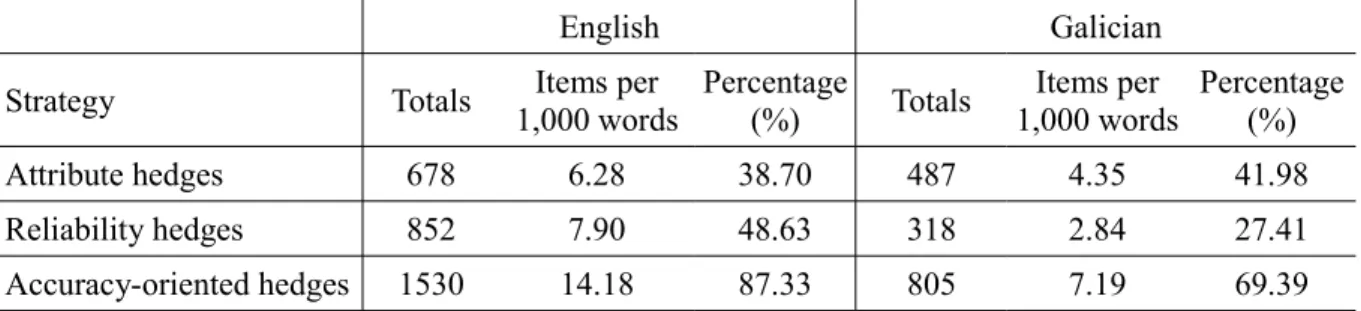
(33) é bastante frecuente na Alta Idade Media galega. GALFEM.2. As seen in example (29), attribute hedges may be combined with the other types included within this polypragmatic model –in this case, with a writer-oriented one in the form of depersonalisation. Furthermore, other verbs such as tend or tender –and their nominalised forms, tendency and tendencia/tendência– and, exclusively in the case of Galician, adoitar and acostumar/costumar, also act as attribute hedges in our texts: (31) American Indian languages tend to have prosody different from English.. ENGFEM.2. (32) Os segundos são de procedência europeia, onde se costuma conceber o termo ‘marcador discursivo’ como um hiperónimo de ‘conector’. GALMAL.3. For their part, reliability hedges are used to “indicate the degree of confidence [writers] invest in the validity of the proposition they make” (Musa, 2014, p. 15). Therefore, they have to do with the truth of the proposition itself and with the recognition of an impossibility of complete accuracy, and are realised through a wide range of different forms. English epistemic modal verbs and Galician poder –together with the conditional and imperfect tenses– are, when combined with explicit subjects, the most recurrent expressions of reliability hedges: (33) In present terms, one might be tempted to say that condensation and information differ in that only the former lies in correspondence with its stem.. ENGMAL.6. (34) A aparición da interdental nestas dúas palabras pode vir motivada por o informante estar influído pola escola. GALMAL.2. Modal nouns (possibility, assumption, posibilidade/possibilidade…), adjectives (possible, probable, likely, posible/posíbel/possível, probable/probábel/provável…) and adverbs (possibly, perhaps, apparently, presumably, posiblemente/posibelmente/possivelmente, tal vez/talvez, se cadra, se callar/se calhar…) also function as markers of the truth value of a statement: 30.
(34) (35) Language policies are likely to reflect prevailing language ideologies.. ENGFEM.7. (36) The spread of substratum elements into a second language presumably takes place through a period of language shift.. ENGMAL.5. (37) A escaseza das ocorrencias leva a pensar na posibilidade dunha errata.. GALFEM.2. Finally, evidential verbs also serve reliability purposes when they are used as part of personal constructions, as in example (38) –which additionally contains another reliability hedge (podería) and a reader-oriented one (estamos): (38) Este dato parece suxerir unha distribución dialectal de dous ítems antroponímicos, o que podería reforza-la idea de estarmos ante dúas raíces distintas.. GALFEM.1. Table 5 shows the figures obtained for accuracy-oriented hedges in both languages: English Strategy. Totals. Galician. Items per Percentage 1,000 words (%). Totals. Items per Percentage 1,000 words (%). Attribute hedges. 678. 6.28. 38.70. 487. 4.35. 41.98. Reliability hedges. 852. 7.90. 48.63. 318. 2.84. 27.41. Accuracy-oriented hedges. 1530. 14.18. 87.33. 805. 7.19. 69.39. Table 5: Accuracy-oriented hedges in both languages. As can be seen, accuracy-oriented downraters represent the vast majority of hedging strategies in both languages. Therefore, my results are in consonance with Musa’s (2014), for whom this sort of hedges also turned out to be the ones most commonly used in the English masters theses he analysed –and were followed, as here, by writer-oriented and reader-oriented hedges respectively. This larger use of accuracy-oriented strategies indicates that authors in both languages are mostly concerned with the precision of their claims and with visibly showing their degree of confidence in what they are stating. Nevertheless, there is a conspicuous difference regarding the results shown in table 5: reliability hedges are much more used in texts of linguistics written in English. In fact, attenuators of this type are even largely outnumbered by attribute ones in Galician, reversing 31.
(35) the English tendency. If our data is thoroughly analysed and the results for each specific item are taken into consideration, the smaller use of epistemic modal verbs expressing reliability in Galician mainly accounts for this divergence; a divergence which might indicate that the academic community in this language parallels the Spanish one in terms of mitigating strategies of this kind, for it is argued that in the latter “the use of hedges that imply indetermination […] is associated with lack of clarity, insecurity and lack of validity of the proposal being expressed” (Alonso et al., 2012, p. 58). At the same time, the aforementioned relatively lower necessity for protecting the author’s own face due to the restrained size of the community itself is likely to be the other reason for this smaller use of indetermination strategies in Galician. Scholars belonging to the linguistics academic community in English seem to be, on the other hand, much more worried about their own image and hence resort much more to these reliability hedges that will provide them with a bigger protection of their own faces –apparently more necessary in an extremely far-flung academic community such as the English one– and which will simultaneously help them gain the acceptance of the other members of their research community.. 4.2. GENDER COMPARISON As shown in tables 6 and 7, our study appears to confirm the spread theory that women are “more likely to hedge” than men (Newman et al., 2008, p. 232). The gender difference is more flagrant in English, where women use as much as 3 more hedges per 1,000 words than men. In Galician, the divergence between sexes drops to 1,5 hedges per 1,000 words. One way or another, it must be taken into account that the corpus that has been used as a basis for the present analysis only comprises 15 articles per language and, as a result, an extension of it may provide more similar figures for both genders –as in Serholt’s case (2012). Were the differences to be repeated with a larger corpus, we would certainly have to look for the causes 32.
(36) for this divergence out of the field of linguistics, and to always take into account the inequity that has so far characterised the history of humanity in terms of gender. Women Strategy. Totals. Men. Items per Percentage 1,000 words (%). Totals. Items per Percentage 1,000 words (%). Reader-oriented hedges. 18. 0.43. 2.39. 20. 0.30. 2.01. Writer-oriented hedges. 85. 2.05. 11.32. 95. 1.43. 9.53. Attribute hedges. 270. 6.50. 35.95. 408. 6.14. 40.92. Reliability hedges. 378. 9.10. 50.33. 474. 7.14. 47.54. Totals. 751. 18.08. 100. 997. 15.01. 100. Table 6: Hedges used by women and men in English. Women Strategy. Totals. Men. Items per Percentage 1,000 words (%). Totals. Items per Percentage 1,000 words (%). Reader-oriented hedges. 103. 1.88. 17.52. 50. 0.88. 8.77. Writer-oriented hedges. 110. 2.00. 18.71. 92. 1.61. 16.14. Attribute hedges. 213. 3.88. 36.22. 274. 4.80. 48.07. Reliability hedges. 162. 2.95. 27.55. 154. 2.70. 27.02. Totals. 588. 10.71. 100. 570. 9.20. 100. Table 7: Hedges used by women and men in Galician. What may be more interesting in our study is the fact that the trends in English and Galician seem to be almost inverse. Whereas female Galician authors clearly use more readeroriented hedges but less attribute ones than men writing in the same language, and hence appear to be less concerned about saving their own face –i.e. they do not mind taking more responsibility for what they claim–, the female authors of linguistics papers in English make greater use of both reliability and writer-oriented downgraders than men. This indicates they tend to reduce the commitment they invest in the truth of the propositions they postulate, mainly to avoid potential threats to their own faces or to the image of others. Therefore, even if women’s potential greater use of hedges were confirmed in a larger piece of research, the reasons for such a tendency may not be as clear as other studies that are still considered 33.
(37) landmarks in the field, such as Lakoff’s (1975), have attempted to show in the past, for women within the domain of linguistics appear to use the language for very different purposes depending on the particular discourse community they belong to.. 5. CONCLUSION Hopefully, the present study has somewhat contributed to expanding the existing knowledge about hedging and thus the increasing literature on this subject –namely in Galician, since, as mentioned in the introductory section for this paper, little or no attention has been paid to the use of this pragmatic category in this language. Moreover, the focal points that have guided my piece of research –i.e. the cross-linguistic and gender comparisons– within the chosen context of academic writing are, in my opinion, two of the most interesting areas of study for this and other linguistic features, since they allow us to appraise how historical cultural and gender differences have affected the way contemporary scholars use the language they work with. Nonetheless, although it may be tempting at first, it would be troublesome to resort to these differences (broadly speaking) in order to account for all the remarkable dissimilarities that have been exposed here. By doing so, we would inevitably fall into the imagotypes –or even into the stereotypes and their inherent changelessness– recurrently associated with both cultures and genders and thus into the problematic scenario of generally attributing certain personality traits to people on the basis of their mere sex or belonging to a particular society – i.e. for having been born in a particular place and at a particular time. Therefore, when it has come to drawing conclusions –namely between languages–, I have agreed with MartínMartín’s (2008) vision that, in the academic context, the variation between languages regarding the use of hedges must “be interpreted mainly in relation to the specific features of the socio-pragmatic context where the texts have been produced, that is, the relationship 34.
Figure



Documento similar
Tweets related to this political party tend to be more explicit than the rest, while PSOE shows the highest levels of distrust, both in terms of denotation and connotation.
In contrast, two populations were found for the mutant: a minor population, with distances ranging between 3.5-7 Å, and a major population, with highly oscillating distances,
Abstract: We extend the classical Stallings theory (describing subgroups of free groups as automata) to direct products of free and abelian groups: after introducing enriched
De las respuestas a estas preguntas puede surgir el inicio de un plan de recuperación personal y algunas ideas para encontrar una red de personas que puedan y estén dispuestas
Just as businesses are being asked to change their physical spaces to make it safer for more people to come to work, they should also be thinking about offering reasonable
Government policy varies between nations and this guidance sets out the need for balanced decision-making about ways of working, and the ongoing safety considerations
This can make the experience of video calls even more tiring and difficult.. As a result of the factors mentioned above, people are at risk of what is now called “video
The areas studied through this database are how many heartbeats are needed to identify a user; the costs of convergence of the presented model; the classification of a non-seen user
