
The Importance of Certification of English Medium Instruction teachers in Higher Education in Spain
16
0
0
Texto completo
(2) Porta Linguarum. 1. Introduction. Nº 32, junio 2019 and literature review. The fast-spreading popularity of English-medium instruction (henceforth EMI) can be observed in higher education (HE) institutions all over the world (Dearden, 2015; Barnard & Hasim, 2018). Frequent explanations for this rise include the status of English as a lingua franca in a more global world, heightened institutional competition, internationalization at home (Robson et al., 2017) through attracting international students and teachers (in this paper we use ‘teachers’ as a general term for ‘lecturers’ or ‘instructors’) to climb in university rankings (Hultgren, 2017) and faculty requirements to publish in highly ranked English-medium journals. However, despite such a global trend there is currently no international certification for EMI teachers, and in most settings this is also the case at the national level. There is no personal EMI teacher accreditation that can be transferred across institutions, leading professionals to retrain or re-apply for accreditation and limiting mobility. Dearden (2015) observed that, out of the 54 EMI countries surveyed in her study, 83% of them lacked sufficiently qualified EMI teachers and that policy makers had not considered the need to ensure adequate implementation of EMI programmes through teacher certification of competence. Against this backdrop, we explore in this study EMI teachers’ and managers’ views on whether a personal and institution/transferable global certification for EMI should be established and, if so, how the certification and accreditation process should be carried out. We define ‘certification’ as an official qualification given to an individual that provides evidence of the competence needed to teach a particular subject in a particular way, and identify some of its possible components by drawing on previous research on EMI requirements for HE (Kling & Stæhr, 2012; Pilkinton-Pihko, 2013; Smit, 2010). Research findings have demonstrated the need for contexts where EMI experiences have proved ineffective due to the insufficient English proficiency of EMI teachers, or their inability to put across content to students with low English proficiency (Macaro 2018). In Spain teachers were also conscious of their language limitations (Lasagabaster, 2018), underscoring the challenges they needed to bridge the gap between their current and ideal performance – mainly pronunciation, fluency and vocabulary, but also their communicative competence. They emphasized the need to enhance their ability to interact with students spontaneously, to tackle unforeseen classroom situations and to explain complex concepts in different ways. Aguilar and Muñoz (2014) also pointed to teachers’ insufficient proficiency as key, which has led authors such as Dimova (2017) to call for the alignment of EMI certification with internationally recognized assessment scales. In bilingual programmes involving dissimilar languages such as Spanish and English, a heightened focus on language requires an implicit additional degree of attention to language that may be beyond the skills of content teachers. Many subject specialists have complained about their English being insufficient (Macaro et al. 2018) but also the fact that their understanding of language learning is limited. These restrictions have often caused the attention to language to be left to other actors, such as teaching assistants or language specialists, or not addressed at all. These teachers require specific training for language awareness – a non-linear, complex process which may still be developing after ten years of professional service (Andrews, 2009). This situation adds to structural complications, such as the content-based programmes at the secondary level (Dale et al., 2017; Nikula et al., 2016) or the lack of a general model for the integration of content and language aims in HE.. 104.
(3) Ernesto Macaro, Antonio Jiménez and David Lasagabaster. The Importance of.... The teacher-related findings from the above studies in EMI lead us to conclude that a number of quality-assurance measures need to be fostered more comprehensively to avert EMI poor implementation, stemming from insufficient professional development.. 2. Certification. in. EMI. programmes. Teaching in a foreign language is a demanding task, but the provision of EMI has mostly focused on improving student proficiency rather than on teacher competence since “it is widely assumed that teaching staff possess such skills at a high level” (Dubow & Gundermann, 2017: 475). Consequently, there exists an ad hoc situation where some universities rely on customized EMI language courses (Kunioshi et al., 2016), while others lag behind or do not even contemplate such certification (Halbach & Lázaro, 2015). Moreover, pedagogical skills are usually overlooked, despite EMI teachers being aware of training shortcomings and student grades being negatively affected when compared with those taught in their mother tongue (Hernández-Nanclares & Jiménez-Muñoz, 2017). Studies have rarely gauged teachers’ and managers’ opinions on certification. Galloway, Kriukow and Numajiri (2017) found that Chinese and Japanese EMI teachers did not particularly envisage a need for a qualification that confirmed an ability to deliver their subject through English – while students did consider it important. Therefore, there is a need to analyse in depth EMI teachers’ and managers’ beliefs concerning EMI certification, because “the creation of a teaching quality evaluation framework is a crucial element in the toolkit required for judging or otherwise evaluating the performance, effectiveness, and success of university EMI programmes” (Huang & Singh, 2014: 363). For countries such as Spain, where EMI has acted as a catalyser for change to otherwise traditionally teacher-centred education, teacher beliefs are essential to facilitate change (Borg, 2006; Bradford, 2016). Traditionally-trained Spanish teachers have rapidly transitioned towards both EMI and the European Higher Education Area (EHEA), and they may not be fully aware that a paradigmatic change such as EMI requires both curricular and methodological adaptations. Continuing professional development (CPD) must be an integral part of the EMI certification process, since pedagogical training raises awareness of their approach to teaching, and some may become more student-centred (Parson et al., 2012). Postareff, Lindblom-Ylänne and Nevgi (2008) assert that longer training produces better results than shorter courses, with at least a one-year programme for positive results to emerge, and for teachers’ reflective skills to emerge. Nevertheless, they also “acknowledge that pedagogical training is more likely to strengthen those teachers’ self-efficacy beliefs who have less teaching experience than of those who have more teaching experience” (p. 42). Parson et al. (2012) conclude that teacher knowledge and skills are positively influenced by a combination of longer duration programmes, integrated induction support, and sustained input from CPD. Classroom observation is regarded as an essential procedure in the CPD process (Lasagabaster & Sierra, 2011; Montgomery, 2002). However, research reveals that even experienced teachers dislike being observed, and find it stressful or intimidating (Aubusson et al. 2007; Borich, 2008). Nonetheless, classroom observation needs to play an essential role in assessments of language proficiency and pedagogical skills certification, even if met with some resistance.. 105.
(4) Porta Linguarum. Nº 32, junio 2019. 2.1. Certification in Spanish universities To ease internationalization, the Spanish Ministry of Education, Culture and Sport in 2014 recommended increasing the number of EMI modules and to improve English levels for faculty and staff. However, Halbach and Lázaro (2015) surveyed 50 Spanish universities and observed that the majority of their EMI-related quality assurance measures (such as language requirements and suitable pedagogical adaptations) were not rigorously applied, differing in levels of implementation or simply non-existent. Strikingly, 75% of language requirements were below CEFR C1. In the case of students, just 62% of the universities required them to have a minimum English proficiency, again varying between B1 and B2 levels. The study also confirmed that language-related accreditation systems varies considerably, as well as external or in-house tests. Despite the guidelines put forward by the Conference of Spanish University Rectors (Bazo et al., 2017) the wide-ranging diversity that exists regarding EMI certification in the country is stark. The conclusion to be drawn is that a framework of common standards should develop more unified and comprehensive teacher-development programmes. It is also necessary to raise awareness about the pedagogical requirements for EMI teachers, which is why we have sought participation from teachers and managers who have been directly involved in the implementation of EMI in recent years. In this way, areas of improvement can be detected, and it may be possible to shed light on how EMI teacher certification should be tackled in the future. We also postulate that the variety of choices made by Spanish universities and their more-than-likely diverse degrees of effectiveness will benefit from greater specific pathways for professional development.. 3. Research. questions. A number of issues were explored through the following research questions: 1. Do Spanish EMI teachers’ institutions already have certification of EMI teacher competence? If so how is this obtained? 2. What do EMI teachers think about obtaining certification of their competence and how long should a programme of development be? 3. What attributes should an EMI teacher have? 4. What body do they consider should give certification? 5. To what extent do managers’ beliefs match those of the teachers?. 4. Materials. and method. The data presented in this study are a focused extract of a larger worldwide study on the certification of EMI teachers in HE (See Macaro et al. 2019). In order to answer the research questions above with particular reference to the Spanish context, relevant Spanish-based data were extracted from this larger corpus in order to gain an in-depth understanding of the situation in one of the most actively EMI countries in Europe.. 106.
(5) Ernesto Macaro, Antonio Jiménez and David Lasagabaster. The Importance of.... The research instruments included an online teacher questionnaire, which was developed using a grounded approach (Charmaz, 2008). We first carried out a series of pilot interviews in institutions where we had connections using broad questions regarding the participants’ background: whether participants had attended in-service or pre-service training courses, whether they thought certification of EMI competence was possible, whether it was important, and for whom. A first draft of the instrument was then piloted to ascertain whether the questions were appropriate and the English used was understandable. Their responses in the interviews formed the basis of the first draft of the questionnaire, which was then further piloted for comprehensibility, to ensure the language was not beyond informants’ implicit proficiency level. The final online questionnaire consisted of 25 closed questions and a number of fields for respondents to elaborate on their answers or make comments, thus allowing both quantitative and qualitative analysis. Potential respondents’ access to the online questionnaire could only be obtained via a website address which was part of one of the current authors’ university learning platform. This address was then distributed through the network of connections that the authors had. Following information about the purpose of the research and detailed explanation of ethics and consent issues, we provided a definition of EMI as follows (from Macaro, 2018: 1): “The use of the English language to teach academic subjects (other than English itself) in countries or jurisdictions where the first language of the majority of the population is not English”. We also provided examples of what was intended by an “EMI teacher” as in the following: ‘Teaching Business Studies through the medium of English in Spain; Teaching Geography through the medium of English in China’. The numerical data was then entered onto SPSS version23.We excluded incomplete responses and carried out a reliability measure of the teacher belief items in the questionnaire and obtained a Cronbach alpha of 0.84 which is considered to be of high reliability. As a result of this process, 151 respondents were included and these were respondents who were teaching through EMI in a Spanish university. Of these, 1.3% were aged 20-29, 24.7% were aged 30-39, 36.7% were aged 40-49 and 37.3% were aged 50 or above. The vast majority, 90.1%, were teaching at a state-funded university, and only 9.9% at a private university. In Spain, 86.21% of HE teachers are employed by state-funded universities, and 13.78% in private institutions (Spanish Department for Education, 2016: 123). The majority of respondents were relative newcomers to EMI, with 61% having taught through English for less than five years. Two thirds, 68.5%, only taught undergraduates, while 13% taught both undergraduate and postgraduate students. The study also included a questionnaire aimed at university ‘managers’ (policymakers, programme coordinators, or internationalization managers) to provide an additional institutional insight into some of the issues raised by our research questions. Nine managers from Spain were willing to share their views and experience. This data was not analysed quantitatively, but their views from open responses were considered and will be discussed. Finally, a total of seven interviews were carried out with those teachers willing to be contacted directly. A semi-structured one-hour interview was scheduled for each informant. As these informants belonged to several institutions around Spain, some of them could be interviewed face to face, while others used video-conference and in one case, writing.. 107.
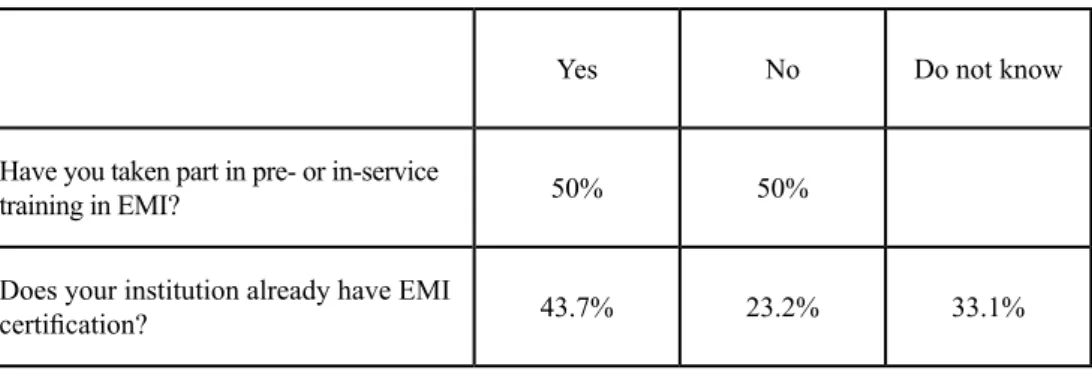
(6) Porta Linguarum. Nº 32, junio 2019. During the interview, the interviewer sometimes asked for clarification or justification, and they were given opportunities for elaboration or discussion. Specifically, all of those interviewed responded to questions on: • The process through which they became EMI teachers in their institution • whether they had spent time or perhaps worked in an English-speaking country • what they thought were the most important professional development needs to teach through English • whether they had been involved in a professional development programme or course related to EMI • whether they thought a Certificate of Competence to teach though EMI was useful and, if so, how the evidence leading to a certificate should be gathered, and who or what kind of body should award such a certificate. In this study participants were asked whether they would be willing to be observed over a period of time, and if so, what kind of profile the observer should have. • how much time and effort they were prepared to dedicate to becoming a better EMI teacher. Since everyday teaching and research obligations may limit teachers’ willingness to take part in longer courses, this aspect is also integrated into our research. Analysis of the recorded transcripts took the form of selecting the main ideas or argumentations given as response to each of these questions. To add further qualitative data, answers to open-ended questions in the previously-filled teacher questionnaire were extracted and incorporated. The interviewed teachers had differing ages, backgrounds and fields of expertise. Two were aged 30-39, and taught a Degree in Primary Education; two were in their forties, and taught Chemistry and Economics; three were aged over 50, and taught Art, History, and Economics. Two teachers worked in private institutions, while the rest were state-funded – keeping the aforementioned proportionality. Their careers as EMI teachers varied from relatively short (two had less than 5 years’ EMI service) to the more than ten years of one informant, but most had been teaching EMI for 5 to 10 years, reflecting strong internationalization at Spanish universities since 2010. With two exceptions, they primarily teach EMI to undergraduates. All but one had spent relatively long spells in an English-speaking country as visiting scholars or post-doctoral researchers as well as summer vacations. These teachers reported that they had been in regular contact with English through conferences, reading papers, and interacting with foreign colleagues.. 5. Results Our first research question was concerned with whether respondents’ institutions already had some form of certification of competence to teach through English. As can be seen in Table 1, fewer than 50% of respondents reported that their institution provided an EMI certificate, with a surprising 33.1% being unaware of whether it did or did not. Some teachers, however, had already taken part in a programme of development.. 108.
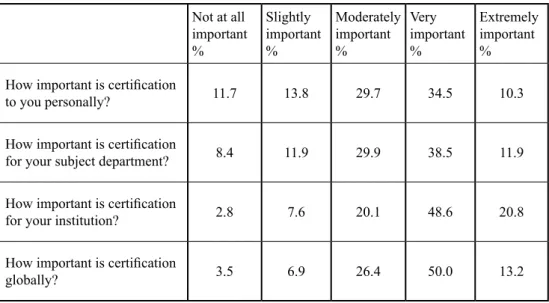
(7) Ernesto Macaro, Antonio Jiménez and David Lasagabaster. The Importance of.... Table 1. Aspects of teacher competence to teach through EMI. Yes. No. Have you taken part in pre- or in-service training in EMI?. 50%. 50%. Does your institution already have EMI certification?. 43.7%. 23.2%. Do not know. 33.1%. The teacher interviews provided further evidence of severe variation in EMI teaching requirements from one institution to another. In some private universities there was no other requirement than mere willingness, or an interview in English with some questions related to teaching, but no direct observation of teaching performance nor a probationary period. In state-funded universities, requirements varied from CEFR B2 English and further training on particular aspects such as pronunciation or presenting, to C1 certificate (TOEFL 95-120, IELTS 6.5-7, or a comparable certificate). Despite the metalinguistic and methodological issues raised in our introduction, these language-level certificates were deemed sufficient to guarantee preparedness for HE EMI. Two teachers reported the approach to be fair in its expectations, although they stated that there was a need for further support for those already teaching EMI. Most informants expressed their dissatisfaction at such a light-touch, language-focused form of accreditation. They valued the fact that at least there was “some sort of internal accreditation system, which is missing in other institutions, but no-one thinks about methodology or other important aspects” (Inf2). Others stressed the fact that accreditation should focus “not only on language skills, but also on pedagogical skills” (Inf4), and that “most training offered has been linguistic, but not methodological, which is needed more: EMI requires more participation” (Inf5). This need contrasts with the status quo reported by most informants: “if teachers have a C1 level in English, they are not required any further training” (Inf6) to be accredited for EMI teaching. Our second research question sought EMI teachers’ reaction to the idea of obtaining certification of their competence, and their considerations on the length of such a development programme. This aspect was answered through a series of subquestions. Table 2 shows that most teachers thought some sort of certification was important for them not only personally, but also for their department, for their institution as a whole, and ‘globally’.. 109.
(8) Porta Linguarum. Nº 32, junio 2019. Table 2. The importance of certification as perceived by EMI teachers Not at all important %. Slightly important %. Moderately Very important important % %. Extremely important %. How important is certification to you personally?. 11.7. 13.8. 29.7. 34.5. 10.3. How important is certification for your subject department?. 8.4. 11.9. 29.9. 38.5. 11.9. How important is certification for your institution?. 2.8. 7.6. 20.1. 48.6. 20.8. How important is certification globally?. 3.5. 6.9. 26.4. 50.0. 13.2. Several interviewees argued for stronger accreditation including pedagogical and methodological aspects (geared towards fostering more student-centredness, and including cultural aspects) as well as more advanced interaction skills (such as negotiation or improvisation) this often being linked to the need for direct observation to evidence such skills and the establishment of continuing support groups to find common solutions to EMI areas. Others valued the existence of entry requirements and training available, because they were aware of institutions lacking them. One participant wanted to be able to transfer humour and personality to English, which required more advanced skills and further learning on their part. One teacher pointed out that, while the “average Spanish scholar is usually able to read in English […] the same can’t be said of our ability to write and speak in fluent Academic English” (Inf1). Most teachers, also stressed “oral language proficiency” (Inf3) or “general language proficiency” (Inf5) as a key improvement area, but also identified needs more concerned with explaining vocabulary and fostering participation and interaction both in class and online. Some teachers are “experts in their field” but they “lack the skills to teach vocabulary or pronunciation, for classroom management or interaction in class” (Inf3). There is a need for help “to promote interaction online” (Inf4) and advice on “how to start, introduce, make transitions from one topic to another, to paraphrase, as you would in your language [while] focusing on both language and teaching skills” (Inf6). Others report that training on learner differences would help anticipate problems, and stressed methodology as a key factor. This “awareness of students’ challenges” is felt to be more prominent in cases of “international enrolments, especially native speakers of English” (Inf6) because they “are used to having more interaction in class; in Spain learners tend to be more passive, which needs to be addressed when teaching EMI” (Inf7). In any case, they were aware that “it is difficult to keep the attention of students in longer sessions, particularly when the language is strange for both students and teacher” (Inf6).. 110.
(9) Ernesto Macaro, Antonio Jiménez and David Lasagabaster. The Importance of.... All informants agreed on the potential usefulness of a more robust, more global and wide-ranging training/accreditation system which “would be useful for everybody” involved in EMI (Inf1). They stressed its relevance for their professional development, but most importantly for quality assurance in the teaching-learning process, thus improving institutional provision across the board; it would “promote mobility” (Inf5) and it would be “good for both teachers and universities, and perhaps those graduates wishing to work in an English-speaking environment” (Inf3). They underscored the need for more international accreditation –being the exact opposite of the insularity reflected in our findings above– although one teacher argued that already in some areas ability to teach EMI “is assumed as a prerequisite” (Inf2). We found a lack of clear consensus among teachers on the ideal scheme leading to certification. Some considered sufficient a three-month modular course, perhaps online, but underscored the need to send recorded real-life sessions for further assessment, as proof of skills development or, alternatively, to set up class observations, potentially through video-conferencing where “lessons can be broadcast and be interactive” with evaluators (Inf5). They all stated that, against a backdrop of very little or no classroom observation in their current practice, direct observation “is needed, both for EMI and Spanish” for quality assurance (Inf2). One informant mentioned that his lectures had been recorded and commented on by members of the English department at his university, which “may feel uncomfortable, but it is a good way to improve” (Inf1). Most preferred peer observation to be external; two informants pointed out potential conflicts of interest with observers from their own faculty, while one teacher would rather complement these observations with student surveys, since “they are the ones directly affected” and also assess other aspects such as “the use of visuals and teamwork” (Inf7) by teachers. Most see EMI as an opportunity to enhance teaching skills, but language anxiety is triggered by long sessions “of up to two hours” (Inf4) in which their command of the language –and that of the students– would make shortcomings more noticeable. When asked what type of professional programme they would prefer, questionnaire responses were evenly split: 38.5% said they would opt for a short intensive course, 37.2% for a course over a more extended period of time, and 12.8% said they had no preference. Interestingly, 11.3% said they would not be willing to take such a course. One interviewee reported that language level may determine the length of such training, since two or three months should be sufficient for already proficient trainees, but those with a lower level of English may need a more sustained programme. We return to this issue in our discussion. Next, we asked what attributes an EMI teacher should possess and, therefore, the qualities that might be looked for in an evaluation of them leading to certification. The majority of teachers (50.3%) thought their pedagogy had to change as a result of teaching though EMI (26.8% did not, with 22.8% being ‘unsure’) and three quarters (76.2%) thought there was a clear difference between presenting at a conference and teaching EMI. In the interviews and extended written answers informants suggested a long list of aspects to be covered under such certification: language level and academic register/complexity, clear pronunciation and intelligibility, command of content-specific materials and vocabulary, oral and written communication skills, scaffolding for effective learning, promoting student interaction and motivation, classroom management tools, methods for materials design and lesson planning, strategies for student feedback, additional skills for non-theoretical sessions, and ICT-enhanced problem-solving.. 111.
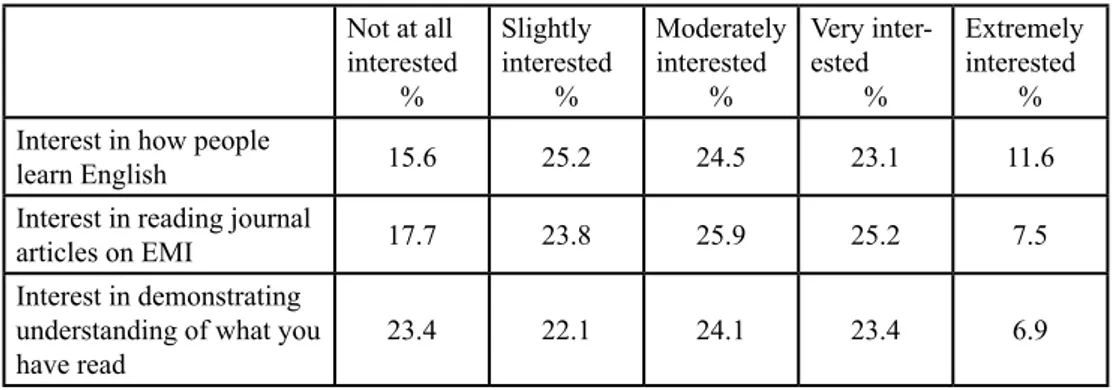
(10) Porta Linguarum. Nº 32, junio 2019. Expectations were high; some said it “must be thorough and comprehensive” (Inf3), unlike their current training. Others desired a methodological change, so that “our whole system focuses attention on the students” (Inf4). The emphasis on academic register is also needed, since it “often escapes students and lecturers who do not read papers in English” (Inf5). Some informants proposed that language requirements “must be applied to the specific vocabulary and register of the content area” (Inf5), so that teaching History or Chemistry through English would require differing sets of skills. When asked how far they would go in order to gain a better understanding of EMI issues (e.g. learning about research into EMI; reading journal articles on EMI; demonstrating reading comprehension), the answers (table 3) were quite mixed. Only 34% showed a real interest in how ‘people learn English,’ so how students learn through the medium of English seems secondary. Table 3. Engagement with EMI language-related issues Not at all interested %. Slightly interested %. Moderately Very interinterested ested % %. Extremely interested %. Interest in how people learn English. 15.6. 25.2. 24.5. 23.1. 11.6. Interest in reading journal articles on EMI. 17.7. 23.8. 25.9. 25.2. 7.5. Interest in demonstrating understanding of what you have read. 23.4. 22.1. 24.1. 23.4. 6.9. Finally, on the question of whether respondents would be willing to take a test of academic English, 55.8% said that they were willing, with 22.4% claiming they were undecided, perhaps uncertain about their preparedness for that particular test, or about what a test of academic English might entail. As for our fourth research question, EMI teachers interviewed were strongly in favour of an external body to accredit certification. They generally agreed on an international consortium, one which included leading or relevant universities (or academic-related bodies) around the world. There was some disagreement between those who thought that it should be awarded by “a top-level British or American university” (Inf1) and those opposing this idea, particularly if that was an “Anglo-centric, language-certifying institution” (Inf3) in full awareness that EMI skills go beyond language. Some called for wider, more institutional participation, such as “the EU or an international body” (Inf2) while another informant called for such an agreement to involve the Spanish Department for Education, and another specifically not to do so (Inf4). One informant deemed sufficient a two-party agreement with a prestigious university (Inf7) in an English-speaking country, but others envisaged a consortium of reputable universities as desirable (informants 3, 5 and 6) as long as this “group is representative globally” (Inf2) which, in turn, would. 112.
(11) Ernesto Macaro, Antonio Jiménez and David Lasagabaster. The Importance of.... also have the advantage that “courses could be run by several institutions” (Inf3). One interviewee was mistrustful of some standard-settings bodies and their economic motivations. The majority of teachers believed that this type of certification must be paid for by the HEIs themselves (Inf7), or the Spanish Department for Education; they felt “ [it’s] something that we need, so the money needs to be found” (Inf4). In Spain, state-university funding depends on particular regional government provision, as the responsibility for education is transferred from central to regional governments; hence, there is “very little lecturer and researcher mobility among Spanish universities” (Inf5) because of administrative limitations in these regions. In such a context, teachers feel that universities “should take responsibility for its current staff” although any individual certification “could be a future requirement for potential recruits when hiring” (Inf6). Potential obstacles to reliable certification by a university consortium or supranational body were the fact that separate countries might develop their own versions of the accreditation system, rather than keeping a unified criteria for content and assessement. Other informants fear that, being organized on several sites, distance may deter some teachers, or that teachers may see the cost but “may not see the need” (Inf2) if not explicitly required by employers. On the other hand, all the interwees stressed how much effort, time and money they had put into improving their teaching and language skills “for years” (Inf5) and “every day” (Inf6). They perceived it was their “responsibility to improve” (Inf4) and showed strong motivation, pointing out they had already taken steps to improve the quality of their teaching, such as peer-observation by English-language and content specialists, and departmental discussions. They also highlighted that they have been reading research in English more (including pedagogy and teaching skills, in some cases), had devoted years to learning English both formally and informally, and were ready to take on further training opportunities, including “being observed and receiving feedback from peers and students” (Inf6). Some were wary of the potential conflict with alloting time for research, believing that few may find further training appealling without further incentives from university managers. Managers for EMI programmes were also asked to give their opinion through the questionnaire. Seven managers worked at state-funded institutions, while two worked in private universities. With one exception, they also had over a decade teaching experience. Four of their universities already provided some form of internal EMI accreditation, while two managers were surprisingly unsure, and three said the institution had none. When asked about the importance of certification in EMI programmes, six informants stated it was very or extremely important, and only one respondent had strong reservations. Eight believed it would be very important for their teaching staff, their university prospects, and more globally, to recognise staff as able to teach through English. Seven also thought that teaching and learning through English was substantially different to teaching in a L1. Seven managers thought that their universities were willing to devote time and resources to teachers who wished to pursue EMI certification, while two were unsure, and one informant was certain it would not be the case. Four informants would prefer a longer course, while five deemed a short intensive course sufficient. Their views largely mirrored that of teachers: they perceived the need and importance or EMI, particularly for their institutions –perhaps because of their direct contact with internationalization programmes– and were just as aware of the more challenging aspect of teaching and learning through English. They were also unsure about how to approach such. 113.
(12) Porta Linguarum. Nº 32, junio 2019. training best but, perhaps because of their awareness of budget constraints, managers were not always confident about the necessary resources to implement such training. Spain’s latest official figures for government investment in state-funded HE education show a regression of 11.85% in the period 2010-2013 (Spanish Department for Education, 2016: 112). While the teachers generally saw the need for training and further support, managers had experienced situations where budget allocation missed those.. 6. Discussion This study sought to investigate the beliefs of university teachers in Spain with regard to EMI certification. Great variation has been discovered both in beliefs and in the way that teachers situate themselves in the fast developing phenomenon of EMI. Moreover, it is clear that the growth of EMI in Spain (Bazo et al., 2017) has not been matched by the kind of planning needed nor the resources required to ensure its success. EMI has to be shown to be effective both in promoting language learning and content learning (Graham et al., 2018), but it cannot be contextualised without establishing the objectives of EMI programmes not only at the local level but also at the international level (Macaro 2018). The heterogeneity of EMI teachers’ background discovered in this study, being the first of its kind, shows that, if there is such variation in background (and indeed beliefs) in just one country, then to arrive at a global understanding of the teacher competencies needed to teach through English effectively must need strong discussion and coordination in order to escape the local focus. It might well be argued that EMI competencies are or should be context-specific. However, with the increasing mobility of students globally, the notion of institution or country-specific competencies becomes less tenable; teaching quality assurance has to be considered at an international level if one institution is to have faith in the outcomes of another institution from which it may be receiving applications. The practice of providing certification in recognition of competence does not appear to be widespread in Spanish universities, certainly not with regard to planning and resource allocation. The dwindling budgets for Education can only partially explain this trend. Making sure that teachers have the right competencies to teach EMI is crucial, and our research suggests a significant investment for teachers making the transition to EMI from L1 Medium of Instruction or teaching EMI at the beginning of their careers. Prior research evidence (Jiménez-Muñoz, 2016; Ball & Lindsay, 2013) supports our findings that, with EMI, a university teacher’s pedagogy has to change. It is not just a question of improving a teacher’s general proficiency in English, however important a requisite this may be. This study has evidenced that this perspective is clear to EMI practitioners, with a number of respondents highlighting competencies which are directly related to student needs rather than to themselves as teachers. Our study has demonstrated that, at least in Spain, there is a stark contradiction between light-touch CPD in EMI accreditation and the strong recognition among teachers of the need for a demanding level of teaching-quality assurance, their perspective being supported by our sample of university managers. We have uncovered, however, an absence of consensus as to what kind of body should be awarding certification, although it is quite clear that. 114.
(13) Ernesto Macaro, Antonio Jiménez and David Lasagabaster. The Importance of.... teachers realise that certification must go beyond the measures taken by their own institution, indeed that it should have a more global reference. Future research into the organization of such CPD might investigate different models of awarding bodies, such as a consortium of universities in different geographical areas of the world. It is interesting that there was very little suggestion that the awarding body should be a single British or American institution, again making the point that the knowledge, understanding and skills to be an effective EMI teacher go well beyond English language competence. Despite the overwhelming support for complex and demanding certification of competence among our sample, we have found a resistance among many to a more protracted and in-depth professional development programme. As noted earlier, it is unlikely that the complexity of shifting from L1 MOI to EMI can be achieved through something like a one-week intensive course, which has a temporary or at best limited impact on pedagogy. Our study has also uncovered an ambiguity in the EMI teacher’s role and in their status as experts in one particular discipline, which corroborates the findings in other recent studies (e.g. Macaro et al., 2016). EMI teachers in Spain would like to become more student-centred and are aware that teaching students is different from presenting at a conference, where they can assume a high level of not only English proficiency in the audience, but also of subject knowledge. However, they are not enthusiastic about becoming language experts, or at least they do not consider they have the time to invest in such dual expertise, in accordance with findings suggested by previous research (Aguilar & Muñoz, 2014). Yet the call for ‘Integrating Language and Content in Higher Education’ (Wilkinson & Walsh, 2015; Dafouz & Smit, 2016) would strongly suggest that this dual expertise is necessary. An alternative, of course, is for content specialists and English language specialists in the same institution to collaborate (Macaro et al., 2016) in planning, and some have suggested even in teaching (Lasagabaster, 2018) although the latter is generally regarded as very costly in human and monetary terms.. 7. Concluding. remarks. Our study of EMI teacher beliefs, being the first to explore the accreditation of EMI teachers at HE, has added to the body of research evidence which has shown that teaching academic content through the medium of English as an L2 requires a major rethink in terms of pedagogy and that, therefore, content teachers in universities cannot simply be encouraged or required to switch from their L1 as the medium without infrastructure planning and support. EMI teachers, particularly those who have gone through internal accreditation, have revealed the shortcomings of such a programme: from an excessive emphasis on linguistic skills – which classroom experience tells them not to be enough – to the lack of any further requirements, other than willingness to teach through English. Planning and support will need to take into account what research shows to be the important competencies an EMI teacher needs to acquire for students to thrive in an EMI environment. Our informants have already identified further training needs in terms of academic register, more supra-segmental language skills and stylistics, classroom preparation and management, promoting student interaction, and other pedagogical micro-skills, required to solve problems in unexpected communication breakdown situations.. 115.
(14) Porta Linguarum. Nº 32, junio 2019. To date the research on teacher beliefs has centred on the advantages and challenges of introducing EMI in universities in non-English-speaking countries. Teacher beliefs about certification of EMI competence has, to our knowledge, not been previously investigated. Our informants show that more substantial training, and a more global accreditation system is needed to ensure homogeneity and quality of EMI provision in tertiary education and set the pathways for professional development and a more global future. Based on their experiences with national accreditation and institution-specific appraisal, they have also expressed some concerns about which body should award such an accreditation. Yet in the light of the teacher and student challenges presented by EMI, which previous research has uncovered, it is clear that certification can play a crucial role in establishing the aims and objectives of EMI from stakeholders’ perspectives, thereby providing a mechanism for evaluating those aims and objectives more successfully, and thus contributing to much needed quality assurance in the profession. Future research needs to explore in greater detail what kind of certification is viable, as well as the theoretical bases for the teacher competencies it would seek to provide assurance for.. 8. References Aguilar, M. & Muñoz, C. (2014). The Effect of Proficiency on CLIL Benefits in Engineering Students in Spain. International Journal of Applied Linguistics, 24, 1-18. Andrews, S. (2009). The Evolution of Teachers’ Language Awareness. Language Awareness, 15(1), 1-19. Aubusson, P., Steele, F., Dinham, S. & Brady, L. (2007). Action learning in teacher learning community formation: Informative or transformative? Teacher Development, 11, 133-148. Ball, P. & Lindsay, D. (2013). Teaching content through the medium of English: Faculty perspectives, in A. Doiz, D. Lasagabaster, and J. M. Sierra (Eds.). English-Medium Instruction at Universities: Global Challenges (pp. 44-64). Bristol: Multilingual Matters. Barnard, R. & Hasim, Z. (2018). English medium instruction programmes. Abingdon, UK: Routledge. Bazo, P., González, D., Centellas, A., Dafouz, E., Fernández, A. & Pavón, V. (2017). Linguistic policy for the internationalisation of the Spanish university system: A framework document. Madrid: CRUE. Borg, S. (2006). Teacher cognition and language education: research and practice. London: Continuum. Borich, G. D. (2008). Observation skills for effective teaching. Upper Saddle River, NJ: Pearson Merrill Prentice Hall. Bradford, A. (2016). Teaching content through the medium of English: Faculty perspectives, in P. Clements, A. Krause, and H. Brown (Eds.). Focus on the learner (pp. 433-438). Tokyo: JALT. Burn, K., Mutton, T. & Hagger, H. (2010). Strengthening and sustaining professional learning in the second year of teaching. Oxford Review of Education, 36( 6), 639-659. Charmaz, K. (2008). Constructionism and the grounded theory method, in J. A. Holstein, & J. F. Gubrium (Eds.). Handbook of constructionist research (pp. 379-412). New York: The Guilford Press. Dafouz, E. & Smit, U. (2016). Towards a dynamic conceptual framework for English-medium education in multilingual university settings. Applied Linguistics 37(3), 397-415.. 116.
(15) Ernesto Macaro, Antonio Jiménez and David Lasagabaster. The Importance of.... Dale, L., Oostdam, R. & Verspoor, M. (2017). Searching for Identity and Focus: Towards an analytical framework for language teachers in bilingual education. International Journal of Bilingualism and Bilingual Education 21(3), 366-383. Dearden, J. (2015). English as a medium of instruction –A growing global phenomenon. Oxford, UK: British Council. Dimova, S. (2017). Life after oral English certification: The consequences of the Test of Oral English Proficiency for Academic Staff for EMI lecturers. English for Specific Purposes, 46, 45-58. Dubow, G. & Gundermann, S. (2017). Certifying the linguistic and communicative competencies of teachers in English-medium instruction programmes. Language Learning in Higher Education, 7, 475-487. Fernández, I. & Márquez, M. D. (2017). Educational development units in Spain: Current status and emergent trends. International Journal for Academic Development, 22, 343-359. Galloway, N., Kriukow, J. & Numajiri, T. (2017). Internationalization, higher education and the growing demand for English: an investigation into the English medium instruction (EMI) movement in China and Japan. London: British Council. Graham, K. M., Choi, Y., Davoodi, A., Razmeh, S. & Dixon, L. Q. (2018). Language and content outcomes of CLIL and EMI: A systematic review. Latin American Journal of Content & Language Integrated Learning, 11(1), 19-37. Halbach, A. & Lázaro, A. (2015). La acreditación del nivel de lengua inglesa en las universidades españolas: actualización 2015. Madrid: British Council. Hernández-Nanclares, N. & Jiménez-Muñoz, A. (2017). English as a medium of instruction: evidence for language and content targets in bilingual education in economics. International Journal of Bilingual Education and Bilingualism, 20(7), 883-896. Huang, D. & Singh, M. (2014). Critical perspectives on testing teaching: reframing teacher education for English medium instruction. Asia-Pacific Journal of Teacher Education, 42, 363-378. Hultgren, A. K. (2017). The drive towards EMI in non-English-dominant European HE: The role of university rankings. Language Teaching: 3-6. Jiménez-Muñoz, A. (2016). Content and Language: the Impact of Pedagogical Designs on Academic Performance within Tertiary English as a Medium of Instruction. Porta Linguarum, M1: 111-125. Kling, J., & Staehr, L. S. (2011). Assessment and assistance: Developing university lecturers’ skills through certification feedback, in R. Cancino, L. Dam and K. Jaeger (Eds.). Policies, principles, practices: new directions in foreign language education in the era of educational globalization (pp. 213-245). Newcastle, UK: Cambridge Scholars Publishing. Kunioshi, N., Noguchi, J., Tojo, K. & Hayashi, H. (2016). Supporting English-medium pedagogy through an online corpus of science and engineering lectures. European Journal of Engineering Education, 41, 293-303. Lasagabaster, D. (2018). Fostering team teaching: Mapping out a research agenda for Englishmedium instruction at university level. Language Teaching, 51, 400-416. Lasagabaster, D. & Sierra J.M. (2011) Classroom observation: Desirable conditions established by teachers.. European Journal of Teacher Education, 34, 449-463. Macaro, E. (2018). English Medium Instruction: Language and content in policy and practice. Oxford: Oxford University Press. Macaro, E. Akincioglu, M. & Dearden, J. (2016). English Medium Instruction in Universities: A Collaborative Experiment in Turkey. Studies in English Language Teaching, 4(1), 51-76. Macaro, E., Curle, S. Pun, J. An, J. & Dearden, J. (2018). A systematic review of English Medium. 117.
(16) Porta Linguarum. Nº 32, junio 2019. Instruction in Higher Educaton. Language Teaching, 51(1), 36-76 Macaro, E. Akincioglu, M. & Han, S., (2019). English Medium Instruction in Higher Education: Teacher perspectives on professional development and certification. International Journal of Applied Linguistics doi: 10.1111/ijal.12272 Montgomery, D. (2002). Helping teachers develop through classroom observation, Second edition. London: David Fulton. Nikula, T. et al. (2016). Conceptualising integration in CLIL and multilingual education. Clevedon: Multilingual Matters. Parson, D., Hill, I., Holland, J. & Willis, D. (2012). Impact of teaching development programmes in higher education. London: The Higher Education Academy. Postareff, L., Lindblom-Ylänne, S. & Nevgi, A. (2008). A follow-up study of the effect of pedagogical training on teaching in higher education. Higher Education, 56, 29-43. Robson, S., Almeida, J. & Schartner, A. (2017). Internationalization at home: time for review and development? European Journal of Higher Education, 8(1), 19-35. Smit, U. (2010). English as a lingua franca in higher education: A longitudinal study of classroom discourse. Berlin /New York: De Gruyter. Spanish Department for Education (2016). Datos y cifras del sistema universitario español. Curso 2015/2016. Madrid: MECD. Tedick, D. & Young, A. (2017). Two-way immersion students’ home languages, proficiency levels, and responses to form-focused instruction. International Journal of Bilingual Education and Bilingualism, 21(3), 303-318. Wilkinson, R. & Walsh, M.L. (eds.) (2015). Integrating content and language in higher education: From theory to practice, selected papers from the 2013 ICLHE Conference. Frankfurt: Peter Lang.. 118.
(17)
Figure
Documento similar
