
Using Data Mining Techniques to Solve the Web Classification Problem in Real Scenarios
78
0
0
Texto completo
(2)
(3)
(4)
(5)
(6)
(7) Dedication. I would like to dedicate this thesis to my God for giving me the opportunity and privilege to work in this exciting program. Thanks to my parents for helping me emotionally and financially this last two years. I would like to also express my gratitude to my sister Cristina Martı́nez. Without the help and motivation of them I would have never entered this program. Thanks to all my Professors and friends who were instrumental this last two years of my life.. v.
(8)
(9) Acknowledgements. I would like to express my deepest gratitude to my assessors Dr. Hugo Terashima Marı́n and Dr. Alejandro Rosales Pérez. Thank you for guiding me in the creation of this project. As well I would like to thank the Professors of Tecnológico de Monterrey for doing an excellent job in all their teachings and making the time to solve any inquires of mine. The last acknowledgments goes to Tecnológico de Monterrey for giving me the change of studying my masters and creating this project; and to CONACYT for supporting me these last two years.. vii.
(10)
(11) Using Data Mining Techniques to Solve the Web Classification Problem in Real Scenarios by Samuel Jesús Martı́nez Eguiarte Abstract The following thesis describes an investigation that aims to solve the web classification problem with real scenarios. The main motivation of the project is to be able to fully automate the testing of different types of web pages. For this reason, a total of four classes were defined as: Login, Search, Form, and Article. These four classes represent basic testing scenarios. The main goal is to correctly identify each example as one of these classes. A dataset was initially created containing 2,000 different examples (500 examples for each class). The dataset contains the tag elements of a web page as features. These tag elements show the frequency a tag appears in a specific web page. Since this problem can be also viewed as a text classification problem, where every tag element represents a different word and a web page represents a different document, one goal of the project is to determine if the tag dataset could be used instead of the text dataset. For this reason, another dataset was created (using the same 2000 examples), in which the plain text of the web pages was extracted in order to apply text classification techniques. The classification models selected were: Support Vector Machines (SVM), K-Nearest Neighbors (KNN), Multinomial Naive Bayes (MNB), and a simple Neural Network (NN). These models were also defined as One-class models in order to see if the models could be trained using positive data only. In the end, three experiments were performed. One using the One-class models with the tag dataset; other using the same tag dataset but with Multi-class models; and one last one using the text dataset with both One-class and Multi-class models. To obtain all of these 2000 scenarios, a web-scrapping tool was created to obtain both the tag frequency and the plain text of a web page. As it was mentioned previously, four classes were defined with 500 examples for each class. A baseline was created in order to compare the results of the models. This baseline uses an algorithm called Web Page Classification Algorithm Based on Feature Selection (WCAFS). The results of the baseline yielded a score of 0.88. The One-class models do not show a score similar to the one established in the baseline model, except for one. The One-class Article SVM model, with the use of the tag dataset, had a score of 0.88. This was the only model, that uses the tag dataset, that achieved the same score as the baseline. The Multi-class models only achieved the same result as the baseline when the text dataset was applied. So, the best configuration to use is a Multi-class model with a TF-IDF (Terms Frequency - Inverse Document Frequency) transformation applied to a text dataset.. ix.
(12)
(13) List of Figures 1.1 1.2 1.3 1.4. The rendering of a web page with dynamic content. . . . . . . . . . . . Cornell web page according to the WebKB dataset. . . . . . . . . . . . Current Cornell web page. . . . . . . . . . . . . . . . . . . . . . . . . General diagram showing the three modules of the automation solution.. 2.1 2.2 2.3. The three different categories of web mining. . . . . . . . . . . . . . . . . . 12 The SVM function that separates the data points using a separator with a margin. 15 Basic example of transforming a text document into a word vector. . . . . . . 20. 3.1. Final dataset used in the experiments. The content column represents the text dataset that is going to be transformed using the text transformation methods. Solution proposed for the web classification problem using the original tag dataset. . . . . . . . . . . . . . . . . . . . . . . . . . . . . . . . . . . . . . Solution proposed for the web classification problem using the text dataset. . Architecture for the ONN. . . . . . . . . . . . . . . . . . . . . . . . . . . . The experimental setting used for the project. This procedure describes the separation of the train and test set for all the possible models. . . . . . . . . .. 3.2 3.3 3.4 3.5. xi. . . . .. . . . .. . . . .. 2 4 5 6. 25 27 28 29 32.
(14)
(15) List of Tables 3.1 3.2. Basic Tag elements with their names and function in a rendered web page. . . Initial results of using the WCAFS algorithm in the text dataset. . . . . . . .. 24 33. 4.1 4.2 4.3 4.4 4.5 4.6. Overall results of the One-class models for the Login class. . . . . . . . . . Overall results of the One-class models for the Search class. . . . . . . . . . Overall results of the One-class models for the Form class . . . . . . . . . . Overall results of the One-class models for the Article class. . . . . . . . . . Overall results of the One-class models with feature reduction . . . . . . . . The best models selected for each class without counting for the PCA method filter. . . . . . . . . . . . . . . . . . . . . . . . . . . . . . . . . . . . . . . .. 36 37 38 38 39. Results for applying SVM in a Multi-class problem. . . . . . . . . . . . . . . Overall results of the SVM model with PCA feature reduction. . . . . . . . . Results for applying Multi-class KNN. . . . . . . . . . . . . . . . . . . . . . Overall results of the KNN model with PCA feature reduction. . . . . . . . . Results for applying Multi-class MNB models. . . . . . . . . . . . . . . . . Results for applying Multi-class NN models. . . . . . . . . . . . . . . . . . . Overall results of the NN model with PCA feature reduction. . . . . . . . . . The best models selected for each Multi-class configurations. The last two rows show the results of the best One-class Article model and the baseline. . .. 42 42 43 44 44 45 45. Overall results of the One-class models using the text dataset. . . . . . . . . . The best One-class models compared with the best models in the tag dataset configuration. . . . . . . . . . . . . . . . . . . . . . . . . . . . . . . . . . . Results of the Multi-class with the text dataset. . . . . . . . . . . . . . . . .. 49. 5.1 5.2 5.3 5.4 5.5 5.6 5.7 5.8 6.1 6.2 6.3. xiii. 40. 46. 50 50.
(16)
(17) Contents Abstract. ix. List of Figures. xi. List of Tables. xiii. 1. Introduction 1.1 Context . . . . . . . . . . . . . . . . 1.2 Problem Definition . . . . . . . . . . 1.3 Motivation . . . . . . . . . . . . . . . 1.4 Classification of four different classes 1.5 Objectives . . . . . . . . . . . . . . . 1.5.1 Specific Objectives . . . . . . 1.6 Hypothesis and Research Questions . 1.7 Solution Overview . . . . . . . . . . 1.8 Main Contributions . . . . . . . . . . 1.9 Document Structure . . . . . . . . . .. . . . . . . . . . .. 1 1 2 3 4 6 7 7 8 9 9. 2. Background 2.1 Web Mining . . . . . . . . . . . . . . . . . . . . . . . . . . . . . . . . 2.1.1 Web structured Mining . . . . . . . . . . . . . . . . . . . . . . 2.1.2 Web Content Mining . . . . . . . . . . . . . . . . . . . . . . . 2.1.3 Web Usage Mining . . . . . . . . . . . . . . . . . . . . . . . . 2.2 Data Mining Techniques . . . . . . . . . . . . . . . . . . . . . . . . . 2.2.1 Multi-class Models . . . . . . . . . . . . . . . . . . . . . . . . 2.2.2 One-class Models . . . . . . . . . . . . . . . . . . . . . . . . . 2.2.3 Comparison with Text Classification and Web Classification . . 2.2.4 Principal Component Analysis . . . . . . . . . . . . . . . . . 2.2.5 Web Page Classification Algorithm Based on Feature Selection 2.3 Related Work . . . . . . . . . . . . . . . . . . . . . . . . . . . . . . . 2.4 Summary . . . . . . . . . . . . . . . . . . . . . . . . . . . . . . . . .. . . . . . . . . . . . .. 11 11 12 13 14 14 14 16 18 21 21 22 22. 3. Solution Model 3.1 Data Acquisition . . . . . . . . . . . . . . . . . . . . . . . . . . . . . . . . 3.1.1 List of Tag Elements . . . . . . . . . . . . . . . . . . . . . . . . . . 3.1.2 Choosing the Class Examples . . . . . . . . . . . . . . . . . . . . .. 23 23 23 24. xv. . . . . . . . . . .. . . . . . . . . . .. . . . . . . . . . .. . . . . . . . . . .. . . . . . . . . . .. . . . . . . . . . .. . . . . . . . . . .. . . . . . . . . . .. . . . . . . . . . .. . . . . . . . . . .. . . . . . . . . . .. . . . . . . . . . .. . . . . . . . . . .. . . . . . . . . . .. . . . . . . . . . .. . . . . . . . . . .. . . . . . . . . . .. . . . . . . . . . .. . . . . . . . . . . . . . . . . . . . . . .. . . . . . . . . . . . . . . . . . . . . . ..
(18) 3.2. 3.3 3.4 3.5. Classification Models . . . . . . . . . 3.2.1 One-class Classifiers . . . . . 3.2.2 Multi-class Classifiers . . . . 3.2.3 Text classifiers . . . . . . . . Experimental Setting . . . . . . . . . Baseline Model used for Comparison . Summary . . . . . . . . . . . . . . .. . . . . . . .. . . . . . . .. . . . . . . .. . . . . . . .. . . . . . . .. . . . . . . .. . . . . . . .. . . . . . . .. . . . . . . .. . . . . . . .. . . . . . . .. . . . . . . .. . . . . . . .. . . . . . . .. . . . . . . .. . . . . . . .. . . . . . . .. . . . . . . .. . . . . . . .. . . . . . . .. . . . . . . .. 26 27 30 31 31 32 32. 4. Experiments and Results: One-Class models 4.1 Experimental Setting . . . . . . . . . . . . . . 4.2 Login . . . . . . . . . . . . . . . . . . . . . . 4.3 Search . . . . . . . . . . . . . . . . . . . . . . 4.4 Form . . . . . . . . . . . . . . . . . . . . . . . 4.5 Article . . . . . . . . . . . . . . . . . . . . . . 4.6 Inclusion of the Principal Component Analysis 4.7 General Discussion . . . . . . . . . . . . . . . 4.8 Summary . . . . . . . . . . . . . . . . . . . .. . . . . . . . .. . . . . . . . .. . . . . . . . .. . . . . . . . .. . . . . . . . .. . . . . . . . .. . . . . . . . .. . . . . . . . .. . . . . . . . .. . . . . . . . .. . . . . . . . .. . . . . . . . .. . . . . . . . .. . . . . . . . .. . . . . . . . .. . . . . . . . .. 35 35 36 36 37 37 38 39 40. 5. Experiments and Results: Multi-Class Models 5.1 Experimental Setting . . . . . . . . . . . . 5.2 Multi-class Support Vector Machines . . . . 5.3 Multi-class K-Nearest Neighbor . . . . . . 5.4 Multi-class Multinomial Naive Bayes . . . 5.5 Multi-class Neural Network . . . . . . . . 5.6 General Discussion . . . . . . . . . . . . . 5.7 Summary . . . . . . . . . . . . . . . . . .. . . . . . . .. . . . . . . .. . . . . . . .. . . . . . . .. . . . . . . .. . . . . . . .. . . . . . . .. . . . . . . .. . . . . . . .. . . . . . . .. . . . . . . .. . . . . . . .. . . . . . . .. . . . . . . .. . . . . . . .. . . . . . . .. 41 41 41 43 43 44 45 46. 6. Experiments and Results for Document Classification 6.1 Experimental Setting . . . . . . . . . . . . . . . . 6.2 One-class . . . . . . . . . . . . . . . . . . . . . . 6.3 Multi-class . . . . . . . . . . . . . . . . . . . . . 6.4 General Discussion . . . . . . . . . . . . . . . . . 6.5 Summary . . . . . . . . . . . . . . . . . . . . . .. . . . . .. . . . . .. . . . . .. . . . . .. . . . . .. . . . . .. . . . . .. . . . . .. . . . . .. . . . . .. . . . . .. . . . . .. . . . . .. . . . . .. 47 47 48 48 50 51. 7. Conclusions 7.1 Future work . . . . . . . . . . . . . . . . . . . . . . . . . . . . . . . . . . .. 53 54. Bibliography. . . . . . . .. . . . . . . .. 58. xvi.
(19) Chapter 1 Introduction 1.1. Context. Testing is the process in which a company team, called testers, test the functions and navigation of one or multiple web pages. The aim of this group is to detect bugs and errors that need to be fixed by the developing team. The testing process is important in order to guarantee the quality of the web page. This process can be performed before and after its release. Testing is a term used in the field of development and programming. In quality control of software, it means the application of tests or the revision of code for the verification of correct operation. It is proven that by implementing Testing mechanisms or tests, the quality of the applications and computer systems are improved [22]. Currently, software development companies have a great focus on the preparation and execution of tests to determine if a product meets the necessary requirements in order to be launched to the market. Testing can be applied in web as a mechanism of validation before release. The objective is to guarantee software quality. In general, workers for this team (also known as testers) do not necessarily design nor construct the software. But, there could be cases where the same person is both the programmer and the tester [5]. An automatic process of Testing enables the testing of software without the need of human intervention. Unlike a traditional model, automation has the advantage that it can be executed with little or no human supervision. In addition to that, it provides a great advantage to companies, since it is faster than manual tests. Also, it frees the programmers or testers from tedious and repetitive tasks [6]. Currently, there are several automation tools that allow us to manipulate web pages. In general, these tools work as a programming language, in which a human has to send commands that represent the interaction of a human with a page. A popular tool for performing the task is Selenium. A disadvantage of this kind of tool is that it is necessary to know the structure of the web page. As will be discussed later, there is no established pattern that applies to all web pages. Therefore, a programmer has to understand the structure of a new page in order to develop a successful test case. Although, there are other tools and add-ons that help generate these test cases faster. But,in general, the dynamic structure represents a limitation when wanting to define a testing case in a more general way. 1.
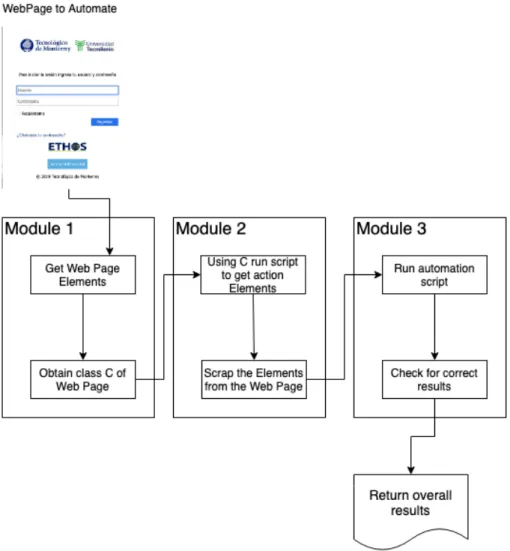
(20) 2. 1.2. CHAPTER 1. INTRODUCTION. Problem Definition. The Web is a set of unstructured documents. Extracting the web information could be beneficial in identifying different patterns [11]. A web page can be used by users with different roles and intentions. Every user may present different behavior depending on his/her needs. The web page data can be used to identify profiles between different users. Some quick examples could be the use of user profiles to correctly classify a user and identify new relationships [15]. In this scenario, the web page needs the user interaction. However, there could be a need to study web pages without knowing the user interaction. In this case, the document itself is studied and several automatic tools can be used on order to extract information. With the exponential growth in the number of web pages and their dynamic properties, it is time consuming to extract information [11]. The following thesis works with web pages and their inner code known as HTML (Hyper Text Markup Language). This language is structured with tags that describe rendered elements. A tag normally has a specific function that will be interpreted by the web browser and the display element will be rendered when the user opens the web page. Tag elements also contain plain text which is displayed as is. A web page could be constructed using a large amount of tag elements. This combination is referred to as DOM (Document Object Model) [44]. For the scope of this thesis, the tag elements to use are the ones described by W3Schools [45]. For the experiment, the number of tags and the plain text of the web page are used as datasets for the classification problem. One final thing to notice, regarding HTML, is that the use of JavaScript creates new web elements at run time. This makes it difficult to check the final rendered tag elements using only the HTML file document without using browser [34]. Figure 1.1 shows the process a HTML document follows when being rendered by the browser. In today web pages, the content generated while rendering comes from the CSS and JavaScript documents as well. So, it is difficult to detect all the possible elements by only reading the HTML document.. Figure 1.1: The rendering of a web page with dynamic content. While it is difficult to establish a general ontology, there is a practical way where we could solve the General Testing problem. To solve this, the web classification problem has to be tackled. The web classification problem describes the ability to discern a class of a web.
(21) 1.3. MOTIVATION. 3. page using their elements. This problem can be solved by applying classification models. However, for the purposes of the established testing scenario, it is necessary that the contents of the web page are used when doing the classification. There are not many investigations that tackle this web classification problem. One possible solution is to use vision techniques to correctly classify a web page using their rendered page viewed as an image. There is a vision-based technique called VIPS that uses the rendered image of a web page in order to generate a tree like document that can be used to find patterns [7]. While this is a possible and viable way to do classification, it establishes the rules to determine the blocks and several extensions have been made in order to tackle the dynamic web pages [2]. Currently, there is not a repository containing images of several web pages with their labeled class. The process of doing this repository may consume a large number of resources and time. Additionally, it is believed that through the code itself the same results may be obtained with less computational power. For the web classification problem, a dataset with the name of WebKB can be used in order to train the models. However, these web pages structure do not reflect the current HTML and JavaScript; for instance, in Figures 1.2 and 1.3, we can see the difference of the same web page from the WebKB database and its current implementation. The dataset can be obtained from http://www.webkb.org. While it may be a good starting point for specific cases. The main objective of the project is to be able to solve the web classification problem with real world examples.. 1.3. Motivation. An automation tool that can be used to solve this problem is Selenium. This framework gives the ability to execute multiple tests through multiple machines [4]. However, to create those functions it is necessary to design and implement them in code. The engineers, responsible of designing the code, have to be trained and gain the knowledge to understand the company processes to correctly develop the scripts. Hoffman mentions that the cost of testing include the training of personnel [16]. With this in mind, the ability to reduce the test cases using an automated process may reduce the costs of testing, in general. A general view of the entire solution can be looked in Figure 1.4. Once a model correctly identifies a web page, it can select the corresponding script in order to find the components that will help to create an automated testing. For example, in the case of Login, the individual elements will be the username and password since these elements will contain the input of the user. These elements are within, in most cases, a great amount of tag elements. A possible solution could be to use the DOM as a tree and apply search algorithms in order to find those elements. Lastly, the script selected is executed. With the previously found elements the automation can know execute the process as if it were a real person. With this, simple test cases could be performed by a computer without human intervention. A further project could include managing automation errors and improve the speed of the execution. While this may be a long approach the main focus of the thesis is to solve the classification problem and leave the rest of the automation for a future work..
(22) 4. CHAPTER 1. INTRODUCTION. Figure 1.2: Cornell web page according to the WebKB dataset.. 1.4. Classification of four different classes. The solution tries to correctly identify which script is necessary for a specific web page. This initial problem can be viewed as a classification problem. The general concept is: if a web page belongs to a specific class then specific scripts can be executed in it. The definition of the classes is something that vary between company processes. For this project, four classes were defined in order to represent different web functions. Another consideration was if the number of examples were found by each class. That is, if a class did not have enough examples, then it was not considered. The Login, Search, Form and Article were the easiest examples that could be defined with updated web pages. The recollection process was of significance in the definition of the classes. A more streamlined corporate process may add more specific classes according to their business needs. The Login class describes a page which its main focus is for the client to login to a platform or service. The most common structure is to have a text box for a username and then.
(23) 1.4. CLASSIFICATION OF FOUR DIFFERENT CLASSES. 5. Figure 1.3: Current Cornell web page. another for a password. Not all login pages have this structure, but the main idea is to input at least two texts. When talking about testing, this example could be used to verify that the authentication process is working correctly. The Search class describes a web page that is used by users to discover extra content from the current web page or from other sources. The most common cases of search pages are pages like Google or Bing. Other examples are institutional web pages that contain a great amount of bibliographical content and the search page is used to filter the results. Normally, search classes have an emphasis on one text box that will receive the keywords or input text that describe the content that the user is looking for. Another variation is the advanced search page where more text boxes are used to limit the results. Other important elements are the list indexes, which are normally at the bottom of the page and help when the results are too much to render in one page. If the user clicks on another index then the corresponding results are shown. In testing scenarios, one process may include the verification of these elements and the validity of the results that are showed to the user. The Form class is a web page that obtains information from the user in order to be saved at a database. The form class is typically structured with several input elements that generally are text boxes. Some other elements include: buttons, check-boxes, radio-boxes, texts-area, etc. The most common examples are registration forms or ”Contact Us” web-pages. One testing case is to verify that the form elements correctly record the users input. The Article class is a type of web page which is different than the previous classes. The objective of this web page is to present information to the user. The most common examples are News web pages or Blog articles. The most common element found in this type of page is the paragraph elements. Another common elements are the images and hyperlinks to another article. In this case, the scenario is more of an automation scenario. A company could be interested in obtaining information from several web pages and process that information. To do this, the automation is performing web scrapping from the articles. Web scrapping is a technique where the specific information of a web page is obtained and formatted into a text document..
(24) 6. CHAPTER 1. INTRODUCTION. Figure 1.4: General diagram showing the three modules of the automation solution. The definition of these classes could change depending on the goal of a company. But, these classes were defined for the project in order to experiment with the web classification problem. In a company there could be n number of different classes. The focus of this thesis is to solve the web classification problem using different known techniques.. 1.5. Objectives. With the previous definition of web classification the main objective of the thesis can be established as: To construct a classification model, with current web pages, that can predict among four different classes (Login, Search, Form and Article) using web components like tag and text elements as inputs. It is expected an accuracy of over 80% through the use of classification models like Support Vector Machines (SVM), K-Nearest Neighbor (KNN) and their One class counterparts..
(25) 1.6. HYPOTHESIS AND RESEARCH QUESTIONS. 1.5.1. 7. Specific Objectives. Some particular objectives from this project are: 1. To construct a dataset containing the inner information of 2000 web pages. The inner information will consist of the number of tag elements and the web page text. The 2000 web pages will be divided into four classes each containing 500 examples. 2. To test several classification methods to obtain the best possible combination that gets the more accurate results. The main techniques to test are the One class models. More specificaly the SVM, KNN, and Multinomial Naive Bayes (MNB). Additionally, Multi class counterparts will be tested and the techniques of Neural Networks(NN). 3. Filter specific tag features to obtain the most relevant elements that represent a web page. The main methods of filtering will be the K-Best features, Las Vegas Filter (LVF) and Principal Component Analysis (PCA). 4. To verify if the web page classification problem can be viewed as a simple document classification problem. To do this the dataset will be divided into two: one containing the tag elements and other containing the text information. The project will check if there is a difference between using the text or tag datasets for solving this problem. The text dataset represents a document classification problem.. 1.6. Hypothesis and Research Questions. It is believed that the Data Mining (DM) techniques could improve the web automation process. Mostly because they could give the specific context of a HTML web page. In several DM techniques, instances can be declared with their given features and class label. Following these principles four web classes are defined as: Login, Search, Form, and Article classes. This in turn may lead to a web classification problem where the objective is to determine if a new instance belongs to a specific class. With this in mind, the hypothesis is defined as: The use of DM classification methods will correctly solve the web classification problem with updated web pages (for the classes Login,Search, Form, and Article) using merely the HTML tag elements. For this project, the One-Class, Multi-Class and Document Classification models are used to perform the classification of the web pages. This comparative may determine the best models to use in the testing scenario. The Login, Search, Form, and Article classes were chosen as it was the most common and clearly separable testing cases. However, the main idea behind the project it is the ability to construct a new class and having the model determine its features given the tag elements. The results show a possible way to use these methods to determine whether one instance belongs to a specific web class. It is believed that, depending on the classes, the number of tag elements will present a visible pattern. For example, the Login class will have present the tag element password more so than the other classes. Another example may be the class Form containing more elements of the form tag. The following questions are expected to be answered:.
(26) 8. CHAPTER 1. INTRODUCTION 1. Can the tag elements serve as a replacement dataset for the traditional text dataset? 2. What is the performance of a classification model using limited data and compared against a baseline model? 3. Is it possible to solve the web classification problem using updated web pages? 4. What is the best classification method for this particular problem and considering different scenarios? 5. Can the web classification problem be tackled using a variety of classification models?. 1.7. Solution Overview. The developing team frequently uses the HTML markup to develop the web pages. However, the HTML, being a markup language, does not provide a specific structure that all web pages must follow. The markup language has more in common with natural languages, such as English or Spanish, than a programming language. In a programming language, like C or JAVA, there is an arithmetical and a logical structure that every program has to obey. HTML is more like a canvas were the programmer, or designer, has the ability to define the structure according to their own needs. This is a good thing since it makes the web pages dynamic and more creative. But, trying to find a pattern within the code of multiple web pages may be difficult. Nevertheless, there are multiple tags that are used for specific functions and it is believed that through this information it is possible to find multiple patterns in the web pages. It is believed that web pages that have similar functions may have the same tag elements. To verify this, a dataset must be created containing the total of tag elements of multiple web pages. As said before, four categories were created: Login, Search, Form, and Article. These four categories will represent four different test cases and the problem could be viewed as a simple classification problem. To correctly classify, there will be used several classification methods that are found in the current literature. Additionally, the web page code can be viewed as a plain text document. In this case, the web page can be processed using text classification methods. There could be specific keyword that correctly represent a single classification. To this end, some pre-processing is necessary because the HTML markup contains specific elements that represent functionality in the web browser. Three different types of models were constructed: One Class-models, Multi-Class models and Document Classification models. The data of 2,000 different real world web pages were obtained in order to train and test the models. For the One class section, four models were trained, one for each class, and the model was tested using a portion of the dataset. The process was repeated for the Multi-Class models, while the Document classification models were trained using the plain text of all the web pages. At the end, the majority of the models presented an accuracy of over 70%. The best performing model was the One-Class model for the Article class. However, the best model that predicted the four types of class was the Document Classification model using the plain text of a web page..
(27) 1.8. MAIN CONTRIBUTIONS. 1.8. 9. Main Contributions. The main contributions of this thesis are listed below: 1. Construction of a dataset containing the information of 2,000 current web pages. This dataset includes the number of tag elements and their text information. 2. Implementation of a process to scrap the data of 2,000 web pages. This process can be extended to obtain information of additional web pages. 3. Experimentation and comparison between One class models with Multi class models. The results showing the best possible application when dealing with this problem. 4. Experimentation and comparison between using text data, like a document classification problem, and using the tag elements as a way to classify web pages. Text data is known to give good results. 5. Inclusion of a feature reduction technique to verify if the results of a model are improved. 6. Experimentation using the tag dataset. This particular dataset can be used regardless of the language of the document.. 1.9. Document Structure. The following sections are divided as follows: Chapter 2 presents the background of the study, it focuses on establishing the concepts of Web DM, explaining the current models that are going to be used and the previous work done that tackles the web classification problem. Chapter 3 describes the solution models, how the data was obtained and the experimental settings used. Chapter 4, 5 and 6 show the results of the three types of models; and finally, Chapter 7 discusses the conclusions of the thesis and establishes the future work..
(28)
(29) Chapter 2 Background This chapter explains in more detail the technical parts of the thesis. The entirety of the process tries to solve the web classification problem, described in the previous chapter. The project does not create or improve previously known models. Instead, it is more of a comparative study to determine which model or combination of models could be used to better solve the web classification problem.. 2.1. Web Mining. Web is the highest source of data in the world. It is also one of the most accessible data sources. However, it is difficult and time consuming to extract the information from the Web due to special characteristics: 1. The amount of information is extremely large. It is everyday growing and it could cover a diverse number of topics. 2. There are multiple types of data in the Web. For example: videos, images, tables, among others. 3. The data from the web is heterogeneous. This means that one simple topic could be handled by multiple authors with different terminology or keywords. 4. There is a link structure on the web. Multiple web pages are linked together and are referenced within their web pages through links. 5. The data on the web page is noisy. Because, some web pages have adds, billboards, tabs or columns from other content that compete with the main content. 6. Web is also about interaction with the user. Some information could be the button clicks or the navigation logs. 7. The content of a web page is constantly changing and evolving. 11.
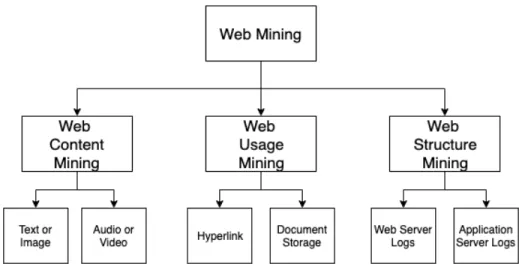
(30) 12. CHAPTER 2. BACKGROUND. Due to these reasons, it is difficult to simply extract information from the Web. DM is used to transform the noisy information into a condensed dataset (typically in a table form). Thus, Web DM (WebDM) aims to discover useful information from web documents [29]. Web data can be classified into three different areas [40]: 1. Content: It refers to the real data that is inside of the web page. May include images, audio files, tables, and lists. 2. Structure: It is the organization of the content using the HTML and XML tags. 3. Usage: It describes the pattern of the users behavior while in the web. WebDM can be categorized into these three same applications: Web Structured mining, Web usage mining, and Web content mining. WebDM problems can be tackled using DM techniques and procedures. Figure 2.1 shows how these three categories are separated within the web mining context. In this project, several techniques will be explored. The important distinction is the fact that the data used reflects real Web scenarios.. Figure 2.1: The three different categories of web mining.. 2.1.1. Web structured Mining. This area of Web Structured Mining focuses on the relations between web pages. Normally, this is thanks to the hyperlinks that are embedded in a single web page. Web structured mining tries to find a powerful relation between a web page and their linked pages to identify similarities. The algorithms used in this process require that the link elements of a web page are extracted and the data obtained is compared with other web pages and their relationships. One way to look at Web structured mining is to compare it to graph theory. In this comparison, the nodes of a graph are web pages, and their connections are the hyperlinks that reference each other. Some of the current applications of web structure mining use graph theory algorithms. Web structured mining can be divided into two [31]:.
(31) 2.1. WEB MINING. 13. 1. Hyperlink analysis: The identification of patterns between the connections made of web pages through hyperlinks. 2. Document structure: The analysis of the tree document structure form the web page and their relationship with the tag elements. Some common applications are the search engines that use this hyperlink structure to obtain similarities among web pages. The PageRank algorithm is one of the main focus when trying to improve the web page similarity through links. Other combinations have been made to improve the relevancy of the search results [37]. Recommendation systems for social network analysis are also a common use of Web structure mining. This system is used for identifying groups between people, companies, computers, and other connection entities [19]. Web structure mining follows four different steps [40]: 1. Data collection: This means the collection of hyperlinks and web documents. 2. Pre-processing: It validates the links and transforms the data. 3. Knowledge discovery: It applies DM techniques to the processed data. 4. Knowledge analysis: Identifies the patterns and displays the information to the final users.. 2.1.2. Web Content Mining. Web Content Mining is the area that uses the elements inside of the web page. For example, the topics talked on a web page, the text used or the comments a user makes while visiting a web page [29]. In the majority of the cases, this content is unstructured and the need to extract this information is useful in order to obtain the context of the web page. The use of these techniques has been applied to several pattern discovery problems like e-commerce [43]. Web content was also used to analyze the activities of research and development departments from different companies [13]. Web content mining deals primarily with Information Retrieval (IR) from the web pages. As stipulated above, the web pages have a semi-structured form. This makes it difficult to apply traditional DM techniques since the majority deal with relational datasets. The area of web content includes the integration and extraction of relevant information and its processing to formats that are understood to DM techniques. For this reason, some applications of web content mining include: categorization, clustering, user modeling, and finding patterns [26]. Like Web structured mining, web content mining can be divided into two types [28]: 1. Text mining: The use of text model techniques in order to find patterns, extract information, and in general obtain knowledge from unstructured or semi-structured web pages. 2. Multi-media mining: This area focuses on the extraction of media content within the web page in order to process it and analyze it..
(32) 14. CHAPTER 2. BACKGROUND. 2.1.3. Web Usage Mining. This area of Web usage mining tries to find patterns in the end user while it navigates the web. For example, the recordings of the clicks made by the user are considered to fall in web usage mining [29]. The main objective is to represent, in a readable way, the behavioral patterns that the user has while navigating or using the web page. The way to obtain this information is through three sources [18]: 1. Server logs: This refers to the collection of data that is stored in the servers. This data may include IP addresses, time logs, web pages visited, etc. 2. Client data: It is collected from the host that access the websites. The way to obtain the information is through JavaScript implementations. They generally describe the users navigational history. 3. Intermediate data: When the user request a web page through an intermediate devices such like proxy servers. The information gain could vary depending on the request of the user. One application of web usage mining is to provide better content depending on the user behavior. In a study, raw log files are used to provide the user with better products [30]. This thesis can be viewed as a combination of Web structure and Web content mining. Since the inner code is used, one could identify it as a Web structure. However, the application at run time and the use of the plain text of web pages can classify this problem as Web content. In reality, one problem can belong to different classification problems. This problem has the distinction that uses inner HTML code in order to classify contextual information of the web page.. 2.2. Data Mining Techniques. The idea of this project is to incorporate several DM models to solve the web classification problem. The models can be divided into two sections: Multi-class models and One-class models. Both types try to solve the problem of identifying the class of a new instance. For both types there are considered the following methods: SVM, KNN, and MNB.. 2.2.1. Multi-class Models. Multi-class models have the distinction of having more than two target classes. If a model only has two categories, for example, positive and negative; this problem can be viewed as a binary classification problem. As said before, Multi-class have N number of classes, and the objective is to find the set of rules that correctly classifies a new instance. Support Vector Machines Support Vector Machines (SVM) are useful when trying to find non-linear classification problems. SVM transforms a dataset into a higher dimension (which does not have a linear representation). The main objective is to be able to define the optimal separator in the hyperplane.
(33) 2.2. DATA MINING TECHNIQUES. 15. that could help with the separation of the classes in a classification problem [27]. A normal linear function, for a set of x, may be classified as follows: F (x) = wT x. (2.1). b. where w is a weight vector and b is a bias calculated during training. A margin is 1 presented with |w| which represents the margin between the closest data point of each class. The objective is to be able to reduce this margin while maintaining the classification [47]. Figure 2.2 shows a representation of how the margin describes the line that correctly classifies the data points.. Figure 2.2: The SVM function that separates the data points using a separator with a margin. For non-linear problems, SVM transform the data points into a higher dimensional vectors. While these vectors are in a high dimension, the linear function is discovered using this high dimension plane. However, the original input space appears to be a non-linear function [47]. The decision boundary is represented as: F (x) = w ⇤ ✓(x). b. (2.2). Where ✓(x) represents the transformation of x into a higher dimension plane. Generally, SVM are most commonly used with binary problems. However, one could interpret a multiclass problem as a combination of multiple binary-class problems. SVM do this by creating multiple models that correctly tries to classify two classes of the original classes. At the end, a voting mechanism is applied to identify the correct class of the instance. This method can be known as one-vs-one (OVO). K-nearest Neighbors KNN works by using a set of instances that can be represented in a m-dimensional space. Thus, forming a pattern that can be seen from this m-dimensional space. When a new instance is presented, it establishes its class by looking at the k neighbors that are near its data point in the m-dimensional space. An Euclidean distance is used to determine that a point is close or near another [35]. The Euclidean distance is measured using the following formula:.
(34) 16. CHAPTER 2. BACKGROUND. d(x, y) =. v um uX t (x. i. yi ) 2. (2.3). i=1. The new instance is assigned the most prominent class of its k neighbors. KNN is one of the simplest methods to implement since the class is assigned as a voting mechanism between the k neighbors. Generally, k has a low value and an odd number is assigned in order to prevent ties [35]. Multinomial Naive Bayes MNB assigns the class of an instance based on its likelihood. It uses the Bayesian theorem that describes the probability of an event based on prior knowledge of that event [36]. The Bayes’ rule specifies that given an event E and a class c. The probability of E being class c is: p(c|E) =. p(E|c)p(c) p(E). (2.4). The most probable class is the one assigned to the new instance. The simple form of MNB dictates that all the attributes from the instance are independent from each other. Although, such independence is very hard to accomplish. MNB has had a popularity with text classification problems [48]. In this problem, event E is considered to be a document D with a vocabulary of words W . The recollection of all different words W from all documents D are generally called the dictionary. For this problem the NB is considered as a MNB. In MNB, the word count for each document is treated separately in the calculations of p(d|C). That is, the prior knowledge of P (d|C) is calculated using the probability of the words in the document in class C p(w|C). This technique is being mainly used for text classification problem where there is a great amount of documents used for training [33]. Neural Networks NN consist of the connection between multiple layers called neurons. Each neuron produces a sequence of real value activation. Generally, neuron receive their inputs from their environment or from other neurons after a weighted calculation is applied. Learning comes by altering these weighted values in order to find the desiring behavior from the NN [39]. NN are used in multiple problems, one of them is the classification of text documents. NN are beneficial in this kind of problems due to their ability to process multiple features. Although, this may come to a high computational price [23]. For the text classification problem there has been a raising popularity with Deep Neural Networks (DNN) and Convolutional Neural Networks (CNN). Both have reached solutions that reach over 90% accuracy over text classification problems that include a great amount of corpus [9].. 2.2.2. One-class Models. The previous multi-class models try to classify one instance into a predefined list of categories. However, there is a big problem when there is not enough data that can be used to train the.
(35) 2.2. DATA MINING TECHNIQUES. 17. model. In the real world, there is a lot of information about one class (target class), but there is not enough information, or any, about an unknown or outlier class. To solve this problem one-class models are used [24]. One-class Classification Models (OCC) are classification models that are trained using data for the target class and none, or few, data from the unknown class. Generally, the target class is labeled as a positive and the outlier is labeled as a negative. The main objective is to create a boundary, using the positive examples, in order to accept future positive values while reducing the number of negative examples accepted [24]. OCC can be tackled using several algorithms and methodologies. Some multi-class algorithms have been translated to solve the OCC problem. Three models are studied in this project: One-Class Support Vector Machines (OSVM), One-Class K-Nearest Neighbors (OKNN), and One-Class multinomial Naive Bayes (OMNB). One-Class Support Vector Machines Instead of using a hyper-plane to distinguish between two classes, a hyper-shpere is created using the positive examples. These positive examples represent the positive data points in the plane and a minimum radius is used around them to generate the final boundary. This method is also known as the Support Vector Data Description (SVDD) [24]. Kernel functions can be used in order to improve the boundary and reduce the number of positive examples labeled as negative. Generally, the Polynomial or Gaussian kernel are good fits for the OCC problem. However, due to the absence of negative training data, OCC problems with SVM generally require a high amount of positive examples [24]. One-Class K-Nearest Neighbors Like regular KNN, this method uses the nearest neighbors in order to identify if the instance belongs to the positive class. The method is generally used with k = 1. For a new instance z, it is calculated the distance to the first nearest neighbor. The neighbors are the training set that contains the positive values. Then, this nearest neighbor is used to calculate its distance to its nearest neighbor in the training set. The division between the two distances is used to determine the class [10]. N N (z) =. ||z tr ||N N (z). N N tr (z)|| N N tr (N N tr (z))||. (2.5). Where N N tr (z) is the nearest neighbor of z from the training dataset. A threshold th can be used to determine the final calculated distance and evaluate if z belongs to the positive or negative class. For applying this method with k > 1. The following steps are proposed: 1. Having the number of neighbors k, a threshold th, and a training dataset Dtr with size n. Create a matrix of nx1. 2. For every I✏Dtr calculate the Euclidean distance of its k nearest neighbors. Using the mean of these distances populate the nx1 matrix..
(36) 18. CHAPTER 2. BACKGROUND 3. Obtain the nearest neighbor of z and obtain its euclidean distance D1 . 4. Using nearest neighbor. Obtain the k nearest neighbors distances from the matrix nx1 and obtain the mean D2 . 5. Calculate the distance D(z) as the division of D1 from D2 . 6. If D(z) < th. The class of z is positive. Otherwise the class is negative.. The value of the threshold th can be calculated using a harmonic mean of the euclidean distances from the nx1 matrix [1]. One-Class Multinomial Naive Bayes Since the dataset used to train the model is going to be positive values. The process of OMNB is a little different than its regular multi-class form. In this scenario a threshold th is used to determine the class of the new instance. If P (z|C) is smaller than th then we can label that instance as a negative class [42]. The following procedure goes as follows: 1. For every d in Dtr the probability P (d|C) is calculated. 2. The probability of P (d|C) is represented as the product of the probabilities P (w|C) for all the words that appear in document d. 3. Given a new instance z the probability P (z|C) is calculated. If the value is less than th we label the instance as negative. The value of can be established as the minimum distance, of P (d|C), from of all examples in class C [32].. 2.2.3. Comparison with Text Classification and Web Classification. As said in the previous chapter, the web classification problem can be viewed as a way to correctly classify a web page given their contents. Several models and techniques are used to solve this particular problem. However, another problem can present similar characteristics. The text classification problem or document classification problem can possibly share elements of the web classification problem. This also implies that algorithms applied to the text classification problem can be used to solve the web classification problem. In the following sections, it will be described how these patterns can be used. Text Classification In its simple form, the text classification can be viewed as the ability to assign predefined classes to text documents. It can be defined as a set of documents D = d1 , d2 , ..., dn where each document di is assigned a class lj from a set L = l1 , l2 , ..., lm . The task is thus to find f such that [3]:.
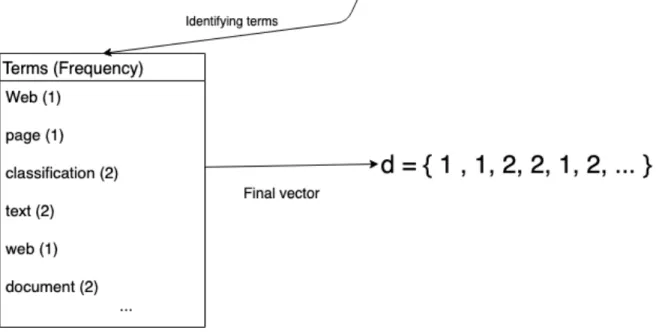
(37) 2.2. DATA MINING TECHNIQUES. 19. f :D!L. f (d) ! l. (2.6). For the majority of the text classification cases, the measurements used are precision, recall, and F-measure (or F-score). These measures determine the effectiveness of the classification model. The precision and recall can be defined as [14]: 1. Precision: It is the probability that an instance is relevant given the total of predictions made by the model. The following equation can be used: precision =. TP TP + FP. Where T P is the total of true positives and F P is the total of false positives. 2. Recall: It is the probability that an instance is relevant given the total of real instances in the test. The following equation can be used: precision =. TP TP + FN. Where T P is the total of true positives and F N is the total of false negatives. 3. F-score: It can be calculated as the harmonic mean of the precision and recall. The following equation can be used: F score = 2. PR P +R. Normally the F-score is a better measurement to calculate the accuracy of a model. Most of the previous work, described in a future section, uses the F-score. Another term used in text classification is the words frequency and vocabulary. Given the set of documents D let V be a set of collections of words V = w1 , w2 , ..., wn each word w establishes a different term in the collection. The frequency fd (w) describes the number of repetitions a word wi appears on a document dj [3]. A vector can be defined as: t~d = fd (w1 ), fd (w2 ), ..., fd (wn ). (2.7). This vector is commonly used to describe the features required by the classification model. A short example can be viewed in Figure 2.3. While this is a valid way to create numerical instances of documents. There is a technique called Term Frequency–Inverse Document Frequency (TF-IDF) that helps with the optimization of the classifier. Term Frequency - Inverse Document Frequency TF-IDF is a numerical statistic that is meant to show how important a word in a document given a collection of documents. The goal of the technique is to augment the value of rare term given a number of similar documents [38]. The result is that those words that do not repeat frequently enough in all the documents are given an elite status which helps to discriminates.
(38) 20. CHAPTER 2. BACKGROUND. Figure 2.3: Basic example of transforming a text document into a word vector. more the context of a document [49]. The method is divided into two techniques: TF and IDF. The TF is the number of repetitions a word appear in a document. IDF determines whether a word is common or rare between a collection of documents. The value can be obtained by the logarithmic of the total number of documents divided by the total number of documents containing the word w [38]. The following equations can be used : tf (w, d) = f requency(w, d). idf (w, D) = log. N |d ✏ D : w ✏ d|. (2.8). (2.9). With these definitions the TF-IDF can be calculated as: tf idf (w, d, D) = tf (w, d)idf (w, D). (2.10). The TF-IDF is used when a vector of frequencies are used. In the web classification problem, the frequencies of the tag elements can be used instead of a word frequency. With the goal of obtaining a better context, the TF-IDF is used in the experiment in order to see if the frequency of tag elements can be improved using this method. The normal TF-IDF method is also used with text documents of the web pages..
(39) 2.2. DATA MINING TECHNIQUES. 2.2.4. 21. Principal Component Analysis. Principal Component Analysis (PCA) is a linear unsupervised classification technology. It has the ability to create interrelated variables uncorrelated through singular value decomposition (SVD) or eigenvalue decomposition. PCA is used when trying to reduce the dimensions of a dataset and it has proven to be successful in multi-class classification [20]. The process of PCA is generally described as follows [21]: 1. Given a set X = x1 , x2 ...xn calculate the mean m. 2. Re-scale every xinX to have unit variance. This to ensure that all the attributes are treated on the same scale. 3. The eigenvalue is calculated for every position. The highest k values are chosen.. 2.2.5. Web Page Classification Algorithm Based on Feature Selection. The Web Page Classification Algorithm Based on Feature Selection (WCAFS) was proposed by Zhou, et al [50]. The algorithm is based on the TF-IDF transformation. The difference, is that the WCAFS algorithms calculates the weight of the word based on three aspects: category, Inter-class Deviation (ID) and Intra-class Distribution Ratio (IDR). The category is determined depending on the location of the term. If a term is found in the title of the document, then the category is set as 4. If the term is found in the description of the web page, then the category is set as 2. The category is set as 1 if the term is not found in any of those locations. Inter-class Deviation (ID) means that a term may appear in certain classes and not in others. The calculation of ID is as follows: N (w, Cj ) ID(w, Cj ) = Pm x=1 N (w, Cx ). (2.11). Where N (w, Cj ) is the number of documents that contain the term w in class Cj , x=1 N (w, Cx ) is the sum of all the documents that contain the term w in all the classes, and m is the number of classes. Intra-class Distribution Ratio (IDR) is the probability that the term appears in all the documents in a class. The calculation of IDR is as follows: Pm. IDR(w, Cj ) =. M (w, Cj ) M (Cj ). (2.12). Where M (w, Cj ) is the frequency that the term w appears in class Cj , and M (w, C) is the total number that all the terms appear in class Cj . The final WCAFS transformation uses the following formula:. W (w, Di ) =. r Pn. (D) f (w, Di )xlog( NN(w,D) + 0.01). N (D) 2 2 k=1 (f (wk , Di ) x(log( N (w,D) + 0.01)). xID(w, Cj )xIDR(w, Cj ) (2.13).
(40) 22. CHAPTER 2. BACKGROUND. Where f (w, Di ) represents the category of term w in document Di . N (D) is the number of documents in the collection D, N (w, D) is the document frequency of term w in the collection D. The variable n is the number of terms in document Di . ID(w, Cj ) is the Inter-class Deviation of term w and IDR(w, Cj ) is the Intra-class Distribution Ratio of the term w. The class Cj is the class that the term w belongs in the document Di [50].. 2.3. Related Work. Several applications are being made to solve the classification of web elements. One of the most prominent experiments is the work done by Gkantouna and Tzimas [12]. They established that the hypertext level of a web page can be used to determine the specific patterns of their elements. In their experiment they use the Joomla framework to determine the different elements or attributes that one instance has. Another experiment, performed by Yeongsu and Seungwoo, uses specific tag features such as title, date and paragraph to perform an SVM model in order to do the classification of web content [25]. Their work relates to a specific area of DM called WebDM. They concur in the use of web tags to determine the category of a web page. Although, unlike Gkantouna, they do not use the Joomla framework to establish their classes. Experiments made by Sun et al. [41] have gotten a SVM classification model using the WebKB dataset. Their problem is to classify between different types of university web pages. Applying different elements to the SVM they got an F score of 0.575. They use different types of context elements such as: text, title and anchor words. This article does show that an SVM model could be used to classify web page documents. Chen and Hsieh [8] have created another SVM model which consists of two SVM models: one using latent semantic analysis and other uses text features. The final model is a voting system that consists of determining whether one instance belongs to a class or not. The results show that the voting schema is better than previously know methods with a precision of over 90. Another experiment using text documents was made by Zhou et al [50]. This experiment proposes a new algorithm that outperforms the TF-IDF transformation. With this experiment a precision of over 0.9 is found. The TF-IDF transformation has a precision of 0.8.. 2.4. Summary. In this chapter, the WebDM was defined as three possibles categories: Web structure mining, Web content mining, and Web usage mining. For the purposes of the project, the web classification problem will fall into a combination of Web content mining and Web structure mining. This is because the tag dataset is going to be used to correctly classify web pages without he need of user information. Different DM techniques were described in this chapter. In order to solve the web classification problem, the models chosen were the SVM, KNN, MNB, and NN. Additionally, the problem can be viewed as a text classification problem and the TF-IDF transformation can be used to improve the overall results of the models. Finally, the Oneclass models are described since it presents an opportunity to be able to train the models with limited data..
(41) Chapter 3 Solution Model The following chapter explains the different models that were used in the final sets of experiments. The aim of the project is to compare different configurations of models in order to determine the best solution for the web classification problem. This chapter will describe the procedure followed when recollecting the data and the construction of the final models.. 3.1. Data Acquisition. Gathering the data is difficult in this project. There is not a real dataset that contains the information that it is needed. For solving this problem, the information of real web pages have to be extracted. To help with the creation of the dataset, a web crawler was made using Selenium. The program was made using C# and the full code can be obtained in https://github.com/samuelistico/web-examples-repository/. The general extraction problem follows these steps: 1. A list of 2,000 web pages is made containing the URL of all the different web pages. 2. For every URL the crawler opens a Google Chrome browser and navigates to the following page. 3. Once the page is fully loaded, a JavaScript command is executed in order to obtain the count of all the elements specified below. The count is zero if a web page does not contain the specific element. 4. The plain text of the web page is then extracted using a library in C# (called HtmlAgility). 5. The data is saved as a json file and then it is transformed into a csv file for each class. The final result is four files corresponding to the different classes.. 3.1.1. List of Tag Elements. The W3Schools specifies a list of 119 different tag elements [45]. All of those elements will be used as features for the dataset. However, there are tags that are going to be removed, transformed or added. 23.
(42) 24. CHAPTER 3. SOLUTION MODEL. The elements that are going to be removed are those tag elements that do not provide additional information for the problem or that are common among all web pages. For example, the tags: BODY, HTML, DOCTYPE and BODY will be removed since the number of frequency in all web pages is 1. The a tag elements, which represents a hyperlink, are going to be divided into two different types: a and a.href elements. The a.href element is an a element that contains the attribute href. The rest of the elements will be considered simple a elements. This distinction is made to identify a elements that function as links or action objects. Links generally send the user to another web page while action objects may reflect an interaction with the user. The INPUT tag elements are going to be transformed into 22 different elements. These elements are the ones found in the W3Schools web page [46]. The reason to do this is because every INPUT element has a distinct function regarding their type. The most common example is text and password. Both of these elements are INPUT elements but with different functions. For the purposes of the web classification, these elements are going to be added in the final dataset. With these changes a total of 141 features are obtained. However, other elements are going to be removed from the dataset. There are 21 elements that have a value of 0 in every instance. Since they do not present relevant information, these features will be removed. Features with a frequency less than 50 will be also removed. The information gained using these features is not much. The total of features with less than 50 repetitions is 30. One last set of tag elements are removed, these elements were chosen due to being elements that contribute little with the final rendered objects of the DOM. The number of these elements are 7 and were chosen manually. The final dataset contains a total of 83 different features. That is, of the previously 119 elements, 36 elements were removed in order to obtain the real tags that are believed to be helpful in the web classification problem. Table 3.1 presents a short list of the most representative elements and their function. Figure 3.1 shows a representation of the final dataset. Tag Function A.HREF Represents a hyperlink in a web page. A Represents a A element that does not necessary functions as a hyperlink. INPUT.TEXT Represents a text box where a user can introduce text values. INPUT.PASSWORD Similar to the previous element. Except the value typed it is hidden. BUTTON Represents an element that can be clicked by the user triggering an action. Table 3.1: Basic Tag elements with their names and function in a rendered web page.. 3.1.2. Choosing the Class Examples. The 2,000 examples are divided into four classes with 500 examples each. Each instance had to be manually chosen from the Internet. Generally, the examples were found using special keywords on popular search engines like Google or Bing. Certain rules had to be met in order to be considered as an instance of a class. These rules are defined for each class..
(43) 3.1. DATA ACQUISITION. 25. Figure 3.1: Final dataset used in the experiments. The content column represents the text dataset that is going to be transformed using the text transformation methods. Rules for Login For the Login class, an authentication form must be heavily present in the web page. An authentication form typically consist of three elements: the username text box, password, and an action button. The majority of the examples had the login form in the center of the web page. Other examples had the form with extra content. Some special cases had only the username text box and, after filling the information, the password text box would appear later. These cases were also considered as instances of the Login class. Rules for Search For the case of the Search class, the search text box was the element that had to appear and be very prominent in the web page. Normally, like Google, the text box is large and is either in the middle or in the top of the web page. Other variations could include having the text box on the top right corner and having the rest of the web page be filled with static results. Another variation is the advanced search web page, this page contains multiple text boxes that represent a more specific search. The majority of the web pages used were universities databases. Rules for Form The Form login was obtained mostly by fill up forms or ”Contact Us” web pages. The key factor was the number of input elements. Since a login could be considered a form; the web pages were picked if they had at least 3 input elements that were different from those of the Login class. For example, a form with three text boxes could be considered an instance of the Form class. However, there could be a possible overlap with the advanced search case from the Search class. For this reason, other web pages were obtained were the elements were different than text boxes..
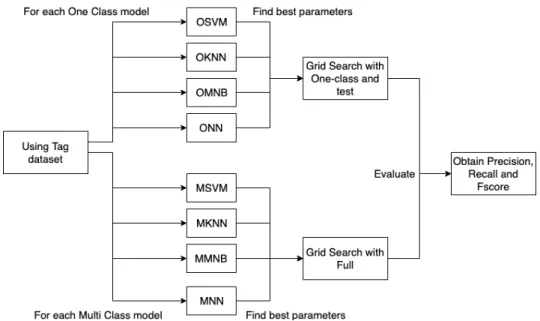
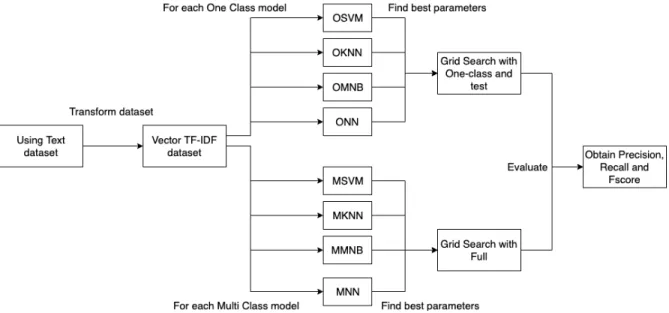
(44) 26. CHAPTER 3. SOLUTION MODEL. Rules for Article The article class was the easiest of all the classes. The examples were articles that contain a big amount of paragraph elements. For this reason, popular news and entertainment web pages were used to obtain these examples. Other elements that could appear in the article were images and headers.. Construction of the Dataset Once the list of the web pages was created, the C# program was executed to obtain the information of all 83 tags and the plain text of each web page. This dataset was then divided into two: the tag dataset and the text dataset. In the end, both datasets represent a term frequency vector of a single web page.. 3.2. Classification Models. As said before, the models can be divided into two categories depending on the dataset used for the problem. These categories are: tag models and text models. In both cases the SVM, KNN, MNB, and NN models are used. However, both categories handle the data preprocessing in different ways. These differences will be explained in the Experimental Settings section. Figure 3.2 shows, in a general way, the process followed when using the original tag dataset. The first observation is the selection of the parameters. With the one class models, the full train and test sets have to be used to determine the best parameters. This is mainly because the training set generally has only positive values. In this instance, the test set is used to determine the best model parameters. For the Multi-class models, the full dataset is used. This means that all the 2,000 examples are used, with their labels, to determine the best parameters. Both sets of models return the accuracy measurements, the parameters of the highest accuracy model are used for the experiment. One last thing to notice is that, for the tag dataset, the process will be executed several times. The dataset will be transformed using the PCA method. However, as it will be explained in the next chapter, the PCA method will not be applied in all models. The total models will be of 13. There will be eight with the original dataset, and five with the PCA method. This whole process will be repeated again but the tag dataset will be transformed using a TF-IDF method. In total, 26 models will be executed and compared. For the text models, a similar process will be performed with a dataset containing 1000 different frequency terms. The process will transform the words frequency into a vector dataset. Then, the TF-IDF method will be performed. This final dataset will then be used to create and evaluate the eight different models. Table 3.3 shows the process of the Text models. In total, 44 models will be used and analyzed. The main objective will be to determine what is the best combination that solves the web classification problem. The Precision, Recall and F-score will be used in order to determine the highest performing model..
(45) 3.2. CLASSIFICATION MODELS. 27. Figure 3.2: Solution proposed for the web classification problem using the original tag dataset.. 3.2.1. One-class Classifiers. In total, there were 13 different One-class classifiers. However, the parameters can be fine tuned in order to improve the model. For the majority of the parameters, a guide was used to determine the range values of the parameters [17]. Basically, the parameters were introduced with an initial range of values. For example, some attributes had a range from zero to one with increments of 0.25. The Grid Search was performed and the best model was recorded. If the final values were in the limit of the range (for example the value returned one) the range of that specific parameter was extended until the search returned a model with a lower score. For example, if the highest performing model had a parameter of 1, the grid search was performed again but with a range of one to two. Again, this was done until the best performing model was not in the limit or the accuracy was lower. In general, the parameters were bound to the specifics of the library used or the search was concluded when the model did not performed any better. One-class Support Vector Machines For OSVM, the sklearn library was used. In this classifier, three parameters were used: , ⌫ and the kernel. To fully obtain the best possible classifier a grid search is perform with a range of these parameters. The values used were the following: kernel = [”poly”, ”rbf ”, ”sigmoid”, ”linear”] = [2. 27. ,2. 25. , ..., 2 9 , 2 7 ]. ⌫ = [0.25, 0.5, 0.75, 1.0] In this case, the parameter was determined by the example performed in the previously mentioned guide [17]. The range of this parameter began with 2 15 , 2 13 , ..., 2 9 , 2 7 . After.
(46) 28. CHAPTER 3. SOLUTION MODEL. Figure 3.3: Solution proposed for the web classification problem using the text dataset. the first run, the best parameter was 2 15 . The second range became 2 23 , 2 21 , ..., 2 17 , 2 15 . This process continued one more time until 2 27 became the best model since no improvements were obtained by reducing the parameter further. The kernel parameter had only those four values that are also considered in the guide [17]. Another parameter was C but the sklearn library did not consider it a parameter in the Oneclass version of SVM. However, ⌫ is a specific parameter for this model. In the library documentation, the range of nu goes from (0, 1]. But, after a few executions the best parameter found was one. For this reason, no further searches were performed for the nu parameter.. One-class K-Nearest Neighbor For OKNN, a python class was created. This class receives the K parameter and calculates the Euclidean distance of all the training data points. Then a threshold th is defined in order to determine the margin difference that will be used to determine whether a new instance is part of the class or not. The implementation of the class can be found on https://github.com/samuelistico/webexamples-repository/blob/master/OneClassModels.ipynb. For this problem, the parameter of k will be the only parameter that is going to be fine tuned. This parameter represents the number of neighbors that the model will consider while assigning the label classes. k = [1, 3, 5, 7, 9, 11, 13, 15, 17] In this case, the search of the k value was halt after 17. This is because increasing the k value did not improved the overall accuracy of the model. Values like 19 to 25 returned the same accuracy as the one obtained in 17. For this reason, the final parameters for all the models were established as [1,17]..
(47) 3.2. CLASSIFICATION MODELS. 29. One-class Multinomial Naive Bayes For the One-class Multinomial Naive Bayes (OMNB), a python implementation was created according to the specifications established in Chapter 2. For this class, the probabilities of each word or vector will be calculated for the entirely dataset. Since all the training data is from one class, the entire training dataset is going to be used for the calculations. The total of words are going to be fixed for the tag elements. The only parameter used is the threshold th with the following values: 0.5, 1, 1.5, 2 Like the OKNN, changing the value of th did not returned better results. However, this model was unaffected by increasing or decreasing the value. Overall, this model was the worst model of all the execution regardless of the parameter used. One-class Neural Network For the One-class Neural Network (ONN), the keras library was used to construct the NN classifier. For this case, a simple NN architecture was used. The simplest found was one called F astT ext [9]. Figure 3.4 shows the basic architecture of this model. However, some modifications had to be made in order to be executed correctly. The most notable one was the application of the ReLu activation function with a final sof tmax function. The sigmoid function was considered in order to perform a One-class model with only positive classes. However, the final results always calculated the classes as positive examples with a very low difference between instances. In the end, it was decided to use the previously mentioned architecture with low examples of negative instances in the training data. This resulted with the best possible model. Nevertheless, in the following chapters, it will be noticed this change since the previous One-class models do not have the advantage of having negative classes in their training sets.. Figure 3.4: Architecture for the ONN..
Figure



+7


Documento similar