
CE as orthogonal technique to HPLC for alprazolam degradation product identification / Coral Barbas [et al ]
8
0
0
Texto completo
(2) 2360 Luis Saavedra1 Angel Luis Huidobro1 Antonia García1 Jose Carlos Cabanelas2 María G. González2 Coral Barbas1 1. Sección de Química Analítica, Facultad de Farmacia, Universidad San Pablo-CEU, Campus Montepríncipe, Madrid, Spain 2 Dpto Ciencia e Ingeniería de Materiales e Ingeniería Química, Escuela Politécnica Superior, Universidad Carlos III de Madrid, Madrid, Spain. Received December 1, 2005 Revised March 14, 2006 Accepted March 15, 2006. Electrophoresis 2006, 27, 2360–2366. Research Article. CE as orthogonal technique to HPLC for alprazolam degradation product identification The control of degradation products is currently a critical issue to the pharmaceutical industry. A degradation product that appeared in alprazolam tablets during their stability assay, 7-chloro-1-methyl-5-phenyl-[1,2,4]triazolo[4,3-a]quinolin-4-amine, also named triazolaminoquinoline, was tested as possible candidate in the HPLC method employed for the study. The impurity showed the same retention time and spectra as the degradation product; but as all these compounds are very closely related, a confirmation with an independent technique was necessary, and CE was chosen for that purpose. Problems related to the adsorption of the analytes to the negatively charged silica surface were solved by employing a new polymeric capillary coating consisting of poly(3-aminopropylmethylsiloxane). The polymer provided EOF towards the anode, and the two compounds were separated in less than 8 min in a 60 cm total-length capillary, 75 mm id capillary with a BGE containing 50 mM phosphate buffer at pH 2.0 with 20% ACN. When the sample containing the degradation product was injected, the presence of triazolaminoquinoline was confirmed. Keywords: Capillary coating / Impurities / Poly(3-aminopropylmethoxysilane / Pharmaceutical analysis DOI 10.1002/elps.200500882. 1 Introduction Stability testing is the primary tool used in the pharmaceutical industry to assess expiration dating and storage conditions for pharmaceutical products. Stability testing includes long-term studies, where the product is stored at room temperature and humidity, as well as accelerated studies where the product is stored under conditions of high heat and humidity. The appropriate physical, chemical, biological and microbiological testing must be performed. Strict regulatory guidelines of the International Conference on Harmonization (ICH), have led to an increasing need for identification and quantification of trace impurities in drugs. All impurities defined by ICH as any component of a pharmaceutical product which is not the chemical entity of active substance or excipient, present at levels higher than 0.1% or in some cases higher than. Correspondence: Dr. Coral Barbas, Sección de Química Analítica, Facultad de Farmacia, Universidad San Pablo-CEU, Campus Montepríncipe, 28668 Boadilla del Monte, Madrid, Spain E-mail: [email protected] Fax: 134-913510475 Abbreviations: PAMS, poly(3-aminopropylmethylsiloxane); PDA, photodiode array. © 2006 WILEY-VCH Verlag GmbH & Co. KGaA, Weinheim. 0.2%, depending on the daily recommended dosage, need to be identified and qualified with appropriate toxicological studies. If impurities were expected to be very toxic, then identification and qualification would be required even at lower concentrations [1]. Ahuja [2] and Görög [3] have published books covering different aspects of impurities, including the governmental regulations and guidelines and the identification and monitoring of impurities found in drug products. In addition, a number of recent articles [4–6] have described a designed approach and guidance for isolating and identifying process-related impurities and degradation products using MS, NMR, HPLC, Fourier transform ion cyclotron resonance MS (FTICR-MS), and MS/MS for pharmaceutical substances. These have been reviewed by Roy [7]. Isolation and purification of sufficiently large quantities of impurity required for its unambiguous identification and characterisation by different instrumental techniques, including NMR, is a very complex and time-consuming process. The problem is particularly complex when dealing with formulations like tablets with low quantities of active substance, e.g. ,1 mg per tablet and it is important to look for alternative strategies when all this effort is not fully necessary, as is the case with known compounds. www.electrophoresis-journal.com.
(3) CE and CEC. Electrophoresis 2006, 27, 2360–2366. 2361. HPLC with UV detector is the predominant tool used to analyse the pharmaceutical products, particularly for small molecules. Identification by retention time, even including a photodiode array (PDA) detector is not unambiguous, because different impurities, degradation products and the active compound are closely related compounds.. Polybrene™) has been widely used to create a cationic surface and reverse the direction of EOF [26–28], as have polyarginine [29], polyethyleneimine [30–32] and poly(diallyldimethylammonium chloride) (PDADMAC) [33]. Although mainly applied for protein analysis, their usefulness for small molecules would be based on the same working principle.. Alprazolam is a benzodiazepine used to treat anxiety disorders. Nudelman et al. [8] performed stress studies of alprazolam under accelerated thermal, hydrolytic and photochemical conditions; and the main photodegradation products were isolated and properly characterised as: triazolaminoquinoline, 5-chloro-[5’-methyl-4H-1,2,4triazol-4-yl]benzophenone and 1-methyl-6-phenyl-4H-striazo-[4,3-a][1,4]benzodiazepinone. Moreover, the reversible 1,4-benzodiazepinone ring-opening under aqueous acidic conditions was previously described for alprazolam [9].. The objective of the present work was the identification of triazolaminoquinoline as the degradation product of alprazolam, formed during a stability test of tablets containing the active compound. This was done by employing CE as orthogonal tool to confirm the information obtained by HPLC.. The separation of benzodiazepines using CE has been performed using MEKC both at acidic pH [10–12] and basic pH values around 8–9.5 [10, 13–19]. Furthermore, CEC has also been employed for this purpose [20, 21]. Recently, the use of dynamically coated capillaries has been described for the separation of a series of benzodiazepines, not including alprazolam, at low pH [22]. Moreover, the benzodiazepine drug substance bromazepam and related impurities have been determined with a method based on NACE [23]. Frequently, basic (positively charged) compounds present a particularly difficult challenge in CE due to their strong electrostatic interactions with the negatively charged silica surface. In CE, the effects of that adsorption are manifested in poor peak shape, irreproducible migration times and irregular EOF, and in the most severe cases, total adsorption resulting in failure of a protein to elute. Thus, a major objective of capillary coating protocols is to modify or mask the silanol groups on the capillary surface by presenting a more inert surface. A second major reason for treating capillary surfaces is to modify EOF. Neutral, hydrophilic polymers, such as polyacrilamide, either covalently bound or physically adsorbed, create a thick region of very high viscosity that extends beyond the double layer, effectively eliminating EOF [24]; but they are not useful in cases when EOF is desired. In a publication about coatings for protein analysis in CE, Meagher et al. [25] reviewed the state-of-art on the subject. In summary, regarding charged polymers, many of them have been used to modify surface charge as well as to reduce analyte adsorption. 1,5-Dimethyl-1,5-diazaundecamethylene polymethobromide (hexadimethrine bromide, trade name © 2006 WILEY-VCH Verlag GmbH & Co. KGaA, Weinheim. 2 Materials and methods 2.1 Chemicals Poly(3-aminopropylmethylsiloxane) (PAMS) was prepared according to a method already reported [34]. The molecular mass was 1600 g/mol as measured by vapor pressure osmometry (Knauer K-7000). Acetone was purchased from Scharlab (Barcelona, Spain). Boric acid was from Fluka (Buchs, Switzerland), sodium hydroxide, acetic and phosphoric acids were from Panreac (Madrid, Spain). ACN was from Merck (Darmstadt, Germany). Ultrapure water was obtained with a Milli-Q Plus system (Millipore, Bedford, MA, USA). Alprazolam raw material as well as tablets and excipients were kindly supplied by CINFA, S. A. (Pamplona, Spain). Triazolaminoquinoline was synthesised in our laboratory following the indications described by Nudelman et al. [8], and qualified by NMR and MS.. 2.2 Instrumentation 2.2.1 HPLC The HPLC method was similar to the one previously described [35] with minor modifications. A LaChrom Elite HPLC system from VWR consisted of a quaternary pump, an automatic injector, a variable wavelength detector and a column oven. The column was ODS Hypersil from Hewlett Packard (20064.6 mm and 5 mm). It provided baseline separation with isocratic conditions at pH 4.2 in less than 12 min for the impurity and alprazolam. The mobile phase consisted of buffer A/ACN 45:55 v/v with buffer A being 25 mM KH2PO4 brought to pH 4.2 with H3PO4. The flow rate was 0.75 mL/min and the injection volume was 20 mL. The oven temperature was set at 407C and UV detection was performed at 234 nm. www.electrophoresis-journal.com.
(4) 2362. L. Saavedra et al.. Alprazolam and triazolaminoquinoline standard solutions were prepared by weighing exactly around 5.0 mg of each separately in 100 mL volumetric flasks. In all cases the solvent for standards and samples was the mobile phase. For quantification 268 mg of the pulverised tablets (0.25 mg of active compound per tablet) were dissolved to 10 mL. After bath sonication for around 5 min samples were filtered through a 0.45 mm nylon membrane prior to the injection.. 2.2.2 CE All the experiments were carried out in a Beckman P/ACE MDQ CE System (Fullerton, CA, USA) with a PDA detector. All the data were processed using Beckman’s 32Karat 5.0 software. The injection was by pressure at 0.5 psi for 5 s, whenever it is not specifically indicated. The fused-silica capillary tubing was from Polymicro Technologies (Phoenix, AZ, USA). It was properly cut to have a 60 cm total length and 75 mm id capillary. The BGE was 50 mM phosphate buffer set at pH 2.0 and mixed afterwards with 20% ACN. The running potential was 20 kV in reverse polarity mode (injection in the negative end and detection at the positive end) and temperature was maintained at 257C during the analysis. The current observed under these conditions was around 40 mA. At its first use the capillary was flushed with NaOH of 0.1 N for. Electrophoresis 2006, 27, 2360–2366. 15 min, followed by a water rinse for 5 min. A 2% w/w aqueous solution of PAMS polymer was used to perform the coating of the capillary inner walls. The procedure consisted of just flushing the polymer solution throughout the capillary for 5 min for the first time and wait for ten additional minutes while keeping the solution inside. After this, the capillary was ready for use. In-between runs, the capillary was just rinsed with fresh buffer (2 min at 10 psi) prior to each injection. The BGE was replenished every 8 runs to avoid the variability due to the buffer deterioration. Standards and samples were prepared in the same concentration levels as for the HPLC method but dissolved in 10 mM phosphate buffer at pH 3.0/ACN (80:20 v/v).. 3 Results and discussion The appearance of a still unidentified impurity with increasing concentration at increasing time of storage during a stability test on alprazolam tablets is shown in Fig. 1. The compound should be identified following ICH guidelines [1]. Previous studies on alprazolam degradation had described the equilibrium of the reversible alprazolam ring-opening [9]. Therefore, the corresponding triazolaminoquinoline standard was tested. The peak showed the same retention time (as can be observed in the upper trace in the same figure) and UV spectra as the unidentified impurity and with characteristic UV maxima. Figure 1. Chromatograms corresponding to alprazolam tablets after 18, 24 and 36 months (for continuous lines, increasing time corresponds to increasing impurity peak) of storage at 257C/60% relative humidity and triazolaminoquinoline at 1% (discontinuous line). ODS Hypersil column was used. Mobile phase: 25 mM phosphate buffer (pH 4.2)/ACN (45:55 v/v) at 0.75 mL/min, 407C. UV detection at 234 nm. © 2006 WILEY-VCH Verlag GmbH & Co. KGaA, Weinheim. www.electrophoresis-journal.com.
(5) CE and CEC. Electrophoresis 2006, 27, 2360–2366. at 195, 234 and 315 nm in the HPLC mobile phase. Therefore the identification was considered quite reliable, but still not unequivocal. MS facilities are not always available and, therefore, CE was chosen as the orthogonal technique to increase the confidence in the identification. Indeed, in order to obtain an orthogonal separation to the previously described method, the first attempt was to employ HPLC with stationary phases with different selectivity. Columns with polar RP stationary phases, such as the PEG (Discovery HS PEG 15064.6 mm, 5 mm) and the pentafluorophenyl (Discovery HS F5 15064.6 mm 5 mm) were tested. Both columns were discarded because a different selectivity was not obtained for these two compounds. In addition, new stationary phases have been developed as an alternative to normalphase such as HILIC. These columns have similarities with traditional NP-HPLC, but they can work under semiaqueous mobile phases. Their main advantage is that the elution order is likewise inverted to RP chromatography. Therefore, different columns were tested following such strategy: Waters Atlantis® HILIC 15064.6 mm, 5 mm and Agilent Zorbax RX-SIL 15064.6 mm, 5 mm. The best results were obtained with a mobile phase containing 25 mM phosphate buffer pH 6.0/ACN 15:85 v/v; although the elution order was modified, resolution was not enough for the purpose. As no reasonable results were obtained with different stationary phases, the possibility of achieving an orthogonal separation by HPLC was discarded and an other separation technique, such as CE, was checked. The availability of a different separation mechanism can provide useful information when it comes to compound identification. In this matter, CE along with HPLC becomes to a powerful combo for peak assessment. The physicochemical nature of the benzodiazepines may give rise to some problems if CE is used as the analytical technique as they are difficult to ionise due to fairly low pKa values. The pKa values for both molecules have been calculated using the ACDLabs PhysChem software [36] and they are shown in Table 1. Because of these low pKa values, low pH buffers are necessary to achieve some kind of separation by CZE and that produces the EOF suppression in uncoated silica capillaries. As a consequence of this lack of ionization, and also due to the lipophilic molecular structure, many of the benzodiazepines have a very low solubility in aqueous solvents [23]. The initial experiments were performed on a silica capillary tubing 37 cm long and a 75 mm internal diameter, and were operated at 215 kV potential by varying the pH from © 2006 WILEY-VCH Verlag GmbH & Co. KGaA, Weinheim. 2363. Table 1. Calculated pKa values for alprazolam and the impurity Alprazolam. pKa1 pKa2 pKa3 pKa4. 1.42 6 0.20 2.09 6 0.40 2.28 6 0.40 –. Triazolaminoquinoline. 21.80 6 0.70 21.13 6 0.30 3.12 6 0.30 4.41 6 0.50. 2 to 11, but no peak was obtained. These results raised the possibility that these compounds were not soluble in the buffer assay or may get adsorbed to the capillary surface. CZE of positively charged analytes in uncoated fusedsilica capillaries might be problematic due to the interaction of the analytes with the negatively charged wall. The following experiments were performed on a polyacrylamide-coated capillary tubing (37 cm long and 50 mm id; Beckman Coulter), and was operated at 218.5 kV potential, borate buffer 100 mM, pH 8.5, urea 5 mM, SDS 10 mM as described previously [14]. This method allows the identification of alprazolam but not its impurity, which does not appear in the profile, probably due to its different solubility. Different modifications of this method were carried out in order to approach the analysis of both compounds. In this way, urea free buffers with varying concentration of SDS from 10 to 100 mM and pH from 4 to 8 were assayed without adequate results. The separation of alprazolam and its impurity by CZE requires challenging techniques due to the ionisation states of these particular compounds. After these set of negative results it was necessary to tackle the separation from a different point of view. In this matter the use of some kind of inner coating is a must for a rapid and high efficiency performance. PAMS polymer can be easily adsorbed to the capillary walls providing two different effects: (i) it avoids the interactions between analytes and silanol groups and (ii) it gives to the capillary a positively charged surface. Furthermore, this second www.electrophoresis-journal.com.
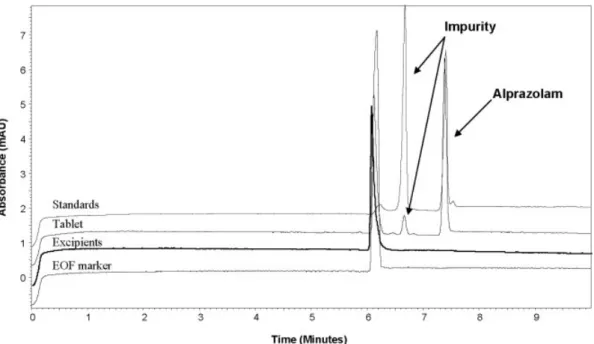
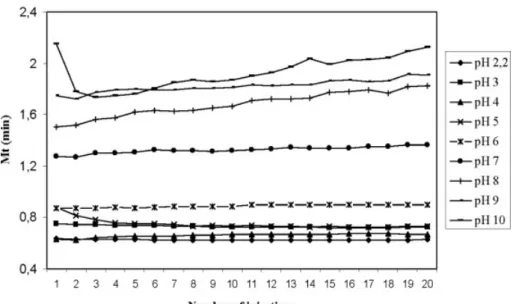
(6) 2364. L. Saavedra et al.. effect will permit us to switch the direction of the EOF which in practice is almost essential in order to have short analysis times. Similar polymeric coatings have been successfully applied for EOF control [37–40] but tedious coating procedures are needed in most cases [41]. Our approach just takes 15 min to prepare the coating and it does not need any special instrumentation. Using the conditions described above in Section 2.2.2, it was possible to separate the alprazolam and its impurity in less than 8 min. Figure 2 shows the electropherograms obtained for the excipients and the mixture of the standards and the sample under these conditions. The magnitude of the EOF depends on the ionisation degree of the inner capillary wall. In addition, this ionisation state depends on the pH of the buffer used. The EOF performance versus the pH has been studied in a coated capillary with PAMS. Figure 3 shows the variation of an EOF marker (acetone in this case) for different pH values along 20 consecutive injections. In this experiment the EOF marker was injected by the exit tip of the capillary so that the effective separation length was 10 cm only. It can be seen that the lower the pH the faster the EOF marker is detected which means the higher the EOF. Moreover, reproducibility conclusions can be extracted from these results by comparing the slopes of the tendency along the 20 runs. As can be seen, as long as the pH raises more, variations in the EOF marker time are detected.. Electrophoresis 2006, 27, 2360–2366. Our application needs a pH 2.0 or lower so that no coating reproducibility issues are involved. Nevertheless, a second experiment was performed to assure the minimum deviation in elution times. Two different 48-run sequences were analysed for alprazolam and its impurity. In the first one, the capillary coating was done at the beginning of the first injection only. In the second one, the capillary coating was done at the beginning of each injection. When the capillary was coated only once, RSDs for migration times were 0.66 and 0.88% for triazolaminoquinoline and alprazolam, respectively, after discarding a first set of data, probably because the capillary needs some time to stabilize. When the polymer was flushed between runs, the RSD was 0.74% for both analytes.. 4 Concluding remarks CE has been employed as an analytical technique with different selectivity to HPLC and therefore, a complementary technique to confirm the identification of a degradation product in alprazolam tablets during their stability assay. A polymeric capillary coating, PAMS has been employed to avoid the adsorption of the analytes to the capillary wall and to provide EOF. The coating process is very simple and the results showed a good reproducibility even after over 40 injections without further treatment.. Figure 2. Electropherograms of EOF marker (acetone), excipients, standards and tablet. Silica capillary, 60 cm, 75 mm PAMS-coated. BGE: 50 mM phosphate buffer (pH 2.0)/ACN (80:20 v/v), 220 kV at 257C. UV detection at 234 nm. © 2006 WILEY-VCH Verlag GmbH & Co. KGaA, Weinheim. www.electrophoresis-journal.com.
(7) Electrophoresis 2006, 27, 2360–2366. CE and CEC. 2365. Figure 3. EOF performance vs. pH.. The authors thank Juan Baselga (Department of Ciencia e Ingeniería de Materiales e Ingeniería Química, Escuela Politécnica Superior, Universidad Carlos III de Madrid) for providing the polymer and CINFA laboratories for supplying alprazolam. J. C. Cabanelas and M. G. Gonzalez wish to acknowledge support from CICYT (MAT2004–01347).. 5 References [1] International Conferences on Harmonization, Fed. Regist. 2000, 65, 44791–44797. [2] Ahuja, S., Impurities Evaluation of Pharmaceuticals, Marcel Dekker, New York 1998. [3] Görög, S., Identification and Determination of Impurities in Drugs, Elsevier Science Publishing Company, Amsterdam 2000. [4] Alsante, K. M., Hatajik, T. D., Lohr, L. L., Sharp, T. R., Am. Pharm. Rev. 2001, 4, 70–78. [5] Lohr, L. L., Sharp, T. R., Alsante, K. M., Hatajik, T. D., Am. Pharm. Rev. 2001, 4, 104–113. [6] Winger, B. E., Kemp, C. A. J., Am. Pharm. Rev. 2001, 4, 55– 63. [7] Roy, J., AAPS PharmSciTech 2002, 3, E6. [8] Nudelman, N. S., Gallardo Cabrera, C., J. Pharm. Sci. 2002, 91, 1274–1286. [9] Cho, M. J., Scahill, T. A., Hester, J. B., J. Pharm. Sci. 1983, 72, 356–362. [10] McGrath, G., McClean, S., O’Kane, E., Smyth, W. F., Tagliaro, J., J. Chromatogr. A 1996, 735, 237–247. [11] McClean, S., O’Kane, E., Hillis, J., Smyth, W. F., J. Chromatogr. A 1999, 838, 273–291. [12] Peyrin, E., Guillaume, Y. C., J. Chromatogr. A 1999, 749, 563–573.. © 2006 WILEY-VCH Verlag GmbH & Co. KGaA, Weinheim. [13] Imazawa, M., Hatanaka, Y., J. Pharm. Biomed. Anal. 1997, 15, 1503–1508. [14] Jinno, K., Han, Y., Sawada, H., Electrophoresis 1997, 18, 284–286. [15] Renou-Gonnord, M. F., David, K., J. Chromatogr. A 1996, 735, 249–261. [16] Tomita, M., Okuyama, T., J. Chromatogr. B 1996, 678, 331– 337. [17] Boonkerd, S., Detaevernier, M. R., Vindevogel, J., Michotte, Y., J. Chromatogr. A 1996, 756, 279–286. [18] Jinno, K., Han, Y., Nakamura, M., J. Capil. Electrophor. Microchip Technol. 1996, 3, 139–145. [19] Schafroth, S., Thormann, W., Allemann, D., Electrophoresis 1994, 15, 72–78. [20] Cahours, X., Morin, P., Dreux, M., J. Chromatogr. A 1999, 845, 203–216. [21] Taylor, M. R., Teale, P., J. Chromatogr. A 1997, 768, 89–95. [22] Vanhoenacker, G., de l’Escaille, F., De Keukeleire, D., Sandra, P., J. Pharm. Biomed. Anal. 2004, 34, 595–606. [23] Hansen, S. H., Sheribah, Z. A., J. Pharm. Biomed. Anal. 2005, 39, 322–327. [24] Doherty, E. A., Berglund, K. D., Buchholz, B. A., Kourkine, I. V. et al., Electrophoresis 2002, 23, 2766–2776. [25] Meagher, R. J., Seong, J., Laibinis, P. E., Barron, A. E., Electrophoresis 2004, 25, 405–414. [26] Wiktorowicz, J. E., United States Patent 50153250, 1991. [27] Masselter, S. M., Zemann, A. J., Anal. Chem. 1995, 67, 1047–1053. [28] Masselter, S. M., Zemann, A. J., Bobleter, O., Electrophoresis 1993, 14, 36–39. [29] Chiu, R. W., Jimenez, J. C., Monnig, C. A., Anal. Chim. Acta 1995, 307, 193–201. [30] Erim, F. B., Cifuentes, A., Poppe, H., Kraak, J. C., J. Chromatogr. A 1995, 708, 356–361. [31] Cifuentes, A., Rodriguez, M. A., García-Montelongo, F. J., J. Chromatogr. A 1996, 742, 257–266. www.electrophoresis-journal.com.
(8) 2366. L. Saavedra et al.. [32] Yao, Y. J., Li, S. F. Y., J. Chromatogr. A 1994, 663, 97–104. [33] Morand, M., Blass, D., Kenndler, E., J. Chromatogr. B 1997, 691, 192–196. [34] Cabanelas, J. C., Serrano, B., González-Benito, J., Bravo, J., Baselga, J., Macromol. Rapid Commun 2001, 22, 694– 699. [35] Perez-Lozano, P., Garcia-Montoya, E., Orriols, A., Minarro, M. et al., J. Pharm. Biomed. Anal. 2004, 34, 979–87. [36] ACDLabs, PhysChem, Advanced Chemistry Development.. © 2006 WILEY-VCH Verlag GmbH & Co. KGaA, Weinheim. Electrophoresis 2006, 27, 2360–2366. [37] Hardenborg, E., Zuberovic, A., Ullsten, S., Soderberg, L. et al., J. Chromatogr. A 2003, 1003, 217–221. [38] Guo, Y., Imahori, G. A., Colon, L. A., J. Chromatogr. A 1996, 744, 17–29. [39] Chiari, M., Cretich, M., Stastna, M., Radko, S. P., Chrambach, A., Electrophoresis 2001, 22, 656–659. [40] Cretich, M., Chiari, M., Pirri, G., Crippa, A., Electrophoresis 2005, 26, 1913–1919. [41] Guo, Y., Colon, L. A., Anal. Chem. 1995, 67, 2511–2516.. www.electrophoresis-journal.com.
(9)
Figure


Documento similar
According to various studies, the degradation of marly lithologies that constitute heterogeneous rock masses such as flysch, can trigger and condition many slope
to a decrease in drug bioavailability, drug degradation, and/or production of toxic products. In the literature there are studies that have evaluated the
The forward and inverse procedures are presented for the identification of stiffness degradation in lami- nated composite plates by combining the FEM as the numerical procedure for
Using the proposed degradation models, equations (3.2), (3.5), (3.6), (3.8) and the outdoor derived model parameters, it is possible to predict the dominating degradation precursor
However, it is already possible to apply the algorithms and methods presented in this paper to increase the understanding of product models by identification of entry points
2 The DNA shuffling technique has also been useful for the identification of genetic determinants responsible for certain viral characteristics already present in
To the best of our knowledge this is the first time that such a high stability for the ORR with Fe/N/C based catalysts has been reported under severe degradation
attitudes with respect to the price they pay and would be willing to pay for irrigation water, as well as the marginal product value of the water they use and the potential for
