
Experimental studies on growth and survival in Atlantic bluefin tuna (Thunnus thynnus) and Atlantic bonito (Sarda sarda) larvae: effects of light, food availability and temperature on their physiology and behavior
192
0
0
Texto completo
(2)
(3) DOCTORAL THESIS 2018. Doctoral Program of Marine Ecology EXPERIMENTAL STUDIES ON GROWTH AND SURVIVAL IN ATLANTIC BLUEFIN TUNA (Thunnus thynnus) AND ATLANTIC BONITO (Sarda sarda) LARVAE: EFFECTS OF LIGHT, FOOD AVAILABILITY AND TEMPERATURE ON THEIR PHYSIOLOGY AND BEHAVIOR. Edurne Blanco Rodríguez Supervisor: Dr. Patricia Reglero Supervisor: Prof. Dr. Arild Folkvord Supervisor: Dr. Aurelio Ortega Tutor: Dr. Guillem Mateu Doctor by the Universitat de les Illes Balears.
(4)
(5) Dr. Patricia Reglero, Spanish Institute of Oceanography Prof. Dr. Arild Folkvord, University of Bergen Dr. Aurelio Ortega, Spanish Institute of Oceanography DECLARE: That the thesis title “Experimental studies on growth and survival in Atlantic bluefin tuna (Thunnus thynnus) and Atlantic bonito (Sarda sarda) larvae: effects of light, food availability and temperature on their physiology and behavior”, presented by Edurne Blanco Rodríguez to obtain a doctoral degree, has been completed under our supervision, and meets the requirements to opt for an International Doctorate.. For all intents and purposes, we hereby sign this document.. Signature. Palma de Mallorca, Bergen and Mazarrón, 8th of October, 2018.
(6)
(7) -Gurasoei eta Josuri-.
(8)
(9) “Los peces no se mueren, los mata la ignorancia de quien los cultiva” De la Gándara, F. (2003).
(10)
(11) Table of content Acknowledgements ..................................................................................................... iii List of fundings........................................................................................................... vi List of publications .................................................................................................... vii List of acronyms and abbreviations ........................................................................... ix Summary / Resumen / Resum .................................................................................... xi Chapter 1. General introduction ................................................................................. 3 1.1 Phylogeny ........................................................................................................... 4 1.2 Distribution / Migration .................................................................................... 6 1.3 Fisheries ............................................................................................................. 9 1.4 Aquaculture ..................................................................................................... 11 1.5 Life cycle of Atlantic bluefin tuna and Atlantic bonito .................................. 13 1.5.1 Eggs, endogenously and exogenoulsy feeding life stages ......................... 15 1.5.2 Exogenously piscivorous feeding life stage .............................................. 17 1.6 Methods to study larval growth and survival ................................................ 19 1.6.1 Microstructure analysis of otoliths .......................................................... 19 1.6.2 Biochemical analysis of condition ............................................................ 20 1.7 Aims of the study ............................................................................................ 20 Chapter 2. Materials and methods ........................................................................... 25 2.1 General characteristics of the facility ............................................................. 25 2.2 This thesis ....................................................................................................... 26 2.3 Obtainment of the eggs ................................................................................... 29 2.4 From eggs to hatching .................................................................................... 31 2.5 Larval rearing ................................................................................................. 31 2.6 From the facility to the laboratory ................................................................. 32 2.7 Animal ethics .................................................................................................. 33 Chapter 3. The effect of nutritional condition on the growth to post-flexion of Atlantic bluefin tuna and Atlantic bonito ............................................................................... 37 Chapter 4. Size-selective mortality of laboratory-reared Atlantic bluefin tuna larvae: evidence from microstructure analysis of otoliths during the piscivorous stage .... 57 Chapter 5. The effects of light, darkness and intermittent feeding on the growth and survival of reared Atlantic bonito and Atlantic bluefin tuna larvae ....................... 75 Chapter 6. Differences in the metabolic rates in light and darkness condition during the piscivorous stage of Atlantic bluefin tuna ......................................................... 91 Chapter 7. Vertical distribution of Atlantic bluefin tuna (Thunnus thynnus) and bonito (Sarda sarda) larvae is related to temperature preference ........................ 111. i.
(12) Chapter 8. General discussion ................................................................................ 133 8.1 Synthesis ....................................................................................................... 133 8.2 Contribution of this thesis to the state of the art on the biology and aquaculture of these species ............................................................................... 136 8.3 The difficulty of working with these species ................................................ 138 8.4 Future perspectives ...................................................................................... 139 Concluding remarks ................................................................................................ 143 References................................................................................................................ 147. ii.
(13) Acknowledgements A lo largo de estos casi 5 años de tesis doctoral, he tenido la suerte de trabajar y conocer a un gran número de personas, que, tanto en lo profesional como en lo personal, han formado parte de la presente tesis de alguna u otra manera. Seguramente me deje a mucha gente, pero creo que durante estos años he verbalizado mi agradecimiento a todas ellas, sin embargo, y para que quede constancia, os lo dejo por escrito. En primer lugar, quisiera agradecer a mi directora de tesis, Patricia Reglero, por todo el apoyo que me ha dado durante los 7 años que llevamos trabajando juntas. Por llevarme a Mazarrón en 2012 para ayudarte con los experimentos cuando mi experiencia en acuicultura y experimentación era nula y gracias por seguir haciéndolo durante los siguientes años. Gracias también por toda tu ayuda durante el máster, todavía recuerdo que terminamos con las correcciones del TFM en Mazarrón en Julio del 2012 a las tantas de la noche y este año casi repetimos con la tesis. Gracias por todas las tardes en las que por revisar mi tesis te has quedado hasta tarde y no has podido recoger a Andrea, y por siempre, independientemente del día que fuese, estar disponible para que la tesis saliese adelante. Porque cuando trabajas con atún “It is what it is and we have to live with it”. Por la idea y tu ayuda con la redacción del proyecto de tesis sin el que nada de esto hubiese sido posible. Por entender mis dramatismos cuando me he agobiado durante todos estos años (que han sido muchos) y por ayudarme a reconducirlos. Gracias por confiar en mi desde un principio, por el apoyo, por tu paciencia infinita y por todo lo que me has enseñado a lo largo de estos años. A mi co-director, Aurelio Ortega por hacer que toda la experimentación de mi tesis haya sido posible. Por proporcionarme los huevos y larvas que siempre he necesitado. Por mantener vivas a las larvas y que no les faltase nunca de nada y por encontrar una solución inmediata a todos los problemas que iban surgiendo. Por estar siempre pendiente de mi durante mis largas semanas e incluso meses en los que cada año me he trasladado a Mazarrón. Y por dejarme muestrear larvas a pesar de que te doliese en el alma. To my other co-director, Arild Folkvord. Thank you very much for accepting the supervision of this thesis without knowing me, and for giving me the opportunity to work with you. I don’t want to sound “pelota”, but it has been an absolute pleasure and honour to learn from you. Thank you for your patience and understanding with my not advanced English level. For always having time for my doubts and questions during my stay in Bergen and in every e-mail I have sent to you. I am very grateful for all your help, ideas and comments during these years. You have no idea how a simple comment from you can change the discussion of a work. Thank you. A Fernando de la Gándara. Gracias todos tus comentarios y sugerencias a lo largo de todos estos años y por haber sacado tiempo este verano para leerte cada capítulo de la tesis. Por las discusiones acerca del metabolismo y por resolver siempre todas mis dudas sobre el atún. iii.
(14) Debo agradecer a Francisco Alemany, por haber confiado en mi durante mis inicios, cuando todavía estaba haciendo el máster y darme la oportunidad de obtener mi primer contrato laboral. Por dejarme participar en una de las mejores campañas oceanográficas en las que he estado, BLUEFIN 2011 y por apoyar mi solicitud de beca. A Alma Hernandez de Rojas por enseñarme la técnica de los ácidos nucléicos y por acogerme tan bien siempre en Gijón. Por tu paciencia inicial con mis pipeteos y por la plena confianza que siempre has depositado en mi en el laboratorio. Lo que empezó siendo una colaboración puntual, se ha convertido una parte fundamental de mi tesis. Espero sinceramente que podamos seguir colaborando en el futuro. Gracias también a Carmen por estar siempre pendiente de que no me faltase de nada en el laboratorio. Y a Paloma, por ser tan maja!! A mi tutor en la Universidad, Guillem Mateu. Gracias por hacer posible que haya cumplido con todos los plazos. Gracias a Itziar Álvarez y a Silvia Pérez por dejarme utilizar el laboratorio del IMEDEA durante los primeros años y por introducir en mi vida el teflón. Thank you to Øyvind Fiksen for your fantastic idea about the intermittent feeding that resulted in my first ever published article as a first author. Muchas gracias a toda la gente del Centro Oceanográfico de Baleares y a todos los que forman parte del grupo de Ecología larvaria. A Joan Fort por solucionar todos los problemas burocráticos tan eficientemente. A Carme por los buenos momentos cuando empezamos el máster. Al grupo de reservas, por haberme acogido en vuestro despacho durante los dos primeros años de la tesis. A Manolo y Tolo, por soportar las temperaturas extremas tanto en invierno como en verano a las que someto el despacho. Y a Itzi, que en las pocas semanas que llevamos compartiendo despacho, me has solucionado interminables dudas y sacado de varios apuros. Melissa, gracias por haberme ayudado siempre que lo he necesitado con todo lo relacionado con el laboratorio y los programas de Leica. A Asvin, por enseñarme a clasificar plancton, por supervisar las muestras de suprabentos durante el máster y por ser tan generosa e incluirme en varios de tus trabajos. A Diego, por tus comentarios e ideas cuando estábamos preparando la propuesta de tesis, los cuales la mejoraron considerablemente. Y a Rocío, gracias por ayudarme con las calibraciones y con mis dudas químicas. Me gustaría dar las gracias y dedicar un párrafo por separado a Teresa. No podría estar mas agradecida a la vida de haber compartido cada paso, informe de anualidad, burocracia y picos de estrés de las tesis juntas. Por solucionarme todas mis dudas sobre estadística. Empezamos con la beca el mismo día y terminaremos la tesis con semanas de diferencia. Sin tu amistad desde luego que mi actitud hubiese sido diferente. Por ser tan buena persona y siempre estar ahí.. iv.
(15) A todo el personal de la planta de cultivos de Mazarrón. En especial a J Prieto y MA Gallego por hacer llegar los huevos de atún desde las jaulas. A R Rodriguez, MJ Arenas and F Méndez y Fran, por siempre ayudarme con los muestreos y en todo lo que he necesitado y por cuidar tan bien los tanques. Gracias Maria José por escuchar todas las tonterías que decía cuando despúes de un fin de semana en la planta, sin mucha gente alrededor con la que hablar, decidía bajar el domingo por la tarde a molestarte y sacar conversación fuese como fuese. A Diego “Gallina”, por estar siempre pendiete de mi cuando he estado sola en Mazarrón y a Javier Viguri, por tu ayuda y compañía durante los primeros años. Y a la Chara como no, por las croquetas y las almendras. To Marta Moyano and Manabu Seoka, thank you vey much for agreeing to review the final version of my thesis in such a short time and thus facilitate the deposit on time. Thank you for al your your valuable comments. A Marta me gustaría darle doblemente las gracias. Gracias por haberme dado la oportunidad de trabajar contigo en Hamburgo unos meses antes de empezar la tesis y gracias por volver a dármela al terminarla. Agradezco enormemente tu apoyo y compromiso durante los meses en los que estuvimos preparando la solicitud de la beca post-doc que coincidieron con tu baja maternal. Gracias por siempre sacar un rato para revisar los textos. Muchas gracias a toda la gente que ha estado conmigo en especial durante este último año de tesis. Por soportar mis dramas y mis periodos de estrés. Agradezco que hayáis hecho que me olvide de la tesis y hacerme ver que hay vida más allá. A Sara, por la maravillosa portada. A Antonia, por seguir ahí después de tantísimos años como si estuvieses aquí en Soller y no en México. A la Nati, por ser tán maravillosa y por Alain. A Lucía y Ale, lo mejor que me llevo del Erasmus y cuyos reencuentros siempre me recuerdan que seguimos igual que hace 10 años. Por último, gracias a mis padres, por entender lo importante que era para mi irme a Vigo a estudiar Ciencias del Mar. Por estar siempre ahí y apoyarme en todo.. v.
(16) List of fundings The present Ph.D. research has been funded by the pre-doctoral FPI Fellowship Program of the Regional Government of the Balearic Islands selected as part of an operational programme co-financed by the European Social Fund, during the period 2013-2017 (BOIB published 24/8/2013,118). The thesis was linked with the project entitled “Assessment of the Atlantic bluefin TunA population breeding in the western MEditerranean”, acronym ATAME, founded by the Spanish Ministry (CTM2011-29525-C04-02-MAR), 2009-2014.. This research has received partial funding from the European Union’s Horizon 2020 research and innovation programme under grant agreement No 678193 entitled “Climate change and European aquatic RESources” acronym CERES, 2016-2020.. The ichthyoplankton Research cruises in Chapter 7, have been partly supported by the BLUEFIN project “Uso sostenible de los recursos vivos marinos: impacto de la variabilidad del Mediterráneo sobre la reproducción y dinámica de la población del atún rojo” funded by Convenio IEO – SOCIB; 2011-2015 fase 1, 2016-2019 fase 2 and the ATAME Project.. A three month stay at the University of Bergen was funded by “la Caixa” Banking Foundation.. vi.
(17) List of publications Three of the five chapters containing original research have already been published in SCI journals (Chapters 4, 5 and 7). One chapter has been already submitted (Chapter 3) and another one is ready for submission (Chapter 6). Blanco, E., Reglero, P., Hernández de Rojas, A., Ortega, A., De la Gándara, F., Folkvord, A. (submitted). The effect of nutritional condition on the growth to post-flexion of Atlantic bluefin tuna and Atlantic bonito larvae. Journal of Experimental Marine Biology and Ecology. (Chapter 3). Blanco, E., Reglero, P., Ortega, A., De la Gándara, F., Folkvord, A., 2018. Sizeselective mortality of laboratory-reared Atlantic bluefin tuna larvae: evidence from microstructure analysis of otoliths during the piscivorous phase. Journal of Experimental Marine Biology and Ecology 509, 36-43. (Chapter 4). Blanco, E., Reglero, P., Ortega, A., De la Gándara, F., Fiksen, Ø., Folkvord, A., 2017. The effects of light, darkness and intermittent feeding on the growth and survival of reared Atlantic bonito and Atlantic bluefin tuna larvae. Aquaculture 479, 233-239. (Chapter 5). Blanco, E., Reglero, P., Ortega, A., Hernández de Rojas, A., De la Gándara, F., Folkvord, A., (in preparation). Differences in the metabolic rates in light and darkness conditions during the piscivorous phase of Atlantic bluefin tuna larvae. (Chapter 6). Reglero, P., Blanco, E., Alemany, F., Ferrá, C., Alvarez-Berastegui, D., Ortega, A., De la Gándara, F., Aparicio-González, A., Folkvord, A., 2018. Vertical distribution of Atlantic bluefin tuna Thunnus thynnus and bonito Sarda. sarda larvae is related to temperature preference. Marine Ecology Progress Series 594, 231-243. (Chapter 7).. vii.
(18) The Ph.D. candidate has participated in four papers directly related to the line of research of this thesis, which have not been included in this thesis: Reglero, P., Balbín, R., Abascal, F.J., Medina, A., Alvarez-Berastegui, D., Rasmuson, L., Mourre, B., Ortega, A., Blanco, E., De la Gándara, F., Alemany, F.J., Ingram Jr, G.E., Hidalgo, M. (accepted). Pelagic habitat and offspring survival in the Eastern stock of Atlantic bluefin tuna. ICES Journal of Marine Science. Reglero, P., Blanco, E., Ortega, A., Fiksen, Ø., De La Gándara, F., Seoka, M., Viguri, F.J., Folkvord, A., 2014. Prey selectivity in piscivorous bluefin tuna larvae reared in the laboratory. Journal of Plankton Research 37(1), 2-5. Reglero, P., Ortega, A., Balbín, R., Abascal, F. J., Medina, A., Blanco, E., De la Gándara, F., Alvarez-Berastegui, D., Hidalgo, M., Rasmuson, L., Alemany, F., Fiksen, Ø., 2018. Atlantic bluefin tuna spawn at suboptimal temperatures for their offspring. Proceedings of the Royal Society B 285(1870), 20171405. Reglero, P., Ortega, A., Blanco, E., Fiksen, Ø., Viguri, F.J., De la Gándara, F., Seoka, M., Folkvord, A., 2014. Size-related differences in growth and survival in piscivorous fish larvae fed different prey types. Aquaculture 433, 94-101. .. viii.
(19) List of acronyms and abbreviations AB. Atlantic bonito. ABFT. Atlantic bluefin tuna. Alt.. Alternating treatment. ANCOVA. Analysis of covariance. ANOVA. Analysis of variance. ATAME. Assessment of the Atlantic bluefin tuna population breeding in the western Mediterranean.. CSD. Cumulative size distribution. Cont.. Continuous treatment. DHA. Docosahexaenoic acid. DLI. Daily length increment. DNA. Deoxyribonucleic acid. Dph. Days post hatch. DW. Dry weight. DYSL. Delayed yolk-sac larva. EB. Ethidium bromide. Eday. Experimental day. EDTA. Ethylenediaminetetraacetic acid. Exp.. Experiment. F0. Pre-flexion stage. F1. First caudal fin rays stage. F2. Flexion stage. F3. Post-flexion stage. FAO. Food and Agriculture Organization of the United Nations. GAM. Generalized additive model. GLM. Generalized linear model. IBM. Individual-based models. ICCAT. International Commission for the Conservation of Atlantic Tunas. ICES. International Council for the Exploration of the Sea. IEO. Spanish Institute of Oceanography. IUCN. International Union for Conservation of Nature and Natural Resources. IUU. Illegal, Unreported and Unregulated. L:D. Light:Darkness. M. Instantaneous mortality ix.
(20) MMR. Maximum metabolic rate. MO2. Metabolic rate. mRNA. Messenger RNA. NaCl. Sodium chloride. NW. Northwestern. OR. Otolith radii. PVC. Polyvinyl chlorid. R1, R2. Tank replicates 1, 2. RMR. Routine metabolic rate. RNA. Ribonucleic acid. RNase A. Ribonuclease A. SD. Standard deviation. SCR. Stomach content ratio. SDA. Specific dynamic action. SDS. Sodium dodecyl sulfate [CH3(CH2)11SO4Na]. SE. Southeast. SGR. Specific growth rate. SL. Standard length. SMR. Standard metabolic rate. SpCR. Spearman’s rank correlation coefficient. TAC. Total allowed catches. TRIS. Tris(hydroxymethyl)aminomethane [(HOCH2)3CNH2]. tRNA. Transfer RNA. HSD. Honestly significant difference. VO2. Mass-specific metabolic rate. YSL. Yolk-sac larva. x.
(21) Summary Understanding what determines the growth and survival of individuals among large pelagic fish populations, particularly during the larval stage, is crucial, because these factors will eventually determine recruitment variability and the number of survivors that reach the juvenile stage. Both Atlantic bluefin tuna and Atlantic bonito serve important ecological role as top predators, are targets of some of the most important fisheries in the world and have a fundamental influence on the structure and function of marine communities. Besides, they are the only two scombrid species in the Mediterranean Sea that have been successfully reared in captivity. However, there are still several unresolved problems in their rearing due to our current lack of knowledge regarding their development during these early life stages, knowledge that is difficult to obtain in the field. This thesis aims to improve current knowledge on the growth and survival of the larval stage of Atlantic bluefin tuna and Atlantic bonito under different light, food and temperature conditions. The results of this thesis are based on laboratory experiments (Chapters 3–6) and combined field and laboratory results (Chapter 7). Chapter 1 provides an introduction with a background to the topic of study. Chapter 2 discusses the materials and methods used for the studies upon which this thesis is based. In Chapter 3, growth differences during the first days of life of Atlantic bluefin tuna and Atlantic bonito are discussed. The nutritional condition of the larvae, measured by RNA:DNA ratio, did not explain the differences in developmental stage in larvae that had been cultured under the same conditions. Chapter 4 examines how larval size is related to vulnerability to manipulation in the timing of onset of piscivory. This is an important aspect to examine, since mortality during the larval stage is considered to be size-selective. The effect that changing the feeding regime, from continuous to intermittent piscivorous feeding, had on larval growth and survival is explored in Chapter 5. In Chapter 6, the metabolic cost of different light and darkness conditions was estimated. The effect that temperature had on fish larval vertical distribution was analysed in Chapter 7 by a comparative laboratory analysis between field-sampled individuals at different depths and experimental thermocline columns. The results suggest that the vertical distribution of Atlantic bluefin tuna and Atlantic bonito larvae is spatially constrained to the upper warmer layers due to larval thermal tolerance.. xi.
(22) The results of this thesis demonstrate the importance of studying the larval stages of these species, stages which are still not well understood. The characteristics of Atlantic bluefin tuna and bonito are very different from other commonly studied cold water species, such as herring, cod and salmon, for which many empirical studies have been conducted. The results presented in this thesis demonstrate the need to use experimentation in order to obtain knowledge on the processes driving growth and survival—knowledge that is difficult to obtain in the field. Culture of larvae could be improved using alternating light regimes instead of the common long light photoperiod regimes that are used in aquaculture to maximize larval ingestion rates. Field and experimental work can be combined in order to have a more complete view of the processes driving these species and their ecosystems.. xii.
(23) Resumen Comprender qué determina el crecimiento y la supervivencia de los individuos, particularmente durante la etapa larvaria, es de crucial importancia ya que va a determinar la variabilidad del reclutamiento y el número de supervivientes que van a alcanzar la etapa juvenil. El atún rojo del Atlántico (Thunnus thynnus) y el bonito del Atlántico (Sarda sarda) son grandes predadores que se encuentran en la parte alta de la cadena trófica, son objetivo de algunas de las mas importantes pesquerías del mundo y tienen una influencia fundamental en la estructura y función de las comunidades marinas. Además, son las dos únicas especies de escómbridos del mar Mediterráneo que han sido cultivadas con éxito en cautividad. Sin embargo, debido a nuestro gran desconocimiento acerca de su desarrollo durante el estadio larvario, el cultivo de ambas es una tarea muy complicada donde existen una gran cantidad de problemas aún sin resolver. La presente tesis tiene como objetivo mejorar el conocimiento actual sobre el crecimiento y la supervivencia larvaria del atún rojo y del bonito bajo diferentes condiciones de luz, alimentación y temperatura, con especial énfasis en su etapa de alimentación piscívora. Los resultados se han obtenido mediante experimentos de laboratorio (Capítulos 3-6) y resultados combinados de campo y de laboratorio (Capítulo 7). El Capítulo 1 ofrece una introducción acerca del tema de estudio. El Capítulo 2 desarrolla el material y métodos utilizado a lo largo de la tesis. En el Capítulo 3 se muestran las diferencias de crecimiento durante los primeros días de vida del atún rojo y del bonito. La condición nutricional medida como la relación ARN:ADN no explicó las diferencias entre los diferentes estadios de desarrollo en larvas cultivadas bajo las mismas condiciones. El Capítulo 4 examina el espectro de tamaño larvario más vulnerable a la manipulación del inicio de la piscivoría. Este es un aspecto importante ya que la mortalidad durante la etapa larvaria se sabe que es selectiva con respecto al tamaño. El efecto de un cambio en el régimen de alimentación, de una alimentación continua a una intermitente durante la etapa piscívora, en el crecimiento y supervivencia larvaria se exploró en el Capítulo 5. En el Capítulo 6, se midieron los costes metabólicos de las larvas en condiciones de luz y oscuridad. l efecto de la temperatura en la distribución vertical de las larvas de ambas especies se analizó en el Capítulo 7 mediante un análisis comparativo de individuos muestreados en el mar a diferentes profundidades y en el laboratorio en columnas experimentales. Los resultados sugieren que la distribución vertical del atún rojo y del bonito se encuentra limitada espacialmente a las capas superficiales más cálidas debido a su tolerancia térmica. xiii.
(24) Los resultados de la presente tesis demuestran la importancia del estudio de la etapa larvaria de las dos especies, etapa hasta ahora ampliamente desconocida. Las características del atún rojo y del bonito son muy diferentes a las de otras especies comúnmente estudiadas de aguas frías como son el arenque, el bacalao y el salmón, para las cuales se han realizado una gran cantidad de estudios experimentales a lo largo de los años. Los resultados presentados en esta tesis demuestran la necesidad de utilizar los experimentos de laboratorio para ampliar el conocimiento acerca de los procesos que afectan al crecimiento y supervivencia larvaria, y obtener así información difícil de obtener mediante muestreos en el medio marino. Además, la combinación de estudios de campo y experimentales proporcionan una visión más completa de los procesos que impulsan a estas especies y a sus ecosistemas.. xiv.
(25) Resum Comprendre allò que determina el creixement i la supervivència dels individus, particularment durant l'etapa larval, és de crucial importància ja que determinarà la variabilitat del reclutament o el nombre de supervivents que assoliran l'etapa juvenil. La tonyina (Thunnus thynnus) i el bonítol (Sarda sarda) són de gran importància ecològica ja que es troben a la part alta de la cadena tròfica, són objectiu d'algunes de les pesqueres més importants del món i tenen una influència fonamental en l'estructura i funció de les comunitats marines. A més, són les dues úniques espècies d’escòmbrids de la mar Mediterrània que han estat cultivades amb èxit en captivitat. Tanmateix, a causa del nostre gran desconeixement sobre el seu desenvolupament durant l'estadi larval, el cultiu de les dues és una tasca molt complicada on existeixen una gran quantitat de problemes que encara estan sense resoldre. La present tesi té com a objectiu millorar el coneixement actual sobre el creixement i la supervivència larval de la tonyina i del bonítol sota diferents condicions de llum, alimentació i temperatura, amb especial èmfasi en la seva etapa d'alimentació piscívora. Els resultats s'han obtingut mitjançant experiments de laboratori (Capítols 3-6) i resultats combinats de camp i de laboratori (Capítol 7). El primer capítol ofereix una introducció al tema d'estudi. El capítol 2 desenvolupa el material i mètodes utilitzat al llarg de la tesi. En el capítol 3 es mostren les diferències de creixement durant els primers dies de vida de la tonyina i del bonítol. La condició nutricional mesurada com la relació ARN:ADN no va explicar les diferències entre els diferents estadis de desenvolupament en larves sota les mateixes condicions de cultiu. El Capítol 4 examina l'espectre de talla larval més vulnerable a la manipulació a l'inici de la piscivoria. Aquest és un aspecte important ja que és ben sabut que la mortalitat durant l'etapa larval és selectiva per la grandària. L'efecte d'un canvi en el règim d'alimentació, d'una alimentació contínua a una intermitent durant l'etapa piscívora, en el creixement i supervivència larval es va explorar en el capítol 5. En el capítol 6, es van mesurar els costos metabòlics de les larves en condicions de llum i foscor. L'efecte de la temperatura en la distribució vertical de les larves de les dues espècies es va analitzar en el capítol 7 mitjançant una anàlisi comparativa d'individus mostrejats a la mar a diferents profunditats i al laboratori en columnes experimentals. Els resultats suggereixen que la distribució vertical de la tonyina i del bonítol es troba limitada espacialment a les capes superficials més càlides causa de la seva tolerància tèrmica.. xv.
(26) Els resultats de la present tesi demostren la importància de l'estudi de l'etapa larval de les dues espècies, etapa fins ara àmpliament desconeguda. Les característiques de la tonyina i del bonítol són molt diferents a les d'altres espècies d'aigües fredes comunament estudiades com són l'arengada, el bacallà i el salmó, per a les quals s'han realitzat una gran quantitat d'estudis experimentals al llarg dels anys. Els resultats presentats en aquesta tesi demostren la necessitat d'utilitzar els experiments de laboratori per ampliar el coneixement sobre els processos que afecten el creixement i la supervivència larvària, i obtenir així informació difícil d'obtenir mitjançant mostrejos en el medi marí. A més, la combinació d'estudis de camp i experimentals proporcionen una visió més completa dels processos que impulsen a aquestes espècies i als seus ecosistemes.. xvi.
(27) CHAPTER 1 - GENERAL INTRODUCTION -.
(28)
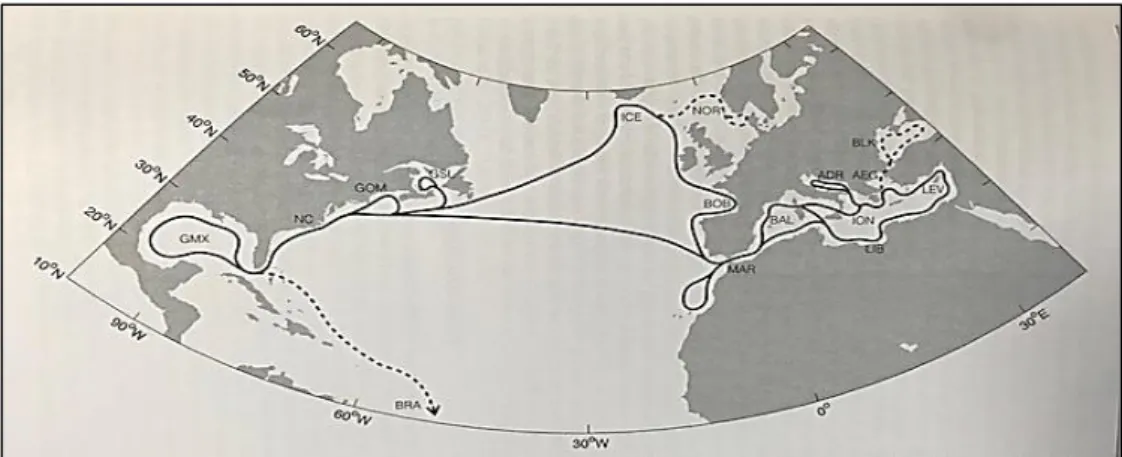
(29) CHAPTER 1: GENERAL INTRODUCTION. GENERAL INTRODUCTION Large pelagic fish are fascinating organisms that have been studied by fisheries scientists and fish ecologists for many years, particularly adults. However, the early life stages of pelagic fish have received less attention. When considering large or medium pelagic species such as Atlantic bluefin tuna (Thunnus thynnus) or Atlantic bonito (Sarda sarda), we usually think of the adult individuals. However, they all pass through a planktonic egg and larval stage (millimetres in length) where survival rates are very low (McGurk, 1986; Peterson and Wroblewski, 1984). Decades of research have provided considerable information on adult bluefin tuna populations (though not as much on adult bonito) (e.g. Block et al., 2001, 2005; Reglero et al., 2012, 2017, 2018b; Rey et al., 1984). However, relatively little is known about these populations’ growth and survival during the early stages of life (De la Gándara et al., 2012, 2016; Ortega, 2015). Both Atlantic bluefin tuna and Atlantic bonito serve important ecological role as top predators, are targets of some of the most important fisheries in the world and have a fundamental influence on the structure and function of marine communities (Shimose and Wells, 2015). Besides, are prey of other predators during the larval stage. Understanding the processes that drive growth and survival during the early life stages of these individuals has recently became a major objective in order to better manage fisheries and ensure the sustainable exploitation of these resources (Hjort, 1914; Houde, 2008). Stock recruitment variability, “the number of fishes surviving to enter the fishery or to some life history stage such as settlement or maturity”, is known to be the result of complex interacting factors operating on different temporal and spatial scales and throughout the pre-recruit life stages of fishes. The growth of the aquaculture industry during recent years for Atlantic bluefin tuna (Mylonas et al., 2010) and the expansion of experimental aquaculture for Atlantic bonito (De la Gándara et al., 2012) provides us with a unique opportunity to improve process-based knowledge of the drivers of survival and growth during the egg and larval stages of these species, information that is difficult to obtain from field samplings. How different processes influence growth and survival in fish larvae is complicated to understand if using only field data, since the effects of multiple variables acting at the same time are difficult to isolate. Consequently, field observations and laboratory experiments can be combined. This thesis is an attempt to generate new information on the processes that drive growth and survival during the larval stage of a large pelagic fish, Atlantic bluefin tuna, and a medium pelagic fish, Atlantic bonito, taking advantage of rearing techniques developed in the last few years. The knowledge of the ecology of the early life stages of fishes is crucial to understanding the population dynamics of fish stocks, and also the functioning of marine ecosystems.. 3.
(30) CHAPTER 1: GENERAL INTRODUCTION 1.1 Phylogeny The Scombridae is a family of 5 tribes and 51 species of epipelagic marine fishes (Collette et al., 2001; Graham and Dickson, 2004). Mackerels, Spanish mackerels, bonitos and tunas form the basis of important commercial and recreational fisheries in tropical and temperate waters worldwide (Fig. 1.1).. Figure 1.1. Morphological phylogeny of the family Scombridae. From Graham and Dickson (2004).. Bonitos and tunas are sister groups which differ both morphologically and physiologically (Collette et al., 2001; Graham and Dickson, 2004). The derivation of tunas from a bonito-like ancestor occurred through selection for an integrated set of characteristics affecting locomotion and endothermy (Graham and Dickson, 2000). Selection for continuous, steady, and efficient swimming resulted in changes in body shape which increased streamlining and led to the adoption of the thunniform swimming mode unique to tunas. Alterations in blood supply necessitated by the anterior shift in red muscle led to the development of numerous arterial and venous branches, which set the stage for heat conservation. The evolution of endothermy, together with thunniform swimming, contributed significantly to the ecological radiation and diversification of tunas during the Early Tertiary Period (Graham and Dickson, 2000).. -Atlantic bluefin tuna A total of 15 species of tuna comprise the Thunnini tribe, which is divided into 5 genera (Collete et al., 2001): Thunnus (8 species), Katsuwonus (1 species), Euthynnus (3 species), Auxis (2 species) and Allothunnus (1 species). The genus Thunnus include tunas that are typically considered tropical and temperate fishes with a wide geographical distribution such as bigeye tuna (Thunnus obesus) and yellowfin tuna (Thunnus albacares); species that show a tropical but also a temperate distribution, such as albacore tuna (Thunnus alalunga); tunas with a more restricted distribution, such as longtail tuna (Thunnus tonggol) and blackfin tuna (Thunnus atlanticus); and some species that have adapted to colder waters, such as the three bluefin tuna species, southern bluefin tuna (Thunnus maccoyii), Atlantic bluefin tuna (Thunnus thynnus) and Pacific bluefin tuna (Thunnus orientalis). 4.
(31) CHAPTER 1: GENERAL INTRODUCTION Among the tuna species, bluefin tunas are the largest (Collete et al., 2001). Atlantic bluefin tuna (Thunnus thynnus) (Linnaeus, 1758) grow up to 300 cm in length and attain masses up to 600 kg (Cort, 2007) (Fig. 1.2a). The heaviest documented Pacific bluefin tuna and southern bluefin tuna are 555 kg and 260 kg respectively (Foreman and Ishizuka, 1990; Nakamura, 1990). Along with the rest of the tunas and some sharks, bluefin tuna are unique among teleosts for their endothermic capacity and cardiovascular physiology (Blank et al., 2004; Dickson and Graham, 2004; Kubo et al., 2008). This allows them to maintain a higher body temperature than the surrounding environment and a constant metabolism enables them to penetrate cooler waters, thus expanding their thermal niche (2.8 to 30.6 °C) in both latitude and depth (Block et al., 2001, 2005; Cermeño et al., 2015; Reglero et al., 2014b). Elevated body temperature is maintained by a retia mirabile vascular countercurrent heat exchange system of warm venous blood and cold arterial blood (Graham and Dickson, 2000). This system allows bluefin tunas to retain 95% or more of the body heat produced by muscle activity, preventing it from dissipating externally. Atlantic bluefin tuna adults are continuous swimmers that breathe using ram ventilation, a mechanism whereby forward swimming provides enough force to drive water into the mouth and through the branchial chamber (Wegner et al., 2010, 2013). Atlantic bluefin tuna adults swim an average of 5.9 km h-1 and maximum sustained speeds of 20–31 km h-1 (Lutcavage et al., 2000).. -Atlantic bonito The Sardine tribe is comprised of 8 species of bonitos, which are divided among 4 genera: Cybiosarda (1 species), Gymnosarda (1 species), Orcynopsis (1 species) and Sarda (5 species). The genus Sarda comprises Atlantic bonito (Sarda sarda), striped bonito (Sarda orientalis), eastern Pacific bonito (Sarda chiliensis), Pacific bonito (Sarda lineolate) and Australian bonito (Sarda australis). The Atlantic bonito (Sarda sarda) (Bloch 1973), considered a small scombrid, can reach 80 cm in length and weigh more than 5–6 kg, although the most common catches are of individuals of 1–3 kg, corresponding to fish up to three years old (Macías et al., 2005; Rey et al., 1984; Santamaría et al., 2005) (Fig. 1.2b). Unlike tunas, bonitos do not have a counter-current heat exchange system, but like other scombrids (including Atlantic bluefin tuna), they are ram-ventilators, which implies that they swim continuously so that water is continually passing through their gills (Wegner et al., 2013).. a. b. Figure 1.2. Image of adult a) Atlantic bluefin tuna and b) Atlantic bonito, targeted species in this study.. 5.
(32) CHAPTER 1: GENERAL INTRODUCTION 1.2 Distribution / Migration -Atlantic bluefin tuna Atlantic bluefin tuna is a highly migratory species with a range across vast expenses of the Atlantic Ocean and its adjacent seas–the Mediterranean Sea, the Black Sea, and the Gulf of Mexico. Atlantic bluefin tuna are able to do trans-Atlantic migrations (Fromentin and Powers, 2005; Teo and Boustany, 2016). Adult individuals are distributed widely, from the cold waters of Norway and Canada to more tropical equatorial regions (Fig. 1.3). The adults are also able to exploit the water column down to 1000 m but they generally spend most of their time in waters less than 100 m (Block et al., 2001; Lutcavage et al., 2000). Since 1982, Atlantic bluefin tuna are separated into the eastern and the western stocks for management purposes at the 45˚ W meridian by the International Commission for the Conservation of Atlantic Tunas (ICCAT), the international organism in charge of the management of this species. This separation is based on spatial observation and temporal differences in spawning and a genetic differentiation between the two populations (Boustany et al., 2008; Carlsson et al., 2007; Fromentin and Powers, 2005). However, several researchs show evidence of mixing of the two stocks in geographical areas, an element that needs to be considered for the correct management of the species (Block et al., 2001; Dickhut et al., 2009; Rooker et al., 2008; Lutcavage et al., 1999).. Figure. 1.3.. Larval. versus adult habitat for Atlantic bluefin tuna. The presence of larvae is shown with red lines and the habitats of adult individuals is shown in blue. From Reglero et al. (2014b).. In general, adult Atlantic bluefin tuna performs two types of migrations. A reproductive migration in late spring, from the feeding areas in the North Atlantic to the breeding areas (Gulf of Mexico and the Mediterranean Sea) and postreproductive or food migration in late summer towards the feeding areas, where both stocks mix (Fromentin and Powers, 2005; Reglero et al., 2014b) (Fig. 1.4). Atlantic bluefin tuna of the eastern stock (east of the 45º meridian) migrates more than 10 000 km in May–June to reach the warm, confined areas of the Mediterranean Sea to spawn, and then return to their foraging grounds in the North Atlantic during July– August (Aranda et al., 2013; Block et al., 2005). Western Atlantic bluefin tuna (west of the 45º meridian) migrates from central and eastern Atlantic foraging grounds to spawn in April–June in the Gulf of Mexico (Block et al., 2005). Several studies have indicated a no mixing on the spawning grounds with a strong natal homing (Block et al., 2005; Dickhut et al., 2009; Rooker et al., 2008). However, the migration 6.
(33) CHAPTER 1: GENERAL INTRODUCTION patterns vary considerably among individual age and size, years and areas (Block et al., 2001; Lutcavage et al., 1999). Still, the relative magnitude of trans-Atlantic movement and mixing, and the timing and extent of natal homing are unresolved. Resident individuals are found in the Mediterranean Sea, where they move to productive areas (Gulf of Leon and Ligurian Sea) and can be found in deeper layers (Mather et al., 1995; Tudela et al., 2011).. Figure 1.4. Migratory pathways for Atlantic bluefin tuna in the Atlantic Ocean. From Teo and Boustany (2016).. The Mediterranean Sea and the Gulf of Mexico are considered the two major spawning grounds for the eastern and western stocks of Atlantic bluefin tuna, respectively, where reproduction occurs during a short season (Gordoa et al., 2015; Muhling et al., 2017; Reglero et al., 2014b, 2018b). Recently, however, the continental shelf of the Northeastern United States (Slope Sea) has been described as an alternative reproductive area used by smaller tunas than those observed in the Gulf of Mexico (Richardson et al., 2016). Spawning here may occur two months later than in the Gulf of Mexico.. Figure 1.5. Three main spawning grounds of Atlantic bluefin tuna in the Mediterranean Sea (western, center and eastern zones). From Reglero et al. (2018b).. 7.
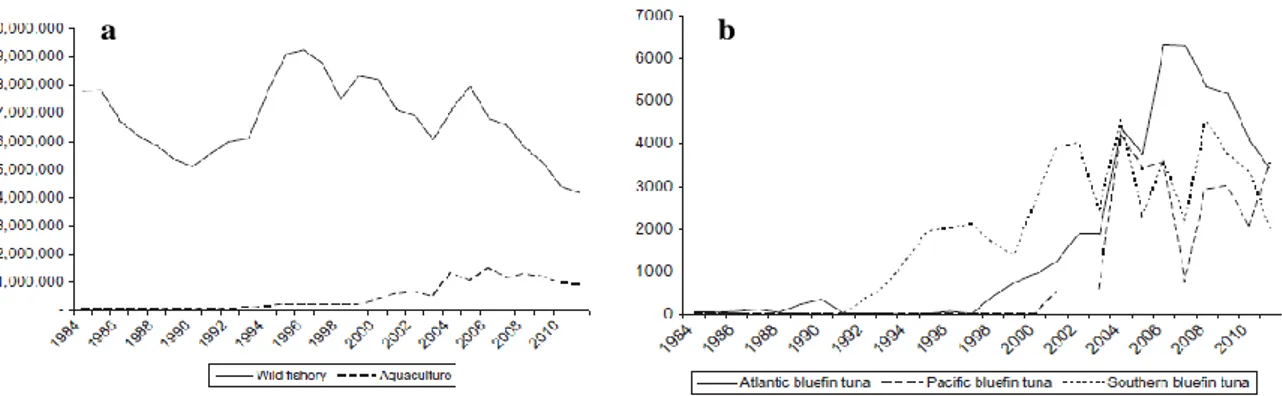
(34) CHAPTER 1: GENERAL INTRODUCTION Some of the most important spawning areas in the Mediterranean Sea are around the Balearic Islands (western Mediterranean), Sicily, Malta and Tunisia (Central Mediterranean) and Cyprus (eastern Mediterranean) (Koched et al., 2013; Rooker et al., 2007; Sanzo, 1932; Sella, 1924; Zarrad et al., 2013) (Fig. 1.5). The breeding season extends from May to June in the eastern Mediterranean and June to July in the central and western Mediterranean, in correlation with a progressive increase in sea surface temperature from east to west (Reglero et al., 2018b). In general, tunas, including bluefin tunas, reproduce in warm waters with temperatures above 20 °C (Reglero et al., 2014b). Another major characteristic of bluefin tuna spawning areas is their mesoscale oceanographic activity (Alemany et al., 2010).. -Atlantic bonito Atlantic bonito adult individuals are found along the tropical and temperate coasts of the Atlantic Ocean, the Mediterranean Sea and the Black Sea, and inhabit pelagic waters limited by the continental shelf (epipelagic and neritic) (FAO; Rey et al., 1984) (Fig. 1.6). Among four allopatric species (S. australis, S. chiliensis, S. orientalis and S. sarda), Sarda sarda, the Atlantic bonito is the only species inhabiting Figure 1.6. World distribution of Atlantic bonito. both Atlantic (both sides) and Source www.fao.org. Mediterranean waters. In general, S. sarda has a plurality of spawning areas, where the reproduction occurs at precise times (Relini et al., 2005). The spawning season in the Mediterranean usually occurs between May and July, with a maximum in June (Sanzo, 1932; Rodríguez-Roda, 1966). In general, reproduce in water with temperatures above 18-19 ºC (Ortega, 2015). Spawning is well known in the eastern part of the Mediterranean, Black Sea and Marmara Sea (Demir, 1963). However, less information is known about the western Mediterranean, although eggs and larvae have been found around the Catalan coast, Balearic Islands and Algerian coast (see references from Sabatés and Recasens, 2001). Information regarding to migration patterns is scarce and contradictory with some studies suggesting migration to spawning areas in the Mediterranean through the Gibraltar Strait and a reverse migratory from June to September after reproduction (Rey and Cort, 1981). And others suggesting that is resident in the Mediterranean and mature specimens migrate from coastal areas to open sea to spawn, and return at the end of the summer (Sabatés and Recasens, 2001).. 8.
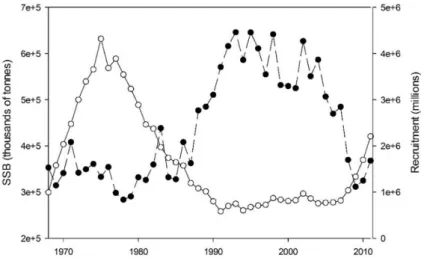
(35) CHAPTER 1: GENERAL INTRODUCTION 1.3 Fisheries -Atlantic bluefin tuna Tunas are the most valuable fishery resource exploited worldwide (Majkowski et al., 2011) and with the exception of skipjack tuna (Katsuwonus pelamis), global stocks are either fully exploited, over-exploited, or depleted (IUCN, 2018). Seven species of tunas support the major part of the tuna market in terms of quantity and economic value in the world (~ 90%): skipjack tuna, albacore, yellowfin tuna, southern bluefin tuna, bigeye tuna, Pacific bluefin tuna and Atlantic bluefin tuna. Among these, the skipack tuna fishery is the most important in terms of volume of caches (primarily sold to the canning industry), and although bluefin tuna contributes relatively little in terms of landings, they are among the most valuable fish in the sea (Majkowski et al., 2011). In the Mediterranean Sea, there are five species of tunas, all of commercial interest: Atlantic bluefin tuna, albacore, bullet tuna (Auxis rochei), Atlantic black skipjack (Euthynnus alletteratus) and skipjack tuna (Alemany et al., 2010). Atlantic bluefin tuna is the most important tuna and one of the most important species in the Mediterranean, attracting the highest level of commercial interest from the fisheries industry. Eastern and western stock of Atlantic bluefin tuna are managed by ICCAT. The high market value of tuna stocks has led to intensified fishing pressure that, in turn, has resulted in drastic population reductions (Fernandez-Polanco and Llorente, 2016) (Fig. 1.7). Long-line and mainly purse-seine fleets targeting breeding adults have complemented the traditional trap fisheries in the Mediterranean, increasing the overall effort, which resulted in higher pressure on the population. Also, during the last decade, most of the caught fishes are destined for fattening activities, in which wild specimens are transferred alive to rearing cages—an activity which has contributed to an increase in the misreporting of catches. This caused a deterioration of the spawning stock biomass from the 1970s that led to a full exploitation of the commercial stock (ICCAT, 2011). In 2007, ICCAT coordinated a strict recovery plan, decreasing the total allowable catches (TACs) for the first time, in line with the scientific recommendations—namely, having a minimum legal size of 30 kg (Anonymous, 2007) and following specific capture time limits (Cort and Martínez, 2010). Partly as a result of these protective measures, and possibly also due to an extraordinary good recruitment in 2003 (García et al., 2013), the stock seems to be gradually recovering (Fig. 1.7) (Anonymous, 2017). The management of the Atlantic bluefin tuna stock is a complicated matter. The eastern and western stocks are evaluated and managed independently by ICCAT. In general, the complexity of breeding migrations and spawning zones leads to a complex estimation of the abundance of the population, which may translate into lower estimates of the vulnerability of this species to exploitation (Fromentin and Powers, 2005). Additionally, ongoing farming (fattening) activities and the underreporting of total catches still affect the representativeness of catch statistics, which are crucial elements for the bluefin tuna stock assessment. There is therefore 9.
(36) CHAPTER 1: GENERAL INTRODUCTION an increasing effort to improve the quality and accuracy of fisheries-independent indicators in order to provide more reliable evaluations of the stock status. Recently, ICCAT is working on an alternative larval index, an independent method from the fisheries that will estimate the reproductive biomass by using fish larval abundance in spawning grounds (Ingram et al., 2010, 2015, 2017).. Figure 1.7. Estimates of spawning stock biomass in thousands of tons (white dots) and recruitment at age 1 in millions of fish (black dots) from the 2017 assessment for the eastern stock of Atlantic bluefin tuna (Anonymous, 2017).. -Atlantic bonito Atlantic bonito is one of the most abundant small scombrid in the Mediterranean Sea. The species is particularly important in the Mediterranean, Black Sea and Marmara Sea where it is taken mainly by artisanal flets, trap net, ring net, gillnet, trammel net, purse seine, beach seine, and hook and line (Demir, 1963). Fishing in the Black Sea and Marmara Sea peaks between May and October, while in the Mediterranean it may vary from area to area or even extend throughout the year (FAO). In the western and central Mediterranean, Atlantic bonitos are mainly fished in coastal waters, but large specimens (60–85 cm fork length) are sporadically present offshore (observations; Relini et al., 2005). Peak fishing of the Spanish fleet all around the peninsula is in late spring and fall. In the western Atlantic (Gulf of Maine), Atlantic bonito is fished between June and October (FAO). Total catches have fluctuated with no apparent increasing or decreasing trends (FAO). This species is also managed by ICCAT, although no proper assessment is conducted. There are no quote estimates or even an established fishing season for Atlantic bonito, and the stock is considered to be in good condition (IUCN, 2018).. 10.
(37) CHAPTER 1: GENERAL INTRODUCTION 1.4 Aquaculture -Atlantic bluefin tuna Fishing of different tuna species has been practiced for several millennia, however, tuna aquaculture is a relatively new industry (Benetti et al., 2016; Mylonas et al., 2010). Tuna aquaculture production comprised only 0.2% of the total world tuna production (wild fishery + aquaculture) in 2011 (FAO, 2015). Besides some production of yellowfin tuna in Mexico and Oman between 2004 and 2008, tuna aquaculture is fully focused on the three different species of bluefin tuna (FernandezPolanco and Llorente, 2016). Pacific bluefin tuna is cultured in Japan and Mexico, Atlantic bluefin tuna in several countries around the Mediterranean Sea and the Atlantic coast of Portugal (not in the Gulf on Mexico), and southern bluefin tuna only in south Australia. When the three bluefin tuna species are considered separately, their aquaculture production represented 18% of the total world bluefin tuna production (Fig. 1.8a and b). First tuna aquaculture or farming efforts started in the late 1960s, however, it was not until the early 1990s when commercial-scale farming began. To date, the majority of tuna aquaculture production is reliant upon the capture of wild-caught adult and juvenile induviduals (ICCAT, 2014). This practice makes it difficult to consider the aquaculture independent from the fisheries sectors. Atlantic bluefin tuna fish targeted for farming in the Mediterranean are captured by purse seiners and traditional traps during the spawning migration to the Mediterranean and then they are fattened over 3–7 months (De la Gándara et al., 2016; Karakulak et al., 2016). In Croatia, juvenile tunas are caught and kept in cages for more than 1 year to reach marketable size (Mylonas et al., 2010). There are some criticisms of this aquaculture system, which is strongly based on wild-caught tuna, because illegal, unreported, and unregulated (IUU) Atlantic bluefin tuna fishing is affecting the proper management of wild stocks (Mielgo, 2007).. a. b. Figure 1.8. a) Compared production of bluefin tuna species. This production does not include the data from Japan. b) Aquaculture production of bluefin tuna. Quantities in tons. Souce FAO 2015, Fishstat plus.. 11.
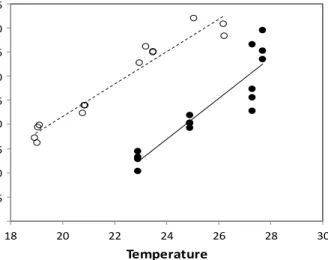
(38) CHAPTER 1: GENERAL INTRODUCTION In an effort to reduce the reliance on wild-caught adult individuals and enable consistent supply, there has been an intensive effort on closing the life cycle of Atlantic bluefin tuna in Europe to farming purposes since the early 2000s (De la Gándara et al., 2016). In Japan, research into closed-cycle aquaculture of the relative Pacific bluefin tuna started in the 1970s, and the life cycle was closed in 2002 (Sawada et al., 2005). The Japanese success with Pacific bluefin tuna raised European interest in developing similar spawning and larval rearing protocols to support the Atlantic bluefin tuna farming industry (De la Gándara et al., 2012; Mylonas et al., 2010; Ottolenghi, 2008). The largest land-based bluefin tuna broodstock facility in the world was completed in 2016 at the Spanish Institute of Oceanography (IEO) in Cartagena, Spain (Fig. 1.9). This facility will allow Atlantic bluefin tuna to be spawned in captivity under controlled conditions and represents a significant advancement in the closed-cycle production of this species (De la Gándara et al., 2016). In 2011 the IEO put 3000 juvenile Atlantic bluefin tuna to sea, and in July 2016 these tuna spawned in sea cages, generating the complete closed cycle of Atlantic bluefin tuna (Ortega and De la Gándara, 2017). Turkey, Malta and Croatia are also improving in Atlantic bluefin tuna aquaculture. The closure of the life cycle of southern bluefin tuna has not been succefully achieved yet. Figure 1.9. Image of the newly built land-based Atlantic bluefin tuna aquaculture facility in Cartagena, Spain.. -Atlantic bonito The reproduction in captivity and production of juveniles of Atlantic bonito are only carried out experimentally (Chapter 5; Blanco et al., 2017; De la Gándara et al., 2012; Ortega, 2015; Reglero et al., 2014a). There are few research projects that have undertaken the study of captive reproduction, obtaining the development of larval cultures, the feeding of larvae during the first days of life, etc. The completion of the Atlantic bonito life cycle in captivity was succeeded in 2010 (Ortega et al., 2013). Atlantic bonito could be a new candidate to aquaculture for several reasons: it has a quick growth, reaching 1kg in a few months of life (Santamaria et al., 2005), it is capable of reproducing at the end of its first year of life (Rey et al., 1984; Macías et al., 2005) and it is also a valuable and well-known species.. 12.
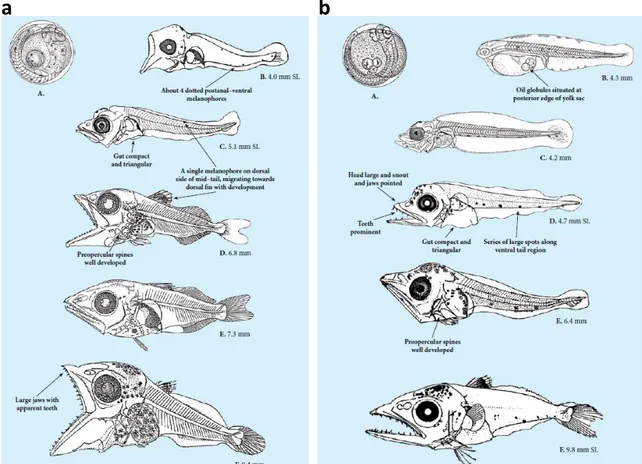
(39) CHAPTER 1: GENERAL INTRODUCTION -Challenges in aquaculture The culture of Atlantic bluefin tuna and Atlantic bonito is a very difficult task and still fluctuates due to the significant mortality events occurring during every life stage. These can be summarized as (i) floating death and sinking death during the first 8 days of life (Tanaka et al., 2009) (ii) cannibalism and collision death during the post-flexion stages, and (iii) transfer-related mortalities after they are moved from land-based hatcheries to sea cages. Mortality rates during each period can approach 90% and the overall average survival of tuna larvae ranges from 0.01% to 4.5% (De la Gándara et al., 2012). Feeding tuna larvae also represents a challenge not experienced in the culture of other marine fish, as they must be fed on the yolk-sac larvae of other marine fish, with feeding on Artemia alone resulting in “growth failure” (Seoka et al., 2007). The different feeding transition phases, planktivory and piscivory, have been seen to generate two bottlenecks in the survival of both species where a delay in the timing of onset of the different diet can caused significant mortalities (see section 1.5) (Reglero et al., 2014a). Arguably, cannibalism remains the most serious problem causing low survival rates of all species of tuna larvae. To minimize the effects of cannibalism, it is important to switch the live prey offered, from planktivory to newly hatched fish larvae such as sea bream (Sparus aurata) (De la Gándara et al., 2010; Sawada et al., 2005).. 1.5 Life cycle of Atlantic bluefin tuna and Atlantic bonito Atlantic bluefin tuna and Atlantic bonito share similar life history at early developmental stages, despite differing life history traits as adults (Fig. 1.10). Both species spawn pelagic eggs that hatch into larvae within a few days (~3–4 mm long), grow fast and develop foraging and swimming organs, then metamorphose into juveniles during the first month of life (De la Gándara et al., 2012; Kaji et al., 1996; Margulies et al., 2007; Miyashita et al., 2001). Both species share spawning grounds in oligotrophic areas where the abundance of plankton prey is often low, although bonito can also spawn in more coastal areas (Mena et al., 2016; Reglero et al., 2018b; Rey et al., 1984). The growth rate in Atlantic bonito larvae is higher than in Atlantic bluefin tuna (Chapter 5; Blanco et al., 2017; De la Gándara et al., 2012; Reglero et al., 2014a) (Fig. 1.11).. 13.
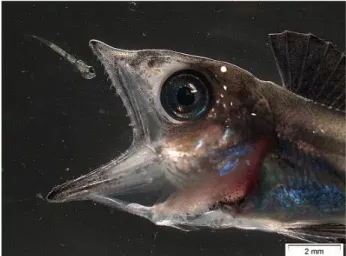
(40) CHAPTER 1: GENERAL INTRODUCTION. a. b. Figure 1.10. Morphological and developmental differences during the larval stage of Atlantic bluefin tuna (a) and Atlantic bonito (b). From Rodríguez et al. (2017).. The nomenclature of the different early developmental stages of both species in this thesis follow the one suggested by Kendall et al. (1984). They divided the early life history of fishes into three stages: egg, from spawning to hatching; larva, from hatching to attainment of complete fin-ray counts and beginning of squamation (juvenile); and juvenile, young fish, fundamentally like the adult in the meristic characters (excluding squamation) but smaller and reproductively inactive. Kendall et al. (1984) also divided the larval stage into four sub-stages: yolk-sac larva, from hatching to exhausting of yolk reserves (endogenous feeding); pre-flexion larva, from yolk exhausting (start of exogenous feeding) to the beginning of upward flexion of the notochord; flexion larva, ending when the urostyle is in its final position, 90 º; and post-flexion larva, ending when metamorphosis begins.. 14.
(41) -1 day -1) mgday-1) (mg rate growthrate Specific mg-1 (mg Specific growth. CHAPTER 1: GENERAL INTRODUCTION 0,45 0.45 0,4 0.40. 0,35 0.35 0,3 0.30 0,25 0.25 0.20 0,2. 0,15 0.15 0,1 0.10 0,05 0.05 0 18. 20. 22. 24. 26. 28. 30. Temperature. Figure 1.11. Relationship between specific growth rate of larvae and water temperature in planktivorous Atlantic bluefin tuna (black dots) and Atlantic bonito (white dots). The specific growth rate with temperature was estimated from the slope of an exponential curve between age (experimental day) and dry weight (Reglero et al., unpublished).. 1.5.1 Eggs, endogenously and exogenously planktivorous feeding life stages Both Atlantic bluefin tuna and Atlantic bonito spawn spherical eggs with an average diameter of 1–1.3 mm (Ortega, 2015) (Fig. 1.12a, b). Atlantic bluefin tuna eggs normally have a single oil globule, but some eggs can present two or even three globules. At hatching, Atlantic bluefin tuna larvae had a total length of 3.3 ± 115.7 mm (Fig. 1.12c). Atlantic bonito eggs had on average 3.4 ± 0.6 oil globules and the larvae hatch at a total length of 4.3 ± 105.4 mm (Ortega, 2015) (Fig. 1.12b, d).. ATLANTIC BONITO. ATLANTIC BLUEFIN TUNA. a. b. c. d. Figure 1.12. Picture of the eggs and newly hatched Atlantic bluefin tuna (a and c) and Atlantic bonito (b and d).. The thermal range for viable egg hatching is slightly colder in Atlantic bonito than Atlantic bluefin tuna—ranging from 14–27 ºC and 19–32 ºC, respectively (Fig. 1.13a). According to Ortega (2015), Atlantic bluefin tuna eggs do not hatch below 19 ºC and above 32 ºC. Between 21–29 ºC hatching success is above 50%, and between 23–26 ºC hatching success is about 75%. In Atlantic bonito, no hatching occurs at temperatures below 14 ºC and above 28 ºC, the probability of hatching success is more than 50% between 16–26 ºC, and there is about a 75% chance at the optimum temperature, between 18–23 ºC. The developmental time to hatch the eggs decreases when the temperature increases. At lower temperatures, the developmental time for hatching of Atlantic bonito eggs is higher than for Atlantic bluefin tuna, with 10 hours of difference at 20 ºC. However, at higher temperatures, from 25 ºC, similar egg developmental time to hatch occurs in both species (Fig. 1.13b). 15.
(42) 100. a. (%) probability(%) hatching probability Egg hatching Egg. 90 80 70 60 50 40 30 20 10 0. (hours) time, DTDT Egg developmental time, (hours) Egg developmental. CHAPTER 1: GENERAL INTRODUCTION. 100 100. 80 80 70 70 60 60 50 50 40 40. 30 30 20 20 10 10 00. 13. 15. 17. 19. 21 23 25 27 Temperature (ºC). 29. 31. 33. b. 90 90. 15. 15. 17 17. 19 19. 21. 23 25 27 21 23 25 27 Temperature (ºC) Temperature (ºC). 29. 29. 31. 31. 33. 33. Figure 1.13. a) Relationship between egg hatching probability and water temperature in Atlantic bluefin tuna and Atlantic bonito, b) relationship between egg developmental time and water temperature in Atlantic bluefin tuna and Atlantic bonito. Black dots for Atlantic bluefin tuna and white dots for Atlantic bonito (Ortega, 2015).. The transition from endogenous to exogenous feeding is considered one main bottleneck affecting larval survival in Atlantic bonito and Atlantic bluefin tuna as observed for other fish species (Hjort,1914). Nearly all offspring produced (>99.9%) in most marine fish species, will not survive their first year of life, and the strength of the recruitment is determined shortly after yolk-sac absorption, at the beginning of exogenous feeding, when the larvae must find suitable prey in sufficient amounts (Houde, 2008) (Fig. 1.14). Failing to find adequate feeding conditions would lead to massive larval mortality in a short period of time, making successful “first-feeding” a prerequisite for survival (Hjort, 1914). Given the large number of offspring produced, subtle differences in mortality rates can cause order-of-magnitude differences in recruitment from year to year (Hjort, 1914; Leggett and Deblois, 1994). This stage has been associated with massive mortalities both in nature and in laboratory populations. After the exhaustion of yolk reserves, deprivation of food in nature as well as inappropriate food quality and feeding procedure in reared populations reduce survival substantially in the first days or weeks.. Figure 1.14. Illustration showing Hjort’s Critical Period Hypothesis (1914, 1926). From Houde (2008).. 16.
(43) CHAPTER 1: GENERAL INTRODUCTION In Atlantic bonito and Atlantic bluefin tuna larvae, the short duration of the yolksac (~ 2 days after hatching) and the fast exhaustion of the inner reserves forces the ingestion of prey items just one or two days after hatching (De la Gándara et al., 2012; Ortega, 2015). Successful feeding during the first days of life is key for larval survival as high ingestion rates are necessary to maintain growth and metabolic needs. High mortalities after only one day of starvation have been seen in planktivorous Pacific bluefin tuna (Tanaka et al., 2008). In the laboratory, first prey items usually consist of enriched rotifer (see all chapters in this Ph.D. thesis) since culture with copepods (their natural prey in the field) is still under development (Ortega, 2015). Although there is still limited knowledge of the two species, the planktivorous feeding stage is the most studied period in the laboratory, and a detailed description of organ development has been described (Yúfera et al., 2014). In the field the planktivorous feeding stage is also the most common stage captured during the ichthyoplankton surveys, which have provided data to help understand larval spatial distribution and timing (Alemany et al., 2010; Reglero et al., 2012). However, there are still major gaps in our knowledge of basic ecology during this developmental stage, such as the role that temperature has on driving the vertical distribution of the larvae (see Chapter 7) or the mechanisms that explain why larvae attains the flexion stage at different ages (see Chapter 3). The flexion of the notochord is considered an important event in the early life stage of the life of fishes (Kendall et al., 1984). It is a particularly important development in Atlantic bonito and in Atlantic bluefin tuna because it coincides with the development of an adult-type digestive system (Kaji et al., 1996, 1999; Yúfera et al., 2014) that leads to a transition to a piscivorous diet during the larval stage (Chapter 4–6; Blanco et al., 2017, 2018; Reglero et al., 2014a, 2015). This development of an adult-type digestive system occurs earlier in Atlantic bluefin tuna and Atlantic bonito relative to other marine fishes. The completion of the flexion allows the larvae to improve their swimming and reach new prey (Kendall et al., 1984; Osse et al., 1995; Roy et al., 2014). Growth variability to flexion time has been observed in Pacific bluefin tuna (Takebe et al., 2012; Tanaka et al., 2006), however an explanation for it has not yet been found in larvae reared under the same abiotic and ad libitum feeding conditions (Chapter 3).. 1.5.2 Exogenously piscivorous feeding life stage Piscivorous feeding during the larval stage is known to be a second bottleneck in the survival of both Atlantic bonito and Atlantic bluefin tuna (Reglero et al., 2014a). Other species of scombrids also pass through a piscivorous feeding stage. An early transition to piscivory has previously been shown to benefit survival and increase growth in cultured Atlantic bluefin tuna and Pacific bluefin tuna with high survival and growth rates only achievable when fish larvae were included in diets (Reglero et al., 2014a; Tanaka et al., 2014a). Evidence for the onset of piscivorous behavior in Atlantic bonito and in Atlantic bluefin tuna has been observed in the laboratory (Fig. 1.15) at larval lengths between 7–9 mm and 8–10 mm respectively.. 17.
(44) CHAPTER 1: GENERAL INTRODUCTION In the field, evidence of a piscivorous diet has already been reported during the early larval stages for some tuna species (Thunnus alalunga Catalán et al., 2011; Euthynnus alleteratus, Katsuwonus pelamis, Axis rochei Llopiz et al., 2010; A. rochei Morote et al., 2008; Thunnus macoyii and K. pelamis Young and Davis, 1990). However, it has not yet been documented in the field for Pacific Figure 1.15. Atlantic bonito larva feeding on sea bluefin tuna larvae. High rates of bream yolk-sac larva. Source: IEO Murcia. piscivory and even cannibalism in Atlantic bluefin tuna larvae has been reported in the Gulf of Mexico at lengths 8–10 mm (Llopiz and Hobday, 2015; Llopiz et al., 2015). Based on modelling work, it has been shown that Atlantic bluefin tuna larvae cannot solely survive on zooplankton diets and consequently must prey on fish larvae at post-flexion stages to provide the sufficient energy for growth and therefore survival (Reglero et al., 2011). However, it was not until recently that piscivory in Atlantic bluefin tuna larvae in the Mediterranean Sea was found in larvae > 7 mm (Uriarte et al., 2017). The lack of evidence of piscivory in the field could be due to the capturability of large larvae since individuals longer than 7 mm are scarcely captured during ichthyoplankton surveys by the oblique Bongo 60 and surface Bongo 90 plankton tows, mainly due to net avoidance (Satoh et al., 2008; Tilley et al., 2016). For Atlantic bonito larvae there is no knowledge of their diet in the field, since their larvae are usually very scarce in ichthyoplankton surveys and no trophic studies have been conducted yet. The start of the piscivory is associated with an increase in the growth rate of the larvae (Reglero et al., 2014b; Tanaka et al., 2010, 2015). The fast growth, along with the mortalities caused by the dietary transition, can cause size differences among individuals of the same cohort (Hecht and Pienaar, 1993) due to suggested sizeselective mortality during the larval stage (McGurk, 1986). However, knowledge is scarce regarding how mortality affects the size spectrum of the larvae that survive through piscivory and become part of the juvenile population (Chapter 4; Blanco et al., 2018).. 18.
(45) CHAPTER 1: GENERAL INTRODUCTION 1.6 Methods to study larval growth and survival The knowledge of the ecology of the early life stages of fishes is crucial to understanding the population dynamics of fish stocks, and also, the functioning of marine ecosystems. Laboratory studies are a perfect tool to understand how different variables drive fish physiology and behavior and eventually influence growth and survival by manipulating abiotic and biotic factors. Those responses are difficult to estimate from field-sampled individuals, as fish individuals are exposed to multidimensional environmental conditions that simultaneously vary and interact, and by the time the fishes reach the boat they are often dead or not fit for study. Even though the complexity of the aquatic environment makes it difficult to replicate adequately in the laboratory, it is the best and more appropriate alternative in order to obtain those data that are unknown in the field. A wide array of technological advances and new analytical techniques developed in the last several decades have allowed for significant advances in the knowledge of the growth process and the causes of mortality during the early life stages of fishes (e.g. Fiksen et al., 2007; Moyano et al., 2017; Reglero et al., 2014a). In this Ph.D. thesis study, we have focused on the use of microstructure analysis of otoliths (Chapter 4; Panella, 1971) and of the biomolecular analysis of condition (Chapters 3 and 6; Buckley, 1984) as proxies for growth and survival in fish larvae.. 1.6.1 Microstructure analysis of otoliths Otoliths (ear stones) are small calcified structures found in the head of the fish which assist in detecting sound and are used for balance and orientation (Fig. 1.16). Otoliths are natural data loggers that record information in their microstructure and chemistry at different temporal scales (Campana, 1999). The 10 µm presence of these daily structures enables not only a size-independent estimate of Figure 1.16. Image of the otolith of Atlantic bluefin age, but also of growth and tuna 27 days post-hatch. mortality of larvae and juvenile fish, assuming a relationship between otoliths’ length increments and somatic growth (Campana and Jones, 1992; Folkvord et al., 2004). Previously formed increment widths-at-age in an otolith, will remain unchanged as the fish continues to grow over time. If the temporal significance of these increments has been established, comparison of increment widths at given ages of fish sampled at later stages will have the potential to reveal any changes in the increment width pattern (or otolith size distribution) among fish from the sampled population (Folkvord et 19.
Figure

+7

Documento similar
Bigeye tuna (Thunnus obesus (Lowe, 1839)) is a marine pelagic fish species characterized by large populations and a worldwide distribution (Atlantic, Indian and Pacific
Effects of basic fibroblast growth factor on early revascularization and epithelial regeneration in rabbit tracheal orthotopic transplantation. Comparative anatomy, physíology,
For a short explanation of why the committee made these recommendations and how they might affect practice, see the rationale and impact section on identifying children and young
In support of this notion, hyper- thermic Atlantic salmon showed down-regulation of ECM genes (i.e. Col1A1, ON and OCN) and at the juvenile stage had shorter and less
Recombinant human insulin‑like growth factor I has significant anabolic effects in adults with growth hormone receptor deficiency: studies on protein, glucose, and lipid
In particular, the growth and decay of the positive phase of the North Atlantic Oscillation, which projects onto the large-scale con figuration fostering clustering over the UK
"Obtaining healthy globe artichoke plants by shoot apex culture and clonal micropropagation in vitro".. "The effect of light intensity and temperature on plant growth
This work aims to contribute to the understanding of the geomorphological evolu- tion of rocky cliffs by means of a case study of a geologically complex cliff (developed on
