
Product differentiation and option games : closing the gap
72
0
0
Texto completo
(2) PONTIFICIA UNIVERSIDAD CATOLICA DE CHILE ESCUELA DE INGENIERIA. PRODUCT DIFFERENTIATION AND OPTION GAMES: CLOSING THE GAP. CARLOS GUILLERMO DECK LABRA. Members of the Committee: JAIME CASASSUS VARGAS ENZO SAUMA STEPHEN ZHANG JUAN IGNACIO GUZMÁN BARROS MARCELO ARENAS SAAVEDRA. Thesis submitted to the Office of Research and Graduate Studies in partial fulfillment of the requirements for the Degree of Master of Science in Engineering Santiago de Chile, (June, 2011).
(3) To my family for showing me the path towards excellence and for making that path worthwhile.. ii.
(4) ACKNOWLEDGMENTS. I must first recognize the support of my Supervisor, Jaime Casassus. I thank his support and wise words during the making of this thesis; because, even though it was not his area of expertise, he was willing to follow my whims and guide me towards this final product. I must also thank Juan Ignacio Guzmán, for helping me along the way when I thought that all was lost with my model: he was always capable of saying the right words that could lead me to think of the problem at hand with a different perspective. The other members of my committee – Marcelo Arenas, Enzo Sauma and Stephen Zhang – were of great help during the final stage of this thesis and I am grateful for their feedback. During the elaboration of this thesis, my time in GEM was a great influence in this final product. The rigorous intellectual environment within this company has always pushed me to higher excellence. Finally, I want to make a special recognition to my loved ones. I thank Stefanie for her love and patience during this last year and a half. And I especially thank my parents and my brothers for a lifetime of good family memories. Without them, this thesis would not have been possible.. iii.
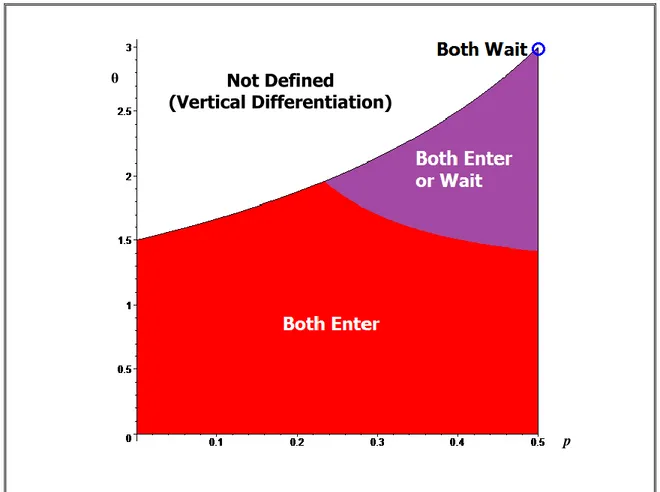
(5) TABLE OF CONTENTS Page DEDICATORY ............................................................................................................ ii ACKNOWLEDGMENTS........................................................................................... iii LIST OF TABLES ...................................................................................................... vi LIST OF FIGURES .................................................................................................... vii ABSTRACT .............................................................................................................. viii RESUMEN .................................................................................................................. ix 1.. ARTICLE BACKGROUND .............................................................................. 1 1.1. Introduction ................................................................................................ 1 1.2. Main Objectives ......................................................................................... 4 1.3. Literature review ........................................................................................ 4 1.3.1. Option Pricing .................................................................................. 5 1.3.2. Option Games .................................................................................. 5 1.3.3. Product Differentiation .................................................................. 10 1.3.4. Intersecting both lines of research ................................................. 12 1.4. Future research ......................................................................................... 16. 2.. PRODUCT DIFFERENTIATION AND OPTION GAMES: CLOSING THE GAP ....................................................................................... 18 2.1. Do waiting options in differentiated markets exist?................................. 20 2.2. The model ................................................................................................. 24 2.2.1. Game structure ............................................................................... 24 2.2.2. Game resolution ............................................................................. 27 2.2.3. Solution under locational uncertainty ............................................ 30 2.3. Benchmark comparison ............................................................................ 42 2.3.1. Nash-Cournot competition ............................................................. 42 2.3.2. Locational competition .................................................................. 48 2.4. Analysis .................................................................................................... 51 2.5. Conclusions .............................................................................................. 58.
(6) REFERENCES ........................................................................................................... 60.
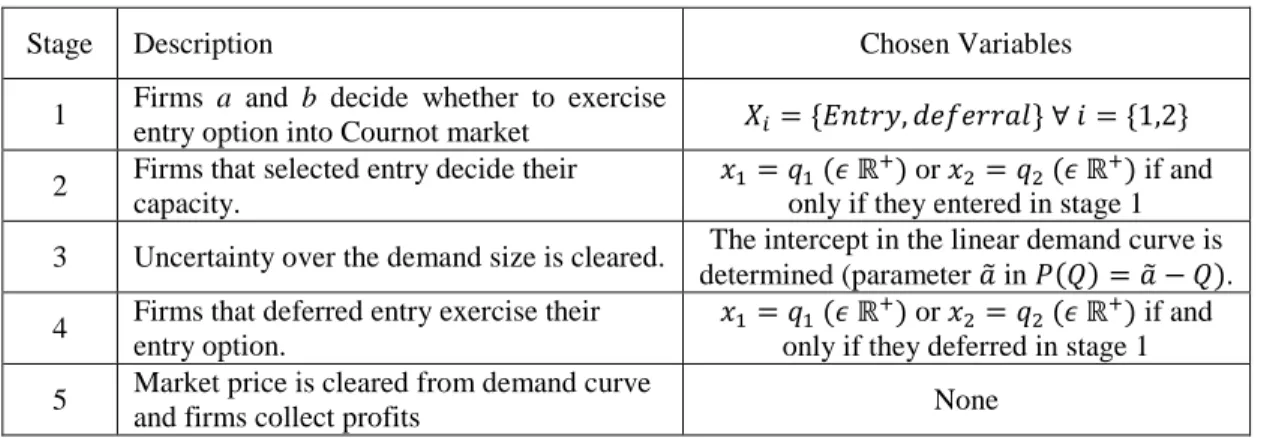
(7) LIST OF TABLES Page Table 2-1: Worldwide smartphone sales to end users by operating system (OS) in 2010 ................................................................................................................................. 23 Table 2-2: Worldwide smartphone additional sales in 2010 by operating system (OS) ......................................................................................................... 23 Table 2-3: Summary of the Entry Option Game into Hotelling’s Linear City under Uncertainty .......................................................................................................................... 26 Table 2-4: Summary of the Entry Option Game into a Cournot Market with Demand Intercept Uncertainty ........................................................................................................... 43. vi.
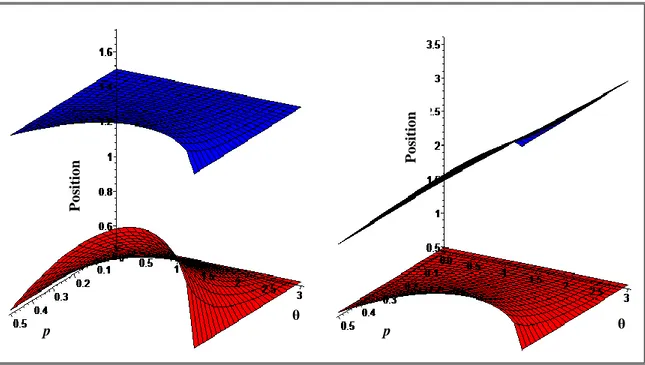
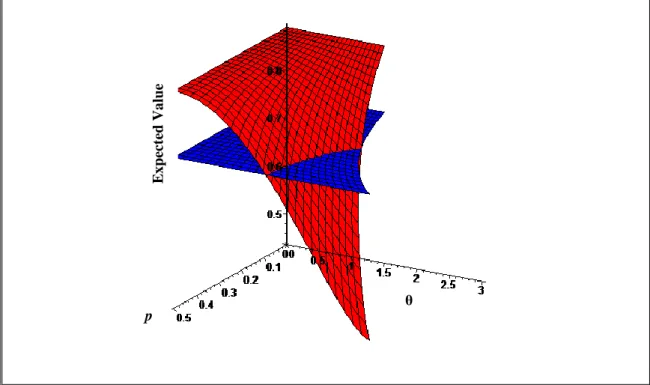
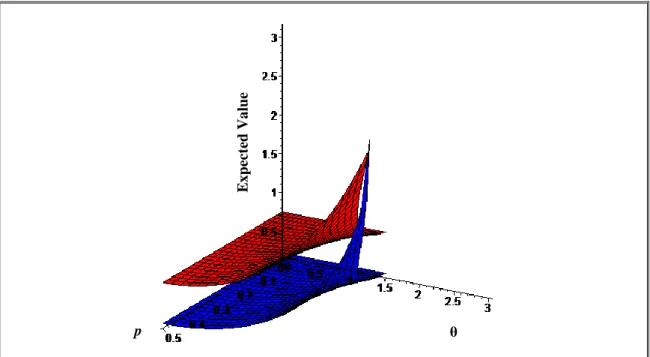
(8) LIST OF FIGURES Page Figure 1-1: Optimal exercise strategy for joint entry of firms based on Grenadier (1996) ................................................................................................................... 7 Figure 1-2: Possible equilibrium regions from Pawlina and Kort (2006) ............................. 8 Figure 2-1: Firms’ positions under simultaneous entry before solving locational uncertainty .......................................................................................................... 33 Figure 2-2: Firm’s locations under sequential entry for possible outcomes of locational uncertainty .......................................................................................................... 36 Figure 2-3: Firms’ expected value for preempting and waiting, assuming that the other firm waits under locational uncertainty................................................................ 39 Figure 2-4: Firms’ expected value when preempting and waiting, assuming that the other firm preempts under locational uncertainty ........................................................ 40 Figure 2-5: Entry patterns for all feasible. pairs under locational uncertainty .......... 41. Figure 2-6: Expected Value functions for leader and follower under sequential entry in a Cournot framework ..................................................................................................... 46 Figure 2-7: Entry patterns for relevant. pairs under demand intercept uncertainty. in a Cournot framework ..................................................................................................... 47 Figure 2-8: SPNE visualization for locational uncertainty model without price competition under simultaneous entry ...................................................................... 50 Figure 2-9: Value of waiting in Hotelling’s linear city and in a Cournot market under uncertainty ................................................................................................................ 52. vii.
(9) ABSTRACT Up to now, the Option Games literature has studied oligopolistic markets where firms compete à la Cournot, leaving aside other markets where firms use pricing policies as part of their market strategy. To address this issue, Hotelling’s linear city model is adapted, to include the tradeoff between preempting competitors under uncertainty or waiting to know where the city’s customers are. Despite the simplicity of this model, it is one of the first to study the trade-off between flexibility and commitment under competition à la Bertrand. The main result of this study shows that giving firms the freedom to endogenously determine their best entry strategy can lead to more than one entry pattern to arise as a Subgame Perfect Nash Equilibrium. This result can be extended to an adapted Cournot framework. Besides this point, the role of price competition ex-post once firms have chosen positions on the real axis lowers the commitment of the previous stages, lowering the relative value of their waiting option when compared to competition solely based on positions or à la Cournot. These results are then used to give plausible explanations to markets ranging from smartphones to political elections.. Keywords: Option Games, Hotelling, Cournot, Uncertainty viii.
(10) RESUMEN Hasta el momento, la literatura de Option Games se ha enfocado primordialmente en considerar mercados oligopólicos donde las firmas compiten à la Cournot, dejándose de lado los mercados donde las firmas pueden establecer políticas de precio como parte de su estrategia para competir en el mercado. Con este fin, se adapta el modelo de la ciudad lineal de Hotelling, donde dos firmas deben decidir si posicionarse sin saber exactamente dónde están los consumidores para anticiparse a su competidor, o esperar hasta saber donde se encuentran. A pesar de su simplicidad, éste es uno de los primeros artículos donde se estudia el trade-off entre flexibilidad y compromiso en un contexto de competencia à la Bertrand. El resultado principal de este estudio muestra que entregándoles a las firmas la libertad para determinar de forma endógena su mejor estrategia de entrada puede llevar a múltiples Equilibrios de Nash Perfecto en Subjuegos (ENPS). Este resultado es extensible a la competencia en cantidades adaptado a esta estructura de juego. Además, el rol de la competencia en precios ex-post lleva a disminuir el grado de compromiso en la decisión del producto a escoger, por lo que el valor de esperar disminuye en comparación con la competencia sólo en base a las posiciones o à la Cournot. Estos resultados son usados posteriormente para entregar explicaciones plausibles a mercados tan diversos como los celulares inteligentes y elecciones políticas.. Palabras Claves: Option Games, Hotelling, Cournot, Incertidumbre. ix.
(11) 1. 1. ARTICLE BACKGROUND 1.1.Introduction During the past 20 years, economics has notoriously improved the techniques for valuing investment opportunities under uncertainty in oligopolistic markets. Up to date, the main valuation technique for capital budgeting has been the Net Present Value (NPV) criterion, which discounts the expected future cash flows belonging to a certain project to determine its value. This technique has a series of flaws that deems it inappropriate for valuing this type of investments, such as: . It is not the same to calculate the NPV of expected future cash flows than the expected NPV of future cash flows.1. . There is no flawless model for determining a discount rate that correctly accounts for a project’s risk.. . The NPV criterion does not give any flexibility to a project’s owner to adjust to different scenarios, since it eliminates all uncertainty by working with expected values.. . It does not consider whatsoever how competition may affect a project’s value.. Most of these issues have been taken into account in Option Pricing theory – applied to both financial and, later on, real assets. This valuation technique corrects the first three points, allowing project owners to value investment opportunities considering the fact that they do not remain passive towards relevant uncertain variables that affect their project’s value. Nevertheless, this framework maintains the neoclassical assumption that markets are governed by perfect competition, where no economic agent has the capacity of unilaterally affecting the market equilibrium; hence, an option’s influence once exercised is restricted solely to the value of its related asset. 1. This result is related to Jensen’s Inequality, which states that for a convex function variable the following inequality is always true:. and an uncertain.
(12) 2. During the 90’s, financial economists began to recognize that many real projects are inserted in non-competitive markets, where strategic interaction among the firms is present and their value depends not only on their actions, but on the actions of their competitors as well. Therefore, the valuation of a project’s options will also need to take into account the actions of third parties that can affect its value. A clear example of this type of market is the mining industry, where mining companies must make large and highly irreversible investments before receiving any payoffs. These are affected not only by the high volatility of commodity prices, but by the threat of preemption of other firms that can lower the long term market equilibrium as well. This limitation of Option Pricing has been addressed by combining this framework with non-cooperative game theory – which is, according to Tirole (1988), “the standard tool for the analysis of strategic conflict” – to give birth to the Option Games framework: an area that studies investment opportunities accounting for both uncertainty and competition. At present, this is an area of active research in economics and finance which has gone a long way in understanding options in oligopolistic markets. Nevertheless, there are still phenomena left to be understood. For example, while many economists have studied the dynamic problem of expanding capacity considering competition à la Cournot, such as Grenadier (2002), Novy-Marx (2007) and Aguerrevere (2009), there has not been an equal amount of attention for the problem considering competition à la Bertrand, where firms choose prices and afterwards, depending on the prices posted, the demand for each firm is determined. This thesis is a first attempt to close this gap. To this end, it constructs a six stage game based on a renowned model of product differentiation in the field of Industrial Organization (from hereafter, IO): the linear city of Hotelling (1929). The stages of this game are:. 1. Each firm decides whether to choose a location on the real axis either before or after the city’s position becomes known to them..
(13) 3. 2. Firms who decided to enter select their position on the real axis. 3. The final position of the linear city is revealed to both firms. 4. The firms that haven’t installed themselves choose a position on the real axis. 5. Firms decide on product prices to attract the consumers in the linear city to buy their product. 6. Consumers choose the firm that minimizes their total costs for acquiring the product (transportation costs + product price).. This model, although it does not have repeated competition in time like the Option Games literature, gives insight when analyzing the trade-off between discarding the waiting option to gain a first-mover advantage or using it to know the position of the linear city before choosing a location on the real axis. It is also novel in the Option Games literature because the final payoffs are a non-linear function that depends on both the option’s exercise (as seen in most option games) together with an additional competition stage where both firms choose product prices. In this case, it is not necessarily clear a priori how this additional stage of competition will affect the entry option’s value. Finally, it is important to mention that this model gives insight for option exercise in differentiated markets, where current option games do not apply. The rest of this chapter is structured as follows: section 1.2 states the main objectives pursued by this thesis; section 1.3 provides a summary of previous contributions in the fields of Option Pricing (which includes Real Options), Option Games and Product Differentiation (from the field of IO) and how this thesis comes to complement each of these areas;2 finally, section 1.4 suggests areas of future research. Chapter 2 contains the main article of this thesis.. 2. This section is intended to introduce these lines of literature to readers unfamiliar with them. Hence, the reader familiar with these fields can skip this section without affecting their understanding of the rest of this thesis..
(14) 4. 1.2.Main Objectives This thesis has the goal of developing a theoretical model that narrows the gap between the literature of product differentiation (in IO) and Option Games, by helping to understand the logic behind a firm’s decision to invest when product differentiation is present. Up to date, all Option Games models assume that firms are inserted in a homogeneous market, where their productions are perfect substitutes for one another and the price is cleared by means of a downward sloping demand curve. Related to this point, a secondary objective is to use the theoretical framework developed in this thesis to give a plausible explanation to real-life phenomena. Chapter 2 focuses on two applications: a real market and the political arena. First, the smartphone industry is analyzed, because it is currently under major shifts (regarding each competitor’s market share) and uncertainty (regarding the market’s size and main drivers), making it appropriate to study under an Option Game framework with product differentiation. Afterwards, this framework is applied to the area of voting theory in political science, where the economic models of product differentiation have been modified to study how political candidates position themselves regarding crucial topics when facing elections with uncertainty in the electorate’s position. 1.3.Literature review To build this model, contributions from three distinct lines of research were necessary. First, Option Pricing has questioned the prevalence of the NPV criterion as the sole technique for valuing all types of investments. This framework has consolidated itself in academia as the most appropriate technique for valuing irreversible investments under uncertainty. Its main insight can be resumed as “the higher the volatility, the higher the option’s value”, due to the fact that options limit the impact of negative scenarios while maintaining all of the upside potential of positive scenarios. Secondly, Option Games have made important advances in incorporating the impact of competition in the options that exist in oligopolistic markets, reaching the general insight that strategic competition erodes an option’s value. Finally, the product differentiation literature provides the structure of the game used in this thesis, which arise from the.
(15) 5. seminal article of Hotelling (1929). This line of research delivers the insight that, in differentiated markets, the final product choice depends on two forces at work: the demand effect, which leads competitors to offer similar products trying to capture a bigger market share; and the strategic effect, which leads competitors to offer different products, so as to avoid competition and to charge higher prices (becoming local monopolists). The following subsections summarize the literature for each of these lines of research, before detailing the works that – in the author’s opinion – seek to intersect the theory of option games in a context of product differentiation. 1.3.1. Option Pricing This line of research is widely known in academia, ever since Black and Scholes (1973) derived a closed-form equation for financial options. Brennan and Schwartz (1985) were among the first to realize that the underlying logic for valuing financial options can be extrapolated to value real investments when these are at least partially irreversible and made under uncertainty. Afterwards, an ever increasing literature on the subject has emerged, valuing different types of investment opportunities, such as investing in a project with uncertain cash flows (McDonald & Siegel, 1986), investing in mothballing or abandoning a project (Myers & Majd, 1990), expansion options (Trigeorgis & Mason, 1987), or storage options (Cortázar & Schwartz, 1993), among others. The general conclusion reached by these papers is that there is intrinsic value in waiting to invest until economic conditions are “good enough” – if these are uncertain. Hence, the traditional rule of investing if the project’s NPV is greater than zero is replaced by a higher threshold. Dixit and Pindyck (1994) and Casassus (1996) are excellent surveys for revising the general insight behind the Option Pricing literature. 1.3.2. Option Games Fudenberg and Tirole (1985) can be considered as the seminal paper in this line of research. They study an n-player game of technology adoption, where the technology’s returns to scale are monotonically deceasing in the number of firms. Here,.
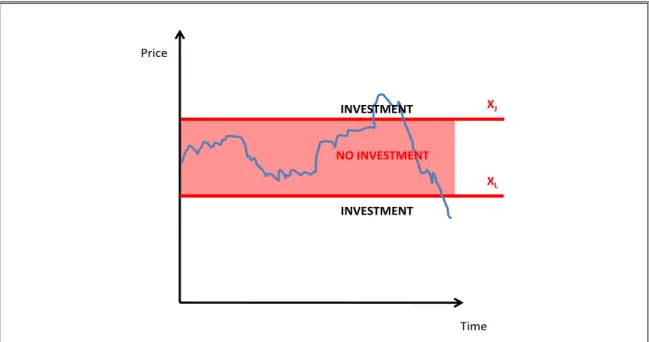
(16) 6. they discover that, in the duopoly case, one firm will preempt the other’s access to the cost-reducing technology if the gains are sufficiently high, such as the insertion into a new market without competitors. If this is not the case, then both firms will jointly adopt the technology at the same time. Nevertheless, beyond the intuition delivered by the model, their main contribution in this field resides in the mathematical framework for modeling non-cooperative dynamic games in continuous time, which allows to incorporate this effect into the stochastic processes used in Option Pricing theory. Leahy (1993) is another of the seminal works in the Option Games literature, where he analyzes a competitive equilibrium in a market where infinitesimal firms must determine their optimal strategy to carry out an irreversible investment. He demonstrates that, even when irreversible investment affects the price process of a commodity market, firms can assume a myopic behavior when deriving their optimal investment strategies. In other words, firms can ignore the strategic effects caused by their investment (and of their competitors) when determining the optimal trigger price for investing. This conclusion is fascinating, since it gives support to the previous literature of Option Pricing of investments under uncertainty, where firms are either monopolists or price takers. Nevertheless, although these conclusions are valid for a world with and without uncertainty in the price process, it assumes necessarily that investment must be made in infinitesimal amounts and with constant returns to scale: violating either of these assumptions makes these conclusions no longer valid. Grenadier (1996) analyzes a duopoly where both firms have a single option to invest a fixed amount to increment its earnings and determines possible option exercise equilibria. The payoffs after exercising the option are determined by a stochastic variable. that follows a geometric Brownian Motion (GBM) process, which is. pondered by a constant factor. , where is the number of firms that have exercised. their investment option. Following the common notion in IO, he assumes that . Grenadier’s main result shows that, depending on the initial value of the stochastic variable. , there could be an initial period of inaction by both firms before. joint entry, when the variable reaches a lower trigger. . This seemingly counterintuitive.
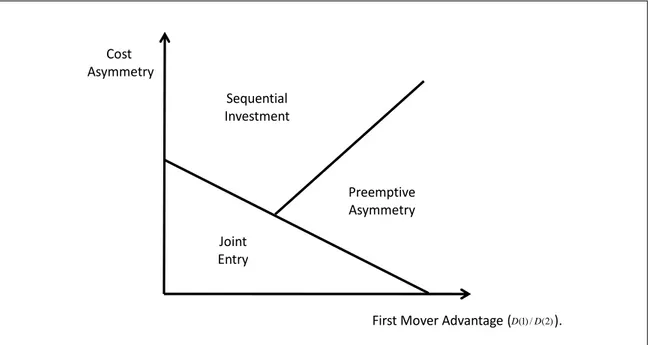
(17) 7. result arises due to the fact that it is preferable to exercise the expansion option in a shrinking market that to be preempted altogether from it, and is used to explain the case of construction booms that occur in economic recessions. This phenomenon is seen in Figure 1-1. The other interesting aspect of this paper is that it considers the entry decisions (whether joint or sequential) as an endogenous variable and determines under which circumstances each type of equilibria arises.. Price. INVESTMENT. XJ. NO INVESTMENT XL INVESTMENT. Time. Figure 1-1: Optimal exercise strategy for joint entry of firms based on Grenadier (1996). Pawlina and Kort (2006) adapt Grenadier’s model by introducing asymmetric investment costs. This leads to different entry patterns, depending on the cost asymmetry and the first-mover advantage, which are summarized in the following figure..
(18) 8. Cost Asymmetry Sequential Investment. Preemptive Asymmetry Joint Entry. First Mover Advantage (D(1) / D(2) ).. Figure 1-2: Possible equilibrium regions from Pawlina and Kort (2006). Lambrecht and Perraudin (2003) also analyze a duopoly where both firms have a single option for investing in a project, which has the characteristics of the McDonald and Siegel (1986) project. Nevertheless, there is only one project, which goes to the first agent that exercises its option to invest, and agents only know their own investment cost and the probability distribution of its counterpart’s. Therefore, the optimal trigger strategy is a trade-off between waiting for the project to raise its value or exercising immediately to avoid its competitor to gain the project. This trigger strategy changes in time as the game goes on, which reveals new information on each competitor’s investment costs to its counterparts. The resulting Bayesian Nash Equilibrium can “lie anywhere between the zero-NPV trigger and the monopolist’s trigger level, depending on the competitor’s costs and the implied fear of preemption” (p. 619). Grenadier (2002) follows the line started by Leahy (1993), by analyzing a repeated game of investment in a Nash-Cournot framework, where n symmetrical firms must decide their trigger for incrementing marginally their capacity by dq. This decision involves a strategic interaction by diminishing the current price, which is cleared in a.
(19) 9. downward sloping demand function multiplied by a stochastic shock. This article, recognized in this area due to its tractability and general form, reaches the conclusion that the degree of competition, given by the number of firms n, erodes the investment option’s value, given that “as the number of industry competitors increases, the likelihood of existing asset values falling below their investment cost increases” (p. 604). Novy-Marx (2007) is the first paper to explicitly question that competition necessarily must erode an option’s value for investing (hence, lowering the investment trigger towards the zero-NPV rule). This author reaches this conclusion using a dynamic Nash-Cournot framework, but where there is a continuum of firms that have different sizes. In this case, the equilibrium strategy has the smallest firm investing a constant proportion. when the underlying asset’s price rises, differing from Grenadier (2002),. which assumed that all (symmetrical) firms invested an incremental capacity dq at the same price trigger. Aguerrevere (2003), on the other hand, relaxes the assumption of firms producing without cost at capacity from Grenadier’s original Nash-Cournot framework, which leads the commodity price to follow a different stochastic process than the demand shock, which follows a GBM process. Aguerrevere (2009) uses Grenadier’s Nash-Cournot model to analyze how a firm’s rate of return is affected by the level of competition in the product market where it competes. In the words of this author: “We find that the relationship between the degree of competition and the firm’s exposure to systematic risk (external demand shock) varies with product market demand. Firms in competitive industries (with a high n) are riskier when demand is low, while firms in concentrated industries (with a low n) are riskier when demand is high. This result follows from the effect of competition on the value of growth options and from the relation between the level of demand and the relative riskiness of assets in place and growth options.” (p. 975). It is important to emphasize that this thesis does not intend to provide an exhaustive list of references in this field, but what is considered by the author as the.
(20) 10. most important contributions in the area. For a comprehensive survey of this line of research, refer to Azevedo and Paxson (2010) and Chevalier-Roignant et al. (2010). 1.3.3. Product Differentiation Considering the fact that the Option Games literature implicitly focuses on homogeneous markets, this thesis builds heavily on the IO literature in differentiated markets. This section particularly focuses on the contributions that can be directly related to the model explained in Chapter 2. For an excellent introduction to the literature, refer to Eaton and Lipsey (1989). For another interesting summary, together with how this line of research can be associated to Discrete Choice Theory, refer to Anderson et al. (1992). Hotelling (1929) is the seminal contribution in this area, where he constructs a game in which two firms must first choose a location on the real line segment [0,1]. This decision relates back to choosing a particular characteristic in a product market, such as the sweetness of cider.3 Secondly, these firms, once installed, must decide on the price to charge for their product. Finally, a continuum of consumers located on this segment must decide on which product to buy. When making this decision, each consumer seeks to minimize the total cost in acquiring the product, which includes both the product’s price and the “disutility” the consumer must suffer for getting a product that does not coincide with its preferred product – in other words the distance between its location and the chosen product’s location. This function is:. (1). Here,. represents each consumer’s valuation of the good,. consumer’s location,. 3. and. represents the. represent the -th firm’s product price and location,. This is the original example used by Hotelling (1929)..
(21) 11. respectively. The function. is a non-decreasing function that determines the. consumer’s disutility when it must leave its location to choose the product located at. 4. As a result, Hotelling derived that the optimal location for both firms would be to locate themselves in the middle of the city (i.e.. ), a result known in the. literature as minimal differentiation. This occurs due to the fact that the firm’s incentives to gain additional market share (known as the demand effect) surpass the benefits of differentiating themselves to gain additional market power (known as the strategic effect), because the disutility function’s is not “steep enough”5 to avoid a price war when trying to exercise market power and charge higher prices in the price-setting stage. D’Aspremont et al. (1979) discovered 50 years later that Hotelling’s reasoning was not entirely correct, since they demonstrate that there is no Nash Equilibrium (NE, from hereafter) in pure strategies for the location stage when both firms are “close enough” because of a discontinuity in each firms’ profit function in the price setting stage (assuming that its competitor’s price remains constant). Therefore, to reach a unique Subgame Perfect Nash Equilibrium (SPNE, from hereafter) in pure strategies, they change the disutility function from a linear to a quadratic one:. .. As a result, this new convexity in the disutility function exacerbates the strategic effect and encourages both firms to locate at the city limits (i.e.. and. ). Brenner. (2005) extends this setting by considering more firms (up to 9) and shows that the leftmost and rightmost firms enjoy more monopoly power because they only face competition from one side, while the center firms cluster in the middle, because the two sided competition exacerbates the demand effect over the strategic effect. Lambertini (1994) uses the setting in D’Aspremont et al. (1979), but relaxes the assumption that both firms must locate themselves inside the city limits. This leads firms to differentiate themselves even more, up to a point where the demand and the strategic. 4. In Hotelling’s original paper, this function was linear: . As the transportation cost function increases, firms increment their market power. This becomes clear when analyzing the limit cases: when , the problem degenerates into the traditional Bertrand equilibrium and firms price their goods at marginal cost. On the other hand, when , firms become monopolists and can charge a price . 5.
(22) 12. effect balance themselves. This NE in positions is given by leading to greater distortions in terms of social welfare.. and. ,. 6. Lambertini (1997) focuses on analyzing what occurs to the SPNE in the D’Aspremont et al. (1979) model when the firms decide on whether to play simultaneously or sequentially on both the location stage and the price stage of the game, determining that they prefer to select simultaneously their locations, followed by a sequential play in prices. He also shows that the SPNE can dramatically change, according to the roles determined in each stage of the game. This paper is interesting, since it introduces a dynamic decision making process and firms endogenously determine which entry pattern they prefer. Casado-Izaga (2000) is probably the first paper in this line of research that explicitly incorporates uncertainty into this type of product differentiation models. In this case, the location of the linear city of length 1 can be shifted by , where. is an. instance of the Uniform(0,1) distribution. Meagher and Zauner (2004) extend this model to a more general setting, where the parameters of the uniform distribution can vary. Both papers determine that uncertainty is a differentiation force, since it increases the strategic effect while at the same time diminishing the demand effect, because the upside a firm can gain when the uncertainty in the city’s location is solved to its favor is greater than the downside when the uncertainty’s resolution favors its competitor. Meagher and Zauner (2004) additionally demonstrate that this result is robust to whether the uncertainty is cleared before or after the price setting stage. 1.3.4. Intersecting both lines of research As mentioned beforehand, most option games assume that the revenue stream is either: (1) a monopolistic claim over a stochastic cash flow (as seen in most models related to the Option Pricing literature) or (2) a result of competition in a Nash-Cournot framework where the commodity price is cleared from a downward sloping demand 6. IO textbooks, such as Tirole (1988) and Carlton and Perloff (2005), demonstrate that the optimal social locations for both firms – which minimize the transportation costs for all consumers – are located at and , respectively..
(23) 13. function multiplied by an external shock that follows a stochastic process. Therefore, this framework is not directly applicable to markets where firms compete in prices for a mass of consumers, such as the product differentiation literature seen in Subsection 1.3.3. There are, up to the author’s knowledge, only a couple of papers that try to include other strategic variables, with limited success. Boyer et al. (2004) analyze a model of a market of fixed size where consumers’ willingness to pay varies according to a GBM process. On the supply side, two firms must consider when to invest to produce an additional unit of capacity for satisfying the market, making a trade-off between waiting for the consumers’ willingness to pay to rise and, on the other hand, the preemption of its competitor of adding this capacity and closing out the entry option into the market. This model, although it is pictured as a model that competes à la Bertrand, can also be seen as a McDonald and Siegel (1986) model, where two firms decide when to invest for a partial (or total) claim on the project’s cash flows by investing a part (or all) of the investment cost. This interpretation can help to understand the main results derived in this paper, described in the authors’ original words: “If the average growth rate of the market is large enough relative to the risk-free rate, or if the volatility of demand changes is high enough, there is a unique Markov perfect equilibrium outcome, namely that firms simultaneously invest in one unit of capacity at the random time that maximizes industry profits” (p. 3) This phenomenon occurs because the option value of waiting is too large and the dissipated rents lost due to early exercise do not surpass the first-mover advantages of gaining the entire market. “If on the other hand, the risk-free rate is high relative to the average growth rate of the market, and if the volatility of demand is low enough, then multiple Markov perfect equilibria exist. However, if the initial state of demand is low enough, all these equilibria generate the same outcome: firms will simultaneously invest in one unit of capacity at the first date at which it becomes worthwhile to preempt one’s rival with two units of capacity.” (p. 3).
(24) 14. In this case, the option value is not high enough (or, equivalently, each firm’s “patience” towards future revenues is low enough) for both firms to prefer to exercise their options early, in the fear of preemption.7 Hence, despite the fact that this paper sells itself as one where firms compete in prices, it emulates the methodological strengths (and weaknesses) of the Option Pricing and Option Games research, while leading to disturbing conclusions regarding the IO literature, such as the extraction of the consumer’s willingness to pay in equilibrium.8 Pawlina and Kort (2010), like the previous model, also analyze a market of finite size where each consumers’ revenue to purchase a product varies according to a GBM process. Nevertheless, here consumers have the choice of not purchasing the good until they have a benefit from consuming (i.e. their willingness to pay is greater than zero). The utility function of a consumer i is given by:. (2). Where. is this consumer’s valuation of quality (which is distributed uniformly over. the [0,1] interval),. is the product’s quality,. the product of quality externality and. ,. is the number of customers purchasing. is a parameter that indicates the strength of a network. is the cost of purchasing the good of quality .. Using equation (2), the authors are capable of determining the size of the monopolist’s market, by matching this expression to zero to determine the indifferent consumer. This same principle is then used to determine the market size of each firm in a duopoly, by making additional assumptions regarding the substitution a consumer makes between the qualities of the firms’ products. This is done, since the product’s. 7. It is important to note that this paper analyzes the specific case when the market size is 2 (units) and each firm can only invest in discrete amounts of capacity, restricting their investment space ( or ) to {0,1,2}. The particular equilibria that result in either case, where both firms end up with half of the market, occur as a result of the Nash-Bertrand equilibrium once both firms invest. 8 Nevertheless, this is due to the fact that both firms invest in order to cover the market, avoiding incentives to lower the price to capture the other’s market share. This can be seen as an application of Kreps and Scheinkman (1983) which, curiously, the authors omit in their references..
(25) 15. price is not included in this model, since the authors deemed that it is not relevant for certain markets, such as software. Therefore, the firms must solve the problem of determining their optimal entry trigger and product quality, seeking to maximize their profits. To this end, the authors solve the problem using dynamic programming. First, they determine the entry triggers, as in Grenadier (1996), for the follower and leader parameterizing their qualities as and. , respectively. Then, they differentiate the profit functions derived – based on. Dixit and Pindyck (1994) – with respect to these variables to determine their optimal qualities. Pawlina and Kort analyze two different games. First, they assume that firms must select their quality when they enter the market, which remains fixed for the rest of the game. Under this setting, they demonstrate that the leader’s value decreases under uncertainty due to the additional flexibility the follower has by selecting quality in addition to the entry trigger. Secondly, they give the firms the flexibility to vary their qualities every instant in time. In this case, the follower’s value decreases under uncertainty, because the leader preempts the follower from capturing higher profits. Additionally, they analyze how network externalities affect both equilibriums. Nevertheless, these last results are not relevant for the scope of this thesis. Even though the model seems to be consistent, it rests on assumptions that are, to say the least, questionable. First, a model of quality that does not take into account the product’s prices has a limited use: it is no coincidence that vertical differentiation models seen in most IO textbooks consider both price and quality as strategic variables. Nevertheless, in defense of the authors, introducing this additional variable would probably lead to an intractable solution to be solved using numerical methods. Secondly, the authors assume that the cost of acquiring a good is independent of the product’s quality for the consumer. This is especially questionable, considering that they assume that the production costs are a monotonically increasing function in terms of quality for both producers. Finally, their most questionable assumption is that the revenue flow per customer is exogenous and independent of each consumer’s utility function. This leads.
(26) 16. to an inconsistency, since the expected value of the revenue flow increases in time, while the consumer’s utility remains constant. Instead, the authors use the utility function to determine how the firms split the fixed mass of consumers according to their qualities. This leads them towards a game where they split a stochastic revenue flow according to a strategic variable, in a similar fashion as Boyer et al. (2004), although in this case the variable they select is a continuous one. Hence, even though this reference attempts to intersect the fields of IO and Option Games, their model’s construction rests on a series of assumptions that diverge from the IO literature on vertical differentiation in an unrealistic manner. 1.4.Future research As seen in the previous subsection, there is a long way to go to introduce the intuition behind the Option Games framework successfully into product differentiation models. This thesis is only the first step in closing the gap between these (up to now) separate lines of research. A first set of refinements goes along the line of improving the model developed in Chapter 2 by introducing additional elements of the Product Differentiation literature, such as:. 1. Introducing additional players An interesting analysis can be made on how the waiting option’s value changes in a product differentiation framework by incrementing the number of firms when compared to the duopoly case. This follows the line of research seen by such authors as Brenner (2005).. 2. Considering different probability distributions The results seen in this thesis can be checked under different probability distributions (both discrete and continuous) to see how the waiting option’s value changes and whether this alters the entry patterns that arise as SPNE. This follows the line of research seen by such authors as Meagher and Zauner (2004)..
(27) 17. 3. Analyzing different types of uncertainty in Hotelling’s linear city Up to date, the Product Differentiation literature has focused primarily on introducing uncertainty into Hotelling’s linear city by considering the city’s position on the real axis. Nevertheless, other types of uncertainty can be included, such as the city’s length. Hence, different NE will emerge regarding the city’s prices and locations, which in turn alter the value of the waiting option.. A second line of refinements goes along the path of accommodating product differentiation models to the mathematical tools seen in the Option Pricing and Option Games literature. This step is more difficult, given the complexities in determining the SPNE for the standard D’Aspremont et al. (1979) model, which will most surely lead the continuous time equivalent to equations that can only be solved numerically. Finally, it must be said that non-Cournot competition models are not restricted solely to Hotelling’s linear city. Other areas in IO, such as Chamberlin’s monopolistic competition models (originated in 1933), vertical differentiation models or combinations of Cournot and Bertrand models (such as Kreps and Scheinkman’s Bertrand model with capacity restraints) can be represented in a dynamic fashion where firms face a tradeoff between waiting to obtain better information and preempting competitors to gain a first mover advantage. The possibilities of extending the literature along these lines are boundless..
(28) 18. 2. PRODUCT DIFFERENTIATION AND OPTION GAMES: CLOSING THE GAP “Thus, what is of supreme importance in war is to attack the enemy’s strategy” Sun Tzu (Chinese General, 500 BC) Ever since Hotelling’s “Stability in Competition” first appeared in 1929, there has been an increasing literature in economics that has come to realize that, without many exceptions, there are no two products that are equal.9 And, even though two products can appear as identical, firms can appeal to other techniques such as marketing to differentiate themselves in the market. In fact, according to Porter (1980), incumbents have incentives to differentiate, because it “creates layers of insulation against competitive warfare because buyers have particular preferences and loyalties to particular sellers” (p. 36). On the other hand, product differentiation does not come for free since, according to this same author, “investments in building a brand name (i.e. position in the market) are particularly risky, since they are unrecoverable” (p. 33, parenthesis added). Therefore, the decision of launching a product into a differentiated market cannot be taken lightly, because the firm faces: (1) the sunk cost of choosing a position into a particular market that cannot be changed, (2) the uncertainty of how customers will welcome this product and (3) how incumbents will react towards this action. Up to date, for evaluating this type of investment opportunities, firms usually use the Net Present Value (from hereafter, NPV) criterion. Nevertheless, Del Sol and Ghemawat (1999) realize that this technique is known for its “failure to include option values and failure to take competition into account”. Therefore, new evaluation techniques must be used to capture the true value of the entry opportunity of a firm into a differentiated market.. 9. Commodities such as copper or oil are an excellent counterexample of homogeneous goods..
(29) 19. First, option pricing on real assets, based on the seminal work of Brennan and Schwartz (1985), tackles the issue of valuing irreversible decisions in an uncertain context. The general insight gained by this method is that having the option to modify a firm’s actions or a project’s design according to the outcomes of relevant uncertainties has value, and this methodology measures it under different contexts, such as deferring investment, expanding production capacity, opening/closing/mothballing current operations or storage options. Dixit and Pindyck (1994) contain an excellent survey of this line of research. This first line of research, although extremely valuable and necessary to improve the NPV criterion, does not take into account the role of competition in investment opportunities.10 Realizing that this effect can be significant, especially in oligopolistic markets, the line of research known as Option Games arises during the 90’s. In this context, investigators use the mathematical tools presented by Fudenberg and Tirole (1985) for using non-cooperative game theory in a continuous-time framework and combined them with the continuous-time stochastic processes used in option pricing to account for the role of competitors in the option value or optimal exercise strategies of the options embedded in real assets. Revising some important contributions in the literature, Leahy (1993) analyzes a perfectly competitive market setting, where capacity expansions by firms affect the market price. He finds that, under certain assumptions, firms can be myopic when it comes to determining the optimal price for expanding, even though there is strategic interaction. Grenadier (1996) considers a dynamic duopoly where a firm’s exercise of an expansion option affects its competitor’s expansion option, leading to different Subgame Perfect Nash Equilibrium (from hereafter, SPNE) exercise strategies. He then applies this model to explain the paradox of real-estate booms in shrinking markets. Pawlina and Kort (2006) extend this model to the case where there are asymmetries in the competitor’s project cash flows. Lambrecht and Perraudin (2003) analyze how the 10. To be fair, Dixit and Pindyck (1994) do tackle this issue in Chapters 8 and 9. However, in this case, they develop a simple model and recognize that “a more general analysis of this kind is a promising topic for future research”..
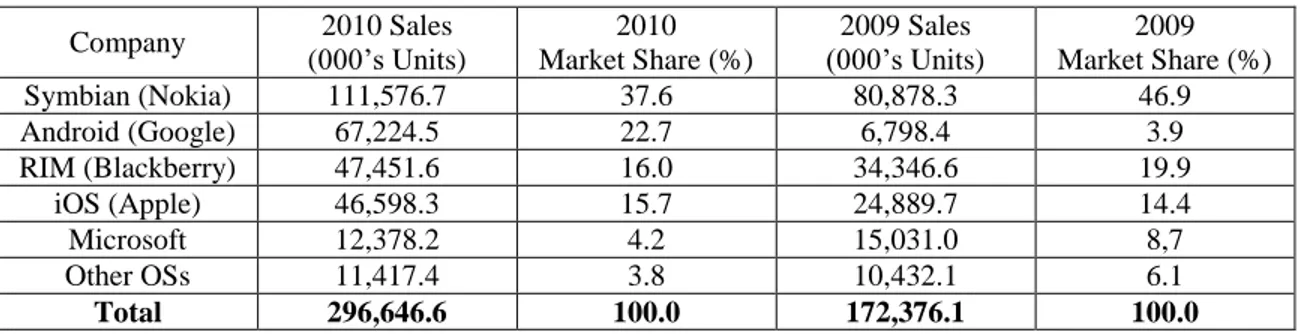
(30) 20. exercise strategies in the McDonald and Siegel (1986) model vary when there are two firms competing for it and their investment costs are unknown to their counterparts. Grenadier (2002) studies a repeated game of capacity expansion in a symmetrical NashCournot framework of n firms, reaching the conclusion that a greater amount of competition erodes the option value of waiting to expand until prices improve. Aguerrevere (2003) relaxes the constant returns to scale assumption in Grenadier’s model, reaching that the aggregate price process is mean-reverting, even though the stochastic demand shock follows a Geometric Brownian Motion (from hereafter, GBM) process. Novy-Marx (2007), on the other hand, relaxes the assumption that firms are symmetric, reaching the notable conclusion that the option value is not necessarily a decreasing function in the number of firms. Aguerrevere (2009) uses Grenadier’s Cournot model to plausibly explain the asset returns of firms, which depend on the commodity price and the firm’s expansion options and assets-in-place. Finally, even though this list goes on, it is important to note that this article is not a survey; to this end, the reviews of Azevedo and Paxson (2010) and Chevalier-Roignant et al. (2010) provide an excellent summary of the current state of the Option Games’ literature. 2.1.Do waiting options in differentiated markets exist? In spite of the improvements in the Option Games’ literature in the last 10 years, the surveys mentioned above illustrate that all these games depict a world where the firms’ payoff functions are either exogenous or determined by a downward sloping demand curve, weighed by a factor that follows a continuous-time stochastic process. Although this framework has the advantage of reaching elegant solutions for homogeneous products in a dynamic setting, it fails to capture the intuition in markets where differentiation is present, because the strategic interaction between firms is modeled using capacity instead of other variables, such as the price of each firm’s product. This leads the price to clear out afterwards, as a result of the firms’ decisions, instead of being part of a firm’s strategy per se. This is a clear limitation of the Option.
(31) 21. Games literature up to this point, because there are many markets where firms can influence their payoffs through pricing policies.11 This does not mean that there have not been attempts to extend the Option Games literature to model strategic interaction in frameworks other than Grenadier’s Nash-Cournot equilibrium. Boyer et al. (2004) model a Bertrand duopoly where both firms compete for a fixed mass of consumers whose willingness to pay for a certain product varies in time according to a GBM process. Pawlina and Kort (2010), on the other hand, consider a differentiated market where two firms must select qualities to determine their revenues (that follows a GBM process as well), taking into account that network externalities affect the distribution of this cash flow among the firms. When revising the resolution of both models, these can be seen as an extension to Lambrecht and Perraudin (2003), where firms can now invest for a total or a partial amount of a cash flow stream that varies in time according to a GBM process. Hence, the underlying logic of Option Games’ theory does not essentially change. And, what is even more important, both models are unrealistic from an Industrial Organization (from hereafter, IO) perspective:12 Boyer et al. (2004) assume that the firms are capable of extracting the entire consumer surplus under Bertrand competition, while Pawlina and Kort (2010) assume that a customer’s payment grows in time following a GBM process while the utility they get from the product remains constant. Taking this into account, this article is a first attempt to successfully narrow the gap between the Option Games literature with markets where price (and not capacity) is the strategic variable at hand. To this end, an iconic model of differentiated markets in IO is used: Hotelling’s linear city (1929). Lambertini’s (1994) original setting is used, where a location-then-price duopoly game with quadratic transport costs takes place and. 11. When referring to pricing policies, this articles is restricted to the case where firms cannot discriminate consumers according to their willingness to pay, and therefore must charge the same price to all buyers. 12 Jean Tirole (1988) says that “to study industrial organization is to study the functioning of markets” (p. 1). Hence, this branch of economics is per se the most appropriate one for analyzing differentiated markets. See Tirole (1988) for an excellent introduction to IO. Eaton and Lipsey (1989) is an excellent survey on product differentiation, while Anderson et al. (1992) establish the link between product differentiation models and Discrete Choice Theory..
(32) 22. firms have the freedom to locate themselves anywhere on the real axis.13 However, there is uncertainty regarding the city’s position in the location stage, and here firms have the option to wait until the city’s exact position becomes known. Hence, a tradeoff arises between waiting to know where the market is and gaining a first mover advantage, which is known to exist in this type of models ever since Tabuchi and Thisse (1995). Using this adapted model that incorporates uncertainty, the objective of this article is to analyze the entry pattern that emerges as a SPNE: either both firms enter before the uncertainty is resolved, after it is resolved or sequential entry occurs. The method for determining the endogenous entry pattern is done in the same fashion as Lambertini (1997), which analyzed the endogenous location and price patterns for the city in the [0,1] segment. Related to this point, as a byproduct of the procedure to calculate the entry pattern that arises as a SPNE, the option value of waiting to know the location of the city’s customers is calculated to see if these opportunities really exist under the context of product differentiation. This result is important, because a secondary objective of this article is to compare the value of the waiting option to other benchmarks. First, the product differentiation model is adapted to represent Cournot competition. Doing this allows to establish a comparable link between the model analyzed here with the traditional results of the Option Games literature, since this model is not done in a continuous time framework. Secondly, the price setting stage of the model is removed to see the role prices play in the entry pattern that arises as a SPNE. This configuration without a price setting stage can be seen as introducing uncertainty into Down’s model (1957) of political competition. And, as a third objective, this article attempts to use the model developed here to plausibly explain the occurrences of a real market that does not fit the assumptions used in the Option Games literature up to date. The smartphone industry is a contemporary example, since this type of phone has a series of differentiating features that make each 13. Hotelling’s original game considered linear costs. However, D’Aspremont et al. (1979) realized that no NE in positions exists when firms are near each other and modified the game by using quadratic transport costs, ensuring a unique NE in positions..
(33) 23. of them different from its competitors, giving producers pricing power over their products. This market is currently a flourishing one, with total sales increasing over 70% in the year 2010, as seen in Table 2-1:. Table 2-1: Worldwide smartphone sales to end users by operating system (OS) in 2010 Source: Pettey and Goasduff (2011) Company Symbian (Nokia) Android (Google) RIM (Blackberry) iOS (Apple) Microsoft Other OSs Total. 2010 Sales (000’s Units) 111,576.7 67,224.5 47,451.6 46,598.3 12,378.2 11,417.4 296,646.6. 2010 Market Share (%) 37.6 22.7 16.0 15.7 4.2 3.8 100.0. 2009 Sales (000’s Units) 80,878.3 6,798.4 34,346.6 24,889.7 15,031.0 10,432.1 172,376.1. 2009 Market Share (%) 46.9 3.9 19.9 14.4 8,7 6.1 100.0. From this table, it is possible to see that not all operating systems (from hereafter, OS) were able to capture the same proportion of this new critical mass of smartphone users. Table 2-2 estimates the market shares of each OS considering the new mass of customers:14. Table 2-2: Worldwide smartphone additional sales in 2010 by operating system (OS) Source: Based on Pettey and Goasduff (2011) Company Symbian (Nokia) Android (Google) RIM (Blackberry) iOS (Apple) Microsoft Other OSs Total. 14. 2010 Additional Sales (000’s Units) 30,698.4 60,426.1 13,105.0 21,708.6 -2,652.8 985.3 124,270.6. 2010 Additional Sales (%) 24.7 48.6 10.5 17.5 -2.1 0.8 100.0. For calculating this result, the additional customers were calculated by simply subtracting 2010 sales with respect to 2009 sales. The market share was subsequently calculated by dividing these differences by total additional sales worldwide in 2010 (124,270,600 smartphones)..
(34) 24. This comes to show that the new customers are not divided equally among the firms, violating the Option Games’ usual assumption that firms are symmetrical. Added to this, it is interesting to see that Google’s OS, which is relatively new to the market, captured nearly half of the new mass of consumers. Hence, it is not true either that the new customers are divided proportionally among the existing firms’ market share. Could this be due to the fact that Google’s OS Android was a late follower that was capable to adapt better in this differentiated market under uncertainty? These facts are to be explained in Section 2.4. The rest of this article is structured as follows: Section 2.2 presents the option game model based on Hotelling’s linear city with uncertainty in the city’s location and how this model is solved; Section 2.3 presents and solves the benchmark models of Cournot competition and product differentiation without price competition; Section 2.4 analyzes and compares the results found in the previous chapters; finally, Section 2.5 presents the most relevant findings of this paper and where future research must aim to continue closing the gap between product differentiation and the Option Games literature. 2.2.The model 2.2.1. Game structure Regarding demand, the city is made up by a mass of price-taking consumers that are distributed uniformly over a linear city (represented by an interval on the real axis). This city is of fixed length (normalized at 1) that begins at k (which is greater than or equal to zero). Each consumer demands a unit of a differentiated good they value at , which is assumed to be high enough so that the market is covered (i.e. all consumers purchase a unit of the good). Regarding supply, there are two firms that select a location (also referred to as position or product type) on the real axis to satisfy demand. In this sense, both duopolists are not restricted to choose positions inside the linear city, emulating Lambertini (1994), because there is uncertainty regarding the city’s position from their perspective..
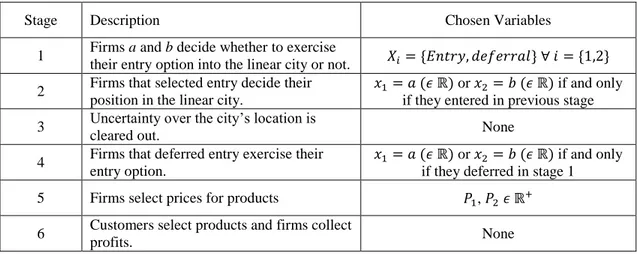
(35) 25. Additionally, besides the choice of location, this model also gives each firm the option to wait until this uncertainty is cleared out before positioning themselves on the real axis. This is the key difference between this article with past papers in the product differentiation literature that incorporate uncertainty in Hotelling’s linear city: while this paper assumes that there is a trade-off between a first-mover advantage and waiting to reduce the city’s uncertainty; the other papers up to date have compared the degree of differentiation between both duopolists with and without uncertainty in the city’s position. Nevertheless, it can be anticipated that the insight given by this line of literature is present when determining the entry pattern that rises as a SPNE for the model, as will be seen in Subsection 2.2.3. Related to the exercise of the entry option, it is important to mention that both firms do not have investment costs when choosing a location neither production costs when satisfying demand. However, firms do face an irreversible cost regarding the sacrificed earnings by choosing a position in the product space ex-ante that ends up being far away from the linear city once its position becomes known to both players, so the option to wait can be valuable. Afterwards, once both firms choose positions, they compete simultaneously in prices. Here, both firms can use their pricing strategy to take advantage or compensate their location decision in the previous stages, leading their payoffs to become a nonlinear function of both location (related to the option exercise strategy) and price (which is decided ex-post once both firms have entered). Therefore, this game has a non-trivial solution regarding the timing of entry for both firms into the product space. Once both firms price their products, each consumer in the linear city selects the product that maximizes their utility. For consumer i, located at selecting product j, located at. , the utility achieved by. , is given by:. (3).
(36) 26. Here,. is a constant that represents the disutility caused by quadratic transport costs. between the buyer and seller. For simplicity, this value is normalized to 1. To summarize the structure of this option game together with the strategy space available to both duopolists, Table 2-3 shows each of the stages in their chronological order. Seeing this table, it is clear that this model is more closely related to the IO literature because, unlike other option games, there is only one period where firms compete for consumers (stage 6), which is separated from the periods where the firms must exercise their entry options (stages 1-4). Finally, the price setting period (stage 5) is decided after the firm’s locations are picked, reflecting the difference between long term competition versus short term competition, an aspect which has been ignored up to date in the Option Games literature. Table 2-3: Summary of the Entry Option Game into Hotelling’s Linear City under Uncertainty Stage 1 2 3 4. Description. Chosen Variables. Firms a and b decide whether to exercise their entry option into the linear city or not. Firms that selected entry decide their position in the linear city. Uncertainty over the city’s location is cleared out. Firms that deferred entry exercise their entry option.. 5. Firms select prices for products. 6. Customers select products and firms collect profits.. or if and only if they entered in previous stage None or if and only if they deferred in stage 1 , None. Up to now, the uncertainty in the city’s location has been mentioned rather ambiguously. To clarify how this uncertainty, known hereafter as locational uncertainty, is modeled, the city’s position on the real axis is given by the interval. , where. is an uncertain variable that follows a Bernoulli distribution: the city can begin either at 0, occupying the [0,1] segment, with probability segment, with probability. or at. , occupying the. . It is important to note that, due to the.
(37) 27. uncertainty’s symmetry, the valid range for for. lies in. ,15 while the possible values. are determined in such a way that vertical differentiation is not possible.16 This. uncertainty emulates the uncertainty seen in previous articles in the product differentiation literature, such as Casado-Izaga (2000) and Meagher and Zauner (2004). However, the Bernoulli distribution was used in this case because the relationship between p and. is easy to manipulate achieving any expected value for the city’s. location, while keeping the model traceable enough to reach closed mathematical expressions. 2.2.2. Game resolution As in all games with a finite number of stages, the appropriate method for solving this model implies using backward induction. To make the results derived in this paper comparable to others in the product differentiation literature, Hotelling’s original convention is used, where firms 1 and 2 select positions a and b, respectively. Position a is measured from the point. on the real axis towards the right; position b, on the. other hand, is measured from the point. towards the left.. In the final stage, assuming that firms have already chosen positions and prices, and the city’s characteristics – symbolized by the vector. –has been revealed,17 it is. possible to calculate each firm’s profits by determining the city’s indifferent customer positioned at. , which would gain the same utility buying from either firm. This. stage is straightforward and can be seen in references such as D’Aspremont et al. (1979) or Tirole (1988).. 15. This due to the fact that for values of between , the same phenomenon can be reproduced by simply changing the point of reference to and reversing the axis’ direction. 16 In the IO literature, this implies that “all consumers agree over the most preferred mix of characteristics and, more generally, over the preference ordering” (Tirole, 1988, p. 96). Therefore, this model avoids the case where a firm can capture the entire market. 17 Although this article introduces uncertainty only in the city’s location, other attributes such as the city’s length or density can also act as random variables. Hence, a general vector is used to represent this general case, which is part of the subspace of all feasible combinations of city attributes..
(38) 28. For choosing prices both firms, knowing their competitor’s position (a and b) and the city’s characteristics (. , select a price that maximizes their profits, giving its. competitor no incentive to change its price unilaterally. This system of equations can be expressed as follows:. (4). Solving this system of equations, prices will be a function of the city’s characteristics and the firms’ positions. and .. Afterwards, when firms choose positions, this will depend on the entry pattern at hand: either both firms enter after the uncertainty is resolved, before the uncertainty is resolved or if sequential entry occurs. The first case, where both wait until the uncertainty is cleared, has both firms maximizing their profits for a city with known characteristics. , giving their competitor. no incentive to change unilaterally their position. The system of equations is given by:. (5). For the second case, where both firms enter immediately, it is assumed that both firms will maximize their expected profits considering all possible outcomes of together with their probability of occurrence seen as:. . The NE problem for this stage can be.
(39) 29. (6). For the third case, when sequential entry occurs, it is assumed (without a loss in generality) that firm 2 enters after firm 1. Hence, the follower maximizes its profits already knowing where the city is and the leader’s location, as shown:. (7). The leader, on the other hand, must maximize its expected profits considering all possible outcomes for the city’s characteristics occurrence. together with their probability of. and the fact that its position influences the follower’s location. .. (8). Finally, once the optimal positions are determined for each of these scenarios, it is possible to construct a 2x2 matrix with the payoff functions in equilibrium for both players considering all the possible combinations of the firms’ decisions of entering before or after the city’s characteristics are revealed, in the same fashion as Lambertini (1997), which sought to determine the endogenous order of entry under a deterministic setting..
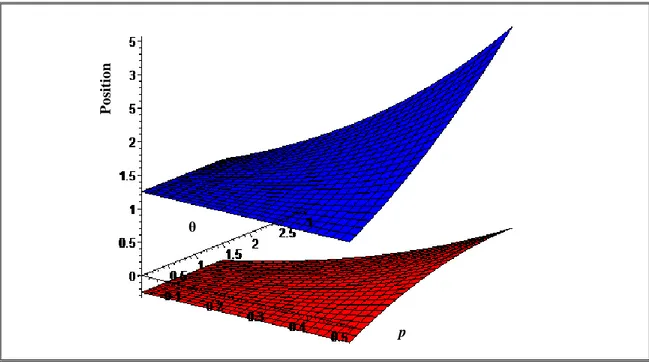
(40) 30. 2.2.3. Solution under locational uncertainty Following the game resolution process described por encima de, the vector of city characteristics is reduced to the city’s location ( restricted to two positions as seen in subsection 2.2.1 ( probabilities of occurrence (. and. ) with all possible outcomes ) with their respective ). To derive the entry pattern. that rises as a SPNE, the optimal positions and prices of both firms are determined for all possible entry patterns. Afterwards, the value functions evaluated at these positions and prices are compared using Lambertini’s 2x2 matrix to determine which pattern rises as a SPNE. However, considering that both the probability of displacement displacement factor. and the. are parameterized, it is possible to vary these variables to achieve. different “amounts” of uncertainty in the city’s location. Hence, the entry pattern that rises as a SPNE is clearly a function of these variables and results in a 2x2 matrix for each combination of. and .18 To determine the SPNE for all valid. pairs, the. value function of preempting and waiting is found for each pair assuming that its competitor either preempts or waits for the city’s location to be revealed. This determines the reaction function for the firm. The same process is then done for the other firm and the intersection of these reaction functions gives the SPNE for all pairs. Before determining the position equilibriums that arise for each entry pattern, the price selection stage must be solved. This stage is common to all entry patterns, because the location of the city’s consumers is already known to both firms. Here, prices are determined simultaneously from the following equation system, considering a general city location parameterized at :. 18. This problem is the general case of Lambertini (1997), since this reference only analyzes the lines and in the space, which is the case without locational uncertainty..
(41) 31. (9). Where x is the indifferent consumer, which is a function solely of both firms’ strategic variables. Proposition 1 determines the equilibrium in prices for this type of uncertainty.. Proposition 1: The equilibrium prices that arise under locational uncertainty are given by:. (10). Proof: Formulating the maximization problem for the firms’ profits in equation (4), under this type of uncertainty, leads to the system in (9). Solving this system of first order conditions leads to this solution, which satisfies the second order conditions that ensure that this equilibrium maximizes the profits of both firms. Q.E.D.. As said before, these prices arise after both firms choose locations and, therefore, are consistent for all entry patterns seen under locational uncertainty and are not dependent on the probability of displacement , but are a function of the firms’ and the city’s locations. Once prices are determined, the NE in positions for each entry pattern can be calculated. First, for simultaneous entry after the city’s location is known (a SPNE known hereafter as mutual waiting), the NE in positions that arises is the traditional result seen in Lambertini (1994), where firms 1 and 2 locate themselves at and. , respectively. Since the degree of differentiation between both firms is.
(42) 32. not a function of the city’s position ex-post, both players gain the known profit of . Hence, the upside a firm can gain by waiting when their competitor also waits is limited. Secondly, assuming that both firms’ locations are to be determined simultaneously before the city’s location is revealed (a SPNE known hereafter as mutual preemption) leads firms to maximize expected profits, as shown:. (11). Solving this system, the positions of firms 1 and 2 are a non-linear function of both the probability. that the city shifts from its initial point 0 and the distance. of this. shift, as seen in Proposition 2. However, to understand the intuition behind the results seen in this section, these will be expressed in terms of the uncertain variable’s mean (. ) and variance (. ).. Proposition 2: The equilibrium locations that arise when both firms enter before the city’s locational uncertainty is cleared are defined by:. (12). Proof: Formulating the maximization problem for the firms’ expected profits, seen in equation (6), leads to the system in (11). Solving this system of first order conditions.
(43) 33. leads to this solution, which satisfies the second order conditions that ensure that this equilibrium maximizes the expected profits of both firms. Q.E.D.. These positions can be seen graphically as follows for all relevant. pairs,19. where the convention is that firm 1 (position a) is in red and firm 2 (position b) is in. Position. blue:. θ. p. Figure 2-1: Firms’ positions under simultaneous entry before solving locational uncertainty. Here, considering that the range for be at. leads the city’s most probable location to. causes firm 1 to avoid moving from the [0,1] segment, which is related to. the fact that the city’s mean and variance act as opposing forces in determining firm 1’s position. On the other hand, firm 2’s position grows in a non-linear manner, which is related to the fact that the city’s mean and variance both act as a differentiating force in. 19. It can be shown that, for prices to remain positive and/or to avoid vertical differentiation,. must be true (assuming that. )..
Figure
+7
Documento similar
In this model the nuclear technology has been considered as generation option in several scenarios of costs of the fossil fuels, coal and natural gas.. Also, two
The growth of global markets for finance and specialized services, the need for transnational servicing networks due to sharp increases in international investment, the reduced
Then, § 3.2 deals with the linear and nonlinear size structured models for cell division presented in [13] and in [20, Chapter 4], as well as with the size structured model
The purpose of this study was to analyze the current situation of the shopping tourism in Barcelona by examining how the city is promoting the product of
The Dwellers in the Garden of Allah 109... The Dwellers in the Garden of Allah
This paper is organized as follows: in Section 2, the relationship of intuitionist fuzzy numbers with image processing is described; in Section 3, the
We also examined whether the questionnaire included additional information explaining how a family meal was defined (number of diners, the location (home, away
The structure of the paper is as follows: Section 2 presents the vehicle modeling and the combination method for kinematic and dynamic models; Section 3 defines the proposed
