
Building adaptive capacity to climate change in tropical coastal communities
7
0
0
Texto completo
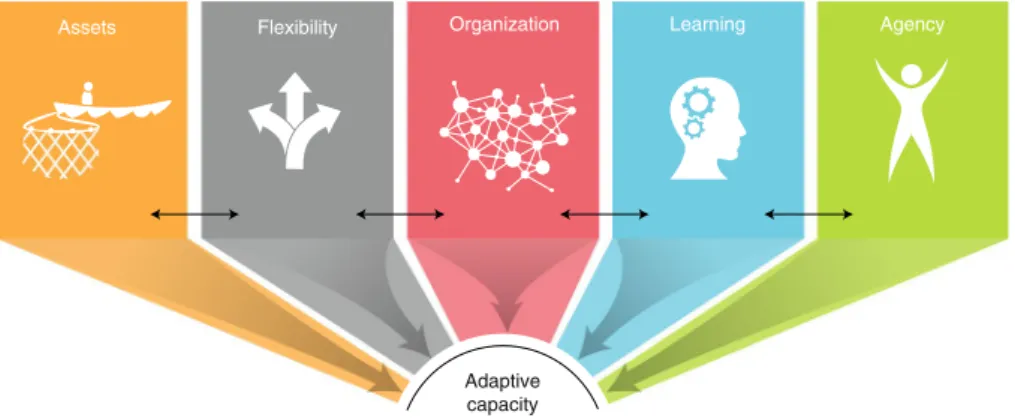
(2) Perspective. NaTure ClimaTe CHange Assets. Flexibility. Organization. Learning. Agency. Adaptive capacity. Fig. 1 | Five domains of adaptive capacity to climate change: assets, flexibility, social organization, learning, and agency. The five domains are interlinked; feedbacks and interactions can occur among any of the domains, not just the neighbouring ones graphically represented by connecting arrows.. affordable capital, credit, and insurance22–24. Some coastal residents also benefit from social investments (for example, healthcare) that help to prevent a decline of existing assets (for example, household assets critical to sustaining livelihoods)22,24. For example, malaria is a cause of morbidity and mortality in many tropical coastal areas, and households affected by death or illness of household members may find their attempts to secure their livelihoods thwarted by having to meet the costs of recurrent illnesses, often having to sell productive assets (land, livestock, and fishing gear) to cope. This then erodes their capacity to adapt to future shocks and adverse trends23. Interventions to address malaria (for example, by improving availability of insecticide-treated bed-nets, or improving availability of anti-malarial drugs and emergency care), could therefore help such households escape these poverty traps22 and build the household assets that could, in the long term, help them adapt to a changing climate. This illustrates the complex and multi-scale interactions between planned and autonomous adaptive action to multiple stressors. Attempts to build or secure assets can focus on individuals (for example, providing micro-credit loans) or community-scale public goods (such as infrastructure or information dissemination). However, investments in public goods may fail to reach the most vulnerable if certain social mechanisms (such as caste systems, gender inequality, and so on) prevent some people from accessing the benefits13,25,26. In these situations, attempts to build adaptive capacity can strongly differentiate society, and it is critical to be aware of the power asymmetries and political dimensions that underpin the potential impacts of intervention. Although it is often assumed that the wealthy are better able to adapt to change than the poor18,27, building assets that enhance people’s ability to exploit natural resources may actually increase the vulnerability of coastal communities to climate change by undermining the long-term sustainability of coastal ecosystems. This represents both temporal and social trade-offs inherent in adaptation strategies, which must be heeded when designing interventions to enhance adaptive capacity. For example, in Tanzania, fishers who were more likely to intensify fishing effort in response to lower catches (thereby increasing exploitation) were those who had assets, but lacked flexibility to change livelihood strategies28. Wealthier fishers were thus more likely to catalyse a ‘social–ecological trap’, whereby lower yields increased fishing exploitation, which in turn further decreased yields28. Likewise, investments in basic infrastructure such as roads may increase people’s assets by improving market accessibility, while serving as a catalyst for other types of development (for example, access to education, healthcare and markets)29 that can provide greater flexibility and agency to manage climate shocks30. However, access to markets is also a key driver of 118. overexploitation31 and habitat destruction32, and may increase social–ecological vulnerability20.. Flexibility. The flexibility domain of adaptive capacity reflects opportunities for switching between adaptation strategies and captures the diversity of potential adaptation options available. Organizations and individuals with more flexibility are better able to adapt to climatic impacts. In coastal communities reliant on natural resources, flexibility within people’s current occupations (for example, fishing or marine-based tourism) can enable them to minimize losses or even take advantage of climate-related changes, such as shifting species abundance, species range1,20, or habitat destruction. Flexibility allows people to change fishing strategies and the location of fishing grounds and tourism operations. For example, fishers in Peru were able to rapidly change from gill and seine nets aboard their fishing boats to trawl nets in response to an abundance of shrimp that appeared with the extreme marine heat wave associated with the 1997–1998 El Niño23. Flexibility also entails the capacity to shift into different occupational sectors (for example, agriculture and non-natural resource-based enterprises), either temporarily or permanently, in response to climate change impacts (for example, reductions in fisheries yields or eco-tourism revenue). At a larger scale, the flexibility of organizations and institutions (that is, both formal and informal rules and norms) to adjust rules, boundaries, partners, and membership helps to manage shocks and perturbations associated with climate change23,33,34. For example, in coastal cities in Queensland, Australia, local governments have implemented policies to facilitate the re-building of housing and infrastructure at higher levels after flooding34. Building flexibility in tropical coastal communities will require a number of strategies. At a large scale, organizations and institutions can build flexibility through processes of ongoing monitoring and review, with regular formal revision. At the individual scale, removing social and legal barriers that can constrain key adaptation actions, such as switching to new fishing gears35, could foster flexibility. Building the flexibility to change the location of fishing grounds or tourism operations will not only require the removal of barriers to fishing in different locations, but will also require developing ecological knowledge about new places36, and the capacity to reach them (that is, potentially larger boats). Efforts to build the flexibility to shift occupations primarily focuses on developing alternative income or subsistence livelihoods that are often implemented in conjunction with interventions to reduce poverty37. For example, in North Sulawesi, Indonesia, the introduction of seaweed farming as an alternative to fishing improved villagers’ material assets38.. Nature Climate Change | VOL 8 | FEBRUARY 2018 | 117–123 | www.nature.com/natureclimatechange. © 2018 Macmillan Publishers Limited, part of Springer Nature. All rights reserved..
(3) Perspective. NaTure ClimaTe CHange There are often interactions between flexibility and other domains of adaptive capacity that potentially create other adaptation tradeoffs. For example, as coastal communities become wealthier (that is, have more assets), they often exhibit lower livelihood flexibility39. As with the building of assets, the building of flexibility also has potential ecological consequences. For instance, since different fishing gear selectively targets different sizes and species of fish, there can be ecological consequences of adopting fishing gear that preferentially targets specific species, for example, those that play a critical role in the maintenance and recovery of coral reef ecosystems40. In addition, increasing people’s spatial flexibility to adapt to climate change may have negative ecological consequences (such as boom and bust episodes for high-demand fish species)41. Increased mobility may also be at odds with property-rights-based fisheries management or marine spatial planning initiatives that aim to promote sustainability and reduce conflict by defining and limiting where certain activities can occur42. Specifically, fisheries management strategies such as Territorial Use Rights for Fishers (TURFs) that define and limit entry into fishing grounds may limit other aspects of flexibility, such as the ability of fishers to move their fishing activities along the coast42. Diversification of livelihood activities can also create unintended ecological consequences. For example, investments in alternative livelihoods in aquaculture lead directly to pollution loading and contribute to salinity intrusion, thereby disrupting ecosystem services and the wellbeing of others43,44. There are a number of challenges to building flexibility. Alternative livelihood projects often fail for social and cultural reasons45. For example, the extent that fishers create a sense of themselves around their occupation (occupational identity) or their place of residence (place attachment) can limit whether they are able to re-imagine themselves in other roles or places if the need to change arises46,47. Additionally, diversification is not always an option for households that are trapped in deep poverty because there can be insurmountable costs and risks associated with trying something new24,48. In these cases, building the flexibility component of adaptive capacity requires that costs and risks are buffered with provision of skills and access to capital49,50.. Social organization. Social organization is the domain of adaptive capacity that captures the ways in which society is organized to enable (or inhibit) cooperation, collective action, and knowledge sharing16,51. Formal and informal relationships between individuals, communities, and organizations can help people deal with change by providing social support and access to knowledge and resources16. Critically, social organization is by nature multi-scale, containing individual, collective, and organizational dimensions16. For example, preparing for or recovering from high-intensity storms often requires individual people to help one another and state agencies to coordinate shortterm recovery and long-term resilience strategies52. Likewise, networks that promote information exchange and cooperation can help communities adapt to changes such as increasingly variable fish catch or weather patterns53. Trust and social cohesion within communities (referred to as bonding social capital) can play a key role in whether or not people will support each other in times of crisis, or agree on coordinated action to confront climate-induced threats54. Governments, development agencies, and civil society organizations can build bonding social capital by creating opportunities for sustained interaction among groups through community events, recreational activities, and spiritual gatherings55. Building connections across communities (bridging social capital), and to people or organizations operating at larger scales, (for example, international NGOs and financial organizations; linking social capital) can help to secure access to resources, scientific information, and technological innovations that facilitate adaptation56. For example, when climate change impacts. are so severe that people must change livelihoods, bridging connections can provide crucial information about new job opportunities57. Likewise, linking social capital can provide access to novel sources of information and resources, and give people a voice in adaptation planning and policy occurring at higher levels54. Bridging and linking social capital can be fostered by creating shared values and interpretation of experience through dialogue and engagement, through reducing disparities in income and wealth, and by enabling a sense of involvement in working towards collective goals58. Such efforts can include developing or strengthening institutions for collective action, such as co-management59,60. Indeed, collaborative management processes have been shown to improve adaptive capacity by strengthening links among people responsible for disaster planning in Trinidad and Tobago61, and among fishers in Chile62. Bonding, bridging, and linking social capital facilitate different types of adaptation. For example, strong bonding ties can be crucial for survival in the face of extreme natural disasters and conflict63, while bridging and linking ties can help national and regional adaptation policies to reflect the goals and objectives of local communities. Robust adaptive capacity depends on having a balance of different types of social capital, where having too much of one type can actually inhibit adaptation. For example, strong cohesive groups can become locked into a particular way of thinking that prevents learning about change or adaptation options64. Likewise, when only local elites have bridging and linking connections, the wider community may lack access to the assets needed to effectively respond to change17. Consequently, efforts to build social capital need to consider whether and how different types of social capital are available to people, and how social organization interacts with the other components of adaptive capacity. Empirical examples of building the social organization dimension of adaptive capacity are limited, but emerging evidence suggests that practical efforts can include: (1) establishment and strengthening of networks across scales (for example, community, provincial, and national)65; (2) community currency, or time banking systems, where individuals are incentivized to volunteer66 — this not only creates novel connections in the community, but can also result in material and mental health benefits among participants67; and (3) creation of interaction arenas where people can work together towards shared goals, build trust, and develop social cohesion67. Such arenas occur through community meetings and the facilitation of other social events, as well as through town and community planning that creates physical interaction spaces.. Learning. Learning reflects people’s capacity to generate, absorb, and process new information about climate change, adaptation options, and ways to live with, and manage, uncertainty23,33,68. Learning can be experimental or experiential, and occurs within and across multiple organizational, spatial, and temporal scales69. For example, in response to climate change, fishers will have to learn about new fishing grounds, gears, weather patterns, technologies, species, and in some cases, new ways of making a living. Building the learning domain of adaptive capacity to climate change will require supporting processes that enable people to frame or reframe problems by recognizing change, attributing this change to its causes, and assessing potential responses18,70. This may involve supporting formal education71, as well as informal forums for learning. Provision of access to critical information, such as market prices and weather forecasts, is central to building the learning domain of adaptive capacity in coastal communities. For example, early warning systems can help fishers assess potential risks, reduce lost or unproductive fishing days, and ultimately reduce deaths23. Likewise, seasonal forecasts can help coastal farmers to choose crops with the best yields under new climatic conditions7, and future rainfall. Nature Climate Change | VOL 8 | FEBRUARY 2018 | 117–123 | www.nature.com/natureclimatechange. © 2018 Macmillan Publishers Limited, part of Springer Nature. All rights reserved.. 119.
(4) Perspective. NaTure ClimaTe CHange. projections can help local governments manage areas vulnerable to flooding34. Learning to adapt to climate change also requires investment in peer-to-peer networks (also referred to as communities of practice)72 that allow people to share experiences of ecological surprise from other locations and other knowledge systems (for example, expert, local, and indigenous). Such peer-to-peer networks have not only facilitated learning, but also empowered people to develop novel adaptation strategies73. For example, the Locally Managed Marine Areas network connects and shares experiences among coastal communities across the Indo-Pacific, blending scientific and local ecological knowledge systems to implement a range of community-based fisheries management strategies74. Learning may emerge in a locally generated or self-organized form triggered by crisis, or because of an active adaptive co-management strategy. Learning provides depth in understanding and occurs across timescales, where instrumental single-loop learning occurs within short-to-medium periods, and deeper double-loop learning occurs over longer time scales. Instrumental single-loop learning only informs and changes the most immediate technical operations (for example, turning on the air conditioner in a heatwave), while deeper double-loop learning may change governance procedures at the organizational level (for example, local green infrastructure planning), and even overarching values and norms at the policy and paradigmatic levels (for example, reduction of carbon emissions at a societal level)75. Both single and double-loop learning are challenging to orchestrate as they tightly couple with other domains of adaptive capacity, and building this domain can have knock-on effects. For example, supporting formal education opportunities can indirectly reduce poverty and improve health71. Yet, learning may only enable adaptation when other domains of adaptive capacity, such as agency, flexibility, and social organization, are sufficiently developed.. Agency. Effective adaptation to environmental change not only requires that people have assets, flexibility, learning, and social organization, but also that they have the power and freedom to mobilize these components of adaptive capacity to actively shape their future. Agency, our fifth domain of adaptive capacity, generally refers to the ability of people — individually or collectively — to have free choice in responding to environmental change11,12. It is dependent upon people’s belief in their own ability to perform and manage prospective situations and control events that affect them, encompassing aspects of empowerment, motivation, and cognition14,76. Agency plays a pivotal role in activating the other domains of adaptive capacity. For example, the availability, access to, and interpretation of information about the impacts of climate change on fisheries (which are key aspects of learning) are insufficient to enact adaption unless fishers are willing or able to use this information to support the adaptation process77. People have little incentive to adapt unless they believe that their actions can produce desired outcomes or forestall undesired ones78. As such, agency is the basis for creating visions of alternative futures when large-scale changes are necessary. For example, fishers in Chile have created a new alternative vision for biodiversity conservation in which they have conservation rights within TURFs79. However, agency can also be the source of resistance and opposition to adaptation efforts, particularly when it encroaches upon key cultural values such as place attachment and occupational identity80. Building agency for adaptive capacity to climate change involves three key types of actions. (1) Incorporating local or customary knowledge, skills, and management into both science and policy36,81. For example, climatologists and communities have used indigenous knowledge to develop climate history and baseline data, to formulate research questions and develop locally acceptable climate adaptations81. (2) Empowering people through participatory 120. processes such as adaptive co-management33,82. For example, in the Philippines, people became actively involved in climate adaptation because decentralization devolved management authority to the municipality level83. Finally, (3) removing barriers that may inhibit people’s ability to exercise agency14,15. For example, reduction of regulatory and economic barriers that restrict small-scale water storage has been associated with increased household agency over water security in small island developing states84.. Frontiers in building adaptive capacity to climate change. Scientific frontiers for the building of adaptive capacity relate to trade-offs between the different domains of capacity, issues of justice and distribution, and management of complex feedbacks. First, where are the important trade-offs in adaptive capacity, and where are investments likely to have greatest benefits? Current models and concepts of adaptive capacity do not resolve critical issues of optimal investment across the different domains of adaptive capacity to influence adaptation. They also fail to determine how investments in adaptive capacity may differ by type, for example, investment in adaptation to long-term environmental stresses from climatic changes will differ considerably to investment in adaptation to short-term weather-related shocks. Future research should address these issues through resolving two dimensions: the substitutability of elements of adaptive capacity and the existence of trade-offs, for example through inadvertently reducing one domain of adaptive capacity through investing in others. The examples reviewed here suggest that there is limited substitutability between domains of adaptive capacity with respect to shocks and long-term change: investment in assets does not provide the same capacity to adapt as increasing social and individual learning or managing risk. The concept of limited substitution means that adaptive capacity may be restricted by the weakest of its underlying determinants — the so-called weakest link hypothesis85,86. However, the weakest link idea has not been tested, and would require longitudinal and control studies to assess such trade-off effects87. A further question for trade-off analysis is whether building specific domains of adaptive capacity may actually crowd out or undermine other domains. For example, collective action and civic volunteerism can be crowded out by the provision of certain types of government services (that is, building assets)58. Measuring and monitoring the effectiveness of different types of adaptive-capacity-building programs will be critical to informing these debates88, where a portfolio approach that builds capacity across domains would minimize the risks of significant trade-offs. A second critical frontier is the intersection between social justice and the building of adaptive capacity. Better understanding of how social justice affects and is affected by efforts to build adaptive capacity will be crucial to avoiding unintended and even perverse outcomes. For example, rebuilding community-scale infrastructure after a disaster most often exacerbates existing inequalities — making already vulnerable people even more vulnerable and undermining their capacity to adapt in the future. Yet rebuilding infrastructure offers opportunities for progressive planning that redresses past injustices68,89,90. Likewise, building aspects of adaptive capacity through removing social and cultural institutions that form barriers to adaptation (for example, customary taboos that restrict where and when people can fish) often has the perverse effect of undermining culturally important beliefs and practices that help to form a basis for agency91. The issue of social justice and adaptation is particularly relevant because of the politics that drive how adaptation and recovery efforts and investments are targeted towards specific populations, places, and capacities. The differential response of US hurricane relief in Texas and Puerto Rico in 2017 highlights how recovery investments can be driven at least as much by politics as need.. Nature Climate Change | VOL 8 | FEBRUARY 2018 | 117–123 | www.nature.com/natureclimatechange. © 2018 Macmillan Publishers Limited, part of Springer Nature. All rights reserved..
(5) Perspective. NaTure ClimaTe CHange Place attachment and occupational identity are two further examples where building adaptive capacity towards new occupations or living in new regions can isolate or influence resource users and impact on their capacity to adapt over the longer term92. Future research directions include developing insights into where identity and place attachment are important to maintain in order to ensure that system resilience occurs across scales. Communities may need strategies to maintain identity (individual or system identity) or remain in place. Policymakers should guide such interventions according to the principle of leaving no one behind, now embedded in the Sustainable Development Goals. Correspondingly, strategies that are ‘pro-poor’ and focused on sustainable adaptation93 highlight the difficulties associated with reaching the poorest and most vulnerable populations. Often the factors that keep people poor keep them vulnerable, so addressing root causes of poverty in some cases will support adaptive capacity. Efforts to build adaptive capacity will also frequently need to move beyond the local, but at the same time recognize that enhancing capacities of one community may have unintended consequences or undermine capacities at another scale. The third frontier involves better understanding key linkages and feedbacks to inform improved adaptation outcomes33,54. These linkages and feedbacks occur between scales, between domains of adaptive capacity, and between social and ecological dynamics. Larger-scale social dynamics such as demographics and governance may set a social or political context that enables or inhibits adaptation at smaller scales94. Additionally, adaptation actions or capacity building in one location or at one scale may undermine the adaptive capacity of other geographies, people, and scales. These issues may be particularly relevant in tropical coastal areas where high rates of migration, ecological change, and shifting governance of natural resources exacerbate issues of resource control and conflict94,95. Consequently, investigating the multi-scale nature of adaptation and the larger-scale conditions that enable or inhibit local-scale adaptive capacity should be a high-priority research area. Additionally, certain adaptation responses (such as changing fishing strategies) interact with ecological dynamics in ways that affect the flows of ecosystem goods and services, with knock-on impacts for human wellbeing. Scenarios, modelling, and empirical research into threshold relationships96 and feedbacks both between domains of adaptive capacity and between social and ecological systems97,98 will be critical to identifying how to minimize the negative and unintended consequences of building adaptive capacity, and will also help identify where critical trade-offs exist. In the wake of major climate-induced threats to coastal systems such as the global coral-reef bleaching event associated with the 2015–2016 El Niño5, many coastal communities around the world are now adapting to the aftermath of multiple interacting stresses on their coastal environments. The need to build adaptive capacity to help these communities anticipate and deal with these changes will only continue to escalate. To date, ad hoc and localized documentation and monitoring of efforts to build adaptive capacity has rendered it difficult to assess success. Yet parties to the 2015 Paris Agreement underscored the realization that adaptation is no longer just a local issue but “a global challenge faced by all”99. Assessment of past and on-going efforts to build adaptive capacity across the five domains we identify here will be critical to effective adaptation to this global challenge across multiple scales and places. Received: 16 November 2016; Accepted: 15 December 2017; Published online: 29 January 2018. References. 1. Cheung, W. W. L. et al Large-scale redistribution of maximum fisheries catch potential in the global ocean under climate change. Global Change Biol. 16, 24–35 (2010). Models how climate change is likely to impact global fisheries yields, highlighting how many tropical countries will suffer losses.. 2. Sumaila, U. R., Cheung, W. W. L., Lam, V. W. Y., Pauly, D. & Herrick, S. Climate change impacts on the biophysics and economics of world fisheries. Nat. Clim. Change 1, 449–456 (2011). 3. Mora, C. et al. Suitable days for plant growth disappear under projected climate change: Potential human and biotic vulnerability. Plos Biology 13, e1002167 (2015). 4. Nicholls, R. J. & Cazenave, A. Sea-level rise and its impact on coastal zones. Science 328, 1517–1520 (2010). 5. Hughes, T. P. et al. Global warming and recurrent mass bleaching of corals. Nature 543, 373–377 (2017). 6. Adger, W. N. Vulnerability. Global Environ. Change 16, 268–281 (2006). Synthesises current understanding about the concept of vulnerability. 7. Grothmann, T. & Patt, A. Adaptive capacity and human cognition: the process of individual adaptation to climate change. Global Environ. Change 15, 199–213 (2005). 8. Hinkel, J. “Indicators of vulnerability and adaptive capacity”: Towards a clarification of the science–policy interface. Global Environ. Change 21, 198–208 (2011). 9. Smit, B. & Wandel, J. Adaptation, adaptive capacity and vulnerability. Global Environ. Change 16, 282–292 (2006). 10. Yohe, G. & Tol, R. S. J. Indicators for social and economic coping capacity — moving toward a working definition of adaptive capacity. Global Environ. Change 12, 25–40 (2002). 11. Brown, K. & Westaway, E. Agency, capacity, and resilience to environmental change: Lessons from human development, well-being, and disasters. Ann. Rev. Environ. Res. 36, 321–342 (2011). 12. Coulthard, S. Can we be both resilient and well, and what choices do people have? Incorporating agency into the resilience debate from a fisheries perspective. Ecol. Soc. 17, 4 (2012). 13. Sen, A. Development as Freedom (Oxford Paperbacks, Oxford, 2001). 14. Bandura, A. Exercise of human agency through collective efficacy. Current Directions Psychol. Sci. 9, 75–78 (2000). 15. Alkire, S. Subjective quantitative studies of human agency. Soc. Indicators Res. 74, 217–260 (2005). 16. Adger, W. N. Social capital, collective action, and adaptation to climate change. Econ. Geogr. 79, 387–404 (2003). 17. Pelling, M. & High, C. Understanding adaptation: what can social capital offer assessments of adaptive capacity? Global Environ. Change 15, 308–319 (2005). 18. Brooks, N., Adger, W. N. & Kelly, M. The determinants of vulnerability and adaptive capacity at the national level and the implications for adaptation. Global Environ. Change 15, 151–163 (2005). 19. Fenichel, E. P. et al. Wealth reallocation and sustainability under climate change. Nat. Clim. Change 6, 237–244 (2016). 20. Cinner, J. E. et al. Evaluating social and ecological vulnerability of coral reef fisheries to climate change. Plos One 8, e74321 (2013). 21. Pratchett, M. S. et al. Effects of climate-induced coral bleaching on coral-reef fishes — Ecological and economic consequences. Oceanogr. Marine Biol. 46, 251–296 (2008). 22. Adato, M., Carter, M. R. & May, J. Exploring poverty traps and social exclusion in South Africa using qualitative and quantitative data. J. Dev. Stud. 42, 226–247 (2006). 23. Badjeck, M.-C., Allison, E. H., Halls, A. S. & Dulvy, N. K. Impacts of climate variability and change on fishery-based livelihoods. Marine Policy 34, 375–383 (2010). 24. Barrett, C. & Carter, M. Can’t get ahead for falling behind: new directions for development policy to escape poverty and relief traps. Choices 17, 35–38 (2001). 25. Sen, A. Poverty and Famines: an Essay on Entitlements and Deprivation (Oxford University Press, Oxford, 1981). 26. Ribot, J. C. & Peluso, N. L. A theory of access. Rural Sociol. 68, 153–181 (2003). 27. Allison, E. H. et al. Vulnerability of national economies to the impacts of climate change on fisheries. Fish Fish. 10, 173–196 (2009). 28. Cinner, J. E. Social-ecological traps in reef fisheries. Global Environ. Change 21, 835–839 (2011). 29. Njenga, P. & Davis, A. Drawing the road map to rural poverty reduction. Transport Rev. 23, 217–241 (2003). 30. Lemos, M. C., Lo, Y. J., Nelson, D. R., Eakin, H. & Bedran-Martins, A. M. Linking development to climate adaptation: Leveraging generic and specific capacities to reduce vulnerability to drought in NE Brazil. Global Environ. Change 39, 170–179 (2016). 31. Brewer, T., Cinner, J., Green, A. & Pandolfi, J. Thresholds and multiple scale interaction of environment, resource use, and market proximity on reef fishery resources in the Solomon Islands. Biol. Conservation 142, 1797–1807 (2009). 32. Ibisch, P. L. et al. A global map of roadless areas and their conservation status. Science 354, 1423–1427 (2016).. Nature Climate Change | VOL 8 | FEBRUARY 2018 | 117–123 | www.nature.com/natureclimatechange. © 2018 Macmillan Publishers Limited, part of Springer Nature. All rights reserved.. 121.
(6) Perspective. NaTure ClimaTe CHange. 33. Folke, C., Hahn, T., Olsson, P. & Norberg, J. Adaptive governance of social-ecological systems. Ann. Rev. Environ Res. 30, 441–473 (2005). Reviews current understanding of social, organizational and institutional dimensions of adaptive social-ecological systems. 34. Bell, J. & Morrison, T. A comparative analysis of the transformation of governance systems: Land-use planning for flood risk. J. Environ. Policy Planning 17, 516–534 (2015). 35. Aguilera, S. E. et al. Managing small-scale commercial fisheries for adaptive capacity: Insights from dynamic social-ecological drivers of change in Monterey Bay. Plos One 10, e0118992 (2015). 36. Berkes, F., Colding, J. & Folke, C. Rediscovery of traditional ecological knowledge as adaptive management. Ecol. Appl. 10, 1251–1262 (2000). 37. Krishna, A. Pathways out of and into poverty in 36 villages of Andhra Pradesh, India. World Dev 34, 271–288 (2006). Documents poverty trap dynamics over time to show how households get entrapped in, and emerge from, poverty. 38. Sievanen, L., Crawford, B., Pollnac, R. & Lowe, C. Weeding through assumptions of livelihood approaches in ICM: Seaweed farming in the Philippines and Indonesia. Ocean Coastal Management 48, 297–313 (2005). 39. Cinner, J. E. & Bodin, O. Livelihood diversification in tropical coastal communities: A network-based approach to analyzing ‘Livelihood Landscapes’. Plos One 5, 8 (2010). 40. Cinner, J. E. et al. Gear-based fisheries management as a potential adaptive response to climate change and coral mortality. J. Appl. Ecol 46, 724–732 (2009). 41. Berkes, F. et al. Ecology — globalization, roving bandits, and marine resources. Science 311, 1557–1558 (2006). 42. Gelcich, S. et al. Navigating transformations in governance of Chilean marine coastal resources. Proc. Natl Acad. Sci. USA 107, 16794–16799 (2010). 43. Adger, W. N., Kelly, P. M., Winkels, A., Huy, L. Q. & Locke, C. Migration, remittances, livelihood trajectories, and social resilience. Ambio 31, 358–366 (2002). 44. Szabo, S. et al. Soil salinity, household wealth and food insecurity in tropical deltas: evidence from south-west coast of Bangladesh. Sust. Sci. 11, 411–421 (2016). 45. Hill, N. A. O., Rowcliffe, J. M., Koldewey, H. J. & Milner-Gulland, E. J. The interaction between seaweed farming as an alternative occupation and fisher numbers in the Central Philippines. Conservation Biol. 26, 324–334 (2012). 46. Marshall, N. A. et al. A Framework for Social Adaptation to Climate Change: Sustaining Tropical Coastal Communitites and Industries (IUCN, Gland, 2010). 47. Smajgl, A. et al Responding to rising sea levels in the Mekong Delta. Nat. Clim. Change 5, 167–174 (2015). Identifies effective adaptation strategies according to an ensemble of soft and hard options. 48. Cohen, P. J. et al. Understanding adaptive capacity and capacity to innovate in social-ecological systems: Applying a gender lens. Ambio 45, S309–S321 (2016). 49. Krishna, A., Kritjanson, P., Radeny, M. & Nindo, W. Escaping poverty and becoming poor in 20 Kenyan villages. J. Human Dev. 5, 211–226 (2004). 50. Boko, M. et al. In Climate Change 2007: Impacts, Adaptation and Vulnerability (eds Parry, M. et al.) 433–467 (IPCC, Cambridge Univ. Press, Cambridge, 2007). 51. Pelling, M., High, C., Dearing, J. & Smith, D. Shadow spaces for social learning: a relational understanding of adaptive capacity to climate change within organisations. Environ. Planning A 40, 867–884 (2008). 52. Aldrich, D. P. Building Resilience: Social Capital in Post-Disaster Recovery (University of Chicago Press, Cambridge, 2012). 53. Barnes, M. L., Lynham, J., Kalberg, K. & Leung, P. Social networks and environmental outcomes. Proc. Natl Acad. Sci. USA 113, 6466–6471 (2016). 54. Barnes, M. L. et al. The social structural foundations of adaptation and transformation in social–ecological systems. Ecol. Soc. 22, 4 (2017). 55. Mathbor, G. M. Enhancement of community preparedness for natural disasters — The role of social work in building social capital for sustainable disaster relief and management. Int. Soc. Work 50, 357–369 (2007). 56. Ratner, B. D. et al. Governance of aquatic agricultural systems: Analyzing representation, power, and accountability. Ecol. Soc. 18, 59 (2013). 57. Granovetter, M. S. The strength of weak ties. Am. J. Sociol. 78, 1360–1380 (1973). 58. Putnam, R. D. Bowling Alone: The Collapse and Revival of American Community (Simon and Schuster, New York, 2001). 59. Wagner, C. L. & Fernandez-Gimenez, M. E. Does community-based collaborative resource management increase social capital? Soc. Nat. Res. 21, 324–344 (2008). 60. Barnes-Mauthe, M., Arita, S., Allen, S. D., Gray, S. A. & Leung, P. The influence of ethnic diversity on social network structure in a common-pool resource system: Implications for collaborative management. Ecol. Soc. 18, 23 (2013). 61. Tompkins, E. L. & Adger, W. N. Does adaptive management of natural resources enhance resilience to climate change? Ecol. Soc. 9, 10 (2004). 122. 62. Marin, A., Bodin, O., Gelcich, S. & Crona, B. Social capital in post-disaster recovery trajectories: Insights from a longitudinal study of tsunami-impacted small-scale fisher organizations in Chile. Global Environ. Change 35, 450–462 (2015). 63. Pelling, M. Natural Disaster and Development in a Globalizing World (Routledge, Abingdon, 2003). 64. Bodin, Ö. & Crona, B. I. The role of social networks in natural resource governance: What relational patterns make a difference? Global Environ. Change 19, 366–374 (2009). 65. Blythe, J. B. G., Cohen, P., Moveni, M. & Kwatelae, A. Five Principles for Network Success in Solomon Islands (Penang Malaysia WorldFish Program, 2017). 66. Lietaer, B. Complementary currencies in Japan today: History, originality and relevance. Int. J. Commun. Currency Res 8, 1–23 (2004). 67. Aldrich, D. P. & Meyer, M. A. Social capital and community resilience. Am. Behav. Sci. 59, 254–269 (2015). 68. Adger, W. N., Arnell, N. W. & Tompkins, E. L. Successful adaptation to climate change across scales. Global Environ. Change 15, 77–86 (2005). 69. Berkhout, F., Hertin, J. & Gann, D. M. Learning to adapt: organisational adaptation to climate change impacts. Climatic Change 78, 135–156 (2006). 70. Fazey, I. et al. Adaptive capacity and learning to learn as leverage for social-ecological resilience. Frontiers Ecol. Environ. 5, 375–380 (2007). 71. Lutz, W., Muttarak, R. & Striessnig, E. Universal education is key to enhanced climate adaptation. Science 346, 1061–1062 (2014). 72. Pahl-Wostl, C. et al. Social learning and water resources management. Ecol. Soc. 12, 5 (2007). 73. Funfgeld, H. Facilitating local climate change adaptation through transnational municipal networks. Current Opinion Environ. Sust. 12, 67–73 (2015). 74. Building Vibrant, Empowered and Resilient Communities (Locally Managed Marine Area Network, 2009); http://go.nature.com/2lEWVqQ 75. Argyris, C. Single-loop and double-loop models in research on decision making. Administrative Science Q. 21, 363–375 (1976). 76. Bandura, A. in Advances in Psychological Science: Personal, Social and Cultural Aspects Vol. 1. (eds Adair, J. G., Belanger, D. & Dion, K. L.) 51–71 (Psychology Press, Hove, 1998). 77. Olsson, P. et al. Shooting the rapids: Navigating transitions to adaptive governance of social-ecological systems. Ecol. Soc. 11, 18 (2006). 78. Ajzen, I. The theory of planned behavior. Organizational Behav. Human Decision Processes 50, 179–211 (1991). 79. Gelcich, S. & Donlan, C. J. Incentivizing biodiversity conservation in artisanal fishing communities through territorial user rights and business model innovation. Conservation Biol. 29, 1076–1085 (2015). 80. Brown, K. Resilience, Development and Global Change (Routledge, Abingdon, 2016). 81. Riedlinger, D. & Berkes, F. Contributions of traditional knowledge to understanding climate change in the Canadian Arctic. Polar Record 37, 315–328 (2001). 82. Armitage, D. R. et al. Adaptive co-management for social–ecological complexity. Frontiers Ecol. Environ. 7, 95–102 (2009). 83. Cuevas, S. C., Peterson, A., Robinson, C. & Morrison, T. H. Institutional capacity for long-term climate change adaptation: evidence from land use planning in Albay, Philippines. Regional Environ. Change 16, 2045–2058 (2016). 84. Elliott, M. et al. Multiple household water sources and their use in remote communities with evidence from Pacific Island countries. Water Resour. Res. 53, 9106–9117 (2017). 85. Adger, W. N. et al. Are there social limits to adaptation to climate change? Climatic Change 93, 335–354 (2009). 86. Tol, R. S. J., & Yohe, G. W. The weakest link hypothesis for adaptive capacity: An empirical test. Global Environ. Change 17, 218–227 (2007). Empirically examines how adaptive capacity may be limited by the weakest component of it’s underlying determinants. 87. Fawcett, D., Pearce, T., Ford, J. D. & Archer, L. Operationalizing longitudinal approaches to climate change vulnerability assessment. Global Environ. Change 45, 79–88 (2017). 88. Engle, N. L. Adaptive capacity and its assessment. Global Environ. Change 21, 647–656 (2011). 89. Thomas, D. & Twyman, C. Equity and justice in climate change adaptation amongst natural-resource-dependent societies. Global Environ. Change 15, 115–124 (2005). 90. McSweeney, K. & Coomes, O. T. Climate-related disaster opens a window of opportunity for rural poor in northeastern Honduras. Proc. Natl Acad. Sci. USA 108, 5203–5208 (2011). 91. Daw, T. M. et al. Evaluating taboo trade-offs in ecosystems services and human well-being. Proc. Natl Acad. Sci. USA 112, 6949–6954 (2015). 92. Marshall, N. A., Park, S. E., Adger, W. N., Brown, K. & Howden, S. M. Transformational capacity and the influence of place and identity. Environ. Res. Lett. 7, 034022 (2012). 93. Brown, K. Sustainable adaptation: An oxymoron? Clim. Dev. 3, 21–31 (2011). 94. Morrison, T. H. Evolving polycentric governance of the Great Barrier Reef. Proc. Natl Acad. Sci. USA 114, E3013–E3021 (2017).. Nature Climate Change | VOL 8 | FEBRUARY 2018 | 117–123 | www.nature.com/natureclimatechange. © 2018 Macmillan Publishers Limited, part of Springer Nature. All rights reserved..
(7) Perspective. NaTure ClimaTe CHange 95. Alcala, A. C. & Russ, G. R. No-take marine reserves and reef fisheries management in the Philippines: A new people power revolution. Ambio 35, 245–254 (2006). 96. Barrett, C. B. & Constas, M. A. Toward a theory of resilience for international development applications. Proc. Natl Acad. Sci. USA 111, 14625–14630 (2014). 97. Enfors, E. Social-ecological traps and transformations in dryland agroecosystems: Using water system innovations to change the trajectory of development. Global Environ. Change 23, 51–60 (2013). 98. Hughes, T. P. et al. Coral reefs in the Anthropocene. Nature 546, 82–90 (2017). 99. Paris Agreement: Article 7 FCCC/CP/2015/10/Add1 (UNFCCC, 2015).. Acknowledgements. Council’s Centre for Excellence Program (CE140100020), an Australian Research Fellowship to J.C., a Future Fellowship to J.C., an Australian Laureate Fellowship to T.H., Pew Fellowships in Marine Conservation to J.C. and S.G., and an NSF Fellowship to M.B. (#1513354). This work contributes to the CGIAR Research Program on Fish Agrifood Systems (FISH).. Author contributions. J.E.C. conceived of the concept and led the writing. W.A., E.A., M.B., K.B., P.C., S.G., C.H., T.H., J.L., N.M., and T.M. substantively contributed ideas and writing.. Additional information. Reprints and permissions information is available at www.nature.com/reprints. Correspondence and requests for materials should be addressed to J.E.C.. Thanks to T. McClanahan for input on an early iteration of this concept. S.G. thanks Conicyt Basal 002 and NC120086. Funding was provided by the Australian Research. Publisher's note: Springer Nature remains neutral with regard to jurisdictional claims in published maps and institutional affiliations.. Nature Climate Change | VOL 8 | FEBRUARY 2018 | 117–123 | www.nature.com/natureclimatechange. © 2018 Macmillan Publishers Limited, part of Springer Nature. All rights reserved.. 123.
(8)
Figure
Documento similar
They also do not seem to have the necessary support from health- care professionals in light of the low number of behavioral change interventions prescribed in the clinical records
Government policy varies between nations and this guidance sets out the need for balanced decision-making about ways of working, and the ongoing safety considerations
In view of this, the use of technology to address environmental issues can be a double-edged sword affecting both adaptation to climate change and the concept of Smart City,
Por tanto, a pesar del elevado número de factores condicionantes, mediante este estudio se ha podido demostrar como las cubiertas vegetales ayudan a adaptar y mitigar el
The structure of the project is thought to reach not only the community of Vila do Bispo but also wider audiences, which inspires people to begin change
However, most indigenous children really have a strong wish to learn (as we will see), the problem is frustra- ting, when they want to go to school but can- not, people do not
Given costly announcements, in the unique equilibrium outcome patient depositors would not announce their decision to keep the money deposited: 5 once all patient deposi- tors
To examine whether attitude change could lead people to show implicit ambivalence toward the attitude object that was the target of change, Petty and colleagues (2006) conducted
