
Search for contact interactions in dilepton events from pp collisions at root s=7 TeV with the ATLAS detector
21
0
0
Texto completo
(2) 2 electron-positron [9–13], electron-proton [14, 15], and hadron colliders [16–24]. In the case of eeqq contact interactions, the best limits in the LLIM for all quark flavors come from e+ e− experiments with Λ− > 7.2 TeV and Λ+ > 12.9 TeV [9] at 95% confidence level (CL) for ηLL = −1 and +1, respectively. These limits assume that contact interactions of electrons with all quark flavors are of the same strength. Best limits set in the specific case of first generation quarks are Λ− > 9.1 TeV and Λ+ > 8.6 TeV [13] at 95% CL. In the case of µµqq contact interactions, the best limits are Λ− > 4.9 TeV and Λ+ > 4.5 TeV from the ATLAS analysis of the 2010 data [2].. ATLAS DETECTOR AND DATA SAMPLE. ATLAS is a multipurpose particle detector [25]. It consists of an inner tracking detector surrounded by a 2 T superconducting solenoid, electromagnetic and hadronic calorimeters, and a muon spectrometer with a toroidal magnetic field. Charged particle tracks are reconstructed using the inner detector, which comprises a silicon pixel detector, a silicon-strip tracker, and a transition radiation tracker, covering the pseudorapidity range |η| < 2.5 [26]. A hermetic calorimeter, which covers |η| < 4.9, surrounds the superconducting solenoid. The liquidargon electromagnetic calorimeter, which plays an important role in electron identification and measurement, is finely segmented, with readout granularity (η, φ) varying by layer and cells as small as 0.025 × 0.025 extending to |η| < 2.5, to provide excellent energy and position resolution. The electron energy resolution is dominated at high energy by a constant term equal to 1.2% in the barrel (|η| < 1.37) and 1.8% in the endcaps (1.52 < |η| < 2.47). Hadron calorimetry is provided by an iron-scintillator tile calorimeter in the central rapidity range |η| < 1.7 and a liquid-argon calorimeter in the rapidity range 1.5 < |η| < 4.9. Another key detector component for this analysis is the muon spectrometer, which is designed to identify muons and measure their momenta with high accuracy. The currently achieved resolution for momenta transverse to the beam line (pT ) of 1 TeV ranges from 15% (central) to 44% (for |η| > 2). The muon system comprises three toroidal magnet systems, a trigger system consisting of resistive plate chambers in the barrel and thin-gap chambers in the endcaps, providing triggering capability up to |η| = 2.4, and a set of precision monitored drift tubes and cathode strip chambers in the region |η| < 2.7. The data sample for this analysis was collected during LHC operation in the first half of 2011 and corresponds to a total integrated luminosity of 1.08 and 1.21 fb−1 in the e+ e− and µ+ µ− channels, respectively. It was collected with stable beam conditions and an operational inner detector. For the electron (muon) channel, the calorimeter. (muon spectrometer) was also required to be operational. Events were selected by requiring that they pass the single electron (muon) trigger with a transverse momentum pT threshold of 20 (22) GeV. This analysis follows the same event selection as the search for new heavy resonances. A summary is provided below, a more complete description can be found in Ref. [3].. SIGNAL AND BACKGROUND MODELING. This analysis looks for deviations from the expected SM dilepton spectra. The largest SM contribution comes from DY followed by semileptonic decay of tt̄ pairs, electroweak diboson production (W W , W Z, and ZZ), and production of jets in association with a W boson (W +jets). In addition, multi-jet production (QCD) is a significant background in the electron channel. With the exception of QCD, Monte Carlo (MC) simulation was used to model these backgrounds. DY events were generated with Pythia 6.421 [27] and Mrst2007 LO∗ parton distribution functions (PDFs) [28]. Signal DY+CI samples in the LLIM were generated with the same version of Pythia for the full dilepton differential cross section as shown in Eq. (2). This ensured that the interference term FI was properly included. All quark flavors contributed to the contact interaction in these signal samples. Diboson processes were produced with Herwig 6.510 [29] using Mrst2007 LO∗ PDFs. The W +jets background was generated with Alpgen [30] and Cteq6l1 [31] PDFs, and the tt̄ background with Mc@nlo 3.41 [32] and Cteq6.6 [33] PDFs. For the latter two, Jimmy 4.31 [34] was used to describe multiple parton interactions and Herwig to describe the remaining underlying event and parton showers. Photos [35] was used to handle the final-state photon radiation for all MC samples. Furthermore, higher order QCD corrections were implemented via a mass-dependent Kfactor defined as the ratio between the next-to-next-toleading order (NNLO) Z/γ ∗ cross section, calculated using Phozpr [36] and Mstw2008 PDFs [37], and the LO cross section. This QCD K-factor was applied to both DY and DY+CI samples. Likewise, DY and DY+CI samples are corrected with a mass-dependent K-factor accounting for higher-order electroweak corrections arising from virtual heavy gauge boson loops that are calculated using Horace [38]. Finally, the generated samples were processed through a full simulation of the ATLAS detector [39] based on the Geant 4 package [40]. For both channels, the QCD multi-jet background is evaluated from data due to poor modeling and low MC statistics. In the electron channel, a reversed electron identification technique is used to select a sample of events in which both electrons fail a subset of the electron identification criteria (see further discussion below). This sample is then used to determine the shape.
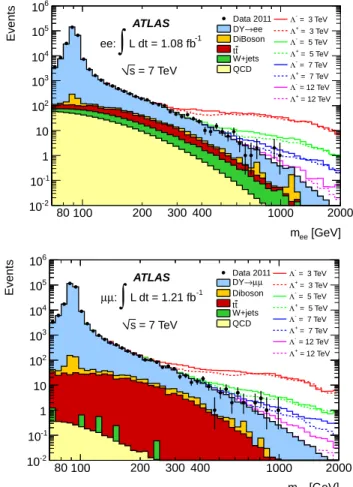
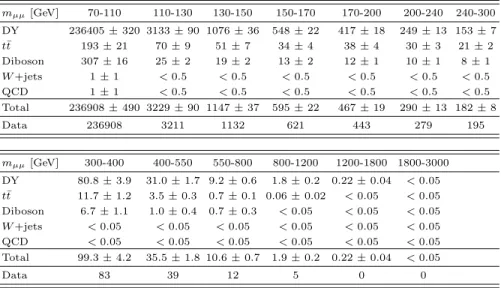
(3) 3 of the QCD background as a function of dielectron invariant mass. This template shape and the sum of the DY, dibosons, tt̄, and W +jets backgrounds normalized by their cross sections (including higher order corrections) are fitted to the observed dielectron mass distribution in the range between 70 and 200 GeV to determine the normalization of the QCD contribution. The above QCD background estimate is cross-checked with two other methods described in Ref. [3] in order to determine its systematic uncertainty. In particular, these cross-checks set bounds on the potential bias in the QCD mass spectrum introduced by the reversed identification technique. In the muon channel, the QCD background is much smaller and is also evaluated from data. A reverse isolation method is utilized: a QCD sample is selected from data by requiring two non-isolated muons with 0.1 < ΣpT (R < 0.3)/pT (µ) < 1.0, where ΣpT (R < 0.3) p is the sum of the pT of the tracks in a cone of R = ∆η 2 + ∆φ2 < 0.3 around the direction of the muon. The normalization for this sample is obtained from the ratio of isolated to non-isolated dimuon events in QCD cc̄ and bb̄ MC, where the isolation requirement is ΣpT (R < 0.3)/pT (µ) < 0.05. Muons from light hadron decays are not a significant source of background at the high momenta relevant to this analysis.. EVENT SELECTION. Events passing the trigger selection described above are required to have a pair of either electrons or muons with pT greater than 25 GeV to ensure maximal trigger efficiency. To reject cosmic ray events and beam halo background, events are required to have a reconstructed vertex with at least three charged particle tracks with pT > 0.4 GeV. If several such vertices are found, the vertex with the largest Σp2T is selected as the primary vertex of the event, where the sum is over all charged particles associated with the given vertex. Electron candidates are confined in |η| < 2.47, with the detector crack region 1.37 ≤ |η| ≤ 1.52 excluded because of degraded energy resolution. Muon candidates are required to be within the inner detector acceptance. Electron candidates are formed from clusters of cells reconstructed in the electromagnetic calorimeter. Identification criteria on the transverse shower shape, the longitudinal leakage into the hadronic calorimeter, and the association to an inner detector track are applied to the cluster to satisfy the medium electron definition [41]. The electron energy is obtained from the calorimeter measurements and its direction from the associated inner detector track. A hit in the first layer of the pixel detector is required (if an active pixel layer is traversed) to suppress background from photon conversions. Further QCD jet background suppression is achieved by demanding the highest pT electron in the event to be isolated.. To that effect, the sum of the calorimeter transverse momenta around the electron direction ΣpT (R < 0.2) must be less than 7 GeV. The core of the electron energy deposition is excluded and the sum is corrected for transverse shower leakage and pile-up from additional pp collisions. In addition, the two electron candidates are not required to have opposite charge because of possible charge misidentification either due to bremsstrahlung or to the limited momentum resolution of the inner detector at very high pT . If the event contains more than two selected electrons, the two electrons with the highest pT are chosen. For these selection criteria, the overall event acceptance for signal events has a small dependence on the dielectron mass above 500 GeV and a value of approximately 65% at 1 TeV. Muon candidates are required to be of opposite charge and are reconstructed independently in both the inner detector and the muon spectrometer. The momentum is taken from a combined fit to the measurements from both subsystems. To obtain optimal momentum resolution and accurate modeling by the simulation, the muon candidates are required to satisfy the following requirements in the muon spectrometer: have at least three hits in each of the inner, middle, and outer detectors, and at least one hit in the non-bending xy plane. To suppress background from cosmic rays, requirements are imposed on the muon impact parameter and primary vertex (PV): transverse impact parameter |d0 | < 0.2 mm, z coordinate with respect to the PV |z0 − zPV | < 1 mm, and z position of the PV |zPV | < 200 mm. Muons are also required to be isolated to reduce background from jets: ΣpT (R < 0.3)/pT (µ) < 0.05, as explained in the previous section. If more than one opposite-sign muon pair is found in an event, the pair with the largest pT (µ+ ) + pT (µ− ) is chosen. The overall event acceptance for signal events has only a weak dependence on the dimuon mass with a value of approximately 40% at 1 TeV. Stringent requirements on the presence of hits in all three layers of the muon spectrometer and the limited three-layer geometrical coverage are the primary reason for the lower acceptance relative to the electron channel. Extensive comparisons between data and MC simulation were performed at the level of single-lepton distributions to confirm that the simulation reproduces the selected data well, especially at high momentum. Figure 1 displays the dielectron and dimuon mass spectra for all selected events with invariant mass greater than 70 GeV. The expected event yields for the different processes are obtained by first normalizing each MC process by its cross section (including higher order corrections) and then normalizing the total MC event yield plus the data-derived QCD background to the data in the Z peak region (dilepton mass between 70 and 110 GeV). Good agreement is observed between the data and the SM prediction over the whole dilepton mass range. A quantitative comparison is provided in Tables I and II. A.
(4) Events. 4 106 ATLAS. 105 ee:. 104. ∫ L dt = 1.08 fb. -1. s = 7 TeV. 103. Data 2011 DY→ee DiBoson tt W+jets QCD. -. Λ = 3 TeV Λ+ = 3 TeV Λ = 5 TeV Λ+ = 5 TeV Λ = 7 TeV Λ+ = 7 TeV Λ = 12 TeV Λ+ = 12 TeV. 102 10 1 10-1 10-2. 80 100. 200. 300 400. 2000. 1000. Events. mee [GeV]. 106 ATLAS. 105. µµ:. 104. ∫ L dt = 1.21 fb. -1. s = 7 TeV. 103. Data 2011 DY→µ µ Diboson tt W+jets QCD. -. Λ = 3 TeV Λ+ = 3 TeV Λ = 5 TeV Λ+ = 5 TeV Λ = 7 TeV Λ+ = 7 TeV Λ = 12 TeV Λ+ = 12 TeV. 102 10 1 10-1 10-2. 80 100. 200. 300 400. 1000. 2000. mµµ [GeV]. FIG. 1. Dielectron (top) and dimuon (bottom) invariant mass distributions for data (points) and Monte Carlo simulation (histograms). The open histograms correspond to the distributions expected in the presence of contact interactions with different values of Λ for both constructive (solid histograms) and destructive (dashed histograms) interference.. slight excess of events observed at high dimuon mass is consistent with a statistical fluctuation. The most significant deviation in the number of dimuon events occurs for events with mass greater than 800 GeV. In this region, the Poisson probability for observing 5 or more events where 2.1 are expected is 6.2%. The muon tracks in the five data events were inspected in detail and no problem was found.. SYSTEMATIC UNCERTAINTIES. Since the MC event yields are normalized to the number of events observed in the Z peak region, only massdependent systematic uncertainties need to be considered, except for a 5% overall uncertainty in the knowledge of the Z/γ ∗ cross section in the normalization region. This overall uncertainty is required since the cross section change due to the new physics is defined with re-. spect to the SM cross section. The dominant uncertainties are of theoretical origin but experimental sources are also considered. Theoretical uncertainties in the predicted event yields arise from the limited knowledge of PDFs, αS , QCD and electroweak K-factors, and Z/γ ∗ cross section. The finite available MC statistics are also taken into account. The uncertainty due to the PDF and αS is estimated using the Mstw2008 PDF eigenvector set and additional PDFs corresponding to variations in αS . The resulting effect is about 4% at the Z pole growing with increasing mass to 10% at 1.5 TeV. Uncertainties due to QCD and electroweak K-factors are estimated to grow from 0.3% and 0.4% at the Z pole to 3% and 4.5% at 1.5 TeV, respectively, for both electron and muon channels. Estimates for the QCD K-factor are obtained by varying the renormalization and factorization scales independently by factors of two, then adding the impact of those variations linearly. The uncertainty in the electroweak K-factor is evaluated from the effect of neglecting real boson emission, varying the electroweak scheme definitions as implemented in Pythia and Horace, as well as of the effect of higher order electroweak and O(ααS ) corrections. For the electron channel, the QCD background estimate is subject to an uncertainty derived from a comparison with different background estimate methods (see discussion above). For the muon channel, the QCD background uncertainty is negligible. Experimental uncertainties originate from the energy/momentum resolution, as well as the trigger, reconstruction and identification efficiencies. In the electron channel, the uncertainty in the constant term, which dominates the energy resolution at high energy, has a negligible impact on the analysis. Knowledge of the energy scale also has a negligible effect. The electron reconstruction and identification uncertainty results in a 1.5% effect, which is estimated by studying the impact of the isolation requirement on the dielectron mass distribution. In the muon channel, the momentum resolution is dominated by the quality of the muon spectrometer alignment. The uncertainty in the alignment is evaluated directly from dedicated toroid field-off runs and redundant momentum measurements in overlapping small and large chambers. These experimental uncertainties are found to have minimal impact on the dimuon mass distribution. Finally, a systematic error growing from 0.3% at the Z pole to 4.5% at 1.5 TeV is assigned to the muon reconstruction efficiency to account conservatively for its small pT dependence due to occasional large energy loss from bremsstrahlung.. STATISTICAL ANALYSIS. The data analysis proceeds with a Bayesian method to compare the observed event yields with the expected.
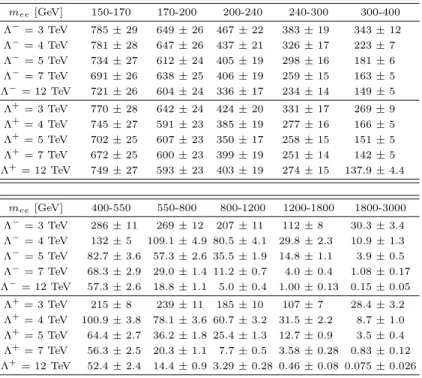
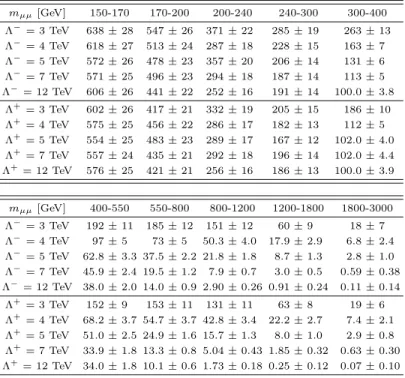
(5) 5 TABLE I. Expected and observed numbers of events in the electron channel. The total expected yield is normalized to the data in the Z peak control region between 70 and 110 GeV. The errors quoted originate from both systematic uncertainties and limited MC statistics, except the error on the total expected yield in the normalization region which is given by the square root of the number of observed events. mee [GeV]. 70-110. 110-130. 130-150. 150-170. DY tt̄ Dibosons W +jets QCD. 258482 ± 410 3185 ± 110 1183 ± 46 218 ± 36 87 ± 7 64 ± 5 368 ± 19 31 ± 2 24 ± 2 150 ± 100 57 ± 11 40 ± 9 332 ± 60 80 ± 42 50 ± 20. 608 51 15 27 32. Total. 259550 ± 510 3440 ± 120 1361 ± 50. Data. mee [GeV]. 259550. 300-400. ± ± ± ± ±. 28 2 1 6 7. 170-200 473 51 16 26 29. ± ± ± ± ±. 24 2 1 6 7. 733 ± 30. 595 ± 25. 3419. 1362. 758. 578. 400-550. 550-800. 800-1200. 200-240. 240-300. 312 ± 18 37 ± 2 14 ± 1 20 ± 5 19 ± 15. 196 ± 9 30 ± 1 8±1 14 ± 4 12 ± 9. 401 ± 24 260 ± 13 405. 1200-1800 1800-3000. DY tt̄ Dibosons W +jets QCD. 105.0 ± 5.0 14.9 ± 0.8 7.5 ± 1.1 9.0 ± 3.2 5.5 ± 4.4. 41.0 ± 2.2 12.8 ± 0.8 2.5 ± 0.2 0.29 ± 0.05 4.5 ± 0.2 1.0 ± 0.1 0.10 ± 0.02 < 0.05 2.1 ± 0.4 1.0 ± 0.3 0.3 ± 0.1 < 0.05 3.5 ± 1.6 1.0 ± 0.7 0.2 ± 0.3 < 0.05 1.5 ± 1.2 0.3 ± 0.2 < 0.05 < 0.05. < < < < <. Total. 141.9 ± 8.0. 52.6 ± 3.0 16.1 ± 1.1. Data. 147. 48. 17. 256. 0.05 0.05 0.05 0.05 0.05. 3.0 ± 0.4. 0.33 ± 0.05. < 0.05. 3. 0. 0. TABLE II. Expected and observed numbers of events in the dimuon channel. The total expected yield is normalized to the data in the Z peak control region between 70 and 110 GeV. The errors quoted originate from both systematic uncertainties and limited MC statistics, except the error on the total expected yield in the normalization region which is given by the square root of the number of observed events. mµµ [GeV]. 150-170. 170-200. DY tt̄ Diboson W +jets QCD. 236405 ± 320 3133 ± 90 1076 ± 36 193 ± 21 70 ± 9 51 ± 7 307 ± 16 25 ± 2 19 ± 2 1±1 < 0.5 < 0.5 1±1 < 0.5 < 0.5. 548 ± 22 34 ± 4 13 ± 2 < 0.5 < 0.5. 417 ± 18 38 ± 4 12 ± 1 < 0.5 < 0.5. 249 ± 13 153 ± 7 30 ± 3 21 ± 2 10 ± 1 8±1 < 0.5 < 0.5 < 0.5 < 0.5. Total. 236908 ± 490 3229 ± 90 1147 ± 37. 290 ± 13 182 ± 8. Data. mµµ [GeV]. 70-110. 110-130. 595 ± 22. 467 ± 19. 3211. 1132. 621. 443. 400-550. 550-800. 800-1200. 236908. 300-400. 130-150. 200-240. 279. 80.8 ± 3.9 11.7 ± 1.2 6.7 ± 1.1 < 0.05 < 0.05. 31.0 ± 1.7 9.2 ± 0.6 1.8 ± 0.2 0.22 ± 0.04 3.5 ± 0.3 0.7 ± 0.1 0.06 ± 0.02 < 0.05 1.0 ± 0.4 0.7 ± 0.3 < 0.05 < 0.05 < 0.05 < 0.05 < 0.05 < 0.05 < 0.05 < 0.05 < 0.05 < 0.05. < < < < <. Total. 99.3 ± 4.2. 35.5 ± 1.8 10.6 ± 0.7. Data. 83. 12. yields for a range of different contact interaction model parameters. Specifically, the number µ of expected events in each of the mass bins defined in Tables I and II is µ = nDY+CI (θ, ν̄) + nnon−DY. bg (ν̄). ,. (3). where nDY+CI (θ, ν̄) is the number of events predicted by the Pythia DY+CI MC for a particular choice of contact interaction model parameter θ, nnon−DY bg (ν̄) is the number of non-DY background events, and ν̄ represents the set of Gaussian nuisance parameters that account for systematic uncertainties in these numbers as discussed. 195. 1200-1800 1800-3000. DY tt̄ Diboson W +jets QCD. 39. 240-300. 0.05 0.05 0.05 0.05 0.05. 1.9 ± 0.2. 0.22 ± 0.04. < 0.05. 5. 0. 0. above. The parameter θ corresponds to a choice of energy scale Λ and interference parameter ηLL . The complete set of µ values used in this analysis is shown in Tables III and IV for the electron and muon channels, respectively. For each mass bin, a second order polynomial is used to model the dependence of µ on 1/Λ2 . The likelihood of observing a set of n̄ events in N invariant mass bins is given by a product of Poisson probabilities for each mass bin k:. L(n̄ | θ, ν̄) =. N Y µnk k e−µk . nk !. k=1. (4).
(6) 6 TABLE III. Expected numbers of events in the signal region of the analysis for various contact interaction scales with constructive (Λ− ) and destructive (Λ+ ) interference in the electron channel. The errors quoted originate from both systematic uncertainties and limited MC statistics. 150-170. 170-200. Λ− = 3 TeV Λ− = 4 TeV Λ− = 5 TeV Λ− = 7 TeV Λ− = 12 TeV. mee [GeV]. 785 781 734 691 721. ± ± ± ± ±. 29 28 27 26 26. 649 647 612 638 604. ± ± ± ± ±. 26 26 24 25 24. 467 437 405 406 336. ± ± ± ± ±. 22 21 19 19 17. 383 326 298 259 234. ± ± ± ± ±. 19 17 16 15 14. 343 223 181 163 149. ± ± ± ± ±. 12 7 6 5 5. Λ+ = 3 TeV Λ+ = 4 TeV Λ+ = 5 TeV Λ+ = 7 TeV Λ+ = 12 TeV. 770 745 702 672 749. ± ± ± ± ±. 28 27 25 25 27. 642 591 607 600 593. ± ± ± ± ±. 24 23 23 23 23. 424 385 350 399 403. ± ± ± ± ±. 20 19 17 19 19. 331 277 258 251 274. ± ± ± ± ±. 17 16 15 14 15. 269 166 151 142 137.9. ± ± ± ± ±. 9 5 5 5 4.4. mee [GeV] Λ− = 3 TeV Λ− = 4 TeV Λ− = 5 TeV Λ− = 7 TeV Λ− = 12 TeV. 400-550 286 132 82.7 68.3 57.3. ± ± ± ± ±. 550-800. 11 269 ± 12 5 109.1 ± 4.9 3.6 57.3 ± 2.6 2.9 29.0 ± 1.4 2.6 18.8 ± 1.1. Λ+ = 3 TeV 215 ± 8 Λ+ = 4 TeV 100.9 ± 3.8 Λ+ = 5 TeV 64.4 ± 2.7 Λ+ = 7 TeV 56.3 ± 2.5 Λ+ = 12 TeV 52.4 ± 2.4. 239 78.1 36.2 20.3 14.4. ± ± ± ± ±. 11 3.6 1.8 1.1 0.9. According to Bayes’ theorem, the posterior probability for the parameter θ given n̄ observed events is P(θ | n̄) =. 1 LM (n̄ | θ)P (θ), Z. (5). where Z is a normalization constant and the marginalized likelihood LM corresponds to the likelihood after all nuisance parameters have been integrated out. This integration is performed assuming that the nuisance parameters are correlated across all mass bins and that they affect both signal and background expectations, except for the electroweak K-factor that only affects the DY and DY+CI components. The prior probability P (θ) is chosen to be flat in 1/Λ2 , motivated by the form of Eq. (2). The 95% CL limit is then obtained by finding the value Rθ Λlim satisfying 0 lim P(θ | n̄) dθ = 0.95, where θ = 1/Λ2 . The above calculations have been performed with the Bayesian Analysis Toolkit (BAT) [42].. RESULTS. To test the consistency between the data and the standard model, a likelihood ratio test was performed by producing a set of 1000 SM-like pseudoexperiments and comparing the likelihood ratio between the signal+background and pure background hypotheses obtained in the data to the results of the pseudoexperiments. The signal+background likelihood is evaluated at. 200-240. 800-1200. 240-300. 1200-1800. 300-400. 1800-3000. 207 80.5 35.5 11.2 5.0. ± ± ± ± ±. 11 4.1 1.9 0.7 0.4. 112 29.8 14.8 4.0 1.00. ± ± ± ± ±. 8 2.3 1.1 0.4 0.13. 30.3 10.9 3.9 1.08 0.15. ± ± ± ± ±. 3.4 1.3 0.5 0.17 0.05. 185 60.7 25.4 7.7 3.29. ± ± ± ± ±. 10 3.2 1.3 0.5 0.28. 107 31.5 12.7 3.58 0.46. ± ± ± ± ±. 7 28.4 2.2 8.7 0.9 3.5 0.28 0.83 0.08 0.075. ± ± ± ± ±. 3.2 1.0 0.4 0.12 0.026. the Λ value that maximizes it. The derived p-value, corresponding to the probability of observing a fluctuation in the pseudoexperiments that is at least as signal-like as that seen in the data (i.e. with a maximum likelihood ratio greater or equal to that obtained in the data), is estimated to be 39% (79%) in the electron channel and 21% (5%) in the muon channel for constructive (destructive) interference. These values indicate that there is no significant evidence for contact interactions in the analyzed data and thus limits are set on the contact interaction scale Λ. Using the Bayesian method described above, the expected 95% CL lower limit values on the energy scale Λ are found to be 9.6±1.0 TeV for constructive interference (ηLL = −1) and 9.3 ± 1.0 TeV for destructive interference (ηLL = +1) in the electron channel. The corresponding expected limits in the muon channel are 8.9±0.9 TeV and 8.6±0.9 TeV. The quoted uncertainties correspond to the 68% range of limits surrounding the median value of all limits obtained with a set of 1000 pseudoexperiments. Stronger limits are expected in the electron channel than in the muon channel due to the significantly larger acceptance for the dielectron selection. The observed limits (at 95% CL) are Λ− > 10.1 TeV (Λ+ > 9.4 TeV) in the electron channel and Λ− > 8.0 TeV (Λ+ > 7.0 TeV) in the muon channel for constructive (destructive) interference. These limits are summarized in Table V. If instead of choosing the prior to be flat in 1/Λ2 , it is selected to be flat in 1/Λ4 to match the form of the.
(7) 7 TABLE IV. Expected numbers of events in the signal region of the analysis for various contact interaction scales with constructive (Λ− ) and destructive (Λ+ ) interference in the muon channel. The errors quoted originate from both systematic uncertainties and limited MC statistics. mµµ [GeV]. 150-170. 170-200. 200-240. 240-300. 300-400. Λ− = 3 TeV Λ− = 4 TeV Λ− = 5 TeV Λ− = 7 TeV Λ− = 12 TeV. 638 618 572 571 606. ± ± ± ± ±. 28 27 26 25 26. 547 513 478 496 441. ± ± ± ± ±. 26 24 23 23 22. 371 287 357 294 252. ± ± ± ± ±. 22 18 20 18 16. 285 228 206 187 191. ± ± ± ± ±. 19 15 14 14 14. 263 163 131 113 100.0. ± ± ± ± ±. 13 7 6 5 3.8. Λ+ = 3 TeV Λ+ = 4 TeV Λ+ = 5 TeV Λ+ = 7 TeV Λ+ = 12 TeV. 602 575 554 557 576. ± ± ± ± ±. 26 25 25 24 25. 417 456 483 435 421. ± ± ± ± ±. 21 22 23 21 21. 332 286 289 292 256. ± ± ± ± ±. 19 17 17 18 16. 205 182 167 196 186. ± ± ± ± ±. 15 13 12 14 13. 186 112 102.0 102.0 100.0. ± ± ± ± ±. 10 5 4.0 4.4 3.9. mµµ [GeV]. 400-550. 550-800. 800-1200. 1200-1800. 1800-3000. Λ− = 3 TeV 192 ± 11 Λ− = 4 TeV 97 ± 5 Λ− = 5 TeV 62.8 ± 3.3 Λ− = 7 TeV 45.9 ± 2.4 Λ− = 12 TeV 38.0 ± 2.0. 185 73 37.5 19.5 14.0. ± ± ± ± ±. 12 5 2.2 1.2 0.9. 151 50.3 21.8 7.9 2.90. ± ± ± ± ±. 12 60 ± 9 4.0 17.9 ± 2.9 1.8 8.7 ± 1.3 0.7 3.0 ± 0.5 0.26 0.91 ± 0.24. 18 6.8 2.8 0.59 0.11. ± ± ± ± ±. 7 2.4 1.0 0.38 0.14. Λ+ = 3 TeV Λ+ = 4 TeV Λ+ = 5 TeV Λ+ = 7 TeV Λ+ = 12 TeV. 153 54.7 24.9 13.3 10.1. ± ± ± ± ±. 11 3.7 1.6 0.8 0.6. 131 42.8 15.7 5.04 1.73. ± ± ± ± ±. 11 63 ± 8 3.4 22.2 ± 2.7 1.3 8.0 ± 1.0 0.43 1.85 ± 0.32 0.18 0.25 ± 0.12. 19 7.4 2.9 0.63 0.07. ± ± ± ± ±. 6 2.1 0.8 0.30 0.10. 152 68.2 51.0 33.9 34.0. ± ± ± ± ±. 9 3.7 2.5 1.8 1.8. pure CI term in Eq. (2), the observed limit in the electron channel becomes weaker by 0.9 TeV (0.8 TeV) for constructive (destructive) interference. The corresponding shift to lower values is 0.4 TeV (0.3 TeV) in the muon channel, see Table V. The quoted limits have been obtained with electroweak corrections applied to both DY and DY+CI samples for consistency, although part of the electroweak corrections cannot be computed reliably due to the unknown new physics represented by the contact interaction. However, this particular choice does not affect the observed limits significantly and results in slightly more conservative limits. The limits obtained without electroweak corrections improve by less than 0.1 TeV. Finally, a limit is set on the combination of the electron and muon channels, assuming lepton universality, by computing a combined posterior probability for the two channels. The following sources of systematic uncertainty are treated as fully correlated between the two channels: PDF and αS , QCD and electroweak K-factors, and Z/γ ∗ cross section for normalization. The resulting combined limits are Λ− > 10.2 TeV and Λ+ > 8.8 TeV for the 1/Λ2 prior. Table V summarizes all limits for the two priors considered in this study and shows that the combined limit is weaker than the electron channel limit in the case of destructive interference. This is due to the slight excess of events observed in the muon channel for masses greater than 800 GeV, an excess that gives an increase in the likelihood that is stronger for destructive interference than it is for constructive interference.. TABLE V. Expected and observed 95% CL lower limits on the contact interaction energy scale Λ for the electron and muon channels, as well as for the combination of those channels. Separate results are provided for the different choices of flat priors: 1/Λ2 and 1/Λ4 . Channel Prior Expected limit (TeV) Observed limit (TeV) Constr. Destr. Constr. Destr. e+ e−. 1/Λ2 1/Λ4. 9.6 8.9. 9.3 8.6. 10.1 9.2. 9.4 8.6. µ+ µ−. 1/Λ2 1/Λ4. 8.9 8.3. 8.6 7.9. 8.0 7.6. 7.0 6.7. Comb.. 1/Λ2 1/Λ4. 10.4 9.6. 10.1 9.4. 10.2 9.4. 8.8 8.4. CONCLUSIONS. A search for contact interactions in e+ e− and √ µ+ µ− events produced in proton-proton collisions at s = 7 TeV has been performed. The analysis uses early 2011 run data amounting to 1.08 (1.21) fb−1 of pp collisions in the electron (muon) channel collected with the ATLAS detector. The dilepton mass distributions do not display significant deviations from the standard model. Using a Bayesian approach with a 1/Λ2 prior, as was done in most previous searches at hadron colliders, the following 95% CL limits are set on the energy scale of contact interactions: Λ− > 10.1 TeV (Λ+ > 9.4 TeV) in the.
(8) 8 electron channel and Λ− > 8.0 TeV (Λ+ > 7.0 TeV) in the muon channel for constructive (destructive) interference in the left-left isoscalar compositeness model. Somewhat weaker limits are obtained with a prior flat in 1/Λ4 . These limits are the most stringent to date on µµqq contact interactions and exceed the best existing limits set by a single experiment on eeqq contact interactions for light-quark flavors.. ACKNOWLEDGEMENTS. We thank CERN for the very successful operation of the LHC, as well as the support staff from our institutions without whom ATLAS could not be operated efficiently. We acknowledge the support of ANPCyT, Argentina; YerPhI, Armenia; ARC, Australia; BMWF, Austria; ANAS, Azerbaijan; SSTC, Belarus; CNPq and FAPESP, Brazil; NSERC, NRC and CFI, Canada; CERN; CONICYT, Chile; CAS, MOST and NSFC, China; COLCIENCIAS, Colombia; MSMT CR, MPO CR and VSC CR, Czech Republic; DNRF, DNSRC and Lundbeck Foundation, Denmark; ARTEMIS, European Union; IN2P3-CNRS, CEA-DSM/IRFU, France; GNAS, Georgia; BMBF, DFG, HGF, MPG and AvH Foundation, Germany; GSRT, Greece; ISF, MINERVA, GIF, DIP and Benoziyo Center, Israel; INFN, Italy; MEXT and JSPS, Japan; CNRST, Morocco; FOM and NWO, Netherlands; RCN, Norway; MNiSW, Poland; GRICES and FCT, Portugal; MERYS (MECTS), Romania; MES of Russia and ROSATOM, Russian Federation; JINR; MSTD, Serbia; MSSR, Slovakia; ARRS and MVZT, Slovenia; DST/NRF, South Africa; MICINN, Spain; SRC and Wallenberg Foundation, Sweden; SER, SNSF and Cantons of Bern and Geneva, Switzerland; NSC, Taiwan; TAEK, Turkey; STFC, the Royal Society and Leverhulme Trust, United Kingdom; DOE and NSF, United States of America. The crucial computing support from all WLCG partners is acknowledged gratefully, in particular from CERN and the ATLAS Tier-1 facilities at TRIUMF (Canada), NDGF (Denmark, Norway, Sweden), CCIN2P3 (France), KIT/GridKA (Germany), INFN-CNAF (Italy), NL-T1 (Netherlands), PIC (Spain), ASGC (Taiwan), RAL (UK) and BNL (USA) and in the Tier-2 facilities worldwide.. [1] L. Evans and P. Bryant, JINST 3, S08001 (2008). [2] ATLAS Collaboration, Phys. Rev. D 84, 011101 (2011). [3] ATLAS Collaboration, arXiv:1108.1582 [hep-ex], to appear in Phys. Rev. Lett.. [4] E. Fermi, Nuovo Cim. 11, 1 (1934); Z. Phys. 88, 161 (1934). [5] E. Eichten, K. Lane, and M. Peskin, Phys. Rev. Lett. 50, 811 (1983). [6] K. Nakamura et al. (Particle Data Group), J. Phys. G 37, 075021 (2010). [7] E. Eichten, I. Hinchliffe, K. Lane, and C. Quigg, Rev. Mod. Phys. 56, 579 (1984); Addendum-ibid. 58, 1065 (1986). [8] K. McFarland, Eur. Phys. J. A 24, 161 (2005). [9] ALEPH Collaboration, Eur. Phys. J. C 49, 411 (2007). [10] DELPHI Collaboration, Eur. Phys. J. C 45, 589 (2006). [11] DELPHI Collaboration, Eur. Phys. J. C 60, 1 (2009). [12] L3 Collaboration, Phys. Lett. B 489, 81 (2000). [13] OPAL Collaboration, Eur. Phys. J. C 33, 173 (2004). [14] H1 Collaboration, Phys. Lett. B 705, 52 (2011). [15] ZEUS Collaboration, Phys. Lett. B 591, 23 (2004). [16] CDF Collaboration, Phys. Rev. Lett. 79, 2198 (1997). [17] CDF Collaboration, Phys. Rev. Lett. 87, 231803 (2001). [18] CDF Collaboration, Phys. Rev. Lett. 96, 211801 (2006). [19] D0 Collaboration, Phys. Rev. Lett. 82, 4769 (1999). [20] D0 Collaboration, Phys. Rev. Lett. 103, 191803 (2009). [21] CMS Collaboration, Phys. Rev. Lett. 105, 262001 (2010). [22] ATLAS Collaboration, Phys. Lett. B 694, 327 (2011). [23] CMS Collaboration, Phys. Rev. Lett. 106, 201804 (2011). [24] ATLAS Collaboration, New J. Phys. 13, 053044 (2011). [25] ATLAS Collaboration, JINST 3, S08003 (2008). [26] ATLAS uses a right-handed coordinate system with its origin at the nominal interaction point (IP) in the center of the detector and the z-axis along the beam pipe. The xaxis points from the IP to the center of the LHC ring, and the y-axis points upward. Cylindrical coordinates (r, φ) are used in the transverse plane, φ being the azimuthal angle around the beam pipe. The pseudorapidity is defined in terms of the polar angle θ as η = − ln tan(θ/2). [27] T. Sjöstrand, S. Mrenna, and P. Skands, JHEP 05, 026 (2006). [28] A. Sherstnev and R.S. Thorne, Eur. Phys. J. C 55, 189 (2008). [29] G. Corcella et al., JHEP 01, 010 (2001). [30] M. L. Mangano, M. Moretti, F. Piccinini, R. Pittau, and A. D. Polosa, JHEP 07, 001 (2003). [31] J. Pumplin et al., JHEP 0207, 012 (2002). [32] S. Frixione and B. Webber, JHEP 0206, 029 (2002). [33] P.M. Nadolsky et al., Phys. Rev. D 78, 013004 (2008). [34] J.M. Butterworth et al., Z. Phys. C 72, 637 (1997). [35] P. Golonka and Z. Was, Eur. Phys. J. C 45, 97 (2006). [36] R. Hamberg, W. L. van Neerven, and T. Matsuura, Nucl. Phys. B359, 343 (1991). [37] A.D. Martin, W.J. Stirling, R.S. Thorne, and G. Watt, Eur. Phys. J. C 63, 189 (2009). [38] C.M. Carloni Calame et al., JHEP 0710, 109 (2007). [39] ATLAS Collaboration, Eur. Phys. J. C 70, 823 (2010). [40] S. Agnostinelli et al., Nucl. Instrum. Meth. A506, 250 (2003); J. Allison et al., IEEE Trans. Nucl. Sci. 53, 270 (2006). [41] ATLAS Collaboration, arXiv:1110.3174 [hep-ex], submitted to Eur. Phys. J. C. [42] A. Caldwell, D. Kollar, and K. Kröninger, Computer Phys.Comm. 180, 2197 (2009)..
(9) 9. The ATLAS Collaboration G. Aad48 , B. Abbott110 , J. Abdallah11 , A.A. Abdelalim49 , A. Abdesselam117 , O. Abdinov10 , B. Abi111 , M. Abolins87 , O.S. AbouZeid157 , H. Abramowicz152 , H. Abreu114 , E. Acerbi88a,88b , B.S. Acharya163a,163b , L. Adamczyk37 , D.L. Adams24 , T.N. Addy56 , J. Adelman174 , M. Aderholz98 , S. Adomeit97 , P. Adragna74 , T. Adye128 , S. Aefsky22 , J.A. Aguilar-Saavedra123b,a , M. Aharrouche80, S.P. Ahlen21 , F. Ahles48 , A. Ahmad147 , M. Ahsan40 , G. Aielli132a,132b , T. Akdogan18a , T.P.A. Åkesson78 , G. Akimoto154 , A.V. Akimov 93 , A. Akiyama66 , M.S. Alam1 , M.A. Alam75 , J. Albert168 , S. Albrand55 , M. Aleksa29 , I.N. Aleksandrov64 , F. Alessandria88a , C. Alexa25a , G. Alexander152 , G. Alexandre49 , T. Alexopoulos9 , M. Alhroob20 , M. Aliev15 , G. Alimonti88a , J. Alison119 , M. Aliyev10 , P.P. Allport72 , S.E. Allwood-Spiers53 , J. Almond81 , A. Aloisio101a,101b , R. Alon170 , A. Alonso78 , B. Alvarez Gonzalez87 , M.G. Alviggi101a,101b , K. Amako65 , P. Amaral29 , C. Amelung22 , V.V. Ammosov127 , A. Amorim123a,b , G. Amorós166 , N. Amram152 , C. Anastopoulos29 , L.S. Ancu16 , N. Andari114 , T. Andeen34 , C.F. Anders20 , G. Anders58a , K.J. Anderson30 , A. Andreazza88a,88b , V. Andrei58a , M-L. Andrieux55 , X.S. Anduaga69 , A. Angerami34 , F. Anghinolfi29 , A. Anisenkov106 , N. Anjos123a , A. Annovi47 , A. Antonaki8 , M. Antonelli47 , A. Antonov95 , J. Antos143b , F. Anulli131a , S. Aoun82 , L. Aperio Bella4 , R. Apolle117,c , G. Arabidze87 , I. Aracena142 , Y. Arai65 , A.T.H. Arce44 , J.P. Archambault28 , S. Arfaoui147 , J-F. Arguin14 , E. Arik18a,∗ , M. Arik18a , A.J. Armbruster86 , O. Arnaez80 , C. Arnault114 , A. Artamonov94, G. Artoni131a,131b , D. Arutinov20 , S. Asai154 , R. Asfandiyarov171, S. Ask27 , B. Åsman145a,145b , L. Asquith5 , K. Assamagan24 , A. Astbury168 , A. Astvatsatourov52, B. Aubert4 , E. Auge114 , K. Augsten126 , M. Aurousseau144a , G. Avolio162 , R. Avramidou9 , D. Axen167 , C. Ay54 , G. Azuelos92,d , Y. Azuma154 , M.A. Baak29 , G. Baccaglioni88a, C. Bacci133a,133b , A.M. Bach14 , H. Bachacou135 , K. Bachas29, G. Bachy29 , M. Backes49 , M. Backhaus20 , E. Badescu25a , P. Bagnaia131a,131b, S. Bahinipati2 , Y. Bai32a , D.C. Bailey157 , T. Bain157 , J.T. Baines128 , O.K. Baker174 , M.D. Baker24, S. Baker76, E. Banas38 , P. Banerjee92 , Sw. Banerjee171 , D. Banfi29 , A. Bangert149 , V. Bansal168 , H.S. Bansil17 , L. Barak170 , S.P. Baranov93, A. Barashkou64, A. Barbaro Galtieri14 , T. Barber48 , E.L. Barberio85 , D. Barberis50a,50b, M. Barbero20, D.Y. Bardin64 , T. Barillari98 , M. Barisonzi173 , T. Barklow142, N. Barlow27, B.M. Barnett128 , R.M. Barnett14 , A. Baroncelli133a , G. Barone49, A.J. Barr117 , F. Barreiro79, J. Barreiro Guimarães da Costa57 , P. Barrillon114, R. Bartoldus142 , A.E. Barton70 , V. Bartsch148 , R.L. Bates53 , L. Batkova143a, J.R. Batley27 , A. Battaglia16 , M. Battistin29 , F. Bauer135 , H.S. Bawa142,e , S. Beale97 , B. Beare157 , T. Beau77 , P.H. Beauchemin160 , R. Beccherle50a , P. Bechtle20 , H.P. Beck16 , S. Becker97 , M. Beckingham137 , K.H. Becks173 , A.J. Beddall18c , A. Beddall18c , S. Bedikian174 , V.A. Bednyakov64, C.P. Bee82 , M. Begel24 , S. Behar Harpaz151 , P.K. Behera62 , M. Beimforde98 , C. Belanger-Champagne84, P.J. Bell49 , W.H. Bell49 , G. Bella152 , L. Bellagamba19a, F. Bellina29 , M. Bellomo29 , A. Belloni57 , O. Beloborodova106,f , K. Belotskiy95 , O. Beltramello29 , S. Ben Ami151 , O. Benary152 , D. Benchekroun134a , C. Benchouk82 , M. Bendel80 , N. Benekos164 , Y. Benhammou152 , E. Benhar Noccioli49 , J.A. Benitez Garcia158b , D.P. Benjamin44 , M. Benoit114 , J.R. Bensinger22 , K. Benslama129 , S. Bentvelsen104 , D. Berge29 , E. Bergeaas Kuutmann41 , N. Berger4, F. Berghaus168, E. Berglund104 , J. Beringer14 , P. Bernat76 , R. Bernhard48 , C. Bernius24 , T. Berry75 , C. Bertella82 , A. Bertin19a,19b , F. Bertinelli29 , F. Bertolucci121a,121b , M.I. Besana88a,88b, N. Besson135 , S. Bethke98 , W. Bhimji45 , R.M. Bianchi29 , M. Bianco71a,71b , O. Biebel97 , S.P. Bieniek76 , K. Bierwagen54, J. Biesiada14 , M. Biglietti133a , H. Bilokon47 , M. Bindi19a,19b , S. Binet114 , A. Bingul18c , C. Bini131a,131b , C. Biscarat176, U. Bitenc48 , K.M. Black21 , R.E. Blair5 , J.-B. Blanchard135 , G. Blanchot29 , T. Blazek143a , C. Blocker22 , J. Blocki38 , A. Blondel49 , W. Blum80 , U. Blumenschein54 , G.J. Bobbink104 , V.B. Bobrovnikov106, S.S. Bocchetta78 , A. Bocci44 , C.R. Boddy117 , M. Boehler41 , J. Boek173 , N. Boelaert35 , S. Böser76 , J.A. Bogaerts29, A. Bogdanchikov106, A. Bogouch89,∗ , C. Bohm145a , V. Boisvert75, T. Bold37 , V. Boldea25a , N.M. Bolnet135 , M. Bona74 , V.G. Bondarenko95, M. Bondioli162 , M. Boonekamp135 , G. Boorman75 , C.N. Booth138 , S. Bordoni77 , C. Borer16 , A. Borisov127, G. Borissov70, I. Borjanovic12a, S. Borroni86, K. Bos104 , D. Boscherini19a , M. Bosman11 , H. Boterenbrood104 , D. Botterill128 , J. Bouchami92 , J. Boudreau122 , E.V. Bouhova-Thacker70, D. Boumediene33 , C. Bourdarios114, N. Bousson82 , A. Boveia30, J. Boyd29 , I.R. Boyko64, N.I. Bozhko127 , I. Bozovic-Jelisavcic12b, J. Bracinik17 , A. Braem29 , P. Branchini133a , G.W. Brandenburg57, A. Brandt7 , G. Brandt117 , O. Brandt54 , U. Bratzler155 , B. Brau83 , J.E. Brau113 , H.M. Braun173 , B. Brelier157 , J. Bremer29 , R. Brenner165 , S. Bressler170, D. Breton114 , D. Britton53 , F.M. Brochu27 , I. Brock20 , R. Brock87 , T.J. Brodbeck70 , E. Brodet152 , F. Broggi88a, C. Bromberg87, J. Bronner98 , G. Brooijmans34 , W.K. Brooks31b , G. Brown81 , H. Brown7 , P.A. Bruckman de Renstrom38 , D. Bruncko143b, R. Bruneliere48 , S. Brunet60 , A. Bruni19a , G. Bruni19a , M. Bruschi19a , T. Buanes13 , Q. Buat55 , F. Bucci49 , J. Buchanan117 , N.J. Buchanan2 , P. Buchholz140 , R.M. Buckingham117 , A.G. Buckley45 , S.I. Buda25a , I.A. Budagov64, B. Budick107 , V. Büscher80 , L. Bugge116 , O. Bulekov95 , M. Bunse42 , T. Buran116 , H. Burckhart29 , S. Burdin72 , T. Burgess13 , S. Burke128 , E. Busato33 , P. Bussey53 , C.P. Buszello165 , F. Butin29 , B. Butler142 , J.M. Butler21 , C.M. Buttar53 , J.M. Butterworth76 , W. Buttinger27 , S. Cabrera Urbán166 , D. Caforio19a,19b,.
(10) 10 O. Cakir3a , P. Calafiura14, G. Calderini77 , P. Calfayan97, R. Calkins105 , L.P. Caloba23a , R. Caloi131a,131b , D. Calvet33 , S. Calvet33 , R. Camacho Toro33, P. Camarri132a,132b, M. Cambiaghi118a,118b, D. Cameron116 , L.M. Caminada14 , S. Campana29 , M. Campanelli76 , V. Canale101a,101b , F. Canelli30,g , A. Canepa158a , J. Cantero79 , L. Capasso101a,101b, M.D.M. Capeans Garrido29 , I. Caprini25a , M. Caprini25a , D. Capriotti98 , M. Capua36a,36b , R. Caputo80 , C. Caramarcu24, R. Cardarelli132a , T. Carli29 , G. Carlino101a , L. Carminati88a,88b , B. Caron84 , S. Caron103 , G.D. Carrillo Montoya171, A.A. Carter74 , J.R. Carter27 , J. Carvalho123a,h , D. Casadei107 , M.P. Casado11 , M. Cascella121a,121b , C. Caso50a,50b,∗ , A.M. Castaneda Hernandez171 , E. Castaneda-Miranda171, V. Castillo Gimenez166 , N.F. Castro123a , G. Cataldi71a , F. Cataneo29 , A. Catinaccio29 , J.R. Catmore29 , A. Cattai29 , G. Cattani132a,132b , S. Caughron87 , D. Cauz163a,163c , P. Cavalleri77, D. Cavalli88a , M. Cavalli-Sforza11, V. Cavasinni121a,121b , F. Ceradini133a,133b , A.S. Cerqueira23b , A. Cerri29 , L. Cerrito74 , F. Cerutti47 , S.A. Cetin18b , F. Cevenini101a,101b , A. Chafaq134a , D. Chakraborty105, K. Chan2 , B. Chapleau84 , J.D. Chapman27 , J.W. Chapman86 , E. Chareyre77, D.G. Charlton17 , V. Chavda81 , C.A. Chavez Barajas29, S. Cheatham84 , S. Chekanov5 , S.V. Chekulaev158a , G.A. Chelkov64, M.A. Chelstowska103 , C. Chen63 , H. Chen24 , S. Chen32c , T. Chen32c , X. Chen171 , S. Cheng32a , A. Cheplakov64 , V.F. Chepurnov64 , R. Cherkaoui El Moursli134e , V. Chernyatin24 , E. Cheu6 , S.L. Cheung157 , L. Chevalier135 , G. Chiefari101a,101b , L. Chikovani51a , J.T. Childers29 , A. Chilingarov70, G. Chiodini71a , M.V. Chizhov64 , G. Choudalakis30 , S. Chouridou136 , I.A. Christidi76 , A. Christov48 , D. Chromek-Burckhart29, M.L. Chu150 , J. Chudoba124 , G. Ciapetti131a,131b , K. Ciba37 , A.K. Ciftci3a , R. Ciftci3a , D. Cinca33 , V. Cindro73 , M.D. Ciobotaru162 , C. Ciocca19a , A. Ciocio14 , M. Cirilli86 , M. Citterio88a , M. Ciubancan25a , A. Clark49 , P.J. Clark45 , W. Cleland122 , J.C. Clemens82 , B. Clement55 , C. Clement145a,145b , R.W. Clifft128 , Y. Coadou82 , M. Cobal163a,163c , A. Coccaro171, J. Cochran63 , P. Coe117 , J.G. Cogan142 , J. Coggeshall164 , E. Cogneras176, J. Colas4 , A.P. Colijn104 , N.J. Collins17 , C. Collins-Tooth53 , J. Collot55 , G. Colon83 , P. Conde Muiño123a , E. Coniavitis117 , M.C. Conidi11 , M. Consonni103 , V. Consorti48 , S. Constantinescu25a , C. Conta118a,118b , F. Conventi101a,i , J. Cook29 , M. Cooke14 , B.D. Cooper76 , A.M. Cooper-Sarkar117, K. Copic14 , T. Cornelissen173 , M. Corradi19a, F. Corriveau84,j , A. Cortes-Gonzalez164, G. Cortiana98 , G. Costa88a , M.J. Costa166 , D. Costanzo138 , T. Costin30 , D. Côté29 , R. Coura Torres23a, L. Courneyea168, G. Cowan75 , C. Cowden27 , B.E. Cox81 , K. Cranmer107 , F. Crescioli121a,121b, M. Cristinziani20 , G. Crosetti36a,36b , R. Crupi71a,71b , S. Crépé-Renaudin55, C.-M. Cuciuc25a , C. Cuenca Almenar174 , T. Cuhadar Donszelmann138 , M. Curatolo47 , C.J. Curtis17 , C. Cuthbert149 , P. Cwetanski60 , H. Czirr140 , P. Czodrowski43 , Z. Czyczula174 , S. D’Auria53 , M. D’Onofrio72 , A. D’Orazio131a,131b , P.V.M. Da Silva23a , C. Da Via81 , W. Dabrowski37 , T. Dai86 , C. Dallapiccola83 , M. Dam35 , M. Dameri50a,50b , D.S. Damiani136 , H.O. Danielsson29 , D. Dannheim98 , V. Dao49 , G. Darbo50a , G.L. Darlea25b , C. Daum104 , W. Davey20 , T. Davidek125 , N. Davidson85 , R. Davidson70 , E. Davies117,c , M. Davies92 , A.R. Davison76 , Y. Davygora58a, E. Dawe141 , I. Dawson138 , J.W. Dawson5,∗ , R.K. Daya-Ishmukhametova22, K. De7 , R. de Asmundis101a , S. De Castro19a,19b, P.E. De Castro Faria Salgado24, S. De Cecco77 , J. de Graat97 , N. De Groot103 , P. de Jong104 , C. De La Taille114 , H. De la Torre79 , B. De Lotto163a,163c , L. de Mora70 , L. De Nooij104 , D. De Pedis131a , A. De Salvo131a , U. De Sanctis163a,163c , A. De Santo148 , J.B. De Vivie De Regie114 , S. Dean76 , W.J. Dearnaley70 , R. Debbe24 , C. Debenedetti45 , D.V. Dedovich64 , J. Degenhardt119 , M. Dehchar117 , C. Del Papa163a,163c , J. Del Peso79 , T. Del Prete121a,121b , T. Delemontex55 , M. Deliyergiyev73 , A. Dell’Acqua29 , L. Dell’Asta21 , M. Della Pietra101a,i , D. della Volpe101a,101b , M. Delmastro4 , N. Delruelle29 , P.A. Delsart55 , C. Deluca147 , S. Demers174 , M. Demichev64 , B. Demirkoz11,k , J. Deng162 , S.P. Denisov127 , D. Derendarz38 , J.E. Derkaoui134d , F. Derue77 , P. Dervan72 , K. Desch20 , E. Devetak147 , P.O. Deviveiros104 , A. Dewhurst128 , B. DeWilde147 , S. Dhaliwal157 , R. Dhullipudi24 ,l , A. Di Ciaccio132a,132b , L. Di Ciaccio4 , A. Di Girolamo29 , B. Di Girolamo29, S. Di Luise133a,133b , A. Di Mattia171 , B. Di Micco29 , R. Di Nardo47 , A. Di Simone132a,132b , R. Di Sipio19a,19b , M.A. Diaz31a , F. Diblen18c , E.B. Diehl86 , J. Dietrich41 , T.A. Dietzsch58a , S. Diglio85 , K. Dindar Yagci39 , J. Dingfelder20 , C. Dionisi131a,131b , P. Dita25a , S. Dita25a , F. Dittus29 , F. Djama82 , T. Djobava51b , M.A.B. do Vale23c , A. Do Valle Wemans123a , T.K.O. Doan4 , M. Dobbs84 , R. Dobinson 29,∗ , D. Dobos29 , E. Dobson29,m , J. Dodd34 , C. Doglioni49 , T. Doherty53 , Y. Doi65,∗ , J. Dolejsi125 , I. Dolenc73 , Z. Dolezal125 , B.A. Dolgoshein95,∗ , T. Dohmae154 , M. Donadelli23d , M. Donega119 , J. Donini33 , J. Dopke29 , A. Doria101a , A. Dos Anjos171 , M. Dosil11 , A. Dotti121a,121b , M.T. Dova69 , J.D. Dowell17 , A.D. Doxiadis104 , A.T. Doyle53 , Z. Drasal125 , J. Drees173 , N. Dressnandt119 , H. Drevermann29 , C. Driouichi35 , M. Dris9 , J. Dubbert98 , S. Dube14 , E. Duchovni170 , G. Duckeck97 , A. Dudarev29 , F. Dudziak63 , M. Dührssen 29 , I.P. Duerdoth81 , L. Duflot114 , M-A. Dufour84 , L. Duguid75 , M. Dunford29 , H. Duran Yildiz3a , R. Duxfield138 , M. Dwuznik37 , F. Dydak 29 , M. Düren52 , W.L. Ebenstein44 , J. Ebke97 , S. Eckweiler80, K. Edmonds80 , C.A. Edwards75 , N.C. Edwards53, W. Ehrenfeld41 , T. Ehrich98 , T. Eifert142 , G. Eigen13 , K. Einsweiler14 , E. Eisenhandler74 , T. Ekelof165 , M. El Kacimi134c , M. Ellert165 , S. Elles4 , F. Ellinghaus80 , K. Ellis74 , N. Ellis29 , J. Elmsheuser97 , M. Elsing29 , D. Emeliyanov128, R. Engelmann147 , A. Engl97 , B. Epp61 , A. Eppig86 , J. Erdmann54 , A. Ereditato16 ,.
(11) 11 D. Eriksson145a , J. Ernst1 , M. Ernst24 , J. Ernwein135 , D. Errede164 , S. Errede164 , E. Ertel80 , M. Escalier114 , C. Escobar122, X. Espinal Curull11 , B. Esposito47 , F. Etienne82 , A.I. Etienvre135 , E. Etzion152 , D. Evangelakou54, H. Evans60 , L. Fabbri19a,19b , C. Fabre29 , R.M. Fakhrutdinov127 , S. Falciano131a , Y. Fang171 , M. Fanti88a,88b , A. Farbin7 , A. Farilla133a , J. Farley147 , T. Farooque157 , S.M. Farrington117 , P. Farthouat29 , P. Fassnacht29 , D. Fassouliotis8 , B. Fatholahzadeh157 , A. Favareto88a,88b , L. Fayard114 , S. Fazio36a,36b , R. Febbraro33 , P. Federic143a , O.L. Fedin120 , W. Fedorko87 , M. Fehling-Kaschek48 , L. Feligioni82 , D. Fellmann5 , C. Feng32d , E.J. Feng30 , A.B. Fenyuk127 , J. Ferencei143b , J. Ferland92 , W. Fernando108 , S. Ferrag53, J. Ferrando53 , V. Ferrara41, A. Ferrari165 , P. Ferrari104 , R. Ferrari118a , A. Ferrer166 , M.L. Ferrer47 , D. Ferrere49 , C. Ferretti86 , A. Ferretto Parodi50a,50b, M. Fiascaris30, F. Fiedler80 , A. Filipčič73, A. Filippas9 , F. Filthaut103 , M. Fincke-Keeler168, M.C.N. Fiolhais123a,h , L. Fiorini166 , A. Firan39 , G. Fischer41 , P. Fischer 20 , M.J. Fisher108 , M. Flechl48 , I. Fleck140 , J. Fleckner80 , P. Fleischmann172 , S. Fleischmann173 , T. Flick173 , L.R. Flores Castillo171 , M.J. Flowerdew98, M. Fokitis9 , T. Fonseca Martin16 , D.A. Forbush137 , A. Formica135 , A. Forti81 , D. Fortin158a , J.M. Foster81 , D. Fournier114 , A. Foussat29 , A.J. Fowler44 , K. Fowler136 , H. Fox70 , P. Francavilla11 , S. Franchino118a,118b , D. Francis29 , T. Frank170 , M. Franklin57 , S. Franz29 , M. Fraternali118a,118b , S. Fratina119 , S.T. French27 , F. Friedrich 43 , R. Froeschl29 , D. Froidevaux29 , J.A. Frost27 , C. Fukunaga155 , E. Fullana Torregrosa29, J. Fuster166 , C. Gabaldon29 , O. Gabizon170 , T. Gadfort24 , S. Gadomski49 , G. Gagliardi50a,50b, P. Gagnon60 , C. Galea97 , E.J. Gallas117 , V. Gallo16 , B.J. Gallop128 , P. Gallus124 , K.K. Gan108 , Y.S. Gao142,e , V.A. Gapienko127 , A. Gaponenko14 , F. Garberson174 , M. Garcia-Sciveres14, C. Garcı́a166, J.E. Garcı́a Navarro166, R.W. Gardner30 , N. Garelli29 , H. Garitaonandia104 , V. Garonne29 , J. Garvey17 , C. Gatti47 , G. Gaudio118a , O. Gaumer49 , B. Gaur140 , L. Gauthier135 , I.L. Gavrilenko93, C. Gay167 , G. Gaycken20 , J-C. Gayde29 , E.N. Gazis9 , P. Ge32d , C.N.P. Gee128 , D.A.A. Geerts104 , Ch. Geich-Gimbel20 , K. Gellerstedt145a,145b , C. Gemme50a , A. Gemmell53 , M.H. Genest55 , S. Gentile131a,131b , M. George54 , S. George75 , P. Gerlach173 , A. Gershon152 , C. Geweniger58a , H. Ghazlane134b , N. Ghodbane33 , B. Giacobbe19a , S. Giagu131a,131b , V. Giakoumopoulou8 , V. Giangiobbe11 , F. Gianotti29 , B. Gibbard24 , A. Gibson157 , S.M. Gibson29 , L.M. Gilbert117 , V. Gilewsky90 , D. Gillberg28 , A.R. Gillman128 , D.M. Gingrich2,d , J. Ginzburg152 , N. Giokaris8 , M.P. Giordani163c , R. Giordano101a,101b , F.M. Giorgi15 , P. Giovannini98 , P.F. Giraud135 , D. Giugni88a , M. Giunta92 , P. Giusti19a , B.K. Gjelsten116 , L.K. Gladilin96 , C. Glasman79 , J. Glatzer48 , A. Glazov41 , K.W. Glitza173 , G.L. Glonti64 , J.R. Goddard74 , J. Godfrey141 , J. Godlewski29 , M. Goebel41 , T. Göpfert43 , C. Goeringer80 , C. Gössling42 , T. Göttfert98 , S. Goldfarb86 , T. Golling174 , S.N. Golovnia127 , A. Gomes123a,b , L.S. Gomez Fajardo41 , R. Gonçalo75 , J. Goncalves Pinto Firmino Da Costa41 , L. Gonella20 , A. Gonidec29 , S. Gonzalez171 , S. González de la Hoz166 , G. Gonzalez Parra11, M.L. Gonzalez Silva26 , S. Gonzalez-Sevilla49 , J.J. Goodson147 , L. Goossens29 , P.A. Gorbounov94, H.A. Gordon24 , I. Gorelov102 , G. Gorfine173 , B. Gorini29 , E. Gorini71a,71b , A. Gorišek73, E. Gornicki38 , S.A. Gorokhov127, V.N. Goryachev127 , B. Gosdzik41 , M. Gosselink104 , M.I. Gostkin64 , I. Gough Eschrich162, M. Gouighri134a , D. Goujdami134c , M.P. Goulette49 , A.G. Goussiou137 , C. Goy4 , S. Gozpinar22 , I. Grabowska-Bold37, P. Grafström29 , K-J. Grahn41 , F. Grancagnolo71a, S. Grancagnolo15, V. Grassi147 , V. Gratchev120 , N. Grau34 , H.M. Gray29 , J.A. Gray147 , E. Graziani133a , O.G. Grebenyuk120 , T. Greenshaw72 , Z.D. Greenwood24,l , K. Gregersen35, I.M. Gregor41, P. Grenier142 , J. Griffiths137 , N. Grigalashvili64, A.A. Grillo136 , S. Grinstein11 , Y.V. Grishkevich96 , J.-F. Grivaz114 , M. Groh98 , E. Gross170 , J. Grosse-Knetter54 , J. Groth-Jensen170 , K. Grybel140 , V.J. Guarino5 , D. Guest174 , C. Guicheney33 , A. Guida71a,71b , S. Guindon54 , H. Guler84,n , J. Gunther124 , B. Guo157 , J. Guo34 , A. Gupta30 , Y. Gusakov64 , V.N. Gushchin127 , A. Gutierrez92 , P. Gutierrez110 , N. Guttman152 , O. Gutzwiller171 , C. Guyot135 , C. Gwenlan117 , C.B. Gwilliam72 , A. Haas142 , S. Haas29 , C. Haber14 , H.K. Hadavand39 , D.R. Hadley17 , P. Haefner98 , F. Hahn29 , S. Haider29 , Z. Hajduk38 , H. Hakobyan175, D. Hall117 , J. Haller54 , K. Hamacher173 , P. Hamal112 , M. Hamer54 , A. Hamilton144b,o , S. Hamilton160 , H. Han32a , L. Han32b , K. Hanagaki115 , K. Hanawa159 , M. Hance14 , C. Handel80 , P. Hanke58a , J.R. Hansen35 , J.B. Hansen35 , J.D. Hansen35 , P.H. Hansen35 , P. Hansson142 , K. Hara159 , G.A. Hare136 , T. Harenberg173, S. Harkusha89 , D. Harper86 , R.D. Harrington45 , O.M. Harris137 , K. Harrison17, J. Hartert48 , F. Hartjes104 , T. Haruyama65 , A. Harvey56 , S. Hasegawa100, Y. Hasegawa139, S. Hassani135 , M. Hatch29 , D. Hauff98 , S. Haug16 , M. Hauschild29 , R. Hauser87 , M. Havranek20, B.M. Hawes117 , C.M. Hawkes17 , R.J. Hawkings29 , A.D. Hawkins78 , D. Hawkins162 , T. Hayakawa66, T. Hayashi159 , D. Hayden75 , H.S. Hayward72 , S.J. Haywood128 , E. Hazen21 , M. He32d , S.J. Head17 , V. Hedberg78 , L. Heelan7 , S. Heim87 , B. Heinemann14 , S. Heisterkamp35 , L. Helary4 , C. Heller97 , M. Heller29 , S. Hellman145a,145b , D. Hellmich20 , C. Helsens11 , R.C.W. Henderson70 , M. Henke58a , A. Henrichs54 , A.M. Henriques Correia29 , S. Henrot-Versille114 , F. Henry-Couannier82 , C. Hensel54 , T. Henß173 , C.M. Hernandez7 , Y. Hernández Jiménez166 , R. Herrberg15 , A.D. Hershenhorn151 , G. Herten48 , R. Hertenberger97 , L. Hervas29 , N.P. Hessey104 , E. Higón-Rodriguez166, D. Hill5,∗ , J.C. Hill27 , N. Hill5 , K.H. Hiller41 , S. Hillert20 , S.J. Hillier17 , I. Hinchliffe14 , E. Hines119 , M. Hirose115 , F. Hirsch42 , D. Hirschbuehl173 , J. Hobbs147 , N. Hod152 , M.C. Hodgkinson138 , P. Hodgson138 , A. Hoecker29 , M.R. Hoeferkamp102 , J. Hoffman39 ,.
(12) 12 D. Hoffmann82 , M. Hohlfeld80 , M. Holder140 , S.O. Holmgren145a , T. Holy126 , J.L. Holzbauer87 , Y. Homma66 , T.M. Hong119 , L. Hooft van Huysduynen107 , T. Horazdovsky126, C. Horn142 , S. Horner48 , J-Y. Hostachy55 , S. Hou150 , M.A. Houlden72 , A. Hoummada134a , J. Howarth81 , D.F. Howell117 , I. Hristova 15 , J. Hrivnac114 , I. Hruska124 , T. Hryn’ova4 , P.J. Hsu80 , S.-C. Hsu14 , G.S. Huang110 , Z. Hubacek126 , F. Hubaut82 , F. Huegging20 , A. Huettmann41 , T.B. Huffman117 , E.W. Hughes34 , G. Hughes70 , R.E. Hughes-Jones81, M. Huhtinen29 , P. Hurst57 , M. Hurwitz14 , U. Husemann41 , N. Huseynov64,p , J. Huston87 , J. Huth57 , G. Iacobucci49 , G. Iakovidis9, M. Ibbotson81 , I. Ibragimov140 , R. Ichimiya66 , L. Iconomidou-Fayard114, J. Idarraga114, P. Iengo101a , O. Igonkina104 , Y. Ikegami65 , M. Ikeno65 , Y. Ilchenko39 , D. Iliadis153 , N. Ilic157 , D. Imbault77 , M. Imori154 , T. Ince20 , J. Inigo-Golfin29 , P. Ioannou8 , M. Iodice133a , V. Ippolito131a,131b , A. Irles Quiles166 , C. Isaksson165 , A. Ishikawa66 , M. Ishino67 , R. Ishmukhametov39 , C. Issever117 , S. Istin18a , A.V. Ivashin127 , W. Iwanski38 , H. Iwasaki65 , J.M. Izen40 , V. Izzo101a , B. Jackson119, J.N. Jackson72, P. Jackson142 , M.R. Jaekel29 , V. Jain60 , K. Jakobs48 , S. Jakobsen35 , J. Jakubek126 , D.K. Jana110 , E. Jankowski157, E. Jansen76 , H. Jansen29 , A. Jantsch98 , M. Janus20 , G. Jarlskog78, L. Jeanty57 , K. Jelen37 , I. Jen-La Plante30 , P. Jenni29 , A. Jeremie4 , P. Jež35 , S. Jézéquel4, M.K. Jha19a , H. Ji171 , W. Ji80 , J. Jia147 , Y. Jiang32b, M. Jimenez Belenguer41 , G. Jin32b , S. Jin32a , O. Jinnouchi156 , M.D. Joergensen35 , D. Joffe39 , L.G. Johansen13 , M. Johansen145a,145b , K.E. Johansson145a , P. Johansson138 , S. Johnert41 , K.A. Johns6 , K. Jon-And145a,145b , G. Jones81 , R.W.L. Jones70 , T.W. Jones76 , T.J. Jones72 , O. Jonsson29 , C. Joram29 , P.M. Jorge123a , J. Joseph14 , T. Jovin12b , X. Ju171 , C.A. Jung42 , R.M. Jungst29 , V. Juranek124 , P. Jussel61 , A. Juste Rozas11 , V.V. Kabachenko127, S. Kabana16 , M. Kaci166 , A. Kaczmarska38, P. Kadlecik35 , M. Kado114 , H. Kagan108, M. Kagan57 , S. Kaiser98 , E. Kajomovitz151, S. Kalinin173 , L.V. Kalinovskaya64, S. Kama39 , N. Kanaya154, M. Kaneda29 , S. Kaneti27 , T. Kanno156 , V.A. Kantserov95, J. Kanzaki65 , B. Kaplan174 , A. Kapliy30 , J. Kaplon29 , D. Kar43 , M. Karagounis20, M. Karagoz117, M. Karnevskiy41, K. Karr5 , V. Kartvelishvili70 , A.N. Karyukhin127 , L. Kashif171 , G. Kasieczka58b, R.D. Kass108 , A. Kastanas13, M. Kataoka4, Y. Kataoka154 , E. Katsoufis9, J. Katzy41 , V. Kaushik6 , K. Kawagoe66, T. Kawamoto154, G. Kawamura80, M.S. Kayl104 , V.A. Kazanin106 , M.Y. Kazarinov64, R. Keeler168 , R. Kehoe39 , M. Keil54 , G.D. Kekelidze64 , J. Kennedy97 , C.J. Kenney142 , M. Kenyon53 , O. Kepka124 , N. Kerschen29 , B.P. Kerševan73, S. Kersten173 , K. Kessoku154 , J. Keung157 , F. Khalil-zada10 , H. Khandanyan164, A. Khanov111 , D. Kharchenko64, A. Khodinov95 , A.G. Kholodenko127 , A. Khomich58a , T.J. Khoo27 , G. Khoriauli20 , A. Khoroshilov173, N. Khovanskiy64 , V. Khovanskiy94, E. Khramov64, J. Khubua51b , H. Kim145a,145b , M.S. Kim2 , P.C. Kim142 , S.H. Kim159 , N. Kimura169 , O. Kind15 , B.T. King72 , M. King66 , R.S.B. King117 , J. Kirk128 , L.E. Kirsch22 , A.E. Kiryunin98 , T. Kishimoto66 , D. Kisielewska37 , T. Kittelmann122 , A.M. Kiver127 , E. Kladiva143b , J. Klaiber-Lodewigs42, M. Klein72 , U. Klein72 , K. Kleinknecht80 , M. Klemetti84 , A. Klier170 , P. Klimek145a,145b , A. Klimentov24 , R. Klingenberg42 , E.B. Klinkby35 , T. Klioutchnikova29 , P.F. Klok103 , S. Klous104 , E.-E. Kluge58a , T. Kluge72 , P. Kluit104 , S. Kluth98 , N.S. Knecht157 , E. Kneringer61, J. Knobloch29 , E.B.F.G. Knoops82 , A. Knue54 , B.R. Ko44 , T. Kobayashi154, M. Kobel43 , M. Kocian142 , P. Kodys125 , K. Köneke29 , A.C. König103 , S. Koenig80 , L. Köpke80 , F. Koetsveld103 , P. Koevesarki20, T. Koffas28 , E. Koffeman104 , L.A. Kogan117, F. Kohn54 , Z. Kohout126 , T. Kohriki65 , T. Koi142 , T. Kokott20 , G.M. Kolachev106, H. Kolanoski15, V. Kolesnikov64, I. Koletsou88a , J. Koll87 , D. Kollar29 , M. Kollefrath48 , S.D. Kolya81, A.A. Komar93 , Y. Komori154 , T. Kondo65 , T. Kono41,q , A.I. Kononov48, R. Konoplich107,r , N. Konstantinidis76 , A. Kootz173 , S. Koperny37 , K. Korcyl38 , K. Kordas153 , V. Koreshev127 , A. Korn117 , A. Korol106 , I. Korolkov11, E.V. Korolkova138, V.A. Korotkov127, O. Kortner98 , S. Kortner98 , V.V. Kostyukhin20 , M.J. Kotamäki29 , S. Kotov98 , V.M. Kotov64 , A. Kotwal44 , C. Kourkoumelis8, V. Kouskoura153, A. Koutsman158a , R. Kowalewski168, T.Z. Kowalski37, W. Kozanecki135 , A.S. Kozhin127 , V. Kral126 , V.A. Kramarenko96, G. Kramberger73, M.W. Krasny77, A. Krasznahorkay107, J. Kraus87, J.K. Kraus20 , A. Kreisel152 , F. Krejci126 , J. Kretzschmar72, N. Krieger54, P. Krieger157, K. Kroeninger54 , H. Kroha98, J. Kroll119 , J. Kroseberg20, J. Krstic12a , U. Kruchonak64, H. Krüger20, T. Kruker16, N. Krumnack63 , Z.V. Krumshteyn64 , A. Kruth20 , T. Kubota85 , S. Kuehn48 , A. Kugel58c , T. Kuhl41 , D. Kuhn61 , V. Kukhtin64 , Y. Kulchitsky89 , S. Kuleshov31b, C. Kummer97 , M. Kuna77 , N. Kundu117 , J. Kunkle119 , A. Kupco124 , H. Kurashige66, M. Kurata159 , Y.A. Kurochkin89 , V. Kus124 , E.S. Kuwertz146 , M. Kuze156 , J. Kvita141 , R. Kwee15 , A. La Rosa49 , L. La Rotonda36a,36b , L. Labarga79, J. Labbe4 , S. Lablak134a , C. Lacasta166 , F. Lacava131a,131b , H. Lacker15 , D. Lacour77 , V.R. Lacuesta166 , E. Ladygin64 , R. Lafaye4 , B. Laforge77 , T. Lagouri79, S. Lai48 , E. Laisne55 , M. Lamanna29 , C.L. Lampen6 , W. Lampl6 , E. Lancon135 , U. Landgraf48 , M.P.J. Landon74 , H. Landsman151 , J.L. Lane81 , C. Lange41 , A.J. Lankford162 , F. Lanni24 , K. Lantzsch173 , S. Laplace77 , C. Lapoire20 , J.F. Laporte135 , T. Lari88a , A.V. Larionov 127 , A. Larner117 , C. Lasseur29 , M. Lassnig29 , P. Laurelli47 , W. Lavrijsen14 , P. Laycock72, A.B. Lazarev64, O. Le Dortz77 , E. Le Guirriec82 , C. Le Maner157 , E. Le Menedeu9 , C. Lebel92 , T. LeCompte5 , F. Ledroit-Guillon55 , H. Lee104 , J.S.H. Lee115 , S.C. Lee150 , L. Lee174 , M. Lefebvre168 , M. Legendre135 , A. Leger49 , B.C. LeGeyt119 , F. Legger97, C. Leggett14 , M. Lehmacher20 , G. Lehmann Miotto29 , X. Lei6 , M.A.L. Leite23d , R. Leitner125 , D. Lellouch170 , M. Leltchouk34 , B. Lemmer54 , V. Lendermann58a , K.J.C. Leney144b , T. Lenz104 ,.
(13) 13 G. Lenzen173 , B. Lenzi29 , K. Leonhardt43 , S. Leontsinis9 , C. Leroy92 , J-R. Lessard168 , J. Lesser145a , C.G. Lester27 , A. Leung Fook Cheong171 , J. Levêque4 , D. Levin86 , L.J. Levinson170 , M.S. Levitski127 , A. Lewis117 , G.H. Lewis107 , A.M. Leyko20 , M. Leyton15 , B. Li82 , H. Li171,s , S. Li32b,t , X. Li86 , Z. Liang117,u , H. Liao33 , B. Liberti132a , P. Lichard29 , M. Lichtnecker97 , K. Lie164 , W. Liebig13 , R. Lifshitz151 , C. Limbach20 , A. Limosani85 , M. Limper62 , S.C. Lin150,v , F. Linde104 , J.T. Linnemann87 , E. Lipeles119 , L. Lipinsky124 , A. Lipniacka13 , T.M. Liss164 , D. Lissauer24 , A. Lister49 , A.M. Litke136 , C. Liu28 , D. Liu150 , H. Liu86 , J.B. Liu86 , M. Liu32b , S. Liu2 , Y. Liu32b , M. Livan118a,118b , S.S.A. Livermore117, A. Lleres55 , J. Llorente Merino79 , S.L. Lloyd74 , E. Lobodzinska41 , P. Loch6 , W.S. Lockman136 , T. Loddenkoetter20 , F.K. Loebinger81 , A. Loginov174, C.W. Loh167 , T. Lohse15 , K. Lohwasser48, M. Lokajicek124 , J. Loken 117 , V.P. Lombardo4, R.E. Long70 , L. Lopes123a,b , D. Lopez Mateos57 , J. Lorenz97 , M. Losada161 , P. Loscutoff14 , F. Lo Sterzo131a,131b , M.J. Losty158a , X. Lou40 , A. Lounis114 , K.F. Loureiro161, J. Love21 , P.A. Love70, A.J. Lowe142,e , F. Lu32a , H.J. Lubatti137 , C. Luci131a,131b , A. Lucotte55 , A. Ludwig43 , D. Ludwig41 , I. Ludwig48 , J. Ludwig48 , F. Luehring60 , G. Luijckx104 , D. Lumb48 , L. Luminari131a , E. Lund116 , B. Lund-Jensen146 , B. Lundberg78 , J. Lundberg145a,145b , J. Lundquist35 , M. Lungwitz80 , G. Lutz98 , D. Lynn24 , J. Lys14 , E. Lytken78 , H. Ma24 , L.L. Ma171 , J.A. Macana Goia92 , G. Maccarrone47, A. Macchiolo98, B. Maček73, J. Machado Miguens123a , R. Mackeprang35, R.J. Madaras14 , W.F. Mader43 , R. Maenner58c , T. Maeno24 , P. Mättig173 , S. Mättig41 , L. Magnoni29 , E. Magradze54, Y. Mahalalel152 , K. Mahboubi48 , G. Mahout17 , C. Maiani131a,131b , C. Maidantchik23a , A. Maio123a,b , S. Majewski24 , Y. Makida65 , N. Makovec114, P. Mal135 , B. Malaescu29 , Pa. Malecki38 , P. Malecki38 , V.P. Maleev120 , F. Malek55 , U. Mallik62 , D. Malon5 , C. Malone142 , S. Maltezos9 , V. Malyshev106 , S. Malyukov29, R. Mameghani97 , J. Mamuzic12b , A. Manabe65 , L. Mandelli88a , I. Mandić73 , R. Mandrysch15 , J. Maneira123a , P.S. Mangeard87 , L. Manhaes de Andrade Filho23a , I.D. Manjavidze64 , A. Mann54 , P.M. Manning136 , A. Manousakis-Katsikakis8, B. Mansoulie135 , A. Manz98 , A. Mapelli29 , L. Mapelli29 , L. March 79 , J.F. Marchand28 , F. Marchese132a,132b , G. Marchiori77, M. Marcisovsky124, A. Marin21,∗ , C.P. Marino168 , F. Marroquim23a , R. Marshall81 , Z. Marshall29 , F.K. Martens157 , S. Marti-Garcia166, A.J. Martin174 , B. Martin29 , B. Martin87 , F.F. Martin119 , J.P. Martin92 , Ph. Martin55 , T.A. Martin17 , V.J. Martin45 , B. Martin dit Latour49 , S. Martin-Haugh148 , M. Martinez11 , V. Martinez Outschoorn57, A.C. Martyniuk168 , M. Marx81 , F. Marzano131a , A. Marzin110 , L. Masetti80 , T. Mashimo154 , R. Mashinistov93 , J. Masik81 , A.L. Maslennikov106, I. Massa19a,19b, G. Massaro104, N. Massol4 , P. Mastrandrea131a,131b, A. Mastroberardino36a,36b, T. Masubuchi154 , M. Mathes20 , P. Matricon114 , H. Matsumoto154 , H. Matsunaga154 , T. Matsushita66 , C. Mattravers117,c , J.M. Maugain29 , J. Maurer82 , S.J. Maxfield72 , D.A. Maximov106,f , E.N. May5 , A. Mayne138 , R. Mazini150 , M. Mazur20 , M. Mazzanti88a , E. Mazzoni121a,121b , S.P. Mc Kee86 , A. McCarn164 , R.L. McCarthy147 , T.G. McCarthy28 , N.A. McCubbin128 , K.W. McFarlane56 , J.A. Mcfayden138 , H. McGlone53 , G. Mchedlidze51b , R.A. McLaren29 , T. Mclaughlan17 , S.J. McMahon128 , R.A. McPherson168,j , A. Meade83 , J. Mechnich104 , M. Mechtel173 , M. Medinnis41 , R. Meera-Lebbai110 , T. Meguro115 , R. Mehdiyev92 , S. Mehlhase35 , A. Mehta72 , K. Meier58a , B. Meirose78 , C. Melachrinos30, B.R. Mellado Garcia171 , L. Mendoza Navas161 , Z. Meng150,s , A. Mengarelli19a,19b , S. Menke98 , C. Menot29 , E. Meoni11 , K.M. Mercurio57 , P. Mermod49 , L. Merola101a,101b, C. Meroni88a , F.S. Merritt30 , A. Messina29 , J. Metcalfe102 , A.S. Mete63 , C. Meyer80 , C. Meyer30 , J-P. Meyer135 , J. Meyer172 , J. Meyer54 , T.C. Meyer29 , W.T. Meyer63 , J. Miao32d , S. Michal29 , L. Micu25a , R.P. Middleton128 , S. Migas72 , L. Mijović41 , G. Mikenberg170 , M. Mikestikova124, M. Mikuž73 , D.W. Miller30 , R.J. Miller87 , W.J. Mills167 , C. Mills57 , A. Milov170 , D.A. Milstead145a,145b , D. Milstein170 , A.A. Minaenko127 , M. Miñano Moya166 , I.A. Minashvili64 , A.I. Mincer107 , B. Mindur37 , M. Mineev64 , Y. Ming171 , L.M. Mir11 , G. Mirabelli131a , L. Miralles Verge11 , A. Misiejuk75 , J. Mitrevski136 , G.Y. Mitrofanov127 , V.A. Mitsou166 , S. Mitsui65 , P.S. Miyagawa138, K. Miyazaki66 , J.U. Mjörnmark78 , T. Moa145a,145b , P. Mockett137 , S. Moed57 , V. Moeller27 , K. Mönig41 , N. Möser20 , S. Mohapatra147, W. Mohr48 , S. Mohrdieck-Möck98, A.M. Moisseev127,∗ , R. Moles-Valls166 , J. Molina-Perez29, J. Monk76 , E. Monnier82 , S. Montesano88a,88b , F. Monticelli69 , S. Monzani19a,19b , R.W. Moore2 , G.F. Moorhead85 , C. Mora Herrera49, A. Moraes53 , N. Morange135 , J. Morel54 , G. Morello36a,36b , D. Moreno80 , M. Moreno Llácer166 , P. Morettini50a , M. Morii57 , J. Morin74 , A.K. Morley29 , G. Mornacchi29 , S.V. Morozov95, J.D. Morris74 , L. Morvaj100 , H.G. Moser98 , M. Mosidze51b , J. Moss108 , R. Mount142 , E. Mountricha9,w , S.V. Mouraviev93 , E.J.W. Moyse83 , M. Mudrinic12b , F. Mueller58a , J. Mueller122 , K. Mueller20 , T.A. Müller97 , T. Mueller80 , D. Muenstermann29 , A. Muir167 , Y. Munwes152 , W.J. Murray128 , I. Mussche104 , E. Musto101a,101b , A.G. Myagkov127, M. Myska124 , J. Nadal11 , K. Nagai159 , K. Nagano65, Y. Nagasaka59, M. Nagel98 , A.M. Nairz29 , Y. Nakahama29 , K. Nakamura154 , T. Nakamura154 , I. Nakano109 , G. Nanava20 , A. Napier160 , R. Narayan58b, M. Nash76,c , N.R. Nation21 , T. Nattermann20 , T. Naumann41 , G. Navarro161, H.A. Neal86 , E. Nebot79 , P.Yu. Nechaeva93 , A. Negri118a,118b , G. Negri29 , S. Nektarijevic49 , A. Nelson162 , S. Nelson142 , T.K. Nelson142 , S. Nemecek124 , P. Nemethy107 , A.A. Nepomuceno23a , M. Nessi29,x , M.S. Neubauer164 , A. Neusiedl80 , R.M. Neves107 , P. Nevski24 , P.R. Newman17 , V. Nguyen Thi Hong135 , R.B. Nickerson117, R. Nicolaidou135 , L. Nicolas138 , B. Nicquevert29 , F. Niedercorn114 , J. Nielsen136 , T. Niinikoski29 ,.
Figure
Documento similar
33 (a) Institute of High Energy Physics, Chinese Academy of Sciences, Beijing; (b) Department of Modern Physics, University of Science and Technology of China, Anhui; (c) Department
33 (a) Institute of High Energy Physics, Chinese Academy of Sciences, Beijing; (b) Department of Modern Physics, University of Science and Technology of China, Anhui; (c) Department
78 Department of Physics and Astronomy, University College London, London, United Kingdom. 79 Louisiana Tech University, Ruston
33 (a) Institute of High Energy Physics, Chinese Academy of Sciences, Beijing; (b) Department of Modern Physics, University of Science and Technology of China, Anhui; (c) Department
Institute of High Energy Physics, Chinese Academy of Sciences, Beijing; (b) Department of Modern Physics, University of Science and Technology of China, Anhui; (c) Department
4 (a) Department of Physics, Ankara University, Ankara, Turkey; (b) Istanbul Aydin University, Istanbul, Turkey; (c) Division of Physics, TOBB University of Economics and
35 (a) Institute of High Energy Physics, Chinese Academy of Sciences, Beijing; (b) Department of Modern Physics, University of Science and Technology of China, Anhui; (c) Department
Institute of High Energy Physics, Chinese Academy of Sciences, Beijing; (b) Department of Modern Physics, University of Science and Technology of China, Anhui; (c) Department
