
Collaborative learning in the colombian educational system: a literature review
73
0
0
Texto completo
(2) COLLABORATIVE LEARNING IN THE COLOMBIAN EDUCATIONAL SYSTEM i Declaration I hereby declare that my research report entitled: “Collaborative Learning in the Colombian Educational System: A Literature Review” . Is the result of my own work or research circle members ‘work. . Declares which is the outcome of work done in collaboration as declared and specified in the text;. . Is neither substantially the same as nor contains substantial portions of any similar work submitted or that is being concurrently submitted for any degree or diploma or other qualification at the Universidad de La Sabana or any other university or similar institution except as declared and specified in the text;. . Complies with the word limits and other requirements stipulated by the Research Subcommittee of the Department of Languages and Cultures;. . Has been submitted by or on the required submission date. Date: February, 2019 Full name: Job Gabriel Yepes Espitia Signature:.
(3) COLLABORATIVE LEARNING IN THE COLOMBIAN EDUCATIONAL SYSTEM ii Acknowledgments. I wish to thank the external advisor professor Blanca Lucia Cely Betancourt for her comments on the first submitted version of this thesis. This final version has benefitted a great deal because of her comments. Further thanks must go to professor Martha Jeanette Moreno Torres for consulting with me about proper citations. I would also like to give full credit to Debra Vaughn, as she not only kept me sane during this process but was invaluable with her knowledge of English grammar. I am grateful also to professors Claudia Acero and Maria Catalina Caro who patiently encouraged me and were gracious with their corrections during the writing process. Last, but not least, I wish to dedicate this thesis to my parents, my mother, Blanca de Yepes and my father, Manuel Yepes who passed away while I was undertaking this study. I owe my entire life to them..
(4) COLLABORATIVE LEARNING IN THE COLOMBIAN EDUCATIONAL SYSTEM iii. Abstract The Ministry of Education (MEN) in Colombia has been interested in improving the communicative competence in English, in this way English has been selected as the official foreign languages to be taught because it is the third spoken language in the world and more than 200 million people use it as their second language. The aim to the Colombian government is to implement a bilingualism program. Since 2004 a national educational policy as well as different bilingual initiatives have been implemented, this is something that is still happening in order to have a bilingual country by 2025.. English teachers have been interested in including new technologies and approaches that facilitate the teaching-learning processes at all the educational levels, as it is show in the systematic review that was done to develop this research. It provided a general overview of literature on this specific topic through these stages: Scoping, Planning, Identification (searching), Screening and Eligibility. This study shows that during the last decades the implementation of collaborative learning has had successful results. It was also found that sometimes teachers have misconceptions and lack of training in the use of this approach. This results in the unsuccessful implementation of collaborative learning in the classroom. Key words: Collaborative learning, Second language, Bilingualism in Colombia, educational system, approach. Resumen El gobierno colombiano ha estado interesado en el bilingüismo. Desde 2004, se ha implementado una política educativa nacional y 26 se han implementado diferentes iniciativas.
(5) COLLABORATIVE LEARNING IN THE COLOMBIAN EDUCATIONAL SYSTEM iv para tener un país bilingüe para el año 2025. Colombia seleccionó el inglés como el idioma oficial extranjero a enseñar porque es el tercer idioma más hablado en el mundo como lengua materna y el segundo más hablado, después del chino mandarín, significa que más de 200 millones de personas es su segundo idioma.. Es por eso que los profesores de inglés han estado interesados en incluir nuevas tecnologías y enfoques que faciliten los procesos de enseñanza-aprendizaje en todos los niveles educativos. Para esta investigación se realizó una revisión sistemática que proporcionó una visión general de la literatura sobre este tema específico a través de estas etapas: alcance planificación, identificación (búsqueda), Revisión y Elegibilidad. Este estudio muestra que durante las últimas décadas la implementación del aprendizaje colaborativo ha arrojado resultados exitosos y los beneficios de la implementación de este enfoque, sin embargo, también se encontró que a veces los maestros tienen conceptos erróneos y falta de capacitación en el uso de este enfoque que hace que la implementación del aprendizaje colaborativo no se implemente de manera exitosa en el aula. Palabras clave Aprendizaje colaborativo, Segundo idioma, Bilingüismo en Colombia, sistema educativo, enfoque.. ..
(6) COLLABORATIVE LEARNING IN THE COLOMBIAN EDUCATIONAL SYSTEM v. Table of Contents Chapter 1: Introduction ...............................................................................................................1 1.1 Rationale ...........................................................................................................................1 1.2 Introduction to the study ....................................................................................................2 1.3 Problem statement .............................................................................................................4 1.4 Problem’s significance ......................................................................................................6 1.5 Strategy selected to address problem .................................................................................7 1.6 Review question(s) and objective(s) ..................................................................................8 1.6.1 Objectives ...................................................................................................................9 Chapter 2: Relevant theoretical bases for the review and other reviews ..................................... 10 2.1 Introduction ..................................................................................................................... 10 2.2 Theoretical framework..................................................................................................... 10 2.2.1. Defining collaborative learning ................................................................................ 10 2.2.2 Differences and implications in this approach ......................................................... 13 2.2.3 Collaborative learning and information and communications technology, or technologies (ICTs) ........................................................................................................... 14 2.2.4 Collaborative Learning Implications ......................................................................... 15 2.2.5 Autonomy ................................................................................................................. 16 2.2.6 Implementing Cooperative Learning ......................................................................... 20 2.2.7. Conclusion ............................................................................................................... 20 Chapter 3: Research Design ...................................................................................................... 22 3.1 A systematic literature review .......................................................................................... 22 3.2 Stages in conducting a systematic review......................................................................... 22 3.3 Research Paradigm and Methodology .............................................................................. 23 3.4 Data collection instrument and validation ........................................................................ 26 3.5 Ethical considerations ...................................................................................................... 26 3.6 Researcher’s role ............................................................................................................. 27 Chapter 4: Results and Data Analysis ........................................................................................ 28 4.1 Introduction ..................................................................................................................... 28 4.2 Results of the database search .......................................................................................... 28.
(7) COLLABORATIVE LEARNING IN THE COLOMBIAN EDUCATIONAL SYSTEM vi 4.3. Characterization of the studies..................................................................................... 31. 4.4 Interpretation of findings ................................................................................................. 33 4.5 Deep analysis .................................................................................................................. 33 4.5.1 Population: ............................................................................................................... 33 4.5.2 Context ..................................................................................................................... 37 4.5.3 Communicative skills ............................................................................................... 39 4.6 Categories of analysis ...................................................................................................... 39 4.6.1 Cognitive skill development...................................................................................... 40 4.6.2 Improving language skills. ........................................................................................ 40 4.6.3. Developing metacognitive skills .............................................................................. 41 4.6.4 Social skills development .......................................................................................... 42 4.6.5 Interpersonal skills development ............................................................................... 42 4.6.6 Awareness development ........................................................................................... 42 4.6.7 Self-confidence ......................................................................................................... 43 4.7 Answering Initial Questions ............................................................................................ 43 Chapter 5: Conclusions and Pedagogical Implications .............................................................. 49 5.1 Significance of the results ................................................................................................ 49 5.2 Limitations of the present study ....................................................................................... 49 5.3 Further research ............................................................................................................... 50 5.4 Conclusion ...................................................................................................................... 51 References ................................................................................................................................ 54 Appendix .................................................................................................................................. 59 Appendix 1: Questionnaire for teachers ................................................................................. 59 Appendix 2: List of Articles included on the preliminary stage. ............................................. 60 Appendix 3: Articles related to collaborative learning and autonomy.................................... 61 Appendix 4: Articles found about Collaborative Learning ..................................................... 62 Appendix 5. Mind maps ....................................................................................................... 64. Table of figures.
(8) COLLABORATIVE LEARNING IN THE COLOMBIAN EDUCATIONAL SYSTEM vii. Figure 1. Evolution of Cooperative Learning ............................................................................. 15 Figure 2: Selected Articles ........................................................................................................ 29 Figure 3. Collaborative Learning Implementation...................................................................... 38 Figure 4. Categories and subcategories ...................................................................................... 40. Table of tables. Table 1. Collaborative Learning Definition ............................................................................... 11 Table 2. Differences with similar approaches ............................................................................ 13 Table 3. Different definitions about autonomy learning ............................................................. 17 Table 4. Stages to Conduct a Systematic Review according to Baumeister& Leary, 1997; and Cooper, 2008) ........................................................................................................................... 23 Table 5. Criteria to select the articles ......................................................................................... 25 Table 6. List of databases consulted .......................................................................................... 29 Table 7. Differences between Collaborative and Cooperative Learning ..................................... 30 Table 8. Characterization of the studies ..................................................................................... 32 Table 9. Implementation of Collaborative Learning ................................................................... 34 Table 10. Articles about Collaborative learning ......................................................................... 35 Table 11. Findings about Collaborative learning........................................................................ 39 Table 12. Definitions about Collaborative Learning .................................................................. 44. LIST OF ABBREVIATIONS CL COL PPL FL CSCL CNL. Collaborative Learning Cooperative Learning Peer to peer learning Foreign Language Computer-supported Collaborative Learning Collaborative Networked Learning.
(9) COLLABORATIVE LEARNING IN THE COLOMBIAN EDUCATIONAL SYSTEM 1. Chapter 1: Introduction 1.1 Rationale. The educational system has changed and so have teachers´ roles. Nowadays, second language teachers are guides and facilitators of the students’ learning process rather than judges or evaluators. Therefore, one of the most important role teachers have is to motivate students, making them aware of the capabilities and responsibilities they have in learning process. It is well known that collaborative learning (CL) increases students’ motivation by giving them more control over their learning experiences states by Quinn (2006). On the other hand, students must take control over their learning process and be attentive to new challenges that modern society demands. Holec (1981) highlights the importance of reflecting about the responsibility students have in their learning process and the importance of their autonomy to achieve freedom as individuals. Students can work competitively to reach their own goals. One of the most important issues is a teacher must help students to develop autonomy by teaching strategies to learn a foreign language rather than just transmitting grammar rules or vocabulary. Learning a foreign language is a process that implies motivation, effort and daily work. However, it needs more than what a teacher can do during class. Students must do more activities at home to get better results. Studies, such as the one done in Singapore in, 2016 by Christopher Pang, demonstrated collaborative learning promotes social skills because students could interact with each other, giving, and listening to opinions and ideas which in turn improves relationships. Collaborative.
(10) COLLABORATIVE LEARNING IN THE COLOMBIAN EDUCATIONAL SYSTEM 2 learning encourages students to have higher achievements instead of competitive or individualistic learning. It offers learners opportunities that enable them to increase their selfesteem and to become more intrinsically motivated (Kagan (1994). Also, collaborative learning promotes cognitive and meta - cognitive skills due to the fact interactions with other dexterities build new knowledge. It has also been an effective approach in enhancing communicative skills in second languages, such as reading and writing, (Cole, 2012; Elola & Oskoz, 2010; Wong 2009; Mason, 2006; Chen, 2004; Atkinson, 2003; Mariam, 2004; Chandrika, 2001). They also state that implementing collaborative learning makes students improve their communicative skills. Atkinson (2003) for example, states collaborative learning improves writing. Writing instruction is not only getting students to put pen to paper, but it also needs personal interaction to develop students’ responses towards texts. In the same way, Kim and Kim (2005) suggest applying this approach when teaching because students would be expected to make, organize, and share ideas. Therefore, they would be able to manage the other components of writing such as vocabulary, spelling, purpose, target audience, and mechanics.. 1.2 Introduction to the study. Collaborative learning plays an important role in the English language learning process. Nowadays learners’ autonomy is an important factor as each student has qualities, skills and abilities enabling them to take an active role in their own second language learning process Recent studies in Colombia have demonstrated that collaborative learning has been used as an innovative approach and it has given excellent results in language learning (Lopera, 2014). Gaillet (1994) stated that the implementation of collaborative learning has several benefits.
(11) COLLABORATIVE LEARNING IN THE COLOMBIAN EDUCATIONAL SYSTEM 3 associated with the success of the second language learning processes. Other study done in Colombia shows that CL and writing skills can be worked together to improve several academic and personal skills (Caicedo, 2016). Collaborative learning (CL) has many advantages according to the findings in schools, universities, and groups of study in Colombian institutions where it was applied. This is an approach that facilitates work in the classroom. It fosters students’ motivation as students are involved in their own learning process. Learners work at their own pace on a topic of interest, interacting collaboratively with learners who are familiar with the theme or who are keen to know more about it. Brown and Lara (2011) cited by Johnsons (2009, p. 489) state that; when students have the opportunity to work together, they can promote success to others; they can also work competitively to reach their own goals, or they can work individually to achieve personal goals distinct of others, autonomy is important as to achieve freedom as individuals, Holec (1981). The main objective of this paper is to present the findings of CL reported by various foreign language researchers in Colombia and how CL has been implemented in the acquisition of English as a foreign language in different contexts and different levels of proficiency. The conclusions found in these research projects can help foreign language teachers to understand and implement this approach in their own context since this literature review works with papers from different educational areas in Colombia. This paper focuses on collaborative learning in the second language teaching area. It shows mainly the results of some researches in Colombia that have proven the success of this approach. This thesis is divided into five chapters; chapter 1 presents the need for conducting a literature review on the topic of collaborative learning, including the problem statement and.
(12) COLLABORATIVE LEARNING IN THE COLOMBIAN EDUCATIONAL SYSTEM 4 problem significance. The main research question and objectives of the research project will also be stated. Chapter 2 includes the literature review focusing specifically on how the collaborative learning approach has been implemented in Colombia. Chapter 3 explains the importance of a systematic review and describes the steps followed to collect the data for further analysis. Chapter 4 presents a characterization of the studies obtained and provides an analysis of the findings. The analysis is divided into two phases: the first phase identifies key aspects of the studies chosen to present a general perspective of the topic; and the second part corresponds to an in-depth analysis of the results of the literature review on the topic. Finally, chapter 5 presents the main conclusion and the pedagogical implications of this research project.. 1.3 Problem statement. Collaborative learning is an approach based on the view that knowledge is a social construct. It means that individuals construct their own meaning assisted by others in a collaborative way. This approach has been demonstrated to benefit student’s learning process because of reasons such as: it develops a higher-level of thinking; it promotes oral communication and interaction as students can acquire leadership skills; to increases students’ responsibility and their ability to participate expressing their own ideas and points of view, as Gillies (2006) states. This approach prepares students for daily life situations as they can learn different methods to solve problems, how to listen to others, and express their opinions. This helps students to be ready to face the demands of situations in the future, i.e. job interviews, teamwork. Although collaborative learning is not a new approach, most teachers are unaware of this approach and its benefits. Johnson and Johnson (1993) state that there is always a danger of.
(13) COLLABORATIVE LEARNING IN THE COLOMBIAN EDUCATIONAL SYSTEM 5 incorrect implementation of collaboration because of inadequate training, which results in teachers’ frustration. Most teachers think collaborative learning only refers to making students work in groups to carry out a task. To confirm Johnson and Johnson´s hypothesis, 10 out of 15 school teachers were asked about the use of this approach in their English classes. I used simple questions in informal interviews to indagate the use of CL approach in the English class. The result was not positive because more traditional teachers rarely made activities in groups during their classes as they thought collaborative learning had disadvantages. Some teachers were concerned students might assume a passive role in the group and not contribute to the development of the corresponding activity. Classes in Colombia are large and heterogeneous, sometimes 40 students or more; Teachers prefer to ask students to work individually to have better class control. In addition, some of them think collaborative learning contributes to bad behavior and class management becomes harder. Most teachers may not know the advantages of collaborative learning and the impact it plays on developing students’ interpersonal skills. It seems most of the teachers prefer passive classes and they feel afraid of promoting activities in which students assume an active role because of discipline issues. As Schug, Tarver and Western (2001) state, some teachers believe instructions centered provided by teachers were associated with improving student learning. Collaborative learning strategies can be implemented as peer-to-peer instruction or in larger groups. Peer learning, or peer instruction, is a type of collaborative learning that involves students working in pairs or small groups to discuss concepts or find solutions to problems. It also promotes social skills; “collaborative learning has as its main feature a structure that allows.
(14) COLLABORATIVE LEARNING IN THE COLOMBIAN EDUCATIONAL SYSTEM 6 for student talk: students are supposed to talk with each other and it is in this talking that much of the learning occurs.” (Golub, 1988). The success of this approach depends on the design and implementation of the group activities. There is a need to comprehensively know this approach to identify the advantages it brings. Different reports of some related research studies that have been carried out in Colombia have shown it is possible to implement this approach despite the number of students per group, their ages or language level.. 1.4 Problem’s significance Although it has been implemented in different contexts, there is a lack of awareness about collaborative learning. In the classroom, as in the society, individuals need to think and work together on issues of critical concerns (Austin, 2000). It has become a twenty-first-century trend; however, it is challenging for teachers working with groups of students who are shy and passive recipients of knowledge rather than active participants in class. It could be due to the teacher’s tendency to talk and transmit knowledge while students are required to simply listen, repeat and answer, reiterating information provided by the teacher (Galton, Hargreves, Comber, Wall & Pell 1999). In some cases, when students are placed in groups, there is little instruction for students to reflect on their roles in the group, the purpose of the activity they must undertake, and there is no discussion on how they can resolve difficulties (Baines, 2003). That is why it is important to provide teachers with ongoing professional development and training in the application of CL in the classroom (Webb, 2009)..
(15) COLLABORATIVE LEARNING IN THE COLOMBIAN EDUCATIONAL SYSTEM 7 It is necessary for teachers to know the approach, the research carried out and the results of implementing CL to ensure tasks are complex and challenging enough (Cohen, 1994). Also, it is needed to provide students with opportunities to develop social skills required to manage conflict, to monitor and review the group's progress (Johnson & Johnson, 2003). In other words, before implementing CL teachers should reflect on the importance of implementing this approach to contribute to the development of students’ social skills, which is a practice usually neglected in the classroom.. 1.5 Strategy selected to address problem For this research, a systematic literature review 1 of papers published from 2000 to 2016 in Colombia was done, in order to identify evidence based on rigorous research papers on the implementation of CL. This section presents the strategies and criteria adopted to carry out this review, the organization of information, and the biographic research. To write this paper, first, the type of revision to be implemented was decided. A theoretical review was done to examine the corpus of theory that has been stated in regard to CL, the research studies in this field have been carried out in Colombia, as well as the concept, theory and phenomena. This theoretical literature review aims to establish and systematize current theories in Colombia. This review will be done through an exhaustive bibliographical search of information sources. According to Dankhe (1989) there are three types of sources: a) primary or original. A strategy to identify and synthesize studies that directly relate to the systematic review question. 1.
(16) COLLABORATIVE LEARNING IN THE COLOMBIAN EDUCATIONAL SYSTEM 8 sources: They correspond to first-hand data such as books, scientific journals, conferences, etc. b) Secondary sources: They help the researcher find the required references. These sources are compilations, summaries and reference lists published in a particular area of knowledge such as catalogs, systematic reviews, summaries, and databases. c) Tertiary sources used when the theme is completely new, and the researcher does not know anything about it. For this review, primary and secondary sources have been used. This topic was not new for the researcher and the purpose was to compile information and research studies on this topic in Colombia. To sum up, the topic was selected considering the researcher’s own interest and the latest trends in education. Then an exhaustive search of the information was carried out, including both the theoretical framework and related research studies done in this field. All the information was compiled and analyzed in order to write the final report.. 1.6 Review question(s) and objective(s) To carry out this research project, a review of this approach, its definitions and implications in the classrooms were first done. Some questions were considered: 1. What is the general definition of CL approach according to the literature review included in the selected articles? The second step was reviewing research projects about the CL implementation in Colombia while considering the population, study dates, education sector, aims and findings.. 1. What are the results of implementing CL and student’s outcomes in research studies done in Colombia? 2. What communicative skills has been developed using CL approach in Colombia?.
(17) COLLABORATIVE LEARNING IN THE COLOMBIAN EDUCATIONAL SYSTEM 9 3. What are the advantages and disadvantages of implementing this approach in the foreign language learning and teaching in Colombia? 1.6.1 Objectives General Elaborate a review of literature about the implementation of Collaborative Learning Approach in foreign language teaching contexts in Colombia during the last decade in order to find a general definition of CL approach and its implications according to the literature review included in the selected articles. Specific ➢ Revise research studies done about the Collaborative Learning Approach in Colombia during the last decade to know experiences and student’s outcomes. ➢ Identify the different foreign language learning contexts in Colombia in which the Collaborative Learning Approach has been applied and studied. ➢ To identify the advantages or disadvantages of implementing this approach in the foreign language learning in Colombia?.
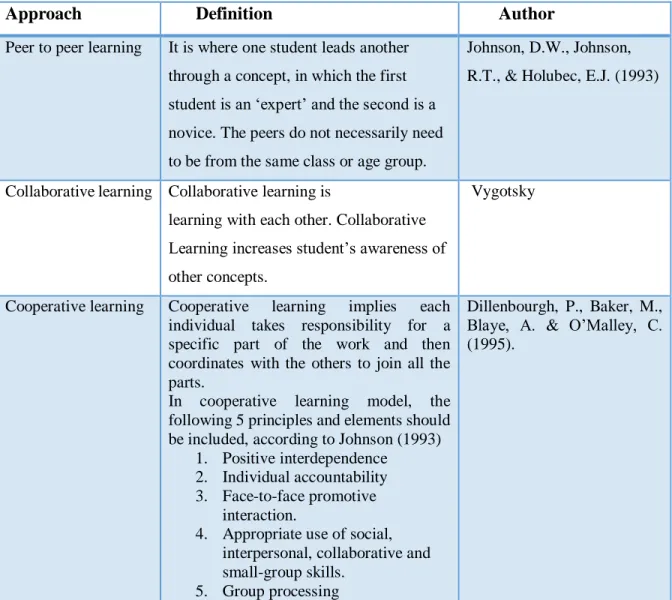
(18) COLLABORATIVE LEARNING IN THE COLOMBIAN EDUCATIONAL SYSTEM 10. Chapter 2: Relevant theoretical bases for the review and other reviews 2.1 Introduction This section presents a general outline of this paper. In addition, it points out the pedagogical implications of using this approach. First it is presented the theoretical review which give a specific idea about collaborative learning as an umbrella term that involves different strategies. Then it is given a complete comparison among definitions from different authors about collaborative learning, in the same way it is also given the differences among CL and other similar approaches that tend to be confusing. Finally, it is presented the implications of collaborative learning.. 2.2 Theoretical framework. 2.2.1. Defining collaborative learning Collaborative learning is an umbrella term that covers intellectual effort by teachers and students or students together according to Mac Gregor (1990). In collaborative learning, students work in small groups; they reciprocally try to understand and find a solution in order to present a product at the end. This approach is mostly student centered rather than teacher-centered. It implies material preparation and a lesson plan that fosters a good environment and makes all the members of the group work together collaboratively. According to Bruffee (1996), collaborative learning started in the middle of the eighteenth century in Britain as a consequence of the predominant authoritarian teaching style. It was noticed that students had problems with traditional methods, it was the moment when researchers looked into the problem and suggested.
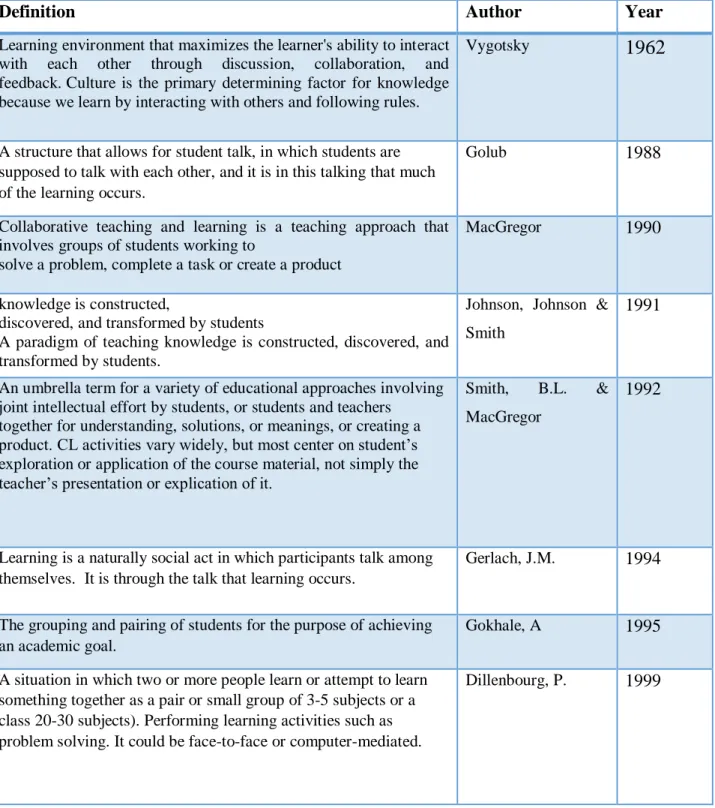
(19) COLLABORATIVE LEARNING IN THE COLOMBIAN EDUCATIONAL SYSTEM 11 other alternatives to teach their classes. To clarify the meaning of CL, different sources of literature were explored. Results are shown in table 1. Table 1. Collaborative Learning Definition. Definition. Author. Year. Learning environment that maximizes the learner's ability to interact Vygotsky with each other through discussion, collaboration, and feedback. Culture is the primary determining factor for knowledge because we learn by interacting with others and following rules.. 1962. A structure that allows for student talk, in which students are supposed to talk with each other, and it is in this talking that much of the learning occurs.. Golub. 1988. Collaborative teaching and learning is a teaching approach that involves groups of students working to solve a problem, complete a task or create a product. MacGregor. 1990. knowledge is constructed, discovered, and transformed by students A paradigm of teaching knowledge is constructed, discovered, and transformed by students.. Johnson, Johnson & 1991. An umbrella term for a variety of educational approaches involving joint intellectual effort by students, or students and teachers together for understanding, solutions, or meanings, or creating a product. CL activities vary widely, but most center on student’s exploration or application of the course material, not simply the teacher’s presentation or explication of it.. Smith,. Learning is a naturally social act in which participants talk among themselves. It is through the talk that learning occurs.. Gerlach, J.M.. 1994. The grouping and pairing of students for the purpose of achieving an academic goal.. Gokhale, A. 1995. A situation in which two or more people learn or attempt to learn something together as a pair or small group of 3-5 subjects or a class 20-30 subjects). Performing learning activities such as problem solving. It could be face-to-face or computer-mediated.. Dillenbourg, P.. 1999. Smith B.L.. & 1992. MacGregor.
(20) COLLABORATIVE LEARNING IN THE COLOMBIAN EDUCATIONAL SYSTEM 12. Reviewing what some experts have stated about Collaborative Learning, most of them agree in defining it as an approach that involves intellectual capacities subjects develop in order to join efforts together to find a solution to a task. It has been considered an umbrella term because there are varieties of this methodology. For instance, Dillenbourg (1999) states that CL could be developed either face to face or computer mediated, in small groups or groups of 20 or 30 people. Group members’ abilities and contributions help to prepare and solve a task. This is an important aspect experts mention, as well as the importance of the responsibility that each one has as a member of the group. Analyzing the advantages, CL has proven to be a successful approach with different ages of foreign language students, especially with young learners, in this way, the teacher can teach them social skills to improve their relationship rather than simply transmitting concepts and ideas. Nowadays, people need to develop social skills in order to accept and respect ideas from others. They should value contributions as well as share their own ideas in order to establish thoughts, solve a problem, complete a task or obtain a product. It is also important to mention that individuals should know that knowledge is constructed in the community (Vygotsky, 1978). CL is an approach that can be implemented with students of all ages, learning styles, and backgrounds because all of them can make contributions depending on their own previous experiences and knowledge. Gokhale (1995) declares CL is a proper approach because students improve their critical thinking and they are able to accomplish higher levels of learning as they work in groups rather than individually. Also, they are able to retain more information when it is received from their peers. CL also promotes interaction, communication and active participation instead of the passive way of receiving information from the teacher..
(21) COLLABORATIVE LEARNING IN THE COLOMBIAN EDUCATIONAL SYSTEM 13 2.2.2 Differences and implications in this approach Different ways to carry out and implement this approach can be confusing; that is why it is important to clarify the differences among collaborative learning, peer-to-peer learning, and cooperative learning.. Table 2. Differences with similar approaches. Approach Peer to peer learning. Definition. Author. It is where one student leads another. Johnson, D.W., Johnson,. through a concept, in which the first. R.T., & Holubec, E.J. (1993). student is an ‘expert’ and the second is a novice. The peers do not necessarily need to be from the same class or age group. Collaborative learning Collaborative learning is. Vygotsky. learning with each other. Collaborative Learning increases student’s awareness of other concepts. Cooperative learning. Cooperative learning implies each Dillenbourgh, P., Baker, M., individual takes responsibility for a Blaye, A. & O’Malley, C. specific part of the work and then (1995). coordinates with the others to join all the parts. In cooperative learning model, the following 5 principles and elements should be included, according to Johnson (1993) 1. Positive interdependence 2. Individual accountability 3. Face-to-face promotive interaction. 4. Appropriate use of social, interpersonal, collaborative and small-group skills. 5. Group processing. Collaborative and cooperative learning could be confused; but they are actually not alike. According to the experts and definitions given in the table above, CL implies the mutual.
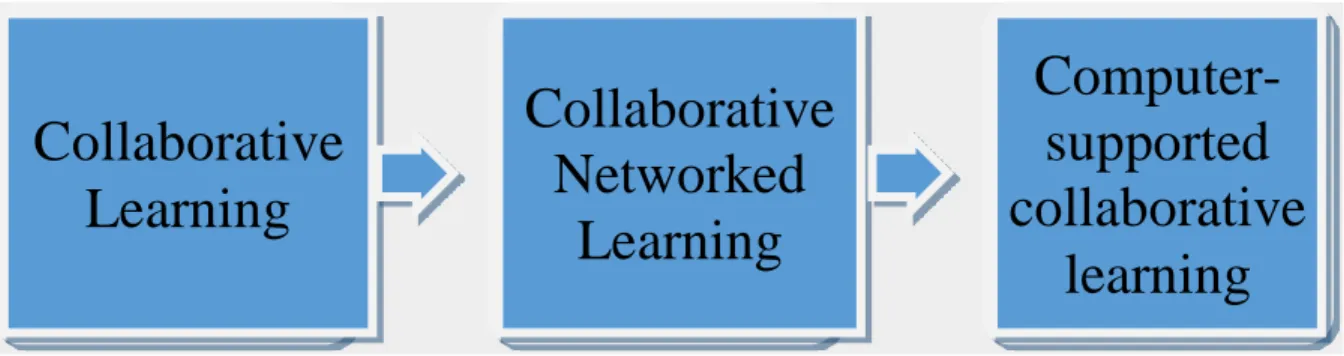
(22) COLLABORATIVE LEARNING IN THE COLOMBIAN EDUCATIONAL SYSTEM 14 engagement of participants and combines all efforts to figure out a task or a work. Cooperative learning implies individual accountability to contribute to the group’s success; each student takes responsibility of a specific task that is part of a project or a product. On the other hand, some authors believe cooperative learning is used for primary education, to understand the basis of knowledge, while CL is used for college and university students because it is used to teach nonfoundations of learning. However, there are similarities as both of them are group learning approaches, implying students take an active role in the class; and both of them suggest social responsibility and social skill development.. 2.2.3 Collaborative learning and information and communications technology, or technologies (ICTs). New technology has become an important aspect in education and it has had an important impact on students learning process. The use of the internet, for example, allows for communication and interaction between individuals and groups. Nowadays, virtual environments are common. Recent research studies have been conducted to investigate how new technology fosters collaborative learning. These studies show students are able to learn even when they were not present at their university campus (Stacey, 1999). According to Findley (1987), the use of ICTs has increased in CL and it is called Collaborative Networked Learning (CNL). This refers to the learning process that occurs through online interaction. In this process, each learner actively interacts in a group and exchanges knowledge with one another within a contextual framework. There is a new paradigm in education called Computer-supported collaborative learning (CSCL) which refers to the use of.
(23) COLLABORATIVE LEARNING IN THE COLOMBIAN EDUCATIONAL SYSTEM 15 technology in learning environments to support group interactions in a collaborative learning context. CSCL provides new knowledge using technology to complete a task or product. Nowadays, CL has evolved, and teachers have started to take advantage of ICTs to promote communication and interaction in collaborative tasks. Even now the use of 3D models facilitates and motivate students’ participation in group activities. This way, CL in virtual environments provides an excellent opportunity to promote the foreign language learning process. Figure 1. Evolution of Cooperative Learning. Collaborative Learning. Collaborative Networked Learning. Computersupported collaborative learning. Font: Researcher design. 2.2.4 Collaborative Learning Implications. Collaborative learning has some pedagogical implications that experts consider are vital in order to successfully observe its outcomes. For instance, Slavin (1997) suggests four key theoretical perspectives to explain the positive effects of collaborative learning: motivation, social cohesion, developmental, and cognitive elaboration perspectives. ➢ Motivational perspectives. Students in CL should feel interested and motivated as group members. All must feel they are an active member of the group and know their.
(24) COLLABORATIVE LEARNING IN THE COLOMBIAN EDUCATIONAL SYSTEM 16 responsibilities to make the group successful. All members of the group must help and encourage their mates to succeed. ➢ Social Cohesion Perspectives. This refers to the cohesiveness of the group. This approach emphasizes team-building activities in preparation for collaborative learning instead of using external motivations and individual responsibilities. Students help their group mates learn because they care about the group’s interest. ➢ Developmental perspectives. The important assumption of this approach is that interaction among students increases their critical thinking, promoting personal and social growth. If students of similar ages have developmental differences, then the more advanced peers can contribute from their experiences to build new knowledge and scaffold the less advanced learners’ learning process. ➢ Cognitive elaboration perspectives. CL is effective because participants elaborate new cognitive structures in a social context. They discover new knowledge and strengthen their own mental structures. All four perspectives should be considered in the application of CL, rather than the empirical way in which some teachers carry out this approach. It is important to know its implications and its theoretical bases to better guide the development and implementation of CL.. 2.2.5 Autonomy One of the most valuable benefits of collaborative learning is that it promotes the development of social, cognitive and metacognitive skills. It also fosters learners’ sense of responsibility since students move from interdependence to autonomy and build new knowledge.
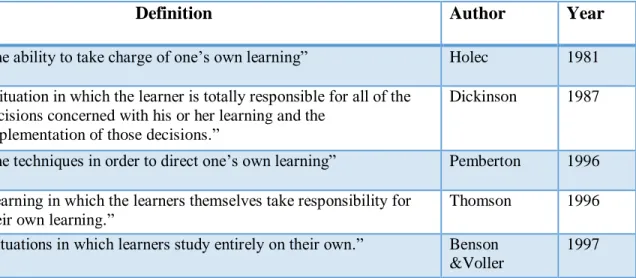
(25) COLLABORATIVE LEARNING IN THE COLOMBIAN EDUCATIONAL SYSTEM 17 in a collaborative way, making contributions and receiving help from others. It permits students to make decisions about their own learning. It promotes autonomy in learning and is a long-term pedagogic goal. The term autonomy is sometimes misunderstood when it refers to learning in isolation, working independently and alone. On reviewing different definitions about autonomous learning, different definitions were found. The information is shown in table 3.. Table 3. Different definitions about autonomy learning. Definition. Author. Year. “the ability to take charge of one’s own learning”. Holec. 1981. “Situation in which the learner is totally responsible for all of the decisions concerned with his or her learning and the implementation of those decisions.”. Dickinson. 1987. “the techniques in order to direct one’s own learning”. Pemberton. 1996. “learning in which the learners themselves take responsibility for their own learning.” “situations in which learners study entirely on their own.”. Thomson. 1996. Benson &Voller. 1997. In table 3, all of the authors agree with defining autonomy as students taking the responsibility of their own learning process. That is why collaborative learning is considered a good and pertinent approach to enhancement of autonomy as part of the social and humanistic skills that all learners should develop as future professionals. It means autonomous learners are able to choose the materials that best facilitate their comprehension, define strategies to learn, set goals and evaluate their process. Benson and Volley (1997, p.52) also mention that there are five ways in which students can develop autonomy:.
(26) COLLABORATIVE LEARNING IN THE COLOMBIAN EDUCATIONAL SYSTEM 18. a.. When students have to study entirely on their own.. b.. When students need to develop skills that can be learned and applied in selfdirected learning.. c.. When students need to account for an inborn “capacity” which is suppressed by institutional education.. d.. When students need to exercise the “learners’ responsibility” for their own learning.. e.. When students are given the “right” to determine the direction of their own learning.. Autonomous learners are characterized by high levels of responsibility and interest in improving learning. They also develop a coherent set of values and principles and are involved in a still-continuing process of censure and re-evaluation (Benn 1976, cited in Candy, 1991, p. 102). An autonomous learner is able to set his/her own goals, carry out his learning process, devote time to reflect about his/her learning, and evaluate his/her process, being conscious of this process and defining ways to improve it. On the other hand, Omaggio (1978) as cited in Wenden, 1998, pp. 41-42 defines some characteristics that identify an autonomous learner.. a.. Autonomous learners have insights into their learning styles and strategies.. b.. Autonomous learners take an active approach to the learning task at hand.. c.. They are willing to take risks, for instance they attempt to communicate in the target language at all costs.. d.. Autonomous learners are good guessers; it means a person who is able to infer and build up new concepts and knowledge from existing information..
(27) COLLABORATIVE LEARNING IN THE COLOMBIAN EDUCATIONAL SYSTEM 19. e.. Pay attention to the form as well as to content. Students place importance on accuracy as well as appropriateness.. f.. In the process of learning a foreign language, they are able to understand the target language system and make hypotheses and infer rules analyzing, applying and checking.. g.. They are able to define a flexible and reflexive approach that facilitates their learning process in the target language.. Collaborative learning promotes learners’ autonomy. A student is able to glean new knowledge from a group of learners in a collective way, which is helpful in promoting his autonomy in learning. This approach offers a supportive environment in which students learn to be more independent. A number of studies suggest that collaborative learning develops an interpersonal environment which promotes autonomy and responsibility in learners (Baumann, J & Jones, L., (1992). Collaborative learning offers an environment that helps learners build a community that increases the performance level of each member. Consequently, learners improve their critical thinking skills, and retention of information, while calling attention to, and developing interest in a specific topic. CL has positive effects in the learning process because as students learn in groups, they increase their cognitive skills and are more likely to get successful results. Students are able to develop a positive attitude towards learning, increasing their self-esteem. Consequently, students’ interest in the target language increases and their performance improves. Diener and Dweck (1978) state that a lack of self-esteem is likely to lead to negative attitudes towards one’s capability as a learner, and to a deterioration in cognitive performance (as cited in Wenden, 1998, p. 57)..
(28) COLLABORATIVE LEARNING IN THE COLOMBIAN EDUCATIONAL SYSTEM 20 2.2.6 Implementing Cooperative Learning It is important to bear in mind that there are a number of criteria to implement CL. It is necessary to specify roles and duties for students to fulfill their task. Teachers need to ensure that all members of the groups are chosen at random or use specific criteria, Rau and Heyl (1990) state that smaller groups may lack divergent thinking styles because they contain less diversity. However, larger groups might make it difficult to ensure all members participate, so according to Salvin (1989) it is important to keep groups smaller. ● Teachers should create a positive environment and have students become acquainted with each other. It is also important to encourage politeness, respect and good behavior towards others. ● Assign academic tasks that develop a collaborative spirit and engage students in important team building activities in which they support and learn from each other. ● Agree how long the group will work together, starting with one task, then a semester, to a whole year a whole project. ● Material is important to be prepared to distribute to the group. Instructions must be clear in order for students to work together. Salvin (1989) states that for effective collaborative learning, there must be group goals and individual responsibility. ● Clarify roles for each member of the group. The teacher may have to explain and demonstrate/practice these roles previous to, and during, the activity.. 2.2.7. Conclusion Collaborative learning is an approach that has positive effects on participants as it is based on a social structure that facilitates students’ interaction and improves their social skills..
(29) COLLABORATIVE LEARNING IN THE COLOMBIAN EDUCATIONAL SYSTEM 21 CL facilitates teaching since students are able to discover new knowledge through interaction. It means students learn from each other. It also has positive impact to produce a level of engagement, better than other forms of learning. On the other hand, students can explain things better to another student than a teacher to a class. CL develop teaching competences since students learn how to teach one another. CL creates a positive interdependency because students feel that they cannot succeed unless everyone in their group succeeds. Other positive benefits are that CL develops the ability to lead an activity and create responsibilities.. CL also has negative disadvantages for example, it makes students responsible for each other’s learning apart from themselves. It sometimes creates chances for conflict and consequently need for conflict resolution skills. In groups of mixed ability, low-achieving students become passive, demotivated and do not focus on the task. In big groups, it is difficult for the teacher to be sure that the groups are discussing the task rather than something else. Lower ability students may feel continually looking for help rather than experiencing the role of leader and be ready to help others in the group..
(30) COLLABORATIVE LEARNING IN THE COLOMBIAN EDUCATIONAL SYSTEM 22. Chapter 3: Research Design 3.1 A systematic literature review A systematic review is a piece of research that provides a general overview of literature on a specific topic (Boote & Beile, 2005). Thus, a systematic review addresses much broader questions than single empirical studies. According to Baumeister and Leary (1997), a good systematic review must clarify a particular problem; identify contradictions or relations; explore reasons for these; and elaborate an overarching conceptualization instead of summarizing different points of view (Sternberg, 1991). It must also develop a theory and describe directions for further research. The main characteristic for a systematic review is that it must be transparent and replicable; which implies a systematic search process to exploring studies that address a specific research question. It also implies presenting the findings resulting from the research. Baumeister (2013) recommends adopting the attitude of a judge and jury, rather than a lawyer. It means assuming the role of an evaluator in order to make a reasonable judgment instead of being subjective and choosing one side of an argument.. 3.2 Stages in conducting a systematic review To develop this research project, the stages described in the following table were considered. First, a question was formulated; then relevant research studies were selected in order to analyze their data and finally, their results were analyzed and summarized to build up the systematic review (Baumeister& Leary, 1997; and Cooper, 2008). Table 4. shows the stages to conduct a systematic review..
(31) COLLABORATIVE LEARNING IN THE COLOMBIAN EDUCATIONAL SYSTEM 23 Table 4. Stages to Conduct a Systematic Review according to Baumeister& Leary, 1997; and Cooper, 2008). STAGES. PROCESS. Scoping. Think about the audience, formulate one or more research questions as to clarify whether the planned systematic review has already been done.. Planning. Find as many potentially relevant articles as possible to include, make an exhaustive search of the most representative studies that have been conducted on the topic of interest.. Identification (searching). Search at least two different (relevant) electronic databases. Inspect the results and conduct additional searches to ensure you have located all relevant publications.. Screening. Export references to a citation manager to collate the search results. Read the Title and/or Abstract of identified work.. Eligibility. Sift the full-text version of potentially eligible articles and extract relevant information to be included.. 3.3 Research Paradigm and Methodology After following the steps mentioned above, the type of research was defined. This is a qualitative research study because the studies found are methodologically diverse in order to make a meta-analysis giving precise description. Marshall (1999) defines qualitative research as a process of trying to gain a better understanding of the complexities of human experience. Qualitative research is especially effective in obtaining culturally specific information about any topic or specific theme of interest. Family Health International (2005), defines qualitative research as the ability to provide complex textual descriptions about people’s experiences in any given research issue. It means that qualitative research helps to interpret and understand the complexity of a given situation and the implications of qualitative data..
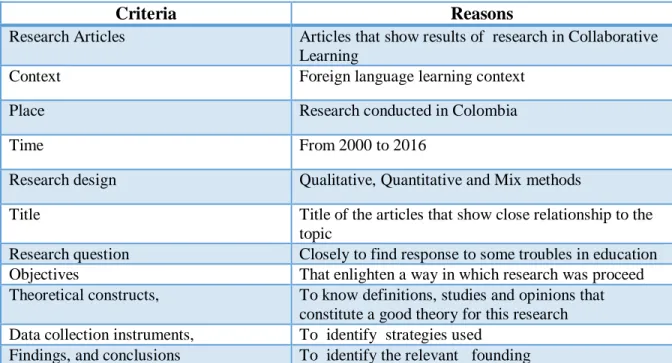
(32) COLLABORATIVE LEARNING IN THE COLOMBIAN EDUCATIONAL SYSTEM 24 To carry out this research, a variety of articles were considered because in Colombia a lot has been published during the last two decades. The researcher conducted this research for 4 months by using databases: EBSCO, PUBLINDEX, SCOPUS, Scielo, Latindex, RedALyC, Dialnet ResearchGate, DOAJ, as it is shown in table No 6. The key words about the topic, collaborative learning second language, bilingualism in Colombia educational system and approach, were introduced. The database provided the corresponding abstracts and keywords. R.A.E (Resumen Analitico Especializado) was imperative to find a synthesis of the concepts, approaches, proposals or ideas, following the structural organization from the original text.. At first, the research was only focused on general theories about CL. It was easy to find the information as there was a great quantity of material such as books and articles that contain this topic. This information was used to build the theoretical framework. After, an in-depth reading was carried out and the most interesting points of view according to the experts were summarized. Then, the search was focused on research projects conducted in Colombia during the last two decades. Only those articles related to CL in the context of foreign language learning were chosen. The purpose of selecting articles written as a product of any research study was to contextualize the research and help teachers to understand how this approach could be implemented in any Colombian educational context. It should be considered that there are local factors in the Colombian education system that affect the implementation of any approach. Therefore, it is significant for teachers to know how this approach has been implemented in educational contexts similar to the ones they experience..
(33) COLLABORATIVE LEARNING IN THE COLOMBIAN EDUCATIONAL SYSTEM 25 All the articles were reviewed and filtered according to the pre-established criteria in order to extract the relevant information. Each article was reviewed considering the title, research question, objectives, context, theoretical constructs, data collection instruments, methodology, findings, and conclusions.. Table 5. Criteria to select the articles. Criteria Research Articles. Reasons. Context. Articles that show results of research in Collaborative Learning Foreign language learning context. Place. Research conducted in Colombia. Time. From 2000 to 2016. Research design. Qualitative, Quantitative and Mix methods. Title. Title of the articles that show close relationship to the topic Closely to find response to some troubles in education That enlighten a way in which research was proceed To know definitions, studies and opinions that constitute a good theory for this research To identify strategies used To identify the relevant founding. Research question Objectives Theoretical constructs, Data collection instruments, Findings, and conclusions. Twenty-five (25) articles were finally selected; and then ten (10) were considered relevant for this systematic review. The information was extracted to a spreadsheet (see appendix 2). Then an in-depth review was made, considering the research questions and objectives defined in this research. This means the research question and objectives were related to the purpose of this research. Considering the inclusion and exclusion of the criteria, the studies found provided the theoretical framework underpinning the concept of CL and the differences with CL and Peer to.
(34) COLLABORATIVE LEARNING IN THE COLOMBIAN EDUCATIONAL SYSTEM 26 Peer Learning (PPL). The evolution of CL in CNL and CSCL was also included. The studies that provided evidence related to the use of this approach, including their contributions on current teaching situations were also identified.. 3.4 Data collection instrument and validation For this research, I defined instrument databases registers and R.A.E (Resumen Analitico Especilizado) where I found articles related to the studied topic. And instruments for the taxonomy and categorization of the Literature Review were also considered, this leads to the development of the theoretical framework, theoretical construct and conceptual framework of the articles that were selected. A literature map was also used to express relationships between ideas, arguments and concepts (See appendix 5). It was used as a tool to develop critical and analytical skills and to help me understand relationships in the concepts that were included in the articles used for this research. All the instruments were first piloted in order to verify its usefulness, then they were validated with experts in research who made suggestions to adapt them to my study.. 3.5 Ethical considerations In order to develop this research, the following considerations were considered, bearing in mind what Bryman and Bell (2007) state the most important principles related to ethical considerations in dissertations. First, I considered the adequate level of confidentiality of the research data used for this study. Also, the use of any type of ambiguous information was avoided, as well as representation of primary data findings that were biased in any way. For this research, articles carefully selected from indexed magazines were used that had academic consistency, which means the information they presented had a high grade of plausibility..
(35) COLLABORATIVE LEARNING IN THE COLOMBIAN EDUCATIONAL SYSTEM 27 3.6 Researcher’s role According to Denzin & Lincoln (2003), my role as a researcher was an instrument of data collection. This means that the data is mediated trough the human instrument rather than through inventories, questionnaires or machines. On the other hand, according to Creswell, (2007) the researcher’s role in qualitative research is critical, as he or she collects data and implements analysis. My role in this study was as an observer participant because I was the primary instrument for data collection and analyzing that data, coded and analysis the data to identify the emerging concepts and patterns..
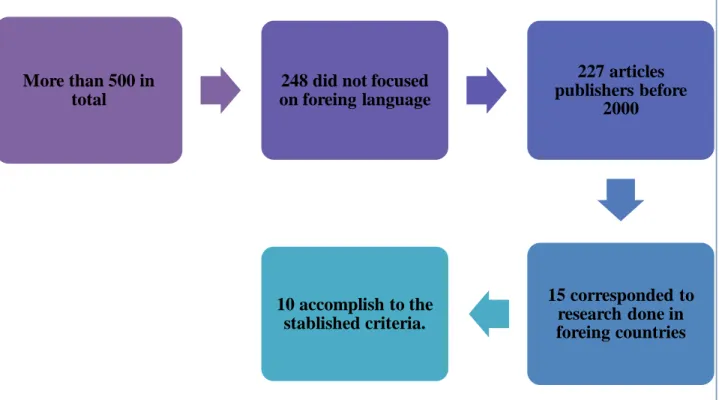
(36) COLLABORATIVE LEARNING IN THE COLOMBIAN EDUCATIONAL SYSTEM 28 Chapter 4: Results and Data Analysis 4.1 Introduction This chapter includes an explanation of the screening procedures applied to the studies that were obtained for this review. It presents a systematic review of the studies carried out during the last two decades in Colombia on collaborative learning. In addition, this review focuses on foreign language learning. According to the criteria established, 10 articles were analyzed in the present chapter.. 4.2 Results of the database search At the beginning of the search, more than 500 articles related to CL were found. However, taking into account the pre-established search criteria (see table 5.), 248 reports were excluded as they did not focus on foreign language learning. Some of the articles referred to the implementation of CL in teaching mathematics or chemistry in university settings, the impact of CL in the development of new knowledge and success of their academic development. Thus, those articles were not relevant for the purpose of this study. The 252 articles were analyzed, it was found that most of them corresponded to researches done before year 2000. The next step was to select the ones done during the last two decades, and 25 were found. However, 15 were done in other countries. Finally, 10 were analyzed because they fit the criteria..
(37) COLLABORATIVE LEARNING IN THE COLOMBIAN EDUCATIONAL SYSTEM 29 Figure 2: Selected Articles. More than 500 in total. 248 did not focused on foreing language. 227 articles publishers before 2000. 10 accomplish to the stablished criteria.. 15 corresponded to research done in foreing countries. Table 6. List of databases consulted. DATABASES. DEFINITION. Google Scholar. Abstracts and technical reports about this topic of research.. Scopus. The largest database of citations and abstracts of scientific journals, books and conference proceedings. Electronic library that selects collection of scientific journals from all areas of knowledge. Scientific Journals of Latin America and the Caribbean, Spain National scientific journals Scientific Journals of Latin America and the Caribbean, Spain and Portugal. Find abstracts and reports about research scientific publishing in Spanish Online directory that provides access to quality open access, peerreviewed journals.. Scielo Latindex Publindex RedALyC Researchgate Dialnet DOAJ.
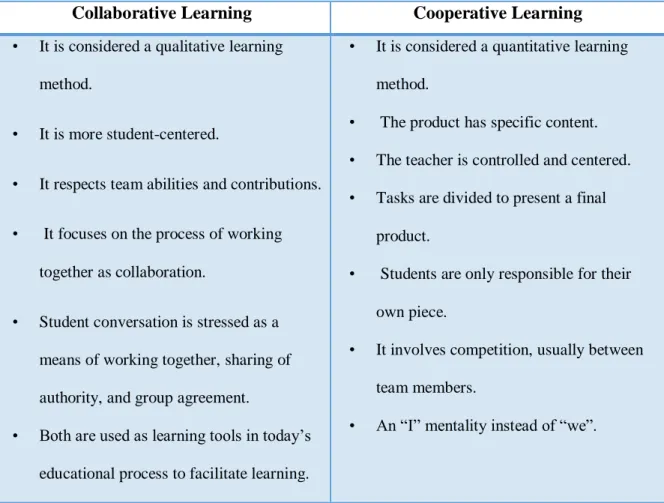
(38) COLLABORATIVE LEARNING IN THE COLOMBIAN EDUCATIONAL SYSTEM 30 There were 25 articles that were pertinent for this study; however, 15 of them corresponded to research studies done in other countries and this systematic review aims to include studies carried out in Colombia, therefore, only 10 articles were analyzed. As it was mentioned before, CL implies the mutual engagement of participants and combines everyone’s efforts to figure out a task or a work. Cooperative learning implies individual work in which each subject takes responsibility for a specific task that is part of a project or a product. Both of them are group learning approaches that imply that students take an active role in the class; and both of them suggest social responsibility and social skill development. The conclusion was that these two approaches have different methodological and epistemological implications. The table below illustrates the reason why they were explored. Table 7. Differences between Collaborative and Cooperative Learning. Collaborative Learning •. It is considered a qualitative learning. Cooperative Learning •. method. •. It is more student-centered.. •. It respects team abilities and contributions.. •. It focuses on the process of working together as collaboration.. •. method. •. The product has specific content.. •. The teacher is controlled and centered.. •. Tasks are divided to present a final product.. •. •. Both are used as learning tools in today’s educational process to facilitate learning.. It involves competition, usually between team members.. authority, and group agreement. •. Students are only responsible for their own piece.. Student conversation is stressed as a means of working together, sharing of. It is considered a quantitative learning. •. An “I” mentality instead of “we”..
(39) COLLABORATIVE LEARNING IN THE COLOMBIAN EDUCATIONAL SYSTEM 31 •. Both require knowledge and social skills.. •. These methods include placing learners into teams and groups.. •. Cooperative learning is more teachers oriented.. •. As for collaborative learning, students are in control of their own learning. •. Cooperative learning tends to facilitate competition between members.. The present study focuses on Collaborative Learning because according to the literature review, CL grants much more autonomy and students are in control of their learning process instead of the teacher. It means that teachers are guides and learners do not have to work alone. The final task is the result of a collaborative process. According to Mittan, cited in Ede, L., & Lunsford, A. A. (2001), “collaboration is a cross-fertilization of ideas, the energizing discussion among people with common interests and goals, the shared sense of accomplishments when those goals are reached”. It was important to take into consideration that working collaboratively implies a preparation of learners for the future. CL is a way to work together while using our individual abilities and no one team member takes on all the leadership and responsibilities.. 4.3 Characterization of the studies The criteria established earlier in the protocol designed restricted the selection of articles to those focused-on contents related to the research question of this thesis: What is the general definition of this approach and its implications according to the literature review included in the selected articles? As it was mentioned at the beginning, an increasing interest in investigating.
(40) COLLABORATIVE LEARNING IN THE COLOMBIAN EDUCATIONAL SYSTEM 32 the impact of collaborative learning in different educational contexts has arisen in Colombia. The articles reviewed in the different databases demonstrated that researchers have successfully implemented this approach.. To select the articles, some criteria were established in order to find the final ones that were thus analyzed, as it is shown in table 8. More specifically, the articles needed to address the topic of CL in the context of foreign language teaching and learning in Colombia during the last two decades. Other criteria of inclusion required articles with qualitative, quantitative, or mixed methods. Articles to be included in the review needed to focus only on populations located in the educational sector. Action research projects were also selected to identify the impact of implementing this approach across different levels of education. Table 8. Characterization of the studies. CRITERIA Content. INCLUSION Collaborative learning for teaching English as a foreign language.. EXCLUSION • • •. Setting Methodology. Type of publication Year of publication. All educational levels. Qualitative method studies Quantitative method studies Mixed method studies Action research Journal articles of studies done in Colombia.. During the last two decades. Collaborative learning other subjects, e.g. math. Collaborative learning for teaching other languages, e.g. French Studies done in other countries, e.g. China.. Non- formal education. Evidence of the impact.. Publications that were not related with the topic of this study; for example: autonomous learning, cooperative learning. Publications that report impact on other subjects. Articles published before year 2000.
(41) COLLABORATIVE LEARNING IN THE COLOMBIAN EDUCATIONAL SYSTEM 33 4.4 Interpretation of findings As it was mentioned before, there was an interest in identifying the evidences of implementing CL and the outcomes of studies done in Colombia. This review demonstrated that the entries of CL articles in different databases generated a wide number of results. However, the number of entries was significantly reduced when the concept studies dealt directly with CL in the foreign language learning context. It was important to identify some general characteristics of the studies regarding CL bearing in mind, for instance, years and place of production, population, and educational settings. 4.5 Deep analysis This section presents a deep analysis making a complete description of the population and sampling where CL has been implemented such as teenagers, young adults and adults, in the same way it is presented a description of the context where research studies were done, primary and secondary schools, private and state institutions. Finally, it is present the skills that according to the researchers found, have been develop using CL such as cognitive skills, social skills and interpersonal skills.. 4.5.1 Population: It is worth noticing that Collaborative Learning has been applied in different contexts and in all levels of education. Eight research studies were done in primary and secondary schools in Colombia. They were done in state schools and private schools with students of different ages. There were two research studies done in virtual and distance education and six in undergraduate programs. It means that CL is an approach that can be used in any level of education with students of different ages and different social strata since some of the research projects.
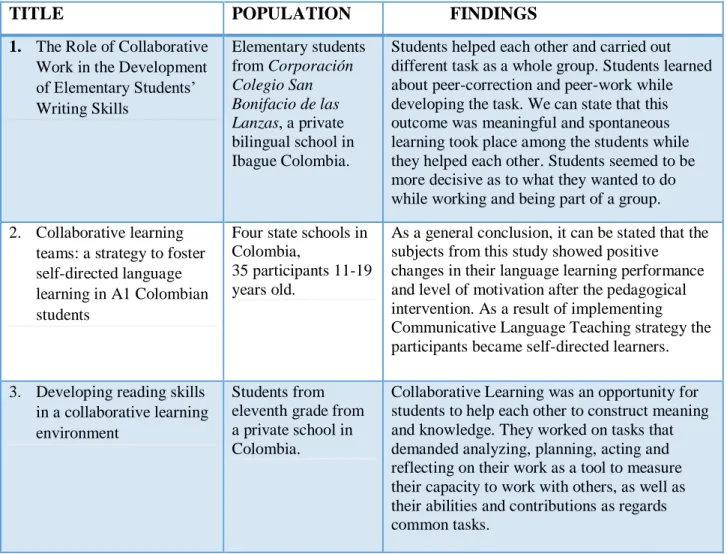
(42) COLLABORATIVE LEARNING IN THE COLOMBIAN EDUCATIONAL SYSTEM 34 mentioned in annex 2 were done in private institutions and others in public institutions. The table below shows the impact that the implementation of CL had on different groups of students. 4.5.1.1 Teenagers: Six studies done with teenagers from secondary schools were found.. Table 9. Implementation of Collaborative Learning. TITLE. POPULATION. FINDINGS. 1. The Role of Collaborative Work in the Development of Elementary Students’ Writing Skills. Elementary students from Corporación Colegio San Bonifacio de las Lanzas, a private bilingual school in Ibague Colombia.. Students helped each other and carried out different task as a whole group. Students learned about peer-correction and peer-work while developing the task. We can state that this outcome was meaningful and spontaneous learning took place among the students while they helped each other. Students seemed to be more decisive as to what they wanted to do while working and being part of a group.. 2. Collaborative learning teams: a strategy to foster self-directed language learning in A1 Colombian students. Four state schools in Colombia, 35 participants 11-19 years old.. As a general conclusion, it can be stated that the subjects from this study showed positive changes in their language learning performance and level of motivation after the pedagogical intervention. As a result of implementing Communicative Language Teaching strategy the participants became self-directed learners.. 3. Developing reading skills in a collaborative learning environment. Students from eleventh grade from a private school in Colombia.. Collaborative Learning was an opportunity for students to help each other to construct meaning and knowledge. They worked on tasks that demanded analyzing, planning, acting and reflecting on their work as a tool to measure their capacity to work with others, as well as their abilities and contributions as regards common tasks.. 4.5.1.2 CL with teenagers According to the findings shown in the table above, it seems that CL offers meaningful experiences for learners and for teachers as well since it allows teachers to create a better.
(43) COLLABORATIVE LEARNING IN THE COLOMBIAN EDUCATIONAL SYSTEM 35 environment for the learning process. Smith and Macgregor (1992) state that nowadays, CL is seen as a powerful tool that offers meaningful experiences for students and teachers. Here learning as a group is the manner that stimulates other learning processes. According to these authors, teachers are not the ones that possess all the knowledge; teachers rather encourage students to succeed in their learning processes. Findings in the following articles show that teachers successfully implemented CL. 4.5.1.3 Young Adults and Adults Table 10. Articles about Collaborative learning. TITLE OF ARTICLES. POPULATION. FINDINGS. AUTHORS. Collaborative Project Work Development in a Virtual Environment with Low-Intermediate Undergraduate Colombian Students. A virtual English language learning program at a public university in Bogotá (Colombia).. CL helped students to bridge the gap of isolation generated by distance in virtual environments, bringing more interaction, knowledge sharing, and responsibility.. Yakelin Salinas Vacca* Universidad Nacional de Colombia and Fundación Universitaria Los Libertadores, Bogotá, Colombia. Collaborative Work as an Alternative for Writing Research Article. A group of nine students in their tenth semester in the Electronics Engineering Faculty at Universidad Santo Tomas.. Most students showed a positive attitude during the development of each workshop and enjoyed working in groups. They helped each other; and also, they acquired specific roles conducting significant negotiations. CL encouraged the participants to take on different work roles, such as leaders, harmonizers, facilitators, compromisers, among others.. Nancy Emilce Carvajal Medina*1 Universidad Pedagógica y Tecnológica de Colombia, Tunja, Colombia Eliana Edith Roberto Flórez**2 Universidad Santo Tomás - Tunja, Colombia.
(44) COLLABORATIVE LEARNING IN THE COLOMBIAN EDUCATIONAL SYSTEM 36 Making Sense of Critical Pedagogy in L2 Education Through a Collaborative Study Group. Eleven members who all had different levels of teaching experience (from the Bachelor’s and Master’s program in Foreign Language Teaching). CL created a positive learning environment because it decreased the effects of anxiety often produced by complex content, and abstract concepts or ideas. Students could express their fears, ideas, biases, or lack of understanding.. Paula Andrea Echeverri Sucerquia Sebastián Pérez Restrepo Universidad de Antioquia, Medellín, Colombia. Collaborative Work with Wikis in the setting monitoring language learning 4.5.1.4 objectives. 15 adult learners at intermediate level B1 according to the Common European Framework of Reference (CEFR) at a language institute.. Students participated in the wikis and helped each other to make contributions. Students could assess the outcomes of their language objectives and they accomplished their expected languages learning process.. Santana Prieto, Boris Ernesto Universidad de la Sabana. Collaborative Learning and Autonomy in EFL University Students. Students from the fourth semester of Veterinary Medicine at a local institution in Tunja, Boyacá.. Students enjoyed working collaboratively. Students increased oral interaction in the foreign language and made their learning process meaningful. Students gradually began to diminish their fear of talking and took the risk of participating and interacting in the target language.. Molina Farfán, Zaida Carolina Universidad de la Sabana. 4.5.1.4 CL with young adults and adults. After analyzing the data, it can be concluded that CL was implemented with young adults and adults in face-to-face, virtual, and distance programs in different universities and institutions. In all these experiences, students were motivated to work in groups instead of working individually. Having a positive attitude is essential in the configuration of collaborative practices.
Figure
+7


Documento similar
In the education sector, Design Thinking offers a flexible learning framework with students being responsible for their own learning and fostering entrepreneurial skills such
motivation and interest; to encourage their active participation in learning experiences; to explore a constructivist approach in which students build their own learning
Students will also be expected to take responsibility for their own learning through careful guidance from both the language assistant and the teacher which will provide students
The aim of this paper is to demonstrate that reading authentic literary material in the English as a Foreign Language (EFL) classroom can improve students’ language learning skills as
This is a systematic review of the literature published in three major databases to explore the different teaching and learning methodologies, and analytics practices applied in
The Task Manager receives information about student events via the Process Manager, and decides the next set of achievable tasks depending on the active learning strategy, the
Busuu; (2) fieldwork, to observe learners’ learning experience in the two online communi- ties selected for the study; (3) online survey, submitted to learners to find out about their
Critical period effects in second language learning: The influence of maturational state on the acquisition of English as a second language.. Encyclopedic dictionary of
![thepedagogicalusability[ , ].Thepurposeofpedagogicalusabilityisnottoqualify oflearningactivityflows,includingasynchronousandsynchronouscollaborativetasks,andthegenerationofthelatter.Thus,inordertoenablethegenerationofcollaborative ofcollaborativelearningta](data:image/gif;base64,R0lGODlhAQABAIAAAP///wAAACH5BAEAAAAALAAAAAABAAEAAAICRAEAOw==)