
Lectins of Erythrina poeppigiana and Erythrina steyermarkii (Leguminosae): characterization and mitogenic effect
8
0
0
Texto completo
(2) 1040. REVISTA DE BIOLOGIA TROPICAL. and Harris-Hooker 1990, Maennel et al. 1991). Sorne lectins, as Phytohaemagglutinin (PHA) extracted from Phaseolus vulgaris and Concanavalin A (Con A) from Canavalia ensi formis, are commercially available mitogens. However, the bínding of lectins to the surface of lymphocytes does not necessaríly induce cellular activatíon. Lectins have been used to demonstrate structural and functional differ ences in membrane compositíon between nor mal and tumoral cells (Slesak et al. 1989, Figols et al. 1991, Slupsky et al. 1993). The biologícal importance of lectins has increased due to their potential for the purifica tion, selectíon and cloníng of subpopulations of cens involved in normal or pathological immune response (Cunnick et al. 1990, Tietz et al. 199]). In this investigation, the lectins from the seeds of Erythrina steyermarkii and Erythrina poeppigiana were isolated, bíochemically characterized, and screened for mitogenic activity on mononuclear leukocytes. MATERIALS AND METHODS Preparation oC tbe crude extracts: The seeds extracts of Erythrina steyermarkii and E. poeppigiana were obtained as described in a pre vious work (Nanne-Echandi and Aragón-Ortiz 1991) with slight modifications. BriefIy, 80 g of the seeds were homogenized with 500 mL of 0.15 M NaCl containing 3mM KCI, 0.05M sodi um phosphate buffer, pH 7.2 (PBS), and cen trifuged at 10000 g for 30 min at 4°e. The pro teins in the supematant were precipated with an equal volume of acetone and centrifuged at 10000 g for 10 ruin at 4 0e. The pellet was dis solved in .PBS and lyophilized. The protein con centration of the extracts was determined according to Bradford ( 1976).. Goat, horse, rabbit and human [A, B, O, (Rho (D)+, (Rho (D)-] erythrocytes were washed three times with NaCI 0.9 % at 3000 g for 5 min and resus pended at a 5% (v/v) concentration in the same solution. Hemagglutinating activity:. The hemagglutínating actlvlty was assayed in 96-well microtiter pIates (U shaped), using 100 f.1L of extract solution (5 mg proteinlmL), and adding 50 f.1L of erythro cyte suspension to each well. The agglutina tion was screened visually after one hour of incubation at room temperature.. In order to determine the carbohydrate recognízed by the lectin, 50 f.1L of a carbohy drate soludon (O. 1M) was added to 50 f.1L of the crude extract (5 mg of proteinlmL) and incubated one hour at room temperature. Immediately, 50 ¡.tL of a suspension of human erythrocytes (A, Rho (D)+) was added to each well, and incubated again for one hour at room temperature. The inhibitory effect of the carbo hydrates on the agglutination was determined by titration using double serial dilutions. Temperafure stability: One mL of each of the seed extracts (5mg/mL of protein) was incubated for 10 minutes at different tempera tures (4-100°C), and immediately placed in an ice bath. These extracts were then centrifuged at 3000 g for 5 minutes. The hemagglutinating activity of the supernatants was detennined as described previously, usíng human group A, Rho (D)+ erythrocytes. pH stability: The extracts were dissolved in saline phosphate buffers of different pH val ues (2-12), adjusted to obtain a protein con centratíon of 5 mglmL, and incubated for one hour at room temperature. The pH was read justed to 7.0 with 0.1M NaOH or with O.lM HC!. The precipitate was eliminated by cen trifugation (3000 g, 5 min) and the agglutinat ing activity of the supernatant was then assayed with human group A, Rho (D)+ ery throcytes. Isolation oC tb.e tedins: The crude extracts of the lectíns were adjusted to a pro tein concentration of 30 mglmL in PBS and were run through a· Sephadex G-I00 column (2.5 cm x 100 cm), at a flow rate of 20 mL/hour. Fractions of three mL were collected, screened at 280 nm, and their agglutinating.
(3) QUESADA et al.: Lectins of Erythrina poeppigiana and Erythrina steyermarkii (Leguminosae). aetivity determined with human group A, Rho (D)+ erythrocytes. Fractions showing positive results were passed several times at 4 oC through a Lactose-Agarose column (Sigma, USA). After washing the column extensively with PBS, the bound material was eluted with 100 mL of 2M D-laetose in PBS. The eluate was dialyzed 48 hours at 4 oC against PBS, and eoncentrated through a stirred eell fi!ter with a 30 k:Da pore membrane. Human peripheral blood mononuclear eells were separated from venous blood of hea1thy adult volunteers by density gradient eentrifugation on Fieoll (B¡;}yum 197 1). Cell cultures were performed as previously described (González et al. 1992). Briefly, the mononuclear cells were eultured at a density of 1 x 10⁵ cells/well in RPMI medium (Sigma, USA) with 10% fetal calf serum (FCS) in the presence of serial dilu tíons of the leetin fraetion obtained from the gel filtration. PHA (6.5 flg/mL) and medium alone were used as controIs. The cultures were incubated at 37°C for 48 hours in an atmos phere containing 5% CO2, followed by a 24 hour pulse with 1 flg 3H-thymidine/well. The eells were harvested on filter paper dises and the thymidine incorporation was assessed using a beta counter. AH samples were run in triplicate. Mitogenic activity:. RESULTS The seed extracts obtained from E. steyer markii and E. poeppigiana aglutinate aH types of human erythrocytes of the ABO and Rho(D) positive and negative systems. Differences were found when erythroeytes from other mammalian species were tested with the extraets. The E. steyermarkii seed extraet did agglutinate rabbit erythroeytes, but not goat or horse erythrocytes, and the E. poeppigiana seed extract did not agglutinate any of these types of erythroeytes (Table 1). Working with human A, Rho (D)+ ery throeytes that were randomly seleeted since all. 1041. TABLE 1. Agglutinating activity of the lectins from E.steyermarkií and E. poeppigiana with different erythrocytes types. Human. erythrocytes. Animal. erythroeytes. Extraet. A. B O Rabbit. Erythrina steyermarkii. +. + +. +. + +. Erythrina poeppigiana. +. -. Goat. Horse. +. Haemagglutination No haemagglutination. types of human red cells were agglutinated by the leetin extraets, the inhibition of the agglu tinating effeet of the seed extraets was experi mentaHy tested against D-galactose, D-lae tose, D-N-acetyI galactosamine, L-rhamnose and other earbohydrates. The titers of the inhi bition of haemagglutination tests using D galactose, D-laetose, D-N-aeetyl galae tosamine and raffinose, against the leetin extracts of both Erythrina species, are shown in Table 2. D-galactose, D-laetose, D-raffinose and D-N-acetyl galactosamine inhibit the agglutination of the human erythrocytes on both seed extraets (Table 2). In the particular ease of Erythrina steyermarkii extract, agglu tination of human erythroeytes was inhibited by D-raffinose. This carbohydrate had no inhibitory effect when tested with rabbit red eells (Table 3). The results of the mitogenie effect of both extraets against mononuclear eells isolated fram peripheral blood of two hea1thy human donors are presented in Figure 1. E. steyermarkii extract showed mitogenie effeet on these eells, whereas E. poeppigiana extract did not have any effeet on mononuclear cells. The effeet of temperature on the eapaeity of haemagglutination of both extracts was investigated. The extraets were heated at dif ferent temperatures, ranging from 40 to 90°C for ten minute intervals. It was found that the hemagglutinating capacity was stable between 40 and 70°C, and was lost eompletely al 80°C..
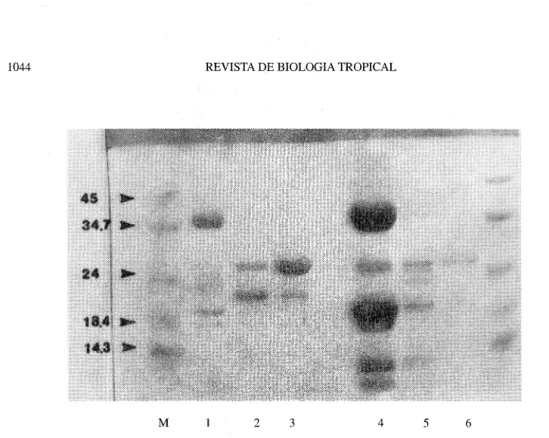
(4) REVISTADE BIOLOGIATROPICAL. 1042. TABLE2. Titer oj the inhibitory activity oj the carbohydrates on the haemagglutination· oj human erythrocytes (A Rh+}with the lectins ojE. poeppigiana andE. steyennarkii. 1:1. 1:2. 1:4. 1 :8. + +. + +. +. ±. +. +. +. N-Acetyl Galactosarnine. +. +. +. +. +. Raffinose. +. +. +. +. + + +. + + +. + + +. +. +. Raffinose. +. +. +. +. Rharnnose*. +. +. E. POEPPIGIANA Galactose Lactose. 1:16. 1:32. 1:64. E. teyennarkii Galactose Lactose N-Acetyl GaJactosarnine. +. + +. +. * hemagglutinating inhibition with rabbit erythrocytes.. TABLE 3. lnhibitory activity oj carbohydrates (0.1 M) on the haemagglutination oj human erythrocytes (A Rh+) and rabbit erythrocytes by the lectin ojE. steyennarkii. Rabbit. A+. Carbohydrate D-Lactose D-N-Ac Galactosamine D-GaJactose L-Rhamnose. + + +. D-Raffinose D-N-Ac Glucosarnine Sorbose. +. + + + +. column. In E. poeppigiana extract four frac. tions were observed whereas five fractions were separated in the extract of E. steyer. markii.. In. both extracts, the hemagglutinating. activity was located in the second fraction (Fig. 2).. Further purification of the lectins was. achieved by collecting the hemagglutinating fractions, concentrating and passing them through an affinity chromatography column with agarose-Iactose. The molecular weight of the hemaggluti nating fractions, determined by gel filtration in. D-Glucose. Sephadex G-100 was estimated as 50 kDa (Fig. Inositol D-N-Ac Mannosamine. 3). By polyacrylamide gel electrophoresis (SDS-PAGE), under reducing conditions, the. TrehaJose D-Mannose. hemagglutinating fraction of both lectins. D-Saccharose. obtained by affinity chromatography have a. Sorbitol D-Xylose. molecular weight close to 25 kDa. These find. ing suggest that each lectin ís formed by two subunÍts of similar molecular weight.. + Inhibitory activity - No inhibitory activity. Regarding. pH,. the. activity. extracts remained constant at pH was lostat pH 11.. 2. of both to 10, and. Fractionation of crude extracts was per. formed by gel filtration on Sephadex. G-lOO. DISCUSSION The extracts of E. poeppigiana and E.. steyermarkii agglutinated all types of human. erythrocytes tested. These findings agree with.
(5) 1043. QUESADA el al.: Lectins of Erythrina poeppighma and Elythrina steyennarkii (Leguminosae). A. 1. 14(XJ(l. 120m. +. ¡(XJOO E. '7. 35. a E sttyarwr.L.-ii ti E. poep¡úgia:;¡) o PES. ¡S. f. 8000. 4(;(,'0. 2DOO. .·. .. ··········,·. .. ·. · .. ··.. ········.. ··..·. ": ���T - t;; =�=: �j. t. 6000. ( .. . . . l·. . . t: .. ................... ... 1, . . . .. 3. '.l. DHution. 1. B lROOO. 1. E. fr. 6IKM). .. .. .. .. C. r. 50. tj. E.. :llfYefmarkii. 1m. · ... ... . ·. · .. .. ._. .. ···. .... ·. .. .. ... E.. poerpj¿�¡(jna. i50. 100. Fraction. 2:IÜ. NI'.. 1:1 PBS. (A) and E. steyer (8) extraets on Sephadex G-IOO coiumn.. Fíg. 2. Gel filtration uf E. poeppigiana. ::" t ¡20Ofl. . . . . . +. . . . ... . J\·. -j--. . \ . i. ... o:¡ C::=t�fC'=�. 4iXlü "1. 161100. .. r. markii. Agglutination of human erythrocytes was observed in the fractíons of peak 2 from both extrae!s (*). Protein markers:. 1. Bovine ,erum albllmin (66 kDa). 2.Carbonic tmhydrase 3. Lysozyme (14.3 kDa).. (29 leDa).. •. 4000 200.n. o. studied. In the pE:rticular case of the extract of 1/2. !/4. liS. 1/16. 1/32. DHution Fig.. l. Mitogenic response of human rnononuclear cells. fmm two healthy donors (A, B) to hemagglutinatíng frac lÍons obtained by gel filiration of extracts of E. steyer markii and E. poedppigiana.. E.. steyermarkii; agglutination was obsel'ved. with rabbit red cells. These observations sug. gest that this lectin is similar to the one isolat ed from E.. edulis by Pérez (1984). This leetin. agglutinated rabbit red cells, but had no effeet on horse or goat erythroeytes. The mitogenic effect of both lectins was evaluated with mononuclear cells isolated. those of ABen and Brillantíne (1969), who 1'ound that the vast rnajority 01' lectins aggluti. [mm the blood of t\ll<'O healthy donors. Results. varied in eaeh case. With dOílOf A the mito. nate in a non specifie way all types 01' human. genic effect increased with higher dilution.. red censo. This could be explained by assuming that. Horse and goal red ceUs were not aggluti nated by the lectin extraets 01' both species. interfering substances present in the extraet partially inhibited cel! proliferation.. This.
(6) REVISTA DE BIOLOGIA TROPICAL. 1044. M. Fig.. 2. 3. 4. 5. 6. 3. SDS-PAGE run under redueing eonditions of the extracts ü'om E. steyermarkii and E. poeppigiana. M: protein mark 2: Positive fraetion fmm gel filtration of E. poeppigiana. 3: Leetin of E. poeppigiana. ers. 1: E. poeppigiana erude extraet.. isolated froIn affinity ehromatography. 4: E. steyemwrkii erude extrae!. markii.. 6: Leetin of E.. 5: Positive fraction from gel filtration of E. steyer. steycmUlrkii isolated by aílinity ehromatography.. effect was 10st at higher dilutions. On donar B not such effect was observed, and the mito genic effect was more intense at lower dilu tions ( 114 and 1/8). Nevertheless, it was evi dent that only the extract of E. steyennarkii has mitogenic effect. In a previous investigation by Lis et al. (1985) it was found that among a group of lectins investigated, six of them agglutinated rabbit red cells and had mitogenÍC on lymphocytes isolated from peripheraJ human blood, whereas three weakly aggluti nated rabbit erythrocytes and two of them dis played a poor mitogenic effect D-galactose, D-N-acetygalactosamine and D-Iactose inhibited the agglutinating activity of both extracts in human red blood cells. Of these carbohydrates, D-lactose was the most potent, inhibiting at a mínimum concentration of 3.1 mM. AH of the Erythrina extracts that have been studied in the past by various authors, show the sarue pattern of inhibition with these carbohy drates (Bhattacharyya et al. 1981, Lis and Sharon 1985, Nanne and Aragón 1991).. The inhibitory activity of raffinose of haemagglutination by both extracts can be explained by the recognition of the galactose moiety of this trisaccharide. L-rhamnose ol1ly inhibits the agglutination of rabbit red cells with the E. steyermarkii extract. Lis et al. ( 1985) proposed that the differences in behavior of the different lectil1 extracts with .rabbit red cells and mononuclear human cells is caused by variation in or clase the combina tion site of the carbohydrate to the red cell membrane. Incubating the lectin extracts at different temperatures (40-90°C) the hemagglutinating capacity remained intact in a 40 to 70°C mnge, but was 10st at 80 oc. Similar results were reported by Bhattacharya et al. ( 1981) and Nanne and Aragón ( 1991). The stability of the extracts at various pH ranges demonstrated tha! these remained constant between pH 2 and pH 10, completely loosing hernagglutinating capacity at pH 11. Roberson and StTenght ( 1983) and Cammue et al. ( 1985) reported that.
(7) QUESADA et al.: Lectins of Erythrina poeppigiana and Erythrina steyermarkii (Leguminosae). the lectins from the seed of Vigna unguiculata and the tubercle Eranthis hyemalis maintained their hemagglutinating activity in a pH range. of 2 to 12 for the Vigna extract, and from 3 to. 11 for the Eranthis extract. Nanne and Aragón. (1991) found tIlat the lectin of Erythrina coslaricensis is stable at a pH range of 2 to 10. The molecular weight of the lectins stud ied, determined by gel filtration, was approxi mately 50 kDa, similar to other Erythrina. 1045. de poliacrilamida y duodecil sulfato de sodio (SDS PAGE). Con la filtración en gel y el SDS-PAGE, se com probó que las dos lectinas tienen una masa molecular aparente de 50 kDa y. que están formadas por dos sub unidades de 25 kDa, aproximadamente. Se buscó un efec mitogénico en las dos lectÍnas y se encontró que sólo E. steyermarkii lo manifestaba sobre células mononucleares. to. humanas aisladas de sangre periférica. Se determinó la estabilidad de las ¡eetinas en diferentes ámbitos de tem peratura (4 a 100°C) y de pH (2 a 12 ). Las dos lectinas se. mantuvieron estables en un rango de temperatura de 40 a. 70°C y en un pH de 2 a 10.. lectins (Pérez 1984, Lis and Sharon 1985). By polyacrylamide gel electrophoresis (SDS REFERENCES. PAGE), a molecular weight close to 25 kDa was determined, suggesting that each lectin is formed by two subunits of similar molecular weight.. Adar, R. & N. Sharon. 1996. Mutational' studies of the. amino aeids residues in the combining site of. Erythrina corallodendron. Eur. J. Biochem. 239: 668-674. ABen, N.K. & L. BriBantine. 1969.A survey ofhemagglu. ACKNOWLEDGMENTS. tinins in various seeds. J. Immunol. 102: 1295-1299.. We. gratefulIy. acknowledge. the. International Foundation for Science (IFS, grant # F/2279-1) and the University of Costa Rica for the financial support and Jorge Gómez Laurito, School of Biology, University of Costa Rica, for the taxonomical identifica tion of the Erythrina trees.. Barondes, S.H. 1981. Lectins: their multiple endogenous cellular funetions. Ann. Rev. Bioehem. 50: 207-231. Bhattacharyya, L., P.K. Das & A. Sen. 1981. Purification and properties of D-galactose binding leetins from. sorne Erythrina species. Comparison of properties of lectins from E. indica, E. arborescens, E. suberosa. and E. lithosperma. Arch. Bioehem. Biophys. 211: 459-470.. RESUMEN Las diferentes especies de Erythrina se encuentran ampliamente distribuidas en Costa Rica y se las conoce popularmente con el nombre de "poró". En el presente estudio, se seleccionaron dos especies: Erythrina poeppi. giana y Erythrina steyermarkii. Se prepararon extractos. de las semillas en solución tampón salina de fosfatos y se verificó la presencia de lectinas en ellos mediante l a técni. ca de hemaglutinación, utilizando eritrocitos humanos. Se trató de demostrar un efecto selectivo de la hemagluti nación empleando eritrocitos de varias especies de mamíferos, específicamente de carnero, caballo y conejo. Solo los eritrocitos de conejo fueron aglutinados con la lectina de E. steyermarkii. El efecto hemaglutinante de las dos lectinas fue inhibido con los siguientes carbohidratos: D-galactosa, N-D-acetil galactosamina, D-Iactosa y D rafinosa. La lectina de E. steyermarkii también fue inhibi da con L-rhamnosa. Las dos lectinas fueron aisladas por filtración en gel y cromatografia de afinidad, usando lac tosa como ligando. Las fracciones que resultaron positivas se analizaron mediante la técnica de electroforesis en gel. B\'!yum, A. 1976. Isolation of Iymphocytes, granulocytes and macrophages. Scand. J. Irnmunol. 5: 9-15. Bradford, M. 1976.A rapid sensitive method fot the quan titation of microgram quantities of protein utilizing the principIe of protein dye binding. Anal. Biochem. 72: 248-254. Cammue, B. P., B. Peeters & W. J. Peumanns. 1985. Iso. latÍon and partial characterization of an N-acetyl. galactosamine specific lectin from winter aconite. (Eranthis hyemalis) root tubers. Biochem. J. 227: 949-955. Cunnick, l.E., K. Sakarnoto, S.K. Chapes, G. W. Fortner & D. Takemoto. 1990. Induction of tumor cytotoxic cells using a protein from bitter melon (Momordica. charantia). CeIl. Irnmunol. 126: 278-289. Figols, J., lE Madrid & 1. Cervós-Navarro. 1991.Lectins as. differentiation markers of human gliomas. Histol.. Hístopath. 6: 79-85.
(8) REV ISTA DE BIOLOGIA TROPICAL. 1046. González, L., E. Saénz, S. Rodríguez & O. Porras. 1992.. Cuantificación de linfocitos T mediante rosetas con. Roberson, BJ & D.R. Strenght. 1983. Characterization of a lectin from cowpeas. Prep. Bioehem. 13: 45-56.. glóbulos de camero y respuesta mitogénica a lecti nas. Rey. Cost. Cienc. Med. 13: 37-42.. Sansford, G.L & S. Harris-Hooker. 1990. Stimulation of yascular cell proliferatíon by 6-galactoside specific. Laemmli, U.K. 1970. CleaYage of structural proteins du. lectíns. FASEB J. 4: 2912-2918.. ring the assembly of the head of the bacteriophage T4. Nature. 227: 680-685.. Slesak, B., J. Boguslawska-Jaworska, 1. Pejez & A. Harlo. zinska. 1989. Binding of lectins to human leukaemic. Lis, H & N. Sharon. 1985. Iso1ation and properties of N. cells. Folia. Hematol. 116: 251:259.. acetyllactosarnine-specific lectins from nine Erythri. na species. Phytochem. 24: 2803-2809. Mannel, D.N., H. Becher, A. Gundt, A. Kist & H. Franz.. Slupsky, J.R., M. Duggan-Keen; L. A. Booth, A. Karpas,. E.G. Rhodes, lC. Cawley & M. Zuzel. 1993. The. peanut agglutínin (PNA)-binding surface eomponent. 1990. Induction of tumor necrosis factor expression. of malignant plasma cells. Br. J. Haematol. 83: 567-. by a lectin from Viscum album. Cancer. Immnol. Im. 573.. munother. 33: 177-182. Nanne-Echandi, C.I & F. Aragón-Ortiz. 1991. Aislamien. Tietz, HJ., T. Montag, H.D. Volk, E. Brose, R. Garnen. berg, F.F. Weichold & T. Hiepe. 1991. Actíyation of. to, purificación y caracterización de una lectina de la. human CD4+ and CD8+ cells by Sarcocystis gigan. semilla del poró, Erythrína costaricensis. (Legumi. tea lectin. Parasitol. Res. 77: 577-580.. nosae). Rey. Biol. Trop. 39: 15-21. Pérez, G. 1984. Isolation and characterization of a lectin from the seeds of Erythrina edulis. Phytochem. 23: 1045-1048.. Van Léuyen, F., S. Torrekens, E. Van Damme, W. Peu. mans & H. Van den Berghe. 1993. Mannose-speci. fie lectins bind a-2-macroglobulin and an unknown protein from human plasma. Protein Science. 2: 255-263.. Quiocho, F.A. 1986. Carbohydrate-binding proteins. Ter tiaIy structures and proteín-sugar interactions. Ann. Rey. Bíochem. 55: 287-315..
(9)
Figure

Documento similar
Using the different stimulations (rLiHyV, Peptide1, Peptide2 and SLA) in the spleen cells of mice of the rLiHyV/saponin group; it was observed that both Peptide1 and Peptide2 were
In the same figure, it can be observed that SKNSH, MCF-7, and C33-A cells lines did not show significant changes in cell viability with the different lectin concentrations, which
The performance and durability of PEM fuel cells significantly depend on variations in the concentrations of hydrogen and oxygen in the gas channels, water activity in the
The high crystallinity of studied graphite makes central Spain graphite suitable for 360. applications in advanced technologies, as graphene
In the present review, we will focus on the effects of PUFAs on a cardiac sodium channel (Na v 1.5) and two potassium channels involved in cardiac atrial and
As a result of the study, it was determined that “Exclusion,” one of the sub-dimensions of “Social Exclu- sion,” had positive and significant effects on “Powerlessness”
This section presents a brief introduction to the physics of uorescence on the nanoscale, and considers the most relevant topics for understanding the results obtained from the
Of special concern for this work are outbreaks formed by the benthic dinoflagellate Ostreopsis (Schmidt), including several species producers of palytoxin (PLTX)-like compounds,
