Facultad de Filosofía, Letras y Ciencias de la Educación Carrera de Lengua y Literatura Inglesa
Methods and techniques for vocabulary teaching used in the fifth, sixth and
seventh grade at República del Ecuador primary school
Trabajo de titulación previo a la obtención del título de Licenciado en Ciencias de la Educación en Lengua y Literatura Inglesa Autor:
Jhordan Stalin Mejia Matute CI: 1400996599
Correo: [email protected]
Directora:
Mgt. Sandra Leonor Cabrera Moreno CI: 0105027049
Cuenca, Ecuador
Jhordan Stalin Mejia Matute
Página 2
Resumen:
Esta investigación tuvo como objetivo determinar cuáles son los métodos y técnicas utilizados en el quinto, sexto y séptimo curso de educación básica en la escuela primaria República del
Ecuador. Para determinar los métodos y técnicas utilizados por el profesor se aplicaron tres instrumentos: una entrevista al profesor, una hoja de observación de las clases y una
conversación guiada con un grupo focal. Los resultados obtenidos permitieron determinar qué métodos y estrategias se utilizan para enseñar vocabulario. Así mismo, la investigación permitió identificar la relación entre el discurso del docente y sus prácticas en el aula de inglés.
Jhordan Stalin Mejia Matute
Página 3
Abstract:
The following research study aimed to determine what methods and techniques were used to teach vocabulary in the fifth, sixth and seventh grade at República del Ecuador primary school. In order to determine the methods and techniques used by the teacher, three data collection techniques were applied for the purpose: an interview, an observation, and a guided conversation with a focus group. This research allowed to determine the methods and techniques used to teach vocabulary in the EFL classroom at this particular school. Likewise, the study enabled a deeper understanding of the relationship between teacher’s discourse and her actual practices in the classroom.
Jhordan Stalin Mejia Matute
Página 4
Table of contents
Resumen ... 2
Abstract ... 3
Table of contents ... 4
Acknowledgements ... 10
Introduction ... 11
1: Description of the research ... 12
1.1. Problem statement ... 12
1.2. Background and Justification ... 13
1.3. Research questions ... 17
1.4. Objectives ... 17
1.4.1. General Objective ... 17
1.4.2. Specific Objectives ... 17
Chapter 2: Literature review ... 18
2.1. Importance of learning vocabulary ... 18
2.2. Methods for teaching vocabulary ... 19
2.2.1. Teaching vocabulary through non-traditional methods ... 20
2.2.2. Games as a tool for teaching vocabulary ... 22
2.3. How non-traditional methods suit students’ learning preferences ... 25
Chapter 3: Theoretical framework ... 26
Jhordan Stalin Mejia Matute
Página 5
3.1.1. Form and meaning of words ... 26
3.1.2. Active and passive vocabulary ... 26
3.1.3. Word levels ... 27
3.2. Method vs. technique ... 28
3.3. Traditional method ... 28
3.3.1. Drilling ... 29
3.4. Non-traditional methods ... 30
3.4.1. Realia ... 30
3.4.2. Imagery ... 31
3.4.3. Mimics ... 32
3.4.4. Games ... 32
3.4.5. Role play ... 33
3.4.6. Brainstorming ... 34
3.5. Natural approach ... 34
3.6. Total Physical Response ... 35
3.7. Communicative approach ... 35
Chapter 4: Methodology ... 36
4.1. Research design ... 36
4.2. Participants ... 36
4.3. Data collection and analysis procedures ... 36
Chapter 5: Results ... 40
Jhordan Stalin Mejia Matute
Página 6
5.2. Observation ... 41
5.3. Results of the guided conversation ... 46
Chapter 6: General discussion ... 48
Conclusions and recommendations ... 50
Conclusions ... 50
Recommendations ... 50
References ... 52
Appendices ... 61
APPENDIX A. Questions for interviewing English teachers ... 62
APPENDIX B. List of codes through In Vivo Coding Method ... 64
APPENDIX C. First Cycle of researcher-generated codes for data analysis ... 66
APPENDIX D. Second cycle of researcher-generated codes for data analysis ... 68
APPENDIX E. Observation sheet results chart ... 69
APPENDIX F. Guided conversation transcript in fifth grade ... 72
APPENDIX G. Guided conversation transcript in sixth grade ... 80
APPENDIX H. Guided conversation transcript in seventh grade ... 90
Jhordan Stalin Mejia Matute
Jhordan Stalin Mejia Matute
Jhordan Stalin Mejia Matute
Página 9
Dedication
Jhordan Stalin Mejia Matute
Página 10
Acknowledgements
Jhordan Stalin Mejia Matute
Página 11
Introduction
The following research study aims to determine what methods and techniques are used to teach vocabulary in the fifth, sixth and seventh grade at República del Ecuador primary school. In order to determine the methods and techniques used by the teacher, three data collection techniques were applied: an interview, an observation, and a guided conversation with a focus group.
This research work encompasses six chapters. In the first chapter, the researcher provides a concise description of the research. The statement of the problem as well as the background and justification are outlined as the bases for the present research. In addition, the objectives and research questions that guide this study are clearly stated. The second chapter provides a review of the literature available for the methods and techniques used to enhance vocabulary in the EFL classroom.
The third chapter is the theoretical framework, a section that provides key concepts to better understand how vocabulary learning works and what are the techniques used in traditional and non-traditional methods. The fourth chapter describes the methodology that was used for collecting and analyzing data in order to determine what the teacher of the fifth, sixth and seventh grades does to enhance vocabulary learning. It also describes the characteristics of the participants.
The fifth chapter presents the results of the study and the sixth chapter presents a general discussion that allows a deeper understanding of the relationship between the teacher’s discourse and her actual practices for teaching vocabulary. Finally, the researcher focuses on conclusions and recommendations. The appendices section includes the observation tables and the
Jhordan Stalin Mejia Matute
Página 12
1: Description of the research
1.1. Problem statement
In Ecuador, students have a low level of English in comparison with other countries, as stated in a survey done by EF English Proficiency Index (Heredia, 2017). Thus, it is necessary to look for techniques and methods that will help students overcome the obstacles that do not allow them to become proficient in English as a foreign language (EFL). According to Linse (2006), a possible way to help students enhance their overall proficiency is to promote the learning of English vocabulary in a significant way. This lexical approach for improving students’ language proficiency is also shared by Aslanabadi (2013), who strongly supports that an accurate and vast knowledge of vocabulary can be considered more important than grammar or syntax, since without lexical development the former skills are not possible.
According to Berne and Blachowiz (2008), teaching vocabulary may be a difficult task because many teachers are not confident about the best methods to teach vocabulary.
Furthermore, many language learners believe that learning vocabulary is nothing but a matter of memorization that requires a great deal of time invested in repeating words from a list
(Alqahtani, 2015). According to Nation (2001), memorization is not significant since humans construct knowledge through the meaning they give to different notions. Therefore, the learning process should require students to find meaning for what they learn through the right use of teaching techniques (Alqahtani, 2015). Thus, it can be said that “teaching and learning can be successful when the students can directly feel the advantages of learning materials by
experiencing them” (Kusumayati, 2010, p. 2). For that reason, teaching vocabulary through non-traditional methods such as games, imagery, realia or role-plays might enhance students’
Jhordan Stalin Mejia Matute
Página 13
As mentioned before, Ecuador has scored low on the scale provided by the EF English proficiency test, which suggests that students are having difficulties in EFL learning. Therefore, the purpose of this project is to analyze the methods and techniques that teachers at República del Ecuador primary school use in order to enhance children’s vocabulary learning, an area that is key to students’ overall language proficiency and performance in EFL. In addition, this research compares and contrasts how the teaching and learning of vocabulary takes place in relation to the methods and techniques used in this particular context to what the literature on this topic suggests to overcome traditional approaches. By doing this, it will be possible to determine which methods and techniques for the teaching and learning of vocabulary could be used to enhance children’s vocabulary learning at this institution.
1.2. Background and Justification
Lexical development as an essential part of EFL learning has generally been relegated; however, during the last few decades, new research studies have focused on vocabulary as a cornerstone in the EFL classroom (Word Dive, 2013). The reason why vocabulary has become a central axis for language learning is because of the role it plays in communication and in getting thoughts and ideas across (Alqahtani, 2015).
According to Schmitt (2000), “lexical knowledge is central to communicative
Jhordan Stalin Mejia Matute
Página 14
something, they need to know the proper words that will express the meaning or concept they have in mind.
Therefore, it is clear that vocabulary knowledge is key to communication (Walters, 2004), which is the ultimate goal for a vast majority of learners. However, most EFL students struggle when it comes to learning vocabulary. In spite of its relevance, lexical development has been acknowledged as L2 learners’ greatest single source of problems (Meara, 1980). More specifically, Ecuadorian students’ performance in the target language seems to be highly affected by their low level of lexical proficiency. Taking into account that “vocabulary has traditionally been one of the language components measured in language tests’’ (Schmitt, 1999, p. 189), it is more likely that learners’ tests performance increases if their vocabulary increases as well. Thus, it can be said that “instead of contrasting vocabulary with the rest of the language skills, it would be more useful to consider it as solid bedrock upon which to build the overall language
proficiency” (Word Dive, 2013, p. 1).
Meara (1980) suggests two possible reasons why vocabulary learning is a problematic instance in language learning. First, she believes that vocabulary is difficult for learners because it does not have a structure or system that tells them which vocabulary items should be learned first. A second reason has to do with the lack of rules guiding the learner to make assumptions about its use. That is to say, learners cannot make generalizations; instead, students need to memorize the words.
Jhordan Stalin Mejia Matute
Página 15
development, children under twelve years old are not yet able to think critically or in an abstract way as they are in what is known as the concrete operational stage. Children in that stage can perform different tasks such as sequencing, ordering, understanding cause and effect, but only to a concrete level (Piaget, 1936, as cited in McLeod, 2015). Thus, memorization of concepts alone will be devoid of meaning and sense even if children are able to attach a concept to a word. In order to avoid this, teachers should use innovative teaching strategies that do not rely only on memorization.
On this matter, Anil (2011) states that EFL teachers play a predominant role in helping students acquire sufficient vocabulary to comprehend real-life situations. Anil suggests that students should be given opportunities throughout their English lessons to speak in English using their known vocabulary. Furthermore, she adds that there are many techniques and methods that teachers could use in order to make students learn a language successfully. For example, Duff (1998) mentions that teachers should make use of flash cards, pictures, drawings, gestures, and even body movements in order to teach vocabulary. Even though all the tools mentioned before are useful, Duff addsthat children might learn vocabulary more easily if they are engaged in something that is fun such as games, which he recommends to be introduced in the EFL classroom.
According to Haghighat, Jahandar and Shahrokh (2015), games are considered as an effective tool for facilitating language learning, especially at the elementary school level. Haghighat et al. (2015) mention that one of the benefits of incorporating games into the classroom is that students use language to play and, at the same time, they feel motivated and interested in learning. According to Bradley, Lindstorm and Rystedt, (2010), games are
Jhordan Stalin Mejia Matute
Página 16
Nicolson and Williams (1975) also support this statement by saying that “games are a form of teaching which may be used in circumstances where ordinary approaches are not well tolerated; when attention is hard to get and harder to keep” (p. 1). Finally, Richard-Amato (1996) warns teachers not to underestimate the pedagogical value of games in foreign language teaching.
However, games are not the only non-traditional technique that teachers may use in order to enhance children’s vocabulary learning. Realia, also known as manipulative materials, is a good option according to Mothe (2000), who states that this is a very useful technique to teach vocabulary to beginners. One major benefit of teaching vocabulary by showing real objects is that it provides a real experience and gives meaning to learning (Mothe, 2000). The key factor when using these materials is that students can touch, feel, and handle the objects instead of only memorizing a concept. Hence, teachers should make frequent use of such models to teach vocabulary.
Mothe (2000) also argues that imagery can also be used to teach vocabulary. When it comes to imagery there is a wide selection of techniques that can be used to teach new words to children. Some of the techniques that might be used are flash cards, illustrations, drawings, videos and charts. Vocabulary can also be taught by physical demonstrations such as mimics, role plays and gestures. Finally, words can be taught by means of association, i.e., by
categorizing them in relation to topics or by contrasting them with their antonyms. All of the methods mentioned before are non-traditional, which means that they do not rely on concept memorization or simple sentence-making.
Jhordan Stalin Mejia Matute
Página 17
is also essential to compare and contrast what the theory says about vocabulary instruction through non-traditional methods to what really happens in schools. Thus, this study aims to address the following two research questions.
1.3. Research questions
1. What does an English teacher at República del Ecuador primary school do to enhance children’s vocabulary learning in the target language?
2. If non-traditional methods are used for vocabulary teaching, how are they used?
1.4. Objectives
1.4.1. General Objective
● To analyze which methods and techniques one teacher at República del Ecuador primary school uses to teach vocabulary to children in fifth, sixth and seventh grade.
1.4.2. Specific Objectives
● To analyze the perceptions that one teacher and her young learners have towards the teaching and learning of vocabulary in the EFL classroom.
Jhordan Stalin Mejia Matute
Página 18
Chapter 2: Literature review
2.1. Importance of learning vocabulary
Rivers and Nunan (1991) explain that students are able to communicate more effectively through the acquisition of an adequate vocabulary, which, according to Zimmermann (1997), is central to language and, thus, of critical importance in language learning.
The reason for such efficiency is that vocabulary learning enhances the four skills – listening, speaking, reading, and writing (Nation, 2001). When students are tested, they are usually evaluated on those four skills (Marzano & Pickering, 2005), and since these tests rely heavily on vocabulary knowledge, the authors suggest that it is precisely this lexical knowledge which determines students’ success, because “the knowledge anyone has about a topic is based on the vocabulary related to that information that they may have at their disposal” (p. 1). Therefore, if students lack vocabulary, they are more likely to perform poorly in EFL tests and exams.
Similarly, Nation (2001) notes that learners who possess a richer vocabulary can better perform on the skills of listening, speaking, reading and writing. The reason is that students can fully concentrate on higher aspects of language such as sentence structure and appropriate grammar when they are not worried about the choice of words and correct pronunciation (Word Dive, 2013).
Jhordan Stalin Mejia Matute
Página 19
students find themselves in a constant struggle to understand, produce and manipulate the foreign language (Bintz, 2011).
2.2. Methods for teaching vocabulary
It is of vital importance for teachers to look for innovative techniques that will make it easier for students to learn vocabulary, an area that, as observed by Kelly (1990), is still the largest obstacle for all students who wish to learn a foreign language.
Bintz (2011) mentions that even though there are several methods for teaching
vocabulary, the most traditional ones do not seem to be as effective as teachers might believe. For example, in most EFL classes, teachers usually ask students to underline unknown words in order to look for their definition in a dictionary. Students then have to write down the word and a sentence using that word; however, this common technique has little to no impact in students’ vocabulary size (Kameenui, 1991, as cited in Bintz, 2011). Similarly, Stahl and Fairbanks (1986) support that relying exclusively on finding word definitions and literal meanings neither
enhances students’ reading comprehension nor their overall performance. This means that instructional methods or techniques (e.g. drilling) that rely on providing definitions or isolated information in relation to new words are useless.
Jhordan Stalin Mejia Matute
Página 20
words in meaningful contexts (Daniels & Zemelman, 2004, p. 13). For this reason, teachers should focus on non-traditional methods.
2.2.1. Teaching vocabulary through non-traditional methods
Egenfeldt-Nielsen (2011) states that non-traditional methods are significantly growing in importance across the educational field. Teachers sometimes feel weighed down by assigned curricula and audiences; however, non-traditional methods and techniques allow teachers to add variety and flexibility to their vocabulary lessons (Mothe, 2000). Therefore, one of the most relevant reasons for the popularity of non-traditional methods is that they provide choices to the classroom. Additionally, activities that do not rely on word-repetition, drilling or finding
concepts can make language learning a fun process and an enjoyable experience rather than a tedious task.
Jhordan Stalin Mejia Matute
Página 21
Furthermore, Kelly (1990) also mentions that enhancing students’ motivation is a
relevant factor to consider, as motivated students often feel engaged to work harder. As a result, it is easier for them to focus and construct new knowledge. Thus, by making learning fun, students are more likely to learn new vocabulary without much effort (Kelly, 1990). Additionally, Marzano and Pickering (2005) underscore two critical factors for vocabulary learning in EFL environments: (1) the ability of the student to process and store information; and (2) the regularity with which a student goes through academically-oriented experiences. In the case of enhancing vocabulary through games, imagery, realia and mimics, students would reinforce their academically oriented experiences more often and in a way that would be fun and innovative rather than monotonous.
Jhordan Stalin Mejia Matute
Página 22
2.2.2. Games as a tool for teaching vocabulary
Research suggests that games are an effective technique to promote vocabulary learning in EFL classrooms (Thi and Huyen, 2003; Sugar; 2002). According to Thi and Huyen (2003), the purpose of using games is to enhance vocabulary learning in the classroom, to determine what progress students are making and how students’ experiences enhance their learning process. They also suggest that "learning through games could encourage the operation of certain psychological and intellectual factors which could facilitate communication, heighten self-esteem, enhance motivation and spontaneity, and reinforce learning while improving intonation and building confidence” (p. 5).
Furthermore, Akdogan (2018) states that applying games for building vocabulary is a tool of great educational value. According to this author, “games also encourage learners to keep interested in the work and a teacher can use them to create contexts in which the language is useful” (p. 32).
In relation to games, Sugar (2002) foregrounds two main reasons for applying games in the classroom (p.7):
1. “Games have an unparalleled facility to introduce new or difficult material to willing participants. Because the game format is playful, the challenge of new or difficult material is much less threatening for students” (p.7). Thus, games can introduce new or difficult material such as vocabulary in a friendly way.
Jhordan Stalin Mejia Matute
Página 23
Piaget’s (1962) Theory of Play states that humans build knowledge through the satisfaction that comes from problem solving, and that, in this process, games help learners overcome cognitive disequilibrium, which refers to an imbalance between what the child already knows and the new information that the child encounters. In this context, Vandenberg (1986)
remarks that games that push for cognitive disequilibrium while offering the tools needed to overcome such cognitive state are the most successful and the ones that promote better learning since games facilitate cognitive development, which is based on Vygotsky’s concept of the zone of proximal development, which refers to the distance between what the child already knows and her potential for reaching new cognitive domains (Vygotsky, 1978).
A study performed by Thi and Huyen (2003) intended to measure students’ reactions to learning vocabulary through games. The researchers worked with 20 Vietnamese students and their teachers with the purposeto address students’ perceptions about vocabulary learning. To achieve this goal, the researchers used three data collection methods: observations, surveys, and interviews, and the results were sorted into two categories: (1) students’ expectations; and (2) students’ progress. Concerning the first category, when asked about the way they normally learned new words, students said that they used to copy or underline new or unknown words, translate their meanings into Vietnameseand define them according to what was stated in a dictionary.In addition, they described these methods as “boring” and all of them agreed that they would like to learn vocabulary in a more interesting way.
Jhordan Stalin Mejia Matute
Página 24
play some more. They also perceived playing as pivotal in their learning process, specifically their lexical development. In this context, eighteen out of twenty students agreed that playing games was useful for learning new words meaningfully. Therefore, it can be suggested that games effectively motivate students and help them enhance vocabulary learning.
Additionally, a research study conducted by Andreu (2017) aimed to validate the effectiveness of games and imagery for teaching vocabulary. For this purpose, the researcher conducted a case study in which she had a control and an experimental group. Both groups were school children of similar ages. Concerning the control group, children were taught new
vocabulary through translation and other traditional methods, whereas the experimental group was taught through games and flashcards. Both groups then took a post-test that allowed the researcher to compare how well they were able to perform after the learning sessions. The results showed that the experimental group did significantly better than the control group, as their results surpassed the ones of the control group.
Jhordan Stalin Mejia Matute
Página 25
2.3. How non-traditional methods suit students’ learning preferences
It is well known that all students have a personal preference for receiving, interpreting, and understanding information (Grinder, 1989). For that reason, Grinder (1989) divides students into visual, auditory, and kinesthetic learners. Therefore, it is a huge advantage that
non-traditional methods benefit students no matter their preference for learning. As stated by Sugar (2002), different techniques address specific learner needs and help enhance students’ learning potential.
For example, visual learners have a better performance when pictures and other visual media, such as wall charts, game sheets, game props, and videos are shown to them. Thus, board games create a visual experience that suits this kind of learners. All techniques discussed before can be considered both imagery and realia. Similarly, auditory learners react best to music, story-telling, songs, and oral directions in games. Therefore, gameplay that includes set phrases that must be contextualized several times turn the lesson into a meaningful experience for them. Finally, kinesthetic learners prefer to be involved in the learning experience through interaction, as it occurs during game play, especially by means of realia. Learners enjoy tactile experiences such as touching game tokens or manipulating ordinary objects (Sugar, 2002, p. 4).
All in all, it can be seen that non-traditional methods are useful tools to develop students' language learning and to enhance their vocabulary knowledge by providing students an
Jhordan Stalin Mejia Matute
Página 26
Chapter 3: Theoretical framework
This study focuses on the methods and techniques used for teaching vocabulary to kids in the EFL classroom. For this reason, it is important to define key terminology in order to establish the differences between method and technique as well as to define vocabulary.
3.1. Definition of vocabulary
Alqahtani (2015) states that vocabulary can be defined as the words that people must know in order to communicate in an effective way. More specifically, Ur (1998) states that “vocabulary can be defined, roughly, as the words we teach in the foreign language” (p. 10). However, he prefers that teachers use the term ‘vocabulary items’ rather than words. The rationale for this is that in many occasions two or more words come together as a single unit, such as “mother-in-law” or “post office”. That is, two or more words in a phrase may look as they represent different meanings, but in fact they represent one single idea. That is why Ur (1998) makes this distinction.
3.1.1. Form and meaning of words
All words are made up of two elements: form and meaning, which work together all the time. On the one hand, the lexeme refers to the form of a word, its sound and its written
representation. On the other hand, meaning refers to the images we associate to lexemes, which are known as the lemma (Bower, 1970). Bearing these definitions in mind, the analysis of the methods and techniques teachers use to enhance the learning of vocabulary must focus on form and meaning as key elements of vocabulary.
3.1.2. Active and passive vocabulary
Jhordan Stalin Mejia Matute
Página 27
while listening to them, but which students cannot produce. Thus, passive vocabulary refers to those words that learners are able to recognize in written texts, but which they do not use in speaking or writing (Webb, 2009). Active vocabulary, on the other hand, refers to those words that students not only understand but produce freely in their speech and writing. Thus, through the use of non-traditional techniques, students are likely to transform their passive vocabulary into active vocabulary as they would be producing and learning the language in a significant way.
3.1.3. Word levels
According to Beck, McKeown, and Kucan (2013), words can be classified into three different levels depending on the complexity of the word. Level 1 refers to the words that are common, usually regarded as easy, and of common use in daily life. Level 2 consists of words that are used across the content areas and, thus, are important for students to know and
Jhordan Stalin Mejia Matute
Página 28
3.2. Method vs. technique
It is important to distinguish between the concepts of method and technique. According to Hofler (1983), a method, on the one hand, is a synonym for system or program. In education, it refers to the general principles, pedagogy and management strategies used for classroom instruction. On the other hand, a technique may be defined as “the immediate procedure or strategy that is used to implement the method”. (Hofler, 1983, p. 71). As we can see, a method implies a broader concept and procedure while a technique refers to a specific strategy that is part of a method. In this context, non-traditional methods have been broadly defined by Stelljes and Allen-gil (2009) as any method that does not follow traditional education principles. The techniques which are intrinsically connected to this type of method are imagery, games, realia, and miming.
3.3. Traditional method
Before providing a more detaileddefinition of a non-traditional method, it is necessary to define what a traditional method is. According to Nicholls (2008), “traditional methodology is based largelyon a reduction of the integrated process of using a foreign language into sub-sets of discrete skills and areas of knowledge. It is largely a functional procedure which focuses on skills and areas of knowledge in isolation” (p. 10). Nicholls also claims that the most salient feature of the traditional method is that it is deeply teacher-centered. According to Kuzu (2008), this view is based on the traditional view of education, “where teachers serve as the source of knowledge while learners serve as passive receivers” (Kuzu, 2008, p. 36).
Furthermore, traditional methods or traditional teaching methodologies can be associated with the ‘jug and mug’ simile presented by Scrivener (2005), who claims that this model
Jhordan Stalin Mejia Matute
Página 29
teachers pour or provide. “This widespread attitude is based on a precondition that being in a class in the presence of a teacher and ‘listening attentively’ is [...] enough to ensure that learning will take place” (Scrivener, 2005, p. 17). Some examples of this method are lessons that focus on fixed conceptsand that require memorization, lecturing, dictation, drilling, and teacher-led discussions. Thus, this method relies heavily on the teacher while learners have no responsibility over their own learning experience other than following instructions, memorizing and listening to the teacher. Finally, Lacsi (2017) suggests that the traditional method is outdated and not effective. She states that: “this approach is not effective enough to address the students’ needs and interests [since] they don’t have opportunity to play a role, to collaborate and to report” (p.1).
3.3.1. Drilling
The most common technique associated with the traditional method is drilling, which is “a technique that consists of the repetition of oral patterns and structures” (Zakime, 2018, p.1). It always involves oral repetition either from a group of students, all the students, or a single individual. In all cases, it requires a prompt or cue from the teacher so that students can repeat a set of words or phrases (Zakime, 2018). This technique has been greatly criticized, as it
approaches learning on a behaviorist level and relies exclusively on imitating patterns (Zakime, 2018). In spite of this, drilling is still an essential part of learning in the EFL classroom,
Jhordan Stalin Mejia Matute
Página 30
leaves little room for manipulating the language (Zakime, 2018). Most English teachers still use drilling as their main teaching tool.
3.4. Non-traditional methods
Concerning non-traditional methods, they are exactly the opposite to traditional teaching methodology. This means that it is mostly learner-centered and that it places more emphasis on students and their work. According to Lacsi (2017), this method aims to develop communicative skills and critical thinking while allowing students to take part in the teaching-learning process.
According to Scrivener (2005), when this method is used, the teachers only help learning to take place, which means that students are included throughout the lessons. This enables them to work at their own pace, while it also encourages them to talk, participate, interact, move, and do things. Regarding vocabulary and language learning, Broughton (1994) adds that a learner is motivated when “he senses the language [which] is truly communicative, [language] that is appropriate to its context” (Broughton, p. 47). This goal is achievable through the use of non-traditional methods, which refer to any method or technique that is not aligned with non-traditional teaching (e.g. realia, imagery, mimics, and games).
3.4.1. Realia
Realia is a term that refers to the concrete objects that are used in a language classroom to build background knowledge and vocabulary, and to provide students with sensory experiences during learning. According to Nunan (1999), realia is defined as “objects and teaching props from the world outside the classroom that are used for teaching and learning”. The British Council (n.d.), on the other hand, defines realia as any real object used in the classroom.
Jhordan Stalin Mejia Matute
Página 31
in a language classroom. However, it must be clear that most experts state that realia applies only to real objects, not models or representations; this is because all objects (realia) are designed for using them in real life situations, not as instructional tools for any language teaching purpose.
Furthermore, Bala (2019) states that “realia can be used as a tool to stimulate the learners and to activate them in the classroom. They are also used to make the topics more attractive to appeal the learners to get involved in the class activities [because they] do not just perceive the topic; they also obtain that foreign language cultural information” (p. 3).
According to Bala (2019) and Richards (2001), the benefits of using realia and authentic materials, in general, are that they contribute to amplify learners’ motivation positively and that they bring an imaginative approach to teaching. Richards and Platt (1992) explain that this is because realia is closely related to the natural approach (See section 3.5. for an explanation of this approach).
3.4.2. Imagery
According to Berwald (1987), imagery refers to any visual materials such as flashcards, note cards, photographs, illustrations, cinema timetables, newspapers, recipes etc. that are used to facilitate learning. Pictures are regarded as a teaching tool that helps awakening students’
Jhordan Stalin Mejia Matute
Página 32
benefits of using imagery in the classroom are that students feel more confident when speaking, and that it is easier for them to memorize new vocabulary because of the contextualization that visual media brings to the lessons.
Moreover, according to Dunn and Dunn (1992), a large number of learners in our culture are primarily visual learners and about nighty four percent (94%) of all people are at least moderately good at using visual imagery although they do not always apply visuals to the process of learning. Another kind of visual image useful to L2 learners is a mental image or a drawing of an object related to a new L2 word, such as a house full of money for the term tax shelter (Bower, 1970). In most classrooms, however, the most used imagery technique is flashcards.
3.4.3. Mimics
According to Binte (2015) mimics, or mime, refers to the use of gestures, facial expressions or actions to convey meanings. In addition, this technique is especially useful for verbs and all words that imply some kind of action (e.g., running, jumping, eating) and for prepositions that relate to movement or location (e.g., on, in, under, around, into, and on). The use of mime in the classroom is closely related to the Totally Physical Response Approach (See section 3.6. for an explanation of this approach).
3.4.4. Games
Jones (1982) suggests that a game is any situation where one or more players can compete or co-operate according to a set of rules. Rogers, Miller and Henigan (1981) state that gaming is any scenario that is goal-defined, rule-governed and engaging for students.
Jhordan Stalin Mejia Matute
Página 33
“closed activities that have a beginning and an end with a winner who defines the end of the game. Games require cooperation with other members and competition against another team or players. While playing, young learners need to use the language and repeat patterns which will help in developing and improving their skills. Player could communicate with words, mime, use body movements, and gestures among many which guarantee fun and unpredictability” (Rixon, 1981, as cited in Bakhsh, 2016, p. 122). According to Thi and Huyen (2003), the purpose of using games is to enhance vocabulary learning in the classroom, to determine what progress students make and how students’ experiences help themwith their learning process. They also mention that "learning through games could encourage the operation of certain psychological and intellectual factors which could facilitate communication, heighten self-esteem, motivation and spontaneity, reinforcing learning, improving intonation and building confidence” (p.5).
Games are used to assist young learners during their language development. They make classes entertaining and sustain effort and interest. They create an atmosphere for meaningful communication where young learners communicate before, during, and after the game (Wright, Betteridge, & Buckby, 2005), stages that serve as comprehensible input. Furthermore, through games students are able to use language to convey meaning, which is closely related to the communicative approach (See section 3.7. for an explanation of this approach).
3.4.5. Role play
Jhordan Stalin Mejia Matute
Página 34
situation. It also helps students improve their listening, speaking, vocabulary, and overall communicative skills.
3.4.6. Brainstorming
This technique is characterized for being non-structured and for regarding all opinions and answers as valuable. According to Peterson (1991):
Brainstorming is an existing process by which individuals strive to stimulate and inspire each other to create ideas. The purpose is to tap the subconscious mind of each member in a group and create a mutual sharing of mental wealth of those participating. Through the mechanism of association, one idea will suggest another and another, creating a chain reaction (p. 10-11).
Despite its lack of structure, brainstorming allows creative thought. It regards all opinions and ideas as correct and of importance; there are no wrong answers. It is usually used to activate knowledge students already have, to allow imagination and creativeness to flow, and to generate ideas through group collaboration (Peterson, 1991).
3.5. Natural approach
This approach was developed by Stephen Krashen and Tracy Terrell. They developed the "Natural Approach" in the early eighties (Krashen and Terrell, 1995), based on Krashen’s theories about second language acquisition. This acquisition-focused approach has as its goal to foster "natural" language acquisition in the same way a child would learn his native tongue. Through this approach, teachers try to engage students in using language to talk about ideas, perform tasks, and solve problems. In order to achieve this, teachers should provide
Jhordan Stalin Mejia Matute
Página 35
3.6. Total Physical Response
According to the British Council website (n.d), Total Physical Response (TPR), is an
approach to language teaching based on the idea that if students have to do something physical in response to language, then learning is more meaningful and develops faster. Concerning
vocabulary learning, the use of physical response involves physically acting out a new
expression while creating a context for that expression. The Total Physical Response approach (Asher, 1966) embodies and popularizes this technique for language learning. The theory on which this technique is built underscores body movement as a mediator towards the learning of vocabulary.
3.7. Communicative approach
Jhordan Stalin Mejia Matute
Página 36
Chapter 4: Methodology
4.1. Research design
This research uses a qualitative approach to analyze a single case with two embedded units of analysis: the teacher and her students. This is an exploratory research study that aims to determine how the teacher uses different methods and techniques in the EFL classroom to enhance students’ learning of vocabulary. This exploratory study relies on discourse analysis to understand the relationship between the teacher’s discourse and her actual practices in the classroom. In addition, the analysis of children’s discourses in a focus group allows to understand their perceptions regarding the methods and techniques used by their teacher. 4.2. Participants
The participants in this research study were students of the fifth, sixth and seventh grade at República del Ecuador primary school. There were about 30 students per classroom, including female and male participants. The ages of the participants ranged from nine to eleven years old on average. All of them received at least five hours of English instruction per week and were able to use English in a pre-basic to basic level. Additionally, all participants have Spanish as their mother tongue. The English teacher who was interviewed teaches at the fifth, sixth and seventh grade at República del Ecuador primary school.
4.3. Data collection and analysis procedures
Jhordan Stalin Mejia Matute
Página 37
methods and techniques she used to enhance children’s L2 lexical development in fifth, sixth and seventh grades.
The interview consisted of six questions and it was conducted with one teacher in charge of the three classes. The first question aimed at exploring teachers’ perceptions regarding their own methodologies and techniques for teaching vocabulary. The second question was designed to delve into the difficulties students might experience as they develop their lexicon. The third question focused onteachers’ actions to enhance vocabulary learning in their students, whereas questions four, five and six were related to students’ experience in relation to non-traditional methods for teaching vocabulary.
If the teacher used techniques such as games, realia, and other non-traditional methods for teaching vocabulary, questions four and five asked to provide information about their perceptions on how the use of games, imagery, realia or mimics contributed to children’s EFL lexical development. The teacher was also asked to provide information about how students had used such techniques. If the teacher had not used any of them before, she provided her reasoning in question six. This question aimed to identify why she had not used non-traditional techniques before and if she would consider those techniques as a teaching strategy in the future.
Jhordan Stalin Mejia Matute
Página 38
into positive and negative whereas open-ended questions were analyzed for common factors. All results were organized into a chart for better analysis and discussion.
The second part of this research study aimed to compare the teacher’s discourse regarding her methods for developing students’ lexicon in the target language to what she actually does in the EFL classroom. Direct observationallowed this comparison between the way in which the teacher actually teaches vocabulary at República del Ecuador primary school and her points of view about the most suitable methods and techniques to engage children in the learning process of a foreign language, specifically the learning of new vocabulary. Based on this, it was possible to compare and contrast the teacher’s discourse about the teaching and learning process of vocabulary and her actual pedagogic culture in the EFL classroom.
For collecting the data, an observation sheet was used to register the teacher’s methods and techniques during different lessons. The observation was done for the period of 10 lessons in three different classes: fifth, sixth and seventh grade; and it took two weeks to complete.
Through the analysis of this data, it was possible to tell how the teacher approached vocabulary and whether or not her methods paralleled what her discourse suggested. The observation sheet consisted of two parts. The first part was a chart in which the researcher checked the technique that was used by the teacher in each class. The second part of the observation sheet was more specific and it focused on the technique that was applied. Direct observation then provided a basis for understanding how the teacher used different methods and techniques in the EFL classroom; how students responded to such methods; and how vocabulary learning was
Jhordan Stalin Mejia Matute
Página 39
uncomfortable with those methods, and if they had difficulties during the lesson or showed any signs of boredom or apathy.
Jhordan Stalin Mejia Matute
Página 40
Chapter 5: Results
5.1. Interviews
Through the interview applied to the teacher of the fifth, sixth and seventh grade, it was possible to obtain information about the specific methods that the teacher used in the EFL classroom.This process enabled the researcher to determine the techniques the teacher used during lessons, students’ performance in the target language, and students’ difficulties as perceived by the teacher.
According to the data generated during the interview, the teacher’s discourse suggests that students were exposed to a variety of methods and techniques that implied meaningful communication (e.g. the use of target vocabulary in context). Among the techniques that the teacher mentioned were: realia, role-plays, flashcards, pictures, charts, short stories, dialogues, listening to conversations in context, and asking questions. In this context, her discourse suggests that these techniques enhanced students’ understanding of vocabulary. Furthermore, the teacher underscored that the lack of input and no opportunities to practice were detrimental to the learning process in the EFL classroom, and that such condition did nothing but to prevent students from a meaningful lexical development.
Jhordan Stalin Mejia Matute
Página 41
Table 1. Desirable aspects for vocabulary teaching based on teacher’s discourse
Using target vocabulary in context
Listening to specific topics in the context of conversations Asking questions
Using techniques for enhancing students’ understanding Language exposure
Teaching vocabulary through techniques and strategies according to the level of difficulty Teaching vocabulary to improve students’ performance
Teaching vocabulary in context in a meaningful way.
Teaching vocabulary through techniques that respect students’ particularities Providing sufficient input.
In sum, the analysis of the teacher’s discourse suggests that there is a preference for traditional over non-traditional methods, and that the teacher is aware that the learning of vocabulary must be a process that occurs in context and that is meaningful for learners, since they require methods and techniques that respect their own pace and needs.
5.2. Observation
Jhordan Stalin Mejia Matute
Página 42
specifically, whether they participated or not. This information was extremely important to analyze which techniques the teacher was using nowadays, how the teacher was implementing those techniques, and which techniques were the most successful among students.
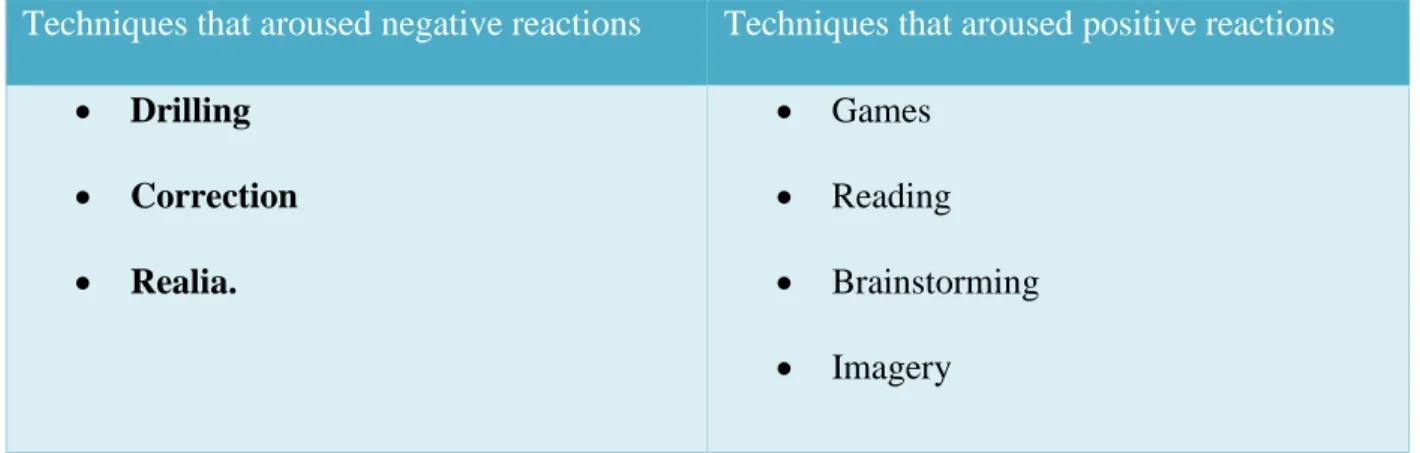
Table 2. Type of technique based on positive and negative reactions in the EFL classroom
Techniques that aroused negative reactions Techniques that aroused positive reactions
• Drilling
• Correction
• Realia.
• Games • Reading • Brainstorming • Imagery
The first technique used was drilling. This technique was used a total of five times
throughout one single class with less than satisfactory results. First, the teacher used repetition to teach new vocabulary in relation to a specific topic. Students did not engage in this activity and only a few of them participated, but it was an unwilling participation. The teaching of verbs was marked by the use of multiple drills. This time, more students participated, probably because the teacher also included gestures in order to teach these verbs.
Jhordan Stalin Mejia Matute
Página 43
prompt other than written words on a piece of paper, it is not surprising that students were not involved in this activity.
Observation also allowed to determine that vocabulary teaching for fifth, sixth and seventh graders highly relies on the use of isolated words detached from a context (e.g. the teacher chooses one word for students to make a short sentence with). Once again, even though the teacher prompted her students by giving a selected word, the exercise lacked structure, which means that the drilling-based activity was by no means useful. Students participated unwillingly and most of them had negative reactions such as (a) students ignored the exercise; (b) students did not know how to make a sentence; and (c) students could not engage in the activity.
It was also observed that the organization of desks in the classroom determines, to some extent, the level of participation learners may have in drilling-based activities. This plausible assumption arises considering that students in the first rows tended to participate or tried to participate more, while students in the back would mumble or keep quiet. This suggeststhat drilling might work better with small groups. However, it is still a technique that reduces students’ interest in the class and thus it prevents students from participating. Furthermore, drilling was highly teacher-centered while learners had little responsibility over their own learning experience other than following instructions, memorizing and listening to the teacher.
Jhordan Stalin Mejia Matute
Página 44
item belonging to a library; meanwhile, the other students had to guess the word and say it out loud correctly. All students were engaged and participated; it especially boosted their enthusiasm to play in teams. Next, the teacher played “Tic Tac Toe” with the students in order to practice words and sounds. During this game, students also had to write sentences in order to play. This made students more interested in creating their own sentences through collaborative work. All students participated. The teacher also provided a crossword puzzle for students to practice vocabulary in pairs. Even though this technique was performed individually, it allowed engaging students in the search for words in a systematically conducted way. All students participated in this activity. Finally, the teacher played charades with the students. Students were sorted into five groups. Then, students had to perform an action, but they were not allowed to say anything or give any clues. Students had to guess the word for points. This turned out to be a really fun lesson and drew lots of positive reactions from students.
Another technique used was reading. First, the teacher provided handouts for students to recognize selected words. Even though this activity was not very exciting, it was simple enough for students to perform and feel successful. Afterward, the teacher provided a reading passage in order to enhance reading comprehension. Students had to answer questions about the reading and to fill in the blanks with the appropriate words. Then, students were asked to match the word with its meaning. Students participated easily in this activity given the simple nature of the exercise. Finally, the teacher asked the students to look for the meaning of words in their
Jhordan Stalin Mejia Matute
Página 45
Another technique used by the teacher was correction. This technique turned out to be the one that aroused the most of negative reactions. In order to implement this technique, the teacher provided students with printed sentences with mistakes and asked students to correct the spelling of selected words. Students did not participate and those who participated did so unwillingly and were not engaged in the activity. Second, the teacher wrote different words on the whiteboard and asked students to first correct the spelling and then say the meaning of the corrected word. Again, students did not participate.
Finally, the teacher mispronounced some words and students had to correct the teacher’s pronunciation. Students did not participate in this exercise either. In three out of three situations, students neither engaged in this technique nor did they engage in the activities. It is worth noting that, during this specific technique, students seemed to be uncomfortable and bored.
Another technique that the teacher implemented was brainstorming. This technique turned out to be extremely successful and had students engaged at all times. The first
brainstorming activity consisted of students writing a free list with as many words as they could think about vocabulary related to a library. This activity was performed in groups of five and all of them collaborated to create the lists. Afterward, the teacher divided the class into two groups and students had to come to the board to write words that were related and see which group had most words written on the board. Once again, the game format of this exercise made students feel confident and engaged in the lesson.
Jhordan Stalin Mejia Matute
Página 46
virtually no wrong answers, and everyone is encouraged to participate and speak their minds. This technique was very successful as it engaged students three out of three times.
The sixth technique used was imagery, which is also a very common technique in English classrooms around the world. For this technique, the researcher could observe positive responses from students’ participation. First, the teacher used flashcards for teaching verbs. Students seemed to be engaged in this activity and had a good performance. For the next activity, the teacher shared sheets with pictures and vocabulary as a resource for later use in class. Once again, students mostly showed positive reactions. Finally, the teacher used flashcards to teach objects that students could find in the class. In this activity, students seemed to be less engaged and did not participate. It is important to mention that flashcards are a resource that elicits students’ imagination through the use of visuals; however, the teacher did not use flashcards big enough for the whole class. That might be the reason why, to some extent, students were not fully engaged.
The last technique that was used was realia. This technique, however, was only executed once and did not bring good results. Students showed negative reactions. In this activity, the teacher tried to use realia for showing the meaning of words; however, the teacher, regardless of the fact that classroom items were available, failed to use concrete objects that could have caught students’ attention. This might be an indicator that the teacher does not know this technique or does not know how to implement it.
5.3. Results of the guided conversation
Jhordan Stalin Mejia Matute
Página 47
Jhordan Stalin Mejia Matute
Página 48
Chapter 6: General discussion
This section provides a general discussion on the teacher’s discourse regarding her knowledge of the desirable methods and techniques to be used in an EFL classroom for
enhancing students’ learning of vocabulary in comparison to her actual practices for this purpose. As stated in the methodology section, an important aspect of this research is to compare and contrast what the teacher’s discourse, during the interview, suggests in comparison to what was observed by the researcher.
First, the English teacher of the fifth, sixth and seventh grade claims that she regularly uses different methods and techniques in order to enhance learning and promote significant communicative experiences, discourse that places emphasis on the principles of the Natural Approach (Krashen & Terrell, 1995) and the Communicative Approach (Zakime, 2018). In fact, she underscores a great variety of significant aspects that English teachers should consider for a meaningful lexical development. In her discourse, she foregrounds that the use of the target language must be connected to the listening of specific topics in contextualized situations. In addition, her discourse evidences that she is aware that students must be exposed to the target language by means of techniques and strategies that respect students’ particularities, i.e., learners must have sufficient linguistic input for learning vocabulary.
Jhordan Stalin Mejia Matute
Página 49
showing that the teacher’s discourse is detached from her actual pedagogic and didactic practices.
In addition, the teacher heavily relies on drilling, a technique associated with traditional teaching. The repetitive use of this technique, as expected, arises negative reactions from students. Among those reactions are (a) lack of motivation due to momentaneous retention of vocabulary and (b) lack of engagement in learning activities. This traditional approach to teaching and learning is supported by students’ discourses. The analysis of the data generated during the focus-group guided conversation reveals that young learners in fifth, sixth and seventh grade perceive their own learning of vocabulary as a process highly marked by repetition,
Jhordan Stalin Mejia Matute
Página 50
Conclusions and recommendations
Conclusions
This exploratory research has allowed to understand how an English teacher’s discourse
is detached from her actual pedagogic practices. Even though the teacher knows and applies
some non-traditional techniques, she fails to include them on a regular basis for her classes;
instead, she prioritizes drilling and memorization which seem to be strongly connected to the
pedagogic culture of the institution, which, to some extent, seems to emphasize the learning of
vocabulary for the exclusive purpose of testing students’ mechanic learning. This notion
becomes pivotal for further research, since the teacher and her students are aware of the benefits
of implementing games and non-traditional techniques for teaching and learning vocabulary.
Therefore, this exploratory study suggests that there is still a need to combine theory and practice
in the EFL classroom to have a fully non-traditional atmosphere, capable of enhancing the
learning of vocabulary in meaningful, dialogue-based and contextualized situations.
Recommendations
This research study leads the researcher to propose two main recommendations.
• There is a need for future research to analyze how teachers can implement the most
suitable non-traditional methods and techniques to teach vocabulary in the EFL
classroom in the Ecuadorian context.
• Teachers at República del Ecuador primary school could use the information given by
Jhordan Stalin Mejia Matute
Página 51
for learning vocabulary as well as what techniques they would like the teacher to apply
Jhordan Stalin Mejia Matute
Página 52
References
Akdogan, E. (2018). Developing vocabulary in game activities and game materials. Journal of Teaching and Education, 07 (01), p. 31–66. Retrieved from:
https://www.academia.edu/35587945/DEVELOPING_VOCABULARY_IN_GAME_AC TIVITIES_AND_GAME_MATERIALS
Alemi, M. (2010). Educational games as a vehicle to teaching vocabulary. MJAL, 2 (6), 425-438. Retrieved from:
http://www.mjal.org/removedprofiles/2013/Educational%20Games%20as%20a%20Vehi cle%20to%20Teaching%20Vocabulary.pdf
Allen, J. (1999). Words, words, words: Teaching vocabulary in grades 4–12. Portland, ME: Stenhouse.
Alqahtani, (2015). The importance of vocabulary in language learning and how to be taught. International Journal of Teaching and Education, 3 (3), 21-34. DOI:
10.20472/TE.2015.3.3.002
Andreu (2017). Teaching and Learning Vocabulary through Games and Translation in the EFL Classroom: A Case Study. [Masters’ dissertation]. Universitat de Illes Balears.
Anil, B. (2011). Teaching vocabulary through games. I-manager’s Journal on English Language Teaching, 1, (4), 46-50. Retrieved from: https://files.eric.ed.gov/fulltext/EJ1071102.pdf
Asher, J. (1966). The Total Physical Response Approach to Second Language Learning. The Modern Language Journal, 53 (1), 3-17. Retrieved from:
https://www.jstor.org/stable/322091?seq=1#page_scan_tab_contents
Aslanabadi, H. (2013). The Effect of Games on Improvement of Iranian EFL Vocabulary
Jhordan Stalin Mejia Matute
Página 53
(1), 186-195. Retrieved from:
http://www.irssh.com/yahoo_site_admin/assets/docs/22_IRSSH-728-V6N1.329192947.pdf
Bakhsh, S. (2016) Using Games as a Tool in Teaching Vocabulary to Young Learners. English Language Teaching, 9 (7), 120-128 . Retrieved from:
https://files.eric.ed.gov/fulltext/EJ1101751.pdf
Bala, E. (2019). The Positive Effect of Realia in EFL Classes. [Masters’ dissertation]. Department of English Language Teaching. Ishik University, Erbil, Iraq.
Beck, I., McKeown, M. & Kucan, L. (2013). Bringing Words to Life: Robust Vocabulary Instruction. NewYork, NY: The Guilford Press.
Berne, J. I., & Blachowich, C. L. Z. (2008). What reading teachers say about vocabulary
instruction: Voices from the classroom. The Reading Teacher, 62(4), 314–323. Retrieved from:
http://onlinelibrary.wiley.com/doi/10.1598/RT.62.4.4/abstract;jsessionid=4F16C43B166 8C2F391BCDFFEE3FA105D.f01t03
Berwald, J. (1987). Teaching foreign languages with realia and other authentic materials. ERIC Clearinghouse- Languages and Linguistics, Washington, D.C
Binte, F. (2015). Use of gestures and facial expressions in language acquisition. [Bacherlor’s dissertation]. Brak University, Daka. Retrieved from:
https://pdfs.semanticscholar.org/4919/19e9288383cb79ebaa4c08b9d8820b986999.pdf Bintz, W. (2011). Teaching vocabulary across the curriculum. Middle School Journal, 42, (4),
44-53. Retrieved from:
Jhordan Stalin Mejia Matute
Página 54
Bower, G. (1970). Imagery as a Relational Organizer in Associative Learning. JOURNAL OF VERBAL LEARNING AND VERBAL BEHAVIOR 9 (1), 529-533. Retrieved from:
https://web.stanford.edu/~gbower/1970/Imagery_as_a_relational_organizer.pdf Bradley, L., Lindstrm, B. & Rystedt, H. (2010). Rationalities of collaboration for language
learning in a wiki. ReCALL, 22 (2), 247-265.Retrieved from:
https://pdfs.semanticscholar.org/cb8c/caff1eedb436c855f0c212e3960b71ce67b6.pdf British council (n.d) Realia. [Blog post]. Retrieved from:
https://www.teachingenglish.org.uk/article/realia-0
British council (n.d.) Total Physical Response. [Blog post]. Retrieved from: https://www.teachingenglish.org.uk/article/total-physical-response-tpr British council (n.d.) Communicative Approach. [Blog post]. Retrieved from: https://www.teachingenglish.org.uk/article/communicative-approach
Broughton, G. (1994). Teaching English as a Foreign Language. 2nd ed. London: Routledge. Daniels, H., & Zemelman, S. (2004). Subjects matter: Every teacher’s guide to content-area
reading. Portsmouth, NH: Heinemann.
Doff, A. (1998). Teach English: A Training Course for Teachers. Cambridge, UK: University Press.
Dunn, J. (2013). Utilization of semantic networks in the teaching of vocabulary. Language Education in Asia, 4 (2), 175-182. Retrieved from:
http://www.leia.org/LEiA/LEiA%20VOLUMES/Download/LEiA_V4_I2_2013/LEiA_V 4I2A07_Dunn.pdf
Jhordan Stalin Mejia Matute
Página 55
Egenfeldt-Nielsen, E. (2011). Serious games in education: A global perspective. Denmark: Aarhus University Press.
Greenwood, S. (2004). Content matters: Building vocabulary and conceptual understanding in the subject areas. Middle School Journal, 35(3), 27–34.
Grinder, M. (1989). Righting the educational conveyer belt. United States: Metamorphous Press. Haghighat, R., Jahandar, S. & Shahrokh, M. (2015). The effect of group games on Iranian
elementary learners. Modern Journal of Language Teaching Methods, 5 (4). Retrieved from: https://www.questia.com/library/journal/1P3-4017294811/the-effect-of-group-games-on-iranian-elementary-learners
Harmer, J. (1991). The Practice of English Language Teaching. London, UK: Longman.
Harmer, J. (2001). The Practice of English language teaching (3rd Ed.). London: HarperCollins. Heredia, V. (2017, November 10). El nivel de Inglés en el Ecuador todavía es bajo. El Comercio.
Retrieved from: http://www.elcomercio.com/tendencias/ecuador-nivel-ingles-adultos-educacion.html
Hofler, D. (1983) Approach, method, technique a clarification. Reading World, 23 (1), 71-72. DOI: 10.1080/19388078309557742
Huguet, J. (2015). Why do kids learn faster than adults? [Blog Post]. Retrieved from: https://www.seeker.com/why-do-kids-learn-faster-than-adults-1792717450.html Jones, K. (1982). Simulations in language teaching. Cambridge: Cambridge University Press Kelly, P. (1990) Guessing: No substitute for systematic learning of lexis. System, 18 (2),
199-207. Retrieved from:
https://docslide.com.br/documents/guessing-no-substitute-for-systematic-learning-of-lexis.html
Jhordan Stalin Mejia Matute
Página 56
Krashen, S. (1988). Second Language Acquisition and Second Language Learning. New York, NY: New York Prentice-Hall International Inc.
Kusumayati, L. (2010). Improving students’ vocabulary mastery using contextual teaching and learning. [Masters’ dissertation] Retrieved from:
https://id.123dok.com/document/wyegloez-improving-students-vocabulary-mastery- using-contextual-teaching-and-learning-a-classroom-action-research-at-the-third-grade-of-sd-negeri-kalimacan-in-academic-year-2009-2010.html
Kuzu, A. (2008). Views of pre-service teachers on blog use for instruction and social interaction. Turkish Online Journal of Distance Education-TOJDE, 8 (3). Retrieved from:
http://tojde.anadolu.edu.tr/yonetim/icerik/makaleler/349-published.pdf Lacsi, R. (2017). Traditional approach. Retrieved from:
https://www.researchgate.net/publication/321134079_Traditional_Approach/stats Linse, C. (2006). Practical English Language Teaching: Young Learners. New York, NY:
McGraw-Hill.
McLeod, S. (2015) Jean Piaget [BlogPost]. Retrieved from: https://www.simplypsychology.org/piaget.html
Marzano, R & Pickering, D. (2005). Building Academic vocabulary teacher’s manual. Alexandria, VA: Association for Supervision and Curriculum Development.
Meara, P. (1980). Vocabulary acquisition: A neglected aspect of language learning. Language Teaching and Linguistics Abstracts, 13, 221-246. Retrieved from:
https://www.cambridge.org/core/journals/language-teaching/article/vocabulary-
Jhordan Stalin Mejia Matute
Página 57
Miles, M. B., Huberman, A. M., & Saldaña, J. (2014). Qualitative data analysis: A methods sourcebook. Thousand Oaks, California: SAGE Publications, Inc
Mothe, P. (2000). Innovative Techniques of Teaching Vocabulary at the Intermediate Level in the Second Language Classroom. India: Adarsh senior college.
Nation, I. (2001). Learning vocabulary in another language. United Kingdom: Cambridge University Press.
Nicholls, M. (2008). Traditional vs. Modern Teaching Methods: Advantages and Disadvantages of Each. (Master’s diploma thesis). Masarik Univerisity of Arts.
Nicholson, D. & Williams, G. (1975) Word games for the teaching of reading. London, Uk: Pitman Education Library.
Nguyen, T & Thanh, H. (2003). Learning vocabulary through games The Effectiveness of Learning Vocabulary Through Games. Asian EFL journal, 5 (4). Retrieved from: http://asian-efl-journal.com/dec_03_vn.pdf
Nunan, D. (1999). Second language teaching & learning. Boston, MA: Heinle & Heinle. Oxford, R.L. and Crookall. (1990). Language Learning Strategies: what every teacher should
know. Boston, USA: Wadsworth Inc.
Peterson, W. (1991). The art of creative thinking. Hay House: USA.
Piaget, J. (1962). Play, dreams, and imitation in childhood. New York: W.W. Norton & Co Ramirez, M. (2012). Usage of Multimedia Visual Aids in the English Language Classroom: A
Case Study at Margarita Salas Secondary School (Majadahonda). [Masters’ dissertation]. Retrieved from: